
Before You Read: Open My Eyes
Before you read a single verse, pray this — out loud if you can:
"Father, this is the day Your Son showed what His authority looks like — a voice that muzzles demons and a hand that touches lepers. Open my eyes to see both His power and His compassion, and show me where I need each one today. In Jesus' name, amen."
(Psalm 119:18 — "Open thou mine eyes, that I may behold wondrous things out of thy law.")
Welcome
John is in prison. The forerunner's voice goes silent — and a greater voice takes up the cry. In thirty-two verses, Jesus announces His message, recruits His crew, and unleashes a day of authority so stunning that "the whole city" ends up gathered at a fisherman's door.
This lesson is Mark's thesis in action: who Jesus is shows up in what He does — and what He does is command demons, disease, and despair like they answer to Him. Because they do.
CHECK WHAT YOU THINK YOU KNOW
- ☐ "'Repent' just means feel really sorry for your sins." (It's far more active than that.)
- ☐ "The disciples dropped everything because they already understood who Jesus was." (They didn't — not for a long time.)
- ☐ "Jesus wanted everyone to spread the news about His miracles." (He kept ordering silence. Why?)
- ☐ "Biblical leprosy is the same disease we call leprosy today." (Not exactly — and the difference matters.)
Where we are in the story
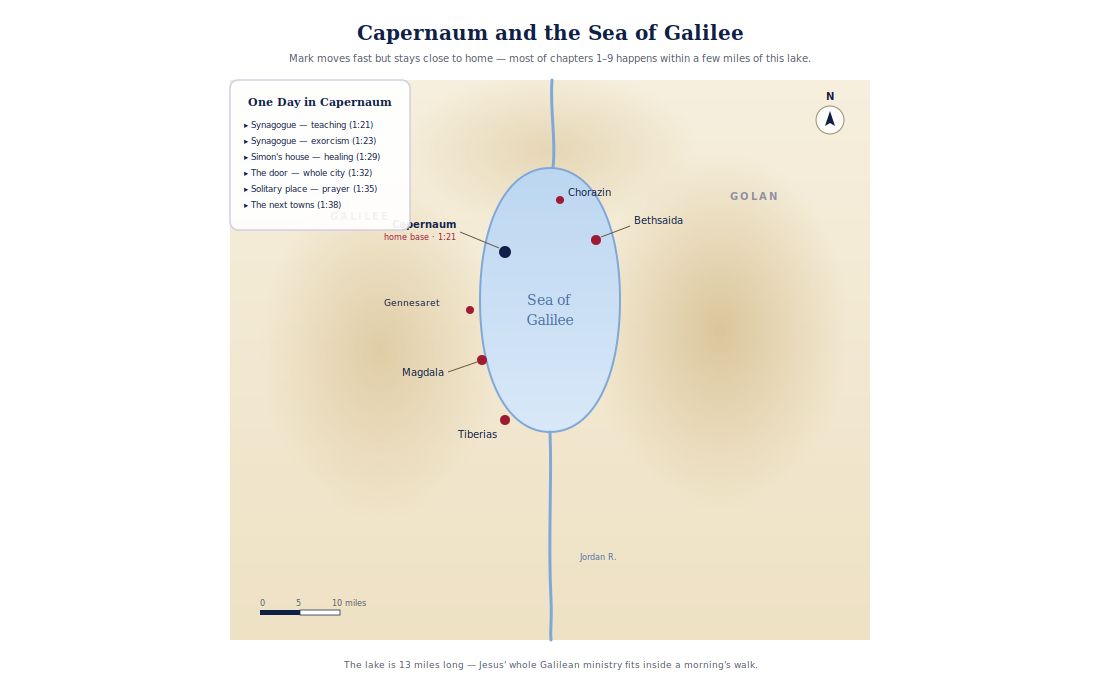
Mark 1:14 opens with a changing of the guard: "Now after that John was put in prison, Jesus came into Galilee." The forerunner's ministry ends in a dungeon (we'll learn how in Lesson 07); the Son's begins in the open. From here to chapter 9, Galilee is the stage — and Capernaum, a fishing village on the northwest shore of the Sea of Galilee, becomes home base.
The proclamation (1:14–15)
Jesus' opening sermon is one sentence — and it's the summary of His entire ministry:
"The time is fulfilled, and the kingdom of God is at hand: repent ye, and believe the gospel." (1:15)
Four phrases, each loaded:
- "The time is fulfilled" — the Greek is kairos (KY-ros), not chronos (KHRO-nos). Chronos is clock-time (minutes ticking); kairos is decisive time — Thayer's lexicon defines it as "the fixed and definite time... the decisive epoch waited for." 32 God's long promise — the one Daniel's "seventy weeks" were counting down to (Daniel 9:24–27) — has come due.
- "The kingdom of God is at hand" — basileia (bah-sil-I-ah) means reign more than realm: God's rule breaking into the world. "At hand" (engizo, en-GID-zo) means it has drawn near — close enough to touch. In Jesus, the future reign of God has arrived in the present.
- "Repent" — metanoeo (meh-tah-no-EH-oh): change your mind, reverse direction. 32 Not mere regret — a U-turn of life.
- "Believe the gospel" — pisteuo (pist-YOO-oh): trust, rely on, lean your weight on. The good news isn't advice to follow; it's a victory to trust.
Two verbs. That's the whole human response: turn (repent) and trust (believe). Everything Jesus will preach for three years is commentary on this sentence.
The call (1:16–20)
Walking by the Sea of Galilee, Jesus sees two pairs of brothers casting and mending nets: Simon (later Peter) and his brother Andrew (also one of the Twelve); James and John, sons of Zebedee.
"Come ye after me, and I will make you to become fishers of men." (1:17)
In Jesus' world, disciples chose their rabbi — they applied, and the famous teachers selected the best. 9 Jesus flips it: He chooses them — working men, not scholars. And His metaphor meets them where they live: you catch fish; now you'll catch people — dragging them out of death into life.
"And straightway they forsook their nets, and followed him" (1:18). Mark's drumbeat again. Note the cost honestly: James and John leave their father Zebedee "in the ship with the hired servants" (1:20) — this was a family business with employees, not a hobby. Following Jesus cost them their livelihood on day one.
Authority in the synagogue (1:21–28)
On the Sabbath, Jesus teaches in the synagogue — the local gathering place where Jews met for Scripture reading, prayer, and teaching every Sabbath (distinct from the temple in Jerusalem, where sacrifices happened). Mark notes the crowd's reaction first: "they were astonished at his doctrine: for he taught them as one that had authority, and not as the scribes" (1:22).
The scribes were the Bible scholars of the day — and they taught by citation: "Rabbi Hillel says... Rabbi Shammai says..." Jesus cites no one. He speaks as if the truth were His own. Because it is. 28
Then the authority gets demonstrated. A man "with an unclean spirit" — a person oppressed by a fallen, evil spiritual being — cries out: "Let us alone; what have we to do with thee, thou Jesus of Nazareth? art thou come to destroy us? I know thee who thou art, the Holy One of God" (1:24).
Pause on the irony Mark wants you to feel: the demon knows Jesus' identity before any disciple does. The title it uses — "the Holy One of God" — is rare on human lips: applied to Christ, it occurs only here, in Luke's parallel (Luke 4:34), and in Peter's confession (John 6:69), and it likely echoes the messianic "Your Holy One" of Psalm 16:10. And Jesus' response? "Hold thy peace, and come out of him!" (1:25). The Greek is phimoo — literally "be muzzled!" — the word for putting a muzzle on an ox. 32 Then the spirit convulses the man, screams, and comes out.
The crowd's verdict: "What thing is this? what new doctrine is this? for with authority commandeth he even the unclean spirits, and they do obey him" (1:27). Teaching with authority, commanding with authority — word and deed match.
Why muzzle the demon? Because a demon's testimony is poisoned praise — and because "Holy One of God" on a demon's lips would feed exactly the wrong Messianic expectations (a wonder-worker, not a cross-bearer). Jesus will reveal Himself on His own terms. The Messianic Secret has begun.
A day in Capernaum (1:29–39)
Simon's house: Simon's mother-in-law lies sick with a fever (1:30). (Note it, married readers: Peter — the "first pope" in Catholic tradition — had a mother-in-law. Mark just mentions it in passing.) Jesus takes her hand, lifts her up, the fever leaves — "and she ministered unto them" (1:31). The Greek is diakoneo (dee-ah-ko-NEH-oh) — the verb behind the noun diakonos, the word English transliterates as "deacon." 32 It means to serve, to wait on — often at table. Her first act of health is ministry. Healed to serve.
Evening: "all the city was gathered together at the door" (1:33). Picture it: a fishing village funneling its sick, its demon-oppressed, its desperate to one doorway. Jesus heals "many"of divers diseases, and cast out"many" demons — and again, "He did not allow the demons to speak, because they knew Him" (1:34). 8
Before dawn: "a great while before day, he went out, and departed into a solitary place, and there prayed" (1:35). The Greek verb for "He prayed" is proseuchomai (pros-yoo-KHO-my) — the New Testament's standard word for prayer addressed to God. The busiest day of His ministry so far — and He steals away to pray while it's still dark. Then Simon "hunts Him down" (the Greek suggests pursuing, almost with reproach): "All men seek for thee." (1:37). 3314 Jesus' answer reveals what the prayer clarified: "Let us go into the next towns, that I may preach there also: because for therefore came I forth" (1:38).
Feel the tension: the crowds want a hometown healer; the mission demands a traveling preacher. Prayer is where Jesus re-centers on His purpose — preaching the kingdom — against the pull of popular demand. Ministry success can be as dangerous as ministry failure.
The leper (1:40–45)
A leper comes — kneeling, begging: "If thou wilt, thou canst make me clean." (1:40).
"Leprosy" in the Bible (lepra) covered a range of disfiguring skin conditions — the Hebrew behind it, tzara'at, likely included things like psoriasis, eczema, and fungal infections, not just modern Hansen's disease. 3435 But the meaning was the same: ritual uncleanness. Leviticus 13–14 quarantined lepers from worship and community; they had to cry "Unclean! Unclean!" wherever they went (Leviticus 13:45). This man was a walking exile — cut off from the temple, the synagogue, his family.
Jesus' response breaks every rule: "Jesus, moved with compassion, put forth his hand, and touched him" (1:41).
Touching a leper made you unclean. 28 Every rabbi knew it. But Jesus' touch works in reverse — His cleanness flows into the man instead of the man's uncleanness flowing into Him. "I will; be thou clean" — and "immediately" the leprosy left him.
Then the strange ending: Jesus "strictly warned him" — the Greek verb is embrimaomai (em-bri-MAH-o-my), literally "to snort with anger": 32 stern, almost angry urgency — "See thou say nothing to any man: but go thy way, shew thyself to the priest, and offer for thy cleansing those things which Moses commanded, for a testimony unto them" (1:44). The priestly inspection (Leviticus 14) would officially restore the man to community and worship — Jesus cares about that restoration, not just the cure.
But the man disobeys — "he went out, and began to publish it" — with joyful, understandable, disastrous enthusiasm. The result: "Jesus could no more openly enter into the city" (1:45). The crowds now chase the miracle-worker, and the mission of preaching is hampered. This is why Jesus kept ordering silence. Not modesty — strategy. The wrong kind of fame would drown the message.
WORD STUDY
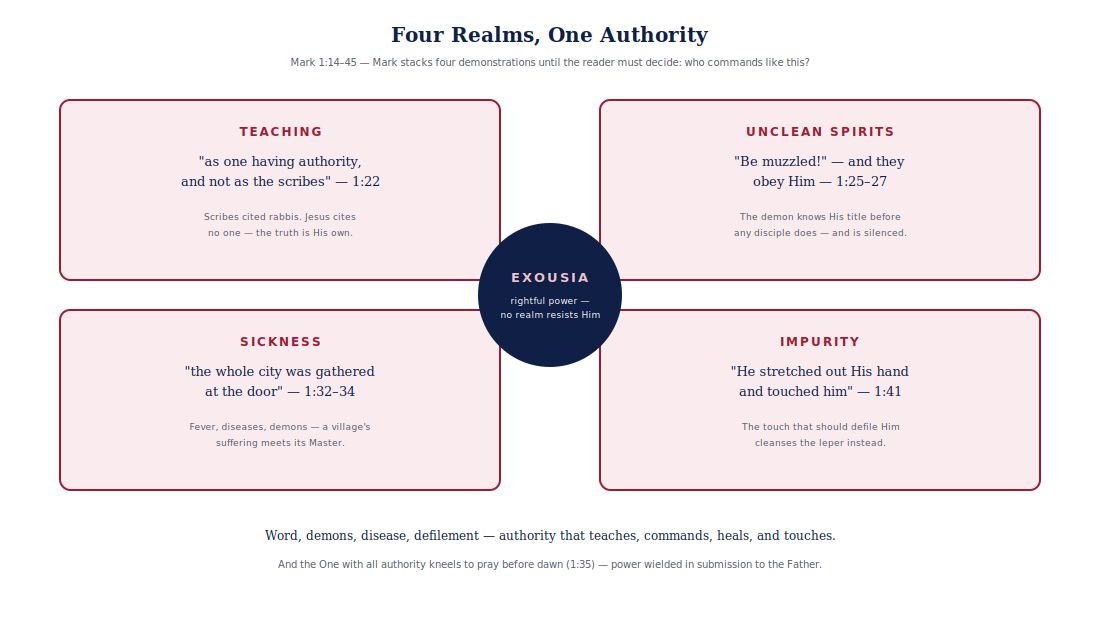
Authority — exousia (ex-oo-SEE-ah). Not just power (dunamis) but rightful power — the authority of someone who is entitled to command. The scribes had learning; Jesus had exousia. Demons, disease, and crowds all recognize what the scholars miss: this One has the right to say "come out," "be cleansed," "follow Me."
Repent — metanoeo (meh-tah-no-EH-oh). Meta (change) + noeo (mind): to change one's mind so completely that life changes direction. In Mark it's not an emotion — it's a U-turn.
Muzzled — phimoo (fee-MOH-oh). To muzzle an animal. Jesus doesn't debate the demon or answer its theology — He muzzles it. Truth from a lying spirit is still a lie's errand. (He'll use the same verb to muzzle the storm in 4:39.)
"The time is fulfilled" — why Mark starts the ministry here
Mark skips Jesus' childhood, baptism-to-ministry gap, everything — and opens the public ministry with a one-sentence sermon. Why? Because 1:15 is Mark's gospel in miniature: God's decisive moment has arrived, His reign is breaking in, and the only fitting response is turn-and-trust. Every healing, exorcism, and parable to come is that sentence with flesh on.
The disciples' "immediately" — and what it cost
Don't romanticize the call. These men abandoned a working business that morning for a preacher they'd just met. Mark wants you to feel the recklessness of it — because discipleship still works that way. Jesus doesn't recruit after a six-week inquiry course; He calls, and the called decide. (And Mark will spend the rest of the Gospel showing that saying "yes" fast doesn't mean understanding fast — the Twelve misunderstand Him for chapters.)
Why the secrecy? The Messianic Secret, part one
Three times in this lesson Jesus silences testimony about Himself (1:25, 1:34, 1:44). The pattern will repeat all Gospel long. The reason is consistent: a premature, misunderstood fame would destroy the mission. The crowds wanted a healer-king; the demons advertised a wonder-worker; the healed leper's disobedience literally drove Jesus out of the cities (1:45). Jesus isn't being humble — He's being strategic. The cross must define the Christ before the crowds do.
Compassion that touches
Mark 1:41 is the emotional center of the lesson: "moved with compassion" (splanchnizomai, splahngk-NID-zo-my — a gut-level churning; the same word at 6:34 and 8:2). Jesus doesn't heal from a safe distance. He touches the untouchable — absorbing the risk, reversing the flow. Every barrier the law built between clean and unclean, Jesus crosses with a hand. That's the whole Gospel in a gesture.
The Christ Thread
Christ in His own story — who this passage shows Him to be. Mark stacks four demonstrations of authority (teaching, demons, sickness, impurity) until the reader must answer the question the crowds asked: "What is this?" (1:27). The answer Mark is building: this is the Holy One of God (1:24) — the promised King whose reign has broken into the present. Every exorcism is a border skirmish in the war He came to win; every healing is the kingdom arriving ahead of schedule.
OT/NT parallels — where the thread runs on. The kingdom program Jesus announces (1:15) is Isaiah's: "The Spirit of the Lord GOD is upon me; because the LORD hath anointed me to preach good tidings unto the meek... to heal the brokenhearted" (Isaiah 61:1 — the text Jesus will read in the Nazareth synagogue, Luke 4:18). The leper's cleansing runs on Leviticus 13–14's rails — Jesus doesn't bypass Moses' law, He fulfills what it pointed to. And Matthew and Luke tell this same Capernaum day (Matthew 4:12–25; Luke 4:14–44) — the authority Mark shows, they confirm.
The Christian future — what this foreshadows for us. The kingdom Jesus announced as "at hand" is the kingdom we still await in full: the day when no demon oppresses, no disease wastes, no impurity excludes — "there shall be no more death, nor sorrow, nor crying... and there shall by no means enter it anything that defiles" (Revelation 21:4, 27). Every healing in Capernaum was a preview trailer of that day. And the pattern holds for us: the King who touched lepers still touches the untouchable — through His people, until He returns to finish it.
Where in the Covenant Story?
The kingdom of God Jesus announces (1:15) is the Davidic promise arriving: the long-awaited reign of God through David's heir (2 Samuel 7:12–16). But it comes inside a bigger frame — the Abrahamic blessing going global ("fishers of men" gathering people from every shore) and the New Covenant breaking in, where God writes His law on hearts rather than stone (Jeremiah 31:33). "Repent and believe" is the doorway into that covenant: not circumcision, not lineage — turn and trust. We live inside the covenant Jesus was announcing: the kingdom has come in Him, and is still coming in full.
Father, Son, and Spirit
Watch the Persons at work. The Son prays to the Father before dawn (1:35) — not as theater, but in real dependence; even the Son re-centers His mission in prayer. The Father is the one whose kingdom the Son proclaims and whose purpose ("for this purpose I have come forth," 1:38) sets the agenda. And the Spirit — the same Spirit who descended at the baptism and drove Jesus into the wilderness — is the power behind the exorcisms (compare Matthew 12:28: "by the Spirit of God I cast out demons"). One mission, three Persons: the Father sends, the Son obeys and proclaims, the Spirit empowers. When you pray, you're entering the same pattern — a child speaking to the Father, in the Son's name, by the Spirit's help.
It's Okay to Ask
Honest questions this passage raises — bring them, don't bury them:
- Why did Jesus order silence about the miracles? Isn't telling people the whole point? (Right testimony at the wrong time is dangerous — the crowds wanted a wonder-worker, not a cross-bearer. Jesus controlled the definition of "Messiah" until the cross could define it. See "Why the secrecy?")
- Did the disciples really abandon their families on the spot? Was that responsible? (They left a working business with hired hands — Zebedee wasn't destitute. And "follow Me" wasn't abandonment forever; it was a call that reordered every loyalty. Costly, yes. Reckless, no.)
- If Jesus is God, why did He need to pray? (Because He is also truly man — and because prayer isn't a sign of weakness, it's the Son's own habit of dependence. If He needed the solitary place, the question isn't whether we need it but when we'll start.)
Watch Out — the enemy is real
Mark names him plainly: an unclean spirit (1:23, 26) — and then "many" demons (1:34, 39). The enemy is personal, intelligent, and theologically accurate: the demon correctly identifies Jesus as "the Holy One of God" (1:24) — and stays His enemy. That's the warning for us: right doctrine about Jesus without surrender to Jesus is demon-level religion. But notice the hierarchy — the spirits don't negotiate, debate, or resist. One word — "Be muzzled!" — and they come out. The enemy is real, but he is not Jesus' rival. He is His subject.
FACT, INFERENCE, OR DISPUTED?
- FACT: Phimoo ("be muzzled") is Jesus' word to the demon (1:25) — the language of muzzling an animal.
- FACT: Leviticus 13–14 required lepers to live apart and be inspected by priests for restoration; Jesus sends the healed man to the priest (1:44).
- INFERENCE: Jesus' stern warning (1:44) reflects His strategy to control the Messianic narrative — confirmed by the outcome in 1:45.
- DISPUTED: Whether Mark originally wrote "moved with compassion" at 1:41 — a few ancient manuscripts read "moved with anger" instead. Nearly all manuscripts read "compassion," which every major translation follows. 28
- DISPUTED: Why Jesus ordered the silences. This lesson follows the standard evangelical reading — He was controlling the timing and definition of His messiahship, since a premature fame as wonder-worker would drown the message of the cross (see Barnes on 1:34). 27 Some critical scholars instead treat the silences as Mark's own literary device (Wrede's "Messianic Secret"). 12
- DISPUTED: Whether "the whole city" (1:33) is literal or Mark's vivid hyperbole for a large crowd. (Either way, the door was mobbed.)
SCHOLAR'S NOTE: Capernaum is one of the best-excavated sites in the Gospels. Beneath the visible 4th–5th-century limestone synagogue lie basalt foundations that many archaeologists identify as a 1st-century synagogue — the kind of building Jesus taught in — though not every scholar agrees on the dating. 36 And beneath a 5th-century octagonal church lie the remains of a humble 1st-century house that was converted into a place of Christian worship within decades of Jesus' lifetime, its plastered walls covered in early Christian graffiti; pilgrims as early as the 4th century venerated it as Peter's house. 36 Archaeology can show a venerated house — it cannot prove who owned it. You can stand in Capernaum today within steps of where "All the city was gathered together at the door." The stones remember.
Cross-references (explained, not just listed)
- Leviticus 13–14 — the leper laws: quarantine, inspection, restoration. Jesus' command in 1:44 only makes sense against this background.
- 2 Kings 5 — Naaman the leper healed through Elisha; the Old Testament's great leprosy story — and even Elisha didn't touch Naaman.
- Isaiah 61:1 — "preach good tidings to the poor... heal the brokenhearted" — the kingdom program Jesus is enacting.
- Matthew 4:12–25; Luke 4:14–44; 5:1–11 — the other Gospels' fuller accounts of the call and the Capernaum day.
Go Deeper
Hungry for more?
- Read Luke 4:14–44 — Luke's fuller Capernaum day, including the Nazareth sermon where Jesus reads Isaiah 61 and announces the program.
- Read Isaiah 61 — the kingdom manifesto Jesus was enacting, in the prophet's own words.
Theological truth (arising from the text)
Jesus' authority is absolute and His compassion is personal — the two never separate in Mark. He commands demons and touches lepers. He preaches the kingdom and prays before dawn. Power without compassion would terrify; compassion without authority couldn't save. In Jesus, the reign of God has a human face — and human hands.
Humble — and confident
Humble, because the demons had better Christology than the disciples — and sometimes better than us. Recognizing who Jesus is isn't the finish line; following Him is. The unclean spirit knew His title and was still His enemy.
Confident, because no realm resists Him. The things that master us — habits, fears, shames, the "unclean" labels we wear — answer to the same voice that muzzled the demon and cleansed the leper. His authority is not past tense.
Confess It
The unclean spirit knew Jesus' title and stayed His enemy — knowing about Him isn't following Him. Is there an area where you've admired Jesus without obeying Him? Name it concretely and confess it now (1 John 1:9). The demons tremble; sons and daughters repent.
For discussion
- Jesus' whole message in one sentence: "Repent ye, and believe the gospel." If someone asked you what a Christian does, could you answer that simply? What makes it hard?
- The disciples left their nets "immediately" — before they understood. What's one step of obedience you've been postponing until you "understand more"?
- Jesus prayed before dawn on His busiest day, then let prayer redirect His plans (1:35–38). What would change if your prayer life set your agenda instead of reacting to it?
What He has done (the indicative)
Before one "you should," hear what He did: He announced the kingdom in one sentence. He chose nobodies and made them fishers of men. He taught with heaven's own authority, muzzled a demon with a word, and touched a leper no one else would touch — then knelt to pray before dawn like the mission depended on it. Every step below is a response to that authority and compassion, not a way to earn either.
This week's practices
- The two-verb examen. Three evenings this week, ask two questions: Where do I need to turn? (repent) and What promise do I need to trust? (believe). Write one line for each.
- Pray like 1:35. One morning this week, get up 30 minutes early, go somewhere solitary, and pray — no phone, no list, just presence. Notice what gets clarified.
- Pray It Back. Take Mark 1:35–38 into prayer: "Jesus, You let prayer set Your agenda instead of the crowd's demands. Show me the 'next towns' You're calling me to — and the crowd's applause I need to stop chasing."
- Touch the untouchable. One concrete act of compassion toward someone others avoid or overlook — a visit, a call, a hand extended. Let Jesus' gesture become yours.
- Memorize Mark 1:15. The Gospel in one sentence.
For Us Together
Ask your small group or family: "What 'realm' — what habit, fear, or label — have we assumed is outside Jesus' authority? What would change if we actually believed no realm resists Him?" Authority believed together becomes courage shared.
Who Needs This?
Who in your life is living under an "unclean" label — shame, past, reputation — that Jesus' touch could reverse? One name. One visit, call, or prayer for them this week. Be the hand extended.
Take It Home
At the table, ask your kids: "Jesus told a bad spirit 'Be quiet!' and it had to obey — like a dog with a muzzle. What does that tell us about how strong Jesus is? Is there anything too big or scary for Him?" Let them feel safe in His authority.
Praise Him
Don't end with a to-do list — end with worship. Right now, finish this sentence out loud or in writing: "Jesus, I praise You because in this passage I saw Your authority over _ — and Your compassion for ___." (Demons? Disease? The leper nobody touched?) Sit in it. The reign of God has a human face — praise Him for it.
The bottom line
Authority that teaches, commands, heals, and touches — yet kneels to pray before dawn and refuses to be made into a celebrity. Mark 1:14–45 shows us the pattern of Jesus' ministry and the pattern of ours: proclaim the kingdom, follow immediately, pray first, touch the untouchable.