
Before You Read: Open My Eyes
Before you read a single verse, pray this — out loud if you can:
"Father, Your Son is about to inspect His temple — and inspect me. Open my eyes to see the difference between leaves and fruit in my own life, and give me grace to bear what pleases You. In Jesus' name, amen."
(Psalm 119:18 — "Open thou mine eyes, that I may behold wondrous things out of thy law.")
Welcome
Palm Sunday to the widow's mite — in two chapters, Jesus goes from celebrated King to marked man, from "Hosanna!" to homicide plots. These are the last public days: the King enters His city, inspects His temple, finds it fruitless, and spends three days fielding traps from every faction in Jerusalem. Each debate ends the same way — with His questioners silenced and the crowds astonished.
This is also Mark's most Jewish stretch: every scene breathes Old Testament. If you've ever wondered why Christians wave palm branches, this lesson is why.
CHECK WHAT YOU THINK YOU KNOW
- ☐ "The triumphal entry was a spontaneous celebration." (It was staged — down to the borrowed colt. Whether Jesus arranged it with the owner in advance or knew of it by divine foreknowledge, commentators differ — either way, He left nothing to chance.)
- ☐ "Jesus cursed the fig tree because He was angry it had no fruit." (It wasn't even fig season. Something deeper is happening.)
- ☐ "Jesus drove the money changers out because commerce in church is wrong." (The problem wasn't commerce — it was what the commerce was doing.)
- ☐ "The widow gave a little; the rich gave a lot." (Jesus does the math exactly backwards.)
Where we are in the story
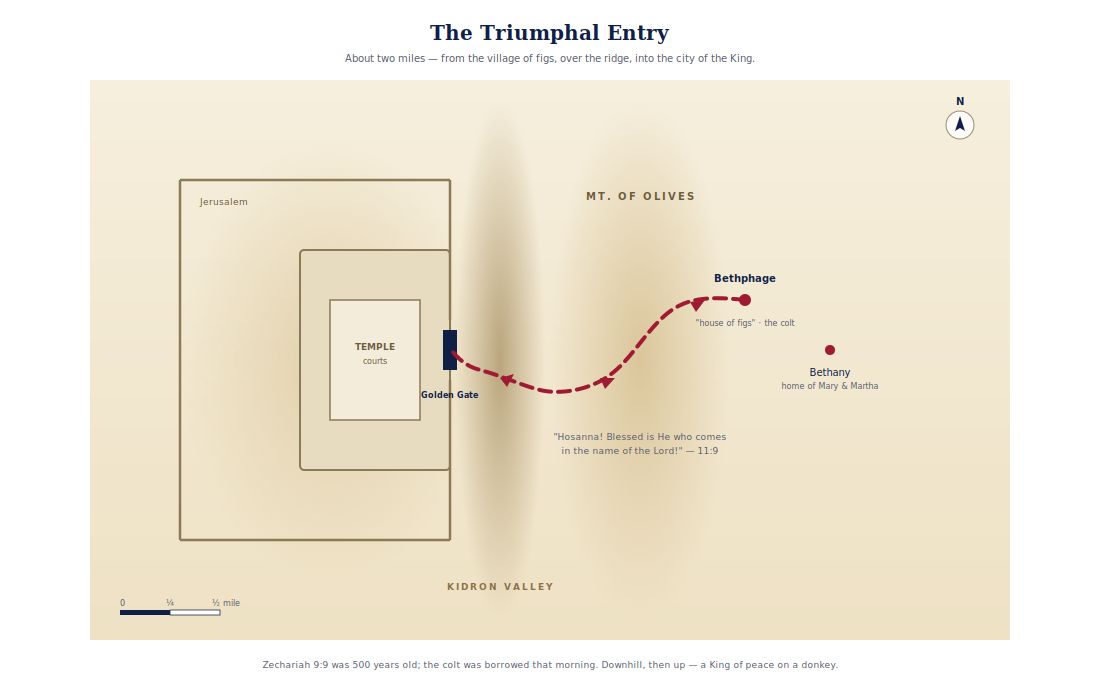
The road from Jericho has done its climbing. Jesus now stands on the Mount of Olives, the ridge east of Jerusalem, looking across the Kidron Valley at the temple glittering in the sun. It's the week of Passover — the festival remembering Israel's exodus from Egypt — and Jerusalem is swollen with pilgrims. Everything from here to chapter 16 happens within a few square miles.
Check What You Think You Know
Many sincere Christians picture the triumphal entry as the crowds finally understanding who Jesus was — welcoming their Savior with open hearts. But the crowd shouting "Hosanna" wanted a political liberator to crush Rome, not a suffering Servant to die for sin. Within days, the same city would shout "Crucify Him." They got the title right (King) and the job description wrong. Enthusiasm for Jesus isn't the same as understanding Jesus — and this week exposes the difference.
Scene 1: The King enters (11:1–11)
From Bethphage (a village on the Olivet slope whose name means "house of figs"), Jesus sends two disciples: "Go your way into the village over against you... ye shall find a colt tied, whereon never man sat. Loose him, and bring him" (11:2). If anyone asks, say "The Lord hath need of him" (11:3) — and it happens exactly so.
Every detail is prophecy in motion:
- The colt — an unridden young donkey. Zechariah 9:9 foretold it about 550 years earlier: "Behold, your King is coming to you... lowly and riding on a donkey, A colt, the foal of a donkey." The unridden detail matters: in Israel, an animal never put to ordinary work was set apart for sacred use (Numbers 19:2; Deuteronomy 21:3; 1 Samuel 6:7) — fit, then, for the King. How did Jesus know it would be there? Some read it as pre-arranged with the owner (Guzik, Barclay); 8109 others as divine foreknowledge. Mark doesn't settle it — he shows it happening exactly as Jesus said. Kings rode warhorses; this King rides a borrowed colt. A King of peace, not of war.
- The cloaks and branches — the crowd spreads garments on the road and waves leafy branches (11:8). This was how Israel welcomed kings — the same honor given to Jehu centuries earlier (2 Kings 9:13).
- The shout — "Hosanna; Blessed is he that cometh in the name of the Lord: Blessed be the kingdom of our father David, that cometh in the name of the Lord: Hosanna in the highest!" (11:9–10). Hosanna is Hebrew for "Save now!" (Psalm 118:25–26) — a cry that had become a shout of praise. They're quoting the Passover psalm and applying it to Jesus: God's rescue is here, and it's riding a donkey.
And then Mark's wonderfully flat ending: Jesus enters Jerusalem, goes into the temple, "looked round about upon all things," and — "now the eventide was come" — goes back out to Bethany (11:11). The King inspects His temple like a homeowner doing a walkthrough. Tomorrow He'll act on what He saw.
Scene 2: The fig tree — a parable in action (11:12–14, 20–26)
The next morning, hungry, Jesus sees a fig tree "having leaves" and goes to find fruit — "and when he came to it, he found nothing but leaves; for the time of figs was not yet" (11:13). Then the shocking line: "No man eat fruit of thee hereafter for ever" (11:14).
Wait — it wasn't fig season. Is Jesus being unreasonable? No — He's being prophetic. In the Old Testament, the fig tree is a living picture of Israel (Jeremiah 8:13; Hosea 9:10; Micah 7:1). A leafy, fruitless tree is Israel with all the show of religion and none of the fruit. Jesus isn't throwing a tantrum at agriculture — He's performing a sign-act, the prophets' signature move (Jeremiah smashing pottery, Ezekiel lying on his side). The cursing interprets what He's about to do in the temple.
Mark sandwiches the stories deliberately — fig tree (11:12–14), temple cleansing (11:15–19), fig tree withered (11:20–26). The withered tree is the verdict on what the temple has become. When Peter points at the dried tree, Jesus pivots to faith and prayer: "Have faith in God... whosoever shall say unto this mountain, 'Be thou removed'... What things soever ye desire, when ye pray, believe that ye receive them" (11:22–24) — with the searching condition: "And when ye stand praying, forgive, if ye have ought against any" (11:25). Mountain-moving faith and forgiving hearts belong together.
Scene 3: Cleansing the temple (11:15–19)
Jesus enters the temple courts and overturns "the tables of the moneychangers, and the seats of them that sold doves" (11:15). He blocks the shortcut traffic through the courts (11:16). Then the indictment, fusing two prophets:
"Is it not written, 'My house shall be called of all nations the house of prayer'? but ye have made it a 'den of thieves.'" (11:17)
- Isaiah 56:7 — God's house is for all nations. The commerce had colonized the Court of the Gentiles — the one place non-Jews could pray. The nations were being squeezed out by the marketplace.
- Jeremiah 7:11 — "den of thieves" (literally "cave of robbers"). In Jeremiah's day, the temple had become a hideout where people committed injustice all week and claimed sanctuary on Sabbath. Same disease, 600 years later.
The problem wasn't commerce as such — pilgrims needed to buy sacrificial animals and exchange Roman coins (bearing Caesar's image, forbidden in the temple) for temple currency. The problem was what the system had become: exploitation dressed as worship — with the profits, in all likelihood, flowing upward to the priestly family that controlled the trade (that's inference, not text — see "Den of thieves" below). 16 The chief priests and scribes hear it — "and sought how they might destroy him" (11:18). The temple's guardians decide to kill the temple's Lord.
Scene 4: "By what authority?" (11:27–33)
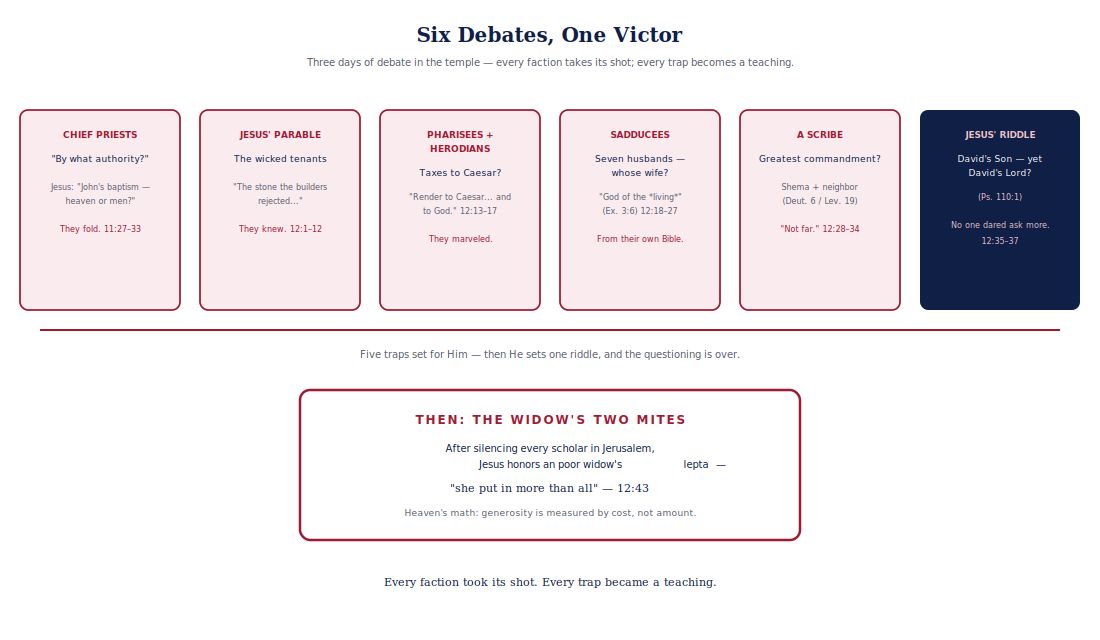
The next day, the establishment confronts Him directly in the temple: "By what authority doest thou these things? and who gave thee this authority?" (11:28). It's a trap: claim divine authority and they charge blasphemy; claim human authority and they dismiss Him.
Jesus answers a question with a question — the rabbis' own art form: "The baptism of John, was it from heaven, or of men? answer me" (11:30). Now they're trapped: say "from heaven" and He asks why they rejected John; say "from men" and the crowds (who revered John) riot. "We cannot tell," they mutter. "Neither do I tell you," says Jesus (11:33). Checkmate — and the crowd watches their leaders fold.
Scene 5: The wicked tenants (12:1–12)
Jesus tells a parable — and this one is a guided missile. A man plants a vineyard (Israel — Isaiah 5's famous "song of the vineyard"), leases it to vinedressers (Israel's leaders), and goes away. At harvest he sends servants (the prophets) — beaten, wounded, killed. Finally he sends his "beloved son" (12:6) — "They will reverence my son." The tenants murder him for the inheritance.
"What shall therefore the lord of the vineyard do? he will come and destroy the husbandmen, and will give the vineyard unto others" (12:9). Then the cornerstone: "The stone which the builders rejected, the same is become the head of the corner" (Psalm 118:22–23, 12:10–11).
The leaders "knew that he had spoken the parable against them" (12:12) — and wanted to arrest Him on the spot. They understood the parable perfectly. That's the tragedy: they recognized themselves as the murderers in the story — and their response was to start planning the murder.
Scene 6: The traps — taxes, resurrection, commandments (12:13–34)
Three delegations, three traps, three masterstrokes:
Trap 1: The tax (Pharisees + Herodians, 12:13–17). Strange allies — the Pharisees (religious purists who hated Rome) team with the Herodians (political pragmatists who backed Rome's puppet king). 110 "Is it lawful to give tribute to Caesar, or not?" Say yes, lose the crowds. Say no, get arrested for sedition. Jesus asks for a denarius — the Roman silver coin with Tiberius's face. The legend around his head reads TI CAESAR DIVI AVG F AVGVSTVS — "Tiberius Caesar, son of the divine Augustus, Augustus" — and the back names him PONTIF MAXIM, "chief priest." 111 The coin claims its bearer is both divine and the empire's high priest — and it was the very coin of the hated poll tax: one denarius a year from every adult, about a day's wage. "Render to Caesar the things that are Caesar's, and to God the things that are God's" (12:17). The coin bears Caesar's image — so it belongs to Caesar. The logic seems to be: you bear God's image (Genesis 1:27) — so you belong to God. They "marveled at Him."
Trap 2: The resurrection (Sadducees, 12:18–27). The Sadducees — the priestly aristocracy, who accepted only the five books of Moses and denied resurrection, angels, and spirits — spin a riddle: seven brothers marry one woman in turn (the levirate marriage law of Deuteronomy 25:5–6); "in the resurrection therefore, when they shall rise, whose wife shall she be of them?" Jesus answers twice: (1) "Do ye not therefore err, because ye know not the scriptures, neither the power of God?" — resurrection life isn't marriage extended, it's transformed: "as the angels which are in heaven" (12:25). (2) From their own Scriptures — the burning bush: "I am the God of Abraham, and the God of Isaac, and the God of Jacob" (Exodus 3:6) — present tense, centuries after their deaths. "He is not the God of the dead, but the God of the living" (12:27). God doesn't remember Abraham; Abraham lives.
Trap 3 (almost): The greatest commandment (a scribe, 12:28–34). One scribe asks honestly: "Which is the first commandment of all?" Jesus answers with the Shema (Deuteronomy 6:4–5 — "Hear, O Israel; The Lord our God is one Lord: And thou shalt love the Lord thy God with all thy heart...") plus Leviticus 19:18 — "you shall love your neighbor as yourself." The scribe agrees — "well said... to love Him... and one's neighbor as oneself, is more than all the whole burnt offerings and sacrifices" — and Jesus replies: "Thou art not far from the kingdom of God" (12:34). Not in — not far. Honest, near, but still outside. Then: "no man after that durst ask him any question" (12:34). The traps are over.
Scene 7: David's Son — and David's Lord (12:35–37)
Now Jesus goes on offense, teaching in the temple: "How say the scribes that Christ is the Son of David?" Then Psalm 110:1: "The LORD said unto my Lord, Sit thou at my right hand...'" — David calls the Messiah "my Lord." "David therefore himself calleth him 'Lord'; and whence is he then his son?" (12:37).
The riddle: the Messiah is David's descendant (Son of David) — but also David's superior (David's Lord). The answer Mark's readers know: He's both — human son of David and divine Lord. "And the common people heard him gladly" (12:37).
Scene 8: Beware the scribes — and behold the widow (12:38–44)
Jesus warns against the scribes' theater: "which love to go in long clothing, and love salutations in the marketplaces, and the chief seats in the synagogues... devour widows' houses, and for a pretence make long prayers" (12:38–40). Religious performance funding itself on the vulnerable.
Then, sitting "opposite the treasury" — the thirteen trumpet-shaped offering chests standing in the Court of the Women 112 — He watches the giving. Rich people drop in large sums. Then "one poor widow" puts in "two mites, which make a farthing" (12:42) — two lepta, the smallest coins in circulation, together worth a fraction of a penny.
"Verily I say unto you, That this poor widow hath cast more in than all they which have cast into the treasury: for all they did cast in of their abundance; but she of her want did cast in all that she had, even all her living" (12:43–44).
Jesus does the math of heaven: generosity isn't measured by the amount given but by the cost to the giver. The rich gave from surplus; she gave her survival. And note the quiet thunder underneath: the system that "devours widows' houses" (12:40) has just devoured her last coins — and she gave them freely, to God. The temple's corruption and the widow's devotion sit side by side in Mark's final temple scene.
WORD STUDY
Hosanna — (hoh-SAH-nah). From Hebrew hoshi'a na: "Save now!" (Psalm 118:25). By Jesus' day it had become a shout of joyful praise — but the crowd waving branches and crying "Save now!" at Passover, the festival of deliverance, knew exactly what they were asking for. They just didn't know what kind of saving was coming.
Cornerstone — the chief stone (Psalm 118:22): the stone the builders threw away as useless, which God made the foundation's most important piece. Jesus applies it to Himself — rejected by Jerusalem's "builders," made by God the cornerstone of everything.
Denarius — (deh-NAH-ree-us). A Roman silver coin: one day's wage for a laborer — and the exact amount of the yearly poll tax. It was stamped with Tiberius's portrait and the legend "Tiberius Caesar, son of the divine Augustus, Augustus"; the reverse named him "chief priest" (PONTIF MAXIM). Holding one up in the temple courts made Jesus' point visible: this bears Caesar's image; you bear God's.
Mite — lepton (LEP-ton), "a small thin thing." The tiniest Jewish coin — one lepton was about 1/128 of a day's wage; two made a quadrans, about 1/64 113 — so her two coins were worth roughly eleven minutes of a laborer's pay. The widow's whole livelihood, in the smallest currency imaginable.
The fig tree: why curse out of season?
This is the question that troubles honest readers, so face it head-on. Mark tells us it wasn't fig season (11:13) — he's not hiding the oddity; he's highlighting it. In Israel, early figs (breba) sometimes appeared with the leaves before the main crop — small edible buds (the taqsh) that came with the first leaves; a leafy tree with no buds would bear nothing later that year either. 114 A leafy tree promised fruit — as one commentator put it, "abundance of foliage was a profession that fruit was there." 24 This tree advertised and delivered nothing.
And the Old Testament trained every reader to see it: the fig tree is Israel (Jeremiah 8:13; Hosea 9:10; Micah 7:1 — "There is no cluster to eat / Of the first-ripe fruit which my soul desires"). Jesus performs what the prophets called a sign-act — a living parable. The cursing interprets the temple cleansing sandwiched inside it: Israel's religious center has leaves (ritual, commerce, crowds) and no fruit (justice, prayer for the nations, true worship). Judgment on the tree previews judgment on the temple — which, within a generation (AD 70), would fall stone from stone.
Inference: the "mountain" of 11:23 may be the Temple Mount itself, rising across the Kidron Valley as Jesus spoke — the fruitless system, removed by believing prayer.
"Den of thieves" — what was actually wrong?
Not commerce itself — pilgrims needed animals and currency exchange. Three things were rotten: (1) Location — it filled the Court of the Gentiles, the only space where non-Jews could pray, strangling Isaiah's "house of prayer for all nations." (2) Exploitation — (inference) the temple shops belonged to the high-priestly family of Annas — so say later Jewish sources (the Talmud's "woe to the house of Annas," b. Pesahim 57a; Edersheim) 11516 — which means the profits likely flowed upward, and the money changers charged steep exchange rates. Mark doesn't say this outright; it's historical reconstruction, not text. (3) Cover — "den" (spelaion, cave) is where robbers hide. The temple had become religious cover for injustice — exactly Jeremiah's charge 600 years earlier (Jeremiah 7:11). Jesus wasn't tidying; He was prophesying — acting out God's verdict.
The traps: why Jesus always wins them
Each trap assumes a false either/or: Caesar or God (taxes); marriage or resurrection (Sadducees). Jesus rejects the frame: Caesar gets the coin, God gets you (you bear His image). Resurrection isn't marriage continued — it's life transformed by "the power of God." And notice His method with the Sadducees: He beats them from their own Bible (the five books they accepted). Mark's point: the leaders' problem was never lack of evidence — it was unwillingness to see.
"Not far from the kingdom" — the saddest compliment
The honest scribe gets the warmest words Jesus speaks to any leader in Mark — and they're still outside. "Not far" is not "in." Knowledge of the commandments, agreement with Jesus, admiration for His teaching — none of it is the kingdom. The kingdom is entered by repentance and faith (1:15), not by proximity. Some of the people closest to Jesus' teaching are still outside it. That's worth sitting with.
The Christ Thread
Christ in His own story. This is the week the promise line lands. The King of Zechariah 9:9 rides the borrowed colt — prophecy fulfilled down to the animal. The rejected stone of Psalm 118:22 becomes the cornerstone — and Jesus applies it to Himself while His rejecters listen. The riddle of Psalm 110:1 (David's Son and David's Lord) is answered by the Man standing in front of them: He is both, and they can't see it. Mark 11–12 is the Messiah presenting His credentials in person — and being refused.
OT/NT parallels. Psalm 118 is the Passion Week soundtrack twice over: the crowd's "Hosanna" (118:25–26) and the cornerstone (118:22) come from the same psalm — Israel sang the King's welcome and His rejection from one scroll. The vineyard parable re-sounds Isaiah 5's song of the vineyard, now with the tenants named. And the temple critique echoes forward: Stephen's speech in Acts 7 picks up exactly Jesus' charge — God doesn't dwell in houses made by hands.
The Christian future. The inspected temple foreshadows the final inspection: every life examined for fruit (John 15; Revelation 20). But there's mercy in the trajectory — the physical temple gives way to a living one: believers themselves are God's temple now (1 Corinthians 3:16), and the New Jerusalem needs no temple at all, "for the Lord God Almighty and the Lamb are the temple of it" (Revelation 21:22). Judgment passed over the stones so worship could move into hearts.
WHAT THE CHURCH HAS ALWAYS BELIEVED: The apostles made the rejected stone the church's founding confession — Peter preaches it at Pentecost's aftermath (Acts 4:11) and again in his letter (1 Peter 2:6–7); Paul builds on it (Ephesians 2:20). For 2,000 years the church has confessed: the stone Jerusalem threw away is the cornerstone of everything.
Where in the Covenant Story?
Mark 11–12 stands at the Old Covenant's crisis point. The temple system — Mosaic-covenant worship at its most magnificent — is inspected by the covenant Lord and found fruitless. Within a generation it will be gone (13:2). But the Davidic covenant is simultaneously being fulfilled: David's greater Son rides into David's city as King. We stand on the far side of the hinge: the old covenant's sacrifices have given way to the new covenant's once-for-all offering (Hebrews 10), and the "house of prayer for all nations" is now a people, not a place.
It's Okay to Ask
Honest questions this passage raises — bring them, don't bury them:
- Was Jesus being unreasonable with the fig tree — cursing it out of season? (Mark tells you it wasn't fig season on purpose — the oddity is the point. See "The fig tree: why curse out of season?" above.)
- "Render to Caesar" — is Jesus saying God stays out of politics? (No — He's saying Caesar gets the coin because it bears his image; the logic seems to be that you bear God's image, so you belong to God. That's not withdrawal from public life; it's the claim that everything is God's.)
- The widow gave her last coins to a corrupt system — was Jesus really praising that? (He praised her, not the system. Heaven's math measures cost, not destination — and His anger at the devourers (12:40) stands right beside His honor for her.)
- Why didn't Jesus just answer "by what authority" directly? (Because the question wasn't honest — it was a trap. Jesus answers honest seekers plainly; He dismantles dishonest questioners publicly. There's a difference.)
FACT, INFERENCE, OR DISPUTED?
- FACT: Mark sandwiches the fig tree around the temple cleansing (11:12–14, 15–19, 20–26) — the literary structure is deliberate.
- FACT: "Hosanna" quotes Psalm 118:25–26; the colt fulfills Zechariah 9:9; "den of thieves" fuses Isaiah 56:7 and Jeremiah 7:11.
- INFERENCE: The fig tree is a prophetic sign-act pronouncing judgment on fruitless Israel/temple — the sandwich structure makes this Mark's intended reading.
- DISPUTED: Whether Jesus' temple action was a "cleansing" (reform) or a symbolic destruction — some scholars argue overturning tables enacted the temple's coming judgment. Either way, the leaders heard a death sentence (11:18).
- INFERENCE: The temple market ran under priestly license — later rabbinic sources complain of "the bazaars of the sons of Annas" (b. Pesahim 57a), and Edersheim notes the shops belonged to the high-priestly family — so priestly profit from the trade is likely, but Mark never says it. Reconstruction, not text.
- DISPUTED: Whether Jesus pre-arranged the colt with its owner (Guzik, Barclay, Bauckham) or knew of it by divine foreknowledge — commentators hold both; Mark reports the outcome, not the mechanism. 13109
SCHOLAR'S NOTE: The temple Jesus entered was Herod's temple — one of the wonders of the ancient world, still under construction after 46 years (John 2:20). Its courts covered about 35 acres; the Royal Stoa's columns stood 40 feet tall. When the disciples marvel at "what manner of stones" (13:1), they're looking at blocks weighing up to 100 tons. And the Court of the Gentiles — where the money changers set up — was larger than a dozen football fields. The scale makes the cleansing more astonishing, not less: one Man, unarmed, shutting down the machine.
Cross-references (explained, not just listed)
- Zechariah 9:9 — "your King... lowly and riding on a donkey" — the entry's script, about 550 years early.
- Psalm 118:22–23, 25–26 — the rejected stone and the Hosanna cry: the Passover psalm becomes the Passion Week soundtrack.
- Isaiah 5:1–7 — the vineyard song behind the wicked tenants: Israel as God's vineyard, judged for wild grapes.
- Isaiah 56:7; Jeremiah 7:11 — the two texts fused in the cleansing: prayer for all nations vs. robbers' den.
- Exodus 3:6; Deuteronomy 25:5–6; Psalm 110:1; Deuteronomy 6:4–5; Leviticus 19:18 — the armory Jesus draws from in the debates.
Go Deeper
Hungry for more? Two doors worth opening:
- Read Psalm 118 in full — the whole psalm behind both the "Hosanna" and the "rejected stone." Notice how one song holds the week's welcome and its rejection.
- Read Matthew 21–23 alongside Mark 11–12 — the same three days with Matthew's fuller detail (including seven woes against the leaders in chapter 23).
Theological truth (arising from the text)
God inspects what He owns — and fruitlessness under privilege invites judgment. But the same Jesus who curses the fruitless tree weeps over the city (Luke 19:41), overturns the tables and welcomes the widow's mites. Judgment and mercy share the week: the King who judges the temple receives the poor widow's everything. And behind the Son's authority stands the Father whose house this is — "My house shall be called of all nations the house of prayer" — the Son cleansing what belongs to the Father, zealous for His glory (John 2:17).
Humble — and confident
Humble, because the fig tree is a mirror: leaves without fruit — religious activity without justice, prayer, or love. The people closest to the temple were furthest from its purpose. "Not far from the kingdom" is still outside. Proximity to Jesus' teaching is not the same as entering His kingdom.
Confident, because the same King who judges fruitlessness receives the widow's two mites as "more than all." He is not impressed by amounts — He is moved by cost. The smallest gift, given wholly, outweighs the largest gift given from surplus.
Confess It
The fig tree is a mirror, and mirrors are for honesty. Name one place of leaves-without-fruit concretely — the religious activity with no love, no justice, no prayer behind it — and confess it to God now (1 John 1:9). Ask Him not just to forgive the barrenness but to make you fruitful.
For discussion
- The fig tree had leaves but no fruit. What's the difference, in your life, between religious leaves (activity, appearance) and fruit (justice, mercy, prayer)?
- Jesus' temple action was driven by zeal for "all nations" being able to pray. Who might feel squeezed out of our churches — and what would clearing space for them cost?
- The widow gave "her whole livelihood" — Jesus called it more. How does heaven's math challenge the way you think about generosity?
What He has done (the indicative)
Before one "you should," hear what He did: the promised King rode in exactly as Zechariah said He would — about 550 years early in prophecy, that morning in fact. He faced down every trap without flinching, answered the honest scribe with warmth, and honored a widow the world overlooked. He inspected, He judged, He received. Every step below is a response to that King — not a way to impress Him.
This week's practices
- Fruit inspection. Ask one trusted believer: "Where do you see leaves but no fruit in my life?" Listen without defending. Write down what they say and pray over it for three days.
- Clear the court. One concrete act of making room for an outsider — invite someone on the margins to church, to dinner, to prayer. Remove one barrier.
- Pray It Back. Take Mark 12:30–31 into prayer: "Lord, show me what loving You with all my heart, soul, mind, and strength looks like in my actual Tuesday. And show me one neighbor You've put in front of me." Pray it each morning this week.
- Widow's-mite giving. Give something this week that costs — not from surplus, from substance. An amount you'd feel. Give it quietly.
- Memorize Mark 12:30–31. The two great commandments — the answer that left a scribe "not far from the kingdom."
For Us Together
Ask your small group or family this week: "If Jesus inspected our church the way He inspected the temple — what would He find? Leaves, or fruit? And who might feel squeezed out of our 'courts' the way the nations were squeezed out of theirs?"
Who Needs This?
Who in your life is "not far from the kingdom" — close to Jesus' teaching but still outside? One name. One honest conversation, one invitation, or one prayer for them this week.
Take It Home
At the table or at bedtime, ask your kids: "Jesus said the poor widow who gave two tiny coins gave MORE than all the rich people. How can two little coins be more than lots of money?" (Because God measures the cost to the giver, not the size of the gift.) Then let them pick something small of theirs to give away this week.
Praise Him
Don't end with a to-do list — end with worship. Right now, out loud or in writing, finish this sentence: "King Jesus, I praise You because in this passage I saw that You _____." (A King who rides a borrowed colt? Traps turned into teachings? A widow honored above scholars?) Sit in it for a minute. Theology that doesn't become doxology hasn't finished its work.
The bottom line
The King entered to shouts, inspected His temple, found leaves without fruit — and spent three days dismantling every trap His enemies set, honoring instead an honest scribe and a poor widow. The question Mark 11–12 leaves ringing: are you bearing fruit, or just leaves?