
One study, one walk — the universal FIRM format. The passage first and whole; then its world; then the Walk (Context · Observe · Genre · Terms · Entire Canon); the meaning taught straight; the AIM sentence; the misread exposed and answered; and the walk-out, where application has to pass the Transfer Tests before it reaches your week. The same skeleton serves a book, a chapter, a single verse, or a whole subject. In the early studies the moves are labeled as they happen. The labels fade as the walk becomes yours.
THE WEEK WITH THIS STUDY — six bites
Day 1 — Read the passage · Say It Plain · The World (§§1–2) · Day 2 — Observe · Genre (§§3–4) · Day 3 — Terms · Entire Canon (§§5–6) · Day 4 — The Meaning · the AIM Sentence · Say It Back (§§7–9) · Day 5 — The Misread · From Word to Walk (§§10–11 — add For Discussion, §12, if you're with others) · Day 6 — The Walk-Out · the Recap Card (§§13–14). Go Deeper (§16) any evening you want the basement.
BEFORE YOU READ — Open My Eyes
Holy One of Israel, open my eyes in this book. Let me hear "Comfort ye" without skipping the holiness, and see Your glory without losing my nerve. Teach me to wait on You — and renew my strength. In Jesus' name, amen.
§ means “section” — the numbered parts of your lesson. Each bite above names the sections for that day.
1. READ THE BOOK — Isaiah at a glance
This first study is a survey: instead of one passage printed whole, you get the whole book in one view — so every passage ahead is met inside its home. Its Scripture quotations are one-use exhibits, KJV-exact. 1
Isaiah does not whisper its address. The book opens with whose words these are, whose people they concern, and which kings were reigning:
"The vision of Isaiah the son of Amoz, which he saw concerning Judah and Jerusalem in the days of Uzziah, Jotham, Ahaz, and Hezekiah, kings of Judah." — Isaiah 1:1 1
Hold that sentence a moment: it is the whole survey in seed. A vision — something Isaiah saw, not something he invented. A named man — Isaiah, son of Amoz (not Amos the shepherd-prophet; a different name, a different man). A named place — Judah, the small southern kingdom of God's people, and Jerusalem, its capital, built around the temple hill. And four named kings: these words belong to real history, in datable years, in a world you can map.
| The book at a glance | |
|---|---|
| Book | Isaiah — the first and longest of the major prophets (the long prophetic books: Isaiah, Jeremiah, Ezekiel, Daniel) |
| Chapters | 66. Our series: this overview + 35 lessons, covering every verse |
| The man | Isaiah son of Amoz, prophet in Jerusalem, called in the year King Uzziah died (about 740 BC) and still active under Hezekiah (king until about 686 BC) |
| Time covered | The prophet's own century (about 740–680s BC), reaching forward to the exile (586 BC), the return under Persia, and a new heavens and a new earth |
| Main people | Isaiah and his sons · Uzziah, Jotham, Ahaz, Hezekiah · Sennacherib · Cyrus · the Servant of the LORD |
| Key words to watch | Holy, Zion, remnant, servant, highway, comfort, glory — they will follow you through the whole book |
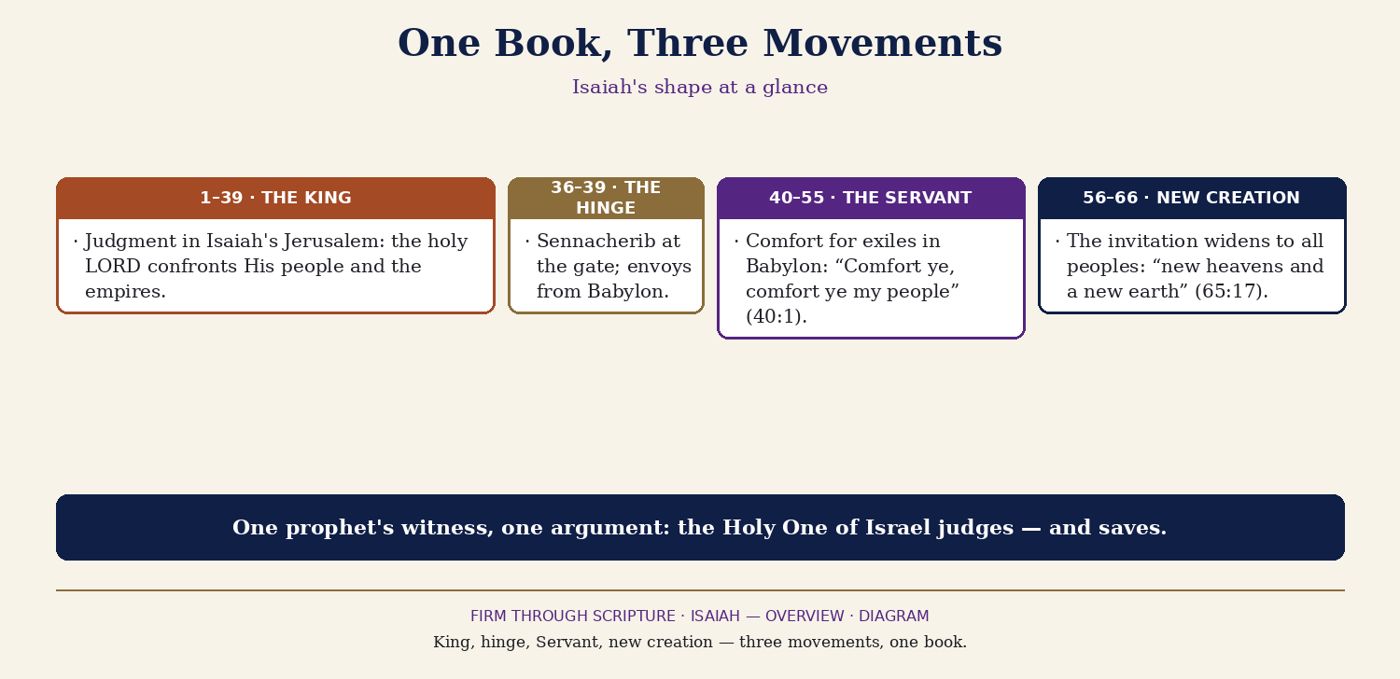
The outline — one book, three movements, on one hinge:
| Part One: chapters 1–39 | The hinge: chapters 36–39 | Part Two: chapters 40–55 | Part Three: chapters 56–66 | |
|---|---|---|---|---|
| The name we give it | The Book of the King | History, retold | The Book of Comfort | The Book of Glory |
| The setting | Isaiah's Jerusalem, Assyria rising | Sennacherib at the gate; envoys from Babylon | God's people addressed in Babylonian exile — spoken before they get there | A restored community, and a world remade |
| The sound | Judgment first — "Hear, O heavens" (1:2) | Narrative, almost no oracle | Comfort first — "Comfort ye, comfort ye my people" (40:1) | Invitation widened — "an house of prayer for all people" (56:7) |
| The centre | The holy King who will not wink at sin | The king who prays — and the king who shows off | The Servant who suffers and saves | New heavens, new earth (65:17) |
Notice the hinge — beginners skate past it. Chapters 36–39 are mostly story: they retell Sennacherib's invasion and Hezekiah's sickness in words running very close to 2 Kings 18–20. 2 They close Part One's world (Assyria at the gate) and plant Part Two's (Babylon's envoys tour the treasury in chapter 39 — and hear Babylon will one day carry it all away). The hinge is the doorframe the house swings on.
SAY IT PLAIN — the whole book in everyday words: God's people had a holy King they kept disobeying, in a little country the empires kept stepping on. God sent Isaiah to say two things at full volume: judgment is real — the holy God will not pretend sin is fine — and comfort is realer: He will save a remnant, send a Servant who suffers in their place, bring His people home, and remake heaven and earth. One argument: the Holy One of Israel judges, and the Holy One of Israel saves.
2. THE WORLD — C: Context & Audience
A text can never mean what it never meant — so before we ask what this book means, we stand where its first hearers stood.
First, how to read this study
One piece of furniture before the history, because you will trip over it all series if nobody names it. Every lesson in this course is built in numbered sections, and the numbers carry a little mark you may never have been taught:
§ KEY — § means 'section' — the numbered parts of your lesson.
That is all § is: an old printer's mark for "section." "§7" means section 7 of this lesson; §§ is the plural. The sections sit under four banners — FOUNDATION, INTERPRETATION, REFLECTION, MOVEMENT — spelling FIRM. Each lesson ends with a Recap Card (§14), five check questions (§15), an optional deep basement (§16), and the source list (§17), where every bracketed citation can be checked. By the end of Isaiah you will run this walk without thinking about the labels — that is their point.
The man: a prophet with sermon-names for sons
Isaiah son of Amoz lived in Jerusalem and prophesied, by the book's own superscription, through the reigns of four kings of Judah — Uzziah, Jotham, Ahaz, and Hezekiah (1:1). 1 Working from the kings' dates, that puts his call at about 740 BC — chapter 6 dates it precisely, "in the year that king Uzziah died" — and his known ministry runs more than forty years, into the 680s BC. [2, 48] He was, by every sign in the book, an insider: a man with access to kings (he confronts Ahaz in chapter 7 and advises Hezekiah in chapters 37–39), at home in the temple and the court, and a master of Hebrew poetry besides. Tradition outside the Bible later claimed he was martyred under a later king; the book itself does not say, so this course will not either.
He was also a family man, and his family was part of the message. His wife is called, strikingly, "the prophetess" (8:3). 1 His two named sons carry sermon-names — names God gave them because the names themselves preached:
- Shear-jashub (7:3) — "a remnant shall return." The boy standing beside his father at Ahaz's most frightening meeting was a walking promise: some of this people will survive, and some will come back. [2, 4]
- Maher-shalal-hash-baz (8:1–4) — roughly, "haste to the spoil, speed to the prey": before this child can talk, the powers threatening Judah will themselves be plundered. Possibly the longest name in the Bible — a headline, not a keepsake. [2, 4]
Isaiah says it himself: "Behold, I and the children whom the LORD hath given me are for signs and for wonders in Israel" (8:18). 1 The prophet's household was a billboard. When you meet his sons ahead, read their names out loud — everyone in Jerusalem did.
The century: a small country between hammer and anvil
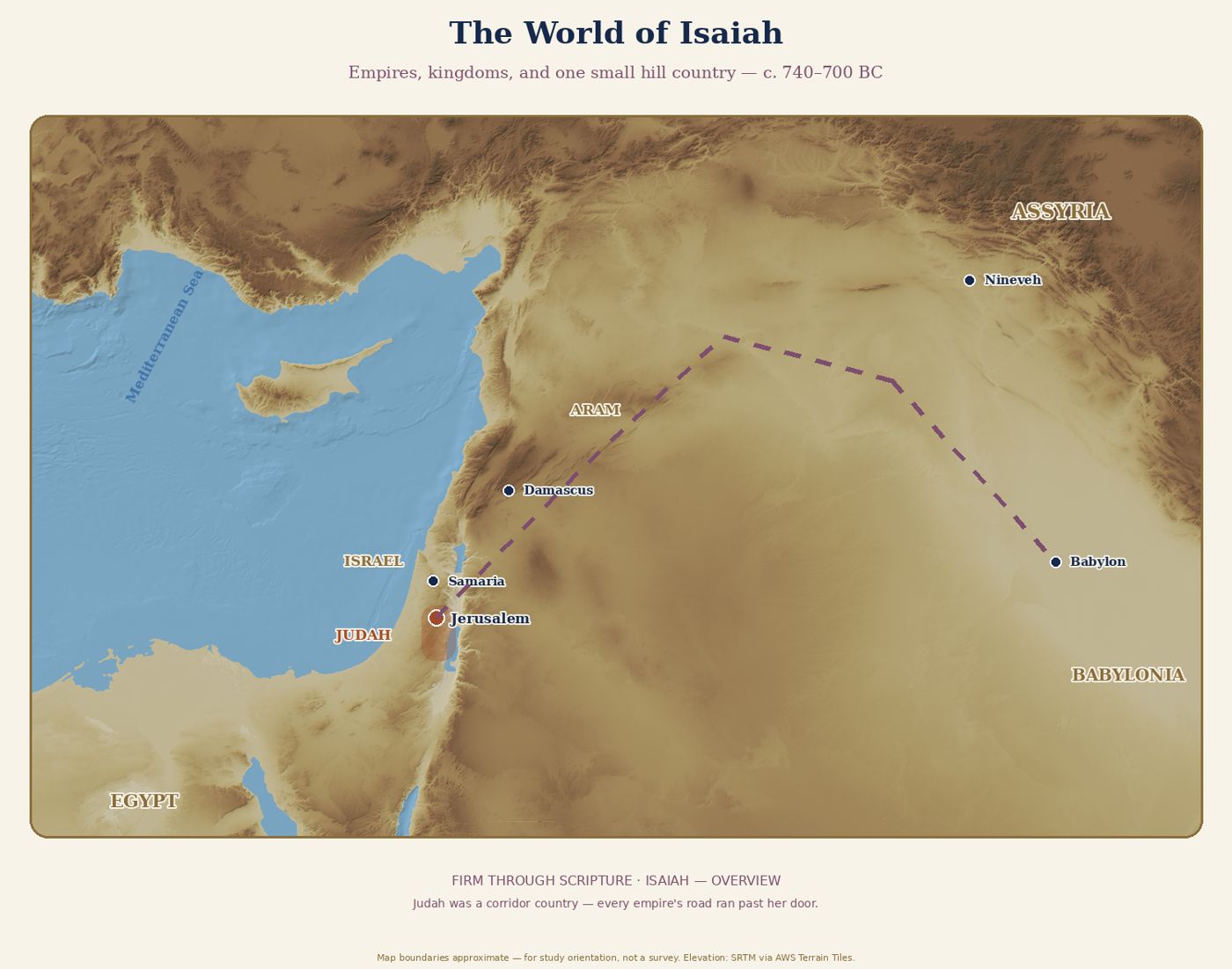
Now zoom out — Isaiah is unintelligible without his map:
Judah was tiny — a hill kingdom you could walk across in days, with one great city, Jerusalem, and one temple at its heart; its kings were David's descendants. North of it sat its sister kingdom, Israel (also called Ephraim, after its biggest tribe), capital Samaria — bigger, richer, and further gone in idolatry. The two kingdoms were family, and frequently at war. That matters in chapter 7, where Israel and Syria team up against Judah — the crisis scholars call the Syro-Ephraimite crisis. You will meet it in Lesson 05.
Assyria was the hammer. From its heartland around Nineveh, in what is now northern Iraq, the empire was swallowing the region — feared for siege warfare and for deporting conquered peoples wholesale: uproot a nation, scatter it, and rebellion becomes nearly impossible. 48 In Isaiah's lifetime Assyria destroyed Damascus (732 BC), ended the northern kingdom at Samaria (722 BC), and in 701 BC came for Judah itself, penning Hezekiah in Jerusalem — the invasion chapters 36–37 tell from inside the walls.
Egypt was the false friend. Southwest down the Nile, the old great power still gleamed — horses, chariots, wealth — and Judah's politicians kept wanting to buy Egyptian help against Assyria. Isaiah calls Egypt a splintered reed that pierces the hand that leans on it, and whole chapters (19–20, 30–31) argue Judah out of the alliance. Egypt in this book is trusting human rescue instead of God, with an address on it.
Babylon was waiting offstage — and learning this distinction will save you hours of confusion. In Isaiah's century Babylon, far east on the Euphrates, was a proud old city under Assyria's thumb, not yet an empire. But Isaiah's prophecies look ahead to Babylon's rise, its destruction of Jerusalem (586 BC, well after Isaiah's death), and the exile — and then further, to Babylon's fall to Persia under Cyrus (539 BC). 48 Three empires in sequence: Assyria the present threat, Babylon the coming destroyer, Persia the unlikely deliverer. Chapters 1–39 breathe Assyrian air; 40–55 address the exile Isaiah foresaw; 56–66 speak to a community back in the land. Keep the horizons straight and the book opens like a door.
Who first heard it — and the question everyone asks
The first hearers of chapters 1–39 were Isaiah's own Jerusalem — people who considered themselves God's people while running, on the prophet's evidence, a city of bribes, idols, and crushed poor (1:21–23). 1 Chapters 40–55 present themselves to their grandchildren — exiles in Babylon asking whether God had lost, or left: "My way is hid from the LORD" (40:27). Chapters 56–66 address a returned, discouraged community rebuilding among ruins.
Which raises the honest question this book is famous for: how can one prophet address people a hundred and fifty years apart? Scholars have argued it for over two centuries; this course will not pretend otherwise. Short answer, for now: the book never introduces a second Isaiah — its superscriptions name Isaiah son of Amoz (1:1; 2:1; 13:1), the oldest complete copy is one scroll of all 66 chapters, and the New Testament quotes all three parts under one name. [22, 50] The long answer gets its hearing in §16. Flag it, don't fear it: §16 is coming. What matters for the walk is simpler: the book as we have it is one book, arranged on purpose, and we read it whole. [5, 57] The sections that follow teach you to read it that way.
3. OBSERVE — O: what the text actually does
Before meaning comes observation. Most bad interpretation is shallow reading — people answering a text they never actually looked at. So look at how this book is built:
- It opens in a courtroom, not a concert. The first oracle summons heaven and earth as witnesses: "Hear, O heavens, and give ear, O earth: for the LORD hath spoken, I have nourished and brought up children, and they have rebelled against me" (1:2). 1 God is filing a covenant lawsuit — charging His people with breach of covenant. That legal frame (accusation, evidence, verdict, and — astonishingly — an offer to settle, 1:18) sets the tone for everything.
- It is mostly poetry, and the poetry is load-bearing. The book runs in Hebrew verse — parallel lines, images piled on images: vineyards, highways, watchmen, potters, banners. The imagery is not wrapping paper; in Isaiah the images are arguments. The standing rule: read the image, ask what it claims, then check the claim against the book's prose. 52
- The refrains repeat like drumbeats. "For all this his anger is not turned away, but his hand is stretched out still" tolls through chapters 5 and 9–10. "Comfort ye" opens the second movement. "There is no peace… unto the wicked" closes the second and third (48:22; 57:21).
- The tone swings — deliberately. The same book that thunders "Woe unto them that call evil good, and good evil" (5:20) also whispers "He shall feed his flock like a shepherd: he shall gather the lambs with his arm" (40:11). 1 A survey that leaves you with only the thunder — or only the comfort — has not observed the book. The interpretation sections now put tools in your hands.
4. GENRE — N: note the genre (Prophecy — poetry, oracle, narrative, and song, woven as one witness)
Isaiah is prophecy, the most misread genre in the Bible — usually by treating it as a crystal ball. Prophecy is forthtelling first — God speaking His word into a present situation, calling His people back — and foretelling second, with the prediction serving the call. 51 Isaiah contains both, in roughly that proportion; confusing the order ruins readings in both directions.
Inside the one genre, Isaiah works in many forms, each reading by its own rules:
- The oracle — a direct word from the LORD, often opening "Thus saith the LORD" or "the burden of…" (a "burden" is an oracle of judgment, explained at Lesson 09). Oracles against foreign nations fill chapters 13–23 — God judging empires His people feared, its own kind of comfort.
- The lawsuit and the woe — courtroom charges (chapter 1) and funeral-cries of "Woe" over the living (chapters 5, 28–33). A woe is a eulogy delivered early: the judged treated as already dead unless they turn.
- Narrative — chapters 6–8 and the hinge (36–39), in prose, checked against the parallel telling in 2 Kings. Narrative teaches by showing; description is not prescription.
- The song — a vineyard song turned indictment (chapter 5), a song of trust (chapter 12), and at the book's heart the four Servant Songs (42:1–9; 49:1–13; 50:4–11; 52:13–53:12), which the New Testament reads of Jesus. [40, 42]
- Apocalyptic — chapters 24–27 (the "Isaiah Apocalypse") and parts of 65–66: cosmic, symbolic writing. Read it for its claims — God reigns, death itself will die (25:8) — not as a timetable.
One genre rule governs all of it: poetry tells the truth in images, and images must be read as images. When Isaiah says the trees clap their hands (55:12), he is not teaching botany; when he says God will swallow up death (25:8), he is not being vague. Flatten either, and you have misread both.
5. TERMS — T: the words in the writer's mouth
Isaiah has a vocabulary, and half the book unlocks when you learn five signature words and one signature title. You will meet them in nearly every lesson.
- The Holy One of Israel — not a term but the title: Isaiah's signature name for God, used more than two dozen times in this book and only a handful of times anywhere else in the Bible. [4, 17] It fuses the book's two poles: God is Holy — utterly set apart, morally blazing, dangerous to sin — and He is of Israel — bound by covenant to this people, present among them. The Holy One judges Israel; the Holy One of Israel refuses to abandon her. When you see the title, slow down.
- Zion — originally Jerusalem's temple hill; in Isaiah the word swells until it means the city, then the people, then the place where God reigns and the nations stream to be taught (2:2–3). When Isaiah says "Zion," ask which circle he means — hill, city, people, or the world remade. By the book's end, often: all of them, widening.
- The remnant — the part of God's people that survives judgment and carries the future, built into a son's name (Shear-jashub) and into the theology: "Except the LORD of hosts had left unto us a very small remnant, we should have been as Sodom" (1:9). 1 Never a boast about the survivors' quality — they exist because God left them: a root, not a remainder (37:31).
- The Servant — God's chosen agent, through whom He will put the world right. The word works in layers: Israel itself is called God's servant (41:8; 49:3), yet a figure also appears who is distinguished from Israel, sent to restore her (49:5–6), and who suffers for others' sins (53:5). [17, 42] Who the Servant is is the book's deepest question; §7 and §16 handle it honestly rather than quickly.
- Anointed — someone smeared with oil at their commissioning, set apart for an office; kings and priests were anointed in Israel. The Hebrew is mashiach — "Messiah"; the Greek form, Christos — "Christ." When Isaiah calls Cyrus "his anointed" (45:1), the book does something startling — and when the New Testament calls Jesus "the Christ," it is spending Isaiah's currency among others. 18
- Highway — Isaiah is a book of roads: a highway in the desert for God's coming (40:3), a highway out of exile for the ransomed (35:8–10; 11:16), even a highway between former enemies, Egypt and Assyria (19:23). 52 In a world where empires built roads to carry peoples away, Isaiah promises a road God builds to carry people home. §7 returns to it.
Method note — the word-study guardrail: a word means what its author uses it to mean, in its sentence, in its century — not what its oldest root once meant, and not everything it can mean anywhere. Every term above was settled by Isaiah's own usage across his book.
TRANSLATION NOTE — "vision," or daydream?
Your KJV calls the whole book a "vision" (1:1) — and in modern English a vision sounds like a daydream. The Hebrew word, chazon, means a revelation received — a prophetic seeing, the same word family used in Proverbs 29:18 for God's instruction itself: "Where there is no vision, the people perish." 19 The KJV's word was precise in 1611; the drift is in our English, not in Isaiah. Read "vision" in this series as what God showed him.
6. ENTIRE CANON — E: where this passage sits in the whole story
Isaiah sits at a crossroads of the Bible so busy that he is sometimes called the fifth Gospel. Fix his coordinates:
- In the Old Testament, Isaiah opens the Latter Prophets — the books that look back at the Law and ask what went wrong and what God will do. Jeremiah and Ezekiel inherit his vocabulary: the remnant, the new covenant, the highway home. 57
- In the New Testament, Isaiah is the most-quoted prophet — quoted and alluded to scores of times, more than any other single prophet. [48, 50] Matthew builds his proof-structure on Isaiah ("that it might be fulfilled which was spoken by Esaias the prophet" — Esaias is Isaiah in Greek dress). Paul argues from Isaiah in Romans like a man citing his senior partner. The official in Acts 8 is reading Isaiah 53 when Philip "began at the same scripture, and preached unto him Jesus" (Acts 8:35). 1
| John quotes… | From… | And calls it… |
|---|---|---|
| "Lord, who hath believed our report?" (John 12:38) | Isaiah 53:1 — Part Two, the Servant | the words of "Esaias" |
| "He hath blinded their eyes…" (John 12:40) | Isaiah 6:10 — Part One, the call | the same "Esaias," again |
| "These things said Esaias, when he saw his glory" (John 12:41) | the temple vision, ch. 6 | a sighting of Christ's glory |
| - John 12 sets the survey's argument in one paragraph (see the table above): Isaiah 53:1 and Isaiah 6:10, from opposite ends of the book, quoted side by side as one man's words — and the glory Isaiah saw in chapter 6 identified as Christ's (John 12:41). 1 The New Testament does not merely quote this book often; it reads it as one prophet's witness to one Lord. That is canon evidence, and §16 weighs it as such. | ||
| - In the covenant story, Isaiah stands at the crisis of the Davidic covenant (2 Samuel 7). By his day the line looks finished: corrupt kings, a divided kingdom, a stump where the tree stood. His answer is the book's royal thread: a child who bears the government (9:6), a shoot from Jesse's stump (11:1), a king in his beauty (33:17). The covenant is not cancelled; it is concentrated into the coming King. |
7. THE MEANING — what the passage teaches
A survey's "meaning" is the book's own teaching, in the book's own proportions. Now its payload, taught straight — five great themes every lesson ahead will draw on.
First theme: the Holy One of Israel — a God both blazing and bound
Everything in Isaiah flows from who God is, and the book's vision of Him opens in a throne room. Isaiah saw "the Lord sitting upon a throne, high and lifted up," and heard the seraphim — the burning angelic attendants — crying the book's keynote: "Holy, holy, holy, is the LORD of hosts: the whole earth is full of his glory" (6:3). 1 No other attribute of God gets the triple repetition in Scripture's worship scenes. Isaiah never recovers from it: his God is "God that is holy" (5:16), the "high and lofty One that inhabiteth eternity, whose name is Holy" (57:15). 1
But hold the second half of 57:15, because it is the whole book in one verse: the high and lofty One dwells "with him also that is of a contrite and humble spirit." 1 Isaiah's God is not holy instead of near, or near instead of holy. His holiness is why sin cannot be winked at — and why proud empires and a proud people alike fall. His covenant nearness is why judgment is never the last word over His people. If your Isaiah leaves you only frightened, you stopped at 6:5 ("Woe is me! for I am undone"). If it leaves you only comforted, you skipped to chapter 40 without reading 1–39.
Second theme: Zion — the city God chose, judged, and will fill with nations
Isaiah's God has an address. Zion is where He has put His name, and the book's hope radiates from it: "the mountain of the LORD's house… established in the top of the mountains" and "all nations shall flow unto it" — uphill, note, the way water never flows, because grace reverses currents — "for out of Zion shall go forth the law, and the word of the LORD from Jerusalem" (2:2–3). 1 Yet the same Zion is a city become a harlot (1:21), besieged in chapter 36, weeping in exile, and only at the end the mother of nations. Hold the address and the audit together: God's presence is no talisman — chapters 28–31 hammer that presumption — yet His purposes outlast their failure. Where in the Covenant Story? Here: Zion is where the Abrahamic promise gets its mailing address and the Davidic king reigns. [4, 57]
Third theme: the remnant — judgment is real, and so is the root
Isaiah is unsentimental about numbers. The people will be thinned like a felled forest — and through the thinning runs the book's most stubborn mercy-word: remnant. It is announced as pure gift — left by God, not earned by the left (1:9) — carried in a child's name (7:3), and pictured as agriculture, not arithmetic: "the remnant that is escaped of the house of Judah shall again take root downward, and bear fruit upward" (37:31). 1 The theme teaches two things at once, and readers perennially drop one: against despair, God never lets His people's story reach zero; against presumption, belonging to the crowd proves nothing — what matters is being among those who return (the verb inside Shear-jashub's name means return in geography and in repentance at once). [2, 17] Paul argues the future of Israel from this exact theme in Romans 9–11.
Fourth theme: the Servant — the one in whom Israel's calling comes true
At the book's centre stands its most loved and most argued figure. God presents "my servant, whom I uphold; mine elect, in whom my soul delighteth" (42:1) — gentle enough not to break a bruised reed — then, in the fourth Song, disfigured, despised, and finally confessed: "he was wounded for our transgressions, he was bruised for our iniquities: the chastisement of our peace was upon him; and with his stripes we are healed" (53:5). 1 The identity question is argued in §16 and Lesson 29: the text names the servant Israel (41:8; 49:3) and distinguishes him from Israel (49:5–6), and the New Testament reads the Songs of Jesus as a matter of record (Matthew 12:18; Acts 8). [1, 42] This course's POSITION, with the church's historic reading: the Servant is fulfilled in Christ, Israel's calling gathered into Him.
Fifth theme: the highway — God builds the road home
End where Isaiah ends: with roads and a remade world. The highway runs the book's length — prepared in the desert for God's arrival (40:3), paved home for the ransomed (35:8–10), and built through the new creation's gates (62:10). 52 The destination is stated without embarrassment: "For, behold, I create new heavens and a new earth" (65:17) — words taken up in 2 Peter 3:13 and Revelation 21:1. 1 Isaiah's last word is not exile or return. It is creation, done again and done right — worship at its centre and, in the sobering final verse, judgment still real outside the gates (66:24).
The Christ Thread
No forcing is needed here: the New Testament's own reading is the thread. Isaiah gives the church the Immanuel of Matthew 1:23 (7:14 — argued in the open in Lesson 05), the child-King of 9:6, the anointed preacher Jesus claims at Nazareth (61:1–2; Luke 4), the wilderness-voice text all four Gospels hang on John the Baptist (40:3), and the suffering figure of chapter 53 whom Philip preaches as Jesus (Acts 8). John 12:41 goes furthest: Isaiah "saw his glory" — the temple vision of chapter 6 was, on the apostle's reading, a sighting of Christ. 1 That is why Isaiah is sometimes called the fifth Gospel.
Father, Son, and Spirit
Isaiah does not teach the Trinity in creed language — no Old Testament book does — but the persons are all on his stage. The Father speaks and sends throughout. The Son is present in the royal and Servant threads as the New Testament identifies them — most startlingly at John 12:41. And the Spirit is named and active: resting on the Branch (11:2), put on the Servant (42:1) and the coming Preacher (61:1), grieved by His people's rebellion (63:10). One God, acting in the fullness the New Testament will name — earned passage by passage, and collected as they come.
The Long View — what the church has believed
You are not this book's first reader, and the centuries converge at the centre. Jerome (about AD 408) wrote the early church's fullest Isaiah commentary and called Isaiah "not only a prophet, but an evangelist." 37 Calvin's commentary reads the book as one prophetic whole and remains a control on interpreters who would dissolve its comfort into mere politics. 36 Across those centuries the church has confessed from Isaiah: holiness and covenant mercy held together, the virgin birth (Matthew's reading of 7:14), the Servant's suffering (53), the resurrection-world of 25:8 and 65:17, and the nations' inclusion (56; 60) as promise, not afterthought. Where the centuries have honestly differed is chiefly composition — and §16 states that argument fairly. The centre has held: the Holy One judges, and the Holy One saves, through the Servant-King.
That is the payload. The next section compresses it into the one sentence you are meant to carry out of this study.
8. THE AIM SENTENCE — X: eXplain the intent
Everything observed now compresses into one sentence — the book's intended meaning, before any application is allowed near it:
Isaiah is one prophet's witness that the Holy One of Israel will judge His rebellious people and the proud empires around them — yet will not abandon His covenant: He will preserve a remnant, send His Servant to bear sin and bring the nations in, and finish with a new heavens and a new earth.
If a sermon or devotional uses Isaiah to say something untraceable to that sentence, it is not this book talking.
9. SAY IT BACK
Close the book and say the AIM sentence from section 8 in your own words, without looking. Then say, in one more sentence, which of the five great themes — holiness, Zion, remnant, Servant, highway — this book is aiming at you with first.
If your version quietly changes the meaning — the Holy One only a comforter, the comfort a licence — walk it again. It is the entire course in miniature: meaning first, then — and only then — your life.
10. THE MISREAD — the guardrail, with verdicts
Three live misuses of this book — each with a hearing, evidence, and a verdict.
Misread 1: "Isaiah is really two or three different books stapled together — the 'Isaiah' story is a polite fiction." Why it sounds right: the shift at chapter 40 is real — new setting, new tone, Babylon named, a Persian king named. Since Duhm's 1892 commentary, much academic writing speaks of First, Second, and Third Isaiah as a matter of course. 40 The evidence: a shift is not a second author; it is also what a prophet announcing the future would produce — and the debate's premises are usually smuggled in rather than argued (§16 names both). Against simple stapling: the signature title runs through all three parts; the oldest complete copy is one scroll 22; the Septuagint is already one book 24; and the New Testament quotes all three parts under one name, most pointedly at John 12:38–41. [1, 50] The composition question is genuinely DISPUTED; the stapled-anthology shrug is not a conclusion the evidence forces. Verdict: read the debate in §16 with the labels on — but do not let a disputed theory of composition dissolve a book whose unity of argument you can watch working from 1:1 to 66:22.
Misread 2: "Prophecy is just history written afterwards and dressed up — so the predictions prove nothing." Why it sounds right: if chapters 40–55 were written in Babylon, then "predicting" Babylon's fall and Cyrus is no prediction at all. The evidence: the explanation assumes what it needs — that named foretelling (Cyrus, 44:28; 45:1) cannot happen — then cites the lateness it assumed as proof. That is a circle. The text presents the naming as the point: God surnames Cyrus "though thou hast not known me" (45:4) so the event reads as His signature. 1 Honest disagreement exists about how to weigh that claim; a premise-free demonstration that prophecy is impossible does not. Verdict: a premise dressed as a finding. Weigh Isaiah's claim as a claim — the book stakes its God on it ("declaring the end from the beginning," 46:10) — rather than ruling it out before the evidence is heard.
Misread 3: "Isaiah is basically a comfort book — the judgment talk is the part we've outgrown." Why it sounds right: "Comfort ye" is famous, 40:31 is on wall plaques everywhere, and judgment preaching is unfashionable. The evidence: proportions. The first thirty-nine chapters are dominated by lawsuit, woes, and oracles — and even the comfort chapters close with "there is no peace… unto the wicked" (48:22), while the final verse shows judgment outside the new creation's gates (66:24). 1 The comfort is because of, not instead of, the judgment: the Servant's stripes (53:5) are good news only to people who know what transgressions cost. Verdict: comfort with the judgment edited out is not Isaiah's comfort. The book consoles the afflicted and afflicts the comfortable, in that order, on purpose.
11. FROM WORD TO WALK
A reflection page — the lesson is not finished until the book has had its say with you.
Sit with Isaiah's position, because it may be yours. He stood in a city that called itself God's city, fluent in worship, sent to say: the Holy One sees through it. Isaiah 1 is God's review of a religious people's worship — assemblies He calls an abomination, hands full of blood (1:13–15) — followed, in the same chapter, by the book's most gracious sentence: "though your sins be as scarlet, they shall be as white as snow" (1:18). 1 That is the doorway into this series: God is not impressed by our religion and not finished with our sin. Both at once. Holiness we perform means nothing; holiness we receive — "wash you, make you clean" (1:16) — means everything.
| The book's two hands | To the performers (ch. 1) | To the forgotten-feeling (ch. 40) |
|---|---|---|
| The diagnosis | Worship without obedience — "hands full of blood" | Despair — "my way is hid from the LORD" |
| The word | "Wash you, make you clean" (1:16) | "Comfort ye, comfort ye my people" (40:1) |
| The promise | Scarlet made white as snow (1:18) | Strength renewed for those who wait (40:31) |
And there is the other pole, aimed at people sure God has forgotten them: exiles rehearsing "my way is hid from the LORD" (40:27), answered with the size of God — and then landed, impossibly, on the tired: "they that wait upon the LORD shall renew their strength; they shall mount up with wings as eagles; they shall run, and not be weary; and they shall walk, and not faint" (40:31). 1 Notice the order: fly, run, walk. The crescendo is not the soaring; it is the walking — ordinary, Tuesday-morning faithfulness.
If You're Not Yet a Christian
Isaiah may be the most honest place to start, because he begins where you actually are. His diagnosis is not that you need to try harder; it is that all of us, religious and rebellious alike, stand before a holy God with a record we cannot fix: "we are all as an unclean thing, and all our righteousnesses are as filthy rags" (64:6). 1 And his remedy is not a program. It is a Person — the Servant of chapter 53, wounded "for our transgressions," so that "with his stripes we are healed." The church reads that Servant as Jesus of Nazareth — crucified, and raised on the third day — and Philip preached exactly that identification from exactly this chapter (Acts 8:32–35). 1 Isaiah's invitation stands at 55:1, to the thirsty with empty hands: "Ho, every one that thirsteth, come ye to the waters, and he that hath no money; come ye, buy, and eat." No money required. No cleaning up first. Come thirsty, and come honestly.
Holy One of Israel — You are high and lifted up, and I am not clean enough to impress You and not strong enough to save myself. Thank You that Your book does not leave me there: cleanse what is scarlet in me, gather me into the remnant You preserve, and teach me to wait on You without fainting. In Jesus' name, amen.
12. FOR DISCUSSION — OR FOR YOUR JOURNAL
With a group, work these aloud. Alone, they're yours — answer them in your journal or in prayer; they lose nothing in the quiet.
- Isaiah's signature title holds two truths in one breath: God is Holy, and He is of Israel. Which half do you naturally emphasize, and which do you quietly drop? What does dropping it cost you?
- Shear-jashub's name — "a remnant shall return" — was carried into a frightening political meeting as a promise. Where in your life do you need to hear return as mercy rather than threat?
- The book swings between courtroom (chapter 1) and comfort (chapter 40). Which voice of Isaiah do you find harder to receive — and why do you think the book refuses to let you have only the other one?
- Assyria, Babylon, and Persia each felt permanent — and God's word outlasted all three (40:8). What "empire" in your world currently feels permanent, and what changes if you read it on Isaiah's timeline?
13. THE WALK-OUT — T: Transfer to today
Meaning is settled. Now — and only now — application, crossing the bridge honestly. Run the five Transfer Tests on the book as a whole:
- Same covenant? Isaiah spans the old covenant at its crisis and promises the new. What God did in exile and return is finished history; what He promised — Servant, Spirit, new creation — arrives in Christ and is still arriving. We receive; we do not re-enact.
- Same audience? First spoken to Jerusalem, to exiles, and to a returned remnant. We read from the far side of the cross, as people the book foresaw being gathered in (56:3–8) — guests at Zion's feast by grace, not natives by birth. Invited, not entitled: that posture crosses with full weight.
- Same genre rules? Prophecy forthtells before it foretells and teaches in image. So the book yields faith, posture, and patterns before predictions — and no timetables are on offer.
- Repeated or rooted? God's holiness, His refusal to abandon His covenant, comfort for the waiting, judgment on pride — each is rooted in God's character and repeated from Genesis to Revelation. These cross undiminished.
- Ten verses either side? For a survey the test widens honestly: every application below is drawn from the whole book read whole — courtroom, throne room, comfort, Servant, new creation.
What crosses — and lands:
Before any command, what God has done: the Holy One has preserved a people He could have finished (1:9); He has sent a Servant wounded for transgressions not His own (53:5); He has promised a new creation no exile can cancel (65:17). 1 Application here is always a response to that indicative. You do not walk the highway to earn a place in the remnant; the remnant walks because God kept them, and the highway is already built.
- Read for holiness before comfort. Sit in chapters 1–39's audit of your own religion before hurrying to chapter 40. A faith that has never heard "Woe is me" rarely hears "Comfort ye" at full strength.
- Wait as a discipline, not a pause. 40:31's promise is to those who wait upon the LORD — active, expectant attendance on God, the watchman's posture, not resignation.
- Carry the remnant posture. Small and surviving is not failing in this book; it is God's people's normal condition between promise and fulfilment. Root downward first (37:31); fruit is God's department.
Practices — what the gate lets through, made concrete this week:
- Read Isaiah 1 and Isaiah 40 back to back — out loud if you can, about twenty minutes. Mark every sentence that tells you who God is before you mark anything He asks.
- Learn the map. Keep §2's three empires straight: Assyria the present threat, Babylon the coming destroyer, Persia the unlikely deliverer. Every lesson ahead assumes you can tell them apart.
- Memorize Isaiah 40:8 — it's on your Recap Card (§14). Say it when headlines insist the empires are permanent.
- Name one scarlet thing. Bring God one specific, named sin this week (1:18) — in prayer, honestly, expecting cleansing rather than a performance review.
- One name for the highway. Who in your life is in exile — far from God, sure they've been forgotten? Pray for them by name, and take one concrete step toward them: a call, a meal, an invitation to read chapter 40 with you.
What does not cross: treating Isaiah's promises to Israel as personal guarantees detached from their covenant home (the nations are gathered in, 56:7 — gathered, not handed the deed); copying the prophet's office as your assignment; mining the oracles for timetables. The gate is there to make sure the claims that land are the ones God actually made.
Praise Him
Praise the Holy One of Israel — high and lifted up, His glory filling the whole earth. Praise Him who comforts His people, who bore our griefs in His Servant, whose word stands for ever while empires fall. Holy, holy, holy — and nearer than we feared. Hallelujah.
14. THE RECAP CARD — this study on one page
Print it. Keep it where you'll see it.
- The passage: The book: Isaiah — 66 chapters, from a courtroom in Jerusalem to a new heavens and a new earth
- Say It Plain: Judgment is real — and comfort is realer: God will save a remnant, send a suffering Servant, bring His people home, and remake heaven and earth.
- The AIM: Isaiah is one prophet's witness that the Holy One of Israel will judge His rebellious people and the proud empires around them — yet will not abandon His covenant: He will preserve a remnant, send His Servant to bear sin and bring the nations in, and finish with a new heavens and a new earth.
- Key terms: The Holy One of Israel — holiness and covenant in one title · Zion — hill, city, people, world remade · remnant — those God preserves · Servant — the agent who sets the world right · highway — God's road home.
- The Misread, in one line: A disputed composition debate does not dissolve the book · "prophecy is impossible" is a premise, not a finding · comfort with the judgment edited out is not Isaiah's comfort.
- Memory verse: "The grass withereth, the flower fadeth: but the word of our God shall stand for ever." — Isaiah 40:8
- This week's practice: read Isaiah 1 and 40 back to back, marking who God is — and bring Him one scarlet thing (1:18).
15. CHECK YOURSELF — five questions
Answer from the study, not instinct. (Answers live in the Teacher Edition.)
- In your own words: what is the AIM of Isaiah?
- Name the book's three movements and their chapters, and the hinge between the first and second — and say what the hinge does.
- What does Isaiah's signature title, "the Holy One of Israel," hold together — and why does the book break in half if you drop either side?
- A friend says: "Isaiah was obviously written by at least three different people, so calling it one prophet's book is just wrong." Give this study's strongest honest reply — including what is genuinely DISPUTED.
- Name the book's five great themes. Trace one from its first appearance to where the book leaves it.
16. GO DEEPER
Optional — the lesson is complete without it.
From the Sources — The Great Isaiah Scroll
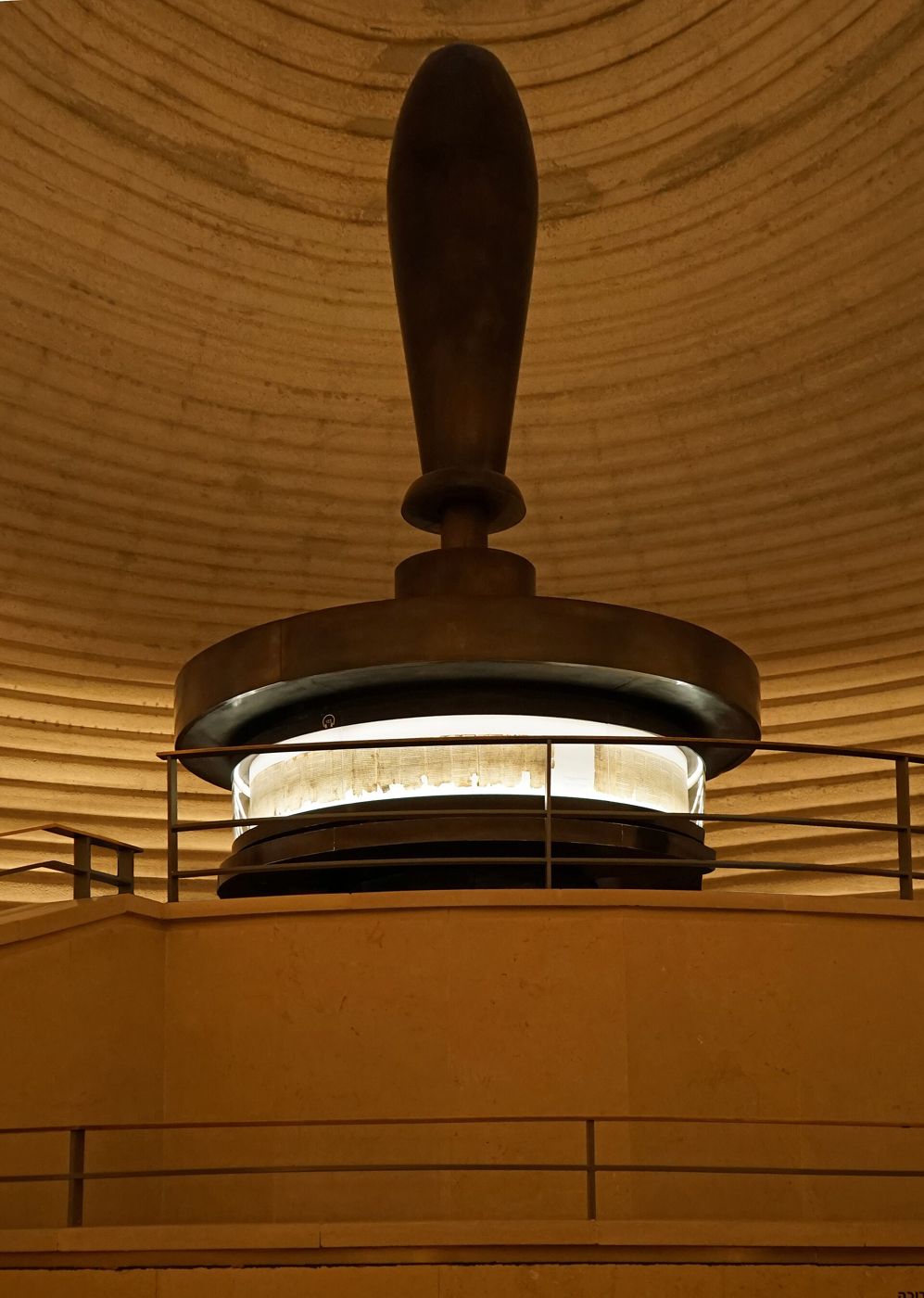
In 1947 shepherds found, in a cave above the Dead Sea (Qumran, Cave 1), a leather scroll more than seven metres long containing the whole book of Isaiah — all 66 chapters, in 54 columns, copied around 125 BC. 22 FACT. It is the oldest complete copy of any biblical book by roughly a thousand years over the medieval manuscripts behind most Old Testament translations; it now rests at the Shrine of the Book in Jerusalem (§7, Visual 4). FACT. Set it beside a modern Hebrew Bible and the headline is the closeness: a millennium of copying produced variations of spelling and small words, but the book's substance and structure are recognisably the same. 22 FACT. And the fact this survey needs most: the scroll is one scroll. Centuries before Jesus, the book already circulated as a single work under Isaiah's name — the Septuagint presents it the same way. [22, 24] INFERENCE — the honest boundary of what artifacts can prove: a scroll shows how the book was held, not how it was written.
The Honest Argument — One Isaiah, or three?
Here is the argument the lesson flagged, both sides at full strength, labels on.
The critical case. Duhm's 1892 commentary crystallized a reading already forming in the scholarship: chapters 40–55 address Babylonian exiles in the present tense of their world, name Cyrus as a contemporary actor (44:28; 45:1), and use vocabulary and style measurably different from chapters 1–39; chapters 56–66 fit a later community again. 40 On that reading, an exilic genius ("Second Isaiah") and later disciples ("Third Isaiah") wrote under the prophet's name. FACT — as an account of what the scholarship holds and why. Its underlying observations — the setting shift, the naming of Cyrus, the absence of "Isaiah son of Amoz" superscriptions after the early chapters — are also FACT: any honest unity case must carry them, not hide them.
The church's historic case. The book presents itself under one name from 1:1, and no ancient witness — not the Great Isaiah Scroll 22, not the Septuagint 24 — knows a divided Isaiah. The signature title and the Zion, remnant, and highway threads run through all three parts like a watermark. [4, 50] The New Testament quotes every part under the one name — John sets 53:1 and 6:10 side by side as "Esaias" (John 12:41). 1 And the strongest critical card, Cyrus named a century and a half ahead, only cuts if predictive prophecy of that precision is ruled out in advance — a premise, not a finding (Misread 2, §10). Scholars from Alexander to Oswalt and Motyer have carried the unity case from the Hebrew. [2, 4, 50] FACT — as an account of the evidence and its defenders.
POSITION — the book is Isaiah's: one prophet's witness, read whole.
Where FIRM lands. That position is held with the evidence on the table: the setting shift is real, Cyrus is really named, and the premise question — can God foretell? — is the debate's true hinge, which is why reasonable readers have landed in different places, and why Delitzsch famously revised his composition view across his commentary's editions. 34 DISPUTED terrain, honestly. What is not disputed is the text in front of us — and a disputed theory of how a book came together never licenses ignoring what the book says.
The Word Underneath — qadosh, "holy"
Isaiah's signature title rests on one Hebrew adjective: qadosh — holy, set apart. [18, 19] The seraphim's triple cry (6:3) uses it three times in a row, Hebrew's way of writing a superlative — not very holy, but holiness itself. FACT. Isaiah's distinctive move is to weld that absolute word to a covenant address: not "the Holy One" in the abstract, but "the Holy One of Israel," the phrase's home being overwhelmingly this book. [17, 18] INFERENCE — the weld is the theology: the God beyond every empire's reach has bound His holiness to a people who keep failing Him, so His judgments and comforts are both the same attribute at work. Separate word from address and you get a distant deity; separate address from word, a tribal mascot. Isaiah will have neither.
Go Read
- Motyer, The Prophecy of Isaiah 4 — read his introduction for the book's architecture by a master.
- Dillard & Longman, An Introduction to the Old Testament 48 — Isaiah's date, structure, and authorship question, fair to both sides.
- House, Old Testament Theology 57 — Isaiah's three movements as one theological argument.
- Ryken, Wilhoit & Longman (eds.), Dictionary of Biblical Imagery 52 — for the highway, vineyard, and watchman images you will meet all series.
17. SOURCES & REFERENCES
Numbered citations in this lesson key to this list — the course standard: every sourced claim carries its number, and every number can be checked.
- The KJV text itself — Holy Bible, King James Version (eBible.org KJV, 1769 text). Scripture quotations are from the King James Version (KJV), which is in the public domain in the United States; the full passage is always assigned as reading. Cross-references within Scripture cite this number.
- Oswalt, The Book of Isaiah, Chapters 1–39 (NICOT) — John N. Oswalt (Eerdmans). The leading evangelical commentary on the first half; defends essential unity of authorship and reads the book as a finished theological whole. Detailed notes on the Assyrian-period history (Ahaz, Hezekiah, Sennacherib).
- Motyer, The Prophecy of Isaiah — J. Alec Motyer (IVP). A one-volume commentary by an evangelical scholar who argues the whole book breathes the mind of the eighth-century prophet; especially strong on the book's structure, its repeated refrains, and the Servant.
- Childs, Isaiah (Old Testament Library) — Brevard S. Childs (Westminster John Knox). The canonical-approach reading: the book in its final form as Scripture, whatever its compositional prehistory; a control on both conservative and critical overreach.
- Boda & McConville (eds.), Dictionary of the Old Testament: Prophets — Mark J. Boda and J. Gordon McConville (IVP). Articles on Isaiah's composition, the Servant, Zion, the nations oracles, and the prophetic genres, written across the scholarly spectrum.
- VanGemeren (ed.), New International Dictionary of Old Testament Theology and Exegesis (NIDOTTE) — Willem A. VanGemeren (Zondervan). Theological word studies with semantic-range discipline for the Hebrew terms.
- Brown, Driver & Briggs, Hebrew and English Lexicon of the Old Testament (BDB) — The standard older Hebrew lexicon; word senses and usage ranges for the Terms sections.
- The Great Isaiah Scroll (1QIsaᵃ) and the Dead Sea Scrolls Bible — The complete Isaiah scroll from Qumran Cave 1 (c. 125 BC), in Abegg, Flint & Ulrich, The Dead Sea Scrolls Bible (HarperSanFrancisco). The oldest substantial witness to Isaiah's text — already a single scroll of all 66 chapters centuries before Christ.
- The Septuagint (LXX) — Rahlfs–Hanhart edition. The ancient Greek Isaiah (2nd century BC): itself already one book of 66 chapters, and the Bible of the early church; its renderings (e.g., parthenos at 7:14) argued in the open where they matter.
- Keil & Delitzsch, Commentary on the Prophecies of Isaiah — C. F. Keil and Franz Delitzsch (19th century; public domain). Delitzsch famously revised his view of Isaiah's composition across editions — the honest-argument file in one author.
- Calvin, Commentary on Isaiah — John Calvin (public domain). Reformation exegesis; a control on interpretation and a voice in the Long View.
- Jerome, Commentary on Isaiah — Jerome (c. AD 408–410). The early church's fullest Isaiah commentary; Jerome transmits the Hebrew learning of his day and treats Isaiah as one prophet's book.
- Duhm, Das Buch Jesaia (1892) — Bernhard Duhm. The commentary that named the "Servant Songs" as a distinct set and crystallized the "Deutero-Isaiah" division — the historical origin of the modern authorship debate, cited as fact about scholarship.
- North, The Suffering Servant in Deutero-Isaiah — C. R. North (Oxford). The classic survey of every identification of the Servant (Israel, a prophet, a king, the Messiah) weighed in one place.
- Dillard & Longman, An Introduction to the Old Testament — Raymond B. Dillard and Tremper Longman III (Zondervan). Survey-level treatment of Isaiah's structure, date, and authorship question from an evangelical hand.
- Archer, A Survey of Old Testament Introduction — Gleason L. Archer (Moody). The standard conservative survey of the authorship question, including the Cyrus argument and the New Testament's citation pattern.
- Fee & Stuart, How to Read the Bible for All Its Worth — Gordon D. Fee and Douglas Stuart (Zondervan). The beginner's method book; its prophecy chapter ("a forthtelling first") undergirds the Genre sections.
- Ryken, Wilhoit & Longman (eds.), Dictionary of Biblical Imagery — Leland Ryken et al. (IVP). Isaiah's image-fields — vineyard, highway, banner, potter, watchman — traced across the canon.
- House, Old Testament Theology — Paul R. House (IVP). Isaiah's place in a whole-Bible theology; the book's three movements read as one argument.