
One study, one walk — the universal FIRM format. The passage first and whole; then its world; then the Walk (Context · Observe · Genre · Terms · Entire Canon); the meaning taught straight; the AIM sentence; the misread exposed and answered; and the walk-out, where application has to pass the Transfer Tests before it reaches your week. The same skeleton serves a book, a chapter, a single verse, or a whole subject. In the early studies the moves are labeled as they happen. The labels fade as the walk becomes yours.
THE WEEK WITH THIS STUDY — six bites
Day 1 — Read the passage · Say It Plain · The World (§§1–2) · Day 2 — Observe · Genre (§§3–4) · Day 3 — Terms · Entire Canon (§§5–6) · Day 4 — The Meaning · the AIM Sentence · Say It Back (§§7–9) · Day 5 — The Misread · From Word to Walk (§§10–11 — add For Discussion, §12, if you're with others) · Day 6 — The Walk-Out · the Recap Card (§§13–14). Go Deeper (§16) any evening you want the basement.
BEFORE YOU READ — Open My Eyes
Lord, You called heaven and earth to listen before You said a word about us. Open my eyes to see what is actually in this courtroom — the charge, the evidence, and the offer I would rather skip past. Wash what I cannot wash, and teach me to stop calling scarlet clean. In Jesus' name, amen.
§ means “section” — the numbered parts of your lesson. Each bite above names the sections for that day.
1. READ THE PASSAGE — Isaiah 1:1–31 (KJV)
Read it all, slowly, before any teaching. In this course the passage always prints once, in full, at the head of the lesson. Everything after this is commentary — this is the text.
1 The vision of Isaiah the son of Amoz, which he saw concerning Judah and Jerusalem in the days of Uzziah, Jotham, Ahaz, and Hezekiah, kings of Judah.
2 Hear, O heavens, and give ear, O earth: for the LORD hath spoken, I have nourished and brought up children, and they have rebelled against me.
3 The ox knoweth his owner, and the ass his master's crib: but Israel doth not know, my people doth not consider.
4 Ah sinful nation, a people laden with iniquity, a seed of evildoers, children that are corrupters: they have forsaken the LORD, they have provoked the Holy One of Israel unto anger, they are gone away backward.
5 Why should ye be stricken any more? ye will revolt more and more: the whole head is sick, and the whole heart faint.
6 From the sole of the foot even unto the head there is no soundness in it; but wounds, and bruises, and putrifying sores: they have not been closed, neither bound up, neither mollified with ointment.
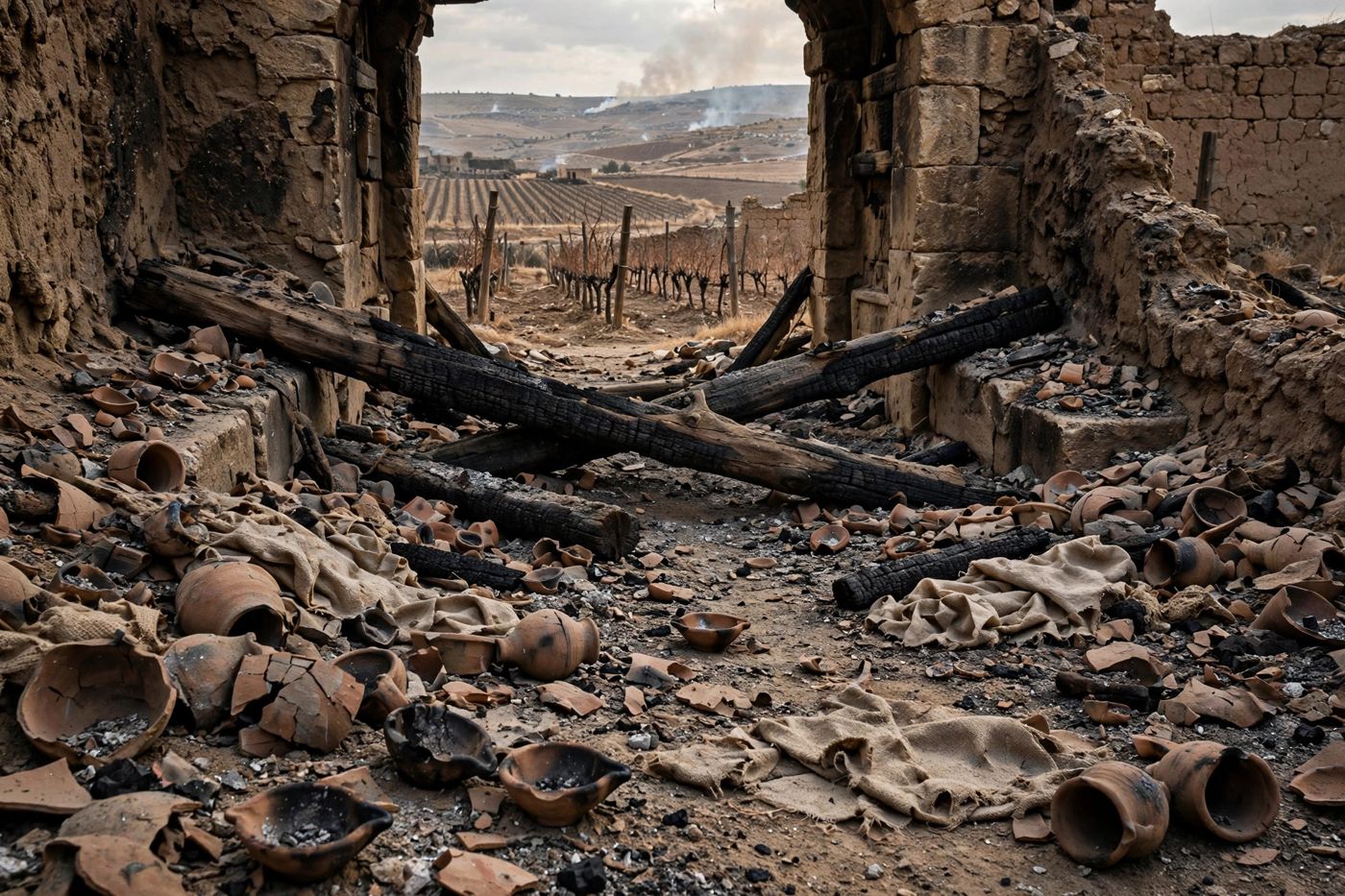
7 Your country is desolate, your cities are burned with fire: your land, strangers devour it in your presence, and it is desolate, as overthrown by strangers.
8 And the daughter of Zion is left as a cottage in a vineyard, as a lodge in a garden of cucumbers, as a besieged city.
9 Except the LORD of hosts had left unto us a very small remnant, we should have been as Sodom, and we should have been like unto Gomorrah.
10 Hear the word of the LORD, ye rulers of Sodom; give ear unto the law of our God, ye people of Gomorrah.
11 To what purpose is the multitude of your sacrifices unto me? saith the LORD: I am full of the burnt offerings of rams, and the fat of fed beasts; and I delight not in the blood of bullocks, or of lambs, or of he goats.
12 When ye come to appear before me, who hath required this at your hand, to tread my courts?
13 Bring no more vain oblations; incense is an abomination unto me; the new moons and sabbaths, the calling of assemblies, I cannot away with; it is iniquity, even the solemn meeting.
14 Your new moons and your appointed feasts my soul hateth: they are a trouble unto me; I am weary to bear them.
15 And when ye spread forth your hands, I will hide mine eyes from you: yea, when ye make many prayers, I will not hear: your hands are full of blood.
16 Wash you, make you clean; put away the evil of your doings from before mine eyes; cease to do evil;
17 Learn to do well; seek judgment, relieve the oppressed, judge the fatherless, plead for the widow.
18 Come now, and let us reason together, saith the LORD: though your sins be as scarlet, they shall be as white as snow; though they be red like crimson, they shall be as wool.
19 If ye be willing and obedient, ye shall eat the good of the land:
20 But if ye refuse and rebel, ye shall be devoured with the sword: for the mouth of the LORD hath spoken it.
21 How is the faithful city become an harlot! it was full of judgment; righteousness lodged in it; but now murderers.
22 Thy silver is become dross, thy wine mixed with water:
23 Thy princes are rebellious, and companions of thieves: every one loveth gifts, and followeth after rewards: they judge not the fatherless, neither doth the cause of the widow come unto them.
24 Therefore saith the Lord, the LORD of hosts, the mighty One of Israel, Ah, I will ease me of mine adversaries, and avenge me of mine enemies:
25 And I will turn my hand upon thee, and purely purge away thy dross, and take away all thy tin:
26 And I will restore thy judges as at the first, and thy counsellors as at the beginning: afterward thou shalt be called, The city of righteousness, the faithful city.
27 Zion shall be redeemed with judgment, and her converts with righteousness.
28 And the destruction of the transgressors and of the sinners shall be together, and they that forsake the LORD shall be consumed.
29 For they shall be ashamed of the oaks which ye have desired, and ye shall be confounded for the gardens that ye have chosen.
30 For ye shall be as an oak whose leaf fadeth, and as a garden that hath no water.
31 And the strong shall be as tow, and the maker of it as a spark, and they shall both burn together, and none shall quench them.
SAY IT PLAIN — the passage in everyday words: God opens a court case against His own people. He raised them like children, and they rebelled — dumber, He says, than an ox that knows its owner. Their land lies burned and eaten by strangers, and only a tiny remnant kept them from ending like Sodom. Then God does something shocking: He tells them to stop bringing sacrifices. Their worship hands are bloody, so He will not listen — wash, stop doing evil, start defending widows and orphans instead. Come into court, He says, and even scarlet sins can become white as snow — if you are willing and obedient. If you refuse, the sword. The chapter ends with a once-faithful city promised a purging fire that will make her righteous again, and with idol-worshippers pictured as a dry oak about to burn. Everything after this teaches from it — nothing will change what you just read.
2. THE WORLD — C: Context & Audience
A text can never mean what it never meant — so before we ask what these verses mean, we stand where their first hearers stood.
Isaiah, and the four kings in one line. Verse 1 is the title page, and it does real work. The prophet is Isaiah the son of Amoz — Amoz is his father, not the prophet Amos; the similar names trip up first readers in every generation. Isaiah prophesied in Judah, the southern kingdom, from its capital Jerusalem, during the reigns of four kings: Uzziah, Jotham, Ahaz, and Hezekiah. That reign-list stretches his ministry across roughly four decades in the second half of the eighth century BC — from about the time Uzziah died (the year Isaiah saw his famous vision in chapter 6) into Hezekiah's reign and the great Assyrian crisis at the end of that century [2, 11].
| King (v. 1) | Note for the reader |
|---|---|
| Uzziah | Long, prosperous reign; Isaiah's call came in the year he died (ch. 6) |
| Jotham | Uzziah's son; a shorter, steadier reign |
| Ahaz | The fearful king of the ch. 7 crisis, who refused God's sign |
| Hezekiah | The praying king who faced Assyria in 701 BC (chs. 36–39) |
Two kingdoms, one family. After Solomon died, the nation split. In the north sat Israel — ten tribes, its own kings, its own rival shrines. In the south sat Judah — the tribes of Judah and Benjamin, David's line still on the throne, and the temple still standing in Jerusalem. Isaiah speaks mostly to Judah and Jerusalem, but watch verse 3: God calls the accused "Israel."
Assyria is the shadow at the edge of every page. Assyria, centred on the Tigris River in what is now northern Iraq, was building the ancient world's most feared empire — professional armies, siege ramps, deportation as policy. Assyria swallowed the northern kingdom whole (722 BC) and later marched into Judah itself, bottling Hezekiah up in Jerusalem in 701 BC [16, 11]. So verse 7's "strangers devour it in your presence" was not first heard as metaphor. It was a war report they could picture: crops seized, towns torched, an invader eating the harvest while the farmers watched. Which invasion the poem pictures most directly is honestly debated — the chapter reads like an overture gathering the book's whole crisis into one scene — an INFERENCE about its composition, not a fact to settle before the charge can land [2, 11].
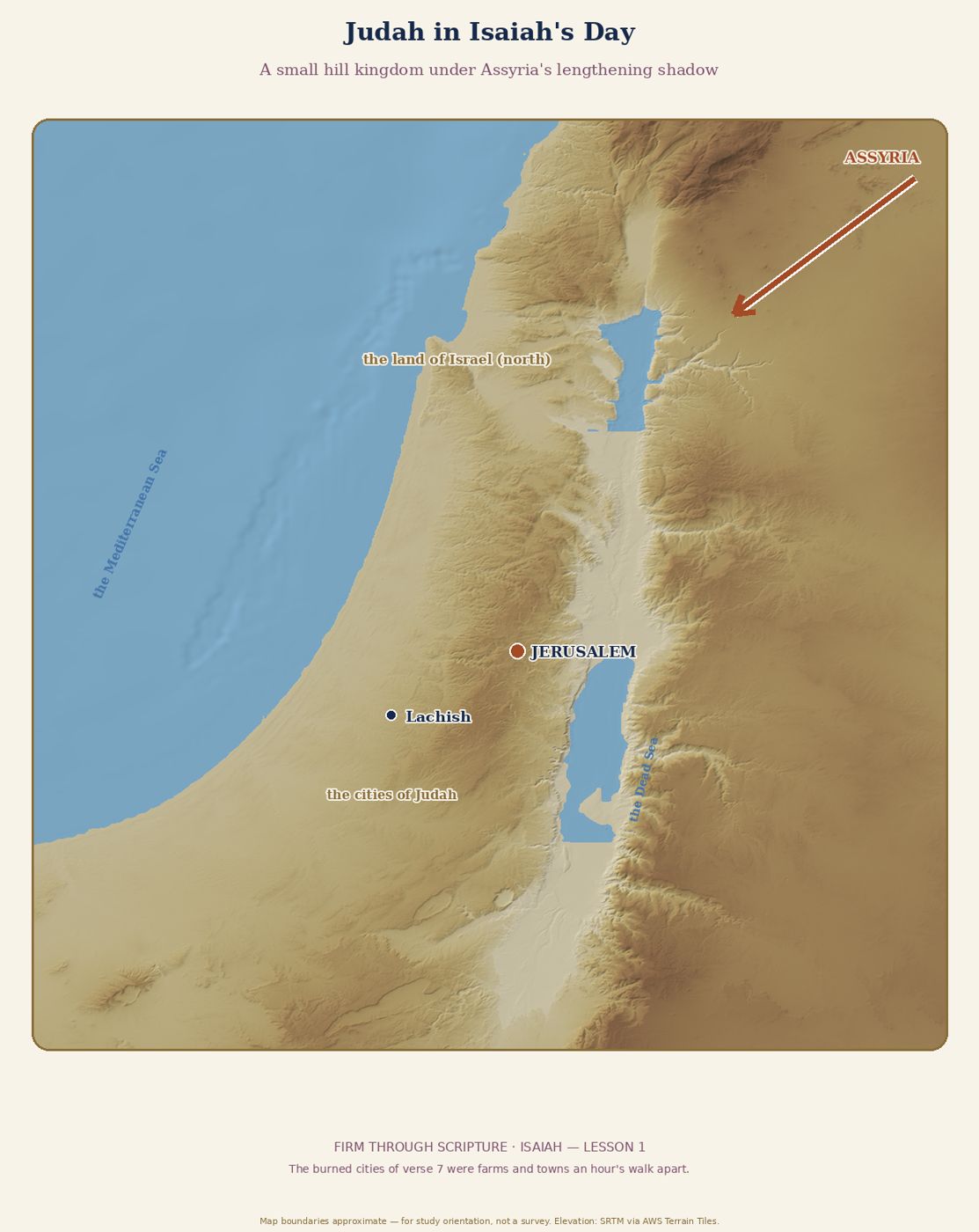
Zion, the daughter, and the city. Zion was the hill in Jerusalem where David's city and the temple stood; by Isaiah's day the name carries the whole city, and more — God's chosen dwelling and His people there [47, 17]. Verse 8's "daughter of Zion" is poetry's tender picture of a city as a vulnerable young woman, and the booth left in a harvested vineyard — a watchman's flimsy shelter, abandoned when the crop is in — is the image: Jerusalem still standing, barely, alone in a stripped field [16, 52].
Sodom is not a swear word here; it is an address. Sodom and Gomorrah were the cities God destroyed by fire in Genesis 19 — in Israel's memory, the standing picture of a place so corrupt that nothing was left of it. No remnant, no survivors. So verse 9 turns on a knife edge: had the LORD not left "a very small remnant," Judah would already be Sodom. Verse 10 then addresses Jerusalem's rulers as "rulers of Sodom" to their faces. The comparison is not decoration. It is the prosecution telling the defendants what file their case has been put in [2, 4].
The covenant is the contract in the courtroom. Why can God sue His people at all? Because He bound Himself to them in a covenant — a solemn, witnessed agreement, like the ancient treaties between a great king and a people he had rescued. At Sinai God gave His law, with blessings for obedience and curses for rebellion written out in advance (Leviticus 26; Deuteronomy 28). The sacrifices, feasts, and Sabbaths of verses 11–14 were God's own appointments, part of that covenant's gift. That is what makes verses 11–15 so violent to first ears: the God who gave the worship is refusing it — from these hands, in this condition. Something has gone wrong not with the rituals, but with the worshippers, and the covenant itself supplies the courtroom in which that can be said [17, 16].
Blood on the hands was literal before it was figurative. Verse 15's charge lands in a city whose princes, verse 23 will say, love bribes, run with thieves, and refuse to defend the fatherless. The fatherless (orphans) and the widow are named in verses 17 and 23 because in that world they had no protector, no income, and no one to bribe a judge with — the easiest people in the city to rob and forget [16, 53].
That is the world: a rescued people, a written covenant, an empire on the march, a city still standing by a thread. Now open the text itself and watch what it does.
3. OBSERVE — O: what the text actually does
Before meaning comes observation. Most bad reading is not deep error; it is shallow looking. So look, slowly:
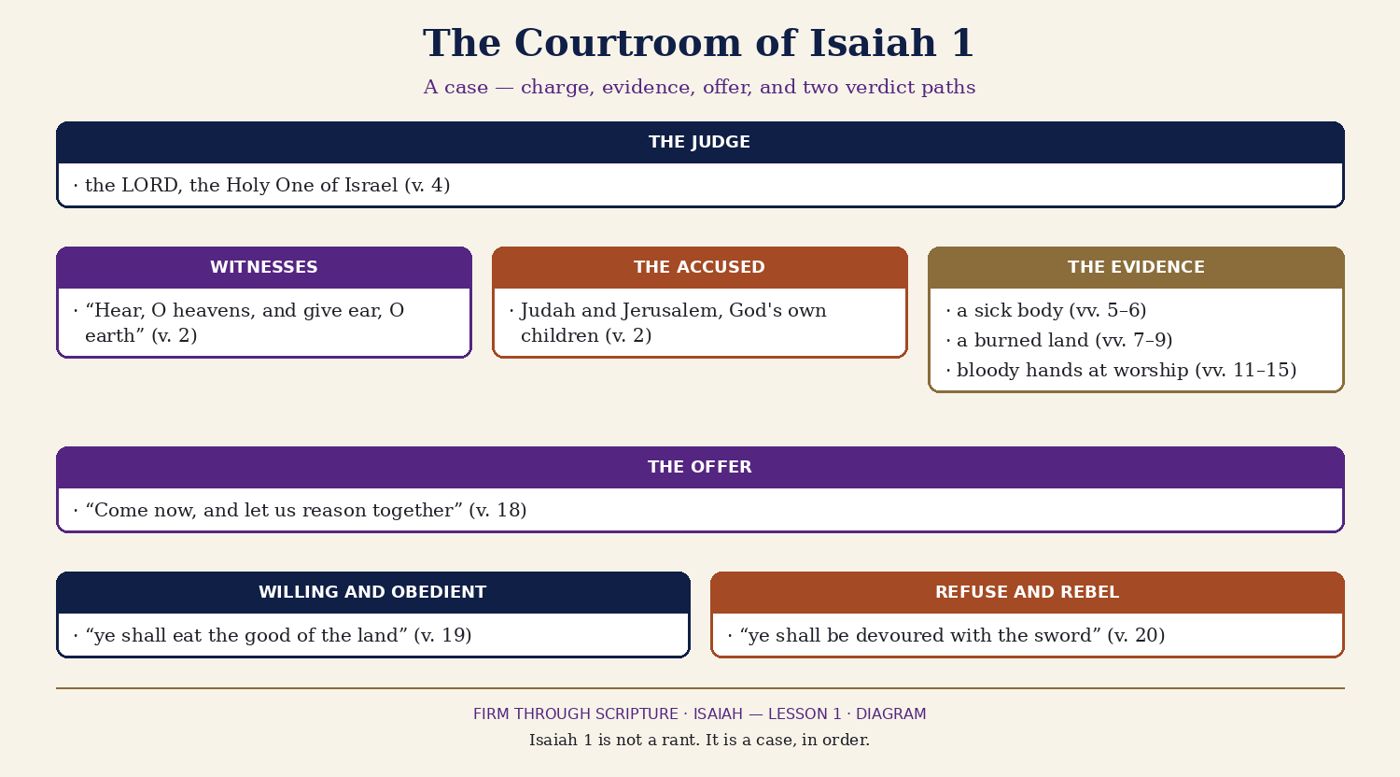
- The shape. Thirty-one verses in clear movements: title (v. 1) · the charge — rebellious children, a sick body, a burned land (vv. 2–9) · worship refused, and the wash commanded (vv. 10–17) · the offer and the two ways (vv. 18–20) · a lament over the city, and its purging (vv. 21–27) · a last word on idol-shame (vv. 28–31). The chapter is an overture: almost every major theme of the sixty-six chapters sounds here first [4, 2].
-
The witnesses are called before the charge is read. Verse 2 summons heaven and earth to hear — before a single sin is named. In a covenant lawsuit, witnesses matter because the treaty was witnessed; heaven and earth were there at the making of it (Deuteronomy 30:19). Isaiah opens his book by putting the original witnesses back on the stand [1, 17]. | Movement | Verses | What happens | |---|---|---| | The charge | 2–9 | Rebellious children; a sick body; a burned land; a remnant left | | Worship refused | 10–17 | Sacrifices rejected from bloody hands; wash, and do justice | | The offer | 18–20 | Scarlet to snow — or the sword | | The city | 21–27 | Lament over the harlot city; a smelter's purge; a name restored | | The warning | 28–31 | Idol-oaks, a dry garden, an unquenchable burning |
-
Hands, everywhere. Spread in prayer — and full of blood (v. 15). Commanded to be washed (v. 16). And God's own hand, turned against His city to purge it (v. 25). Track the hands and you track the chapter's argument: what hands do all week decides what hands lifted on the Sabbath are worth.
- The body and the land mirror each other. The people are a patient sick "from the sole of the foot even unto the head" (v. 6); the land is desolate, burned, devoured (v. 7). Sin here is never private. It shows up in bodies, fields, and courtrooms at once.
- Two fires. Cities burned by strangers (v. 7) — and a smelter's fire God Himself will light to burn dross out of silver (v. 25), and a final unquenchable burning for the forsakers (v. 31). Not all fire in this chapter means the same thing. One destroys, one refines, one ends. Confuse them and you will misread the chapter's mercy as cruelty, or its cruelty as mercy.
4. GENRE — N: note the genre (prophetic poetry — a covenant lawsuit that opens into lament and promise)
Isaiah 1 is prophecy, and prophecy in the Bible is almost always poetry — compressed, image-carrying speech that must be read with a poet's attention, not a clerk's. But naming it "poetry" is only the start. Inside the poetry, this chapter performs a recognisable legal act, and naming that unlocks its order.
It is a covenant lawsuit. Scholars call this form a rîb — a contention, a legal dispute — and its shape recurs across the prophets: summons, witnesses, a charge laid from the history of the relationship, evidence, and a verdict or a path to settlement [17, 51]. Micah 6 runs the same form, and Deuteronomy 32 opens with the same witnesses in the same seats [1, 17]. Once you see the courtroom, the chapter stops looking like angry outbursts. The devotion of verses 2–4 is the indictment; the sick body and burned land are the evidence; the refused sacrifices are the court rejecting a bribe dressed as worship; verse 18 is — astonishingly — the judge offering a settlement; verses 19–20 lay out the two sentences [2, 13].
Three reading rules follow, and they will serve you through the whole book:
- Poetry prosecutes by picture. "Laden with iniquity" (v. 4) pictures sin as a load an animal carries; the city as a prostitute (v. 21) and as adulterated silver and watered wine (v. 22) are not ornaments on the argument — they are the argument, in the form human beings actually feel. Do not rush past an image to get to an idea. Sit in the image until it does its work.
- Forthtelling before foretelling. Prophecy's first work is not predicting the distant future; it is telling God's people forthrightly where they presently stand with God [51, 17]. Isaiah 1 predicts — the purged city lies ahead — but its predictive force rides on its present-tense charge. Read every Isaiah oracle asking first, what is God saying to these people, now?
- Lament and promise are genres too, inside the lawsuit. Verses 21–23 grieve like a funeral song over the city, and verses 26–27 promise like a restoration oracle. The chapter changes register without changing speaker: God is not merely prosecuting His city. He is mourning her — and already describing her recovery.
5. TERMS — T: the words in the writer's mouth
Four terms carry this chapter. Learn them in the writer's own usage, and a good deal of fog lifts — in this chapter and in the sixty-five that follow.
- Rîb (reev) — the Hebrew noun behind the chapter's whole frame: a legal contention, a lawsuit, a strife brought before a judge. The word lives in courtrooms and in quarrels alike — a dispute that needs settling by an authority, not by shouting. Isaiah does not use the noun itself in chapter 1, and honesty requires saying so: the form is here — summons, witnesses, charge, offer, verdict — even where the label-word is not, and later in the book the lawsuit language becomes explicit as God pleads His case against the nations and their gods [18, 17]. Naming the genre from its shape is an INFERENCE — the standard one, widely shared across the scholarship — and it is the kind of inference a text earns by doing, in order, exactly what a rîb does.
- The Holy One of Israel — God's signature name in this book, first at verse 4 and then some two dozen times in Isaiah, against a handful in all the rest of the Old Testament [4, 18]. Holy: set apart, utterly other, morally pure beyond approach. Of Israel: this unapproachable God has bound His name to this people. The name itself is the chapter's tension — the Holy One cannot shrug at blood on worshipping hands, and the One of Israel is the very God now offering to wash them.
- She'ar (sheh-AHR) — "remnant": what is left over, the survivors after judgment has passed through. Verse 9's "very small remnant" is the word's first, stark appearance — a mercy measured in a handful of survivors, the thin reason Judah is not already Sodom [18, 47]. Do not load it yet with all it will carry: in chapter 7 it becomes a child's name — Shear-jashub, "a remnant shall return" — and across the book the remnant grows into the seed of everything God restores. Here, keep verse 9's weight, and its grammar: the remnant is left to them by God, not achieved by them. That grammar never changes in Isaiah.
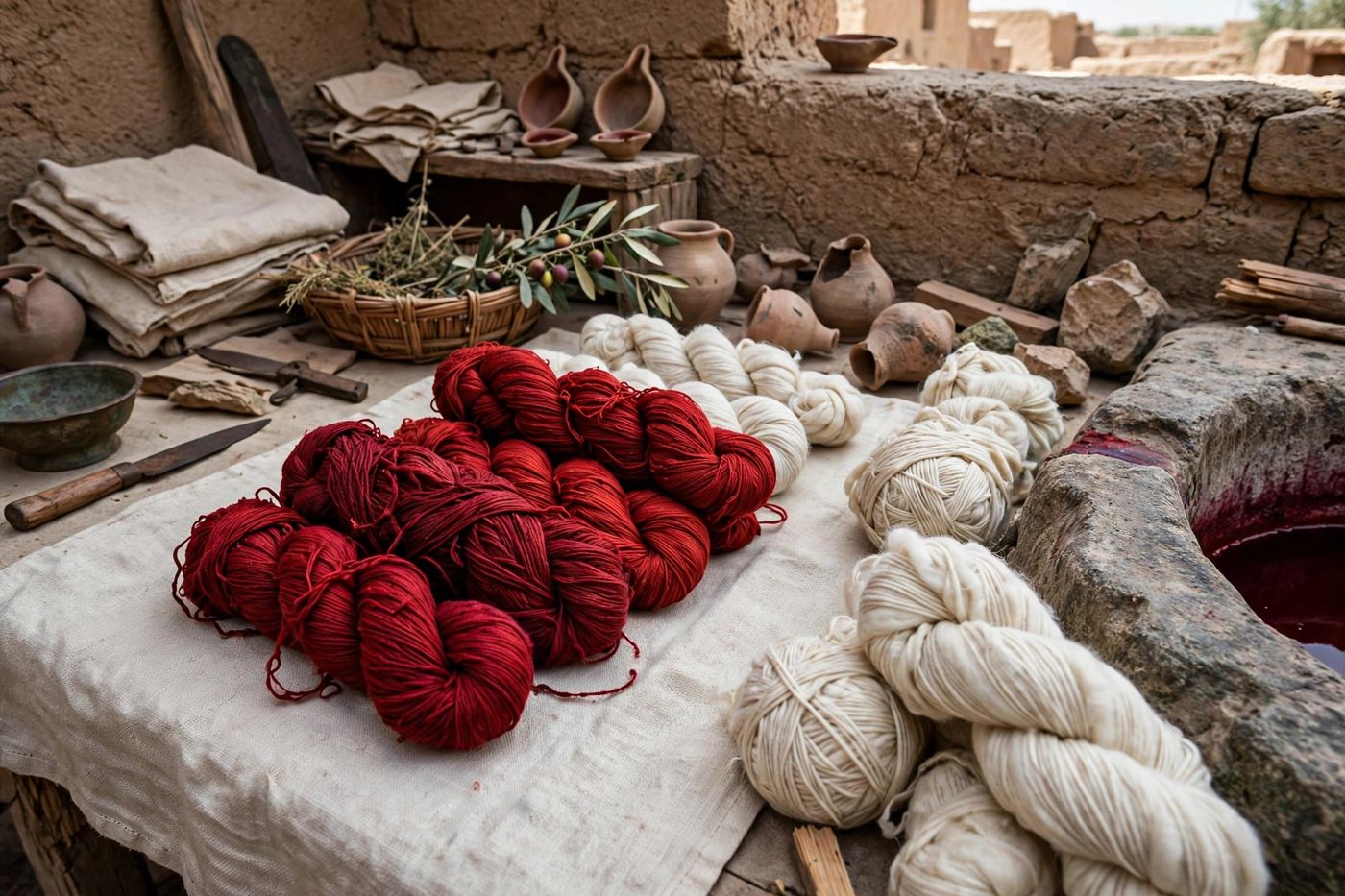
- The scarlet words: shanî and tôlāʿ (shah-NEE; toh-LAH) — the two red words of verse 18, and they are chosen like a jeweller chooses stones. Shanî, "scarlet," names a brilliant red dye; tôlāʿ, rendered "crimson," is the name of the dye-worm itself — the insect from which the deep red was made — so that the phrase can carry the sense "red like the worm-dye" [19, 18]. These were not watercolours. Scarlet and crimson wool and cloth were luxury goods precisely because the colour held — fixed in the fibre, famous for not washing out, worn by the wealthy and used in the tabernacle's own fabrics [16, 18]. That is the whole force of the metaphor, and the Translation Note below sits with it.
Method note — the word-study guardrail: a word means what its author uses it to mean, in its sentence, in its century — not what its oldest root once meant, and not everything it can mean anywhere. Every term above was settled by Isaiah's usage in Isaiah. That is the discipline that keeps word studies honest.
TRANSLATION NOTE — scarlet that will not wash out (v. 18)
Your KJV gives the pair plainly: sins "as scarlet" shall be "as white as snow"; sins "red like crimson" shall be "as wool." Nothing in the rendering is wrong — but an English reader can miss what a Hebrew reader felt in his hands. Scarlet and crimson were dye-fast colours: once wool took that red, ordinary washing did not bring it out. That is why the verse pairs them against snow and undyed wool — the two whitest natural things in that world, things that had never been dyed at all. So the promise is not that God will scrub hard enough. Scrubbing is exactly what cannot do it, and verse 16's "wash you" has already put washing in view. The miracle in the metaphor is a change no laundering achieves: what is permanently dyed, made as though it had never taken the colour. Read the whiteness as God's act, not as the sinner's improved technique — the verse's own colours insist on it [18, 19].
6. ENTIRE CANON — E: where this passage sits in the whole story
No chapter lives alone, and this one least of all: Isaiah 1 is deliberately built as the doorway of a sixty-six-chapter house, and its threads run backward to Moses and forward to the last pages of the New Testament.
- Backward: the witnesses were sworn in by Moses. "Hear, O heavens, and give ear, O earth" (v. 2) reopens Deuteronomy 32, the Song of Moses, which begins with the same summons and tells the same story in advance: a God who fathered His people, a people who rebelled, judgment — and final vindication. Isaiah's opening tells a Bible-reading hearer: the case Moses warned about has now come to court [1, 4]. Deuteronomy 28's blessings and curses stand behind the two ways of verses 19–20 as well.
- Forward inside the book: the seed-chapter. The Holy One becomes the book's refrain; the remnant becomes a named child (7:3) and a returning company (ch. 35); Zion, here a besieged hut, will be lifted up (2:2–4), comforted (ch. 40), and radiant (ch. 60); the purged "city of righteousness" (v. 26) grows toward chapter 65's new heavens and new earth. And the book ends where this chapter ends — with the rebels' unquenchable fire (66:24 answering 1:31) [4, 3].
- Forward into the New Testament: the apostles read this chapter as live ammunition. Paul quotes verse 9 at Romans 9:29, arguing that Israel's survival and the Gentiles' inclusion both run on God's remnant-mercy [1, 4]. Jesus aims Isaiah's worship-charge at His own generation (Matthew 15:7–9, from Isaiah 29:13). And verse 18's whiteness finds its ground in blood: the redeemed in Revelation 7 have "washed their robes, and made them white in the blood of the Lamb," and 1 John 1:7 says Christ's blood "cleanseth us from all sin." The canon does not leave scarlet-to-snow vague. It names the agent — §7's Christ Thread takes it up.
| Isaiah 1 thread | Where the canon takes it |
|---|---|
| Heaven and earth as witnesses (v. 2) | Deuteronomy 32's Song of Moses — the same courtroom, convened in advance 1 |
| "A very small remnant" (v. 9) | Romans 9:29 — Paul: remnant-mercy is how Israel, and now the Gentiles, survive [1, 4] |
| Scarlet made white (v. 18) | Revelation 7:14; 1 John 1:7 — white, in the Lamb's blood 1 |
| "The city of righteousness" (v. 26) | Isaiah 60; 65–66; Revelation 21 — Zion restored, then made new [3, 4] |
| Unquenchable burning (v. 31) | Isaiah 66:24 — the book's own last paragraph returns to this fire 3 |
7. THE MEANING — what the passage teaches
The Walk has established what the text says and where it sits. Now its payload, taught straight — the doctrines this passage actually carries, in the proportions the passage itself gives them.
A Father opens the case — and that changes what kind of case it is
The first words of evidence in this trial are not about a broken regulation. "I have nourished and brought up children, and they have rebelled against me" (v. 2). The plaintiff is a father. The charge is not first of all that Judah broke rules — though they did, and the rules will be named — but that children He raised turned on Him. That is why the ox and the ass are brought in (v. 3), and they are more devastating than any list of statutes. An ox knows its owner. A donkey knows where its food comes from. These are not brilliant animals; that is the point. The lowest bar of creaturely sense — recognise the hand that feeds you — Israel has fallen under. "My people doth not consider": the failure is not finally intellectual, as if Judah lacked information about God. They had the temple, the law, the feasts, the history. The failure is relational knowledge — the knowing that acknowledges, honours, and obeys. A son can pass an exam on his father and still not know him, in the Bible's sense of the word [2, 18].
Sick head to foot — sin as a wound nobody will have treated
Verses 5–6 change the picture from courtroom to sickroom, and the change is the teaching. The nation is one body, with no healthy part left to start a recovery from — head sick, heart faint, the rest "wounds, and bruises, and putrifying sores." Three details carry doctrine. First, the sickness is self-worsening: "Why should ye be stricken any more? ye will revolt more and more." The invasions of verse 7 are, in Isaiah's theology, covenant discipline — and discipline is not working, because the patient answers every blow with more revolt. Second, the wounds are untreated: "not closed, neither bound up, neither mollified with ointment." Nobody is tending them; a people that will spread its hands in prayer (v. 15) will not repent, which is the Bible's word for letting a wound be treated. Third — hold this for verse 18 — the patient cannot heal himself. There is no sound spot to build on. Whatever rescue comes must come from outside [2, 11].
| The patient (vv. 5–6) | The finding |
|---|---|
| Head and heart | Sick, faint — no healthy place to start from |
| Skin and limbs | Wounds, bruises, sores — untreated, unbound, unsoftened |
| The lesson in the image | The cure must come from outside the patient |
The worship God refuses — read verses 11–17 in their own order
Now the chapter's most quoted — and most misquoted — movement. God rejects sacrifices, feasts, assemblies, incense, and even prayers, in language of disgust: "my soul hateth," "I am weary to bear them," "I will not hear." Read in the order the text gives, exactly what is being rejected, and why?
The order is: the offering (vv. 11–12), the calendar (vv. 13–14), the prayers (v. 15) — and threaded through the whole refusal, one stated reason: the hands. "Your hands are full of blood." The sacrifices themselves were God's idea, commanded in His own law, and Isaiah himself will later picture worship God delights in, streaming to Zion from the nations. What God refuses here is not ritual. It is ritual used as a cover — worship as a transaction that lets a man rob widows all week and feel settled with heaven on the Sabbath. "To what purpose?" (v. 11) is a merchant's question: what do you think you are buying with all this livestock? The answer the worshippers assumed — favour, covering, a God kept sweet — is precisely what God says is not for sale, not to bloodied hands [4, 16].
And notice what God puts in worship's place — because He does put something there, in the very next breath, and it is not "nothing, just believe harder." Verses 16–17 are a string of commands, and they are concrete to the point of embarrassment: wash, make clean, put away evil, cease to do evil — then the positive turn — learn to do well, seek judgment (pursue justice; go looking for it), relieve the oppressed, judge the fatherless, plead for the widow. True religion, in God's own courtroom settlement, is measured at the courthouse steps and the widow's door. The three named cases — oppressed, fatherless, widow — are the people Judah's princes were specifically failing (v. 23). God does not give generic ethics homework. He hands the defendants the exact docket they had been refusing to hear [2, 17].
The sequence is the sermon. God does not say: stop sacrificing, start doing justice instead — as if justice were a replacement religion. He says: your sacrifices are refused while your hands are bloody; wash, do justice — and the whole book will then show worship restored, purified, and finally opened to the nations. Severed from justice, worship becomes an abomination to the God who commanded it. Joined to repentance, the same worship is His delight. Hold both halves, or you have not read the passage — you have raided it.
"Come now" — a summons that ends in an offer no court should make
Verse 18 is one of the most loved sentences in the Old Testament, and the commonest way to ruin it is to lift it out of its courtroom. "Come now, and let us reason together" — the verb is courtroom language: to argue a case, to settle a matter by evidence and verdict, the same root-family as the "judge" and "judgment" words running through the chapter [19, 18]. God is not suggesting a negotiation between equals. There is no middle on offer. He has presented the evidence; it is not in dispute; the defendants have not one line of reply in the whole chapter. What "reason together" means here is: come into court, face the case as it stands — and hear what the Judge proposes to do about it.
And what He proposes is the scandal at the centre of the chapter: not a reduced sentence, not probation, but a change of colour that dye cannot undergo — scarlet to snow, crimson to undyed wool (see the Translation Note, §5). The promise is unconditional in its power — only God can do this — and it is not unconditional in its address: it sits between "wash you, make you clean" (v. 16) behind it and "if ye be willing and obedient" (v. 19) in front of it. The offer is free. It is not cheap, and it is not addressed to people crossing their arms. Willingness and obedience are not the price of the whitening — dye cannot buy its own removal — but they are the posture of the people who receive it: the defendants who stop contesting the case, come when called, and take the Judge's settlement on the Judge's terms [2, 4].
Verses 19–20 then set the two ways side by side with treaty-like bluntness: eat the good of the land, or be devoured by the sword — and notice the grim wordplay a translation can only half carry: the people will either eat in the land God gave, or be eaten in it. "For the mouth of the LORD hath spoken it" closes the offer like a seal on a legal document. This is not God wondering what will happen. It is a verdict structure published in advance, so that when either outcome comes, no one can say they were not told which road they were on.
The faithful city, the smelter, and the two fires of God
The last movement (vv. 21–31) weeps, then refines, then warns — in that order, and the order preaches.
First the weeping: "How is the faithful city become an harlot!" (v. 21). The word "How" opens funeral laments in Hebrew poetry. God is singing a dirge over a living city, which is a prophet's way of saying her present course is a kind of death already. The charges are civic and specific — silver turned to dross (the worthless residue on smelted metal), wine watered, princes in league with thieves, bribes loved, the fatherless undefended, the widow unheard (vv. 22–23). Notice: the city's fall is measured not first at its altars but at its courts and markets. A city can keep its temple open and lose its soul in its judiciary [11, 16].
Then the refining — and here a careless reader hears only threat, while the text describes rescue by fire. "I will turn my hand upon thee, and purely purge away thy dross" (v. 25) is a smelter's promise: the fire exists because there is silver buried in dross, and God intends to have it back pure. Verse 26 states the aim — judges restored "as at the first," and a name restored: "The city of righteousness, the faithful city." God does not plan merely to forgive Jerusalem and leave her corrupt with a clean conscience. "Zion shall be redeemed with judgment, and her converts with righteousness" (v. 27) — redeemed through judgment, and made righteous, not excused from righteousness [4, 2].
Two fires, one chapter: the smelter's fire of verse 25 burns dross out of silver God keeps; the fire of verse 31 consumes what has become its own fuel. Same God, same holiness — the difference lies in turning versus forsaking (vv. 27–28).
Then, without softening, the warning: the same chapter that promises purging for the city promises consumption for "they that forsake the LORD" (v. 28), and pictures idol-worshippers becoming their own fuel — the oak whose leaf fades, the garden without water, the strong man as tow (flax fibre, which catches fire at a spark) meeting the spark of his own work, both burning "together, and none shall quench them" (vv. 29–31). The oaks and gardens were sites of the fertility-worship Judah kept choosing over the covenant — sacred trees and planted shrines where they sought life from created things [16, 52]. The judgment is fitted to the sin with poetic exactness: trust in green things, become a dry thing; seek life apart from God, discover what a garden without water actually is. Both fires are in the chapter because both futures are. The smelter's fire and the wildfire are not the same fire, and the difference between them is not God's mood. It is the difference between those who turn (v. 27's converts) and those who forsake (v. 28).
The Christ Thread
Isaiah 1 does not name Jesus, and this study will not pretend otherwise. The Christ Thread here is not a hidden portrait to decode; it is the chapter's own needs, named in the chapter's own words, which the New Testament says Christ met. The patient who cannot heal himself (vv. 5–6) — met by a Servant wounded so that others are healed (Isaiah 53:5), a connection this same book will make explicit. The worship God refuses from bloody hands — answered in the New Testament not by abolishing sacrifice but by one sacrifice offered once, by a priest with clean hands, on behalf of the bloodied (Hebrews 9–10). The scarlet that no washing can whiten — whitened, Revelation says, in the Lamb's blood (Revelation 7:14). And the city promised the name "city of righteousness" finds its final form when John sees a holy city descending, into which nothing unclean enters (Revelation 21). FACT: the New Testament quotes this chapter's remnant-verse for its own argument (Romans 9:29), and builds its cleansing doctrine in this chapter's colours. POSITION — the church's historic reading, held with the labels on: Jesus is the answer to Isaiah 1 not because we have decorated Him with its imagery, but because the chapter diagnoses a condition — whole-body sickness, dye-fast guilt, a corrupt city — that only a rescuer from outside the patient could cure, and the apostles identify that rescuer by name [1, 4].
The thread in one line: Isaiah 1 does not predict a name; it diagnoses a condition — whole-body sickness, dye-fast guilt, a corrupt city — and the New Testament names the rescuer that condition required.
Where in the Covenant Story?
Isaiah 1 stands in the covenant-lawsuit stage of the story: after creation, fall, promise to Abraham, exodus, and law — where the covenant's curses and blessings are formally invoked by God's prosecutor-prophet. The sacrifices refused are Sinai's sacrifices. The land being devoured is the promised land, under its published curse-terms. The two ways of verses 19–20 are Moses' two ways, restated to a generation that imagined they were exempt. And the promised restoration reaches forward past the coming exile to covenant renewal. Isaiah 1 is the old covenant's courtroom doing its appointed work: exposing guilt so thoroughly that when grace speaks — verse 18, in the same chapter — it is unmistakably grace, not self-improvement in religious clothes [17, 57].
The Long View — what the church has believed
You are not this chapter's first reader. The early church read Isaiah as one prophet's unified witness to Christ, and Jerome — who produced the early church's fullest Isaiah commentary (c. AD 408–410) — treats chapter 1 as the book's own doorway [37, 35]. Calvin fastened on exactly the point §10 will defend: God's rejection of the sacrifices targets worship severed from repentance and justice, not the worship God Himself had commanded [36, 2]. Across the centuries there is striking agreement that Isaiah 1 is the book's overture: judgment and mercy announced together, in that order, by the same voice. Where readers have honestly differed is over the book's composition behind the chapter — a real dispute, argued in §16 — which does not move what the chapter says [40, 9]. The centre has held: no historic reading has made its God a God who hates worship, or its pardon a pardon that leaves blood on the hands unaddressed.
That is the payload. The next section compresses it into the one sentence you are meant to carry out of this study.
8. THE AIM SENTENCE — X: eXplain the intent
Everything observed now compresses into one sentence — the author's intended meaning, stated before any application is allowed near it:
In Isaiah 1, God brings His own rebellious children into His covenant court — their land burned, their worship refused from bloody hands — and the Judge Himself offers what no washing could do: scarlet sins made white as snow for the willing and obedient, a corrupt city purged back into the city of righteousness, while those who forsake Him face the unquenchable fire.
If a sermon, a post, or a devotional uses Isaiah 1 to say something that cannot be traced back to that sentence — pardon without the courtroom, judgment without the offer, worship God supposedly despises in itself — it is not this passage talking. That is the whole skill this book exists to build, and the next section is where you watch it work.
9. SAY IT BACK
Close the book and say the AIM sentence from section 8 in your own words — out loud, or written in your notes, without looking. Then say, in one more sentence, what it asks of you this week.
If your version quietly drops a half of the chapter — if the lawsuit becomes only comfort, or the offer becomes only threat, or the washed hands forget the widow — open the lesson and walk it again. This exercise feels small. It is the entire course in miniature: meaning first, in the author's words become your words, then — and only then — your life.
10. THE MISREAD — the guardrail, with verdicts
Three live misuses of this passage. Each gets a fair hearing, the evidence, and a verdict.
Misread 1: "God hates ritual worship — Isaiah 1 proves He wants sincerity and justice instead of sacraments, services, and set forms." Why it sounds right: the language is genuinely violent — God says He is full of their sacrifices, that incense is an abomination, that His soul hates their feasts, that He will not hear their prayers. Quoted flat, it sounds like a divine review of organised religion itself. The evidence: read the passage in its own order (§7). The sacrifices, feasts, and Sabbaths were commanded by God Himself — He is refusing His own gifts, returned by hands "full of blood" (v. 15), from a people whose courts robbed widows (v. 23). The stated ground is never the ritual's existence; it is the worshipper's injustice. And the same prophet will picture God delighting in worship on Zion, sacrifices accepted, foreigners gathered to His holy mountain (Isaiah 56:7; 60). A God who hated ritual as such could not promise its restoration. What He hates is worship deployed as a substitute for repentance. Verdict: the text hates worship severed from justice, not worship. The misread takes God's rejection of a bribe as God's rejection of the altar — and, conveniently, usually ends by excusing the reader from both worship and justice, when the passage commands the second as the condition of the first being heard.
Misread 2: "'Let us reason together' means God negotiates with sinners — He meets us halfway, and salvation is the compromise we agree on." Why it sounds right: "reason together" sounds, to modern ears, like a discussion between reasonable parties who will each give a little. The verse is often quoted as God's invitation to a chat. The evidence: the vocabulary is legal (§5): to reason a case is to argue and settle it in court, and this court has been in session for seventeen verses. The evidence has been presented unanswered; the defendants have spoken no line in the chapter. God is not polling the accused for their terms — He announces the settlement Himself, and the settlement is entirely one-sided in its power: He will make scarlet white, which no negotiation produces and no defendant could propose. Verses 19–20 immediately attach the two verdict-paths, which is not how chats end and exactly how court offers work: accept the Judge's terms, or take the other sentence. Verdict: a summons into court that ends in an offer of pardon — not a negotiation between equals. Softening it into a compromise shrinks both halves of the gospel in the verse: the guilt is worse than a disagreement, and the pardon is greater than a deal.
Halfway guardrail: the first two misreads pull in opposite directions — one makes God an enemy of worship, the other makes Him a negotiator. The text refuses both: He is the worship-giver prosecuting bloody hands, and the Judge whose settlement no defendant could have proposed.
Misread 3: "Verse 18 promises pardon with no repentance attached — 'scarlet to snow' means God wipes the slate no matter how I live." Why it sounds right: verse 18 by itself states the whitening as a flat promise, and it is often printed alone — on cards, in tracts, at funerals — severed from everything around it. The evidence: ten verses either side, this course's standing test. Behind the promise stands verse 16 — "Wash you, make you clean" — and verse 17's justice-docket. In front of it stands verse 19 — "If ye be willing and obedient" — and verse 20's sword for those who "refuse and rebel." The text's own order is repentance commanded, pardon offered, two ways published. What the promise does exclude is earning: dye cannot remove dye, and the whitening is God's act, not the wage of the obedient (§5, §7). But a pardon addressed to the willing is not promised to the refusing — verse 20 is in the same paragraph, from the same mouth. Verdict: pardon with repentance all around it — verses 16–19 read whole. Isolate verse 18 and you have not found a bigger grace than Isaiah's; you have invented a different doctrine and signed his name to it.
11. FROM WORD TO WALK
A reflection page — the lesson is not finished until the passage has had its say with you.
Stand in the courtroom a moment, and notice where you have been standing in it. It is comfortable to read Isaiah 1 as a spectator — admiring God's prosecution of them: corrupt princes, bloodied hands, a harlot city. The chapter is built to take that seat away. The accused are not pagans. They are the nourished children, the temple-going, feast-keeping, prayer-spreading people of God — insiders whose worship was full and whose widows were unheard. For a churchgoing reader, Isaiah 1 is not a window onto somebody else's corruption. It is a mirror with the lights turned up.
So let the chapter's two searching questions search you, in its own order. First, the hands: what do yours do all week — with money that could relieve, influence that could defend, silence where an overlooked person needed somebody to plead? God grades Judah's worship at the courthouse, by whether the powerless got heard. Second, the washing: "wash you" is a command, and verse 18 confesses a stain no washing of yours can reach. Both are true at once — God genuinely commands your turning, and the whiteness itself is His gift, or it does not happen. Bring Him the bloody hands honestly. That is what "come now" is for.
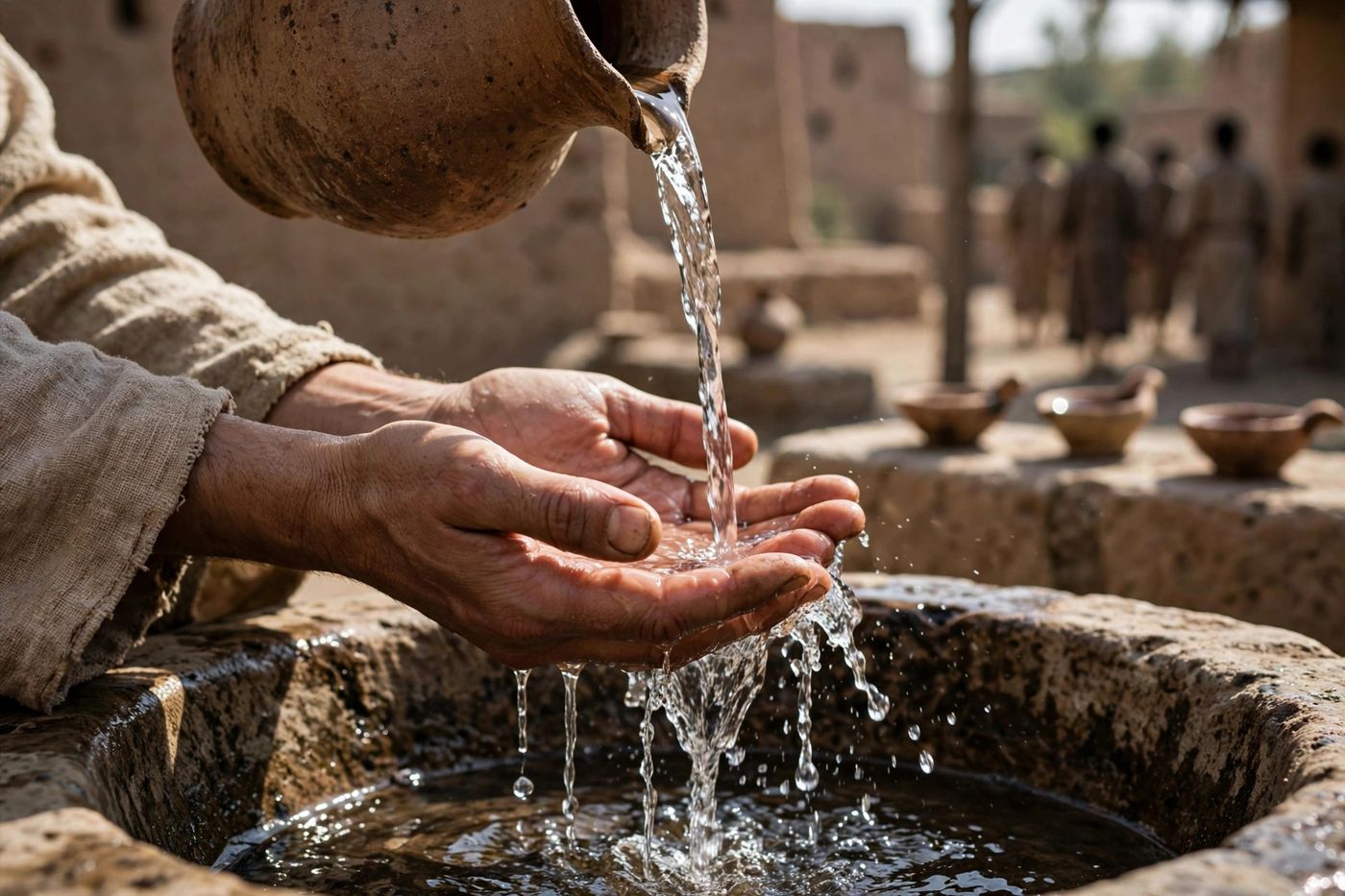
Holy One of Israel — I have spread my hands in prayer and kept them busy with things You call blood. I will not rename them clean. Name my dross for me; teach my hands to plead for the people I have walked past; and do in me what no washing of mine can do — make scarlet white, on Your terms, because You offered it. Turn Your hand upon me as the smelter turns it, not to consume, but to restore the name. In Jesus' name, amen.
12. FOR DISCUSSION — OR FOR YOUR JOURNAL
With a group, work these aloud. Alone, they're yours — answer them in your journal or in prayer; they lose nothing in the quiet.
- God opens His case with a father's history: "I have nourished and brought up children." How does it change your hearing of this chapter's severity that the plaintiff is a father — and where has ingratitude, rather than ignorance, been the shape of your own distance from God?
- Verses 16–17 hand Judah a specific docket — the oppressed, the fatherless, the widow — rather than general instructions to be nicer. Who are the specific, nameable people in your world whose cause does not currently "come unto" you (v. 23)? What would pleading for one of them concretely look like this month?
- The chapter holds two things together that we keep pulling apart: God commands "wash you, make you clean," and only God can make scarlet white. Which half do you instinctively drop — self-effort that tries to launder the dye out, or a passive pardon that never gets around to ceasing evil? What does holding both change?
- A friend quotes verse 18 and says repentance is unnecessary because "God makes scarlet white, full stop." Using this study's verdicts — and keeping your friendship — how do you answer from verses 16–20 read whole?
13. THE WALK-OUT — T: Transfer to today
Meaning is settled. Now — and only now — application, and it must cross the bridge honestly. Run the five Transfer Tests on this passage:
- Same covenant? Judah stood under the Sinai covenant, with its temple sacrifices and its published land-curses; we live under the new covenant, on the far side of the cross, where sacrifice has been offered once for all. So the forms do not transfer directly — no reader is commanded to bring, or to stop bringing, a burnt offering. What transfers is the covenant principle the forms carried: the God who gave the worship still refuses it from unrepentant, unjust hands — a principle the New Testament itself restates about prayer, giving, and the Lord's Table.
- Same audience? The first defendants were God's covenant people, not outsiders — and that is exactly the audience that must not dodge this chapter now. Isaiah 1 transfers most directly not as a weapon against the world's corruption but as a mirror for the church's: full worship, unheard widows.
- Same genre rules? A poetic lawsuit: it prosecutes by image and verdict, not by giving the modern reader a checklist to photocopy. The commands inside it (vv. 16–17) are genuinely commands — poetry does not dissolve imperatives — but the cases named must be translated to their equivalents, not copied as a closed list: "the oppressed, the fatherless, the widow" names whoever in your world has no protector and no hearing.
- Repeated or rooted? Worship joined to justice is not an Isaiah eccentricity. It runs from Amos ("let judgment run down as waters") through Micah 6:8 to James's definition of pure religion — visiting the fatherless and widows — and Jesus' own woe on tithing that neglects judgment and mercy. Rooted in God's character, repeated across both Testaments: this crosses at full weight [1, 17].
- Ten verses either side? Every application below is drawn from the chapter read whole — the offer kept with the courtroom, the washing kept with the whitening, the purge kept with the promise. Nothing hangs on verse 18 torn out of its paragraph, or verses 11–15 torn out of God's own authorship of the sacrifices.
| Test result in brief | What it lets through |
|---|---|
| Covenant forms stay in Sinai | The principle crosses: worship refused from unjust hands |
| Audience is God's own people | The mirror is for the church first, not the world first |
| Rooted and repeated (Amos, Micah, James, Jesus) | Worship joined to justice, at full weight |
What crosses — and lands:
- God acted first, and His act is the ground under everything asked of you. Before any practice below: the Judge offered the settlement. Scarlet is white because God makes it white — in the canon, through the blood of Christ (§6, §7) — and the city is righteous because God restores her judges and her name. The indicative leads: you do not wash to persuade a reluctant God to notice you; you wash because the God who alone can whiten has called you into His court and spoken pardon over the willing.
- Repentance in this chapter is a hand-washing, not a mood. "Cease to do evil; learn to do well" is a change of practice with named beneficiaries. Crossed over, it means the turn you make this week should be findable — in your accounts, your calendar, your courtroom-equivalents — by the people it was meant to relieve.
- Worship will be audited at the widow's door. Not instead of the gathering — the passage never cancels the assembly; it refuses the assembly as a hiding place. The application is a joined life: hands spread in prayer that are clean because they were busy, all week, seeking judgment for people who cannot bribe anybody.
- The smelter's fire is not the wildfire. For the turning, God's purging aims at a restored name (v. 26). Read conviction that exposes dross in you as refining — painful, purposeful, pointed at purity — not as the unquenchable burning reserved for forsaking. The chapter keeps the fires distinct, and so should you.
Practices — what the gate lets through, made concrete this week:
- The hands audit. Thirty unhurried minutes with verses 15–17 open. Ask, in writing: whose cause has not come unto me? List specific people — the overlooked at work, the unprotected in your family or church, the neighbour with no advocate. The chapter names cases, and so should you.
- One case pleaded. From that list, take one — one widow-equivalent, one fatherless-equivalent, one oppressed person — and do one concrete act of pleading this week: the phone call made, the form filled in alongside them, the money quietly moved, the authority appealed to on their behalf. "Plead for the widow" is a practice before it is a sentiment.
- Wash before you worship. Before your next gathering for worship, come the chapter's way: confess specifically — the named evil ceased, not a vague fog of regret — and where your hands' work has harmed or neglected someone, make the first move of repair before you sing. Verse 16 comes before any restored verse 11.
- Pray verse 18 whole. Each morning, pray the promise with its paragraph attached: thank God that the whitening is His act, ask Him to make you willing and obedient (v. 19) rather than merely sorry, and name one scarlet thing you are bringing into His court instead of managing yourself.
- Memorize Isaiah 1:17. The docket, by heart — "seek judgment, relieve the oppressed, judge the fatherless, plead for the widow" — so that the chapter's definition of doing well is available to you at the moment a case actually crosses your path.
Before the gate closes: notice what the practices above have in common — every one of them is a hand-practice. This chapter measures faith where hands work, give, plead, and wash. If an application of Isaiah 1 never reaches your hands, it has not crossed yet.
What does not cross: treating verse 18 as a pardon detached from repentance (§10, Misread 3); wielding verses 11–15 against other Christians' worship while your own hands go unaudited (§10, Misread 1); claiming Judah's land-promises ("eat the good of the land") as a personal prosperity contract — those sentences ran on the Sinai covenant's published terms to that nation in that land; and reading the unquenchable fire of verse 31 as God's word to the repentant, when the text addresses it to those who forsake Him. The gate is not there to shrink the Bible's claims on you. It is there to make sure the claims that land are the ones God actually made.
Praise Him
Holy One of Israel — the children You nourished rebelled, and You did not lower Your holiness to keep them, nor abandon Your name to lose them. You called heaven and earth to hear; You showed us our sores and would not be bribed with sacrifices; and then, Judge that You are, You Yourself spoke the only sentence that could save the defendants: scarlet, made white as snow. Smelter of Zion, purge our dross until this people can be called again what You first called us — a city of righteousness, a faithful city — for the mouth of the LORD hath spoken it, and Your mouth does not lie. To You, Father, Son, and Holy Spirit, be the praise of the washed. Amen.
14. THE RECAP CARD — this study on one page
Print it. Keep it where you'll see it this week.
- The passage: Isaiah 1:1–31 — the covenant lawsuit: God's case against His own children, His offer of whitening, and His promise to purge Zion back into the city of righteousness.
- Say It Plain: God sues His rebellious people; their land is burned and their worship refused from bloody hands; wash, do justice — and scarlet can become snow for the willing, while the refusing face the sword, and the faithful city is promised her name back.
- The AIM: In Isaiah 1, God brings His own rebellious children into His covenant court — their land burned, their worship refused from bloody hands — and the Judge Himself offers what no washing could do: scarlet sins made white as snow for the willing and obedient, a corrupt city purged back into the city of righteousness, while those who forsake Him face the unquenchable fire.
- Key terms: rîb — a covenant lawsuit, a case to be settled in court · the Holy One of Israel — God's signature name in Isaiah: unapproachable holiness, bound to this people · she'ar — remnant, the survivors God leaves · shanî / tôlāʿ — scarlet / crimson, the reds that do not wash out.
- The Misread, in one line: God refuses worship severed from justice, not worship · "reason together" is a court summons ending in pardon, not a negotiation · verse 18's pardon stands with repentance on both sides of it (vv. 16–19).
- Memory verse: "Come now, and let us reason together, saith the LORD: though your sins be as scarlet, they shall be as white as snow; though they be red like crimson, they shall be as wool." — Isaiah 1:18
- This week's practice: the hands audit — one overlooked person's case, pleaded concretely — and washing before worship: one named evil confessed and ceased.
From card to conscience: the Recap Card is for your wall; the next section is for your honesty. Answer §15 from the study — if a question exposes a gap, that gap is the lesson pointing you back to the section that fills it.
15. CHECK YOURSELF — five questions
Answer from the study, not from instinct. (Answers live in the Teacher Edition.)
- In your own words: what is the AIM of Isaiah 1:1–31?
- Why does God refuse Judah's sacrifices, feasts, and prayers in verses 11–15 — and what evidence from the chapter shows He is not rejecting worship itself?
- What do the scarlet and crimson dye words of verse 18 contribute to the promise — why is "made white" a miracle and not a laundering result?
- Someone says: "'Let us reason together' shows God negotiates salvation with us, and verse 18 means repentance isn't required." Answer them from the chapter, in order.
- What is the difference between the fire of verse 25 (purging dross) and the fire of verse 31 (none shall quench) — and what decides which fire a person meets?
16. GO DEEPER
Optional — for readers who want the machinery. The lesson is complete without it.
From the Sources — Sodom's file, opened
Verse 9's mercy depends on remembering what Sodom was in the record: a destruction so complete that the cities became the Bible's shorthand for judgment without remainder [47, 46]. Isaiah's point is the inverse of Genesis 18–19: in Judah, a remnant was left, by God's act ("the LORD of hosts had left unto us"), and that left-over few is the entire difference between a judged nation with a future and a name on a cautionary tale. FACT: Paul, arguing in Romans 9 that God's purposes for Israel have not failed, reaches for exactly this verse — remnant-mercy is the standing pattern of how God carries a people through judgment [1, 4]. INFERENCE: that is why the remnant theme, introduced here as a "very small" survival, can bear the weight the rest of the book loads onto it.
The Honest Argument — one Isaiah, or three?
The book behind this chapter carries modern scholarship's most famous authorship dispute, stated here with the lights on. FACT: since Duhm's 1892 commentary, mainstream scholarship has commonly spoken of First Isaiah (chs. 1–39), Second Isaiah (exilic, chs. 40–55), and Third Isaiah (post-exilic, chs. 56–66) — on grounds of setting, style, and Cyrus named centuries ahead [40, 9]. FACT: the other direction has hard data too: the Great Isaiah Scroll (c. 125 BC) already contains all sixty-six chapters as one scroll; the Septuagint presents one book; and the New Testament cites all three sections under the single name "Isaiah" — John 12 sets chapter 53 beside chapter 6 as one prophet's words [22, 24]. DISPUTED: how those facts should be weighed. POSITION — this program's, labelled: the book is read here as Isaiah's, one prophet's witness read whole, following the church's historic reading and the New Testament's citation practice [35, 50]. For this chapter the dispute matters least of anywhere: its eighth-century setting is affirmed across the spectrum. What no side may honestly do is pretend the other side's evidence does not exist.
POSITION — stated plainly, as this course states its positions: the Great Isaiah Scroll is one scroll, the New Testament cites all three sections as "Isaiah," and the church has read one prophet's book for two thousand years. This program reads it that way — with the critical case stated above at full strength, not hidden.
The Word Underneath — yakhaḥ, to reason a case out
The verb inside "let us reason together" (v. 18) is yakhaḥ — to decide, to reprove, to argue a matter to its settlement [19, 18]. Its range is legal and relational at once: not laboratory reasoning, and not haggling, but the hammering-out of a case until a verdict or agreement stands. FACT: the same root supplies the chapter's atmosphere — judgment sought (v. 17), a city once "full of judgment" (v. 21), Zion "redeemed with judgment" (v. 27). INFERENCE: verse 18 therefore invites the defendants not to a seminar but to the settlement table of a court that has already heard the evidence — which is why the verse can be tender ("come now") and non-negotiable in its two outcomes (vv. 19–20) at the same time.
| Label | Where it worked in this section |
|---|---|
| FACT | The Scroll is one scroll; Paul quotes v. 9; the dye words' senses |
| DISPUTED | How the unity evidence should be weighed |
| POSITION | This program reads the book as Isaiah's, whole |
| INFERENCE | The remnant pattern's load-bearing role; yakhaḥ's courtroom colour |
Go Read
- Oswalt, The Book of Isaiah, Chapters 1–39 (NICOT) 2 — the fullest evangelical treatment of the chapter's lawsuit structure and of the four-kings setting of verse 1.
- Motyer, The Prophecy of Isaiah 4 — especially strong on chapter 1 as the book's overture and on the Holy One of Israel as the book's signature name for God.
- Walton, Matthews & Chavalas, The IVP Bible Background Commentary: Old Testament 16 — the ancient Near Eastern background on treaties, dyes, smelting, and city life behind the chapter's images.
17. SOURCES & REFERENCES
Numbered citations in this lesson key to this list — the course standard: every sourced claim carries its number, and every number can be checked.
- The KJV text itself — Holy Bible, King James Version (eBible.org KJV, 1769 text). Scripture quotations are from the King James Version (KJV), which is in the public domain in the United States; the full passage is always assigned as reading. Cross-references within Scripture cite this number.
- Oswalt, The Book of Isaiah, Chapters 1–39 (NICOT) — John N. Oswalt (Eerdmans). The leading evangelical commentary on the first half; defends essential unity of authorship and reads the book as a finished theological whole. Detailed notes on the Assyrian-period history (Ahaz, Hezekiah, Sennacherib).
- Oswalt, The Book of Isaiah, Chapters 40–66 (NICOT) — John N. Oswalt (Eerdmans). The second volume: the comfort section, the Servant Songs, Cyrus, and the new-creation chapters, read as the deliberate answer to chapters 1–39.
- Motyer, The Prophecy of Isaiah — J. Alec Motyer (IVP). A one-volume commentary by an evangelical scholar who argues the whole book breathes the mind of the eighth-century prophet; especially strong on the book's structure, its repeated refrains, and the Servant.
- Blenkinsopp, Isaiah 1–39, Isaiah 40–55, Isaiah 56–66 (Anchor Bible) — Joseph Blenkinsopp (Doubleday). Mainstream-critical commentary across all three traditional divisions; a fair statement of the multiple-authorship case and of post-exilic settings.
- Smith, Isaiah 1–39 and Isaiah 40–66 (New American Commentary) — Gary V. Smith (B&H). Evangelical commentary with strong historical notes (the Assyrian and Babylonian records) and an even-handed survey of the authorship debate.
- Brueggemann, Isaiah 1–39 and Isaiah 40–66 (Westminster Bible Companion) — Walter Brueggemann (Westminster John Knox). A rhetorical-theological reading for preachers and teachers; strong on the poetry's movement from judgment to hope.
- Walton, Matthews & Chavalas, The IVP Bible Background Commentary: Old Testament — John H. Walton, Victor H. Matthews, Mark W. Chavalas (IVP). Verse-by-verse ancient Near Eastern background: Assyrian siege practice, Babylonian religion, treaty and coronation customs, geography.
- Boda & McConville (eds.), Dictionary of the Old Testament: Prophets — Mark J. Boda and J. Gordon McConville (IVP). Articles on Isaiah's composition, the Servant, Zion, the nations oracles, and the prophetic genres, written across the scholarly spectrum.
- VanGemeren (ed.), New International Dictionary of Old Testament Theology and Exegesis (NIDOTTE) — Willem A. VanGemeren (Zondervan). Theological word studies with semantic-range discipline for the Hebrew terms.
- Brown, Driver & Briggs, Hebrew and English Lexicon of the Old Testament (BDB) — The standard older Hebrew lexicon; word senses and usage ranges for the Terms sections.
- The Great Isaiah Scroll (1QIsaᵃ) and the Dead Sea Scrolls Bible — The complete Isaiah scroll from Qumran Cave 1 (c. 125 BC), in Abegg, Flint & Ulrich, The Dead Sea Scrolls Bible (HarperSanFrancisco). The oldest substantial witness to Isaiah's text — already a single scroll of all 66 chapters centuries before Christ.
- The Septuagint (LXX) — Rahlfs–Hanhart edition. The ancient Greek Isaiah (2nd century BC): itself already one book of 66 chapters, and the Bible of the early church; its renderings (e.g., parthenos at 7:14) argued in the open where they matter.
- Alexander, Commentary on the Prophecies of Isaiah — Joseph Addison Alexander (19th century; public domain). The great Princeton defense of the book's unity and messianic reading, argued from the Hebrew.
- Calvin, Commentary on Isaiah — John Calvin (public domain). Reformation exegesis; a control on interpretation and a voice in the Long View.
- Jerome, Commentary on Isaiah — Jerome (c. AD 408–410). The early church's fullest Isaiah commentary; Jerome transmits the Hebrew learning of his day and treats Isaiah as one prophet's book.
- Duhm, Das Buch Jesaia (1892) — Bernhard Duhm. The commentary that named the "Servant Songs" as a distinct set and crystallized the "Deutero-Isaiah" division — the historical origin of the modern authorship debate, cited as fact about scholarship.
- The International Standard Bible Encyclopedia (rev. ed.) — Articles on Isaiah, Assyria, Babylon, Lachish, the Servant of the Lord, and related entries — encyclopedic background and older scholarship in one place.
- Freedman (ed.), The Anchor Bible Dictionary — Articles on Isaiah, Zion, the remnant, anointing, and the ancient Near Eastern entries.
- Archer, A Survey of Old Testament Introduction — Gleason L. Archer (Moody). The standard conservative survey of the authorship question, including the Cyrus argument and the New Testament's citation pattern.
- Fee & Stuart, How to Read the Bible for All Its Worth — Gordon D. Fee and Douglas Stuart (Zondervan). The beginner's method book; its prophecy chapter ("a forthtelling first") undergirds the Genre sections.
- Ryken, Wilhoit & Longman (eds.), Dictionary of Biblical Imagery — Leland Ryken et al. (IVP). Isaiah's image-fields — vineyard, highway, banner, potter, watchman — traced across the canon.
- King & Stager, Life in Biblical Israel — Philip J. King and Lawrence E. Stager (Westminster John Knox). Daily life, agriculture, warfare, and worship in Isaiah's world.
- House, Old Testament Theology — Paul R. House (IVP). Isaiah's place in a whole-Bible theology; the book's three movements read as one argument.