
One study, one walk — the universal FIRM format. The passage first and whole; then its world; then the Walk (Context · Observe · Genre · Terms · Entire Canon); the meaning taught straight; the AIM sentence; the misread exposed and answered; and the walk-out, where application has to pass the Transfer Tests before it reaches your week. The same skeleton serves a book, a chapter, a single verse, or a whole subject. In the early studies the moves are labeled as they happen. The labels fade as the walk becomes yours.
THE WEEK WITH THIS STUDY — six bites
Day 1 — Read the passage · Say It Plain · The World (§§1–2) · Day 2 — Observe · Genre (§§3–4) · Day 3 — Terms · Entire Canon (§§5–6) · Day 4 — The Meaning · the AIM Sentence · Say It Back (§§7–9) · Day 5 — The Misread · From Word to Walk (§§10–11 — add For Discussion, §12, if you're with others) · Day 6 — The Walk-Out · the Recap Card (§§13–14). Go Deeper (§16) any evening you want the basement.
BEFORE YOU READ — Open My Eyes
LORD, You spoke before anyone asked, and You spread out Your hands all day to people walking the other way. Open my eyes at the end of this long book: teach me to tremble at Your word, to hope in the world You are creating, and to hold Your comfort and Your warning together, the way You wrote them. In Jesus' name, amen.
§ means “section” — the numbered parts of your lesson. Each bite above names the sections for that day.
1. READ THE PASSAGE — Isaiah 65:1–66:24 (KJV)
Read it all, slowly, before any teaching. In this course the passage always prints once, in full, at the head of the lesson. Everything after this is commentary — this is the text.
One orientation before you read: this is the book's final lesson, taking Isaiah's last two chapters as one continuous passage, because the book does. Chapter 65 is God's answer to the great prayer that closed Lesson 34 (63:7–64:12); chapter 66 carries that answer to the book's last verse. The verse numbers restart at chapter 66. Read to the very end — the final verse is part of the passage, and this lesson will not look away from it.
Isaiah 65
1 I am sought of them that asked not for me; I am found of them that sought me not: I said, Behold me, behold me, unto a nation that was not called by my name.
2 I have spread out my hands all the day unto a rebellious people, which walketh in a way that was not good, after their own thoughts;
3 A people that provoketh me to anger continually to my face; that sacrificeth in gardens, and burneth incense upon altars of brick;
4 Which remain among the graves, and lodge in the monuments, which eat swine's flesh, and broth of abominable things is in their vessels;
5 Which say, Stand by thyself, come not near to me; for I am holier than thou. These are a smoke in my nose, a fire that burneth all the day.
6 Behold, it is written before me: I will not keep silence, but will recompense, even recompense into their bosom,
7 Your iniquities, and the iniquities of your fathers together, saith the LORD, which have burned incense upon the mountains, and blasphemed me upon the hills: therefore will I measure their former work into their bosom.
8 Thus saith the LORD, As the new wine is found in the cluster, and one saith, Destroy it not; for a blessing is in it: so will I do for my servants' sakes, that I may not destroy them all.
9 And I will bring forth a seed out of Jacob, and out of Judah an inheritor of my mountains: and mine elect shall inherit it, and my servants shall dwell there.
10 And Sharon shall be a fold of flocks, and the valley of Achor a place for the herds to lie down in, for my people that have sought me.
11 But ye are they that forsake the LORD, that forget my holy mountain, that prepare a table for that troop, and that furnish the drink offering unto that number.
12 Therefore will I number you to the sword, and ye shall all bow down to the slaughter: because when I called, ye did not answer; when I spake, ye did not hear; but did evil before mine eyes, and did choose that wherein I delighted not.
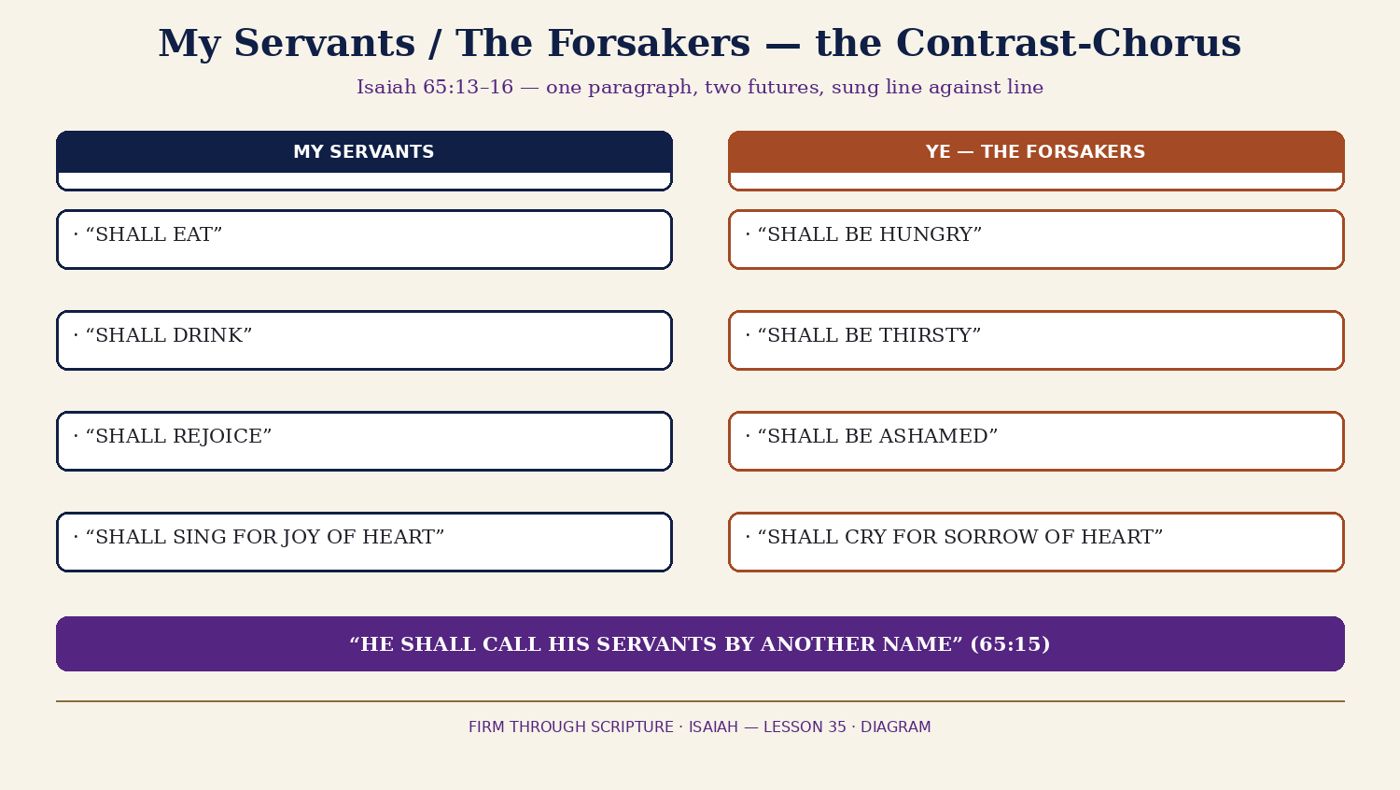
13 Therefore thus saith the Lord GOD, Behold, my servants shall eat, but ye shall be hungry: behold, my servants shall drink, but ye shall be thirsty: behold, my servants shall rejoice, but ye shall be ashamed:
14 Behold, my servants shall sing for joy of heart, but ye shall cry for sorrow of heart, and shall howl for vexation of spirit.
15 And ye shall leave your name for a curse unto my chosen: for the Lord GOD shall slay thee, and call his servants by another name:
16 That he who blesseth himself in the earth shall bless himself in the God of truth; and he that sweareth in the earth shall swear by the God of truth; because the former troubles are forgotten, and because they are hid from mine eyes.
17 For, behold, I create new heavens and a new earth: and the former shall not be remembered, nor come into mind.
18 But be ye glad and rejoice for ever in that which I create: for, behold, I create Jerusalem a rejoicing, and her people a joy.
19 And I will rejoice in Jerusalem, and joy in my people: and the voice of weeping shall be no more heard in her, nor the voice of crying.
20 There shall be no more thence an infant of days, nor an old man that hath not filled his days: for the child shall die an hundred years old; but the sinner being an hundred years old shall be accursed.
21 And they shall build houses, and inhabit them; and they shall plant vineyards, and eat the fruit of them.
22 They shall not build, and another inhabit; they shall not plant, and another eat: for as the days of a tree are the days of my people, and mine elect shall long enjoy the work of their hands.
23 They shall not labour in vain, nor bring forth for trouble; for they are the seed of the blessed of the LORD, and their offspring with them.
24 And it shall come to pass, that before they call, I will answer; and while they are yet speaking, I will hear.
25 The wolf and the lamb shall feed together, and the lion shall eat straw like the bullock: and dust shall be the serpent's meat. They shall not hurt nor destroy in all my holy mountain, saith the LORD.
Isaiah 66
1 Thus saith the LORD, The heaven is my throne, and the earth is my footstool: where is the house that ye build unto me? and where is the place of my rest?
2 For all those things hath mine hand made, and all those things have been, saith the LORD: but to this man will I look, even to him that is poor and of a contrite spirit, and trembleth at my word.
3 He that killeth an ox is as if he slew a man; he that sacrificeth a lamb, as if he cut off a dog's neck; he that offereth an oblation, as if he offered swine's blood; he that burneth incense, as if he blessed an idol. Yea, they have chosen their own ways, and their soul delighteth in their abominations.
4 I also will choose their delusions, and will bring their fears upon them; because when I called, none did answer; when I spake, they did not hear: but they did evil before mine eyes, and chose that in which I delighted not.
5 Hear the word of the LORD, ye that tremble at his word; Your brethren that hated you, that cast you out for my name's sake, said, Let the LORD be glorified: but he shall appear to your joy, and they shall be ashamed.
6 A voice of noise from the city, a voice from the temple, a voice of the LORD that rendereth recompence to his enemies.
7 Before she travailed, she brought forth; before her pain came, she was delivered of a man child.
8 Who hath heard such a thing? who hath seen such things? Shall the earth be made to bring forth in one day? or shall a nation be born at once? for as soon as Zion travailed, she brought forth her children.
9 Shall I bring to the birth, and not cause to bring forth? saith the LORD: shall I cause to bring forth, and shut the womb? saith thy God.
10 Rejoice ye with Jerusalem, and be glad with her, all ye that love her: rejoice for joy with her, all ye that mourn for her:
11 That ye may suck, and be satisfied with the breasts of her consolations; that ye may milk out, and be delighted with the abundance of her glory.
12 For thus saith the LORD, Behold, I will extend peace to her like a river, and the glory of the Gentiles like a flowing stream: then shall ye suck, ye shall be borne upon her sides, and be dandled upon her knees.
13 As one whom his mother comforteth, so will I comfort you; and ye shall be comforted in Jerusalem.
14 And when ye see this, your heart shall rejoice, and your bones shall flourish like an herb: and the hand of the LORD shall be known toward his servants, and his indignation toward his enemies.
15 For, behold, the LORD will come with fire, and with his chariots like a whirlwind, to render his anger with fury, and his rebuke with flames of fire.
16 For by fire and by his sword will the LORD plead with all flesh: and the slain of the LORD shall be many.
17 They that sanctify themselves, and purify themselves in the gardens behind one tree in the midst, eating swine's flesh, and the abomination, and the mouse, shall be consumed together, saith the LORD.
18 For I know their works and their thoughts: it shall come, that I will gather all nations and tongues; and they shall come, and see my glory.
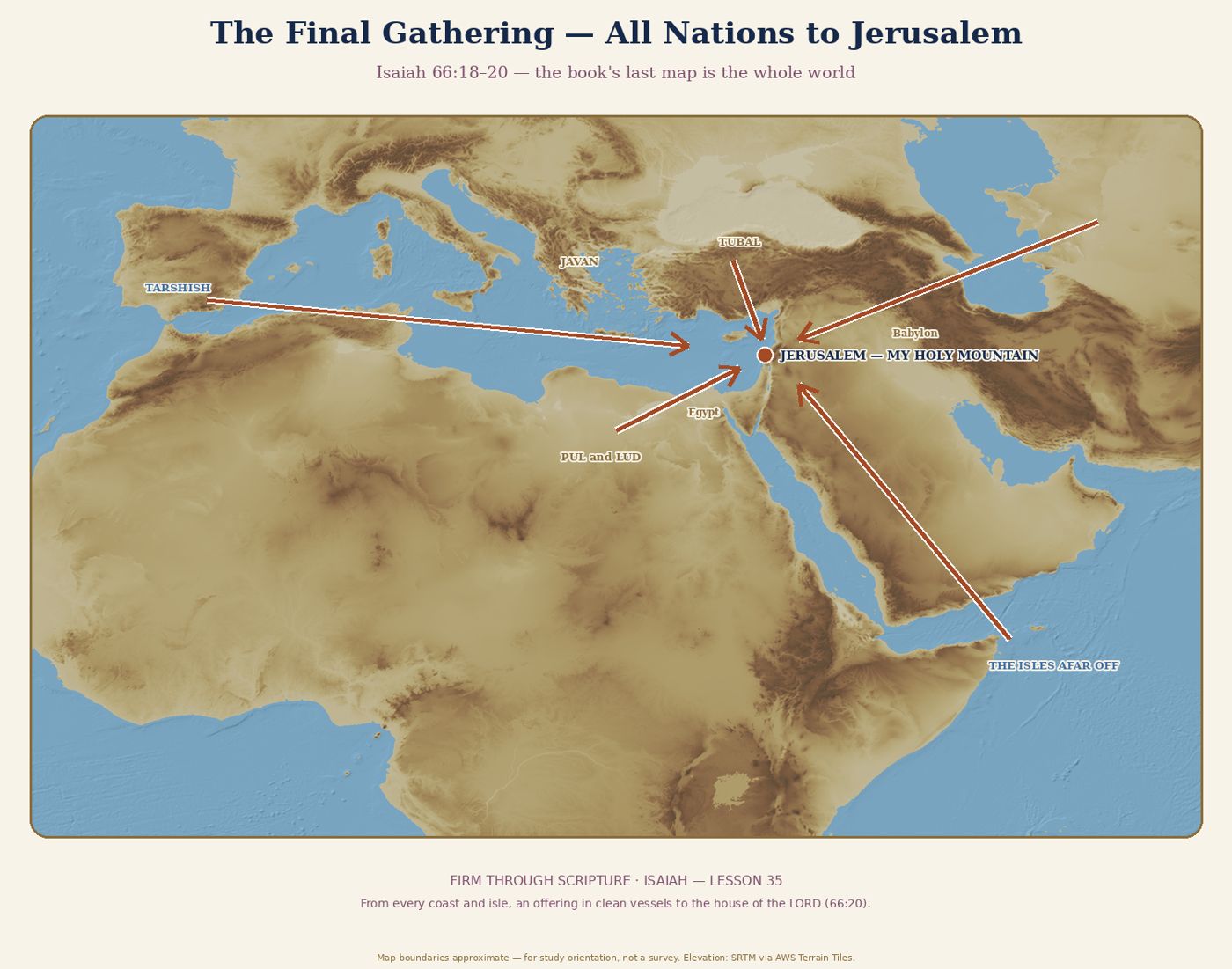
19 And I will set a sign among them, and I will send those that escape of them unto the nations, to Tarshish, Pul, and Lud, that draw the bow, to Tubal, and Javan, to the isles afar off, that have not heard my fame, neither have seen my glory; and they shall declare my glory among the Gentiles.
20 And they shall bring all your brethren for an offering unto the LORD out of all nations upon horses, and in chariots, and in litters, and upon mules, and upon swift beasts, to my holy mountain Jerusalem, saith the LORD, as the children of Israel bring an offering in a clean vessel into the house of the LORD.
21 And I will also take of them for priests and for Levites, saith the LORD.
22 For as the new heavens and the new earth, which I will make, shall remain before me, saith the LORD, so shall your seed and your name remain.
23 And it shall come to pass, that from one new moon to another, and from one sabbath to another, shall all flesh come to worship before me, saith the LORD.
24 And they shall go forth, and look upon the carcases of the men that have transgressed against me: for their worm shall not die, neither shall their fire be quenched; and they shall be an abhorring unto all flesh.
SAY IT PLAIN — the passage in everyday words: God answers the prayer that ended the last lesson — and His answer starts with Himself: I spoke first. I let people find Me who weren't even looking, and I held out My hands all day to My own people while they walked away. He lists their secret religions — garden sacrifices, grave-visiting, forbidden food, a smug "I'm holier than you" — and promises repayment. But He will not destroy everyone: like good grapes in one cluster, a faithful remnant — His servants — will inherit the land, while those who set tables for Luck and Destiny get the sword. Then God announces the end of the story: I am creating new heavens and a new earth — a Jerusalem with no weeping, long life, work that isn't stolen, prayers answered before they're finished, and even the animals at peace. Chapter 66 opens at the throne: heaven is God's seat and earth His footstool, so no temple impresses Him — He looks to the poor, the broken-spirited, the one who trembles at His word. Worshippers who chose their own ways get the delusions they chose; the tremblers, hated even by their own brothers, get joy. Zion gives birth in a day; Jerusalem nurses her children; peace flows in like a river. And the book closes with fire and worship side by side: God gathers every nation, sends survivors out as missionaries, receives the nations' people as an offering — even as priests — and swears the new world, and His people's name, will last. All flesh worships. And outside, the rebels' end stands in view, unquenched and undying, exactly as the last verse says. That's the whole passage. Everything after this teaches from it — nothing will change what you just read.
2. THE WORLD — C: Context & Audience
A text can never mean what it never meant — so before we ask what these verses mean, we stand where their first hearers stood.
Where we are in the book. You have walked the whole of Isaiah to get here. Part One (chapters 1–39) was the Book of the King: the eighth-century prophet Isaiah, son of Amoz, preaching in Jerusalem while the empire of Assyria — the superpower to the northeast — swallowed Israel's northern kingdom and beat against Judah's walls. Part Two (chapters 40–55) was the Book of Comfort, spoken ahead to a people who would sit in exile in Babylon (Assyria's successor); its centre was the Servant of the LORD, who suffers for the many. Part Three (chapters 56–66) — the Book of Glory — addresses the community back in the land: returned exiles, a rebuilt but modest temple, neighbours who mix the LORD's worship with everybody else's. Scholars commonly assign chapters 56–66 to a post-exilic circle later than Isaiah himself; this program's POSITION, held since Lesson 00 and argued openly in §16, is that the book is Isaiah's, one prophet's witness read whole — and the Great Isaiah Scroll, our oldest complete witness (about 125 BC), already carries all sixty-six chapters as one scroll 22. Nothing in this lesson's teaching depends on settling authorship first.
The prayer this passage answers. Lesson 34 ended with one of the Bible's great prayers (63:7–64:12). The community recited God's past mercies, confessed that their iniquities had melted them, and begged God to rend the heavens and come down (64:1). Then the prayer stopped on an unanswered question — "Wilt thou hold thy peace, and afflict us very sore?" (64:12). Silence. This lesson is what comes after the silence. Chapters 65–66 are God's reply — and its first surprise is its direction: before God explains Himself to the pray-ers, He describes people who never prayed at all (65:1), and people who prayed to everything except Him (65:3–5). The answer is a God who has been speaking and spreading out His hands the whole time [3, 4].
The world inside the charges. Read 65:3–5 and 66:17 slowly and you are looking at a religious marketplace, not atheism. Sacrificing in gardens — small green shrines where fertility deities were honoured alongside, or instead of, the LORD. Remaining among the graves and lodging in the monuments — nights spent at tombs, associated in the ancient world with consulting the dead for dreams and direction 16. Swine's flesh and broth of abominable things — eating what Moses' law declared unclean (Leviticus 11), pork above all, as a deliberate cultic act. None of this was casual: it was a rival spirituality with its own priests, its own menu, and — verse 5 — its own sense of superiority. The community addressed is tempted not to abandon religion but to blend it: the LORD on feast days, garden shrines for luck, tombs for guidance. That blend — syncretism, the mixing of worships — is the named enemy of the book's final chapters [3, 9].
Two little gods with names. Verse 11's charge — preparing a table and furnishing a drink offering — is aimed at worship of fortune itself. Your KJV renders the two deities "that troop" and "that number," but underneath stand two Hebrew names: Gad, a god of fortune or luck, and Meni, a god of destiny or allotted fate [16, 19]. A banquet for Luck; wine for Destiny — hedging your prayers when life felt random. Isaiah's God reads the second table as forsaking the first: verse 11 opens, "But ye are they that forsake the LORD." The God of the Bible does not compete for shelf space.
The places in the promises. Chapter 65's restoration is drawn on a real map. Sharon (v. 10) is the fertile coastal plain. The valley of Achor lies near Jericho; its name means Trouble, and Joshua 7 tells why: Achan's theft and execution happened there. Hosea promised God would give "the valley of Achor for a door of hope" (Hosea 2:15) — Isaiah 65:10 is that door standing open: Trouble Valley become cattle pasture for "my people that have sought me." The last chapters are Lesson 02's mountain (2:2), come home.
3. OBSERVE — O: what the text actually does
Before meaning comes observation. Most bad interpretation is not deep error; it is shallow reading — people answering a text they never actually looked at. So look:
- The first word is God's, and it is about God. The answer to a prayer that ended in silence opens not with an explanation but with a self-portrait: "I am sought of them that asked not for me" (65:1). Count the "I" statements in the first two verses. Before the passage tells us anything about us, it insists on a God who moves first.
- Two hands, one day. Verse 2's picture — hands "spread out… all the day" — is a posture held for hours: reaching, offering, unclosed. Set it beside verse 6's "I will not keep silence." The same God, in one paragraph, is endlessly patient and finally resolved. Observation refuses to choose between them.
- "My servants" is the passage's drumbeat. The phrase sounds again and again from verse 8 to verse 15, and again at 66:14 — always in contrast: my servants shall eat, but ye shall be hungry. The passage is an antiphony — two choirs answering each other, line by line (65:13–14).
- "Behold, I create" — the verb is creation's own. Verse 17's "create" is the verb of Genesis 1 — in Hebrew, bara', the verb Scripture reserves for God's making [19, 18]. The new creation is not a renovation humanity achieves; it is an act of God.
- Chapter 66 sorts by trembling, twice. "Trembleth at my word" (66:2) names the person God looks at; "ye that tremble at his word" (66:5) addresses the same people as a community, hated by their brothers. The passage's final name for God's people is not an ethnicity or a party. It is a posture toward a word.
- The last verse does not flinch — and neither does the arrangement. Verse 23's universal worship and verse 24's unquenched fire stand back to back, in that order, with no softening sentence between them. The book ends with both images at full strength; any reading that deletes either verse has edited the book, not read it.
4. GENRE — N: note the genre (prophetic answer-oracle and eschatological promise, closing as worship and warning)
These two chapters are not one kind of writing; they are the book's whole orchestra playing its finale, and naming the movements keeps you from misreading any one of them 51.
- An answer-oracle (65:1–16). Formally, chapter 65 is God's speech in reply to prayer — a divine answer-oracle — behaving like the book's opening lawsuit grown old: indictment (vv. 3–7), a remnant exception (vv. 8–10), sentence on the forsakers (vv. 11–12), and a sung contrast between two destinies (vv. 13–16). Prophecy in Isaiah is forthtelling first — God's word into the hearers' present — before it is foretelling 51.
- Eschatological promise-poetry (65:17–25). "Eschatological" simply means about the last things — God's final future. This is poetry, not blueprint: it describes the world remade using the materials of the world we know — houses, vineyards, children, animals, long lives — stretched past their present limits. Poetry of this kind teaches truly without supplying engineering tolerances.
- A throne-room pronouncement and a birth-song (66:1–14). Chapter 66 opens with a pronouncement on worship (vv. 1–6), then swings — without apology — into birth imagery, a nursing mother, and a river of peace (vv. 7–14). Hebrew prophecy moves between courtroom and nursery in a single breath.
- A mission report from the future, and a liturgy (66:15–24). The closing movement alternates theophany (God appearing in fire, vv. 15–17), the ingathering and sending of the nations (vv. 18–22), and a worship calendar (v. 23) — before the final, terrible vista (v. 24).
Rule for the whole passage: read each movement by its own genre, and let the movements interpret one another.
5. TERMS — T: the words in the writer's mouth
Three terms carry this passage's weight. Learn them in Isaiah's own usage, and half the lesson is already taught:
- "The God of truth" (65:16) — the God you bless yourself by and swear by. Underneath the KJV's "truth" stands one Hebrew word: 'amen — firm, firmly-so, it is true and it will stand. Here it becomes a name of God: the God of Amen, whose word is the fixed point you can stake an oath on 19. The Translation Note below follows it to the New Testament, where it becomes a title of Christ Himself.
- "Trembleth at my word" (66:2, 5) — the verb is hared: to tremble, to shake with reverent dread — the word used when Israel shook at Sinai. It is the book's last name for God's people [19, 18]. Notice its company in 66:2: "poor and of a contrite spirit" — contrite means crushed, ground down; the trembler is not the confident religious manager but the lowly person who believes God means what He says.
- "My holy mountain" (65:25; also 65:11 and 66:20) — Zion, Jerusalem's hill, and in Isaiah's usage far more than geography: the place God chose for His name, the nations' destination in 2:2–3, When the forsakers "forget my holy mountain" (65:11) they are abandoning the place — and the God — where the world was always meant to be healed 4.
Method note — the word-study guardrail: a word means what its author uses it to mean, in its sentence, in its century — not everything it can mean anywhere. 'Amen is traced here through this verse, this book, and the canon's own later use of it. That is the discipline that keeps word studies honest.
TRANSLATION NOTE — "the God of truth," or the God of Amen?
Your KJV reads, at 65:16, "the God of truth." The Hebrew is more startling: 'elohe 'amen — literally, "the God of Amen." The translators rendered the sense faithfully — Amen means firm truth — but the rendering hides the word itself, and the word is the sermon. FACT: the canon takes this title up twice more. Paul writes that in Christ all God's promises are "yea, and in him Amen" (2 Corinthians 1:20) 1. And the risen Christ introduces Himself to Laodicea as "the Amen, the faithful and true witness" (Revelation 3:14) 1. Those are the texts, quoted exactly. What weight to give the thread — a deliberate canonical arc in which the swear-by God of the old covenant is personally present in Jesus — is the church's historic reading, and this course holds it as POSITION: Isaiah's hearers swore by the God whose word stands; Christians confess that God's standing-word has a face.
6. ENTIRE CANON — E: where this passage sits in the whole story
No passage in this course sits at more crossroads than this one — fittingly, since it is the last. Walk the threads:
- Paul reads 65:1–2 — and splits it in two (FACT). In Romans 10 the apostle quotes this paragraph twice, in consecutive verses, in opposite directions. Verse 1 — "Esaias is very bold, and saith, I was found of them that sought me not" (Romans 10:20) — he applies to the Gentiles coming in; verse 2 — "All day long I have stretched forth my hands unto a disobedient and gainsaying people" (Romans 10:21) — "to Israel he saith" 1. Grace reaching the unseeking nations and patience extended to a resisting Israel are not rival readings of Isaiah 65. They are the passage's own two hands [3, 4].
- Stephen builds his scaffold-speech on 66:1–2 (FACT). Stephen retells Israel's whole history — honouring the tabernacle and temple as God-given — and then quotes this lesson's opening (Acts 7:49) against the council's confidence that God could be contained and managed by the house: "the most High dwelleth not in temples made with hands" (Acts 7:48) 1. §10's second Misread guards exactly this distinction.
- Jesus takes the last verse as His own word (FACT). Isaiah 66:24's closing image — "their worm shall not die, neither shall their fire be quenched" — is quoted by the Lord Jesus as His own description of Gehenna: "Where their worm dieth not, and the fire is not quenched" (Mark 9:48) 1. Treating 66:24 at full strength is following Jesus' own use of the verse, not inventing a severity.
- The new creation, escalated (FACT, then POSITION). "I create new heavens and a new earth" (65:17) is the Old Testament's fountainhead for the doctrine's language. Peter takes the phrase up (2 Peter 3:13); John sees it (Revelation 21:1) — and adds what Isaiah's picture does not say: "there shall be no more death" (Revelation 21:4) 1. The seam between 65:20 — death present, at the margins — and Revelation 21:4 is real, and §16 argues it in the open. POSITION — this course's: the promise escalates across the canon; Isaiah's picture is true in its register, Revelation's true in its fullness, and neither text is trimmed to fit the other.
- The peace of the animals, reprised — with one addition. Chapter 11 sang of wolf and lamb together, and "They shall not hurt nor destroy in all my holy mountain" (11:9). Chapter 65:25 re-sings the chorus — "The wolf and the lamb shall feed together" — and adds a line chapter 11 did not have: "and dust shall be the serpent's meat" 1. Isaiah's last picture of peace keeps Genesis 3:14's sentence in force inside the peace. The new creation does not rehabilitate the serpent.
7. THE MEANING — what the passage teaches
The Walk has established what the text says and where it sits. Now its payload, taught straight — in the passage's own proportions: initiative and refusal, remnant and sword, a world remade, a throne above every house, a mother, a mission, and two final verses that will not be separated.
The God who speaks first (65:1–7)
The prayer's last word was a question hanging in silence (64:12). God's answer begins by correcting the pray-ers' picture of the silence: He was never the silent party. "I am sought of them that asked not for me; I am found of them that sought me not" — the verbs run backwards from every religious instinct: found precedes seeking. To a nation "not called by my name" He said — twice, like a man waving from a road — "Behold me, behold me" (v. 1). And to His own covenant people, in the same breath: hands "spread out… all the day unto a rebellious people, which walketh in a way that was not good, after their own thoughts" (v. 2). Hold the two verses the way Paul held them (§6): this God is simultaneously found by people who weren't looking and refused by people He addressed all day long. Grace and obstinacy stand in one paragraph [3, 4].
Then the indictment, and it is an inventory. Gardens sacrificed in; incense on brick altars; nights lodged among graves; vessels full of swine's flesh and "broth of abominable things" (vv. 3–4). These are not ignorant sins — they are practised ones, a counterfeit worship with its own liturgy, carried on "continually to my face" (v. 3). Its crowning product is not pleasure but pride: "Stand by thyself, come not near to me; for I am holier than thou" (v. 5) — the sentence that coined our idiom holier-than-thou. God's verdict on it: "These are a smoke in my nose, a fire that burneth all the day."
So the patience has a terminus, announced as a written record, not a mood: "Behold, it is written before me: I will not keep silence, but will recompense, even recompense into their bosom" (v. 6) — the bosom, the garment-fold where a man carried what he treasured, filled instead with repayment — for "your iniquities, and the iniquities of your fathers together" (v. 7). Judgment here is not God losing His temper; it is God keeping His books [3, 11].
The cluster, and the contrasts (65:8–16)
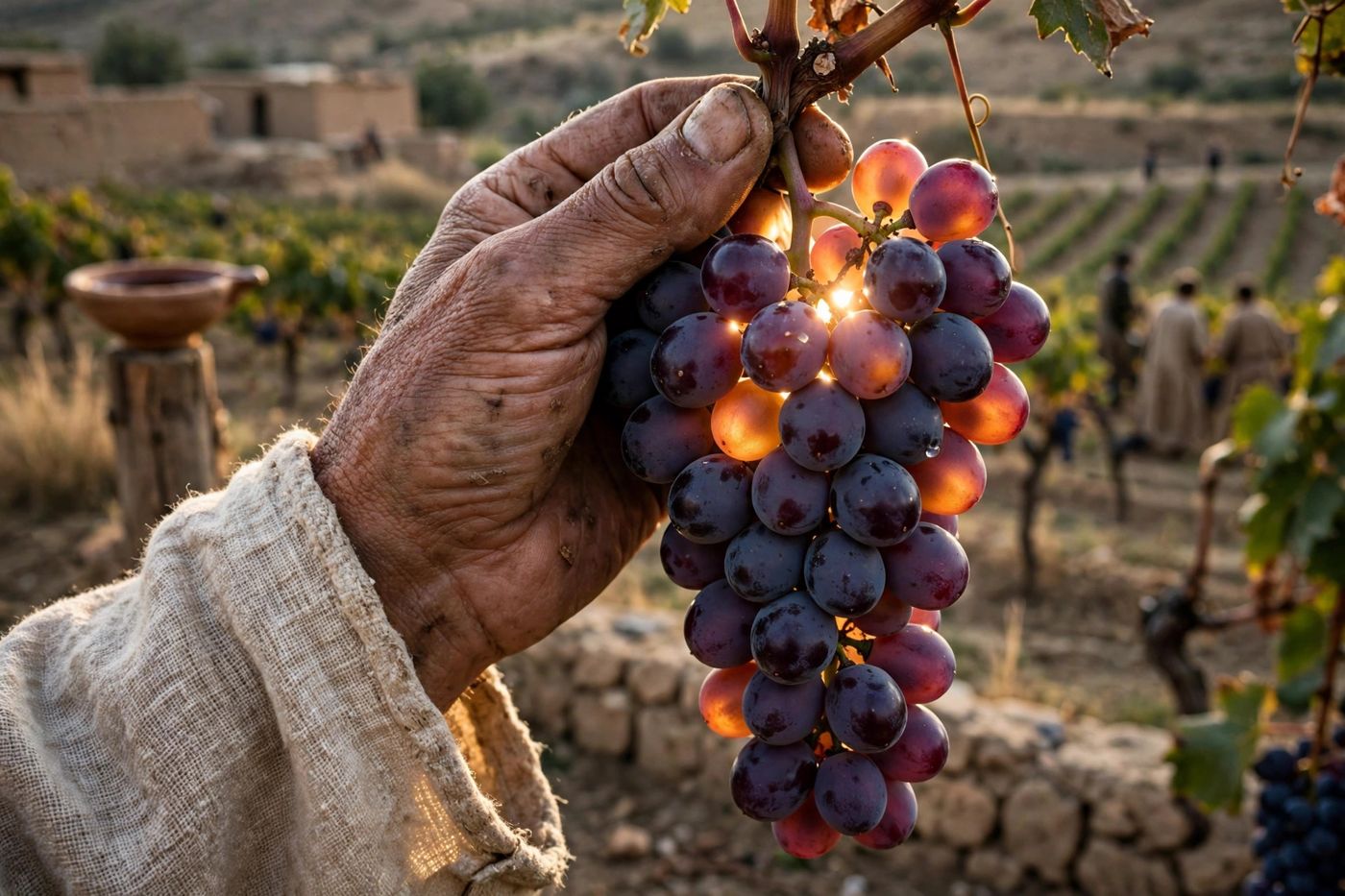
Judgment, in this God, is pruned by mercy where mercy has something to preserve. Verse 8 gives the book's tenderest picture of the remnant: "As the new wine is found in the cluster, and one saith, Destroy it not; for a blessing is in it: so will I do for my servants' sakes, that I may not destroy them all." That is the doctrine of the remnant in one gesture — the nation is spared not because the harvest was good, but because a blessing is in it: a seed out of Jacob, an inheritor out of Judah (v. 9), "mine elect" in the mountains, Sharon a fold of flocks, and Achor — Trouble Valley — a place for herds to lie down (v. 10) [4, 13].
Their crime was verse 11's feast — Gad and Meni, Luck and Destiny, served in God's city while God was forgotten (§2, §5). The punishment fits with terrible symmetry: "Therefore will I number you to the sword" (v. 12) — you gave yourselves to Number, to Meni the counter of destinies; be numbered, then, yourselves. And the ground is stated, twice in the closing chapters (here and at 66:4), as a history of unanswered grace: "because when I called, ye did not answer; when I spake, ye did not hear." The sword falls not on the uninformed but on the unanswering — people who chose, knowingly, "that wherein I delighted not."
Then the passage sings. Verses 13–14 are a contrast-chorus, built to be memorised: eat/drink/rejoice/sing for my servants, against hungry/thirsty/ashamed/howling for the forsakers — the futures of the two companies, harmonised line against line (the diagram below lays it out) [13, 3]. The chorus lands at verse 15: the rebels' very name becomes a curse-formula on other lips, while God calls His servants "by another name." And verse 16 closes the movement with the new world's first blessing: men will bless themselves "in the God of truth" — the God of Amen (§5) — "because the former troubles are forgotten."
The new creation (65:17–25)
Now the passage's centre of gravity — the sentence the whole Bible afterwards quotes: "For, behold, I create new heavens and a new earth: and the former shall not be remembered, nor come into mind" (v. 17). And note what the new world is for: "be ye glad and rejoice for ever in that which I create: for, behold, I create Jerusalem a rejoicing, and her people a joy" (v. 18). God creates a city whose substance is joy — and then enters the joy Himself: "I will rejoice in Jerusalem, and joy in my people" (v. 19). The soundtrack ends: "the voice of weeping shall be no more heard in her, nor the voice of crying."
Verse 20 must be read with both eyes open, because §10 and §16 will defend it: "the child shall die an hundred years old; but the sinner being an hundred years old shall be accursed." Death is still in this picture. Isaiah's new earth still has graves — but graves relocated to life's far margins: infancy no longer cut off ("no more thence an infant of days"), and a death at a hundred counted what a death at ten is now — a shocking exception, attached to sin, not to the human condition. §16's table sets this beside Revelation 21:4's stronger word, "no more death," with the readings labelled [3, 5]. For now: in Isaiah's register the curse is not yet abolished but visibly losing — pushed to the century-mark and branded as anomaly.
The curse-economics of Deuteronomy 28 are then run backwards (vv. 21–23). Deuteronomy threatened a disobedient Israel: you will build a house and not inhabit it, plant a vineyard and not eat of it (Deuteronomy 28:30). Isaiah reverses the film: "they shall build houses, and inhabit them; and they shall plant vineyards, and eat the fruit of them… mine elect shall long enjoy the work of their hands. They shall not labour in vain, nor bring forth for trouble." Work that reaches its enjoyer; children born not "for trouble" but into blessing — futility itself, the oldest curse on labour since Genesis 3, is repealed [4, 16].
And prayer is outrun (v. 24): the answer arrives "before they call," and God hears "while they are yet speaking" — chapter 58's "Here I am" perfected, the distance between asking and answering collapsed to nothing. The vision closes where chapter 11 closed, on the holy mountain, with the animals at peace — wolf and lamb feeding together, the lion eating straw like the bullock — and then the grave added line: "and dust shall be the serpent's meat" (v. 25). Inside the most hopeful paragraph in the Old Testament stands an eternal sentence on the serpent. "They shall not hurt nor destroy in all my holy mountain, saith the LORD."
The throne, and the tremblers (66:1–5)
Chapter 66 opens by pulling the camera back past the sky. "The heaven is my throne, and the earth is my footstool: where is the house that ye build unto me?" (v. 1). God's answer to temple-pride is scale: "all those things hath mine hand made" (v. 2). The cosmos' Maker cannot be housed by His creatures' construction — and then comes one of Scripture's great pivots: "but to this man will I look, even to him that is poor and of a contrite spirit, and trembleth at my word" (v. 2). The universe's Maker announces His preferred address: not the impressive house, but the crushed, trembling heart that takes His word seriously. Chapter 57:15's promise — God dwelling with the contrite — is completed here [3, 13].
Verses 3–4 then unmask the sacrifices of the self-directed. A row of savage equations: killing an ox counts as murder, sacrificing a lamb as cutting off a dog's neck, an offering as swine's blood, incense as blessing an idol — when the offerer has "chosen their own ways." The verse does not say the sacrifices were wrong; it says sacrifice detached from obedience is reclassified by God as the very abominations the garden-cults practised. Book One's opening charge (1:11–17) returns at the book's close, resolved into a principle: God weighs the worshipper's chosen way, not the worship's production values [4, 9]. And the sentence mirrors the crime: "I also will choose their delusions, and will bring their fears upon them" (v. 4) — you chose; God ratifies your choice.
Then, tenderly, verse 5 reveals the book's final division — fraternal, a split inside the family of faith: "Hear the word of the LORD, ye that tremble at his word; Your brethren that hated you, that cast you out for my name's sake, said, Let the LORD be glorified." The excluders use pious language as cover for casting out the tremblers. God's verdict inverts the courtroom: "he shall appear to your joy, and they shall be ashamed." The last named community in Isaiah is a small, hated, trembling company — and the book's last promise to a group is made to them.
The birth and the river (66:7–14)
What follows is the book's most joyful impossibility. "Before she travailed, she brought forth; before her pain came, she was delivered of a man child" (v. 7). Zion — barren, bereaved Zion, who in chapter 49 thought herself forgotten — gives birth before labour, a nation "born at once" (v. 8). Verse 9 gives the ground, in the voice of the midwife-God: "Shall I bring to the birth, and not cause to bring forth? saith the LORD." The God who carried the pregnancy of promise through sixty-six chapters does not abandon a birth at its final moment. Beside 49:14–21, where Zion counted her children lost, the bereaved mother is answered completely — not with an explanation, but with children [13, 4].
Then the imagery turns maternal at full strength, and the lesson must not tidy it up. Jerusalem is a nursing mother: her children "suck, and be satisfied with the breasts of her consolations" (v. 11). Peace arrives "like a river," the glory of the Gentiles "like a flowing stream" (v. 12); children are "borne upon her sides" and "dandled upon her knees." And the capstone, verse 13, surpasses even 49:15's mother-image in tenderness: "As one whom his mother comforteth, so will I comfort you." God does not merely outlast a mother; He comforts like one.
The fire, the mission, and the last verse (66:15–24)
"For, behold, the LORD will come with fire, and with his chariots like a whirlwind, to render his anger with fury, and his rebuke with flames of fire" (v. 15). And the garden-cults of 65:3–4 meet their end where they began: those "that sanctify themselves, and purify themselves in the gardens… eating swine's flesh, and the abomination, and the mouse, shall be consumed together" (v. 17). The self-sanctifiers — people who made themselves holy by their own chosen rites — are consumed mid-procession. Self-made holiness is the book's final portrait of ruin [3, 9].
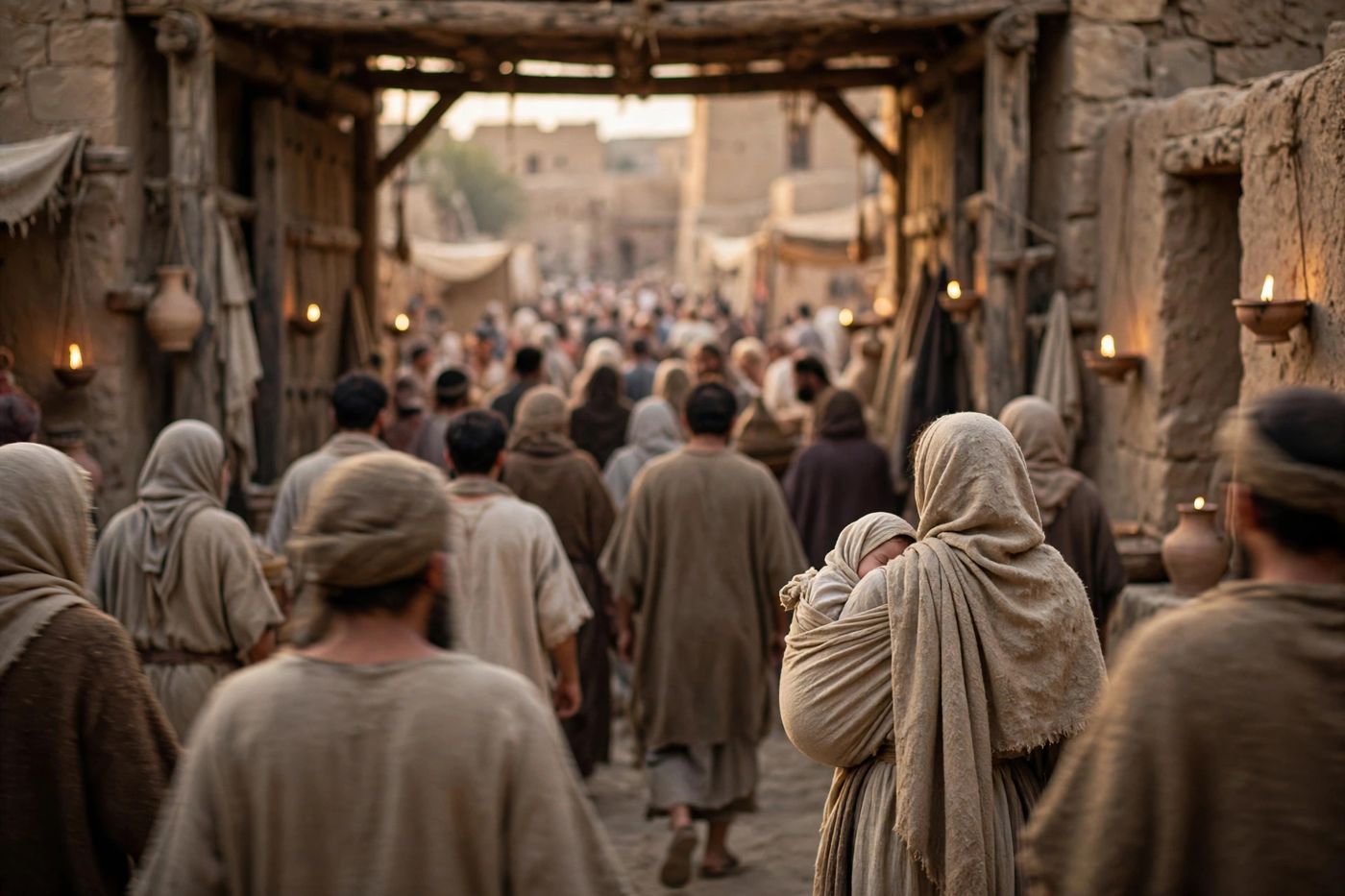
Out of that fire, the book's widest movement begins: "I will gather all nations and tongues; and they shall come, and see my glory" (v. 18). God sets a sign among them and sends the escapees — Israel's survivors, verse 8's spared cluster — as missionaries to nations "that have not heard my fame," who "shall declare my glory among the Gentiles" (v. 19). Mark the reversal: the people once carried away captive are now the carriers; 49:6's light to the nations is borne by the carried. And the mission's cargo home is people: the nations bring Israel's scattered brothers "for an offering unto the LORD" to "my holy mountain Jerusalem" (v. 20). Then the line that removes the last fence: "I will also take of them for priests and for Levites" (v. 21) — of them, the gathered nations. What 56:6–7 promised foreigners at the altar and 61:6 promised Israel as a priestly people, 66:21 fulfils at world level [4, 11].
Permanence is sworn by creation's own renewal: "as the new heavens and the new earth, which I will make, shall remain before me… so shall your seed and your name remain" (v. 22). The remade cosmos' stability is the pledge of the people's permanence. Verse 23 sets the calendar of the age to come: "from one new moon to another, and from one sabbath to another, shall all flesh come to worship before me" — all flesh, summoned as defendants in the lawsuit, now worshipping forever.
And then verse 24, left as written, because this course does not edit endings: the worshippers "go forth, and look upon the carcases of the men that have transgressed against me," whose "worm shall not die, neither shall their fire be quenched." The valley outside the city — Gehenna, in later language — stands as the permanent public exhibit of what transgression against this God finally is. The book does not end with the fire; it ends with both, in sequence: worship, then the looking. The Meaning states the fact now, unsoftened: God's final future contains an unquenched fire His worshipping people are made to see. Any gospel smaller than this text is not this text's gospel [3, 4].
The Christ Thread
Isaiah needs no forced Christology, and this lesson least of all — the New Testament does the work openly, and we follow its handling as canon evidence 1. FACT: Paul reads 65:1 as the Gentiles finding God in the gospel age, and 65:2 as Israel's resistance to the same outstretched hands (Romans 10:20–21) — the paragraph's fulfilment runs through Christ's mission. FACT: Jesus three times repeats 66:24's worm-and-fire sentence as His own word for hell (Mark 9:43–48) — the book's last verse is on the Lord's own lips, which settles how His followers may treat it: not as an embarrassment to skip, but as His warning to heed. FACT: the risen Christ names Himself with 65:16's title — "the Amen, the faithful and true witness" (Revelation 3:14). The nations' priesthood (66:21) echoes in Peter's "royal priesthood" for the whole church (1 Peter 2:9), and Revelation 21–22 shows 65:17's new heavens consummated 1. POSITION, labelled: the apostles themselves read these chapters as the future that arrives in Christ — and this course reads with the apostles.
The Long View — what the church has believed
On the new creation, the church has consistently read Isaiah 65:17 as a true promise of a remade world, and just as consistently differed over verse 20's machinery — an intermediate kingdom age, or the final state in accommodated language, or a promise Revelation escalates (§16 lays the readings side by side). The promise itself — new heavens, new earth, no weeping — has never been the disputed part. On 66:24, the historic church followed its Lord: Jesus' own citation (Mark 9) fixed the verse as a real warning of unending judgment 1, and preachers treated the ending as deliberately double — comfort's door open (66:2, 5), warning unexpired 3. The pattern is this course's final lesson in reading: the centre has held across every century; the honest disputes live at the machinery's edges, argued here with the lights on.
That is the payload. The next section compresses it into the one sentence you are meant to carry out of this study — and out of this book.
8. THE AIM SENTENCE — X: eXplain the intent
Everything observed now compresses into one sentence — the author's intended meaning, stated before any application is allowed near it:
Isaiah ends with God's own answer to His people's prayer: the God who spoke first and reached all day creates new heavens and a new earth for His trembling servants — a world of answered prayer, repealed futility, gathered nations, and permanent worship — while those who chose their own ways are numbered to the sword, and the book's last sight is the unquenched end of transgression.
If a sermon, a post, or a devotional uses Isaiah 65–66 to say something that cannot be traced back to that sentence — comfort without the sorting, warning without the new creation — it is not this passage talking. That is the whole skill this course exists to build.
9. SAY IT BACK
Close the book and say the AIM sentence from section 8 in your own words — out loud, or written in your notes, without looking. Then say, in one more sentence, what it asks of you this week.
If your version quietly changes the meaning — if the new creation becomes only a mood, or the last verse drops out — open the lesson and walk it again. This exercise feels small. It is the entire course in miniature: meaning first, in the author's words become your words, then — and only then — your life. You have done this thirty-five times now. It is yours.
10. THE MISREAD — the guardrail, with verdicts
Three live misuses of this passage. Each gets a fair hearing, the evidence, and a verdict.
Misread 1: "Isaiah 65:20 must be either a literal engineering spec for the age to come — lifespans, death-rates and all — or an embarrassment to skip; and since Revelation says 'no more death,' one of the two texts has to give." Why it sounds right: verse 20 really does place death inside the new-earth picture, while Revelation 21:4 really does say "there shall be no more death." Readers who treat both texts as flat technical prose will feel the collision honestly. The evidence: the collision is manufactured by the reading method, not the texts. Isaiah's picture is prophetic poetry (§4) describing the remade world in the present world's idiom: death pushed to the hundred-year margin and reclassified as a curse-anomaly is how Hebrew promise-poetry says death is losing its dominion — infant mortality abolished, futility repealed (65:20–23). Revelation, at the canon's end, speaks of the consummation where death is not marginalised but abolished. §16's table sets out the three historic readings — millennial-intermediate; prophetic accommodation; progressive, escalating realisation — each labelled. Readings that pit Isaiah against John have misread both. Verdict: the verse is the passage's idiom doing honest work — sin and death reduced to the margins of a world being remade. §16's table is the honest handling; forcing a spec or skipping the verse are both refusals to read it.
Misread 2: "Isaiah 66:1–2 shows God has contempt for temples, buildings, and gathered place-worship — real spirituality is placeless, and the church's houses are an embarrassment to Him." Why it sounds right: the rhetoric is genuinely sweeping — heaven His throne, earth His footstool — and Stephen does quote it against the temple establishment. The evidence: read Stephen whole and he honours the tabernacle and temple as God-given (Acts 7) before quoting Isaiah against temple-absolutism — God contained by, and at the disposal of, the house's managers 1. And read Isaiah whole: this same book exalts the mountain of the LORD's house as the nations' destination (2:2–3), promises the foreigners' sacrifices accepted on God's altar (56:7), and ends with worshippers streaming to "my holy mountain Jerusalem" and the house of the LORD (66:20, 23). God's look in 66:2 does not fall on no one, nowhere — it falls on a described person, "poor and of a contrite spirit, and trembleth at my word," normally found exactly where God's word is read aloud: among the gathered. Verdict: 66:1–2 is God's contempt for building-pride, not for buildings; for managed religion, not for gathered worship. The Maker cannot be housed — and He has told you where He loves to be found: with the tremblers, in the house and out of it.
Misread 3: "Merciful readers end the book at 66:23 — all flesh worshipping — and honest readers let 66:24's horror swallow the comfort; either way, one of the last two verses must win." Why it sounds right: each half has a constituency — comfort-only preaching finds verse 24 unusable; terror-only preaching finds verse 23's joy an interruption. And the juxtaposition really is jarring — deliberately. The evidence: the sequence as written is the doctrine. The same "all flesh" that worships "from one sabbath to another" (v. 23) then goes forth and looks (v. 24) — one company, two sights, in the author's fixed order. Jesus Himself took verse 24 up as His own warning (Mark 9:48) while also proclaiming the kingdom's feast; the apostles held the new creation (2 Peter 3:13) and the judgment in a single sermon without embarrassment 1. Deleting verse 24 produces a comfort God never offered — peace with the serpent rehabilitated, which 65:25 explicitly refuses; deleting verse 23 produces a terror that ignores the river of peace, the nursing mother, and the sworn permanence of the servants' name three verses earlier. Isaiah, who held comfort and warning in one book for sixty-six chapters, holds them in one paragraph at the end — on purpose. Verdict: neither verse wins; the sequence teaches. End the book where Isaiah ends it: the door held open to tremblers (66:2, 5), the new world sworn and certain (66:22), all flesh at worship (66:23) — and the warning unexpired (66:24).
11. FROM WORD TO WALK
A reflection page — the lesson is not finished until the passage has had its say with you.
Sit first with the hands of verse 2. Spread out — all the day. Before this book asked anything of you, it showed you a God whose posture toward rebellious people, for generation after generation, was open hands in daylight. Most of us quietly live as if God were the reluctant party and we the reaching ones. Verse 1 reverses the photograph: He is found by the ones who weren't even looking. If you know Him at all, it is because "Behold me, behold me" reached you before your seeking reached Him.
Then sit with the table of verse 11. Nobody in this passage is irreligious. The forsakers spread tables, pour offerings, sanctify themselves — diligently, at cost. Their ruin was not laziness; it was hedging: the LORD for the covenant, and a little table for Luck on the side, because the future felt too important to trust to one God. Ask the passage its searching question of your own arrangements: where have you set a second table? Not a dramatic idol — a hedge. Isaiah's God names it forsaking (v. 11): eating at two tables, you end up hearing neither God clearly.
And sit, last, with the two final verses — in order, the way §10 taught. First the worship: all flesh, sabbath to sabbath, in a world where prayer is answered mid-sentence and no child is born for trouble. Let yourself want that world without embarrassment; the God of Amen has sworn it (66:22). Then the looking: the carcases, the undying worm, the unquenched fire — held at full weight, as Jesus held it. A gospel that ends at verse 23 is a comfort you invented; an honesty that ends at verse 24 is a terror God never preached alone. Isaiah's actual ending is a worshipping people who have seen both — and who therefore tremble (66:2) and rejoice in the same breath. If you leave Isaiah able to hold both, you have learned to see.
God of Amen — You spoke before I asked, and Your hands were open all the day I was walking the other way. Search out my second tables and name them to me, kindly and plainly. Make me poor in spirit, contrite, and trembling at Your word — the address You said You look for. And fix my hope on the world You are creating and the name You have sworn will remain. Let me end this book the way it ends — worshipping, and warned, and wholly Yours. In Jesus' name, amen.
12. FOR DISCUSSION — OR FOR YOUR JOURNAL
With a group, work these aloud. Alone, they're yours — answer them in your journal or in prayer; they lose nothing in the quiet.
- God says He was "found of them that sought me not" (65:1) — and Paul applies it to the Gentiles (Romans 10:20). Tell the story of how God found you before you were looking. What does it do to your pride — and to your hope for people who aren't looking now?
- The forsakers were not irreligious; they were hedgers — a table for the LORD, a table for Luck (65:11). Where is the "second table" temptation strongest in ordinary Christian life today? Name yours honestly.
- God's preferred address is the person "poor and of a contrite spirit, and trembleth at my word" (66:2). What does trembling at God's word look like in practice — in how you read, decide, and repent? How is it different from mere dread?
- The book ends with worship (66:23) and the unquenched fire (66:24) side by side — and Jesus quotes verse 24 Himself (Mark 9:48). Why does God end His book this way? What goes wrong in a church — or a heart — that keeps only one of the two verses?
13. THE WALK-OUT — T: Transfer to today
Meaning is settled. Now — and only now — application, and it must cross the bridge honestly. Run the five Transfer Tests on this passage:
- Same covenant? Isaiah's hearers stood between Sinai's curses and the new covenant's dawn; we live on the far side of the cross, in the age where Paul says 65:1 is already happening — the unseeking nations are being found (Romans 10:20) 1. So the promises reach us in Christ, through the gospel, while the national sentences (the sword on that generation, 65:12) belong to that covenant moment and are not re-issued as threats over individuals today. What transfers is the pattern underneath: the God who speaks first, sorts by response to His word, and finishes what He creates.
- Same audience? The passage addresses a mixed community — servants and forsakers in one city — and its sorting-test transfers precisely because it is not ethnic: trembling at God's word versus choosing your own ways (66:2–4).
- Same genre rules? Promise-poetry and oracle, not a timetable or spec sheet (§4, §10 Misread 1). So applications here are postures and practices — trembling, unhedging, hoping, witnessing — not date-setting or claims staked on verse 20's machinery.
- Repeated or rooted? Every practice below reappears across the New Covenant: grace preceding seeking (Romans 10:20); God seeking the contrite (James 4:6); worship joined to obedience (Matthew 23:23); the mission to nations that have not heard (Matthew 28:19); the new-creation hope (2 Peter 3:13; Revelation 21) 1. Rooted and repeated: these cross at full weight.
- Ten verses either side? Every application below is drawn from these two chapters read whole — comfort kept with warning, the last verse kept with the second-to-last. Nothing hangs on a torn-out line.
| Test result in brief | What it lets through |
|---|---|
| National sentences stay in their covenant moment | The pattern crosses: God speaks first, sorts by response to His word |
| The sorting-test is trembling, not descent | Every reader stands inside the fork (66:2–4) |
| Rooted and repeated (Romans, James, Peter, Revelation) | Unhedged trust, trembling, mission, new-creation hope — at full weight |
What crosses — and lands:
- God acted first, and His act is the ground under everything asked of you. Before any practice below: He spoke first (65:1), reached all day (65:2), spares for the blessing in the cluster (65:8), comforts like a mother (66:13), and swears the future by His own permanence (66:22). The indicative leads, one final time: you do not tremble to purchase God's look (66:2); you tremble because the God who creates new heavens has already turned His face toward the contrite.
- Unhook the hedges. The forsakers' sin was a second table (65:11). Crossed over, the application is subtraction, not addition: one trusted-when-God-feels-slow arrangement, named and surrendered.
- Trembling is the book's last name for God's people — take it as yours. Not dread of a tyrant, but the settled habit of treating God's word as the heaviest thing in the room: read slowly, believed actually, obeyed first and explained later (66:2, 5).
- Hold both final verses. Verse 23 gives hope its scale — worshipping all flesh in a world God remakes; verse 24 gives evangelism and holiness their urgency — an end Jesus Himself warned against. A faith that keeps both will be joyful without being naive, and sober without being despairing.
Practices — what the gate lets through, made concrete this week:
- The second-table audit. Thirty minutes with 65:11–12 open. In writing, answer: if God felt slow for a year, what would I actually lean on? Name the hedge — money, a person, a habit, a plan — and take one concrete step of surrender this week.
- Pray before you finish. Once a day this week, practise 65:24 as a posture: bring God one matter mid-sentence — pray it briefly, believing He answers "while they are yet speaking," then watch for the answer instead of re-litigating the request all week.
- Tremble once, deliberately. Take the passage that has most recently unsettled you — perhaps this lesson's own last verse — and instead of explaining it away, sit with it ten minutes, then write one sentence of response: what it asks you to stop, start, or say.
- Carry the fame somewhere it hasn't been heard. Isaiah 66:19's survivors declare God's glory among those who "have not heard my fame." One person in your ordinary week has not heard it from you. One unhurried conversation, telling the story of the God who speaks first (§11).
- Memorize Isaiah 66:2's promise-clause by heart — the description of the person God looks at: poor, contrite, trembling at His word. Carry the address with you.
What does not cross: claiming 65:20 as a timetable or lifespan promise for this age (§10, Misread 1); wielding 66:24 as a threat against named individuals whose end you cannot know — it is God's exhibit, delivered as warning to hearers, beginning with us (§10, Misread 3); treating 66:1–2 as a licence to despise the gathered church (§10, Misread 2); and reading the nations' priesthood (66:21) as a present institutional claim rather than God's sworn future received by faith. The gate is not there to shrink the Bible's claims on you — it is there to make sure the claims that land are the ones God actually made.
One last thing, because this is the book's last lesson. Thirty-five studies ago you opened Isaiah at a courtroom, with a people who did not know their own Father (1:2–3). You were taught, lesson by lesson, a way of seeing: the passage first and whole; its world honoured; its words weighed; its place in the canon traced; its meaning stated before its use. That way of seeing — not any single fact in these pages — is what the book was for. Isaiah's own name for the reader it produces is in this lesson: one who is poor, and of a contrite spirit, and trembleth at my word. Take the Walk with you to the next book. The labels fade now. The walk is yours.
Praise Him
God of Amen — You were found by people who were not looking, and You have not stopped being found. You spread out Your hands all the day; You spared the cluster for the blessing in it; You comforted us as a mother comforts, and swore by heavens You have not yet made that our name would remain. Create, we pray — and keep creating — until weeping is heard no more and prayer is answered mid-sentence; gather the nations; send the survivors; and receive, at the last, the worship of all flesh, sabbath to sabbath, for ever. To You, Father, Son, and Holy Spirit, whose name is Amen — be glory in the new heavens and the new earth. Amen.
14. THE RECAP CARD — this study on one page
Print it. Keep it where you'll see it this week.
- The passage: Isaiah 65:1–66:24 — God's answer to the rend-the-heavens prayer: the God who speaks first, the spared cluster, the new heavens and new earth, the tremblers, the nursing mother, the mission — and the last verse, unflinching.
- Say It Plain: God reached first and was refused by His own; He spares a remnant like good grapes in a cluster, numbers the forsakers to the sword, and creates a new world — no weeping, no stolen work, prayer answered before it's spoken — looking not to temple-builders but to tremblers, comforting like a mother, gathering all nations, and ending with worship and unquenched fire side by side.
- The AIM: Isaiah ends with God's own answer to His people's prayer: the God who spoke first and reached all day creates new heavens and a new earth for His trembling servants — a world of answered prayer, repealed futility, gathered nations, and permanent worship — while those who chose their own ways are numbered to the sword, and the book's last sight is the unquenched end of transgression.
- Key terms: the God of truth — the God of Amen, whose word stands firm · trembleth at my word — the book's last name for God's people.
- The Misread, in one line: 65:20 is promise-poetry, not a spec — and it does not fight Revelation · 66:1–2 dethrones building-pride, not gathered worship · the book ends at both 66:23 and 66:24, in that order.
- Memory verse: "And it shall come to pass, that before they call, I will answer; and while they are yet speaking, I will hear." — Isaiah 65:24
- This week's practice: the second-table audit — one hedge named and surrendered — and one unhurried telling of the God who speaks first, to someone who has not heard it from you.
From card to conscience: the Recap Card is for your wall; the next section is for your honesty. Answer §15 from the study — if a question exposes a gap, that gap is the lesson pointing you back to the section that fills it. You have finished the book of Isaiah. The card is a good place for the whole book to land: found first, trembling, hoping — and warned, in that order.
15. CHECK YOURSELF — five questions
Answer from the study, not from instinct. (Answers live in the Teacher Edition.)
- In your own words: what is the AIM of Isaiah 65:1–66:24?
- Paul applies 65:1 and 65:2 in opposite directions at Romans 10:20–21. State both applications, and explain how the paragraph holds them together.
- Verse 20 places death inside the new-earth picture, yet Revelation 21:4 says "no more death." How does this study handle the seam without trimming either text? Name the course's labelled position.
- Someone says: "Isaiah 66:1–2 proves God despises church buildings and place-worship." Answer them from the book itself — two exhibits — and from Stephen's actual argument in Acts 7.
- Why must the book end with both 66:23 and 66:24, in that order? What does each one-sided ending lose?
16. GO DEEPER
Optional — for readers who want the machinery. The lesson is complete without it.
From the Sources — the answer that opens by not answering
The communal prayer of 63:7–64:12 pleads for the praying community, and God's reply begins with people outside the prayer entirely (65:1), indicts some inside it (65:3–7), and only then unfolds the future [3, 9]. FACT: the reply progressively distinguishes "my servants" from the forsakers — sorting the community by response to God's word rather than by descent 5. INFERENCE: hence the chapters' double feel, consolation and confrontation at once: the answer to "rend the heavens" is a heaven that was never closed.
The Honest Argument — a hundred-year death, and "no more death"
Here is the seam, argued with the lights on. FACT: Isaiah 65:20 places death inside the new-earth picture — dying at a hundred, and then only for "the sinner… accursed" — while Revelation 21:4 states that "there shall be no more death" 1. FACT: both texts use the identical promise-frame: "new heavens and a new earth" (65:17; Revelation 21:1; 2 Peter 3:13) 1. The church's readings of the seam, at full strength:
| Reading | How it handles 65:20 | Its strength | Its cost |
|---|---|---|---|
| Millennial-intermediate | Isaiah describes a kingdom age before the final state: death present but drastically curtailed; Revelation 21 describes what follows, when death is abolished | Takes both texts at maximum literal force, in sequence | Requires a two-stage future the passage itself never signals |
| Prophetic accommodation | Isaiah describes the final state in the only idiom his hearers had — this world's materials stretched: longevity language means "death is defeated," not "graves continue" | Honours the genre (§4) and death's branding as an accursed anomaly | Risks thinning concrete detail into symbol whenever it becomes difficult |
| Progressive / escalating realisation | One promise, revealed in stages: Isaiah's picture is true in its register — death marginalised, curse repealed — and John's is the same promise at fullness; the canon escalates rather than corrects | Fits Isaiah's own escalation (58:9 → 65:24) and both texts untrimmed | Leaves the end's exact mechanics unspecified — some readers find that restraint unsatisfying |
DISPUTED: which reading governs — faithful teachers divide here, and the division runs through the standard commentaries [3, 5]. POSITION — this course's, as stated in §6: the promise escalates across the canon; Isaiah's picture is true in its register and Revelation's in its fullness — neither text trimmed to fit the other. What no reading may do is what Misread 1 does: set Isaiah and John at war, or quietly delete verse 20.
And the book's standing dispute, one final statement: FACT — since Duhm, mainstream scholarship commonly assigns chapters 56–66 to a post-exilic stage distinct from the eighth-century prophet and from chapters 40–55 [40, 9]. FACT — the Great Isaiah Scroll (about 125 BC) already binds all sixty-six chapters as one book, and the New Testament cites across all three sections under the one name "Isaiah" 22. POSITION — this program's, from Lesson 00 to this final lesson: the book is Isaiah's, one prophet's witness read whole, following the church's historic reading [35, 50].
The Word Underneath — 'amen, the word that became a Name
The lesson followed 'amen from 65:16's "God of truth" to Christ's title (Revelation 3:14). Its root, 'aman, means to be firm, reliable, to stand — the same root that gives Hebrew its word for faith as firm reliance 19. FACT: Isaiah 65:16 is the Hebrew Bible's only 'elohe 'amen, "God of Amen" — the word promoted from response to Name 19. INFERENCE: that promotion is the verse's poetry: in the new world, blessing and oath-taking no longer appeal to fortune (65:11's Gad and Meni) but to the one reality that cannot wobble — the God whose word stands. When Paul says the promises are "in him Amen" in Christ (2 Corinthians 1:20) and the risen Jesus calls Himself "the Amen" (Revelation 3:14), the canon is cashing Isaiah's title, not borrowing a slogan 1. The forsakers swore by Luck. The servants bless themselves in the God of Amen.
Go Read
- Oswalt, The Book of Isaiah, Chapters 40–66 (NICOT) 3 — the fullest evangelical treatment of chapters 65–66 as the answer to chapters 1–39.
- Childs, Isaiah (Old Testament Library) 5 — the canonical reading: the final form's two endings held together as Scripture.
- Fee & Stuart, How to Read the Bible for All Its Worth 51 — the prophecy chapter behind §4: forthtelling first, poetry read as poetry.
17. SOURCES & REFERENCES
Numbered citations in this lesson key to this list — the course standard: every sourced claim carries its number, and every number can be checked.
- The KJV text itself — Holy Bible, King James Version (eBible.org KJV, 1769 text). Scripture quotations are from the King James Version (KJV), which is in the public domain in the United States; the full passage is always assigned as reading. Cross-references within Scripture cite this number.
- Oswalt, The Book of Isaiah, Chapters 40–66 (NICOT) — John N. Oswalt (Eerdmans). The second volume: the comfort section, the Servant Songs, Cyrus, and the new-creation chapters, read as the deliberate answer to chapters 1–39.
- Motyer, The Prophecy of Isaiah — J. Alec Motyer (IVP). A one-volume commentary by an evangelical scholar who argues the whole book breathes the mind of the eighth-century prophet; especially strong on the book's structure, its repeated refrains, and the Servant.
- Childs, Isaiah (Old Testament Library) — Brevard S. Childs (Westminster John Knox). The canonical-approach reading: the book in its final form as Scripture, whatever its compositional prehistory; a control on both conservative and critical overreach.
- Blenkinsopp, Isaiah 1–39, Isaiah 40–55, Isaiah 56–66 (Anchor Bible) — Joseph Blenkinsopp (Doubleday). Mainstream-critical commentary across all three traditional divisions; a fair statement of the multiple-authorship case and of post-exilic settings.
- Smith, Isaiah 1–39 and Isaiah 40–66 (New American Commentary) — Gary V. Smith (B&H). Evangelical commentary with strong historical notes (the Assyrian and Babylonian records) and an even-handed survey of the authorship debate.
- Brueggemann, Isaiah 1–39 and Isaiah 40–66 (Westminster Bible Companion) — Walter Brueggemann (Westminster John Knox). A rhetorical-theological reading for preachers and teachers; strong on the poetry's movement from judgment to hope.
- Walton, Matthews & Chavalas, The IVP Bible Background Commentary: Old Testament — John H. Walton, Victor H. Matthews, Mark W. Chavalas (IVP). Verse-by-verse ancient Near Eastern background: Assyrian siege practice, Babylonian religion, treaty and coronation customs, geography.
- VanGemeren (ed.), New International Dictionary of Old Testament Theology and Exegesis (NIDOTTE) — Willem A. VanGemeren (Zondervan). Theological word studies with semantic-range discipline for the Hebrew terms.
- Brown, Driver & Briggs, Hebrew and English Lexicon of the Old Testament (BDB) — The standard older Hebrew lexicon; word senses and usage ranges for the Terms sections.
- The Great Isaiah Scroll (1QIsaᵃ) and the Dead Sea Scrolls Bible — The complete Isaiah scroll from Qumran Cave 1 (c. 125 BC), in Abegg, Flint & Ulrich, The Dead Sea Scrolls Bible (HarperSanFrancisco). The oldest substantial witness to Isaiah's text — already a single scroll of all 66 chapters centuries before Christ.
- Alexander, Commentary on the Prophecies of Isaiah — Joseph Addison Alexander (19th century; public domain). The great Princeton defense of the book's unity and messianic reading, argued from the Hebrew.
- Duhm, Das Buch Jesaia (1892) — Bernhard Duhm. The commentary that named the "Servant Songs" as a distinct set and crystallized the "Deutero-Isaiah" division — the historical origin of the modern authorship debate, cited as fact about scholarship.
- Archer, A Survey of Old Testament Introduction — Gleason L. Archer (Moody). The standard conservative survey of the authorship question, including the Cyrus argument and the New Testament's citation pattern.
- Fee & Stuart, How to Read the Bible for All Its Worth — Gordon D. Fee and Douglas Stuart (Zondervan). The beginner's method book; its prophecy chapter ("a forthtelling first") undergirds the Genre sections.