
One study, one walk — the universal FIRM format. The passage first and whole; then its world; then the Walk (Context · Observe · Genre · Terms · Entire Canon); the meaning taught straight; the AIM sentence; the misread exposed and answered; and the walk-out, where application has to pass the Transfer Tests before it reaches your week. The same skeleton serves a book, a chapter, a single verse, or a whole subject. In the early studies the moves are labeled as they happen. The labels fade as the walk becomes yours.
THE WEEK WITH THIS STUDY — six bites
Day 1 — Read the passage · Say It Plain · The World (§§1–2) · Day 2 — Observe · Genre (§§3–4) · Day 3 — Terms · Entire Canon (§§5–6) · Day 4 — The Meaning · the AIM Sentence · Say It Back (§§7–9) · Day 5 — The Misread · From Word to Walk (§§10–11 — add For Discussion, §12, if you're with others) · Day 6 — The Walk-Out · the Recap Card (§§13–14). Go Deeper (§16) any evening you want the basement.
BEFORE YOU READ — Open My Eyes
LORD, rend my polite distance, not just the heavens. Show me the One who comes mighty to save, teach me to remember Your lovingkindnesses honestly, and give me words to confess, plead, and wait when Your answer has not yet come. In Jesus' name, amen.
§ means “section” — the numbered parts of your lesson. Each bite above names the sections for that day.
1. READ THE PASSAGE — Isaiah 63:1–64:12 (KJV)
Read it all, slowly, before any teaching. In this course the passage always prints once, in full, at the head of the lesson. Everything after this is commentary — this is the text.
One orientation before you read: this lesson takes two chapters as one passage, because the book does. Chapter 63 opens with a watchman's dialogue and turns, at verse 7, into a long prayer of memory. Chapter 64 is that same prayer, still going — confessing and pleading over ruins — with no answer yet inside the passage. Verse numbers restart at chapter 64.
Isaiah 63
1 Who is this that cometh from Edom, with dyed garments from Bozrah? this that is glorious in his apparel, travelling in the greatness of his strength? I that speak in righteousness, mighty to save.
2 Wherefore art thou red in thine apparel, and thy garments like him that treadeth in the winefat?
3 I have trodden the winepress alone; and of the people there was none with me: for I will tread them in mine anger, and trample them in my fury; and their blood shall be sprinkled upon my garments, and I will stain all my raiment.
4 For the day of vengeance is in mine heart, and the year of my redeemed is come.
5 And I looked, and there was none to help; and I wondered that there was none to uphold: therefore mine own arm brought salvation unto me; and my fury, it upheld me.
6 And I will tread down the people in mine anger, and make them drunk in my fury, and I will bring down their strength to the earth.
7 I will mention the lovingkindnesses of the LORD, and the praises of the LORD, according to all that the LORD hath bestowed on us, and the great goodness toward the house of Israel, which he hath bestowed on them according to his mercies, and according to the multitude of his lovingkindnesses.
8 For he said, Surely they are my people, children that will not lie: so he was their Saviour.
9 In all their affliction he was afflicted, and the angel of his presence saved them: in his love and in his pity he redeemed them; and he bare them, and carried them all the days of old.
10 But they rebelled, and vexed his holy Spirit: therefore he was turned to be their enemy, and he fought against them.
11 Then he remembered the days of old, Moses, and his people, saying, Where is he that brought them up out of the sea with the shepherd of his flock? where is he that put his holy Spirit within him?
12 That led them by the right hand of Moses with his glorious arm, dividing the water before them, to make himself an everlasting name?
13 That led them through the deep, as an horse in the wilderness, that they should not stumble?
14 As a beast goeth down into the valley, the Spirit of the LORD caused him to rest: so didst thou lead thy people, to make thyself a glorious name.
15 Look down from heaven, and behold from the habitation of thy holiness and of thy glory: where is thy zeal and thy strength, the sounding of thy bowels and of thy mercies toward me? are they restrained?
16 Doubtless thou art our father, though Abraham be ignorant of us, and Israel acknowledge us not: thou, O LORD, art our father, our redeemer; thy name is from everlasting.
17 O LORD, why hast thou made us to err from thy ways, and hardened our heart from thy fear? Return for thy servants' sake, the tribes of thine inheritance.
18 The people of thy holiness have possessed it but a little while: our adversaries have trodden down thy sanctuary.
19 We are thine: thou never barest rule over them; they were not called by thy name.
Isaiah 64
1 Oh that thou wouldest rend the heavens, that thou wouldest come down, that the mountains might flow down at thy presence,
2 As when the melting fire burneth, the fire causeth the waters to boil, to make thy name known to thine adversaries, that the nations may tremble at thy presence!
3 When thou didst terrible things which we looked not for, thou camest down, the mountains flowed down at thy presence.
4 For since the beginning of the world men have not heard, nor perceived by the ear, neither hath the eye seen, O God, beside thee, what he hath prepared for him that waiteth for him.
5 Thou meetest him that rejoiceth and worketh righteousness, those that remember thee in thy ways: behold, thou art wroth; for we have sinned: in those is continuance, and we shall be saved.
6 But we are all as an unclean thing, and all our righteousnesses are as filthy rags; and we all do fade as a leaf; and our iniquities, like the wind, have taken us away.
7 And there is none that calleth upon thy name, that stirreth up himself to take hold of thee: for thou hast hid thy face from us, and hast consumed us, because of our iniquities.
8 But now, O LORD, thou art our father; we are the clay, and thou our potter; and we all are the work of thy hand.
9 Be not wroth very sore, O LORD, neither remember iniquity for ever: behold, see, we beseech thee, we are all thy people.
10 Thy holy cities are a wilderness, Zion is a wilderness, Jerusalem a desolation.
11 Our holy and our beautiful house, where our fathers praised thee, is burned up with fire: and all our pleasant things are laid waste.
12 Wilt thou refrain thyself for these things, O LORD? wilt thou hold thy peace, and afflict us very sore?
SAY IT PLAIN — the passage in everyday words: A watchman sees a mighty figure coming from Edom, his clothes stained red, and asks who he is. The figure answers first that he speaks in righteousness and is mighty to save — then explains the red: he has trodden God's enemies alone, like grapes in a winepress, in the day of vengeance that is also the year of his redeemed. Then the voice changes. God's people begin a great prayer: they recite how God saved them in love, carried them, and gave them his holy Spirit — and how they rebelled and grieved that Spirit. Remembering Moses and the sea, they plead: Look down. You are our Father and Redeemer, even if Abraham himself would not know us. They point to a trodden sanctuary, then cry out for God to tear the heavens and come down as he once did. They confess that their best deeds are stained, that they are fading and wind-blown, and that no one among them is even stirring himself to call on God. Still they come back to the potter: we are clay, you are our Father. They describe cities in ruins and the temple-house burned — and the prayer ends on a question with no answer yet: will you hold your peace and leave us afflicted? That's the whole passage. Everything after this teaches from it.
2. THE WORLD — C: Context & Audience
A text can never mean what it never meant — so before we ask what these verses mean, we stand where their first hearers stood.
Where this sits in Isaiah. These chapters stand near the end of the book's third movement (56–66), after the blaze of chapters 60–62 — Zion (Jerusalem, the hill where God's temple stood, and by extension God's people gathered there) shining, the Anointed Preacher proclaiming liberty. Lesson 33 left the city called "Sought out, A city not forsaken." Now the camera cuts to a road from the south-east and a figure in red, and then down into a prayer prayed from among ruins. Hold both neighbours in mind: the glory just promised, and chapter 65, where God finally speaks. This passage is the dark valley left between them [3, 4].
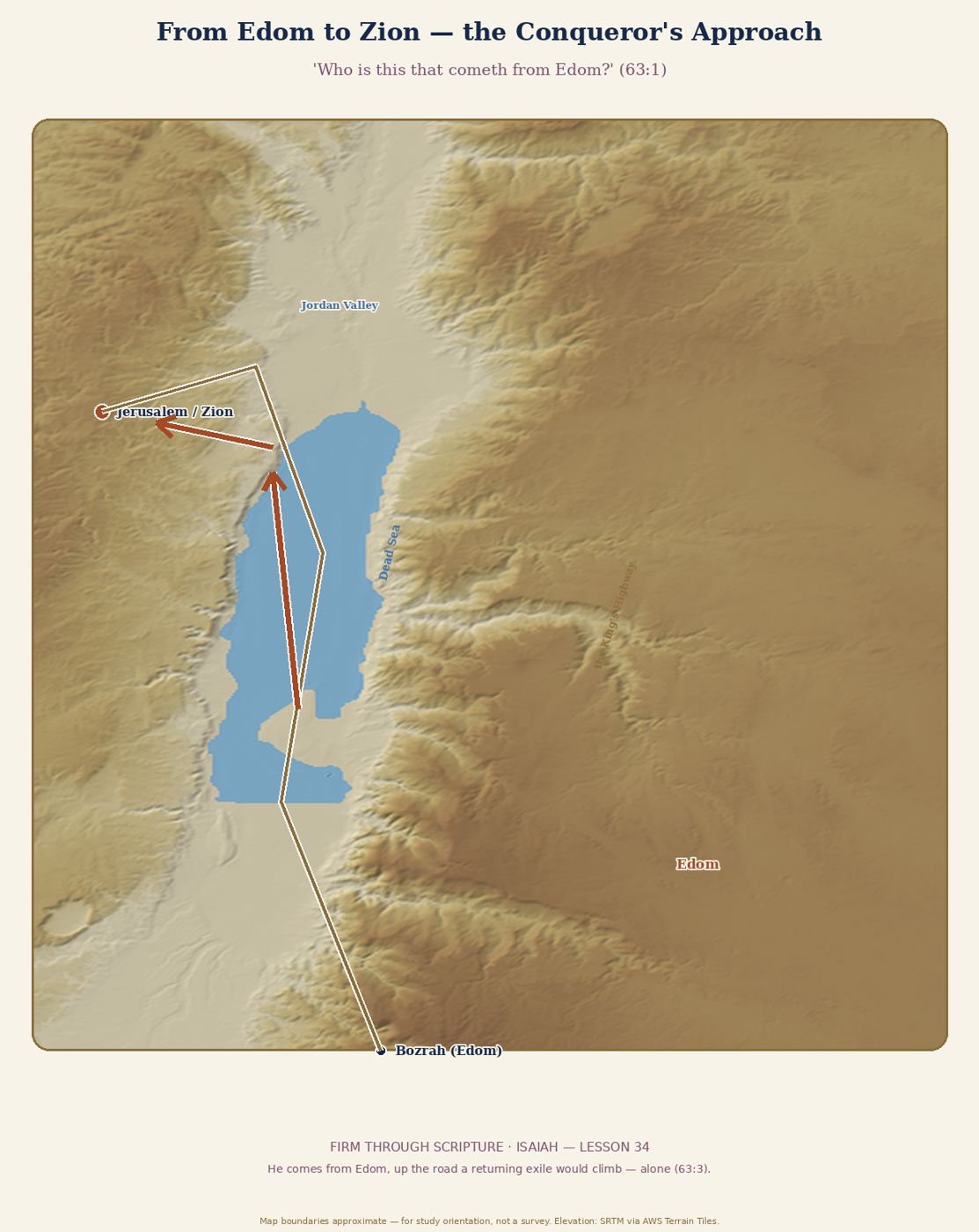
Edom and Bozrah — learn the geography, because the geography preaches. Edom was Israel's neighbour to the south-east — the land of Esau's descendants, Jacob's twin brother's family, and so Israel's oldest, bitterest kin-rival. Bozrah was one of Edom's chief cities, a fortified town on the high plateau [16, 11]. When a figure "cometh from Edom, with dyed garments from Bozrah" (63:1), he is coming up from enemy country toward Zion, along the road a returning army would take. And the name rang a bell rung thirty chapters earlier: chapter 34 had announced God's judgment on Edom — a sacrifice in Bozrah, a great slaughter in the land of Edom [1, 3]. Chapter 63 is that geography come back, not as a forecast, but as a road home already travelled.
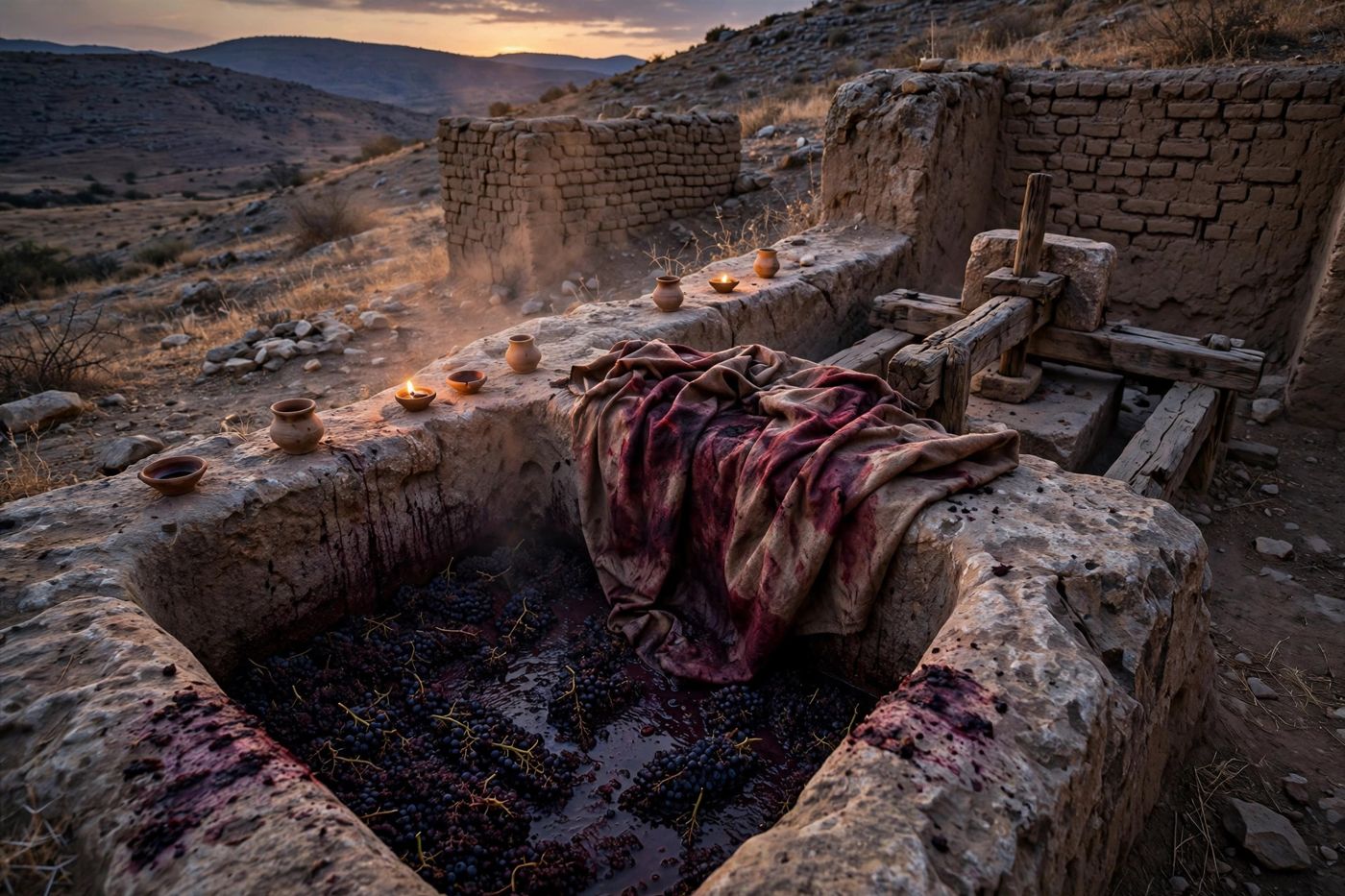
The winepress was ordinary — which is why the picture lands. Grapes were trodden, barefoot, in a winefat — an older English word for a wine-vat, a stone or rock-cut trough — by workers whose garments came out stained deep red. Pressing was harvest work, communal and joyful, often done with shouting [16, 53]. Everybody had seen a treader come up out of a vat looking like this. That is what makes the Conqueror unsettling: he looks like a harvest worker after a long day — except he was alone in the press, the staining is not juice, and the harvest is judgment.
Watchmen asked questions for a living. Cities kept watchmen on their walls to challenge anyone approaching: who are you, where from, what news? The opening of chapter 63 is staged as exactly that challenge-and-answer at the border — question, answer, second question, fuller answer [4, 13]. The dialogue is not decoration. It lets the Conqueror name himself and his mission in his own words, before anyone explains him.
And then: the prayer's world is ruins. From 63:7 onward the speaker is the community itself, praying in the first person plural — us, our, we. By 64:10–11 the setting is explicit: holy cities a wilderness, the temple — "our holy and our beautiful house" — burned with fire. Exactly which generation prayed among which ruins is honestly DISPUTED (see §16): readers have long heard in it a community at the exile's end or in the hard first years of return, when chapter 60's promises had manifestly not yet happened [3, 9]. Do not build doctrine on a date the text does not give you. What it does give you is firm: a believing community, a burned sanctuary, unkept-feeling promises, and a prayer that refuses to stop.
One name you must have: Moses. The prayer's great memory (63:11–14) reaches back to Moses — the leader God raised up centuries before Isaiah, who led Israel out of slavery in Egypt, through the parted sea, and through the wilderness. That deliverance — the exodus — is Israel's founding story, the rescue every later rescue is measured against. When this prayer asks where the God of the sea is, it is producing its best evidence.
3. OBSERVE — O: what the text actually does
Before meaning comes observation. Look at what is actually on the page:
- Two scenes, one passage, no seam announced. Verses 1–6 are dialogue on a road. Verse 7, without introduction, is a congregation praying: "I will mention the lovingkindnesses of the LORD." Treat them as a pair — the Conqueror who acts alone, and the people who can only pray — because the book sets them side by side and lets each interpret the other.
- The questions run the whole passage. "Who is this…?" (63:1). "Wherefore art thou red…?" (63:2). "Where is he that brought them up out of the sea…?" (63:11). "Where is thy zeal…?" (63:15). "Wilt thou hold thy peace…?" (64:12). Questions open it, drive its middle, and — unanswered — close it. This passage is built out of asking.
- The arm keeps appearing. "Mine own arm brought salvation unto me" (63:5). "His glorious arm" dividing the water for Moses (63:12). The arm — God's strength personally at work, used since chapter 40 — acts alone in the winepress and is then remembered, mid-prayer, as the same arm that made a road through the sea. Memory here is not nostalgia. It is ammunition.
- The Spirit is named three times. The people "vexed his holy Spirit" (63:10, past rebellion). God "put his holy Spirit within him" (63:11, past gift). "The Spirit of the LORD caused him to rest" (63:14, past leading). The prayer's history of God is a history of his Spirit given, resisted, and longed for again.
- "Father" is claimed twice, at the two pressure points. "Thou art our father… our redeemer" (63:16); "we are the clay, and thou our potter" (64:8). Both times the claim comes after the evidence seems to fail — after ancestry is surrendered, after total confession. Watch where a passage places its strongest words; placement is preaching.
- The pairing in one verse. Look at 63:4 again and do not split it: a day of vengeance, a year of the redeemed, in a single breath, in a single heart. The proportions are the doctrine.
- The ending refuses to resolve. No amen, no answer, no "and God spake." The last word of chapter 64 is a question about God's silence. Observation does not fix that discomfort; it refuses to pretend it isn't there — the book itself answers in chapter 65, and this study will point there and wait.
4. GENRE — N: note the genre (prophetic dialogue-oracle joined to communal lament)
This passage is two recognised forms joined end to end, and each half must be read by its own rules 51.
The first half (63:1–6) is a prophetic dialogue-oracle — a staged question-and-answer in poetic lines, announcing what God has done and will do. Prophecy in Isaiah is forthtelling before it is foretelling: it confronts the present with God's declared action 51. Read it as a herald's report, not a timetable: its verbs swing between accomplished fact ("I have trodden") and settled future ("I will tread them"), because in prophetic speech God's decided future is spoken of as good as done. Do not build a chronology out of it.
The second half (63:7–64:12) is a communal lament — a whole people's formal prayer in trouble, of the same family as the lament psalms. Communal laments have a recognisable skeleton, and this one follows it almost bone for bone 13:
- Recital — the community retells God's past deeds (63:7–14).
- Complaint — it says, out loud, how the present contradicts those deeds (63:15–19).
- Confession — it owns its sin without varnish (64:5–7).
- Petition — it asks for specific intervention (64:1–4, 8–9) and protests God's silence (64:12).
Knowing the form protects you twice. It keeps you from treating the complaint lines as doctrine stated cold — lament wrestles, from inside pain, to God, in faith, and its rawest lines (63:17) must be read inside the prayer's whole movement, as §7 will do. And it teaches you the form's own lesson: this is how God's people are taught by Scripture itself to pray when the sanctuary is in ruins. The lament is not a failure of faith. In this book, it is an act of faith.
5. TERMS — T: the words in the writer's mouth
Three phrases carry this passage. Learn them in the writer's mouth, and watch how much confusion dies at the dictionary:
- "The day of vengeance / the year of my redeemed" (63:4) — not two events, but one paired phrase: a single act of God described from its two sides. Vengeance here is a judge's word, not a temper word: vindication — wrongs set right by the rightful judge. For those who crushed God's people, that act is a day of vengeance. For the redeemed — redeemed means bought back, ransomed out of another's power, as a kinsman bought a relative out of slavery — the same act is a year of release. The time-words preach too: a day for judgment, a year for redemption. Judgment is the shorter measure in God's own sentence [3, 4].
- "The angel of his presence" (63:9) — a figure from the exodus story: the messenger in whom God's own presence travelled with Israel, who went before the camp and guarded it (Exodus 14:19) 1. "Of his presence" can also be heard as "of his face" — God's own facing-toward his people. Isaiah's point is not the angel's rank but his nearness: God did not save from a distance; his presence was in the rescue [4, 11]. The lesson teaches the phrase at that strength and no stronger.
- "O that thou wouldest rend the heavens" (64:1) — rend means tear, rip open, the violent verb you use for cloth. The cry is not "open a door politely" but "tear the sky the way you tear a garment." Underneath it stands a memory: at Sinai (the mountain where God gave Israel his law after the exodus) God came down, and the mountain shook and smoked (64:3 recalls exactly such descents). The prayer asks for a theophany — a visible, world-shaking arrival of God — not for a vague sense of comfort [3, 13].
Method note — the word-study guardrail: a word means what its author uses it to mean, in its sentence, in its century — not what its oldest root once meant, and not everything it can mean anywhere. Every term above was settled by Isaiah's usage in Isaiah. That is the discipline that keeps word studies honest.
TRANSLATION NOTE — "In all their affliction he was afflicted" (63:9)
Your KJV reads: "In all their affliction he was afflicted." Underneath that line the Hebrew tradition wavers at one small word — written one way in the text (lo, "not") and read aloud another way by the tradition (loy/lo, "to him / his") — so manuscripts and versions have divided over the clause. The textual apparatus records the waver openly 23. FACT — about the text: the variant is real, tiny, and ancient. The KJV follows the read tradition, and the majority sense across the versions supports its direction. What the variant does not do is change the verse's pastoral direction once the whole recital is heard: verses 7–14 are, line after line, about a God who bore his people, carried them, was grieved by them, and saved them by his own presence [3, 4]. This study flags the waver, teaches the KJV's reading, and rests no doctrine on the disputed syllable alone.
6. ENTIRE CANON — E: where this passage sits in the whole story
No passage lives alone. This one is a knot where threads from across the whole book — and the whole Bible — pull tight:
- Edom again (ch. 34). Chapter 34 announced judgment on the nations and singled out Edom — a sacrifice in Bozrah, a sword filled with blood 1. Chapter 63 opens on that same road, from that same city, and this time we meet the Traveller himself 3.
- The arm alone, again (59:16). In Lesson 32's passage, God looked for a human intercessor and found none: he "wondered that there was no intercessor," so his own arm brought salvation 1. Chapter 63:5 is that scene's twin in shape: "I looked, and there was none to help… therefore mine own arm brought salvation unto me." Twice the book tells you: when salvation came, no champion stood beside God. His arm worked alone [4, 11].
- The day Jesus left unproclaimed (61:2). The Anointed Preacher's charter pairs "the acceptable year of the LORD" with "the day of vengeance of our God." In Luke 4, Jesus read that charter aloud in Nazareth — and stopped mid-sentence, before the day of vengeance (Luke 4:18–21) 1. Chapter 63 shows you the half he did not read that day: the day is still in God's heart, still future to that first visit, and still paired with the redeemed's year. Lesson 33 labelled the two-visits reading a POSITION; this lesson keeps the label.
- The Spirit grieved (Eph. 4:30). Isaiah 63:10 says the people "vexed his holy Spirit" — vexed, grieved, caused pain. Paul, writing to a church of Gentiles (non-Jews) centuries later, reaches back for this exact grief: "And grieve not the holy Spirit of God, whereby ye are sealed unto the day of redemption" (Ephesians 4:30) 1. FACT — as a citation: the apostle's phrase carries Isaiah's. The Spirit who can be grieved is no impersonal force, in either Testament.
- The prayer answered in the next chapter (65:1). Chapter 64 ends begging God not to hold his peace. Chapter 65 opens with God speaking first: "I am sought of them that asked not for me" 1. The silence of 64:12 is real, and it is not the book's last word. Next lesson walks into that answer; this one honours the pause.
- Paul weaving 64:4 (1 Cor. 2:9). Paul takes up Isaiah's line about what God has prepared and re-aims it at what God has prepared "for them that love him," revealed now by the Spirit (1 Corinthians 2:9–10) 1. FACT — as a citation: the apostle treats Isaiah's unseeable future as a promise the gospel has begun to open.
| Thread | Earlier in the story | Here (63–64) |
|---|---|---|
| Edom / Bozrah | Judgment announced, ch. 34 | The Conqueror comes from there, work done |
| The arm alone | No intercessor found, 59:16 | None to help, none to uphold — the arm again, 63:5 |
| The day of vengeance | Proclaimed in the charter, 61:2 | In God's heart — and paired with the redeemed's year, 63:4 |
| The Spirit | Given within his people, 63:11 | Remembered, grieved (63:10), and longed for |
7. THE MEANING — what the passage teaches
The Walk has established what the text says and where it sits. Now its payload, taught straight — the doctrines this passage actually carries.
Mighty to save — the mission named before the blood
Read the dialogue slowly, because the order of the answers is the first sermon. The Traveller's self-introduction is not "I who judge." It is: "I that speak in righteousness, mighty to save" (look at v. 1 again). Save is the first verb he claims. Only when the second question comes — why the red? — does the winepress come out. That ordering disciplines everything this lesson will say about judgment: vengeance is never God's self-introduction here. Salvation is. The red garments are explained inside a rescue mission, not as a battlefield boast [3, 13].
And notice who is speaking. The figure answers with God's own prerogatives — righteousness, salvation, the day and the year in his heart. Commentators across the spectrum hear the LORD himself coming as warrior and saviour, the book's long-promised deliverance arriving in person [3, 4, 11]. The lesson teaches it at that strength: the Conqueror is God come to do, alone, what no one else could do.
One calendar: the day and the year
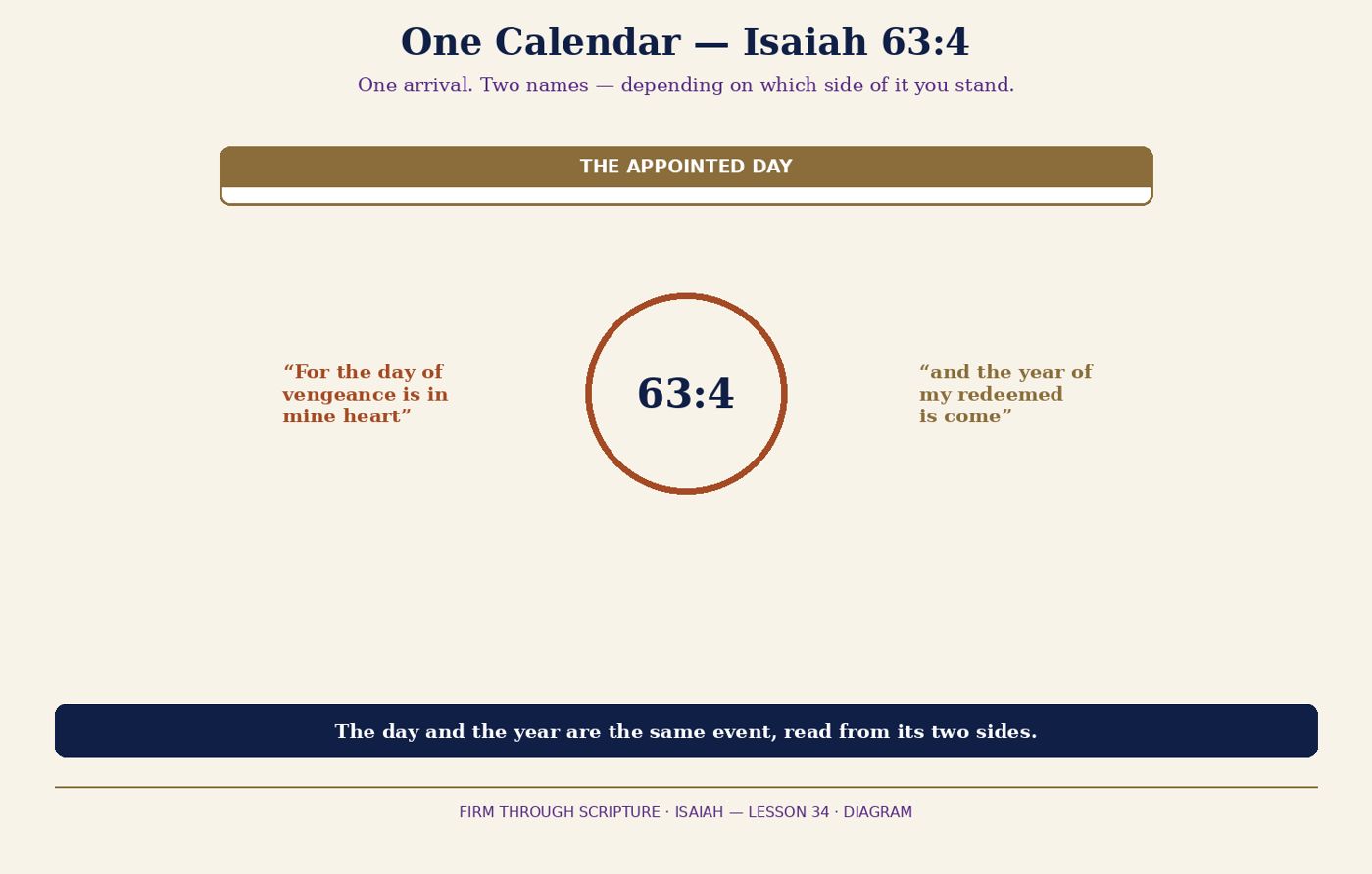
Now the pairing the whole passage turns on. "For the day of vengeance is in mine heart, and the year of my redeemed is come" (v. 4, in fragments — go back and read the verse whole in §1). One event, two names, depending on which side of it you stand. For the oppressors who trod God's people down, the arrival of the righteous judge is vengeance-day. For the redeemed — the bought-back, the ransomed — the same arrival is the opening of their year.
This is not a contradiction in God. A prison door broken open is catastrophe to the jailer and jubilee to the prisoner, and it is one door, broken once. The acceptable year and the day of vengeance stood side by side already in 61:2; 63:4 explains why — they are the same calendar. Preaching that keeps the year and drops the day has amputated the passage. Preaching that keeps the day and drops the year has made God's judgment an end in itself, which this text — where the judge introduces himself as mighty to save — refuses to do [3, 4].
Alone in the press
"I have trodden the winepress alone; and of the people there was none with me" (v. 3, in part). Then again, harder: "I looked, and there was none to help; and I wondered that there was none to uphold: therefore mine own arm brought salvation unto me" (v. 5, in part). Three times the passage insists on the aloneness — none with me, none to help, none to uphold.
Why insist? Because the aloneness is where the book has been heading since 59:16, where God looked for an intercessor among men and found no man. Humanity, in Isaiah's accounting, cannot supply even an assistant. Salvation — and the judgment that clears its way — is God's solo work, accomplished by his own arm, upheld (the irony is deliberate) by his own fury when no one else would uphold him [4, 11]. The passage's second half will confess the same truth from the people's side, at 64:7, where there is "none that calleth upon thy name." The Conqueror was alone in the press partly because the people who most needed the pressing done were not even awake enough to pray for it. That is not comfortable. It is this passage's doctrine, twice-told.
The recital: memory as the prayer's foundation
At verse 7 the passage turns, and the turning itself teaches. The book's longest sustained prayer does not begin with need. It begins with memory: "I will mention the lovingkindnesses of the LORD" — lovingkindnesses, plural, God's covenant-loyal love itemised act by act 3. The congregation lists what God has done before it mentions anything it wants: his great goodness to the house of Israel (the people descended from Jacob, renamed Israel, God's covenant nation), his mercies, the multitude of his lovingkindnesses.
Then the recital's heart, verses 8–9: God claimed them beforehand — "Surely they are my people, children that will not lie" — and "so he was their Saviour." Saviour first; their performance, as the next verse admits, was another story. And the saving was near, not distant: in their affliction he was afflicted (see the Translation Note, §5, and hold the line at its honest strength), the angel of his presence saved them, in love and pity he redeemed them, "and he bare them, and carried them all the days of old." Carried — a father with a child on his shoulders, sustained not for a crisis weekend but all the days of old [3, 4]. Before this congregation asks God for anything, it establishes, on the record, what kind of God it is asking. Present trouble is argued against the evidence of God's own past, in God's own hearing.
The turning point: they rebelled, and vexed his holy Spirit
"But they rebelled" (v. 10) — three words that carry the whole sad history. The carried children rebelled; they "vexed his holy Spirit" — grieved the Spirit God had put within them — "therefore he was turned to be their enemy, and he fought against them." Isaiah softens neither side: the rebellion was real, and so was its consequence. The book will not let you blame the ruins or the silence on a God who wandered off. The prayer's own history assigns the rupture to the people [11, 13].
And yet hear how the verse is used: inside a prayer, as part of an appeal. Confessed honestly, even this becomes ground for hope — if the rupture came from our turning, the way back runs through his mercy to people who turn again. Paul warned the church not to re-enact the same grief (Ephesians 4:30). The grieved Spirit is not a discarded Spirit; 63:11 will ask for his return in the next breath.
The Moses-memory: where is he?
Verse 11 is the prayer's boldest move: "Then he remembered the days of old, Moses, and his people, saying, Where is he that brought them up out of the sea…?" The remembering is done in speech to God — the congregation recites the exodus back to its Author and turns the recital into a question: Where is he? The God who put his holy Spirit within Moses, whose glorious arm went at Moses' right hand, "dividing the water before them," who led them through the deep as steadily as a horse crossing open country, and — the final picture softens completely — led them the way a beast is led down into a valley to rest (vv. 11–14)?
| The prayer's questions | Asked of | Grounded in |
|---|---|---|
| "Who is this…?" (63:1) | The watchman, of the Conqueror | What his eyes see — red garments |
| "Where is he…?" (63:11) | The people, of God | What their memory knows — the sea |
| "Wilt thou hold thy peace…?" (64:12) | The people, of God | What their ruins show — and his past answers anyway |
Do you see what the prayer is doing? It is holding God's own résumé up in God's own court, as evidence for the present case: You have been this God. The sea knows it. Your name is staked on it — you did it, the text says twice, "to make thyself a glorious name." Be this God again. Memory here is ammunition — aimed not at God's character, as if he had changed, but at God's silence, as if he had stopped. Every believer who has prayed "You did it before, Lord" is praying Isaiah 63:11 [13, 4].
The plea: a father when the family tree fails
Verses 15–19 stop reciting and start pleading, and the pleading begins upward: "Look down from heaven, and behold from the habitation of thy holiness" — and then the daring question, "where is thy zeal and thy strength… are they restrained?" (v. 15). Bowels, in the verse's older English, names the deep inward parts — the seat of gut-level compassion. The prayer asks whether God's own compassion has been restrained, held back, dammed up. It is a daring question, and it is prayed, not published — lament's privilege, inside lament's form (§4).
Then comes verse 16, one of the great sentences of the book: "Doubtless thou art our father, though Abraham be ignorant of us" — and it ends, "our redeemer; thy name is from everlasting" (read the whole verse in §1). Abraham is the nation's founding father; Israel is Jacob himself. The prayer imagines the worst: the ancestors themselves would not recognise us, would not claim us. Lineage, as a ground of appeal, is surrendered completely. And precisely there, the deeper ground appears: God's fatherhood of his people does not rest on blood descent. It rests on redemption — "our father, our redeemer." He is their father because he bought them back, and that name, the prayer says, is "from everlasting" — older than Abraham, and not dependent on Abraham's acknowledgment [3, 11].
Hear the pattern, and label it honestly. INFERENCE: a people gathered to God not by ancestry but by redemption, claiming him as Father on the ground of what he has done, is the church's own situation anticipated in prayer. Galatians will argue it in prose (Galatians 3:29; 4:5–6) 1. Isaiah prays it first.
The plea in one line — When the family tree cannot claim us and the file cannot defend us, "our father, our redeemer" still stands — because it never rested on either.
The hardest complaint — held, not solved
Verse 17 must be handled with the discipline Lesson 25 taught on the hardening passages: "O LORD, why hast thou made us to err from thy ways, and hardened our heart from thy fear?" — and its plea, "Return for thy servants' sake" (read the whole verse in §1). This is the hardest line in the prayer. It appears to lay the people's wandering at God's own door.
Do not settle it cheaply in either direction. The same prayer will confess, nine verses later, "we have sinned" — flatly, in the first person (64:5) — and detail that sin at length (64:6–7). The prayer refuses to choose between God's sovereignty over hearts and the people's guilt for their own erring, and a faithful lesson must refuse with it [4, 13]. In its form, verse 17 is lament — a wrestling, not a verdict: the community cries out that only the God who governs hearts can reverse a wandering this deep, and its actual request is not an acquittal but a return: "Return for thy servants' sake." Read as an excuse, the verse is a lie the prayer itself contradicts. Read as lament, it is people who would rather argue with God than stop talking to him.
The plea closes on the ground itself: the sanctuary trodden down, the inheritance possessed "but a little while" (v. 18), and verse 19's name-contrast — we are thine, called by thy name; they never were. The prayer stakes everything on belonging. Then chapter 64 tears the sky.
The cry: rend the heavens
"Oh that thou wouldest rend the heavens, that thou wouldest come down" (64:1, in part) — if §5's verb study did its work, you feel the violence of that rend. This is not a request for a clearer sense of God's presence. It is a request for intervention on the scale of the old theophanies: mountains flowing down, fire making waters boil, nations trembling (64:2). Verse 3 grounds it in precedent — "when thou didst terrible things which we looked not for, thou camest down" — terrible in the older sense: awe-full, dread-producing. The prayer's logic is consistent from 63:7 to here: the past is the argument for the future. You came down before. Come down again.
What eye has not seen (64:4)
Then, in the middle of the cry, the prayer slows down for one of the most-quoted sentences in Isaiah: since the beginning of the world, eye has not seen and ear has not heard "what he hath prepared for him that waiteth for him" (64:4 — read it whole in §1). Notice for whom the unseen preparation waits: "for him that waiteth for him." The verse is not, in its first home, a general remark about heaven's surprises. It is the creed of a waiting community among ruins — and waiting, in this prayer, is precisely the discipline being exercised, at full stretch, for two chapters 3. Paul will weave this verse into 1 Corinthians 2:9 (§6) and aim its promise at what the Spirit now reveals. Both aims honour the verse. Neither cancels the waiting.
The confession: the file opened all the way
Verse 5 opens with the standard the people cannot meet: God "meetest him that rejoiceth and worketh righteousness" — welcomes the one who delights to do right. "Behold, thou art wroth; for we have sinned." Then the confession goes all the way down:
"We are all as an unclean thing, and all our righteousnesses are as filthy rags; and we all do fade as a leaf; and our iniquities, like the wind, have taken us away" (64:6, in part). Unclean is a ritual word — the state that barred a person from the sanctuary; applied to the whole community, it says even our approach to you is compromised. Righteousnesses, plural — not their sins, but their best deeds — are rags, and foul ones. A leaf fading, then the wind taking what faded. And the confession's floor is verse 7: there is none — the intercessor-shaped hole of 59:16 and the empty winepress of 63:5, now confessed from inside the people — "none that calleth upon thy name, that stirreth up himself to take hold of thee." Nobody is even praying properly. This prayer is, by its own admission, prayed by people who cannot pray as they should — and it is prayed anyway [13, 11].
Teach this inside its posture, or do not teach it at all (see Misread 2, §10). It is a devastated community's true confession, inside a plea, two verses before it calls God Father again. Its target is self-trust — the idea that our best efforts could stand as our case before God. The same book commands real righteousness and blesses it (56:1; 58:6–12) 1. Both are true: God demands righteousness of his people, and his people's righteousness, offered as their defence, is rags. The prayer knows the difference. So must we.
The clay pleads: the potter, second posture
"But now, O LORD, thou art our father; we are the clay, and thou our potter" (64:8, in part — the memory verse; meet it whole on the Recap Card). You have met this potter before. In chapter 45, the clay was warned: "Woe unto him that striveth with his Maker!… Shall the clay say to him that fashioneth it, What makest thou?" (45:9) 1. There, the image rebuked the clay for striving — arguing with the Potter's right to use a pagan king as his instrument. Here, the same image is prayed from the other posture entirely: the clay does not strive. It pleads. "Thou art our father" — the potter is not a stranger with rights over us; he is our Father with his hand still on us — "we all are the work of thy hand." Same sovereignty, same image, opposite human posture: striving there, surrendered appeal here. The book's two potter scenes, laid side by side, are its whole doctrine of how creatures should meet an absolute God: not with a lawsuit about his rights, and not with despair about his distance — with a child's appeal to a Father whose handiwork you still are [4, 3].
| The clay in Isaiah | Its posture | Its words |
|---|---|---|
| Chapter 45:9 | Striving — arguing with the Maker's rights | "What makest thou?" |
| Chapter 64:8 | Pleading — appealing to the Father's hand | "We all are the work of thy hand" |
The appeal finishes its case in verse 9: "Be not wroth very sore… neither remember iniquity for ever: behold, see, we beseech thee, we are all thy people." We are all thy people — after the rags, after the wind, after "none that calleth" — belonging is still the last argument the prayer owns, because belonging was never based on the file. It was based on the Redeemer.
The ruins, and the unanswered question
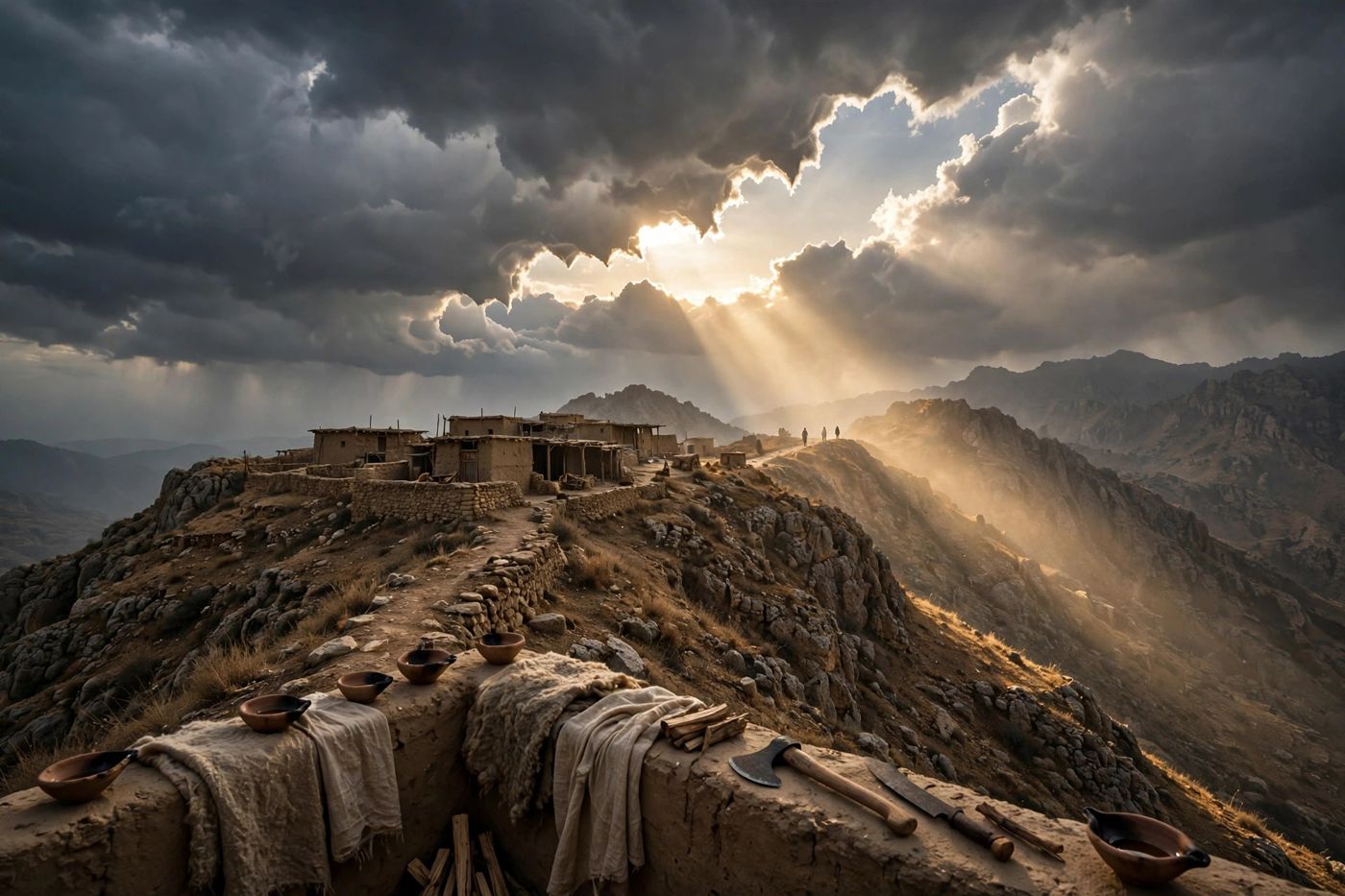
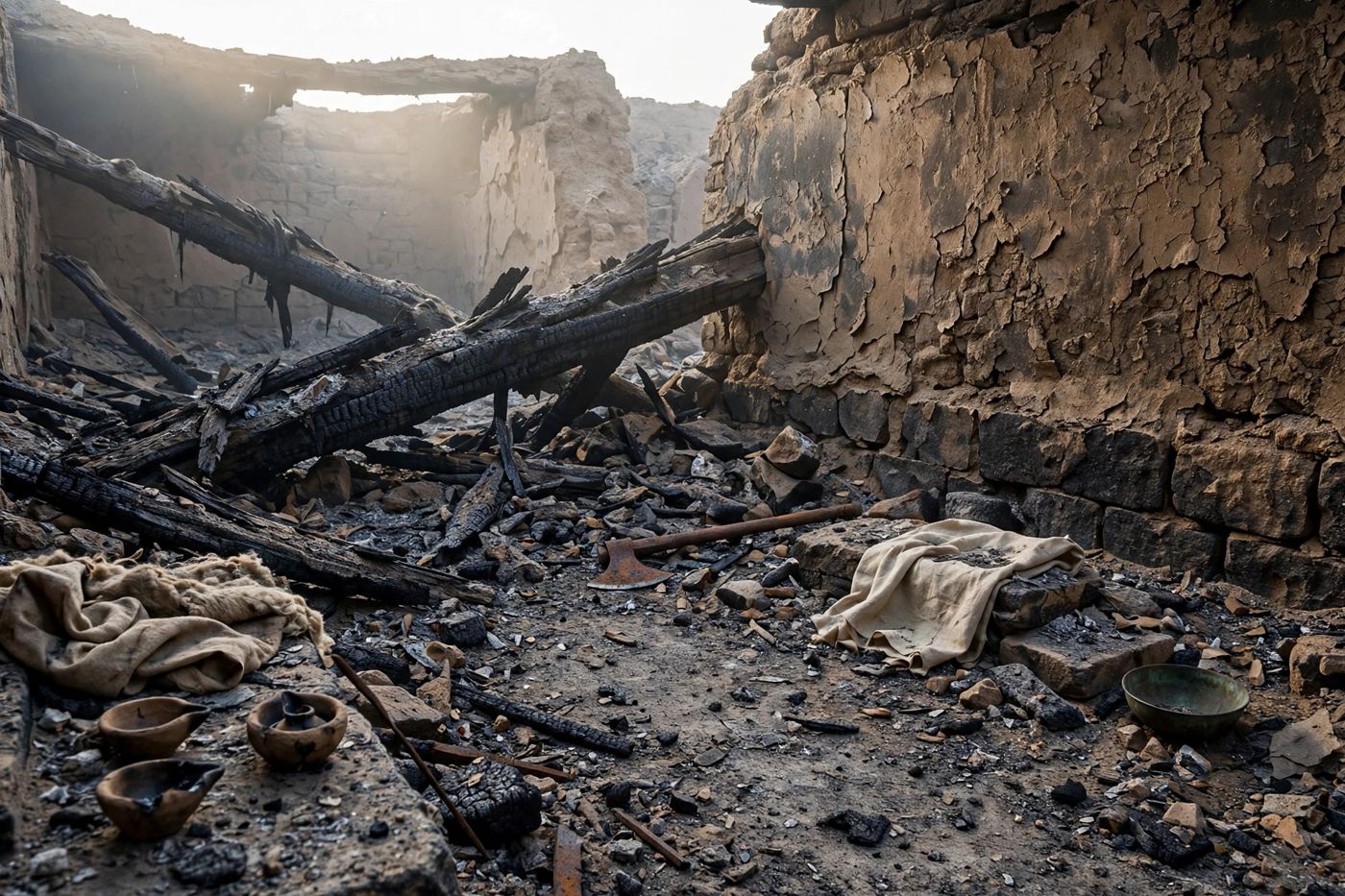
Then the camera is allowed to look around: "Thy holy cities are a wilderness, Zion is a wilderness" (64:10, in part), and "our holy and our beautiful house, where our fathers praised thee, is burned up with fire" (64:11, in part). Our holy and our beautiful house — the temple, the place where the fathers praised. The prayer does not look away from the ash, and neither does this lesson (Visual 5 waits in §11). It carries that inventory into its final line, which is not a statement at all:
"Wilt thou refrain thyself for these things, O LORD? wilt thou hold thy peace…?" (64:12, in part). For these things — with all this in front of you, will you still hold back? The passage ends there. Mark the silence deliberately: no voice from heaven, no resolution inside the frame. Chapter 65 will open with God speaking first. The answer is real, and it is next lesson's. Sit, as the congregation sat, in the pause the book itself makes — neither inventing an answer God has not yet spoken nor concluding that silence is absence. A prayer that ends unanswered has not ended unheard; in this book, it has ended one verse before God replies.
The Christ Thread
Isaiah needs no forcing here; the New Testament reaches for this passage's wardrobe in the open. FACT — as citations: in Revelation 19, the returning Christ, called the Word of God, appears "clothed with a vesture dipped in blood," and "he treadeth the winepress of the fierceness and wrath of Almighty God" (Revelation 19:13–15) 1. The robe and the winepress are this passage's robe and winepress, taken up to dress the final coming of the same Lord who introduces himself in 63:1 as "mighty to save." Beside it stands Revelation 14:19–20's vintage — the vine of the earth cast into "the great winepress of the wrath of God" 1. And signpost back to Lesson 33: the "day of vengeance of our God" that the Nazareth reading stopped short of (61:2; Luke 4) is this day — still in God's heart in 63:4, still paired with the redeemed's year, and in Revelation still future to the first coming. The two-visits reading remains a POSITION, labelled as in Lesson 33 — but the citations are facts [3, 4].
One more echo, at the other end of Christ's work — his beginning, not his return. At Jesus' baptism, Mark writes that he saw the heavens torn — his verb is schizō, torn, not merely opened (Mark 1:10) 1. Isaiah 64:1 is the Bible's great prayer for exactly that tearing. That Mark's torn heaven answers Israel's "rend the heavens" cry is INFERENCE — a deliberate allusion, widely noted, strengthened by the rarity and violence of the verb; this study presents it as inference, no stronger. If it holds, the prayer's first great answer came not with mountains melting but with a dove descending: God did rend the heavens and come down, and the coming looked, at first, like humility. The final coming, Revelation says, will look like the winepress. The prayer gets both answers, in order.
Where in the Covenant Story?
Stand back and place the passage. The covenant — God's binding promise-relationship with his people — has always run on his initiative: he claimed them before they performed ("Surely they are my people," 63:8), redeemed them, carried them, gave them his Spirit. This passage shows what the covenant is made of by showing what survives maximum strain. Ancestry does not survive — surrendered at 63:16. Performance does not survive — rags at 64:6. Even prayer, as a human achievement, does not survive — none stirs himself, 64:7. What survives is entirely on God's side: his fatherhood-by-redemption, his name from everlasting, his arm. The new covenant will be built on exactly those timbers — a people gathered by redemption rather than descent, held by God's faithfulness rather than their own. Praying at the end of their resources, the old covenant's people find themselves already standing on new-covenant ground [57, 3].
Father, Son, and Spirit
The passage earns this heading, provided we walk carefully. The Father is claimed twice, as the prayer's last ground: "thou art our father, our redeemer" (63:16); "thou art our father; we are the clay" (64:8). The Spirit is no abstraction: given within God's people (63:11), leading and giving rest (63:14), and capable of being vexed — grieved — by rebellion (63:10), a line Paul takes up for the church (Ephesians 4:30) 1. The coming One of 63:1–6 speaks with divine prerogatives, and the New Testament dresses the returning Son in his garments (Revelation 19:13–15) 1. Isaiah does not state the church's later doctrine of the Trinity, and this lesson will not pretend he does. What he does is set Father, Spirit, and the divine Saviour side by side in one passage's work — and the church, reading the whole canon, learned to confess here what it confesses everywhere: one God, personally at work in distinguishable ways, none of them a metaphor [4, 57].
The Long View — what the church has believed
You are not this passage's first reader. The ancient church read the Conqueror christologically as a matter of course — the blood-stained garments heard alongside the passion and the return, with Revelation's own reuse of the passage (§6) as that reading's charter inside the canon 37. The prayer half became one of the church's teachers of prayer: generations in ruined circumstances have found their words pre-written in 63:7–64:12, and 64:6's "filthy rags" entered the church's vocabulary of confession so deeply that it is now quoted far more often than it is read in place — §10 exists largely because of that afterlife. Where the centuries have honestly differed is over the setting (§16): which ruins, which generation — a question about the prayer's first pray-ers, not about its God. The centre — a God mighty to save, who judges alone, pleaded with as Father by a people with no other case — has held across every century that has prayed it.
That is the payload. The next section compresses it into the one sentence you are meant to carry out of this study.
8. THE AIM SENTENCE — X: eXplain the intent
Everything observed now compresses into one sentence — the author's intended meaning:
Isaiah shows the LORD coming alone, mighty to save, in the one act that is vengeance-day to his enemies and redemption-year to his people — and then teaches that people, among ruins, to pray as he taught them: reciting his lovingkindnesses, confessing their sin without excuse, surrendering every ground but his fatherhood-by-redemption, and crying for him to rend the heavens and come down again.
If a sermon or devotional uses this passage to say something that cannot be traced back to that sentence, it is not this passage talking.
9. SAY IT BACK
Close the book and say the AIM sentence from section 8 in your own words — out loud, or in your notes, without looking. Then say what it asks of you this week.
If your version quietly changes the meaning — if the Conqueror becomes only a threat, or the day and the year come apart in your hands — open the lesson and walk it again. This exercise feels small. It is the entire course in miniature: meaning first, then — and only then — your life.
10. THE MISREAD — the guardrail, with verdicts
Three live misuses of this passage. Each gets a fair hearing, the evidence, and a verdict.
Misread 1: The winepress, relished — or amputated. "Isaiah 63 is either a celebration of God's violence to enjoy, or an embarrassment to cut out of a sermon on a loving God." Why it sounds right: the passage really is graphic — blood sprinkled on garments, people trodden down in fury. Both kinds of reader are reacting to something genuinely there. The evidence: both reactions refuse the pairing the text itself makes. The speaker introduces himself, before any blood, as the one who speaks in righteousness and is "mighty to save" (63:1). The vengeance is defined by its calendar: it is "the year of my redeemed" read from the other side (63:4). And inside the book's frame, this judgment is rescue for the oppressed — the answer to a world where, as chapter 59 showed, no intercessor could be found. Gloating detaches the day from the year and makes judgment a spectator sport, which the text — where the judge works alone — never does. Amputating leaves the oppressed with a Saviour who will never actually set anything right. Verdict: both are refusals of 63:4. Read whole, the winepress is rescue wearing judgment's clothes, announced by a speaker whose first self-description is mighty to save.
Misread 2: "'All our righteousnesses are as filthy rags' — so human righteousness is worthless, religious effort is hypocrisy, and nothing we do matters to God." Why it sounds right: verse 64:6 really is absolute in its wording, and it really does say righteousnesses — the good deeds, not just the bad ones. Detached, it sounds like a doctrine of total human worthlessness with a proof-text attached. The evidence: the verse has an address. It is a devastated community's confession inside a plea, prayed by people who two verses later call God "our father" and themselves "the work of thy hand" (64:8), and whose prayer God answers in the next chapter. Its own book commands and blesses real righteousness: "Keep ye judgment, and do justice" (56:1); the fast God chooses frees the oppressed (58:6–12) 1. The confession's target is precise — righteousness offered as a defence, our best deeds filed as our case before God. Against that use, the verse is devastating and true. Turned against the works God commands, it contradicts its own book. Verdict: preach 64:6 at self-trust, never at obedience. The doctrine drawn from it must carry its prayer-context: a confession inside a plea, not a slogan against doing right.
Misread 3: "63:17 says God made us err and hardened our heart — so our wandering is God's doing, and we are not to blame." Why it sounds right: the verse's words, read flat, really do address God as the one who made them err and hardened their heart. If lament is read as a legal deposition, the transfer of guilt looks complete. The evidence: the same prayer will not let that reading stand. "But they rebelled, and vexed his holy Spirit" (63:10) assigns the rupture to the people. "We have sinned" (64:5) confesses it in the first person. The catalogue of 64:6–7 is owned, not outsourced. Verse 17 is lament's wrestling with a real mystery (God's sovereignty over hearts, human guilt for wandering, held together — see §7 and §16), and its actual request is "Return for thy servants' sake," not "acquit us." A prayer cannot be used as an excuse when the prayer itself refuses the excuse nine verses later. Verdict: hold the prayer's both lines the way the prayer does. Verse 17 is an argument with God from inside guilt, not a transfer of it.
11. FROM WORD TO WALK
A reflection page — the lesson is not finished until the passage has had its say with you.
Sit with the prayer's order. When your life contains ruins — a burned place where praise used to happen, a relationship, a church, a season of obedience lying in ash — what is your first sentence to God? This congregation's first sentence was not about the ruins. It was "I will mention the lovingkindnesses of the LORD." They recited before they complained. Not because the complaint wasn't coming — it comes, at full volume — but because a complaint untethered from memory becomes despair, and a complaint anchored in memory becomes this prayer: the kind that can ask "where is thy zeal?" and mean it as faith.
Then notice what the prayer does with guilt. Most of us minimise it (it wasn't that bad; God understands) or drown in it (the file is the whole story; finished). This prayer does neither. It opens the file all the way — uncleanness, rags, fading, nobody even praying — and then, with the file still open, it says: "But now, O LORD, thou art our father; we are the clay, and thou our potter." Confession and claim, two verses apart. That distance — 64:6 to 64:8 — is the distance the gospel asks you to learn to travel: no shorter (the file matters), no longer (the Father is near).
And sit where the passage leaves you — in the unanswered question. Most of us, this week, are at the 64:12 end: prayed truly, confessed honestly, remembered accurately — and heaven, so far, quiet. Isaiah 63–64 tells you this exact position has a liturgy. The book that preserves the unanswered prayer also preserves, one page later, God's answer. Until your chapter 65 comes, you are not off the map. You are in Isaiah 64, which is in the Bible — God counted this silence worth scripting. Wait the way this prayer waits: out loud, on the record, résumé in one hand and ruins in the other.
Father — our Redeemer, thy name is from everlasting: I mention your lovingkindnesses before I mention anything else. You have carried your people all the days of old; you have been afflicted in their affliction; your arm has never needed help. I open the file as honestly as this prayer does — my best deeds are not my defence, and some days I do not even stir myself to call on you. But now: we are the clay, and thou our potter; we are all the work of thy hand. Do not remember iniquity for ever. Rend the heavens at your own time, and until then teach me to wait the way this prayer waits — out loud, and holding on. In Jesus' name, amen.
12. FOR DISCUSSION — OR FOR YOUR JOURNAL
With a group, work these aloud. Alone, they're yours — answer them in your journal or in prayer; they lose nothing in the quiet.
- The Conqueror names himself "mighty to save" before the winepress is ever mentioned. How does that order change the way you think — and feel — about God's judgment?
- The prayer recites God's past deeds for eight verses before it complains. What would your own "lovingkindnesses list" contain, and what difference would reciting it first make to a prayer you need to pray now?
- In 63:16 the people surrender ancestry as their ground and claim God's fatherhood-by-redemption instead. What grounds are you tempted to rest on — background, performance, being better than someone — that this verse takes off the table?
- Chapter 64 ends unanswered, and chapter 65 opens with God speaking first. Where are you currently in the pause between a prayed prayer and its answer — and what does this passage teach you to do there?
13. THE WALK-OUT — T: Transfer to today
Meaning is settled. Now — and only now — application, and it must cross the bridge honestly. Run the five Transfer Tests on this passage:
- Same covenant? The prayer is prayed by old-covenant Israel among its sanctuary's ruins; we pray on the far side of the cross, as a people gathered by redemption, not descent. Its postures (recital, confession, appeal to the Father-Redeemer) are the church's native postures; its setting is not re-enacted.
- Same audience? The oracle announces God's action to watchers; the lament is the community's own voice. We receive the first as hearers and join the second as pray-ers — we do not appoint ourselves its Conqueror, its targets, or its editors.
- Same genre rules? An oracle announces; a lament wrestles. So the oracle yields trust, not assignments, and the lament's rawest lines (63:17) yield a way to pray, not doctrines stated cold or excuses stated at all.
- Repeated or rooted? Appealing to God's past deeds, confessing without varnish, claiming his fatherhood over every other ground, waiting for him to act — each is rooted in God's character and reappears across the canon. These cross.
- Ten verses either side? Every application below is drawn from these thirty-one verses read whole — the day kept with the year, 64:6 kept with 64:8, 63:17 kept with 64:5. Nothing hangs on a torn-out line; this passage punishes torn-out lines.
What crosses — and lands:
- God has acted alone, and will. The indicative first: salvation and final judgment are God's solo work (63:3–5), accomplished without a human assistant, and dressed by the New Testament on the returning Christ (Revelation 19). Your part is not to execute either side. It is to be found, by grace, among the redeemed when the one arrival comes.
- The prayer pattern crosses whole. Recital before complaint; memory as evidence; ancestry and performance surrendered; fatherhood-by-redemption claimed; confession at full depth; petition at full boldness ("rend the heavens"); waiting, out loud, when the answer pauses. It is Scripture's own script for praying from ruins.
- The both-lines discipline crosses. God's sovereignty and our guilt, held together the way the prayer holds them (63:17 with 64:5–7) — neither cancelling the other.
Practices — what the gate lets through, made concrete this week:
- The lovingkindnesses list. Before any other praying this week, write your own 63:7 list: specific acts of God toward you, dated where you can. Pray from the list before you pray about any need.
- Pray Isaiah 63:11 at one ruin. Name one burned place in your life or your church's. Hold God's past up as this prayer does — "Where is he that…?" — not as accusation, but as evidence in his own court. Say it aloud.
- The two-verse prayer. Pray 64:6 and 64:8 back to back, in your own words, three mornings this week: the file opened honestly, then the clay's appeal.
- Memorize Isaiah 64:8 — the clay's appeal, printed whole on the Recap Card (§14).
- Wait on the record. If you are in a 64:12 pause, write the unanswered prayer down — dated, unedited — and keep it where you will find it when the answer comes. Chapter 65 is easier to recognise if chapter 64 is written down.
| Held together in the passage | Never split into |
|---|---|
| The day of vengeance (63:4) | Judgment without redemption |
| The year of my redeemed (63:4) | Redemption without judgment |
| "We have sinned" (64:5) | An excuse drawn from 63:17 |
| "Thou art our father" (64:8) | A claim that skips the confession of 64:6 |
What does not cross: taking the winepress into your own hands — naming yourself the executor of God's vengeance on your enemies (the press is trodden alone, and not by you); quoting 64:6 at other people's sincere obedience; using 63:17 as an excuse note for your own wandering; treating God's present silence as a verdict on his character, when this book puts his reply one chapter later.
Praise Him
Praise the LORD who speaks in righteousness and is mighty to save; whose day of vengeance is the redeemed's year; who bore his people, and carried them all the days of old. Praise the Father whose name is from everlasting, the Potter whose hand is still on the clay — who has prepared for those who wait for him what eye has not seen. He has held his peace for a sentence. He has never held his love. Praise him in the pause.
14. THE RECAP CARD — this study on one page
Print it. Keep it where you'll see it this week.
- The passage: Isaiah 63:1–64:12 — the Conqueror in red, and the great prayer of memory, confession, and the cry to rend the heavens.
- Say It Plain: God comes alone from Edom, mighty to save, his garments stained from treading judgment that is also the redeemed's year; his people recite his lovingkindnesses, confess their rebellion and their rags, claim him as Father and Redeemer, and beg him to come down again — and the prayer ends, deliberately, unanswered.
- The AIM: Isaiah shows the LORD coming alone, mighty to save, in the one act that is vengeance-day to his enemies and redemption-year to his people — and then teaches that people, among ruins, to pray by reciting his lovingkindnesses, confessing without excuse, surrendering every ground but his fatherhood-by-redemption, and crying for him to rend the heavens again.
- Key terms: the day of vengeance / the year of my redeemed — one arrival, two names · the angel of his presence — God's own nearness in the rescue · rend the heavens — tear the sky; come down as at Sinai.
- The Misread, in one line: the winepress is rescue, not a spectacle or an embarrassment · "filthy rags" is a confession inside a plea, aimed at self-trust · 63:17 is lament wrestling, not an excuse — the same prayer says "we have sinned."
- Memory verse: "But now, O LORD, thou art our father; we are the clay, and thou our potter; and we all are the work of thy hand." — Isaiah 64:8
- This week's practice: the lovingkindnesses list, prayed before any need — and the two-verse prayer, 64:6 then 64:8, file open and Father claimed.
15. CHECK YOURSELF — five questions
Answer from the study, not from instinct. (Answers live in the Teacher Edition.)
- In your own words: what is the AIM of Isaiah 63:1–64:12?
- In 63:4, what is the relationship between "the day of vengeance" and "the year of my redeemed" — and what two errors follow from splitting them apart?
- The prayer surrenders ancestry as its ground at 63:16. What ground does it claim instead, and why is that ground older and stronger?
- Someone quotes 64:6 to prove that nothing believers do matters to God. Using the verse's context and one other passage from Isaiah itself, answer them.
- Chapter 64 ends on an unanswered question. What is that question, what does the very next chapter do — and why does the lesson insist on sitting in the pause first?
16. GO DEEPER
Optional — the lesson is complete without it.
From the Sources — The winepress in Isaiah's world
The treading floor was the loud, glad centre of the vintage: workers trod grapes in a rock-cut vat, clothes stained to the knee and beyond, the work often accompanied by shouting [16, 53]. FACT. Isaiah had used the image before (the vineyard song of chapter 5), and later prophets take it up for judgment 1. What is new in chapter 63 is the solitude: a vintage with one worker, no song, and a task no one else could share. INFERENCE — from the text's threefold insistence (none with me, none to help, none to uphold): the aloneness is not scenery. It is the doctrine, dressed as a harvest.
The Honest Argument — Which ruins? Whose prayer?
The setting of 63:7–64:12 is genuinely DISPUTED. The case for a community at the exile's end or in the return's first hard years: the temple burned and unrestored (64:11), the cities waste (64:10), the land possessed "but a little while" and already lost again (63:18) — a post-destruction community for whom chapters 60–62 were still unfulfilled, exactly the gap the prayer complains of 9. The case for hearing it inside the book's own prophetic frame, without pinning it to one decade: the book's canonical shape places this prayer deliberately after Zion's glory and before God's reply, and its language echoes the whole preceding book rather than one datable crisis 3. POSITION — this course reads the prayer as the book presents it, in its canonical place, prayed in real desolation (its precise decade honestly unsettled), and teaches its theology at full strength from the text that is certain. The dispute changes nothing in the AIM, the confession, or chapter 65's answer.
A second honest file: that Revelation dresses the returning Christ in this passage's garments is FACT (the citations are on the page). That 61:2's day/year pairing maps onto a first and a second visit, with the day deferred, is this program's POSITION, labelled as in Lesson 33 — argued from Luke 4's stopped reading and Revelation's future winepress, not asserted as a lexical fact about 63:4.
The Word Underneath — rend, and the torn heavens
The verb in 64:1 — Hebrew qara' — is the ordinary verb for tearing cloth, used for garments rent in grief and kingdoms torn away 19. FACT. Isaiah's prayer asks God to do to the sky what mourners do to their clothes. Mark's Greek word at the baptism, schizō, carries the same violence (§7) 1. Set the tearings side by side — heaven torn over the Son, the veil torn at his death — and a pattern the text invites but nowhere states emerges. INFERENCE, labelled: the prayer of 64:1 is answered in instalments, and the first instalment looked like gentleness.
Go Read
- Oswalt, The Book of Isaiah, Chapters 40–66 (NICOT) 3 — on the dialogue's divine speaker and the day/year pairing.
- Motyer, The Prophecy of Isaiah 4 — on the book's refrains: the arm, and the "none to help" echo of 59:16.
- Brueggemann, Isaiah 40–66 (Westminster Bible Companion) 13 — the lament read rhetorically: complaint, confession, and petition.
17. SOURCES & REFERENCES
Numbered citations in this lesson key to this list — the course standard: every sourced claim carries its number, and every number can be checked.
- The KJV text itself — Holy Bible, King James Version (eBible.org KJV, 1769 text). Scripture quotations are from the King James Version (KJV), which is in the public domain in the United States; the full passage is always assigned as reading. Cross-references within Scripture cite this number.
- Oswalt, The Book of Isaiah, Chapters 40–66 (NICOT) — John N. Oswalt (Eerdmans). The second volume: the comfort section, the Servant Songs, Cyrus, and the new-creation chapters, read as the deliberate answer to chapters 1–39.
- Motyer, The Prophecy of Isaiah — J. Alec Motyer (IVP). A one-volume commentary by an evangelical scholar who argues the whole book breathes the mind of the eighth-century prophet; especially strong on the book's structure, its repeated refrains, and the Servant.
- Blenkinsopp, Isaiah 1–39, Isaiah 40–55, Isaiah 56–66 (Anchor Bible) — Joseph Blenkinsopp (Doubleday). Mainstream-critical commentary across all three traditional divisions; a fair statement of the multiple-authorship case and of post-exilic settings.
- Smith, Isaiah 1–39 and Isaiah 40–66 (New American Commentary) — Gary V. Smith (B&H). Evangelical commentary with strong historical notes (the Assyrian and Babylonian records) and an even-handed survey of the authorship debate.
- Brueggemann, Isaiah 1–39 and Isaiah 40–66 (Westminster Bible Companion) — Walter Brueggemann (Westminster John Knox). A rhetorical-theological reading for preachers and teachers; strong on the poetry's movement from judgment to hope.
- Walton, Matthews & Chavalas, The IVP Bible Background Commentary: Old Testament — John H. Walton, Victor H. Matthews, Mark W. Chavalas (IVP). Verse-by-verse ancient Near Eastern background: Assyrian siege practice, Babylonian religion, treaty and coronation customs, geography.
- Brown, Driver & Briggs, Hebrew and English Lexicon of the Old Testament (BDB) — The standard older Hebrew lexicon; word senses and usage ranges for the Terms sections.
- Biblia Hebraica Stuttgartensia (BHS) — The standard critical edition of the Hebrew text behind the modern translations, with its textual apparatus (the home of the Isaiah variants discussed in the Translation Notes).
- Jerome, Commentary on Isaiah — Jerome (c. AD 408–410). The early church's fullest Isaiah commentary; Jerome transmits the Hebrew learning of his day and treats Isaiah as one prophet's book.
- Fee & Stuart, How to Read the Bible for All Its Worth — Gordon D. Fee and Douglas Stuart (Zondervan). The beginner's method book; its prophecy chapter ("a forthtelling first") undergirds the Genre sections.
- King & Stager, Life in Biblical Israel — Philip J. King and Lawrence E. Stager (Westminster John Knox). Daily life, agriculture, warfare, and worship in Isaiah's world.
- House, Old Testament Theology — Paul R. House (IVP). Isaiah's place in a whole-Bible theology; the book's three movements read as one argument.