
One study, one walk — the universal FIRM format. The passage first and whole; then its world; then the Walk (Context · Observe · Genre · Terms · Entire Canon); the meaning taught straight; the AIM sentence; the misread exposed and answered; and the walk-out, where application has to pass the Transfer Tests before it reaches your week. The same skeleton serves a book, a chapter, a single verse, or a whole subject. In the early studies the moves are labeled as they happen. The labels fade as the walk becomes yours.
THE WEEK WITH THIS STUDY — six bites
Day 1 — Read the passage · Say It Plain · The World (§§1–2) · Day 2 — Observe · Genre (§§3–4) · Day 3 — Terms · Entire Canon (§§5–6) · Day 4 — The Meaning · the AIM Sentence · Say It Back (§§7–9) · Day 5 — The Misread · From Word to Walk (§§10–11 — add For Discussion, §12, if you're with others) · Day 6 — The Walk-Out · the Recap Card (§§13–14). Go Deeper (§16) any evening you want the basement.
BEFORE YOU READ — Open My Eyes
LORD, You alone are exalted, and everything I lean on besides You is breath in nostrils. Open my eyes to Your mountain and to my own high places; teach me to walk in Your light, and wash what needs washing until I can stand in Your shelter. In Jesus' name, amen.
§ means “section” — the numbered parts of your lesson. Each bite above names the sections for that day.
1. READ THE PASSAGE — Isaiah 2:1–4:6 (KJV)
Read it all, slowly, before any teaching. In this course the passage always prints once, in full, at the head of the lesson. Everything after this is commentary — this is the text.
1 The word that Isaiah the son of Amoz saw concerning Judah and Jerusalem.
2 And it shall come to pass in the last days, that the mountain of the LORD's house shall be established in the top of the mountains, and shall be exalted above the hills; and all nations shall flow unto it.
3 And many people shall go and say, Come ye, and let us go up to the mountain of the LORD, to the house of the God of Jacob; and he will teach us of his ways, and we will walk in his paths: for out of Zion shall go forth the law, and the word of the LORD from Jerusalem.
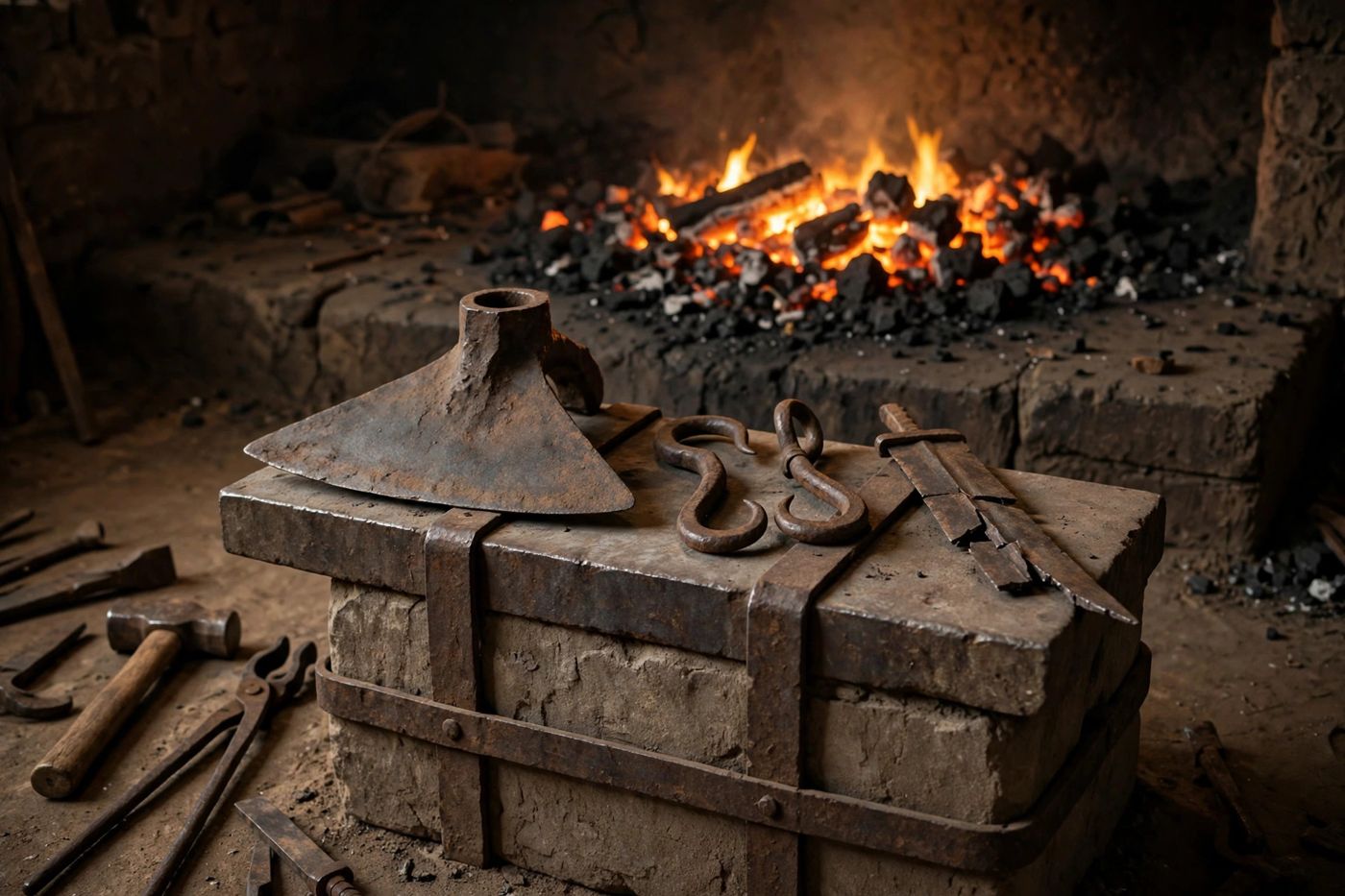
4 And he shall judge among the nations, and shall rebuke many people: and they shall beat their swords into plowshares, and their spears into pruninghooks: nation shall not lift up sword against nation, neither shall they learn war any more.
5 O house of Jacob, come ye, and let us walk in the light of the LORD.
6 Therefore thou hast forsaken thy people the house of Jacob, because they be replenished from the east, and are soothsayers like the Philistines, and they please themselves in the children of strangers.
7 Their land also is full of silver and gold, neither is there any end of their treasures; their land is also full of horses, neither is there any end of their chariots:
8 Their land also is full of idols; they worship the work of their own hands, that which their own fingers have made:
9 And the mean man boweth down, and the great man humbleth himself: therefore forgive them not.
10 Enter into the rock, and hide thee in the dust, for fear of the LORD, and for the glory of his majesty.
11 The lofty looks of man shall be humbled, and the haughtiness of men shall be bowed down, and the LORD alone shall be exalted in that day.
12 For the day of the LORD of hosts shall be upon every one that is proud and lofty, and upon every one that is lifted up; and he shall be brought low:
13 And upon all the cedars of Lebanon, that are high and lifted up, and upon all the oaks of Bashan,
14 And upon all the high mountains, and upon all the hills that are lifted up,
15 And upon every high tower, and upon every fenced wall,
16 And upon all the ships of Tarshish, and upon all pleasant pictures.
17 And the loftiness of man shall be bowed down, and the haughtiness of men shall be made low: and the LORD alone shall be exalted in that day.
18 And the idols he shall utterly abolish.
19 And they shall go into the holes of the rocks, and into the caves of the earth, for fear of the LORD, and for the glory of his majesty, when he ariseth to shake terribly the earth.
20 In that day a man shall cast his idols of silver, and his idols of gold, which they made each one for himself to worship, to the moles and to the bats;
21 To go into the clefts of the rocks, and into the tops of the ragged rocks, for fear of the LORD, and for the glory of his majesty, when he ariseth to shake terribly the earth.
22 Cease ye from man, whose breath is in his nostrils: for wherein is he to be accounted of?
— Isaiah 3 —
1 For, behold, the Lord, the LORD of hosts, doth take away from Jerusalem and from Judah the stay and the staff, the whole stay of bread, and the whole stay of water,
2 The mighty man, and the man of war, the judge, and the prophet, and the prudent, and the ancient,
3 The captain of fifty, and the honourable man, and the counsellor, and the cunning artificer, and the eloquent orator.
4 And I will give children to be their princes, and babes shall rule over them.
5 And the people shall be oppressed, every one by another, and every one by his neighbour: the child shall behave himself proudly against the ancient, and the base against the honourable.
6 When a man shall take hold of his brother of the house of his father, saying, Thou hast clothing, be thou our ruler, and let this ruin be under thy hand:
7 In that day shall he swear, saying, I will not be an healer; for in my house is neither bread nor clothing: make me not a ruler of the people.
8 For Jerusalem is ruined, and Judah is fallen: because their tongue and their doings are against the LORD, to provoke the eyes of his glory.
9 The shew of their countenance doth witness against them; and they declare their sin as Sodom, they hide it not. Woe unto their soul! for they have rewarded evil unto themselves.
10 Say ye to the righteous, that it shall be well with him: for they shall eat the fruit of their doings.
11 Woe unto the wicked! it shall be ill with him: for the reward of his hands shall be given him.
12 As for my people, children are their oppressors, and women rule over them. O my people, they which lead thee cause thee to err, and destroy the way of thy paths.
13 The LORD standeth up to plead, and standeth to judge the people.
14 The LORD will enter into judgment with the ancients of his people, and the princes thereof: for ye have eaten up the vineyard; the spoil of the poor is in your houses.
15 What mean ye that ye beat my people to pieces, and grind the faces of the poor? saith the Lord GOD of hosts.
16 Moreover the LORD saith, Because the daughters of Zion are haughty, and walk with stretched forth necks and wanton eyes, walking and mincing as they go, and making a tinkling with their feet:
17 Therefore the Lord will smite with a scab the crown of the head of the daughters of Zion, and the LORD will discover their secret parts.
18 In that day the Lord will take away the bravery of their tinkling ornaments about their feet, and their cauls, and their round tires like the moon,
19 The chains, and the bracelets, and the mufflers,
20 The bonnets, and the ornaments of the legs, and the headbands, and the tablets, and the earrings,
21 The rings, and nose jewels,
22 The changeable suits of apparel, and the mantles, and the wimples, and the crisping pins,
23 The glasses, and the fine linen, and the hoods, and the vails.
24 And it shall come to pass, that instead of sweet smell there shall be stink; and instead of a girdle a rent; and instead of well set hair baldness; and instead of a stomacher a girding of sackcloth; and burning instead of beauty.
25 Thy men shall fall by the sword, and thy mighty in the war.
26 And her gates shall lament and mourn; and she being desolate shall sit upon the ground.
— Isaiah 4 —
1 And in that day seven women shall take hold of one man, saying, We will eat our own bread, and wear our own apparel: only let us be called by thy name, to take away our reproach.
2 In that day shall the branch of the LORD be beautiful and glorious, and the fruit of the earth shall be excellent and comely for them that are escaped of Israel.
3 And it shall come to pass, that he that is left in Zion, and he that remaineth in Jerusalem, shall be called holy, even every one that is written among the living in Jerusalem:
4 When the Lord shall have washed away the filth of the daughters of Zion, and shall have purged the blood of Jerusalem from the midst thereof by the spirit of judgment, and by the spirit of burning.
5 And the LORD will create upon every dwelling place of mount Zion, and upon her assemblies, a cloud and smoke by day, and the shining of a flaming fire by night: for upon all the glory shall be a defence.
6 And there shall be a tabernacle for a shadow in the daytime from the heat, and for a place of refuge, and for a covert from storm and from rain.
SAY IT PLAIN — the passage in everyday words: Isaiah sees a day when God's mountain stands highest of all and the nations stream uphill to learn His ways, when weapons are reforged into farm tools and war is unlearned. Then the picture flips: that same day levels everything men are proud of — wealth, armies, idols — until people throw their gods to the bats and hide in the rocks. In Jerusalem, God removes the leaders and the food supply, society unravels, a court that grinds the poor is judged, and proud luxury is stripped away item by item. But the passage ends not in rubble but with a Branch beautiful and glorious, a washed remnant written among the living, and God's cloud and fire standing over Zion like a shelter. Everything after this teaches from it — nothing will change what you just read.
2. THE WORLD — C: Context & Audience
A text can never mean what it never meant — so before we ask what these verses mean, we stand where their first hearers stood.
Where we are in the book. Lesson 01 ended with Jerusalem indicted and yet promised a future. Chapter 2 opens with a fresh heading: a new "word that Isaiah the son of Amoz saw concerning Judah and Jerusalem" (2:1). Isaiah ministered in Jerusalem, capital of the southern kingdom of Judah, across four kings' reigns in the eighth century BC — the century when Assyria, the brutal superpower based in what is now northern Iraq, was swallowing the ancient world piece by piece. Judah was a small hill kingdom in Assyria's path. That pressure matters: when a frightened nation is tempted to buy safety with alliances, gold, and foreign gods, a prophecy about what is truly high and what will be brought low is not abstract theology. It is a survival question. [2, 4]
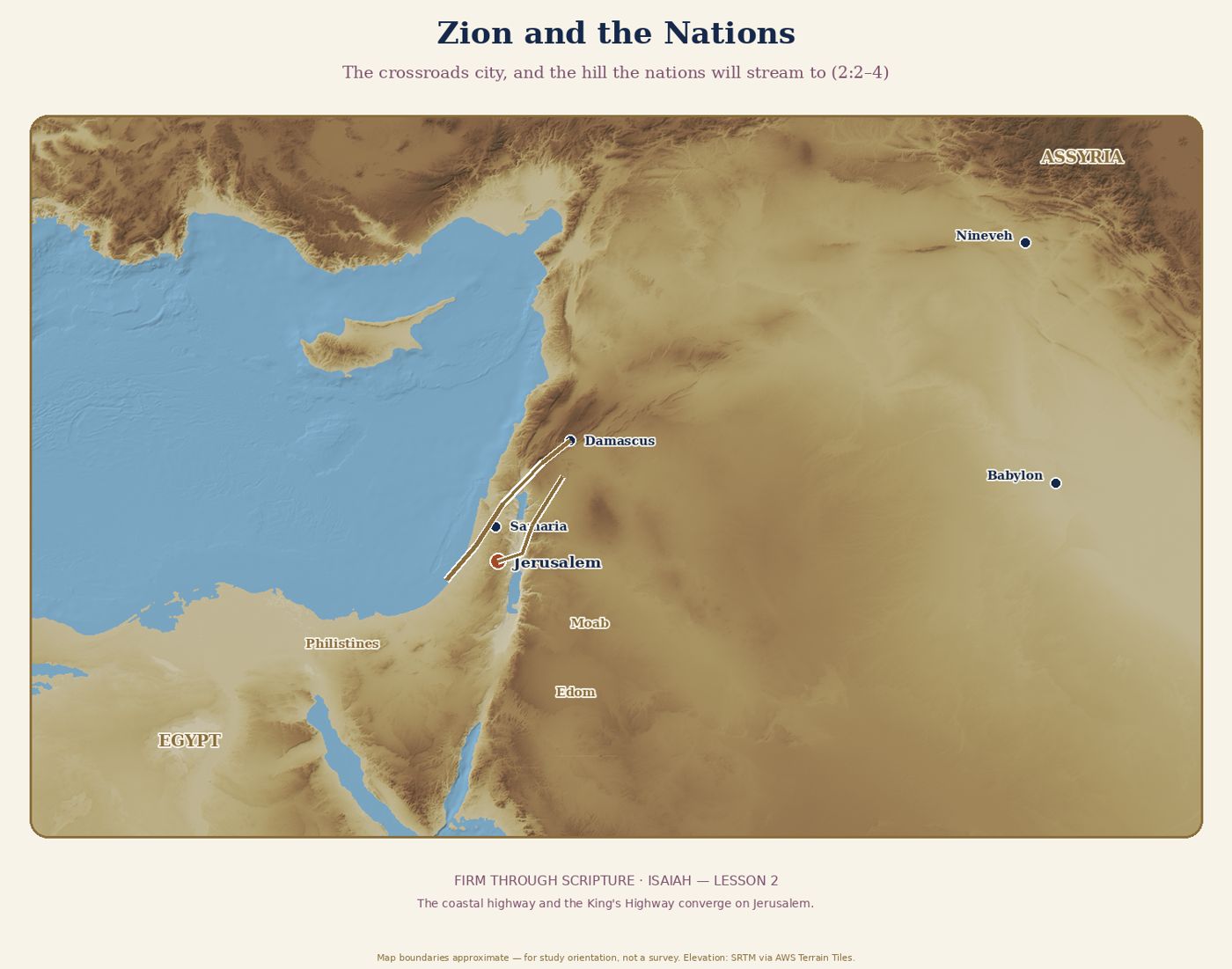
Zion is a real hill before it is a great idea. Zion was originally the fortified hill where Jerusalem began; by Isaiah's day it had widened to mean the temple mount, then Jerusalem itself, then — in the prophets' mouths — the place where God had chosen to put His name and meet His people. And here is the surprise: Jerusalem's hill is not, by any surveyor's measure, an impressive mountain. It sits lower than the Mount of Olives just to its east. Nothing about its altitude earns verse 2. Isaiah is announcing that rank in God's world is not measured the way we measure it — the hill God chooses will outrank every height men boast about, not because it is tall but because He is there. [12, 47]
The nations streaming in — picture the map, not just the metaphor. Verse 2 says "all nations shall flow unto it"; verse 3 names the flow's direction: "out of Zion shall go forth the law, and the word of the LORD from Jerusalem." Rivers flow downhill and people go up to a mountain; Isaiah mixes the pictures — the nations flow like a river, but uphill. Around Judah sat the peoples these chapters will address by name: Philistines west (named already in 2:6), Egypt southwest, Moab and Edom across the Jordan, Damascus and Israel north, Assyria looming beyond, Babylon rising in the east. Jerusalem sat on the ridge route between Egypt and Mesopotamia, which is why empires kept marching through it — and why the claim that the world's peoples would one day voluntarily stream to this crossroads to be taught, reversed everything its hearers knew about traffic on that road. [16, 47]
A land full — of the wrong things. Verses 6–8 catalogue what Judah had filled itself with, and every item is a policy, not an accident. Silver and gold without end, horses and chariots without end: a treasury and a cavalry built by trade and alliance — security purchased. Soothsayers "like the Philistines" and fullness "from the east": imported religion, flowing in along the same trade routes as the gold. Idols, "the work of their own hands": worship manufactured at home. A nation hedging every bet — wealth, horses, fortune-telling, and handmade gods, all at once. The background commentaries note how precisely this matches the period: Judah's kings really did buy alliances, import horses, and absorb stronger neighbours' religious fashions. [16, 47] Isaiah's word for it lands in verse 6 like a door closing: God has "forsaken thy people" — not because He grew tired of them, but because they had filled the land with everything except trust in Him. Hold that catalogue in mind; the judgment of 2:10–22 and chapter 3 answers it item for item.
Bread, staffs, and the way a city actually falls. Chapter 3 opens with God removing "the stay and the staff, the whole stay of bread, and the whole stay of water" (3:1). A "stay" is a support — something you lean on. Bread and water are life's literal supports; verses 2–3 then list the human ones: soldiers, judges, prophets, elders, captains, counsellors, craftsmen, orators. In a besieged city, stored bread was survival measured in weeks, and experienced leadership survival measured in decisions. God Himself will withdraw both, and the vacuum will be filled by the unqualified and the unwilling (3:4–7). This is not an invading army doing the damage. It is a society God stops propping up. [16, 47]
The daughters of Zion and the world of the court. The inventory in 3:18–23 — tinkling ankle ornaments, crescent necklaces ("round tires like the moon"), chains, bracelets, veils, headbands, rings, nose jewels, festal robes, purses ("crisping pins"), mirrors ("glasses"), fine linen — is a wardrobe list from the top of Jerusalem society: luxury goods, many imported, worn by the ruling class's women in a city where, verse 15 has just said, the spoil of the poor sat in the rulers' houses. This is not about fashion in general, or women in general; it is about a corrupt court's jingling wealth, displayed while the poor were ground down in the same streets. The list is real period dress, and that realism is the point: judgment in 3:24 answers the wardrobe item for item. [16, 52]
That is the world: a small, hedging kingdom; a low hill God calls the highest; a city full of everything except trust.
3. OBSERVE — O: what the text actually does
Before meaning comes observation. Most bad interpretation is shallow reading — people answering a text they never actually looked at. So look:
- The passage swings like a pendulum, and the swing is the structure. Vision of glory (2:2–4) → invitation (2:5) → indictment (2:6–9) → the day that levels (2:10–22) → the city unravelled (3:1–15) → the court judged (3:16–26, with 4:1) → the turn: Branch, remnant, shelter (4:2–6). Hope and judgment are not two sermons stitched together; each is preached in the other's hearing.
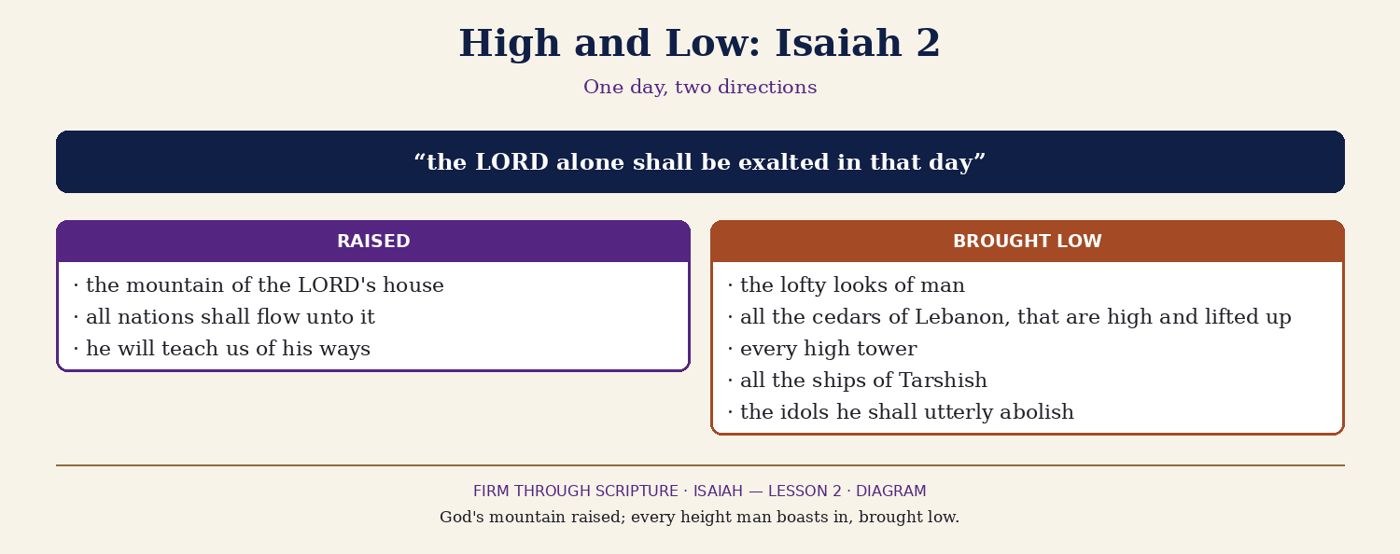
- One refrain tolls through the levelling. "The LORD alone shall be exalted in that day" sounds at 2:11 and again, nearly word for word, at 2:17, framing the catalogue of high things. When a prophet repeats a sentence inside one oracle, he hands you its thesis.
- Watch the height words pile up. Proud, lofty, lifted up, high, haughty — 2:11–17 is saturated with them, and the objects descend the scale of creation: men, cedars and oaks, mountains and hills, towers and walls, ships and "pleasant pictures." Nothing tall in nature, building, trade, or art is left off the list. The observation is the doctrine: the day is universal in its reach.
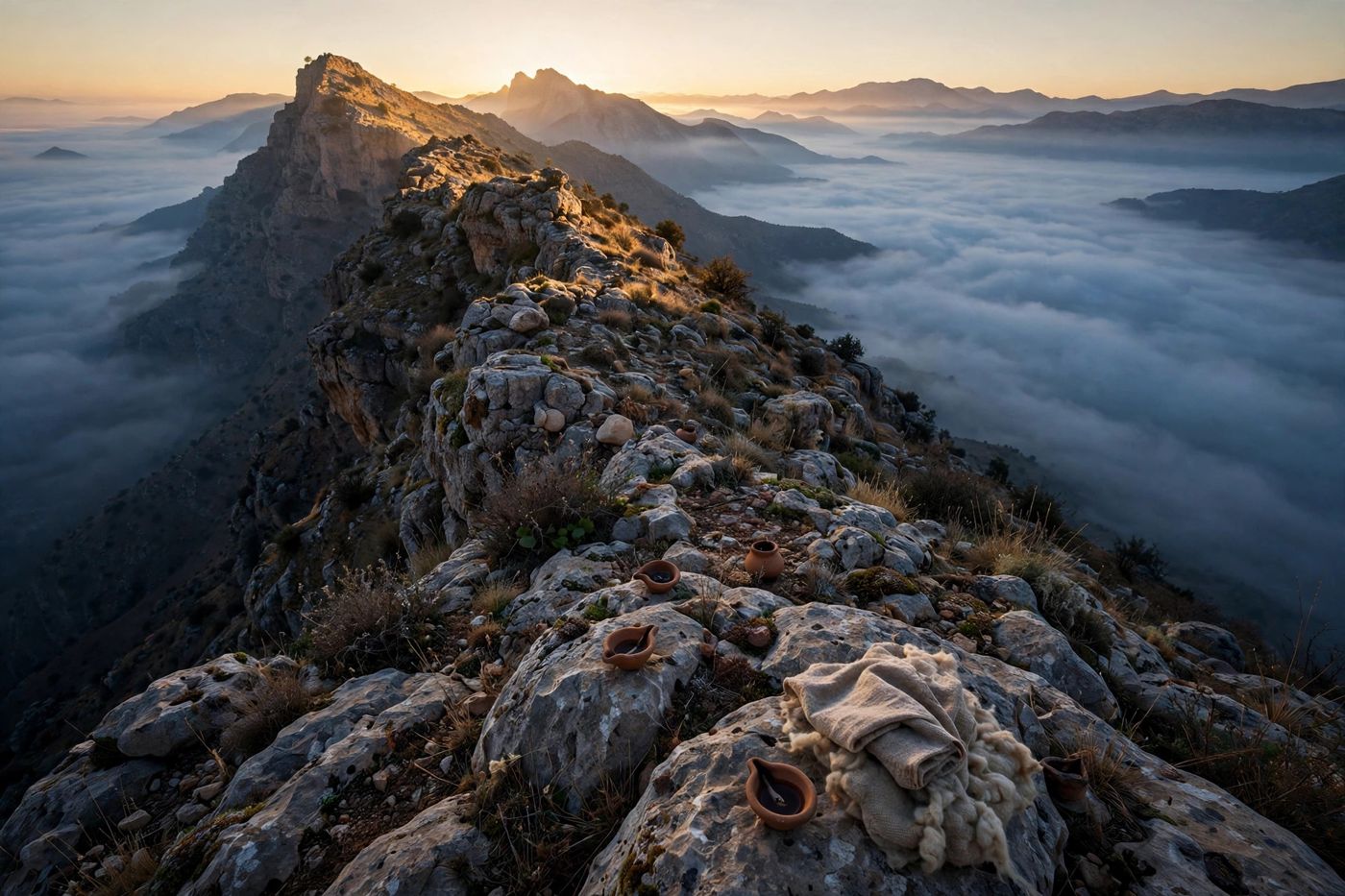
- The verbs reverse between the two halves. In 2:2–4 the motion is up and in: nations flow, people go up, God teaches. In 2:10–22 it is down and in: men bow down, hide, enter rocks, cast away. Same city, same God, two directions — and which way a person moves depends on whether they come to be taught or come to hide.
- Chapter 3 answers chapter 2 in inventory form. Chapter 2 lists what the land is full of (silver, horses, idols); chapter 3 lists what God takes away (bread, water, leaders); 3:18–24 lists what is stripped off the court's body, each item answered by its opposite in verse 24. Isaiah preaches by inventory. Count the lists and you have the argument.
- The commands aimed at us. Scan for imperatives aimed at God's people rather than at the doomed: the invitation of 2:5, and the searching "Cease ye from man" at 2:22. A passage of vision and verdict still tells us where to walk and what to stop leaning on.
- The last word belongs to shelter, not rubble. The final movement (4:2–6) is shorter than the judgment it follows, but it is placed last and built from Israel's oldest imagery — cloud by day, fire by night. Isaiah wants the shelter ringing in your ears when the lesson ends.
4. GENRE — N: note the genre (prophetic vision and judgment–salvation oracle)
Isaiah 2–4 is prophecy, a specific literary kind with its own rules — not a crystal ball, and not a code to be cracked for headlines. The heading tells you the form at once: this is a "word that Isaiah… saw" (2:1) — a vision-report: the prophet is shown something and then speaks it. Inside that frame, the passage runs through several standard prophetic forms:
- The salvation oracle (2:2–4; 4:2–6) — God's future pictured in certainty, meant to create hope and summon present obedience. Its time-marker is deliberately open: "it shall come to pass in the last days" (2:2). A destination announced, not a timetable issued.
- The judgment oracle (2:6–22; 3:1–26) — God's case spoken against His own people first. This thunder is aimed at Judah and Jerusalem, not at the pagans; a reading that enjoys these verses only as a weapon against outsiders has already missed the genre.
- The lawsuit note (3:13–15) — the LORD "standeth up to plead": God appears as prosecutor and judge, and the evidence is named ("the spoil of the poor is in your houses").
- Poetry throughout. Even the prose-looking lists are Hebrew poetry — parallelism, repetition, image on image. When verse 24 answers the wardrobe with five "instead of" reversals, the form is part of the meaning.
Two genre rules protect this whole lesson. First, prophecy is forthtelling before it is foretelling: its first job is to speak God's word into the hearers' present — their pride, their hedging, their cruelty — and the future it announces serves that present summons. 51 Second, vision language is real language about real things, in pictures: a mountain established, weapons reforged, a Branch growing. The pictures are not disposable wrappers around an abstract idea; ask at each one: what reality is this image carrying? [51, 52]
5. TERMS — T: the words in the writer's mouth
Four terms carry this passage, and the whole book will reuse all four.
- "The day of the LORD" — yom YHWH. Yom is the ordinary Hebrew word for a day; YHWH is God's covenant name, the LORD. Joined, the phrase names a day God appoints to act decisively — to judge, to humble, to set things right. [19, 21] This lesson is its great Isaiah debut: "the day of the LORD of hosts shall be upon every one that is proud and lofty" (2:12). Two things to fix at first appearance. First, in Isaiah the phrase is a pattern, not a single date: the day falls inside history again and again — on Judah here, on Babylon in chapter 13, on Egypt, on Edom — each a real humbling of pride, and each an instalment and preview of the last, great day. Second, the day is always the LORD's — His appointment, His action. Men do not schedule it or carry it out for Him.
- The mountain of the LORD's house — Zion. The phrase in 2:2–3 is precise: not just "a mountain," but the mountain where the LORD's house — the temple — stands. Zion (§2) is Jerusalem's hill become a theological name: the place God chose to dwell among His people and to be taught from. [47, 12] In Isaiah, Zion is never mere geography. It is the address of God's kingship on earth, the nations' destination, and the place where the remnant is sheltered. "Established" (nakhon — fixed, firm, immovable 19) is the language of a throne set down for good.
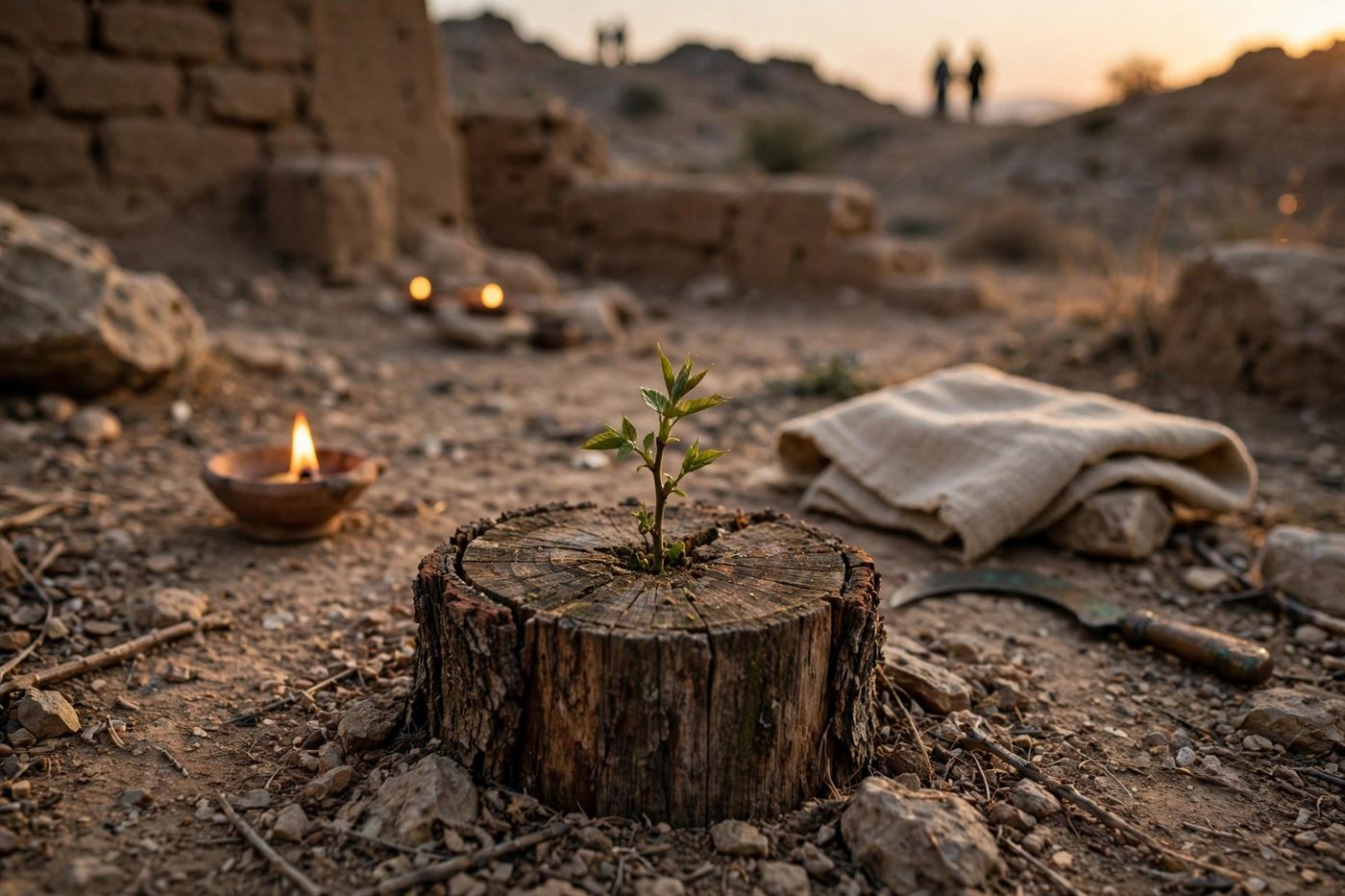
- The Branch — semach (4:2). The Hebrew semach (TSEH-makh) means a sprout, a shoot — fresh growth pushing up where a plant was cut down. [19, 18] In 4:2, "the branch of the LORD" stands in parallel with "the fruit of the earth" — growth that is God's, and a harvest the land yields, both "beautiful and glorious" for the survivors. Later the word becomes a name: Jeremiah promises David "a righteous Branch" who reigns as King; Zechariah says, "Behold the man whose name is The BRANCH." 1 Isaiah returns to the picture in chapter 11 — a shoot from Jesse's cut-down stem. Fix the root image now: when everything tall has been felled, God's future grows — low, green, and alive — rather than being built.
- The remnant — "them that are escaped," "written among the living" (4:2–3). A cluster of phrases runs together through 4:2–3: those "escaped" of Israel, he that is "left" in Zion, he that "remaineth" in Jerusalem, everyone "written among the living." The remnant is Isaiah's name for the people who come through judgment rather than around it — reduced, washed, recorded by God Himself. 47 "Written" pictures a city register, a census roll of the living. Survival here is not luck or self-rescue; it is inscription. God keeps the list.
Method note — the word-study guardrail: a word means what its author uses it to mean, in its sentence, in its century — not what its oldest root once meant, and not everything it can mean anywhere. Every term above was settled by Isaiah's usage in Isaiah.
TRANSLATION NOTE — breath in the nostrils, and a Branch in the ground (2:22; 4:2)
Two renderings deserve a look under the surface. First, 2:22: your KJV bids you cease from man "whose breath is in his nostrils." The Hebrew word is neshamah — the breath God Himself breathed into man's nostrils at creation (Genesis 2:7). 19 The KJV keeps the anatomy on purpose: a creature whose life is a puff of air held in two nostrils is a strange thing to build your security on. Translations that smooth this to "who is mortal" say the same truth and lose the picture; Isaiah's picture is the argument. Second, 4:2: "branch of the LORD" renders semach YHWH (see Terms). Some modern versions capitalise it — "the Branch" — signalling the messianic name the word later becomes; the KJV leaves it lowercase and lets the parallel do the work: Branch of the LORD // fruit of the earth, heaven's planting // the land's harvest, both glorious for the escaped. Neither choice is an error. But know what your translation has decided for you, because in this verse the pairing is the poetry.
6. ENTIRE CANON — E: where this passage sits in the whole story
No passage lives alone — and few passages in the Old Testament are quoted, echoed, and re-run as often as this one. Watch the threads:
- The Micah parallel — one word, two prophets. Isaiah 2:2–4 recurs nearly word-for-word at Micah 4:1–3: "But in the last days it shall come to pass, that the mountain of the house of the LORD shall be established in the top of the mountains… and they shall beat their swords into plowshares." 1 Micah was Isaiah's contemporary, preaching in the same decades, in the same kingdom. This is not a copying scandal: two prophets carrying one shared word about Zion is what you would expect if the word was given rather than invented. Which prophet had it first, or whether both drew on an older Zion tradition, is honestly DISPUTED — §16 argues it in the open. The canonical fact is not in dispute: the word stands twice in your Bible, like a door hung on two hinges. 5
- Joel runs the film backwards — on purpose. In Joel 3:10 the same forge imagery is reversed: "Beat your plowshares into swords, and your pruninghooks into spears." 1 Not a contradiction — the canon keeping two ages distinct. While the day of the LORD is still falling on a hostile world, the nations arm; swords into plowshares belongs to the day when God has judged and the nations come to be taught.
- The Branch grows through the whole canon. Semach sprouts here first (4:2), returns as Isaiah's shoot from Jesse's stem (11:1), and becomes a royal name in Jeremiah and Zechariah. [1, 4] The New Testament never quotes 4:2 directly, and this study will not pretend otherwise; but when it presents Jesus as David's shoot — "the root and the offspring of David" — it is harvesting a picture Isaiah planted. FACT as to the texts; the full identification is weighed in §7's Christ Thread.
- Zion, all the way to the end. Hebrews tells believers, "ye are come unto mount Sion, and unto the city of the living God, the heavenly Jerusalem." 1 Revelation closes the Bible with Isaiah's traffic pattern at full strength: "the nations of them which are saved shall walk in the light of it: and the kings of the earth do bring their glory and honour into it." 1 One picture, first sketched here — the canon, at its climax, still lives inside Isaiah's images. 12
- The cloud and the fire are Exodus furniture. When 4:5 promises "a cloud and smoke by day, and the shining of a flaming fire by night," every Israelite hearer heard the wilderness: "the LORD went before them by day in a pillar of a cloud… and by night in a pillar of fire." 1 Isaiah deliberately recalls the Exodus to say the God who sheltered a camp in the desert will shelter Zion the same way. Note the verb: the LORD will "create" this shelter — new-creation language.
- Where this sits in Isaiah's own argument. Chapters 2–4 form a single panel early in the Book of the King (chs. 1–39): future (2:2–4), present (2:6–3:26), and purged, sheltered remnant (4:2–6) — in that order. The rest of the book works out how a God who judges like chapter 3 can land His people at chapter 4's shelter. [2, 4]
7. THE MEANING — what the passage teaches
The Walk has established what the text says and where it sits. Now its payload, taught straight — the doctrines this passage actually carries.
Glory first: God announces the destination before the indictment (2:2–4)
The order of this passage is itself a doctrine. Before Isaiah says one word about Judah's idols, treasuries, or cruelty, he shows the end of the story: God's mountain established, the nations streaming up, God's judging settling the quarrels of peoples so completely that weapons become farm tools and war is no longer even studied — "neither shall they learn war any more." Notice who acts in every clause. The mountain is established — passive; God sets it. "He will teach us of his ways." "He shall judge among the nations." The nations' part is to come, say "let us go up," and walk in the paths they are taught. Peace here is not negotiated upward by human diplomacy; it flows down from God's settled rule and His taught word. [2, 13] That is why the vision opens the indictment rather than closing it: Judah is judged by the God whose future is already fixed — running in exactly the opposite direction from the one her leaders are buying.
The invitation hidden inside the vision (2:5)
Between the vision and the indictment stands one verse, the hinge of the lesson: Isaiah invites his own people to start walking now — "walk in the light of the LORD" — toward the future he has just described. Prophetic futures work this way: the announced end is given so the present can be lived from it. The light the nations will one day walk by already shines on Jacob's house; the question is whether Jacob will walk in it, or keep filling the land with substitutes (2:6–8). This is the passage's first application, written by the prophet himself. [4, 13]
The day that levels: only One stays high (2:6–22)
Now the indictment, heard in its own logic. Judah's root sin in chapter 2 is not first of all cruelty (that comes in chapter 3) but substituted trust: a land filled with gold, horses, and gods of its own manufacture — a nation hedged in every direction so it will never have to do the one thing it was called to do, which is trust the LORD. Verse 9 gives the result in one grim picture: "the mean man boweth down, and the great man humbleth himself" — bowing, but to idols. Human beings will bow; the only question is to what.
The day of the LORD in 2:10–22 is described almost entirely as a great levelling, and its refrain states its whole theology: "the LORD alone shall be exalted in that day." Read the catalogue again in that light — cedars of Lebanon (the ancient world's most prestigious timber), oaks of Bashan, high mountains, high towers, fenced walls, the ships of Tarshish (the long-distance merchant fleet, the very engine of the gold of verse 7), and finally the idols themselves. [16, 52] Nature's heights, architecture's heights, commerce's heights, religion's handmade heights — nothing a human being has ever pointed to and said "that will stand" is left standing. And the human response is the vision's dark mirror image: instead of flowing up to God's mountain, men crawl into the rocks — "for fear of the LORD, and for the glory of his majesty" — and throw their silver and gold idols "to the moles and to the bats," to blind burrowing creatures, the right congregation for gods that could never see. The treasures of verse 7 end as rubbish tossed into dark holes in verse 20.
Two guardrails for your doctrine here. First, this is God's act, not man's: "when he ariseth to shake terribly the earth." The levelling is not a political revolution Isaiah is recruiting for; it is a theophany — God arising. Second, the day's aim is not destruction for its own sake. Its stated result, twice, is that "the LORD alone shall be exalted." The day clears the field of rival heights so the mountain of 2:2 is the only one left in view: the same exalted LORD, met by the taught nations as Teacher and by the proud as terror. [2, 4]
When God stops propping up a city (3:1–15)
Chapter 3 brings the day of the LORD down to street level, and its mechanism is chilling precisely because it is so quiet: God takes away. The stay and the staff — bread, water, and then the whole leadership bench: soldier, judge, prophet, elder, captain, counsellor, craftsman, orator. What follows is not invasion but entropy: children as princes, each man oppressing his neighbour, a desperate search for anyone with a cloak to take charge of the ruin — and the man with the cloak refusing, because in his house there is no bread either (3:6–7). Isaiah's doctrine here is one every age needs: a society's competence is a gift on loan, not a natural resource. Leadership, order, food systems, public trust — the LORD gives them and can withdraw them, and their withdrawal is itself a judgment, before any enemy crosses a border.
Then, at 3:13–15, the quiet collapse gets its courtroom explanation. The LORD stands to plead and to judge, and His charge against the elders and princes is not idolatry this time — it is economics: "ye have eaten up the vineyard; the spoil of the poor is in your houses," and then the question to read slowly: "What mean ye that ye beat my people to pieces, and grind the faces of the poor?" Note whose people they are: "my people." Exploitation of the poor is not a policy failure standing next to the religious charges; it is a charge God prosecutes in the first person, against His own nation's leaders. [13, 16] Verses 10–11 hold the moral frame steady mid-collapse — well with the righteous, ill with the wicked, each eating "the fruit of their doings" — because even when the city unravels, God's moral order has not unravelled with it.
The court's finery, judged — and taught with care (3:16–24; 4:1)
Now the passage this lesson handles with both hands. "Because the daughters of Zion are haughty, and walk with stretched forth necks and wanton eyes, walking and mincing as they go, and making a tinkling with their feet" (3:16) — therefore the LORD will strike, expose, and strip. The ornaments of 3:18–23 will be taken away "in that day," and verse 24 answers finery with its opposites: stink for sweet smell, baldness for well-set hair, sackcloth for the stomacher, "burning instead of beauty." Then the desolation: their men fallen by the sword, Zion a widowed woman sitting on the ground (3:25–26) — and 4:1's grim coda, seven women seizing one surviving man, begging only for his name to cover their reproach. The verse measures war's desolation — it is not a joke about desperation.
Teach this straight, and teach it carefully:
- The frame is set by 3:14–15, not by modern arguments about dress. The oracle's "moreover" (3:16) continues the same courtroom. The daughters of Zion are the ruling households' women — the class whose houses hold "the spoil of the poor." Their finery is the court's wealth made visible in a city of ground-down poor. What God arraigns is haughtiness — from the same height-family as all of chapter 2 — displayed as luxury built on injustice. [13, 16]
- The judgment is chapter 2's levelling reaching the wardrobe. Here the "high things" are carried on bodies — stretched-forth necks, tinkling steps. God strips the symbols because the symbols were the sermon the court preached about itself: we are above you. His answer is the same one He gives cedars, towers, and ships.
- This is never a warrant for contempt toward women. The text's grief breaks through its severity — Zion in 3:26 is mourned, not mocked, and 4:1's women are victims of a desolation men made by war and corruption. A teacher who reads these verses with a sneer has reversed the passage: its contempt is reserved for the proud court, its tears for the city. [13, 52]
The turn: a Branch, a washed remnant, a shelter (4:2–6)
"In that day" — the same marker that headed the levelling (2:12) and the stripping (3:18) now heads this: "shall the branch of the LORD be beautiful and glorious." The day that fells every tall thing is also the day the low green thing flourishes. Everything in 4:2–6 answers something earlier in the lesson, and seeing the answers is the meaning:
- Against the felled heights, growth. The Branch and "the fruit of the earth" are "excellent and comely for them that are escaped of Israel." God's future after judgment is not a taller tower but a living crop — beautiful precisely to the people who came through the fire.
- Against the removed register of leaders, a register of the living. In 4:3 the survivors are "written among the living in Jerusalem" — and the bookkeeping is His. And they "shall be called holy": a name God bestows on the remnant, made true by washing — verse 4 says the LORD will have "washed away the filth of the daughters of Zion, and… purged the blood of Jerusalem… by the spirit of judgment, and by the spirit of burning." Note it — the daughters of Zion from 3:16 reappear, and God's final word over them is not exposure but washing. The burning that judged is the burning that cleanses. [2, 4]
- Against men hiding in rocks from His glory, the glory becomes a roof. In 4:5, over every dwelling place of Mount Zion and her assemblies, the LORD creates the cloud and the fire — "for upon all the glory shall be a defence." In chapter 2 men fled from "the glory of his majesty" into caves; in chapter 4 the glory is a canopy over God's people — "a tabernacle for a shadow in the daytime from the heat, and for a place of refuge, and for a covert from storm and from rain" (4:6). The same glory. The difference is not in God; it is in whether a person meets His glory proud or washed. That sentence is the lesson in miniature.
The Christ Thread
Isaiah does not name Jesus in these chapters, and this study does not force Him in. But the New Testament reads this passage's pictures as Christ's, and where the apostles draw the lines, we may draw them with a steady hand:
- The Branch is the clearest thread. Semach becomes a royal name across the prophets (Jeremiah 23:5; Zechariah 3:8; 6:12), and Isaiah's own development of the picture — the shoot from Jesse's stem, on whom the Spirit rests (11:1–2) — is read by the New Testament of Jesus' Davidic descent and anointing. [1, 4] POSITION — the church's historic reading, held here as the canon's own trajectory rather than as a claim that 4:2's first hearers saw a full portrait of Christ: what they saw was God's promise that His future would grow from David's felled tree; what the church confesses is in whom it grew.
- The exalted One. Chapter 2's refrain is the Old Testament weather in which the New Testament's confession forms: God has "highly exalted" Jesus and given Him the name above every name, that every knee should bow (Philippians 2:9–11). 1 And John, looking back at Isaiah, says the prophet "saw his glory, and spake of him" — of Christ (John 12:41). 1 The glory men hide from in Isaiah 2 and shelter under in Isaiah 4 is, the apostles say, finally seen in a face.
- The washed remnant becomes a people from all nations. The register of the living in Jerusalem (4:3) opens into the Lamb's book of life and into a Zion Hebrews says believers have already come to — its gates, in Revelation 21, open to the nations Isaiah watched streaming uphill. 1 Isaiah drew the map; the gospel fills the road.
Where in the Covenant Story?
This passage stands early in the story, under the covenant made at Sinai and renewed with David — and shows it working in both its motions at once. Sinai's blessings and curses promised exactly chapter 3's sequence for covenant treachery: leaders removed, bread scarce, society disordered (compare Deuteronomy 28). 1 Isaiah 3 is not God improvising punishments; it is the covenant's own terms, read aloud. But the covenant carries a deeper promise — God will not let the story end in the curse. The Branch is Davidic language (2 Samuel 7's house, felled but not forgotten); the shelter of 4:5–6 is Exodus language; the nations streaming to Zion is Abrahamic language — Abraham's blessing reaching "all families of the earth" (Genesis 12:3). 1 Judgment here is the covenant enforced; hope is the covenant outlasting its own enforcement.
Father, Son, and Spirit
Gently, and only where the text reaches: the Father — "the LORD of hosts" throughout — is the passage's great Actor: He establishes the mountain, arises to shake the earth, takes away, washes, and creates shelter. The Son is present by promise and picture rather than by appearance: the Branch of the LORD (4:2), whose fuller portrait Isaiah paints in chapters 9 and 11. The Spirit appears once, unforgettably: Jerusalem is purged "by the spirit of judgment, and by the spirit of burning" (4:4) — God's own breath as the agent of cleansing, judgment-fire that washes rather than merely consumes. A reader trained by the whole canon can already see the shape of God's action here: the God who decrees, the Branch who comes, the Spirit who cleanses. That is as far as this passage, honestly handled, lets us go — and it is far enough to be wonderful.
The Long View — what the church has believed
You are not this passage's first reader. Swords into plowshares (2:4) has been the church's emblem of God's coming peace from the earliest centuries — eventually cast in bronze in the United Nations garden (a Soviet gift of 1959), straight off this verse. The historic agreement: the peace is God's act at His exaltation — prayed for and witnessed to now, not a programme any generation has completed. The day of the LORD has been read as Isaiah reads it — falling repeatedly within history, gathering toward a final day confessed in the creeds as Christ's return to judge. The Branch, in the church's reading from the earliest fathers onward, has been Christ — Jerome treats Isaiah's sprouting promises as one prophet's witness to Him 37 — while Jewish reading has characteristically heard in 4:2 the glory of the land and its people in the age to come; §16 keeps that argument open. The centre has held: one LORD exalted, pride levelled, a washed remnant sheltered. [2, 4]
That is the payload. The next section compresses it into one sentence to carry out of this study.
8. THE AIM SENTENCE — X: eXplain the intent
Everything observed now compresses into one sentence — the author's intended meaning, stated before any application is allowed near it:
Isaiah announces God's fixed future — His mountain exalted, the nations taught, weapons reforged, and a washed remnant sheltered under His glory — and confronts proud Judah with its present: the day of the LORD will level every height men trust in, until the LORD alone is exalted; therefore walk now in the light of that coming day.
If a sermon, a post, or a devotional uses Isaiah 2:1–4:6 to say something that cannot be traced back to that sentence, it is not this passage talking.
9. SAY IT BACK
Close the book and say the AIM sentence from section 8 in your own words — out loud, or written in your notes, without looking. Then say, in one more sentence, what it asks of you this week.
If your version quietly loses half the pendulum — the mountain as only comfort, or the levelling as only a threat aimed at other people — open the lesson and walk it again. A Say-It-Back that keeps only the breath you liked has not said the passage back. Meaning first, then — and only then — your life.
10. THE MISREAD — the guardrail, with verdicts
Three live misuses of this passage. Each gets a fair hearing, the evidence, and a verdict.
Misread 1: "Swords into plowshares is a political programme for today — if the church lobbies hard enough, we can legislate Isaiah 2:4 into being." Why it sounds right: the vision is concrete — real weapons, real farm tools — and Christians rightly long for peace. The evidence: read who acts in the text. The verbs of 2:2–4 belong to God: He establishes the mountain, He teaches, He judges among the nations — and then, downstream of His settled judgment, "they shall beat their swords into plowshares." War ends because a Judge has settled the nations' quarrels, not because the nations outgrew quarrelling. Joel 3:10 runs the same forge in reverse for the age of conflict — the picture belongs to God's season. 1 The New Testament's sequencing agrees: the nations walk in the city's light when the Lamb reigns (Revelation 21:24). A church promising to deliver Isaiah 2:4 by policy is claiming God's verbs as its own. Verdict: right longing, wrong agent and wrong tense. The passage commissions the church as witness — a people who learn war no more in their own dealings, make peace where they stand, and point to the coming Judge — not as the engineer of the consummation. Confusing the two eventually makes the church either coercive or despairing.
Misread 2: "'The day of the LORD' is Bible language for one thing only — the end of the world — so these verses are all about the distant future." Why it sounds right: the New Testament does use the phrase for Christ's return (1 Thessalonians 5:2; 2 Peter 3:10), and modern prophecy teaching has collapsed it onto that single event. 1 The evidence: Isaiah's own usage will not allow the collapse. In this very lesson, the day falls on eighth-century Judah — her cedars, towers, ships, elders, and court — within her own history (2:12; 3:1). Later the day falls on Babylon (ch. 13); other prophets land it on Egypt, on Edom, on Israel itself (Amos 5:18 warns people who desired the day that it would be "darkness, and not light" for them). [1, 19] The pattern is consistent: many real days of the LORD inside history, each a genuine judgment on pride, all of them instalments and previews of the final one. Read Isaiah 2 as only-future and you evacuate its first meaning — God's word to the people actually standing in front of the prophet. Verdict: the day of the LORD is a pattern before it is a date. In Isaiah it lands repeatedly inside history — against Judah, Assyria, Babylon — and the final day gathers them all.
Misread 3: "Isaiah 3:16–24 shows God's contempt for women — the finery passage is God (and the church after Him) sneering at women who dress well." Why it sounds right: the passage is aimed at "the daughters of Zion," its catalogue is of women's ornaments, and its reversals fall on women's bodies. Verses like these have also been preached with contempt, which makes the misread feel confirmed by experience. The evidence: the passage's frame is 3:14–15, a courtroom charge against the elders and princes for grinding the poor — and 3:16 begins "Moreover," continuing the same arraignment of the same ruling class. The daughters of Zion are the court's households; the ornaments are a corrupt regime's ill-gotten wealth worn in public; the sin named is "haughty" — the height-sin of the whole lesson, condemned identically in men, cedars, towers, and ships. 13 The oracle stands in a line with Amos against the cows of Bashan and Jesus against those who devour widows' houses — judgment on predatory wealth, not on womanhood. And the sequel forbids the contemptuous reading: these same daughters of Zion are the ones God washes in 4:4. God does not wash what He merely despises. Verdict: a judgment oracle on a corrupt court's luxury built on the poor — 3:14–15 sets the frame, and 4:4 gives the daughters God's last word over them: washing, not contempt. Preached as a sneer at women, the passage is used against its author.
11. FROM WORD TO WALK
A reflection page — the lesson is not finished until the passage has had its say with you.
Everyone in this passage is doing something with height, and so are you. The nations stream up. The proud crawl into rocks. The court struts. The remnant is washed and sheltered. Pick your verb, because one of them is yours this week.
Start where Isaiah starts the application — at 2:5, before any of the thunder: walk in the light of the LORD. Light you already have. There is some obedience you do not need more information for — at work, at home, with money, with a grudge — where you already know what walking in the light looks like and have been walking by imported substitutes instead: respectable hedges, sensible securities, everything except plain trust. This passage calls that what it is. Not weakness. Forsaking (2:6).
And then let the levelling become mercy before it becomes fear. The day of the LORD levels everything you are tempted to make your height: the record, the bank balance, the reputation, the being-right, the being-needed. Men in the passage hide from that because they meet it proud. But there is another way to meet the truth that the LORD alone will be exalted — as relief. You were never going to stay high; breath is in your nostrils. The only question is whether your high things come down by your own honest hand now, in confession, or in the shaking later. Isaiah holds out the first option in verse 5's warmest grammar: "come ye, and let us." The prophet puts himself inside the invitation.
Finally, sit with the remnant of 4:3 a moment, because some readers come to this passage carrying shame the way 4:1's survivors carried reproach. Hear what God does with the leftovers of a judged city: He writes them among the living, calls them holy, washes them Himself, and builds His glory over them as a roof. If you are in Christ, that is not somebody else's picture. It is the family story: washed, recorded, sheltered. The God who levels towers does not level the people who hide in Him — He covers them.
LORD of hosts — You alone are exalted, and I confess how much of my life is an attempt to stay high by other means. Teach me to walk in the light I already have. Bring down what I have trusted instead of You; wash what judgment has exposed in me; and write me — as You have written Your remnant — among the living, under the shelter of Your glory. In the name of the Branch, Jesus, amen.
12. FOR DISCUSSION — OR FOR YOUR JOURNAL
With a group, work these aloud. Alone, they're yours — answer them in your journal or in prayer; they lose nothing in the quiet.
- Isaiah puts the glorious future (2:2–4) before the indictment (2:6 onward). Why does God announce the destination before He names the sins — and what difference does that order make to how conviction feels?
- Verses 6–8 describe a land "full" of gold, horses, and idols — a nation hedging every bet. What are the respectable hedges of our moment, stacked up so we never quite have to trust God? Name one of yours.
- The refrain says the LORD alone shall be exalted in that day. Which of the levelled heights in 2:12–16 do you find hardest to imagine God bringing low in your own life, and why?
- In 4:2–6 the God who stripped the court washes the daughters of Zion and shelters the remnant under His glory. What changes for you if God's glory is terror to the proud and a roof to the washed — and which side of that difference are you living on this week?
13. THE WALK-OUT — T: Transfer to today
Meaning is settled. Now — and only now — application, and it must cross the bridge honestly. Run the five Transfer Tests on this passage:
- Same covenant? Isaiah addresses covenant Judah under Sinai's terms; we read as those gathered into the new covenant in Christ. The levelling of pride and the call to walk in God's light cross intact (rooted in who God is); chapter 3's curse sequence — bread, staff, and leadership withdrawn from Jerusalem — was spoken to that city in that crisis, not as a template for any modern nation.
- Same audience? The oracles address God's own people first. Applications that aim the thunder only at outsiders fail this test on arrival.
- Same genre rules? Prophetic vision and oracle: the futures announced (2:2–4; 4:2–6) are God's to perform; the present-tense summons (2:5; 2:22) is ours to obey. Keep the verbs with their owners — we walk in the light; we do not establish the mountain.
- Repeated or rooted? Humility before God's exaltation, trust instead of hedging, justice for the poor, hope in a sheltered remnant — each is repeated across both testaments and rooted in God's character. These cross at full strength.
- Ten verses either side? Every application below is drawn from these chapters read whole. Nothing hangs on a torn-out line: not on 2:4 without its Judge, not on 3:16 without 3:14–15 and 4:4.
The whole passage, on one screen — the two ways to meet God's glory:
| Meet Him… | And the passage shows… |
|---|---|
| Taught, walking in His light (2:2–5) | Nations streaming up; weapons reforged; peace |
| Proud, trusting high things (2:6–22) | Levelling; hiding in rocks; idols cast to the bats |
| Washed and written (4:2–6) | The Branch glorious; the register kept; glory as a roof |
What crosses — and lands (led, as always, by what God has done — the indicative before the imperative):
- God has fixed the future; walk from it, not toward uncertainty. The mountain is established in God's decree before it is visible in history; the Branch has come in Christ; the register of the washed is kept by God Himself. Application begins as confidence, not anxiety: live now in the direction of a settled end (2:5).
- Stop leaning on breath. "Cease ye from man, whose breath is in his nostrils" (2:22) crosses as a standing order about ultimate trust: no leader, expert, market, movement, or version of yourself is load-bearing. Respect people and use means — and let none of them be what your soul rests on.
- Pride is the height-sin in every costume. Chapter 2 levels it in nature, architecture, commerce, and religion; chapter 3 finds it in courts and wardrobes. God's opposition is to haughtiness wherever it grows — especially in religious people — and His prescribed response is not despair but descent, by confession, before the shaking.
- The poor are God's courtroom concern, personally. "My people," "grind the faces of the poor" (3:15) — how the powerless are treated by the comfortable is not a side-issue to this passage's spirituality; it is one of its prosecutions. What crosses: an obligation on everyone with surplus or say-so to answer God's question — what mean ye? — with clean hands.
Practices — what the gate lets through, made concrete this week:
- Walk in one known light. Name one specific obedience you already know — a call, an apology, a debt, a habit, a truth to tell — and do it this week before asking God for more light. Verse 5 is present tense.
- The height inventory. List your own cedars, towers, and ships: the three things you most rely on to be somebody. Confess any that have become trust-substitutes, and choose one concrete act of descent — generosity with the surplus, rest from the striving, silence where you would have boasted.
- Answer for the poor, once, concretely. One act this week that puts real resource — money, time, a meal, a ride — toward someone with less power than you, done quietly. Then re-read 3:14–15 and let the passage examine the rest of your surplus.
- Memorize Isaiah 2:5 — the prophet's invitation to walk in the LORD's light (printed in full on the Recap Card below). Carry it into every room where you are tempted to hedge.
- Peacemaking, at your scale. Where you actually have standing — a feud, a family cold war, a workplace grudge — take one step that learns war no more: initiate the conversation, absorb a small cost, refuse to pass the quarrel on. Witness to 2:4, at the size God has given you.
What does not cross: claiming Isaiah 2:4 as a promise that any present political order can be made warless by legislation; reading chapter 3 as a coded forecast about any modern nation or leader; using 3:16–24 to police or shame women's dress; treating the remnant's register as a roster we keep — the bookkeeping is God's (4:3). The gate is there to make sure the claims that land are the ones God actually made.
Praise Him
Praise the LORD of hosts, who alone shall be exalted — whose mountain shall stand when every tower has come down, and whose forge turns swords to plowshares. Praise Him who arises to shake the earth and yet writes His washed ones among the living; who makes His glory a defence and His presence a tabernacle — shadow from the heat, refuge from the storm. To the God of Jacob: be glory, now and in that day. Amen.
14. THE RECAP CARD — this study on one page
Print it. Keep it where you'll see it this week.
- The passage: Isaiah 2:1–4:6 — the mountain exalted, the nations streaming up; the day of the LORD levelling every high thing; Jerusalem unravelled; the Branch, the washed remnant, the shelter of God's glory.
- Say It Plain: God shows Judah the end of the story — His mountain highest, the nations taught, war unlearned — then the present: pride levelled, a city unpropped, a corrupt court stripped — and then the turn: a Branch glorious, survivors washed and written among the living, cloud and fire standing guard over Zion.
- The AIM: Isaiah announces God's fixed future — His mountain exalted, the nations taught, weapons reforged, and a washed remnant sheltered under His glory — and confronts proud Judah with its present: the day of the LORD will level every height men trust in, until the LORD alone is exalted; therefore walk now in the light of that coming day.
- Key terms: yom YHWH — the day of the LORD, God's appointed day that falls again and again in history · semach — the Branch, God's future growing low and green · Zion — Jerusalem's hill become the address of God's kingship · the remnant — those who come through judgment, washed and written among the living.
- The Misread, in one line: swords into plowshares is God's act at the consummation, witnessed to now — not a programme we legislate · the day of the LORD is a pattern landing inside history, not only the end of the world · 3:16–24 judges a corrupt court's luxury built on the poor, and ends in God's washing, not His contempt.
- Memory verse: "O house of Jacob, come ye, and let us walk in the light of the LORD." — Isaiah 2:5
- This week's practice: walk in one known light — one specific, already-known obedience done this week — and take the height inventory: name your cedars, towers, and ships, and descend from one on purpose.
15. CHECK YOURSELF — five questions
Answer from the study, not from instinct. (Answers live in the Teacher Edition.)
- In your own words: what is the AIM of Isaiah 2:1–4:6 — both halves of the pendulum, not just the half you prefer?
- Why does the study insist the peace of 2:4 belongs to God's agency and God's season? Use the passage's verbs, and Joel's reversal, in your answer.
- What is yom YHWH, and why is it wrong to say it means only the end of the world? Give one in-history landing from this lesson.
- A friend reads 3:16–24 and concludes God despises fashionable women. Correct the reading using 3:14–15 and 4:4.
- Name two ways 4:2–6 deliberately answers the judgment of chapters 2–3 — a picture in the turn for a picture in the fall.
16. GO DEEPER
Optional — for readers who want the machinery. The lesson is complete without it.
From the Sources — Ships of Tarshish and the economics of pride
"Ships of Tarshish" (2:16) were the long-haul merchantmen of the ancient world — named for Tarshish, a far western trading destination usually located toward Spain — capable of the voyages that brought gold, silver, ivory, and apes to Solomon's court (1 Kings 10:22). [1, 16] FACT. Listing them among the levelled high things strikes the supply line of 2:7's endless treasure — the import economy that filled Judah with luxuries and foreign gods alike. INFERENCE — drawn from the chapter's own structure (the fullness of vv. 6–8 answered by the levelling of vv. 12–16), and the reading the major commentaries converge on. [2, 16] The lesson for any trading nation: a supply chain can be a theology. What a people imports, it eventually worships.
The Honest Argument — whose word is it anyway? Isaiah 2:2–4 and Micah 4:1–3
The mountain word stands in two prophetic books, nearly verbatim — Isaiah 2:2–4 and Micah 4:1–3, with small variations ("all nations shall flow" / "people shall flow"). 1 FACT. Who had it first? Three live options, all defended by serious scholars: (a) Micah spoke it and Isaiah took it up; (b) Isaiah spoke it and Micah's book preserves it; (c) both drew on an older, circulating Zion oracle. DISPUTED — the evidence can be arranged for each, and no external witness settles it. POSITION — this study reads the doubling itself as the canonical point: the word stands twice because the church is meant to hear it as the fixed future, attested by two witnesses in one generation. 5 No side claims a late editor invented it; its presence in the eighth-century stratum of both is the broad point of agreement.
A second, quieter dispute sits at 4:2. Is "the branch of the LORD" a person — the coming King — or the land's God-given fruitfulness, parallel to "the fruit of the earth" as produce rather than title? The parallelism can be read either way, and careful readers divide. DISPUTED at the level of this verse's first sense. POSITION — held in §7: the word's canonical career (Isaiah 11; Jeremiah 23; Zechariah 3 and 6) makes the personal, messianic reading the trajectory the Bible itself develops, without denying that 4:2's first hearers also heard a promise of a fruitful land. In Isaiah, the sprout ends up being both. [4, 19]
The Word Underneath — semach, the sprout that becomes a name
Semach comes from a verb meaning simply "to sprout, spring up." 19 Track the noun across the prophets and watch a common word harden into a title: Isaiah 4:2, the LORD's sprout · Jeremiah 23:5, "a righteous Branch" raised for David · Zechariah 3:8, "my servant the BRANCH" · Zechariah 6:12, "the man whose name is The BRANCH," who builds the LORD's temple. 1 FACT as to the texts and the word. The pattern is the sermon: never "cedar," never "tower," always the small green thing — because God's King comes by growth from a felled stump, not by construction from a standing height. INFERENCE — but one the texts keep making across three centuries. Cedars fall; the sprout rises.
Go Read
- J. Alec Motyer, The Prophecy of Isaiah 4 — chapters 2–4 as a single designed panel, refrain structure laid bare.
- John N. Oswalt, The Book of Isaiah, Chapters 1–39 (NICOT) 2 — the day of the LORD as Isaiah's pattern.
- Walter Brueggemann, Isaiah 1–39 (Westminster Bible Companion) 13 — judgment turning to hope; especially on 3:16–24.
- "Zion," The Anchor Bible Dictionary 47 — the hill, the theology, and the word's career across the canon.
17. SOURCES & REFERENCES
Numbered citations in this lesson key to this list — the course standard: every sourced claim carries its number, and every number can be checked.
-
The KJV text itself — Holy Bible, King James Version (eBible.org KJV, 1769 text). Scripture quotations are from the King James Version (KJV), which is in the public domain in the United States; the full passage is always assigned as reading. Cross-references within Scripture cite this number.
-
Oswalt, The Book of Isaiah, Chapters 1–39 (NICOT) — John N. Oswalt (Eerdmans). The leading evangelical commentary on the first half; defends essential unity of authorship and reads the book as a finished theological whole. Detailed notes on the Assyrian-period history (Ahaz, Hezekiah, Sennacherib).
-
Motyer, The Prophecy of Isaiah — J. Alec Motyer (IVP). A one-volume commentary by an evangelical scholar who argues the whole book breathes the mind of the eighth-century prophet; especially strong on the book's structure, its repeated refrains, and the Servant.
-
Childs, Isaiah (Old Testament Library) — Brevard S. Childs (Westminster John Knox). The canonical-approach reading: the book in its final form as Scripture, whatever its compositional prehistory; a control on both conservative and critical overreach.
-
Seitz, Isaiah 1–39 (Interpretation) — Christopher R. Seitz (John Knox). A theological reading alert to the book's editorial shaping and to Isaiah's place in the canon; useful on Zion theology and on chapters 36–39 as the hinge.
-
Brueggemann, Isaiah 1–39 and Isaiah 40–66 (Westminster Bible Companion) — Walter Brueggemann (Westminster John Knox). A rhetorical-theological reading for preachers and teachers; strong on the poetry's movement from judgment to hope.
-
Walton, Matthews & Chavalas, The IVP Bible Background Commentary: Old Testament — John H. Walton, Victor H. Matthews, Mark W. Chavalas (IVP). Verse-by-verse ancient Near Eastern background: Assyrian siege practice, Babylonian religion, treaty and coronation customs, geography.
-
VanGemeren (ed.), New International Dictionary of Old Testament Theology and Exegesis (NIDOTTE) — Willem A. VanGemeren (Zondervan). Theological word studies with semantic-range discipline for the Hebrew terms.
-
Brown, Driver & Briggs, Hebrew and English Lexicon of the Old Testament (BDB) — The standard older Hebrew lexicon; word senses and usage ranges for the Terms sections.
-
Harris, Archer & Waltke (eds.), Theological Wordbook of the Old Testament (TWOT) — Word studies from a conservative-evangelical hand; pastoral-theological range of key terms.
-
Jerome, Commentary on Isaiah — Jerome (c. AD 408–410). The early church's fullest Isaiah commentary; Jerome transmits the Hebrew learning of his day and treats Isaiah as one prophet's book.
-
Freedman (ed.), The Anchor Bible Dictionary — Articles on Isaiah, Zion, the remnant, anointing, and the ancient Near Eastern entries.
-
Fee & Stuart, How to Read the Bible for All Its Worth — Gordon D. Fee and Douglas Stuart (Zondervan). The beginner's method book; its prophecy chapter ("a forthtelling first") undergirds the Genre sections.
-
Ryken, Wilhoit & Longman (eds.), Dictionary of Biblical Imagery — Leland Ryken et al. (IVP). Isaiah's image-fields — vineyard, highway, banner, potter, watchman — traced across the canon.