
One study, one walk — the universal FIRM format. The passage first and whole; then its world; then the Walk (Context · Observe · Genre · Terms · Entire Canon); the meaning taught straight; the AIM sentence; the misread exposed and answered; and the walk-out, where application has to pass the Transfer Tests before it reaches your week. The same skeleton serves a book, a chapter, a single verse, or a whole subject. In the early studies the moves are labeled as they happen. The labels fade as the walk becomes yours.
THE WEEK WITH THIS STUDY — six bites
Day 1 — Read the passage · Say It Plain · The World (§§1–2) · Day 2 — Observe · Genre (§§3–4) · Day 3 — Terms · Entire Canon (§§5–6) · Day 4 — The Meaning · the AIM Sentence · Say It Back (§§7–9) · Day 5 — The Misread · From Word to Walk (§§10–11 — add For Discussion, §12, if you're with others) · Day 6 — The Walk-Out · the Recap Card (§§13–14). Go Deeper (§16) any evening you want the basement.
BEFORE YOU READ — Open My Eyes
Lord of hosts, You planted and You looked for fruit — open my eyes before I judge this song too quickly. Let me hear myself in the dock before I point at anyone else, and teach me what judgment and righteousness actually look like when they grow. In Jesus' name, amen.
§ means “section” — the numbered parts of your lesson. Each bite above names the sections for that day.
1. READ THE PASSAGE — Isaiah 5:1–30 (KJV)
Read it all, slowly, before any teaching. In this course the passage always prints once, in full, at the head of the lesson. Everything after this is commentary — this is the text.
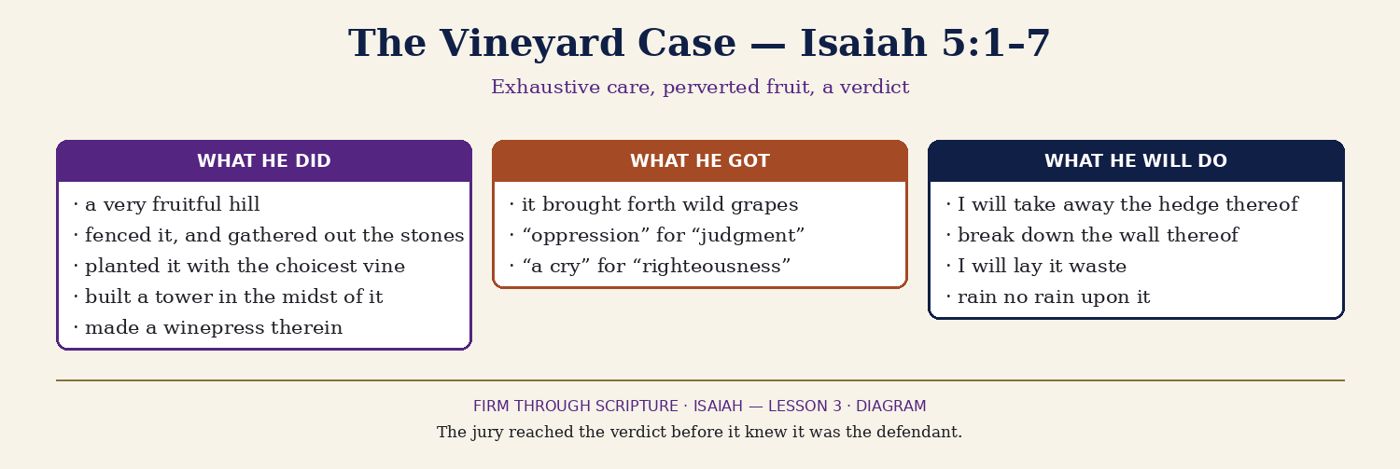
1 Now will I sing to my wellbeloved a song of my beloved touching his vineyard. My wellbeloved hath a vineyard in a very fruitful hill:
2 And he fenced it, and gathered out the stones thereof, and planted it with the choicest vine, and built a tower in the midst of it, and also made a winepress therein: and he looked that it should bring forth grapes, and it brought forth wild grapes.
3 And now, O inhabitants of Jerusalem, and men of Judah, judge, I pray you, betwixt me and my vineyard.
4 What could have been done more to my vineyard, that I have not done in it? wherefore, when I looked that it should bring forth grapes, brought it forth wild grapes?
5 And now go to; I will tell you what I will do to my vineyard: I will take away the hedge thereof, and it shall be eaten up; and break down the wall thereof, and it shall be trodden down:
6 And I will lay it waste: it shall not be pruned, nor digged; but there shall come up briers and thorns: I will also command the clouds that they rain no rain upon it.
7 For the vineyard of the LORD of hosts is the house of Israel, and the men of Judah his pleasant plant: and he looked for judgment, but behold oppression; for righteousness, but behold a cry.
8 Woe unto them that join house to house, that lay field to field, till there be no place, that they may be placed alone in the midst of the earth!
9 In mine ears said the LORD of hosts, Of a truth many houses shall be desolate, even great and fair, without inhabitant.
10 Yea, ten acres of vineyard shall yield one bath, and the seed of an homer shall yield an ephah.
11 Woe unto them that rise up early in the morning, that they may follow strong drink; that continue until night, till wine inflame them!
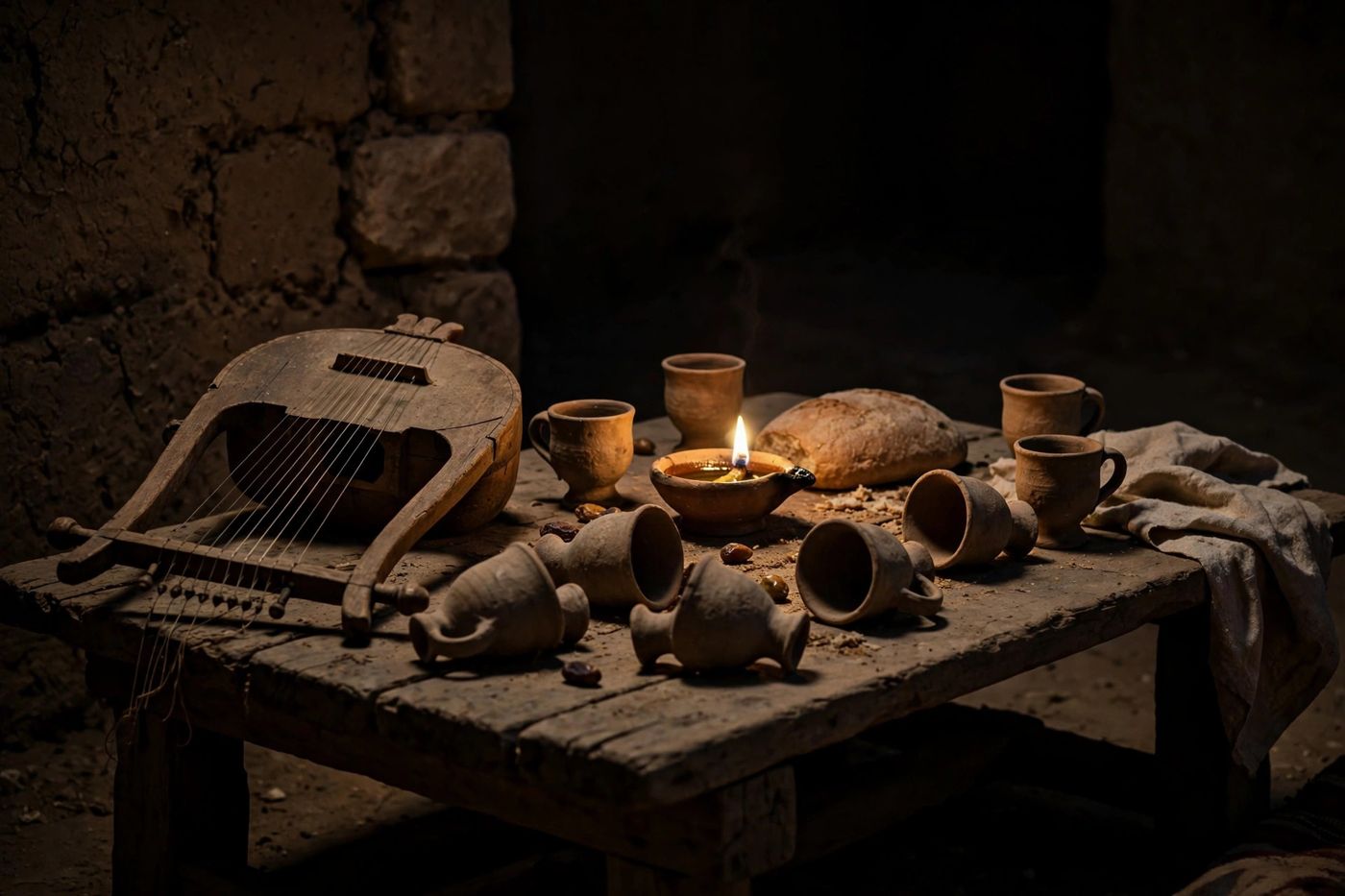
12 And the harp, and the viol, the tabret, and pipe, and wine, are in their feasts: but they regard not the work of the LORD, neither consider the operation of his hands.
13 Therefore my people are gone into captivity, because they have no knowledge: and their honourable men are famished, and their multitude dried up with thirst.
14 Therefore hell hath enlarged herself, and opened her mouth without measure: and their glory, and their multitude, and their pomp, and he that rejoiceth, shall descend into it.
15 And the mean man shall be brought down, and the mighty man shall be humbled, and the eyes of the lofty shall be humbled:
16 But the LORD of hosts shall be exalted in judgment, and God that is holy shall be sanctified in righteousness.
17 Then shall the lambs feed after their manner, and the waste places of the fat ones shall strangers eat.
18 Woe unto them that draw iniquity with cords of vanity, and sin as it were with a cart rope:
19 That say, Let him make speed, and hasten his work, that we may see it: and let the counsel of the Holy One of Israel draw nigh and come, that we may know it!
20 Woe unto them that call evil good, and good evil; that put darkness for light, and light for darkness; that put bitter for sweet, and sweet for bitter!
21 Woe unto them that are wise in their own eyes, and prudent in their own sight!
22 Woe unto them that are mighty to drink wine, and men of strength to mingle strong drink:
23 Which justify the wicked for reward, and take away the righteousness of the righteous from him!
24 Therefore as the fire devoureth the stubble, and the flame consumeth the chaff, so their root shall be as rottenness, and their blossom shall go up as dust: because they have cast away the law of the LORD of hosts, and despised the word of the Holy One of Israel.
25 Therefore is the anger of the LORD kindled against his people, and he hath stretched forth his hand against them, and hath smitten them: and the hills did tremble, and their carcases were torn in the midst of the streets. For all this his anger is not turned away, but his hand is stretched out still.
26 And he will lift up an ensign to the nations from far, and will hiss unto them from the end of the earth: and, behold, they shall come with speed swiftly:
27 None shall be weary nor stumble among them; none shall slumber nor sleep; neither shall the girdle of their loins be loosed, nor the latchet of their shoes be broken:
28 Whose arrows are sharp, and all their bows bent, their horses' hoofs shall be counted like flint, and their wheels like a whirlwind:
29 Their roaring shall be like a lion, they shall roar like young lions: yea, they shall roar, and lay hold of the prey, and shall carry it away safe, and none shall deliver it.
30 And in that day they shall roar against them like the roaring of the sea: and if one look unto the land, behold darkness and sorrow, and the light is darkened in the heavens thereof.
SAY IT PLAIN — the passage in everyday words: Isaiah sings what sounds like a love song about a friend's vineyard. The friend did everything right — good hill, stones cleared, best vine, tower, winepress — and got sour, wild grapes instead of a harvest. Then the song turns: you be the judge. The verdict is that the owner will stop protecting a vineyard that will not bear fruit. And then the singer drops the mask: the vineyard is Israel, and the fruit God wanted was justice and righteousness — and what grew instead was oppression and the cry of the people it crushed. Six woes follow, naming the wild grapes one by one: greed, drunkenness, daring God, calling evil good, pride, and courts for sale. The chapter ends with God's anger still burning, His hand still stretched out, and a far-off army already running at His whistle.
2. THE WORLD — C: Context & Audience
A text can never mean what it never meant — so before we ask what these verses mean, we stand where their first hearers stood.
The singer and his century. Isaiah, son of Amoz — Amoz is his father, not the prophet Amos; the names look alike in English and are different men — prophesied in Jerusalem, capital of Judah, the southern kingdom. 1 A quick map for a first-time reader: after Solomon, God's people split in two. The north kept the name Israel; the south, Judah — David's city and the temple — is where Isaiah stands. When this chapter says "the house of Israel" and "the men of Judah" side by side (v. 7), it names God's covenant people with Judah in the foreground — the people actually hearing the song. Isaiah ministered through the reigns of Uzziah, Jotham, Ahaz, and Hezekiah — roughly the second half of the eighth century BC, some seven hundred years before Jesus. [2, 4]
A good century on the surface — and that is the problem. Under Uzziah and Jotham, Judah had known prosperity. Prosperity is the soil of this chapter: the woes do not fall on a starving people, but on landowners adding estates, feasts running from morning to night, courts with money moving under the table — a comfortable people who have mistaken comfort for favour. Oswalt and Goldingay, from opposite sides of the scholarly spectrum, both read chapter 5 as an indictment of Judah's leadership and landholding class in exactly that setting. [2, 6]
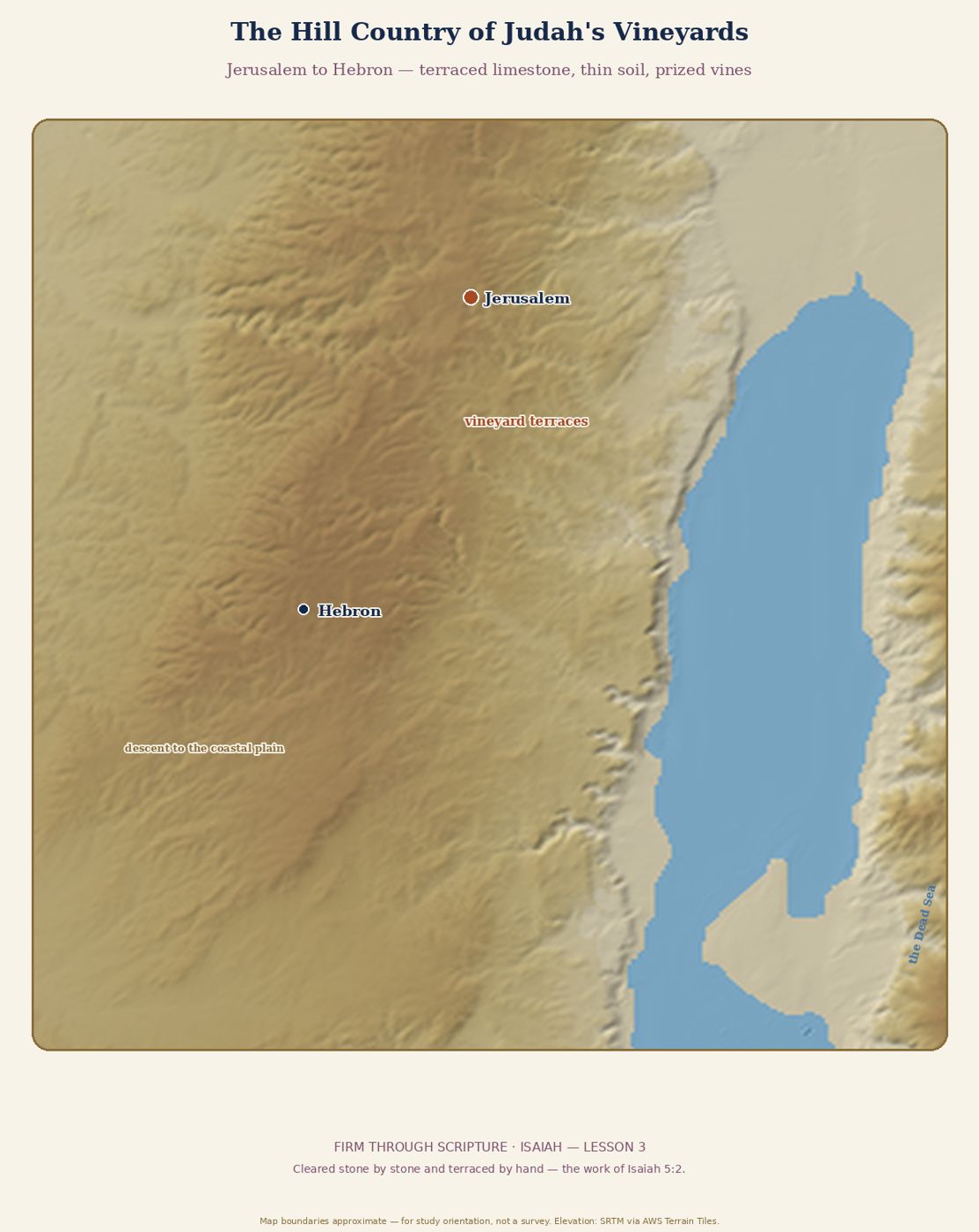
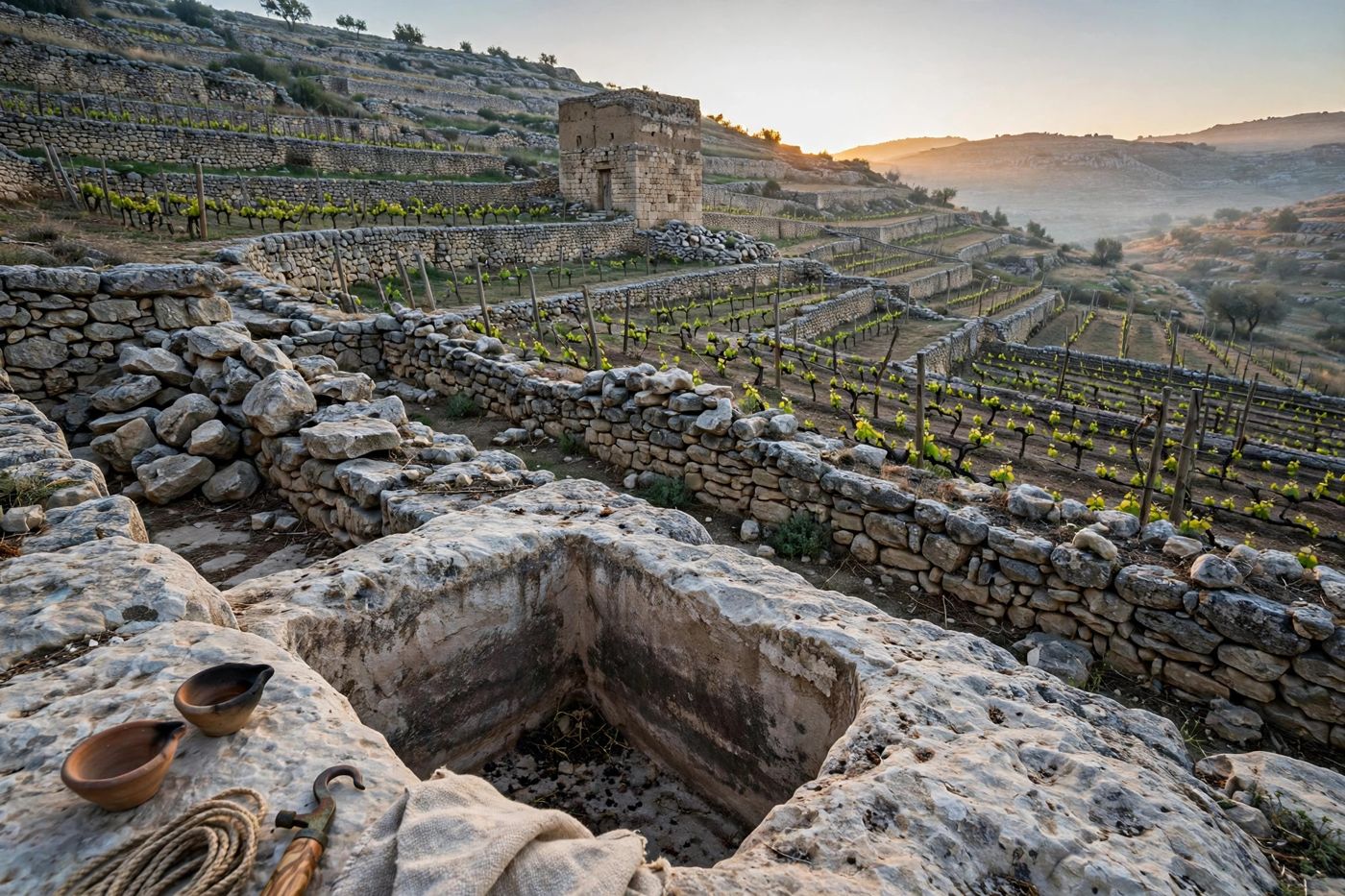
Vineyards were not scenery in Judah. They were wealth, work, and identity. The hill country around Jerusalem and down toward Hebron is limestone under a thin skin of soil — stony ground that grows vines superbly when cleared, terraced, and tended. A family vineyard was a multi-generation investment. King and Stager's account of daily life in biblical Israel and the IVP background commentary fill in the same picture Isaiah assumes: viticulture — vine-growing — was skilled, patient, capital-heavy work, and everyone in the audience knew exactly what each step in verses 1–2 cost. [16, 53]
So walk through the owner's work slowly, because Isaiah's hearers were silently adding it up:
- "A very fruitful hill" (v. 1) — the best site available, where sun, drainage, and moving air favour the vine.
- "He fenced it, and gathered out the stones" (v. 2) — the back-breaking first season; cleared stones typically became the wall and terrace edges themselves. 53
- "Planted it with the choicest vine" — the sorek, a prized stock valued for quality fruit; he did not plant whatever was cheap. [18, 53]
- "Built a tower in the midst of it" — a stone watchtower: guard post against thieves and animals at harvest, and a shelter for the workers. [16, 53]
- "Made a winepress therein" — hewed out of the rock itself, built before there was a single grape to press. That is faith in a harvest, spent in stone. [16, 53]
Every item is money and sweat sunk in advance. That accounting is the song's legal engine: by verse 4's question, the audience has already done the maths. Nothing could have been done more.
Assyria — the name this chapter will not say. To the northeast sat Assyria: the rising superpower of Isaiah's century, headquartered in what is now northern Iraq, famous for professional armies, siege engineering, and deporting conquered peoples wholesale. [16, 53] Judah had not yet felt its full weight, but the shadow was on every map. Hold that for the chapter's end: when God whistles for a nation "from the end of the earth" (v. 26), Isaiah does not name it, and his hearers needed no name to feel their stomachs drop. We will weigh the identification in Go Deeper (§16). An unnamed army is every army — and it is already running.
One more piece of the world: songs were public weapons. A prophet did not only preach. He sang stories a crowd would carry home humming — a song about a neighbour's ruined vineyard could travel Jerusalem faster than any scroll, and people would sing the verdict for days before realising they had been singing about themselves. Motyer and Oswalt both stress this shape: the song wins agreement before the hearer knows he is the defendant. [2, 4]
That is the world. Now we open the text itself.
3. OBSERVE — O: what the text actually does
Before meaning comes observation. Most bad interpretation is not deep error; it is shallow reading — people answering a text they never actually looked at. So look:
- The shape. Thirty verses in three movements: the song and its verdict (vv. 1–7), the six woes (vv. 8–24), and the stretched-out hand and the coming army (vv. 25–30). The first movement explains the second: the woes are the wild grapes, itemised.
- The turn inside verse 3. The song begins in the third person — Isaiah sings about his beloved. At verse 3 the beloved speaks in His own voice: "judge, I pray you, betwixt me and my vineyard." Song becomes courtroom mid-verse, and the audience is promoted from listeners to jury without being asked. That gear-change is the passage's central device.
- The repeated verdict-formula. "He looked for… but behold…" sounds at verse 2 (grapes / wild grapes), verse 4 (the same, as a question), and verse 7 (judgment / oppression, righteousness / a cry). Three times, expectation and outcome are set side by side, and three times the outcome shames the expectation. That drumbeat is the chapter's heartbeat.
- Count the woes. "Woe unto them" sounds at verses 8, 11, 18, 20, 21, and 22 — six times, a list meant to be counted on the fingers. Each woe names a group not by label but by behaviour: "them that join house to house," "them that call evil good." You identify the accused by what they do, so nobody gets to say the list was about somebody else's kind of people.
- The refrain that will not close. Verse 25 ends: "For all this his anger is not turned away, but his hand is stretched out still." Isaiah's readers will meet that sentence again and again in the next four chapters (Lesson 07 is built on it). Here it is a door deliberately left open: the judgment announced in this chapter is not finished at the chapter's end.
- The silences. The distant nation is never named (vv. 26–30). The owner never raises His voice — His most devastating line is a question. And no repentance is recorded: unlike chapter 1, which ends with an offer (Lesson 01), chapter 5 ends in darkness (v. 30). Observation does not explain silences, but it refuses to fill them with invention.
4. GENRE — N: note the genre (prophetic song — a parable that becomes a lawsuit, then a woe oracle)
Isaiah 5 runs three genres in sequence, and each one changes how you are allowed to read the lines under it:
- A song that works like a parable (vv. 1–7). Isaiah calls it a song — "Now will I sing" — and sings it the way Nathan told David a story about a rich man and a lamb, and the way Jesus would later tell parables: a concrete case that draws the hearer's verdict before the application lands. Parable rules apply: the stressed details carry the meaning (the owner's exhaustive care, the crop's failure), and the decoding the text itself gives (v. 7) controls the rest. Do not allegorise the tower into a doctrine the text never assigns it. [4, 52]
- A covenant lawsuit. Underneath the song sits the courtroom form Isaiah opened the book with (Lesson 01): plaintiff, defendant, witnesses invited to judge, evidence, sentence. The legal shape tells you what kind of speech this is: not a mood, not a venting — a verdict, reached on evidence the jury itself has examined. [2, 17]
- A woe oracle (vv. 8–23). "Woe" speeches are a recognised prophetic form: a cry of lament aimed at people still alive, announcing that their present course ends in the graveyard. Fee and Stuart's rule governs the whole chapter: prophecy is forthtelling first — God's word to the people standing there about their own conduct — before it is ever foretelling about the distant future. 51 Read the woes first as a mirror held up in the eighth century BC. Only then ask what carries forward.
And one genre rule for the ending: verses 26–30 are announcement, not timetable. The army is described in poetry's vivid present tense — not dated, named, or scheduled. Readers who mine these verses for a calendar are using a poem as a spreadsheet.
5. TERMS — T: the words in the writer's mouth
Five words carry this passage. Learn what they meant in Isaiah's mouth, and watch how much false teaching dies at the dictionary:
- Mishpat and mishpah — the lesson's jewel. Verse 7, in the KJV, says God "looked for judgment, but behold oppression." Underneath those two English words sit two Hebrew words that sound almost identical: mishpat (mish-PAHT), justice — judgment done right — and mishpah (mish-PAH, often transliterated mispach), rendered "oppression" in the KJV and "bloodshed" in many modern versions: justice perverted into violence. [18, 19] One consonant's difference — and that is the horror Isaiah performs: Judah's society sounds almost like justice, the way a counterfeit coin sounds almost right when it rings. See the Translation Note; English cannot carry this pair.
- Tzedakah and tze'aqah — the second pair. Same verse, same device: God looked for tzedakah (tseh-dah-KAH), righteousness — right conduct, a community set right — and found tze'aqah (tseh-ah-KAH), a cry: the scream of someone being crushed, the distress-cry that in Exodus rises to God from slaves. [18, 19] Righteousness was supposed to be Judah's music. What God hears instead is a cry — her victims' cry, in her streets. Isaiah packs his whole social theology into a rhyme a crowd remembers on the walk home.
- Hoy — "woe." The KJV's "Woe unto them" translates the Hebrew cry hoy (HOY). It is not, first, a threat word; it is a funeral word — the cry raised over the dead, the sound made at a graveside. [18, 19] The prophets aim that cry at the living: six times Isaiah stands at the graves of people still eating, drinking, buying, and litigating, and mourns them in advance. Heard rightly, a woe is not a sneer. It is grief with a deadline — this is where this road ends; I am showing you the grave while there is still road left to turn on.
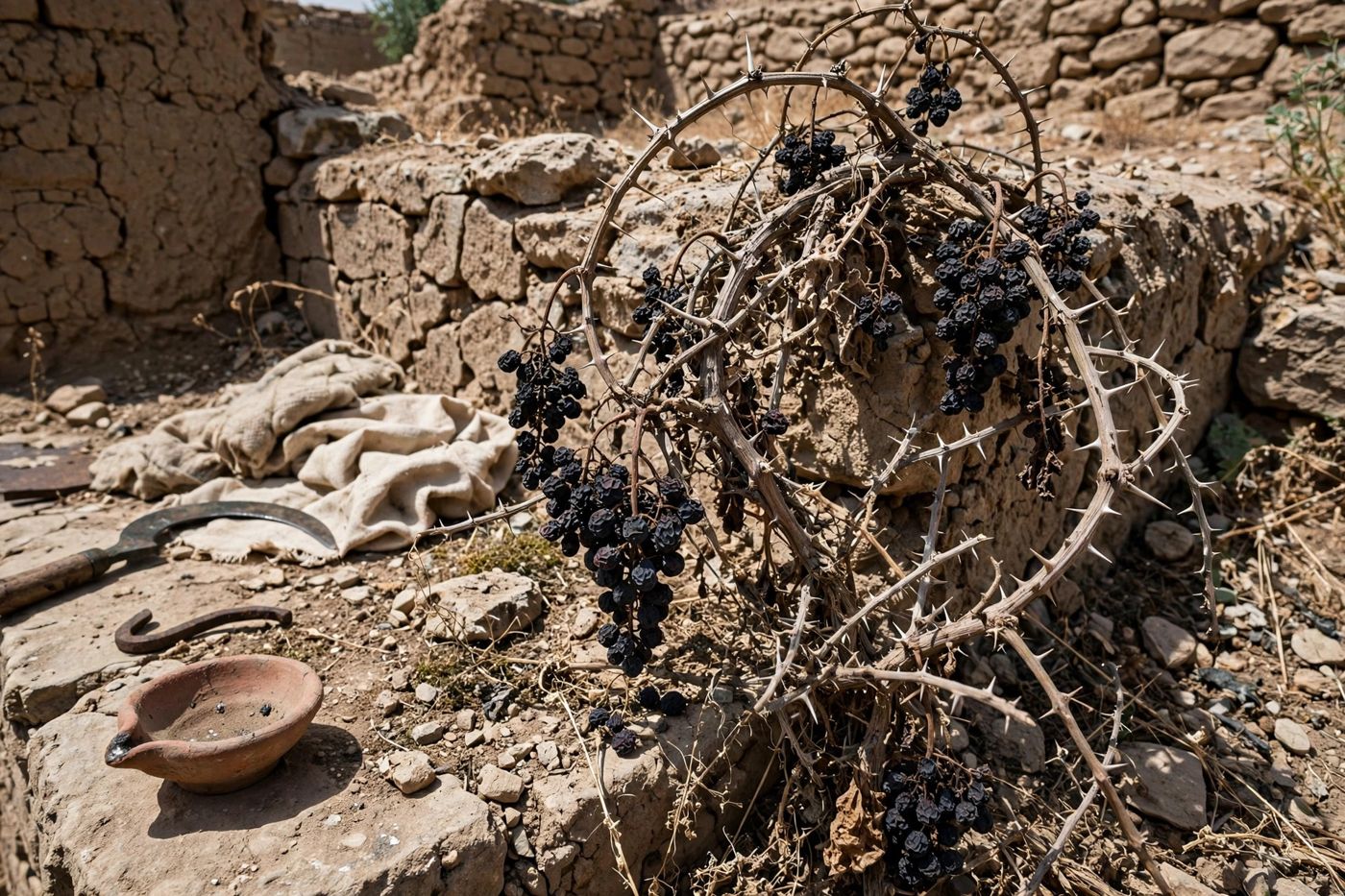
- Be'ushim — "wild grapes" (vv. 2, 4). The crop the vineyard produced. The Hebrew word is related to a root for what is rotten or stinking; it names not merely small or sour fruit but worthless, offensive berries — fruit not just disappointing but wrong, the opposite in kind of what was planted. [18, 19] Keep the category straight: the vineyard did not produce nothing. A barren vineyard might plead a hard year. This one produced actively bad fruit. Isaiah's charge is never mere emptiness. It is perversion — good gifts grown rotten.
- Sheol — "hell" (v. 14). "Hell hath enlarged herself" personifies Sheol, the realm of the dead in Old Testament speech — imagined here as a creature with an appetite and a mouth, swallowing Judah's glory whole. [18, 19] Isaiah gives death a throat because his hearers were giving it their city.
Method note — the word-study guardrail: a word means what its author uses it to mean, in its sentence, in its century — not what its oldest root once meant, and not everything it can mean anywhere. Verse 7's wordplay is not a preacher's trick; it is in Isaiah's Hebrew syllables, checked in the standard lexica. That is the difference between a word study and a word game. [18, 19]
TRANSLATION NOTE — the rhyme English cannot keep
Your KJV reads verse 7: God "looked for judgment, but behold oppression; for righteousness, but behold a cry." Faithful words — and the verse's sharpest edge is invisible in them, because the edge is sound. In Hebrew the sentence chimes twice: mishpat → mishpah, tzedakah → tze'aqah. What God wanted and what He got differ, in each pair, by a breath — as if the language itself is saying: the distance between the kingdom and its counterfeit is this small, and this fatal. No English rendering can reproduce it without inventing words, which is why every serious English version footnotes or explains it rather than translating it. This is not a defect in your KJV, and it is not a secret the translators hid. It is what translation honestly costs — and why this study flags it. When you teach this verse aloud, say the Hebrew pairs out loud. Your hearers will hear the doctrine before they can define it. [2, 4, 18]
6. ENTIRE CANON — E: where this passage sits in the whole story
No chapter lives alone. Isaiah 5 is a knot where the Bible's vineyard thread is tied — and later tightened.
- The vine was Israel's self-portrait long before Isaiah sang. Psalm 80 tells the exodus in vine language: God brought a vine out of Egypt, cleared its ground, planted it, and watched it fill the land — then laments its broken walls, in almost this chapter's imagery. 1 Jeremiah states the diagnosis in one sentence: God planted "a noble vine, wholly a right seed," and asks how it turned into "the degenerate plant of a strange vine." 1 Hosea adds that abundance itself rotted the fruit: the more Israel prospered, the more altars she built to other gods. 1 Isaiah is closing a case the whole canon had been building.
- Isaiah himself sings the vineyard a second time — and the ending reverses. In Isaiah 27, God sings over a vineyard again: this time He keeps it, waters it every moment, guards it night and day, and promises Israel "shall blossom and bud, and fill the face of the world with fruit." 1 Hold chapters 5 and 27 together and you have Isaiah in miniature: the song of judgment is real, and it is not the book's last song — a fact Go Deeper returns to, because it disciplines how final we may call chapter 5's verdict.
- Jesus takes this exact vineyard up — and names Himself inside it. In Matthew 21, Jesus tells the parable of the vineyard: a householder plants a vineyard, hedges it, digs a winepress, builds a tower — Isaiah 5:2's inventory, item for item, so every hearer in the temple courts hears the old song start up — then lets it out to tenants, who beat the servants and finally kill the owner's son. 1 His hearers pronounce Isaiah's verdict on themselves (the vineyard given to others who will render the fruit), and Jesus seals it with the sentence Misread 1 will need: the kingdom given "to a nation bringing forth the fruits thereof." The chief priests, Matthew notes, "perceived that he spake of them." 1 Jesus did not treat Isaiah 5 as a museum piece. Neither may we.
- And then Jesus moves inside the image and becomes the vine. "I am the true vine, and my Father is the husbandman" (John 15:1). 1 Where the planted vine turned degenerate, Jesus presents Himself as the true one — the genuine stock — and relocates fruitfulness entirely: branches bear fruit by abiding in Him, and the Father, still Isaiah's husbandman, tends and prunes. Isaiah 5 asks what God will do with a fruitless vineyard. John 15 is heaven's full answer: He grafts His people into a Vine who cannot fail, and the fruit He looked for — judgment and righteousness — becomes the fruit the Spirit grows in those who abide. [1, 52] | The vineyard thread | The text | What it adds | |---|---|---| | Planted in the exodus | Psalm 80 | The vine's history: brought out, cleared for, planted | | Degenerate despite the planting | Jeremiah 2:21; Hosea 10:1 | The diagnosis restated: right seed, strange fruit | | Judged in the song | Isaiah 5:1–7 | The case closed on the owner's unanswerable question | | Sung over again, kept | Isaiah 27:2–6 | The owner's later song: guarded, watered, world-filling fruit | | Retold by the Son | Matthew 21:33–44 | The tenants kill the son; the verdict hearers pronounce on themselves | | Fulfilled in a Person | John 15:1–6 | The true Vine; fruit by abiding, not by pedigree |
7. THE MEANING — what the passage teaches
The Walk has established what the text says and where it sits. Now its payload, taught straight — the doctrines this passage actually carries.
A love song that is a lawsuit — and why God sings it that way
Begin where Isaiah begins: "Now will I sing to my wellbeloved a song of my beloved touching his vineyard" (v. 1). The singer and the owner are distinct in the song's fiction — Isaiah sings to and for his beloved friend — and the language is affection language. The God of Isaiah 5 is not a distant auditor. He is a wellbeloved — a lover, a devoted friend — singing about His own planting. Judgment here flows out of love that invested, not irritation that erupted. [2, 4]
Why a song, though? Why not open with charges, as chapter 1 did? Because of what a song does to defences. A defendant who hears charges builds a case. A listener who hears a story about somebody else's vineyard simply judges it — fairly, freely, eagerly. And a fair judgment, once spoken, cannot be unspoken when the mask comes off. God wants Judah's verdict on fruitlessness to be Judah's own, reached before pride can hire a lawyer. Motyer calls the device the song's "trap," and Oswalt likewise notes that the hearers pronounce the sentence before verse 7 names them. [2, 4] The God who could simply accuse chooses to let His people see themselves, because a verdict a person reaches is a verdict a person can repent under. Accusation hardens. Recognition breaks.
And the recognition is total. Verse 7 does not say the vineyard pictures Israel. "The vineyard of the LORD of hosts is the house of Israel." The owner is the LORD of hosts — the LORD of armies, heaven's commander. The pleasant plant is Judah. The fruit in question is not ritual attendance or temple revenue. It is judgment and righteousness — justice in the courts and streets, rightness in how people treat each other. [2, 6] That definition governs everything after: when we apply the chapter, we may not substitute easier fruit.
"What could have been done more?" — the doctrine of the unanswerable question
Verse 4 is one of the most searching sentences in the Old Testament, and it is a question about God, not about Judah: "What could have been done more to my vineyard, that I have not done in it?" It claims that when God judges this people, the failure under review will not be His. Every input was sufficient; every advantage was supplied. The variable that failed sits in the dock, not on the bench. [2, 4]
This answers an argument humanity files against God in every century: my circumstances explain my fruit. Sometimes circumstances genuinely crush — the cry in verse 7 is the cry of the crushed, and God hears it as evidence for His case against their crushers. But the vineyard as a whole — with its law, temple, prophets, and history of deliverance — could not plead its conditions; they are recited in verses 1–2 precisely so the plea cannot be made. Teaching point, stated straight: privilege does not soften judgment in this chapter; privilege is the judgment's measure.
"What could have been done more to my vineyard, that I have not done in it?" (v. 4) — the question the whole chapter hangs on. Nobody answers it. That silence is the verdict.
Notice what the owner does not do in the verdict (vv. 5–6). He does not burn the vineyard down in a rage. He withdraws: hedge taken away, wall broken down, pruning stopped, rain commanded off — so the vineyard becomes what it chose to be. Some of God's severest judgments arrive not as lightning but as the quiet lifting of a cultivating hand. The briers and thorns of verse 6 are not imposed; they are what grows by itself the moment the husbandman stops. Nothing new has to happen to Judah to be ruined. Things only have to stop happening.
The six woes — the wild grapes, itemised
Verses 8–23 are the harvest inspection. If the fruit God looked for was mishpat and tzedakah, the woes show the actual crop, bin by bin. Read them as postures, not merely acts: each names a stance toward life, and each stance belongs to covenant insiders who knew the law. That is why this list still searches. [2, 6]
| # | Woe (verse) | The posture | The stated consequence |
|---|---|---|---|
| 1 | Joining house to house, field to field (v. 8) | Greed that must end with one man "placed alone in the midst of the earth" — neighbours bought out, small farms swallowed into estates | The great houses stand desolate and empty; the swollen estates yield almost nothing (vv. 9–10) |
| 2 | Rising early for strong drink (vv. 11–12) | A life organised around the next feast — harp, viol, tabret, pipe, and wine — while God's work goes unregarded | Captivity "because they have no knowledge"; Sheol's mouth opened wide (vv. 13–14) |
| 3 | Drawing sin with cords, daring God to hurry (vv. 18–19) | Sin hauled along like a cart, deliberately — and God mocked: let Him make speed, if He is going to do anything | Under the fire of v. 24 |
| 4 | Calling evil good and good evil (v. 20) | Moral inversion: the labels themselves switched — darkness called light, bitter called sweet | Under the fire of v. 24 |
| 5 | Wise in their own eyes (v. 21) | Self-sufficient pride: no counsel needed, no correction receivable | Under the fire of v. 24 |
| 6 | Mighty to drink wine, justifying the wicked for reward (vv. 22–23) | Strength spent on drinking, and courts for sale: the guilty acquitted for a bribe, the righteous stripped of their right | Under the fire of v. 24 |
Walk the bins slowly.
The first woe (vv. 8–10) is land greed, and its crime is against neighbours. "Join house to house… field to field, till there be no place" — a buy-out campaign, parcel by parcel, until the smallholders are gone and one estate-holder sits "alone in the midst of the earth." In Israel's law, land was not ordinary property: it was family inheritance assigned under God, protected by laws about redemption and the jubilee, when sold land returned to its family (Leviticus 25). [16, 53] To swallow inheritances permanently was dismantling God's social order one foreclosure at a time. And the sentence fits with an accountant's precision: the mansions stand uninhabited, and the maths invert — ten acres yield one bath of wine, a pittance; a homer of seed yields an ephah, a fraction of the sowing. [16, 53] Grab the land, lose the yield. The curse is the greed, ripened.
The second woe (vv. 11–17) is pleasure as a life's organising principle. Up early — not for work, but "that they may follow strong drink"; still at it "until night, till wine inflame them." Isaiah's quarrel is the one line Misread 3 guards: "but they regard not the work of the LORD, neither consider the operation of his hands" (v. 12). The charge is not you own a harp. It is contempt: gifted, well-fed people who never look up at what God is doing. Captivity comes "because they have no knowledge" (v. 13) — not lack of data, but refusal of regard. Sheol "hath enlarged herself" (v. 14): the grave's mouth opens to the width of the party going down into it. Verses 15–16 say what the fall is for: man is humbled — "but the LORD of hosts shall be exalted in judgment, and God that is holy shall be sanctified in righteousness" (v. 16). That is the chapter's thesis: when Judah would not produce mishpat and tzedakah, God is exalted by displaying them. Verse 17 turns the camera to the emptied estates: lambs grazing where landlords feasted.
The third woe (vv. 18–19) reads like ancient atheism, and it is actually insider cynicism. These people "draw iniquity with cords of vanity, and sin as it were with a cart rope": they haul their sin behind them, attached and deliberate — the opposite of the reluctant, struggling sinner. And then they talk: "Let him make speed, and hasten his work, that we may see it" (v. 19). That is sarcasm aimed at the prophet's preaching: do it now, visibly, or be dismissed as fiction. It is the taunt of people formed by the faith, fluent in its vocabulary — "the counsel of the Holy One of Israel" is Isaiah's own title for God — who have decided the warnings are theatre. Oswalt and Goldingay both mark this as unbelief inside the covenant community, not paganism outside it. [2, 6] Demanding that God perform on our schedule, as the price of belief, is not honesty. It is contempt wearing honesty's clothes.
The fourth woe (v. 20) is the list's centre of gravity: moral inversion. "That call evil good, and good evil; that put darkness for light, and light for darkness; that put bitter for sweet, and sweet for bitter!" What is condemned is not merely doing evil but renaming it — seizing the labels, so the community's moral vocabulary itself is reversed. Darkness does not sneak in claiming to be darkness; it files the paperwork to be called light. A society's deepest corruption is not its worst act but its redefinition of the categories by which acts are judged. Once the labels switch, repentance becomes nearly unspeakable — how do you confess a sin your language now calls a virtue? Isaiah needs no consequence verse here. A people who have renamed the light have sentenced their own eyes.
The fifth woe (v. 21) is pride in its intellectual form: "wise in their own eyes, and prudent in their own sight." Short verse, whole biography: the unteachables, for whom correction is an insult. In a list dominated by land, drink, and courts, this quiet verse locates the root system — every other woe is protected from repentance by this one. Verse 19's mockers were probably verse 21's graduates.
The sixth woe (vv. 22–23) pairs the second woe's drink with power. "Mighty to drink wine, and men of strength to mingle strong drink" — heroes of the wine cup, whose only recorded strength is at the table. Then the lethal turn: "Which justify the wicked for reward, and take away the righteousness of the righteous from him!" (v. 23). The judges are bought; for a bribe they acquit the guilty, and the righteous party loses the right that was his. This is mishpat inverted in the very room built to protect it. [2, 4] Verse 7 asked where the fruit went; verse 23 answers: the courthouse itself sells the harvest.
Verse 24 gathers all six bins into one fire: "as the fire devoureth the stubble… so their root shall be as rottenness, and their blossom shall go up as dust: because they have cast away the law of the LORD of hosts, and despised the word of the Holy One of Israel." Two causes, held together: the law cast away (the conduct) and the word despised (the attitude that made the conduct inevitable). And the plant imagery closes the song's loop: root and blossom, rottenness and dust — a plant finished, from root to flower.
The hand stretched out, and the whistle (vv. 25–30)
The chapter's last movement widens the lens from Judah's conscience to God's history. Verse 25 speaks of anger already kindled and a blow already fallen — hills trembling, corpses in the streets, language most readers connect with a disaster already experienced; the text does not name the event, and honesty requires leaving it unnamed (see §16). [2, 6] What the verse stresses is not the blow but the posture after it: "For all this his anger is not turned away, but his hand is stretched out still." Judgment here is not a spent tantrum. It is a settled, unfinished stance toward a people who have not turned — and Isaiah will toll that refrain through the coming chapters like a bell that will not stop (Lesson 07).
"For all this his anger is not turned away, but his hand is stretched out still." (v. 25) — the refrain Isaiah will toll through the chapters ahead (Lesson 07).
Then the whistle. "He will lift up an ensign to the nations from far, and will hiss unto them from the end of the earth" (v. 26) — hiss is the KJV's word for a whistle, the small signal used to summon bees or a flock. 19 The disproportion is deliberate: the mightiest army on earth is moved by a whistle, like livestock. And they come perfectly: no weary, no stumbling, no broken sandal strap (v. 27); arrows sharp, hooves like flint, wheels like a whirlwind (v. 28); roaring like lions, seizing prey none can deliver (v. 29) — a professional army in poetry, the Assyrian war machine as Isaiah's century knew it, whether or not Assyria alone is meant. [16, 53] The point towers over the detail: this army is not God's opponent arriving early. It is God's instrument arriving on summons. Verse 30 lands in darkness: the roar like the sea, the land found dark, "the light… darkened in the heavens thereof." The song that began with a wellbeloved and a fruitful hill ends with the lights going out — because its hearers would rather rename the darkness (v. 20) than repent toward the light.
The Christ Thread
This chapter earns its Christ thread honestly — not by finding Jesus hidden in the tower or the winepress (the text assigns those no such meaning), but by following where the New Testament itself takes the song. Jesus retells Isaiah 5 in Matthew 21 and adds the owner's son: the servants are beaten, and last of all the son is sent — and is cast out of the vineyard and killed. 1 The story of rejected care climaxes not in wild grapes but in a murdered heir — and Jesus stands in His own parable as that Son, days before the priests enact it. Then, in John 15, He answers the song from inside it: "I am the true vine." 1 God's final answer is not a better planting programme but a new Plant — Himself — into whom fruitless branches are grafted and made fruitful by abiding. The song asks, what will God do with a vineyard that will not bear His fruit? The Gospels answer in two movements — judgment on the tenants who kill the Son, and mercy: a true Vine in whom judgment and righteousness finally grow. Leave either out and the thread snaps.
Where in the Covenant Story?
Isaiah 5 sits early in the covenant's lawsuit season. The covenant — God's binding agreement with His people, made at Sinai and renewed under David — always carried two hands: blessing on faithfulness, curse on rebellion, spelled out in Deuteronomy. Chapter 5 is those sanctions read aloud in poetry: hedge removed, land unfruitful, captivity named (v. 13 — the ultimate sanction, exile). Yet this is not a contract cancelled with a stranger. It is a wellbeloved's song over His own pleasant plant, inside a book that ends with new heavens and a new earth. Isaiah's shape is never God finishes with His people; it is God judges His people truly, and a remnant carries the promise through the fire (Lesson 04 takes the remnant up). Chapter 5 is the fire. Do not read it as the whole story; do not read the later mercy as cancelling its truth. [4, 57]
The Long View — what the church has believed
Stand back and notice how the centuries have read this song, because you are not its first reader. The early church read it as Jesus handed it to them — through Matthew 21: Jerome, the early church's fullest Isaiah commentator, treats the vineyard as God's people and the song as the record of care refused, and Calvin, a millennium later, preaches it the same way, lingering on the owner's unanswerable question as the silencer of every excuse. [36, 37] On the chapter's centre — exhaustive care, justice demanded, verdict earned — the historic church has been essentially of one mind, Jewish and Christian readers included: Rashi and Ibn Ezra read the decoding exactly where verse 7 puts it, as God's case against Israel's injustice. 39 Readers have honestly divided only at the edges: how far the judgment reaches (a question §16 argues as POSITION), and the identity of the unnamed nation. The centre held across two thousand years and communities that agreed on little else. The fruit God wants has never been the disputed part.
8. THE AIM SENTENCE — X: eXplain the intent
Everything observed now compresses into one sentence — the author's intended meaning, stated before any application:
Isaiah sings God's own people a love song that becomes their conviction: the LORD who did everything for His vineyard looked for justice and righteousness and found oppression and a cry instead, so He will withdraw His protection, judge the six postures that grew the wild grapes, and summon a distant nation as the instrument of a judgment that is not yet finished.
If a sermon or devotional uses Isaiah 5 to say something that cannot be traced back to that sentence, it is not this passage talking.
9. SAY IT BACK
Close the book and say the AIM sentence from section 8 in your own words — out loud, or written in your notes, without looking. Then say, in one more sentence, what it asks of you this week. If your version quietly changes the meaning — if the six woes become only other people's sins, or the song becomes only a poem about farming — open the lesson and walk it again. This exercise feels small. It is the entire course in miniature: meaning first, in the author's words become your words, then — and only then — your life.
10. THE MISREAD — the guardrail, with verdicts
Three live misuses of this passage. Each gets a fair hearing and a verdict.
Misread 1: "The vineyard song is about ancient Israel only — it has nothing to say to a fruitless church today." Why it sounds right: verse 7 really does name the house of Israel and the men of Judah. The history is real, the audience was eighth-century, and honest reading starts there. The evidence: honest reading does not stop there, because the canon does not. Jesus picks the song up in Matthew 21, retells it to the leaders of His own day, and lets its verdict land on a new generation of tenants — and John 15 relocates fruitfulness into abiding in Him, a word spoken to the church. 1 The owner, the care, and the fruit have not changed; the New Testament itself carries the song across the covenant line. A reading that seals Isaiah 5 in a museum must explain away Jesus' own handling of it. Verdict: ancient Israel first, truly — and then carried forward by Jesus' own authority to every vineyard God plants. "Only about them" is not humility before the text. It is disobedience to its Author's own application.
A woe is a funeral cry spoken early — grief with road left in it. Read the six that way, and they stop being ammunition.
Misread 2: "The six woes are a checklist for condemning other people's sins — the greedy rich, the drunks, the corrupt judges out there." Why it sounds right: the woes really do name greedy landowners, drunkards, and bribed judges, and in any congregation most hearers can name someone else who fits. The list even sounds like a sermon outline pre-made for pointing. The evidence: the woes were preached to covenant insiders — temple-going, law-knowing Judah — and constructed to prevent exactly this deflection: each names a posture ("wise in their own eyes," "call evil good") that wears church clothes as easily as street clothes. Verse 19's God-darers are quoting the prophet's sermons back at him. Jesus wields the same form against the religious leadership of His day (Matthew 23). 1 And the song's whole design — jury first, defendant second — exists to stop the hearer judging as a spectator. The reader who finishes with a list of other people's failures has re-enacted verse 21 in the act of reading it. Verdict: the woes are a mirror before they are a window. Any use of Isaiah 5 that leaves the user feeling righteous has misused it — its first application is always self-examination.
Misread 3: "Verse 12's charge — 'they regard not the work of the LORD' — is about taste in music and drink: God is against feasts, instruments, and wine as such." Why it sounds right: the verse really does list the harp, the viol, the tabret, the pipe, and wine, in a passage of judgment, and the second and sixth woes hammer drunkenness. A reader hunting for a rule against instruments can find his proof-text posture here. The evidence: read the sentence whole. The instruments and the wine "are in their feasts" — that is the description — "but they regard not the work of the LORD, neither consider the operation of his hands" — that is the charge. The indictment is a contrast, not an inventory: full tables, empty regard. Scripture elsewhere commands feasting with wine and music in God's presence (Deuteronomy's festivals; Psalm 104 thanks God for wine that gladdens man's heart) — what Isaiah condemns is drunkenness that runs a life (vv. 11, 22) and, beneath it, cultivated blindness in people too entertained to look up. [1, 2] Reduce the verse to a ban on instruments and you have performed verse 20 on it — calling a text's meaning what it is not. Verdict: the harp and the wine are props. The charge is contempt — a whole life of God's gifts consumed without one regard for the Giver's work. Aim the verse there, where Isaiah aims it.
11. FROM WORD TO WALK
A reflection page — the lesson is not finished until the passage has had its say with you.
Notice how this chapter refuses to let you begin where you want to begin. You want to begin with the woes — the sorting, the quiet relief of finding your own worst things not quite named. Isaiah begins with the stones.
Sit with verses 1–2 as an inventory of your own life. A fruitful hill you did not choose and did not earn. Stones cleared before you were old enough to know they were stones — people who prayed, taught, corrected, carried you. A choice vine, not a cheap one. A tower — watching-over you never saw. A winepress hewn in advance — provision for a harvest God expected before you produced a single thing worth pressing. "What could have been done more?" read in the first person is the chapter's most tender and most terrifying sentence: tender, for how much love it counts; terrifying, for what it leaves you holding — the fruit question, with the circumstance-excuse gently removed from your hand.
So ask the fruit question in God's own two categories, not the easier ones we substitute. Not: did I attend, did I give, did I avoid the scandalous list? But: mishpat — where judgment was mine to render, did the weak get justice from me, or my convenience? And tzedakah — is the sound coming off my life righteousness, or is it, somewhere I have refused to listen, a cry? The people our decisions crush rarely get a microphone. Verse 7 says God hears them as the harvest report of our lives.
And if the reflection turns up wild grapes — for an honest reader, something in the six bins usually does — hear the genre once more before you despair or deflect. A woe is a funeral cry spoken early: grief with road left in it. God sings so the jury will convict in time. The hand stretched out still (v. 25) is judgment unfinished — and unfinished, in this book's grammar, also means the story is unfinished, with Isaiah 27's kept vineyard written further on. The right response is neither shame-spiralling nor self-defence. It is the vineyard's one remaining move, the one Judah never makes in the song: turn back to the Husbandman and ask to be tended again.
Lord of hosts, my Wellbeloved — You have counted what You have done for me, and I cannot answer Your question. You looked for judgment and righteousness; search my harvest honestly, and let me hear the cry I have been too busy or too entertained to hear. Take away nothing but my thorns. Prune what You must, dig where You must — only do not stop tending me. Graft me closer to the true Vine, and grow in me the fruit You have always looked for. In Jesus' name, amen.
12. FOR DISCUSSION — OR FOR YOUR JOURNAL
With a group, work these aloud. Alone, they're yours — answer them in your journal or in prayer; they lose nothing in the quiet.
- The owner asks, "What could have been done more to my vineyard, that I have not done in it?" (v. 4). Name, concretely, what God has done in your own life that belongs in verses 1–2's inventory. What does that inventory do to your usual explanations for your fruit?
- Work the two word-pairs aloud: mishpat / mishpah, tzedakah / tze'aqah. Where do you see the "almost-justice" counterfeit — the thing that sounds like righteousness and produces a cry instead — in your world, your church, or your own week?
- Which of the six woes names a posture (not just an act) you recognise in yourself? Be specific about the posture — grabbing, escaping, daring, renaming, self-trusting, or selling a judgment — and about what turning from it would actually look like this month.
- Verse 19's mockers demand that God hurry up and prove Himself. Where does that demand show up in modern dress — or in your own prayers? What is the difference between honest lament ("how long, O Lord?") and verse 19's taunt?
13. THE WALK-OUT — T: Transfer to today
Meaning is settled. Now — and only now — application, and it must cross the bridge honestly. Run the five Transfer Tests:
- Same covenant? Isaiah sings to Judah under the old covenant, with its land and national sanctions; we read as the church under the new covenant in Christ. The specific national verdicts — hedge removed from that land, exile for that generation — were executed in history and do not re-issue to any modern nation as a timetable. But the Owner, His care, and His fruit have not changed hands, and the New Testament itself carries the song to God's later people (Matthew 21; John 15). 1
- Same audience? The woes addressed covenant insiders who knew the law — congregations are their nearest modern analogue, not secular society. Application that aims this chapter primarily at unbelievers reverses its address.
- Same genre rules? A parable-song decoded by its own text (v. 7), a lawsuit, and woe oracles — forthtelling first. 51 We take the decoded fruit and the named postures; we do not allegorise the tower, date the army, or turn the poem into a calendar.
- Repeated or rooted? Justice and righteousness as God's required fruit, judgment measured by privilege, contempt for God's work, moral renaming as deep corruption — each is rooted in God's character and repeated across both testaments. These cross at full strength.
- Ten verses either side? Every application below is drawn from these thirty verses read whole. Nothing hangs on a torn-out line; no application uses verse 12 without its charge, or verse 20 without its context of insiders renaming.
What crosses — and lands:
God has acted first — that is where application must begin, because it is where the passage begins. Before any woe, there is a wellbeloved and an inventory of care. So the first thing that crosses is not an order but a fact to live from:
| The song's movement | What it becomes this week |
|---|---|
| Care counted (vv. 1–2) | Gratitude with a list, not a mood |
| Fruit defined (v. 7) | Justice and righteousness, no substitutes |
| Postures named (vv. 8–23) | Self-examination before warning anyone else |
| Hand stretched out (v. 25) | An alarm — and an invitation to cry out for tending |
- You are a tended vineyard, not a self-made one. Every stone cleared in your story was cleared by hands — God's first of all. Gratitude here is not a mood; it is the accurate reading of your own verses 1–2. The believer who sees the inventory stops asking why God has not done more, and asks the passage's only open question: what is growing?
- The fruit God looks for is justice and righteousness, grown in ordinary soil. Not intensity or a cleaner public image: mishpat where you hold power — fairness, defence of the person who cannot repay you, honesty where a bribe (of money, approval, or ease) is on offer — and tzedakah in your relationships, rightness that leaves no one crying behind you. The passage allows no substitute crop.
- The postures of the woes are today's temptations in today's dress. Estates are portfolios and platforms now; the feast is a feed that never closes; verse 19's taunt is a comment thread demanding God perform; verse 20's renaming is an industry; verse 23's bought judgment cashes out in a hundred currencies besides coin. The passage does not need updating. It needs recognising. And if prayer, Scripture, and correction have quietly stopped — if the hedge feels thinner — read that silence as the Husbandman's hand pausing, and cry out for His tending before the briers become the landscape.
Practices — what the gate lets through, made concrete this week:
- The inventory prayer. Twenty minutes with verses 1–2 and a pen. List what God has done for you under the song's headings — site, stones, vine, tower, winepress — then write verse 4's question at the bottom and sit with it before writing anything else.
- A justice audit in one arena. Choose the one place this week where you hold real power — a decision at work, a family ruling, a sum of money, a voice in a meeting. Before you act, ask: who is weakest here, and what does mishpat require for them? Act on the answer, visibly, once.
- Listen for the cry. Identify one person your decisions affect who has no platform. This week, hear them out, uninterrupted, with no defence prepared. Verse 7's God counts a cry as evidence; so should you.
- One act of un-renaming. Catch one place — a conversation, a post, a habitual euphemism — where evil is being called good, or good evil, in your own speech. Say the true name instead, kindly and out loud, once.
- Memorize Isaiah 5:16. The chapter's thesis, and the antidote to every woe in it: God's holiness, exalted in the very judgment and righteousness His people failed to grow.
What does not cross: claiming this chapter as a verdict on any modern nation's politics or a rival church's fate; using the woes as ammunition against outsiders while exempting the household; treating verse 12 as a ban on music, feasting, or wine in themselves; reading verses 26–30 as a coded timetable of current wars. The gate is not there to shrink the Bible's claims on you — it is there to make sure the claims that land are the ones God actually made, aimed at His own tended people, first.
Praise Him
But the LORD of hosts shall be exalted in judgment — so praise Him that He is not mocked by our wild grapes, and His holiness does not rise or fall with our harvest. God that is holy shall be sanctified in righteousness — praise Him that the justice His people failed to grow, He displays, and that the Wellbeloved who sang over the vineyard did not stop singing until He gave His people a true Vine, in whom the fruit He looked for grows at last. Exalted be the LORD of hosts. Holy is His name.
14. THE RECAP CARD — this study on one page
Print it. Keep it where you'll see it this week.
- The passage: Isaiah 5:1–30 — the vineyard song, the six woes, and the hand stretched out still.
- Say It Plain: God did everything for His vineyard and got wild grapes; the vineyard is Israel, the fruit He wanted was justice and righteousness, and the woes itemise what grew instead — so protection is withdrawn and a distant army is running at His whistle.
- The AIM: Isaiah sings God's own people a love song that becomes their conviction: the LORD who did everything for His vineyard looked for justice and righteousness and found oppression and a cry instead, so He will withdraw His protection, judge the six postures that grew the wild grapes, and summon a distant nation as the instrument of a judgment that is not yet finished.
- Key terms: mishpat — justice · mishpah — its counterfeit, oppression/bloodshed · tzedakah — righteousness · tze'aqah — the cry of the crushed · hoy — "woe," a funeral cry spoken early · be'ushim — wild, rotten grapes.
- The Misread, in one line: the song is not sealed in ancient Israel — Jesus retells it to His own generation · the woes are a mirror for insiders, not a checklist for outsiders · verse 12 charges contempt for God's work, not the instruments at the feast.
- Memory verse: "For the vineyard of the LORD of hosts is the house of Israel, and the men of Judah his pleasant plant: and he looked for judgment, but behold oppression; for righteousness, but behold a cry." — Isaiah 5:7
- This week's practice: the inventory prayer — count what the Husbandman has done — and one concrete act of mishpat for the weakest person in a decision you control.
15. CHECK YOURSELF — five questions
Answer from the study, not from instinct. (Answers live in the Teacher Edition.)
- In your own words: what is the AIM of Isaiah 5:1–30?
- The owner asks, "What could have been done more?" (v. 4). Why is that question unanswerable in the chapter — and what does it claim about where the failure lay?
- Explain the verse 7 wordplay — mishpat / mishpah and tzedakah / tze'aqah — in plain words a new believer could follow. Why can no English translation simply reproduce it?
- Name the six woes and the posture each one condemns. Which verse carries the deepest corruption of all, and why does the study say so?
- A friend says, "Isaiah 5 was about ancient Israel — it has nothing to say to the church." Using this study's evidence, answer him: which texts carry the song forward, and who carries it?
16. GO DEEPER
Optional — for readers who want the machinery. The lesson is complete without it.
Two questions at this chapter's edges are genuinely open — the army's name, and how final the sentence is. Both get argued below, labels on.
From the Sources — The work inside verses 1–2
Everything the owner does can be checked against the agriculture of the hill country. King and Stager describe the sequence as the standard establishment of a serious vineyard on terraced limestone: clearing the stone (which then builds the terrace walls and the tower), planting quality stock, and cutting the press into bedrock — installations whose remains are still found across Judah's hills. 53 The IVP background commentary fills the same gaps: the tower as guard-and-shelter, the press as two rock-cut levels. 16 FACT — the song's husbandry is real husbandry, described to an audience that farmed it. The economics are exact: the sunk cost in verses 1–2 is why verse 4's question cannot be answered, and the sorek stock is the detail Jeremiah 2:21's "noble vine, wholly a right seed" picks up — the degeneracy charged is never the planting's fault. [18, 53]
The Honest Argument — Who is the nation at the whistle, and how final is the verdict?
First: the unnamed army (vv. 26–30). The poem names no nation, dates no march. FACT. The case for Assyria: Isaiah's early book is dominated by the Assyrian threat (chapters 7–10 name it relentlessly), the military portrait matches the Assyrian war machine, and Assyria did invade Judah within Isaiah's lifetime, in 701 BC. [16, 53] INFERENCE — a strong one, held by Oswalt and most commentators, but an inference: the text's silence may be the point, letting the summons stand as a pattern for every instrument God whistles up. [2, 6] DISPUTED at the edges — some critical readers take the poem as a general or later composition rather than a prediction of 701 — but no reading known to this study makes the verses a timetable for modern wars. POSITION: Assyria is the near horizon the first hearers feared; the claim that the nations move at God's whistle is wider than any one empire, deliberately.
Second: how final is the vineyard's sentence? Verse 6's sentence is unqualified in its own paragraph — waste, briers, no rain — and read alone sounds terminal for Israel. But the same prophet sings Isaiah 27's vineyard kept and watered, and Jesus' retelling ends with the vineyard given to tenants who will render fruit, not abolished. FACT — those texts stand where they stand. The historic church at its worst read chapter 5 as God's permanent rejection of the Jewish people; that reading requires ignoring Isaiah 27 and Paul's olive-tree argument in Romans 11, and it produced real cruelty in church history. POSITION — the judgment falls truly on the generation indicted, and the covenant purpose for Israel is carried through judgment by the God of Isaiah 27 and Romans 11, not annulled by chapter 5. What is DISPUTED among faithful readers is the mechanism and timeline of that carrying-through — not whether chapter 5's verdict was real, and not whether interpreters may use it to license contempt. They may not.
A condemnation can be shrugged off. A eulogy, delivered to your face at your own table, is harder to unhear.
The Word Underneath — hoy, the funeral cry
The lesson followed hoy six times. Its range repays a slower look. The cry appears at real gravesides — lament language, mourning over the dead — and the prophets relocate it: Amos aims it at those who long for the day of the LORD without knowing its cost; Habakkuk strings five along an empire's sins; Jesus aims a series at the rich, the full, and the laughing in Luke 6, each time as grief sharpened into warning. [18, 19] FACT — the word's funerary colouring is in the lexica, not a preacher's imagination. INFERENCE — a disciplined one: when a prophet opens with a graveside cry over living banqueters, the hearers were meant to feel the chill of being mourned in advance, and the chill was the mercy. A condemnation can be shrugged off; a eulogy delivered to your face at your own table is harder to unhear — which is what verses 11–14 stage, as the feasters descend, still rejoicing, into the mouth their own feasts were feeding.
Go Read
- Motyer, The Prophecy of Isaiah 4 — the song's rhetorical trap, by the commentary that lingers longest over Isaiah's refrains and wordplay.
- Oswalt, The Book of Isaiah, Chapters 1–39 (NICOT) 2 — this chapter's history, Assyrian horizon, and the owner's unanswerable question.
- King & Stager, Life in Biblical Israel 53 — the vineyard itself: terracing, towers, presses, and the economics of verses 1–2.
- Ryken, Wilhoit & Longman (eds.), Dictionary of Biblical Imagery 52 — the vineyard image-field across the canon, Psalm 80 to John 15.
17. SOURCES & REFERENCES
Numbered citations in this lesson key to this list — the course standard: every sourced claim carries its number, and every number can be checked.
- The KJV text itself — Holy Bible, King James Version (eBible.org KJV, 1769 text). Scripture quotations are from the King James Version (KJV), which is in the public domain in the United States; the full passage is always assigned as reading. Cross-references within Scripture cite this number.
- Oswalt, The Book of Isaiah, Chapters 1–39 (NICOT) — John N. Oswalt (Eerdmans). The leading evangelical commentary on the first half; defends essential unity of authorship and reads the book as a finished theological whole. Detailed notes on the Assyrian-period history (Ahaz, Hezekiah, Sennacherib).
- Motyer, The Prophecy of Isaiah — J. Alec Motyer (IVP). A one-volume commentary by an evangelical scholar who argues the whole book breathes the mind of the eighth-century prophet; especially strong on the book's structure, its repeated refrains, and the Servant.
- Goldingay, Isaiah (Understanding the Bible / NIBC) — John Goldingay (Hendrickson). A mainstream-critical one-volume commentary; the exilic-community reading of chapters 40–55 stated fairly, with close attention to the poetry.
- Walton, Matthews & Chavalas, The IVP Bible Background Commentary: Old Testament — John H. Walton, Victor H. Matthews, Mark W. Chavalas (IVP). Verse-by-verse ancient Near Eastern background: Assyrian siege practice, Babylonian religion, treaty and coronation customs, geography.
- Boda & McConville (eds.), Dictionary of the Old Testament: Prophets — Mark J. Boda and J. Gordon McConville (IVP). Articles on Isaiah's composition, the Servant, Zion, the nations oracles, and the prophetic genres, written across the scholarly spectrum.
- VanGemeren (ed.), New International Dictionary of Old Testament Theology and Exegesis (NIDOTTE) — Willem A. VanGemeren (Zondervan). Theological word studies with semantic-range discipline for the Hebrew terms.
- Brown, Driver & Briggs, Hebrew and English Lexicon of the Old Testament (BDB) — The standard older Hebrew lexicon; word senses and usage ranges for the Terms sections.
- Calvin, Commentary on Isaiah — John Calvin (public domain). Reformation exegesis; a control on interpretation and a voice in the Long View.
- Jerome, Commentary on Isaiah — Jerome (c. AD 408–410). The early church's fullest Isaiah commentary; Jerome transmits the Hebrew learning of his day and treats Isaiah as one prophet's book.
- Rashi and Ibn Ezra on Isaiah — The medieval Jewish commentators (11th–12th centuries). Rashi's school reads the Servant corporately as Israel; Ibn Ezra leaves doors open Rashi closes. Cited for the Jewish reading at full strength.
- Fee & Stuart, How to Read the Bible for All Its Worth — Gordon D. Fee and Douglas Stuart (Zondervan). The beginner's method book; its prophecy chapter ("a forthtelling first") undergirds the Genre sections.
- Ryken, Wilhoit & Longman (eds.), Dictionary of Biblical Imagery — Leland Ryken et al. (IVP). Isaiah's image-fields — vineyard, highway, banner, potter, watchman — traced across the canon.
- King & Stager, Life in Biblical Israel — Philip J. King and Lawrence E. Stager (Westminster John Knox). Daily life, agriculture, warfare, and worship in Isaiah's world.
- House, Old Testament Theology — Paul R. House (IVP). Isaiah's place in a whole-Bible theology; the book's three movements read as one argument.