
One study, one walk — the universal FIRM format. The passage first and whole; then its world; then the Walk (Context · Observe · Genre · Terms · Entire Canon); the meaning taught straight; the AIM sentence; the misread exposed and answered; and the walk-out, where application has to pass the Transfer Tests before it reaches your week. In the early studies the moves are labeled as they happen. The labels fade as the walk becomes yours.
THE WEEK WITH THIS STUDY — six bites
Day 1 — Read the passage · Say It Plain · The World (§§1–2) · Day 2 — Observe · Genre (§§3–4) · Day 3 — Terms · Entire Canon (§§5–6) · Day 4 — The Meaning · the AIM Sentence · Say It Back (§§7–9) · Day 5 — The Misread · From Word to Walk (§§10–11 — add For Discussion, §12, if you're with others) · Day 6 — The Walk-Out · the Recap Card (§§13–14). Go Deeper (§16) any evening you want the basement.
BEFORE YOU READ — Open My Eyes
King who did not die when the earthly king did — open my eyes to see You high and lifted up. Show me my unclean lips, touch them with Your mercy, and let me hear Your question as a cleansed person should. In Jesus' name, amen.
§ means “section” — the numbered parts of your lesson. Each bite above names the sections for that day.
1. READ THE PASSAGE — Isaiah 6:1–13 (KJV)
Read it all, slowly, before any teaching. In this course the passage always prints once, in full, at the head of the lesson. Everything after this is commentary — this is the text.
1 In the year that king Uzziah died I saw also the Lord sitting upon a throne, high and lifted up, and his train filled the temple.
2 Above it stood the seraphims: each one had six wings; with twain he covered his face, and with twain he covered his feet, and with twain he did fly.
3 And one cried unto another, and said, Holy, holy, holy, is the LORD of hosts: the whole earth is full of his glory.
4 And the posts of the door moved at the voice of him that cried, and the house was filled with smoke.
5 Then said I, Woe is me! for I am undone; because I am a man of unclean lips, and I dwell in the midst of a people of unclean lips: for mine eyes have seen the King, the LORD of hosts.
6 Then flew one of the seraphims unto me, having a live coal in his hand, which he had taken with the tongs from off the altar:
7 And he laid it upon my mouth, and said, Lo, this hath touched thy lips; and thine iniquity is taken away, and thy sin purged.
8 Also I heard the voice of the Lord, saying, Whom shall I send, and who will go for us? Then said I, Here am I; send me.
9 And he said, Go, and tell this people, Hear ye indeed, but understand not; and see ye indeed, but perceive not.
10 Make the heart of this people fat, and make their ears heavy, and shut their eyes; lest they see with their eyes, and hear with their ears, and understand with their heart, and convert, and be healed.
11 Then said I, Lord, how long? And he answered, Until the cities be wasted without inhabitant, and the houses without man, and the land be utterly desolate,
12 And the LORD have removed men far away, and there be a great forsaking in the midst of the land.
13 But yet in it shall be a tenth, and it shall return, and shall be eaten: as a teil tree, and as an oak, whose substance is in them, when they cast their leaves: so the holy seed shall be the substance thereof.
SAY IT PLAIN — the passage in everyday words: In the year Judah's long-reigning king died, Isaiah saw the real King — God on His throne, attended by blazing angels crying "Holy, holy, holy." Isaiah does not volunteer. He collapses: a man of unclean speech among people of unclean speech. Then grace moves first — an angel brings a burning coal from the altar, touches his mouth, and declares his sin purged. Only then does God ask who will go, and only then does Isaiah say, "Here am I; send me." The job is the hardest in the prophets: preach to people who will hear without understanding, until the land lies waste — and even then, a stump will remain, and in the stump, a holy seed. That's the whole passage.
2. THE WORLD — C: Context & Audience
A text can never mean what it never meant — so we stand where its first hearers stood.
Start with the death in the first line. Uzziah — also called Azariah in Kings — reigned over Judah, the southern kingdom, for fifty-two years (2 Kings 15), longer than most of his subjects had been alive. Under him Judah prospered. He was the only king most Jerusalemites had ever known. His death, which most chronologies place around 740 B.C., was not just a date. It was the ground moving. [2, 4]
And Uzziah's end was not peaceful dignity. Second Chronicles 26 tells the story his readers knew by heart: strong and proud, Uzziah pushed into the temple to burn incense himself — a task given to the priests, Aaron's descendants appointed to the altar — and while he raged at the priests who confronted him, leprosy, a dreaded skin disease that made a person ceremonially unclean and cut him off from worship, broke out on his forehead. He lived out his life in a separate house, cut off from the house of the LORD, while his son Jotham ran the kingdom. 1 Hold that story as you read verse 1. The king who forced his way into God's presence ended unable to enter God's house at all. The King Isaiah will see needs no one to admit Him: He is already on the throne, and His robe fills the house the earthly king was expelled from. That contrast is the chapter's doorway. [2, 7]
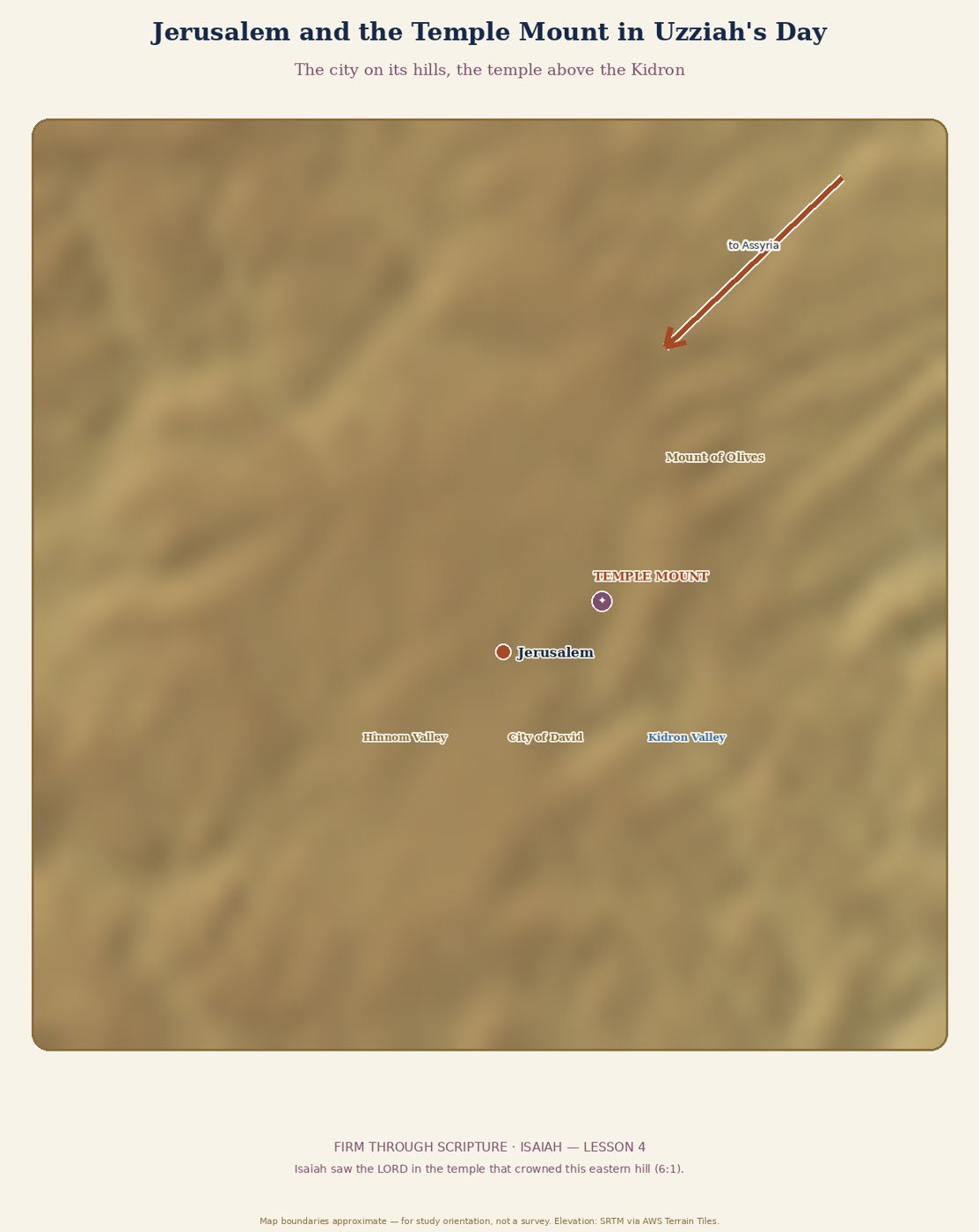
The place is the temple in Jerusalem. Jerusalem was Judah's capital, set on hills in the central highlands, and the temple — Solomon's house on the city's eastern hill — was the place God had chosen to put His name: the one authorised place of sacrifice, with its courts, holy place and holy of holies, its altars of burnt offering and of incense. The train — the hem, the flowing robe — filling the temple, smoke filling the house, doorposts shaking: the temple is doing what it was built to picture, heaven's court in session on earth. Whether Isaiah stood in the literal courts, was taken up in vision, or both, the text does not sort out — commentators divide over it. Its insistence is the meaning: God reigns from the place His people worshipped. [2, 16]
A note on honesty, early. Isaiah 6 stands sixth in the book, but almost every reader has treated it as Isaiah's call — the encounter that made him a prophet — set here as the book's foundation rather than at its chronological head. Chapters 1–5 have already shown a people ripe for judgment: a rebellious nation, pride humbled, a vineyard yielding wild grapes and six woes. Chapter 6 explains where the man who preached all that got his nerve, his message, and his tears. [4, 7]
The world outside was darkening, too. To the northeast, Assyria — the rising empire centred on the Tigris River, in what is now northern Iraq — was expanding under Tiglath-Pileser III, whose armies would soon swallow Syria, threaten Israel, the northern kingdom, and press Judah itself. Nobody in 740 B.C. could yet see the full Assyrian crisis of chapters 7–39, but the direction was plain: small nations were being eaten. One earthly throne had just emptied; a far bigger one was filling with ambition. Into exactly that moment, a man in the temple is shown a throne that was never empty. [2, 11]
Who is Isaiah? Isaiah son of Amoz — Amoz is his father, not the prophet Amos; the names differ in Hebrew — was a Jerusalem prophet able to speak to kings, whose ministry the book dates across the reigns of Uzziah, Jotham, Ahaz, and Hezekiah (Isaiah 1:1). 1 Tradition beyond Scripture makes him a royal relative; Scripture does not say that, and this study will not pretend it does. He will spend decades preaching to people who mostly do not listen. Chapter 6 tells you why he could: he had seen the King, he had been cleansed by the King, and he had been sent by the King — in that order. Lose the order and you lose the chapter.
That is the world. Now we open the text itself.
3. OBSERVE — O: what the text actually does
Before meaning comes observation. Most bad interpretation is shallow reading — people answering a text they never looked at. So look:
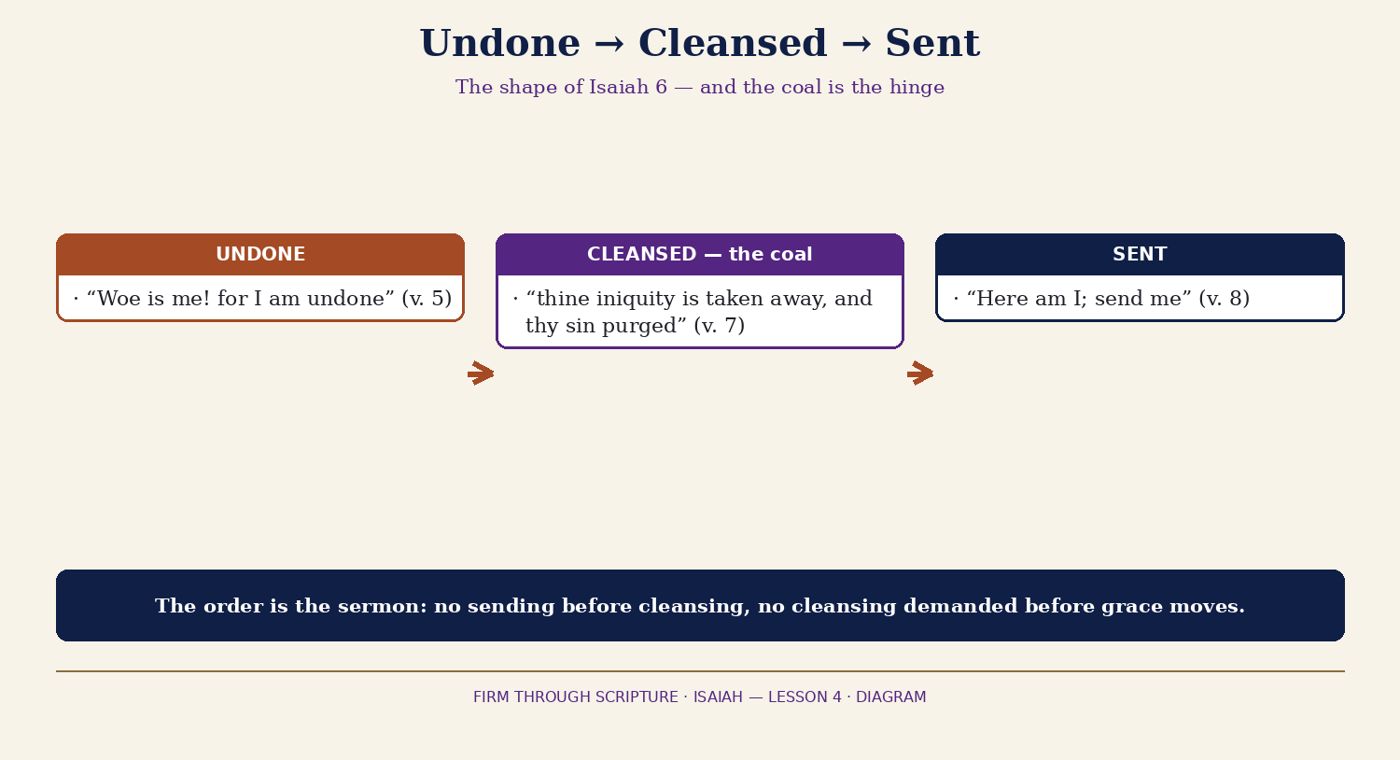
- The shape. Thirteen verses in three movements: the vision (vv. 1–4), the cleansing (vv. 5–7), and the commission (vv. 8–13). Vision does not run straight to service: between seeing God and being sent stands a ruined man, a coal, and a pardon.
- The first-person voice. "I saw" (v. 1), "Then said I" (vv. 5, 8, 11). This is testimony, not a lecture from a safe chair — which is why the chapter authorises no pride in those who preach it.
- The senses, overwhelmed. Sight (throne, train, seraphim, smoke), sound (the antiphonal cry, a voice shaking doorposts), touch (a coal on a mouth). The chapter is not an idea about holiness. It is an encounter with it, reported through a body.
- The repeated words. "Holy" three times in one cry (v. 3), and again in the chapter's last Hebrew words — the "holy seed" of verse 13. "Lips" twice in verse 5 and again in verse 7. "Send" twice in verse 8 — God's question and Isaiah's answer share the verb. In a chapter this tight, repetitions are load-bearing.
- Who acts, and in what order. Verses 1–4: God is seen; the seraphim act and speak. Verse 5: Isaiah speaks — a confession, not a request. Verses 6–7: a seraph acts; God pardons. Verse 8: God asks. Only then does Isaiah volunteer. Grace is not the reward for volunteering. It is the precondition of it.
- The two questions. God's (v. 8) is wide open: "Whom shall I send, and who will go for us?" Isaiah's (v. 11) is the chapter's ache: "Lord, how long?" God answers it fully and honestly — and buries a word of hope in the very last verse, where an exhausted reader might stop one verse too soon.
- The silences. No portrait of the Lord's face — the seraphim cover theirs, and the prophet gives us none — no length for the vision, and not one name of a person converted by the ministry commissioned here. Observation respects silences, and lets the absence of a success-story correct our hunger for one.
Note the proportions: four verses for the throne room, three for a coal and a pardon, six — nearly half — for the sending and its hard terms. A study that keeps only the first half has not shortened Isaiah 6. It has changed it.
4. GENRE — N: note the genre (prophetic call narrative — a throne-room vision)
Isaiah 6 is a prophetic call narrative: a first-person account of God confronting a man, cleansing or equipping him, and sending him with a message not of his own making. Its family is small and recognisable: Moses argues at the burning bush (Exodus 3–4); Jeremiah protests that he is a child (Jeremiah 1); Ezekiel falls on his face before a storm of glory and is set on his feet by the Spirit (Ezekiel 1–3). The details differ — God is not running a template — but the resemblance teaches the reading: the initiative is always God's, the human is always overwhelmed or reluctant or both, and the message is always harder than the messenger would have chosen. [17, 51]
The family, laid side by side:
| Call | The encounter | The human response | The sending |
|---|---|---|---|
| Moses (Exodus 3–4) | The burning bush; holy ground | Arguments and excuses | To Pharaoh, to free Israel |
| Jeremiah (Jeremiah 1) | God's hand on his mouth | "I am a child" | To nations and kingdoms |
| Ezekiel (Ezekiel 1–3) | Glory by the river; falls on his face | Set on his feet by the Spirit | To a rebellious house |
| Isaiah (Isaiah 6) | The throne room; seraphim; smoke | "Woe is me — undone" | To a people who will not hear |
Inside that family, Isaiah 6 is a throne-room vision, and that governs how you handle its pictures. It does not describe heaven with a camera. It reports a real encounter in the language of the place God gave for picturing His court — the temple — stretched to breaking point. Read it as a faithful witness describing something too large for his categories: not a coded puzzle where every wing stands for something else, nor flat prose to be embarrassed by. In the account the seraphim are there; they act and speak; one carries something real to Isaiah's mouth. The vision's reality is the point; its imagery is the God-given clothing of that reality. [2, 4]
Three genre rules, then:
- A call narrative validates a ministry; it does not give you a technique. Isaiah cannot teach you how to get a vision — only testify to the God who gave one. Testimony is not a recipe.
- In a vision, proportion is argument. The commission gets the most verses; a genre that lingers there is telling you what the vision was for.
- Prophecy is forthtelling first. The prophets speak God's word into their own moment before they foretell anything. 51 Isaiah 6 foretells plenty, but it begins as forthtelling: a verdict on the God Judah actually has, and the people Judah actually is, in 740 B.C.
5. TERMS — T: the words in the writer's mouth
Four words carry this chapter. Spend real time on the first; it is the book's keynote word — God is called "the Holy One of Israel" in Isaiah more than anywhere else in the Old Testament. [4, 18]
- Qadosh (kah-DOSH), "holy" — the word cried three times in verse 3. Its root idea is set apart, cut off from ordinary use — but in Isaiah's mouth it is never merely "separate." God's holiness is His utter otherness and His moral perfection held together: unlike anything else that exists, and perfectly, burningly good, exposing everything unclean that comes near Him. [18, 19] Hear both halves. Holiness as mere difference makes God remote; holiness as mere goodness makes Him manageable — a better version of us. Isaiah's qadosh allows neither: this God is other, and His otherness is blazing purity before which even sinless seraphim cover their faces. When Isaiah calls God "the Holy One of Israel" some twenty-five times across the book, he holds these together: the transcendent King has bound Himself, in covenant, to this people — which is why their uncleanness is a scandal and their redemption a wonder. [4, 18]
- Seraphim (SEH-rah-feem), "burning ones" — the plural of saraph, from a root meaning to burn. [19, 21] These are heavenly attendants named in the whole Bible only in this chapter — fiery beings, which fits: fire is this chapter's element (smoke, a live coal, burning purity). The same Hebrew word is used elsewhere for fiery serpents (Numbers 21; Isaiah 14:29; 30:6), which is why some artwork gives them serpentine features. FACT: Isaiah 6 tells us only that they stand above the throne, each with six wings — two covering the face, two covering the feet, two for flying — that they cry to one another, and that one handles, with tongs, a coal from the altar. Everything beyond that in famous artwork is imagination, labelled as such here. Their covered faces preach the chapter's first sermon: if they cannot look directly, what will a man of unclean lips do?
- Kaphar (kah-FAR), "to cover, to atone, to purge" — the word-family under verse 7's "thy sin purged." It is the Old Testament's great atonement word: it stands behind the "mercy seat," the kapporet, the covering over the ark where blood was sprinkled on the Day of Atonement (Leviticus 16). [18, 21] Its picture is sin covered — not ignored or excused, but covered by a God-provided means so the sinner can stand where he otherwise could not. Isaiah does not cover his own sin; he does not even ask. The covering comes to him, from the altar, applied to the exact place of his guilt: his lips. The coal is not a symbol for trying harder. It is grace arriving from the altar, before a commission is ever mentioned.
- Zera' qodesh (ZEH-rah koh-DESH), "holy seed" — the chapter's last two Hebrew words and its final word in every sense: "the holy seed shall be the substance thereof" (v. 13). Zera' is seed — offspring, the thing planted that carries a future inside it. Qodesh is the noun form of our first word: holiness. Hear the chapter rhyme: it opened with angels crying qadosh over a throne; it ends with qodesh buried in a stump in a wasted land. FACT: the phrase means a remnant people, set apart to God, preserved through judgment — the remnant thread already sounded in 1:9 and sounded again and again after. [1, 4] Whether the seed also reaches to one particular descendant is a question the New Testament takes up on its own terms; §6 and §7 handle it from the canon and will not smuggle the answer into the dictionary. The dictionary gives you a holy offspring preserved in the felled tree — and that alone, after verses 11–12, is astonishing mercy.
Method note — the word-study guardrail: a word means what its author uses it to mean, in its sentence, in its century — not what its oldest root once meant. Every term above was settled by Isaiah's usage in Isaiah.
TRANSLATION NOTE — "Hear ye indeed, but understand not": command, prediction, or verdict?
Verses 9–10 are where honest readers must slow down. Your KJV prints verse 10 in commands — imperatives: "Make the heart of this people fat, and make their ears heavy, and shut their eyes." That faithfully renders the Hebrew, which really does use imperative verbs: God speaks in the grammar of a command. [2, 7] But notice how the Bible itself carries the verses forward. Matthew speaks mostly of a state: the heart "is waxed gross," and — significantly — "their eyes they have closed" (Matthew 13:15). 1 John states God's action: "He hath blinded their eyes, and hardened their heart" (John 12:40). 1 Paul in Acts 28 foregrounds the people's own closing of their eyes. Versions behave the same way: some keep the blunt imperatives; others soften verse 10 toward outcome or flat prediction.
So which is it — purpose or result? That question is DISPUTED among faithful scholars; §16 argues it in the open. What is not disputed is the text's own presentation, taught straight in this lesson: Isaiah is genuinely commanded to go, the message is genuinely God's, the refusal is genuinely the people's, and the hardening is God's judgment on a refusal already chosen — chapter 5's vineyard was given everything and yielded wild grapes, and chapter 1's offer still stands in the same book. 1 Softening the imperatives away in translation protects nobody; it only hides how serious God is about a people determined not to hear.
6. ENTIRE CANON — E: where this passage sits in the whole story
No verse lives alone. Isaiah 6 is a knot where the Bible's threads cross — and the New Testament pulls this chapter's threads more daringly than almost any other in the prophets:
- The throne room, across the canon. Moses hides his face at the burning bush, on holy ground (Exodus 3:5–6). 1 Jacob whispers that the place is dreadful — "the house of God, and this is the gate of heaven" (Genesis 28:17). 1 Ezekiel sees "the appearance of the likeness of the glory of the LORD" and falls on his face (Ezekiel 1:28). 1 Daniel sees the Ancient of Days on a fiery throne (Daniel 7:9–10). 1 And Revelation shows four living creatures, each with six wings, who "rest not day and night, saying, Holy, holy, holy, Lord God Almighty, which was, and is, and is to come" (Revelation 4:8) — Isaiah's cry in heaven's final picture, joined in Revelation 5 by the song of the Lamb. 1 The trisagion — Greek for "thrice-holy" — is heaven's standing anthem, not a one-day performance.
- Matthew 13 — Jesus takes up the commission. Asked why He speaks in parables, Jesus answers with Isaiah 6:9–10: in the hearers before Him "is fulfilled the prophecy of Esaias" (Matthew 13:14). 1 The same pattern that governed Isaiah's ministry now governs His: preaching that reveals to the humble and conceals from the proud is not a bug in God's method. Any reading that makes the hardening a strange Old Testament embarrassment must reckon with Jesus reaching for these verses to explain His own ministry.
- John 12 — the boldest sentence in the file. John quotes Isaiah 53:1 and then Isaiah 6:10, setting texts from the book's end and beginning side by side, both as the one "Esaias" (John 12:38–41). 1 Then: "These things said Esaias, when he saw his glory, and spake of him" (John 12:41). 1 His — John's pronoun points to Christ. What Isaiah saw in the temple was, among other things, Christ's glory. The New Testament does not treat this as a vision of an abstract deity; it identifies the King in terms that include the Son.
- Acts 28 — Paul's closing word. Acts ends with Paul in Rome, under guard — and his parting word, the last extended speech Acts records, is Isaiah 6:9–10, introduced thus: "Well spake the Holy Ghost by Esaias the prophet unto our fathers" (Acts 28:25). 1 Keep the three attributions together: Isaiah sees the LORD of hosts; John says he saw Christ's glory; Paul says the Holy Ghost spoke. The New Testament itself distributes this chapter among Father, Son, and Spirit without embarrassment.
- The remnant and the stump, forward. A remnant shall return (Isaiah 10:22); the escaped of Judah "shall again take root downward, and bear fruit upward" (Isaiah 37:31) — the stump picture, blossoming. 1 Paul gathers the thread in Romans 9–11, quoting Isaiah on the remnant (Romans 9:27), confessing "at this present time also there is a remnant according to the election of grace" (Romans 11:5), and picturing Israel's future with a tree, its root holy, its branches broken and grafted. 1 Isaiah 6:13 is the seed of all of it, in both senses.
- The unity of the book — canon evidence. John 12 cited Isaiah 53 and Isaiah 6 in consecutive breaths as one prophet's words. That is the New Testament's habit everywhere: Isaiah is cited across all the book's parts under one name, and the earliest complete witness, the Great Isaiah Scroll from Qumran (about 125 B.C.), is already one scroll of all sixty-six chapters. [22, 50] The critical proposal that chapters 40–66 come from later hands is a real proposal about compositional prehistory, handled honestly in this book's opening study and in §16; the canon's presentation is one Isaiah, whose vision in chapter 6 authorises everything that follows. POSITION — this program's reading, held with the evidence on the table.
The New Testament's use of this chapter, laid out flat:
| Where the NT speaks | What it takes from Isaiah 6 | What it says with it |
|---|---|---|
| Matthew 13:14–15 | vv. 9–10, the hearing that does not understand | Jesus explains His own parable ministry by Isaiah's commission — FACT 1 |
| John 12:38–41 | v. 10, with Isaiah 53:1 beside it | Isaiah "saw his glory" — Christ's — and spoke of Him — FACT 1 |
| Acts 28:25–27 | vv. 9–10, as Acts' closing word | "Well spake the Holy Ghost by Esaias" — FACT 1 |
| Revelation 4:8 | v. 3, the threefold cry, six-winged attendants | Heaven's worship, day and night, until the end — FACT 1 |
Now the payload.
7. THE MEANING — what the passage teaches
Now the payload, taught straight, in the passage's own proportions.
The King who did not die
Begin where the chapter begins: with a contrast it never states outright and never lets you miss. "In the year that king Uzziah died I saw also the Lord" (v. 1, fragment). One king dies; another King is seen — and "also" does its quiet work: alongside Judah's emptying throne stands the throne that was occupied all along. Isaiah does not say God became King when Uzziah died. He saw the Kingship that was true during every year of the reign — prosperity, pride, leprosy — and will still be true when Assyria comes, when Babylon comes, when every king Isaiah advises is in his grave. The vision is not an escape from a bad year. It is a disclosure. [2, 4]
This is why the chapter re-foundations the whole book. Everything Isaiah will say for sixty chapters — to Ahaz trembling before armies, to Hezekiah on his sickbed, to exiles not yet born — rests on this hour. The chapter asks you Judah's question: when the fixture dies — the king, the income, the health, the plan — what is left standing in your picture of the world? Isaiah's answer is not a principle. It is a throne, occupied. And note his title for the One he sees: not "a vision," but "the King, the LORD of hosts" — hosts meaning armies, the countless ranks of heaven. 19 A man who has seen that King can never treat any earthly king as ultimate again. That demotion of all other thrones is the political theology of the whole book in embryo.
High and lifted up — what holiness looks like when you meet it
The throne is "high and lifted up" (v. 1, fragment) — a phrase Isaiah will turn later in two directions that belong together: God is "the high and lofty One that inhabiteth eternity, whose name is Holy" (Isaiah 57:15), yet that same high One dwells "with him also that is of a contrite and humble spirit." 1 Keep 57:15 in your pocket: the height does not cancel the nearness. But in chapter 6 the height comes first, and undiluted.
Watch how the scene builds the holiness the seraphim are about to name. The train fills the temple — no room in the house for anything else to be impressive. The seraphim cover their faces: created glory cannot bear the uncreated Glory unshielded. They cover their feet, presenting nothing of themselves before Him. They cry to one another, antiphonally — not a solo, but heaven's creatures calling each other to keep saying it. The voice shakes the doorposts; the house fills with smoke — the Bible's recurring sign of God's presence veiling itself even as it reveals itself, as on Sinai and in Solomon's temple. Smoke says two things at once: He is here, and you will not see Him unmediated and live comfortably. [2, 16]
Then the cry itself: holy, holy, holy. In Hebrew speech, repetition intensifies — twice is strong, three times is uttermost, complete. [7, 18] The seraphim do not cry "loving, loving, loving," though God is love, nor "mighty, mighty, mighty," though no one doubts His might. The one attribute heaven triples is holiness: the perfection that orders all the others. His love is a holy love; His mercy, when it comes in verse 7, will be a holy mercy — which is why it arrives from an altar, through a burning coal, not as a shrug. And the cry reaches past the temple walls: "the whole earth is full of his glory" (v. 3, fragment). Not just the temple, not just heaven — the whole earth, even the earth this same chapter will show wasting (vv. 11–12). Isaiah will need both sentences for sixty years. The book he is commissioned to write is largely the story of how they finally meet.
Holy, holy, holy — heaven triples one word, and it is not "loving" or "mighty." It is the name that orders all the others.
Woe is me — what holiness does to a man who has been preaching against sin
Now watch the prophet. For five chapters (as the book stands) Isaiah has pronounced woes on others — the greedy, the drunk, those who call evil good (chapter 5). In verse 5, for the first time, he aims the word at himself. That is what a true sight of God does: not a general feeling of smallness, but specific honesty about his own sin.
And Isaiah locates his ruin in exactly one place: his lips. "I am a man of unclean lips, and I dwell in the midst of a people of unclean lips" (v. 5, fragment). Why lips? Because Isaiah is a prophet — his whole calling is speech; his instrument is his mouth, and his mouth is unclean. God exposes, in each person, the sin that lives at the centre of their gift. Notice, too, that Isaiah does not exempt himself from his people: I am unclean, and I dwell among the unclean. He will spend his life calling this people to repent; he begins by confessing he is one of them. Every preacher or teacher who skips that step is working from a different chapter.
"Undone" is the KJV's great word for his condition. Underneath it is a Hebrew verb that can mean to be destroyed, to perish — and also to be silenced, brought to nothing. 19 Both are true here: I am ruined, and I have nothing to say. His first true word in God's presence is a confession. Compare the family: Job — "Wherefore I abhor myself, and repent in dust and ashes" (Job 42:6); Peter — "Depart from me; for I am a sinful man, O Lord" (Luke 5:8). 1 Nobody in Scripture meets the Holy One and comes away discussing how meaningful it was. They come away undone, and then — only then — usable.
Grace before commission — the coal, the altar, and the order that preaches
Here is the chapter's beating heart, and it is a matter of sequence.
Isaiah confesses. He does not bargain, promise, volunteer, or apply for pardon. And the next move is not his. A seraph flies to him — heaven moves toward the sinner — carrying a live coal taken with tongs from the altar. Why tongs? Even the seraph does not handle this fire bare-handed. Why the altar? Because the altar is where sin is dealt with by sacrifice — where God appointed the meeting between His holiness and man's guilt. Isaiah's cleansing is not God overlooking the uncleanness confessed. It is God applying, to the very organ of guilt, something drawn from the place of atonement. The seraph lays it on his mouth and speaks the chapter's gospel in one sentence: his iniquity is taken away, his sin purged — covered, atoned, kaphar. [18, 21] Notice the grammar: all declaration, all done-to-him. Isaiah contributes his confession and his mouth; God contributes everything else. No probation, no commission dangled as the price of pardon. The pardon is complete before God asks for anything.
"Here am I; send me" — the volunteer who did not volunteer first
"Also I heard the voice of the Lord, saying, Whom shall I send, and who will go for us?" (v. 8, fragment). God does not address Isaiah by name; He asks a question into the room, as if the court of heaven is being consulted. Us is debated — majestic self-address, address to the heavenly court, or a deeper hint the New Testament takes up (see Father, Son, and Spirit below). The cleansed man answers a question not put to him personally, without asking for the job description. "Here am I; send me" (v. 8, fragment) is given before he hears what the job is — knowing only who the Sender is, and that his sin is purged. The order preaches: sight, undoing, cleansing, then sending. Reverse it — try to be sent before you are cleansed — and you get Pharisaism or despair, the two occupational diseases of religious people. [4, 36]
Calvin lingered on exactly this: Isaiah, once purged, offers himself freely — and God, who could command, instead asks, so that the service is willing service. 36 Every generation must relearn it: God does not recruit the impressive. He cleanses the undone.
The hardest commission in the prophets — preaching to people who will not hear
Now the terms of the sending; do not let familiarity blunt them. Isaiah is to preach to this people — his own — and the stated effect will be that they hear without understanding and see without perceiving (v. 9, in fragments). His ministry is given to him, in advance, as a ministry of apparent failure: let the preaching itself be the instrument by which a people's long refusal hardens into judgment.
Why would God do this? §10 defends it at length; three things here. First, the hardening is judgment on a refusal already made, not a trap for the innocent. Chapters 1–5 are the record: a vineyard given wall, tower, and winepress, returning wild grapes. Chapter 6 pronounces the refusal's sentence. Second, the hardening works through preaching refused — the same sun melts wax and hardens clay. Third, the prophet is sent anyway. God does not say, "They will not listen, so stay home." He says, in effect: they will not listen — go. The success asked is not response but faithfulness. [2, 7] Isaiah does not withdraw his "send me." He asks, "Lord, how long?" (v. 11, fragment) — a man who loves these people asking how far the judgment runs. God answers fully and terribly: until cities lie waste and people are removed far away (vv. 11–12, in fragments) — an unmaking, measured in national death.
The stump and the seed — judgment is not the last word
And then — verse 13, the verse exhausted readers skip.
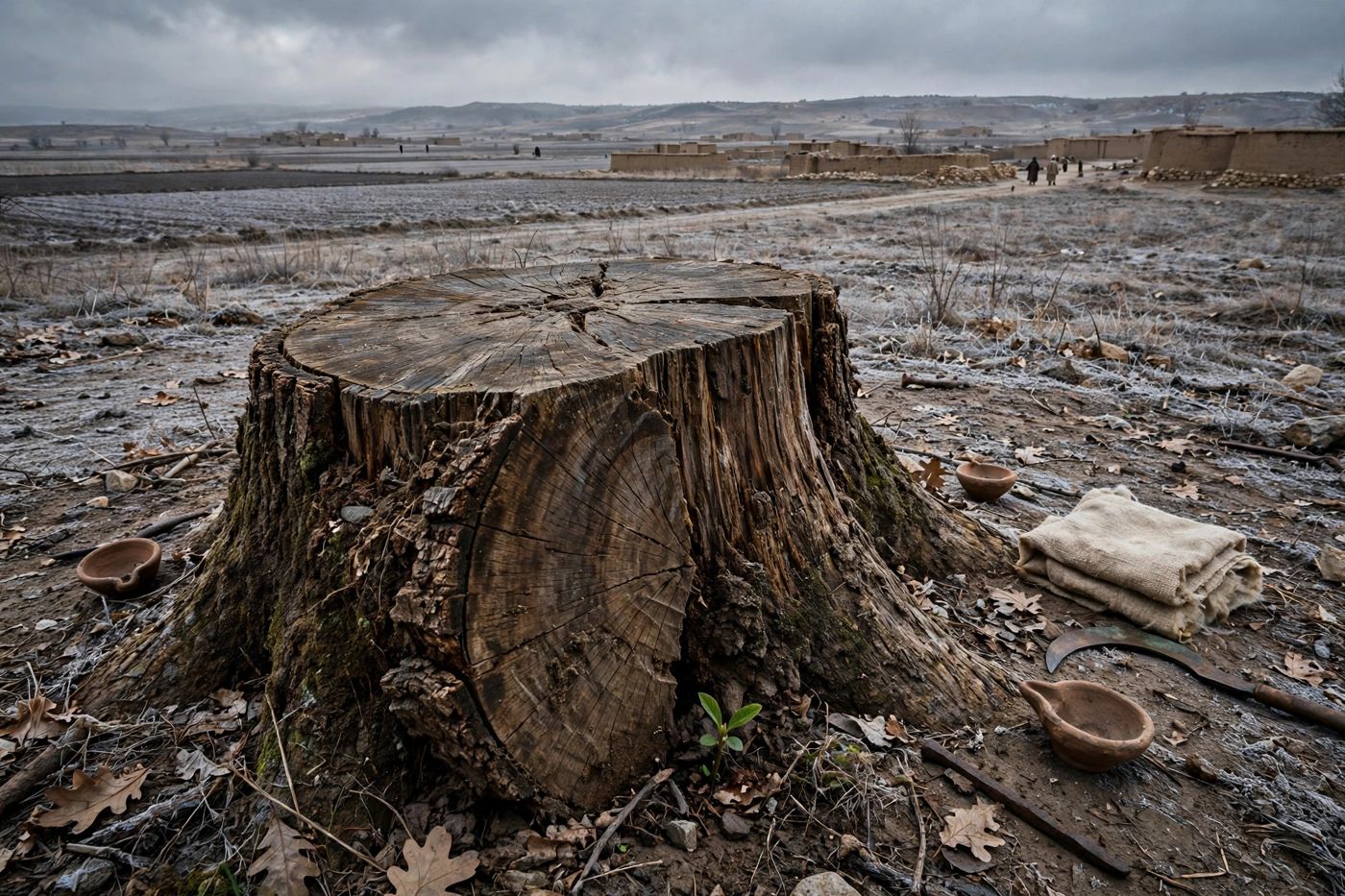
Even after the wasting, "yet in it shall be a tenth" — a remnant — and even that tenth "shall return, and shall be eaten," burned over again (v. 13, in fragments). The picture changes, mid-verse, from arithmetic to forestry: a teil tree — a terebinth, a great spreading tree of the hills — and an oak, both felled, nothing left above ground but a stump. And the stump has substance in it — life stored below the surface, invisible in winter. "So the holy seed shall be the substance thereof" (v. 13, fragment). [4, 52]
HOLD THE RHYME — The word that filled the temple in verse 3, holy, is buried in the ground in verse 13 — and buried things in this Bible have a way of rising.
Judgment, in Isaiah's God, is real, total-looking, and not final. There is a stump; there is substance in the stump; there is seed in the substance, and the seed is — hear the chapter rhyme — holy. The word that filled the temple in verse 3 is buried in the ground in verse 13, and buried things in this Bible have a way of rising. Isaiah does not yet know how far it reaches: a remnant returning from exile, a shoot from the stem of Jesse in chapter 11, and, the church has confessed, beyond. What is immovable at the chapter's own level: the last word of Isaiah 6 is not waste. It is seed. A prophet who knows that can preach judgment for forty years without lying about it or despairing in it. A church that knows it can survive its own winter.
Where in the Covenant Story?
Isaiah 6 stands in the covenant-lawsuit movement of Israel's story. God made covenant — a binding, pledged relationship, like a treaty and a marriage at once — with Israel at Sinai, blessing promised for faithfulness and curse, exile among them, for rebellion (Deuteronomy 28). Chapters 1–5 have been God filing His case; chapter 6 shows the court behind it: the King is the covenant Lord Himself — and, the wonder, still sending and still preserving a seed, when the covenant's terms would justify Him in ending the story. The coal is covenant mercy: the God owed purity provides it, from His own altar. The stump is covenant fidelity: the God who promised Abraham a seed and David a house does not let the axe have the final say. The Child of chapter 9 and the shoot of chapter 11 are this seed, growing on schedule. [4, 57]
The Christ Thread
Isaiah needs no forced symbolism, and this chapter least of all — because the New Testament does the work itself, in words that cannot be improved and must not be exaggerated. John, explaining why so many who saw Jesus' signs did not believe in Him, quotes Isaiah 53 and Isaiah 6:10, and then writes: "These things said Esaias, when he saw his glory, and spake of him" (John 12:41). 1 The evangelist's claim is plain: the glory Isaiah saw in the temple — the King, high and lifted up — was, in John's Spirit-given reading, Christ's glory. Isaiah saw Him, and spoke of Him, centuries before Bethlehem. FACT — that is what John's text says, and this study teaches it as the canon's own reading. [1, 2]
What John does not say must be respected equally. He does not say Isaiah understood, in 740 B.C., the full shape of the incarnation, cross, and resurrection. He says Isaiah saw His glory and spoke of Him. Prophets, Peter says, searched carefully into the grace they prophesied, knowing they served not themselves but us (1 Peter 1:10–12). The thread is real because the apostle ties it: the enthroned King is not a different God from Jesus Christ, nor a mere preview of Him, but — in the mystery John states and does not diagram — the same Lord, seen before He took flesh. The stump thread runs to Him by the book's own road: the shoot from Jesse's stem (Isaiah 11:1) and the child on David's throne (Isaiah 9:6–7) are Isaiah's expansions of the seed in the stump, and the New Testament reads Jesus as their fulfilment — POSITION where that goes beyond any single text's wording, the church's historic reading, labelled as such. No invented types are needed; follow the apostles' knots and add none.
Father, Son, and Spirit
This passage earns this subsection — from the New Testament's handling of this chapter, taught from those texts, carefully.
Lay the three witnesses side by side, as §6 set them out. The voice Isaiah hears is the LORD of hosts, the King — God the Father, as the church has confessed, asking, "Whom shall I send, and who will go for us?" (v. 8, fragment). John says Isaiah saw Christ's glory (John 12:41). 1 Paul says the Holy Ghost spoke the words of verses 9–10 (Acts 28:25). 1 Three apostolic witnesses, three distributions of the same chapter's speech and sight — and none corrects the others. The New Testament itself teaches us to read Isaiah 6 as the church later confessed at the Jordan: one God, three Persons, acting together — the Father sending, the Son's glory seen, the Spirit speaking through the prophet. Even the plural "for us," most naturally heard in its own day against the assembled heavenly court, becomes in the canon's full light a place where the church has heard more than Isaiah could have diagrammed. INFERENCE, honestly labelled, from the NT texts cited. Do not flatten the chapter into a proof-diagram and lose the trembling: the doctrine is here to deepen the worship, not to replace the shaking doorposts.
ONE CHAPTER, THREE WITNESSES — The LORD of hosts speaks (v. 8); John says Isaiah saw Christ's glory (John 12:41); Paul says the Holy Ghost spoke (Acts 28:25). The New Testament made this distribution, not this study.
The Long View — what the church has believed
The earliest centuries read it as the vision of the triune God in the Old Testament. Irenaeus quotes Isaiah as one prophet's unified witness to Christ, and Jerome, whose commentary (about A.D. 408–410) remains the early church's fullest, treated chapter 6 as a window into Father, Son, and Holy Spirit, leaning on the New Testament's distribution of the voices. [37, 45] The threefold "Holy" became the Sanctus of the church's worship, sung at the Lord's Table in historic liturgies of East and West — ordinary Christians, weekly, joining verse 3's cry. On the chapter's centre the centuries are strikingly at one: Calvin reads the coal as free pardon and "Here am I" as service flowing from pardon, not earning it 36; Young reads the commission's hardness as judgment on settled refusal, with the remnant preserved. 7
Where readers have honestly divided is at two points. First, the hardening of verses 9–10 — purpose, result, or both — argued in §16: DISPUTED. Second, the vision's location and mode — temple courts, heaven, or transport between them — which the text seems uninterested in settling, and on which nothing doctrinal turns. [2, 4] The divisions cluster at the edges; the centre — who God is, what He does to the man He calls, and that the seed survives the axe — has held for two thousand years.
That is the payload. The next section compresses it into the one sentence you are meant to carry out of this study.
8. THE AIM SENTENCE — X: eXplain the intent
Everything observed now compresses into one sentence — the author's intended meaning:
In the year the earthly king died, Isaiah saw the true King enthroned in holiness, was undone by his own unclean lips, and was cleansed by grace from the altar before he was sent — to preach, in God's name, to a people who would refuse to hear, until judgment felled the nation and only a stump remained, in which God preserved a holy seed.
If a sermon or devotional uses Isaiah 6 to say something untraceable to that sentence — a volunteering slogan without the coal, a worship mood without the commission, a hardening proof-text without the seed — it is not this passage talking.
9. SAY IT BACK
Close the book and say the AIM sentence from section 8 in your own words, without looking. Then say what it asks of you this week. If your version changes the meaning — the cleansing drops out, or the seed gets lost under the felled cities — walk it again. It is the course in miniature: meaning first, then your life.
10. THE MISREAD — the guardrail, with verdicts
Three live misuses — hearing, evidence, verdict.
| Misread | What it crops out | The verdict in one line |
|---|---|---|
| "Here am I" as volunteerism | The coal (vv. 5–7) and the terms (vv. 9–13) | Pardoned first, sent second |
| Hardening as a cruel trick | Chapters 1 and 5, and the seed (v. 13) | Judgment on refusal, not entrapment |
| Uzziah's death as a date stamp | 2 Chronicles 26 and the throne contrast | The chapter's doorway, not its small print |
Misread 1: "'Here am I; send me' is the Christian life in one line — just volunteer, step up, and God will use you." Why it sounds right: verse 8 really is a volunteer speaking, and churches really do need people to step forward. The evidence: the banner crops the chapter at verse 8 and loses what the verse stands on. Isaiah volunteers because of verses 5–7: undone by God's holiness, confessed in his specific sin, and pardoned by a pardon he did not request, carried from the altar. He volunteers before he is told the assignment — whose stated outcome is refusal, waste cities, and a stump. Generic volunteerism reverses the chapter twice: it makes willingness the cause of God's use (cleansing is the cause, willingness the fruit), and it implies the reward is effectiveness (the chapter promises Isaiah almost none, visibly). The pattern is not volunteer and be used. It is grace → cleansing → sending, on the Sender's terms. Verdict: right words, wrong order. "Here am I" is a pardoned man's answer — not a technique for getting noticed, and never a promise that obedience will look successful.
Misread 2: "Verses 9–10 show God playing a cruel trick — He sends a prophet precisely so people can't repent, then punishes them for it." Why it sounds right: the imperatives are genuinely shocking: "Make the heart of this people fat," with a lest attached — lest they see, hear, understand, turn, and be healed (v. 10, in fragments). Readers who feel the shock are reading better than readers who feel nothing. The evidence: read the verses where God put them, and the cruelty dissolves into judgment — severe, but a different moral category. These are not blank innocents: they are the people of chapters 1–5 — offered cleansing in chapter 1 ("Come now, and let us reason together, saith the LORD: though your sins be as scarlet, they shall be as white as snow"), an offer that stands unretracted in the same book 1 — given a vineyard's every advantage in chapter 5, and answering with wild grapes and calling evil good. Hardening here is God's judgment on persistent refusal: He gives rebels the full fruit of the deafness they have chosen, and even preaching becomes, by their practiced refusal, a hardening occasion. Yet the prophet is still sent, for decades, and the last verse preserves a holy seed. A cruel trick has no remnant, no pleading prophets, and no chapter 1 before it. This has all three. How far God's intention and the foreseen result divide is DISPUTED; that the passage presents judgment-on-refusal, not entrapment of the willing, is the text's own presentation. Verdict: not a trick — a sentence. God is handing unwilling people over to the deafness they chose, through the preaching they refuse — and even then, He keeps a seed.
Misread 3: "'In the year that king Uzziah died' is just date-keeping — ancient small print to skip on the way to the vision." Why it sounds right: the prophets do date their words by kings' reigns; Isaiah 1:1 has already dated the whole book that way. The evidence: this date does theological work. Uzziah reigned fifty-two years; his death ended the only political world most of Judah had known. And his story — the king who forced his way toward the altar, was struck with leprosy in the temple, and died cut off from God's house (2 Chronicles 26) — is the vision's dark backdrop: the king who seized at nearness died exiled from God's presence; in that year a prophet is given nearness he never seized, by a King whose robe fills the very house Uzziah was expelled from. [1, 2] The sentence is built as a contrast: a king died; the King was seen, enthroned. The Assyrian crisis of the next thirty chapters will test whether Judah believes verse 1 or only admires it. Verdict: not small print — the doorway: the earthly king is dead; the King is on the throne.
11. FROM WORD TO WALK
The lesson is not finished until the passage has had its say with you.
There is a version of Isaiah 6 that religious people love, and it ends at verse 3: smoke, song, a triple holy — worship as atmosphere. The chapter does not end there, and if it is honest, neither will you. The cry is the doorway into a room where a man says the truest sentence of his life: Woe is me.
Woe is me — not woe is them. The chapter turns when the prophet's woes finally include himself.
So sit, before anything else, with the lips. Isaiah did not confess a vague unworthiness. He named the unclean place at the centre of his usefulness — his mouth, the instrument of his calling. What is yours? Not the comfortable, general confession that costs nothing. The specific one: words spoken this month that you cannot unsay — the cutting remark dressed as honesty, the flattery, the silence when truth was owed, the gossip carried like news. Or, if your instrument is not speech: the hands, the ledger, the screen, the temper — the place where your gift and your guilt share an address. This chapter will not let you confess your neighbour's sins in the abstract. It teaches you to say: I am a person of unclean lips, and I dwell among a people of unclean lips — one of them, not their judge.
And then — receive the order of grace as your own. The coal came to unclean lips, from the altar, on God's initiative, while the confession was still in the air. That is still how cleansing works: you confess the mouth you have, and God applies what His altar provides — named plainly in the New Covenant: the blood of Jesus Christ cleanses from all sin (1 John 1:7–9). After the coal, Isaiah's mouth — the same mouth, not a replacement — becomes the mouth that will speak chapters 40 and 53. God does not discard the instrument He cleanses. He consecrates it. Only then, the sending: God seen clearly, sin confessed specifically, pardon received humbly — then a willing here am I, trusting the Sender for the terms. Some reading this avoid a known task because it will not visibly "work." Isaiah's success was measured in a stump he would not live to see sprout — and he went anyway, because he had seen the King.
Holy, holy, holy — Lord of hosts, I do not ask You to make me impressive. Make me honest. Show me the unclean place at the centre of my own gift, and let me confess it by name, as Isaiah confessed his lips. Then cleanse me from Your altar's provision, in the blood of Your Son, and let my "here am I" come after Your mercy and never before it. Send me where You will — even to people who may not hear, even to work I will not see finished — and keep the holy seed in front of my eyes when all I can see is the stump. In Jesus' name, amen.
12. FOR DISCUSSION — OR FOR YOUR JOURNAL
With a group, work these aloud. Alone, they're yours — answer them in your journal or in prayer; they lose nothing in the quiet.
- Isaiah pronounced woes on others before he cried "Woe is me." Where do you see sin easiest — in others, or at the centre of your own gift, as Isaiah saw his lips?
- The coal comes before God asks Isaiah for anything. Where are you tempted to reverse that order — serving to feel cleansed, or waiting until you feel clean enough to confess?
- Isaiah asks "Lord, how long?" and God answers without shortening the judgment. How do you pray "how long," and what does this chapter teach you to expect from God's answers?
- Where in your life does everything visible look like a stump — and what would it mean, concretely, to trust that God has kept substance in it?
13. THE WALK-OUT — T: Transfer to today
Meaning is settled. Now application, and it must cross the bridge honestly. Run the five Transfer Tests:
- Same covenant? Isaiah stood under the old covenant, before the cross; we live on its far side. The coal does not repeat as an experience — its reality crosses once-for-all in Christ's atoning death, applied in confession and forgiveness (1 John 1:7–9). The holiness that required the coal has not changed.
- Same audience? Isaiah was commissioned to a nation under a covenant lawsuit; you are not. The commission's terms — preach to harden, until cities waste — were his; no believer is sent to make hearts fat. But its pattern — cleansed first, sent second, faithful regardless of response — addresses every believer who serves.
- Same genre rules? A call-narrative testifies; it does not prescribe an experience to replicate. Nobody is commanded to seek a vision or a coal. It gives you a God to know and an order to trust, not a technique to copy.
- Repeated or rooted? Confession met by cleansing runs from Leviticus through Isaiah to 1 John. Remnant preservation runs from this stump through Romans 11. Worship joining heaven's cry runs from verse 3 to Revelation 4. These cross with their roots showing.
- Ten verses either side? Every application below is drawn from the thirteen verses read whole. Nothing hangs on a torn-out line: not the volunteering (v. 8 without vv. 5–7), not the hardening (vv. 9–10 without vv. 11–13), not the worship (v. 3 without its chapter).
What crosses — and lands:The bridge, at a glance:
| In Isaiah 6 | How it crosses | How it does not |
|---|---|---|
| The coal from the altar | Christ's atonement, received in confession (1 John 1:9) | As a repeatable experience to seek |
| Cleansed, then sent | The order for all Christian service | The hardening terms, which were Isaiah's alone |
| The holy seed in the stump | Patience with God's preserved remnant | A promise that no felling will really come |
What crosses — and lands:
- Because the King did not die when the earthly king did, confidence in a shaking year is not optimism but a settled fact about a throne. Faith here is not the absence of "how long?" — it is asking it toward the throne.
- Because cleansing came before commissioning, from the altar, the doorway into service is confession, not résumé: specific confession, received pardon, willing availability — in that sequence, every time.
- Because God preserved a holy seed in a stump, apparent endings are to be read with patience: the land really was wasted; the seed really was in the stump. Tell the truth about the felling; refuse to call it the end.
Practices — what the gate lets through, made concrete this week:
- Confess the lips. Twenty unhurried minutes, one specific confession — words spoken, or owed and withheld, this month. Name them to God; then, where a person was wronged, go to that person this week and say so.
- Re-order your volunteering. If you serve to feel acceptable to God, re-found it: receive the pardon first (1 John 1:9), then re-offer the service freely. If you are refusing a known task because it promises no success, take Isaiah's terms to prayer and answer.
- Pray "how long?" properly. Choose one wasted-looking place, pray Isaiah's question over it this week, then finish with verse 13: thank God He keeps substance in stumps.
- Memorise Isaiah 6:3 — the Recap Card's memory verse, so heaven's anthem is in your mouth before it is in your feelings.
- One hard conversation, sent anyway. A true word for someone who may not receive it: deliver it this week, kindly and plainly, and leave the response with God. Faithfulness is your assignment; the harvest is His.
What does not cross: Isaiah's hardening commission — no one today is sent to make hearts fat; a throne-room vision claimed as a credential; the coal as a repeatable experience; and any "Here am I" that skips confession. The gate is there to make sure the claims that land are the ones God actually made.
Praise Him
Holy, holy, holy, is the LORD of hosts — and the whole earth is full of His glory. Praise Him who sat on the throne when the king died, and sits there still; who shakes doorposts, and yet flies by His messenger to a ruined man's lips with fire from the altar. Praise Him whose mercy reaches a confessor before it asks him for anything. Praise Him who answers "how long?" without lying, and who, when the tree is felled, keeps a holy seed alive in the stump. The seraphim cannot stop crying it; the redeemed, who have felt the coal, need not stop either: Holy, holy, holy.
14. THE RECAP CARD — this study on one page
Print it. Keep it where you'll see it.
- The passage: Isaiah 6:1–13 — the call of Isaiah: the throne room, the coal, the commission, and the stump.
- Say It Plain: The earthly king dies; Isaiah sees the real King, is undone, is cleansed by a coal from the altar, volunteers only after pardon — and is sent to preach to people who will not hear, until a holy seed remains in the stump.
- The AIM: In the year the earthly king died, Isaiah saw the true King enthroned in holiness, was undone by his own unclean lips, and was cleansed by grace from the altar before he was sent — to preach, in God's name, to a people who would refuse to hear, until judgment felled the nation and only a stump remained, in which God preserved a holy seed.
- Key terms: qadosh — holy, set apart and perfect · seraphim — burning ones · kaphar — to cover, atone, purge · zera' qodesh — the holy seed in the stump.
- The Misread, in one line: "Here am I" follows cleansing, not the other way round · the hardening is judgment on refusal, not a cruel trick · Uzziah's death is the chapter's doorway, not its date stamp.
- Memory verse: "Holy, holy, holy, is the LORD of hosts: the whole earth is full of his glory." — Isaiah 6:3
- This week's practice: confess the lips — one specific confession, to God and, where owed, to the person wronged — and pray "how long?" over one stump-like place.
15. CHECK YOURSELF — five questions
Answer from the study, not instinct. (Answers in the Teacher Edition.)
- In your own words: what is the AIM of Isaiah 6:1–13?
- Why does Isaiah locate his ruin in his lips — and in what order do undoing, cleansing, and sending come in this chapter?
- A friend says verses 9–10 prove God tricks people into damnation. Using chapters 1 and 5 and verse 13, answer them.
- What does kaphar tell you about how Isaiah's sin was dealt with — who acted, from where, and before what was asked of him?
- John 12:41 and Acts 28:25 say two remarkable things about this chapter. What are they, and what do they together teach about who was speaking and seen in Isaiah 6?
16. GO DEEPER
Optional. The lesson is complete without it.
From the Sources — The tongs, the altar, and the fire no one handles bare-handed
Even a seraph takes the coal "with the tongs from off the altar" (v. 6, fragment). The altar of burnt offering was where the daily sacrifices burned, and its fire was holy fire — kindled by God, guarded by priests, never common. [16, 54] FACT: the altar's instruments were consecrated vessels; approach to holy things is always mediated, never casual. INFERENCE: the tongs preach the covered faces' sermon — heaven does not treat this fire as safe. When it nevertheless travels, applied to a sinner's mouth rather than consuming him, the chapter's gospel stands in the picture: what should have burned Isaiah up burns his sin away. The difference is the altar it came from.
The fire that should have consumed him cleansed him instead — because it came from the altar.
The Honest Argument — Purpose, result, and the hardening of Isaiah 6:9–10
State the range at full strength. Reading A — sovereign purpose: the imperatives mean what commands usually mean; God sends Isaiah in order that the people be hardened, as with Pharaoh, and John 12:40 states it unsoftened: "He hath blinded their eyes." Oswalt and Young both protect God's intentional agency in the judgment. [1, 2, 7] Reading B — announced result: the imperatives are a prophetic idiom announcing the effect the preaching will have on hearers settled in refusal; Motyer presses the people's responsibility to the front, and Matthew's "their eyes they have closed" supports it. [1, 4] Reading C — judicial handing-over: the two are one act from two sides — God judges rebels by giving their chosen deafness its full effect through the preached word, as in Romans 1's "God gave them up."
DISPUTED — the balance is genuinely contested. POSITION — this lesson teaches Reading C: the imperatives keep their force, chapters 1–5 keep the refusal prior and theirs, the prophet is really sent, and verse 13's seed is mercy inside the sentence. The sending itself, sustained over Isaiah's lifetime, is the fact the cruel-trick misread cannot digest.
A second dispute, noted here because John 12 raises it: whether chapters 40–66 were composed by Isaiah himself or by later disciples. DISPUTED as compositional prehistory; the canon evidence — John citing chapters 6 and 53 under one name, the Great Isaiah Scroll already one scroll — is FACT, and the program's POSITION is to read the book whole. [22, 50]
The Word Underneath — qadosh, from the throne to the stump
Trace the word and you trace the chapter's argument. Qadosh enters as heaven's triple cry (v. 3). In chapter 5, the people who "despised the word of the Holy One of Israel" (Isaiah 5:24) are the very people the cleansed prophet is sent back to. 1 It becomes the book's signature name for God — "the Holy One of Israel," about twenty-five times — holding transcendence and covenant together: the utterly Other One who has made Himself Israel's. [4, 18] And it ends this chapter underground, as qodesh in "holy seed" (v. 13): holiness hidden, for a season, in a stump.
| Qadosh at… | Where it sits |
|---|---|
| Verse 3 | Cried threefold over the throne |
| Chapters 5–39 and beyond | God's signature name: "the Holy One of Israel" |
| Verse 13 | Buried as the holy seed in the stump |
| FACT: the lexical thread is really there, throne to stump. INFERENCE: Isaiah intends the rhyme — the holiness that undid him will carry his people through the judgment. If so, the chapter's last word about God and about Israel is the same word. Holy. |
Go Read
- Oswalt, The Book of Isaiah, Chapters 1–39 (NICOT) 2 — the fullest evangelical treatment of the vision, commission, and hardening.
- Motyer, The Prophecy of Isaiah 4 — strong on "the Holy One of Israel" as the book's keynote and on chapter 6 as foundation.
- Young, The Book of Isaiah 7 — meticulous on the Hebrew of verses 5–10.
- Calvin, Commentary on Isaiah 36 — pardon applied to the trembling prophet, and willing service flowing from it.
17. SOURCES & REFERENCES
Numbered citations in this lesson key to this list — the course standard: every sourced claim carries its number, and every number can be checked.
- The KJV text itself — Holy Bible, King James Version (eBible.org KJV, 1769 text). Scripture quotations are from the King James Version (KJV), which is in the public domain in the United States; the full passage is always assigned as reading. Cross-references within Scripture cite this number.
- Oswalt, The Book of Isaiah, Chapters 1–39 (NICOT) — John N. Oswalt (Eerdmans). The leading evangelical commentary on the first half; defends essential unity of authorship and reads the book as a finished theological whole. Detailed notes on the Assyrian-period history (Ahaz, Hezekiah, Sennacherib).
- Motyer, The Prophecy of Isaiah — J. Alec Motyer (IVP). A one-volume commentary by an evangelical scholar who argues the whole book breathes the mind of the eighth-century prophet; especially strong on the book's structure, its repeated refrains, and the Servant.
- Young, The Book of Isaiah — Edward J. Young (Eerdmans, 3 vols.). The classic conservative commentary; meticulous on the Hebrew and on the unity question, and the standard evangelical treatment of Isaiah 53.
- Smith, Isaiah 1–39 and Isaiah 40–66 (New American Commentary) — Gary V. Smith (B&H). Evangelical commentary with strong historical notes (the Assyrian and Babylonian records) and an even-handed survey of the authorship debate.
- Walton, Matthews & Chavalas, The IVP Bible Background Commentary: Old Testament — John H. Walton, Victor H. Matthews, Mark W. Chavalas (IVP). Verse-by-verse ancient Near Eastern background: Assyrian siege practice, Babylonian religion, treaty and coronation customs, geography.
- Boda & McConville (eds.), Dictionary of the Old Testament: Prophets — Mark J. Boda and J. Gordon McConville (IVP). Articles on Isaiah's composition, the Servant, Zion, the nations oracles, and the prophetic genres, written across the scholarly spectrum.
- VanGemeren (ed.), New International Dictionary of Old Testament Theology and Exegesis (NIDOTTE) — Willem A. VanGemeren (Zondervan). Theological word studies with semantic-range discipline for the Hebrew terms.
- Brown, Driver & Briggs, Hebrew and English Lexicon of the Old Testament (BDB) — The standard older Hebrew lexicon; word senses and usage ranges for the Terms sections.
- Harris, Archer & Waltke (eds.), Theological Wordbook of the Old Testament (TWOT) — Word studies from a conservative-evangelical hand; pastoral-theological range of key terms.
- The Great Isaiah Scroll (1QIsaᵃ) and the Dead Sea Scrolls Bible — The complete Isaiah scroll from Qumran Cave 1 (c. 125 BC), in Abegg, Flint & Ulrich, The Dead Sea Scrolls Bible (HarperSanFrancisco). The oldest substantial witness to Isaiah's text — already a single scroll of all 66 chapters centuries before Christ.
- Calvin, Commentary on Isaiah — John Calvin (public domain). Reformation exegesis; a control on interpretation and a voice in the Long View.
- Jerome, Commentary on Isaiah — Jerome (c. AD 408–410). The early church's fullest Isaiah commentary; Jerome transmits the Hebrew learning of his day and treats Isaiah as one prophet's book.
- Irenaeus, Against Heresies — 2nd century AD. Isaiah quoted as one prophet's witness to Christ throughout — evidence of how the earliest post-apostolic church held the book.
- Archer, A Survey of Old Testament Introduction — Gleason L. Archer (Moody). The standard conservative survey of the authorship question, including the Cyrus argument and the New Testament's citation pattern.
- Fee & Stuart, How to Read the Bible for All Its Worth — Gordon D. Fee and Douglas Stuart (Zondervan). The beginner's method book; its prophecy chapter ("a forthtelling first") undergirds the Genre sections.
- Ryken, Wilhoit & Longman (eds.), Dictionary of Biblical Imagery — Leland Ryken et al. (IVP). Isaiah's image-fields — vineyard, highway, banner, potter, watchman — traced across the canon.
- de Vaux, Ancient Israel: Its Life and Institutions — Roland de Vaux (McGraw-Hill). The classic account of Israel's social, military, and religious institutions.
- House, Old Testament Theology — Paul R. House (IVP). Isaiah's place in a whole-Bible theology; the book's three movements read as one argument.