
One study, one walk — the universal FIRM format. The passage first and whole; then its world; then the Walk (Context · Observe · Genre · Terms · Entire Canon); the meaning taught straight; the AIM sentence; the misread exposed and answered; and the walk-out, where application has to pass the Transfer Tests before it reaches your week. The same skeleton serves a book, a chapter, a single verse, or a whole subject. In the early studies the moves are labeled as they happen. The labels fade as the walk becomes yours.
THE WEEK WITH THIS STUDY — six bites
Day 1 — Read the passage · Say It Plain · The World (§§1–2) · Day 2 — Observe · Genre (§§3–4) · Day 3 — Terms · Entire Canon (§§5–6) · Day 4 — The Meaning · the AIM Sentence · Say It Back (§§7–9) · Day 5 — The Misread · From Word to Walk (§§10–11 — add For Discussion, §12, if you're with others) · Day 6 — The Walk-Out · the Recap Card (§§13–14). Go Deeper (§16) any evening you want the basement.
BEFORE YOU READ — Open My Eyes
Lord, my heart shakes like trees in the wind when trouble comes in pairs. Quiet me with what is true, not with what I wish were true. Show me the sign You gave — God with us — and teach me to believe You, and so to stand. Open my eyes to what is actually here.
§ means “section” — the numbered parts of your lesson. Each bite above names the sections for that day.
1. READ THE PASSAGE — Isaiah 7:1–25 (KJV)
Read it all, slowly, before any teaching. In this course the passage always prints once, in full, at the head of the lesson. Everything after this is commentary — this is the text.
1 And it came to pass in the days of Ahaz the son of Jotham, the son of Uzziah, king of Judah, that Rezin the king of Syria, and Pekah the son of Remaliah, king of Israel, went up toward Jerusalem to war against it, but could not prevail against it.
2 And it was told the house of David, saying, Syria is confederate with Ephraim. And his heart was moved, and the heart of his people, as the trees of the wood are moved with the wind.
3 Then said the LORD unto Isaiah, Go forth now to meet Ahaz, thou, and Shear-jashub thy son, at the end of the conduit of the upper pool in the highway of the fuller's field;
4 And say unto him, Take heed, and be quiet; fear not, neither be fainthearted for the two tails of these smoking firebrands, for the fierce anger of Rezin with Syria, and of the son of Remaliah.
5 Because Syria, Ephraim, and the son of Remaliah, have taken evil counsel against thee, saying,
6 Let us go up against Judah, and vex it, and let us make a breach therein for us, and set a king in the midst of it, even the son of Tabeal:
7 Thus saith the Lord GOD, It shall not stand, neither shall it come to pass.
8 For the head of Syria is Damascus, and the head of Damascus is Rezin; and within threescore and five years shall Ephraim be broken, that it be not a people.
9 And the head of Ephraim is Samaria, and the head of Samaria is Remaliah's son. If ye will not believe, surely ye shall not be established.
10 Moreover the LORD spake again unto Ahaz, saying,
11 Ask thee a sign of the LORD thy God; ask it either in the depth, or in the height above.
12 But Ahaz said, I will not ask, neither will I tempt the LORD.
13 And he said, Hear ye now, O house of David; Is it a small thing for you to weary men, but will ye weary my God also?
14 Therefore the Lord himself shall give you a sign; Behold, a virgin shall conceive, and bear a son, and shall call his name Immanuel.
15 Butter and honey shall he eat, that he may know to refuse the evil, and choose the good.
16 For before the child shall know to refuse the evil, and choose the good, the land that thou abhorrest shall be forsaken of both her kings.
17 The LORD shall bring upon thee, and upon thy people, and upon thy father's house, days that have not come, from the day that Ephraim departed from Judah; even the king of Assyria.
18 And it shall come to pass in that day, that the LORD shall hiss for the fly that is in the uttermost part of the rivers of Egypt, and for the bee that is in the land of Assyria.
19 And they shall come, and shall rest all of them in the desolate valleys, and in the holes of the rocks, and upon all thorns, and upon all bushes.
20 In the same day shall the Lord shave with a razor that is hired, namely, by them beyond the river, by the king of Assyria, the head, and the hair of the feet: and it shall also consume the beard.
21 And it shall come to pass in that day, that a man shall nourish a young cow, and two sheep;
22 And it shall come to pass, for the abundance of milk that they shall give he shall eat butter: for butter and honey shall every one eat that is left in the land.
23 And it shall come to pass in that day, that every place shall be, where there were a thousand vines at a thousand silverlings, it shall even be for briers and thorns.
24 With arrows and with bows shall men come thither; because all the land shall become briers and thorns.
25 And on all hills that shall be digged with the mattock, there shall not come thither the fear of briers and thorns: but it shall be for the sending forth of oxen, and for the treading of lesser cattle.
SAY IT PLAIN — the passage in everyday words: Two kings march on Jerusalem to force Judah into their alliance and put their own puppet on its throne. King Ahaz and his people shake with fear. God sends Isaiah — with his little son, whose name means "a remnant shall return" — to tell the king: be quiet, do not fear, their plan will not stand. Ahaz is offered a sign and refuses it behind pious words. So God gives a sign anyway, to the whole house of David: a child called Immanuel, God with us, and before that child is old enough to know right from wrong, the two feared kings will be gone. But the chapter does not end in comfort. If Judah will not trust God, the rescue she buys from Assyria will become her ruin: Assyria will come like a hired razor and shave the land bare, until fine vineyards are briers and the few people left live on curds and honey. That's the whole passage. Everything after this teaches from it — nothing will change what you just read.
2. THE WORLD — C: Context & Audience
A text can never mean what it never meant — so before we ask what these verses mean, we stand where their first hearers stood.
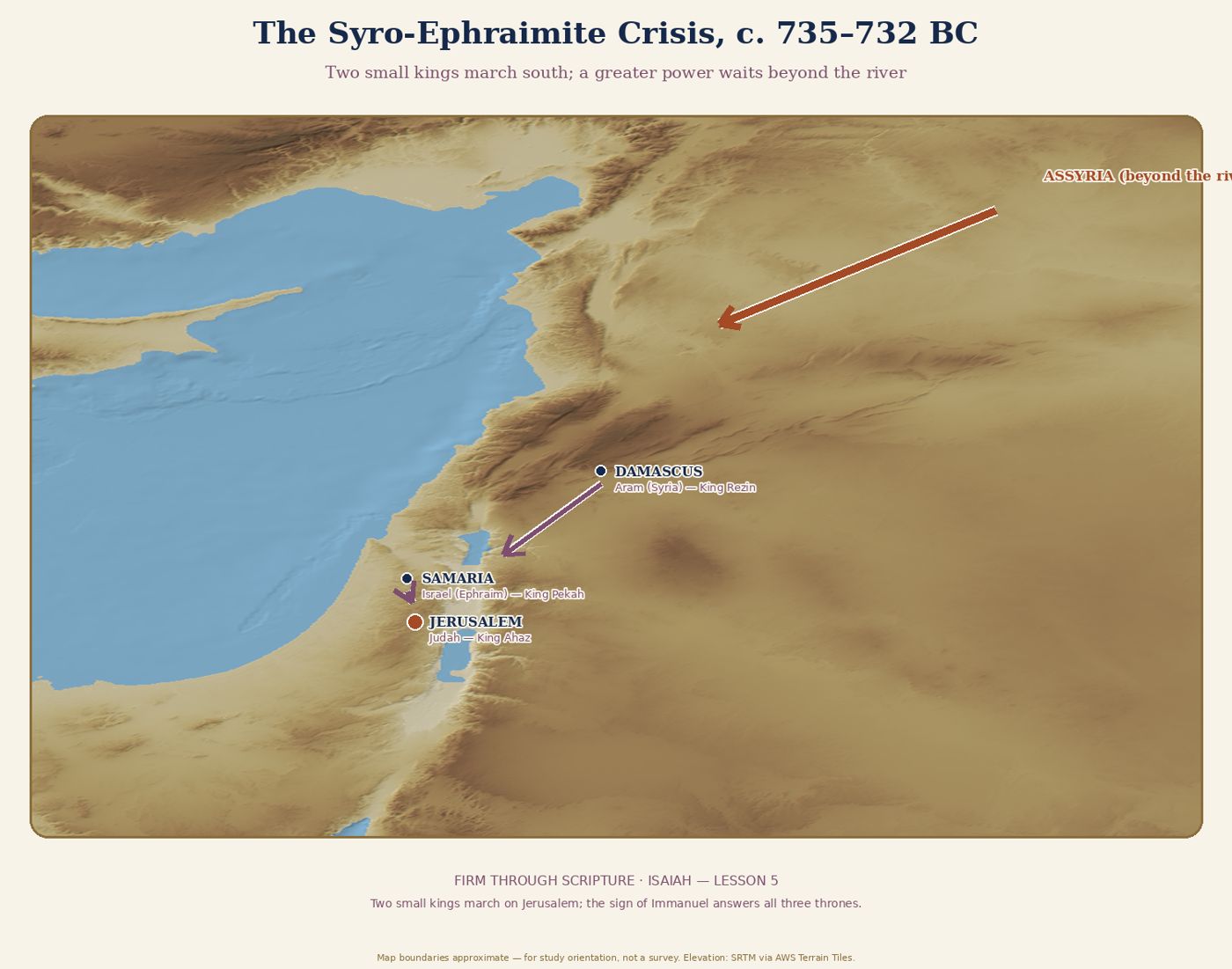
Four kings, two kingdoms, one family quarrel. Verse 1 names the cast, and a first-time reader needs every name unpacked. Ahaz is king of Judah, the southern kingdom, ruling from Jerusalem — son of Jotham, grandson of Uzziah, and, crucially, a descendant of David. Hence the text keeps calling his line "the house of David" (vv. 2, 13): a promise to that house hangs over this chapter. Against him come two kings. Rezin is king of Syria — Aram in Hebrew — centred on Damascus, north-east of Israel. Pekah, the son of Remaliah, is king of Israel, the northern kingdom, centred on Samaria. Israel is also called Ephraim, after its largest tribe — so "Syria is confederate with Ephraim" (v. 2) means Syria and Israel have joined forces. Brother marches on brother: the kingdoms had once been one under David and Solomon, until Ephraim "departed from Judah" (see v. 17). The historical books tell this invasion too, and agree the allies besieged Ahaz but could not overcome Jerusalem [1, 11].
Why they came: the coalition and the empire behind it. This war has a name in the history books — the Syro-Ephraimite crisis, roughly 735–732 BC. Syro- for Syria, Ephraimite for Israel. Behind both kings stood a much larger shadow: Assyria, the brutal, expanding empire far to the north-east, beyond the river Euphrates, under Tiglath-pileser III. Assyria was swallowing small kingdoms one by one, and Syria and Israel had formed an anti-Assyrian coalition — an alliance of small states hoping that together they could resist. Judah refused to join. So the allies marched south not merely to raid Judah but to force her in: break a breach in Jerusalem, depose Ahaz, and "set a king in the midst of it, even the son of Tabeal" (v. 6) — a puppet king, otherwise unknown to us, who would sign Judah's name to their alliance [2, 11]. That is the plan. It is political, it is plausible, and it is terrifying if you are inside the city. The commentaries across the spectrum — evangelical and critical alike — agree on this basic setting of the chapter, because Isaiah's own verses and the parallel account in Kings tell the same story [2, 4, 9, 11].
A heart shaking like trees. The news reached "the house of David" (v. 2), and the response is one of the Bible's most exact pictures of fear: his heart "was moved, and the heart of his people, as the trees of the wood are moved with the wind." Trees do not decide to shake. They are shaken — passively, all at once, by a force bigger than any one trunk. That was Jerusalem: king and people trembling together, not because the city had fallen — verse 1 is careful, the allies "could not prevail against it" — but because everybody could do the arithmetic of empires. Two armies today. Assyria behind them tomorrow. Every option cost something real.
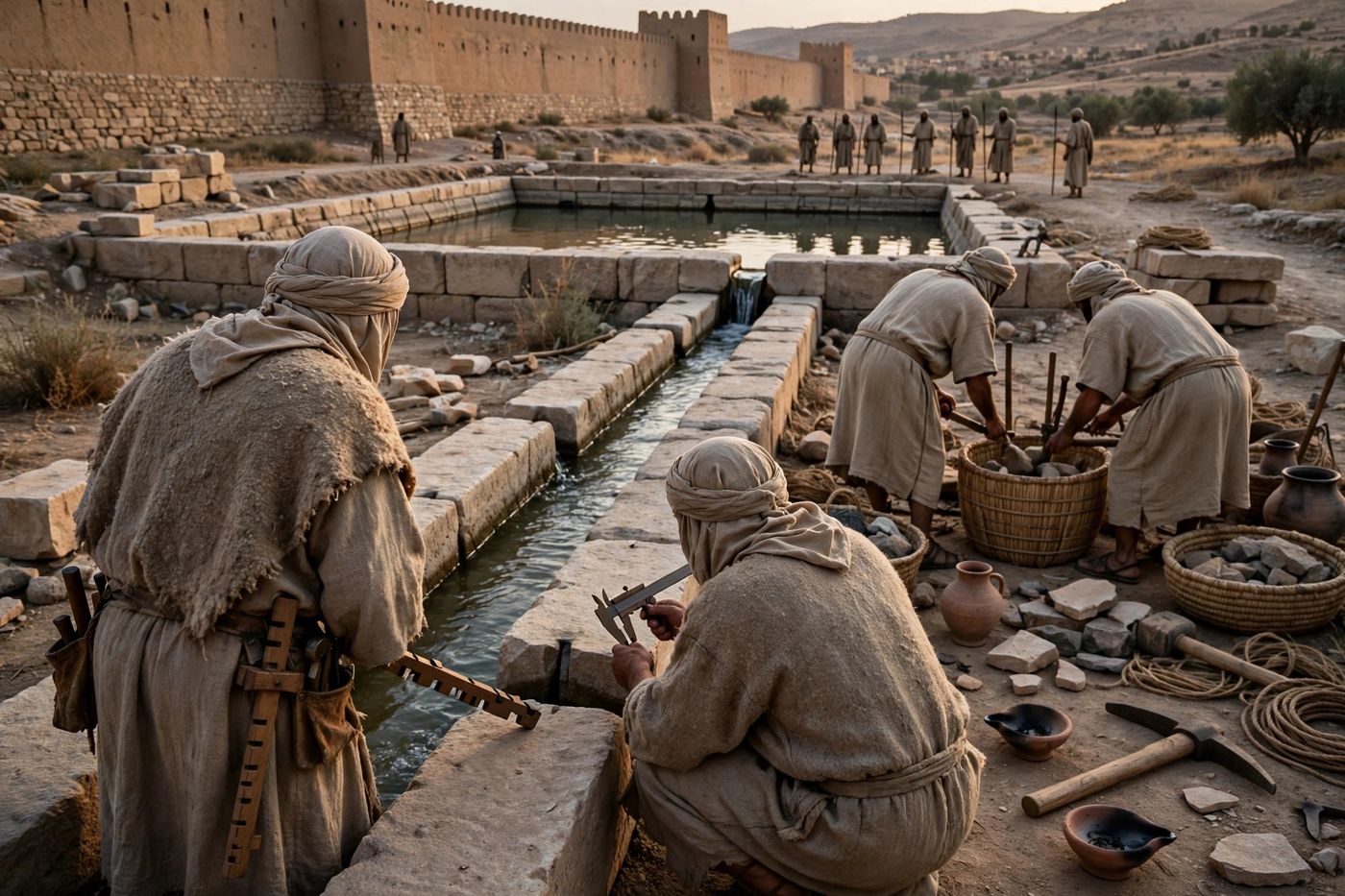
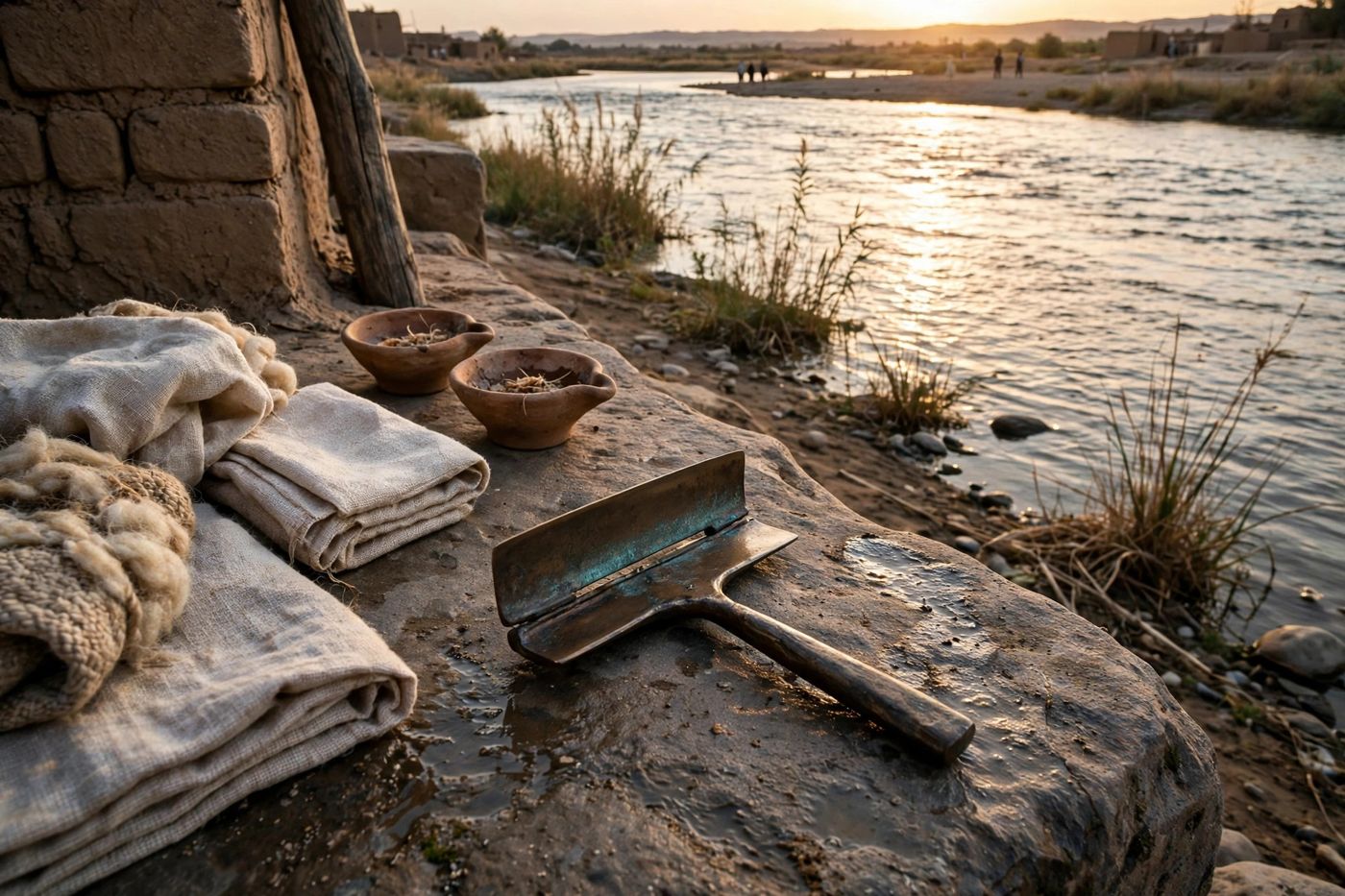
Where Isaiah finds him: the waterworks. God does not send Isaiah to the throne room. He sends him to "the end of the conduit of the upper pool in the highway of the fuller's field" (v. 3). A conduit is an open water channel; a pool is a reservoir; a fuller is a worker who cleans and bleaches cloth, whose field lay outside the wall where there was water and room for the work. In plain terms, Ahaz is out inspecting his city's water supply — exactly what a king does when he expects a siege, because a city without water falls without a battle [2, 11]. He is doing something sensible, even dutiful. And that matters for reading him fairly: Ahaz is not painted as a lazy fool. He is a frightened king doing frightened-king things — checking the water, weighing alliances, preparing to pay for protection. The word of the LORD meets him there, mid-inspection, with his engineers and men-at-arms around him, not in a quiet moment of devotion.
And Isaiah does not come alone. "Thou, and Shear-jashub thy son" (v. 3). The boy's name is the sermon before Isaiah opens his mouth. Shear-jashub means "a remnant shall return" — a remnant is the small part that remains after the rest is gone. The name preaches both edges at once: judgment is real, so only a remnant will be left — and return is real, so a remnant shall come back. In the next chapter Isaiah will say outright that he and his children "are for signs and for wonders in Israel" 1. A prophet, a small boy with a name like a headline, and a king at his waterworks. That is the world. Now we open the text itself.
3. OBSERVE — O: what the text actually does
Before meaning comes observation. Most bad interpretation is not deep error; it is shallow reading — people answering a text they never actually looked at. So look:
- The shape. Twenty-five verses in three movements. First, the crisis and the word of courage (vv. 1–9): the invasion, the meeting at the conduit, and "It shall not stand." Second, the sign refused and then given anyway (vv. 10–16): Ahaz's pious refusal, Isaiah's rebuke, and Immanuel. Third, the other side of the coin (vv. 17–25): what Assyria's coming will actually do to the land. Comfort, sign, judgment — in that order, and the order matters. Anyone who quotes the middle without the last movement has cut the chapter in half.
- The shrinking of kings. God never honours the two terrors with their titles in His speech. They are "the two tails of these smoking firebrands" (v. 4) — not blazing torches but burnt stubs, smoke without flame, nearly spent. Pekah is not even named; he is demoted to "the son of Remaliah" (vv. 4, 5, 9). And their capitals get a plain lesson: "the head of Syria is Damascus, and the head of Damascus is Rezin" (v. 8). Both heads are human, temporary, and already measured.
- The repeated clock. "Within threescore and five years shall Ephraim be broken" (v. 8) — and, much nearer, "before the child shall know to refuse the evil, and choose the good, the land that thou abhorrest shall be forsaken of both her kings" (v. 16). One long clock, one short clock. The short one is the sign's timetable, measured in a toddler's growth, not in reigns.
- "In that day." Count the phrase in the last movement: verses 18, 20, 21, and 23. Four hammer-blows of the same words. Isaiah is turning one day over in the light — flies and bees, a razor, a cow and two sheep, briers and thorns — until you have seen it from every side.
- The diet that bookends the back half. "Butter and honey" appears at verse 15, for Immanuel, and again at verse 22, for "every one that is left in the land." The KJV's "butter" is curds — the food of a land with too few people and too much grazing. Hold that repetition; it ties the sign-child to the survivors, and the food is deliberately both plenty and poverty at once.
- The silences. We are never told the name of the son of Tabeal, never told Ahaz's reply after verse 12, and never told in this chapter which woman the sign of verse 14 first pointed to. Observation does not fill silences with invention. It notices them — because later readers, including Matthew, will have more to say, and this course will let them say it in their place (§6), not backfill it here.
A note on reading kings in Isaiah: when God wants to shrink a threat, He does not deny it exists. He re-names it, re-measures it, and puts a date on it. "Smoking firebrands" are real firebrands — they smoked, they burned people — but they are tails, and they are going out. Watch for that move all through this chapter: the fear is answered, never mocked as imaginary.
4. GENRE — N: note the genre (prophetic narrative carrying an oracle, with a sign)
Isaiah 7 is not a poem, a psalm, or a law. Its backbone is prophetic narrative — a told story about a prophet's encounter with a king — carrying inside it a prophetic oracle, God's direct speech through the prophet ("Thus saith the Lord GOD," v. 7). Prophecy in Isaiah is forthtelling first: before it ever predicts anything, it speaks God's word forth into a present crisis, to named people, about decisions they are making this week [2, 4]. Readers who come hunting only for a prediction about a distant future will miss what the chapter was doing on the day it was spoken — which is why the near horizon in §7 is not optional decoration.
Narrative-with-oracle reads by its own rules:
- The story frames the speech. Where Isaiah meets Ahaz, who walks with him, and what Ahaz has just refused — these are not packaging around the oracle. They are part of its meaning. Verse 14 lands differently once you have heard verse 12.
- A sign has an address. An oracle spoken to a king in a crisis must signify something to that king, in that crisis. That rule — argued fully in §10 — is a genre rule, not a modern invention. Signs in Scripture confirm a word to the people who receive the word.
- Poetic pictures in prose clothing. The last movement (vv. 17–25) shifts register: hissing for flies and bees, a hired razor, vines priced in silver. These are prophetic images, not a logistics report. Read them for what they picture — swarming invasion, total humiliation, a land emptied back to pasture — and resist both flattening them into literal inventory and dissolving them into mere mood [4, 9].
5. TERMS — T: the words in the writer's mouth
Five terms carry this passage. Learn what they meant in Isaiah's mouth, and watch how much confusion dies at the dictionary:
A sign must be readable. That one sentence, kept in hand, will protect you from both of this chapter's great misreads — a sign nobody present could read, and a sign Matthew was wrong to read further.
- 'oth (oath, with a soft th), "sign" (vv. 11, 14) — a mark, token, or pledge that confirms a word. In Scripture a sign is not a magic trick and not a vague feeling; it is a given evidence, attached to a promise, by which the hearer can know the word is God's. Ahaz is offered one — "ask it either in the depth, or in the height above" (v. 11), anywhere in creation — and when he refuses, God gives one anyway (v. 14). The word matters because the whole chapter turns on it: what makes a sign a sign is that the receiver can read it.
- Shear-jashub, "a remnant shall return" (v. 3) — Isaiah's son's name as a compressed sermon. Shear = a remnant, what is left over; jashub (from shuv, to return/turn back) = shall return, or shall repent-turn. The name-sermon cuts both ways at once, which is Isaiah's whole message in two words: some will be left (judgment is real), and those left shall return (mercy is real) [2, 4].
- Immanuel, "God with us" (v. 14) — Hebrew 'immanu = with us, El = God. Not "God is far off," not "God against us," but God with us. Isaiah will ring this name like a bell through the next chapter too: the land is called "thy land, O Immanuel," and the invaders' counsel fails "for God is with us" 1. And note for §6: Isaiah names two other sermon-children in this same movement — Maher-shalal-hash-baz in chapter 8, whose name means "swift to the spoil, hasty to the prey," and the royal child of 9:6, whose names are titles. The names preach together: ruin is swift, a remnant returns, God is with us, and a greater Child is coming [2, 4].
- 'almah (al-MAH), the word behind "virgin" (v. 14) — the most argued word in Isaiah, and this study will do it slowly and honestly, below and in the Translation Note. Start with the dictionary facts, which are FACT: BDB and HALOT both define 'almah as a young woman of marriageable age — a girl who has reached puberty and is ripe for marriage [19, 20]. The word itself does not intrinsically specify virginity. Hebrew has a more specific word, betulah, which is the term ordinarily used when virginity itself is the point being stated. 'almah does not prove its bearer is not a virgin — in its Old Testament uses it never plainly describes a married or sexually experienced woman — but virginity is not what the word says; youth and marriageability are what the word says [19, 20].
- "Butter" — curds (vv. 15, 22) — the Hebrew word is chem'ah, curds or thickened milk. In a rich land, curds and wild honey are the simple food of the field; in an emptied land, they are what you eat when there are too few people to farm, so cattle graze untended and milk is abundant because mouths are few [2, 11]. Same bowl, two readings — plenty because of desolation. Isaiah means you to taste both.
Method note — the word-study guardrail: a word means what its author uses it to mean, in its sentence, in its century — not what its oldest root once meant, and not everything it can mean anywhere. That guardrail matters supremely at 'almah: neither "the word means virgin, full stop" nor "the word means definitely-not-a-virgin, full stop" survives contact with the lexicons. Both are slogans wearing dictionary clothes. The honest work is slower, and §7 and §16 will do it without flinching.
TRANSLATION NOTE — verse 14 is the translation note: "a virgin," or "a young woman"?
Your KJV reads, "Behold, a virgin shall conceive, and bear a son" (v. 14). Underneath "virgin" sits the Hebrew 'almah — "young woman of marriageable age" (see Terms above) [19, 20]. So why does your Bible say virgin? Because the KJV stands in a line that runs through Greek. Centuries before Jesus, Jewish translators rendering Isaiah into Greek — the Septuagint, the translation the early church inherited — chose for 'almah here the Greek word parthenos, which does ordinarily mean "virgin" 24. That is FACT about the translation history: the Greek translators made a choice, narrower than the Hebrew word required. Matthew, quoting this verse for Jesus' birth, quotes the Greek form (Matthew 1:23) [24, 1]. So three layers must be kept distinct, and this study will keep them distinct every time it touches the verse: (1) the Hebrew word — 'almah, young woman, virginity not specified by the word itself; (2) the Greek rendering — parthenos, virgin, chosen by the Septuagint translators; (3) Matthew's use — the apostle reads the Greek form of the verse of Jesus. A translation that prints "young woman" is translating the Hebrew word's range; a translation that prints "virgin" is following the Septuagint-Matthew line. Neither printer is lying to you. But a reader who does not know there are layers will be ambushed by the first sceptic — or the first preacher — who shows him one layer and hides the others.
6. ENTIRE CANON — E: where this passage sits in the whole story
No verse lives alone. Isaiah 7 is a knot where the promise to David, the remnant theme, and the New Testament's most famous birth announcement all cross:
- The parallel history. Kings tells this invasion too: Rezin and Pekah "came up to Jerusalem to war: and they besieged Ahaz, but could not overcome him" 1. Chronicles adds the cost of the wider war and Ahaz's turn to Assyria for help — the very move Isaiah 7 warns by implication — and judges it as unfaithfulness. Read together, the books do not compete; Kings gives the campaign, Isaiah gives the conversation at the waterworks that the campaign history leaves out [11, 1].
- The promise standing behind the king. Ahaz matters not because he is impressive — he is not — but because he is David's heir. God had promised David a house, a throne, and a son whose kingdom would stand, and Isaiah keeps addressing Ahaz by that address: "the house of David" (vv. 2, 13). When Ahaz will not receive the sign as an individual ("thee," v. 11), Isaiah widens the address to the whole house (v. 13) and the sign is given to "you" — plural — the house itself (v. 14) [2, 4]. The promise will survive the king who refuses to believe it. That is not a technicality; it is the chapter's comfort and its rebuke in one move.
-
The sermon-children preach as a set. Isaiah says later that he and the children God gave him are "for signs and for wonders in Israel" 1. Line them up: Shear-jashub (ch. 7) — a remnant shall return. Maher-shalal-hash-baz (ch. 8) — spoil speeds, prey hastens: Damascus and Samaria plundered quickly, Assyria flooding even into Judah. Immanuel (chs. 7–8) — God with us, named over the land itself. And beyond them, the child of 9:6, with the government on his shoulder and names no ordinary child can carry. The set moves from remnant, through judgment, to a King [2, 4].
Matthew is inside the canon, not outside it. His reading of verse 14 is not a later church opinion about Isaiah; it is Scripture reading Scripture — which is why §7 treats it as evidence, not decoration.
-
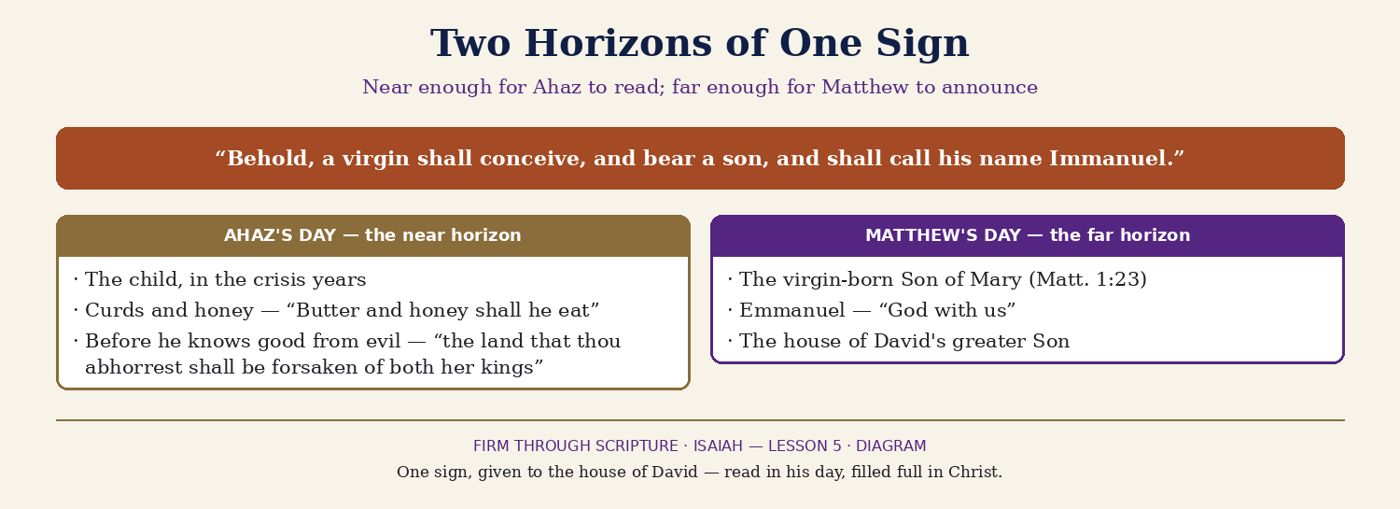
Matthew's reading — the canon's own far horizon. In the New Testament, Matthew introduces Jesus' conception — Mary found with child of the Holy Ghost, before she and Joseph came together — and writes that it happened "that it might be fulfilled which was spoken of the Lord by the prophet," then quotes Isaiah 7:14 in its Greek, parthenos form: a virgin shall be with child, and they shall call his name Emmanuel, "God with us" [1, 24]. That is FACT as a statement about what Matthew wrote and claimed. What kind of "fulfilment" Matthew means — direct prediction only, or the fuller, typological filling-up of a pattern that had a real first horizon in Ahaz's day — is where honest readers divide, and this study labels that question DISPUTED in §7 and argues it openly in §16. What no reader may do is pretend Matthew is not there. The far horizon is not a church tradition pasted onto Isaiah; it is inside the canon itself.
| The sign in Isaiah's day | The sign in Matthew's day |
|---|---|
| A child is born in the crisis years | A child is born to Mary, of the Holy Ghost |
| His name proclaims: God with us | His name is interpreted: "God with us" |
| Before he knows good from evil, two kings are gone | He is Jesus — the LORD saves His people from their sins |
| The house of David is preserved despite Ahaz | The Son of David is preserved despite Herod |
- The remnant thread runs on. Shear-jashub's name becomes a doctrine: Isaiah returns to it, and Paul, centuries later, quotes Isaiah on the remnant to argue that God has not cast away His people 1. The court of 734 BC could not see that far. But the boy at the conduit carries, in his name, a thread that runs to Romans. That is why Isaiah brought him.
7. THE MEANING — what the passage teaches
The Walk has established what the text says and where it sits. Now its payload, taught straight — the doctrines this passage actually carries, in the text's own proportions: courage first, then the sign, then the razor.
"Take heed, and be quiet" — God's first word to a panicking king
Notice what God does not say first. He does not say, "Ahaz, here is your battle plan." He says, "Take heed, and be quiet; fear not, neither be fainthearted" (v. 4). Four commands, and all four are about the king's inner state before any strategy is discussed: watch carefully, be still, do not fear, do not let your heart go soft with dread. Quietness, in Isaiah, is not passivity — later in this book God will say that "in quietness and in confidence shall be your strength," and rebuke the people for refusing exactly that. Quietness here is a theological act: refusing to let the loudest armies set the terms, long enough to hear what God has decided [2, 4].
And God's ground for the command is not Ahaz's courage. It is His own verdict on the enemy's counsel: "It shall not stand, neither shall it come to pass" (v. 7). The allies have "taken evil counsel" (v. 5) — they have a plan, with a breach, a deposition, and a replacement king already named. God answers a plan with a sentence. Their saying occupies verses 5–6; God's saying is one line long. That proportion preaches. Human counsel needs paragraphs, coalitions, and puppet kings. God's counsel needs seven English words.
Look at v. 7 again. Not "it might not stand." Not "it shall not stand if you are brave enough." The plan's failure is announced as settled before Ahaz has lifted a finger — because the plan was weighed in a council Ahaz was not invited to, and overruled there.
Believe, and be established — the chapter's hinge in one line
Verse 9 ends God's first speech with a wordplay that English can hear only if someone points at it — so point. "If ye will not believe, surely ye shall not be established." In Hebrew the two verbs are the same root, 'aman — the root that also gives us "amen." Believe and established are the same word turned around: if you will not stand firm in trust, you will not be made to stand firm at all [2, 19]. It is the whole chapter — the whole book, nearly — in a pun. Ahaz wants to be established: throne secure, city safe, dynasty intact. God tells him the only road to that establishment runs through believing a word he cannot verify in advance. There is no second road. The Assyrian road, which Ahaz is already pricing at the waterworks, promises establishment by payment. Isaiah 7 says it will deliver a razor instead (v. 20). Hold that contrast; the last movement cashes it in.
Same words, opposite acts. Refusing a sign God never offered is humility. Refusing a sign God commanded you to ask for is disobedience — no matter how reverent the sentence sounds.
The offered sign, and the humility that wasn't
God's second speech (vv. 10–11) is astonishing in its generosity. Ask a sign, He says — "either in the depth, or in the height above" (v. 11). Depth to height — Sheol to heaven, the whole vertical of creation — is put at Ahaz's disposal. This is not God reluctantly tolerating a request for proof. This is God inviting it, pressing it on a king who has shown no interest in asking [2, 34].
Then comes verse 12, the most dangerous sentence in the chapter, because it sounds so good: "I will not ask, neither will I tempt the LORD." Ahaz is quoting the law — Israel was indeed commanded not to tempt God, as she had tempted Him in the wilderness. His words are orthodox. His grammar is pious. And Isaiah's reply treats it as wearying God Himself (v. 13). Why? Because context turns the same words into opposite acts. Refusing to demand a sign God has not offered is humility. Refusing a sign God has commanded you to ask for is disobedience dressed in humility's clothes [4, 34]. Ahaz has already decided his policy — Assyria will be his help — and a sign from God can only interfere with a decision already made. Piety becomes the perfect cover: who can argue with a king who quotes Deuteronomy at a prophet? Isaiah can. The text counts Ahaz's refusal as unbelief, not humility — the reply turns away from "thee" to address the whole "house of David," as if the king has just disqualified himself from being the sign's sole addressee. That verdict will be argued as a Misread in §10, because "Ahaz was just being humble" is still preached today.
A sign given anyway — Immanuel, and the two horizons held together
"Therefore the Lord himself shall give you a sign" (v. 14). Himself — the Lord takes the initiative Ahaz refused. You — plural now, the house of David, not the king alone. And the sign: a young woman — 'almah; in the Greek the church inherited, a virgin, parthenos — shall conceive and bear a son, and shall call his name Immanuel, God with us.
Now the honesty this verse demands, labelled as this programme requires. FACT: the Hebrew word is 'almah, young woman of marriageable age; it does not intrinsically specify virginity, and it is not the more specific betulah [19, 20]. FACT: the Septuagint rendered it parthenos, "virgin," centuries before Matthew, and Matthew 1:23 quotes that Greek form for Jesus' birth [24, 1]. FACT: verses 15–16 set a child inside Ahaz's own crisis — before that child knows to refuse evil and choose good, the land will be forsaken of both her kings, Rezin and Pekah. POSITION — the church's historic reading, and this study's: the verse finds its fullest fulfilment in Jesus, born of the virgin Mary, truly Immanuel — Matthew's application is the canon's own reading. DISPUTED: how the horizons relate — the identity of the verses 15–16 child at the near horizon, and whether Matthew's "fulfilled" names direct prediction, typological fullness, or both. Scholars divide there, and §16 lays it out at full strength [9, 34, 4].
What the study will not do is break either horizon to make the other easier. A reading that makes verse 14 mean nothing readable to Ahaz breaks verses 15–16. A reading that makes it mean nothing beyond an unnamed baby in the 730s BC breaks Matthew. The text holds both: a real word for a real king in a real crisis, whose pattern and promise God fills to overflowing in the Son of David Matthew announces. Two horizons, one sign, neither denied. That is what the evidence looks like when all of it is left on the table.
The sign's clock is a toddler. Not a reign, not a generation — the few years before a small child can tell evil from good. God put His promise on a timetable Ahaz's own court could watch.
Curds, honey, and a toddler's clock (vv. 15–16)
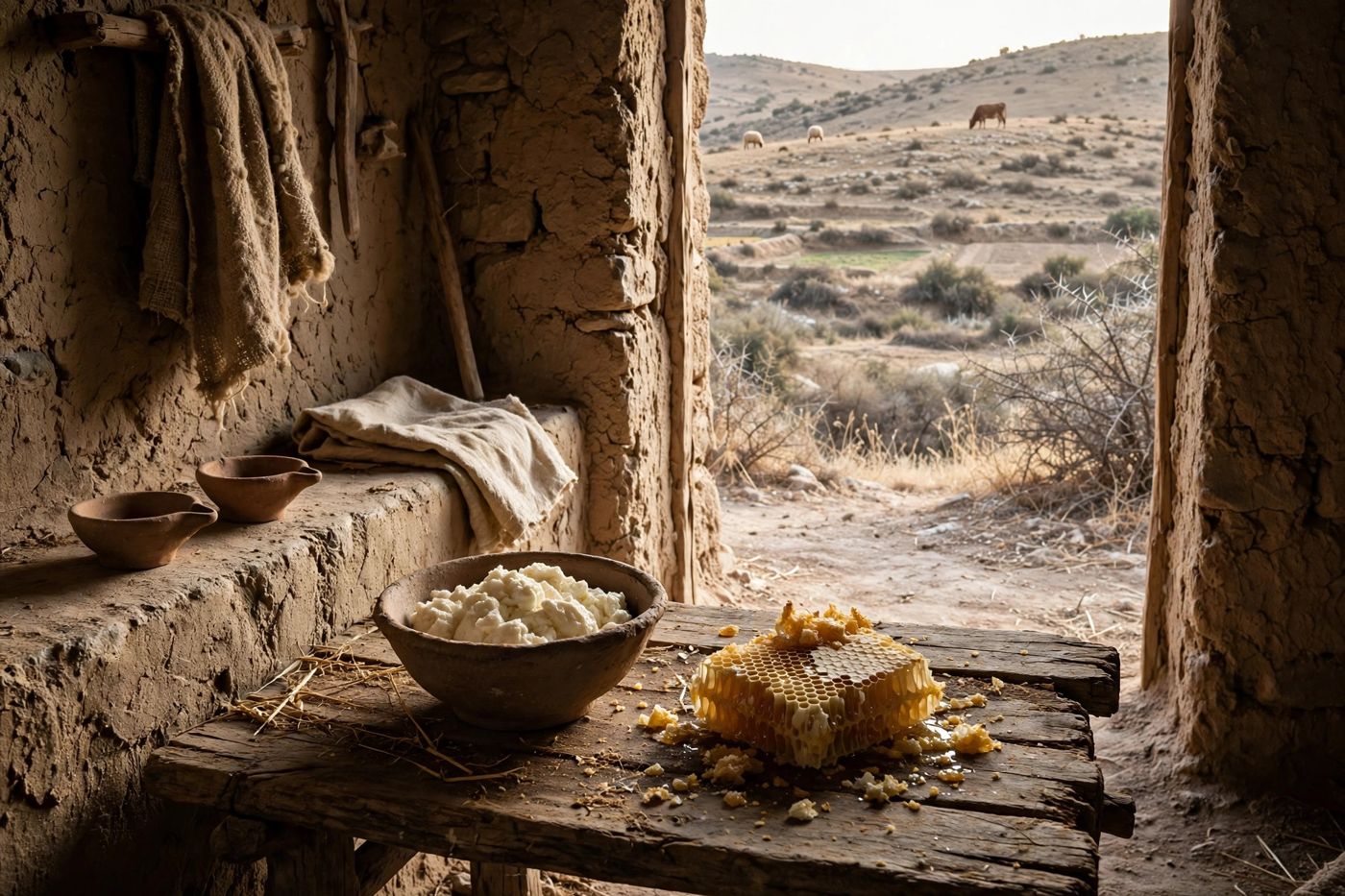
Verse 15 gives the child a diet — curds and honey — and verse 16 gives him a clock: before he reaches the age when a small child "knows to refuse the evil, and choose the good," both feared kings will be gone. History, read alongside Kings and the Assyrian records, fits the short clock: within a few years, Damascus fell and Rezin was killed, and Pekah was assassinated and replaced — both kings forsaken while a child born around the crisis was still small [11, 2]. That is the sign doing sign-work: checkable, within living memory, attached to the promise it confirmed.
The sixty-five years of verse 8 run longer — Ephraim "broken, that it be not a people" across two generations of deportation and resettlement. Isaiah gives Ahaz a near clock he could live to verify and a long clock his grandchildren would. God is not vague with His time.
The Christ Thread
Isaiah 7 earns its Christ Thread through the New Testament's own hand — no symbolism has to be forced. Matthew, announcing Jesus' conception by the Holy Ghost before Mary and Joseph came together, reaches for this verse and reads it of Jesus: the virgin with child, the son, Emmanuel, God with us [1, 24]. Matthew does not say Ahaz understood all of it — Ahaz would not even ask for the sign. He says the word, given to David's house when its king was faithless, "was spoken of the Lord by the prophet" and is now fulfilled in David's greater Son. His Gospel opens with "God with us" and closes with the risen Jesus saying, in effect, the same sentence — "I am with you alway." In Matthew's reading the child is not a metaphor for God's general nearness. He is God, with us, in person [4, 1]. Taught that way — as Matthew's claim, labelled where scholars dispute its mechanics — the thread needs no exaggeration.
Where in the Covenant Story?
This passage stands inside the Davidic covenant — God's promise to David of an enduring house and throne — at the moment it looks most breakable. The king on David's throne is faithless, two armies are camped against David's city, and the allies' plan is to end David's line in Jerusalem and install the son of Tabeal (v. 6). God's answer is aimed exactly there. The sign is not a private comfort to Ahaz; when he refuses it, it is re-addressed to the house of David as a whole (vv. 13–14), because what is at stake is the covenant, not the king's feelings [2, 4]. Ahead of this chapter the Davidic promise will narrow, again and again in Isaiah, toward a single coming King — the child of 9:6, the Branch of chapter 11. Isaiah 7 is where you learn that the covenant survives kings: God preserves His promise not because Ahaz believes, but because God has spoken. Ahaz will be judged. The house will be preserved. Both are covenant sentences.
Turn the coin over. Everything from verse 17 onward is the same God's other word to the same king — and a study that stops at verse 16 has only read half the chapter it sings at Christmas.
The other side of the coin — the hired razor (vv. 17–25)
Everything after verse 16 turns the coin over, and a study that stops at verse 16 has betrayed the chapter. Verse 17 announces days unlike any "from the day that Ephraim departed from Judah" — from the kingdom's division onward — and names the instrument in four devastating words at the end: "even the king of Assyria." Understand the irony, because the irony is the doctrine. Assyria is the power Ahaz will actually trust. The history books record that Ahaz sent Assyria silver and gold, called himself its servant, and bought its help against Rezin and Pekah [1, 11]. Isaiah announces that the help will come — and keep coming. God will "hiss" — whistle, the way a keeper summons insects — "for the fly that is in the uttermost part of the rivers of Egypt, and for the bee that is in the land of Assyria" (v. 18): swarms from both great powers, settling in every valley, rock-hole, thorn, and bush (v. 19), nowhere in the land left unoccupied. Egypt the fly, Assyria the bee — and the bee stings [2, 11].
Then the razor. "In the same day shall the Lord shave with a razor that is hired, namely, by them beyond the river, by the king of Assyria, the head, and the hair of the feet: and it shall also consume the beard" (v. 20). A hired razor — Assyria is an instrument rented for a job, held in God's hand, not its own master. And shaving, in that world, was humiliation: to shave a man's head and beard was to strip his honour publicly, as captives and shamed envoys were shaved. God says the hired instrument will shave Judah from head to feet, beard and all — total, intimate disgrace, delivered by the very empire Judah paid to protect her honour [2, 11]. The application writes itself, and §13 will write it carefully: the help you trust instead of God does not stay your servant. It becomes your razor.
The closing pictures slow down to aftermath, quietly the saddest verses in the chapter. A man keeps "a young cow, and two sheep" alive (v. 21) — not a herd: a subsistence remnant, whose milk, because mouths are so few, becomes curds for "every one that is left in the land" (v. 22). The Immanuel diet, now as the survivors' diet. Vineyards of a thousand vines, worth a thousand silverlings — pieces of silver — become "briers and thorns" (v. 23). Men enter their own former vineyards only with bows, as hunting ground (v. 24). Hills once dug with the mattock — a hoe-like digging tool — are given to loose cattle (v. 25). Farming retreats; the land empties back toward wilderness. Not one dramatic battle, but a whole cultivated country going quietly to thorn — because its king chose a razor for a helper.
Read the argument honestly, and notice where it sits. The centuries divide over a word and a mechanism. They do not divide over whether God gave David's house a sign, or whether Jesus is Immanuel.
The Long View — what the church has believed
No verse in Isaiah has a longer reading history than 7:14. The early church read it, through the Septuagint's parthenos and Matthew's quotation, of the virgin birth of Christ — the settled confession behind the creeds' "born of the Virgin Mary" [24, 34]. Nineteenth-century commentators like Keil and Delitzsch continued to defend the messianic reading while arguing about how its first horizon in Ahaz's day should be described 34. Modern critical scholarship, represented fairly by Blenkinsopp, typically centres the verse on its eighth-century setting — an 'almah, a child of Ahaz's own time, a near timetable — and treats Matthew's use as a later rereading 9. Evangelical scholarship, represented by Oswalt and Motyer, holds the near horizon and Matthew together, in varying accounts of typology and double reference [2, 4]. Where has the church agreed? That the verse is a real sign, to a real house, from a God who gives signs unasked; and — wherever Matthew is received as Scripture — that Jesus is its Immanuel. Where has it divided? Over the lexical weight of 'almah and the mechanics of fulfilment. The division sits at the word-study and the mechanism. The centre — God with us, promised to David's house, arrived in Christ — has held.
That is the payload. The next section compresses it into the one sentence you are meant to carry out of this study.
8. THE AIM SENTENCE — X: eXplain the intent
Everything observed now compresses into one sentence — the author's intended meaning, stated before any application is allowed near it:
When two kings shook David's house with fear, God met Ahaz with a settled verdict — "it shall not stand" — offered him a sign, and when unbelief refused it behind pious words, gave the sign anyway to the whole house: Immanuel, God with us, with a toddler's timetable against the two kings — and warned that the Assyria Ahaz trusted instead would come as God's hired razor and shave the land bare.
If a sermon, a post, or a devotional uses Isaiah 7 to say something that cannot be traced back to that sentence, it is not this passage talking. That is the whole skill this course exists to build — and the next sections are where you watch it work.
9. SAY IT BACK
Close the book and say the AIM sentence from section 8 in your own words — out loud, or in your notes, without looking. Then say, in one more sentence, what it asks of you this week.
If your version changes the meaning — if Immanuel becomes only a Christmas word, or the razor falls out of the chapter, or Ahaz becomes a model of humility — walk it again. This exercise is the entire course in miniature: meaning first, then — and only then — your life.
10. THE MISREAD — the guardrail, with verdicts
Three live misuses of this passage. Each gets a fair hearing, the evidence, and a verdict.
Misread 1: "Isaiah 7:14 is only about Jesus. It has nothing to say to Ahaz — the 'sign' was a prediction no one was meant to understand for seven hundred years." Why it sounds right: Matthew really does quote the verse for Jesus' birth, and the church really does sing it at Christmas. If Matthew is the destination, it is tempting to treat Ahaz's day as mere wrapping paper. The evidence: the text will not allow it. The sign is addressed to a house in a named crisis (vv. 2, 13), and verses 15–16 bolt it to that crisis with a clock: before the child knows good from evil, "both her kings" — Rezin and Pekah — will be forsaken of their land. A sign, by the word's own definition ('oth, §5), is evidence given to a receiver so he can know the word is God's. A sign its receiver could not possibly read for seven centuries is not a sign to him at all. The commentators who defend Matthew most warmly included read verses 15–16 as the sign's near work in Ahaz's own years [2, 4]. Verdict: the far horizon does not erase the near one. Verse 14 was a readable sign for Ahaz's house in his crisis first — and then, in the canon's own reading, far more. Cut the near horizon and you have not honoured Matthew; you have broken the sign.
Hold both horizons. The first misread kept Matthew and lost Ahaz. The second keeps Ahaz and loses Matthew. The text — Hebrew, Greek, near clock, far fulfilment — refuses to lose either.
Misread 2: "Isaiah 7:14 is only about an unnamed baby in 734 BC. Matthew misused the verse — 'almah doesn't mean virgin, so the virgin birth proof-text collapses." Why it sounds right: the lexical fact underneath it is real. 'almah means a young woman of marriageable age; it does not intrinsically specify virginity, and it is not betulah [19, 20]. If the church's reading depended on pretending otherwise, it would deserve the collapse. The evidence: it does not depend on pretending otherwise. The Septuagint's translators chose parthenos, "virgin," for this verse centuries before any Christian existed to benefit from the choice 24. Matthew quotes that Greek form and applies it to a conception he independently describes as "of the Holy Ghost," before Mary and Joseph came together 1. His claim rests not on the Hebrew word secretly meaning "virgin" but on his apostolic reading that Isaiah's sign is filled full — fulfilled — in Jesus. Typological reading of that kind is Matthew's method across his whole Gospel, explained here, not apologised for. One may dispute his reading — scholars do, and §16 does not hide it — but "Matthew misused his Bible" is a verdict about the canon itself, not a discovery about a Hebrew dictionary.
Verdict: the dictionary fact is true and breaks nothing. 'almah is the near horizon's word; parthenos and Matthew are the canon's far horizon. The collapse happens only if you demand the verse do all its work in one word, in one horizon — a demand Isaiah never made of it.
Misread 3: "Ahaz was humble. 'I will not tempt the LORD' is a model answer — we should never ask God for signs or confirmation." Why it sounds right: the words quote the law's own warning against tempting God, and they sound reverent. In a church culture rightly wary of sign-seeking as entertainment, Ahaz can look like the adult in the room. The evidence: the text itself delivers the verdict, immediately. Isaiah does not commend the answer; he explodes at it — "will ye weary my God also?" (v. 13) — and re-addresses the sign away from Ahaz to the whole house. And the genre rule from §4 exposes the move: Ahaz was not demanding a sign uninvited, the classic temptation of God. He was refusing a sign God had explicitly commanded him to ask for, anywhere in depth or height (v. 11). Obedience to an invitation is not presumption. Ahaz's piety is unbelief with a Bible verse on it — he has a policy already (Assyria), and a confirmed word from God could only complicate it [4, 34]. Verdict: Ahaz is a warning, not a model. When refusal to hear God dresses itself in Scripture's own language, the dressing does not change the act. Test "humble" words by whether they obey the God who actually spoke — not by how reverent they sound.
11. FROM WORD TO WALK
A reflection page — the lesson is not finished until the passage has had its say with you.
Stand at the conduit a moment, where Isaiah stood. You know this place. Not the stone channel — the feeling. The news has arrived in pairs, the way verse 2 delivers it — not one threat but a confederacy of them — and your heart is shaking like trees in a wind it did not choose. And you are already at the waterworks: inspecting, calculating, pricing the help you could hire. Ahaz's sin was not that he prepared. Kings should inspect water supplies. His sin was that his preparation had quietly become his trust, and when God offered to be believed instead, he reached for a Bible verse to excuse himself from believing.
Be honest about how respectable that move is, because you have made it. Underneath Ahaz's pious sentence sat a settled refusal: I have already decided whom I will trust, and I do not want a word from God complicating the contract. The piety was real piety-language. It was also a locked door. God, in His mercy, gave the sign anyway — over the king's refusal, to the king's house, for the sake of people not yet born. The Immanuel you sing about arrived through exactly this pattern: a sign nobody in power asked for, given anyway, because God keeps His promises over the heads of the people who refuse them.
And then let the last movement search you. The razor was hired — Judah paid for it, in effect, when Ahaz bought Assyria's help [1, 11]. What have you hired? Not every helper is a razor; God sends help through ordinary means, and receiving it gratefully is faith. The razor is the helper you trust instead of God — the arrangement you protect from prayer, the compromise you will not let a prophet near. Isaiah 7 does not ask you to have no policies. It asks which one you would refuse a sign to protect.
Hear, finally, what the chapter leaves in your hands. A name over a land of briers: Immanuel. God with us — not once the land is cleared and the heart stops shaking, but at the conduit, in the crisis, in the aftermath of our own bad trusting, alongside the remnant left in the land. The remnant shall return. Shear-jashub was standing there the whole time, saying so without saying a word.
Lord God — You met a frightened king at his waterworks and told him the truth in both directions: it shall not stand, and the razor is coming. Quiet my shaking heart with Your verdict, not with my arrangements. Show me where my humility is a locked door, and where my hired help has become my trust. You gave Your sign unasked, to a house that refused it — God with us. Be with me now, in the crisis and in the briers, until I believe You and so stand established. In Immanuel's name, amen.
12. FOR DISCUSSION — OR FOR YOUR JOURNAL
With a group, work these aloud. Alone, they're yours — answer them in your journal or in prayer; they lose nothing in the quiet.
- Ahaz was found inspecting his water supply — doing something sensible — when God's word met him. Where does God tend to meet you: in your devotion, or in the middle of your anxious preparations? What was He saying there?
- "If ye will not believe, surely ye shall not be established" (v. 9). Where in your life are you asking God to establish something — a family, a work, a future — while quietly refusing the believing He asks for first?
- Ahaz refused God's offered sign with a pious sentence. Name, honestly, a "humble" or "spiritual" sentence you have used to avoid hearing God about a decision already made. What would obeying the invitation have cost?
- Verses 15–16 gave Ahaz a near sign; Matthew gives the far one. How does holding both horizons — a word for Ahaz's day, fulfilled in Christ — change the way you read other famous prophecy passages?
13. THE WALK-OUT — T: Transfer to today
Meaning is settled. Now — and only now — application, and it must cross the bridge honestly. Run the five Transfer Tests on this passage:
- Same covenant? Ahaz stood under the Davidic covenant as its reigning king, in the land, before the cross. We receive this chapter as Scripture written for us, but not as a private promise that our nation, church, or family inherits David's throne. What crosses is the God of the covenant and the pattern of trusting Him — not Ahaz's office or Judah's political promises.
- Same audience? The oracle addressed a king and a royal house at war. Its first commands — be quiet, fear not, ask a sign — were spoken to Ahaz. We may not claim a fresh "it shall not stand" over our own enemies as if God had spoken it to us this morning. We may learn what kind of God speaks such verdicts, and trust Him in our crises on that basis.
- Same genre rules? Prophetic narrative-with-oracle: it shows a king's unbelief and God's sign before it commands us anything. So the chapter yields postures and warnings — believe, refuse false humility, beware hired razors — not copied orders. Nobody is commanded to seek a sign on demand, or to stop maintaining their water supply.
- Repeated or rooted? "Believe and be established" echoes across the canon — trust as the root of standing is rooted in God's character and repeated to His people in every covenant. Immanuel reaches its root and fullness in Christ, confessed by Matthew 1. Fear answered by God's verdict, and judgment on trust placed in human empires, recur through Isaiah and beyond. These cross.
- Ten verses either side? Every application below is drawn from these twenty-five verses read whole — comfort and razor, sign and timetable. Nothing hangs on verse 14 torn out of its chapter.
| Test | What it guards here |
|---|---|
| Same covenant? | David's throne-promises are not transferred to us as political claims |
| Same audience? | Ahaz's commands are learned from, not re-addressed to us unexamined |
| Same genre rules? | An oracle-narrative teaches postures before it issues orders |
| Repeated or rooted? | Trust, Immanuel, and God's rule over empires are rooted and repeated |
| Ten verses either side? | Verse 14 is applied only with verses 15–25 still attached |
What crosses — and lands:
- God has spoken first. Before any practice: the indicative. God met unbelief with a sign given anyway; in Christ He has come to be with us — Matthew's Immanuel is God's settled presence, not a seasonal sentiment 1. And He still rules the empires men fear and hire: the razor was hired, held in His hand. Application lives from these facts; it does not create them.
- Quietness is a work of trust. "Take heed, and be quiet" crosses as a posture: refusing to let confederated bad news conduct your inner life. Not denial — the armies were real — but stillness grounded in what God has said, practised before strategy, not instead of it.
- Believing is the road to standing. Verse 9's pun is a standing law: establishment is the fruit of trust, never its substitute. Demand security first and promise trust later, and you have reversed God's order.
- False humility is still unbelief. A refusal to hear God does not become holy because it quotes Scripture. Any sentence that protects a decision already made from God's word is Ahaz's sentence in modern dress.
Practices — what the gate lets through, made concrete this week:
- Name your confederacy. Write down the two threats that have joined forces in your mind — the pair of fears that shake you together, as Syria and Ephraim shook Ahaz. Pray over them honestly: not claiming God's verdict as your own oracle, but confessing that their counsel stands or falls with God, not with their combined size.
- Practise the quiet. Fifteen unhurried minutes, once this week, before you touch the problem: no phone, no planning, just verse 4 read slowly and the question, Lord, what have You actually said — and what am I adding from fear? Then plan — but second, not first.
- Audit one hired razor. Choose one arrangement you trust instead of God — the one you would least want a prophet to ask about. Name it in your journal in one sentence. This week, take one concrete step of un-hiring it: a confession, a conversation, a payment stopped, a door closed.
- Memorize Isaiah 7:9's hinge, in the KJV's own short form: "If ye will not believe, surely ye shall not be established." Say it when you catch yourself demanding establishment as the price of believing.
- One Immanuel conversation. Who near you is living at the conduit — frightened, calculating, quietly buying help? One person, this week: tell them the name as this chapter tells it — God with us, given unasked, in the middle of the crisis.
What does not cross: claiming verse 14 as a private prophecy about your circumstances; demanding a sign as Ahaz was invited to receive one (his invitation was his, given once, in that crisis); reading "it shall not stand" as God's blanket promise that your opponents or debts must collapse on a toddler's timetable; and treating every helper or ally as a "razor" — the test is trust instead of God, not help through ordinary means. The gate makes sure the claims that land are the ones God actually made.
The gate held. What crossed was not a political promise or a demanded sign, but a God to trust, a posture of quiet believing, and a warning about hired help — the claims this chapter actually makes on us.
Praise Him
Praise the Lord who speaks into panic and is not panicked; who calls smoking firebrands by their true size and blazing counsel by its true end — it shall not stand, neither shall it come to pass. Praise Him who gives signs to houses that refuse them, who put His promise into a name a child could carry — Immanuel, God with us — and kept that promise through briers and thorns until God was with us in flesh, and is with us still. Praise Him whose hand holds every hired razor, so that no empire we fear and no help we hire is ever the final word over His remnant. The remnant shall return. God is with us. Amen.
14. THE RECAP CARD — this study on one page
Print it. Keep it where you'll see it this week.
- The passage: Isaiah 7:1–25 — the Syro-Ephraimite crisis: a shaken king, a sign refused and given, and a hired razor.
- Say It Plain: Two kings march to force Judah into their alliance; God tells Ahaz their plan will not stand; Ahaz refuses God's offered sign behind pious words; God gives Immanuel to the whole house of David anyway — and warns that trusted Assyria will shave the land bare.
- The AIM: When two kings shook David's house with fear, God met Ahaz with a settled verdict — "it shall not stand" — offered him a sign, and when unbelief refused it behind pious words, gave the sign anyway to the whole house: Immanuel, God with us, with a toddler's timetable against the two kings — and warned that the Assyria Ahaz trusted instead would come as God's hired razor and shave the land bare.
- Key terms: 'oth — a sign, given evidence confirming a word · 'almah — a young woman of marriageable age; the Septuagint's parthenos, "virgin" · Shear-jashub — "a remnant shall return" · Immanuel — "God with us."
- The Misread, in one line: 7:14 is not only about Jesus (it was a readable sign for Ahaz) · not only about 734 BC (Matthew's reading is the canon's own) · Ahaz's refusal was unbelief, not humility.
- Memory verse: "Therefore the Lord himself shall give you a sign; Behold, a virgin shall conceive, and bear a son, and shall call his name Immanuel." — Isaiah 7:14
- This week's practice: name your confederacy, practise the quiet before the planning — and audit one hired razor, taking one concrete step of un-hiring it this week.
15. CHECK YOURSELF — five questions
Answer from the study, not from instinct. (Answers live in the Teacher Edition.)
- In your own words: what is the AIM of Isaiah 7:1–25?
- Why does verse 9 say believing and being established stand or fall together — and what Hebrew wordplay carries the point?
- State the 'almah facts exactly: what the Hebrew word means, what it does not by itself specify, what the Septuagint chose, and what Matthew did with it.
- Why is Ahaz's "I will not ask, neither will I tempt the LORD" counted as unbelief rather than humility? Give the text's own evidence.
- What is the "razor that is hired" (v. 20), and how do verses 15–16 stop anyone from reading verse 14 as a sign Ahaz could never have understood?
16. GO DEEPER
Optional — for readers who want the machinery. The lesson is complete without it.
From the Sources — Two kings forsaken, on the record
The sign's near timetable (v. 16) is not a claim floating free of history. The biblical history, read beside the Assyrian records as the commentaries survey them, places both enemies off their thrones within a few years: Damascus fell to Tiglath-pileser's Assyria, Rezin was put to death, and Pekah was assassinated by Hoshea [11, 2]. FACT — as a statement about what those records report. The identification of the verse 15–16 child with one particular named infant remains DISPUTED — candidates from Isaiah's own circle to the royal house have all been argued, and chapter 7 names none of them. The sign's timetable is anchored in the crisis; the child's near-horizon identity is a question the chapter leaves open, and this course leaves it open with it.
Labels are load-bearing here. FACT for the dictionary. DISPUTED for the mechanics. POSITION for the church's messianic reading. Never trade one label for another to make the argument end sooner.
The Honest Argument — 'almah, argued at full strength
Here is the dispute with the lights on. The lexical case (FACT): 'almah denotes a young woman of marriageable age. It does not intrinsically specify virginity; betulah is Hebrew's more specific term [19, 20]. Any argument that begins "the Hebrew word means virgin" is false. The critical conclusion (DISPUTED): critical scholarship commonly concludes the verse in its first horizon concerns wholly a child of Ahaz's time, and that Matthew's application is a creative rereading made possible by the Septuagint's parthenos 9. That conclusion is an INFERENCE from the lexical fact, not the fact itself — it assumes a sign cannot bear a fuller horizon than its first hearers grasped, a premise about prophecy, not a dictionary entry. The church's reading (POSITION — this programme's, and the historic church's): parthenos was chosen by Jewish translators before Christianity existed 24; Matthew reads the verse of a conception he describes as of the Holy Ghost, and calls it fulfilment 1; Keil and Delitzsch defended the messianic reading while conceding the lexical range of 'almah and arguing on canonical, not dictionary, grounds 34. On that reading the sign does double duty: real in Ahaz's day, filled full in Christ. Hold labelled things in labelled hands — FACT for the dictionary, DISPUTED for the mechanics, POSITION for the messianic reading — and never purchase the far horizon by fudging the near one's Hebrew.
The Word Underneath — 'aman, the believe/established root
Verse 9's hinge (see §7) is worth sitting under once more. Both verbs — "believe" and "be established" — grow from the Hebrew root 'aman, firm, reliable, true: the root of "amen," the word God's people say when they declare a word trustworthy 19. BDB's range for the root runs from physical firmness to entrusted faithfulness — to stand firm because something firm is under you 19. Isaiah builds the chapter's whole theology into that single root: trust the firm One, and you are made firm; refuse, and no hired empire can firm you up. FACT as a matter of Hebrew. The sermon — that Ahaz was offered firmness at the exact place he was shopping for it in Assyria — is INFERENCE, but it is the kind the wordplay was plainly built to carry.
Go Read
- Oswalt, The Book of Isaiah, Chapters 1–39 (NICOT) 2 — the fullest evangelical treatment of chapter 7's history, the sign, and the Immanuel passages as one movement.
- Blenkinsopp, Isaiah 1–39 (Anchor Bible) 9 — the critical reading at full strength: the eighth-century setting centred, Matthew's use treated as rereading — the other side argued fairly, by its own scholar.
- Keil & Delitzsch, Commentary on the Prophecies of Isaiah 34 — the nineteenth-century defence of the messianic reading, argued from the Hebrew with the 'almah evidence on the table.
17. SOURCES & REFERENCES
Numbered citations in this lesson key to this list — the course standard: every sourced claim carries its number, and every number can be checked.
- The KJV text itself — Holy Bible, King James Version (eBible.org KJV, 1769 text). Scripture quotations are from the King James Version (KJV), which is in the public domain in the United States; the full passage is always assigned as reading. Cross-references within Scripture cite this number.
- Oswalt, The Book of Isaiah, Chapters 1–39 (NICOT) — John N. Oswalt (Eerdmans). The leading evangelical commentary on the first half; defends essential unity of authorship and reads the book as a finished theological whole. Detailed notes on the Assyrian-period history (Ahaz, Hezekiah, Sennacherib).
- Motyer, The Prophecy of Isaiah — J. Alec Motyer (IVP). A one-volume commentary by an evangelical scholar who argues the whole book breathes the mind of the eighth-century prophet; especially strong on the book's structure, its repeated refrains, and the Servant.
- Blenkinsopp, Isaiah 1–39, Isaiah 40–55, Isaiah 56–66 (Anchor Bible) — Joseph Blenkinsopp (Doubleday). Mainstream-critical commentary across all three traditional divisions; a fair statement of the multiple-authorship case and of post-exilic settings.
- Smith, Isaiah 1–39 and Isaiah 40–66 (New American Commentary) — Gary V. Smith (B&H). Evangelical commentary with strong historical notes (the Assyrian and Babylonian records) and an even-handed survey of the authorship debate.
- Brown, Driver & Briggs, Hebrew and English Lexicon of the Old Testament (BDB) — The standard older Hebrew lexicon; word senses and usage ranges for the Terms sections.
- Koehler & Baumgartner, The Hebrew and Aramaic Lexicon of the Old Testament (HALOT) — The standard modern Hebrew lexicon; the control on BDB for contested senses (e.g., 'almah).
- The Septuagint (LXX) — Rahlfs–Hanhart edition. The ancient Greek Isaiah (2nd century BC): itself already one book of 66 chapters, and the Bible of the early church; its renderings (e.g., parthenos at 7:14) argued in the open where they matter.
- Keil & Delitzsch, Commentary on the Prophecies of Isaiah — C. F. Keil and Franz Delitzsch (19th century; public domain). Delitzsch famously revised his view of Isaiah's composition across editions — the honest-argument file in one author.