
One study, one walk — the universal FIRM format. The passage first and whole; then its world; then the Walk (Context · Observe · Genre · Terms · Entire Canon); the meaning taught straight; the AIM sentence; the misread exposed and answered; and the walk-out, where application has to pass the Transfer Tests before it reaches your week. The same skeleton serves a book, a chapter, a single verse, or a whole subject. In the early studies the moves are labeled as they happen. The labels fade as the walk becomes yours.
THE WEEK WITH THIS STUDY — six bites
Day 1 — Read the passage · Say It Plain · The World (§§1–2) · Day 2 — Observe · Genre (§§3–4) · Day 3 — Terms · Entire Canon (§§5–6) · Day 4 — The Meaning · the AIM Sentence · Say It Back (§§7–9) · Day 5 — The Misread · From Word to Walk (§§10–11 — add For Discussion, §12, if you're with others) · Day 6 — The Walk-Out · the Recap Card (§§13–14). Go Deeper (§16) any evening you want the basement.
BEFORE YOU READ — Open My Eyes
LORD of hosts, Your hand is stretched out still, and my first instinct is to look away. Teach me to read disaster honestly — not as a renovation project, not as despair — and to hear, in the same sermon, the word about the remnant and the broken yoke. Open my eyes to what is actually here.
§ means “section” — the numbered parts of your lesson. Each bite above names the sections for that day.
1. READ THE PASSAGE — Isaiah 9:8–10:34 (KJV)
Read it all, slowly, before any teaching. In this course the passage always prints once, in full, at the head of the lesson. Everything after this is commentary — this is the text.
Isaiah chapter 9, verses 8 to 21:
8 The Lord sent a word into Jacob, and it hath lighted upon Israel.
9 And all the people shall know, even Ephraim and the inhabitant of Samaria, that say in the pride and stoutness of heart,
10 The bricks are fallen down, but we will build with hewn stones: the sycomores are cut down, but we will change them into cedars.
11 Therefore the LORD shall set up the adversaries of Rezin against him, and join his enemies together;
12 The Syrians before, and the Philistines behind; and they shall devour Israel with open mouth. For all this his anger is not turned away, but his hand is stretched out still.
13 For the people turneth not unto him that smiteth them, neither do they seek the LORD of hosts.
14 Therefore the LORD will cut off from Israel head and tail, branch and rush, in one day.
15 The ancient and honourable, he is the head; and the prophet that teacheth lies, he is the tail.
16 For the leaders of this people cause them to err; and they that are led of them are destroyed.
17 Therefore the Lord shall have no joy in their young men, neither shall have mercy on their fatherless and widows: for every one is an hypocrite and an evildoer, and every mouth speaketh folly. For all this his anger is not turned away, but his hand is stretched out still.
18 For wickedness burneth as the fire: it shall devour the briers and thorns, and shall kindle in the thickets of the forest, and they shall mount up like the lifting up of smoke.
19 Through the wrath of the LORD of hosts is the land darkened, and the people shall be as the fuel of the fire: no man shall spare his brother.
20 And he shall snatch on the right hand, and be hungry; and he shall eat on the left hand, and they shall not be satisfied: they shall eat every man the flesh of his own arm:
21 Manasseh, Ephraim; and Ephraim, Manasseh: and they together shall be against Judah. For all this his anger is not turned away, but his hand is stretched out still.
Isaiah chapter 10, verses 1 to 34:
1 Woe unto them that decree unrighteous decrees, and that write grievousness which they have prescribed;
2 To turn aside the needy from judgment, and to take away the right from the poor of my people, that widows may be their prey, and that they may rob the fatherless!
3 And what will ye do in the day of visitation, and in the desolation which shall come from far? to whom will ye flee for help? and where will ye leave your glory?
4 Without me they shall bow down under the prisoners, and they shall fall under the slain. For all this his anger is not turned away, but his hand is stretched out still.
5 O Assyrian, the rod of mine anger, and the staff in their hand is mine indignation.
6 I will send him against an hypocritical nation, and against the people of my wrath will I give him a charge, to take the spoil, and to take the prey, and to tread them down like the mire of the streets.
7 Howbeit he meaneth not so, neither doth his heart think so; but it is in his heart to destroy and cut off nations not a few.
8 For he saith, Are not my princes altogether kings?
9 Is not Calno as Carchemish? is not Hamath as Arpad? is not Samaria as Damascus?
10 As my hand hath found the kingdoms of the idols, and whose graven images did excel them of Jerusalem and of Samaria;
11 Shall I not, as I have done unto Samaria and her idols, so do to Jerusalem and her idols?
12 Wherefore it shall come to pass, that when the Lord hath performed his whole work upon mount Zion and on Jerusalem, I will punish the fruit of the stout heart of the king of Assyria, and the glory of his high looks.
13 For he saith, By the strength of my hand I have done it, and by my wisdom; for I am prudent: and I have removed the bounds of the people, and have robbed their treasures, and I have put down the inhabitants like a valiant man:
14 And my hand hath found as a nest the riches of the people: and as one gathereth eggs that are left, have I gathered all the earth; and there was none that moved the wing, or opened the mouth, or peeped.
15 Shall the axe boast itself against him that heweth therewith? or shall the saw magnify itself against him that shaketh it? as if the rod should shake itself against them that lift it up, or as if the staff should lift up itself, as if it were no wood.
16 Therefore shall the Lord, the Lord of hosts, send among his fat ones leanness; and under his glory he shall kindle a burning like the burning of a fire.
17 And the light of Israel shall be for a fire, and his Holy One for a flame: and it shall burn and devour his thorns and his briers in one day;
18 And shall consume the glory of his forest, and of his fruitful field, both soul and body: and they shall be as when a standardbearer fainteth.
19 And the rest of the trees of his forest shall be few, that a child may write them.
20 And it shall come to pass in that day, that the remnant of Israel, and such as are escaped of the house of Jacob, shall no more again stay upon him that smote them; but shall stay upon the LORD, the Holy One of Israel, in truth.
21 The remnant shall return, even the remnant of Jacob, unto the mighty God.
22 For though thy people Israel be as the sand of the sea, yet a remnant of them shall return: the consumption decreed shall overflow with righteousness.
23 For the Lord GOD of hosts shall make a consumption, even determined, in the midst of all the land.
24 Therefore thus saith the Lord GOD of hosts, O my people that dwellest in Zion, be not afraid of the Assyrian: he shall smite thee with a rod, and shall lift up his staff against thee, after the manner of Egypt.
25 For yet a very little while, and the indignation shall cease, and mine anger in their destruction.
26 And the LORD of hosts shall stir up a scourge for him according to the slaughter of Midian at the rock of Oreb: and as his rod was upon the sea, so shall he lift it up after the manner of Egypt.
27 And it shall come to pass in that day, that his burden shall be taken away from off thy shoulder, and his yoke from off thy neck, and the yoke shall be destroyed because of the anointing.
28 He is come to Aiath, he is passed to Migron; at Michmash he hath laid up his carriages:
29 They are gone over the passage: they have taken up their lodging at Geba; Ramah is afraid; Gibeah of Saul is fled.
30 Lift up thy voice, O daughter of Gallim: cause it to be heard unto Laish, O poor Anathoth.
31 Madmenah is removed; the inhabitants of Gebim gather themselves to flee.
32 As yet shall he remain at Nob that day: he shall shake his hand against the mount of the daughter of Zion, the hill of Jerusalem.
33 Behold, the Lord, the LORD of hosts, shall lop the bough with terror: and the high ones of stature shall be hewn down, and the haughty shall be humbled.
34 And he shall cut down the thickets of the forest with iron, and Lebanon shall fall by a mighty one.
SAY IT PLAIN — the passage in everyday words: God sends a word against the northern kingdom, Israel. Its people met disaster with pride: the bricks fell, so they will rebuild in cut stone; the cheap trees were felled, so they will plant expensive ones. Judgment comes from every side, leaders lead the people astray, brother devours brother — and after each blow the same sentence sounds: God's anger is not turned away; His hand is stretched out still. Last comes a woe on lawmakers whose laws rob the poor, the widows, and the fatherless. Then the sermon turns. Assyria, the empire God used as His rod, boasts as if its own hand won everything — so God promises to judge the tool too, like an axe bragging over the woodsman. And to Israel He promises: a remnant will return and lean on the LORD in truth; Zion need not fear; the yoke will be broken; and the invader who shakes his fist at Jerusalem will be felled like a forest. That's the whole passage. Everything after this teaches from it — nothing will change what you just read.
2. THE WORLD — C: Context & Audience
A text can never mean what it never meant — so before we ask what these verses mean, we stand where their first hearers stood.
One family, two kingdoms, and a word aimed north. Jacob is the old covenant name for the whole people descended from Jacob, Abraham's grandson. By Isaiah's day they had been split for two centuries into two kingdoms: Judah in the south, ruled from Jerusalem by David's descendants — Isaiah's own kingdom — and Israel in the north, ruled from its capital, Samaria. The north is also called Ephraim, after its largest tribe. So when verse 8 says the word "lighted upon Israel," and verse 9 names "Ephraim and the inhabitant of Samaria," the target is the north — Judah's brother kingdom, not Judah herself. Yet. Keep that "yet"; the sermon will end by walking south, town by town, to Jerusalem's own hill (10:28–32). Commentators across the spectrum read the sermon as addressed first to the north in the years of Assyria's advance, in the generation after Lesson 05's crisis [2, 4, 6].
The setting: a kingdom already being eaten at the edges. Lesson 05 left Syria (Aram, under King Rezin) and Israel allied against Judah. Now God turns that alliance's logic back on Israel: "the LORD shall set up the adversaries of Rezin against him" (9:11) — Syria in front, the Philistines (Israel's old enemies on the south-western coastal plain) behind, devouring "with open mouth" (9:12). Assyrian records and the biblical histories show the pattern of these decades: the empire pressing down the Fertile Crescent's trade routes, stripping small kingdoms of territory, tribute, and finally independence [16, 25]. The north would fall in 722 BC, Samaria taken and its people deported — FACT, recorded in 2 Kings 17 and consistent with Assyria's own annals [1, 25]. Isaiah preaches in the run-up to that fall, to people who can already see the smoke. This is not a sermon about a danger nobody believed in. It is about a danger everybody could see — and misread.
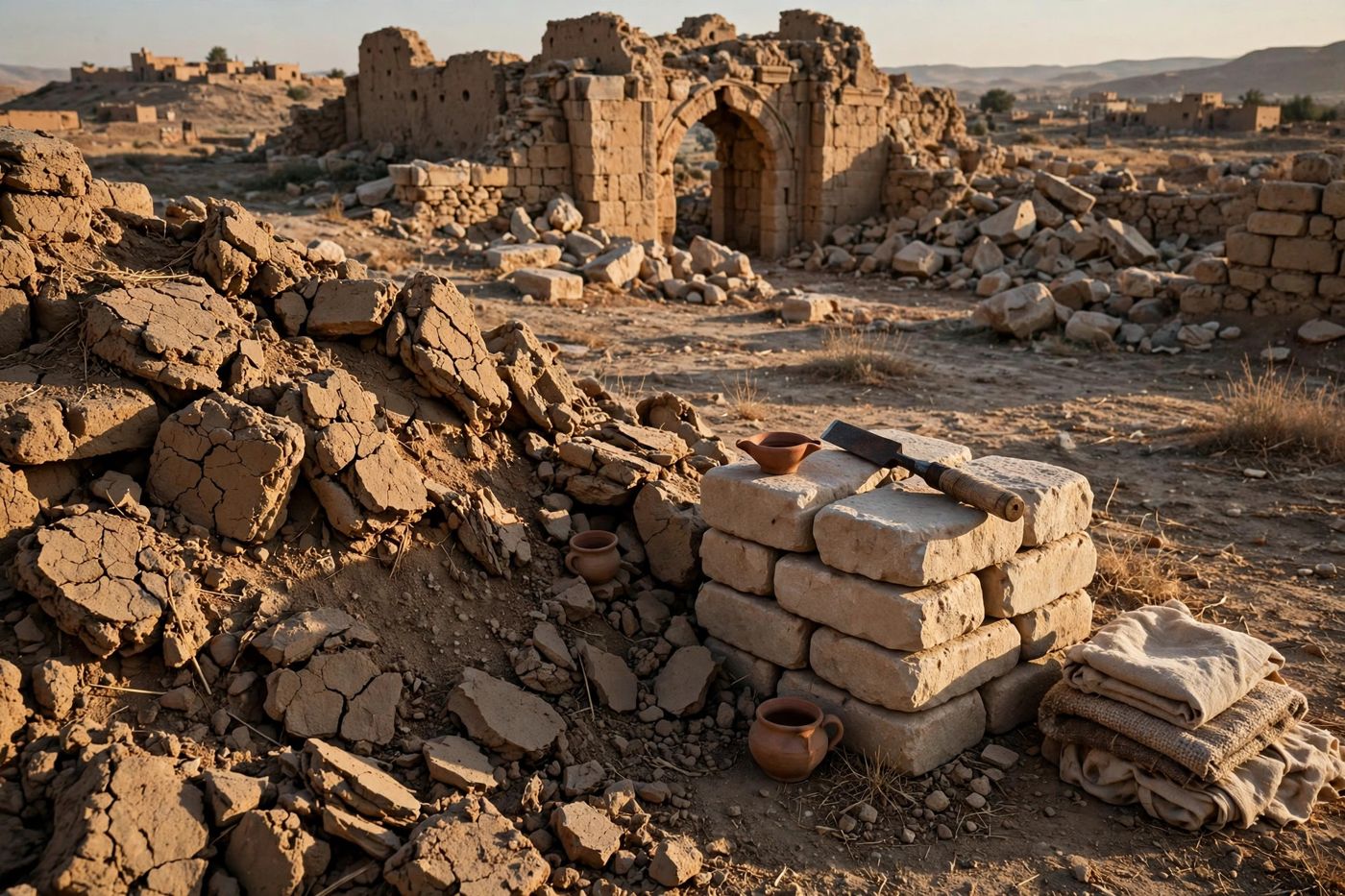
Bricks, hewn stones, sycomores, cedars. Verse 10 is a building report, and you need the price list to hear its tone. Bricks were sun-dried mud bricks — cheap, quick, vulnerable. Hewn stones are cut and dressed by masons — quarried, squared, expensive, the material of palaces. Sycomore gave soft, common timber, the poor man's wood; cedars, imported at great cost from Lebanon, were the prestige timber of kings. Israel's programme is an upgrade: whatever fell would be replaced with something grander 16. This is a nation pricing better materials while the walls still smoke. Nothing in the verse says they mourned, repented, or sought the LORD — the sermon itself notices (9:13).
| Name in the sermon | Who they are |
|---|---|
| Jacob / Israel / Ephraim | The northern kingdom, ruled from Samaria |
| Judah / Zion | The southern kingdom, ruled from Jerusalem |
| Syria (Aram) | The north-eastern neighbour kingdom, King Rezin |
| Assyria | The empire beyond the river — the rod of 10:5 |
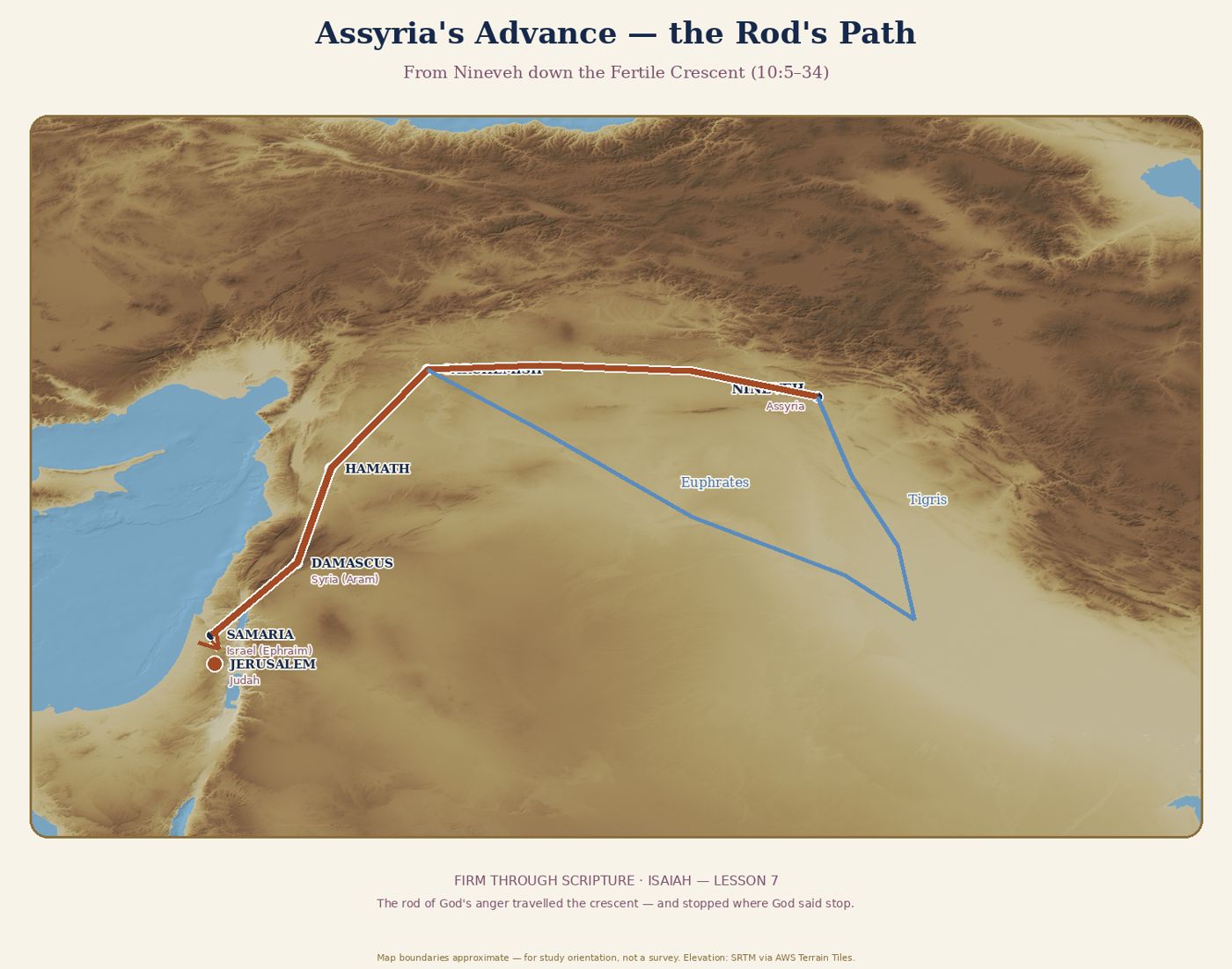
Assyria: the empire that wrote its boasts down. We know how Assyrian kings talked, because they carved it on palace walls and clay prisms and buried the records where archaeologists found them. Royal inscriptions celebrate the king's own hand, his own wisdom, his own irresistible advance, city by city — the very voice Isaiah puts in the king of Assyria's mouth in 10:8–14 [25, 30]. That is the documented rhetoric of the empire, and §16 will set the two side by side. Assyria's war machine was also a terror weapon by policy: siege, deportation, and public cruelty, meant to make the next city surrender at the rumour [16, 25]. When Isaiah calls this empire a "rod" in God's hand, his hearers would not have heard a comforting metaphor. A rod is what smites. The comfort in this passage — and there is real comfort — is never that the rod is gentle. It is that the rod is held.
Widows, the fatherless, and the poor. The woe of 10:1–2 lands on men who "decree unrighteous decrees" — lawmakers and their scribes — and names its victims precisely: "the needy," "the poor of my people," widows (left without a protector or income in that world) and the fatherless (orphaned children). These are not random examples. From Exodus onward, Israel's law singled them out as people God personally pledged to defend, warning their oppressors that He would hear their cry (Exodus 22:22–24) 1. A legal system used to rob them — by decree, in writing, with seals on it — was covenant treason committed with paperwork.
That is the world. Now we open the text itself.
3. OBSERVE — O: what the text actually does
Before meaning comes observation. Most bad interpretation is not deep error; it is shallow reading — people answering a text they never actually looked at. So look:
- The shape: two sermons hinged at 10:5. Verses 9:8–10:4 preach against Jacob — four stanzas of indictment, each sealed with the same refrain. Then, with no pause for breath, 10:5 turns the camera: "O Assyrian, the rod of mine anger." The rest of the chapter preaches against the empire God used, and ends in promise. Anyone quoting the first sermon without the second has cut the passage in half at exactly the joint God built into it.
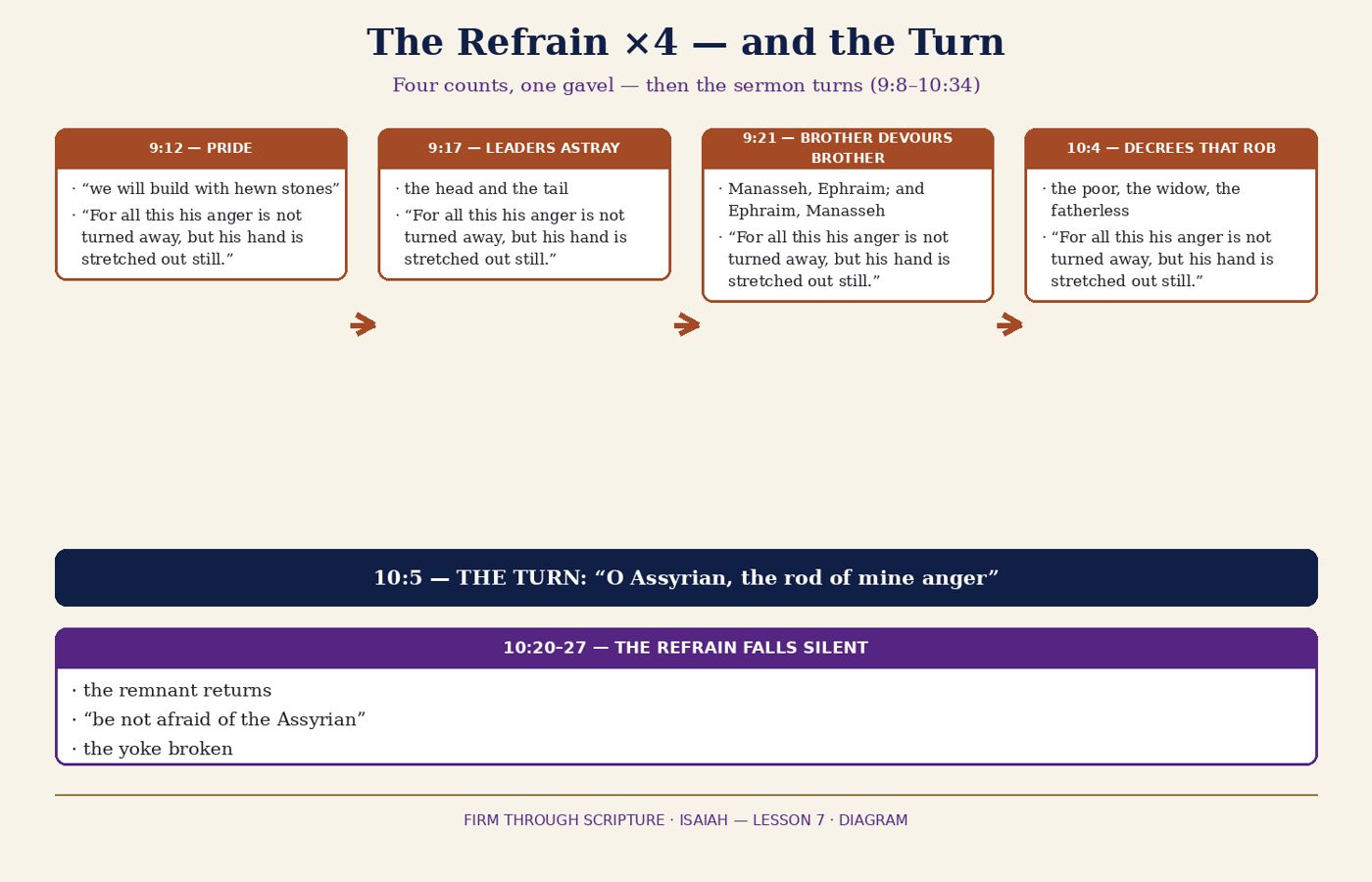
- The refrain is the skeleton. "For all this his anger is not turned away, but his hand is stretched out still" closes the stanzas at 9:12, 9:17, 9:21, and 10:4 — four times. It had already sounded once in the sermon that began in chapter 5 (5:25), so the patient reader hears it five times across the long indictment. Repetition in prophecy is never filler; it is a drumbeat. And then — observe this — it stops. After 10:4 the refrain never sounds again in the chapter. The turn at 10:5 is marked by its silence.
- The head and the tail (9:14–16). God will "cut off from Israel head and tail, branch and rush, in one day" — and the text decodes its own picture in two halves: "The ancient and honourable" is the head; "the prophet that teacheth lies" is the tail. The ancient is the elder, the senior leader. Respected elder and lying prophet are named as one failure: "the leaders of this people cause them to err."
- A fire that eats its own country (9:18–21). Wickedness "burneth as the fire" through briers and thickets until the people themselves become "the fuel of the fire," and the picture turns inward and horrible: no man spares his brother; they snatch and eat and are not satisfied; "Manasseh, Ephraim; and Ephraim, Manasseh" — two brother tribes devouring each other — "and they together shall be against Judah." Judgment here is not only what God sends from outside (Syrians, Philistines). It is what a rotting people does to itself from inside.
- Hands, everywhere. Count them. God's hand stretched out still (four times). Assyria boasts, "By the strength of my hand I have done it" (10:13), and "my hand hath found as a nest the riches of the people" (10:14). The invader at Nob will "shake his hand against the mount of the daughter of Zion" (10:32). Over against all of it stands 10:15's question about the axe and the hewer's hand. This passage is an argument about whose hand is actually doing what.
- The king starts talking in first person (10:13–14). Up to verse 12 God speaks about Assyria. At verse 13 the grammar slips — "For he saith" — and suddenly the king himself is speaking, at length, in his own voice: my hand, my wisdom, I have removed, I have robbed, I have gathered. Isaiah lets the boast run for two full verses without interrupting it, the way you let a man's own words hang in a courtroom. Then verse 15 answers it in a single question about an axe.
- The march that stops one hill short (10:28–32). The last movement before the felling lists small towns — Aiath, Migron, Michmash, Geba, Ramah, Gibeah, Gallim, Laish, Anathoth, Madmenah, Gebim, Nob — villages on the road approaching Jerusalem from the north. The invader stores his baggage, lodges, frightens each town in turn, and arrives at Nob, within sight of the city, where he shakes his hand at "the hill of Jerusalem." And there the march stops. The next two verses are about a woodcutter, and the invader is the forest.
- The silences. We are never told Israel repented — the sermon records none. We are never told Assyria's king heard a word of 10:5–19; the oracle against him is preached to God's people, for their hearing. And the remnant promise has no timetable inside this passage beyond "in that day." Observation refuses to fill silences with invention.
4. GENRE — N: note the genre (prophetic judgment sermon — indictment, woe, and taunt, turning to promise)
This passage is a prophetic sermon: God's word spoken forth into a present crisis before it is a prediction about the future — forthtelling first 51. It is built from several recognised prophetic forms, and naming them keeps you from misreading any of them:
- Indictment with refrain. The stanzas follow a covenant lawsuit in miniature: charge, evidence, sentence — then the refrain, like a judge's gavel at the end of each count. You are meant to feel the counts accumulate, not skim to the new material.
- The woe oracle. "Woe unto them that decree unrighteous decrees" (10:1) opens with the prophets' characteristic cry — woe, a word of doom pronounced over a named sin, here aimed not at foreign enemies but at Israel's own lawmakers. A woe is not a sigh of pity. It is a sentence announced in advance [4, 51].
- The boast quoted, then answered. In 10:8–14 Isaiah quotes the conqueror — lets the royal rhetoric run in its own first-person voice — then answers it with a proverb-question (the axe, v. 15). Quoted speech in prophecy is evidence presented, not views endorsed. The rule matters for a famous modern mistake about 9:10, handled in §10.
- Promise inside judgment. The last movement (10:20–34) shifts genre again — salvation oracle ("be not afraid," v. 24) and a felling-song over the proud forest. The reader who stops at 10:4 has left the courtroom before the judge finished speaking.
Read by its own forms, then: this is one sermon, in two directions, with a hinge at 10:5 and a promise at its end. Quote any part as though it were the whole and you have already misread it — which is precisely what §10 will demonstrate three times.
5. TERMS — T: the words in the writer's mouth
Four terms carry this passage. Learn them in Isaiah's usage, and whole sermons come into focus:
- The refrain — "his hand is stretched out still." Treat the refrain itself as a term, because Isaiah treats it as the sermon's load-bearing sentence. A stretched-out hand in the Old Testament is a hand in action — extended to do something, not resting. In the exodus, that same outstretched hand is the hand of rescue: God promises to redeem Israel "with a stretched out arm, and with great judgments" (Exodus 6:6) 1. Here the identical posture is bent the other way: the hand stretched out still means the action of judgment is not finished — stanza by stanza, the people have given God no reason, by repentance, to withdraw it (9:13). The gesture reads by its context and by the people's response, every time. Hold that for the Translation Note's cousin-observation in §16: it is the same God, the same hand, and a different errand — which is why the refrain must never be flattened into a slogan about God's temper.
- "Rod" and "staff" (10:5). A rod is a stick for striking — a shepherd's club, a ruler's sceptre, an instrument of discipline; a staff is the longer pole carried, leaned on, and used to beat down an enemy. Isaiah spends both on Assyria in one breath (v. 5). The picture is exact: the empire is not a partner or an independent actor in the deepest sense. It is an implement — a thing held. And an implement, as verse 15 will say, is wood.
- "Remnant" — revisited, now as promise. You met this word as a name in Lesson 05: Isaiah's son Shear-jashub, "a remnant shall return." A remnant is what remains after the rest is gone — the survivors, the leftover piece. In chapter 10 the name comes due inside the sermon itself: "The remnant shall return, even the remnant of Jacob, unto the mighty God" (10:21). Notice the double edge the boy's name always carried. Judgment is real: only a remnant will be left — "though thy people Israel be as the sand of the sea, yet a remnant of them shall return" (10:22). And return is real: the remnant is not merely what survives the fire; it is what comes back to God — the Hebrew idea of returning and the idea of repenting are the same movement, a turning around and a coming home [4, 47]. English dictionaries of the term in Isaiah trace exactly this range — remnant as both residue and returning core 47.
- "Stay upon" (10:20). The KJV's phrase means lean on, rest your weight on, depend on. Lean is the right picture: a man puts his weight on whatever he trusts to hold him. Israel had leaned on the smiter — Assyria, hired as protector in these chapters' politics (Lesson 05's hired razor) — and the promise is a transfer of weight: from the empire that struck them to the LORD, leaned on "in truth," really and not in pretence [2, 4].
Method note — the word-study guardrail: a word means what its author uses it to mean, in its sentence, in its century — not what its oldest root once meant, and not everything it can mean anywhere. The terms above were settled by Isaiah's usage in Isaiah, cross-checked against the standard lexica 19, which is the discipline that keeps word studies honest.
TRANSLATION NOTE — "the yoke shall be destroyed because of the anointing" (10:27)
Your KJV ends the comfort of 10:24–27 with a famous and difficult phrase: the Assyrian's yoke "shall be destroyed because of the anointing." The Hebrew underneath is harder than the English suggests. Its key word is shemen — oil, fat, fatness — and the sentence can be heard more than one way: the yoke breaks because of the anointing oil (the KJV's reading, connecting the breaking to God's anointed and consecrated order); or the yoke bursts because of fatness — because the neck it rides on has grown too fat for it, a picture some commentators take from the animal imagery of a yoke splitting on a thriving ox [19, 2, 6]. Modern translations divide over it in the open. FACT: the Hebrew phrase is genuinely compressed and contested. FACT: every reading agrees on the verse's main clause — in that day the burden comes off the shoulder and the yoke off the neck; the deliverance is certain on any construal of its last phrase. DISPUTED: which mechanism the final phrase names — anointing, or fatness. This study keeps the KJV's "anointing" in the text, teaches the alternative honestly here, and builds no doctrine on the disputed phrase alone. That is how this course handles a hard rendering: lights on, main clause firm, disputed tail labelled.
6. ENTIRE CANON — E: where this passage sits in the whole story
No passage lives alone. Isaiah 9:8–10:34 is a knot where several of the Bible's long threads cross:
- The sermon began before this lesson. The refrain had already fallen once, at 5:25, closing the indictment after the Vineyard Song (Lesson 03). Chapters 5 and 9–10 form one long courtroom session, interrupted by Isaiah's call (ch. 6), the sign to Ahaz (ch. 7), and the child of hope (ch. 8–9:7). This lesson is the resumption: the counts continue, and the gavel falls four more times [4, 5].
- The name comes due: Shear-jashub (7:3 → 10:21–22). In Lesson 05, Isaiah took his small son — named "a remnant shall return" — to meet a frightened king. Here the promise speaks the boy's name as a sentence (10:21). A sign-name from chapter 7 becomes a preached promise in chapter 10 — and the God the remnant returns to carries the child's title from 9:6, "the mighty God" (Lesson 06) [1, 4].
- The sand of the sea (10:22) reaches back to Abraham. The phrase echoes the patriarchal promise — descendants like seashore sand (Genesis 22:17) 1. Verse 22 is breathtaking in both directions: the promise was kept — the people really did multiply like sand — and the judgment is real — of that multitude, a remnant returns. Promise-keeping and judgment are not rivals here; each proves the other serious.
- Paul picks up this exact text (Romans 9:27–28). Writing about God's freedom and faithfulness amid Israel's widespread unbelief in his own day, Paul quotes Isaiah 10:22–23 in its Greek form: only a remnant will be saved, and the Lord will execute His word on the earth, cut short in righteousness 1. Paul's use is FACT about the canon: the New Testament reads Isaiah 10 as the pattern for how God preserves a people through judgment — a remnant, by grace, while the judgment-word is carried out completely and not endlessly. Nor does Paul repeal the promise: the same letter insists God has not cast away His people, and speaks of a remnant "according to the election of grace" (Romans 11:1–5) 1.
- The outstretched hand, across the canon. In Exodus the stretched-out hand saves (Exodus 6:6); here it judges; later in this book it will gather and comfort (40:10–11, the arm that rules and carries lambs — Lesson 20) [1, 4]. The gesture takes its meaning from its errand, every time.
- Assyria elsewhere. Micah, Isaiah's contemporary, also names Assyria as the invader to be answered by a ruler from Bethlehem (Micah 5); Nahum, a century later, preaches over its capital in its fall; and the historical books tell the 722 BC fall of Samaria that this sermon foresees (2 Kings 17) [1, 6]. The canon keeps Assyria in its place: a real empire, a genuine terror, a temporary instrument — never a rival god.
7. THE MEANING — what the passage teaches
The Walk has established what the text says and where it sits. Now its payload, taught straight, in the text's own proportions: half the sermon against God's own people, half against the empire, the promise woven through the second half.
Disaster read as a renovation opportunity (9:8–10, 13)
Begin where the sermon begins: with the diagnosis under the diagnosis. Israel's presenting problem is not that bricks fell. Bricks fall in every century. The problem is what the nation said while standing in the rubble: "in the pride and stoutness of heart" (9:9) — stoutness here is hardness, a heart grown thick and unfeeling — "The bricks are fallen down, but we will build with hewn stones."
Listen to what is missing from that sentence. There is no why — no asking what the falling meant, no seeking the LORD (v. 13 says it outright), no grief over the sin the prophet has named since chapter 1. There is only a materials upgrade: disaster processed as a construction brief. And notice the verdict: God does not say the stones will not be bought or the cedars planted; the rebuilding may well have happened. His verdict is that it would change nothing that matters, because the builders were unchanged: "the people turneth not unto him that smiteth them." The issue was never architecture. It was direction — a nation facing its blueprints when it should have been facing its God.
Teach it as the passage teaches it: pride is not always a sneer. Sometimes pride is optimism with no repentance in it — energy and resolve spent rebuilding exactly the life God was shaking. This is the response the sermon opens with, because it is the most respectable. Nobody in verse 10 shakes a fist at heaven. They are hiring masons.
Leaders who lead astray — the head and the tail (9:14–16)
The second count concerns leadership, and the text refuses to split the blame comfortably. "The leaders of this people cause them to err." The head is "the ancient and honourable" — the elders — and the tail, in a withering demotion, is "the prophet that teacheth lies": the religious voice that tells the nation what it wants to hear. Statesmen and prophets who will not tell the truth have reinforced each other until a whole culture of guidance has failed.
But the led are not excused as mere victims: "they that are led of them are destroyed," and verse 17's summary covers the whole people — "every one is an hypocrite and an evildoer, and every mouth speaketh folly." God holds leaders responsible for leading astray, and the led responsible for loving the lie. Neither half cancels the other.
The fire a nation lights in itself (9:18–21)
The third count changes the picture from invasion to combustion. Wickedness "burneth as the fire": it starts in the low scrub — briers and thorns, Isaiah's picture of a society gone to waste — and climbs into "the thickets of the forest." But the darkest stroke is who the fuel is: "the people shall be as the fuel of the fire." Judgment here looks less like an army arriving and more like a society consuming itself — snatching and still hungry, eating and not satisfied, until the text reaches its most appalling image: a man eating "the flesh of his own arm."
Then it names names: "Manasseh, Ephraim; and Ephraim, Manasseh: and they together shall be against Judah." Manasseh and Ephraim are the brother half-tribes descended from Joseph's sons — the core of the northern kingdom — devouring each other, and united in one thing only: hostility to Judah. This is judgment as given over: appetite without satisfaction, and appetite, unsatisfied, eats the nation.
The woe on respectable robbery (10:1–4)
The fourth count is the sermon's most precise, aimed at the top of a society doing everything legally. "Woe unto them that decree unrighteous decrees, and that write grievousness which they have prescribed" — the doubling underlines it: this oppression is drafted, documented, duly enacted. Its purpose is stated without varnish: "to turn aside the needy from judgment" — to block the poor man's fair hearing — so "that widows may be their prey, and that they may rob the fatherless."
Note whose people these are: "the poor of my people," says God. The oppressed are not statistics; they are His, and the men robbing them do it by statute. Then come 10:3's three questions — what will you do in the day of visitation? to whom will you flee? where will you leave your glory? — with no answers supplied, because there are none. The men who controlled every court will find no court to flee to. The stanza ends with prisoners and slain — and the refrain, for the last time.
The rod in God's hand — and what the rod intended (10:5–7, 12)
Now the hinge. "O Assyrian, the rod of mine anger." Isaiah teaches one of the Bible's most searching doctrines: God can wield a wicked empire as His instrument without approving or excusing its wickedness. Assyria is sent, with a limited charge: spoil, prey, treading down (10:6). But verse 7 separates the two intentions sharing one event: "Howbeit he meaneth not so" — God's intention is measured judgment on hypocrisy; Assyria's is unlimited appetite, nations "not a few." One event, two meanings, two moral accounts. Therefore verse 12 can promise fairly: when God's work is performed, "I will punish the fruit of the stout heart of the king of Assyria." The tool will be judged — not for being used, but for what it meant by it. Commentators across the spectrum converge on this logic [2, 4, 6].
Do not rush this doctrine into a slogan either way. The text does not make God the author of Assyria's cruelty; it says He sent Assyria against a nation under judgment and held Assyria answerable for its own heart in the going. Nor did Assyria's evil make it unusable, as if God's purposes waited on a virtuous empire. Both refusals are the teaching.
The axe that boasts (10:8–15)
Isaiah now lets the king talk. The boast runs through his fallen cities like a trophy list — Calno, Carchemish, Hamath, Arpad, Samaria, Damascus (10:9): real places on the road of conquest down the Fertile Crescent, each a headline Assyria's own annals would have recognised [25, 16]. Then the logic of empire states itself: as I did to Samaria and her idols, so to Jerusalem and hers (10:11). Hear the theological error inside the military confidence: Assyria has sorted the LORD into the category idols — one more national god whose city falls when its army does. Then, verses 13–14, the first person takes the microphone entirely: by my hand, by my wisdom; I gathered the earth like eggs from an abandoned nest, and none peeped.
God's answer is not a counter-army. It is a question about a tool (10:15): shall the axe boast against the hewer, the saw against the man who shakes it? An axe taking credit for the forest would be ridiculous — and the ridicule is the argument. Everything Assyria did was real: cities fell, treasures moved. The boast is not false about the acts; it is false about the actor. A hand was indeed at work — "my hand hath found" is truer than the king knows — but it was not finally his.
Leanness among the fat ones — the forest felled (10:16–19, 33–34)
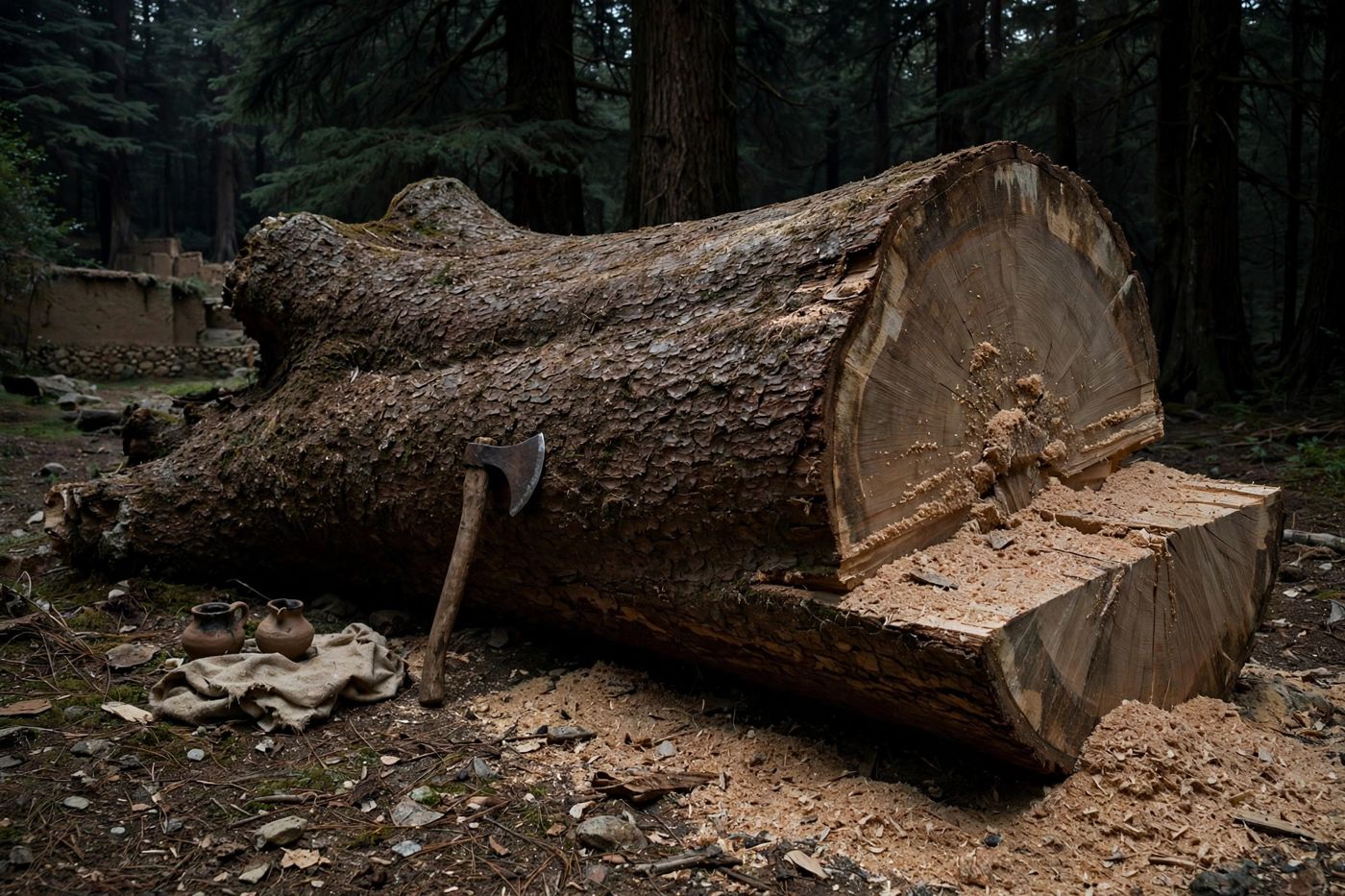
The sentence on Assyria is preached in the sermon's two master images, fire and forest. First the fire turns: "the light of Israel shall be for a fire, and his Holy One for a flame" (10:17). The Lord of hosts will "send among his fat ones leanness" — among the empire's sleek great ones, a wasting (10:16). The thorns that burned in Israel (9:18) burn here too; the instrument does not get a different Bible.
Then the forest: after the burning, "the rest of the trees of his forest shall be few, that a child may write them" (10:19) — an empire reduced to a schoolboy's tally. And the closing verses give the fullest statement: the LORD of hosts will "lop the bough with terror," the haughty humbled, the thickets cut "with iron," and "Lebanon shall fall by a mighty one" (10:33–34). Lebanon — the cedar country, the prestige timber of 9:10's shopping list — falls by a mighty one: not by Assyria's hand, and not by Israel's. The march brought the invader to Nob, shaking his hand within sight of Jerusalem. The lopping is God's answer to that shaken fist.
The remnant shall return — and learn to lean (10:20–23)
Woven into the sentence on Assyria stands the promise to Israel, and its centre is a change of leaning. "In that day," the remnant "shall no more again stay upon him that smote them; but shall stay upon the LORD, the Holy One of Israel, in truth" (10:20). The survivors are a remnant, not the nation entire — the sermon never hides the scale of the loss. Their defining act is not rebuilding (contrast 9:10) but returning (10:21) — a transfer of trust off the smiter they had hired and flattered, onto the LORD, leaned on "in truth," without Ahaz's generation's double game of confessing God in the temple and leaning on Assyria in the cabinet room.
Verses 22–23 keep the promise honest about its proportions: of the sand-of-the-sea people, a remnant returns, because "the consumption decreed shall overflow with righteousness" — destruction carried out completely (v. 23), and righteously, not vindictively and not endlessly. A remnant survives not because the judgment was bluffing, but because the Judge decreed the limit as surely as the blow.
"Be not afraid of the Assyrian" (10:24–27)
The sermon's last pastoral word is addressed not to the north but to Zion — Jerusalem: "O my people that dwellest in Zion, be not afraid of the Assyrian." Note the tenderness after four refrains: my people. God does not hide what is coming: the Assyrian will really smite with the rod, "after the manner of Egypt" (10:24). But the rod's lease is short: "yet a very little while, and the indignation shall cease" (10:25). God's answer is drawn from Israel's memory shelf: a scourge like Midian's slaughter at Oreb, when Gideon's tiny force routed a host (Judges 7), and a rod lifted over the sea as at the exodus (10:26) 1. The comfort ends where §5's Translation Note stood: burden off the shoulder, yoke off the neck, destroyed (10:27). Chapters 36–37 will tell the night this was made good at Jerusalem's wall (Lesson 18). Here Zion is told in advance: fear is understandable, and fear is not the final word.
The Christ Thread
This passage earns a modest, honest Christ thread — through the New Testament's own handling, not invented symbolism. FACT: Paul quotes Isaiah 10:22–23 in Romans 9:27–28, inside an argument that runs straight to Christ — the same chapter ends with Israel stumbling over "the stumblingstone," Christ Himself, laid in Zion (Romans 9:33, quoting Isaiah again) 1. The remnant Paul describes is preserved around the Messiah: God's word has not failed, and a remnant is saved. POSITION — the church's historic reading, labelled as such: the returning remnant finds its fullest gathering in the people, Jew and Gentile, who lean on the LORD in truth through Jesus — Himself called, in this neighbourhood of Isaiah, "the mighty God" (9:6), the name to which 10:21 says the remnant returns. That is the church's reading of the whole canon, not a claim that Isaiah's first hearers saw the whole of it. No forced types are needed: no one in this passage is a picture of Christ, and the sermon is stronger for saying so.
Where in the Covenant Story?
Three pegs carry it. First, the covenant curses: Moses warned that a disobedient Israel would be devoured by enemies, divided against itself, and reduced to few (Deuteronomy 28) — this sermon is those warnings arriving as history. Second, the Abrahamic promise: the sand-of-the-sea multitude of 10:22 is Genesis 22:17 fulfilled — which is why a remnant, and not nothing, remains. Third, the Davidic horizon: the sermon ends at Zion comforted, in the long run-up to the Branch of Lesson 08 (ch. 11), where the stump of the felled forest turns out to be alive. Chapter 10's felling is not the book's last picture of a tree.
The Long View — what the church has believed
Stand back and notice how the centuries have heard this sermon. The historic church read the refrain neither as a slogan about God's mood nor as an embarrassment, but as preached law: judgment patiently repeated, stanza by stanza, to a people still being addressed — the hand stretched out being, in the old preachers' hands, as much a sign that God had not yet finished speaking as that He had not finished judging; Calvin lingers on exactly this double edge in the refrain's repetitions 36. On Assyria the church's reading has been settled: God's use of a wicked power is His sovereignty, not His approval, and the axe text (10:15) has been quoted for two millennia wherever empires — or churches, or preachers — have mistaken instrumentality for importance [36, 4]. And on the remnant, the church from Paul onward has read this chapter as the pattern of its own existence: preserved through judgment, by grace, a returning and leaning people rather than a multitude trusting its numbers [1, 4]. Honest differences sit at the labelled edges — 10:27's final phrase, the staging of the march (vv. 28–32). The centre has held.
That is the payload. The next section compresses it into the one sentence you are meant to carry out of this study.
8. THE AIM SENTENCE — X: eXplain the intent
Everything observed now compresses into one sentence — the author's intended meaning, stated before any application is allowed near it:
Isaiah preaches one sermon in two directions: to a proud Israel that met judgment with upgrades instead of repentance, with corrupt leaders, self-devouring strife, and laws that robbed the poor — God's anger is not turned away and His hand is stretched out still; and to the Assyria He wielded as His rod — the boasting axe will itself be judged and felled, while a remnant of Jacob returns to lean on the LORD in truth, and Zion is told not to fear, for the yoke will be broken.
If a sermon or devotional uses this passage to say something untraceable to that sentence, it is not this passage talking.
9. SAY IT BACK
Close the book and say the AIM sentence from section 8 in your own words, without looking. Then answer, in one sentence each: who is the first sermon against, who is the second against, and what is promised inside the second?
If your version drops one of the sermon's two directions — refrain without remnant, or comfort without counts — walk it again. This exercise is the entire course in miniature: meaning first, then — and only then — your life.
10. THE MISREAD — the guardrail, with verdicts
Three live misuses of this passage. Each gets a fair hearing, the evidence, and a verdict.
Misread 1: "The refrain proves the God of this passage is simply a God of anger — 'his hand is stretched out still' is the Bible's portrait of a deity who never relents." Why it sounds right: the line really does sound four times in this lesson, and a fifth time in chapter 5. Read as a slogan, lifted out and repeated, it can be made to sound like the whole story. The evidence: the passage refuses the slogan three ways. First, the refrain is contextual: each sounding follows a named, unrepented sin, and verse 13 states its reason — the people "turneth not unto him that smiteth them." The hand is out still because the people are turned away still; it describes a standoff the people maintain, not a temper God cannot control. Second, the refrain stops: after 10:4 it is never heard again, and the sermon's second half is judgment on the instrument and promise — remnant, comfort, a broken yoke. Third, across the canon the same outstretched hand is the exodus rescue hand (Exodus 6:6). The gesture takes its meaning from its errand. Verdict: the refrain is a gavel inside one sermon, not a slogan about God's character. Four sounds, then silence — and what follows the silence is promise. Quoting the gavel and suppressing the rest of the sermon is not taking the text seriously; it is taking it apart.
Misread 2: "If God sent Assyria and called it the rod of His anger, then Assyria's conquest had God's endorsement — might, in God's hands, is right." Why it sounds right: verse 6 really does say "I will send him," with a charge to take spoil and tread down. If God commissioned the invasion, He must have approved of the invader. The evidence: the passage builds the refutation into the commission itself. Verse 7 separates the intentions: God means judgment on hypocrisy; Assyria "meaneth not so" — its heart is set on destroying "nations not a few," without limit or commission. Verse 12 schedules the instrument's own judgment in advance. And verse 15 states the principle as proverb: an axe is used by the hewer; being used confers no honour and no innocence on the axe. Use is not endorsement anywhere else in life — and it is not endorsement here. Verdict: the rod is judged for its own stout heart in the very chapter that calls it a rod. God's sovereignty over an empire's actions and God's approval of an empire's heart are two different things, and Isaiah 10 is one of the places the Bible teaches the difference most carefully.
Misread 3: "'The bricks are fallen down, but we will build with hewn stones' (9:10) is a stirring text of resilience — the Bible's own 'we will rebuild' speech, fit for memorials and rebuilding after disaster." Why it sounds right: the words, out of context, are magnificent — defiant, forward-looking, quotable. In modern times the verse has in fact been quoted publicly, by leaders after national tragedy, as an inspiration text — which is exactly why this guardrail exists. The evidence: in context, the sentence is the exhibit, not the exhortation. Verse 9 introduces it as what the people "say in the pride and stoutness of heart." Verse 13 supplies God's reading: the people did not turn to Him who smote them, nor seek Him. The plan is immediately followed by enemies devouring with open mouth and the first sounding of the refrain. Nothing praises the resolve; everything frames it as refusal to repent in a construction programme's respectable clothes. Resilience itself is not the sin — the same Bible honours rebuilding under God (Nehemiah's wall). The sin diagnosed here is rebuilding instead of returning. Verdict: quoted as inspiration, 9:10 preaches the opposite of Isaiah. In context it is diagnosed pride — defiance dressed as optimism. A disaster text becomes a summons first ("turn," v. 13's missing act) and a rebuilding text only afterwards; preach verse 10 without verse 13 and you have reversed the sermon.
11. FROM WORD TO WALK
A reflection page — the lesson is not finished until the passage has had its say with you.
Sit with the bricks first. Verse 10 is the most modern sentence in this ancient sermon: it is the exact sound of a heart — or a church, or a nation — that processes conviction as a project. Something falls, perhaps something God let fall, a smiting meant to be read. And within hours the plans are drawn: better stones, costlier timber, a launch date. Ask the sermon's diagnostic question, the one verse 13 asks of Israel: in the last thing that fell in your life — the loss, the exposure, the failure — did you turn? Or did you upgrade?
There is no condemnation in that question for the person who answers it honestly; the whole passage proves God keeps speaking to people mid-rubble. The refrain itself, heard rightly, carries something almost tender under its severity: the hand is stretched out still — God has not walked off or finished the conversation. The day the refrain stops in this sermon, it stops because the word has turned to promise. God is not asking you to admire the refrain. He is asking you to be in the remnant's sentence instead: the ones who return, who move their weight off every smiter they ever leaned on — every Assyria of money, approval, control, and competence — and stay upon the LORD, in truth.
And if your honest fear today is not pride but the invader at Nob — the thing that has marched town by town through your life and now stands shaking its hand within sight of everything you love — the sermon's last word to Zion is addressed to people exactly there: be not afraid of the Assyrian. Not because the rod will not land; God promised no such thing. But because its lease is "a very little while," its forest is already measured for the axe, and the yoke has an expiry written into the sermon itself. The hand shaken at Jerusalem from Nob is not the biggest hand in the chapter. It never was.
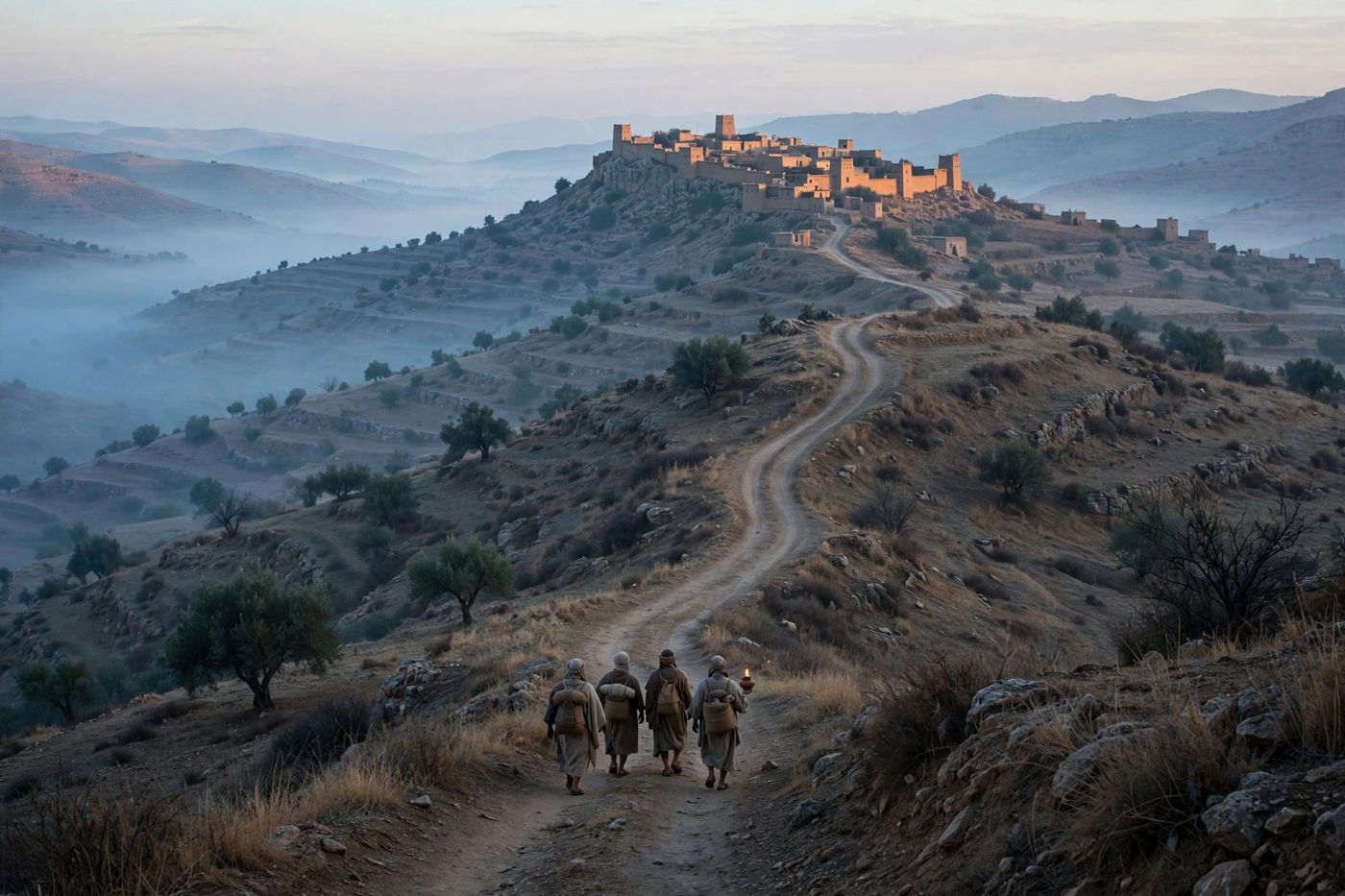
LORD of hosts — I confess how quickly I reach for hewn stones: better plans, better materials, anything but turning. Teach me the remnant's motion instead. Take my weight off every helper that ever smote me, and set it on You, in truth. And for the fear that stands at my Nob this week, speak Your own sentence over it: a very little while. In the name of the mighty God, to whom the remnant returns, amen.
12. FOR DISCUSSION — OR FOR YOUR JOURNAL
With a group, work these aloud. Alone, they're yours — answer them in your journal or in prayer; they lose nothing in the quiet.
- Verse 13 says the people did not turn and did not seek. When something has "fallen" in your life, what is your first instinct — to turn, to seek, or to upgrade? What would turning have looked like, concretely, in the last instance?
- The head and the tail — the honoured elder and the lying prophet — fail together (9:15–16). How do leaders and the led share responsibility in a community going wrong, without either side using the other as an excuse?
- God wields Assyria and judges Assyria in the same chapter (10:5–7, 12). Where do you see that distinction — use without endorsement — mattering in how a Christian should think about the powers of our own day?
- The remnant's mark is a transfer of leaning (10:20): off "him that smote them," onto the LORD, in truth. What is one thing you currently lean on that has also smitten you — and what would leaning on the LORD in truth, not in pretence, look like this month?
13. THE WALK-OUT — T: Transfer to today
Meaning is settled. Now — and only now — application, and it must cross the bridge honestly. Run the five Transfer Tests on this passage:
- Same covenant? The sermon addresses covenant Israel under the law's sanctions, in the Assyrian crisis. We live on the far side of the cross. God's discipline of His children (Hebrews 12) crosses; Deuteronomy 28's national sanctions do not transfer as a template for reading modern nations' disasters.
- Same audience? The counts land on Israel's proud, its leaders, and its law-writing oppressors; the comfort on Zion's frightened. This text examines God's own people first; using it as a weapon against outsiders inverts it.
- Same genre rules? A prophetic sermon yields postures and patterns — how to respond to discipline, weigh power, and lean — not copied scenarios. No one is commanded to replicate a remnant, a march, or a felling.
- Repeated or rooted? Turning to God under discipline rather than merely rebuilding (Hebrews 12:11), God's hatred of oppression of the poor, widow, and fatherless (Exodus 22; James 1:27), the humbling of boasting power (Daniel 4; Luke 1:51–52), and trust in the LORD alone (Psalm 118:8–9) — each is repeated across Scripture and rooted in God's character. These cross at full strength.
- Ten verses either side? Every application below comes from the whole sermon, both directions. Nothing hangs on the refrain alone or on verse 10 alone — §10 has shown what those torn-out lines do.
| The test asks | This passage's answer, in brief |
|---|---|
| Covenant and audience | New-covenant readers; God's own people examined first |
| Genre and repetition | Postures cross; national sanctions and scenarios do not |
What crosses — and lands:
What God has done, first — the indicative before any imperative: He has judged pride without abandoning the people judged; held the empire He used answerable for its own heart; decreed a remnant and received its return; and set a term — "a very little while" — on the rod over Zion. The practices below are responses to a God like that, not techniques for managing Him.
- Discipline is a summons before it is a setback. The sermon's tragedy is a people who processed God's smiting entirely as damage and never as address (9:13). What crosses is the posture: when life falls — especially when conscience knows why — the first move is turning and seeking; rebuilding comes after, in that order.
- Oppression by process is still oppression. Decrees, paperwork, procedure, fine print: 10:1–4 teaches God's people to audit systems for what they do to the needy, the poor, widows, and the fatherless — including systems that never break a visible law of men. Where a believer drafts, administers, profits from, or could challenge such a process, this text claims them.
- Instruments must not boast — and must not despair. Whatever God has done through your work, church, family, or words, 10:15 audits the credit. Its reverse comforts the used-up: the axe's significance was never in the axe. Both halves are the same doctrine.
- Leaning is transferable. Verse 20's promise is a change of support. What you stay upon will either smite you or save you; the remnant's holiness here is not first a list of behaviours but a relocation of weight — onto the LORD, in truth.
Practices — what the gate lets through, made concrete this week:
- The verse-13 audit. Take one thing that has fallen in the last year. Write two columns: every upgrade you responded with, and any turning you responded with. If the second column is empty, do one act from it this week: a named confession, a sought reconciliation, a seeking prayer actually on your knees and on the calendar.
- Read your own decrees. Twenty minutes with the paperwork of your life — budgets, contracts, policies, household rules — asking 10:2's question of each: does this turn aside anyone needy from a fair hearing, or leave any widow, orphan, or poor person as prey in my systems? Fix one item, or begin one fix, this week.
- The axe exercise. Write down one thing God has plainly done through you, then write 10:15's question over it in your own hand, and pray the credit where it belongs. If the boasting has been quiet — the inward "by my wisdom" — name that too; the king's boast was a heart-speech first (10:7, 13).
- Memorize Isaiah 10:21 — the memory verse on the Recap Card. The name of Isaiah's son, come due, and the direction of every true return since.
- Intercede under the rod. Pray once this week, by name, for believers living under a hostile power or crushing system, using 10:24–27 as your text: not afraid, a very little while, the yoke broken. If you know one such person or church, add one concrete encouragement.
What does not cross: reading a modern nation's disasters as this sermon's counts against it (the audience and covenant tests forbid it); quoting 9:10 as a resilience motto (Misread 3); claiming God's endorsement for any power He uses (Misread 2); flattening the refrain into a doctrine of a permanently angry God (Misread 1); and building doctrine on 10:27's disputed final phrase alone — the gate honours the Translation Note's label. The gate is not there to shrink the Bible's claims on you, but to make sure the claims that land are the ones God actually made.
Praise Him
We praise You, LORD of hosts — Holy One of Israel, mighty God — whose hand is never stretched out in temper but always in purpose; who fells the forest that shakes its fist and gathers the remnant that turns home; who breaks the yoke and sets a little while on every rod. Yours is the hand, the axe, the forest, and the returning road. Be praised in the turning, and in the return, forever.
14. THE RECAP CARD — this study on one page
Print it. Keep it where you'll see it this week.
- The passage: Isaiah 9:8–10:34 — one sermon in two directions: four counts against proud Israel, then God's word against the Assyria He wielded, ending in remnant, comfort, and a felled forest.
- Say It Plain: Upgrades instead of repentance draw the refrain four times; then the boasting rod is judged like a bragging axe, a remnant returns to lean on the LORD in truth, and Zion is told not to fear.
- The AIM: Judgment on a proud people who rebuilt instead of returning — and on the proud empire God used on them — with a remnant of Jacob promised return, and Zion a broken yoke.
- Key terms: the refrain — God's hand stretched out still, judgment not finished because repentance has not come · rod/staff — Assyria as a held implement, not a partner · remnant — Shear-jashub's name come due: what is left, returning · stay upon — to lean your whole weight on.
- The Misread, in one line: the refrain is a gavel in one sermon, not God's portrait · God's use of Assyria is not His endorsement of Assyria · "we will build with hewn stones" is diagnosed pride, not a resilience motto.
- Memory verse: "The remnant shall return, even the remnant of Jacob, unto the mighty God." — Isaiah 10:21
- This week's practice: the verse-13 audit — name one fallen thing, list your upgrades honestly, and make one concrete turn before you rebuild anything else.
15. CHECK YOURSELF — five questions
Answer from the study, not from instinct. (Answers live in the Teacher Edition.)
- In your own words: what is the AIM of Isaiah 9:8–10:34 — and why must it carry both directions of the sermon?
- The refrain sounds at 9:12, 9:17, 9:21, and 10:4 — and then never again in the chapter. What does verse 13 tell you about why the hand is stretched out still, and what does the refrain's silence after 10:4 mark?
- "He meaneth not so" (10:7): explain how God and Assyria can intend two different things in the same invasion — and how that distinction answers the claim that God's use of Assyria was His endorsement of it.
- A leader quotes 9:10 after a disaster: "The bricks are fallen down, but we will build with hewn stones — that's our resilience text." Using verses 9 and 13, show what the sentence means in context and where the quotation goes wrong.
- What is the remnant promised in 10:20–22 — who returns, to whom, and what changes about their leaning? Include Paul's use of these verses in your answer.
16. GO DEEPER
Optional — for readers who want the machinery. The lesson is complete without it.
From the Sources — The boast, in Assyria's own words
Set Isaiah 10:8–14 beside the empire's surviving royal inscriptions and the resemblance is unmistakable: the first-person king, the catalogue of fallen cities, the treasures gathered, the conquered gods treated as trophies [25, 30]. FACT: that is the documented rhetoric of Assyrian royal inscriptions of the period, preserved in the standard text collections and chronicle literature. INFERENCE: Isaiah's sermon deliberately performs that rhetoric — putting the empire's own genre on stage in verses 13–14 so verse 15 can answer it. Modern readers, who have never heard an Assyrian annal read aloud, need the parallel texts to feel what the first audience felt: that is exactly how he talks.
The Honest Argument — "because of the anointing," or "because of fatness"? (10:27)
The Translation Note in §5 flagged the crux; here is the argument at full strength. The Hebrew phrase is built on shemen, oil/fat. The case for the KJV's "anointing": shemen is the ordinary word for anointing oil; a yoke destroyed because of the anointing connects Zion's deliverance to God's consecrated order and His anointed — the KJV translators' reading, held by many commentators since, fitting the sermon's movement toward the anointed Branch of the next chapter [2, 19]. The case for "fatness": the immediate context is a yoke on a neck and a burden on a shoulder — animal imagery — and Hebrew can picture a yoke bursting because the animal has grown fat (compare Deuteronomy 32:15); several modern translations and commentators construe it so [6, 19]. FACT: the Hebrew is compressed, both construals are grammatically live, and the lexica record the range without settling the verse 19. DISPUTED: which the prophet intended. POSITION — this study's: the KJV's reading stands in the text, the alternative is taught in the open, and the sermon's comfort is built (§7) on the main clause — the yoke destroyed, in that day, by God's act — which no side disputes.
The Word Underneath — yad, the hand
The sermon's controlling word is the ordinary Hebrew noun yad, "hand" — until Isaiah loads the whole argument onto it. God's yad is stretched out in judgment (9:12, 17, 21; 10:4), the same word that did rescue-work in Exodus 6:6 1. Assyria's king claims the yad (10:13) — not that his hand did nothing, but that his hand was the hand. Verse 15 answers inside the same word-field: an axe has no yad of its own; the hewer's hand is the story. The sermon's last human gesture is a shaken hand at Nob (10:32), answered by the LORD lopping boughs (10:33). FACT: the hand-vocabulary runs at exactly these joints. INFERENCE: the repetition is the sermon's design — a contest of hands, staged so the reader must decide whose hand history is finally in.
Go Read
- Motyer, The Prophecy of Isaiah 4 — the refrain's architecture and the remnant theme across the whole book.
- Oswalt, The Book of Isaiah, Chapters 1–39 (NICOT) 2 — the slow treatment of chapters 9–10: the Assyrian setting, the rod theology, and the note on 10:27.
- Goldingay, Isaiah (Understanding the Bible) 6 — the mainstream-critical reading, careful on the poetry of the march and the felling (10:28–34).
- Walton, Matthews & Chavalas, The IVP Bible Background Commentary: Old Testament 16 — bricks and hewn stone, cedar and sycomore, Assyrian warfare: the sermon's material world, verse by verse.
17. SOURCES & REFERENCES
Numbered citations in this lesson key to this list — the course standard: every sourced claim carries its number, and every number can be checked.
-
The KJV text itself — Holy Bible, King James Version (eBible.org KJV, 1769 text). Scripture quotations are from the King James Version (KJV), which is in the public domain in the United States; the full passage is always assigned as reading. Cross-references within Scripture cite this number.
-
Oswalt, The Book of Isaiah, Chapters 1–39 (NICOT) — John N. Oswalt (Eerdmans). The leading evangelical commentary on the first half; defends essential unity of authorship and reads the book as a finished theological whole. Detailed notes on the Assyrian-period history (Ahaz, Hezekiah, Sennacherib).
-
Motyer, The Prophecy of Isaiah — J. Alec Motyer (IVP). A one-volume commentary by an evangelical scholar who argues the whole book breathes the mind of the eighth-century prophet; especially strong on the book's structure, its repeated refrains, and the Servant.
-
Childs, Isaiah (Old Testament Library) — Brevard S. Childs (Westminster John Knox). The canonical-approach reading: the book in its final form as Scripture, whatever its compositional prehistory; a control on both conservative and critical overreach.
-
Goldingay, Isaiah (Understanding the Bible / NIBC) — John Goldingay (Hendrickson). A mainstream-critical one-volume commentary; the exilic-community reading of chapters 40–55 stated fairly, with close attention to the poetry.
-
Walton, Matthews & Chavalas, The IVP Bible Background Commentary: Old Testament — John H. Walton, Victor H. Matthews, Mark W. Chavalas (IVP). Verse-by-verse ancient Near Eastern background: Assyrian siege practice, Babylonian religion, treaty and coronation customs, geography.
-
Brown, Driver & Briggs, Hebrew and English Lexicon of the Old Testament (BDB) — The standard older Hebrew lexicon; word senses and usage ranges for the Terms sections.
-
Pritchard (ed.), Ancient Near Eastern Texts Relating to the Old Testament (ANET) — James B. Pritchard (Princeton). Translations of the primary records: Sennacherib's annals, the Babylonian Chronicle, the Cyrus Cylinder, treaty and hymn texts.
-
Grayson, Assyrian and Babylonian Chronicles — A. Kirk Grayson (J.J. Augustin). The Babylonian Chronicle series, including the fall of Babylon to Cyrus in 539 BC and the reign of Nebuchadnezzar.
-
Calvin, Commentary on Isaiah — John Calvin (public domain). Reformation exegesis; a control on interpretation and a voice in the Long View.
-
Freedman (ed.), The Anchor Bible Dictionary — Articles on Isaiah, Zion, the remnant, anointing, and the ancient Near Eastern entries.
-
Fee & Stuart, How to Read the Bible for All Its Worth — Gordon D. Fee and Douglas Stuart (Zondervan). The beginner's method book; its prophecy chapter ("a forthtelling first") undergirds the Genre sections.