
One study, one walk — the universal FIRM format. The passage first and whole; then its world; then the Walk (Context · Observe · Genre · Terms · Entire Canon); the meaning taught straight; the AIM sentence; the misread exposed and answered; and the walk-out, where application has to pass the Transfer Tests before it reaches your week. The same skeleton serves a book, a chapter, a single verse, or a whole subject. In the early studies the moves are labeled as they happen. The labels fade as the walk becomes yours.
THE WEEK WITH THIS STUDY — six bites
Day 1 — Read the passage · Say It Plain · The World (§§1–2) · Day 2 — Observe · Genre (§§3–4) · Day 3 — Terms · Entire Canon (§§5–6) · Day 4 — The Meaning · the AIM Sentence · Say It Back (§§7–9) · Day 5 — The Misread · From Word to Walk (§§10–11 — add For Discussion, §12, if you're with others) · Day 6 — The Walk-Out · the Recap Card (§§13–14). Go Deeper (§16) any evening you want the basement.
BEFORE YOU READ — Open My Eyes
LORD, my eyes are good at tall things — thrones, armies, reputations, everything that looks too strong to fall. Open them instead to what You grow out of a stump. Let me see the shoot before I judge the forest, rest in the fear of the LORD the way Your King does, and teach my mouth the song at the end: You are my salvation, and I will not be afraid. Amen.
§ means “section” — the numbered parts of your lesson. Each bite above names the sections for that day.
1. READ THE PASSAGE — Isaiah 11:1–12:6 (KJV)
Read it all, slowly, before any teaching. In this course the passage always prints once, in full, at the head of the lesson. Everything after this is commentary — this is the text.
1 And there shall come forth a rod out of the stem of Jesse, and a Branch shall grow out of his roots:
2 And the spirit of the LORD shall rest upon him, the spirit of wisdom and understanding, the spirit of counsel and might, the spirit of knowledge and of the fear of the LORD;
3 And shall make him of quick understanding in the fear of the LORD: and he shall not judge after the sight of his eyes, neither reprove after the hearing of his ears:
4 But with righteousness shall he judge the poor, and reprove with equity for the meek of the earth: and he shall smite the earth with the rod of his mouth, and with the breath of his lips shall he slay the wicked.
5 And righteousness shall be the girdle of his loins, and faithfulness the girdle of his reins.
6 The wolf also shall dwell with the lamb, and the leopard shall lie down with the kid; and the calf and the young lion and the fatling together; and a little child shall lead them.
7 And the cow and the bear shall feed; their young ones shall lie down together: and the lion shall eat straw like the ox.
8 And the sucking child shall play on the hole of the asp, and the weaned child shall put his hand on the cockatrice' den.
9 They shall not hurt nor destroy in all my holy mountain: for the earth shall be full of the knowledge of the LORD, as the waters cover the sea.
10 And in that day there shall be a root of Jesse, which shall stand for an ensign of the people; to it shall the Gentiles seek: and his rest shall be glorious.
11 And it shall come to pass in that day, that the Lord shall set his hand again the second time to recover the remnant of his people, which shall be left, from Assyria, and from Egypt, and from Pathros, and from Cush, and from Elam, and from Shinar, and from Hamath, and from the islands of the sea.
12 And he shall set up an ensign for the nations, and shall assemble the outcasts of Israel, and gather together the dispersed of Judah from the four corners of the earth.
13 The envy also of Ephraim shall depart, and the adversaries of Judah shall be cut off: Ephraim shall not envy Judah, and Judah shall not vex Ephraim.
14 But they shall fly upon the shoulders of the Philistines toward the west; they shall spoil them of the east together: they shall lay their hand upon Edom and Moab; and the children of Ammon shall obey them.
15 And the LORD shall utterly destroy the tongue of the Egyptian sea; and with his mighty wind shall he shake his hand over the river, and shall smite it in the seven streams, and make men go over dryshod.
16 And there shall be an highway for the remnant of his people, which shall be left, from Assyria; like as it was to Israel in the day that he came up out of the land of Egypt.
Chapter 12 — the song sung back:
1 And in that day thou shalt say, O LORD, I will praise thee: though thou wast angry with me, thine anger is turned away, and thou comfortedst me.
2 Behold, God is my salvation; I will trust, and not be afraid: for the LORD JEHOVAH is my strength and my song; he also is become my salvation.
3 Therefore with joy shall ye draw water out of the wells of salvation.
4 And in that day shall ye say, Praise the LORD, call upon his name, declare his doings among the people, make mention that his name is exalted.
5 Sing unto the LORD; for he hath done excellent things: this is known in all the earth.
6 Cry out and shout, thou inhabitant of Zion: for great is the Holy One of Israel in the midst of thee.
SAY IT PLAIN — the passage in everyday words: The last lesson ended with a forest felled — every tall tree cut down. This one begins at ground level: out of the stump of Jesse's family, one small shoot grows, and on that shoot God's Spirit rests in full. He will judge the world the way God sees it, defend the poor, and silence the wicked with His word. Under His rule even the animals stop killing, children are safe beside snakes, and the whole earth fills with the knowledge of God. That same root of Jesse becomes a flag the nations gather to, God brings His scattered people home a second time — a new exodus, greater than the first — old family feuds end, and the rescued people answer the only way rescued people can: they sing. Everything after this teaches from it — nothing will change what you just read.
2. THE WORLD — C: Context & Audience
A text can never mean what it never meant — so before we ask what these verses mean, we stand where their first hearers stood.
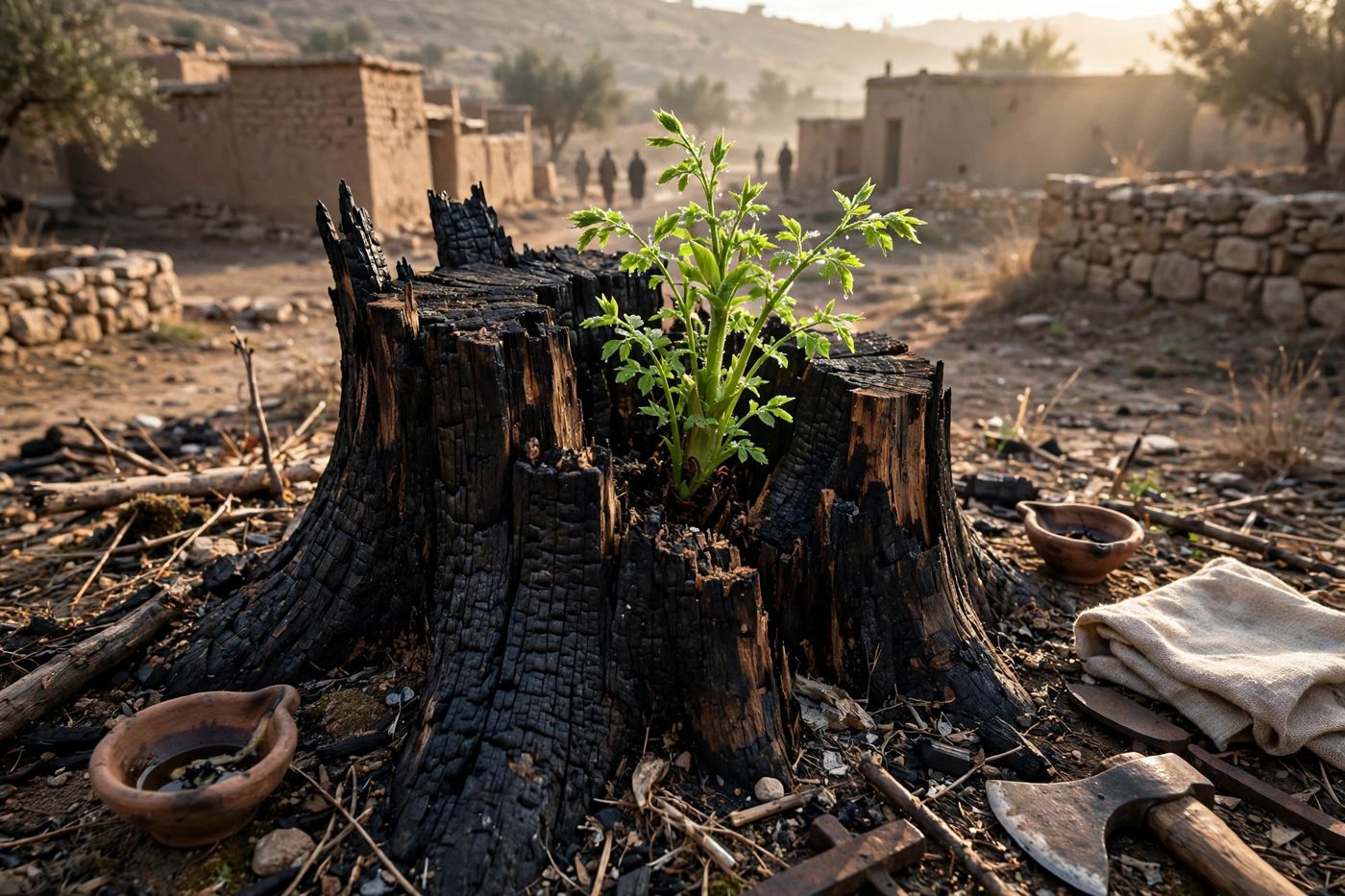
Begin where the previous lesson left the saw. Isaiah 10 ended with a lumberyard: the LORD of hosts lopping boughs "with terror," the thickets of the forest cut with iron, Lebanon itself falling (10:33–34). 1 That felling fell two ways at once. Assyria — the great empire to the northeast that dominated Isaiah's century — was God's axe against a proud world, and then the axe itself was judged for its pride (10:5–19). [1, 2] And Judah, the small southern kingdom Isaiah preached to, was not exempt: her own tall trees stood under the same saw. So when chapter 11 opens with "there shall come forth," the first hearers were not looking at a thriving royal orchard. They were looking at stumps — and being told to watch the ground.
Jesse, before David. You need two names straight, because this passage's whole force rides on them. Jesse was a farmer of Bethlehem, a small town south of Jerusalem, and the father of David (1 Samuel 16). 1 David, Jesse's youngest son, became Israel's great king — shepherd, warrior, psalm-writer — and God promised him a "house," a dynasty God Himself would establish (2 Samuel 7). 1 By Isaiah's day, some three centuries later, that dynasty was a shadow of David's glory: the kingdom had split after David's grandson, the northern ten tribes (called Israel, or Ephraim after their largest tribe) had broken away and would soon be carried off by Assyria, and the kings reigning in Jerusalem — men like Ahaz, whom you met in Lesson 05 — were small, frightened, compromising men. Isaiah's hearers could see Jesse's tree being felled in their own lifetimes. A promise that starts again from Jesse — not from David enthroned, not from any reigning king — is a promise that God will restart the dynasty from before the throne, from the farm, from the roots. [2, 4]
Assyria, Egypt, and the map of being scattered. Verses 11–16 name the compass points of Israel's scattering, and every name needs a plain introduction. Assyria: the empire centred on the Tigris River in what is now northern Iraq, whose armies deported conquered peoples as policy — you scatter a nation so it can never regroup. 16 Egypt: the ancient kingdom on the Nile, Israel's old slave-house. Pathros: Upper (southern) Egypt. Cush: south of Egypt, roughly modern Sudan and Ethiopia. Elam: east of Babylon, in modern southwestern Iran. Shinar: the Babylonian plain. Hamath: a city-kingdom in modern Syria. The islands of the sea: the Mediterranean coasts and islands, the far west as an Israelite reckoned distance. [2, 16] Read the list slowly: it is everywhere God's people could end up — north, south, east, west, and across the water. The promise is not that a few stragglers will drift home. It is that there is no exile address outside the reach of God's hand.
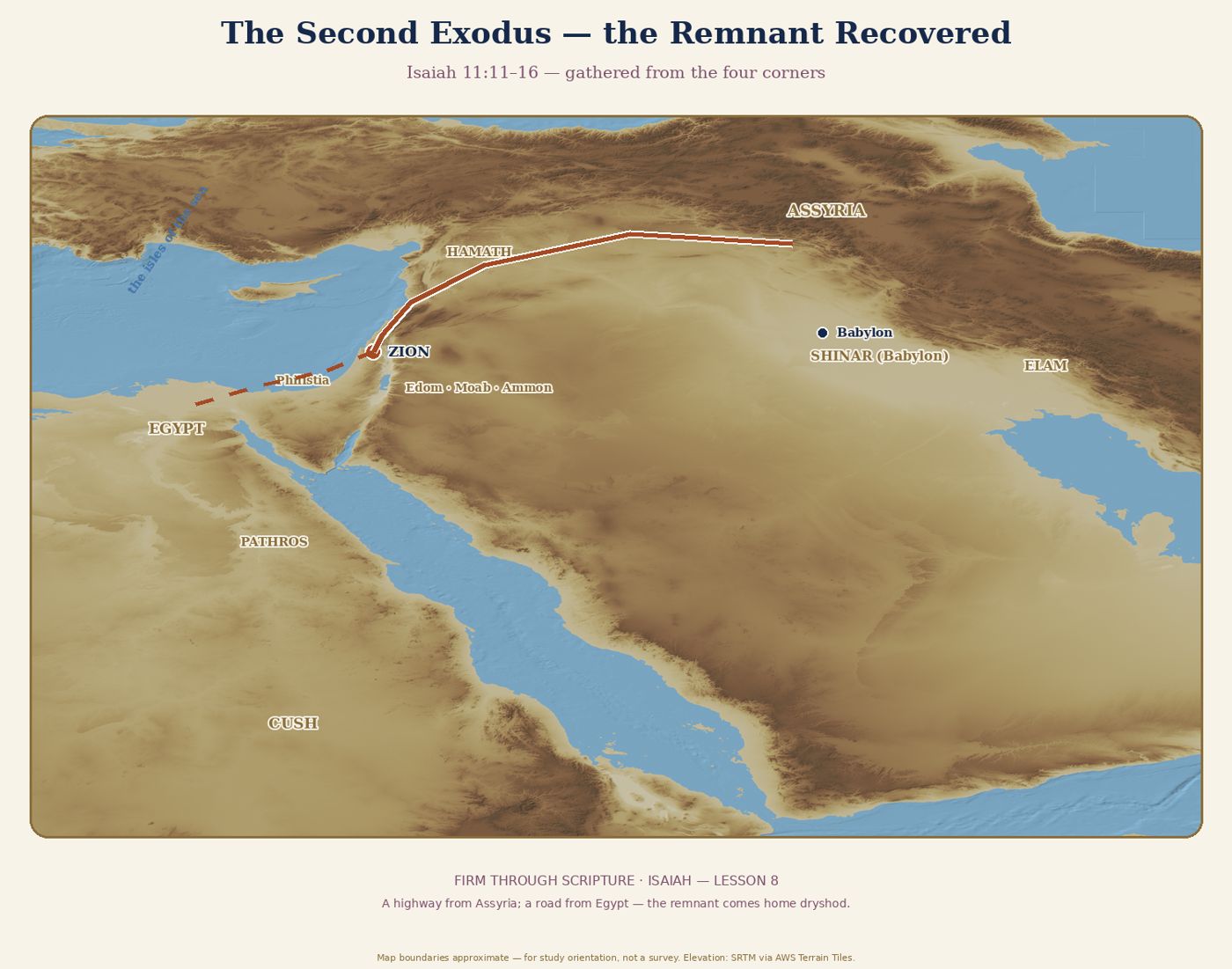
The remnant — a word this book keeps spending. Isaiah named one of his own sons Shear-jashub, "a remnant shall return" (7:3), and the idea runs through everything he preaches: after judgment, God preserves a surviving core — a people carried through the fire who become the seed of the future. [1, 12] Hold the word at full weight in both directions: severe (a remnant means most of the tree is gone) and tender (a remnant means the story is not over). Verses 11–16 are the remnant's homecoming, dressed in exodus clothes — sea smitten, river divided, highway through the water — because his hearers knew that story the way you know your own name: it was the night God made them a people. A second exodus means the God who did it once, against Pharaoh, will do it again, against every empire that holds His people. [2, 4]
And Zion. "My holy mountain" (v. 9) is Zion — the hill in Jerusalem where the temple stood, the address of God's kingship among His people. [12, 52] When verse 9 says the earth will be full of the knowledge of the LORD, it starts the flood at that hill; when chapter 12 ends with the "inhabitant of Zion" shouting, it is the same address: God's presence, in the middle of His people. That is the world. Now we open the text itself.
3. OBSERVE — O: what the text actually does
Before meaning comes observation. Most bad interpretation is not deep error; it is shallow reading — people answering a text they never actually looked at. So look:
- The shape. Four panels: the King described (11:1–5) → the kingdom He makes (11:6–9) → the King as a rallying flag and the people regathered (11:10–16) → the people's song in answer (12:1–6). Description becomes world, world becomes homecoming, homecoming becomes singing.
- Root, shoot — then shoot, root. Verse 1: a Branch grows out of the roots. Verse 10 turns the figure end for end: the King is now himself "a root of Jesse," standing as a banner. The shoot becomes the root — the descendant becomes the source. Isaiah is not careless with his botany; this King is both from the family and before it. Watch §6 pick the thread up where the New Testament pulls it.
- "In that day" tolls like a bell. It sounds at 11:10, 11:11, 12:1, and 12:4, pointing forward to the day when God finishes what the shoot begins — near in history and far in consummation at once. Every bell-ring moves the camera: banner, homecoming, song.
- Equipment before action. Verse 2 piles phrase on phrase — rest, wisdom, understanding, counsel, might, knowledge, fear of the LORD — before the passage says anything about what the King does. Isaiah wants you to know who empowers this King before you watch Him judge a single case.
- Judgment and gentleness in the same mouth. Verse 4 holds, in one breath, the poor judged with righteousness and the wicked slain by the breath of the King's lips. Any reading that keeps the lamb of verse 6 and deletes the rod of verse 4 has edited Isaiah, not read him.
- The audience flips at chapter 12. Prophecy about the future suddenly hands the future a script: "thou shalt say" (12:1), "ye shall say" (12:4). Isaiah teaches his present hearers to start learning the song now.
- Water, everywhere, changing its meaning. The sea that covers the earth with knowledge (11:9); the sea smitten so feet stay dry (11:15); water drawn joyfully from wells (12:3). Deep water, divided water, drawn water — threat, then road, then drink. The element does not change. God's hand on it does.
4. GENRE — N: note the genre (prophetic poetry — royal oracle, eschatological vision, and a psalm)
This passage is prophecy in poetry, and it changes genre twice inside its own borders — normal for Isaiah, and exactly why genre must be named before meaning is drawn. Three forms stand side by side:
- A royal oracle (11:1–5). A prophetic portrait of a coming King from David's line — His ancestry, His endowment, His way of judging. Royal oracles in the ancient world praised reigning kings in inflated court language; Isaiah's is pointedly about a king not yet reigning — indeed, about a dynasty currently being felled. The form is courtly; the timing is the sermon. [51, 16]
- An eschatological vision (11:6–16). Eschatological simply means "about the last things" — God's final settling of the world. Such visions use picture-language at full stretch: animals reconciled, seas smitten, highways through the water. Picture-language is real language about real things, carried in images — ask what reality each image carries, neither dissolving it into "just a metaphor for being nice" nor flattening it into a newspaper forecast. [51, 52]
- A psalm (12:1–6). Chapter 12 is not more oracle; it is a song of thanksgiving, in the form of Israel's worship — testimony, confession of trust, and a call to the congregation to sing. It belongs with the Psalms in kind. Reading a song as if it were a statute misses it as surely as reading a statute as if it were a song.
Two genre rules guard the lesson. First, prophecy is forthtelling before it is foretelling: its first work is to speak God's word into its hearers' present — their fear of Assyria, their despair over the dynasty — and its pictures of the future serve that present summons. 51 Second, prophetic time telescopes. Isaiah sets near and far fulfilments in one frame without a seam — a homecoming from exile and the final gathering of the nations share verses 11–16 the way a near ridge and a far mountain share a horizon. Demanding one date before the passage may mean anything is a demand the genre itself refuses. Read it as the prophet built it: layered, with the last layer the largest.
5. TERMS — T: the words in the writer's mouth
Four terms carry this passage. Learn what they meant in Isaiah's mouth, and watch how much confusion dies at the dictionary:
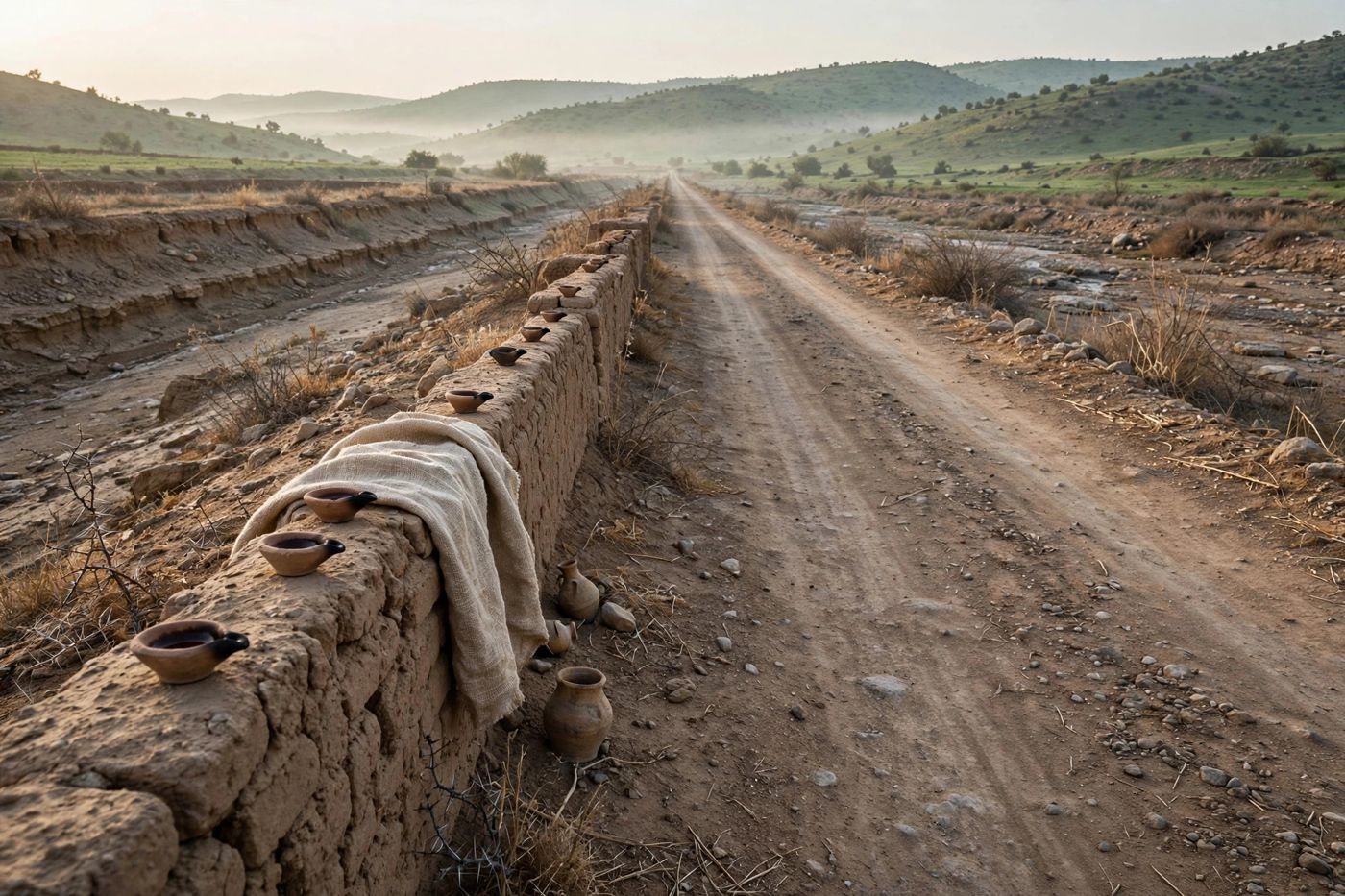
- Branch — netser (11:1). Isaiah calls the shoot two things in one verse: a "rod" (choter, a twig or shoot) and a "Branch," in Hebrew netser (NET-ser) — a sprout growing from a cut stock, the green sucker a stump sends up from its roots. [19, 20] Now the discipline this course keeps: the "Branch" word you met in Lesson 02 (Isaiah 4:2) was a different Hebrew word, semach, the word Jeremiah and Zechariah later take up as the King's name. Netser and semach grow in the same field — new life sprouting where things were cut down — but they are not the same word, and honest teaching says so instead of quietly merging them. [19, 18] A note of tradition, labelled as such: because Matthew 2:23 says the prophets spoke of Jesus being "called a Nazarene," and Nazareth's name plausibly shares the netser root, many readers have heard a wordplay — the Branch from the stump, raised in Branch-town. POSITION / INFERENCE — a cherished tradition and a plausible pun; Matthew quotes no single verse, so no doctrine is built on it here. What is FACT is the stump and the shoot, and they are enough.
- The stem of Jesse (11:1). "Stem" renders geza' — the trunk or stump-stock of a felled tree, what is left at ground level after the saw has done its work. [19, 20] And the name on the stump is the teaching: not David — David is the glory, the throne, the psalms — but Jesse, David's father, the Bethlehem farmer from before there was a throne at all (see §2). The promise deliberately walks past the dynasty's whole history, back to the farm: God's restart does not begin from the last king's résumé but from the family's roots, at stump height, where nobody was looking for a king. [2, 4]
- Ensign / banner — nes (11:10, 12). A nes is a standard or signal-pole — a banner raised high so that scattered people can see it, rally to it, and march under it. [19, 52] Isaiah uses the word across the book for God's own raised signal to the nations (compare 5:26; 49:22). [1, 52] So when verse 10 says the root of Jesse "shall stand for an ensign," picture a flag, not a monument: something lifted up so that people far away — "the Gentiles," the non-Israelite nations — can find their way to it. A banner does not go looking for the scattered. It stands, and the scattered come. The stillness in the image is the theology.
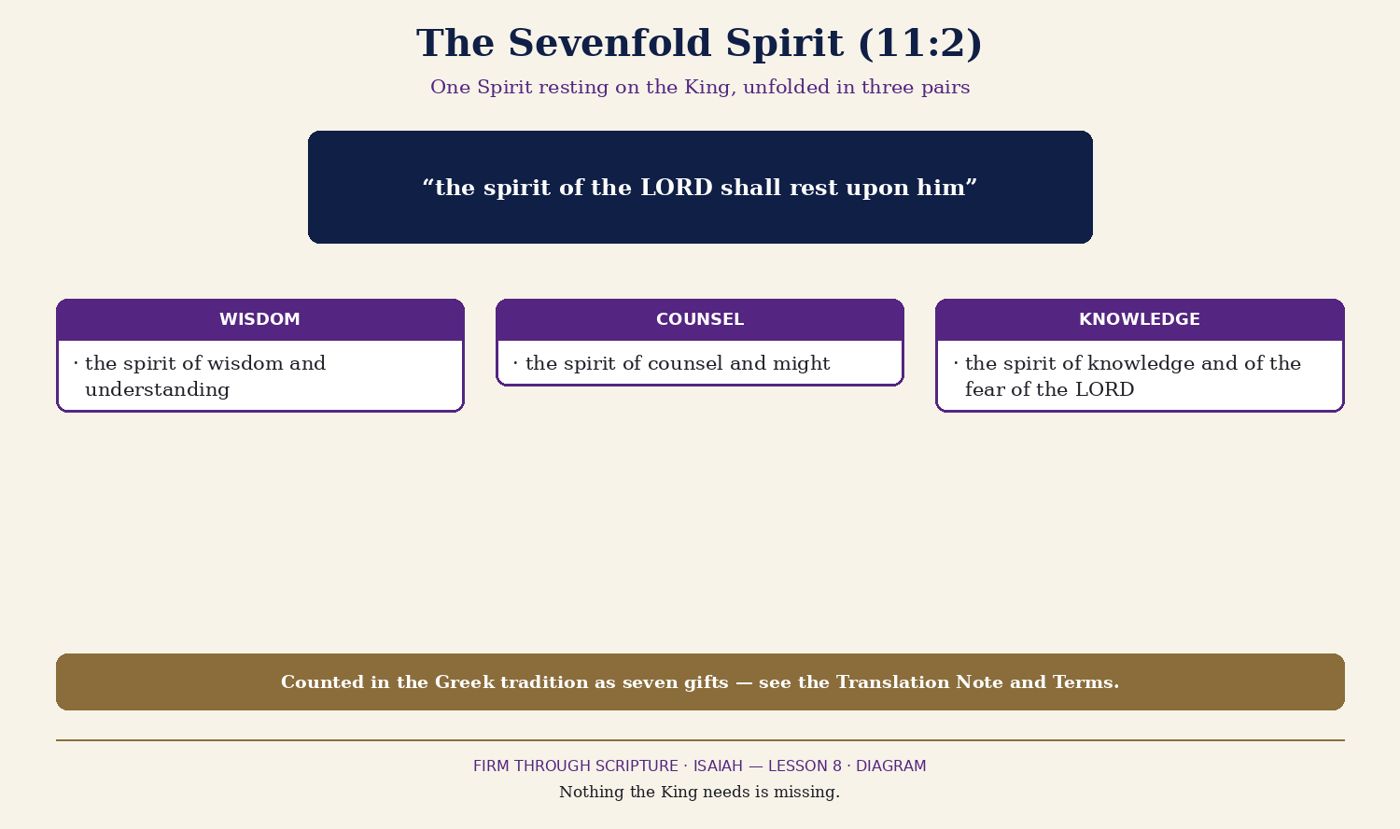
- The Spirit's gifts (11:2). The verse's grammar deserves a slow look. It names "the spirit of the LORD" — God's own Spirit, resting on the King, staying, not visiting — and then unfolds that one Spirit in three pairs: wisdom and understanding (seeing truly), counsel and might (planning rightly, and the strength to carry the plan through), knowledge and the fear of the LORD (knowing God, and standing in reverent awe of Him). [2, 18] Count them honestly: in the Hebrew, that is the Spirit of the LORD characterised by three pairs — six qualities carried by one resting Spirit. The famous count of seven belongs to the verse's reception: the ancient Greek translation (the Septuagint) renders the list so that, with "godliness" named and the fear of the LORD carried into verse 3, the church learned to speak of seven gifts of the Spirit — and Revelation's "seven Spirits" before God's throne (Revelation 1:4; 4:5) gave the number a canonical echo. [24, 2] FACT as to the Hebrew's three pairs and the Greek's sevenfold list; the link to Revelation's seven Spirits is INFERENCE — a resonance the canon invites, not a quotation it makes. Either way: nothing the King needs is missing. The fullness is the doctrine; the arithmetic is the footnote.
Method note — the word-study guardrail: a word means what its author uses it to mean, in its sentence, in its century — not what its oldest root once meant, and not everything it can mean anywhere. Every term above was settled by Isaiah's usage in Isaiah — netser at its stump, nes at its rallying-points across this book.
TRANSLATION NOTE — "of quick understanding," or delighted by the scent of reverence? (11:3)
Your KJV says the Spirit "shall make him of quick understanding in the fear of the LORD." Underneath "quick understanding" sits a Hebrew idiom built on the verb for smelling — literally, something like "his smelling / his delight shall be in the fear of the LORD." [19, 23] The KJV translates the effect: a man whose senses are tuned by reverence perceives swiftly and truly, the way a keen nose catches what eyes miss. Translations that print "his delight shall be in the fear of the LORD" translate the picture. Neither is an error; they are two honest handholds on one idiom. But notice what the picture adds when you hold both: for this King, reverence is not a duty He performs. It is His element — the air He breathes and enjoys. That is why His judgment in the next breath does not run on surfaces (v. 3, "not… after the sight of his eyes"): a King who delights in the fear of the LORD sees the way God sees, all the way down.
6. ENTIRE CANON — E: where this passage sits in the whole story
No verse lives alone. Isaiah 11:1–12:6 is a knot where some of the Bible's longest threads cross — pull them one at a time:
- Backwards to the promise to David. God swore to David a house and a throne established for ever (2 Samuel 7:16). 1 By Isaiah's day that promise looked sawn through — which is precisely when Isaiah 11 speaks: the promise was never tied to the dynasty's unbroken success, but to God's oath, and an oath can grow out of a stump. Acts picks the name up in the same spirit: God raised up David, "the son of Jesse," and "of this man's seed hath God according to his promise raised unto Israel a Saviour, Jesus" (Acts 13:22–23). 1
- Sideways, inside Isaiah. This is the third panel of a triptych: the child born to reign (9:6–7), the shoot from the stump (11:1–5), and — far ahead — the Servant who grows up "as a root out of a dry ground" (53:2). [1, 4] Same garden, three seasons: promised, sprouting, suffering. Isaiah 65:25 will quote 11:6–9 back, nearly word for word, inside the new-heavens-and-new-earth chapters — the prophet's own way of telling you where the peaceable kingdom finally lives. 1
- The Branch across the prophets. Jeremiah promises God will "raise unto David a righteous Branch," a King who "shall execute judgment and justice in the earth" (Jeremiah 23:5); Zechariah names "the man whose name is The BRANCH" (Zechariah 6:12). 1 Those texts spend semach, not Isaiah 11's netser (see §5) — different word, same field, one portrait: God's King arrives by growth out of ruin, not by coup out of strength. [4, 19]
- Paul names this verse. When the apostle wants to prove that the Messiah's welcome of the Gentiles was the plan all along, the capstone of his string of quotations in Romans 15 is Isaiah 11:10, quoted in its Greek form: "There shall be a root of Jesse, and he that shall rise to reign over the Gentiles; in him shall the Gentiles trust" (Romans 15:12). 1 On it Paul builds his whole appeal for Jew-and-Gentile unity in the Roman church (Romans 15:8–13). FACT — the quotation and its argument are there to be read.
- The root that is also the offspring. Revelation closes the canon by seizing verse 10's reversed botany (§3): Jesus names Himself "the root and the offspring of David" (Revelation 22:16), and heaven hails Him as "the Root of David" who has prevailed (Revelation 5:5). 1 In the New Testament's reading this is no contradiction to tidy up but an identity to confess: David's descendant, and David's Lord and source.
- The breath that slays. Verse 4's King reappears in Paul's description of the Lord Jesus consuming the final lawless one "with the spirit of his mouth" (2 Thessalonians 2:8), and in Revelation's rider, "Faithful and True," who "in righteousness… doth judge and make war" (Revelation 19:11). 1 The New Testament does not soften Isaiah's King into harmlessness; it carries His rod into its own last pages.
- The song that quotes a song. Chapter 12's confession — the LORD as "my strength and my song" (12:2) — deliberately echoes Israel's first exodus song, sung at the far side of the Red Sea (Exodus 15:2). 1 Isaiah frames the passage between two exoduses on purpose: the second (11:16) is sung in the first exodus's own words — with one difference: at the sea they sang looking back; in Isaiah 12, the song is written in advance, looking forward. [2, 4]
7. THE MEANING — what the passage teaches
The Walk has established what the text says and where it sits. Now its payload, taught straight — the doctrines this passage actually carries.
Life out of the stump: God's restart does not need a standing tree
The first doctrine is in the first picture — a doctrine about how God works. He does not promise to prop up the tottering dynasty or wait for a better class of king to be born in the palace. He promises growth out of the cut stock — "a rod out of the stem," "a Branch… out of his roots" (look at v. 1 again). The life was in the roots when the visible tree was already firewood. Isaiah's hearers were watching the monarchy fail in slow motion; the announcement is that the monarchy's failure is not the promise's failure, because the promise was rooted in God's oath to Jesse's house, not in the house's performance. [2, 4]
Set the two forest scenes side by side: chapter 10, God fells the proud forest — Assyria's cedars and Judah's alike — because height had become arrogance. Chapter 11, God raises one low green shoot, because the future He intends never travels by height. It travels by root. That is why this King is never described by what ancient kings advertised — no stature, no army list, no treasury — but by ancestry (Jesse's roots), endowment (the resting Spirit), and character (righteousness, faithfulness). Learn to read God's work at ground level, or you will miss most of it. [4, 12]
The Spirit rests here — and stays
Verse 2's verb is rest: the Spirit of the LORD "shall rest upon him." Israel had known the Spirit's comings — rushing on judges for a battle, on Saul for a season, departing again. On this King the Spirit does not visit; He settles. The three pairs unfold what a ruler looks like when God's Spirit has settled for good: he sees truly (wisdom and understanding), he plans and performs (counsel and might), and underneath both, the foundation pair: knowledge and the fear of the LORD — he knows God, and he reveres Him (see §5 and the Translation Note on v. 3, where that reverence is his delight). [2, 18]
Hold the pairs together and notice what they exclude. Wisdom without might is a commentator; might without wisdom is a tyrant; counsel without the fear of the LORD is cleverness in the service of the throne. Isaiah's King is none of those, because the endowment is whole: his qualification for ruling the earth is not charisma but character formed by the Spirit. When the New Testament narrates the Spirit descending on Jesus and abiding on Him (John 1:32–33; Matthew 3:16), and when Jesus reads a sister text in Nazareth — "The Spirit of the Lord is upon me, because he hath anointed me to preach the gospel to the poor" (Luke 4:18, quoting Isaiah 61) — it presents the resting of verse 2 as arrival, not illustration. 1 FACT as to what those texts say; the identification they make is the church's confession, argued in the open in §16.
The King who judges right — sightless, and therefore seeing
Verses 3–5 are the passage's courtroom: a judge who refuses the two sources every human court runs on — "he shall not judge after the sight of his eyes, neither reprove after the hearing of his ears" (look at v. 3 again). Not appearances; not testimony at face value — not gossip, not reputation, not the loudest witness. The Hebrew underneath "quick understanding" (§5) gives the reason: his senses are schooled by the fear of the LORD, so he perceives a case's truth the way you catch a scent, before the evidence is arranged. Righteousness is not his policy; it is his belt (v. 5) — worn at the waist and the reins, the seat of strength and of feeling alike — and faithfulness, being exactly what he appears to be, is belted on with it. [2, 4]
And see who benefits first. First, the poor and the meek (v. 4): "with righteousness shall he judge the poor, and reprove with equity for the meek of the earth." In the corrupt courts Isaiah has spent chapters indicting (1:23; 5:23; 10:1–2), the poor lose because they cannot pay, impress, or threaten. 1 Under this King the powerless are justice's first named beneficiaries: not pitied from a distance but judged for — their cases decided rightly, their oppressors answered with a level scale. Psalm 72, David's great royal psalm, prayed for exactly such a son of the king (Psalms 72:4). 1 Isaiah 11 is that prayer, answered in a portrait.
Then, the wicked — and the weapon is a mouth. He "shall smite the earth with the rod of his mouth, and with the breath of his lips shall he slay the wicked" (v. 4). No sword is drawn; no army is mustered. The King's word is the rod — his sentence executes itself. That is not a softening of judgment but its intensification: no appeal from a verdict spoken by the One who saw the case truly, and no distance at which his breath does not reach (§6: 2 Thessalonians 2:8; Revelation 19). [1, 2] Keep both halves of verse 4 in one grip: the peace of verses 6–9 is not the peace of a King too gentle to judge. It is the peace on the far side of a judgment that actually happened. Delete the rod, and the lamb's safety has no explanation but luck.
| The King judges… | Not by… | But by… | And first for… |
|---|---|---|---|
| Cases, people, the earth (11:3–4) | The sight of his eyes — appearances | Righteousness, with equity | The poor |
| Disputes and reproofs (11:3–4) | The hearing of his ears — hearsay | A perception schooled in the fear of the LORD | The meek of the earth |
| The wicked (11:4) | Sword or army — none is drawn | The rod of his mouth, the breath of his lips | The safety of everyone verses 6–9 will name |
The peaceable kingdom: creation itself, healed (11:6–9)
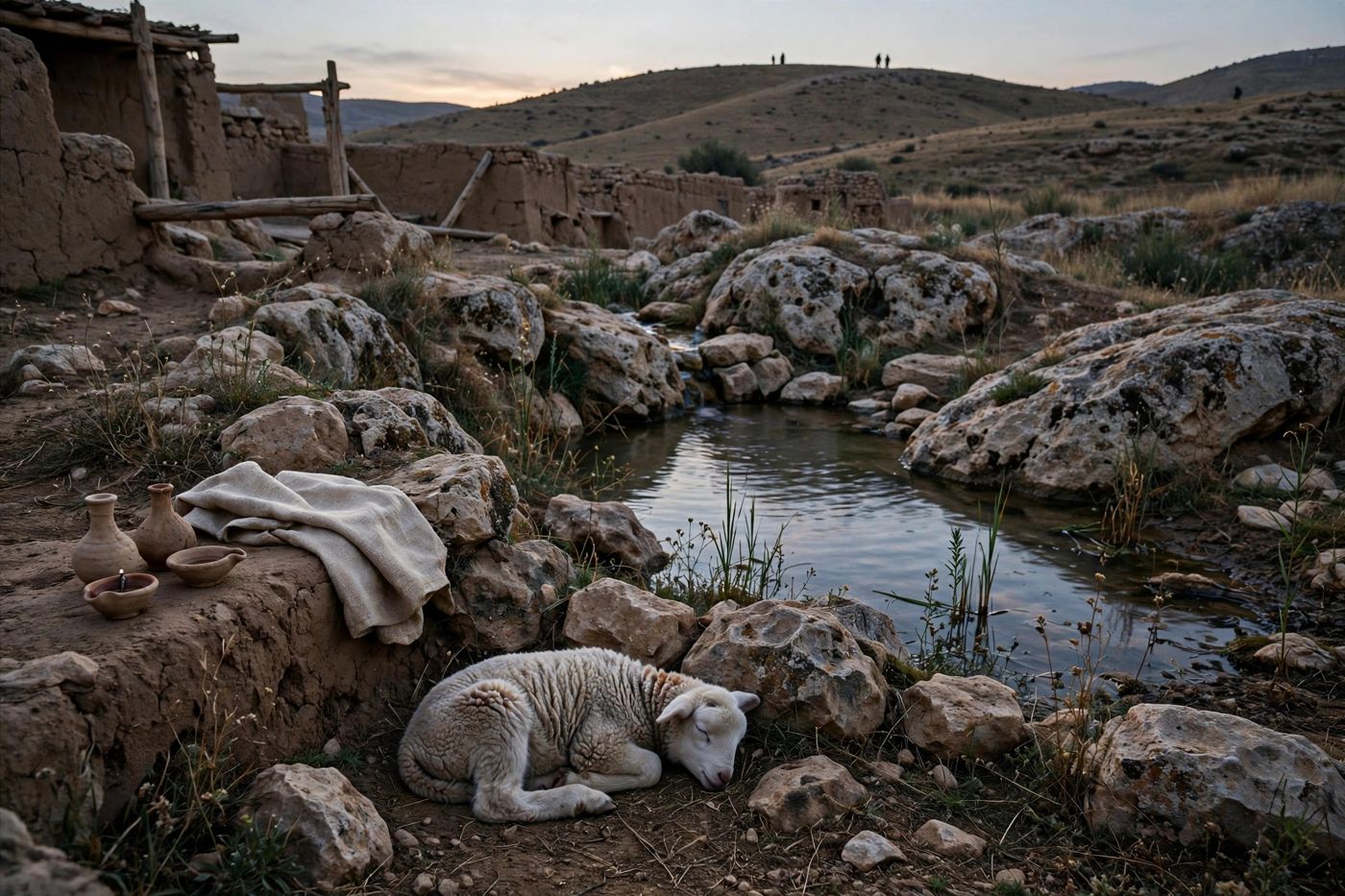
Now the picture widens from the courtroom to the whole created order, in a series of impossible tableaus: "The wolf also shall dwell with the lamb" — predator lodging with prey, not passing it on the road but dwelling with it; the leopard lying down with the kid; calf, young lion, and fatling in one pen, "and a little child shall lead them" (v. 6). The cow and the bear feeding side by side, their young lying down together; the lion — the lion! — eating straw like the ox (v. 7). And the picture rests on the most vulnerable figure in any ancient scene: a nursing baby playing at the hole of the asp, the venomous snake, a weaned toddler putting his hand on the cockatrice' den (v. 8) — and nothing happens. No strike. No funeral. The whole animal kingdom's terror, from wolf down to snake, is dismantled pair by pair. [2, 52]
Read the images with both hands, the way §4 taught you. With one hand, take them seriously as creation-language: Isaiah is not describing nicer human manners in animal costume only — verse 9 grounds the peace in the whole earth filled with the knowledge of the LORD, and Isaiah 65:25 repeats the scene inside the promise of new heavens and a new earth, where Paul can later say that "the creature itself also shall be delivered from the bondage of corruption" (Romans 8:21). 1 The Bible's horizon for this text is a healed world, predators and prey included — the undoing of the curse's violence at the root. With the other hand, take the order seriously: the peace follows the King. It is not achieved; it is reigned into being — "in all my holy mountain" (v. 9), radiating outward from Zion until the knowledge of the LORD covers the earth "as the waters cover the sea" — totally, to the bottom, with nothing dry left over. The reason clause is the doctrine: for the earth shall be full of the knowledge of the LORD. Peace is not the cause of that knowledge; it is the consequence of it. Where God is known as He is, nothing hurts or destroys. [4, 52] Hold that order — King first, then peace; knowledge first, then safety — because the Misread section will lean on it.
The banner to the nations, and the second exodus (11:10–16)
Verse 10 turns the camera from the King's court to the whole world: the root of Jesse stands as an ensign (§5), "to it shall the Gentiles seek: and his rest shall be glorious." Two shocks in one verse. First, the nations — the same nations that have spent eleven chapters as threats, Assyria at their head — are pictured seeking Israel's King, streaming to his banner of their own accord. Second, what the King offers them is "rest" — glorious rest, the settled sabbath of a reign with nothing left to fear. Paul's use of this verse (§6) is no apostolic stretch; it is the verse's own plain direction, read aloud in a church where it was visibly happening. [1, 4]
Then verses 11–16: the regathering, told at maximum scale. God sets His hand to recover the remnant "the second time" — the first time was Egypt, and the comparison is explicit at the end (v. 16). From the whole compass of exile addresses (§2), the outcasts assemble and the dispersed are gathered (v. 12). And the homecoming heals the family's oldest fracture: "Ephraim shall not envy Judah, and Judah shall not vex Ephraim" (look at v. 13 again). The divided kingdom comes home as one people, and together (v. 14) they face their old neighbours from a unity neither kingdom ever managed alone. [2, 12] The route home is pure exodus, enlarged: the tongue of the Egyptian sea destroyed, the great river — the Euphrates, Assyria's river — smitten into seven streams and crossed "dryshod," and "an highway for the remnant" where the sea-road was (vv. 15–16). Highway is one of Isaiah's signature images — a raised, prepared road through impossible country: the homecoming here, God's own coming in 40:3, holiness in 35:8. [1, 52] God's people have never gotten home by their own navigation. He builds the road; He dries the river; He raises the banner. Their part in verses 11–16 is to be gathered.
Chapter 12: the sermon series, sung back
Do not let the chapter break fool you into treating chapter 12 as an appendix. In form and in spirit, it is the response the whole first movement of Isaiah (chapters 1–12) has been aiming at: judgment preached, the King promised — and now the rescued people, scripted in advance, sing. [2, 12] Its opening is personal: "thou wast angry with me, thine anger is turned away, and thou comfortedst me" (12:1). The singer does not deny the anger — Isaiah's God really was angry at real rebellion. The song stands on the far side of it: anger turned away, comfort given, and the double name of God in verse 2 — "the LORD JEHOVAH," the covenant Name doubled for emphasis — confessed as "my strength and my song." Then the well: salvation as water you draw, with joy, daily — not a reservoir you admire but a supply you live from (12:3). And the song turns outward: declare His doings, make mention that His name is exalted, sing it until it "is known in all the earth" (12:4–5), and shout it at home in Zion, for the reason that sums up the passage: "great is the Holy One of Israel in the midst of thee" (12:6). 1 Presence is the final doctrine. Not a King at a distance — the Holy One, great, in the midst of His people. Everything the shoot grew toward comes to rest there.
The Christ Thread
This passage earns the thread openly, and the New Testament does the tying. Isaiah's shoot is from David's family, anointed with the resting Spirit, judging in righteousness, gathering the nations under his banner — and the New Testament's testimony about Jesus answers item for item: born of David's line, of Jesse's house through Bethlehem (Matthew 1; Luke 2; Micah 5:2); the Spirit descending and abiding on Him at the Jordan (John 1:32–33); His claim that the Spirit of the Lord was upon Him for the poor (Luke 4:18–21); Paul's capstone quotation of this passage (Romans 15:12); His self-naming as "the root and the offspring of David" (Revelation 22:16). 1 FACT as to the texts and their correspondences. POSITION — the church's historic confession, held by this course: in Jesus of Nazareth, the shoot of Jesse has come; the King of verses 3–5 has begun to reign; and the full peaceable kingdom of verses 6–9 awaits His consummation of all things. That "already begun, not yet finished" shape is not a hedge. It is how the New Testament itself holds Isaiah 11 — the banner already raised and the nations already streaming (Romans 15), the wolf and the lamb not yet lying down together (Romans 8:19–21), both true at once, in one canon. [1, 4]
Where in the Covenant Story?
Under the covenant with David — that is this passage's home address. The Abrahamic promise explains the Gentiles at the banner; the Mosaic covenant explains the judgment that felled the tree and the exodus pattern of the homecoming; but the shoot, the throne, the righteous King, and the endless rest are Davidic through and through — 2 Samuel 7's oath, surviving its own dynasty. [1, 12] And the passage stretches that covenant to its full canonical size: what was promised to one house in Jerusalem becomes the Holy One great in the midst of a people gathered from the four corners of the earth, with the nations seeking their King. The covenant story's direction has always been that way — particular in its root, universal in its fruit.
Father, Son, and Spirit
Here the passage does earn a careful word. The Father — "the LORD," "the Holy One of Israel" — is the great Actor: He fells the forest, sets His hand the second time, smites the sea, and is confessed in the song as salvation itself. The Spirit is named at the King's anointing in the fullest Old Testament portrait of His endowment: resting, characterising, delighting the King in the fear of the LORD. The Son is present by promise and portrait rather than by appearance, as in Lesson 02: the shoot, the root, the ensign-King, read by the apostles as Jesus (§6). A reader trained by the whole canon can already trace the shape: the God who decrees and gathers, the King who comes and judges, the Spirit who rests and equips. That is as far as this passage, honestly handled, lets us go — and it is far enough to worship from. [2, 4]
The Long View — what the church has believed
You are not this passage's first reader. The early church read Isaiah whole as one prophet's witness to Christ 37, and chapter 11 stood near the centre of its messianic reading: Jerome treats the shoot of Jesse and the resting Spirit as the King's portrait, and the Latin church's Advent liturgy sang verse 10's root into its famous antiphons — "O Root of Jesse, standing as an ensign of the peoples" — prayed every December for centuries. 37 Calvin lingers on the same realism: the kingdom advances from contemptible smallness, a shoot and not a cedar, and the church must not despise the day of small growth. 36 Where the centuries have honestly divided is the timing and texture of verses 6–9 and 11–16: a renewed creation at Christ's return (the historic majority reading, and this course's POSITION), a golden age of the gospel within history, or — in much modern critical reading — an exalted hope for Israel's restoration after exile, with the animal peace as pure picture. [2, 9] Blenkinsopp's critical commentary stands in the registry for that third reading at full strength 9 — cited here so the division is faced, not hidden. The centre has held across all of it: the King is God's, the judgment is righteous, the gathering is God's act, and the end of the story is a song. The argument has only ever been about the calendar.
That is the payload. The next section compresses it into the one sentence you are meant to carry out of this study.
8. THE AIM SENTENCE — X: eXplain the intent
Everything observed now compresses into one sentence — the author's intended meaning, stated before any application is allowed near it:
From the felled stump of Jesse's house, God raises a King on whom His Spirit rests in full — a King who judges the poor with righteousness and the wicked with the breath of His mouth, makes a world where nothing hurts or destroys, gathers His scattered people home in a second exodus and the nations to His banner — and the rescued answer Him in song: God is my salvation, and I will not be afraid.
If a sermon, a post, or a devotional uses Isaiah 11:1–12:6 to say something that cannot be traced back to that sentence, it is not this passage talking. That is the whole skill this course exists to build — and the next section is where you watch it work.
9. SAY IT BACK
Close the book and say the AIM sentence from section 8 in your own words — out loud, or written in your notes, without looking. Then say, in one more sentence, what it asks of you this week.
If your version quietly changes the meaning — if the stump becomes a slogan about your own comeback, or the peaceable kingdom a poster with the judgment cut off, or chapter 12's song mere decoration — open the lesson and walk it again. This exercise feels small. It is the entire course in miniature: meaning first, in the author's words become your words, then — and only then — your life.
10. THE MISREAD — the guardrail, with verdicts
Three live misuses of this passage. Each gets a fair hearing, the evidence, and a verdict.
Misread 1: "The peaceable kingdom is a programme the church can manufacture politically now — if we build the right society, we fulfil Isaiah 11." Why it sounds right: the vision is of a real world really at peace, and the church is commanded to be peacemakers; it feels like unbelief to postpone what God has pictured. The evidence: the passage assigns the agency, and it is not ours. The peace of verses 6–9 flows from the reign of one Agent — the shoot of Jesse, who first judges the wicked with the breath of his mouth (v. 4) — and it is grounded in a condition no policy produces: the earth full of the knowledge of the LORD (v. 9). This is the same discipline Lesson 02 required at the plowshares (2:4): there, disarmament followed God's exaltation; here, creation's peace follows the King's judgment and universal reign. The church's honest relation to the vision now is witness at the banner, and peacemaking that is proleptic — a foretaste performed in advance, real but partial — while the consummation, predators and all, remains the returning King's work (Romans 8:19–21; Isaiah 65:25). [1, 2] Verdict: right longing, wrong manufacturer. Isaiah 11 gives the church a hope to proclaim and a foretaste to practise, not a kingdom to construct. Programmes that claim this passage as their charter have quietly replaced the Branch-King with themselves.
Misread 2: "Chapter 12 is a decorative appendix — a nice hymn tacked on after the real prophecy ends at 11:16." Why it sounds right: the oracle's momentum does seem to crest at the highway of 11:16; chapter 12 changes voice, tense, and form, and skimmers feel the drop. The evidence: the form change is the point. Chapters 1–12 preach judgment and promise the King; chapter 12 hands the rescued people their scripted response — "thou shalt say" — in the form of Israel's thanksgiving psalms, with the exodus song of Exodus 15 quoted inside it (§6). [1, 2] It does for Isaiah's first great movement what a congregation's sung amen does for a sermon: the first of Isaiah's songs sung back to God by the people the sermons were about. Cut it, and the passage loses its destination — for Isaiah, the end of salvation is not information about God but a people drawing water with joy and shouting that He is great in their midst (12:3, 6). Verdict: not an appendix but the aim. A rescue that never becomes a song has not yet arrived where Isaiah is taking it.
Misread 3: "Verses 6–9 are a children's poster — sweet animal pictures for the nursery wall, with nothing to do with judgment." Why it sounds right: the verses really have decorated a thousand nurseries, and the pictures really are tender. Tenderness, flattened, photographs well. The evidence: the same King who makes the peace is the King of verse 4, whose mouth slays the wicked — the kingdom is safe for children at the asp's hole because violence has been judged and removed, not because violence was never real. Nor is the imagery trivial: it is creation-wide (wolf, leopard, lion, bear, asp), grounded in the earth-filling knowledge of the LORD (v. 9), and weighty enough for Isaiah to re-preach it in the new-creation chapters (65:25) and for Paul to gather creation's liberation into the same hope (Romans 8:21). 1 The nursery wall is not wrong to hang it; it is wrong to hang it alone, with verses 3–5 trimmed off the print. Verdict: keep the poster, restore the frame. Isaiah 11's peace is tender and judicious — a healed creation under a King who first judged righteously — and either half, cut from the other, is no longer this passage.
| Misread | The passage's own answer, in one line |
|---|---|
| The kingdom as our political programme | The Branch-King makes the peace, after judgment (11:4), on a ground no policy produces (11:9) |
| Chapter 12 as decorative appendix | It is the scripted song of the rescued — the sermons' destination (12:1, 4) |
| Verses 6–9 as a children's poster | Tender, yes — inside the frame of the King's righteous judgment (11:3–5) |
11. FROM WORD TO WALK
A reflection page — the lesson is not finished until the passage has had its say with you.
Spend a moment at the stump. Most of us do our spiritual accounting by height: what is standing, what is impressive, what can be seen from the road. Isaiah 11 begins God's greatest announcement at ankle height. If there is a part of your life that looks felled — a family line, a calling, a hope you watched come down under a saw you did not choose — this passage does not insult you by calling the stump a tree. It tells you where God characteristically works: in the roots, underground, at a pace no crowd applauds. The shoot was alive in the stem while everyone with eyes was measuring firewood.
And sit with the King's way of seeing, because it is meant to search you. He does not judge by the sight of His eyes or the hearing of His ears. We do — constantly: the screenshot, the rumour, the first ninety seconds. The Spirit-rested King breathes the fear of the LORD the way we breathe air, and so He perceives truly, defends the poor who cannot impress Him, and cannot be spun. Pray this week for His eyes — not sharper suspicion, but His kind of sight: slow to sentence, quick to see the meek person's actual case.
Then let the passage finish where it finishes — not with your resolve, but with a song you are handed. Chapter 12 is written for people who know they were objects of anger and recipients of comfort, and its first move is not effort but trust, stated out loud, against fear. Isaiah even gives you the well to come back to daily: salvation here is not a puddle you visited once, but water drawn with joy, again and again. Learn the song before you feel like singing it. That is what it is for.
Holy One of Israel — You were angry with me, and Your anger is turned away, and You have comforted me. Teach my heart the stump's arithmetic: nothing of Yours is finished while the roots are Yours. Give me the King's eyes for the people I am tempted to judge by surfaces, the King's rest while I wait for the world You promised, and a voice for the song — God is my salvation; I will trust, and not be afraid. Be great in the midst of me. In the name of the Root of Jesse, Jesus, amen.
12. FOR DISCUSSION — OR FOR YOUR JOURNAL
With a group, work these aloud. Alone, they're yours — answer them in your journal or in prayer; they lose nothing in the quiet.
- God restarts the dynasty from Jesse — the father, the farm, the roots — rather than from David's throne. Where in your own life or family have you been watching the branches when God was working in the roots?
- The King's justice names the poor and the meek as its first beneficiaries (11:4). What would change in your church, your workplace, or your own judgments if the powerless person's case reliably went first?
- Chapter 12's song is scripted in advance of the rescue it celebrates — written for people still standing in chapters 1–11. What does it do to a believer to learn the song of deliverance before the deliverance is visible?
- Which of the three Misreads (§10) have you heard most often — or believed? What in the passage itself answers it most directly?
13. THE WALK-OUT — T: Transfer to today
Meaning is settled. Now — and only now — application, and it must cross the bridge honestly. Run the five Transfer Tests on this passage:
- Same covenant? The promise is Davidic, spoken to Judah under the old covenant; we receive it in Christ, in the new covenant. The King's identity crosses entire; the passage's national-political frame (v. 14) belongs to its ancient setting and does not transfer as anyone's foreign policy.
- Same audience? The song of chapter 12 is scripted for the rescued remnant; the church sings it now as those rescued in Christ, and will sing it without remainder at the consummation. Both tenses are in the text; neither may be dropped.
- Same genre rules? Prophetic vision at full stretch: it yields confidence, character, and practice — not timetables, not policy platforms, not a claim that any present peace is verses 6–9 fulfilled.
- Repeated or rooted? Trust without fear (12:2), God's defence of the poor (Psalms 72; James 1–2), reconciliation of divided peoples in one King (Ephesians 2:14–16), creation's coming liberation (Romans 8) — each reappears across the canon, rooted in God's character. These cross.
- Ten verses either side? Every application below is drawn from this passage read whole — stump to song. Nothing hangs on the lamb alone, with the rod trimmed away.
What crosses — and lands:
- God has acted first — that is the ground of everything below. A stump was not the end, because the roots were God's; the King has come, endowed and reigning; the banner is already raised and the nations already gather (Romans 15). Application begins as trust (12:2) — the indicative, God's act — and only then becomes anything you do. Isaiah's order is load-bearing: first the shoot, then the song, then your week.
- Judge cases the King's way. Not by sight of eyes or hearing of ears: slow down verdicts on people until you can ask His questions — what is actually true here, and who here is poor in power? Righteousness and faithfulness as a belt means integrity worn where strength and feeling sit: the same person in the meeting and in the corridor.
- Practise foretaste-peacemaking, honestly labelled. The church cannot manufacture verses 6–9 (§10, Misread 1) — and is not excused from resembling them. Reconciled tables, feuds ended like Ephraim and Judah's (v. 13), safety made for the smallest — these are signs performed in advance of the King's world, and they preach precisely because they are foretastes and not the feast.
- Draw water daily. Salvation as a well, not a memory (12:3): trust is a practice of return — Scripture, prayer, and the song said aloud — especially on the days fear arrives first. "I will trust, and not be afraid" is a decision the rescued rehearse, not a feeling they wait for.
Practices — what the gate lets through, made concrete this week:
- The stump inventory. Twenty quiet minutes. Name one felled thing in your life — honestly, without dressing it up as a tree. Then write, beside it, what is still true underground: God's oath, His past faithfulness, the roots you cannot see growing. Pray from the roots, not from the height.
- One case, re-judged. Choose one person you have assessed by sight or hearsay this month. Before the week ends, learn one true thing about their actual situation — a question asked, a conversation had — and let it revise the verdict. Defend the person in the room with the least power to answer back.
- One ended envy. Ephraim and Judah's feud ended at the homecoming (v. 13). Name one standing division — family, church, old friend — and take the first step that is yours: the message, the invitation, the apology that does not grade theirs first.
- Sing chapter 12 aloud. Once this week, read 12:1–6 out loud, slowly, as your own words — it was scripted for exactly that use — and memorise 12:2 (it waits in the Recap Card).
- Stand at the banner for someone far off. Pray by name for one person who seems furthest from home — and, where God gives the opening, be part of the road: an invitation, a meal, a ride to church.
What does not cross: claiming the peaceable kingdom as a present political achievement or a party's platform; treating verse 14's ancient spoils as any modern nation's orders; reading the stump as a promise that every personal loss will regrow on your timetable — the promise is a King, not a mechanism, and His calendar is His.
Praise Him
Behold — God is your salvation; say it the passage's way, as praise and not as theory. The forest fell and the shoot rose; the sea split and the wells filled; the divided came home under one banner. Great is the Holy One of Israel — not far off, not finished with you — in the midst of thee. Trust, and do not be afraid: the Root of Jesse is standing, his rest is glorious, and the earth he is filling with the knowledge of the LORD includes, at the last, the ground you are standing on.
14. THE RECAP CARD — this study on one page
Print it. Keep it where you'll see it this week.
- The passage: Isaiah 11:1–12:6 — a shoot from Jesse's stump; the Spirit-rested King; the peaceable kingdom; the second exodus; and the song of the rescued.
- Say It Plain: The dynasty is cut to a stump, and out of the stump God's King grows — full of the Spirit, judging the poor with righteousness, making a world where nothing hurts or destroys, gathering the scattered home and the nations to His banner — and the rescued sing: God is my salvation.
- The AIM: From the felled stump of Jesse's house, God raises a King on whom His Spirit rests in full — a King who judges the poor with righteousness and the wicked with the breath of His mouth, makes a world where nothing hurts or destroys, gathers His scattered people home in a second exodus and the nations to His banner — and the rescued answer Him in song: God is my salvation, and I will not be afraid.
- Key terms: netser — the Branch, a shoot from a cut stock (not Lesson 02's semach) · the stem of Jesse — the dynasty reset to its roots, before the throne · nes — an ensign, a banner raised for the scattered to rally to · the Spirit's three pairs — wisdom and understanding; counsel and might; knowledge and the fear of the LORD.
- The Misread, in one line: The peaceable kingdom is the King's work to proclaim and foretaste, not ours to manufacture · chapter 12 is the aim, not an appendix · the poster keeps its frame: the same King's mouth that slays the wicked makes the peace.
- Memory verse: "Behold, God is my salvation; I will trust, and not be afraid: for the LORD JEHOVAH is my strength and my song; he also is become my salvation." — Isaiah 12:2
- This week's practice: the stump inventory — one felled thing named honestly, prayed over from the roots — and one case re-judged the King's way, by truth instead of surfaces.
15. CHECK YOURSELF — five questions
Answer from the study, not from instinct. (Answers live in the Teacher Edition.)
- In your own words: what is the AIM of Isaiah 11:1–12:6?
- Why does the promise name the stem of Jesse rather than the throne of David — and what does the stump tell you about how God restarts what He has promised?
- Count the Spirit's endowment in 11:2 honestly: what does the Hebrew text present, what does the Greek tradition count, and why does the lesson say the fullness matters more than the arithmetic?
- Someone says, "Isaiah 11 is the church's political programme — our job is to build the peaceable kingdom now." Give the passage's own answer: who makes the peace, out of what prior act, and what is the church's honest part meanwhile?
- Why is chapter 12 not an appendix? Name two things it does that the passage would lose if it were cut.
16. GO DEEPER
Optional — for readers who want the machinery. The lesson is complete without it.
From the Sources — A banner the nations were already reading
In Isaiah's world, standards and signal-fires were how scattered peoples and armies found their rallying point, and Isaiah spends the image across his whole book — God lifting an ensign to whistle nations in for judgment (5:26), setting up His standard to carry Israel's sons home (49:22). [1, 52] FACT. Set 11:10–12 within that pattern and the picture sharpens: the God who once raised a banner to summon empires now raises, as the banner itself, a person — the root of Jesse — and the traffic reverses: not nations marched in under compulsion, but peoples seeking (11:10), sons carried home (49:22). INFERENCE — the texts and the image-field support it, and the Dictionary of Biblical Imagery traces the banner and highway fields through the canon in this connected way 52 — which is why Paul, proving Gentiles belong at the banner, needed no argument beyond quoting the verse (Romans 15:12). 1
The Honest Argument — When is the peaceable kingdom, and whose is it?
The church has argued this passage's calendar for centuries, and the argument deserves daylight. Reading one — consummation at Christ's return: verses 6–9 describe the renewed creation itself, of a piece with Isaiah 65's new heavens and new earth, which quotes this scene. This is the historic majority reading and this course's POSITION. Reading two — a gospel age within history: the peace describes the church age's transforming spread, the animal imagery picturing a reconciled humanity. Held by serious readers; its strength is the New Testament's "already" (§7), its difficulty is verse 9's totality — the knowledge of the LORD does not yet cover the earth as the waters cover the sea. Reading three — the critical reading: the oracle is an exalted hope for Israel's restoration in the Persian or post-exilic age, its peace the poetry of national longing rather than prediction of a coming King. 9 Its strength is attention to the ancient setting; its difficulty is the passage's own excess — no restored province ever matched verses 6–9, and Paul reads the root of Jesse as a living ruler over the Gentiles (Romans 15:12). 1 What no reading may do is reassign the agency: on every honest reading the peace is God's act; the disagreement is over God's schedule. DISPUTED as to timing; the passage's centre — King, judgment, gathering, song — is not.
| Reading | When is the peace? | Its strength | Its difficulty |
|---|---|---|---|
| Consummation (course POSITION) | At Christ's return, in a renewed creation | Matches 65:25 and v. 9's totality | The New Testament's "already" (Romans 15) |
| Gospel age | Spread within history through the gospel | Takes the "already" at full weight | Verse 9's earth-covering completeness |
| Critical / restoration hope | An exalted hope for post-exilic Israel | Attends to the ancient setting | No restoration ever matched vv. 6–9; Paul reads a living King (Romans 15:12) |
The Word Underneath — netser, and the town called Branch
Follow Isaiah's word one step further, with the labels on. Netser is a rare word: a shoot, a descendant, a thing watched over and kept — its root carries the sense of guarding, so that some readers hear in it "the kept shoot," the dynasty preserved inside the stump. [19, 21] FACT as to the word's range. Then the tradition §5 flagged: Nazareth. The town's name most plausibly derives from the same root, and Matthew 2:23 says Jesus' settling there fulfilled what was spoken "by the prophets" — plural, no single verse cited — "He shall be called a Nazarene." 1 Generations of readers have heard the pun: the Netser raised in Netser-town. INFERENCE, and a beautiful one — but the label stays on it, because Matthew's plural may gather a theme (the despised, lowly shoot) rather than one quotation, and this King's identity stands on plainer texts (Romans 15:12; Revelation 22:16) and needs no pun to hold it up. [1, 4] The word underneath is a window, not a foundation. Enjoy the view; build on the rock.
Go Read
- Oswalt, The Book of Isaiah, Chapters 1–39 (NICOT) 2 — the fullest evangelical walk through chapter 11's King and chapter 12's song, with the Assyrian-period world kept in view.
- Motyer, The Prophecy of Isaiah 4 — on the book's structure and refrains; his reading of chapters 11–12 as the first movement's crown is the one this lesson's shape leans on.
- Seitz, Isaiah 1–39 (Interpretation) 12 — a theological reading alert to the book's editorial shaping and its Zion theology; strong on how chapters 1–12 gather into one argument.
- Ryken, Wilhoit & Longman (eds.), Dictionary of Biblical Imagery 52 — the banner, highway, and branch image-fields traced across the whole canon.
17. SOURCES & REFERENCES
Numbered citations in this lesson key to this list — the course standard: every sourced claim carries its number, and every number can be checked.
-
The KJV text itself — Holy Bible, King James Version (eBible.org KJV, 1769 text). Scripture quotations are from the King James Version (KJV), which is in the public domain in the United States; the full passage is always assigned as reading. Cross-references within Scripture cite this number.
-
Oswalt, The Book of Isaiah, Chapters 1–39 (NICOT) — John N. Oswalt (Eerdmans). The leading evangelical commentary on the first half; defends essential unity of authorship and reads the book as a finished theological whole. Detailed notes on the Assyrian-period history (Ahaz, Hezekiah, Sennacherib).
-
Motyer, The Prophecy of Isaiah — J. Alec Motyer (IVP). A one-volume commentary by an evangelical scholar who argues the whole book breathes the mind of the eighth-century prophet; especially strong on the book's structure, its repeated refrains, and the Servant.
-
Blenkinsopp, Isaiah 1–39, Isaiah 40–55, Isaiah 56–66 (Anchor Bible) — Joseph Blenkinsopp (Doubleday). Mainstream-critical commentary across all three traditional divisions; a fair statement of the multiple-authorship case and of post-exilic settings.
-
Seitz, Isaiah 1–39 (Interpretation) — Christopher R. Seitz (John Knox). A theological reading alert to the book's editorial shaping and to Isaiah's place in the canon; useful on Zion theology and on chapters 36–39 as the hinge.
-
Walton, Matthews & Chavalas, The IVP Bible Background Commentary: Old Testament — John H. Walton, Victor H. Matthews, Mark W. Chavalas (IVP). Verse-by-verse ancient Near Eastern background: Assyrian siege practice, Babylonian religion, treaty and coronation customs, geography.
-
VanGemeren (ed.), New International Dictionary of Old Testament Theology and Exegesis (NIDOTTE) — Willem A. VanGemeren (Zondervan). Theological word studies with semantic-range discipline for the Hebrew terms.
-
Brown, Driver & Briggs, Hebrew and English Lexicon of the Old Testament (BDB) — The standard older Hebrew lexicon; word senses and usage ranges for the Terms sections.
-
Koehler & Baumgartner, The Hebrew and Aramaic Lexicon of the Old Testament (HALOT) — The standard modern Hebrew lexicon; the control on BDB for contested senses (e.g., 'almah).
-
Harris, Archer & Waltke (eds.), Theological Wordbook of the Old Testament (TWOT) — Word studies from a conservative-evangelical hand; pastoral-theological range of key terms.
-
Biblia Hebraica Stuttgartensia (BHS) — The standard critical edition of the Hebrew text behind the modern translations, with its textual apparatus (the home of the Isaiah variants discussed in the Translation Notes).
-
The Septuagint (LXX) — Rahlfs–Hanhart edition. The ancient Greek Isaiah (2nd century BC): itself already one book of 66 chapters, and the Bible of the early church; its renderings (e.g., parthenos at 7:14) argued in the open where they matter.
-
Calvin, Commentary on Isaiah — John Calvin (public domain). Reformation exegesis; a control on interpretation and a voice in the Long View.
-
Jerome, Commentary on Isaiah — Jerome (c. AD 408–410). The early church's fullest Isaiah commentary; Jerome transmits the Hebrew learning of his day and treats Isaiah as one prophet's book.
-
Fee & Stuart, How to Read the Bible for All Its Worth — Gordon D. Fee and Douglas Stuart (Zondervan). The beginner's method book; its prophecy chapter ("a forthtelling first") undergirds the Genre sections.
-
Ryken, Wilhoit & Longman (eds.), Dictionary of Biblical Imagery — Leland Ryken et al. (IVP). Isaiah's image-fields — vineyard, highway, banner, potter, watchman — traced across the canon.