
One study, one walk — the universal FIRM format. The passage first and whole; then its world; then the Walk (Context · Observe · Genre · Terms · Entire Canon); the meaning taught straight; the AIM sentence; the misread exposed and answered; and the walk-out, where application has to pass the Transfer Tests before it reaches your week. The same skeleton serves a book, a chapter, a single verse, or a whole subject. In the early studies the moves are labeled as they happen. The labels fade as the walk becomes yours.
THE WEEK WITH THIS STUDY — six bites
Day 1 — Read the passage · Say It Plain · The World (§§1–2) · Day 2 — Observe · Genre (§§3–4) · Day 3 — Terms · Entire Canon (§§5–6) · Day 4 — The Meaning · the AIM Sentence · Say It Back (§§7–9) · Day 5 — The Misread · From Word to Walk (§§10–11 — add For Discussion, §12, if you're with others) · Day 6 — The Walk-Out · the Recap Card (§§13–14). Go Deeper (§16) any evening you want the basement.
BEFORE YOU READ — Open My Eyes
Lord, teach me to hear bad news about other people the way Your prophet heard it — with a heart that cries out, not a heart that claps. Quiet me with Your own stillness, the rest that watches and waits and acts in season. Open my eyes to what is actually here.
§ means “section” — the numbered parts of your lesson. Each bite above names the sections for that day.
1. READ THE PASSAGE — Isaiah 15:1–18:7 (KJV)
Read it all, slowly, before any teaching. In this course the passage always prints once, in full, at the head of the lesson. Everything after this is commentary — this is the text.
1 The burden of Moab. Because in the night Ar of Moab is laid waste, and brought to silence; because in the night Kir of Moab is laid waste, and brought to silence;
2 He is gone up to Bajith, and to Dibon, the high places, to weep: Moab shall howl over Nebo, and over Medeba: on all their heads shall be baldness, and every beard cut off.
3 In their streets they shall gird themselves with sackcloth: on the tops of their houses, and in their streets, every one shall howl, weeping abundantly.
4 And Heshbon shall cry, and Elealeh: their voice shall be heard even unto Jahaz: therefore the armed soldiers of Moab shall cry out; his life shall be grievous unto him.
5 My heart shall cry out for Moab; his fugitives shall flee unto Zoar, an heifer of three years old: for by the mounting up of Luhith with weeping shall they go it up; for in the way of Horonaim they shall raise up a cry of destruction.
6 For the waters of Nimrim shall be desolate: for the hay is withered away, the grass faileth, there is no green thing.
7 Therefore the abundance they have gotten, and that which they have laid up, shall they carry away to the brook of the willows.
8 For the cry is gone round about the borders of Moab; the howling thereof unto Eglaim, and the howling thereof unto Beer-elim.
9 For the waters of Dimon shall be full of blood: for I will bring more upon Dimon, lions upon him that escapeth of Moab, and upon the remnant of the land.
1 Send ye the lamb to the ruler of the land from Sela to the wilderness, unto the mount of the daughter of Zion.
2 For it shall be, that, as a wandering bird cast out of the nest, so the daughters of Moab shall be at the fords of Arnon.
3 Take counsel, execute judgment; make thy shadow as the night in the midst of the noonday; hide the outcasts; bewray not him that wandereth.
4 Let mine outcasts dwell with thee, Moab; be thou a covert to them from the face of the spoiler: for the extortioner is at an end, the spoiler ceaseth, the oppressors are consumed out of the land.
5 And in mercy shall the throne be established: and he shall sit upon it in truth in the tabernacle of David, judging, and seeking judgment, and hasting righteousness.
6 We have heard of the pride of Moab; he is very proud: even of his haughtiness, and his pride, and his wrath: but his lies shall not be so.
7 Therefore shall Moab howl for Moab, every one shall howl: for the foundations of Kir-hareseth shall ye mourn; surely they are stricken.
8 For the fields of Heshbon languish, and the vine of Sibmah: the lords of the heathen have broken down the principal plants thereof, they are come even unto Jazer, they wandered through the wilderness: her branches are stretched out, they are gone over the sea.
9 Therefore I will bewail with the weeping of Jazer the vine of Sibmah: I will water thee with my tears, O Heshbon, and Elealeh: for the shouting for thy summer fruits and for thy harvest is fallen.
10 And gladness is taken away, and joy out of the plentiful field; and in the vineyards there shall be no singing, neither shall there be shouting: the treaders shall tread out no wine in their presses; I have made their vintage shouting to cease.
11 Wherefore my bowels shall sound like an harp for Moab, and mine inward parts for Kir-haresh.
12 And it shall come to pass, when it is seen that Moab is weary on the high place, that he shall come to his sanctuary to pray; but he shall not prevail.
13 This is the word that the LORD hath spoken concerning Moab since that time.
14 But now the LORD hath spoken, saying, Within three years, as the years of an hireling, and the glory of Moab shall be contemned, with all that great multitude; and the remnant shall be very small and feeble.
1 The burden of Damascus. Behold, Damascus is taken away from being a city, and it shall be a ruinous heap.
2 The cities of Aroer are forsaken: they shall be for flocks, which shall lie down, and none shall make them afraid.
3 The fortress also shall cease from Ephraim, and the kingdom from Damascus, and the remnant of Syria: they shall be as the glory of the children of Israel, saith the LORD of hosts.
4 And in that day it shall come to pass, that the glory of Jacob shall be made thin, and the fatness of his flesh shall wax lean.
5 And it shall be as when the harvestman gathereth the corn, and reapeth the ears with his arm; and it shall be as he that gathereth ears in the valley of Rephaim.
6 Yet gleaning grapes shall be left in it, as the shaking of an olive tree, two or three berries in the top of the uppermost bough, four or five in the outmost fruitful branches thereof, saith the LORD God of Israel.
7 At that day shall a man look to his Maker, and his eyes shall have respect to the Holy One of Israel.
8 And he shall not look to the altars, the work of his hands, neither shall respect that which his fingers have made, either the groves, or the images.
9 In that day shall his strong cities be as a forsaken bough, and an uppermost branch, which they left because of the children of Israel: and there shall be desolation.
10 Because thou hast forgotten the God of thy salvation, and hast not been mindful of the rock of thy strength, therefore shalt thou plant pleasant plants, and shalt set it with strange slips:
11 In the day shalt thou make thy plant to grow, and in the morning shalt thou make thy seed to flourish: but the harvest shall be a heap in the day of grief and of desperate sorrow.
12 Woe to the multitude of many people, which make a noise like the noise of the seas; and to the rushing of nations, that make a rushing like the rushing of mighty waters!
13 The nations shall rush like the rushing of many waters: but God shall rebuke them, and they shall flee far off, and shall be chased as the chaff of the mountains before the wind, and like a rolling thing before the whirlwind.
14 And behold at eveningtide trouble; and before the morning he is not. This is the portion of them that spoil us, and the lot of them that rob us.
1 Woe to the land shadowing with wings, which is beyond the rivers of Ethiopia:
2 That sendeth ambassadors by the sea, even in vessels of bulrushes upon the waters, saying, Go, ye swift messengers, to a nation scattered and peeled, to a people terrible from their beginning hitherto; a nation meted out and trodden down, whose land the rivers have spoiled!
3 All ye inhabitants of the world, and dwellers on the earth, see ye, when he lifteth up an ensign on the mountains; and when he bloweth a trumpet, hear ye.
4 For so the LORD said unto me, I will take my rest, and I will consider in my dwelling place like a clear heat upon herbs, and like a cloud of dew in the heat of harvest.
5 For afore the harvest, when the bud is perfect, and the sour grape is ripening in the flower, he shall both cut off the sprigs with pruning hooks, and take away and cut down the branches.
6 They shall be left together unto the fowls of the mountains, and to the beasts of the earth: and the fowls shall summer upon them, and all the beasts of the earth shall winter upon them.
7 In that time shall the present be brought unto the LORD of hosts of a people scattered and peeled, and from a people terrible from their beginning hitherto; a nation meted out and trodden under foot, whose land the rivers have spoiled, to the place of the name of the LORD of hosts, the mount Zion.
SAY IT PLAIN — the passage in everyday words: God speaks judgment over three nations around Judah, in three different tones. Moab, east across the river, is destroyed in a single night — her towns howl, her refugees weep up the mountain road, and, strangest of all, the prophet weeps with her. Mixed into Moab's oracle is counsel — send tribute to Zion's king, shelter the fleeing outcasts — and a promise of a throne established in mercy. Then Moab's pride is named, her fields wither, and a date is set: within three years. Next, Damascus in the north-east stops being a city, and Israel's glory — Damascus's ally — thins down to almost nothing, like the last two or three olives left at the top of a beaten tree; in that thinning, a man finally looks to his Maker instead of his idols. Rumbling nations roar like the sea, God rebukes them, and by morning they are gone. Last, far-off Cush sends ambassadors in papyrus boats — probably hoping to recruit Judah — and God answers with stillness: He will rest, watch, and prune at exactly the right moment, and one day that same people will bring gifts to Mount Zion. That's the whole passage. Everything after this teaches from it — nothing will change what you just read.
2. THE WORLD — C: Context & Audience
A text can never mean what it never meant — so before we ask what these verses mean, we stand where their first hearers stood.
We are inside the oracles against the nations. Lesson 09 opened a great block of Isaiah — chapters 13–23 — in which the prophet turns outward and speaks, one after another, to the peoples around Judah. Each oracle opens with the same heavy word: "The burden of…" (15:1; 17:1) — a message that arrives like a load: weighty, unwelcome, impossible to set down lightly. Babylon got the first word (chs. 13–14). Now the camera swings to three smaller neighbours — for Isaiah's first hearers, the peoples on their roads, at their markets, in their wars — and, in Moab's case, in their family tree.
Moab: the kin across the river. Moab's land lay east of the Dead Sea, on a high plateau cut by the gorge of the river Arnon, her northern edge. The Moabites were, by Genesis's own account, descendants of Lot — Abraham's nephew — through Lot's elder daughter, whose son was named Moab (Genesis 19:37) 1. Hold that fact gently: Scripture tells the origin story without relish or mockery. Moab was not a stranger but distant family — family with a sore history beside Israel (Balaam hired to curse her, Numbers 22–24; years under Moab's king Eglon, Judges 3), and yet Moab also gave Israel Ruth, King David's great-grandmother, and sheltered David's parents when Saul hunted him (1 Samuel 22:3–4) 1. Enemy, oppressor, refuge, ancestress — Moab is all of those in the Bible's memory, and that mixed memory is part of why the prophet can weep over her without softening a syllable of her judgment [2, 4]. Moab was also sheep country: her king Mesha paid Israel tribute counted in lambs by the hundred thousand 1. Remember the sheep — chapter 16 opens with them.
Damascus: the ally who is dying on schedule. North-east of Israel stood Damascus, capital of Syria — Aram in Hebrew — head of the kingdom King Rezin ruled in Lesson 05 1. In Isaiah 7, Rezin and Pekah of Israel — called Ephraim, after Israel's largest tribe — allied to force Judah into their coalition against Assyria, the brutal, expanding empire far to the north-east that was swallowing small kingdoms one by one. God told Ahaz their plan would not stand. Chapter 17 is that promise arriving at its date: the commentaries agree the oracle belongs to the years of that alliance and its collapse under Assyria [2, 10, 14]. Verse 3 says it in one breath — fortress ceasing from Ephraim, kingdom from Damascus: ally and ally, named in one sentence, fall in one sentence.
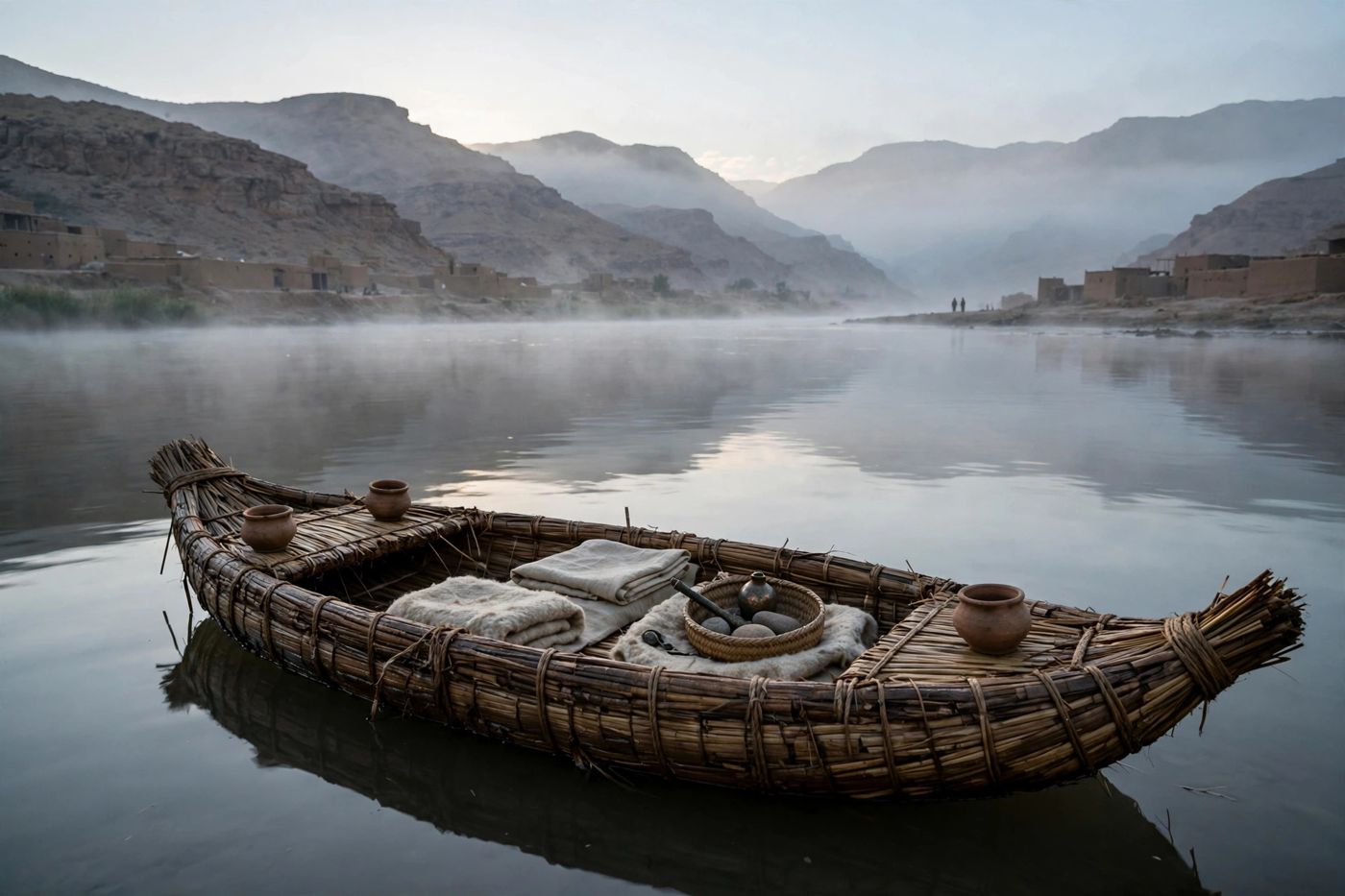
Cush: the far power down the Nile. Cush — Ethiopia in the KJV's geography — is the land "beyond the rivers of Ethiopia" (18:1): the upper Nile country south of Egypt, in the region of modern Sudan. In Isaiah's century Cushite kings had risen to rule Egypt itself, making distant Cush suddenly relevant to little Judah: a southern power that might be courted against Assyria [16, 10]. Its people are tall and formidable (18:2, 7). Their ambassadors travel "by the sea, even in vessels of bulrushes" (18:2) — light papyrus boats suited to the Nile. Whether this embassy came to Judah to recruit her against Assyria is not stated in the chapter; it is the natural reading in its setting, labelled INFERENCE [2, 10]. What the text does say is stranger: God is in no hurry about any of it.
And over all three, the shadow. Assyria is never named in these four chapters. She does not need to be: she is the unnamed instrument behind Moab's ruin and Damascus's fall, and very likely the chief of the roaring nations rebuked in chapter 17 (see §7). These oracles are God's word to a frightened kingdom about the three directions trouble could come from — east, north-east, far south — and about the one throne that is not frightened at all.
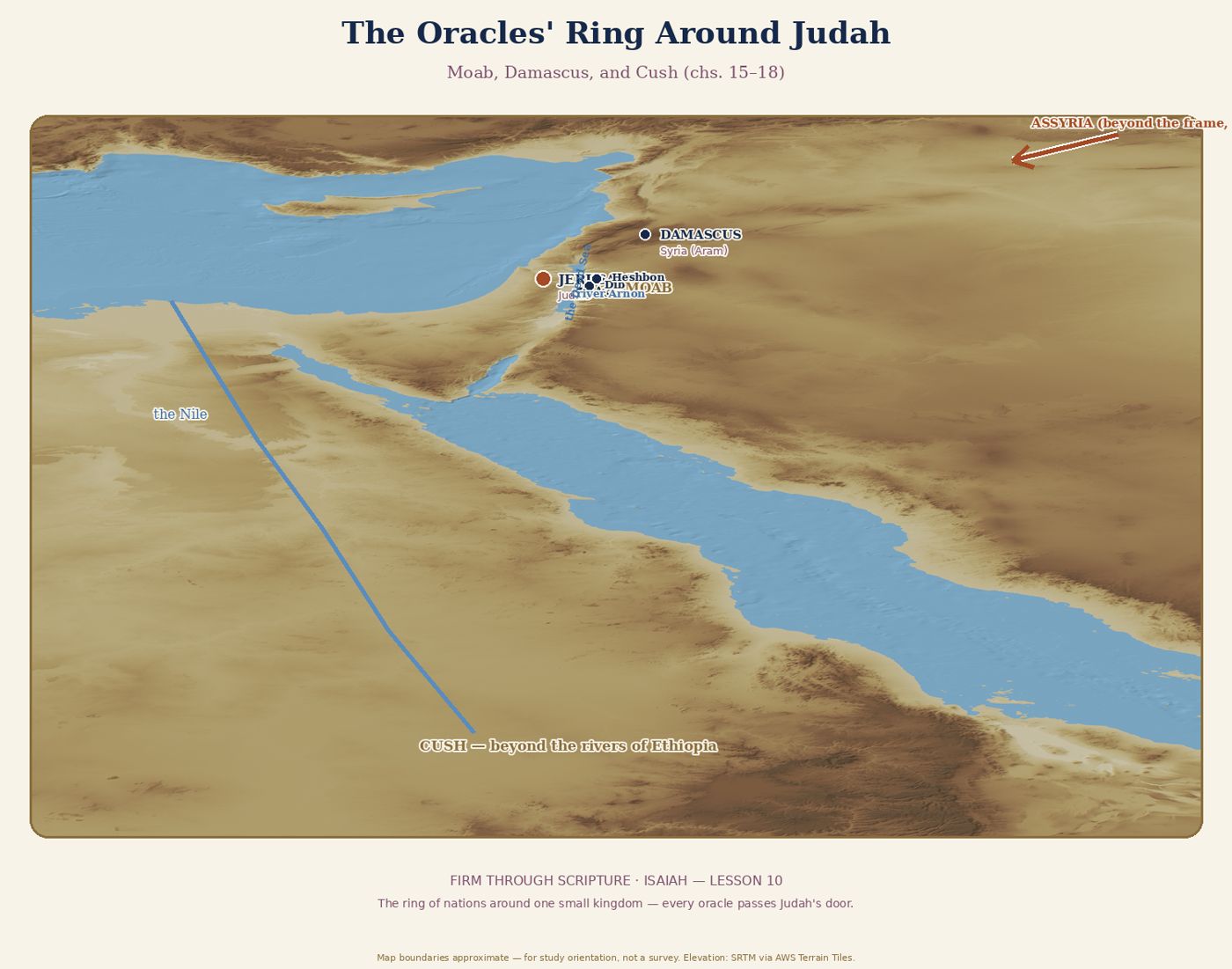
One more piece of the world: how a city mourned. Chapter 15 is full of grief customs a first-time reader can walk straight past: shaved heads and cut-off beards (15:2), sackcloth in streets and on housetops (15:3), public howling — the visible, bodily grammar of catastrophe in the ancient world, not private feelings kept indoors [53, 16]. When Isaiah piles town upon town — Ar, Kir, Dibon, Nebo, Medeba, Heshbon, Elealeh, Jahaz — he walks the reader down Moab's map like a funeral procession: every name a place where the howling is happening. Several also appear in Jeremiah 48 [1, 10].
That is the world. Now we open the text itself.
3. OBSERVE — O: what the text actually does
Before meaning comes observation. Most bad interpretation is not deep error; it is shallow reading — people answering a text they never actually looked at. So look:
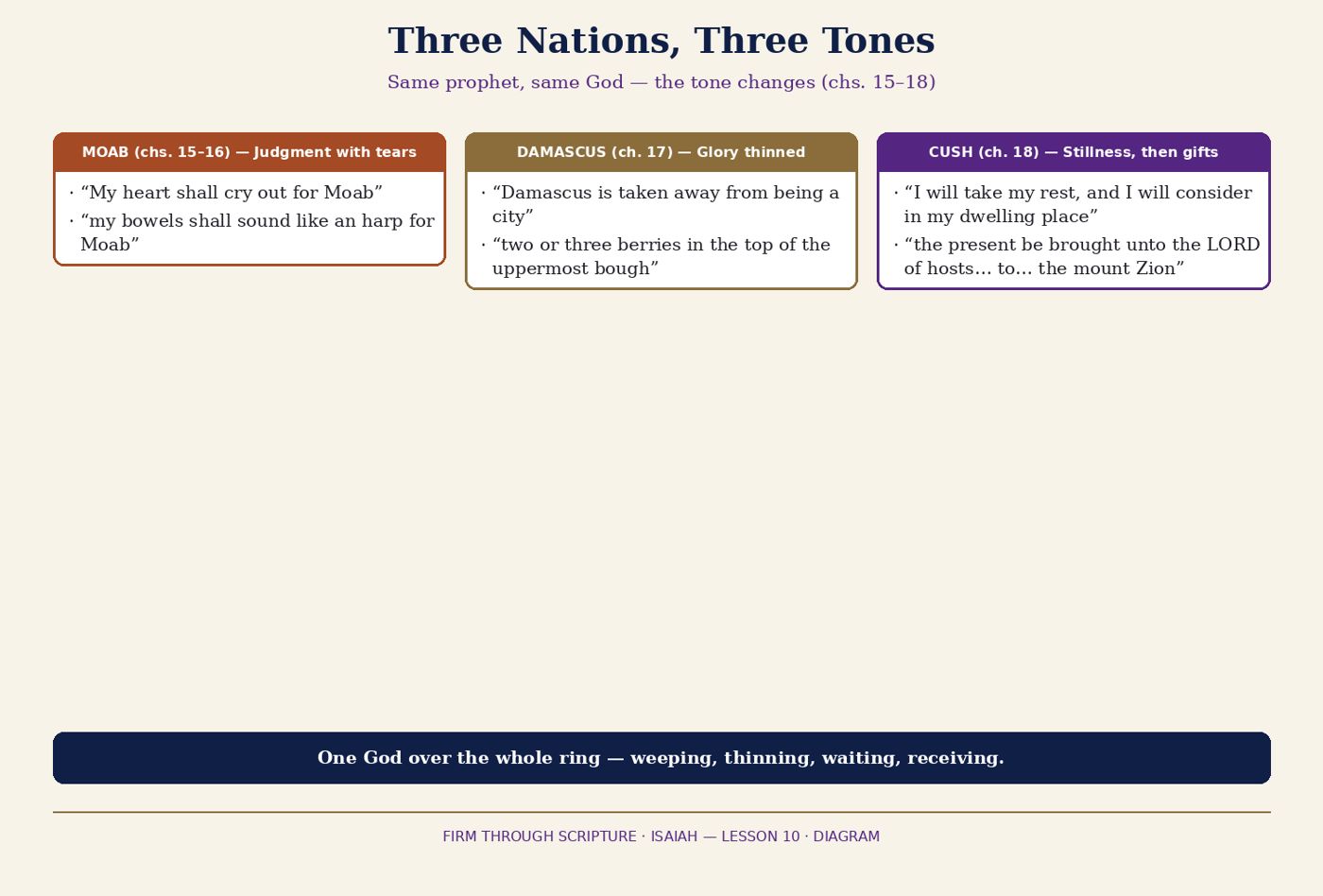
- The shape. Four chapters, three oracles, three tones — and the tones are the teaching. Moab (chs. 15–16) is the longest and most emotional: howling, then counsel, promise, pride, and tears. Damascus (ch. 17) is cooler and more pictorial: a city unmade, a body thinned, an olive tree beaten. Cush (ch. 18) is the shortest and quietest: seven verses, most of them about waiting. Length itself preaches.
- The speed of Moab's fall. Twice in the first verse: "in the night." Ar laid waste in a night; Kir silenced in a night. Empires in these chapters take years (16:14 will count them). Moab's strongholds take hours.
- The sound-words. Count the noise. Moab shall "howl" (15:2, 3, 8); the cry goes "round about the borders" (15:8). In chapter 17 the nations "make a noise like the noise of the seas" (17:12). Against all that noise, set chapter 18: a God who will "take my rest, and… consider" (18:4) — the quietest sentence in the passage, and the most powerful. This passage is partly about volume: who is loud, and who does not need to be.
- The first person keeps breaking in. Oracles are usually God speaking about a nation. Here the speaker keeps stepping into the grief: "My heart shall cry out for Moab" (15:5); tears for Heshbon (16:9); "my bowels shall sound like an harp for Moab" (16:11). Whether those lines are the prophet's own heart or God's speech in the prophet's voice — the commentaries discuss both — the effect is the same: this judgment is delivered wet-eyed [2, 4, 10].
- A throne hidden inside Moab's oracle. Between a plea to shelter outcasts (16:4) and the naming of Moab's pride (16:6) stands a promise about a throne "in the tabernacle of David" (16:5). Easy to read past as scenery. Don't. In a passage about thrones falling — Damascus's kingdom ceasing (17:3) — one throne is "established," and its words are mercy, truth, judging, righteousness. §§6–7 follow that thread.
- The dates the text gives itself. Moab's glory is spent "within three years, as the years of an hireling" (16:14) — a term counted exactly (see §5). And the word has a history: the LORD spoke it "since that time"; "but now" He reissues it with a deadline (16:13–14). Prophecy here is not embarrassed to stand in time.
- The silences. Moab's invader is never named. Cush's ambassadors never deliver their message — we hear only God's answer. And Cush's oracle never pronounces her destroyed; it ends with her bringing a present to Zion. Observation does not fill silences with invention; it notices that the quietest oracle ends in worship.
4. GENRE — N: note the genre (oracles against the nations — prophetic poetry of judgment and lament)
These four chapters are oracles against the nations — a recognised prophetic genre in which God's spokesman addresses a foreign people directly, usually announcing judgment, with Judah listening in 51. Prophecy is forthtelling first: before it predicts anything, it speaks God's verdict forth into the present, naming a nation's actual sins in its actual moment 51. The oracles are also poetry — a harvest, a harp, a shaken olive tree, a sea, a pruning hook. Poetry in Scripture is not decoration on the truth; it is the truth carried in the form that lodges in memory.
This genre reads by its own rules:
- The addressee is not the only audience. God speaks to Moab, Damascus, and Cush — but for Judah, who hears every word. Each oracle quietly answers a Judahite temptation: envy that neighbour, fear that ally, court that power. Always ask: what is God saying to them — and why is He letting us overhear it?
- Judgment speeches name real sins. Nations are not condemned for existing, or for being foreign: Moab for pride (16:6), Jacob for forgetting the God of his salvation (17:10). The charges are moral and specific — verdicts, not mere power.
- Lament inside judgment is part of the genre's honesty. God takes "no pleasure in the death of the wicked" (Ezekiel 33:11) 1; Jeremiah's Moab oracle (Jeremiah 48) likewise mixes sentence and sorrow. Where a prophet weeps over the nation he condemns, the weeping is not a softening of the message. It is part of the message — it shows you the heart of the God who sent it.
- Images must be read as images. A body "made thin" (17:4), grapes left after shaking (17:6), nations as chaff (17:13) — governed pictures, exact in what they claim, not a coded timetable to be cracked. Read them at full force and no further.
5. TERMS — T: the words in the writer's mouth
Three expressions carry this passage, each drawn from ordinary working life — tribute, harvest, and a labour contract. Learn them in their own world:
- "The lamb" — tribute (16:1). "Send ye the lamb to the ruler of the land" is not a pet or a sacrifice. It is diplomatic language: send the tribute-payment, in the currency Moab was rich in. Moab was sheep country on an industrial scale — the historical books record King Mesha rendering Israel "an hundred thousand lambs" in tribute, with the wool of as many rams besides 1. A lamb sent "from Sela" — Moab's southern stronghold, usually identified with the region later called Petra — "unto the mount of the daughter of Zion" is a vassal's payment travelling to Jerusalem's king [16, 10]. In plain terms, verses 1–5 counsel: renew the old tribute, and shelter the refugees, because the throne in Zion is where mercy will be found. The word assumes Moab still has a choice, and a door still open.
- "Gleaning" (17:5–6). After the main harvest, what was left for the poor was the gleaning — ears and fruit the harvesters missed or were commanded to leave (Leviticus 19:9–10) [1, 53]. Isaiah spends the word twice: the harvestman gathers the corn, and what remains is stray ears; then an olive tree after the beating, branches struck to bring the fruit down: "two or three berries in the top of the uppermost bough, four or five in the outmost fruitful branches" (17:6). Gleaning, in Isaiah's mouth, is the Bible's agricultural word for a remnant: real, alive, genuinely fruit — and a fraction of what the tree carried in the morning. Almost nothing survives, but something does: the gleaning, not zero.
- "The years of an hireling" (16:14). A hireling is a hired labourer under contract for a fixed term — and the point is the term's exactness. A hireling counts his days precisely; his contract ends on the day written (compare Job's hireling who "looketh for the reward of his work") [1, 19]. So "within three years, as the years of an hireling" means three years exactly — not a round number for effect. The phrase turns a prophecy into a dated instrument, and Moab's remnant, when the term runs out, will be "very small and feeble" (16:14) — the gleaning again, with a date on it.
Method note — the word-study guardrail: a word means what its author uses it to mean, in its sentence, in its century — not what its oldest root once meant, and not everything it can mean anywhere. Each term above was settled by how working people in Isaiah's world sent tribute, gathered harvests, and served out contracts.
TRANSLATION NOTE — "Woe" to Cush, or "Ho!"? (18:1)
Your KJV opens chapter 18 with "Woe to the land shadowing with wings." The Hebrew word is hoy — and hoy has a wider range than our word "woe." It can be a cry of lament over the doomed, as in the six woes of chapter 5. But the same word can function as a summons — "Ho!" — a hail across a distance, calling someone to attention, as Isaiah 55:1 opens: "Ho, every one that thirsteth, come ye to the waters" 19. The versions and commentators divide on chapter 18: some print "Woe," hearing a threat; others note that the chapter pronounces no destruction on Cush at all — it ends with Cush bringing gifts to Zion (18:7) — and hear an address, even an invitation, to a far-off people called to watch what God is about to do (18:3) [2, 10]. Be honest about what is FACT: the Hebrew word carries both senses, and the KJV's choice is a choice. Which sense governs here is INFERENCE; this study reads the chapter's own ending as the tiebreaker — a word over Cush that finishes at Zion's altar is a summons with a warning inside it, not a funeral notice. Either way, the address is no permission to proceed with the alliance plans: God is hailing them to tell them to stand still and watch.
6. ENTIRE CANON — E: where this passage sits in the whole story
No passage lives alone. These chapters are a knot where several long threads cross — following them keeps Moab from being read as a nobody, Damascus as a stranger, and Cush as a rumour.
- Moab's thread runs the whole Bible. It begins with Lot and the son born in the cave (Genesis 19) 1. It darkens at Baal-peor (Numbers 25) and in the years under Eglon (Judges 3). Then it glows: Ruth the Moabitess clings to Naomi's God, and her name lands in the genealogy of David — and so of Jesus (Ruth 4; Matthew 1:5) 1. David entrusts his parents to Moab's king (1 Samuel 22:3–4); later come Mesha's tribute and revolt (2 Kings 3). The prophets return to Moab repeatedly — Jeremiah 48 in full, Ezekiel 25, Amos 2, Zephaniah 2 — and Isaiah returns in chapter 25 1. Laid out flat, the kinship looks like this:
| Moab in the story | The text | Which means… |
|---|---|---|
| Kin by birth | Genesis 19:37 — Lot's descendant | Not a stranger nation; distant family |
| Snare and oppressor | Numbers 25 · Judges 3 | A real record of harm against Israel |
| Refuge in danger | 1 Samuel 22:3–4 — David's parents sheltered | Moab once kept God's king's family alive |
| Ancestress of kings | Ruth 4 · Matthew 1:5 — Ruth in Jesus' line | Moabite blood in David's house — and the Messiah's |
- Damascus's thread is the alliance's thread. Damascus appears first as the place Abraham's steward came from (Genesis 15:2) and as a power David garrisoned (2 Samuel 8). In Isaiah she matters chiefly as half of the Syro-Ephraimite alliance of Lesson 05 — and chapter 17 is where Isaiah 7's word comes due: the two "smoking firebrands" go out together (17:3), exactly as the sign to Ahaz required [1, 2]. Amos opened his book against Damascus (Amos 1:3–5); Jeremiah 49 takes her up again.
- The throne thread runs straight to Christ. "In mercy shall the throne be established… in the tabernacle of David" (16:5). Isaiah grows the seed himself — David's heir of 9:6–7, the root of Jesse of 11:10 — and the New Testament takes it up: Gabriel tells Mary her Son will receive "the throne of his father David" (Luke 1:32), and James quotes Amos on David's rebuilt tabernacle to explain God visiting the Gentiles (Acts 15:16–17) 1. FACT: the New Testament reads David's throne and tabernacle as finding their standing in Jesus. This study invents no type here; it follows the apostles' own thread.
- Cush's thread ends at worship — repeatedly. An officer of Cush, Ebed-melech, rescues Jeremiah from the cistern when Jerusalem's own princes would not (Jeremiah 38) 1. Psalm 68 looks forward: "Ethiopia shall soon stretch out her hands unto God"; Zephaniah hears of suppliants from beyond Ethiopia's rivers bringing God's offering (Zephaniah 3:10) — Isaiah 18:7's gift, in another prophet's mouth. And in Acts 8, an officer of the Cushite queen's court is found reading Isaiah — chapter 53 — and goes on his way rejoicing, baptised [1, 4]. POSITION — the church's historic reading: Cush in Isaiah 18 is an early sighting of the ingathering of the far nations, which the gospel age displays.
7. THE MEANING — what the passage teaches
The Walk has established what the text says and where it sits. Now its payload, taught straight — three oracles, in their own order, at their own temperatures.
Moab in a night — and the prophet who weeps over her (15:1–9)
The first thing the Moab oracle teaches is the speed of the thing. Ar, Moab's chief city on the Arnon, and Kir, her fortress — "in the night… in the night" (15:1). No siege narrative, no campaign diary. A nation goes to bed a kingdom and wakes up howling. Then chapter 15 stays, and walks the grief town by town (15:2–8): shaved heads, sackcloth on the rooftops, Heshbon and Elealeh crying to Jahaz, armed soldiers undone — "his life shall be grievous unto him" (15:4) — the waters of Nimrim failed, the fugitives carrying what they saved south and out (15:6–7). And verse 9 refuses even the comfort of the story being over: the waters of Dimon are "full of blood," and God will bring more upon Dimon — "lions upon him that escapeth" 1. Escape itself will not rescue Moab. That is the judgment, undiluted
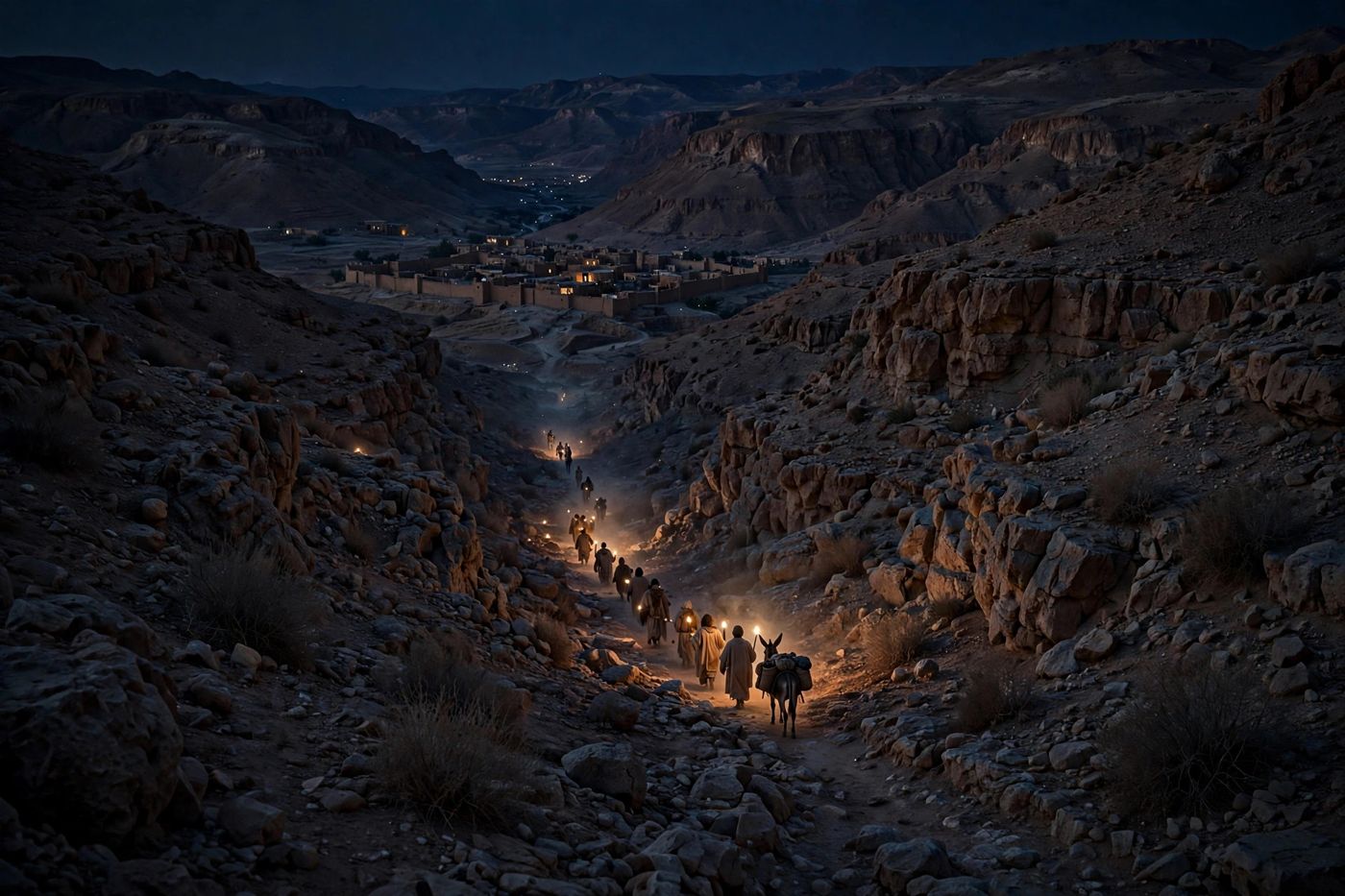
Now hear the oracle's centre. In the middle of Moab's ruin, a first-person voice breaks in: "My heart shall cry out for Moab" (15:5). The fugitives flee toward Zoar — the little town Lot once fled to (Genesis 19:22–23), an echo an Israelite hearer could not miss 1 — pictured with a strange, tender figure, "an heifer of three years old": a young animal in its prime, lowing as it goes, Moab herself in flight, strength and distress in one picture (see §16). "For by the mounting up of Luhith with weeping shall they go it up; for in the way of Horonaim they shall raise up a cry of destruction" (15:5). A refugee column on a mountain road — and the prophet is not watching it like a news report. His heart cries out for them. Chapter 16 says it more physically still: "my bowels shall sound like an harp for Moab, and mine inward parts for Kir-haresh" (16:11) — his insides resonating like a struck string, involuntary as music. And 16:9: "I will water thee with my tears, O Heshbon, and Elealeh."
Who is speaking? The lines can be heard as Isaiah's own grief, and also as God's grief voiced through His prophet — chapter 15 moves between the LORD's "I will bring more upon Dimon" (15:9) and the weeping "I" without drawing a line [2, 4, 10]. Either way, the text teaches what it plainly does: the judgment of Moab is delivered by a weeper. FACT: the weeping is in the text, at its centre, three times. POSITION — this study's reading, with the long tradition: the tears are not Isaiah going soft on God's word. They are a window into the God who gave it — the God who will one day weep over Jerusalem in the flesh (Luke 19:41) and who has no pleasure in the death of the wicked (Ezekiel 33:11) 1. Learn the doctrine whole: God judges nations truly, terribly — and never gleefully. (Misread 1 in §10 takes this up as the guardrail it is.)
Counsel inside the ruin: the lamb, the outcasts, and the throne in mercy (16:1–5)
Chapter 16 changes key — from description to counsel. "Send ye the lamb to the ruler of the land" (16:1): renew the tribute (§5), acknowledge Zion's ruler. Then the picture softens to the refugees: Moab's daughters at the Arnon's fords are "as a wandering bird cast out of the nest" (16:2) — homeless, fluttering, exposed. And then comes the plea: "make thy shadow as the night in the midst of the noonday; hide the outcasts; bewray not him that wandereth" — and, to Moab herself, "be thou a covert to them from the face of the spoiler" (16:3–4). The exact assignment of speakers in verses 3–4 is discussed by the commentators — Moab pleading with Judah, or the prophet pleading for Moab [2, 10]; DISPUTED at the level of staging, plain at the level of content. Whoever says the words, they command the same thing: shelter the fleeing; do not hand back the wanderer; be a shadow at noon. Buried inside a judgment oracle is an ethic for the refugee crisis the judgment creates: God instructs His people — and Moab herself — in what righteousness does with outcasts when they arrive.
And the counsel lands on a promise: "for the extortioner is at an end, the spoiler ceaseth, the oppressors are consumed out of the land. And in mercy shall the throne be established: and he shall sit upon it in truth in the tabernacle of David, judging, and seeking judgment, and hasting righteousness" (16:4–5). Notice the foundations of the one standing throne here: mercy establishes it, truth fills it, and its king is in a hurry — "hasting" — about righteousness. Every other throne in these chapters is falling or ceasing. This one stands, and its ground is not armies but mercy. For Moab's refugees it means a court where their case will be heard justly; for Judah, a future for David's house that no alliance can give or take away.
"And in mercy shall the throne be established" (16:5) — the still centre of the whole passage. Read it once more before the sentence returns, and notice what the throne is for: a court where outcasts are heard, in a passage where every other throne is falling.
Then the sentence returns: pride named, fields languishing, a date set (16:6–14)
The oracle does not end at the open door. Verse 6 gives the reason the counsel will fail: "We have heard of the pride of Moab; he is very proud" — his haughtiness, his pride, his wrath, all named, and his boasts dismissed: "his lies shall not be so." Pride is Moab's named sin across the prophets 1 — the pride of a nation that will send no lamb, ask no shelter, and bend to no throne. So the howling returns (16:7), now agricultural: "the fields of Heshbon languish, and the vine of Sibmah" (16:8) — famous vines, branches reaching to Jazer and over the sea, broken down by the lords of the nations. The vintage shouting stops (16:10): no singing in the vineyards, no crying in the presses, because God Himself says, "I have made their vintage shouting to cease." Joy is a gift that can be withdrawn — a land's harvest songs are a fair barometer of its standing with the Giver [53, 16]. Moab goes to her high place to pray, "but he shall not prevail" (16:12) — prayer at the wrong altar, however weary and earnest, does not reach the throne established in mercy.
Then the date-line (16:13–14). The word is not new — an earlier oracle, now reissued: "But now the LORD hath spoken, saying, Within three years, as the years of an hireling…" (§5). Precision is itself a doctrine: the God of this passage does not deal in moods. He sets terms, and history is expected to keep them. FACT: within the Bible's own telling, Moab's long decline into a small, feeble remnant is the story the later prophets and histories assume [1, 10]. Whether a particular invasion within that window can be isolated in the records is a thinner question — the invader is never named, and any specific identification is labelled INFERENCE and argued in §16.
Damascus unmade, and Jacob thinned to the gleaning (17:1–6)
The Damascus oracle opens with the passage's most absolute sentence: "Behold, Damascus is taken away from being a city, and it shall be a ruinous heap" (17:1). Not defeated. Not fined. Un-citied. Aroer's cities are left to flocks lying down unafraid (17:2): pasture where streets were. Verse 3 welds the ally's fate to the partner's: fortress ceasing from Ephraim, kingdom from Damascus, Syria's remnant reduced to "the glory of the children of Israel" — which, at that hour, is almost nothing. The reader of Isaiah 7 is meant to feel the click: it shall not stand, God said. Here it doesn't [2, 14].
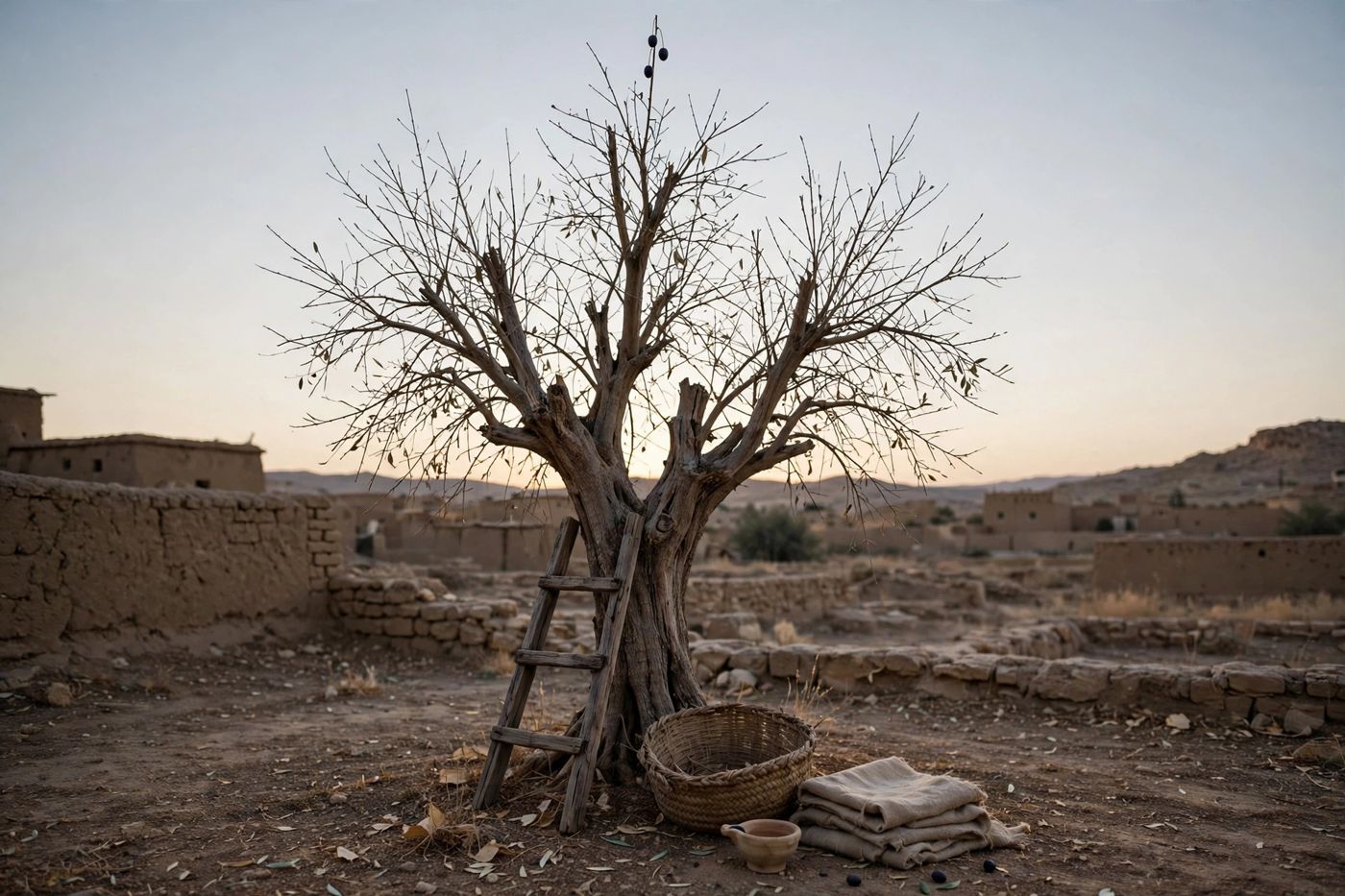
Then the focus slides from Syria to Jacob: "in that day… the glory of Jacob shall be made thin, and the fatness of his flesh shall wax lean" (17:4). A wasting body; then a harvested field (17:5); then the shaken olive tree, and the passage's most quoted counting: "two or three berries in the top of the uppermost bough, four or five in the outmost fruitful branches" (17:6). Teach the arithmetic honestly. This is not total annihilation — the tree is not felled, and the berries are real fruit the LORD God of Israel Himself points to. But it is a humiliation measured in single digits. The northern kingdom that marched on Jerusalem as a great power ends Isaiah 17 as something a harvester would need a ladder and patience to bother with. Isaiah's remnant doctrine is never sentimentality: the remnant is what judgment leaves — small because the judgment was real, alive because God is merciful, and (Lesson 05's boy already told you) destined to return.
The look to the Maker, and the forgotten Rock (17:7–11)
Out of the thinning comes the passage's quietest miracle: "At that day shall a man look to his Maker," his eyes having "respect to the Holy One of Israel" — and he shall not look "to the altars, the work of his hands" (17:7–8). The Holy One of Israel is Isaiah's signature name for God — the book's heartbeat title, met first in Lesson 01 — and here the turning is a re-aiming of the eyes: from the work of his own fingers, the groves and images, to his Maker. No new altar is built in these verses. No programme is announced. A man looks — and the looking is treated as the whole turning. Idolatry, in Isaiah's diagnosis, is fundamentally a direction of attention and trust, and repentance begins as a change of gaze before it becomes a change of anything else 4.
Verse 10 gives the root charge, a charge about memory: "Because thou hast forgotten the God of thy salvation, and hast not been mindful of the rock of thy strength…" Forgetting, in Isaiah, is not a lapse of information — Israel knew the facts. It is the practical atheism of a people who plant "pleasant plants" and set "strange slips" (17:10) — imported seedlings, borrowed religion and borrowed alliances — and make them flourish by morning, while the Rock goes unminded. The harvest? "A heap in the day of grief and of desperate sorrow" (17:11). Quick growth is not blessing: a plant that flourishes by morning can still be a heap by the day that matters.
The turn of the eyes, in one view:
| The eyes leave… | The eyes land on… |
|---|---|
| "the altars, the work of his hands" (17:8) | "his Maker… the Holy One of Israel" (17:7) |
| "pleasant plants… strange slips" (17:10) | "the rock of thy strength" (17:10) |
| The roaring of many peoples (17:12) | The God who rebukes them (17:13) |
The roaring sea, rebuked — evening trouble, morning gone (17:12–14)
The chapter widens suddenly from one city to the weather of the whole world: The many people "make a noise like the noise of the seas," the nations "a rushing like the rushing of mighty waters" (17:12). The sea was the ancient world's picture of ungovernable power — this is the sound of the Assyrian war-machine age, nation after nation rolling in like surf 16. Then one verb answers the whole ocean: "but God shall rebuke them, and they shall flee far off, and shall be chased as the chaff of the mountains before the wind, and like a rolling thing before the whirlwind" (17:13). Sea becomes chaff — the heaviest thing in the world turns, at a rebuke, into the lightest. And the timescale: at eveningtide trouble; and before the morning he is not — "This is the portion of them that spoil us" (17:14).
Hear that as a pattern, because Isaiah's book will shortly make it a headline. In Lesson 18 (chapters 36–37), a vast Assyrian army will threaten Jerusalem at evening — and in the morning be a field of the dead, the angel of the LORD having passed in the night 1. Chapter 17 states the pattern in advance: God's rebukes do not need long campaigns. Evening / morning. Trouble / not there.
Cush, and the God who takes His rest (18:1–7)
The last oracle is the strangest, because almost nothing happens in it — and that is the sermon. Cush sends swift messengers in papyrus vessels to a "nation scattered and peeled" (18:2) — most likely Judah, courted once again (the INFERENCE of §2). God's reply is not addressed to the ambassadors. It is a summons to everyone — all "inhabitants of the world, and dwellers on the earth": "see ye, when he lifteth up an ensign on the mountains; and when he bloweth a trumpet, hear ye" (18:3). Watch. Listen. Something is coming — but not on your timetable, and not at your embassy's pace.
Then God describes His working method, the opposite of every court's anxiety: "I will take my rest, and I will consider in my dwelling place like a clear heat upon herbs, and like a cloud of dew in the heat of harvest" (18:4). Clear heat and harvest dew are not absence. They are a season ripening under a watching sky — the stillness of the husbandman who knows when fruit is ready and refuses to be hurried by panicking field-hands [2, 4]. God's rest is not sleep; it is the composure of the only actor who can see the season's end. And the stillness is timed: "Afore the harvest," while the sour grape is still "ripening in the flower," God "shall… cut off the sprigs with pruning hooks, and take away and cut down the branches" (18:5). The pruning lands just before the harvest — at the moment the ripening plan looks most promising, God cuts. Whose plan is pruned — Assyria's ripening invasion design, or Cush's sprouting alliance scheme — the text leaves the branches unnamed, and commentators divide; DISPUTED [2, 10]. What is not disputed is the lesson for Judah, the true audience: you do not need this embassy. The vineyard is watched by its Owner. Do not sign. The cut-off branches are left to the fowls and beasts for a summer and a winter (18:6).
And the oracle ends not with Cush's ruin but with her gift: "In that time shall the present be brought unto the LORD of hosts of a people scattered and peeled… to the place of the name of the LORD of hosts, the mount Zion" (18:7). The formidable far people, courted by everyone, courted by God in the end — arriving not as conquerors or corpses but as worshippers carrying a present. Of the three oracles, the one addressed farthest away ends nearest to the altar.
The Christ Thread
This passage earns a Christ thread at exactly one point, and it is load-bearing: the throne of 16:5. A throne "established" in mercy, in "the tabernacle of David," occupied by one who judges, seeks judgment, and hastens righteousness — Isaiah's book grows this seed into the child of 9:6–7 and the root of Jesse of chapter 11, and the New Testament, as §6 showed, receives it as Jesus: David's throne given to Mary's Son (Luke 1:32), David's tabernacle raised as the door by which the nations come in (Acts 15:16–17) 1.
"…the Lord God shall give unto him the throne of his father David" — Luke 1:32
FACT: that is how the apostles read these promises. No other verse in chapters 15–18 is claimed in the New Testament as a prediction of Christ, and this study claims no other — no types hidden in Moab's towns. What the passage gives is a throne defined by mercy, and far peoples, Cush at their head, flowing toward the place of the LORD's name, which the gospel age shows arriving at Jesus' feet.
Where in the Covenant Story?
Stand back and locate the four chapters. Israel stands under the Sinai covenant, and the northern kingdom is nearing its announced end for persistent unfaithfulness. But the nations were never outside God's rule: He is LORD of hosts over Moab, Damascus, and Cush without asking their permission, and the standard He judges by is moral — pride, oppression, forgotten grace — not ethnic. Behind the whole ring stands the promise to Abraham: in his seed "shall all the nations of the earth be blessed" 1. Judgment oracles and that promise are not rivals. Cush's gift at Zion (18:7) is the Abrahamic blessing showing through the judgment block like light under a door — the nations judged truly, and gathered finally, and both are covenant business.
The Long View — what the church has believed
Readers have kept these chapters in the canon and read them in public for as long as there has been a church, and their handling has been steady on the points this lesson stresses. Jerome's great commentary — the early church's fullest treatment of Isaiah — reads the Moab oracle with the prophet's grief fully in view, holding sentence and sorrow together, as the church has generally done wherever these verses are actually preached rather than sloganised 37. Calvin, in the Reformation, lingers on the same hinge: the counsel of chapter 16 and the throne in mercy, read as standing instruction that God's judgments on nations never license cruelty in His people 36. Where the centuries have divided is the kind of question §16 argues in the open — the dating of the Moab oracle and the identity of the pruned branches in chapter 18. The centre — who God is here: weeping Judge, still Husbandman, receiver of the nations' gifts — has held; the divisions cluster at the edges.
8. THE AIM SENTENCE — X: eXplain the intent
Everything observed now compresses into one sentence — the author's intended meaning, stated before any application:
God rules the whole ring of nations around Judah — weeping over kin-Moab as He judges her pride and dates her fall within three years, thinning proud Damascus and forgetful Jacob to a gleaning until a man looks to his Maker, and sitting perfectly still while far Cush schemes, because His pruning is timed and His end for the nations is not their ruin only, but their gifts laid down at Mount Zion under David's throne established in mercy.
If a sermon, a post, or a devotional uses Isaiah 15–18 to say something that cannot be traced back to that sentence, it is not this passage talking. That is the whole skill this course exists to build — and the next section is where you watch it work.
9. SAY IT BACK
Close the book and say the AIM sentence from section 8 in your own words — out loud, or written in your notes, without looking. Then say, in one more sentence, what it asks of you this week.
If your version quietly changes the meaning — the weeping Judge turned gleeful, God's rest turned into God's absence, the gleanings into total extinction — open the lesson and walk it again. This exercise feels small. It is the entire course in miniature: meaning first, then — and only then — your life.
10. THE MISREAD — the guardrail, with verdicts
Three live misuses of this passage. Each gets a fair hearing, the evidence, and a verdict.
Misread 1: "These chapters show that God delights in smashing His enemies — so we're free to enjoy it when disaster hits people we oppose." Why it sounds right: the judgments are real and severe — a city unmade, waters full of blood, lions for the escapees. A reader who stops at the severity can mistake the tone for relish. The evidence: the passage refuses that tone at its centre. The longest oracle is saturated with grief: "My heart shall cry out for Moab" (15:5); tears for Heshbon (16:9); "my bowels shall sound like an harp for Moab" (16:11). The passage also commands shelter for the enemy's refugees — "hide the outcasts; bewray not him that wandereth" (16:3) — in the same breath as the sentence. The canon agrees: God takes no pleasure in the death of the wicked (Ezekiel 33:11), and Jesus weeps over the city He has just sentenced (Luke 19:41–44) 1. Judgment preached with tears is not a modern softening of this text; it is this text. Verdict: gloating over enemies' disasters is not boldness about God's word — it is disobedience to this passage's own posture. The verdicts are God's to announce and execute. The tears are ours to share.
Misread 2: "Moab is an irrelevant nobody — a minor ancient tribe we can skip on the way to the important chapters." Why it sounds right: Moab has no state today, her towns are ruins or renamed, and chapters 15–16 are dense with unfamiliar names. Skipping feels efficient. The evidence: the canon will not let Moab be a nobody: Lot's descendant (Genesis 19:37), Ruth's people — Ruth, in the genealogy of David and of Jesus (Matthew 1:5) — and the kingdom that sheltered David's parents (1 Samuel 22:3–4) 1. Jeremiah devotes his longest nations-oracle to her (Jeremiah 48); Amos, Ezekiel, and Zephaniah all take her up. And the length here is itself the tell: Babylon's fall gets two chapters — and tiny kin-Moab gets two chapters. Verdict: skip Moab and you lose the passage's central miracle — a prophet weeping over family he is sent to sentence. Irrelevant peoples do not get two chapters and three tear-stained speeches.
Misread 3: "God says 'I will take my rest' (18:4) — so God is basically disengaged; history runs itself, and prayer and obedience don't change anything." Why it sounds right: the words are genuinely restful, and believers bruised by frantic religion can hear them as a licence to check out. The evidence: read the sentence in its own paragraph. The rest of 18:4 is a husbandman's stillness — "clear heat upon herbs," "a cloud of dew in the heat of harvest": ripening weather, watched weather. Verse 5 is an action, precisely timed ("afore the harvest…"). Verse 7 is a result: the far people bringing their present to Zion. A disengaged God does not prune at the perfect moment, nor receive the nations at His mountain. The God who "shall neither slumber nor sleep" over Israel (Psalm 121:4) rests here the way a watchman rests his voice: still, because nothing escapes his notice 1. What the verse forbids is not human activity but human panic — Judah's embassy-buying panic, and ours. Verdict: 18:4 teaches watchfulness, not absence; composure, not indifference. The stillness belongs to God and is grounded in His perfect timing. Our part, per verse 3, is to watch and listen — not to nap, and not to scheme.
11. FROM WORD TO WALK
A reflection page — the lesson is not finished until the passage has had its say with you.
Start with the tears, because the passage does. Somewhere this week, news will reach you of a disaster landing on someone you have opposed or quietly written off. The world's reflex — and the internet's business model — is a small warm glow: they had it coming. Isaiah stands in that glow and weeps over Moab: family, yes, but also a nation with a record of real harm against his people. He does not deny the record or cancel the sentence; he delivers it. He just refuses to enjoy it. That refusal is what knowing God does to a person's reflexes. Whose fall would you not weep over? That name is exactly where this passage wants to work on you.
Then sit with the outcasts at the fords of the Arnon. "Hide the outcasts; bewray not him that wandereth" (16:3). The refugees in your world rarely arrive as a column with torches. They arrive as the colleague whose life just collapsed, the family with nowhere visible to land, the person whose story is inconvenient to your schedule. The command inside this oracle is not sentiment: be a covert — a shadow at noon — for somebody fleeing. Shelter that is close, immediate, and cool, offered without announcing itself.
And end where the passage ends — in the stillness. Chapter 18 was written for a kingdom tempted to scheme, and God's whole answer was: I will take my rest. If your anxiety is fed by frantic planning, hear the husbandman's composure as an invitation. The bud is not perfect yet; the pruning hook is not late. Somebody who loves the vineyard is watching the season, and it is not finally you.
Lord of hosts — make my heart sound like that harp for people I would rather see fall. Teach me to announce hard truths wet-eyed, to shelter the outcast at my own ford, and to rest in Your timing as You rest in Yours: watching everything, hurried by nothing. Bring the far people in, Lord — and begin with me. In Jesus' name, amen.
12. FOR DISCUSSION — OR FOR YOUR JOURNAL
With a group, work these aloud. Alone, they're yours — answer them in your journal or in prayer; they lose nothing in the quiet.
- Isaiah weeps three times over Moab while delivering her sentence. Whose misfortune — honestly — would you find hardest to weep over? What does that difficulty show you?
- Chapter 16 commands shelter for fleeing outcasts in the middle of a judgment oracle. Who are the "outcasts at the fords" in your actual week, and what would being a "shadow at noon" for one of them cost you?
- Jacob's root sin in 17:10 is forgetting — tending new, impressive growth while the Rock goes unminded. What are you carefully cultivating right now that is crowding out remembrance of God?
- In 18:4 God takes His rest while nations scheme. Where are you currently tempted to "send an embassy" — to fix by scheming what God is asking you to watch and wait on? What would verse-3 watching look like instead?
13. THE WALK-OUT — T: Transfer to today
Meaning is settled. Now — and only now — application, and it must cross the bridge honestly. The five Transfer Tests:
- Same covenant? These are oracles to specific nations in the Assyrian age, heard by covenant Judah. The verdicts are not transferable sentences on any modern nation — no text here authorises naming a modern Moab. What crosses is God's character and His standards, which do not expire: pride judged, outcasts sheltered, God unhurried.
- Same audience? Judah overheard these oracles to correct her temptations — envy, fear, alliance-buying. We stand in the overhearer's place, not the addressee's. Applications aimed at ourselves pass; applications aimed gleefully at "our Moabs" fail at this gate.
- Same genre rules? Prophetic poetry argues by image and pattern. It yields postures and patterns — grief over the judged, a gleaning-sized hope, evening/morning trust — not copied instructions. Nobody is commanded to send tribute or wait for a specific three-year date.
- Repeated or rooted? God's grief over the judged is repeated across the canon (Ezekiel 33:11; Luke 19:41); shelter for the outcast is rooted in God's character and law (Deuteronomy 10:18–19); trust in God's timing over our scheming is rooted everywhere. These cross with full weight 1.
- Ten verses either side? Every application below is drawn from these four chapters read whole — tears with the sentence, rest with the pruning, gleaning with the thinning. Nothing hangs on a torn-out line.
The tests, run in one view:
| Test | Verdict for this passage |
|---|---|
| Same covenant? | Verdicts stay with their nations; God's character and standards cross |
| Same audience? | We are overhearers, like Judah — applications aim at us |
| Same genre rules? | Poetry yields postures and patterns, not copied orders |
| Repeated or rooted? | Grief over the judged, shelter for outcasts, trust in God's timing — all rooted |
| Ten verses either side? | Every practice drawn from the four chapters read whole |
What crosses — and lands:
- God has done the decisive things first. He has spoken the verdicts, set the terms, thinned the tree and kept the berries, and opened Zion to the far peoples' gifts. The world is governed — by a Judge who weeps, a Husbandman who waits, and a King whose throne is mercy. Our obedience responds to a ruled world; it does not attempt to rule it.
- Judgment announced with tears. The community that believes these chapters will sound different when anyone falls: slower to post, quicker to pray, incapable of the glow of satisfaction. That tone is not public relations. It is doctrine with its sleeves rolled up.
- A real remnant, honestly counted. God's arithmetic refuses both despair (the tree is not felled) and denial (two or three berries is not a harvest). In a thinning season: name the smallness, thank God for the berries, and remember that what remains is where He grows the future.
- Rest as resistance. Against every embassy the frightened heart wants to send, 18:4 sets a wakeful stillness: God prunes "afore the harvest," on time, without consulting our panic. Confidence in that timing is a discipline, not a mood.
Practices — what the gate lets through, made concrete this week:
- The tears audit. Take one person or group whose trouble secretly pleased you — or would. Pray for them by name daily this week: their good, their repentance, their shelter. No posting about it; one concrete kindness if you meet them.
- Be a covert. Identify one outcast at your ford and give noon-shadow this week: a meal, a room offered, a call returned, a confidence kept ("bewray not"). One person, one shelter, actually given.
- Count your gleanings. Write down one area where God has thinned you, and beside it the two or three berries still on the bough, by name. Thank God for them out loud. Refuse both scripts: "nothing is left" and "nothing happened."
- Un-send one embassy. Name the scheme you are running to secure yourself where God has asked trust. Confess it, pause it this week, and replace the scheming hour with verse-3 watching: read 17:12–18:7 aloud, then sit quiet for ten minutes before God.
- Memorize Isaiah 17:7 (the Recap Card's memory verse). The cure for the forgotten Rock, in one sentence — the passage's own remedy, learned by heart.
What does not cross: sentences against modern nations read off these chapters; Moab's ruin used to bless contempt for any people today; the three-year term as a template for dating anyone's fall; God's rest as an excuse for sloth (His rest is paired with perfect pruning; ours, with watching); and the gleaning as a guarantee that our ventures will keep a remnant — the promise is God's faithfulness to His people, not insurance for our projects. The gate is not there to shrink the Bible's claims on you — it is there to make sure the claims that land are the ones God actually made.
Praise Him
We praise You, LORD of hosts, who rule the whole ring and miss nothing on it — whose heart cries out for the Moab You judge, whose rebuke turns the roaring sea to chaff before the morning, whose stillness ripens the harvest no embassy can hurry, and whose throne is established in mercy in the tabernacle of David. Let us be found among the far peoples coming to Your name — weeping where You weep, resting where You rest, and looking, at last and always, to our Maker. Amen.
14. THE RECAP CARD — this study on one page
Print it. Keep it where you'll see it this week.
- The passage: Isaiah 15:1–18:7 — three oracles in three tones: Moab judged with tears, Damascus thinned to a gleaning, Cush stilled by a watching God.
- Say It Plain: Moab falls in a night and the prophet weeps over her; pride refuses the counsel and the mercy-throne inside her oracle, and the fall is dated within three years. Damascus stops being a city; Jacob thins to two or three berries, and a man looks to his Maker. The roaring nations are rebuked and gone by morning. Cush sends ambassadors; God takes His rest, prunes in season, and receives Cush's gifts at Zion.
- The AIM: God rules the whole ring of nations around Judah — weeping over kin-Moab as He judges her pride and dates her fall within three years, thinning proud Damascus and forgetful Jacob to a gleaning until a man looks to his Maker, and sitting perfectly still while far Cush schemes, because His pruning is timed and His end for the nations is not their ruin only, but their gifts laid down at Mount Zion under David's throne established in mercy.
- Key terms: the lamb — tribute in Moab's sheep-wealth · gleaning — the remnant, in harvest language · the years of an hireling — a contract term counted exactly · hoy (18:1) — "woe," or a summoning "Ho!"
- The Misread, in one line: God's judgments never license our gloating — the prophet weeps · Moab is kin, not a nobody · God's rest is watchfulness, not absence.
- Memory verse: "At that day shall a man look to his Maker, and his eyes shall have respect to the Holy One of Israel." — Isaiah 17:7
- This week's practice: the tears audit — one opponent prayed for by name daily — and one outcast given real shelter, a shadow at noon.
15. CHECK YOURSELF — five questions
Answer from the study, not from instinct. (Answers live in the Teacher Edition.)
- In your own words: what is the AIM of Isaiah 15:1–18:7?
- Name the three nations addressed, the tone of each oracle in a few words, and one verse that proves each tone.
- What does "within three years, as the years of an hireling" (16:14) tell you about how exactly the term is to be counted — and why does that precision matter?
- A friend says, "God rested in Isaiah 18:4, so He is mostly hands-off with the world." Using verses 3–7, give two pieces of evidence against that reading.
- Someone celebrates online when a public opponent's life collapses, citing "the burden of Moab." Answer them from this passage: what do 15:5, 16:9, and 16:11 require of the reader's posture, and what does 16:3 command toward the fallen?
16. GO DEEPER
Optional — for readers who want the machinery. The lesson is complete without it.
From the Sources — Jeremiah's parallel Moab
Jeremiah 48 runs to forty-seven verses against the same nation: many of the same towns, the same named sin (pride — "his loftiness, and his arrogancy"), and a closing promise that God "will bring again the captivity of Moab in the latter days" 1. FACT: the two oracles stand in the canon side by side, agreeing in substance. Whether Jeremiah reworks Isaiah's older oracle (16:13 says the word existed "since that time"), or both draw on a shared tradition against Moab, is DISPUTED [10, 14]. Either way, the §94 principle is on display in the canon itself: God's word about Moab does not rest on a single voice.
The Honest Argument — who ruined Moab, and when?
Chapter 16:13–14 divides its own oracle into an earlier word and a present reissue "now" spoken, with a three-year fuse. That note has generated an honest argument. For an Assyrian-era fall: the oracle sits among Assyrian-age chapters, and Moab appears in Assyrian records as a tribute-paying vassal whose room to manoeuvre shrank exactly as the oracle assumes 16. For caution: the invader is never named; the "night" of ruin (15:1) is poetry, not annals; and no record dates a destruction of Ar and Kir to a specific three-year window. INFERENCE — therefore — is the label for any specific identification (this campaign, that king) offered for 15:1's night. POSITION — this study's: the oracle is Isaiah's, reissued with its deadline in his lifetime, and its precision ("as the years of an hireling") is a real claim on history, not timeless symbolism — while the identification of the executing army remains an open file. No party disputes that Moab ends the biblical story a small and feeble remnant, exactly as 16:14 totals her.
The Word Underneath — the heifer of three years old (15:5)
The KJV's figure for the fleeing Moabites is startling: they go up to Zoar "an heifer of three years old." The Hebrew pictures a young cow at full, unbroken strength — and versions and commentators debate whether the phrase describes the fugitives lowing like a heifer, attaches to Zoar as a title, or carries some lost local sense [10, 19]. FACT: the phrase is difficult, and translations handle it variously. INFERENCE: read in its sentence — between the fugitives fleeing to Zoar and the weeping ascent of Luhith — the figure most naturally paints the fugitives themselves: strength in its prime, reduced to a lowing flight. This study teaches it that way in §7 and labels the confidence level here, in the open. A hard phrase, honestly held, costs the lesson nothing.
Go Read
- Wildberger, Isaiah 13–27 (Continental Commentary) 10 — the fullest critical treatment of these oracles: the town-list, the reissue note at 16:13, and Cush's staging.
- Oswalt, The Book of Isaiah, Chapters 1–39 (NICOT) 2 — the oracles read as a finished whole, with sustained attention to the prophet's grief and chapter 18's stillness.
- Motyer, The Prophecy of Isaiah 4 — on the throne in mercy (16:5) and the book's remnant arithmetic.
17. SOURCES & REFERENCES
Numbered citations in this lesson key to this list — the course standard: every sourced claim carries its number, and every number can be checked.
-
The KJV text itself — Holy Bible, King James Version (eBible.org KJV, 1769 text). Scripture quotations are from the King James Version (KJV), which is in the public domain in the United States; the full passage is always assigned as reading. Cross-references within Scripture cite this number.
-
Oswalt, The Book of Isaiah, Chapters 1–39 (NICOT) — John N. Oswalt (Eerdmans). The leading evangelical commentary on the first half; defends essential unity of authorship and reads the book as a finished theological whole. Detailed notes on the Assyrian-period history (Ahaz, Hezekiah, Sennacherib).
-
Motyer, The Prophecy of Isaiah — J. Alec Motyer (IVP). A one-volume commentary by an evangelical scholar who argues the whole book breathes the mind of the eighth-century prophet; especially strong on the book's structure, its repeated refrains, and the Servant.
-
Wildberger, Isaiah 1–12, Isaiah 13–27, Isaiah 28–39 (Continental Commentary) — Hans Wildberger (Fortress). The fullest German critical commentary on the first half; detailed on the oracles against the nations and on textual questions.
-
Clements, Isaiah 1–39 (New Century Bible) — R. E. Clements (Eerdmans). Critical commentary notable for its redactional reading of the eighth-century core and its later expansions.
-
Walton, Matthews & Chavalas, The IVP Bible Background Commentary: Old Testament — John H. Walton, Victor H. Matthews, Mark W. Chavalas (IVP). Verse-by-verse ancient Near Eastern background: Assyrian siege practice, Babylonian religion, treaty and coronation customs, geography.
-
Brown, Driver & Briggs, Hebrew and English Lexicon of the Old Testament (BDB) — The standard older Hebrew lexicon; word senses and usage ranges for the Terms sections.
-
Calvin, Commentary on Isaiah — John Calvin (public domain). Reformation exegesis; a control on interpretation and a voice in the Long View.
-
Jerome, Commentary on Isaiah — Jerome (c. AD 408–410). The early church's fullest Isaiah commentary; Jerome transmits the Hebrew learning of his day and treats Isaiah as one prophet's book.
-
Fee & Stuart, How to Read the Bible for All Its Worth — Gordon D. Fee and Douglas Stuart (Zondervan). The beginner's method book; its prophecy chapter ("a forthtelling first") undergirds the Genre sections.
-
King & Stager, Life in Biblical Israel — Philip J. King and Lawrence E. Stager (Westminster John Knox). Daily life, agriculture, warfare, and worship in Isaiah's world.