
One study, one walk — the universal FIRM format. The passage first and whole; then its world; then the Walk (Context · Observe · Genre · Terms · Entire Canon); the meaning taught straight; the AIM sentence; the misread exposed and answered; and the walk-out, where application has to pass the Transfer Tests before it reaches your week. The same skeleton serves a book, a chapter, a single verse, or a whole subject. In the early studies the moves are labeled as they happen. The labels fade as the walk becomes yours.
THE WEEK WITH THIS STUDY — six bites
Day 1 — Read the passage · Say It Plain · The World (§§1–2) · Day 2 — Observe · Genre (§§3–4) · Day 3 — Terms · Entire Canon (§§5–6) · Day 4 — The Meaning · the AIM Sentence · Say It Back (§§7–9) · Day 5 — The Misread · From Word to Walk (§§10–11 — add For Discussion, §12, if you're with others) · Day 6 — The Walk-Out · the Recap Card (§§13–14). Go Deeper (§16) any evening you want the basement.
BEFORE YOU READ — Open My Eyes
LORD, ride into this lesson the way You rode into Egypt — swift, present, impossible to ignore. Melt what in me is hard, fail the counsel I lean on instead of You, and do not let me soften the last verse: the God who breaks the reed is the God who calls Egypt "my people." Open my eyes to wonder in Your law. Amen.
§ means “section” — the numbered parts of your lesson. Each bite above names the sections for that day.
1. READ THE PASSAGE — Isaiah 19:1–20:6 (KJV)
Read it all, slowly, before any teaching. In this course the passage always prints once, in full, at the head of the lesson. Everything after this is commentary — this is the text.
1 The burden of Egypt. Behold, the LORD rideth upon a swift cloud, and shall come into Egypt: and the idols of Egypt shall be moved at his presence, and the heart of Egypt shall melt in the midst of it.
2 And I will set the Egyptians against the Egyptians: and they shall fight every one against his brother, and every one against his neighbour; city against city, and kingdom against kingdom.
3 And the spirit of Egypt shall fail in the midst thereof; and I will destroy the counsel thereof: and they shall seek to the idols, and to the charmers, and to them that have familiar spirits, and to the wizards.
4 And the Egyptians will I give over into the hand of a cruel lord; and a fierce king shall rule over them, saith the Lord, the LORD of hosts.
5 And the waters shall fail from the sea, and the river shall be wasted and dried up.
6 And they shall turn the rivers far away; and the brooks of defence shall be emptied and dried up: the reeds and flags shall wither.
7 The paper reeds by the brooks, by the mouth of the brooks, and every thing sown by the brooks, shall wither, be driven away, and be no more.
8 The fishers also shall mourn, and all they that cast angle into the brooks shall lament, and they that spread nets upon the waters shall languish.
9 Moreover they that work in fine flax, and they that weave networks, shall be confounded.
10 And they shall be broken in the purposes thereof, all that make sluices and ponds for fish.
11 Surely the princes of Zoan are fools, the counsel of the wise counsellors of Pharaoh is become brutish: how say ye unto Pharaoh, I am the son of the wise, the son of ancient kings?
12 Where are they? where are thy wise men? and let them tell thee now, and let them know what the LORD of hosts hath purposed upon Egypt.
13 The princes of Zoan are become fools, the princes of Noph are deceived; they have also seduced Egypt, even they that are the stay of the tribes thereof.
14 The LORD hath mingled a perverse spirit in the midst thereof: and they have caused Egypt to err in every work thereof, as a drunken man staggereth in his vomit.
15 Neither shall there be any work for Egypt, which the head or tail, branch or rush, may do.
16 In that day shall Egypt be like unto women: and it shall be afraid and fear because of the shaking of the hand of the LORD of hosts, which he shaketh over it.
17 And the land of Judah shall be a terror unto Egypt, every one that maketh mention thereof shall be afraid in himself, because of the counsel of the LORD of hosts, which he hath determined against it.
18 In that day shall five cities in the land of Egypt speak the language of Canaan, and swear to the LORD of hosts; one shall be called, The city of destruction.
19 In that day shall there be an altar to the LORD in the midst of the land of Egypt, and a pillar at the border thereof to the LORD.
20 And it shall be for a sign and for a witness unto the LORD of hosts in the land of Egypt: for they shall cry unto the LORD because of the oppressors, and he shall send them a saviour, and a great one, and he shall deliver them.
21 And the LORD shall be known to Egypt, and the Egyptians shall know the LORD in that day, and shall do sacrifice and oblation; yea, they shall vow a vow unto the LORD, and perform it.
22 And the LORD shall smite Egypt: he shall smite and heal it: and they shall return even to the LORD, and he shall be intreated of them, and shall heal them.
23 In that day shall there be a highway out of Egypt to Assyria, and the Assyrian shall come into Egypt, and the Egyptian into Assyria, and the Egyptians shall serve with the Assyrians.
24 In that day shall Israel be the third with Egypt and with Assyria, even a blessing in the midst of the land:
25 Whom the LORD of hosts shall bless, saying, Blessed be Egypt my people, and Assyria the work of my hands, and Israel mine inheritance.
— Chapter 20 begins here: the oracle becomes a sign, walked out in public. —
1 In the year that Tartan came unto Ashdod, (when Sargon the king of Assyria sent him,) and fought against Ashdod, and took it;
2 At the same time spake the LORD by Isaiah the son of Amoz, saying, Go and loose the sackcloth from off thy loins, and put off thy shoe from thy foot. And he did so, walking naked and barefoot.
3 And the LORD said, Like as my servant Isaiah hath walked naked and barefoot three years for a sign and wonder upon Egypt and upon Ethiopia;
4 So shall the king of Assyria lead away the Egyptians prisoners, and the Ethiopians captives, young and old, naked and barefoot, even with their buttocks uncovered, to the shame of Egypt.
5 And they shall be afraid and ashamed of Ethiopia their expectation, and of Egypt their glory.
6 And the inhabitant of this isle shall say in that day, Behold, such is our expectation, whither we flee for help to be delivered from the king of Assyria: and how shall we escape?
SAY IT PLAIN — the passage in everyday words: God Himself comes into Egypt, and Egypt falls apart — gods shaking, hearts melting, Egyptians fighting Egyptians, the Nile failing, fishermen and weavers out of work, and Pharaoh's famous wise men exposed as fools. Then, without warning, the same chapter turns: Egypt will fear little Judah, speak God's people's language, build an altar to the LORD in its own heartland, cry to Him, be smitten and healed by Him — and end up blessed in one breath with Assyria and Israel: "Blessed be Egypt my people." Then chapter 20 makes it flesh: for three years Isaiah walks stripped and barefoot as a living picture of where Egypt's captives are going — and as a warning to everyone who ran to Egypt for safety. That's the whole passage. Everything after this teaches from it — nothing will change what you just read.
2. THE WORLD — C: Context & Audience
A text can never mean what it never meant — so before we ask what these verses mean, we stand where their first hearers stood.
A "burden," aimed at the superpower Judah keeps phoning. Chapter 19 opens with a word you have met since Lesson 09: "The burden of Egypt" (v. 1). A burden — Hebrew massa' — is an oracle that lands like a load: a heavy word from God about a nation. Chapters 13–23 are a whole atlas of them — Babylon, Moab, Damascus, Cush, and now Egypt — and they are not really for those nations first. They are preached in Jerusalem, to Judah, whose leaders kept shopping among the nations for a protector against Assyria. Every burden answers the same Jerusalem question: can that nation carry you? Egypt's is the longest and strangest of them all, because Egypt is the oldest name in Israel's story. [2, 10]
Egypt in Israel's memory: house of slaves, then house of refuge, then habit. Israel was born in Egypt — born as a slave people, and born again at the exodus when God brought them out. Egypt was the oppressor God humiliated with plagues. But Egypt was also the granary that fed Jacob's family in famine, the refuge Joseph ruled, and — long after Isaiah — the refuge where the infant Jesus would be sheltered (Matthew 2). Egypt pulls at Judah from three directions at once: gratitude, trauma, and appetite. When Isaiah's contemporaries "went down to Egypt" for horses and chariots, they were going back to the old house — the place Israel had been told never to build its future on again. That is why this oracle aches where the others merely roar. [2, 11]
Egypt is a river with a country attached. Look at a map and the passage explains itself. Egypt is the Nile: a green ribbon of farmland running south from the Mediterranean through desert that grows almost nothing, widening at the north into the Delta — a fan of channels, marshes, and fields. The river's annual flood was the calendar, the economy, and the religion. When the waters fail, everything in verses 5–10 fails with them — fishermen, flax-workers, weavers, keepers of fish ponds. And the river was theology too: Egyptians worshipped the Nile and its gods as givers of life. So when Isaiah says the river "shall be wasted and dried up" (v. 5), he is not predicting drought as weather. He is announcing judgment on Egypt's god, its income, and its identity in a single blow. 16 Keep that triple target in view when you reach verses 5–10.
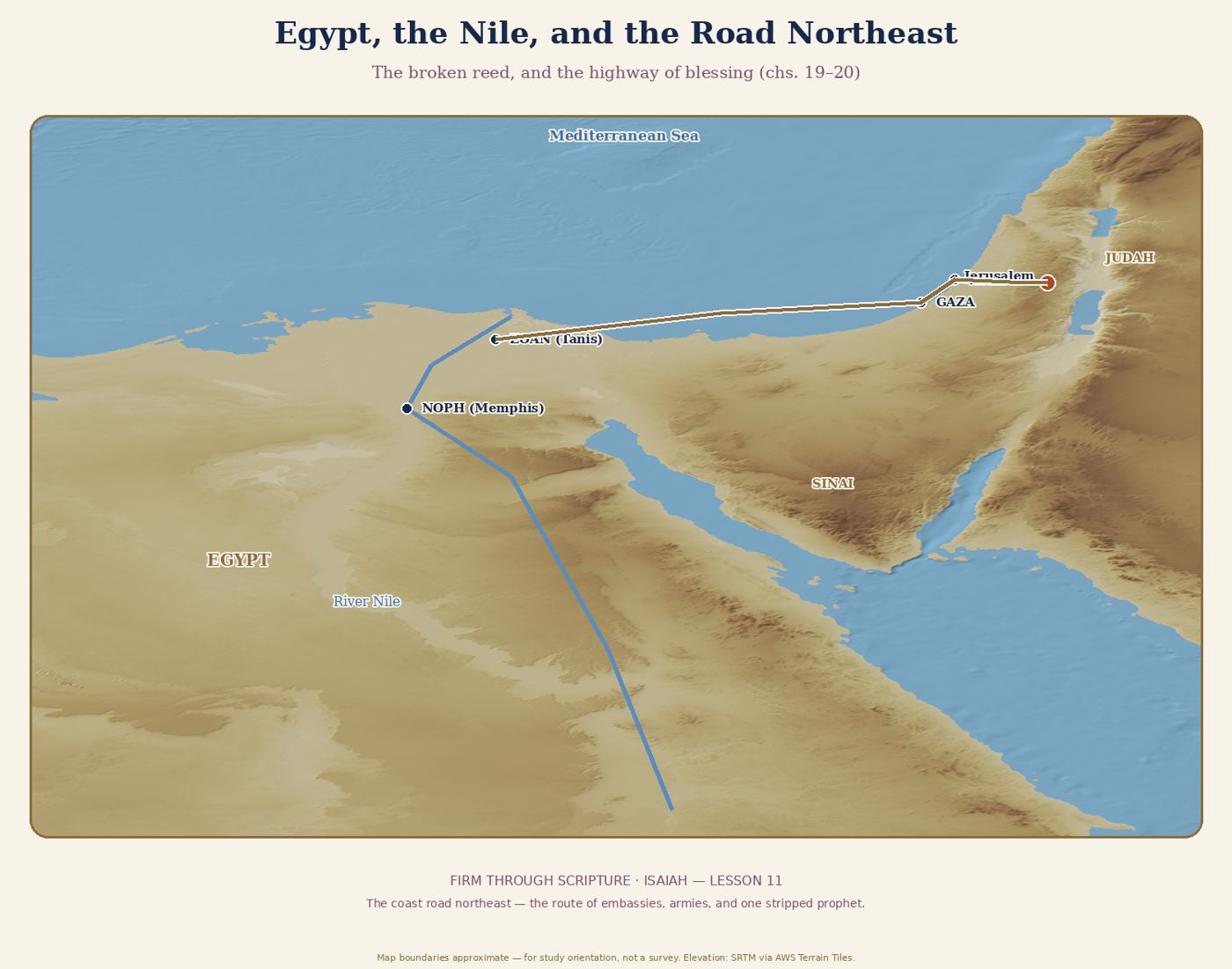
Two capitals, one boast. The oracle names Egypt's great cities of counsel: "the princes of Zoan" (v. 11) and "the princes of Noph" (v. 13). Zoan is Tanis, in the northeastern Delta — a royal city, close to the road from Canaan, the Egypt of the exodus stories ("the field of Zoan," Psalm 78). Noph is Memphis, far up the river to the south — among the oldest capitals on earth. Between them they stand for Egypt whole: north and south, new politics and ancient glory. And ancient is the word the princes are selling: "I am the son of the wise, the son of ancient kings" (v. 11). Egypt's wisdom tradition was genuinely the oldest in the region — court counsel older than Israel itself. 16 Isaiah's charge is not that Egypt was never wise. It is that its wise men cannot read the one event that matters: "let them know what the LORD of hosts hath purposed upon Egypt" (v. 12).
The politics under the poetry: Assyria is coming down the coast. The empire of this whole section of Isaiah is Assyria, the military superpower based in what is now northern Iraq, expanding westward under a line of warrior-kings. In Isaiah's lifetime Assyria swallowed the northern kingdom of Israel (722 BC) and reduced Judah's neighbours to vassals — states that kept a local king but paid tribute and took orders. Egypt, meanwhile, was ruled in this period by kings from Cush — the land the KJV often calls Ethiopia, the Nile valley far to the south, in modern Sudan. That is why this oracle keeps pairing "Egypt and Ethiopia" together (20:3–5): on Egypt's throne sat a Cushite dynasty, so an appeal to Egypt was an appeal to Cush. [2, 11, 16] Judah's court had a standing pro-Egypt party: send envoys, buy horses, sign the treaty, and Assyria will think twice. Chapter 20 dates the end of that hope to a specific year — the year Assyria's commander took Ashdod, the Philistine coastal city that had revolted with Egyptian encouragement. Assyrian royal records tell the same campaign from the other side: Sargon boasts of Ashdod's fall and of its king fleeing toward Egypt. 25 The threat is not prophetic theatre: within a decade Sennacherib, Sargon's son, would storm Judah's own Lachish with siege ramps whose stones archaeologists have excavated and matched against Assyria's own carved pictures of the attack. 33
One more piece of the world: Egypt's gods were a crowd, and they were local. Egypt's religion was not one god but a populated heaven — gods of the river, the sun, the dead, each city with its patrons — carried in procession, housed in temples, consulted through the "charmers" and "wizards" of verse 3. Isaiah's picture is precise: when the LORD arrives, He does not first fight Egypt's army. He walks past its gods, and they tremble, and the nation's heart melts before a sword is drawn (v. 1). In a world where a nation's gods were its constitution, that is the deepest cut in the chapter — and it is the oracle's first line. 16
That is the world. Now we open the text itself.
3. OBSERVE — O: what the text actually does
Before meaning comes observation. Most bad interpretation is not deep error; it is shallow reading — people answering a text they never actually looked at. So look:
| Act | Verses | What happens |
|---|---|---|
| Act one — Egypt broken | 19:1–15 | Arrival, civil war, failed waters, failed counsel |
| The hinge — Egypt afraid | 19:16–17 | Judah a terror; conviction begins |
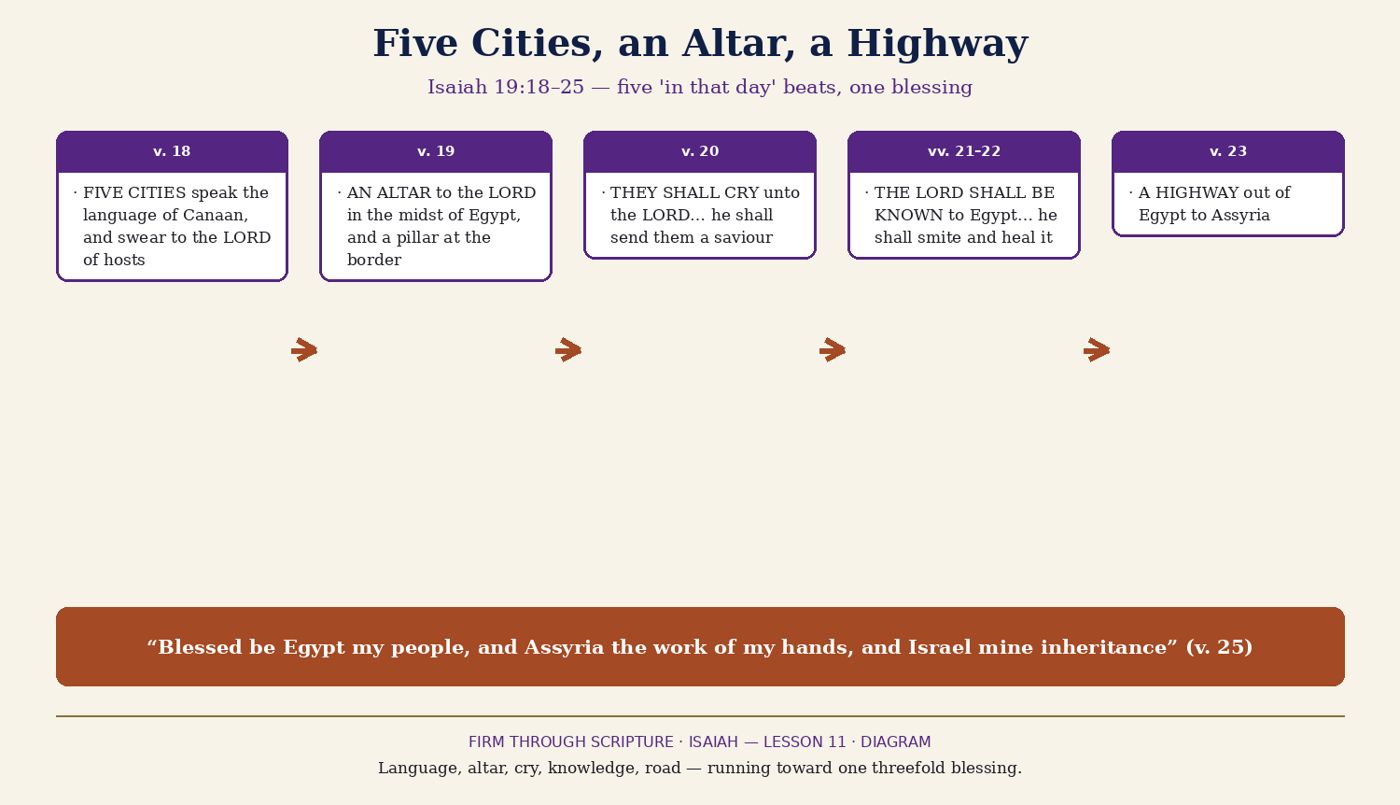
| Act two — Egypt converted | 19:18–25 | Language, altar, saviour, healing, highway, blessing |
| The sign | 20:1–6 | Three stripped years; the coastland's unanswered question |
- The shape. Chapter 19 falls into two acts with a hinge of fear between them. Act one (vv. 1–15) is all collapse: arrival, civil war, failed waters, failed counsel. Act two (vv. 18–25) is all conversion: language, altar, saviour, healing, highway, blessing. Between them, verses 16–17 — Egypt afraid, and Judah a terror — are the turning point. Then chapter 20 leaves poetry for dated prose and gives the whole oracle a body: the prophet's.
- God holds the verbs. Scan act one for who acts: the LORD rideth (v. 1), will set Egyptians against Egyptians (v. 2), will destroy their counsel (v. 3), will give over (v. 4), hath mingled the perverse spirit (v. 14), shaketh His hand (v. 16). Egypt's verbs are fail, melt, mourn, wither, err, stagger. Whatever else this chapter is, it is not Egypt's bad luck. It is a visitation.
- "In that day" tolls five times. The phrase sounds at verses 16, 18, 19, 21, and 23–24 — five beats, and every one of them is in act two. Act one has no "in that day" at all: collapse is simply narrated, but the future is dated — stamped, again and again, as a day God owns. Count them as you read; the Terms section will take up what the refrain is doing.
- The exodus runs backwards. In act two, Egyptians cry to the LORD "because of the oppressors," and He sends them "a saviour, and a great one," who delivers them (v. 20). That is Israel's founding story — cry, oppressor, saviour, deliverance — with Egyptians now in Israel's role. Isaiah expects you to hear it.
- The same hand smites and heals. Verse 22 stacks the verbs: "the LORD shall smite Egypt: he shall smite and heal it." One subject, both actions. Hold that observation tightly; half the misreadings of this chapter come from splitting the hand in two.
- Chapter 20 changes costume. No "burden" heading, no poetry — a date ("In the year that Tartan came unto Ashdod," 20:1), an instruction, a three-year action, and an explanation. It reads like a dispatch filed inside the prophecy, and its plainness is the point: this part is not a vision. It happened on a road, in public, over years.
- The last voice is not God's. The passage closes with the coastland dwellers' unanswered question: "how shall we escape?" (20:6). Isaiah lets it hang — it is addressed to the hearers in Jerusalem, who have to answer it.
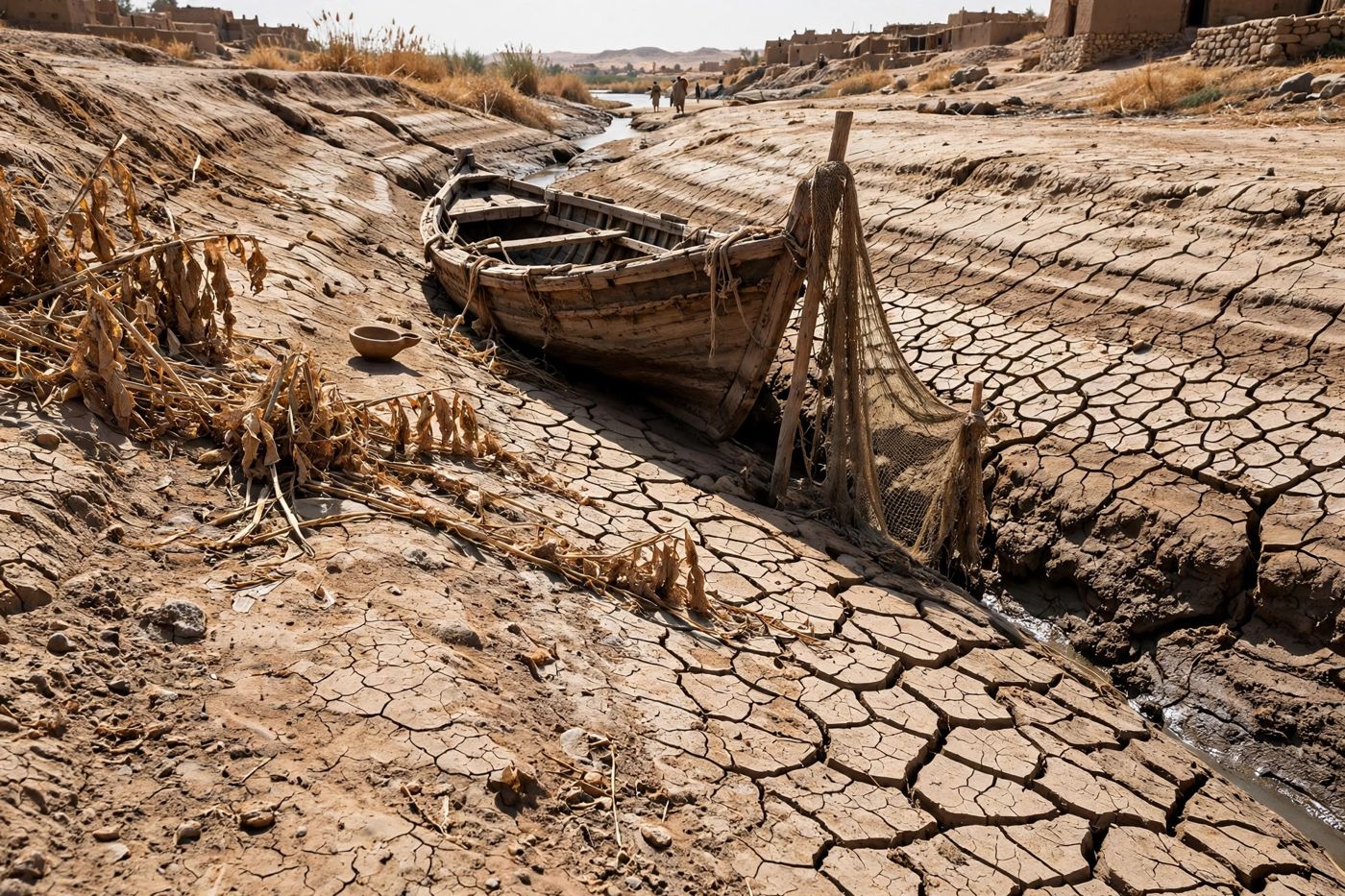
4. GENRE — N: note the genre (oracle against a foreign nation, closed by a sign-act report)
Two genres share this lesson, and each reads by its own rules.
First, the oracle against a foreign nation (ch. 19). This is a recognised prophetic form: Isaiah preaches them in chapters 13–23, and Jeremiah (chs. 46–51) and Ezekiel (chs. 25–32) will preach whole books of them. [17, 51] Three rules for reading them well:
- The named nation is not the only audience. These oracles were delivered where God's people could hear them. Egypt is addressed; Judah is being taught. Every "burden" is a mirror held up to the trusting policy of Jerusalem.
- Prophecy is forthtelling first. Before it foretells anything, an oracle tells forth God's verdict on the present: Egypt's gods are nothing, its counsel is blind, its river is not a saviour — true in Isaiah's present tense before a single prediction ripens. 51
- Judgment oracles can bend toward blessing. Moab gets a remnant promise; Cush, in the last lesson, brings a present to Zion. Nowhere does the bend open as wide as here — and the width is deliberate.
Second, the sign-act report (ch. 20). A sign-act is a prophetic message performed instead of — or alongside — spoken: the prophet's body, clothes, or actions become the sermon. It is terse, dated, prose reportage, and its meaning is given inside the text (20:3–5), which is a mercy: with sign-acts you do not guess at symbolism, you read the prophet's own caption. Isaiah's ministry has been building to this form — his children were already named as walking signs (Lesson 06) — but chapter 20 is the severe version: three years long, written on his own skin. Take the act as public communication, not private eccentricity: everyone on that road could read it, which is why it worked. 17
5. TERMS — T: the words in the writer's mouth
Four terms carry this passage. Learn them, and whole sections of it unlock:
- Sign-act — a modern scholarly name for an ancient prophetic method: a message enacted with the prophet's own body or belongings. His children's names were the mild form — a son called Maher-shalal-hash-baz, "speeding to the spoil," was a headline a father carried through the streets (Lesson 06). Chapter 20 is the severe form: the prophet himself, stripped and barefoot for three years. After Isaiah, Ezekiel will lie on his side for months; Jeremiah will wear a yoke and smash a flask at the gate. The genre's logic is visibility: a nation that will not listen to a sermon may still see one, every day, on the road to market. [17, 51]
- "In that day" — Isaiah's signature phrase for the day of God's decisive action: sometimes judgment, sometimes rescue, often — as here — both in one chapter. In chapter 19 it tolls only over act two (vv. 16, 18, 19, 21, 23–24): five beats, all future, all God's appointment rather than Egypt's achievement. It does not always mean the end of the world; it always means the day that settles things. 4
- Highway — Hebrew mesillah, a raised, built-up road: not a footpath but a roadbed thrown up for armies, kings, and processions. [19, 20] It enters Isaiah's vocabulary early — a highway from Assyria for the returning remnant (11:16) — and this lesson plants it between Egypt and Assyria (v. 23). Watch for it: it returns as the "way of holiness" (35:8) and as the desert road made straight for God Himself (40:3). The question is never only where the road goes, but who is travelling it, and to worship whom. 52
- The LORD of hosts — the title rings seven times in chapter 19 alone (vv. 4, 12, 16, 17, 18, 20, 25). "Hosts" means armies — heaven's marshalled ranks. Against Egypt's trembling crowd of local gods, Isaiah sets one title like a drumbeat: the commander whose counsel stands (vv. 12, 17) while Pharaoh's counsellors babble.
Method note — the word-study guardrail: a word means what its author uses it to mean, in its sentence, in its century — not what its oldest root once meant, and not everything it can mean anywhere. Every term above was settled by Isaiah's usage in Isaiah. That is the discipline that keeps word studies honest.
TRANSLATION NOTE — "naked" (20:2): how bare is bare?
Your KJV says Isaiah walked "naked and barefoot," and verse 4 pictures the captives the same way, "even with their buttocks uncovered, to the shame of Egypt." The Hebrew word, 'arom, covers a range: stripped of the outer garment — down to the underclothing — and, at its hard end, fully unclothed. [19, 20] Scripture uses it across that range: Peter at his fishing was "naked" in working dress until he girt his coat about him (John 21:7); Saul, prophesying, "stripped off his clothes" (1 Samuel 19:24). Some translations of Isaiah 20 soften it to "stripped"; the KJV keeps the blunt word. Either way, do not let the range drain the scene: a respected prophet, publicly reduced to a slave's or a captive's dress — no sandals, no mantle, no dignity — for three years, was a walking disgrace in a culture that read clothing as honour. And verse 4's detail pushes toward the exposure being real and shaming, because that is precisely the cargo Assyria shipped: captives displayed as humiliation. The shame is not an unfortunate side-effect of the sign. The shame is the sign.
6. ENTIRE CANON — E: where this passage sits in the whole story
No passage lives alone. Isaiah 19–20 sits where several of the Bible's longest threads cross:
- The reed, named. Ezekiel, preaching Egypt's fall a century and a half later, gives this lesson its title. God says Egypt has "been a staff of reed to the house of Israel": "When they took hold of thee by thy hand, thou didst break, and rend all their shoulder: and when they leaned upon thee, thou brakest" (Ezekiel 29:6–7). A reed staff looks like support and behaves like a blade. Later in this book, Assyria's spokesman will throw the sentence at Jerusalem's wall: Egypt is "the staff of this broken reed... whereon if a man lean, it will go into his hand, and pierce it" (36:6). Isaiah 19 is the oracle that earns the proverb: God shows the reed snapping — gods, river, counsel, king — so no one in Judah can say they leaned in ignorance.
- Egypt's other future. Isaiah 19 is not Scripture's only word about Egypt turning Godward. The Psalms sang it first: "Princes shall come out of Egypt; Ethiopia shall soon stretch out her hands unto God" (Psalms 68:31). Amos gives Egypt an exodus of its own in God's mouth: "Have not I brought up Israel out of the land of Egypt? and the Philistines from Caphtor, and the Syrians from Kir?" (Amos 9:7). And Zechariah closes the prophets with the nations — Egypt named among them — coming up to worship "the King, the LORD of hosts" (Zechariah 14:16–19). Isaiah 19:18–25 is the fullest form of a hope the whole prophetic choir sings. 4
- Inside this book: the road so far, and the road ahead. You have already walked one stretch of the highway — the remnant's road out of Assyria (11:16) — and just last lesson Cush brought its present to Mount Zion (18:7). Ahead, chapters 30–31 will preach the policy version of this oracle as direct rebuke: "Woe to them that go down to Egypt for help" (31:1) — and chapter 30 will name Egypt's help "in vain, and to no purpose" (30:7). Then, in the book's second half, Egypt reappears among the nations coming over to Israel's God (45:14). Chapter 19 is the fountainhead: judgment, conversion, and blessing are announced here first, and everything later draws on the account opened here. [2, 4]
- Egypt shelters the Saviour. The land that once enslaved Israel becomes the land that hides Israel's Messiah: "Out of Egypt have I called my son" (Matthew 2:15, quoting Hosea). And when the gospel first travels, it travels this chapter's map: an official of Cush — Egypt's partner in this oracle — hears, believes, and is baptized on the desert road home (Acts 8). Acts does not quote this chapter over the Ethiopian's baptism — do not claim it does — but the geography is Isaiah's, and the direction is the highway's. INFERENCE, plainly labelled: the pattern, not a proof-text.
Laid out flat, Egypt's whole Bible story looks like this:
| Egypt is… | In… | The text |
|---|---|---|
| The oppressor God breaks | Exodus | Israel cries; God sends a deliverer |
| The reed that breaks the leaner | Isaiah 19–20; Ezekiel 29 | Judgment on gods, river, and counsel |
| The convert God blesses | Isaiah 19:18–25; Psalms 68:31 | "Blessed be Egypt my people" |
| The refuge of the Saviour | Matthew 2 | The Son sheltered where slaves were made |
| A hearer on the road home | Acts 8 | Cush's official baptized, going on his way rejoicing |
7. THE MEANING — what the passage teaches
The Walk has established what the text says and where it sits. Now its payload, taught straight — the doctrines this passage actually carries.
Act One — the LORD arrives, and Egypt comes apart (19:1–15)
The oracle opens with a theophany — God arriving in person. "Behold, the LORD rideth upon a swift cloud, and shall come into Egypt" (v. 1). Here the rider comes not to Sinai but into Egypt, and the first casualties are not soldiers but gods: "the idols of Egypt shall be moved at his presence." Then the collapse proceeds in widening rings, and the order is a sermon in itself:
- Heart — "the heart of Egypt shall melt in the midst of it" (v. 1). Courage goes first.
- Society — "I will set the Egyptians against the Egyptians... city against city, and kingdom against kingdom" (v. 2). A nation that cannot be invaded from outside is divided from inside: brother, neighbour, city, kingdom — the fracturing runs at every scale.
- Spirit and counsel — "the spirit of Egypt shall fail in the midst thereof; and I will destroy the counsel thereof" (v. 3). And notice the reflex of a counsel-less nation: it runs downward for advice — "to the idols, and to the charmers, and to them that have familiar spirits, and to the wizards." When real counsel fails, superstition does a roaring trade.
- Crown — "the Egyptians will I give over into the hand of a cruel lord; and a fierce king shall rule over them" (v. 4). Who is he? Candidates argued for centuries include an Assyrian conqueror (the direction chapter 20 points), a later Persian king, a harsh native ruler. DISPUTED — the identifications are genuinely unsettled, and this study will not pretend otherwise. [2, 10, 11] What is not disputed is the verse's point, in its tail: "saith the Lord, the LORD of hosts." Whoever holds the whip, God holds the appointment.
Then the judgment reaches the ground Egypt stands on.
An economy judged at its river (19:5–10)
Read verses 5–10 slowly and count the trades. Fishermen mourning over empty brooks (v. 8). Workers in fine flax "confounded" (v. 9). Weavers of networks ashamed. The keepers of "sluices and ponds for fish" broken in their purposes (v. 10). The papyrus-like "paper reeds" wither (v. 7); everything sown by the brooks is "driven away, and be no more." This is a whole economy unplugged at a single socket — the river — and Isaiah itemises it trade by trade the way a man reads out a payroll of the newly unemployed. 16 Two things to learn here. First, biblical judgment is not vague weather-of-the-soul; it touches work, food, cloth, and wages, because God is Lord of those too. Second, the catastrophe is targeted at Egypt's boast: the Nile was the thing Egypt trusted the way Judah was tempted to trust Egypt. God judges the idol at the address where the trust lives.
The wisest men in the world, fooled (19:11–15)
The last movement of act one is a courtroom. "Surely the princes of Zoan are fools, the counsel of the wise counsellors of Pharaoh is become brutish" (v. 11) — brutish: animal-dumb, the wisdom of Egypt curdled into instinct. The taunt that follows is one of Isaiah's sharpest: the counsellors boast of pedigree — "the son of the wise, the son of ancient kings" — and Isaiah answers pedigree with a question: "Where are they? where are thy wise men? and let them tell thee now, and let them know what the LORD of hosts hath purposed upon Egypt" (v. 12). Wisdom, in Isaiah's court, is not ancestry or reputation; it is knowing what God has purposed. A counsellor who cannot factor God's purpose into his advice is not partially wise. He is a fool with a famous grandfather. And the rot is itself God's judgment, stated without flinching: "The LORD hath mingled a perverse spirit in the midst thereof: and they have caused Egypt to err in every work thereof, as a drunken man staggereth in his vomit" (v. 14). It is an ugly picture on purpose — the proud nation's expertise, staggering and soiled — and it ends with Egypt's work simply stopping: "Neither shall there be any work for Egypt, which the head or tail, branch or rush, may do" (v. 15). [2, 10]
That is act one, and if the chapter stopped at verse 17 it would be a complete, terrifying oracle. It does not stop. Look at verse 17, the hinge: "And the land of Judah shall be a terror unto Egypt." Sit with the reversal. Through this whole section, Judah's politicians have treated Egypt as the great power and Judah as the client begging a seat. In God's account the terror runs the other way: it is Judah — small, tribute-paying Judah — whose mention frightens Egypt, "because of the counsel of the LORD of hosts, which he hath determined against it." Egypt has begun to suspect Whose counsel stands behind the little kingdom. Fear, here, is not the end of the story; it is the first crack of light — the nation that feared Judah's God in verse 17 is swearing allegiance to Him by verse 18.
Act Two — the exodus run backwards, and outwards (19:18–22)
Now read act two with Exodus open in your memory, because Isaiah wrote it with Exodus open in his:
- Language (v. 18): "five cities in the land of Egypt speak the language of Canaan, and swear to the LORD of hosts." Five cities — a foothold, not yet a whole nation: conversion starts somewhere specific, with speech changed. The language of Canaan is Hebrew, the covenant tongue; swearing to the LORD is allegiance, a vassal's oath to a king. Egyptians are not admiring Israel's God at a distance; they are talking like His people and binding themselves like His subjects. (One city is called "The city of destruction" — a dark, disputed name argued in Go Deeper.)
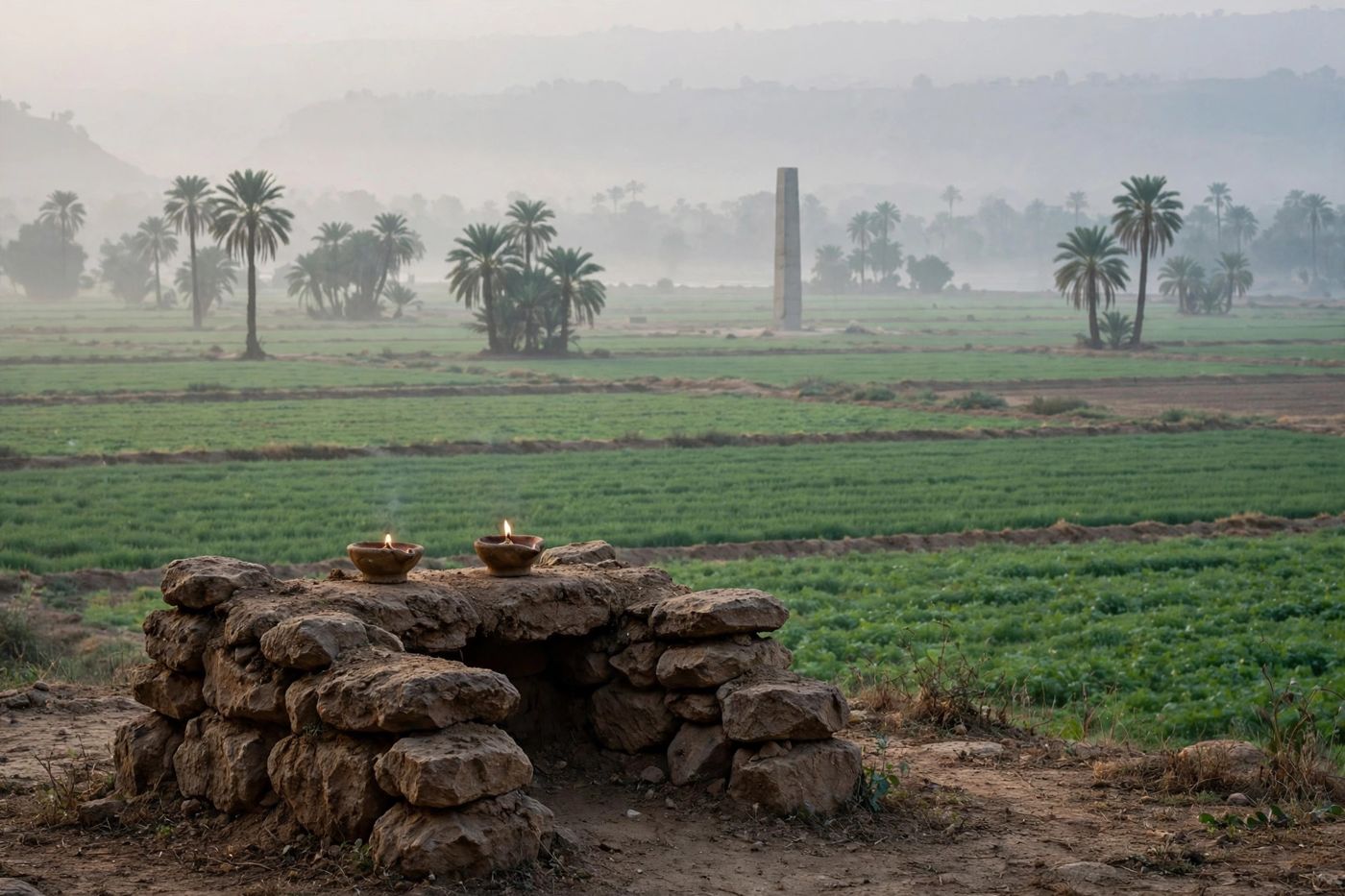
- Altar and pillar (v. 19): "there shall be an altar to the LORD in the midst of the land of Egypt, and a pillar at the border thereof to the LORD." Not at the border only, as a diplomatic gesture — an altar in the midst, in the heartland, with the pillar at the frontier like a boundary stone. Israel's own law gathered sacrifice to one chosen place, and Isaiah does not pause to legislate the tension; he announces the wonder: worship of the true God planted in the middle of the land of the idols that trembled in verse 1. [4, 10]
- Cry and saviour (v. 20): the altar and pillar are "for a sign and for a witness," and then the exodus pattern fires in reverse: they cry because of oppressors, and God sends them "a saviour, and a great one." In Exodus it was Israel crying in Egypt and God sending Moses against Egypt. Here Egyptians cry, and God sends a deliverer for Egypt. The oppressed and the oppressors have changed places; God has not changed at all.
- Knowledge and worship (v. 21): "the LORD shall be known to Egypt, and the Egyptians shall know the LORD in that day" — and the knowledge becomes practice at once: sacrifice and oblation offered, and vows not only vowed but performed. "Know the LORD" is covenant language — the thing God said Egypt would learn through the plagues was that He is the LORD; here Egypt learns it through mercy, and answers with the full grammar of worship: sacrifice, offering, vows made and kept. Paid vows matter to Isaiah: this is not a fright-flash of religion, it is settled, practised devotion.
Smite and heal — the doctrine in verse 22
Look at verse 22 once more: the LORD will "smite Egypt" — "he shall smite and heal it" — and Egypt will "return even to the LORD," who will be "intreated of them, and shall heal them." This is the theological centre of the chapter, and it refuses two easy readings at once. It refuses the reading where judgment is God's last word on Egypt — the smiting aims at return; the sentence ends in healing, twice. And it refuses the reading where mercy means God never smites — the healing comes through the smiting, not instead of it. Carry it in one line: in Isaiah, God's wounds are a form of His pursuit. The same pattern governs Israel's own story in this book, and Egypt is here granted Israel's own pattern — a quiet revolution: the nations are not offered a lesser gospel than the covenant people, but the same road. [2, 4]
The highway and the threefold blessing (19:23–25)
And then the chapter does the most astonishing thing in the whole oracles section. "In that day shall there be a highway out of Egypt to Assyria" (v. 23). The coast road and the king's highways of that world carried exactly two kinds of traffic: armies marching to conquer, and captives marching into exile — Isaiah has just shown you the second kind in chapter 20, naked and barefoot. Onto that road Isaiah sets a third traffic: worshippers. "The Assyrian shall come into Egypt, and the Egyptian into Assyria, and the Egyptians shall serve with the Assyrians" — serve here is worship-service; the ancient enemies cross each other's borders not to raid but to pray, together. And Israel? Not displaced — set between them: "Israel be the third with Egypt and with Assyria, even a blessing in the midst of the land" (v. 24). The Abraham promise is here cashed out in concrete geography: Israel's destiny was never to be blessed instead of the nations, but to be a blessing in the midst of them. [4, 52]
Then the blessing itself, and it must be taught at full strength, because the text gives Egypt and Assyria titles that belong — every reader in Isaiah's audience knew this — to Israel:
| Nation | The title God gives it | What the title means |
|---|---|---|
| Egypt | "my people" | The covenant name — the title of Exodus, God's own designation for the people He redeemed |
| Assyria | "the work of my hands" | The craftsman-title — God claiming the empire that broke nations as His own handiwork |
| Israel | "mine inheritance" | The treasured portion — the lot that falls to God Himself |
Then God speaks the blessing Himself (v. 25): "Blessed be Egypt my people, and Assyria the work of my hands, and Israel mine inheritance." Notice exactly what the verse does and does not do. It does not erase Israel — Israel keeps her own irreplaceable title and her place as the third, the blessing in the midst. It does not bless Egypt and Assyria in their idolatry — this Egypt has an altar, a cry, a saviour, sacrifices, and paid vows behind it in the chapter; this is a converted Egypt, blessed as God's people, not blessed as-is. What it does do is announce that God's purpose for the nations was never merely to judge them in Judah's hearing. The two empires that frame Isaiah's whole world — the ancient oppressor from the south, the present devourer from the north — are both, in God's stated future, His. This is the oracles section's north star: every burden in chapters 13–23 is preached under a sky that ends here. [2, 4, 5]
The Christ Thread
Where is Christ in a chapter that never names Him? Not in a code, and not in every verse — but the chapter's machinery points where the New Testament later walks. The God of verse 20 sends Egypt "a saviour, and a great one": the pattern of the sent deliverer, from Moses through the judges, is the pattern the Bible gathers at last into the one Saviour sent not to Egypt only but to the world — and it is no accident that this Saviour's life begins with Egypt: sheltered there as an infant, called out of it as Hosea's word is fulfilled (Matthew 2:15). And the chapter's end — former enemies worshipping together on one road — is the shape of the church the New Testament describes: one body from every nation, in which verse 25's titles are not confiscated from Israel but extended, through Christ, to all who are brought near. POSITION, where the church has historically read the pattern this way — stated plainly, because the text of Isaiah 19 does not quote the New Testament, and this study does not pretend it does. What is FACT is narrower and strong enough: Isaiah's God announces a converted Egypt, a worshipping Assyria, and His own people as a blessing between them — and the apostles preach a gospel in which exactly those nations begin, on exactly those roads, to come in.
Where in the Covenant Story?
This chapter is the Abrahamic covenant photographed mid-fulfilment. The promise ran: a people chosen, a land given, and through that people blessing to all the families of the earth. Most of Isaiah's audience had quietly edited the promise down to the first two clauses. Chapter 19 restores the third at maximum volume — and covenant particularity and covenant universality prove not to be rivals: the blessing reaches Egypt through the story of Israel — through Israel's prophet, Israel's God, Israel's exodus pattern, and Israel standing as the third — which is precisely how the covenant always said it would work. 4
The Long View — what the church has believed
The church has read this chapter whole — both acts, one oracle — for two thousand years, and its astonishment at verse 25 is not a modern discovery. The historic reading received judgment and conversion together as a single word of the prophet, and preached Egypt's blessing as proof that God's designs for the nations were mercy-shaped from the beginning. 5 Modern scholarship has often divided over whether verses 18–25 can belong to the same prophetic voice as verses 1–15 — a real argument, taken up honestly in Go Deeper. What no era's reading has managed is to make verse 25 small: critical and confessional commentators alike treat the threefold blessing as one of the highest points of Old Testament universal hope; the argument is over its date and mechanics, not over whether it is there. [5, 10] The disputes cluster at this text's edges. The centre — a God who breaks the nations' idols and then blesses the nations by name — has held.
That is the payload. The next section compresses it into the one sentence you are meant to carry out of this study.
8. THE AIM SENTENCE — X: eXplain the intent
Everything observed now compresses into one sentence — the author's intended meaning, stated before any application is allowed:
Isaiah announces that the LORD Himself will break Egypt — its gods, its river, its counsel — and then heal and bless that same Egypt as "my people" on one highway with Assyria and Israel; and He signs the warning with His prophet's stripped body, so that Judah will stop leaning on the broken reed and trust the God who smites in order to heal.
If a sermon, a post, or a devotional uses Isaiah 19–20 to say something that cannot be traced back to that sentence, it is not this passage talking. That is the whole skill this course exists to build — and the next section is where you watch it work.
9. SAY IT BACK
Close the book and say the AIM sentence from section 8 in your own words — out loud, or in your notes, without looking. Then say what it asks of you this week.
If your version quietly changes the meaning — if the blessing becomes a vague niceness about everybody, or the smiting disappears and only healing is left, or Isaiah's three years shrink to a curious detail — open the lesson and walk it again. This exercise feels small. It is the entire course in miniature: meaning first, in the author's words become your words, then — and only then — your life.
10. THE MISREAD — the guardrail, with verdicts
Three live misuses of this passage. Each gets a fair hearing, the evidence, and a verdict.
Misread 1: "Verses 18–25 are an embarrassment pasted onto the oracle later — real Isaiah preached the judgment; somebody softer added the blessing. Quarantine the ending and teach the real chapter." Why it sounds right: the turn at verse 18 is genuinely abrupt, and composition questions about this passage are genuinely argued by serious scholars — the ending's universalism can look, at first glance, like a later age's handwriting. Go Deeper states that case at full strength. The evidence: even if every composition question were granted for argument's sake, the text as it stands — the only Isaiah the church has ever canonically read, one scroll already in antiquity 22 — sets the conversion inside the burden, and the placement is itself the teaching: judgment and blessing are one oracle, one God, one argument aimed at Judah's policy. Quarantining verses 18–25 does not protect the "real" chapter; it amputates the chapter's conclusion and leaves verse 25's blessing — the oracles section's north star — on the cutting-room floor. Canonical readers refuse to let a hypothesis about process veto the finished text. [5, 10] Verdict: a composition question promoted into an editorial act. Ask the dating question in §16, with labels. Do not let it delete a fifth of the chapter before the lesson starts.
Misread 2: "Chapter 20 is a scandal — a prophet parading naked is primitive and embarrassing, and the decent thing is to hurry past it or explain it away." Why it sounds right: the scene is shocking, and modern embarrassment at public nakedness is not wicked — it is the very reaction the sign was engineered to produce. The evidence: the text itself captions the act twice (20:3–4): Isaiah walked stripped "for a sign and wonder upon Egypt and upon Ethiopia," picturing captives led away "to the shame of Egypt." The shame was the sermon. Assyrian deportation was a theatre of humiliation — captives stripped, displayed, marched — and God answered that theatre with theatre: three years of a respected prophet living the captives' disgrace in advance, on Judah's own roads, where the pro-Egypt party had to walk past him daily. Hurrying past chapter 20 in embarrassment is not reverence; it is repeating the audience's original error — declining to look at the sign because looking costs something. The prophet's obedience is also the measure of the warning's weight: God does not spend three years of a man's dignity on a minor policy disagreement. [2, 17]
"my servant Isaiah hath walked naked and barefoot three years for a sign and wonder upon Egypt and upon Ethiopia" (20:3) — God's own caption, so no reader has to guess what the sign meant. Verdict: the scandal is the message, delivered on purpose. Explain the sign-act; do not apologise for it. This is what trust in Egypt buys, drawn to scale.
Misread 3: "'Blessed be Egypt my people' proves all religions are really one — every nation already belongs to God just as it is." Why it sounds right: verse 25 really is one of the most universal sentences in the Old Testament, and its generosity is real. The instinct to celebrate it is right. The evidence: read the chapter the verse concludes. The Egypt that is blessed has watched its idols tremble (v. 1), speaks the language of Canaan and swears to the LORD of hosts (v. 18), builds Him an altar (v. 19), cries to Him and receives His saviour (v. 20), knows the LORD and pays Him vows (v. 21), and returns to Him (v. 22). Every step of Egypt's inclusion runs through conversion to Israel's God — monotheistic to the bone. Assyria is blessed on the same road, worshipping the same LORD (v. 23). The verse teaches that no nation is beyond God's claim and call; it nowhere teaches that the nations' gods are His equals or that Egypt is blessed in its idolatry. Universal embrace, through particular conversion — that is Isaiah's sentence, and inflating it into syncretism reads the blessing while shredding the chapter that earns it. Verdict: right text, wrong religion. Verse 25 is the gospel's wide door, not a demolition of its narrow one: Egypt is "my people" the converted way — altar, saviour, knowledge, return — or not at all.
11. FROM WORD TO WALK
A reflection page — the lesson is not finished until the passage has had its say with you.
Every reader of this oracle has an Egypt. Not a country — a strategy. The impressive, well-resourced thing you lean on so you will not have to trust God at the point where He is asking for trust: the savings you treat as a saviour, the approval that functions as your covering, the competence, the plan, the reputation. Egypt always looks substantial; that is what a reed does before you lean. Isaiah 19 invites you to watch God do to Egypt what He eventually does to every substitute: He visits it, and it melts, divides, dries, and babbles — not because He is cruel, but because it was never going to carry you.
But do not leave the reflection in act one, because God doesn't. The chapter's deepest word for a leaner is not "your reed will break." It is verse 22: smite and heal. The God who exposes your Egypt is not finished with you at the exposure. Egypt — the actual Egypt, the slave-house, the idol-factory — ends the chapter called "my people," not because God lowered His standards but because He raised Egypt: struck it, healed it, heard it, blessed it. The question this passage leaves is the coastland's question reversed: not "how shall we escape?" but "why are we still running to the reed, when the God who breaks reeds is offering to call us His people?"
| Leaning on the reed looks like… | Returning to the LORD looks like… |
|---|---|
| Asking Egypt first, and praying about the answer later | Crying to the LORD first — the order of 19:20 |
| Counsel that never mentions what God has purposed (v. 12) | Counsel weighed against God's stated purpose |
| Vows made in a fright and quietly dropped | "They shall vow a vow unto the LORD, and perform it" (v. 21) |
| Shame at what trust in Egypt bought (20:6) | Smitten, healed, and blessed by name (19:22, 25) |
LORD of hosts — You rode into Egypt and its gods trembled, and You did not stop at breaking: You healed, and You blessed, and You called the slave-house "my people." Break my reeds gently if You can, but break them — and where You have smitten, heal. Teach me to cry to You first, to vow and perform, and to walk the highway You are building through the ruins of my old trusts. In Jesus' name, amen.
12. FOR DISCUSSION — OR FOR YOUR JOURNAL
With a group, work these aloud. Alone, they're yours — answer them in your journal or in prayer; they lose nothing in the quiet.
- Name your Egypt honestly: what is the strong, impressive thing you lean on so you will not have to trust God at the exact point He is asking for trust? What would its "melting" (v. 1) look like — and why is that prospect frightening?
- Egypt's counsellors were exposed by one test: they could not say "what the LORD of hosts hath purposed" (v. 12). Whose counsel shapes your big decisions — and does it ever reckon with God's purpose, or only with odds and outcomes?
- Verse 25 calls Egypt "my people" and Assyria "the work of my hands." Which people — a nation, a group, a person — do you struggle to imagine God blessing by name? What does the verse do with that struggle?
- Isaiah obeyed God publicly, at real cost, for three years (20:2–3). When has obedience cost you dignity or comfort in front of other people — and what did the cost itself preach to the people watching?
13. THE WALK-OUT — T: Transfer to today
Meaning is settled. Now — and only now — application, and it must cross the bridge honestly. Run the five Transfer Tests on this passage:
- Same covenant? We live on the far side of the cross, and Egypt's conversion (vv. 18–25) is announced in the idiom of altar, sacrifice, and vow. The substance — God claiming the nations as His people through a sent Saviour — is fulfilled and opened in Christ; the old-covenant forms are not reimposed. What crosses is the claim and the call, not the altar of rough stones.
- Same audience? The oracle was preached to Judah about Egypt. Its first application is not "you are Egypt" but "stop leaning where Judah leaned." Where Egypt does become a mirror (§11), it is by the text's own pattern, not our convenience.
- Same genre rules? Oracle and sign-act: they announce God's verdicts and embody them. They yield allegiance, repentance, and hope — not techniques. Nobody is commanded to replicate Isaiah's sign; its obedience, not its costume, is the transferable thing.
- Repeated or rooted? Trust in the LORD over human strongholds, God's pursuit of the nations, judgment that aims at healing — each is rooted in God's character and repeated across the canon (Psalms 68:31; Ezekiel 29; Acts 8). These cross at full strength.
- Ten verses either side? Every application below survives reading chapters 19–20 whole — both acts, sign included. Nothing hangs on verse 25 alone, or verse 14 alone.
What crosses — and lands:
- God, not Egypt, holds the future of the nations — and of your arrangements. The indicative first: the LORD rode in, the LORD purposed, the LORD blessed. Before this passage asks you to change a single plan, it tells you Whose counsel stands (vv. 12, 17) — and it is not Pharaoh's, Assyria's, or yours.
- Leaning is a spiritual act with a physical outcome. Judah's Egypt-policy was diplomacy on paper and idolatry in fact: trust misplaced is worship misdirected. The reed test of Ezekiel 29 applies wherever weight rests on a substitute saviour: it holds exactly until you need it.
- God's smiting aims at healing — for nations and for people. Verse 22 crosses as a doctrine of God's character: His exposures, losses, and rebukes are, for those who return, medicinal. "They shall return even to the LORD, and he shall be intreated of them, and shall heal them."
- The blessing of God runs outward on a road. Egypt and Assyria — the oppressor behind, the devourer ahead — are both named, both blessed, both gathered, with God's people a blessing between them. A faith that cannot imagine its enemies at the altar has not read to the end of its own oracle.
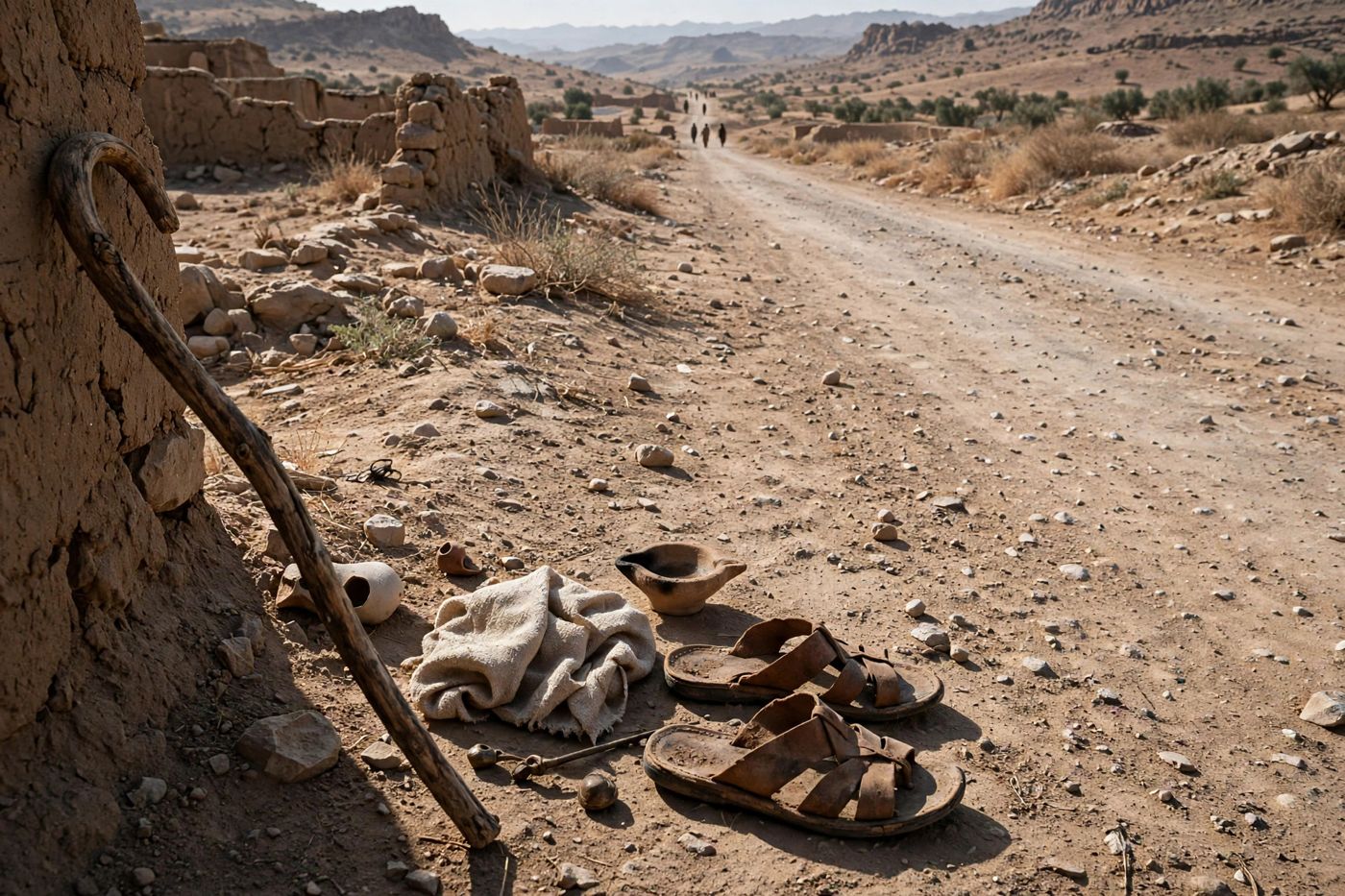
Practices — what the gate lets through, made concrete this week:
- The reed audit. On paper, list the three things you are actually leaning on for security, approval, or rescue. Beside each, write the Ezekiel test: if I lean my whole weight here, what happens? Bring the list to prayer without editing it first.
- Cry first. Egypt's converted order was cry, then saviour (v. 20). This week, take one live anxiety and pray it through — out loud, specifically — before you make the call, send the message, or work the angle. Notice what the order changes.
- Vow and perform. One vow you have already made to God and quietly dropped — a promised practice, gift, apology, or obedience. This week, perform it (v. 21). Small and done beats large and intended.
- Bless one "Assyria" by name. Verse 25 discipline: choose one person or group you instinctively place outside God's blessing, and pray for them daily this week by name, asking God to make them "the work of my hands." Let the prayer argue with you.
- Memorize Isaiah 19:25 — the verse printed at §1 and on the Recap Card below. Learn it until you can say it without the page: the whole oracle in one breath — judgment's God, blessing by name.
What does not cross: rebuilding a literal altar in Egypt as a program; reading verse 25 as God blessing any nation in its idolatry; treating "cruel lord" identifications as settled doctrine; imitating the sign-act's form rather than its obedience; and using "God smites to heal" to call every suffering a healing in progress — the verse promises God's aim for those who return (v. 22). The gate is not there to shrink the Bible's claims on you — only to make sure the claims that land are the ones God actually made.
Praise Him
Blessed be the LORD of hosts, who rides upon the cloud and makes the idols tremble; who smites and heals with the same hand; who hears the cry of the slave-house and sends a saviour; who builds a highway where the captive-road ran, and walks His enemies home on it as worshippers; who calls Egypt my people and Assyria the work of my hands, and keeps His own as mine inheritance — one God, blessing by name. Amen.
14. THE RECAP CARD — this study on one page
Print it. Keep it where you'll see it this week.
- The passage: Isaiah 19:1–20:6 — the burden of Egypt in two acts, and the sign of the stripped prophet.
- Say It Plain: God comes into Egypt and breaks its gods, river, and counsel; then He converts it — altar, saviour, healing — and blesses it with Assyria and Israel; Isaiah walks the warning for three years.
- The AIM: Isaiah announces that the LORD Himself will break Egypt — its gods, its river, its counsel — and then heal and bless that same Egypt as "my people" on one highway with Assyria and Israel; and He signs the warning with His prophet's stripped body, so that Judah will stop leaning on the broken reed and trust the God who smites in order to heal.
- Key terms: sign-act — a sermon performed with the prophet's body · "in that day" — God's appointed day that settles things · highway (mesillah) — the raised road, turned from war-path to worship-road · the LORD of hosts — heaven's commander, seven times in ch. 19.
- The Misread, in one line: verses 18–25 are the oracle's own conclusion, not a later quilt-patch · ch. 20's shame is the sermon, not a scandal · verse 25 blesses a converted Egypt — universal embrace through particular conversion, never syncretism.
- Memory verse: "Whom the LORD of hosts shall bless, saying, Blessed be Egypt my people, and Assyria the work of my hands, and Israel mine inheritance." — Isaiah 19:25
- This week's practice: the reed audit — name what you are leaning on, test it at full weight, and cry to the LORD first.
15. CHECK YOURSELF — five questions
Answer from the study, not from instinct. (Answers live in the Teacher Edition.)
- In your own words: what is the AIM of Isaiah 19:1–20:6?
- Act one breaks Egypt at four points before the "cruel lord" is even mentioned. Name at least three of them — heart, society, counsel, river, crown — and give the verse for each you name.
- What is a sign-act, and what exactly did Isaiah's three stripped years predict? Name the two peoples the sign was "upon" (20:3).
- A friend says Isaiah 19:25 proves all religions are one and every nation is already God's people as it stands. Answer from the chapter itself: list three things the blessed Egypt of verses 18–22 has done or received.
- How many times does "in that day" sound in chapter 19, and in which act? And in verse 25, which title goes to which nation — Egypt, Assyria, Israel?
16. GO DEEPER
Optional — for readers who want the machinery. The lesson is complete without it.
From the Sources — Sargon, the king the Bible kept
Chapter 20 opens in a way no other oracle does — with a date-line a historian can check:
"In the year that Tartan came unto Ashdod, (when Sargon the king of Assyria sent him,)" (20:1) — the whole sign hangs on this one dated sentence.
Tartan is not a name but a title — the Assyrian commander-in-chief, the empire's second man. Sargon — Sargon II of Assyria, father of Sennacherib — is named in the entire Bible only here. FACT: for centuries this verse was the world's only record of him, until nineteenth-century excavation of his palace at Khorsabad uncovered his annals — which tell the Ashdod campaign from the conqueror's side, matching the Bible's spare date-line. [11, 25] The episode taught scholarship a permanent lesson about arguing from silence. And notice Isaiah's restraint: the campaign gets one verse. The history is real, dated, and checkable — and it is only the sign's frame. The sermon is the next three years.
The Honest Argument — who wrote verses 18–25, and when?
State the critical case at full strength. DISPUTED: many scholars, from the great German commentaries onward, have judged verses 18–25 a later addition — pointing to the abrupt turn from judgment to universal blessing, to prose-like rhythms in a poetic chapter, and to a tantalising candidate for fulfilment: the Jewish temple built at Leontopolis in Egypt in the second century BC, which some have read as the "altar in the midst of Egypt" (v. 19) finding its moment. [10, 14] The traditional case answers: abrupt turns are Isaiah's signature everywhere (judgment bending to hope inside single oracles, as in chs. 1, 9, and 28); the "in that day" refrain is Isaiah's own; the exodus-reversal is this prophet's characteristic theology; and the book was already one scroll, all 66 chapters, in the Great Isaiah Scroll centuries before Christ. [2, 22] INFERENCE on both sides — each reading infers an origin from the text's features; neither side can produce the autograph. POSITION — this program's, labelled as the brief requires: the book is Isaiah's, one prophet's witness read whole, and the finished text — the only form in which the church has ever received this oracle — preaches judgment and blessing as one word. The lesson above teaches the text at full strength on exactly that basis, and hides nothing about the argument.
A smaller honesty item: verse 18's "city of destruction." The Hebrew copies and versions divide over one consonant's reading — "destruction" (heres) against "sun" (cheres), which would name Heliopolis, Egypt's great sun-temple city. [23, 24] The KJV follows "destruction." Either reading leaves one of the five cities under a shadowed name — judgment, or irony: a city of the sun-god swearing to the LORD of hosts.
The Word Underneath — mesillah, the road God keeps building
The highway of verse 23 is not a metaphor Isaiah reaches for once. Track the word through the book: a mesillah from Assyria for the returning remnant (11:16); this lesson's highway between Egypt and Assyria (19:23); the "way of holiness" in the wilderness chapter (35:8); the road made straight in the desert for God Himself (40:3); and late in the book the command to "cast up the highway" for God's returning people (62:10). FACT — the occurrences, checkable in any concordance. 19
| Where | The road | Who travels it |
|---|---|---|
| 11:16 | A highway from Assyria | The returning remnant |
| 19:23 | Egypt to Assyria | Worshippers, both directions |
| 35:8 | The way of holiness | The redeemed, in the wilderness made glad |
| 40:3 | A highway for our God | God Himself, coming to His people |
| 62:10 | Cast up the highway | The people returning through the gates The root idea is a road thrown up, embanked above the ground — built, deliberate, engineered. INFERENCE — earned by the sequence: Isaiah's roads trace his gospel. In the book's first half the highways carry armies and exiles; by the end they carry worshippers and the returning redeemed. Chapter 19 is the hinge where the traffic changes direction. 52 |
Go Read
- Oswalt, The Book of Isaiah, Chapters 1–39 (NICOT) 2 — the fullest evangelical treatment of this oracle, act by act, with the Assyrian-period history kept close to the text.
- Wildberger, Isaiah 13–27 (Continental Commentary) 10 — the critical case on chapter 19's composition argued at full strength, textual notes included; read him to feel the other side's real weight.
- Walton, Matthews & Chavalas, The IVP Bible Background Commentary: Old Testament 16 — on Isaiah 19–20: the Nile economy, Zoan and Noph, the Cushite dynasty, and Ashdod, verse by verse.
17. SOURCES & REFERENCES
Numbered citations in this lesson key to this list — the course standard: every sourced claim carries its number, and every number can be checked.
-
Oswalt, The Book of Isaiah, Chapters 1–39 (NICOT) — John N. Oswalt (Eerdmans). The leading evangelical commentary on the first half; defends essential unity of authorship and reads the book as a finished theological whole. Detailed notes on the Assyrian-period history (Ahaz, Hezekiah, Sennacherib).
-
Motyer, The Prophecy of Isaiah — J. Alec Motyer (IVP). A one-volume commentary by an evangelical scholar who argues the whole book breathes the mind of the eighth-century prophet; especially strong on the book's structure, its repeated refrains, and the Servant.
-
Childs, Isaiah (Old Testament Library) — Brevard S. Childs (Westminster John Knox). The canonical-approach reading: the book in its final form as Scripture, whatever its compositional prehistory; a control on both conservative and critical overreach.
-
Wildberger, Isaiah 1–12, Isaiah 13–27, Isaiah 28–39 (Continental Commentary) — Hans Wildberger (Fortress). The fullest German critical commentary on the first half; detailed on the oracles against the nations and on textual questions.
-
Smith, Isaiah 1–39 and Isaiah 40–66 (New American Commentary) — Gary V. Smith (B&H). Evangelical commentary with strong historical notes (the Assyrian and Babylonian records) and an even-handed survey of the authorship debate.
-
Clements, Isaiah 1–39 (New Century Bible) — R. E. Clements (Eerdmans). Critical commentary notable for its redactional reading of the eighth-century core and its later expansions.
-
Walton, Matthews & Chavalas, The IVP Bible Background Commentary: Old Testament — John H. Walton, Victor H. Matthews, Mark W. Chavalas (IVP). Verse-by-verse ancient Near Eastern background: Assyrian siege practice, Babylonian religion, treaty and coronation customs, geography.
-
Boda & McConville (eds.), Dictionary of the Old Testament: Prophets — Mark J. Boda and J. Gordon McConville (IVP). Articles on Isaiah's composition, the Servant, Zion, the nations oracles, and the prophetic genres, written across the scholarly spectrum.
-
Brown, Driver & Briggs, Hebrew and English Lexicon of the Old Testament (BDB) — The standard older Hebrew lexicon; word senses and usage ranges for the Terms sections.
-
Koehler & Baumgartner, The Hebrew and Aramaic Lexicon of the Old Testament (HALOT) — The standard modern Hebrew lexicon; the control on BDB for contested senses (e.g., 'almah).
-
The Great Isaiah Scroll (1QIsaᵃ) and the Dead Sea Scrolls Bible — The complete Isaiah scroll from Qumran Cave 1 (c. 125 BC), in Abegg, Flint & Ulrich, The Dead Sea Scrolls Bible (HarperSanFrancisco). The oldest substantial witness to Isaiah's text — already a single scroll of all 66 chapters centuries before Christ.
-
Biblia Hebraica Stuttgartensia (BHS) — The standard critical edition of the Hebrew text behind the modern translations, with its textual apparatus (the home of the Isaiah variants discussed in the Translation Notes).
-
The Septuagint (LXX) — Rahlfs–Hanhart edition. The ancient Greek Isaiah (2nd century BC): itself already one book of 66 chapters, and the Bible of the early church; its renderings (e.g., parthenos at 7:14) argued in the open where they matter.
-
Pritchard (ed.), Ancient Near Eastern Texts Relating to the Old Testament (ANET) — James B. Pritchard (Princeton). Translations of the primary records: Sennacherib's annals, the Babylonian Chronicle, the Cyrus Cylinder, treaty and hymn texts.
-
Ussishkin, The Conquest of Lachish by Sennacherib — David Ussishkin (Tel Aviv University). The excavation of Lachish's siege ramp — the only Assyrian siege ramp ever found — matched stone by stone against the reliefs 27.
-
Fee & Stuart, How to Read the Bible for All Its Worth — Gordon D. Fee and Douglas Stuart (Zondervan). The beginner's method book; its prophecy chapter ("a forthtelling first") undergirds the Genre sections.
-
Ryken, Wilhoit & Longman (eds.), Dictionary of Biblical Imagery — Leland Ryken et al. (IVP). Isaiah's image-fields — vineyard, highway, banner, potter, watchman — traced across the canon.