
One study, one walk — the universal FIRM format. The passage first and whole; then its world; then the Walk (Context · Observe · Genre · Terms · Entire Canon); the meaning taught straight; the AIM sentence; the misread exposed and answered; and the walk-out, where application has to pass the Transfer Tests before it reaches your week. The same skeleton serves a book, a chapter, a single verse, or a whole subject. In the early studies the moves are labeled as they happen. The labels fade as the walk becomes yours.
THE WEEK WITH THIS STUDY — six bites
Day 1 — Read the passage · Say It Plain · The World (§§1–2) · Day 2 — Observe · Genre (§§3–4) · Day 3 — Terms · Entire Canon (§§5–6) · Day 4 — The Meaning · the AIM Sentence · Say It Back (§§7–9) · Day 5 — The Misread · From Word to Walk (§§10–11 — add For Discussion, §12, if you're with others) · Day 6 — The Walk-Out · the Recap Card (§§13–14). Go Deeper (§16) any evening you want the basement.
BEFORE YOU READ — Open My Eyes
Lord, set me on the watchtower with Your prophet. Give me eyes that stay open through the night watch, a heart that weeps where You weep, and hands that hold every good gift as holiness to You — not as a place to hide from You. Open my eyes to what is actually here.
§ means “section” — the numbered parts of your lesson. Each bite above names the sections for that day.
1. READ THE PASSAGE — Isaiah 21:1–23:18 (KJV)
Read it all, slowly, before any teaching. In this course the passage always prints once, in full, at the head of the lesson. Everything after this is commentary.
1 The burden of the desert of the sea. As whirlwinds in the south pass through; so it cometh from the desert, from a terrible land.
2 A grievous vision is declared unto me; the treacherous dealer dealeth treacherously, and the spoiler spoileth. Go up, O Elam: besiege, O Media; all the sighing thereof have I made to cease.
3 Therefore are my loins filled with pain: pangs have taken hold upon me, as the pangs of a woman that travaileth: I was bowed down at the hearing of it; I was dismayed at the seeing of it.
4 My heart panted, fearfulness affrighted me: the night of my pleasure hath he turned into fear unto me.
5 Prepare the table, watch in the watchtower, eat, drink: arise, ye princes, and anoint the shield.
6 For thus hath the Lord said unto me, Go, set a watchman, let him declare what he seeth.
7 And he saw a chariot with a couple of horsemen, a chariot of asses, and a chariot of camels; and he hearkened diligently with much heed:
8 And he cried, A lion: My lord, I stand continually upon the watchtower in the daytime, and I am set in my ward whole nights:
9 And, behold, here cometh a chariot of men, with a couple of horsemen. And he answered and said, Babylon is fallen, is fallen; and all the graven images of her gods he hath broken unto the ground.
10 O my threshing, and the corn of my floor: that which I have heard of the LORD of hosts, the God of Israel, have I declared unto you.
11 The burden of Dumah. He calleth to me out of Seir, Watchman, what of the night? Watchman, what of the night?
12 The watchman said, The morning cometh, and also the night: if ye will enquire, enquire ye: return, come.
13 The burden upon Arabia. In the forest in Arabia shall ye lodge, O ye travelling companies of Dedanim.
14 The inhabitants of the land of Tema brought water to him that was thirsty, they prevented with their bread him that fled.
15 For they fled from the swords, from the drawn sword, and from the bent bow, and from the grievousness of war.
16 For thus hath the Lord said unto me, Within a year, according to the years of an hireling, and all the glory of Kedar shall fail:
17 And the residue of the number of archers, the mighty men of the children of Kedar, shall be diminished: for the LORD God of Israel hath spoken it.
— Chapter 22 begins here: the burden turns home, to Jerusalem itself. —
1 The burden of the valley of vision. What aileth thee now, that thou art wholly gone up to the housetops?
2 Thou that art full of stirs, a tumultuous city, a joyous city: thy slain men are not slain with the sword, nor dead in battle.
3 All thy rulers are fled together, they are bound by the archers: all that are found in thee are bound together, which have fled from far.
4 Therefore said I, Look away from me; I will weep bitterly, labour not to comfort me, because of the spoiling of the daughter of my people.
5 For it is a day of trouble, and of treading down, and of perplexity by the Lord GOD of hosts in the valley of vision, breaking down the walls, and of crying to the mountains.
6 And Elam bare the quiver with chariots of men and horsemen, and Kir uncovered the shield.
7 And it shall come to pass, that thy choicest valleys shall be full of chariots, and the horsemen shall set themselves in array at the gate.
8 And he discovered the covering of Judah, and thou didst look in that day to the armour of the house of the forest.
9 Ye have seen also the breaches of the city of David, that they are many: and ye gathered together the waters of the lower pool.
10 And ye have numbered the houses of Jerusalem, and the houses have ye broken down to fortify the wall.
11 Ye made also a ditch between the two walls for the water of the old pool: but ye have not looked unto the maker thereof, neither had respect unto him that fashioned it long ago.
12 And in that day did the Lord GOD of hosts call to weeping, and to mourning, and to baldness, and to girding with sackcloth:
13 And behold joy and gladness, slaying oxen, and killing sheep, eating flesh, and drinking wine: let us eat and drink; for to morrow we shall die.
14 And it was revealed in mine ears by the LORD of hosts, Surely this iniquity shall not be purged from you till ye die, saith the Lord GOD of hosts.
15 Thus saith the Lord GOD of hosts, Go, get thee unto this treasurer, even unto Shebna, which is over the house, and say,
16 What hast thou here? and whom hast thou here, that thou hast hewed thee out a sepulchre here, as he that heweth him out a sepulchre on high, and that graveth an habitation for himself in a rock?
17 Behold, the LORD will carry thee away with a mighty captivity, and will surely cover thee.
18 He will surely violently turn and toss thee like a ball into a large country: there shalt thou die, and there the chariots of thy glory shall be the shame of thy lord's house.
19 And I will drive thee from thy station, and from thy state shall he pull thee down.
20 And it shall come to pass in that day, that I will call my servant Eliakim the son of Hilkiah:
21 And I will clothe him with thy robe, and strengthen him with thy girdle, and I will commit thy government into his hand: and he shall be a father to the inhabitants of Jerusalem, and to the house of Judah.
22 And the key of the house of David will I lay upon his shoulder; so he shall open, and none shall shut; and he shall shut, and none shall open.
23 And I will fasten him as a nail in a sure place; and he shall be for a glorious throne to his father's house.
24 And they shall hang upon him all the glory of his father's house, the offspring and the issue, all vessels of small quantity, from the vessels of cups, even to all the vessels of flagons.
25 In that day, saith the LORD of hosts, shall the nail that is fastened in the sure place be removed, and be cut down, and fall; and the burden that was upon it shall be cut off: for the LORD hath spoken it.
— Chapter 23 begins here: the last burden, against Tyre, the merchant city of the sea. —
1 The burden of Tyre. Howl, ye ships of Tarshish; for it is laid waste, so that there is no house, no entering in: from the land of Chittim it is revealed to them.
2 Be still, ye inhabitants of the isle; thou whom the merchants of Zidon, that pass over the sea, have replenished.
3 And by great waters the seed of Sihor, the harvest of the river, is her revenue; and she is a mart of nations.
4 Be thou ashamed, O Zidon: for the sea hath spoken, even the strength of the sea, saying, I travail not, nor bring forth children, neither do I nourish up young men, nor bring up virgins.
5 As at the report concerning Egypt, so shall they be sorely pained at the report of Tyre.
6 Pass ye over to Tarshish; howl, ye inhabitants of the isle.
7 Is this your joyous city, whose antiquity is of ancient days? her own feet shall carry her afar off to sojourn.
8 Who hath taken this counsel against Tyre, the crowning city, whose merchants are princes, whose traffickers are the honourable of the earth?
9 The LORD of hosts hath purposed it, to stain the pride of all glory, and to bring into contempt all the honourable of the earth.
10 Pass through thy land as a river, O daughter of Tarshish: there is no more strength.
11 He stretched out his hand over the sea, he shook the kingdoms: the LORD hath given a commandment against the merchant city, to destroy the strong holds thereof.
12 And he said, Thou shalt no more rejoice, O thou oppressed virgin, daughter of Zidon: arise, pass over to Chittim; there also shalt thou have no rest.
13 Behold the land of the Chaldeans; this people was not, till the Assyrian founded it for them that dwell in the wilderness: they set up the towers thereof, they raised up the palaces thereof; and he brought it to ruin.
14 Howl, ye ships of Tarshish: for your strength is laid waste.
15 And it shall come to pass in that day, that Tyre shall be forgotten seventy years, according to the days of one king: after the end of seventy years shall Tyre sing as an harlot.
16 Take an harp, go about the city, thou harlot that hast been forgotten; make sweet melody, sing many songs, that thou mayest be remembered.
17 And it shall come to pass after the end of seventy years, that the LORD will visit Tyre, and she shall turn to her hire, and shall commit fornication with all the kingdoms of the world upon the face of the earth.
18 And her merchandise and her hire shall be holiness to the LORD: it shall not be treasured nor laid up; for her merchandise shall be for them that dwell before the LORD, to eat sufficiently, and for durable clothing.
SAY IT PLAIN — the passage in everyday words: A watchman is posted, and after a long, diligent night he cries out what he sees: Babylon has fallen, and its gods lie smashed on the ground, while the prophet's own body aches with the grief of carrying the news. A voice from Edom calls through the dark, "Watchman, what of the night?" and gets a haunted answer: morning is coming, and so is night — ask again, come back. Arabia's glory is given a hireling's year to live. Then the oracle turns home: Jerusalem parties on its housetops and fortifies its walls while refusing to look to the God who made the city — so God calls the feasting what it is, and moves to the palace, where a steward carving his own tomb is thrown out and a faithful steward is clothed, girded, and given the key of David's house — though even his nail, in the end, gives way. Last, Tyre, the rich port whose merchants were princes, is silenced for seventy years — and then, astonishingly, her profits are promised a future as holiness to the LORD, feeding the people who dwell before Him. That's the whole passage. Everything after this teaches from it — nothing will change what you just read.
2. THE WORLD — C: Context & Audience
A text can never mean what it never meant — so before we ask what these verses mean, we stand where their first hearers stood.
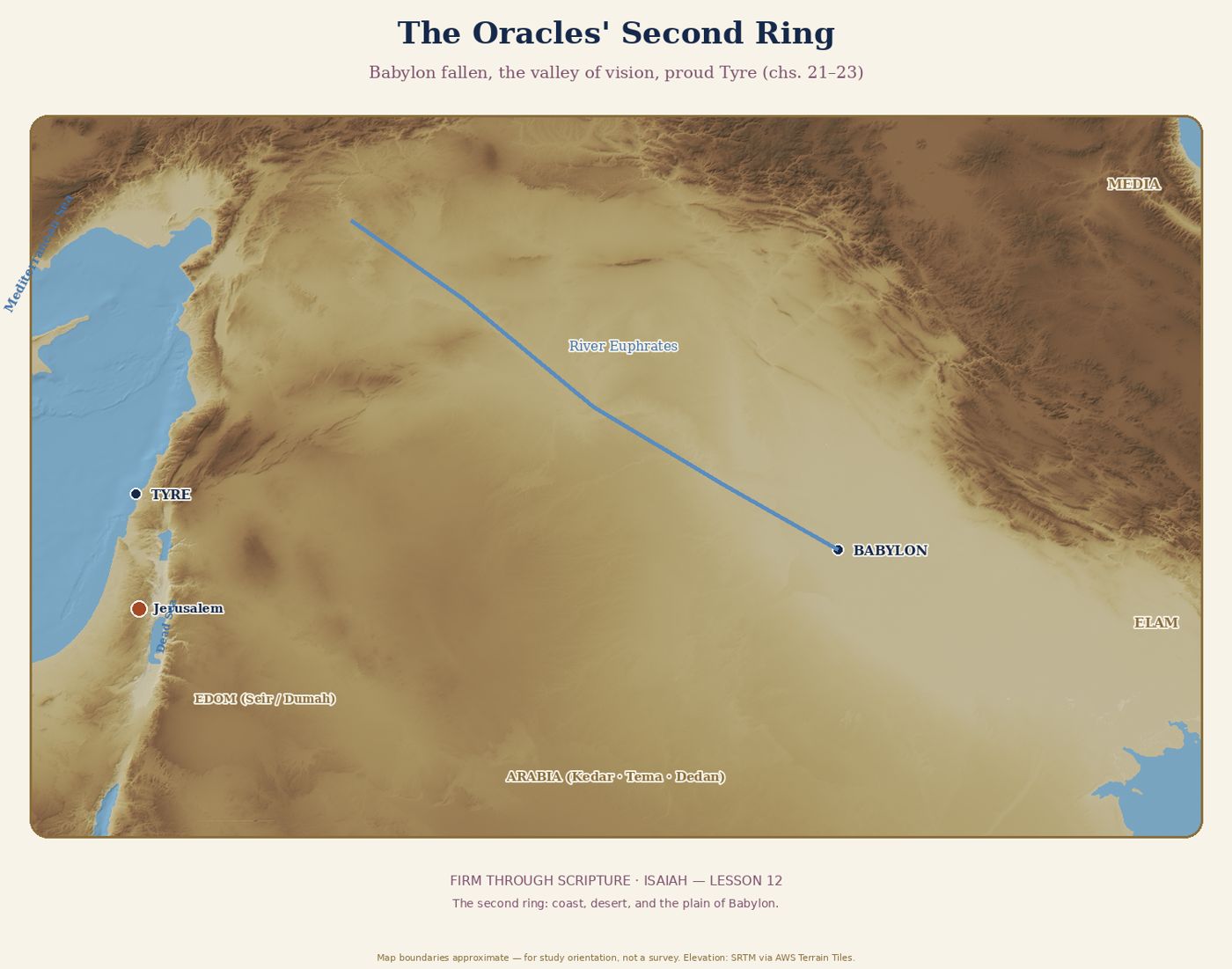
The atlas, nearly complete — and the wheel turning home. You are deep inside Isaiah's book of burdens, the atlas of oracles against the nations running from chapter 13 to chapter 23. A burden — Hebrew massa' — is a heavy word from God about a nation, preached in Jerusalem to Judah, because Judah's leaders kept shopping among these nations for a protector. Babylon opened the atlas (Lesson 09); Moab, Damascus, Cush, and Egypt have followed. Now the prophet sweeps the remaining compass points: Babylon again (21:1–10), Edom and Arabia to the south (21:11–17), then — the shock — Jerusalem itself (ch. 22), and finally Tyre on the northern coast (ch. 23). Isaiah is a prophet to the nations because Israel's God is Lord of the nations; but the longest, saddest oracle in this stretch is not aimed abroad. It is aimed at the prophet's own city. [2, 10]
Babylon again — but this time, from the desert. Chapter 21 opens with "the burden of the desert of the sea" (v. 1) — a riddle-name fitting Babylon's flat southern plain, where the Euphrates spread toward the Persian Gulf in a "sea" of marsh at the desert's edge. [16, 46] The besiegers are named inside the vision: "Go up, O Elam: besiege, O Media" (v. 2). Elam lay east of Babylon, in what is now southwestern Iran; Media to its north, its people joining the rising Persian power. Together they point to the eastern coalition that ended Babylon: in 539 BC Babylon fell to Cyrus of Persia, an event the Babylonian Chronicle also preserves. 30 FACT: Babylon really did fall, suddenly, to an eastern power, long after Isaiah's century. What is argued is the dating of the words — Isaiah seeing far ahead, or a later voice folded into his book. That is Lesson 00's authorship question, DISPUTED terrain; this study's POSITION — the book read whole as Isaiah's witness — was stated there. What no side disputes is that the text presents a watchman's report: somebody is posted, somebody waits, and the cry, when it comes, is two words deep.
Dumah and Kedar: the small nations in Babylon's shadow. Verse 11 turns south. Dumah is an oasis name in the northern Arabian desert, here linked with Seir — the mountain country of Edom, Israel's old brother-and-rival nation southeast of the Dead Sea, descended in Israel's story from Esau. A voice calls out of Seir in the night: Edom, too, lives under the great powers' shadow, and wants to know how much darkness is left. Verses 13–17 cross into Arabia: Dedan and Tema were oasis peoples whose caravans carried trade goods across the desert; Kedar was the best-known northern Arabian tribal confederation, famous for its tents, flocks, and archers. [16, 46] These were not empires, but the desert peoples who supplied them — and who would be trampled in the empires' wars, fleeing "from the swords, from the drawn sword, and from the bent bow" (v. 15).
Jerusalem, the valley of vision. Chapter 22's title is an irony before it is a geography lesson. Jerusalem sits on hills — but Isaiah calls it "the valley of vision" (v. 1), perhaps because the city nestles between higher ridges, perhaps because the valley is where its vision — its prophetic sight — has sunk. [4, 10] The scene is a city under threat doing two things at once: carousing on the flat housetops (living space in a crowded walled city) and engineering desperately below — counting houses, pulling some down to repair breaches, gathering water into reservoirs. Verses 9–11 are a building inspector's report: "the breaches of the city of David," "the waters of the lower pool," "a ditch between the two walls for the water of the old pool." Behind those lines stand real Jerusalem waterworks — above all Hezekiah's tunnel, the rock-cut channel that brought the Gihon spring's water inside the city to the Pool of Siloam, celebrated in 2 Kings 20:20 among the king's mighty works. 28 The Siloam Inscription, a Hebrew text carved in that tunnel's wall, records the moment the two digging crews heard each other's voices and broke through. 28 INFERENCE, carefully: Isaiah 22:9–11 does not name the tunnel; it names pools, a ditch, and gathered waters, and readers have long connected them with Hezekiah's preparations. 28 The connection is plausible and widely made — but notice what the oracle indicts. Not the engineering. The engineers: "but ye have not looked unto the maker thereof" (v. 11). Jerusalem improved everything about its water supply except its relationship with the God who gave it water.
The steward "over the house." Verses 15–25 drop from the city to one office and two men, and beginners need the office explained or the scene reads like court gossip. The official "over the house" (asher al-habayith) was the royal steward: the king's chief of staff, keeper of the palace, its stores, and its keys, second in practical power only to the king himself. [16, 46] Shebna, who holds it, is spending its prestige on himself: carving a grand tomb high in the rock while the city braces for siege. Eliakim the son of Hilkiah, who replaces him, will appear again in chapters 36–37 as Hezekiah's chief envoy to the Assyrian spokesman. 2 Hold both names; the New Testament will reach back into this palace scene, pull out one of its objects — a key — and lay it on another shoulder (see §6).
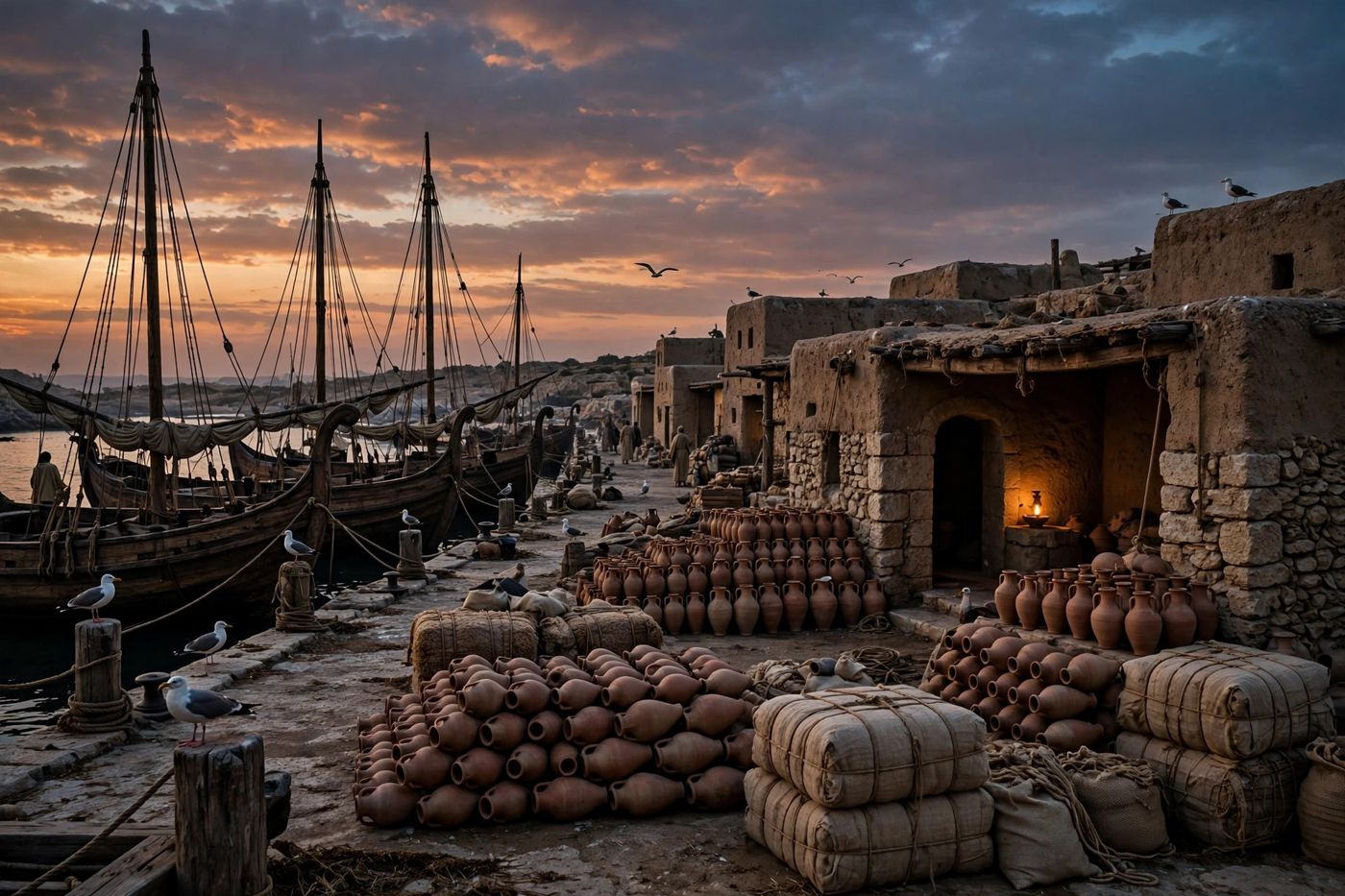
Tyre, the merchant princess. The atlas ends at the sea. Tyre was a Phoenician city on the coast north of Israel — part island fortress, part mainland port — and for centuries the great trading power of the western sea. [16, 46] Her partners ringed the Mediterranean: Tarshish, far to the west (often located in southern Spain), sent the great ocean-going ships bearing its name; Sidon (the KJV spells it Zidon) was her older sister-city; Chittim — Cyprus and the western coasts beyond — was where news of her fall would land first. Verse 3 gives her income statement in one line: Egypt's grain, shipped through her harbour, made her "a mart of nations." 16 Her merchants are called "princes," her traffickers "the honourable of the earth" (v. 8) — description before accusation. Tyre was genuinely magnificent, which makes her the fitting last burden: the section's question — where does a nation put its trust? — is asked one final time, of the nation whose trust-object was wealth itself.
That is the world. Now we open the text itself.
3. OBSERVE — O: what the text actually does
Before meaning comes observation. Most bad interpretation is shallow reading — people answering a text they never actually looked at. So look:
- The shape. Four movements: Babylon and the watchman (21:1–10) — a vision, a posting, a cry; the night questions (21:11–17) — Dumah's call and Kedar's countdown; the valley of vision (22:1–14) — Jerusalem feasting and fortifying, and God's verdict on both; the two stewards and the port (22:15–25; ch. 23) — one man tossed out, one man keyed in, then the camera pulls back to the sea. The passage descends in scale — empire, desert tribes, one city, one office — then widens again to the whole trading world.
- The watchman is ordered to be honest, not hopeful. "Go, set a watchman, let him declare what he seeth" (21:6). His report rests on a discipline the text underlines: "he hearkened diligently with much heed" (v. 7). He does not cry out at the first shape; he waits through chariots, horsemen, asses, camels, until the report is certain. His faithfulness is measured in time served: "I stand continually upon the watchtower in the daytime, and I am set in my ward whole nights" (v. 8).
- The prophet's body is an instrument in this passage. Twice the messenger suffers what he carries. At Babylon's fall: "my loins filled with pain... I was bowed down at the hearing of it" (21:3). At Jerusalem's danger: "Look away from me; I will weep bitterly, labour not to comfort me" (22:4). The grief is the same for the enemy empire and for his own city. Isaiah does not enjoy a single sentence of this passage.
- Jerusalem's verbs are all competence; its one missing verb is sight. They saw the breaches, gathered waters, numbered houses, broke down houses, made a ditch (22:9–11) — brisk, organised, impressive. Then the sentence turns on a single negative: "but ye have not looked unto the maker thereof" (v. 11). They inspected everything except the One thing.
- Judgment here is scheduled, not vague. Kedar's glory fails "within a year, according to the years of an hireling" (21:16) — a hired labourer counts his term to the day, neither longer nor shorter.
- The steward scene runs on clothing and carrying. Shebna will be carried away, tossed like a ball (22:17–18). Eliakim is clothed with the robe, strengthened with the girdle, and the key is laid upon his shoulder (vv. 21–22); he is fastened as a nail — and finally the nail itself "shall be removed, and be cut down, and fall" (v. 25). Office, in this chapter, is something you wear and carry — and something that can be stripped and dropped.
- Tyre's oracle ends facing the opposite direction from every other burden. Count the "howl"s (23:1, 6, 14) — then read the last verse. Every other burden ends in ruin. This one ends with a purpose clause: merchandise "for them that dwell before the LORD, to eat sufficiently, and for durable clothing" (v. 18). Hold that observation; §7 will build on it.

4. GENRE — N: note the genre (oracles against the nations — and against home)
This passage is prophetic oracle poetry, in the sub-form you have met across three lessons: the burden, a judgment-oracle directed at a named nation, in compressed, image-dense verse. [8, 17] But watch what the form does here, because Isaiah bends it twice:
- The burden becomes a report. Chapter 21:1–10 is staged as a watchman's dispatch — a vision received, a post assigned, a report delivered. Judgment-oracles normally announce; this one witnesses. Babylon's fall is presented not as the prophet's opinion but as an eyewitness cry from the wall.
- The burden comes home. Chapter 22 applies the nations-form to Jerusalem itself — the same "burden of..." heading, now over the valley of vision. Form is argument: you have nodded through God's verdicts on Babylon, Moab, Egypt. Then the identical instrument turns, and the address reads your city. A reader who only enjoys burdens against other people has misunderstood the genre's purpose in this book. [4, 17]
- The burden narrows to a personnel file — then widens to the whole economy. The Shebna–Eliakim oracle (22:15–25) is a word against one officeholder, as Nathan's parable named David (2 Samuel 12). Chapter 23 closes the section not with a king but with a market. Empire, tribe, city, steward, port: the net catches every level of human organisation.
Prophecy of this kind is, first, forthtelling — God's verdict spoken into a present situation — before it is foretelling. 51 The predictions here (a year for Kedar, seventy years for Tyre, Babylon's fall) are real, and §7 treats them so; but the oracle's first work was never to satisfy curiosity about dates. It was to expose trust: whose hand is on history, and what are you leaning on instead?
5. TERMS — T: the words in the writer's mouth
Four terms carry this passage. Learn what they meant in Isaiah's mouth, and several flat readings die at the dictionary:
- Tsopheh (tso-FEH), "watchman" — from the verb tsaphah, to look out, keep watch from a height. The watchman was a real military office: a posted lookout on a wall or tower (see the watchman at Jezreel, 2 Kings 9) whose one duty was accurate reporting. [19, 52] Isaiah makes the office a self-portrait — the image Ezekiel, a generation later, will formalise: God sets him "a watchman unto the house of Israel," responsible to warn as God gives him to see (Ezekiel 3; 33). [1, 52] Notice the office's limits: the watchman sees and declares; he does not command the battle, steer the chariots, or choose what comes over the ridge. His glory is not control. It is truthful sight, held over whole nights.
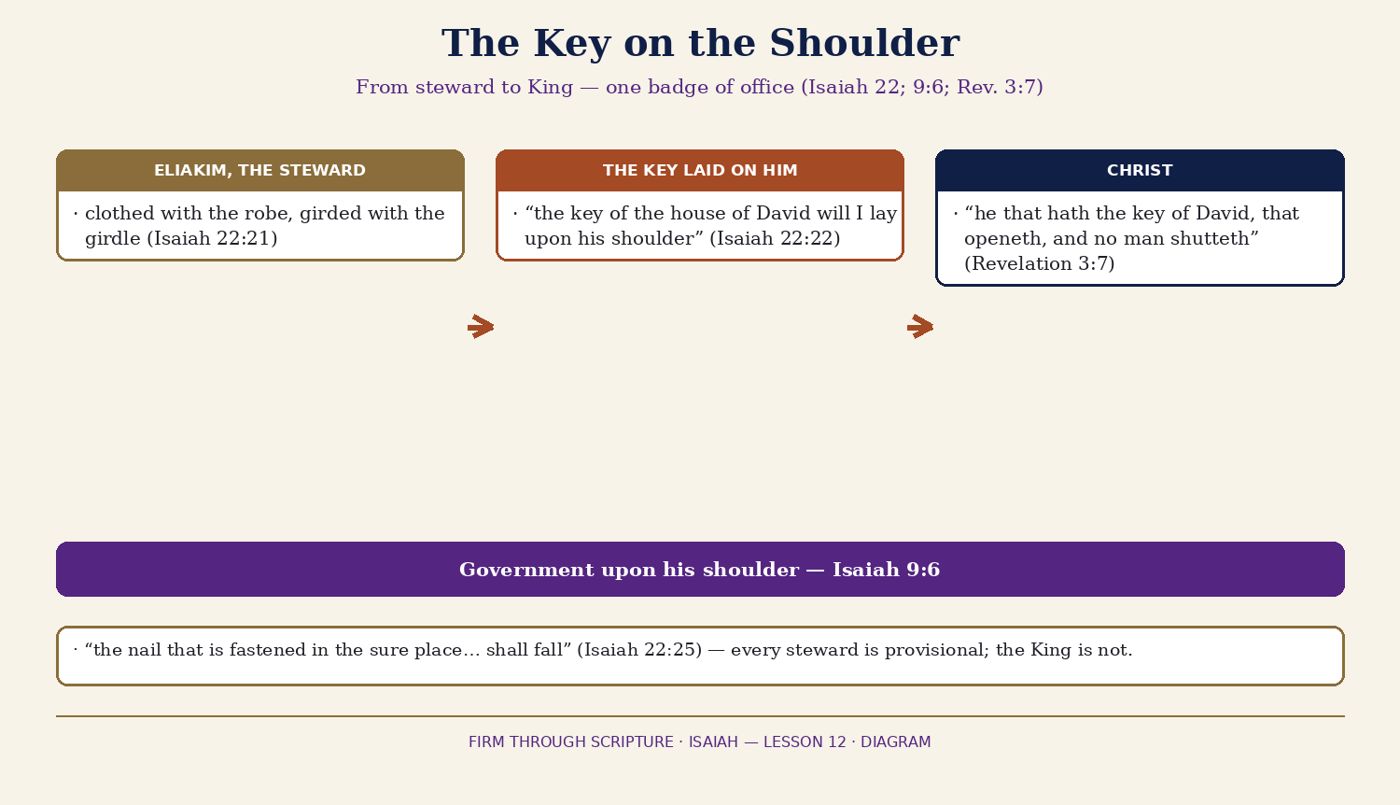
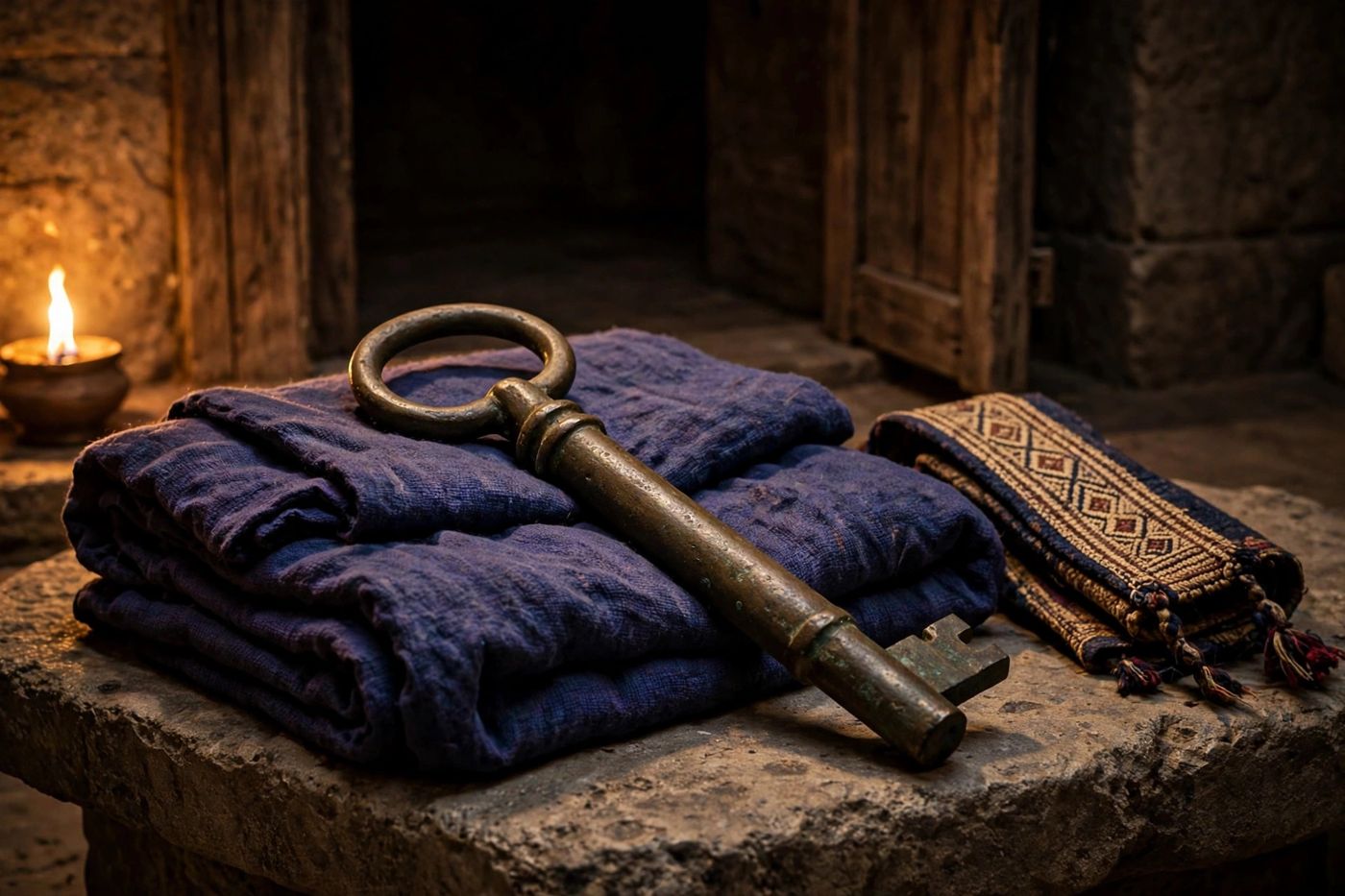
- "Over the house," and the key. The steward's title — asher al-habayith, literally "the one who is over the house" — names the chief officer of the royal household, and his authority had a visible badge: the great house-key, carried on the shoulder, controlling access to the king's stores, treasury, and presence. [16, 46] Keys in that world were not pocket items; a palace key was a large wooden or bronze implement, and to bear it was to be the door — whoever you admitted, entered; whoever you shut out, stayed out. Read 22:22 with that object in mind: "so he shall open, and none shall shut" is a job description before it is a metaphor. Government here is literally "laid upon his shoulder" (v. 22) — the same shoulder language Isaiah used for the coming child-king in chapter 9.
- "The years of an hireling." A hireling is a hired term-labourer under contract for an exact span, who counts his days precisely because his pay depends on the count (Job uses the same picture for a life of toil). 19 "Within a year, according to the years of an hireling" (21:16) is a precision instrument: not "sometime soon," but inside one counted, contracted year — no overtime. The term turns a prophecy into a deadline.
- Mart and the harlot picture (ch. 23). Tyre is "a mart of nations" (v. 3) — a marketplace where goods changed hands. Her profits are called her "hire" (vv. 17–18), and the chapter pictures her, in her forgotten seventy years, as an ageing harlot who must take up a harp and sing in the streets to be remembered (vv. 15–16). In prophetic language, the harlot image for a city is about selling herself — giving her favours to every kingdom that pays (v. 17: she will "commit fornication with all the kingdoms of the world"). It accuses allegiance sold for profit, not trade itself. §10's third misread lives or dies on this distinction: the sin named is harlotry — trust and loyalty trafficked — and the proof is the last verse, where the same merchandise, redirected, becomes "holiness to the LORD."
Method note — the word-study guardrail: a word means what its author uses it to mean, in its sentence, in its century — not what its oldest root once meant, and not everything it can mean anywhere. Every term above was settled by Isaiah's usage in Isaiah.
TRANSLATION NOTE — the tangled battle lines (22:5)
Some verses in Isaiah are hard in Hebrew, and honesty requires showing you one. Verse 5 of chapter 22 piles up phrases that strain: a day "of treading down, and of perplexity by the Lord GOD of hosts... breaking down the walls, and of crying to the mountains." The Hebrew is genuinely difficult: rare words, a compressed line about shouting toward the mountains, no clean parallel elsewhere. [10, 23] That is why translations divide here — some keep the KJV's shape, others render the shout as a cry for help echoing against the hills, and commentators have proposed small emendations — suggested corrections to a possibly damaged line — for over a century. DISPUTED at the level of wording; FACT at the level of sense: every reading agrees the verse describes a day of panic, breached walls, and cries in Jerusalem's valleys, sent "by the Lord GOD of hosts." Nothing doctrinal hangs on the tangle. What hangs on it is your confidence habit: a translation that flags its hard places is more trustworthy, not less — it shows you where the translators worked, instead of pretending every line came easy. Where the versions divide, this study tells you. That is the rule, in this lesson and every one after it.
6. ENTIRE CANON — E: where this passage sits in the whole story
No passage lives alone — and this one is a junction box. Four of its sentences are picked up, centuries later, in the New Testament:
| Isaiah's sentence | Taken up in… | What the later text does with it |
|---|---|---|
| "Babylon is fallen, is fallen" (21:9) | Revelation 14:8; 18:2 — "Babylon is fallen, is fallen, that great city" 1 | John's angel repeats the watchman's cry, doubled word for doubled word, over the final Babylon — the world-system arrayed against God |
| "let us eat and drink; for to morrow we shall die" (22:13) | 1 Corinthians 15:32 — Paul quotes the sentence verbatim 1 | Paul sets it as the logical motto of a world with no resurrection: if the dead rise not, this feasting is simply rational |
| "the key of the house of David... upon his shoulder" (22:22) | Revelation 3:7 — Christ introduces Himself as the one "that hath the key of David, that openeth, and no man shutteth" 1 | Jesus claims Eliakim's badge as His own office: the steward's key, laid finally on the true King's shoulder |
| The watchman on his post (21:6–8) | Ezekiel 3 and 33 — "I have made thee a watchman unto the house of Israel" 1 | Isaiah's self-portrait becomes Ezekiel's formal commission — and, by extension, the church's picture of every faithful messenger since |
- The shoulder thread inside Isaiah itself. Before Revelation reaches for the key, Isaiah has linked his own bookends: the government "upon his shoulder" is the promise of the child of chapter 9 (9:6). Chapter 22's steward carries a real key on a real shoulder — a provisional, office-sized version of a load chapter 9 says will one day rest on a Person. The steward is not the King. But the book has taught you to recognise the silhouette.
- Tyre across the canon. Ezekiel devotes three chapters to Tyre (Ezekiel 26–28) — her shipwreck, her prince who said "I am a God" — a harsher picture than Isaiah's. Jesus names Tyre and Sidon as witnesses against unrepentant Galilean towns (Matthew 11). 1 And yet Isaiah 23:18 — merchandise become holiness — stands unretracted, rhyming forward to Zechariah's last chapter, where "HOLINESS UNTO THE LORD" is engraved even on the bells of the horses (Zechariah 14). 1 The canon does not end with the world's wealth burned, but washed — Revelation closes with kings bringing "the glory and honour of the nations" into the city of God (Revelation 21). 1 Isaiah 23:18 is that ending, announced early, in a harbour ledger.
- The arc of the whole passage. Judgment is spoken over every address — empire, tribe, capital, palace, port — and then, at the final address, a future in which even the port's profits serve God's house. That arc is the entire book's arc, from chapter 1's lawsuit to chapter 66's new heavens. [4, 57]
7. THE MEANING — what the passage teaches
The Walk has established what the text says and where it sits. Now its payload, taught straight.
"Babylon is fallen" — the watchman, the report, and the smashed gods
Begin where the passage begins: not with Babylon's armies, but with God's personnel decision. "Go, set a watchman, let him declare what he seeth" (21:6). Babylon does not fall because the watchman watches; but Judah learns of the fall because a man stood where God posted him and refused to report anything but what he saw. God makes His people wise by posted witnesses, diligent heed ("he hearkened diligently with much heed," v. 7), and reports that arrive in His time rather than the audience's. The watchman sees several processions before the decisive one (v. 7); only when the final chariot comes does he give the verdict the post existed for: Babylon is fallen, is fallen — and the evidence named is theological before military: "all the graven images of her gods he hath broken unto the ground" (v. 9). Empires fall, in Isaiah's telling, at the level of their gods first. The army is the last thing to know. [2, 4]
And hear who receives the report: "O my threshing, and the corn of my floor" (v. 10) — God's own people, pictured as grain beaten on a threshing floor. The cry is pastoral intelligence for sufferers: the power that threshes you has itself been measured, and its gods are already on the ground. "That which I have heard of the LORD of hosts, the God of Israel, have I declared unto you" (v. 10) — the prophet's whole credential in one line.
The prophet who hurts: grief is not unbelief
Twice in this passage the messenger's body revolts — pangs "as the pangs of a woman that travaileth" (21:3), a heart panting, a pleasant night turned to fear (v. 4); and later, over his own city, a refusal of comfort: "labour not to comfort me, because of the spoiling of the daughter of my people" (22:4). This is not decoration. Isaiah is establishing a doctrine the whole Bible maintains: true messengers grieve over the judgment they announce — including judgment on enemies. Babylon is the oppressor; Isaiah still doubles over. Jerusalem is rebelling; Isaiah still weeps. The prophet who enjoys a doom-oracle has failed at the office even if every prediction is accurate. Jeremiah will weep so much he is named for it; Jesus will weep over the same city (Luke 19). 1 The grief resembles the God who announces these judgments — the God found, in this very oracle, calling His city to weeping and mourning (22:12), as if His first preference were tears rather than ruin. If your picture of prophetic truth is a smirk, this passage corrects it. The watchman cries the fall. He does not savour it.
"What of the night?" — the oracle that refuses to comfort cheaply
The burden of Dumah is far shorter than Babylon's and far more unsettling. A voice calls — twice, because night doubles every sound — "Watchman, what of the night?" (21:11). Edom wants a forecast: how much darkness remains? The answer is one of the most quoted and least settled sentences in Isaiah: morning is coming — and also night. If you will enquire, enquire; return, come (v. 12). Teach it honestly:
- What is FACT: the answer holds morning and night together in one breath. Dawn is real, and so is further darkness. No reading may delete either half.
- What is DISPUTED: how the two halves land on Edom. On one reading, the morning is for Judah (deliverance coming) and the night for Edom (judgment returning). On another, both are Edom's: a morning of relief that will not last, followed by deeper night — unless the call at the end is taken: return, come, an invitation the Hebrew can carry as "repent," folded into the refusal of a tidy answer. [2, 10]
- What the oracle does, on any reading: it refuses to turn the watchman into a fortune-teller. Edom asked for the schedule of the night. It received the shape of the night (morning and night both), and an open door: enquire — but enquiring here means coming and returning, not extracting a forecast from a safe distance. A God who can be consulted without being approached is exactly what this verse declines to be.
Then Kedar brings the night into focus. Arabia's caravans scatter; refugees flee to Tema, where the oasis folk "brought water to him that was thirsty" and met them with bread (vv. 13–15) — the passage pauses to honour mercy inside a judgment oracle. And over Kedar's famed archers a deadline falls with a hireling's precision: inside the year, "all the glory of Kedar shall fail," and its mighty men's residue "shall be diminished: for the LORD God of Israel hath spoken it" (vv. 16–17). The doctrine is uncomfortable because it is small-scale. We expect God to schedule empires. This passage says He also counts the days of desert tribes' glory — no nation's excellence, however local or earned, runs on its own calendar.
The valley of vision: competence without looking up
Chapter 22 is the heart of the lesson. Jerusalem, facing invasion, did everything a competent city does. Breaches inspected. Houses numbered — some demolished to repair the wall, real sacrifice and real logistics. Water secured: the lower pool gathered, a ditch cut between the two walls. 28 A first-time reader could file verses 9–11 under good governance. Isaiah files them under unbelief — because of verse 11's tail: "but ye have not looked unto the maker thereof, neither had respect unto him that fashioned it long ago." The sin is not the ditch. The sin is the unlooking: a whole programme of preparation in which God figured as scenery — a tenant maintaining the property, never honouring the owner. And "fashioned it long ago" cuts deeper: the God they ignored is no new claimant. He made the city, its pools, its hills, long before the current crisis committee convened. 4
Verse 12 names the road not taken. "In that day did the Lord GOD of hosts call to weeping, and to mourning, and to baldness, and to girding with sackcloth." God called for repentance — an invitation before it was a standard of judgment. What came instead (v. 13): slaughtering, eating, drinking — and the motto Paul will later lift out of this verse as the philosophy of a resurrection-less life. In its first home it is not philosophy; it is wine on a rooftop within earshot of the siege works: if tomorrow we die anyway, repentance is wasted time and pleasure is the only honest policy. God's verdict is the passage's most terrible sentence, delivered quietly: "Surely this iniquity shall not be purged from you till ye die" (v. 14). Not the fortifying, not the fear — the feasting over a doomed city rather than weeping before a merciful God is the iniquity singled out. The deadliest refusal, here, wears a party's clothes.
Shebna tossed, Eliakim keyed — and the nail that also falls
Now the camera enters the palace. Shebna has one visible project in the text: himself — "thou hast hewed thee out a sepulchre here, as he that heweth him out a sepulchre on high" (22:16). While Jerusalem counts houses to demolish for the wall, its chief officer is carving his name into the cliff of the great. God's reply is prophetic sarcasm and genuine judgment together: the man building a permanent resting-place will be unrested — "violently turn and toss thee like a ball into a large country: there shalt thou die" (v. 18). The self-monument becomes exile; the tomb stays empty in Jerusalem, a carved rebuke with nobody in it. Shebna is deposed — "I will drive thee from thy station" (v. 19) — for using a trust, David's household, as a quarry for personal glory while the house braced for war.
Eliakim is God's replacement, installed by clothing and loading. He receives Shebna's robe and girdle — the office's uniform — and with them his government; he will be "a father to the inhabitants of Jerusalem, and to the house of Judah" (v. 21) — office redefined, in one word, from privilege to fatherhood. Then the key, laid on his shoulder with its door-authority spelled out (v. 22). Then the nail: "I will fasten him as a nail in a sure place; and he shall be for a glorious throne to his father's house" (v. 23) — a fixed peg from which the household's honour hangs (v. 24 piles the vessels onto it, cups to flagons, the family's whole weight on one fastening).
And then — teach this without flinching, because the lesson's honesty depends on it — verse 25: in that day, the nail fastened in the sure place "shall be removed, and be cut down, and fall," and the burden on it cut off with it. The oracle's last word on the good steward is that his fastening also fails. How have readers handled it?
- POSITION 1 (the commonest reading): the nail is Eliakim himself, and the fall is the collapse of his house under verse 24's accumulated weight — a court crowded with relatives and hangers-on, every vessel of the family hung on his position until the position tore out of the wall. Verse 25 is then a warning inside the honour: even a faithful steward's tenure is finite. [2, 4]
- POSITION 2: the fall looks past Eliakim to the whole Davidic administration — every human fastener in the house eventually gives way, which is why the book keeps pointing to a government resting on a different shoulder (9:6–7, "of the increase of his government and peace there shall be no end").
- What is FACT: the text fastens him (v. 23) and removes him (v. 25) with the same divine voice, "for the LORD hath spoken it." Any reading that deletes verse 25 to keep the story tidy has edited God. The scene's final doctrine is not despair but proportion: stewards — even the best — are nails. Necessary, honoured, load-bearing — and not the wall, not the house, and not forever.
The Christ Thread
This passage's road to Christ is not invented by preachers; it is paved by an apostle's book. When the risen Jesus introduces Himself to the church at Philadelphia, He does it in Eliakim's job description: He is the one "that hath the key of David, that openeth, and no man shutteth; and shutteth, and no man openeth" (Revelation 3:7). 1 That is Isaiah 22:22, claimed — not as a loose allusion but as a title. Lay the stewards and the King side by side and the thread teaches itself. Shebna used the house to carve his own tomb; Christ, given the key, uses it to open — a door of mission for a weak church (Revelation 3:8). Eliakim bore the key for a season, and his nail, God said, would fall; Christ bears it as the Son over the house itself, and of His government there is no end (9:7). Even verse 25 preaches Christ by contrast, without forcing: every provisional fastening fails, so that when the final Steward-King arrives you will know Him by this — His nail does not give way, because He is not a peg in the house. He is its cornerstone and builder. And one more strand: Paul reaches for 22:13 precisely while arguing for Christ's resurrection (1 Corinthians 15) — as if to say the valley's feast-or-weep question is settled at an empty tomb. 1 The answer to "let us eat and drink, for tomorrow we die" is not scolding. It is Easter.
Where in the Covenant Story?
These chapters sit inside the covenant lawsuit that opened the book. The God judging Babylon is "the LORD of hosts, the God of Israel" (21:10), the covenant Lord, and the nations-oracles are His rule extended outward: the world's empires answer to Israel's God whether they know His name or not. Jerusalem's place in chapter 22 is the covenant's hard edge: the chosen city gets the nations' own genre, a burden, because covenant privilege raises rather than lowers accountability — "ye have not looked unto the maker thereof" is a charge only a covenant city could be guilty of; Babylon was never expected to look. And Tyre's ending stretches the covenant's horizon widest in this section: merchandise from a Gentile port becoming provision "for them that dwell before the LORD" (23:18) — the Abrahamic promise (Genesis 12: the nations blessed through Abraham's seed) surfacing, briefly and concretely, in a shipping ledger. [1, 57]
Tyre: pride priced, merchandise redeemed
Chapter 23 asks its own question out loud: "Who hath taken this counsel against Tyre, the crowning city, whose merchants are princes?" (v. 8). The answer is the chapter's doctrine: "The LORD of hosts hath purposed it, to stain the pride of all glory, and to bring into contempt all the honourable of the earth" (v. 9). Note the target, precisely: pride — glory trusted in, honour enthroned. Tyre's ships howl because a port's wealth is a network, and God has struck the hub: no house, no entering in (v. 1); the mother-city silenced, her colonies orphaned (vv. 2, 4). The seventy years of forgetting (v. 15) — "according to the days of one king," one royal lifetime, a figure Jeremiah also uses for Babylon's domination — bound the silence: a term, like Kedar's year, not an annihilation. After it, Tyre returns to her "hire" (v. 17). Then the final verse turns the atlas on its head (v. 18): the wealth is not destroyed in the end. It is reassigned — not hoarded, not burned, but flowing to God's people as food and durable clothing. The word over it is the word on the high priest's golden plate (Exodus 28): holiness to the LORD — set apart, consecrated, belonging to Him. 1 God is not at war with Tyre's ships or ledgers. He is at war with the harlotry — allegiance sold to every paying kingdom, the mart enthroned as god. What He does with commerce, in the end, is the most surprising thing in the oracles section: He converts it.
The Long View — what the church has believed
Stand back and watch the centuries read this passage. The early church read Isaiah whole — one prophet, one book: Jerome, whose great Isaiah commentary (c. AD 408–410) carried the book's Hebrew learning into the Latin church, treats these burdens as the one prophet's witness against the powers of his own and every age. 37 Calvin reads Shebna as the standing portrait of the officeholder who turns a public trust into a private monument — and Eliakim's installation as God's ordinary mercy in raising faithful office-bearers when He removes unfaithful ones. 36 On the key of David, the church's reading has been remarkably single-voiced: because Christ Himself claims the title in Revelation 3:7, readers have seen in Eliakim a genuine but provisional bearer of an office that finds permanence only in the Son of David — a typology drawn by the New Testament's own hand, not preachers' ingenuity. Where honest readers divide is at the edges: Dumah's morning-and-night (labelled in §7), the precise history behind the valley of vision (Sennacherib's invasion is the usual setting and the waterworks fit Hezekiah's reign — but the chapter names no invader, so the identification remains INFERENCE), and the fallen nail of verse 25. A held centre, argued edges — that pattern is itself the Long View's lesson.
That is the payload. The next section compresses it into the one sentence you are meant to carry out of this study.
8. THE AIM SENTENCE — X: eXplain the intent
Everything observed now compresses into one sentence — the author's intended meaning, stated before any application:
Isaiah's last burdens declare that the LORD who posts the watchman and brings Babylon down also turns the same searching verdict on His own city, its stewards, and the world's great market — exposing feasting without repentance, office used for self-monument, and wealth enthroned as god — yet ends not in ruin but in consecration, as the key of David passes toward its final Bearer and even Tyre's merchandise becomes holiness to the LORD.
If a sermon, a post, or a devotional uses Isaiah 21–23 to say something that cannot be traced back to that sentence, it is not this passage talking. That is the whole skill this course exists to build — and the next section is where you watch it work.
9. SAY IT BACK
Close the book and say the AIM sentence from section 8 in your own words — out loud, or in your notes, without looking. Then say, in one more sentence, what it asks of you this week.
If your version quietly changes the meaning — if the passage shrinks into "empires fall," or swells into "God hates wealth," or loses the weeping prophet, the falling nail, and the holy merchandise — open the lesson and walk it again. This exercise feels small. It is the entire course in miniature: meaning first, then — and only then — your life.
10. THE MISREAD — the guardrail, with verdicts
Three live misuses of this passage. Each gets a fair hearing and a verdict.
Misread 1: "'Let us eat and drink, for tomorrow we die' is just a party motto — seize the day, enjoy life while it lasts." Why it sounds right: the sentence is catchy, sits in song lyrics, and its surface logic — life is short, so feast — feels like common sense in any century. The evidence: in its first home, the sentence is spoken on rooftops in a city under sentence, by people God had just called to weeping, mourning, and sackcloth (22:12). It is despair wearing a party hat: since we will die anyway, repentance is pointless and pleasure is the only policy left. God's verdict on the feast is verse 14 — "Surely this iniquity shall not be purged from you till ye die." And when Paul quotes the sentence (1 Corinthians 15:32), he quotes it as the conclusion of a false premise — if the dead do not rise, then the motto is rational — in a chapter arguing that the dead do rise, so its logic collapses. In Isaiah it is the epitaph of a city that would not weep; in Paul, the motto of a creed with no resurrection. Neither writer commends it. Both exhibit it. Verdict: not a toast — a diagnosis. The sentence is what unbelief sounds like when it has stopped arguing and started catering.
Misread 2: "Shebna and Eliakim are bureaucratic filler — a palace personnel dispute. Skip to the poetry." Why it sounds right: two named officials, a robe, a girdle, a peg — after Babylon's fall and Jerusalem's siege, the scene can feel like a comedown. The evidence: the New Testament reaches into this exact scene and takes its central object for Christ's self-introduction. "He that hath the key of David, that openeth, and no man shutteth" (Revelation 3:7) is Isaiah 22:22 claimed by Jesus as His present office. 1 The shoulder language ties the steward back to Isaiah 9:6. And the scene carries doctrine nothing else here carries: office as fatherhood versus office as self-monument, and verse 25's truth that even the best human fastening in God's house is provisional. Skip the stewards and you lose the thread the risen Christ pulls in the Bible's last book. Verdict: filler does not get quoted by Christ as His title. The steward oracle is a load-bearing wall disguised as a personnel file.
Misread 3: "Tyre's fall shows God is against trade, wealth, and business success — commerce itself is suspect." Why it sounds right: the judgment is severe, the harlot imagery vivid, and a long tradition of sour preaching has taught suspicion of markets as if it were piety. Verse 9 — God purposing "to stain the pride of all glory" — can sound, torn out, like a verdict on prosperity itself. The evidence: the passage names its target twice, and wealth is not it. The sin is harlotry (23:17): allegiance sold, trust trafficked, the mart enthroned in God's place — pride, per verse 9, not profit. And the final verse is conclusive: God does not abolish Tyre's merchandise; He consecrates it — "her merchandise and her hire shall be holiness to the LORD," feeding and clothing His people (v. 18). A God at war with trade does not end the oracle by putting the trade's proceeds on His own table. Joseph's grain economy saves nations; Lydia the seller of purple hosts the Philippian church; Revelation ends with the glory of the nations carried into the city. What God judges in Tyre is idolatry with a cash register — and idolatry, not the register, is the charge. Verdict: God is against the harlotry, not the harbour. 23:18 is the passage's own rebuttal: commerce is not crushed in the end; it is converted.
11. FROM WORD TO WALK
A reflection page — the lesson is not finished until the passage has had its say.
Stand a while on the watchtower. The orders posted there are almost offensively simple: stand, hearken diligently, declare what you see. No orders to fix the ridge, stop the chariots, or make the report easier to hear. Some of the pain in a believer's life comes from being posted — in a family, a workplace, a church — where your assignment is truthful sight and faithful speech while outcomes stay in stronger hands. The watchman's nights were whole nights; he was not less faithful in hour six, when nothing had come over the ridge, than in the moment he cried the fall. If your obedience currently looks like uneventful vigilance — a parent still praying, a worker still honest in a dishonest shop — this passage calls it by its true name: the watch. It is the whole job. And the God who posted you keeps the same hours you do.
Then come down into the valley, and let verse 11 search the competent places in your life. Jerusalem's preparations were not lazy or fake — and neither, probably, are yours: you maintain, you plan, you insure, you fix. Isaiah's question is not did you prepare? It is did you look? There is a kind of busy faithfulness that is a way of never having to be quiet before God — the ditch gets dug precisely so the weeping (v. 12) never has to happen. If God called you this week not to one more improvement project but to mourning — naming something truly, repenting of it specifically — would your schedule have a crack where that could fit?
And end at the harbour, because the passage does. Somewhere in your life there is merchandise: income, skill, a store of good things, Tyre-like in their reality and their pull. Chapter 23 will not let you call it filth, and will not let you call it god. It must become the third thing: holiness to the LORD — not treasured up as your security or laid up as your monument (Shebna tried the monument version, in stone), but flowing toward the people who dwell before the LORD. That is a picture of every gift finally at peace: not enthroned, not despised, but given its true master and its true direction.
Lord of hosts, God of Israel — You posted the watchman, and You will post me where You please; make me faithful in the whole nights, and truthful when the report is hard. Search my preparations and teach me to look to You, the Maker, not only to my walls and waters. Take my merchandise — all I have earned and held — and make it holiness to You, flowing where You direct. In Jesus' name, amen.
12. FOR DISCUSSION — OR FOR YOUR JOURNAL
With a group, work these aloud. Alone, they're yours — answer them in your journal or in prayer; they lose nothing in the quiet.
- The watchman's job was to declare what he saw — nothing more, nothing less. Where has God posted you as a witness, and what makes the "whole nights" part of that post hard to keep?
- Jerusalem fortified everything except its trust. Name one preparation in your life that is genuinely good — and ask whether it has quietly replaced looking to God. What would "looking unto the maker thereof" add to it this week?
- God called the city to weeping; the city chose feasting. When has celebration — or busyness, or humour, or work — functioned in your life as a way of not mourning something God wanted you to face?
- Eliakim's nail eventually fell; Christ's key never does. What have you been treating as a permanent fastening — a person, a position, an income, a ministry — that this passage teaches you to hold as a steward rather than an owner?
13. THE WALK-OUT — T: Transfer to today
Meaning is settled. Now — and only now — application, and it must cross the bridge honestly. Run the five Transfer Tests on this passage:
- Same covenant? Isaiah's audience lived under the old covenant, in a city facing covenant judgment; we live on the far side of the cross. The patterns — trust displaced onto defences, gifts, and markets; wealth consecrated — rest on God's unchanging character and cross. The specific sentences — Kedar's year, Jerusalem's iniquity unpurged "till ye die" — were addressed to those cities in that hour and are not re-addressed to us as threats.
- Same audience? The verdicts land on nations, a capital, and officeholders. Apply them by analogy — to your nation cautiously, to your church carefully, to yourself first. A passage whose sharpest oracle turns home forbids the reader who aims it only outward.
- Same genre rules? Oracle poetry announces verdicts and exposes trust; it yields postures, warnings, and hopes — not a foreign-policy manual, a business code, or a timetable for modern nations. No modern city may be renamed "Babylon" or "Tyre" by our say-so.
- Repeated or rooted? Faithful witness, grief over judgment, repentance instead of despair-feasting, stewardship of office, consecration of wealth — each is rooted in God's character and repeated across the canon (Ezekiel's watchman; Jesus weeping over Jerusalem; Revelation's open door). These cross.
- Ten verses either side? Every application below is drawn from these chapters read whole — the feast with the call to weeping beside it, the key with the falling nail beside it, Tyre's fall with her holy merchandise at the end. Nothing hangs on a torn-out line.
What crosses — and lands:
- God has done the decisive things first. He posted the watchman and told His threshed people the truth about the power that threshed them; He called the city to weeping before He sentenced its feasting; He raised Eliakim when He removed Shebna; He claimed, in Christ, the key that never falls; and He destined even a pagan port's profits for His people's provision. Application begins from a God already acting — our part is response, not rescue.
- Faithful witness is a post, not a mood. The watchman pattern crosses intact: see truly, say what you see, refuse both exaggeration and silence, and leave the chariots to God.
- Preparation without looking is unbelief in work clothes. Keep the ditch; add the looking. The Maker must be looked to, not merely factored in. And weep when God calls for weeping: repentance is the appointed alternative to the feast — mourning that leads to life, not anaesthesia by pleasure, work, or noise.
- Hold office — and every gift — as a steward. The key is a trust, not a trophy; even faithful nails are provisional. Only Christ's fastenings are forever, which frees stewards from Shebna's tomb-carving panic.
- Consecrate the merchandise. Wealth, income, and skill are to be directed, not worshipped and not despised: held open-handed, flowing toward sufficiency for those who dwell before the LORD.
Practices — what the gate lets through, made concrete this week:
- Take a watch. Choose one post — a person, a place, a responsibility — and keep watch over it in prayer this week: twenty unhurried minutes, on three separate days, hearkening diligently before you speak or act. Declare honestly, even if only in your journal, what you actually see.
- Add the looking to one preparation. Pick one live project and, before the next work session, pray verse 11's correction into it by name: Maker, I have counted the houses; now I look to You. Write down one way the project changes when He is honoured in it, not just assumed behind it.
- Hold one act of mourning. Name — privately, in writing — one loss or sin you have been feasting, shopping, scrolling, or joking over instead of facing. Sit with it before God for one unhurried sitting: grief, confession, and (where another person is owed) one concrete step toward them this week.
- Do a steward's inventory. List the "keys" you hold — responsibilities, access, authority, other people's trust. Beside each write received, provisional, for the house — or, where you find Shebna's instinct, one act this week that turns it back into fatherhood: credit given away, access used for someone else's good.
- Consecrate one piece of merchandise. Take one concrete stream — money, a saleable skill, a stored surplus — and direct it this week, deliberately and quietly, toward sufficiency for someone who dwells before the LORD: a meal covered, a bill paid, clothing that lasts given away. Not treasured up. Forwarded.
What does not cross: claiming Isaiah's sentences against modern nations as if we held his commission; treating "let us eat and drink" as permission because Paul quoted it (he quoted it to refute its premise); using Tyre to baptise either greed or contempt for honest trade; and using verse 25's falling nail to excuse cynicism about every leader — the passage honours Eliakim even while it bounds him. The gate is not there to shrink the Bible's claims on you — it is there to make sure the claims that land are the ones God actually made.
Praise Him
Praise the LORD of hosts, the God of Israel, who declares to His threshed people what He has done; who brings the graven images of the proudest empire down to the ground and counts the days of every glory but His own; who calls His city to weeping because He would rather have their tears than their ruins; who clothes the faithful steward and has laid the key of David at last on the Son who opens and no man shuts; and who, when the howling over the harbour fades, speaks the last word over the world's wealth — holiness to the LORD — and feeds His people from it. Morning cometh. Praise Him.
14. THE RECAP CARD — this study on one page
Print it. Keep it where you'll see it this week.
- The passage: Isaiah 21:1–23:18 — Babylon fallen, the night question from Dumah, Jerusalem feasting in the valley of vision, Shebna tossed and Eliakim keyed, Tyre's merchandise made holy.
- Say It Plain: The watchman cries Babylon's fall; Edom gets morning and night; Kedar gets a year; Jerusalem fortifies but will not look to its Maker, and feasts instead of weeping; the self-carving steward is thrown out, the faithful steward receives David's key — though his nail, too, will fall; Tyre is silenced, and her profits end as holiness to the LORD.
- The AIM: The LORD who brings Babylon down turns the same verdict on His own city, its stewards, and the world's great market — exposing feasting without repentance, office used for self-monument, and wealth enthroned as god — yet ends in consecration, as the key of David passes toward its final Bearer and Tyre's merchandise becomes holiness to the LORD.
- Key terms: tsopheh — watchman, posted to see and declare · "over the house" — the royal steward, whose shoulder-borne key badges the office · "the years of an hireling" — an exact, counted term · mart / harlot — allegiance sold for profit, not trade itself.
- The Misread, in one line: "Eat and drink" is despair's motto, condemned by Isaiah and refuted by Paul · the stewards are no filler — Christ claims their key · God judges Tyre's harlotry, then consecrates her merchandise.
- Memory verse: "And the key of the house of David will I lay upon his shoulder; so he shall open, and none shall shut; and he shall shut, and none shall open." — Isaiah 22:22
- This week's practice: take a watch in prayer over one post — and consecrate one piece of merchandise, directed this week toward someone's sufficiency.
15. CHECK YOURSELF — five questions
Answer from the study, not from instinct. (Answers live in the Teacher Edition.)
- In your own words: what is the AIM of Isaiah 21:1–23:18?
- According to 22:11, what exactly was Jerusalem's sin — and why does the passage refuse to call the engineering itself the problem?
- The watchman answers Dumah, "The morning cometh, and also the night." What two things must every honest reading keep together — and what invitation does the verse end with?
- Verse 25 says the nail fastened in the sure place will fall. State the two positions the study sets out — and the one FACT both must keep.
- A friend says, "Tyre proves God is against business and wealth." Answer from 23:9, 17, and 18: what is actually judged, and what happens to the merchandise in the end?
16. GO DEEPER
Optional — the lesson is complete without it.
From the Sources — The inscription in the tunnel
Hezekiah's tunnel still runs under Jerusalem: some 533 metres of rock-cut channel carrying the Gihon spring's water to the Pool of Siloam, dug by two crews from opposite ends. The Siloam Inscription — six lines of Hebrew carved near its southern end, now in Istanbul — tells the meeting from the diggers' side: a man's voice heard through a crack in the rock, then pick against pick on the day of the breakthrough, and the water flowed. 28 FACT — the inscription, tunnel, and breakthrough are documented by the artefact itself and by the biblical notices of Hezekiah's waterworks (2 Kings 20:20; 2 Chronicles 32:30). INFERENCE — that Isaiah 22:9–11 describes these very works in progress; the oracle names pools and a ditch, not a tunnel, and the study has kept that label rather than upgrading it. The artefact's value is its restraint: it proves the world of verses 9–11 was real — real rock, real crews, real water — and it cannot prove the one thing verse 11 claims, which only the text can say: that a city can move a river and still not look up. 28
The Honest Argument — Whose morning? Whose night?
"The morning cometh, and also the night" (21:12) has carried at least three honest readings — here is the argument at full strength. Reading one: the morning belongs to Judah (relief coming) and the night to Edom (judgment returning). Reading two: both belong to Edom in sequence — a morning of reprieve, then a deeper night; Edom was in fact ground down in the following centuries and eventually erased as a nation. Reading three: the verse is deliberately oracular — a true answer that withholds the thing asked. Edom wanted a timetable; the watchman gives the night's theology — dawn and darkness both in God's hand — plus an invitation, "return, come," that turns the question back on the questioner. DISPUTED: which reading Isaiah intended; the Hebrew supports the sentence's shape, not a distribution chart, and major commentators divide across all three. [2, 10] POSITION of this study: reading three governs the other two — the verse's function is fixed: no forecasts for spectators; an open door for returners. What no reading may do is amputate half the sentence. A church that preaches only the morning has edited the watchman; so has one that preaches only the night.
The Word Underneath — "is fallen, is fallen"
The watchman's cry (21:9) doubles its verb — and doubling, in Hebrew announcement style, is certainty plus finality: compare the doubled "comfort ye, comfort ye" that opens Isaiah 40. FACT: the doubled form is the text's, and John preserves it exactly when his angel takes up the cry over the last Babylon (Revelation 14:8; 18:2). 1 INFERENCE: the repetition is performative as much as informative — a report cried from a wall is meant to be heard through a city, and the second "is fallen" is the echo arriving. Either way: the cry is short because the watching was long. Scripture's most economical sentences are usually its most expensive ones.
Go Read
- Oswalt, The Book of Isaiah, Chapters 1–39 (NICOT) 2 — the fullest evangelical treatment of the burdens, the valley of vision, and the steward oracle.
- Wildberger, Isaiah 13–27 (Continental Commentary) 10 — the critical commentary at its most detailed on chapters 21–23: Dumah's answer, the tangled lines of 22:5, and Tyre's seventy years, argued from the Hebrew.
- Walton, Matthews & Chavalas, The IVP Bible Background Commentary: Old Testament 16 — the steward's office, the desert tribes, and Tyre's trade world, verse by verse.
- The International Standard Bible Encyclopedia 46 — the articles on Tyre, Kedar, and the steward's office, for the reader who wants the background gathered in one place.
17. SOURCES & REFERENCES
Numbered citations in this lesson key to this list — the course standard: every sourced claim carries its number, and every number can be checked.
-
The KJV text itself — Holy Bible, King James Version (eBible.org KJV, 1769 text). Scripture quotations are from the King James Version (KJV), which is in the public domain in the United States; the full passage is always assigned as reading. Cross-references within Scripture cite this number.
-
Oswalt, The Book of Isaiah, Chapters 1–39 (NICOT) — John N. Oswalt (Eerdmans). The leading evangelical commentary on the first half; defends essential unity of authorship and reads the book as a finished theological whole. Detailed notes on the Assyrian-period history (Ahaz, Hezekiah, Sennacherib).
-
Motyer, The Prophecy of Isaiah — J. Alec Motyer (IVP). A one-volume commentary by an evangelical scholar who argues the whole book breathes the mind of the eighth-century prophet; especially strong on the book's structure, its repeated refrains, and the Servant.
-
Watts, Isaiah 1–33 and Isaiah 34–66 (Word Biblical Commentary) — John D. W. Watts (Word). Form-critical commentary reading the book as a drama in acts; a source for the oracles' settings and the book's staged structure.
-
Wildberger, Isaiah 1–12, Isaiah 13–27, Isaiah 28–39 (Continental Commentary) — Hans Wildberger (Fortress). The fullest German critical commentary on the first half; detailed on the oracles against the nations and on textual questions.
-
Walton, Matthews & Chavalas, The IVP Bible Background Commentary: Old Testament — John H. Walton, Victor H. Matthews, Mark W. Chavalas (IVP). Verse-by-verse ancient Near Eastern background: Assyrian siege practice, Babylonian religion, treaty and coronation customs, geography.
-
Boda & McConville (eds.), Dictionary of the Old Testament: Prophets — Mark J. Boda and J. Gordon McConville (IVP). Articles on Isaiah's composition, the Servant, Zion, the nations oracles, and the prophetic genres, written across the scholarly spectrum.
-
Brown, Driver & Briggs, Hebrew and English Lexicon of the Old Testament (BDB) — The standard older Hebrew lexicon; word senses and usage ranges for the Terms sections.
-
Biblia Hebraica Stuttgartensia (BHS) — The standard critical edition of the Hebrew text behind the modern translations, with its textual apparatus (the home of the Isaiah variants discussed in the Translation Notes).
-
The Siloam Inscription — The Hebrew inscription from Hezekiah's tunnel under Jerusalem (2 Kings 20:20; Isaiah 22:9–11; 2 Chron. 32:30), recording the two digging crews meeting in the rock.
-
Grayson, Assyrian and Babylonian Chronicles — A. Kirk Grayson (J.J. Augustin). The Babylonian Chronicle series, including the fall of Babylon to Cyrus in 539 BC and the reign of Nebuchadnezzar.
-
Calvin, Commentary on Isaiah — John Calvin (public domain). Reformation exegesis; a control on interpretation and a voice in the Long View.
-
Jerome, Commentary on Isaiah — Jerome (c. AD 408–410). The early church's fullest Isaiah commentary; Jerome transmits the Hebrew learning of his day and treats Isaiah as one prophet's book.
-
The International Standard Bible Encyclopedia (rev. ed.) — Articles on Isaiah, Assyria, Babylon, Lachish, the Servant of the Lord, and related entries — encyclopedic background and older scholarship in one place.
-
Fee & Stuart, How to Read the Bible for All Its Worth — Gordon D. Fee and Douglas Stuart (Zondervan). The beginner's method book; its prophecy chapter ("a forthtelling first") undergirds the Genre sections.
-
Ryken, Wilhoit & Longman (eds.), Dictionary of Biblical Imagery — Leland Ryken et al. (IVP). Isaiah's image-fields — vineyard, highway, banner, potter, watchman — traced across the canon.
-
House, Old Testament Theology — Paul R. House (IVP). Isaiah's place in a whole-Bible theology; the book's three movements read as one argument.