
One study, one walk — the universal FIRM format. The passage first and whole; then its world; then the Walk (Context · Observe · Genre · Terms · Entire Canon); the meaning taught straight; the AIM sentence; the misread exposed and answered; and the walk-out, where application has to pass the Transfer Tests before it reaches your week. The same skeleton serves a book, a chapter, a single verse, or a whole subject. In the early studies the moves are labeled as they happen. The labels fade as the walk becomes yours.
THE WEEK WITH THIS STUDY — six bites
Day 1 — Read the passage · Say It Plain · The World (§§1–2) · Day 2 — Observe · Genre (§§3–4) · Day 3 — Terms · Entire Canon (§§5–6) · Day 4 — The Meaning · the AIM Sentence · Say It Back (§§7–9) · Day 5 — The Misread · From Word to Walk (§§10–11 — add For Discussion, §12, if you're with others) · Day 6 — The Walk-Out · the Recap Card (§§13–14). Go Deeper (§16) any evening you want the basement.
BEFORE YOU READ — Open My Eyes
Lord of hosts, You empty the earth and You spread the feast. Open my eyes to see both without flinching — the curse honestly faced, and death swallowed up in victory. Keep my mind stayed on You, and teach me to wait for You as the singers in this passage wait. In Jesus' name, amen.
§ means “section” — the numbered parts of your lesson. Each bite above names the sections for that day.
1. READ THE PASSAGE — Isaiah 24:1–27:13 (KJV)
Read it all, slowly, before any teaching. In this course the passage always prints once, in full, at the head of the lesson. Everything after this is commentary — this is the text.
Chapter 24 — The Earth Unmade
1 Behold, the LORD maketh the earth empty, and maketh it waste, and turneth it upside down, and scattereth abroad the inhabitants thereof.
2 And it shall be, as with the people, so with the priest; as with the servant, so with his master; as with the maid, so with her mistress; as with the buyer, so with the seller; as with the lender, so with the borrower; as with the taker of usury, so with the giver of usury to him.
3 The land shall be utterly emptied, and utterly spoiled: for the LORD hath spoken this word.
4 The earth mourneth and fadeth away, the world languisheth and fadeth away, the haughty people of the earth do languish.
5 The earth also is defiled under the inhabitants thereof; because they have transgressed the laws, changed the ordinance, broken the everlasting covenant.
6 Therefore hath the curse devoured the earth, and they that dwell therein are desolate: therefore the inhabitants of the earth are burned, and few men left.
7 The new wine mourneth, the vine languisheth, all the merryhearted do sigh.
8 The mirth of tabrets ceaseth, the noise of them that rejoice endeth, the joy of the harp ceaseth.
9 They shall not drink wine with a song; strong drink shall be bitter to them that drink it.
10 The city of confusion is broken down: every house is shut up, that no man may come in.
11 There is a crying for wine in the streets; all joy is darkened, the mirth of the land is gone.
12 In the city is left desolation, and the gate is smitten with destruction.
13 When thus it shall be in the midst of the land among the people, there shall be as the shaking of an olive tree, and as the gleaning grapes when the vintage is done.
14 They shall lift up their voice, they shall sing for the majesty of the LORD, they shall cry aloud from the sea.
15 Wherefore glorify ye the LORD in the fires, even the name of the LORD God of Israel in the isles of the sea.
16 From the uttermost part of the earth have we heard songs, even glory to the righteous. But I said, My leanness, my leanness, woe unto me! the treacherous dealers have dealt treacherously; yea, the treacherous dealers have dealt very treacherously.
17 Fear, and the pit, and the snare, are upon thee, O inhabitant of the earth.
18 And it shall come to pass, that he who fleeth from the noise of the fear shall fall into the pit; and he that cometh up out of the midst of the pit shall be taken in the snare: for the windows from on high are open, and the foundations of the earth do shake.
19 The earth is utterly broken down, the earth is clean dissolved, the earth is moved exceedingly.
20 The earth shall reel to and fro like a drunkard, and shall be removed like a cottage; and the transgression thereof shall be heavy upon it; and it shall fall, and not rise again.
21 And it shall come to pass in that day, that the LORD shall punish the host of the high ones that are on high, and the kings of the earth upon the earth.
22 And they shall be gathered together, as prisoners are gathered in the pit, and shall be shut up in the prison, and after many days shall they be visited.
23 Then the moon shall be confounded, and the sun ashamed, when the LORD of hosts shall reign in mount Zion, and in Jerusalem, and before his ancients gloriously.
Chapter 25 — The Feast on the Mountain
1 O LORD, thou art my God; I will exalt thee, I will praise thy name; for thou hast done wonderful things; thy counsels of old are faithfulness and truth.
2 For thou hast made of a city an heap; of a defenced city a ruin: a palace of strangers to be no city; it shall never be built.
3 Therefore shall the strong people glorify thee, the city of the terrible nations shall fear thee.
4 For thou hast been a strength to the poor, a strength to the needy in his distress, a refuge from the storm, a shadow from the heat, when the blast of the terrible ones is as a storm against the wall.
5 Thou shalt bring down the noise of strangers, as the heat in a dry place; even the heat with the shadow of a cloud: the branch of the terrible ones shall be brought low.
6 And in this mountain shall the LORD of hosts make unto all people a feast of fat things, a feast of wines on the lees, of fat things full of marrow, of wines on the lees well refined.
7 And he will destroy in this mountain the face of the covering cast over all people, and the vail that is spread over all nations.
8 He will swallow up death in victory; and the Lord GOD will wipe away tears from off all faces; and the rebuke of his people shall he take away from off all the earth: for the LORD hath spoken it.
9 And it shall be said in that day, Lo, this is our God; we have waited for him, and he will save us: this is the LORD; we have waited for him, we will be glad and rejoice in his salvation.
10 For in this mountain shall the hand of the LORD rest, and Moab shall be trodden down under him, even as straw is trodden down for the dunghill.
11 And he shall spread forth his hands in the midst of them, as he that swimmeth spreadeth forth his hands to swim: and he shall bring down their pride together with the spoils of their hands.
12 And the fortress of the high fort of thy walls shall he bring down, lay low, and bring to the ground, even to the dust.
Chapter 26 — The Song of the Strong City
1 In that day shall this song be sung in the land of Judah; We have a strong city; salvation will God appoint for walls and bulwarks.
2 Open ye the gates, that the righteous nation which keepeth the truth may enter in.
3 Thou wilt keep him in perfect peace, whose mind is stayed on thee: because he trusteth in thee.
4 Trust ye in the LORD for ever: for in the LORD JEHOVAH is everlasting strength:
5 For he bringeth down them that dwell on high; the lofty city, he layeth it low; he layeth it low, even to the ground; he bringeth it even to the dust.
6 The foot shall tread it down, even the feet of the poor, and the steps of the needy.
7 The way of the just is uprightness: thou, most upright, dost weigh the path of the just.
8 Yea, in the way of thy judgments, O LORD, have we waited for thee; the desire of our soul is to thy name, and to the remembrance of thee.
9 With my soul have I desired thee in the night; yea, with my spirit within me will I seek thee early: for when thy judgments are in the earth, the inhabitants of the world will learn righteousness.
10 Let favour be shewed to the wicked, yet will he not learn righteousness: in the land of uprightness will he deal unjustly, and will not behold the majesty of the LORD.
11 LORD, when thy hand is lifted up, they will not see: but they shall see, and be ashamed for their envy at the people; yea, the fire of thine enemies shall devour them.
12 LORD, thou wilt ordain peace for us: for thou also hast wrought all our works in us.
13 O LORD our God, other lords beside thee have had dominion over us: but by thee only will we make mention of thy name.
14 They are dead, they shall not live; they are deceased, they shall not rise: therefore hast thou visited and destroyed them, and made all their memory to perish.
15 Thou hast increased the nation, O LORD, thou hast increased the nation: thou art glorified: thou hadst removed it far unto all the ends of the earth.
16 LORD, in trouble have they visited thee, they poured out a prayer when thy chastening was upon them.
17 Like as a woman with child, that draweth near the time of her delivery, is in pain, and crieth out in her pangs; so have we been in thy sight, O LORD.
18 We have been with child, we have been in pain, we have as it were brought forth wind; we have not wrought any deliverance in the earth; neither have the inhabitants of the world fallen.
19 Thy dead men shall live, together with my dead body shall they arise. Awake and sing, ye that dwell in dust: for thy dew is as the dew of herbs, and the earth shall cast out the dead.
20 Come, my people, enter thou into thy chambers, and shut thy doors about thee: hide thyself as it were for a little moment, until the indignation be overpast.
21 For, behold, the LORD cometh out of his place to punish the inhabitants of the earth for their iniquity: the earth also shall disclose her blood, and shall no more cover her slain.
Chapter 27 — The Vineyard Kept, the Trumpet Blown
1 In that day the LORD with his sore and great and strong sword shall punish leviathan the piercing serpent, even leviathan that crooked serpent; and he shall slay the dragon that is in the sea.
2 In that day sing ye unto her, A vineyard of red wine.
3 I the LORD do keep it; I will water it every moment: lest any hurt it, I will keep it night and day.
4 Fury is not in me: who would set the briers and thorns against me in battle? I would go through them, I would burn them together.
5 Or let him take hold of my strength, that he may make peace with me; and he shall make peace with me.
6 He shall cause them that come of Jacob to take root: Israel shall blossom and bud, and fill the face of the world with fruit.
7 Hath he smitten him, as he smote those that smote him? or is he slain according to the slaughter of them that are slain by him?
8 In measure, when it shooteth forth, thou wilt debate with it: he stayeth his rough wind in the day of the east wind.
9 By this therefore shall the iniquity of Jacob be purged; and this is all the fruit to take away his sin; when he maketh all the stones of the altar as chalkstones that are beaten in sunder, the groves and images shall not stand up.
10 Yet the defenced city shall be desolate, and the habitation forsaken, and left like a wilderness: there shall the calf feed, and there shall he lie down, and consume the branches thereof.
11 When the boughs thereof are withered, they shall be broken off: the women come, and set them on fire: for it is a people of no understanding: therefore he that made them will not have mercy on them, and he that formed them will shew them no favour.
12 And it shall come to pass in that day, that the LORD shall beat off from the channel of the river unto the stream of Egypt, and ye shall be gathered one by one, O ye children of Israel.
13 And it shall come to pass in that day, that the great trumpet shall be blown, and they shall come which were ready to perish in the land of Assyria, and the outcasts in the land of Egypt, and shall worship the LORD in the holy mount at Jerusalem.
SAY IT PLAIN — the passage in everyday words: God announces that the whole earth — not one nation, the whole earth — will be emptied and broken because its people have broken His covenant, until its parties go silent and its great city lies in ruins. Yet a thin remnant, scattered to the ends of the earth, is already singing. Then the picture turns: on God's mountain He spreads a feast for all peoples, tears away the veil covering the nations, swallows death itself, and wipes the tears off every face. His people sing of a strong city with gates open to the righteous, confess that their own efforts produced only wind, and hear the promise that their dead will live and rise. They shelter quietly while judgment passes. And at the end the ancient serpent is slain, the vineyard God once judged is one He now waters every moment, and a great trumpet gathers His scattered people home to worship. That's the whole passage. Everything after this teaches from it — nothing will change what you just read.
2. THE WORLD — C: Context & Audience
A text can never mean what it never meant — so before we ask what these chapters mean, we stand where their first hearers stood. Where you are in the book. You have just walked through eleven chapters of oracles against the nations (Lessons 09–12): Babylon, Moab, Damascus, Cush, Egypt, Tyre — one proud power after another named, weighed, and sentenced. Behind them stands the world you have lived in since Lesson 01: the empire of Assyria, the eighth century BC's military superpower, and behind Assyria the rising shadow of Babylon. Isaiah, son of Amoz, prophesied in Jerusalem, capital of Judah, under kings Uzziah, Jotham, Ahaz, and Hezekiah. Now, at chapters 24–27, the camera pulls all the way back: the subject is no longer one nation against another, but the earth — all of it, everyone in it — one great unit gathering up everything the nation-oracles said, at cosmic scale. [4, 8] Modern readers call it the "Isaiah Apocalypse" — a nickname you will meet again in §4 and §16, where its date and composition are argued in the open.
A word you need before verse 1 lands: covenant. A covenant is God's own pledged relationship with His people — promises on one side, commanded loyalty on the other, and announced consequences (blessings and curses) written into its terms. Israel's law-covenant, given through Moses, listed those curses in advance: break it, and the land itself would sicken and empty (Leviticus 26; Deuteronomy 28). 1 Chapter 24 stretches that curse-language over the whole earth, because verse 5 names not only "the laws" and "the ordinance" but "the everlasting covenant" — language reaching back past Sinai to God's covenant with Noah and "every living creature" after the flood (Genesis 9:16). 1 Hear the claim at full size: the whole human race stands under a Maker it has defied, and the Maker is calling the covenant to account. That is why this judgment cannot be dodged by rank (24:2): the curse does not check credentials.
Two cities, and one mountain. These chapters are built on a contrast the rest of Isaiah runs on. On one side stands the proud earthly city — in 24:10 "the city of confusion," every house shut, its gate smashed — human civilization organized without God. On the other side stands Zion: the Jerusalem hill where the temple stood, and in Isaiah shorthand for God's own city, His reign, and His people's safety. It is on "this mountain" (25:6–7) — Zion — that the feast is spread, and the strong city with salvation for its walls (26:1) that the singers celebrate. FACT: the contrast is structural — the proud city is unbuilt verse by verse while God's city is built up song by song. [2, 10]
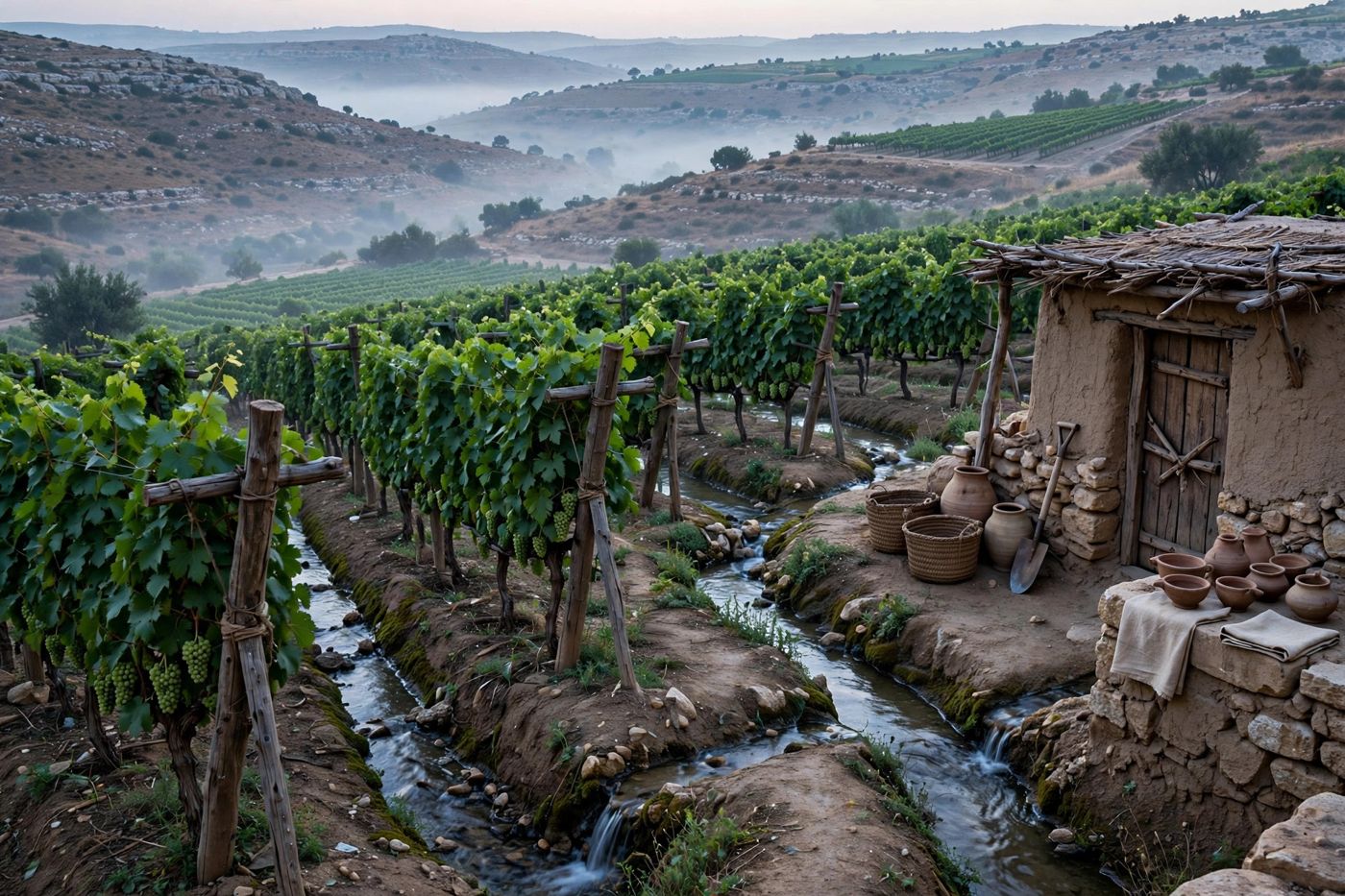
Wine, vines, and why their failure matters. In Isaiah's world wine was the sign of a land at peace — the harvest in the cup, gladness made drinkable, offered even in worship. So when chapter 24 says the new wine mourns and no one drinks wine with a song, ordinary joy itself has collapsed: the curse has reached the dinner table. Hold that picture; this lesson answers it twice — with a feast of "wines on the lees well refined" (25:6), and with a vineyard the LORD waters every moment (27:2–3). The vine was Israel's own oldest portrait (Lesson 03), and first hearers felt every withered vine personally. 2
Who is left to sing? The remnant. Running through Isaiah is the doctrine of the remnant — the small company God preserves through judgment, pictured here as the few olives left on the shaken tree and the gleaning grapes after the vintage (24:13). A gleaning is what the poor gathered after the harvesters passed: the leftovers. That the world's future hangs on leftovers is the pattern of the whole book — God's purposes survive His judgments because He keeps a people through them — and the remnant is already singing (24:14) while the earth still smokes, from "the uttermost part of the earth" (24:14–16): God's future arriving from directions no strategist was watching.
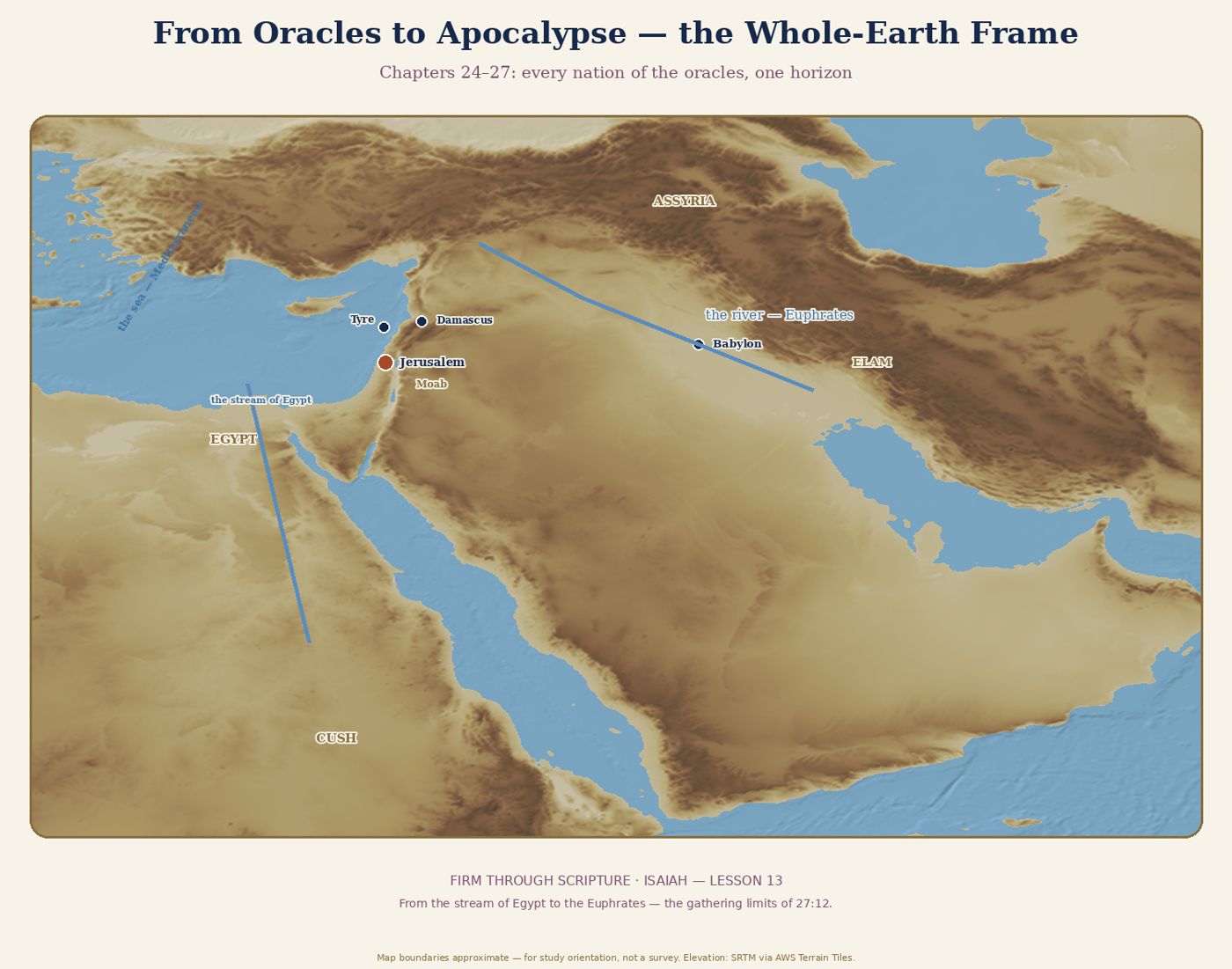
One honesty note belongs here, at the door, with the full argument waiting in §16. DISPUTED: since the nineteenth century, many scholars have treated chapters 24–27 as a distinct composition, often dated later than the eighth-century Isaiah, because its cosmic scope, resurrection hope, and style feel different from the oracles around it. [9, 10] Others answer that its themes — city, vineyard, remnant, mountain, feast — are rooted in chapters 1–23 at every joint. [2, 4] POSITION — this course reads the book whole, as one prophet's witness, at full strength; §16 states the case both ways. The debate is not hidden, and it does not dissolve the text in front of you.
3. OBSERVE — O: what the text actually does
Before meaning comes observation. Most bad interpretation is not deep error; it is shallow reading — people answering a text they never actually looked at. So look:
- The shape. Four chapters, four movements, a fall and a rising: the earth unmade (ch. 24) — the feast (ch. 25) — the song of the strong city (ch. 26) — the vineyard kept and the trumpet blown (ch. 27). Judgment opens the unit; worship closes it:
| Chapter | The picture | The sound |
|---|---|---|
| 24 | The earth emptied, the city of confusion broken | Mirth ceases — then a remnant sings from the ends of the earth |
| 25 | The feast on the mountain, the veil destroyed, death swallowed | A hymn of praise: "O LORD, thou art my God" |
| 26 | The strong city, gates open to the righteous | A song sung in the land of Judah; a confession; a promise |
| 27 | Leviathan slain, the vineyard watered, the trumpet blown | "Sing ye unto her" — and the scattered gather to worship |
- The repeated phrase. "In that day" tolls through the unit like a bell — at 24:21, 25:9, 26:1, 27:1, 27:2, 27:12, 27:13. It is Isaiah's pointer to God's appointed day of settling accounts; its clustering tells you these chapters concern the end of the story, told in advance — not next year's campaign season.
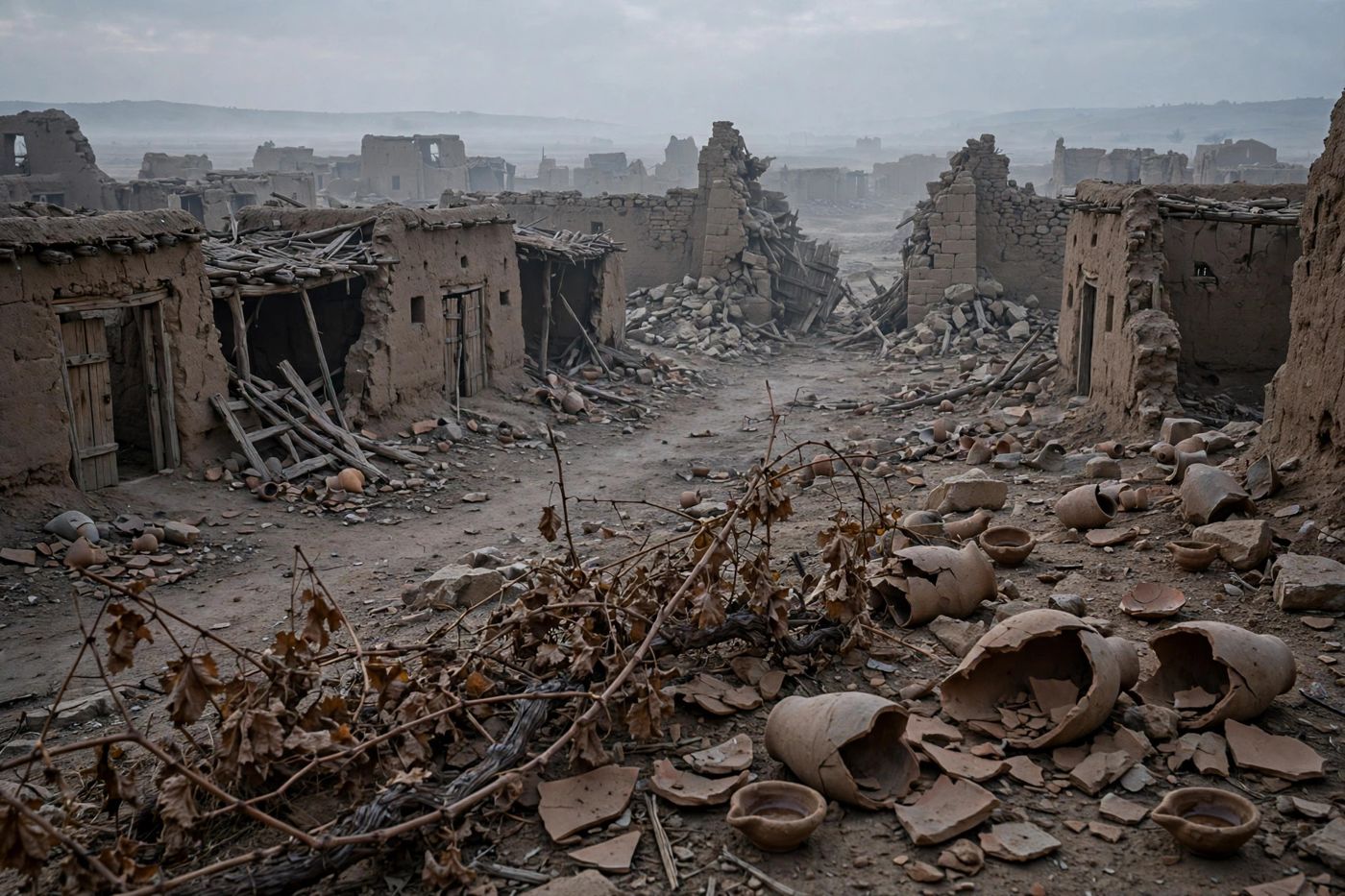
- The earth, the earth, the earth. Count the word in chapter 24 alone and you will lose track past twenty: the earth mourneth, the earth is defiled, the inhabitants of the earth are burned. Any reading that shrinks the chapter to one nation's bad decade has not been watching the text.
- The pivot at 24:16. Mid-chapter, the remnant's singing (24:14–16a) is interrupted by the prophet's own voice: "But I said, My leanness, my leanness, woe unto me!" Worldwide praise and wasting grief, back to back — hold both for §7.
- The songs inside the prophecy. Chapter 25 opens as a hymn ("O LORD, thou art my God; I will exalt thee"), and chapter 26 is introduced outright as one: "In that day shall this song be sung in the land of Judah." Large stretches of this unit are not announcements about worship; they are worship written ahead of its day — the future congregation's songbook, supplied in advance.
- The silences. No king is named in four chapters; no Assyria or Babylon as actors — only "the kings of the earth" gathered as prisoners (24:22), and Moab trodden down in a closing paragraph (25:10–12). After eleven chapters of named nations, the anonymity is itself a statement.
4. GENRE — N: note the genre (apocalyptic prophecy)
These chapters are apocalyptic — and that word, used carefully, is a reading tool, not a scare word. Apocalypse means an unveiling: the curtain pulled back so reality can be seen from God's side. Apocalyptic speaks of God's final settling of accounts in vast, symbolic, cosmic-scale imagery: the earth shaking, the sun ashamed, a chaos-serpent slain, a trumpet gathering the scattered. Isaiah 24–27 is not the Bible's only apocalyptic writing — Daniel and Revelation stand in the same family — but it is among the earliest full examples in Scripture, which is why scholars gave the unit its nickname. 9 The genre has rules, and breaking them is how this passage gets misread most often:
- The imagery is theology in picture-language. When the earth "reels to and fro like a drunkard" (24:20), the point is not seismology; it is that a world built on rebellion is unstable at its foundations. Ask of every picture: what truth is this picture carrying? — before asking what event is this picturing?
- The pictures are bigger than any one event. Apocalyptic language gathers near judgments (a city falling in Isaiah's own century) and the final judgment into one frame, as a distant mountain range stacks its peaks into one ridge. The text means every layer; flattening it to only one loses the picture. 51
- It is written to give God's people nerve, not a timetable. Its first hearers were a small nation between empires; the unveiling tells them how the story ends — God reigns, death dies, the scattered come home — not when. Fee and Stuart's rule for prophecy holds double here: the prophet's first work is forthtelling, God's word to his own generation. 51
- Symbols have anchors. The pictures are drawn from Israel's own Scriptures — creation, the flood, the exodus, the covenant curses — and §6 traces those anchors. A symbol with a biblical anchor means what its anchor means, filled out; it is not a code for this week's headlines.
Read by its own rules, the genre strips the present age of its disguise: empires that look permanent are shown as prisoners awaiting visitation (24:22) — and a feast no empire could cater is shown already spread, by the LORD of hosts Himself.
5. TERMS — T: the words in the writer's mouth
Four terms carry this passage. Learn what they meant in Isaiah's mouth:
- Tohu (TOH-hoo), "confusion / formlessness" — the word in "the city of confusion" (24:10). Its most famous appearance is Genesis 1:2, where the earth before God's ordering word was "without form (tohu), and void"; Isaiah reaches for it again at 34:11, over judged Edom. [19, 20] So the city of confusion is not merely a messy city. It is creation running backwards — the ordered world lapsing toward the formless waste it was before God spoke. Chapter 24 is, in the strictest sense, un-creation, and this word is the tell.
- Leviathan — the "piercing serpent... that crooked serpent" of 27:1, paired with "the dragon that is in the sea." In the ancient Near East's stories, the sea and its monsters pictured chaos — the disorder pagan gods had to fight at the world's making; texts from Israel's neighbours tell of a storm-god battling a twisting sea-serpent with strikingly similar names. [25, 55] Isaiah takes the picture-language over and does what no pagan myth does: the serpent is not God's eternal rival but a creature on God's docket, his end dated — "in that day the LORD... shall punish leviathan" (27:1). FACT: one God, no rival throne; every power of chaos is judged already in principle and will be slain in fact.
- Bala' (bah-LAH), "swallow up" — the verb of 25:8, "He will swallow up death in victory." It is a blunt, physical verb — engulf, gulp down whole, as the earth did to Korah's rebels. [18, 19] Isaiah does not say death will be avoided, managed, or softened. Death — the swallower of everyone who ever lived — will itself be swallowed. The last enemy gets no negotiation. It gets eaten.
- The veil / covering (25:7) — "the face of the covering cast over all people, and the vail that is spread over all nations." A shroud is a veil a corpse wears; the picture is of the whole human race living under a funeral cloth, and of God destroying the cloth itself on His mountain. Note the scope, twice repeated: all people, all nations. This promise is not tribal.
Method note — the word-study guardrail: a word means what its author uses it to mean, in its sentence, in its century — not what its oldest root once meant. Every term above was settled by Isaiah's usage in Isaiah. That discipline keeps word studies honest.
TRANSLATION NOTE — "in victory," or "for ever"? (25:8)
Your KJV reads, "He will swallow up death in victory." Underneath stands the Hebrew lānetsaḥ, whose range covers both permanence — "for ever" — and triumph — "in victory." Translations divide over which to print. [19, 20] The KJV's choice needs no apology: Paul, taking this sentence up at the resurrection (1 Corinthians 15:54), writes "in victory" too — and the senses are allies anyway. Death swallowed in victory is death swallowed for ever: the triumph is why it never comes back.
6. ENTIRE CANON — E: where this passage sits in the whole story
No passage lives alone. Isaiah 24–27 is a knot where the Bible's oldest and newest threads cross:
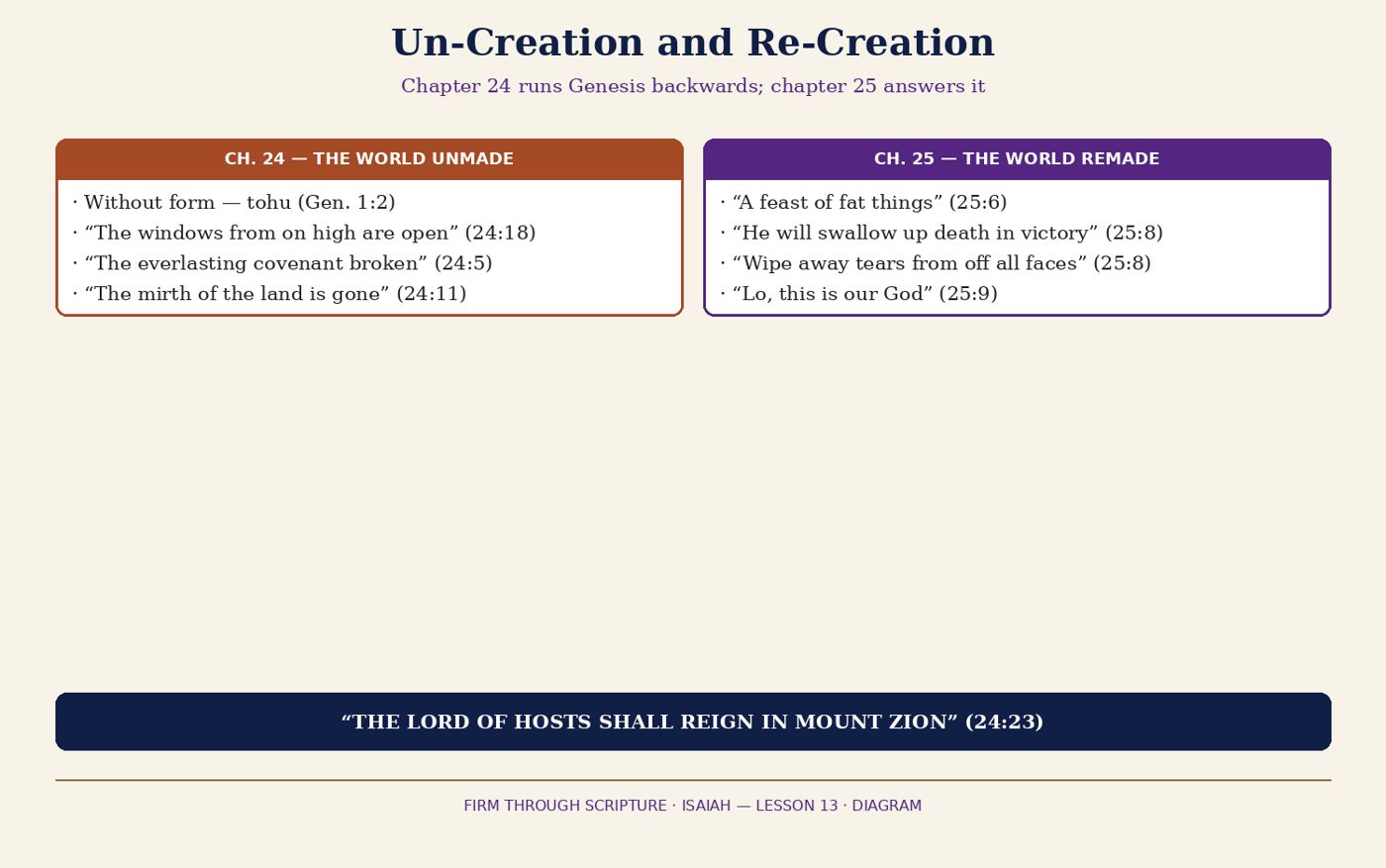
- Creation reversed, creation answered. Chapter 24 replays Genesis backwards: tohu (Gen. 1:2) over the city, "the windows from on high are open" (24:18) — the flood's phrase (Gen. 7:11) — an "everlasting covenant" broken (24:5; Gen. 9:16). 1 Judgment is God letting the world slide back toward the disorder He once ordered — which is why chapter 25's answer is not merely rescue but re-creation: a feast, a removed veil, death undone.
- The covenant curses, gone worldwide. Moses warned that covenant-breaking would empty the land (Leviticus 26; Deuteronomy 28–32). 1 Isaiah 24 applies that pattern to the earth (24:5). And inside the curses Moses had planted the regathering (Deuteronomy 30), which chapter 27's trumpet completes (27:12–13): judgment in measure, then gathering — a pattern older than Isaiah, enlarged by him. 3
- The resurrection witnesses. Ezekiel 37's dry bones give the nation-revival picture, explained by God Himself as Israel restored; Daniel 12:2, later and plainer, speaks of "many of them that sleep in the dust of the earth" awaking. §7 weighs 26:19 between those two companions with its labels on; the canon supplies both rails the verse runs on. 1
- Paul plants 25:8 at the resurrection. Paul, at the climax of the New Testament's great resurrection chapter, quotes this lesson: "then shall be brought to pass the saying that is written, Death is swallowed up in victory" (1 Corinthians 15:54). 1 That is FACT — the apostle's own placement of the promise — and it fixes the verse's centre of gravity: whatever else 25:8 comforts, it is first a resurrection text, about bodies and the end of death.
- John hears the tears wiped twice. Revelation sounds 25:8's second half at the end of all things: "God shall wipe away all tears from their eyes" (Revelation 7:17; again at 21:4, "there shall be no more death"). 1 The feast arrives too — the marriage supper of the Lamb (Revelation 19:9) — and Jesus had already promised that "many shall come from the east and west, and shall sit down... in the kingdom of heaven" (Matthew 8:11), and that His elect will be gathered at "a great trumpet" (Matthew 24:31; echoing 27:13). 1 The New Testament treats Isaiah 24–27 not as an appendix but as a load-bearing wall.
7. THE MEANING — what the passage teaches
The Walk has established what the text says and where it sits. Now its payload, taught straight, in the text's own proportions: a whole chapter of judgment, answered by a feast, a song, and a vineyard.
The earth unmade — the covenant curse at full size (ch. 24)
Chapter 24 opens with God's own hand on the whole world: "Behold, the LORD maketh the earth empty" (24:1). Notice who acts — not accident, climate, or conquest; the LORD does it, "for the LORD hath spoken this word" (24:3). And the why is moral before it is physical: "because they have transgressed the laws, changed the ordinance, broken the everlasting covenant" (24:5). Three verbs: crossing God's lines, altering His terms to suit ourselves, snapping the agreement outright. The curse follows as covenant logic, not divine temper — "therefore hath the curse devoured the earth" (24:6). Creation is not morally neutral scenery: a world in rebellion does not merely have unhappy inhabitants; it sickens — "the earth mourneth and fadeth away" (24:4) — the law's land-curses written across the globe. [2, 10]
The unmaking runs in creation's reverse gear: the earth "turned upside down" (24:1), the flood's windows reopened, the foundations shaking (24:18), the earth reeling "like a drunkard" and falling "and not rise again" (24:20) — that clause belonging to the old order, the world as organised in rebellion, as the following chapters immediately prove. Do not soften the totality; it is comfort in disguise: a judgment that reaches everything cannot be outflanked by the powers that frighten you. Even heaven's rebels are on the docket — "the host of the high ones" punished alongside "the kings of the earth" (24:21), gathered "as prisoners are gathered in the pit" (24:22). And the chapter that begins with an emptied earth ends with a filled throne: "the LORD of hosts shall reign in mount Zion" (24:23) — so gloriously that sun and moon are shamed like lamps at sunrise. Chapter 24 does not end in darkness, but in a reign so bright the lights go out.
Levelled ranks, a silenced city, and wine that no longer sings (24:2–12)
Verse 2's levelling deserves slow reading: people and priest, servant and master, maid and mistress, buyer and seller, lender and borrower, usurer and debtor — six pairs spanning worship, labour, and money. The point is not that God hates distinctions; it is that no distinction exempts: the priest's office does not shield him, the master's money does not ransom him, the servant's lowliness does not especially condemn him. Judgment is the great leveller because sin was the great leveller first. Then the camera settles on the city (24:10–12): houses shut, the gate — pride, court, and defence in one — "smitten with destruction," and ordinary life's soundtrack switched off item by item (24:7–9). Judgment, at its deepest, is joy withdrawn — the gifts remain, the gladness gone. That diagnosis reaches any prosperous, mirthless age.
The singing remnant — and the prophet who cannot sing yet (24:13–16)
Into this emptied world comes the first sound of hope, and notice its size: a gleaning — olives left after the shaking, grapes missed by the pickers (24:13). God does not promise the survivors will be numerous; He promises they will be His, and that they will sing: "They shall lift up their voice, they shall sing for the majesty of the LORD" (24:14) — worship aimed at God's majesty, not their own survival skills. Then the prophet's voice breaks in over the choir: "My leanness, my leanness, woe unto me!" (24:16b) — wasting grief while the treacherous deal treacherously around him. Hold both sounds, because Scripture does: praise for the end God has shown, and grief for the treachery still in view. Isaiah is not doubting the song; he sings his part of it from inside a nation still under sentence. A faith that can only praise, or only grieve, is thinner than the prophet's. 4
The feast on the mountain — death swallowed, tears wiped (ch. 25)
Chapter 25 opens in praise before promise: "O LORD, thou art my God; I will exalt thee" (25:1) — praise for judgment executed: a strong city made a heap, ruthless nations brought to fear God, and God proven "a strength to the poor... a refuge from the storm" (25:2–4). Mark the logic, because modern readers often reverse it: God's judgments are not the obstacle to the weak being sheltered; they are how the weak get sheltered (25:4–5). Then the mountain: "in this mountain shall the LORD of hosts make unto all people a feast of fat things, a feast of wines on the lees" (25:6) — the richest food and best-aged wine of the ancient table, spread "unto all people." Remember chapter 24's bitter wine and silenced songs; here is the answer, course by course.
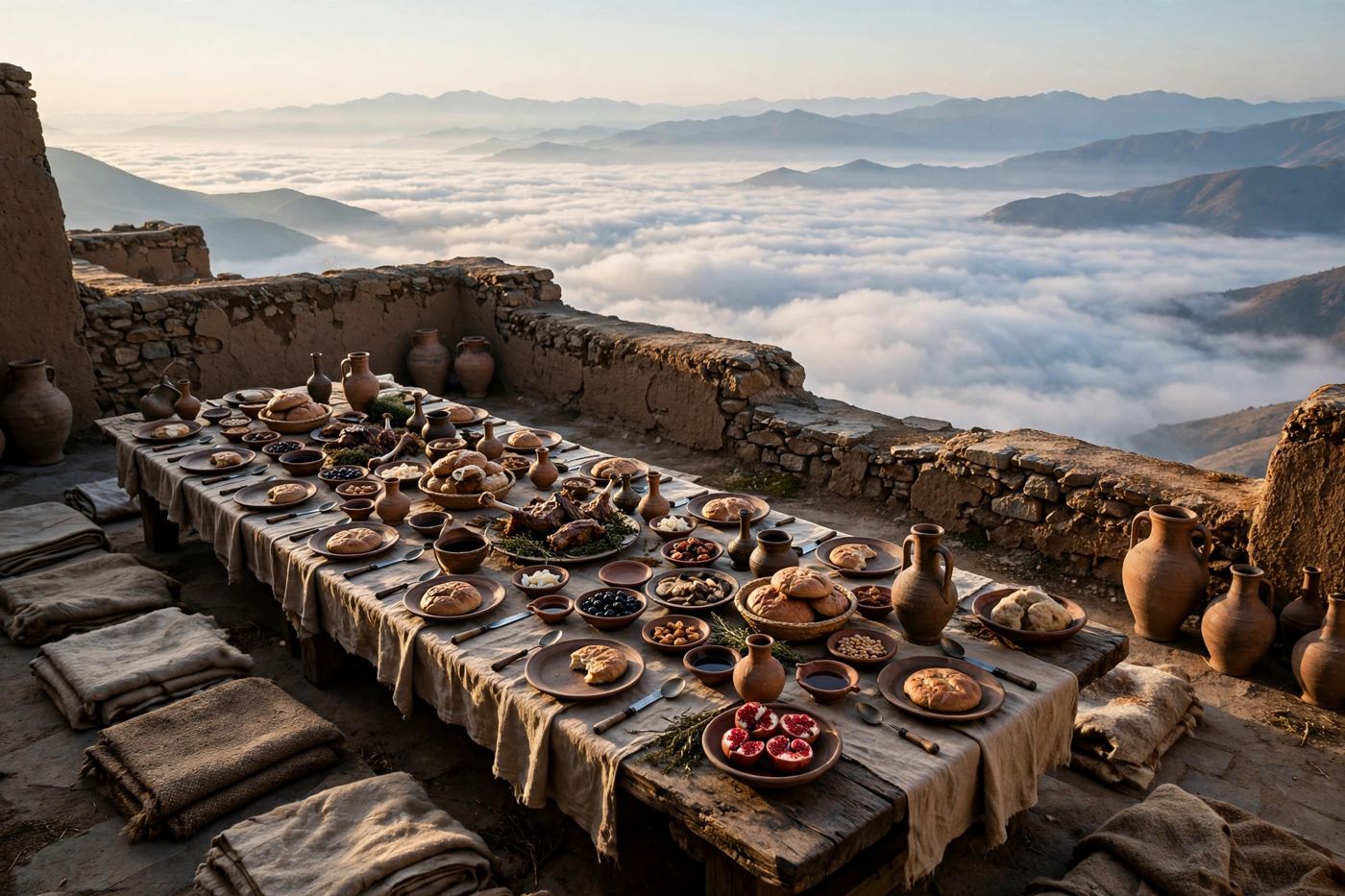
At the feast's centre stands the Bible's boldest sentence about death: "He will swallow up death in victory; and the Lord GOD will wipe away tears from off all faces" (25:8). Two acts, both God's, both universal. Death — the devourer no one escapes — is itself devoured. And the God who swallows death does something almost embarrassingly tender: He wipes tears face by face, the rebuke of His people removed "from off all the earth." The congregation's answer is written in advance: "Lo, this is our God; we have waited for him, and he will save us" (25:9) — waiting is the remnant's whole discipline, and 25:9 is its vindication spoken aloud. The chapter closes with Moab (25:10–12), trodden down like straw in a dunghill: the feast is for all peoples, but not a truce with pride. Mercy and judgment, in this book, are never competitors. [3, 4]
The song of the strong city — peace, confession, and the dead who live (ch. 26)
Chapter 26 is a song the future sings, supplied ahead of time: "We have a strong city; salvation will God appoint for walls and bulwarks" (26:1). Set it against 24:10: the city of confusion had gates smashed and houses shut; this city has gates opened — "Open ye the gates, that the righteous nation which keepeth the truth may enter in" (26:2). Its defence is not masonry but salvation; its citizenship not birth alone but righteousness and truth-keeping. Then the verse half the church knows by heart, in its native context: "Thou wilt keep him in perfect peace, whose mind is stayed on thee: because he trusteth in thee" (26:3). Read it where Isaiah put it — not as a soothing slogan but as a line sung by a people who have watched God lay the lofty city in the dust (26:5). Perfect peace is the portion of a mind stayed — leaned, resting its weight — on the God of "everlasting strength" (26:4). The peace is real precisely because the song is honest about the storm outside the walls.
The song then turns confessional (26:7–18), unflinchingly. "Other lords beside thee have had dominion over us" (26:13) — the people admit they have been ruled by masters not God. And their travail produced nothing: like a woman in labour who "brought forth wind," "we have not wrought any deliverance in the earth" (26:17–18). That admission is the doorway to the thunderclap, and must not be skipped: verse 19 comes to a people who have just confessed their own deadness. "Thy dead men shall live, together with my dead body shall they arise. Awake and sing, ye that dwell in dust... and the earth shall cast out the dead" (26:19). Now the honesty this verse requires. FACT: the promise as written is real and personal-sounding — dead men living, bodies arising, dust-dwellers called to sing; and verse 14 has just said of the dead tyrants, pointedly, "they shall not rise," which gives verse 19's rising its deliberate contrast. DISPUTED: the scope. One reading, running beside Ezekiel 37's dry bones, takes the verse as national-revival imagery — a dead nation raised. Another takes it as the personal, bodily resurrection of God's people, beside Daniel 12:2's plain "them that sleep in the dust of the earth shall awake." The church has very often read both — the nation revived as firstfruit-picture of a resurrection finally personal and bodily — and New Testament resurrection preaching supports the wider reading. POSITION — this course reads 26:19 at full strength: a genuine resurrection promise whose first horizon is Israel's restoration and whose final horizon is the raising of the dead, refusing to shrink it to only a metaphor (§16 argues it fully). Even on the narrowest reading, God is promising life out of death to a people who confessed they could produce only wind.
The hiding-place — shelter while the storm passes (26:20–21)
Between the promise and the vineyard comes an instruction of great tenderness: "Come, my people, enter thou into thy chambers, and shut thy doors about thee: hide thyself as it were for a little moment, until the indignation be overpast" (26:20). While God judges, His people are told not to fight or flee but to shelter, briefly, behind shut doors (26:21). The shape is familiar: a household shut inside while judgment passes through the land — the Passover pattern of Exodus 12, where blood-marked houses were passed over. Label it carefully: a pattern drawn out here as INFERENCE from the two passages' shape, not a claim that Isaiah names the exodus. Some faithfulness looks like going indoors and trusting God with the weather. The indignation is real, it is God's, and it has an end — "a little moment."
The vineyard kept — the serpent slain, judgment in measure, the trumpet (ch. 27)
Chapter 27 opens "in that day" with the oldest enemy: Leviathan, slain by the LORD's "sore and great and strong sword" (27:1). Within two verses the sword is put away and a song begins: "A vineyard of red wine. I the LORD do keep it; I will water it every moment: lest any hurt it, I will keep it night and day" (27:2–3). Feel the ground shift. In Lesson 03 (chapter 5), God sang over a vineyard He had planted and loved — and, finding wild grapes, announced He would take away its hedge and lay it waste. Same Keeper, same vineyard, opposite outcome. But not a lowered standard: verse 4 keeps His fury in its place against briers and thorns set against Him (27:4). What has changed is not God's holiness but the vineyard's relation to its Keeper; the door to peace stands open even to an enemy (27:5). Grace atop justice, not instead of it. And the kept vineyard fruits: Jacob takes root, Israel blossoms, and fills "the face of the world with fruit" (27:6) — from gleaning-grapes (24:13) to a world filled with fruit. That arc is the lesson in one line.
The chapter's second half teaches the manner of God's judgments on His own: "in measure" (27:8). Israel was smitten, but not "as he smote those that smote him" (27:7); God's rough wind was stayed, its purpose purgative — idols ground like chalkstones (27:9). Measure is not softness: the defenced city of 27:10–11 still lies forsaken. It is proportion with a purpose — discipline aimed at purged sin and gathered worshippers, not annihilation. And the unit closes with gathering: His children picked up "one by one" (27:12), then "the great trumpet shall be blown, and they shall come which were ready to perish in the land of Assyria, and the outcasts in the land of Egypt, and shall worship the LORD in the holy mount at Jerusalem" (27:13). The empires that crushed and seduced God's people become the two addresses the lost are called home from. The devastation of the earth ends at a worship service.
The Christ Thread
Isaiah 24–27 needs no forced symbolism; the New Testament reads this passage itself. FACT: Paul quotes 25:8 as a saying that will be "brought to pass" when the dead are raised (1 Corinthians 15:54) — locating the swallowed death at the resurrection of the body, through the risen Christ. FACT: Jesus takes up the unit's feast-geography — many coming from east and west to sit down in the kingdom (Matthew 8:11) — and its gathering instrument, the "great trumpet" (Matthew 24:31; echoing 27:13). FACT: Revelation closes the Bible with this lesson's images: tears wiped away and death no more (Revelation 21:4), the feast of the Lamb (19:9), and "that old serpent, which is the Devil" (20:2) finally judged — the dragon of 27:1 meeting his end in the career of Christ. POSITION — the church's historic reading, held by this course: the feast, the swallowed death, and the gathered nations are fulfilled in Jesus Christ, begun at His table and empty tomb, completed at His return. Nothing here is invented typology.
Where in the Covenant Story?
These chapters stand at the covenant story's far horizon. The everlasting covenant broken (24:5) is the story's problem at its widest — as wide as Noah; the curses are the law's own, enlarged to the earth. But the answers are covenant answers too: a remnant preserved; a mountain feast for all peoples, as Abraham was promised blessing for all families of the earth (Genesis 12:3); a vineyard kept rather than abandoned; a trumpet-gathering home fulfilling Deuteronomy 30's promise to regather the scattered. [1, 3] Here the Book of the King (chs. 1–39) stops looking at empires and shows the last page: curse exhausted, feast served, covenant people — now from every nation — home.
The Long View — what the church has believed
Stand back and notice how the centuries have read these chapters. The ancient church read Isaiah as one prophet's book and reached for these chapters at the resurrection: Paul's use of 25:8 set the pattern, and the fathers followed it; Jerome, whose commentary was the early church's fullest Isaiah treatment, held the book as one prophet's witness throughout. 37 Medieval and Reformation readers — Calvin among them — kept the same frame. 36 Where the centuries have honestly differed is not over whether death will be swallowed — that confession has been remarkably steady — but over the two questions flagged in this lesson: the composition of the "Isaiah Apocalypse" (§16), and the scope of 26:19, whose national and personal horizons readers have weighted differently without ever, in the historic mainstream, denying that God raises the dead. 9 The pattern instructs: the church's divisions cluster at the edges; the centre — God reigns, death dies, the scattered come home singing — has held.
That is the payload. The next section compresses it into the one sentence you are meant to carry out of this study.
8. THE AIM SENTENCE — X: eXplain the intent
Everything observed now compresses into one sentence — the author's intended meaning, stated before any application is allowed near it:
Isaiah declares that when God empties the whole covenant-breaking earth and breaks its proud city, He will Himself reign on Zion, spread a feast for all peoples, swallow death and wipe away every tear, keep the vineyard He once judged, and blow the great trumpet that gathers His scattered people home to worship.
If a sermon, a post, or a devotional uses Isaiah 24–27 to say something that cannot be traced back to that sentence, it is not this passage talking.
9. SAY IT BACK
Close the book and say the AIM sentence from section 8 in your own words, without looking. Then say, in one more sentence, what it asks of you this week.
If your version quietly changes the meaning — if the emptied earth becomes only a warning about current events, or the feast only a private comfort — open the lesson and walk it again. This exercise feels small. It is the entire course in miniature: meaning first, then — and only then — your life.
10. THE MISREAD — the guardrail, with verdicts
Three live misuses of this passage — each with a fair hearing, the evidence, and a verdict.
Misread 1: "Chapters 24–27 are a coded timetable — decode the symbols and you can match them to today's headlines, nations, and dates." Why it sounds right: the imagery really is about the end of things, the symbols really are dense, and the itch to know when is as old as the disciples' questions to the risen Jesus. Charts built on these chapters sell that itch by the shelf. The evidence: §4's genre rules. Apocalyptic imagery is theology in picture-language, anchored in Israel's Scriptures — creation, flood, exodus, covenant curses — not in the reader's news cycle. The chapters name no modern nation and fix no date; their promises teach waiting (25:9), not calculation. Every generation that has stapled these chapters to its own headlines has been falsified by the next decade, while the passage's actual claims stand untouched. The timetable reading makes the reader's century the passage's audience — the very error the Transfer Tests exist to catch. Verdict: apocalyptic imagery does God's end in God's pictures. The passage gives the church the ending of the story, not the schedule of it — and this study's Walk-Out runs on the feast and the wiped tears, not on date-setting.
Misread 2: "'He will swallow up death' is a comfort verse for private grief — a promise that God will make me feel better about loss." Why it sounds right: the tears are real, the verse is read at funerals, and the tenderness is genuine. The evidence: the verse's own scope refuses the shrink — the veil destroyed off "all nations," tears wiped "from off all faces," the rebuke removed "from off all the earth" (25:7–8). And the canon fixes the address: Paul plants this saying at the general resurrection (1 Corinthians 15:54). The promise is cosmic and bodily first — and becomes personal precisely because it is cosmic: your grief is met not with a mood but with an event. Verdict: right tenderness, wrong scale. The promise is the end of death for the world — and only on that ground is it yours in your grief.
Misread 3: "Chapter 27's kept vineyard means God set the judgment of chapter 5 aside — grace replaced justice, so the earlier warnings can be discounted." Why it sounds right: the contrast really is startling. The Keeper who once removed the hedge now waters the vineyard every moment and keeps it night and day. Read chapter 27 alone, and "God changed His mind about standards" can look like the obvious lesson. The evidence: read the two vineyard songs side by side, as the book intends (Lesson 03; §7 above). Chapter 27 refuses the replacement reading itself: the Keeper's fury still falls on briers and thorns set against Him (27:4) — the standard has not moved. Between the songs stand judgment in measure (27:7–8), sin purged (27:9), and a vineyard brought to peace with its Keeper (27:5). The reversal is in the vineyard's relation to God, not in God's character: justice was executed, not evaded — and it is precisely the judged, purged, reconciled vineyard that is kept. Verdict: the reversal is the teaching: grace atop justice, never instead of it. God keeps what He once judged — after judging it, through purging it — and chapter 5 is why chapter 27 astonishes.
11. FROM WORD TO WALK
A reflection page — the lesson is not finished until the passage has had its say with you.
Sit with chapter 24's two sounds at once. From the uttermost part of the earth, songs — glory to the righteous, sung by the gleaning-remnant while the world still smokes. And from the prophet's own chest, a wasting cry: "My leanness, my leanness, woe unto me!" Most of us know both sounds: seasons when God's promised future is perfectly clear — you could sing 25:9 from the page — and seasons when your honest prayer sounds more like leanness. Isaiah does not make you choose between the choir and the cry; he holds both, and the book calls that faithfulness. If you are lean today, you are not outside the song. The prophet wasn't either.
Then let chapter 26's confession search you. Other lords beside thee have had dominion over us (26:13) — no excuses, no percentages. Every life has its other lords: the opinion you cannot stop serving, the appetite that sets your schedule, the fear that votes on your decisions. And beside it: we have brought forth wind (26:18) — all that labour, and nothing delivered, because deliverance was never going to be born from our straining. The people who confess wind in verse 18 are the people who hear resurrection in verse 19. God does not raise the self-sufficient; He raises the dead.
And finally, the vineyard. Perhaps you carry a chapter-5 history: a season when God's judgment on your life was not theoretical — hedge removed, consequences real. Chapter 27 exists so you do not read that season as the last word about the Keeper, who waters what He keeps every moment and keeps it night and day (27:3). Being kept is not being excused — the purging was real, and §10's verdict stands. But kept is kept. If you are His, your history of judgment is not evidence of His absence; in this book it is the doorway into His keeping.
LORD of hosts — You empty the earth and You spread the feast, and I confess both are righteous. Other lords have had dominion over me; name them, and break their lease, for I would mention Your name only. I have brought forth wind with all my straining — so I wait for You, mind stayed on You, until the day You swallow death and wipe the tears Yourself. Keep me as You keep Your vineyard — every moment, night and day — until the trumpet sounds. In Jesus' name, amen.
12. FOR DISCUSSION — OR FOR YOUR JOURNAL
With a group, work these aloud. Alone, they're yours — answer them in your journal or in prayer; they lose nothing in the quiet.
- Chapter 24 holds worldwide singing (vv. 14–16a) and the prophet's "my leanness" (v. 16b) side by side. Where are those two sounds both true in your own life right now — and what does Isaiah's holding them together teach you about honesty in worship?
- The confession of 26:13 names "other lords" that have had dominion. Made specific — not theoretical — which lords would you name, and what would mentioning God's name only concretely change this month?
- Perfect peace (26:3) is promised to the mind stayed on God, inside a song that has just watched the lofty city levelled (26:5). What, practically, does a "stayed" mind look like on your hardest ordinary day — and what usually un-stays it?
- A friend reads chapter 27 and concludes, "See — God got over the judgment stuff; chapter 5 doesn't apply anymore." Using §10's verdict, how would you answer — honouring the kept vineyard's astonishment without discounting the earlier judgment?
13. THE WALK-OUT — T: Transfer to today
Meaning is settled. Now — and only now — application, and it must cross the bridge honestly. Run the five Transfer Tests on this passage:
- Same covenant? The curse falls under the old covenant's terms enlarged to the everlasting covenant; we live on the far side of the cross, where Christ has borne the curse — but the final judgment, feast, and gathering still stand ahead of us. The passage reaches us as promise and warning on the way, not as a sentence presently executing on the reader.
- Same audience? The songs are sung by God's covenant people — the remnant, the righteous nation, Jacob taking root. Their confessions and promises reach believers as members of that people, now gathered from all nations — not as a private horoscope detached from that company.
- Same genre rules? Apocalyptic prophecy unveils the end to strengthen waiting, confession, and hope — not to issue timetables, identify modern nations, or turn symbols into assignments. Responses cross; codes do not.
- Repeated or rooted? Waiting on God (25:9), a stayed mind (26:3), confessing other lords (26:13), sheltering during judgment (26:20), resurrection hope (26:19; 25:8) — each is repeated across the canon and rooted in God's character. These cross.
- Ten verses either side? Every application below is drawn from the four chapters read whole — the feast with the curse it answers, the vineyard with the chapter-5 song it reverses. Nothing hangs on a torn-out line.
| Transfer Test | This passage |
|---|---|
| Same covenant? | Curse under the old covenant enlarged; final feast still ahead — promise and warning, not present sentence |
| Same audience? | God's covenant people, now gathered from all nations — not a private horoscope |
| Same genre rules? | Apocalyptic unveiling: responses cross, codes and timetables do not |
| Repeated or rooted? | Waiting, the stayed mind, confession, shelter, resurrection hope — all rooted in God's character |
| Ten verses either side? | Feast read with its curse; vineyard read with chapter 5 — nothing on a torn-out line |
What crosses — and lands:
- Death's end is announced, not awaited in doubt. Before any practice, the indicative: He will swallow up death in victory, and in Christ's resurrection its firstfruits has already occurred (1 Corinthians 15:20, 54). 1 The believer's hope is a dated promise from the God who "hath spoken it" (25:8).
- Waiting is the passage's central practice, and it is active. "We have waited for him" (25:9) is spoken by people who confessed, sheltered, and sang ahead of time. Waiting here is a discipline with content — not a pause between real spiritual activities.
- The stayed mind is the peace-bearing posture. Perfect peace in 26:3 attaches to a stayed mind and to trust, in a world where lofty cities still rise and fall. Peace here coexists with bad news — it is located in where the mind leans, not in whether the news improves.
- Confession precedes resurrection hope. Chapter 26's order is itself an application: other lords named (v. 13), wind confessed (v. 18), then "thy dead men shall live" (v. 19). The route to hope runs through specific, unexcused confession — not around it.
Practices — made concrete this week:
- Name the other lords. Twenty unhurried minutes with 26:13–18 open. Write the confession in the passage's own form: "Other lords beside thee have had dominion over me: ___." Then write the wind: where your straining has delivered nothing. Confess both aloud — specific, no percentages.
- Practise the stayed mind. Take 26:3 as the week's anchor and return to it at three set points daily (waking, midday, night) for two minutes: read it, name the news currently un-staying you, and deliberately re-lean.
- Shelter on purpose. Identify one storm this week that is God's to judge, not yours to fight. Take 26:20 as your orders: shut the door, on purpose, in prayer, and set the matter down for a stated period instead of rehearsing it hourly.
- Sing ahead of time. Take one song of this passage's future — a hymn of resurrection, or 25:9 written out in your own hand — and pray or sing it before the circumstance resolves, as the remnant sang over a smoking earth.
- Memorize Isaiah 26:3 — the stayed-mind promise at the song's centre, in the song's own words.
What does not cross: decoding current events or setting dates from these chapters; claiming 25:8 as a promise that God will remove a specific grief on your schedule (the promise is death's end at the resurrection — bigger, and slower, than our timetables); treating 26:20 as a general permission to disengage (its shelter is God's appointment during His judgment); and reading chapter 27 as God's lowered standard (§10, Misread 3). The gate is not there to shrink the Bible's claims on you — it is there to make sure the claims that land are the ones God actually made.
Praise Him
Praise the LORD of hosts, who makes the earth empty and the feast full — who breaks the city of confusion and appoints salvation for walls — who reigns in mount Zion until the sun is ashamed by comparison — who wipes tears from off all faces with His own hand, and swallows death the way death once swallowed us — Keeper of the vineyard, night and day, Blower of the great trumpet, Gatherer of the outcasts one by one. Lo, this is our God; we have waited for him, and he will save us (25:9).
14. THE RECAP CARD — this study on one page
Print it. Keep it where you'll see it this week.
- The passage: Isaiah 24:1–27:13 — the earth unmade, the feast spread, the strong city sung, the vineyard kept, the trumpet blown.
- Say It Plain: God empties the covenant-breaking earth and breaks its proud city, yet a remnant sings — for on His mountain He spreads a feast for all peoples, swallows death, wipes every tear, raises His dead, keeps the vineyard He once judged, and gathers His scattered with a great trumpet.
- The AIM: Isaiah declares that when God empties the whole covenant-breaking earth and breaks its proud city, He will Himself reign on Zion, spread a feast for all peoples, swallow death and wipe away every tear, keep the vineyard He once judged, and blow the great trumpet that gathers His scattered people home to worship.
- Key terms: tohu — formlessness, creation running backwards (24:10) · Leviathan — the chaos-serpent, a judged creature, not a rival god (27:1) · bala' — swallow up whole (25:8) · the veil — the funeral covering over all nations, destroyed on the mountain (25:7).
- The Misread, in one line: no timetables from apocalyptic pictures · death swallowed is cosmic and bodily before it is private comfort · the kept vineyard is grace atop justice, not justice cancelled.
- Memory verse: "He will swallow up death in victory; and the Lord GOD will wipe away tears from off all faces; and the rebuke of his people shall he take away from off all the earth: for the LORD hath spoken it." — Isaiah 25:8
- This week's practice: name the other lords in writing (26:13); practise the stayed mind (26:3) three times a day.
15. CHECK YOURSELF — five questions
Answer from the study, not from instinct. (Answers live in the Teacher Edition.)
- In your own words: what is the AIM of Isaiah 24:1–27:13?
- Chapter 24's judgment is called un-creation. Give two pieces of evidence from the chapter itself — one word, one image — and explain what each reaches back to in Genesis.
- How does Paul use Isaiah 25:8, and why does that forbid shrinking the verse to private comfort only?
- State honestly what is FACT and what is DISPUTED about Isaiah 26:19. Which two Old Testament passages supply its companion rails, and which horizon does each one supply?
- A friend says chapter 27 proves God set chapter 5's judgment aside because He lowered His standard. Answer from chapter 27 itself: what stays unchanged, and what has actually changed?
16. GO DEEPER
Optional — the lesson is complete without it.
From the Sources — The serpent in the neighbours' stories
The ancient Near East told stories of the sea's chaos battled at the dawn of the world. In the Ugaritic tales, the storm-god Baal fights a sea power whose serpent bears a name cognate to Leviathan and is described as twisting — language close to 27:1's "leviathan... that crooked serpent" (key texts in Pritchard's collection). 25 FACT: the picture-language was common property in Isaiah's world; Isaiah's use of it is not. In the neighbours' myths the chaos-fight is how a god wins his throne against a genuine rival. In Isaiah 27:1 it is a future sentencing — "in that day" — by the one God, against a creature, on a docket that also includes the kings of the earth (24:21–22). Walton's method exists for exactly this move: read the Bible beside its world without dissolving its claims into that world. 55
The Honest Argument — Who wrote the Isaiah Apocalypse, and when?
Open the question at full strength. FACT: since the nineteenth century, mainstream scholarship has commonly treated Isaiah 24–27 as a distinct composition — the "Isaiah Apocalypse" — often dated later than the eighth-century prophet, some into the exilic or post-exilic centuries; Blenkinsopp states the case, and Wildberger works it in detail. [9, 10] The arguments, fairly stated: no eighth-century king or crisis is named; the scope is cosmic where chapters 1–23 are mostly national; the resurrection hope (26:19) sounds, to many ears, more developed than the eighth century elsewhere shows; the Hebrew style differs measurably. DISPUTED: every argument is contested, and the counter-observations are not trivial: the unit's master-images — proud city, mountain, vineyard, remnant, the banquet's first sketches (compare 25:6 with 2:2–4) — are rooted in chapters 1–23 at every joint. [2, 4] Oswalt reads 24–27 as the oracles' deliberate capstone. 3 FACT: the earliest complete witness, the Great Isaiah Scroll, already contains all 66 chapters as one scroll. 22 POSITION — this course's settled reading: the book is Isaiah's, one prophet's witness read whole. A dating premise ("developed hope must be late"; "prophecy cannot foresee") is a premise, not evidence, whichever side smuggles it in — and the lesson changes little if you re-date its envelope: the earth is still emptied, the feast spread, the trumpet blown.
The Word Underneath — tohu, and the sound of a world unwinding
Genesis 1:2 uses tohu for the earth before God's ordering word: formless, waste — not evil, but not yet a world. At 24:10 the city is named a city of tohu — the ordered world handed back to disorder. [19, 20] Jeremiah watches the same film (Jeremiah 4:23). 1 FACT: the prophets reach for Genesis 1 to say judgment as un-creation. INFERENCE — the kind an author earns: Isaiah front-loads his unit with that grammar (24:1, "empty... waste... upside down") so chapter 25 can answer in creation's forward gear — a mountain, a table, a face wiped dry. Un-creation is never this Bible's last chapter; it is the chapter before the feast.
Go Read
- Oswalt, The Book of Isaiah, Chapters 1–39 (NICOT) 2 — chapters 24–27 as the oracles' capstone, the composition case answered in detail.
- Wildberger, Isaiah 13–27 (Continental Commentary) 10 — the critical commentary at its most thorough on these chapters.
- Walton, Ancient Near Eastern Thought and the Old Testament 55 — the method for Leviathan and chaos imagery: beside the ancient world, not dissolved into it.
- Motyer, The Prophecy of Isaiah 4 — the book's architecture as one mind's work; lucid on the two cities and the vineyard's two songs.
17. SOURCES & REFERENCES
Numbered citations in this lesson key to this list — the course standard: every sourced claim carries its number, and every number can be checked.
-
The KJV text itself — Holy Bible, King James Version (eBible.org KJV, 1769 text). Scripture quotations are from the King James Version (KJV), which is in the public domain in the United States; the full passage is always assigned as reading. Cross-references within Scripture cite this number.
-
Oswalt, The Book of Isaiah, Chapters 1–39 (NICOT) — John N. Oswalt (Eerdmans). The leading evangelical commentary on the first half; defends essential unity of authorship and reads the book as a finished theological whole. Detailed notes on the Assyrian-period history (Ahaz, Hezekiah, Sennacherib).
-
Oswalt, The Book of Isaiah, Chapters 40–66 (NICOT) — John N. Oswalt (Eerdmans). The second volume: the comfort section, the Servant Songs, Cyrus, and the new-creation chapters, read as the deliberate answer to chapters 1–39.
-
Motyer, The Prophecy of Isaiah — J. Alec Motyer (IVP). A one-volume commentary by an evangelical scholar who argues the whole book breathes the mind of the eighth-century prophet; especially strong on the book's structure, its repeated refrains, and the Servant.
-
Watts, Isaiah 1–33 and Isaiah 34–66 (Word Biblical Commentary) — John D. W. Watts (Word). Form-critical commentary reading the book as a drama in acts; a source for the oracles' settings and the book's staged structure.
-
Blenkinsopp, Isaiah 1–39, Isaiah 40–55, Isaiah 56–66 (Anchor Bible) — Joseph Blenkinsopp (Doubleday). Mainstream-critical commentary across all three traditional divisions; a fair statement of the multiple-authorship case and of post-exilic settings.
-
Wildberger, Isaiah 1–12, Isaiah 13–27, Isaiah 28–39 (Continental Commentary) — Hans Wildberger (Fortress). The fullest German critical commentary on the first half; detailed on the oracles against the nations and on textual questions.
-
VanGemeren (ed.), New International Dictionary of Old Testament Theology and Exegesis (NIDOTTE) — Willem A. VanGemeren (Zondervan). Theological word studies with semantic-range discipline for the Hebrew terms.
-
Brown, Driver & Briggs, Hebrew and English Lexicon of the Old Testament (BDB) — The standard older Hebrew lexicon; word senses and usage ranges for the Terms sections.
-
Koehler & Baumgartner, The Hebrew and Aramaic Lexicon of the Old Testament (HALOT) — The standard modern Hebrew lexicon; the control on BDB for contested senses (e.g., 'almah).
-
The Great Isaiah Scroll (1QIsaᵃ) and the Dead Sea Scrolls Bible — The complete Isaiah scroll from Qumran Cave 1 (c. 125 BC), in Abegg, Flint & Ulrich, The Dead Sea Scrolls Bible (HarperSanFrancisco). The oldest substantial witness to Isaiah's text — already a single scroll of all 66 chapters centuries before Christ.
-
Pritchard (ed.), Ancient Near Eastern Texts Relating to the Old Testament (ANET) — James B. Pritchard (Princeton). Translations of the primary records: Sennacherib's annals, the Babylonian Chronicle, the Cyrus Cylinder, treaty and hymn texts.
-
Calvin, Commentary on Isaiah — John Calvin (public domain). Reformation exegesis; a control on interpretation and a voice in the Long View.
-
Jerome, Commentary on Isaiah — Jerome (c. AD 408–410). The early church's fullest Isaiah commentary; Jerome transmits the Hebrew learning of his day and treats Isaiah as one prophet's book.
-
Fee & Stuart, How to Read the Bible for All Its Worth — Gordon D. Fee and Douglas Stuart (Zondervan). The beginner's method book; its prophecy chapter ("a forthtelling first") undergirds the Genre sections.
-
Walton, Ancient Near Eastern Thought and the Old Testament — John H. Walton (Baker). The method book for reading Isaiah beside its world without dissolving it into that world.