
One study, one walk — the universal FIRM format. The passage first and whole; then its world; then the Walk (Context · Observe · Genre · Terms · Entire Canon); the meaning taught straight; the AIM sentence; the misread exposed and answered; and the walk-out, where application has to pass the Transfer Tests before it reaches your week. The same skeleton serves a book, a chapter, a single verse, or a whole subject. In the early studies the moves are labeled as they happen. The labels fade as the walk becomes yours.
THE WEEK WITH THIS STUDY — six bites
Day 1 — Read the passage · Say It Plain · The World (§§1–2) · Day 2 — Observe · Genre (§§3–4) · Day 3 — Terms · Entire Canon (§§5–6) · Day 4 — The Meaning · the AIM Sentence · Say It Back (§§7–9) · Day 5 — The Misread · From Word to Walk (§§10–11 — add For Discussion, §12, if you're with others) · Day 6 — The Walk-Out · the Recap Card (§§13–14). Go Deeper (§16) any evening you want the basement.
BEFORE YOU READ — Open My Eyes
LORD, my hands are weak and my knees are feeble, and my heart is fearful more often than I admit. Strengthen what is weak in me, open the eyes that will not see, and set my feet on Your highway — for You will come, and You will save. In Jesus' name, amen.
§ means “section” — the numbered parts of your lesson. Each bite above names the sections for that day.
1. READ THE PASSAGE — Isaiah 34:1–35:10 (KJV)
Read it all, slowly, before any teaching. In this course the passage always prints once, in full, at the head of the lesson. Everything after this is commentary — this is the text.
1 Come near, ye nations, to hear; and hearken, ye people: let the earth hear, and all that is therein; the world, and all things that come forth of it.
2 For the indignation of the LORD is upon all nations, and his fury upon all their armies: he hath utterly destroyed them, he hath delivered them to the slaughter.
3 Their slain also shall be cast out, and their stink shall come up out of their carcases, and the mountains shall be melted with their blood.
4 And all the host of heaven shall be dissolved, and the heavens shall be rolled together as a scroll: and all their host shall fall down, as the leaf falleth off from the vine, and as a falling fig from the fig tree.
5 For my sword shall be bathed in heaven: behold, it shall come down upon Idumea, and upon the people of my curse, to judgment.
6 The sword of the LORD is filled with blood, it is made fat with fatness, and with the blood of lambs and goats, with the fat of the kidneys of rams: for the LORD hath a sacrifice in Bozrah, and a great slaughter in the land of Idumea.
7 And the unicorns shall come down with them, and the bullocks with the bulls; and their land shall be soaked with blood, and their dust made fat with fatness.
8 For it is the day of the LORD's vengeance, and the year of recompences for the controversy of Zion.
9 And the streams thereof shall be turned into pitch, and the dust thereof into brimstone, and the land thereof shall become burning pitch.
10 It shall not be quenched night nor day; the smoke thereof shall go up for ever: from generation to generation it shall lie waste; none shall pass through it for ever and ever.
11 But the cormorant and the bittern shall possess it; the owl also and the raven shall dwell in it: and he shall stretch out upon it the line of confusion, and the stones of emptiness.
12 They shall call the nobles thereof to the kingdom, but none shall be there, and all her princes shall be nothing.
13 And thorns shall come up in her palaces, nettles and brambles in the fortresses thereof: and it shall be an habitation of dragons, and a court for owls.
14 The wild beasts of the desert shall also meet with the wild beasts of the island, and the satyr shall cry to his fellow; the screech owl also shall rest there, and find for herself a place of rest.
15 There shall the great owl make her nest, and lay, and hatch, and gather under her shadow: there shall the vultures also be gathered, every one with her mate.
16 Seek ye out of the book of the LORD, and read: no one of these shall fail, none shall want her mate: for my mouth it hath commanded, and his spirit it hath gathered them.
17 And he hath cast the lot for them, and his hand hath divided it unto them by line: they shall possess it for ever, from generation to generation shall they dwell therein.
— Isaiah 35 —
1 The wilderness and the solitary place shall be glad for them; and the desert shall rejoice, and blossom as the rose.
2 It shall blossom abundantly, and rejoice even with joy and singing: the glory of Lebanon shall be given unto it, the excellency of Carmel and Sharon, they shall see the glory of the LORD, and the excellency of our God.
3 Strengthen ye the weak hands, and confirm the feeble knees.
4 Say to them that are of a fearful heart, Be strong, fear not: behold, your God will come with vengeance, even God with a recompence; he will come and save you.
5 Then the eyes of the blind shall be opened, and the ears of the deaf shall be unstopped.
6 Then shall the lame man leap as an hart, and the tongue of the dumb sing: for in the wilderness shall waters break out, and streams in the desert.
7 And the parched ground shall become a pool, and the thirsty land springs of water: in the habitation of dragons, where each lay, shall be grass with reeds and rushes.
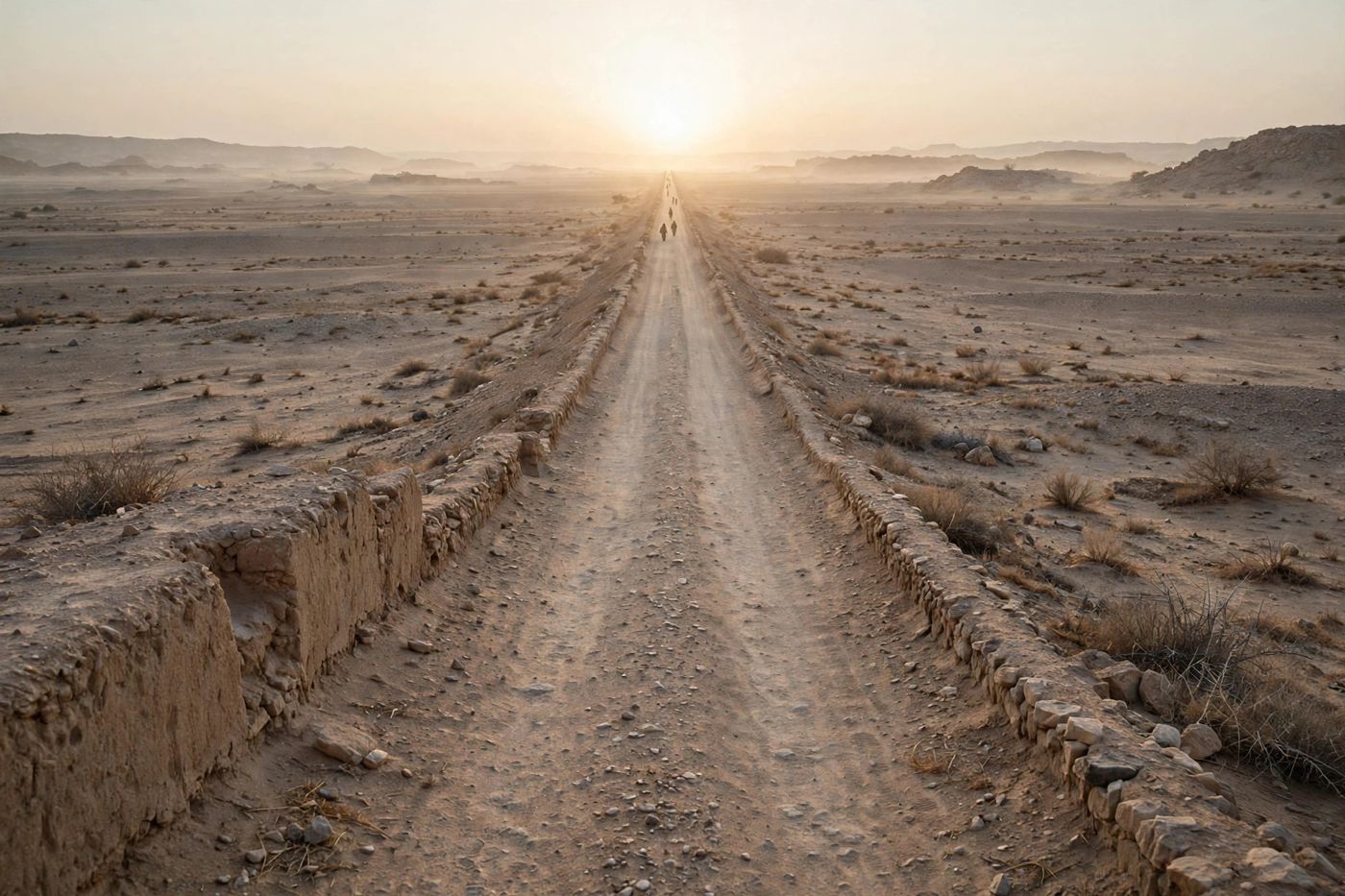
8 And an highway shall be there, and a way, and it shall be called The way of holiness; the unclean shall not pass over it; but it shall be for those: the wayfaring men, though fools, shall not err therein.
9 No lion shall be there, nor any ravenous beast shall go up thereon, it shall not be found there; but the redeemed shall walk there:
10 And the ransomed of the LORD shall return, and come to Zion with songs and everlasting joy upon their heads: they shall obtain joy and gladness, and sorrow and sighing shall flee away.
SAY IT PLAIN — the passage in everyday words: God calls the whole earth into His courtroom. His anger stands against every nation that has set itself against Him, and one nation — Edom, Israel's own brother — is named as the example: her land will burn like tar, lie empty for good, and be handed over to desert birds and wild creatures, exactly as the written word said it would be. Then the music changes completely. The dry desert bursts into flower, weak hands and shaking knees are told to be strong because God Himself is coming to save, blind eyes open and lame legs leap, water breaks out where there was only dust, and a raised holy road runs home — safe from lions, plain enough that even a fool cannot lose his way on it — with God's bought-back people singing all the way to Zion while sorrow runs the other direction. Everything after this teaches from it — nothing will change what you just read.
2. THE WORLD — C: Context & Audience
A text can never mean what it never meant — so before we ask what these verses mean, we stand where their first hearers stood.
Where we are in the book. You have reached the end of the first great movement of Isaiah. Chapters 1–33 have swung between two poles: oracles against the nations that trusted in themselves (chapters 13–23), and promises that a righteous King and a purified Zion would outlast them all (chapters 24–33). Chapters 34–35 close that movement the way a musical antiphon closes a service — two answering panels, sung back to back. Chapter 34 is the sentence; chapter 35 is the song. Read them apart and you will misread both, a point this lesson will keep returning to, because the pairing is deliberate and the commentators across the spectrum read the two chapters as a matched diptych — a hinge that sums up Book One and leans forward into everything after chapter 40 [2, 4]. Two chapters of history still follow (36–39, the Assyrian crisis told as story), and then the book's second voice opens with comfort. But theologically, this is Book One's last word: judgment on the proud world, and a road home for God's people.
Who is Edom, and why does Edom get named? First appearances first, because this lesson will not assume you know. Edom is the nation descended from Esau — Jacob's twin brother, the man who sold his birthright for a bowl of stew and lost the blessing (Genesis 25–27). Esau's other name was Edom, which means "red," and his descendants settled the rugged hill country southeast of the Dead Sea, in what is today southern Jordan 16. The capital named in our passage, Bozrah, was Edom's chief city in the north of that territory. Idumea (34:5–6) is simply the Greek and Latin form of the name Edom — same nation, same people, the form the name takes in later books and in the world of the New Testament [11, 16].
So Edom is not a stranger nation. Edom is family — the brother. And the family history is ugly in one specific direction: when Israel came up out of Egypt and asked to pass through Edom's land on the king's highway, promising to pay for any water they drank, Edom came out against them with a drawn sword and refused (Numbers 20:14–21). Brother would not help brother at the very moment brother was homeless. Centuries later, when Babylon destroyed Jerusalem, Edom did worse — Edom gloated, looted, and handed over fugitives. The little book of Obadiah exists to prosecute exactly that crime 1, and the Psalms remember the cheering (Psalm 137:7). That is why Isaiah names Edom: not because Edom was the strongest empire — it never was — but because Edom is the nearest enemy, the brother who would not help. Judgment that begins with the familiar face cannot be waved off as somebody else's problem [2, 11].
The courtroom and the calendar. Chapter 34 opens as a summons, in a form its first hearers recognized: a herald calls every nation to attention, a charge is laid (34:2), and a sentence is pronounced with a date attached (34:8). Underneath the poetry stands a controversy — the lawsuit word of 34:8: a case with a cause, evidence, and a verdict. Zion — Jerusalem, God's city — has a case. Wrongs done to her have not been forgotten; they have been filed. The day of vengeance is the day the case is settled. Hold that legal frame tightly; it is the guardrail against this chapter's misreaders (§10).
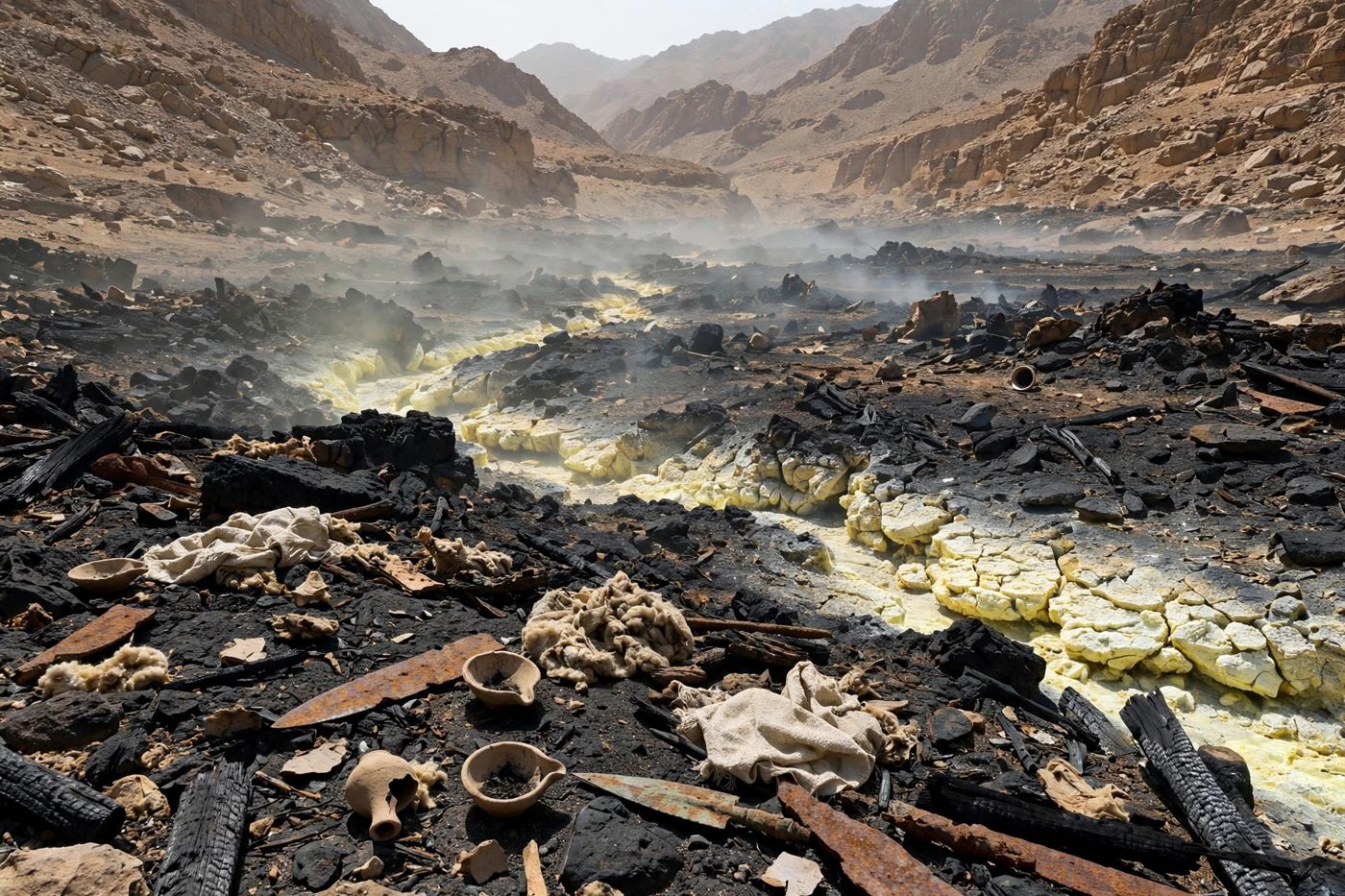
Pitch, brimstone, and a real place on the map. Edom's country was not chosen for the picture by accident. The rift valley along Edom's western border, running down toward the Dead Sea, is a landscape of tar, bitumen, and sulphur — petroleum seeps and mineral-stained rocks in a sun-blasted desert wadi system, where the ground itself can look scorched 16. When the prophet says streams turned to pitch and dust to brimstone (34:9), his hearers are picturing a located ruin, a valley they could walk to, not a cartoon hell. The picture is heightened poetry — Isaiah is a poet before he is a reporter — but it is poetry nailed to real geography. Lesson 34 of this book will meet this same Edom country again, when a conqueror comes up from Bozrah with his garments dyed red (63:1). Isaiah's map does not change between here and there; remember that you have been to this valley before, and what was promised about it.
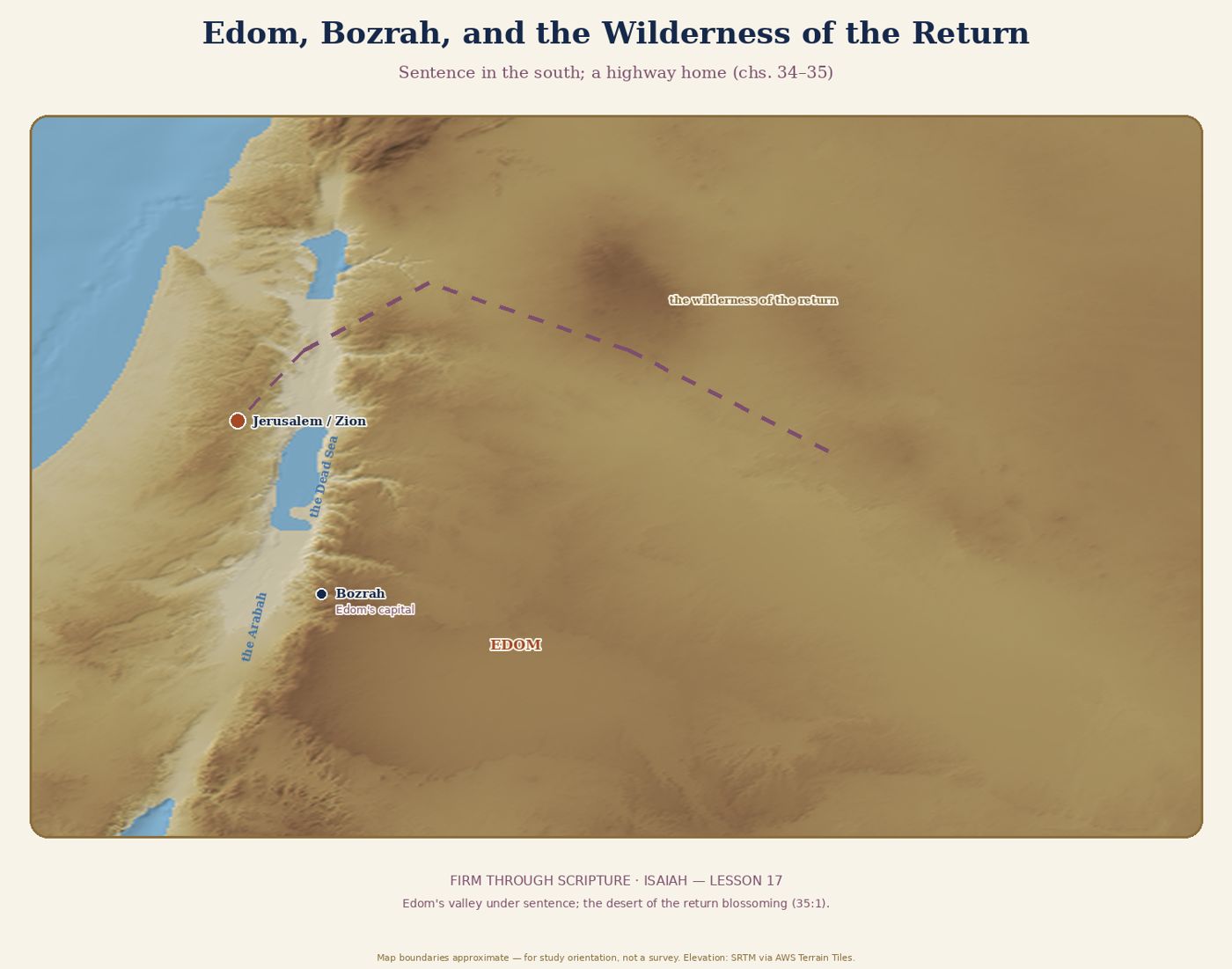
And who is listening? The summons of 34:1 addresses everybody. But chapter 35 addresses people with "weak hands," "feeble knees," and a "fearful heart" (35:3–4) — not an empire's language, but God's own battered people: Judah, squeezed between empires and tempted in every previous chapter to buy safety from Egypt or Assyria. The judgment chapter tells them the proud world will not stand forever; the song tells them what to do with their shaking hands meanwhile. The first audience of the Bible's most terrifying judgment chapter is not the nations trembling. It is the saints trembling — and being steadied.
3. OBSERVE — O: what the text actually does
Before meaning comes observation. Most bad interpretation is not deep error; it is shallow reading — people answering a text they never actually looked at. So look:
- The shape. Two panels, near-mirror images. Chapter 34 moves summons (v. 1) → universal sentence (vv. 2–4) → Edom named (vv. 5–8) → the land ruined (vv. 9–10) → the land inherited by creatures (vv. 11–15) → the written guarantee (vv. 16–17). Chapter 35 moves in reverse gear: desert blooming (vv. 1–2) → the fearful steadied (vv. 3–4) → bodies healed (vv. 5–6) → waters in the waste (vv. 6–7) → the highway (vv. 8–9) → the homecoming (v. 10). Sentence first, song second — and the song is placed so that the sentence can never be the book's last word on its own.
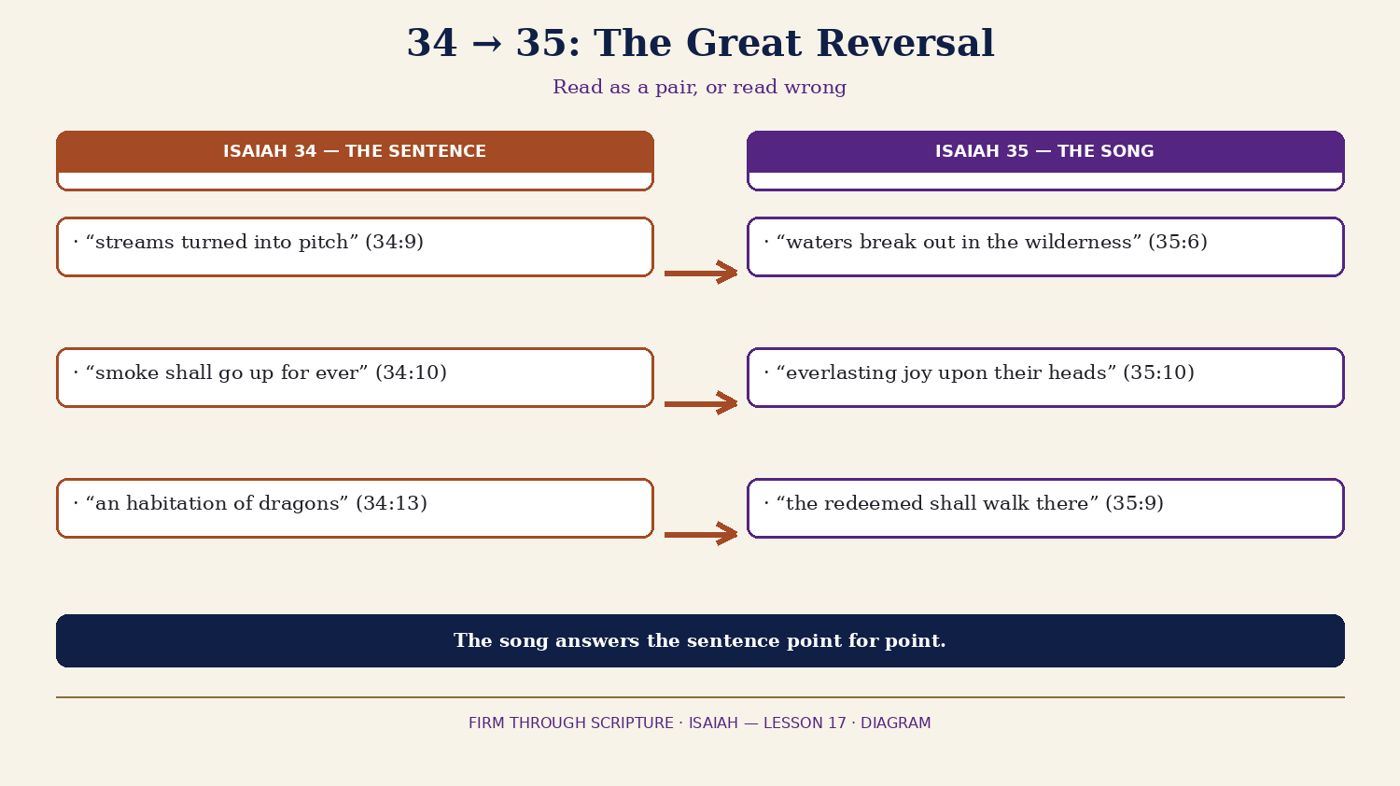
- The point-for-point reversal. Lay the panels side by side and the joins show. Edom's streams become pitch (34:9); the desert gets breaking-out waters (35:6). Edom's smoke rises "for ever" (34:10); the ransomed wear "everlasting joy" (35:10) — the forever of the one answered by the forever of the other. Edom's land is inherited by owls, ravens, and dragons (34:11–15); the highway is inherited by the redeemed, and no ravenous beast is allowed on it (35:9). A habitation of dragons in 34:13 becomes, in 35:7, "grass with reeds and rushes" in the very place where dragons lay. This is not two poems that happen to sit together. It is one argument in two movements [4, 52].
- The cosmic frame of a local sentence. Before Edom is ever named, the stars are dissolved and the sky is "rolled together as a scroll" (34:4). The scale is deliberately larger than one small nation's politics: a local judgment is painted on a universe-sized canvas. Observation simply registers the fact — Isaiah chooses end-of-the-world language for Edom's fall. What to do with that choice belongs to §6 and §7; noticing it belongs here.
- The verbs of God. Count who acts. In chapter 34 the LORD has indignation, destroys, delivers, stretches out the line, casts the lot, divides by line (34:2, 11, 17). In chapter 35 God will come — "he will come and save you" (35:4). Between the panels, human beings are given exactly one job, and it is in 35:3–4: strengthen hands, confirm knees, and speak — "Say to them that are of a fearful heart." The only human action commanded in twenty-seven verses is encouragement. Hold that; it will discipline the Walk-Out.
- The book inside the book. At 34:16 the prophet points at his own text: "Seek ye out of the book of the LORD, and read" — the second time Isaiah has done this (cf. 30:8) 1. A prophet who expects to be checked against events is making a different claim from a poet who expects to be admired. The verification offer is inside the passage itself.
- The last word. Chapter 34 ends with creatures dwelling "for ever" in a ruin. Chapter 35 ends with "sorrow and sighing shall flee away." One chapter's forever is an empty land; the other's forever is a singing crowd. The passage's own ending tells you which forever the book believes is bigger.
4. GENRE — N: note the genre (prophetic judgment oracle answered by a salvation song)
These two chapters are prophetic poetry, in two distinct prophetic forms set back to back — and each form has its own reading rules.
Chapter 34 is a judgment oracle against the nations, the form that fills Isaiah 13–23, now widened to a universal summons. Judgment oracles announce a verdict God has already reached; they are courtroom speech in poetic dress, not blow-by-blow battle reports written in advance. Read them by their own rules:
- The language is heightened on purpose. Mountains melting with blood (34:3), skies rolled like scrolls (34:4) — this is the poetry of total judgment, painting the significance of an event in cosmic colours. Demanding newspaper literalism from it — or, at the other extreme, dissolving it into "mere poetry" that predicts nothing — both break the genre. The oracle means a real fall of a real Edom, described in the largest language the prophet owns [11, 51].
- The representative stands for the whole. Edom is named, but the summons was to all nations (34:1–2). In this genre one nation routinely carries the case for all — as Babylon did in chapter 13 and Moab in chapters 15–16. Read Edom as the exhibit, not the exception.
- Vengeance here is judicial, not emotional. "The day of the LORD's vengeance" (34:8) names a settled case being executed — the "controversy of Zion" — not a temper being lost. Prophetic vengeance language is covenant-lawsuit language: measured, caused, and announced beforehand so no one can call it arbitrary [2, 4].
Chapter 35 is a salvation song — a promise-poem in the prophetic perfect, singing a future deliverance as though it were already accomplished, because in God's counsel it is. Its rules:
- Promise-poetry compresses time. Eyes opened, deserts flowering, and the homecoming stand side by side without a timetable between them. The song tells you what God will do and that He will do it; it does not hand you a dated itinerary. Much confusion in §10's third misread is born right here, by reading a song as a schedule.
- Its images answer the judgment images. Salvation songs in Isaiah work by reversal — the same desert, the same districts, the same bodies, turned right side up (see §3). Read every image in 35 against its partner in 34 and in the chapters before it.
- It ends in a road, not a mood. When a poet builds a road with traffic rules (35:8–9), he means a people actually travelling it — not a decoration for a greeting card 52.
5. TERMS — T: the words in the writer's mouth
Three expressions carry this passage, and a fourth cluster — the creature roll-call — gets the Translation Note. Learn what the words meant in Isaiah's mouth, and watch how much confusion dies at the dictionary:
- "The book of the LORD" (34:16) — not a separate volume and not, in the first instance, the whole Bible between two covers. In Isaiah's mouth this is the written prophetic record itself — this very book of Isaiah, the word God had already ordered written down and preserved "for the time to come" (30:8) 1. The claim being made is specific and checkable: the written word says wild creatures will inherit Edom pair by pair, "every one with her mate," and the reader is invited — commanded, actually — to open the book later and compare. Scripture here presents itself as evidence. That is why the phrase matters far beyond one verse: a book that says "seek… and read: no one of these shall fail" has staked its authority on its own fulfilment, in public, where anyone can audit it [2, 4].
- "Ransomed" (35:10) — a price-word. The Hebrew underneath it belongs to the world of buying back: what belongs to another, released because a price has been paid — the word-family used when God says He ransomed Jacob, and when Israel's firstborn were bought back at the Exodus [18, 19]. Its partner in the verse just before, "the redeemed" (35:9), is the sister word from the family law-court: the kinsman-redeemer, the near relative with the duty and right to buy back a family member fallen into debt or slavery. Two price-words in two verses is not decoration. The people on this highway are not escapees who slipped away free of charge; they are a bought people, and somebody paid. Isaiah does not yet say who pays — that is Book Two's burden, and the Servant Songs will take it up — but the vocabulary has already ruled out a salvation that costs nobody anything [18, 42].
- "Wayfaring men, though fools" (35:8) — wayfaring men are travellers, people actually on the road, the ordinary pilgrims of the ancient world walking from one town to the next. The clause is one of the most misquoted comforts in Isaiah, so hear it precisely: the promise is not that fools will never be foolish, nor that the road requires no attention. It is that the road itself is so plainly built — a raised, marked highway, not a maze of desert tracks — that a traveller who simply stays on it "shall not err therein," shall not wander off and be lost, even if he is no sage, no scholar, no spiritual expert [4, 11]. The safety is in the road's Maker, not in the traveller's cleverness. Isaiah will use this same traveller word again at the dark end of chapter 33 — "the wayfaring man ceaseth" (33:8), when the highways lay waste under siege. What invasion emptied, God refills.
Method note — the word-study guardrail: a word means what its author uses it to mean, in its sentence, in its century — not what its oldest root once meant, and not everything it can mean anywhere. Every term above was settled by Isaiah's usage in Isaiah. That is the discipline that keeps word studies honest.
TRANSLATION NOTE — the creature roll-call of 34:11–15
Your KJV names the new tenants of Edom in detail: "the cormorant and the bittern… the owl also and the raven… dragons… the satyr… the screech owl… the great owl… the vultures." Here is the honest situation. The Hebrew names a roll-call of desert creatures — birds of waste places, wild beasts of the dry country, creatures of ruin and night — and the picture is completely certain: Edom will be so thoroughly deserted that only the wildlife of desolation lives there, nesting undisturbed in the palaces. FACT. The precise zoology, creature by creature, is a different matter. Several of the Hebrew words occur only a handful of times in the whole Bible, some only here; ancient translators already guessed differently among themselves, and the lexica still flag real uncertainty over which exact species stands behind which name — whether this one is a pelican or an owl, that one a jackal or an ostrich, and whether the "satyr" is a wild goat, a hairy desert creature, or a goat-demon of popular imagination [19, 20]. The KJV's "unicorns" in 34:7 belongs to the same honest file: the Hebrew animal is a great wild ox, mighty and untameable — the identification is debated in detail, the impression of brute strength is not. DISPUTED at the level of species; FACT at the level of sense. So this study labels it plainly: the picture is certain, the zoology is not. No doctrine in this lesson rests on telling a bittern from a pelican — and any teaching that builds one on the exact species list has built on the one part of the passage its own translators marked, by their disagreements, as unsure ground.
6. ENTIRE CANON — E: where this passage sits in the whole story
No passage lives alone, and this one lives at a crossroads where an unusual number of the Bible's roads meet:
- The scroll that rolls up twice. "The heavens shall be rolled together as a scroll" (34:4) is Isaiah's picture, and the canon reuses it at the far end of the story. In Revelation 6:14 the sky departs "as a scroll when it is rolled together" at the opening of the sixth seal — the same image, the same uncreation of the present order, now at world scale 1. Label this carefully: it is a pattern, an image the later Scripture deliberately picks up and enlarges — not a claim that Isaiah 34 is Revelation 6, nor that Edom's historical fall exhausts the picture. Isaiah himself painted the local sentence on a cosmic canvas (§3); the New Testament, reading him, keeps the canvas and widens it. FACT that the image recurs; INFERENCE — a strong, canon-shaped one — that the recurrence is deliberate.
- Edom across the canon. Edom is the Bible's standing example of the brother-enemy judged: promised in Numbers 24:18, prosecuted in Obadiah, remembered in Psalm 137:7 and Malachi 1:2–3, sentenced again in Ezekiel 35 and Jeremiah 49 1. Isaiah 34 is that thread's fullest flowering, not an isolated outburst. And the thread has a strange second half in this book: in chapter 63 a warrior comes from Edom, from Bozrah, garments spattered as from a winepress, announcing salvation and vengeance in one breath (63:1–6). Keep the appointment; Lesson 34 will keep it with you.
- The districts come home. "Lebanon is ashamed and hewn down: Sharon is like a wilderness; and Bashan and Carmel shake off their fruits" — that was 33:9, last lesson, the land mourning under invasion. Now hear 35:2: the desert receives "the glory of Lebanon… the excellency of Carmel and Sharon." The very districts that mourned are named as the gift the desert is given. Isaiah's geography is theological: what the curse withered, the promise transplants. A reader who skips chapter 33 misses the echo; a reader who catches it sees that chapter 35 is not generic optimism — it is a reversal with an address list [4, 52].
- Eyes and ears: the book's own reversal. Isaiah's ministry began with a hardening commission — a people who would hear but not understand, see but not perceive (6:9–10). The theme has dogged the book: blind servants and deaf messengers (42:18–19 lies ahead), a nation whose eyes were smeared shut (29:9–10). Against that whole history, 35:5 lands like a bell: "the eyes of the blind shall be opened," and the deaf ears unstopped. The song does not merely promise scenery. It promises the undoing of the book's founding sorrow — the day the hardening ends. When Jesus later takes up these exact words (§7, the Christ Thread), He is announcing that the undoing has begun.
- The highway runs through the whole book. A "highway" for God's returning people is one of Isaiah's signature images 52: a highway from Assyria for the remnant (11:16), a highway between Egypt and Assyria with Israel between them (19:23), and — just ahead, at Book Two's seam — a voice crying "Prepare ye the way of the LORD" (40:3), the same road-building project announced as imminent comfort. Chapter 35's Highway of Holiness is the central span of a road the whole book is building, and John the Baptist will stand on its next section (Mark 1:3; Matthew 3:3) [1, 52].
- Where in the covenant story? Stand and locate yourself. The old covenant — God's covenant with Israel through Moses — promised blessing for faithfulness and curses for rebellion, exile among them (Deuteronomy 28). Isaiah's first audience lives under the shadow of those curses arriving. But chapters 34–35 already look through the covenant's judgment to the covenant God's faithfulness beyond it: the nations judged, yes — and then a bought people ("ransomed," "redeemed") travelling home to Zion, which is exactly the homecoming-from-exile the prophets attach to God's new covenant work (Jeremiah 31:31–34; Ezekiel 36:24–28) 1. The sentence is old-covenant justice; the song is new-covenant mercy arriving early, sung in advance. The church, gathered from the nations by the Servant's work in Book Two, will find itself walking this same road as the people bought by a price (1 Peter 1:18–19) — the price-words of 35:9–10 filled in with a name and a cross.
7. THE MEANING — what the passage teaches
The Walk has established what the text says and where it sits. Now its payload, taught straight — the doctrines this passage actually carries, in the text's own proportions: a full chapter of sentence, a full chapter of song.
A summons to the whole earth — judgment is universal before it is particular
Chapter 34 does not begin with Edom. It begins with everybody: "Come near, ye nations, to hear… let the earth hear" (34:1). The LORD's indignation stands "upon all nations" (34:2) before a single Edomite is mentioned. That order is doctrine. Isaiah's God is not a tribal deity settling a local grudge; He is the Judge of all the earth, and every nation's armies — the thing nations trust instead of God — stand under the same sentence [2, 11]. Only then does the court name its exhibit. No reader gets to treat this chapter as a spectator sport about other people's sins: the summons includes the reader's own nation, armies, and trusts.
The sentence on Edom — measured, caused, and brother-shaped
Look at how precisely the sentence is framed, because the framing is the theology. Verse 8 gives the case its legal title: "the day of the LORD's vengeance, and the year of recompences for the controversy of Zion." Three facts are packed into that one line. First, there is a controversy — a named cause, Zion wronged, a case on file (§2). Second, the response is recompence — repayment, proportioned settlement, the language of a court restoring a balance, not of a mob working off rage. Third, it has a term — a day, a year: bounded, appointed, finished. God's vengeance in Isaiah is never a mood. It is a verdict executed after a case has been heard, for wrongs that were real, named, and unrepented [2, 4].
And the sword imagery preaches the same measured holiness in a darker register. The sword "bathed in heaven" (34:5) descends; the sentence is spoken of in sacrificial language — "the LORD hath a sacrifice in Bozrah" (34:6), with lambs, goats, and rams named as the falling powers of Edom are compared to altar victims. That is deliberately shocking language, and Isaiah means it to be: judgment on entrenched evil is presented as an act of worship-side holiness, the removal of what defiles, carried out by God Himself and not delegated to Israel's army. Notice who wields the sword. Not Judah. Not the reader. The LORD's sword, the LORD's sacrifice, the LORD's day. Vengeance here belongs to God alone, announced by His prophet, executed by His hand — which is exactly where the New Testament will leave it: "Vengeance is mine; I will repay, saith the Lord" (Romans 12:19, quoting Deuteronomy 32:35) 1.
Uncreation — what a land looks like with God against it
Verses 9–15 paint the sentence's result, and the paint is Genesis run backwards. The host of heaven dissolves (34:4); over Edom God stretches "the line of confusion, and the stones of emptiness" (34:11) — and emptiness there is the Bible's own word from Genesis 1:2, the formless waste before God spoke order into it. This is uncreation: a cultivated land unmade, its palaces to thorns, its fortresses to dens. Where Genesis 1 ends with a fruitful garden filled by God's image-bearers, Isaiah 34 ends with an unpeopled waste filled pair by pair with desert creatures — the creatures coming "every one with her mate" (34:15), an inverted echo of the ark and of Eden, fruitfulness continuing with mankind written out of the land [2, 4]. The doctrine is severe and meant to be felt: sin's end, left to itself, is not a smaller life but un-life. And "none shall pass through it for ever and ever" (34:10) closes the door on any hope that Edom-as-enemy could wait out God's anger and rebuild — which is why the door of chapter 35, opened in the very next breath, is such astonishing grace.
"Seek ye out of the book of the LORD" — a prophet who asks to be checked
Verse 16 may be the most quietly important verse in the chapter. Isaiah interrupts his own oracle to direct his readers to a book — his book (§5) — and stakes everything on comparison: read it, then watch; "no one of these shall fail." Two doctrines live here. First, the word is written — not a rumour or a private ecstasy but a public document, preserved on purpose (30:8) to be audited by later audiences 2. Second, the word is verifiable in principle: the prophet issues the ancient world's version of check my work. The lot-and-line language of 34:17 seals it — God distributing the deserted land to its new tenants the way Israel once received Canaan by lot and line (Joshua 14; Psalm 78:55) 1. The same hand apportions inheritance and ruin. A church that reads this verse carefully learns a posture toward Scripture itself: confidence with its eyes open, because the book it trusts invited the audit first.

The song — God strengthens the fearful by promising Himself
Turn the page, and watch what the song does first. Before a single flower is described as present, trembling people are addressed: "Strengthen ye the weak hands"… "Be strong, fear not" (35:3–4). And the ground of the courage is not their improvement, their prospects, or their enemies' weakness. It is a Person arriving: "behold, your God will come with vengeance, even God with a recompence; he will come and save you." The same recompense that was terror to Edom in 34:8 is comfort to the fearful in 35:4 — one settlement of accounts, two experiences of it, depending on which side of the controversy of Zion you stand. That is how Isaiah comforts: not by denying the judgment, but by locating his hearers inside it on the saved side — and by making God's own coming, not their own strength, the reason for strong hands. Weak hands are not told to become strong hands by trying. They are told to strengthen one another with a promise: He will come and save you [4, 13].
The promise then unrolls in a deliberate order — and the order is the doctrine:
| Step | What happens | Verse |
|---|---|---|
| 1 | God Himself comes to save | 35:4 |
| 2 | Bodies are healed — eyes, ears, legs, tongues | 35:5–6 |
| 3 | The land is watered — desert becomes pool | 35:6–7 |
| 4 | The highway is built and guarded | 35:8–9 |
| 5 | The ransomed travel it home to Zion, singing | 35:10 |
Salvation in Isaiah 35 is not a private feeling with scenery attached. It is embodied, environmental, communal, and directional — it goes to Zion. A gospel that heals only the interior, or only the future, is thinner than this song.
The Christ Thread — the Lord answers John's question with this chapter
Here the thread is not tied by us; it is tied by Jesus Himself, on the record. John the Baptist — the forerunner of Isaiah 40:3, now sitting in Herod's prison and wondering if he had pointed to the right man — sent disciples to ask Jesus outright: "Art thou he that should come, or do we look for another?" (Matthew 11:3). Jesus did not answer with an argument. He answered with Isaiah 35: "Go and shew John again those things which ye do hear and see: The blind receive their sight, and the lame walk, the lepers are cleansed, and the deaf hear, the dead are raised up, and the poor have the gospel preached to them" (Matthew 11:4–5; the same answer stands in Luke 7:22) 1. Blind eyes opened, deaf ears unstopped, the lame leaping — Jesus reached for this song as His own credentials. Which means, by His own testimony: the age Isaiah 35 sings about was arriving in His ministry; the God who promised "he will come and save you" had come, and was saving, in person. The church's historic reading follows Him exactly here — the healings of Jesus are not illustrations of the kingdom; they are its first instalments, Isaiah 35 breaking into the present ahead of its full day [4, 42]. Hold both ends of that, because §10's third misread drops one of them: the age has genuinely begun in Christ (the "already"), and the ransomed have not yet all come home singing (the "not yet"). The lame man who leapt in Galilee is the down payment; the highway full of leaping lame is still ahead.
Father, Son, and Spirit
The song's grammar is quietly Trinitarian in shape. The promise is that God will come (35:4) — and the New Testament identifies that coming God, without embarrassment, as the Son walking into Galilee performing the very signs the verse schedules 1. The Father sends; the Son arrives and saves; and in the judgment panel the gathering is credited to "his spirit" (34:16) — the Spirit as executor of what the LORD's mouth commands. One God, acting in distinguishable persons across both panels: commanding, coming, gathering. Isaiah's first readers could not have drawn the later creeds from this alone, and this study does not pretend they did — but a Christian reader can see the shape the creeds would later name.
The Long View — what the church has believed
Stand back and notice how the centuries have read this pair, because you are not their first readers. The church has consistently read chapters 34–35 together, and has heard chapter 35 as one of the Old Testament's clearest advance songs of the messianic age — precisely because Jesus Himself certified it as such in Matthew 11 [4, 36]. Calvin lingered where Isaiah lingers: strengthening weak hands is the church's own commissioned work, believers steadying believers with the promise of God's coming 36. On chapter 34 the historic reading is equally sober: Edom fell, historically and finally, and no Edomite state ever rose again on that land [11, 16]. FACT as far as the historical record speaks. Where honest readers have differed is over the surplus: whether the cosmic language of 34:4 and the "for ever" smoke of 34:10 are exhausted by Edom's historical fall, or whether — as the Revelation 6 echo suggests (§6) — the fall of Edom stands in Scripture as a pattern and preview of a final, universal judgment still to come. That is DISPUTED terrain among faithful scholars, and this course's POSITION is the pattern reading: the historical sentence is real and complete in itself, and Isaiah's deliberately cosmic scale, taken up by the New Testament, teaches the church to read it as a window onto the last day — without dissolving the historical Edom into a mere symbol. Both halves are kept, because the text itself keeps both: a named land, a named capital, a named cause — and a sky rolled up like a scroll.
8. THE AIM SENTENCE — X: eXplain the intent
Everything observed now compresses into one sentence — the author's intended meaning, stated before any application is allowed near it:
Isaiah closes Book One with a matched pair: the LORD, Judge of all nations, executes a measured, caused sentence on Edom — the brother who would not help — and leaves its land to the desert creatures exactly as His written book said; and then that same coming God reverses the curse for His fearful people, opening blind eyes and watering the desert, and builds a holy highway on which His ransomed — a people bought at a price — travel home to Zion singing, while sorrow flees.
If a sermon, a post, or a devotional uses Isaiah 34–35 to say something that cannot be traced back to that sentence — judgment without the song, the song without the sentence, comfort without the coming God — it is not this passage talking. That is the whole skill this course exists to build — and the next section is where you watch it work.
9. SAY IT BACK
Close the book and say the AIM sentence from section 8 in your own words — out loud, or written in your notes, without looking. Then say, in one more sentence, what it asks of you this week.
If your version quietly changes the meaning — if the sentence on Edom becomes God's bad temper, or the highway becomes a vague hope that things work out, or the ransomed become people who saved themselves — open the lesson and walk it again. This exercise feels small. It is the entire course in miniature: meaning first, in the author's words become your words, then — and only then — your life.
10. THE MISREAD — the guardrail, with verdicts
Three live misuses of this passage. Each gets a fair hearing, the evidence, and a verdict.
Misread 1: "Chapter 34 is God delighting in gore — a bloodthirsty text the church should be embarrassed by and quietly skip." Why it sounds right: the chapter is genuinely graphic. Slain cast out, mountains melted with blood, a sword fat with fatness, smoke rising for ever. A modern reader did not invent the shock; the shock is in the text. The evidence: shock is not the same as delight, and the chapter's own frame forbids the reading. This is a courtroom, not a battlefield frenzy: a universal summons (34:1), a stated charge (34:2), a named cause — "the controversy of Zion" (34:8) — and a bounded term, "the day… the year of recompences." The vengeance is recompence: a settlement of real, filed wrongs — a brother nation that refused the homeless, gloated over Jerusalem's fall, and looted the ruins (Obadiah) [1, 2]. The sword is wielded by God alone; Israel is given no share in executing it and no permission to enjoy it — the very next thing God's people are told to do is strengthen weak hands (35:3), not gloat over strong judgment. And the pairing is the final guardrail: the prophet who sings 34 sings 35 in the same breath, and the Bible that keeps both refuses to let judgment be God's hobby. It is His "strange work" (28:21) — real, righteous, and never His pleasure in itself (Ezekiel 33:11) 1. Verdict: a sentence in a courtroom — measured, universal, with a cause named — misread as a temper tantrum by readers who skipped the frame. Read 34 alone and it can be made to sound cruel. Read it as Isaiah built it, bound to 35, and it is justice with its paperwork in order, followed immediately by mercy with its bags packed.
Misread 2: "Chapter 35 is generic heaven-sentiment — pretty poetry about everything being lovely someday, with no specific content to argue about." Why it sounds right: the chapter is beautiful, quotable, and constantly detached — printed on cards, read at funerals, set to music — until it floats free of its context and comes to mean little more than it will all be fine. The evidence: the song is specific at every point a greeting card is vague. Its reversal answers chapter 34 point for point (§3). Its geography is itemised — Lebanon, Carmel, and Sharon, the exact districts mourned as withered in 33:9, now named as the desert's inheritance (35:2) [4, 52]. Its healings answer this book's founding grief, the blind-and-deaf hardening of chapter 6, and Jesus treated the list as a checklist of identifiable events, not a mood (Matthew 11:4–5) 1. And its climax is not a feeling but infrastructure: a raised highway with a name, an access rule, a safety guarantee, a travelling population, and a destination — Zion. Sentiment does not issue traffic regulations. Verdict: not sentiment but a plotted reversal with an address list. Flatten 35 into "someday, somehow" and you have not summarised the song — you have unplugged it from the sentence it answers, the districts it names, and the Saviour who quoted it as His itinerary.
Misread 3: "Isaiah 35:5–6 is a present-tense guarantee: if the church prays in faith, every blindness, deafness, and lameness must be healed now — and an unhealed believer is evidence of failed faith." Why it sounds right: Jesus really did perform these exact signs, and said so (Matthew 11:4–5). If the age has come, why would its signs be rationed? The question deserves a straight answer, not a squirm. The evidence: Jesus's own use of the text is the control. He cited the song as proof the age was arriving in His ministry — inauguration, in the theologians' word — while He Himself still walked toward a cross, still left Lazarus in a tomb for four days, still healed crowds in one village and passed by sufferers in another, and still promised His ransomed their full homecoming as a return yet to come (35:10) [1, 4]. The apostles' ministry keeps the same pattern: real healings, publicly undeniable — and Paul's thorn unremoved (2 Corinthians 12:7–9), Timothy's stomach treated with wine rather than a decree (1 Timothy 5:23), Trophimus "left at Miletum sick" (2 Timothy 4:20) by the very apostle who had raised the dead. The full leaping of every lame man is scheduled where Isaiah schedules it: at the arrival, on the road's far end, when the ransomed come to Zion — not distributed as an entitlement at the road's near end. POSITION — stated plainly because healing traditions divide here, and this course does not hide its labels: the historic church's reading, and this study's, is already and not yet — pray for the sick boldly and expectantly, because the King who opened blind eyes is alive and His age has begun; and refuse, absolutely, to indict the unhealed, because the song itself reserves the complete reversal for the homecoming. A guarantee God never signed is not faith. It is a forgery with a Bible verse pasted on it. Verdict: inauguration with the "not yet" kept honest. Jesus's citation proves the song is coming true; the song's own ending proves it has not finished coming true. Drop either half and you will either stop praying or start accusing — and Isaiah 35 permits neither.
| Misread | The correction in one line |
|---|---|
| 34 = God delighting in gore | A courtroom sentence: caused, measured, God's alone |
| 35 = generic sentiment | A plotted reversal with names, places, and a road |
| 35:5–6 = healing on demand | Already begun in Christ; completed at the homecoming |
11. FROM WORD TO WALK
A reflection page — the lesson is not finished until the passage has had its say with you.
Notice, before anything else, who this passage thinks you are. Not the nations under summons, primarily. Not Edom under sentence. Chapter 35 addresses you — if you are God's, and tired — as a person with weak hands, feeble knees, and a fearful heart. Isaiah does not scold the shaking, or tell the fearful-hearted to be ashamed of the fear. He gives them a sentence to say to one another, and the sentence is not try harder. It is: "behold, your God will come… he will come and save you." Sit with the kindness of that order: the strengthening of your hands is assigned to your brothers and sisters; theirs is assigned to you. Despair is very often just a believer trying to do alone a job God assigned to the whole road-company of the redeemed.
And then there is the road itself. You may have come to this lesson sophisticated, or you may have come to it — be honest — as one of the "fools" of 35:8, a wayfaring man who has wandered off better paths than this one, more than once. Hear what the verse actually promises you: the safety of this journey was never going to rest on your cleverness. The road is raised, marked, guarded, and kept clear of lions by Another. Your part is the traveller's part: get on it, stay on it, and walk it in company, singing more as the city gets closer. The ransomed are not the impressive. The ransomed are the bought — and the price was not your performance.
One more thing, and it is the pair again, because the pair is the lesson. If your heart has grown hard enough to enjoy chapter 34 — to read judgment on others with appetite — chapter 35 was written to expose you: God's people in this passage are encouragers, not connoisseurs of doom. And if your heart has grown soft enough to want chapter 35 without chapter 34 — a blooming desert with no settled accounts, a homecoming with no holiness on the highway ("the unclean shall not pass over it") — the sentence was written to expose that too. Take both, in Isaiah's order. Sentence, then song. Holiness, then home.
LORD, You will come and save — so strengthen my weak hands with that promise, and make my mouth a strengthener of somebody else's. Keep my feet on Your highway, where the foolish do not have to be clever to be safe, only travelling. And bring me, with all Your ransomed, home to Zion singing. In Jesus' name, amen.
12. FOR DISCUSSION — OR FOR YOUR JOURNAL
With a group, work these aloud. Alone, they're yours — answer them in your journal or in prayer; they lose nothing in the quiet.
- Why does Isaiah name Edom — the brother who would not help — as the exhibit of God's universal judgment, rather than a great empire like Assyria or Babylon? What "nearest enemy" sins does that choice expose in us?
- Chapter 34 points readers back to a written book and says, in effect, check whether it came true (34:16). How should that shape the way we hold and test what we believe?
- The only action God's people are commanded in this whole passage is to strengthen weak hands and speak courage to fearful hearts (35:3–4). Who has done that for you? Whose hands are yours to strengthen this month — by name?
- Where do you feel the pull of the "not yet" — a healing, a homecoming, a sorrow not yet fled — and how does this passage teach you to pray inside it: boldly, without accusing God or yourself?
13. THE WALK-OUT — T: Transfer to today
Meaning is settled. Now — and only now — application, and it must cross the bridge honestly. Run the five Transfer Tests on this passage:
- Same covenant? The sentence fell under the old covenant's order, on a nation-state, executed by God in history. We live under the new covenant, in a church drawn from all nations, and no church, state, or believer is handed Edom's sentence to execute. What crosses is God's character — Judge of all the earth, settler of filed wrongs — and the final judgment He still reserves to Himself. What does not cross is any human hand on the sword.
- Same audience? The summons of 34:1 addresses the nations; the comfort of 35:3–4 addresses God's fearful people. Read yourself into the right chair. A believer's primary seat in this passage is among the weak-handed being steadied — and, having been steadied, among the speakers of courage. No reader is seated on the bench.
- Same genre rules? Judgment oracle plus salvation song: the oracle yields warnings, patterns, and the knowledge of God — not a targeting list; the song yields promises to trust and a road to walk — not a timetable or a healing entitlement (§10, Misread 3).
- Repeated or rooted? Vengeance belonging to God alone is repeated at Romans 12:19 and rooted in Deuteronomy 32:35 1. The strengthening of the fearful is repeated almost word for word at Hebrews 12:12 — "lift up the hands which hang down, and the feeble knees" — and applied there to ordinary church life. The road of holiness travelled by a bought people is rooted in the Exodus pattern and repeated in the church's own self-description as ransomed (1 Peter 1:18–19) 1. These cross.
- Ten verses either side? Every application below is drawn from these twenty-seven verses read whole, as a pair. Nothing hangs on 34 without 35, or on 35 without 34.
| Test result | What it means here |
|---|---|
| The sword stays God's | No human vengeance, ever (34:5–6; Rom. 12:19) |
| The comfort is ours in Christ | "He will come and save you" — already begun (35:4; Matt. 11:4–5) |
| The one command is encouragement | Strengthen weak hands; speak courage (35:3–4) |
What crosses — and lands (led, as this course always leads, by what God has done — the indicative before the imperative):
- God has already come, and is coming. The promise "he will come and save you" (35:4) is not an unopened letter. In Jesus it has been opened, read aloud in a prisoner's hearing (Matthew 11:4–5), and acted on at the cross, where the price behind the word "ransomed" was paid in full 1. Your confidence this week does not rest on a maybe. It rests on a down payment already made and a homecoming already scheduled.
- God settles accounts, so you don't have to. The controversy of Zion is His case (34:8). Wrongs done to you that no earthly court will ever hear have been filed in a court that does not lose files. That is not a call to passivity about justice in this world — it is the specific, surgical release from personal vengeance, the thing Romans 12 commands precisely because Isaiah 34 is true.
- The road is plainer than your fears say. The wayfaring men, though fools, do not err on it (35:8) — not because the travellers are upgraded, but because the road is built and guarded. What crosses is a settled refusal to make your standing with God depend on your spiritual cleverness or your record of not wandering.
Practices — what the gate lets through, made concrete this week:
- Be a verse 3–4 speaker. Name one person with weak hands — the name came to mind while you read — and strengthen them this week with the passage's own medicine: not advice, but the promise, said plainly: God will come and save you; He already has, in Christ. One visit, call, or written note. This is the passage's only commanded human action; it is not optional garnish.
- File one controversy. Write down one wrong you are still privately prosecuting — rehearsing, re-arguing, waiting to avenge in imagination. Pray Romans 12:19 over it, by name, and record the date you handed the file to God. When the rehearsal restarts (it will), return to the date, not to the argument.
- Pray for the sick the Isaiah 35 way. Pray for one unhealed person — by name, out loud, with real expectation that the King who opened blind eyes hears you — and in the same prayer thank Him for the homecoming at which that person, in Christ, will leap. Boldness and patience in one breath.
- Memorize Isaiah 35:4's promise in its short form: "Be strong, fear not: behold, your God will come… he will come and save you." Carry it as the sentence you say to fearful hearts — beginning with your own.
- Walk in company. The highway's population is plural from end to end. If your discipleship has gone private, correct it with one concrete step this week: a service attended in person, a table shared, a fellow-traveller asked honestly how their road is going.
What does not cross: executing, celebrating, or fantasising about vengeance on anyone (the sword is the LORD's, 34:5–6, and the church's hands are assigned to strengthening, 35:3); claiming 35:5–6 as a guarantee that any specific healing must occur on your schedule (§10, Misread 3); reading your own nation, party, or enemies into Edom's chair (the summons is universal, 34:1 — it includes every reader's tribe among the summoned); and treating the highway as a private spirituality (its travellers are a company, its destination a city). The gate is not there to shrink the Bible's claims on you — it is there to make sure the claims that land are the ones God actually made.
Praise Him
We praise You, God who comes: Judge of all the earth, who settles Zion's controversy and forgets no filed wrong; Saviour who opens blind eyes and makes the lame leap and the desert sing; Builder of the highway on which fools cannot lose their way. Everlasting joy is Your road's end, and sorrow flees at Your arrival. Bring us home singing — all of us, every ransomed traveller — in the name of the One who came, and comes, and will come. Amen.
14. THE RECAP CARD — this study on one page
Print it. Keep it where you'll see it this week.
- The passage: Isaiah 34:1–35:10 — Book One's closing antiphon: the sentence on Edom, then the song of the blooming desert and the highway home.
- Say It Plain: God summons all nations, sentences brother-Edom for the controversy of Zion, and leaves its land to desert creatures exactly as His book said — then reverses everything for His fearful people: eyes open, waters break out, and the ransomed walk a guarded highway home to Zion, singing.
- The AIM: Isaiah closes Book One with a matched pair: the LORD, Judge of all nations, executes a measured, caused sentence on Edom — the brother who would not help — and then that same coming God reverses the curse for His fearful people and builds a holy highway on which His ransomed travel home to Zion singing, while sorrow flees.
- Key terms: "the book of the LORD" — Isaiah's own written record, offered for checking (34:16) · "ransomed" — a bought-back people; somebody paid (35:10) · "wayfaring men, though fools" — ordinary travellers who cannot lose a road this plainly built (35:8).
- The Misread, in one line: chapter 34 is a courtroom sentence, not divine gloating — and it must never be read detached from 35 · chapter 35 is a plotted, point-for-point reversal, not generic sentiment · 35:5–6 is inauguration with a "not yet," not a guarantee that every healing must come on demand.
- Memory verse: "Say to them that are of a fearful heart, Be strong, fear not: behold, your God will come with vengeance, even God with a recompence; he will come and save you." — Isaiah 35:4
- This week's practice: be a verse 3–4 speaker — strengthen one named person's weak hands with the promise, He will come and save you — and file one controversy with God, by name and date, and leave the vengeance in His hands.
15. CHECK YOURSELF — five questions
Answer from the study, not from instinct. (Answers live in the Teacher Edition.)
- In your own words: what is the AIM of Isaiah 34–35, and why must the two chapters be read as a pair?
- Why does Isaiah name Edom — rather than a great empire — as the exhibit of God's judgment? Give the family history in your answer.
- What is "the book of the LORD" in 34:16, and what is Isaiah inviting his readers to do with it?
- A friend says Isaiah 35:5–6 guarantees that any believer who prays in faith will be healed now. Using Jesus's own use of the passage, explain what is right and what is wrong in that claim.
- What does "ransomed" (35:10) tell you about the people on the highway — and what does "wayfaring men, though fools, shall not err" (35:8) tell you about why they arrive?
16. GO DEEPER
Optional — for readers who want the machinery. The lesson is complete without it.
From the Sources — Edom's real end
Edom's fall was not a metaphor in search of an event. Pressed between greater powers, the Edomites were pushed westward out of their hill country in the centuries after Isaiah, settled southern Judah (the region the New Testament knows as Idumea), were conquered and forcibly converted under the Hasmonean ruler John Hyrcanus in the second century BC, and thereafter dissolve as a distinct people — the family of Herod the Great, history's most famous Idumean, among their descendants [11, 16, 31]. FACT, in outline, from the historical record and Josephus's retelling 31. No Edomite nation ever re-formed in Bozrah's land. The comparison with the record does not prove every cosmic line of the oracle was spent on Edom alone (§16 keeps the pattern question open, labelled) — but the local sentence's local fulfilment is a matter of record, not pious assertion.
The Honest Argument — exhausted by Edom, or a window on the last day?
Here is the dispute, at full strength, both ways. The case that chapter 34 is exhausted by history: the oracle names a real nation, capital, and cause; Edom really fell and never rose; and the heightened language is the genre's native dress (§4), not a coded timetable [11, 14]. The case for the pattern reading: Isaiah reaches for uncreation language (34:4) that overshoots any merely local fall; the New Testament takes up the scroll image at the end of the world (Revelation 6:14) 1; and the book's architecture sets this chapter as Book One's closing summary of all judgment, answered by a chapter 35 whose full performance plainly still awaits the ransomed's arrival [2, 5]. Childs's canonical reading 5 supports reading the chapters in their final, book-level frame — cited for what it carries, not stretched past it. DISPUTED — the surplus question is genuinely open among faithful scholars. POSITION — this course reads the historical sentence as real and complete and the cosmic frame as a deliberate window onto final judgment (§7), because dropping either half requires explaining away language the text plainly contains. What no honest reading may do is use the dispute as a solvent: "pattern" never licenses dissolving Edom into vapour, and "history" never licenses shrinking the sky of 34:4 into a weather report.
The Word Underneath — two price-words, one road
Verses 9–10 of chapter 35 set two different Hebrew words side by side, and English keeps them just distinct enough to hear it: "the redeemed shall walk there" (35:9); "the ransomed of the LORD shall return" (35:10). The first is the kinsman-redeemer's word — family obligation, the near relative buying back his own. The second is the ransom word — a price paid to release what was held [18, 19]. FACT, as a matter of the two words' usage across the Old Testament. Set them together and the song's soteriology — its doctrine of how these people come to be on this road — stands in two words: they are family, bought back by family, at a price. Isaiah will spend his most famous chapter (53) unfolding who stands in the kinsman's place and what the price turns out to be; the Servant literature surveyed in North 42 is, in large part, the centuries-long argument over exactly that identification. INFERENCE — but the kind an author earns, by placing the two price-words at the climax of Book One's final song, within sight of the Servant who dominates Book Two.
Go Read
- Oswalt, The Book of Isaiah, Chapters 1–39 (NICOT) 2 — the fullest slow treatment of chapters 34–35 as Book One's closing diptych, Edom's representative role, and the "book of the LORD" at 34:16.
- Motyer, The Prophecy of Isaiah 4 — on the point-for-point reversal between the chapters and the highway's place in the book's whole design.
- Smith, Isaiah 1–39 (New American Commentary) 11 — the historical notes: Edom, Bozrah, and the ancient Near Eastern background, with the authorship debate surveyed even-handedly.
- Ryken, Wilhoit & Longman (eds.), Dictionary of Biblical Imagery 52 — Isaiah's highway image-field traced across the book and the canon.
17. SOURCES & REFERENCES
Numbered citations in this lesson key to this list — the course standard: every sourced claim carries its number, and every number can be checked.
- The KJV text itself — Holy Bible, King James Version (eBible.org KJV, 1769 text). Scripture quotations are from the King James Version (KJV), which is in the public domain in the United States; the full passage is always assigned as reading. Cross-references within Scripture cite this number.
- Oswalt, The Book of Isaiah, Chapters 1–39 (NICOT) — John N. Oswalt (Eerdmans). The leading evangelical commentary on the first half; defends essential unity of authorship and reads the book as a finished theological whole. Detailed notes on the Assyrian-period history (Ahaz, Hezekiah, Sennacherib).
- Motyer, The Prophecy of Isaiah — J. Alec Motyer (IVP). A one-volume commentary by an evangelical scholar who argues the whole book breathes the mind of the eighth-century prophet; especially strong on the book's structure, its repeated refrains, and the Servant.
- Childs, Isaiah (Old Testament Library) — Brevard S. Childs (Westminster John Knox). The canonical-approach reading: the book in its final form as Scripture, whatever its compositional prehistory; a control on both conservative and critical overreach.
- Smith, Isaiah 1–39 and Isaiah 40–66 (New American Commentary) — Gary V. Smith (B&H). Evangelical commentary with strong historical notes (the Assyrian and Babylonian records) and an even-handed survey of the authorship debate.
- Brueggemann, Isaiah 1–39 and Isaiah 40–66 (Westminster Bible Companion) — Walter Brueggemann (Westminster John Knox). A rhetorical-theological reading for preachers and teachers; strong on the poetry's movement from judgment to hope.
- Clements, Isaiah 1–39 (New Century Bible) — R. E. Clements (Eerdmans). Critical commentary notable for its redactional reading of the eighth-century core and its later expansions.
- Walton, Matthews & Chavalas, The IVP Bible Background Commentary: Old Testament — John H. Walton, Victor H. Matthews, Mark W. Chavalas (IVP). Verse-by-verse ancient Near Eastern background: Assyrian siege practice, Babylonian religion, treaty and coronation customs, geography.
- VanGemeren (ed.), New International Dictionary of Old Testament Theology and Exegesis (NIDOTTE) — Willem A. VanGemeren (Zondervan). Theological word studies with semantic-range discipline for the Hebrew terms.
- Brown, Driver & Briggs, Hebrew and English Lexicon of the Old Testament (BDB) — The standard older Hebrew lexicon; word senses and usage ranges for the Terms sections.
- Koehler & Baumgartner, The Hebrew and Aramaic Lexicon of the Old Testament (HALOT) — The standard modern Hebrew lexicon; the control on BDB for contested senses (e.g., 'almah).
- Josephus, Antiquities of the Jews (Books 9–11; temple-court descriptions also from the Jewish War) — The first-century Jewish historian's retelling of the Hezekiah/Sennacherib crisis, Isaiah's reputation, and the Cyrus decree — an outside witness to how the traditions were held.
- Calvin, Commentary on Isaiah — John Calvin (public domain). Reformation exegesis; a control on interpretation and a voice in the Long View.
- North, The Suffering Servant in Deutero-Isaiah — C. R. North (Oxford). The classic survey of every identification of the Servant (Israel, a prophet, a king, the Messiah) weighed in one place.
- Fee & Stuart, How to Read the Bible for All Its Worth — Gordon D. Fee and Douglas Stuart (Zondervan). The beginner's method book; its prophecy chapter ("a forthtelling first") undergirds the Genre sections.
- Ryken, Wilhoit & Longman (eds.), Dictionary of Biblical Imagery — Leland Ryken et al. (IVP). Isaiah's image-fields — vineyard, highway, banner, potter, watchman — traced across the canon.