
One study, one walk — the universal FIRM format. The passage first and whole; then its world; then the Walk (Context · Observe · Genre · Terms · Entire Canon); the meaning taught straight; the AIM sentence; the misread exposed and answered; and the walk-out, where application has to pass the Transfer Tests before it reaches your week. The same skeleton serves a book, a chapter, a single verse, or a whole subject. In the early studies the moves are labeled as they happen. The labels fade as the walk becomes yours.
THE WEEK WITH THIS STUDY — six bites
Day 1 — Read the passage · Say It Plain · The World (§§1–2) · Day 2 — Observe · Genre (§§3–4) · Day 3 — Terms · Entire Canon (§§5–6) · Day 4 — The Meaning · the AIM Sentence · Say It Back (§§7–9) · Day 5 — The Misread · From Word to Walk (§§10–11 — add For Discussion, §12, if you're with others) · Day 6 — The Walk-Out · the Recap Card (§§13–14). Go Deeper (§16) any evening you want the basement.
BEFORE YOU READ — Open My Eyes
LORD, enthroned between the cherubims, maker of heaven and earth — when the letter is spread out and the evidence in it is real, teach me to concede what is true and refuse what does not follow. Open my eyes to the Holy One of Israel, who defends His city for His own sake. In Jesus' name, amen.
§ means “section” — the numbered parts of your lesson. Each bite above names the sections for that day.
1. READ THE PASSAGE — Isaiah 36:1–37:38 (KJV)
Read it all, slowly, before any teaching. In this course the passage always prints once, in full, at the head of the lesson. Everything after this is commentary — this is the text. Two chapters print here as one continuous story; verse numbers restart at chapter 37, as in your Bible.
1 Now it came to pass in the fourteenth year of king Hezekiah, that Sennacherib king of Assyria came up against all the defenced cities of Judah, and took them.
2 And the king of Assyria sent Rabshakeh from Lachish to Jerusalem unto king Hezekiah with a great army. And he stood by the conduit of the upper pool in the highway of the fuller's field.
3 Then came forth unto him Eliakim, Hilkiah's son, which was over the house, and Shebna the scribe, and Joah, Asaph's son, the recorder.
4 And Rabshakeh said unto them, Say ye now to Hezekiah, Thus saith the great king, the king of Assyria, What confidence is this wherein thou trustest?
5 I say, sayest thou, (but they are but vain words) I have counsel and strength for war: now on whom dost thou trust, that thou rebellest against me?
6 Lo, thou trustest in the staff of this broken reed, on Egypt; whereon if a man lean, it will go into his hand, and pierce it: so is Pharaoh king of Egypt to all that trust in him.
7 But if thou say to me, We trust in the LORD our God: is it not he, whose high places and whose altars Hezekiah hath taken away, and said to Judah and to Jerusalem, Ye shall worship before this altar?
8 Now therefore give pledges, I pray thee, to my master the king of Assyria, and I will give thee two thousand horses, if thou be able on thy part to set riders upon them.
9 How then wilt thou turn away the face of one captain of the least of my master's servants, and put thy trust on Egypt for chariots and for horsemen?
10 And am I now come up without the LORD against this land to destroy it? the LORD said unto me, Go up against this land, and destroy it.
11 Then said Eliakim and Shebna and Joah unto Rabshakeh, Speak, I pray thee, unto thy servants in the Syrian language; for we understand it: and speak not to us in the Jews' language, in the ears of the people that are on the wall.
12 But Rabshakeh said, Hath my master sent me to thy master and to thee to speak these words? hath he not sent me to the men that sit upon the wall, that they may eat their own dung, and drink their own piss with you?
13 Then Rabshakeh stood, and cried with a loud voice in the Jews' language, and said, Hear ye the words of the great king, the king of Assyria.
14 Thus saith the king, Let not Hezekiah deceive you: for he shall not be able to deliver you.
15 Neither let Hezekiah make you trust in the LORD, saying, The LORD will surely deliver us: this city shall not be delivered into the hand of the king of Assyria.
16 Hearken not to Hezekiah: for thus saith the king of Assyria, Make an agreement with me by a present, and come out to me: and eat ye every one of his vine, and every one of his fig tree, and drink ye every one the waters of his own cistern;
17 Until I come and take you away to a land like your own land, a land of corn and wine, a land of bread and vineyards.
18 Beware lest Hezekiah persuade you, saying, The LORD will deliver us. Hath any of the gods of the nations delivered his land out of the hand of the king of Assyria?
19 Where are the gods of Hamath and Arphad? where are the gods of Sepharvaim? and have they delivered Samaria out of my hand?
20 Who are they among all the gods of these lands, that have delivered their land out of my hand, that the LORD should deliver Jerusalem out of my hand?
21 But they held their peace, and answered him not a word: for the king's commandment was, saying, Answer him not.
22 Then came Eliakim, the son of Hilkiah, that was over the household, and Shebna the scribe, and Joah, the son of Asaph, the recorder, to Hezekiah with their clothes rent, and told him the words of Rabshakeh.
— Isaiah 37 —
1 And it came to pass, when king Hezekiah heard it, that he rent his clothes, and covered himself with sackcloth, and went into the house of the LORD.
2 And he sent Eliakim, who was over the household, and Shebna the scribe, and the elders of the priests covered with sackcloth, unto Isaiah the prophet the son of Amoz.
3 And they said unto him, Thus saith Hezekiah, This day is a day of trouble, and of rebuke, and of blasphemy: for the children are come to the birth, and there is not strength to bring forth.
4 It may be the LORD thy God will hear the words of Rabshakeh, whom the king of Assyria his master hath sent to reproach the living God, and will reprove the words which the LORD thy God hath heard: wherefore lift up thy prayer for the remnant that is left.
5 So the servants of king Hezekiah came to Isaiah.
6 And Isaiah said unto them, Thus shall ye say unto your master, Thus saith the LORD, Be not afraid of the words that thou hast heard, wherewith the servants of the king of Assyria have blasphemed me.
7 Behold, I will send a blast upon him, and he shall hear a rumour, and return to his own land; and I will cause him to fall by the sword in his own land.
8 So Rabshakeh returned, and found the king of Assyria warring against Libnah: for he had heard that he was departed from Lachish.
9 And he heard say concerning Tirhakah king of Ethiopia, He is come forth to make war with thee. And when he heard it, he sent messengers to Hezekiah, saying,
10 Thus shall ye speak to Hezekiah king of Judah, saying, Let not thy God, in whom thou trustest, deceive thee, saying, Jerusalem shall not be given into the hand of the king of Assyria.
11 Behold, thou hast heard what the kings of Assyria have done to all lands by destroying them utterly; and shalt thou be delivered?
12 Have the gods of the nations delivered them which my fathers have destroyed, as Gozan, and Haran, and Rezeph, and the children of Eden which were in Telassar?
13 Where is the king of Hamath, and the king of Arphad, and the king of the city of Sepharvaim, Hena, and Ivah?
14 And Hezekiah received the letter from the hand of the messengers, and read it: and Hezekiah went up unto the house of the LORD, and spread it before the LORD.
15 And Hezekiah prayed unto the LORD, saying,
16 O LORD of hosts, God of Israel, that dwellest between the cherubims, thou art the God, even thou alone, of all the kingdoms of the earth: thou hast made heaven and earth.
17 Incline thine ear, O LORD, and hear; open thine eyes, O LORD, and see: and hear all the words of Sennacherib, which hath sent to reproach the living God.
18 Of a truth, LORD, the kings of Assyria have laid waste all the nations, and their countries,
19 And have cast their gods into the fire: for they were no gods, but the work of men's hands, wood and stone: therefore they have destroyed them.
20 Now therefore, O LORD our God, save us from his hand, that all the kingdoms of the earth may know that thou art the LORD, even thou only.
21 Then Isaiah the son of Amoz sent unto Hezekiah, saying, Thus saith the LORD God of Israel, Whereas thou hast prayed to me against Sennacherib king of Assyria:
22 This is the word which the LORD hath spoken concerning him; The virgin, the daughter of Zion, hath despised thee, and laughed thee to scorn; the daughter of Jerusalem hath shaken her head at thee.
23 Whom hast thou reproached and blasphemed? and against whom hast thou exalted thy voice, and lifted up thine eyes on high? even against the Holy One of Israel.
24 By thy servants hast thou reproached the Lord, and hast said, By the multitude of my chariots am I come up to the height of the mountains, to the sides of Lebanon; and I will cut down the tall cedars thereof, and the choice fir trees thereof: and I will enter into the height of his border, and the forest of his Carmel.
25 I have digged, and drunk water; and with the sole of my feet have I dried up all the rivers of the besieged places.
26 Hast thou not heard long ago, how I have done it; and of ancient times, that I have formed it? now have I brought it to pass, that thou shouldest be to lay waste defenced cities into ruinous heaps.
27 Therefore their inhabitants were of small power, they were dismayed and confounded: they were as the grass of the field, and as the green herb, as the grass on the housetops, and as corn blasted before it be grown up.
28 But I know thy abode, and thy going out, and thy coming in, and thy rage against me.
29 Because thy rage against me, and thy tumult, is come up into mine ears, therefore will I put my hook in thy nose, and my bridle in thy lips, and I will turn thee back by the way by which thou camest.
30 And this shall be a sign unto thee, Ye shall eat this year such as groweth of itself; and the second year that which springeth of the same: and in the third year sow ye, and reap, and plant vineyards, and eat the fruit thereof.
31 And the remnant that is escaped of the house of Judah shall again take root downward, and bear fruit upward:
32 For out of Jerusalem shall go forth a remnant, and they that escape out of mount Zion: the zeal of the LORD of hosts shall do this.
33 Therefore thus saith the LORD concerning the king of Assyria, He shall not come into this city, nor shoot an arrow there, nor come before it with shields, nor cast a bank against it.
34 By the way that he came, by the same shall he return, and shall not come into this city, saith the LORD.
35 For I will defend this city to save it for mine own sake, and for my servant David's sake.
36 Then the angel of the LORD went forth, and smote in the camp of the Assyrians a hundred and fourscore and five thousand: and when they arose early in the morning, behold, they were all dead corpses.
37 So Sennacherib king of Assyria departed, and went and returned, and dwelt at Nineveh.
38 And it came to pass, as he was worshipping in the house of Nisroch his god, that Adrammelech and Sharezer his sons smote him with the sword; and they escaped into the land of Armenia: and Esar-haddon his son reigned in his stead.
SAY IT PLAIN — the passage in everyday words: In 701 BC Sennacherib has swallowed Judah's fortified cities one by one, and his chief spokesman — the Rabshakeh — stands at Jerusalem's water channel and delivers the most dangerous speech in the book: Egypt is a broken reed, Hezekiah's reform proves God is against him, Assyria can spare two thousand horses Judah cannot rider, and, the masterstroke, the LORD Himself sent us. The men on the wall are ordered to keep silent. King Hezekiah tears his clothes, puts on sackcloth, and sends to Isaiah: pray for the remnant that is left. Isaiah answers: do not be afraid; God will send a blast and a rumour, and this king will go home and fall by the sword in his own land. A written ultimatum follows; Hezekiah spreads it before the LORD and prays a prayer that agrees with the enemy's facts and refuses the enemy's conclusion: yes, Assyria has wasted the nations; no, their gods were no gods. Save us, he asks, so every kingdom will know You alone are the LORD. God's answer shames the boaster, promises the remnant will root downward and fruit upward, and pledges that not one arrow will be shot into the city — "for mine own sake, and for my servant David's sake." That night the angel of the LORD strikes the camp; 185,000 are dead by morning. Sennacherib goes home — and twenty years later his own sons cut him down in his god's temple, exactly where Isaiah's first oracle said the sword would find him. Everything after this teaches from it — nothing will change what you just read.
2. THE WORLD — C: Context & Audience
A text can never mean what it never meant — so before we ask what these verses mean, we stand where their first hearers stood.
First, a skill this lesson exists to teach: the same event, told twice. Open a second marker at 2 Kings 18–19: you will find this story again, nearly word for word, and retold a third time, shorter, in 2 Chronicles 32. Beginners sometimes meet a parallel account and panic: which one is true? Breathe. A parallel text is not a problem in the Bible; it is one of the Bible's ordinary ways of working. Two histories can tell the same event, agree on its spine, and still select differently — each writer keeping what serves his book's argument. Selection is not deception. What matters is whether the accounts collide where they overlap — and here they interlock. Section 4 gives the method in full; §7 and §16 practise it. Chapters 36–39 are the book's prose hinge: poetry on both sides, and at the hinge, history — the crisis where everything Isaiah has prophesied walks onto the stage in daylight [12, 2].
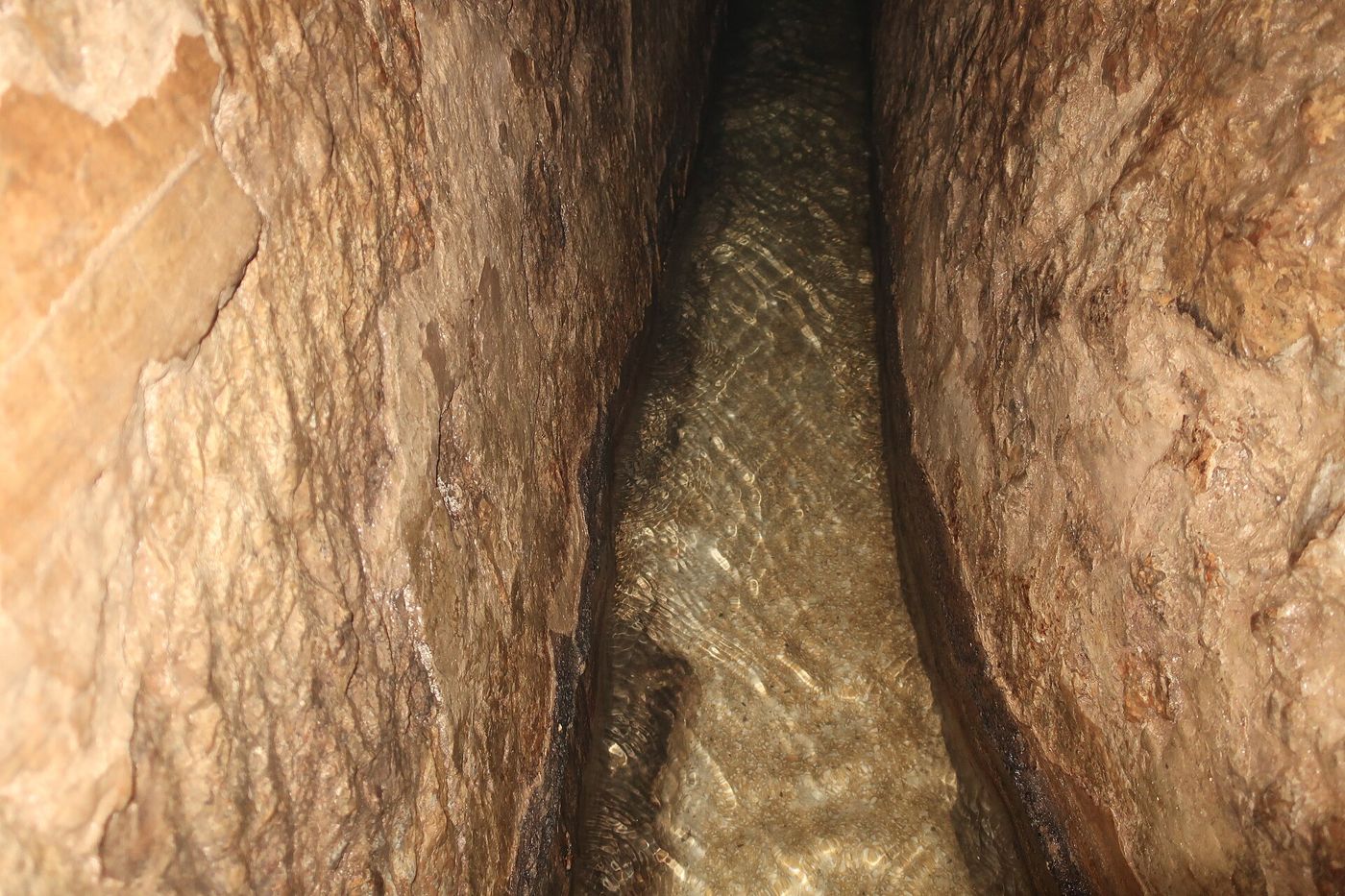
The date, and what kind of year 701 BC was. Verse 1 dates itself: "the fourteenth year of king Hezekiah," king of Judah — what is left of David's realm after the northern kingdom split away and was itself carried off by Assyria a generation before (722 BC). Hezekiah himself is both reformer — he reopened the temple and tore down the high places (2 Kings 18:1–6) 1 — and rebel: he withheld tribute, dug for water (Visual 4), and courted Egypt, the policy Isaiah spent chapters 28–31 denouncing. The enemy knows about the reform and about Egypt, and will fire both barrels. The year is 701 BC: Sennacherib's third campaign, his great western sweep to crush small states that had stopped paying tribute and looked to Egypt for backing [2, 11]. Assyria — centred on the Tigris in what is today northern Iraq — was the superpower of the age: the biblical world's first true military empire, professional at siege warfare, famous for deporting conquered peoples wholesale. Judah is a hill-country kingdom you could walk across in days. When verse 1 says Sennacherib "came up against all the defenced cities of Judah, and took them," the flat "and took them" covers the fall of Judah's fortified network — forty-six fortified places by Sennacherib's own annals' count [26, 25]. What is left is Jerusalem — and the enemy is at the gate.
Stop at the address. Verse 2 gives one, and it matters. The Rabshakeh — Sennacherib's chief spokesman; §5 unpacks the title — takes his stand "by the conduit of the upper pool in the highway of the fuller's field." A conduit is an open water channel; the upper pool, a reservoir; the fuller's field, where cloth-workers washed cloth. A public place by the waterworks, in earshot of the wall. Now reach back to chapter 7. When Isaiah was sent to meet Hezekiah's father, King Ahaz, at an earlier invasion scare, the LORD told him where to find him: "at the end of the conduit of the upper pool in the highway of the fuller's field" (7:3) 1. Word for word, the same address. In chapter 7 the king at that conduit refused to ask a sign and chose Assyria as his hired protector instead of trusting God. A generation later, the hired protector's army stands at that very conduit, demanding the city. INFERENCE — labelled, and strongly grounded in the identical wording of 7:3 and 36:2: the location is the book's great structural echo, placed so you cannot miss the comparison. Same conduit, same crisis, same choice. This time — watch him — the king will listen. Everything Hezekiah does in chapter 37 is the anti-Ahaz (§6).
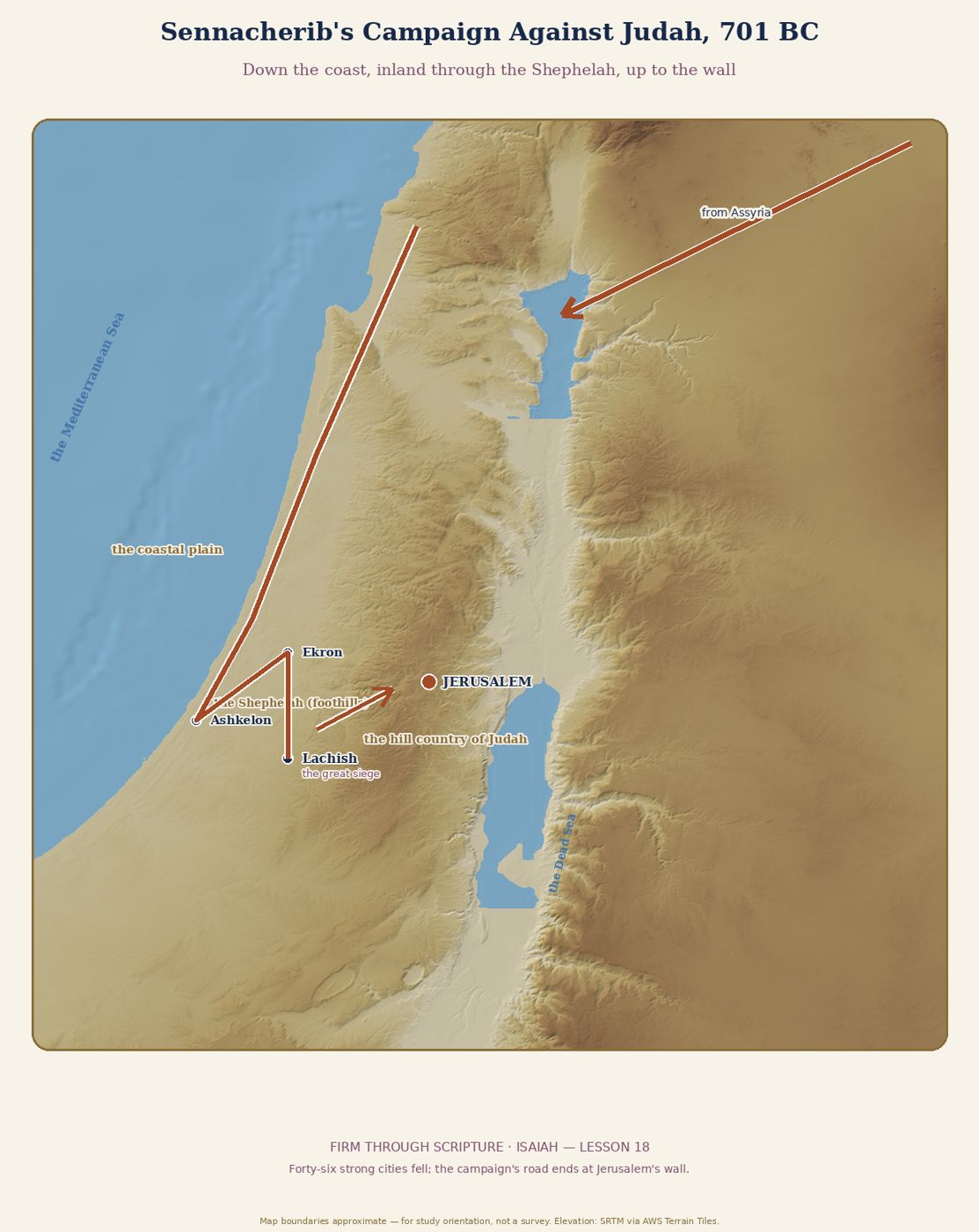
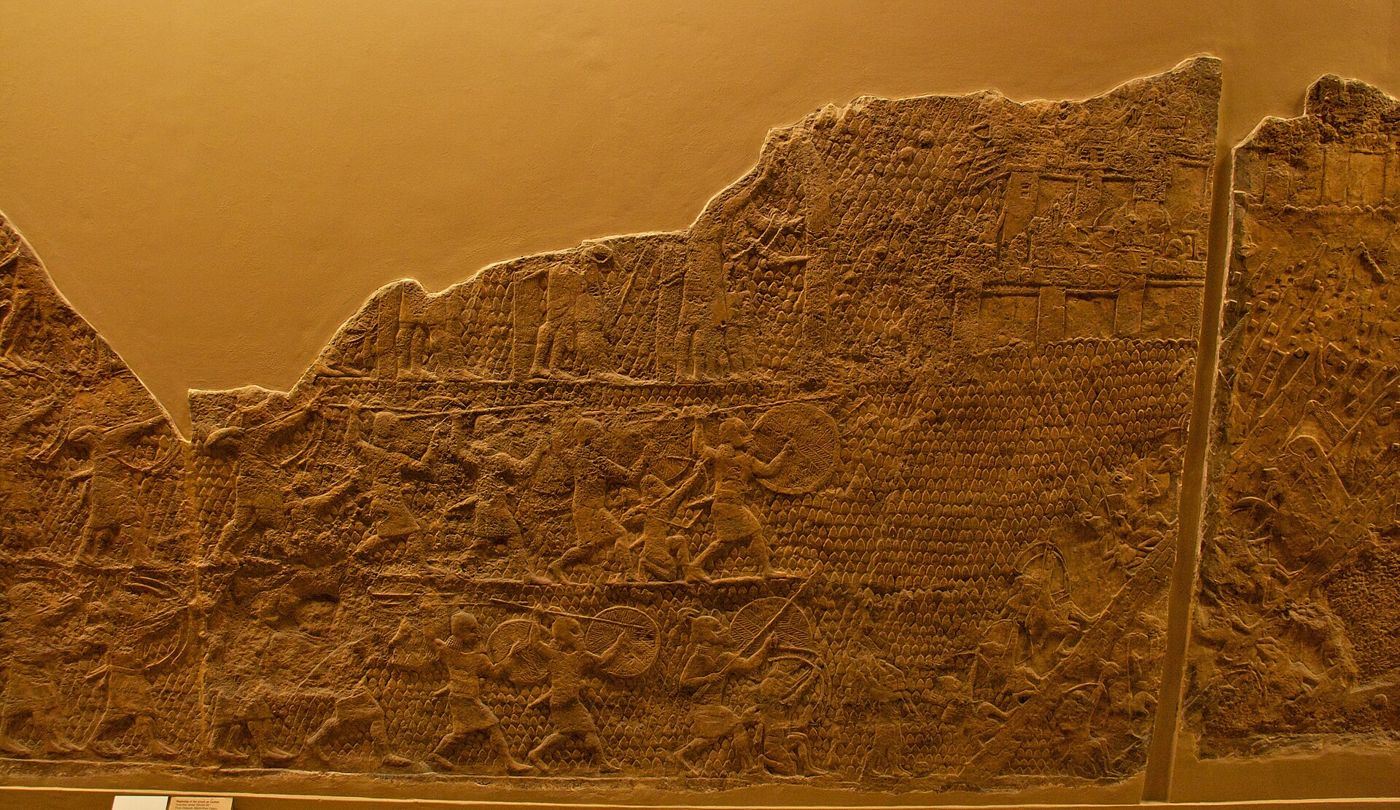
And the records — because this lesson will weigh them in the open. Unusually, we hold the other side's paperwork: Sennacherib's annals 26, his Lachish reliefs 27, and Hezekiah's waterworks, with the diggers' own inscription in the rock 28. Three records, three angles — Assyrian, biblical, and the spade's. §7 weighs them; §16 argues them in the open.
3. OBSERVE — O: what the text actually does
Before meaning comes observation. Most bad interpretation is not deep error; it is shallow reading — people answering a text they never actually looked at. So look:
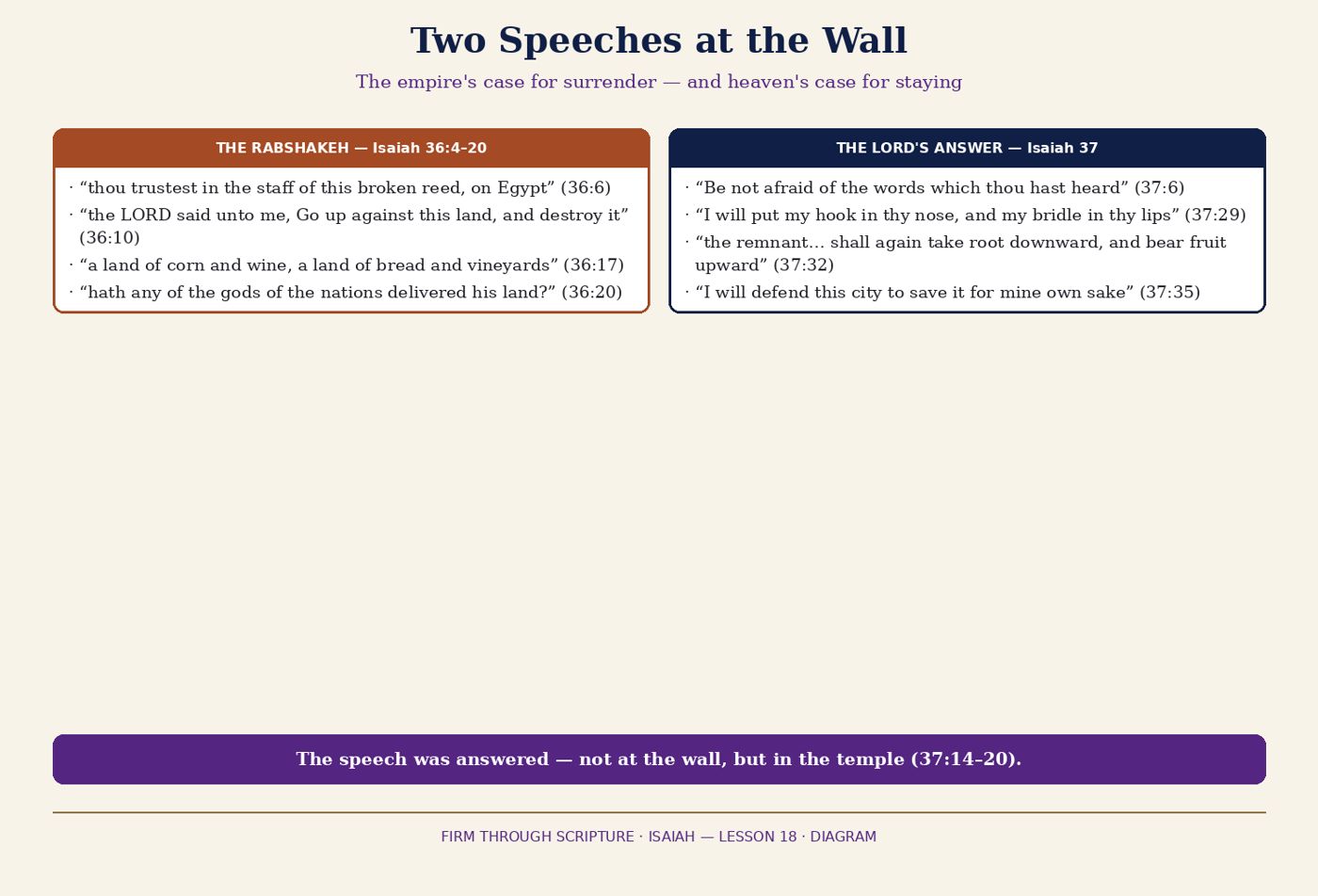
- The shape. Two chapters, built as speech → prayer → answer. Chapter 36 is almost entirely the enemy talking (vv. 4–20) against Judah's silence (v. 21). Chapter 37 is Judah's king talking to God (vv. 15–20) — and then God talking at length (vv. 22–35). The longest speech belongs, in the end, to the LORD: the empire gets one chapter of rhetoric; heaven's reply is longer, later, and last.
- Two confrontations, escalating media. First a voice at the wall (ch. 36) — public, aimed at the crowd. When that fails, a letter follows (37:9–13) — written, private, carried into the king's own hands. The speech he answers with commanded silence; the letter, by carrying it into the temple and unfolding it.
- The word "trust" is the battlefield. Track it: 36:4, 5, 6, 7, and again at 37:10. The whole confrontation is one question asked five ways: where does your trust rest, and can it bear weight? The Rabshakeh argues about trust before walls, because trust is the real siege.
- The promises are planted early and harvested late. Isaiah's first oracle is specific — blast, rumour, return, sword (37:6–7) — and the narrative ticks them off: rumour (37:8–9), return (37:37), sword (37:38, twenty years on). Paid in full, as spoken.
- Remnant, remnant. Hezekiah asks prayer "for the remnant that is left" (37:4); God's answer ends with the remnant rooted downward and fruiting upward (37:31–32) — a planting, not a residue. §5 gives the term its full treatment.
4. GENRE — N: note the genre (historical narrative — the prose hinge, with a parallel account)
After thirty-five chapters carried mostly by poetry, chapters 36–39 are prose historical narrative, told in the plain storyteller's Hebrew of the books of Kings. It is the hinge doing hinge-work: the book pauses its poetry to show you, with dates attached (36:1), that the God of the poems acts in the same world where kings keep annals and diggers cut tunnels. Narrative reads by its own rules:
- Narrative teaches by showing, then by speeches. In biblical narrative the speeches are where the meaning concentrates. Here the narrator gives you three set speeches and lets them collide: the Rabshakeh's (ch. 36), Hezekiah's prayer (37:15–20), and God's oracle (37:22–35). Read the passage as a debate staged inside a story, and you are reading it as it was built.
- Description is not prescription. Hezekiah's letter-spreading is a posture — threats carried to God rather than answered in kind — not a technique God is bound to honour; §13 will pass it through the Transfer Tests.
The parallel-text method, taught plainly. Because this passage stands nearly word-for-word in 2 Kings 18:13–19:37 and is retold in 2 Chronicles 32, it is this course's classroom for parallels. Work them like this:
- Lay them side by side and mark three columns: shared, only here, only there. The spine is shared — campaign, speech, prayer, oracle, night deliverance, the king's death. Three tellings agree on it.
- Ask what each writer's selection serves. Isaiah's telling omits the large tribute Hezekiah paid early in the crisis — 2 Kings 18:14–16 records three hundred talents of silver and thirty of gold, raised in part by stripping gold from the temple doors 1. Isaiah is not hiding it out of embarrassment — his book has been harsher on this generation than Kings is. His argument is about trust, so his telling keeps the trust-confrontation and cuts the diplomacy. Chronicles, retelling for a post-exile congregation that needs courage, expands the blasphemy and the joint prayer of Hezekiah and Isaiah, and names the moral (2 Chron. 32:22–23) 1. Each selection is a sermon decision, openly made.
- Let differences in detail-selection be differences; only contradictions in assertion are collisions. If one account says the king paid tribute and then was besieged anyway, and another begins at the siege, nothing has collided. The accounts differ in selection, not in substance. Learn that sentence here, where the evidence is gentle; it will serve you across the Gospels and Samuel–Kings–Chronicles.
5. TERMS — T: the words in the writer's mouth
Four terms carry this passage. Learn them in their own world and half the speech's fog burns off:
- Rabshakeh (rab-sha-KAY, as the KJV prints it) — not a name. A title: the king's chief cupbearer turned senior official — in practice his chief of staff and spokesman, speaking with the king's full authority, and very good at it [16, 11]. He travels with two colleagues of paired rank, the Tartan and the Rabsaris (2 Kings 18:17) 1. Picture the scene correctly: not a soldier shouting insults, but the empire's press secretary — a polished, multilingual, theologically literate professional whose product is the demolition of an enemy's will to resist. That is why his speech is answered by discernment, not volume.
- The remnant — Hebrew she'erit, what is left over after judgment has passed through 18. In Isaiah the word carries a whole theology: a people reduced to a stump, yet with life in it (6:13); a name given to Isaiah's own son — Shear-jashub, "a remnant shall return" (7:3) 1. Here it converges from doctrine into narrative: Hezekiah asks prayer "for the remnant that is left" (37:4), and God's answer plants the same word — root downward, fruit upward (37:31–32). Not a leftover to be pitied. A planting to be tended.
- "For mine own sake" (37:35) — the ground God Himself gives: His own name and His covenant promise to David. Isaiah's signature for how grace works — God acts for His name's sake where His people have no merit left to present (43:25; 48:11) [2, 4]. The AIM of the lesson sits on it.
- Trust — Hebrew batach, to lean your weight on something 19. Isaiah's diagnostic verb all book long (30:12; 31:1–3; 30:15) 1 becomes, in these chapters, the siege's real weapon and its real wall. The Rabshakeh's whole speech, in one line, is lean anywhere but there.
Method note — the word-study guardrail: a word means what its author uses it to mean, in its sentence, in its century. Every term above was settled by Isaiah's usage in Isaiah. That discipline keeps word studies honest.
TRANSLATION NOTE — "blast" and "rumour" (37:7)
Isaiah's first oracle promises: "I will send a blast upon him, and he shall hear a rumour, and return to his own land" (37:7). Underneath "blast" stands the Hebrew word ruach — the Bible's great elastic word: wind, breath, spirit [18, 19]. The KJV's "blast" keeps the weather in it: a sudden gust sent against the king. Some modern renderings choose "a spirit" — a discouragement sent into the king's own mind. Neither is dishonest; the word carries the range, and the context supports both: an outward blow and an inward unsettling. Watch the "rumour" half get paid inside the chapter: within two verses Sennacherib is reacting to a report — "he heard say concerning Tirhakah king of Ethiopia, Behold, he is come out to make war with thee" (37:9). And the deliverance itself comes in one night, unseen, like weather: "the angel of the LORD went forth" (37:36). Keep both halves: God sends what the king hears, and God sends what the king never sees coming.
6. ENTIRE CANON — E: where this passage sits in the whole story
No passage lives alone, and this one is a knot where the whole book — and half the Bible — crosses:
- Chapter 7, answered. The whole scene is chapter 7 replayed with the opposite king. Ahaz chose Assyria over trust and was told the hired helper would become a razor shaving Judah raw (7:20) 1. Here Assyria stands at the same spot playing razor, exactly as warned — and Hezekiah does the one thing his father would not: he takes the threat to the LORD and to the LORD's prophet.
- Chapter 10, quoted by the enemy. The Rabshakeh's masterstroke (36:10) is half of Isaiah's own doctrine: God called Assyria "the rod of mine anger" (10:5) 1. But the same chapter draws the line he leaves out — the axe does not boast over the hand that swings it (10:15), for Assyria "meaneth not so" (10:7): the empire intended plunder, not ministry, and God's use of a tool never makes the tool His prophet. The remnant theme gathered here (37:31–32) is the one Paul takes up in Romans 9–11 1.
- Chapters 20 and 28–31, vindicated. The "broken reed" of 36:6 is Isaiah's theology returned as a weapon: the prophet had pictured Egypt's help splintering into the leaning hand, and spent chapters 28–31 announcing the alliance would end in shame [1, 2]. The warnings came true — which is why the enemy can quote them. A word from God stops being whole, not God's, when a clever enemy borrows only half.
- The David promise, cashed. "For my servant David's sake" (37:35) reaches back to 2 Samuel 7 — God's covenant pledge of a lasting house for David 1. Three centuries on, with David's city down to its last walls, the pledge is the stated reason the city stands. And Hezekiah stands in the New Testament's genealogy of Jesus (Matt. 1:9–10) 1: 701 is one of the nights that kept that line alive.
7. THE MEANING — what the passage teaches
The Walk has established what the text says and where it sits. Now its payload, taught straight — and this passage's payload is a masterclass in how a threat is built, how prayer thinks, and why a city stood.
Anatomy of the speech: how a half-truth is built to break trust
Now the speech itself (36:4–20), in its layers — the finest piece of hostile rhetoric in the Old Testament, and it repays slow reading. The Rabshakeh asks to be quoted to the king (36:4) and builds his case like a man stacking stones [2, 11].
Layer one: your help is a wound. Egypt is "the staff of this broken reed… whereon if a man lean, it will go into his hand, and pierce it" (36:6). This is true — Isaiah's own teaching (§6). The speech opens with a fact Judah's court already knows, because an audience that has nodded once is halfway to nodding through the lie.
Layer two: your own reform proves God is against you. "Is it not he, whose high places and whose altars Hezekiah hath taken away, and said to Judah and to Jerusalem, Ye shall worship before this altar?" (36:7). Sit with the craftsmanship. The enemy has done research: he knows the reform centralised worship at the Jerusalem altar, and he reframes obedience as sacrilege — Hezekiah did not purify worship, he vandalised it, and the God whose shrines were demolished can hardly defend the vandal. It is the speech's most modern move: take the best thing the king ever did and redescribe it until it looks like the reason heaven has left [16, 11].
Layer three: arithmetic as contempt. The wager of two thousand horses (36:8) is not an offer but a measurement read aloud: Assyria can give away more cavalry than Judah can man.
Layer four: the masterstroke. "And am I now come up without the LORD against this land to destroy it? the LORD said unto me, Go up against this land, and destroy it" (36:10). Here the speech stops arguing about power and starts arguing about God — and it is, in the sentence this whole lesson turns on, half true. God had named Assyria His rod (10:5). What the claim omits is everything chapter 10 says next: the rod does not know it is held (10:7), the axe may not boast (10:15), and the instrument that overreaches comes under the same judgment it delivered (10:12, 24–27) 1. The most dangerous lies are not inventions. They are half the book — true doctrine with the boundary lines erased. You will meet this speech again in pulpits, in comment threads, and in your own head at 3 a.m.: God is against you, and here is the half of your Bible I brought to prove it.
Layer five: the audience swap. Judah's officials make their one request: speak in the Syrian language — Aramaic, the diplomatic tongue — "and speak not to us in the Jews' language, in the ears of the people that are on the wall" (36:11). The request tells you the officials know the speech's real target: not policy, morale. The Rabshakeh refuses — louder, in the Jews' language, to the men on the wall — and spells out siege horror in the crudest terms available (36:12: the besieged reduced to their own dung and piss; the KJV does not soften it, and neither will we — he wants the defenders tasting it) 16.
Layer six: the sales pitch. Then the voice goes warm: "make an agreement with me by a present, and come out to me: and eat ye every one of his vine, and every one of his fig tree… until I come and take you away to a land like your own land" (36:16–17). Every phrase is stolen property. Vine and fig tree is Israel's own picture of covenant peace (1 Kings 4:25; Micah 4:4) 1, and the destination is described in the cadence of the promised land itself — "a land of corn and wine, a land of bread and vineyards." Deportation, marketed in the language of Exodus. The empire offers to be your god: surrender, and I will give you Canaan — elsewhere, under me. It is the oldest pitch in the Bible in Assyrian dress: the good life is available, at the price of the covenant, and it will look almost exactly like the blessing.
Layer seven: the god-list. Finally, theology as scoreboard: "Hath any of the gods of the nations delivered his land out of the hand of the king of Assyria? Where are the gods of Hamath and Arpad?… have they delivered Samaria out of my hand?" (36:18–20). Hamath, Arpad, Sepharvaim, Samaria — a roll of the actually-fallen, city by city, god by god. As argument it has a hole in it: it assumes the LORD is a god of the same kind, one national mascot among many, ranked by recent results. As rhetoric it is devastating, because the evidence is real — those cities did fall, and Judah's own northern kingdom is on the list. The speech ends having made unbelief feel like the only literate position in the city. And the people's answer, commanded by their king in advance, is the passage's first great act of faith: "they held their peace, and answered him not a word" (36:21). Silence — not because there was nothing to say, but because this speech is not answered at the wall at all. It is answered somewhere else, by Someone else. Some speeches you out-wait, on orders, while the real answer is sought in the temple.
| The layer | Its weapon | Its half-truth |
|---|---|---|
| Egypt the reed (36:6) | Your help wounds you | Isaiah's own warning, quoted back |
| The reform (36:7) | God is against your king | A real reform, redescribed as vandalism |
| The horses (36:8) | Arithmetic | Real — and irrelevant to the real siege |
| "The LORD said unto me" (36:10) | Stolen theology | Chapter 10's rod, without chapter 10's limits |
| The sales pitch (36:16–17) | Deuteronomy-flavoured deportation | Covenant language, covenant removed |
| The god-list (36:18–20) | The scoreboard | Real falls — of gods that were no gods |
Torn clothes, sackcloth, and the first short answer
The delegation returns with rent clothes — torn garments, the ancient world's visible grammar of grief (36:22) — and chapter 37 opens with the king's response in three movements: he tears his own clothes, covers himself with sackcloth (rough mourning cloth worn against the skin), and goes into the house of the LORD (37:1) 16. Then he sends to Isaiah. Read the message, because its modesty is its theology: "This day is a day of trouble, and of rebuke, and of blasphemy: for the children are come to the birth, and there is not strength to bring forth" — a woman in labour with no strength left to deliver (37:3). And the request: "It may be the LORD thy God will hear the words of Rabshakeh… wherefore lift up thy prayer for the remnant that is left" (37:4). It may be. No presumption, no entitlement. A king who has courted Egypt and paid tribute and stripped temple doors (the parts Isaiah's telling leaves to Kings) does not come to the prophet with claims. He comes asking that prayer be lifted up — his word — for a remnant. This is what repentance sounds like when it has run out of strategies.
Isaiah's answer (37:6–7) is strikingly small next to the speech it answers — four short clauses against seventeen verses of rhetoric: "Be not afraid of the words which thou hast heard… I will send a blast upon him, and he shall hear a rumour, and return to his own land; and I will cause him to fall by the sword in his own land" (37:6–7). It does not argue with the speech point by point. It issues a prediction with moving parts — blast, rumour, return, sword, in his own land — and the narrative spends the rest of the chapter, and twenty years of history, ticking them off (§3). Prophecy here is not atmosphere; it is testable statements about a named man, made in advance (recall 34:16, from Lesson 17). The first moving part engages at once: Sennacherib hears the rumour of Tirhakah of Ethiopia coming out against him (37:8–9) — hears, exactly as promised. His response is to send the threat again, this time in writing. Which brings us to the letter, and to the finest prayer in the book.
Pray the document: the letter, and the prayer that thinks
The written ultimatum (37:10–13) is the speech distilled and worsened: "Let not thy God, in whom thou trustest, deceive thee, saying, Jerusalem shall not be given into the hand of the king of Assyria" (37:10) — and the god-list again. What Hezekiah does next is one of the great gestures of biblical faith: "Hezekiah received the letter from the hand of the messengers, and read it: and Hezekiah went up unto the house of the LORD, and spread it before the LORD" (37:14). He read it first — no denial, no unopened envelope. Then he carried the document into God's house, unfolded it in front of God, and prayed over the paperwork. If your threats arrive on paper — the letter, the bill, the diagnosis printout — this verse is the book's model of prayer under paper threats: spread it, in full, before the LORD — and then think. What follows is not a wail. Hezekiah's prayer (37:15–20) is the most carefully reasoned prayer in Isaiah, and its logic is the lesson's centre of gravity [2, 4].
First, it addresses God by who He is, not by how the crisis feels. "O LORD of hosts, God of Israel, that dwellest between the cherubims, thou art the God, even thou only, of all the kingdoms of the earth: thou hast made heaven and earth" (37:16). Dwellest between the cherubims — enthroned above the ark in the temple he is standing in. Of all the kingdoms — including Assyria's. Maker of heaven and earth — a category the god-list cannot touch. Before one petition is uttered, the first sentence has answered the Rabshakeh's core assumption: this God is not Israel's mascot ranked against Nineveh's. He is the Maker, and all the kingdoms are His.
Second, it concedes the enemy's evidence — completely. "Of a truth, LORD, the kings of Assyria have laid waste all the nations… and have cast their gods into the fire" (37:17–18). Hezekiah does not spin the scoreboard; he agrees with it, in God's presence. This is a kind of prayer most of us must be taught: bringing God the worst facts unedited, unafraid the facts will change Him.
Third, it refuses the enemy's inference, on theological grounds. "For they were no gods, but the work of men's hands, wood and stone: therefore they have destroyed them" (37:19). Watch the logic lock shut. The Rabshakeh argued: Assyria burned their gods; therefore its king outranks every god; therefore yours will burn too. Hezekiah grants the premise and detonates the conclusion: what burned was wood and stone — manufactured objects — and furniture burning proves nothing about the God who was never manufactured. Prayer, in this passage, is not the suspension of reasoning. It is reasoning at full strength, in the right presence, starting from who God is.
Fourth, the ask aims past Jerusalem. "Now therefore, O LORD our God, save us from his hand, that all the kingdoms of the earth may know that thou art the LORD, even thou only" (37:20). The petition's goal is not, finally, our survival — it is God's reputation among the nations: that the kingdoms, Assyria's included, would learn the difference between the LORD and the wood-and-stone list. A frightened king, in a besieged city, prays a missionary prayer: fear, when faith is real, enlarges the ask until God's glory — not our comfort — is its object. And when God answers, He names the same reason: "for mine own sake" (§5). Hezekiah asked for exactly what God was minded to do, for exactly the reason God gives. That alignment is not a technique. It is what prayer is when it has first spread the letter and told the truth.
The answer: scorn, cross-examination, a hook — and a remnant planting roots
God's reply comes through Isaiah (37:21) and is the longest speech in the passage. The text is careful to note why it comes — because, as the verse says to Hezekiah, thou hast prayed to me against Sennacherib. Prayer is named, in the text itself, as the hinge the answer swings on. Then the oracle, in movements [2, 12]:
Zion speaks first — with contempt. "The virgin the daughter of Zion hath despised thee, and laughed thee to scorn" (37:22). The city that would not answer a word at the wall now answers with a shaken head — the siege's whole reversal in one gesture. Virgin daughter of Zion: the city untouched and unbreached, answering the army that advertised her violation. The scorn is God's, spoken for her, because in her silence she had left the answering to Him.
Then the cross-examination. "Whom hast thou reproached and blasphemed? and against whom hast thou exalted thy voice, and lifted up thine eyes on high? even against the Holy One of Israel" (37:23). All that rhetoric about reeds and horses and god-lists — heaven files it under one heading: blasphemy against the Holy One. The oracle reads the king's boasts back to him (37:24–25) and issues the passage's most quietly terrifying line: "Hast thou not heard long ago, how I have done it; and of ancient times, that I have formed it?… I have brought it to pass" (37:26). The empire's century of victories, re-read as a lease God granted and has now revoked. Then the sentence, following chapter 10's script exactly: "But I know thy abode, and thy going out, and thy coming in, and thy rage against me" (37:28) — perfect knowledge, itemised like a surveillance report — "I will put my hook in thy nose, and my bridle in thy lips, and I will turn thee back by the way by which thou camest" (37:29).
Stop on that image, because it is chosen with malice aforethought. Assyrian kings led captives by rings and hooks through the lip and nose; their own palace art displays an empire that processed human beings like livestock [27, 33]. God fits the inventor's signature instrument to the inventor: the beast-handler will be beast-led home. Poetic justice at its most precise — the sinner's own picture, turned.
Then — tenderness, and a sign. For Hezekiah, a sign (37:30): this year and next, Judah will eat what grows of itself — self-sown harvests from a ravaged land that cannot be worked normally — and in the third year, sow and reap as usual. The sign is not a firework; it is an agricultural calendar — a promise that there will be a third year, and they will be in it. And braided into it, the remnant promise at full strength: "the remnant that escapeth of the house of Judah shall again take root downward, and bear fruit upward… the zeal of the LORD of hosts shall do this" (37:31–32). Roots before fruit, downward before upward, and the doer named: not Judah's pluck, God's zeal — His burning devotion to His own purpose.
Finally, the pledge — and its stated ground. "He shall not come into this city, nor shoot an arrow there… For I will defend this city to save it for mine own sake, and for my servant David's sake" (37:33–35). Measure the completeness: not merely the city will not fall — not an arrow shot into it, not a siege-work begun. And the ground clause (§5) is the passage's doctrinal centre: for mine own sake, and for David's sake. Not for Hezekiah's reform's sake, though the reform was real; not for the remnant's worthiness, though it prayed beautifully. God's name and God's covenant — the two things Assyria had publicly questioned — are the stated reasons the city stands.
The morning after — and the temple where the god could not save his king
"Then the angel of the LORD went forth, and smote in the camp of the Assyrians a hundred and fourscore and five thousand" (37:36). Teach the verse plainly: the text says what it says — 185,000 dead in one night by the direct act of God's messenger, no human battle described because there was none, exactly the shape the "blast" of 37:7 promised (§5). Sennacherib "departed, and went and returned, and dwelt at Nineveh" (37:37) — by the way that he came, by the same he returned.
Two honest notes belong here, made in the open rather than left for a sceptic. First, the wider memory. Herodotus, writing from Egyptian sources, tells of Sennacherib's army crippled in a night — in his version, field-mice gnawed the bowstrings, quivers, and shield-straps, leaving the army weaponless by morning (Histories 2.141) 32. Label it carefully: a foreign echo, not proof. Herodotus sets his tale in Egypt and garbles details as he often does; mice are not an angel. What the echo shows is narrower and still interesting: the memory that something catastrophic and unexplained happened to this king's army in a night survived outside Israel. An echo is evidence that a sound was made. It is not a recording of the sound; §16 weighs it at exactly that weight. Second, the death is twenty years later. Sennacherib was murdered in 681 BC — a generation after the siege — by his own sons, in his own god's temple, and succeeded after a struggle by another son, Esarhaddon [30, 25]. Isaiah's narrative telescopes those twenty years into its final verse, not to deceive you but because the oracle of 37:7 had bundled the events — blast, rumour, return, sword — and the narrator closes the file when the last item lands. Ancient narrative compresses like this constantly; §4 taught you to see the seam. And the seam's content preaches: the king who listed gods that could not save their lands ends his life at prayer, murdered mid-worship by his own sons, while his god — wood and stone, as the prayer had filed him — does nothing. The god-list receives its final reply not in a debate but in a biography.
Three records, three angles: this lesson's worked example in weighing evidence
Record one: Sennacherib's own annals. On the Taylor Prism — the king's official account of this campaign, baked in clay — Sennacherib boasts that he shut Hezekiah up in Jerusalem "like a bird in a cage," lists the cities taken and the tribute received, and describes the siege works thrown up against the city [26, 25]. FACT (the inscription's text, checkable in translation): the annals never claim Jerusalem was taken — never claim Hezekiah surrendered, was deposed, or submitted, the standard trophies an Assyrian annalist always records when he has them, in a genre built on total advertisement of victory. Royal annals are propaganda by design; defeats are absent from the genre. Which is why the annalist's silence at exactly this point is so loud. INFERENCE — labelled: the silence argues that Jerusalem did not fall, because a king who could have written "I took it," in a text written to say precisely such things, would have written it.
Record two: Isaiah's telling. It omits the tribute entirely (2 Kings 18:14–16 carries it) 1 — selection in service of an argument about trust (§4). FACT: the omission exists, in a book that is not protecting Hezekiah. INFERENCE: the annalist omits his failure exactly where the prophet omits the tribute; each omission is visible because the other records exist. That is what a surviving evidence set looks like — complementary, checkable, each one's spin corrected by the others' existence.
Record three: the ground itself. The Lachish reliefs show you, in the enemy's own chosen images, what "took them" meant — ramp, rams, deportation columns [27, 33]. Hezekiah's tunnel shows the siege preparations from inside 28. Nobody has found an Assyrian monument celebrating the capture of Jerusalem, because there is not one. Three records, three angles, one event — and the reading requiring the least special pleading is the Bible's own: the cities fell, the tribute was paid, the siege came anyway, the city did not fall, the army broke in a night, and the king went home to die by the sword in his own land, on a twenty-year fuse. Weighing evidence like this — FACT sorted from INFERENCE, no harmonisation faked, no panic permitted — is a skill to keep for every hard page after this one.
The Christ Thread
No apostle quotes Isaiah 36–37 as a direct prophecy of Jesus, and this study will not invent one — FACT, and the restraint matters. What the canon shows is the pattern this deliverance belongs to, fulfilled and surpassed in Christ. The city preserved "for my servant David's sake" is preserved so that David's line — Hezekiah's own line (Matt. 1:9–10) — reaches David's greater Son 1. The Holy One of Israel is the title Jesus carries in the New Testament's own mouth: "the Holy One of God" (Mark 1:24; John 6:69) 1. And the shape of the deliverance — God defending the helpless for His own name's sake, answering a blasphemer with a night no one watched — is the shape of the cross and the empty tomb. POSITION — the church's historic pattern-reading, stated at that strength: not a prediction hidden in the verses, but the same God keeping the same kind of promise, in the same city, until the promise arrives in person.
The Long View — what the church has believed
The church has read this narrative with a steady hand. Calvin lingers where this lesson lingers: on Hezekiah's prayer as faith's model under threat, and on the ground of the answer — "for mine own sake," the believer's surest plea precisely because it does not depend on the deserving of the one who prays 36. Where the centuries have argued is over §16's matters: the mechanics of the night of 37:36, and how the annals' tribute and Isaiah's silence fit together. The centre has held without serious division.
8. THE AIM SENTENCE — X: eXplain the intent
Everything observed now compresses into one sentence — the author's intended meaning, stated before any application is allowed near it:
Isaiah sets the empire's finest speech — true facts, stolen theology, and a god-list of the fallen — against a king who answers it with silence, sackcloth, and a prayer that concedes the facts and refuses the conclusion, so that God Himself can answer: defending His city, uprooting the boaster, and planting His remnant — not for Judah's worthiness, but for His own sake and for David's.
If a sermon or devotional uses Isaiah 36–37 to say something that cannot be traced back to that sentence, it is not this passage talking.
9. SAY IT BACK
Close the book and say the AIM sentence from section 8 in your own words — out loud, or written, without looking. Then say, in one more sentence, what it asks of you this week.
10. THE MISREAD — the guardrail, with verdicts
Three live misuses of this passage. Each gets a fair hearing, the evidence, and a verdict.
Misread 1: "The Rabshakeh is just a villain doing villain talk — bluster to skip on the way to the miracle." Why it sounds right: he is the enemy, he does lose, and his speech is long. The evidence: the narrative gives his speech more space than God's first oracle gets, and builds it precisely (§7) — climaxing in the half-Isaianic claim of 36:10, half of the book's rod-doctrine (ch. 10) with its boundary lines (10:7, 12, 15) erased. Judah's answer is not a counter-speech: commanded silence (36:21), a message to the prophet (37:2–4), and a prayer answering the speech's logic, not its volume (37:17–19). The passage treats the speech as the most dangerous weapon on the field, because it is aimed at trust and built substantially out of truths. Verdict: an enemy who can quote your own theology is answered by discernment, not by volume — and never by being skimmed. If you cannot state the Rabshakeh's argument at full strength, you have not heard what Hezekiah heard.
Misread 2: "The lesson here is the 185,000 — the miracle is the point; everything else is the run-up." Why it sounds right: verse 36 is the passage's most spectacular sentence, and body counts photograph well. The evidence: count the passage's own proportions. The miracle receives exactly one verse (37:36), with no mechanism, no spectacle, no human witness even awake for it. The prayer receives six verses of close argument (37:15–20); God's oracle, fourteen (37:22–35); and both converge on the same stated centre: God's name — "that all the kingdoms of the earth may know that thou art the LORD" (37:20); "for mine own sake, and for my servant David's sake" (37:35). The 185,000 are the prayer's answer, not its subject. A reading that ends at the body count has mistaken the exclamation mark for the sentence. Verdict: the centre is the prayer's logic and 37:35's "for mine own sake." The miracle is the answer, not the subject.
Misread 3: "Sennacherib's annals disprove the story — or, from the other side, pagan records are propaganda and can be ignored." Why it sounds right: both errors feed on a real fact — the records genuinely do not say the same things. The prism boasts of a caged king and received tribute; Isaiah never mentions tribute. It feels like somebody must be lying. The evidence: §7's three-records exercise. The annals are a victory genre in which defeats are absent by convention — yet even inside it, the capture of Jerusalem, the campaign's whole object, is never claimed, while cage, tribute, and siege-works are (FACT, from the inscription [26, 25]). Isaiah omits a tribute his book had every theological reason to keep if shame were his argument — an omission of selection, exposed precisely because Kings preserves it. And the dirt agrees: Lachish fell as the reliefs advertise [27, 33]; the tunnel was dug 28; no Assyrian monument celebrates Jerusalem taken. Verdict: three contemporary records with complementary silences are how ancient history actually works — weigh them. The bird-in-a-cage boast never claims the city, and the Bible never claims the tribute wasn't paid before the speech at the wall. Honest weighing; no panic, no false harmonisation.
11. FROM WORD TO WALK
A reflection page — the lesson is not finished until the passage has had its say with you.
Stand on the wall for a moment, in the commanded silence. You are not allowed to answer. Below you, a professional is dismantling, one true fact at a time, every reason you had for holding on — and the false part is woven so tightly into the true that you can feel the seam only if someone has taught your fingers. The king's order is not win the argument — it is: hold your peace, and let the argument be carried where it can be answered properly. There are seasons where faithfulness looks less like a rebuttal and more like a refusal to debate on the wall, at the enemy's volume, while the real case is made on your knees in the other room.
And then stand in the temple, with the letter in your hands. Hezekiah did the two things our frightened hearts find hardest to do together: he read the whole document, and he prayed the whole document. We tend to pick one — either re-reading the bad news until it is the only voice in the house, or trying to pray without reading, asking God to bless a situation we will not honestly describe to Him. The king spread the paper out flat in God's presence, then prayed a prayer that could afford to say of a truth about the worst of it — because the God he addressed had been named, first, as Maker of heaven and earth, God of all the kingdoms. The facts did not shrink when he conceded them; they were finally standing next to something bigger.
| The threat arrives as… | Hezekiah's move is… |
|---|---|
| A speech built to break trust (ch. 36) | Commanded silence; the case carried to the prophet |
| A letter meant to be re-read in fear (37:9–14) | Read once, honestly — then spread before the LORD |
| Facts that are genuinely bad (37:17–18) | Concede them in prayer — and refuse their conclusion |
LORD of hosts, God of Israel, enthroned between the cherubims — You are God, even You only, of all the kingdoms of the earth; You have made heaven and earth. Of a truth, the threats against me are not imaginary. But they are not the whole truth, and You are not one god among many, ranked by recent results. Here is the letter; I have read it, and now I am spreading it before You instead of sleeping beside it. Save — for Your own sake — that the kingdoms around me may know that You are the LORD, even You only. In Jesus' name, amen.
12. FOR DISCUSSION — OR FOR YOUR JOURNAL
With a group, work these aloud. Alone, they're yours — answer them in your journal or in prayer; they lose nothing in the quiet.
- Which layer of the Rabshakeh's speech would have hit you hardest on the wall — the broken reed, the reform turned against the king, the two thousand horses, "the LORD said unto me," or the land-like-your-own offer? Why that one?
- Hezekiah's prayer concedes the enemy's facts and refuses the enemy's conclusion (37:17–19). Take one real threat in your life: what are its facts, stated honestly — and what is the conclusion it wants you to draw that does not follow?
- The people answer the speech with commanded silence (36:21); the king answers the letter by spreading it before the LORD (37:14). When is silence before an attack an act of faith rather than avoidance — and how do you tell the difference live?
- God defends the city "for mine own sake, and for my servant David's sake" (37:35) — not for its worthiness. How does that ground change how you pray when your own record is part of the problem?
13. THE WALK-OUT — T: Transfer to today
Meaning is settled. Now — and only now — application, and it must cross the bridge honestly. Run the five Transfer Tests on this passage:
- Same covenant? Hezekiah stands under the Davidic and Mosaic covenants, in the theocracy's capital, with a prophet at hand and a national promise over one city. We stand under the new covenant, in Christ, with no promise that any earthly city of ours is exempt from siege. What crosses is the God of the covenants and His ways with praying people — not a territorial guarantee. Anyone quoting 37:35 as a pledge to defend a modern capital fails here.
- Same audience? The oracles address a king and a besieged remnant-nation; the prayer's logic and the speech's anatomy address every later reader facing a trust-breaking threat. The modelled responses — silence under orders, prayer over paper, discernment of half-truth — cross. The specific promises (not an arrow; the king dead by the sword) were spoken to that siege and are not re-issued.
- Same genre rules? Historical narrative shows before it commands. Hezekiah's actions are a pattern to weigh, not a ritual to copy: what transfers from the letter-spreading is the posture — threats carried whole into God's presence — not the choreography.
- Repeated or rooted? Pleading God's name and glory as the ground of the ask (37:16, 20) is rooted across the canon — Moses pleads God's reputation (Ex. 32:12); Daniel pleads "for the Lord's sake" (Dan. 9:17–19) 1. These cross.
- Ten verses either side? Every practice below is drawn from these two chapters read whole. Nothing hangs on a torn-out line — least of all 37:36, which this study has deliberately refused to make the centre.
What crosses — and lands:
- God defends for His own sake — and that is the believer's firmest ground in prayer. Before this passage asks anything of you, it announces who God is: the Maker enthroned over all kingdoms, who binds His own name to His people's defence and keeps covenant with David's house (37:16, 35). Your applications stand on that announcement, not on your siege performance.
- Half-truth is answered by discernment, not volume. The speech that quotes your theology back with its boundaries erased is carried to God, its facts sorted from its conclusions, its claims measured against the whole book — chapter 10's other half included.
- Prayer concedes facts and refuses false conclusions. "Of a truth… for they were no gods" (37:17–19) is a transferable logic for every threat: total honesty about the evidence, total refusal of the interpretation smuggled in with it.
Practices — what the gate lets through, made concrete this week:
- Spread the letter. Take the one document, message, or headline currently doing the Rabshakeh's work on your trust. Read it once, honestly, in full. Then lay it on the table, open Isaiah 37, and pray Hezekiah's logic over it aloud: God's titles first; facts conceded; the false conclusion refused by name; the ask aimed at God's name.
- Split a half-truth. Write down the most God-quoting discouragement in your head or your feed; beside it, the half of the text it omitted — as chapter 10 stands beside 36:10.
- Practise the commanded silence. Identify one arena this week — a thread, a rumour, an argument — where answering in kind would only hold the debate on the wall. Decline it deliberately, and take the same matter to prayer instead.
- Pray for the remnant by name. Name the reduced people of God you actually know — the small church, the battered family, the few still standing — and pray 37:31–32 over them: roots downward, fruit upward, on the zeal of the LORD of hosts.
What does not cross: claiming 701's deliverance as a standing promise for any modern city or personal crisis on demand; treating letter-spreading as a technique that obliges God to produce a morning-after miracle; reading 37:36 as a template for what God owes your enemies; using "for mine own sake" as permission to stop praying honestly — God's name is not a lever, but the reason prayer aims past your comfort to His glory (37:20).
Praise Him
Maker of heaven and earth, God of all the kingdoms — even the kingdom at the gate — we praise You: no speech, however well-built, is the last word in a city where prayer is being made. You defended for Your own sake; You planted the remnant and did the rooting Yourself; You turned the hook-maker home by the way he came. Thou art the LORD, even thou only. Amen.
14. THE RECAP CARD — this study on one page
Print it. Keep it where you'll see it this week.
- The passage: Isaiah 36:1–37:38 — Sennacherib at the gate: the speech, the silence, the letter spread before the LORD, the answer, and the morning after.
- Say It Plain: Assyria's spokesman preaches surrender out of half of Isaiah's own theology; Hezekiah answers with silence, sackcloth, and a prayer that concedes the facts and refuses the conclusion; God defends the city for His own sake and plants the remnant root-downward.
- The AIM: Isaiah sets the empire's finest speech against a king who answers with silence, sackcloth, and truth-telling prayer, so that God Himself can answer — defending His city and planting His remnant, not for Judah's worthiness, but for His own sake and for David's.
- Key terms: Rabshakeh — a title, not a name: the king's chief spokesman · the remnant — what judgment leaves, God plants · "for mine own sake" — God's stated ground: His name and His covenant
- The Misread, in one line: the speech is half-truth, answered by discernment not volume · the 185,000 are the prayer's answer, not its subject · the annals and the Bible are three-angle evidence to weigh, not a scandal to panic over.
- Memory verse: "For I will defend this city to save it for mine own sake, and for my servant David's sake." — Isaiah 37:35
- This week's practice: spread the letter — one real threat-document, read honestly, then prayed over with Hezekiah's logic.
15. CHECK YOURSELF — five questions
Answer from the study, not from instinct. (Answers live in the Teacher Edition.)
- In your own words: what is the AIM of Isaiah 36–37?
- Why does the conduit of the upper pool matter — what happened at the same spot a generation earlier, and what is different this time?
- State the masterstroke of the speech (36:10) — and the two halves of chapter 10 that expose exactly what it leaves out.
- Walk through the four movements of Hezekiah's prayer (37:15–20). In the third movement, what does he concede, and what does he refuse — and on what grounds?
- The Taylor Prism calls Hezekiah a bird in a cage, yet never claims Jerusalem was taken. Why does that silence matter, and how should it be weighed beside Isaiah's omission of the tribute?
16. GO DEEPER
Optional — for readers who want the machinery. The lesson is complete without it.
From the Sources — The king's own clay
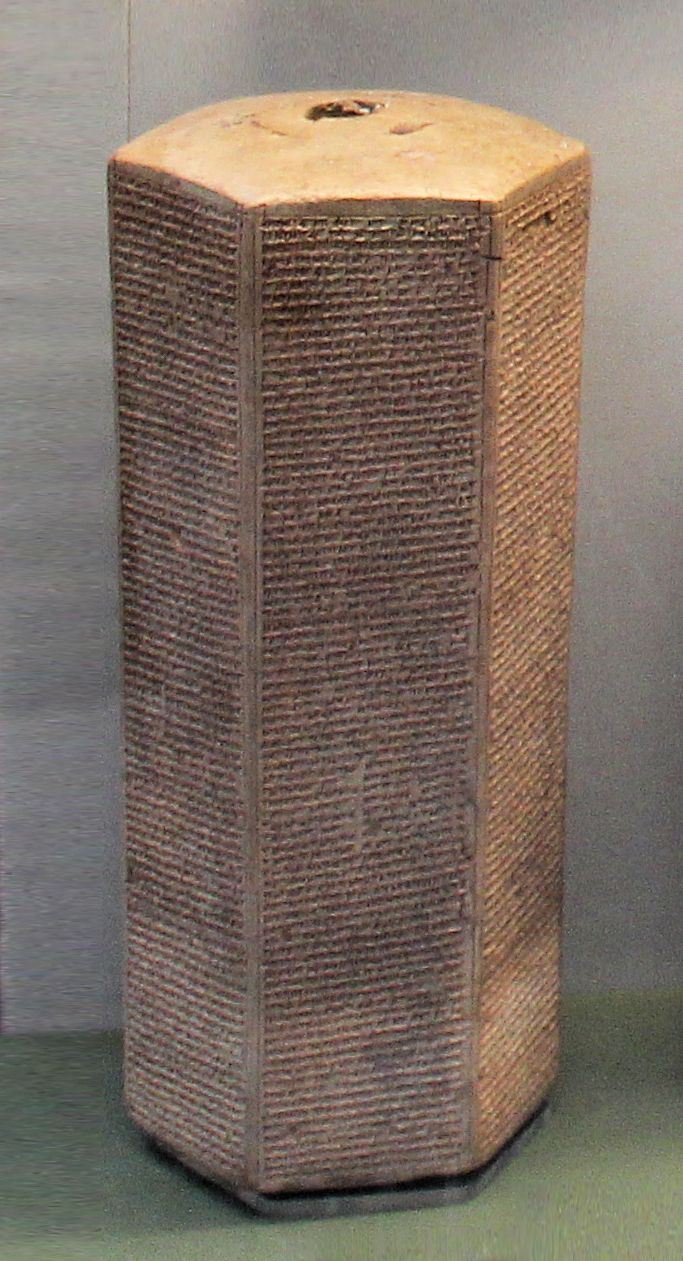
Sennacherib's annals survive in multiple exemplars — clay prisms inscribed for the palace archives, the Taylor Prism (British Museum) the most famous [26, 25]. Read what the prism actually does with Jerusalem: it lists Hezekiah among the rebels, records the taking of his cities, the deportations, the heavy tribute, and the shutting-up of the king in his capital "like a bird in a cage" — and there the Jerusalem story stops 26. FACT: no taking of the city, no capture or deposition of its king — the standard closing trophies of this genre when a capital falls (compare the same king's full celebration of Lachish [26, 27]). INFERENCE: in a document whose purpose is to maximise the king's victories, the absence of the campaign's central victory is evidence the victory was not his to record. A friendly witness whose boasting runs out at Jerusalem's wall is the most valuable kind of outside evidence, because it costs the witness something to give it. The ground agrees: Ussishkin's excavation matched the Lachish reliefs' siege ramp stone by stone — the only Assyrian siege ramp ever excavated — sharpening by contrast the one city with no ramp, no relief, and no fall to carve [33, 27].
The Honest Argument — silences, mice, and twenty years
Three disputes gather around this passage, each stated at full strength. First, the tribute and the two tellings. Critics argue that Kings' tribute account (2 Kings 18:14–16) and Isaiah's silence cannot both stand. The harmonising answer sometimes given — that the tribute belongs to a separate, earlier campaign — multiplies campaigns beyond what the records support and should not be leaned on. This lesson's position is plainer: both records are selective by design, selection is not falsehood, and the selections cross-check each other where they overlap. DISPUTED at the level of composition history; POSITION — this course's reading: complementary selection is the account that does least violence to all three records at once. Second, the night of the 185,000. The text ascribes the deaths to the angel of the LORD (37:36) — the church's reading, held as POSITION on the text's testimony. Herodotus's mice (2.141) — bowstrings gnawed in a night 32 — are read by some scholars as folk-memory of plague, by others as an unrelated Egyptian tale. FACT: Herodotus's story exists, is set in Egypt, and does not name Jerusalem; INFERENCE — at most, an echo of a remembered overnight catastrophe; it neither proves the angel nor disproves him, and this study uses it as neither. Third, the twenty-year fuse. Between siege (701 BC) and murder (681 BC) lies a generation, telescoped into the narrator's final verse. The Babylonian chronicle tradition confirms the murder and Esarhaddon's contested succession independently [30, 25] — FACT as to the death; and §4's genre rules cover the compression: the oracle bundled the events (37:7), and the narrator closed the file when the bundle completed. It said in his own land, by the sword. Twenty years later, in his own land, by the sword, mid-worship: the file closes itself.
The Word Underneath — ruach, sent
§5's Translation Note followed ruach (wind / breath / spirit) into 37:7's "blast." Trace its errands and a small theology of how God fights emerges: the blast is sent (37:7); its audible form is a rumour the king hears (37:7, 9); and the night itself is a sending — "the angel of the LORD went forth" (37:36) 1. Wind sent, word heard, messenger gone forth — answered, on the human side, by one act: prayer "lifted up" (37:4). FACT (the passage's verbal pattern): every divine action in the deliverance travels by breath, word, or messenger — nothing travels by Judah's arm. INFERENCE: that is why this contest was always a contest of speeches, and why the side that stopped talking and started praying understood the war.
Go Read
- Sennacherib's Annals (the Taylor Prism) 26 — the enemy's account, in translation; watch where the boasting stops.
- Ussishkin, The Conquest of Lachish by Sennacherib 33 — the excavation that matched the reliefs 27 stone by stone.
- The Siloam Inscription 28 — six lines of Hebrew from inside Hezekiah's tunnel: the diggers' own voice.
- Oswalt 2 and Smith 11 on Isaiah 1–39 — the speech, the prayer, and the records, in full.
17. SOURCES & REFERENCES
Numbered citations in this lesson key to this list — the course standard: every sourced claim carries its number, and every number can be checked.
-
The KJV text itself — Holy Bible, King James Version (eBible.org KJV, 1769 text). Scripture quotations are from the King James Version (KJV), which is in the public domain in the United States; the full passage is always assigned as reading. Cross-references within Scripture cite this number.
-
Oswalt, The Book of Isaiah, Chapters 1–39 (NICOT) — John N. Oswalt (Eerdmans). The leading evangelical commentary on the first half; defends essential unity of authorship and reads the book as a finished theological whole. Detailed notes on the Assyrian-period history (Ahaz, Hezekiah, Sennacherib).
-
Motyer, The Prophecy of Isaiah — J. Alec Motyer (IVP). A one-volume commentary by an evangelical scholar who argues the whole book breathes the mind of the eighth-century prophet; especially strong on the book's structure, its repeated refrains, and the Servant.
-
Smith, Isaiah 1–39 and Isaiah 40–66 (New American Commentary) — Gary V. Smith (B&H). Evangelical commentary with strong historical notes (the Assyrian and Babylonian records) and an even-handed survey of the authorship debate.
-
Seitz, Isaiah 1–39 (Interpretation) — Christopher R. Seitz (John Knox). A theological reading alert to the book's editorial shaping and to Isaiah's place in the canon; useful on Zion theology and on chapters 36–39 as the hinge.
-
Walton, Matthews & Chavalas, The IVP Bible Background Commentary: Old Testament — John H. Walton, Victor H. Matthews, Mark W. Chavalas (IVP). Verse-by-verse ancient Near Eastern background: Assyrian siege practice, Babylonian religion, treaty and coronation customs, geography.
-
VanGemeren (ed.), New International Dictionary of Old Testament Theology and Exegesis (NIDOTTE) — Willem A. VanGemeren (Zondervan). Theological word studies with semantic-range discipline for the Hebrew terms.
-
Brown, Driver & Briggs, Hebrew and English Lexicon of the Old Testament (BDB) — The standard older Hebrew lexicon; word senses and usage ranges for the Terms sections.
-
Pritchard (ed.), Ancient Near Eastern Texts Relating to the Old Testament (ANET) — James B. Pritchard (Princeton). Translations of the primary records: Sennacherib's annals, the Babylonian Chronicle, the Cyrus Cylinder, treaty and hymn texts.
-
Sennacherib's Annals (the Taylor Prism) — The Assyrian king's own account of his 701 BC campaign, including the siege of Jerusalem and Hezekiah "like a bird in a cage" (Luckenbill, The Annals of Sennacherib; prism in the British Museum).
-
The Lachish Reliefs (British Museum) — Sennacherib's carved palace reliefs depicting the 701 BC siege and storming of Lachish, Judah's second city — the Bible's events in the enemy's own pictures.
-
The Siloam Inscription — The Hebrew inscription from Hezekiah's tunnel under Jerusalem (2 Kings 20:20; Isaiah 22:9–11; 2 Chron. 32:30), recording the two digging crews meeting in the rock.
-
Grayson, Assyrian and Babylonian Chronicles — A. Kirk Grayson (J.J. Augustin). The Babylonian Chronicle series, including the fall of Babylon to Cyrus in 539 BC and the reign of Nebuchadnezzar.
-
Herodotus, Histories — The Greek historian on Babylon's city and fall, Cyrus, and the customs of the Persian world (used with his known limits as a storyteller).
-
Ussishkin, The Conquest of Lachish by Sennacherib — David Ussishkin (Tel Aviv University). The excavation of Lachish's siege ramp — the only Assyrian siege ramp ever found — matched stone by stone against the reliefs 27.
-
Calvin, Commentary on Isaiah — John Calvin (public domain). Reformation exegesis; a control on interpretation and a voice in the Long View.