
One study, one walk — the universal FIRM format. The passage first and whole; then its world; then the Walk (Context · Observe · Genre · Terms · Entire Canon); the meaning taught straight; the AIM sentence; the misread exposed and answered; and the walk-out, where application has to pass the Transfer Tests before it reaches your week. The same skeleton serves a book, a chapter, a single verse, or a whole subject. In the early studies the moves are labeled as they happen. The labels fade as the walk becomes yours.
THE WEEK WITH THIS STUDY — six bites
Day 1 — Read the passage · Say It Plain · The World (§§1–2) · Day 2 — Observe · Genre (§§3–4) · Day 3 — Terms · Entire Canon (§§5–6) · Day 4 — The Meaning · the AIM Sentence · Say It Back (§§7–9) · Day 5 — The Misread · From Word to Walk (§§10–11 — add For Discussion, §12, if you're with others) · Day 6 — The Walk-Out · the Recap Card (§§13–14). Go Deeper (§16) any evening you want the basement.
BEFORE YOU READ — Open My Eyes
LORD, You have seen tears before and not turned away. Open my eyes to the king who turned his face to the wall — teach me to pray the way he prayed, out of a life walked before You, and to praise You while I live, because the living praise You. And guard my heart in the good days, when the doors I open feel like strength. In Jesus' name, amen.
§ means “section” — the numbered parts of your lesson. Each bite above names the sections for that day.
1. READ THE PASSAGE — Isaiah 38:1–39:8 (KJV)
Read it all, slowly, before any teaching. In this course the passage always prints once, in full, at the head of the lesson. Everything after this is commentary — this is the text.
1 In those days was Hezekiah sick unto death. And Isaiah the prophet the son of Amoz came unto him, and said unto him, Thus saith the LORD, Set thine house in order: for thou shalt die, and not live.
2 Then Hezekiah turned his face toward the wall, and prayed unto the LORD,
3 And said, Remember now, O LORD, I beseech thee, how I have walked before thee in truth and with a perfect heart, and have done that which is good in thy sight. And Hezekiah wept sore.
4 Then came the word of the LORD to Isaiah, saying,
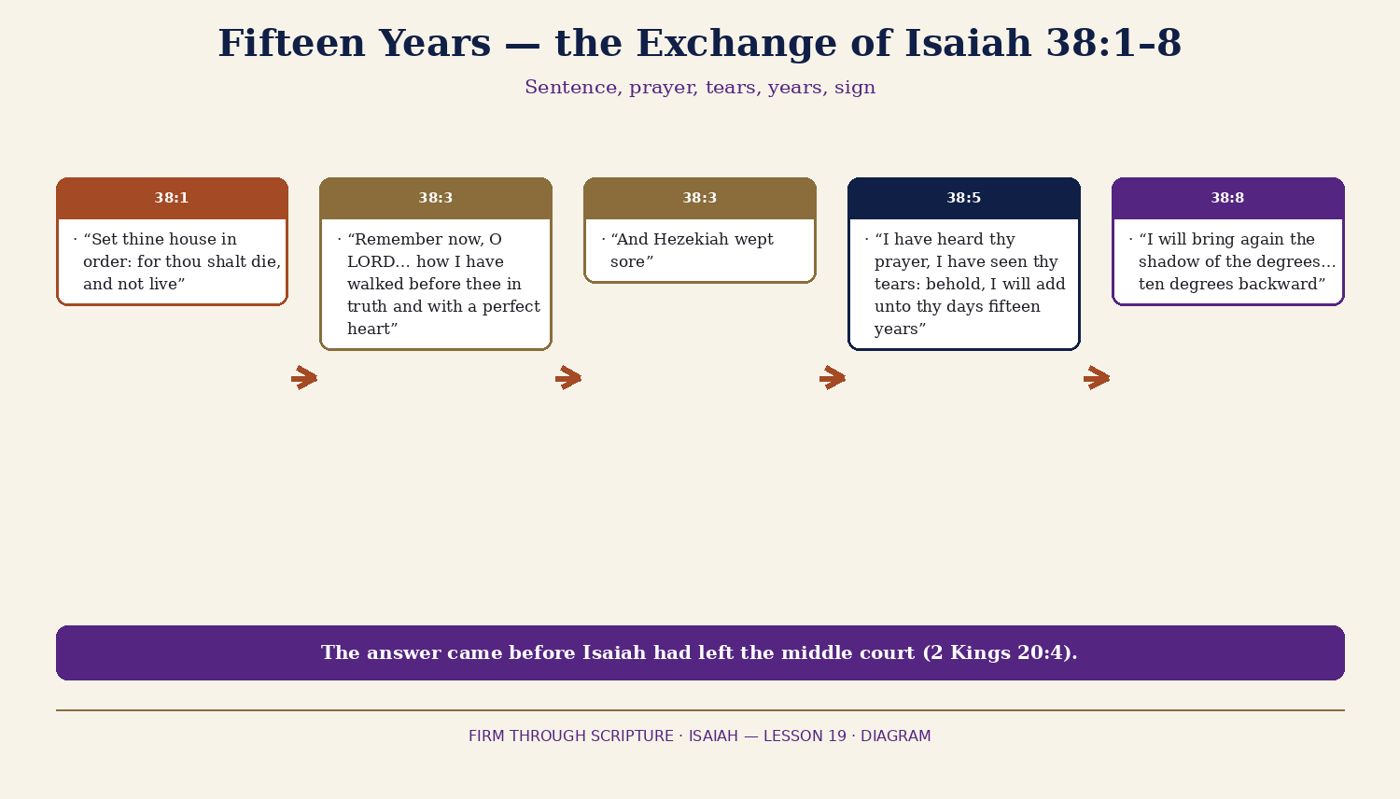
5 Go, and say to Hezekiah, Thus saith the LORD, the God of David thy father, I have heard thy prayer, I have seen thy tears: behold, I will add unto thy days fifteen years.
6 And I will deliver thee and this city out of the hand of the king of Assyria: and I will defend this city.
7 And this shall be a sign unto thee from the LORD, that the LORD will do this thing that he hath spoken;
8 Behold, I will bring again the shadow of the degrees, which is gone down in the sun dial of Ahaz, ten degrees backward. So the sun returned ten degrees, by which degrees it was gone down.
9 The writing of Hezekiah king of Judah, when he had been sick, and was recovered of his sickness:
10 I said in the cutting off of my days, I shall go to the gates of the grave: I am deprived of the residue of my years.
11 I said, I shall not see the LORD, even the LORD, in the land of the living: I shall behold man no more with the inhabitants of the world.
12 Mine age is departed, and is removed from me as a shepherd's tent: I have cut off like a weaver my life: he will cut me off with pining sickness: from day even to night wilt thou make an end of me.
13 I reckoned till morning, that, as a lion, so will he break all my bones: from day even to night wilt thou make an end of me.
14 Like a crane or a swallow, so did I chatter: I did mourn as a dove: mine eyes fail with looking upward: O LORD, I am oppressed; undertake for me.
15 What shall I say? he hath both spoken unto me, and himself hath done it: I shall go softly all my years in the bitterness of my soul.
16 O Lord, by these things men live, and in all these things is the life of my spirit: so wilt thou recover me, and make me to live.
17 Behold, for peace I had great bitterness: but thou hast in love to my soul delivered it from the pit of corruption: for thou hast cast all my sins behind thy back.
18 For the grave cannot praise thee, death cannot celebrate thee: they that go down into the pit cannot hope for thy truth.
19 The living, the living, he shall praise thee, as I do this day: the father to the children shall make known thy truth.
20 The LORD was ready to save me: therefore we will sing my songs to the stringed instruments all the days of our life in the house of the LORD.
21 For Isaiah had said, Let them take a lump of figs, and lay it for a plaister upon the boil, and he shall recover.
22 Hezekiah also had said, What is the sign that I shall go up to the house of the LORD?
— Isaiah 39 —
1 At that time Merodach-baladan, the son of Baladan, king of Babylon, sent letters and a present to Hezekiah: for he had heard that he had been sick, and was recovered.
2 And Hezekiah was glad of them, and shewed them the house of his precious things, the silver, and the gold, and the spices, and the precious ointment, and all the house of his armour, and all that was found in his treasures: there was nothing in his house, nor in all his dominion, that Hezekiah shewed them not.
3 Then came Isaiah the prophet unto king Hezekiah, and said unto him, What said these men? and from whence came they unto thee? And Hezekiah said, They are come from a far country unto me, even from Babylon.
4 Then said he, What have they seen in thine house? And Hezekiah answered, All that is in mine house have they seen: there is nothing among my treasures that I have not shewed them.
5 Then said Isaiah to Hezekiah, Hear the word of the LORD of hosts:
6 Behold, the days come, that all that is in thine house, and that which thy fathers have laid up in store until this day, shall be carried to Babylon: nothing shall be left, saith the LORD.
7 And of thy sons that shall issue from thee, which thou shalt beget, shall they take away; and they shall be eunuchs in the palace of the king of Babylon.
8 Then said Hezekiah to Isaiah, Good is the word of the LORD which thou hast spoken. He said moreover, For there shall be peace and truth in my days.
SAY IT PLAIN — the passage in everyday words: King Hezekiah falls deathly ill, and Isaiah brings him a flat death sentence: get your house in order, you will not recover. The king turns his face to the wall, reminds God of the life he has walked before Him, and weeps hard. Before Isaiah has even left the courtyard, God's word comes back: I have heard your prayer, I have seen your tears — fifteen more years, the city delivered from Assyria, and a sign: the shadow on his father's stair-dial runs ten steps backward. Hezekiah writes a psalm out of the sickroom — bitterness, the grave's gates, sins cast behind God's back, and a vow: the living will praise You. Then Babylonian envoys arrive with a get-well present, the delighted king shows them absolutely everything he owns, and Isaiah announces the cost: one day Babylon will carry all of it away, and royal sons with it. The king's last word is that the word of the LORD is good — since peace will hold in his days. That's the whole passage.
2. THE WORLD — C: Context & Audience
A text can never mean what it never meant — so we stand where their first hearers stood.
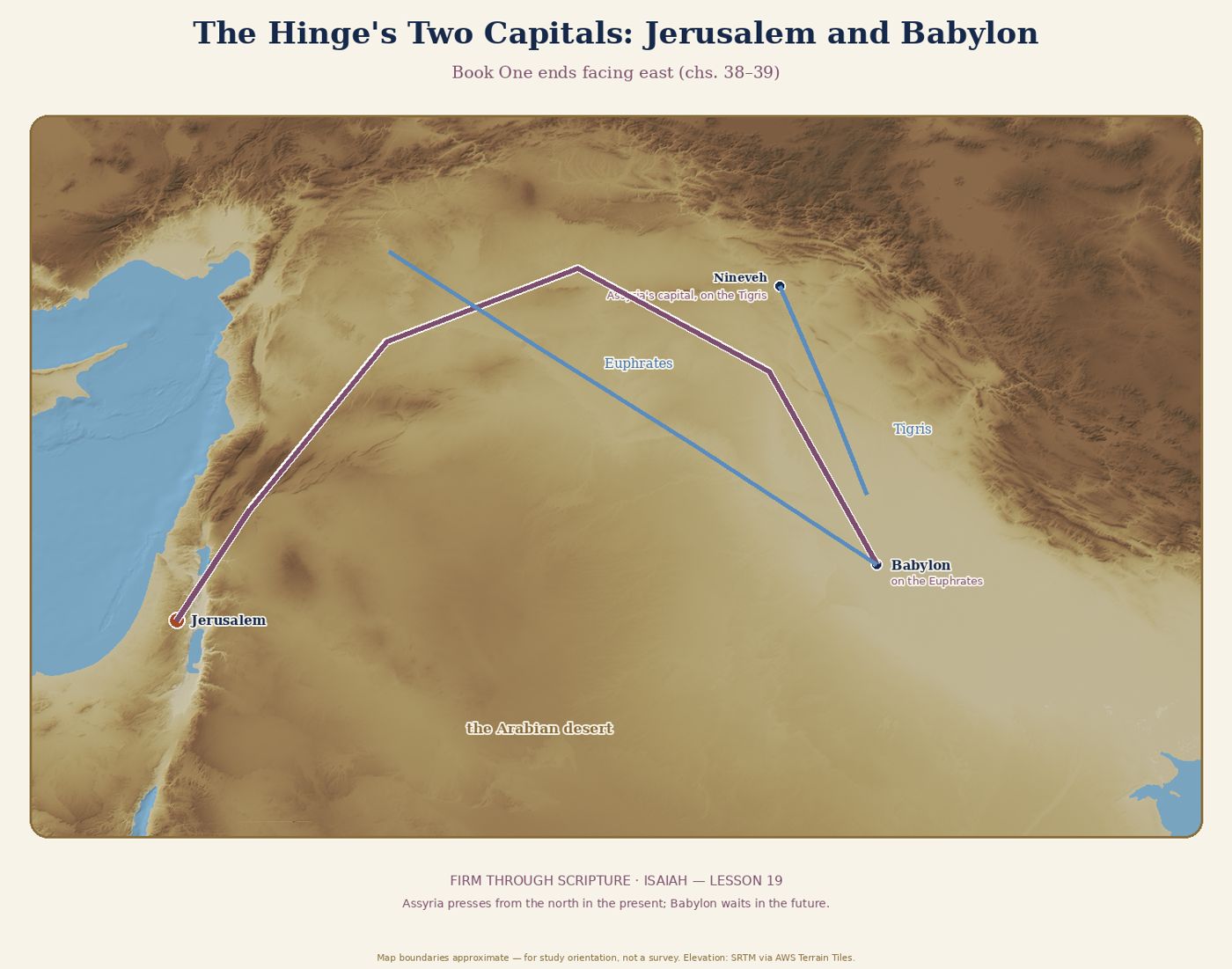
First, the placement — and this lesson will not hide it. You have just come, in Lesson 18, from chapters 36–37: Sennacherib at the gate, Jerusalem delivered in 701 BC. Chapters 38–39 stand after that in the book. In time, they happened before it. Read the evidence inside the text: in 38:6, God promises, "I will deliver thee and this city out of the hand of the king of Assyria" — spoken as a thing still to come, while in chapters 36–37 it is accomplished fact. And chapter 39's visitor, Merodach-baladan, held Babylon's throne in two stretches, the second a brief revolt around 703–702 BC — before Sennacherib's invasion. [2, 11] So the order of events runs: sickness and fifteen years first (roughly 703 BC), then the envoys, then the siege. FACT as to what 38:6 says and when Merodach-baladan reigned; INFERENCE — a strong one, held across the spectrum [2, 4, 11] — as to the exact reconstruction. Why does the book arrange it backwards? Because the book is making an argument, not keeping a diary. Chapters 36–39 close Book One (chapters 1–39, the Book of the King), and the hinge is set deliberately: Assyria's deliverance behind you (36–37), your king's sickroom before you (38), and — in Book One's last scene — Babylon, walking through Jerusalem's open doors (39), the city that dominates Book Two (chapters 40–55). The order is the argument: the hinge swings forward, and you finish chapter 39 already facing the exile, exactly where chapter 40's "Comfort ye" needs you standing. Scholars across the spectrum read chapters 36–39 as this deliberate hinge [12, 5].
The people you need. Hezekiah — king of Judah, the southern kingdom, reigning from Jerusalem in the late eighth century BC; the reforming king who trusted the LORD when Assyria swallowed the north (Lessons 14–18). Isaiah — the prophet, son of Amoz; note that he appears here not as a court flatterer but as bearer of the hardest sentence a king ever heard, and then of the reprieve. Merodach-baladan (also called Berodach-baladan in the parallel account) — king of Babylon, more exactly a Chaldean tribal chief who twice seized Babylon's throne in defiance of Assyria. That fact is the key to his embassy: Babylon at this date is not yet the superpower that will one day burn Jerusalem. She is Assyria's restless subject and rival, shopping for allies — and a famous king in Jerusalem, miraculously recovered, is exactly the ally a rebel king courts. [16, 11] The envoys' errand is, on its surface, courteous: "letters and a present" for a convalescent king (39:1). Underneath, it is coalition-building — the same temptation Lesson 15 watched Judah chase toward Egypt, now arriving from the east with gifts.
Assyria and Babylon — keep the two empires straight. Assyria, to the northeast, is the power of the present hour: the empire that destroyed Israel's northern kingdom in 722 BC and stands at Judah's throat. Babylon, far east on the Euphrates, is at this moment her subordinate — a great ancient city, proud and rebellious, but not yet free. Within a century Babylon will destroy Nineveh and become the empire that carries Judah captive (605–586 BC). [16,46] Chapter 39 is written for readers who know both halves of that sentence: the polite visitors at the door are the future captors, shown the inventory in advance.
The parallel accounts — read them honestly. Almost everything in chapters 38–39 also stands in 2 Kings 20, and the Chronicler retells the embassies in 2 Chronicles 32. The parallels are close but not identical: Kings gives the fig poultice and the sign-request inside its narrative flow (2 Kings 20:7–11), where Isaiah gathers the figs at the chapter's end (38:21) and adds what Kings does not have at all — the king's own writing, the psalm of verses 9–20. [1, 2] This lesson does not harmonize the two silently; it reads Isaiah's arrangement as Isaiah's teaching. The Chronicler contributes one sentence found nowhere else, which §7 leans on hard: "God left him, to try him, that he might know all that was in his heart" (2 Chronicles 32:31). 1
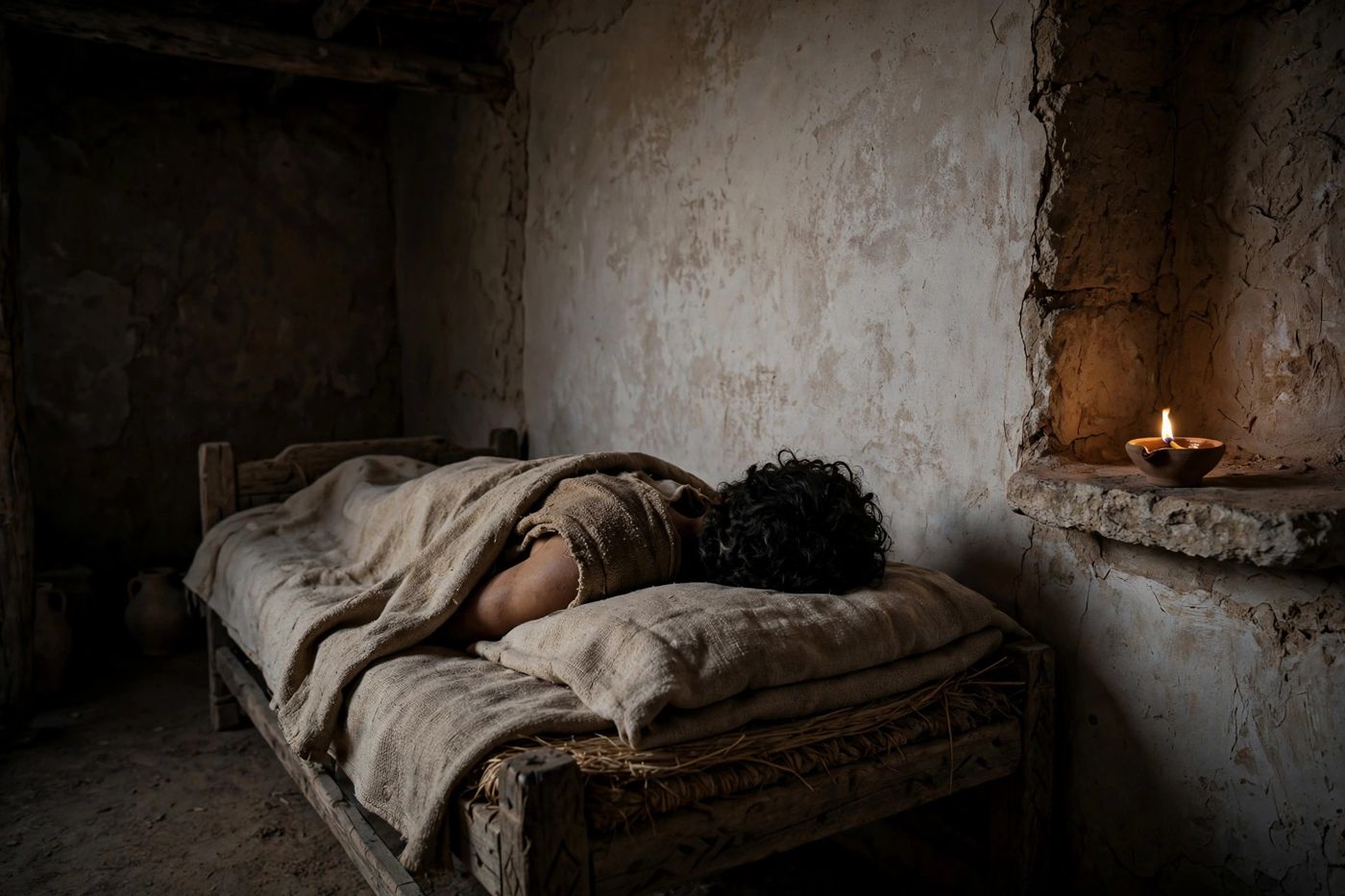
A sickroom in the eighth century BC. One last piece of the world. Hezekiah is "sick unto death" with a "boil" (38:21) — an inflamed, infected swelling; the text gives no modern diagnosis and this lesson will not invent one. DISPUTED — every retrospective diagnosis is guesswork dressed in a white coat; the text's interest is the sentence and the prayer, not the pathology. What the text does show is the period's medicine standing inside the miracle without embarrassment: Isaiah prescribes "a lump of figs" laid "for a plaister upon the boil" — figs were a common poultice material in the ancient world. [16, 53] In one breath this chapter gives you a death sentence reversed by prayer, a sign in the sun's shadow, and a prophet prescribing a fruit poultice. The book sees no competition among the three.
3. OBSERVE — O: what the text actually does
Before meaning comes observation. Most bad interpretation is not deep error; it is shallow reading. So look:
- The shape. Thirty verses, three movements: the sickroom (38:1–8 — sentence, prayer, reprieve, sign), the song (38:9–22 — the king's own writing, with two narrator's notes at the end: the figs, v. 21, and the king's question, v. 22), and the showroom (39:1–8 — embassy, tour, audit, oracle, reply).
- Isaiah comes and goes — watch the prophet's feet. In 38:1 Isaiah enters with the death word. In 38:4 the counter-word catches him barely out the door — Kings says he had not yet gone out into the middle court (2 Kings 20:4). In 39:3 he enters again, uninvited, with questions. Three entrances, three functions: sentence, reprieve, audit. Isaiah is not the king's mood; he is God's courier.
- The tears are seen, not just the prayer heard. God's answer names two things separately: "I have heard thy prayer, I have seen thy tears" (38:5). Prayer as speech, tears as sight.
- The doubled sentence of chapter 39. Hezekiah's own mouth convicts him: asked what the envoys saw, he answers with the tour's completeness in his own words (39:4) — verse 2 repeated as confession.
- The silences. No word of praise from Isaiah for the prayer, and no rebuke — in so many words — for the tour; the oracle is the rebuke. And no narrator's verdict at all on Hezekiah's final reply in 39:8. §16 will respect that silence instead of filling it with certainty the text does not give.
4. GENRE — N: note the genre (prophetic narrative with an embedded royal psalm and an oracle)
These two chapters are not one kind of writing; reading them well means switching ears three times. Fee and Stuart's rule for prophecy governs the whole: prophecy is forthtelling first — God's word into a present situation — before it is foretelling. 51
- Historical narrative (38:1–8; 39). Real events, arranged and told with intent — the same material Kings carries, shaped here to close a book. Narrative teaches by showing: watch what the narrator repeats (the tour's totality, twice), what he leaves uncommented (39:8), and where he places things (Babylon last).
- An embedded psalm (38:9–20). "The writing of Hezekiah" (38:9) is a first-person thanksgiving psalm — kin to the Psalter's songs of a man brought up from the pit (Psalms 30 and 116). [4, 11] Their images (the plucked tent, the cut web, the chattering crane) are prayed emotion, true in the praying rather than measured like a chronicle — §7 will walk them as poetry, not as a medical report.
- A prophetic oracle (39:5–7). "Hear the word of the LORD of hosts" — judgment speech, formally introduced, addressed to the king about his house. Oracles are not weather forecasts; they are covenant verdicts announced in advance, and their first work is on the hearer in front of the prophet.
Hold the three together: the narrative gives you a king, the psalm his heart at its best, the oracle his heart at its worst — the same man in all three.
5. TERMS — T: the words in the writer's mouth
Three expressions carry this passage. Learn what they meant in the mouth that used them:
- "Set thine house in order" (38:1). The verb underneath "set in order" is a command word — to charge, to appoint, to give orders. Isaiah is not suggesting a tidy-up; he is delivering a royal instruction: put your house under orders, because the king is about to be absent from it. And "house" is double-edged in a king's mouth — his household, and his dynasty, the house of David. It is the Bible's classic summons to die administratively honest: wills made, succession faced, accounts settled. [19, 2]
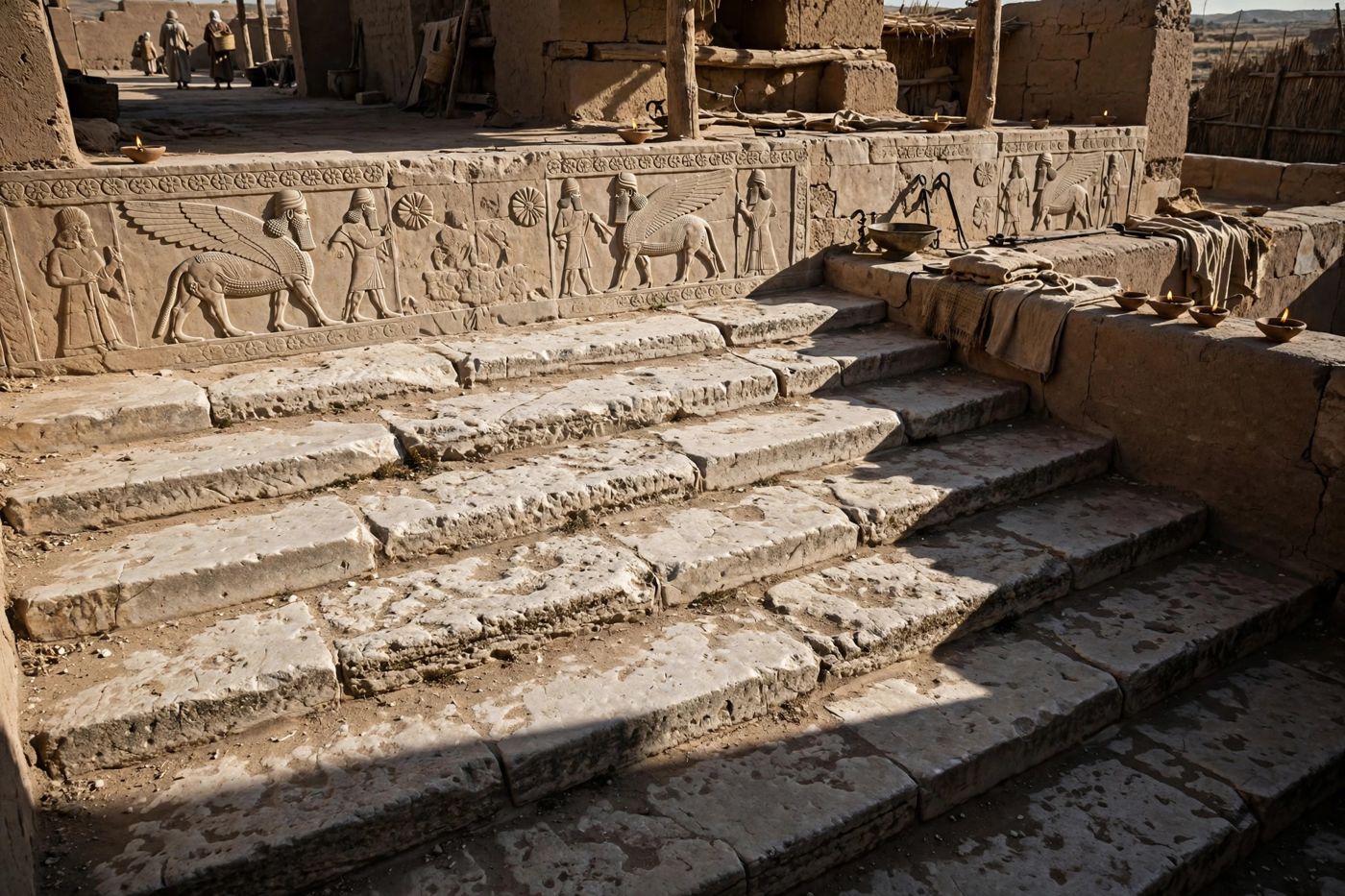
- "The dial of Ahaz" (38:8). Your KJV says the shadow went down "the sun dial of Ahaz" — but the Hebrew word is ma'alot, steps or degrees: literally, the shadow retreated ten steps. Most readers picture a staircase in the palace court arranged so the sun's shadow climbed or fell across its steps through the day — a stairway keeping time — associated with Ahaz, Hezekiah's father. [19, 16] DISPUTED in detail (a staircase-dial or a graduated pillar dial); the lesson takes no side it does not need: what the text claims is precise — the shadow moved backwards by ten steps.
- "Undertake for me" (38:14). The summit-word of the king's psalm. The Hebrew verb is 'arab — to stand surety, to pledge oneself for another, to guarantee a debt or a person you did not incur. It is commercial and legal language: Judah uses it with Jacob — "I will be surety for him; of my hand shalt thou require him" (Genesis 43:9); the psalmist prays it back to God — "Be surety for thy servant for good" (Psalms 119:122); Job begs for it (Job 17:3). [19, 21] So when a drowning king cries, "O LORD, I am oppressed; undertake for me," he is not asking God for a boost of energy. He is asking God to sign for him — to stand guarantor for a man who can no longer stand for himself. It is one of the most daring prayer-idioms in the Old Testament: the creature asking the Creator to be his collateral. Remember the word is about substitution and guarantee, and §6 will show you where the canon takes it.
Method note — the word-study guardrail: a word means what its author uses it to mean, in its sentence, in its century — not what its oldest root once meant, and not everything it can mean anywhere. Every term above was settled by this passage's own usage and its parallels.
TRANSLATION NOTE — "thou hast in love to my soul" (38:17)
The KJV's line at the psalm's summit runs, "but thou hast in love to my soul delivered it from the pit of corruption." The English is compressed, because the Hebrew verb is doing quiet work: the word is hashaq — to be attached to, to cleave in love, to delight in. It is the verb of God's own covenant attachment to Israel: "The LORD did not set his love upon you… because" — the same root (Deuteronomy 7:7). [19, 21] The lexica give its sense as clinging love, attachment rather than pity. [20, 19] So Hezekiah is not saying merely that God loved him while rescuing him. God's attachment to his soul is what reached into the pit: a love that holds on, not a sentiment that passes over. Modern translations unpack it — "in love you have delivered my life" — losing the attachment but gaining the grammar. Neither choice is dishonest; this study flags it because the weight is the sermon: the king's rescue rests on a God who had already bound Himself to him.
6. ENTIRE CANON — E: where this passage sits in the whole story
No passage lives alone, and this one sits on a hinge where the Bible's threads cross:
- The Kings parallel (2 Kings 20). The canon keeps the story twice — among the kings, and as the capstone of Isaiah's first book. Where Kings expands (the sign's mechanics), Isaiah's version adds the psalm. Each is an argument about the same sickroom. [1, 11]
- The Chronicler's diagnosis (2 Chronicles 32). Chronicles, looking back, names what Isaiah leaves implicit: Hezekiah "rendered not again according to the benefit done unto him; for his heart was lifted up" (2 Chronicles 32:25) — and of the embassy, the sentence already quoted: God left him, "to try him, that he might know all that was in his heart" (2 Chronicles 32:31). 1 Not a contradiction of Isaiah 39, but the canon's own commentary on it.
- The psalm's family. Hezekiah's writing breathes the air of the Psalter: "I shall not die, but live, and declare the works of the LORD" is the vow his song ends by making (Psalms 118:17), and his "pit of corruption" stands beside David's "thou hast brought up my soul from the grave" (Psalms 30:3). [1, 52] The grave, in Old Testament speech, is where praise stops — rescue from it is always a rescue for praise.
- The surety thread — the canon takes the king's cry further than he could see. Hezekiah begged, "undertake for me" — be my surety. Israel's Scriptures keep the word in prayer's mouth (Psalms 119:122; Job 17:3). The New Testament then spends its own surety word on Jesus: "By so much was Jesus made a surety of a better testament" (Hebrews 7:22). 1 FACT: the same legal idea — a guarantor who signs for another — is prayed for in Isaiah 38 and proclaimed of Christ in Hebrews 7. INFERENCE — this course's reading, not smuggled as a quotation: the king's prayer names the very office the Son of David would one day fill in full. No apostle quotes Isaiah 38:14; the thread is the language's own, and it is labelled accordingly.
- The palace in Babylon. "They shall be eunuchs in the palace of the king of Babylon" (39:7). Generations later, another book opens with a king of Babylon ordering his master of the eunuchs to bring "certain of the children of Israel, and of the king's seed, and of the princes" to stand in his palace (Daniel 1:3–4). 1 Whether Daniel and his friends were themselves made eunuchs Daniel does not say — do not claim it — but the court they entered is the court Isaiah named: 39:7 is Daniel's first page, written a century early.
- The book's own forward hinge. Chapter 39 ends with Babylon holding a promissory note on everything in Jerusalem; chapter 40 opens — to exiles in that same Babylon — with comfort. That is the distance this whole book exists to cross, and Lesson 20 begins there. The Great Isaiah Scroll is a single scroll of all 66 chapters 22 — the book was always meant to be read across the hinge.
7. THE MEANING — what the passage teaches
The Walk has established what the text says and where it sits. Now its payload, taught straight: a sickroom, a song, and a showroom.
"Thou shalt die, and not live" — the sentence with no softening
Begin where the passage begins: with a prophet who does not cushion. "Thus saith the LORD, Set thine house in order: for thou shalt die, and not live" (38:1). No diagnosis with wiggle room, no hopeful footnote. Hezekiah is not a wicked king being swept away — he is the best king Judah has had in generations, the reformer — and the death word comes to him exactly as flat as it would come to Ahab. That is the first doctrine of the chapter, worth sitting in before we rush to the reprieve: God's sentences are not graded by our résumés. Death comes to the righteous king in his prime ("the cutting off of my days," 38:10) because death comes to the whole race; piety is not an exemption from the sentence, only a way of meeting it. [2, 4] Isaiah's bluntness is itself a mercy: a king told plainly that he will die can do the two things the sentence orders — set his house in order, and pray. A king fed false hope can do neither.
Notice, too, what the sentence does not contain: any charge of sin. The sickness is not explained as punishment, and this lesson will not explain it either: a godly man can receive a terminal sentence that is simply mortality arriving, and the response the chapter models is not a hunt for hidden sin but a turned face and an honest prayer.
The face to the wall — a prayer whose content is a walk
"Then Hezekiah turned his face toward the wall, and prayed unto the LORD" (38:2). The turned face is the whole posture in one gesture: away from the court, the attendants — away from every audience but one. And then the prayer itself (38:3), which startles modern readers: "Remember now, O LORD, I beseech thee, how I have walked before thee in truth and with a perfect heart, and have done that which is good in thy sight." This is not a technique, and not the king bargaining with tokens. Read it in its own world: this is covenant speech. "Remember" is the Bible's great covenant word — God "remembered" Noah, Abraham, His covenant with the fathers — and to ask God to remember is to appeal to a relationship with a history, to lay a shared past on the table. [4, 21] And a "perfect heart" in Hebrew idiom is not a sinless heart — Hezekiah will disprove that reading in chapter 39 all by himself — it is a whole heart, an undivided loyalty. [19, 2] The plea, then: Lord, You and I have a walk. Remember the walk. His evidence is not the volume of his weeping; the weeping ("and Hezekiah wept sore") is what the sentence did to him, not what he offered God as payment.
Hold the shape of this prayer, because the first Misread (§10) will try to break it: the text grounds the plea in a life, and the answer in God's hearing and seeing — grace meeting a walked-before-Him life. It never grounds anything in the tears as a mechanism, as though grief were a coin the dying could mint. And notice: the man praying is the man of Lessons 14–18 — the reform, the Passover, the prayer against Sennacherib. The walk was real. The prayer is the walk, spoken aloud at the wall.
The answer that outran the prophet
"Then came the word of the LORD to Isaiah" (38:4) — and Kings tells us where it caught him: not yet out into the middle court (2 Kings 20:4). Before the prophet had crossed the courtyard he was turned around. Do not miss how the answer is addressed: "the God of David thy father" (38:5) — the covenant name, invoked over a king whose dynasty was the very thing the sentence threatened. Then the two clauses flagged already in observation, now as doctrine: "I have heard thy prayer, I have seen thy tears." God answers prayer as a person addressed, not a mechanism triggered — hearing speech, seeing grief, responding out of His own freedom. The fifteen years are gift, not wage: the king asked God to remember a walk; God answered with years the king had not dared to specify. [2, 4]
And the gift arrives with a rider the king did not request: "And I will deliver thee and this city out of the hand of the king of Assyria: and I will defend this city" (38:6). Personal reprieve and national deliverance, bound in one promise — and, as §2 taught, the chronology's tell: spoken here, the deliverance is future; in chapters 36–37 you have already watched it happen. God was not merely extending a life; He was extending it toward something.
The sign — the shadow that ran backward
Hezekiah asks for a sign (38:22; Kings records the exchange in full), and God gives one of the strangest in Scripture: "I will bring again the shadow of the degrees, which is gone down in the sun dial of Ahaz, ten degrees backward" (38:8). Teach it plainly: the text's claim is that the shadow on the steps of Ahaz reversed its course by ten steps — a visible, located event in a palace courtyard, attached to a promise so the king could watch the promise's signature. [2, 11]
What about the explanations? Natural explanations — a freak refraction, an eclipse effect, a local bending of light — have been proposed since antiquity. Label them accurately: DISPUTED, and inadequate to the text as written — the narrative claims the shadow's retreat as the LORD's act ("that the LORD will do this thing that he hath spoken," 38:7), timed to the word, on a specific instrument, as a sign; a coincidence of weather does not become a sign by being unusual. The other pile is more honest: readers who deny miracles on principle read the account as legend — a premise about what cannot happen, brought to the text, not a finding from it. POSITION — the program's: the passage means what it says. A God who adds fifteen years can sign the addition in the sun's shadow. And note what the sign is for: not the healing itself — the king recovers by verse 21's ordinary poultice — but the promise. The sign certifies the word, as signs do throughout Isaiah (compare Lesson 5: the father Ahaz refused a sign; the son asks and receives).
The lump of figs — miracle and means in one verse
And then, at the chapter's end: "Let them take a lump of figs, and lay it for a plaister upon the boil, and he shall recover" (38:21). Its theology is load-bearing: the God who reversed the shadow healed the king through a poultice. Prayer, prophecy, and a fruit plaster stand in one verse without embarrassment. This kills two errors with one fig. Against the error that faith must refuse means: the prophet himself prescribes the means — refusing Isaiah's prescription would have been unbelief, not spirituality. Against the error that means make prayer decorative: the poultice is prescribed inside an answered death sentence — nobody thinks the figs added the fifteen years. [16, 53] The pattern is neither "God, so no medicine" nor "medicine, so no God," but a Creator who heals through created things and answers prayer.
The king's writing — the book's one royal psalm, walked stanza by stanza
Chapter 38 holds a treasure no other Isaiah lesson has: a psalm written by a king, preserved inside a prophecy. "The writing of Hezekiah king of Judah, when he had been sick, and was recovered of his sickness" (38:9). Walk it slowly; its stanzas map what a godly man actually feels at the grave's edge — which is not serenity.
The lost years (38:10–11). The psalm opens in the cutting — "in the cutting off of my days" — at the gates of the grave: "I am deprived of the residue of my years." The grief is specific, almost book-keeping in its pain — not I will die but I am deprived of the residue, robbed of a remainder he can count. And the loss is doubled: "I shall not see the LORD, even the LORD, in the land of the living: I shall behold man no more with the inhabitants of the world." God and people, both closing in one couplet. Old Testament death faced honestly: the grave is real loss, and the psalm does not pretend otherwise for a brave face. [4, 52]
The plucked tent and the cut web (38:12–13). Two trades supply the images, both about a life unmade in an instant. "Mine age is departed, and is removed from me as a shepherd's tent" — a tent is struck and gone between one hour and the next. "I have cut off like a weaver my life: he will cut me off with pining sickness" — the weaver finishes a web by cutting it from the loom, and God holds the knife to Hezekiah's web the same way; the end is not the cloth wearing out but the cloth cut. Then the lion: "as a lion, so will he break all my bones" (38:13) — God Himself, in the sufferer's night-reckoning, is the lion at the bones. The psalm does not edit this: biblical lament lets the sufferer say what suffering feels like, including feeling God as the assailant. [52, 13]
The chatter, the mourning, and the great cry (38:14). "Like a crane or a swallow, so did I chatter: I did mourn as a dove: mine eyes fail with looking upward." Prayer reduced to bird-noise — inarticulate, undignified sounds from a king accustomed to decrees — and eyes worn out from staring at a ceiling that has not yet answered. And out of the chattering comes the psalm's greatest line: "O LORD, I am oppressed; undertake for me." (§5 gave you the word: be my surety. Sign for me. I cannot stand; stand for me.) It is the centre of the song, and of all biblical prayer at the bottom of things: not a plan, not a vow, not an argument — a request for a Guarantor. Every sufferer who has prayed "Lord, I can't; You must" has prayed Hezekiah's line without knowing its address.
The turn (38:15–16). "What shall I say? he hath both spoken unto me, and himself hath done it" — the answer has come, and it undoes the king's eloquence; the petitioned God is discovered to have been the Actor all along. "I shall go softly all my years in the bitterness of my soul" — the recovered man walks softly now, the bitterness carried. Then the psalm's theology in one sentence: "O Lord, by these things men live, and in all these things is the life of my spirit" (38:16) — by these things, God's words and dealings, the bitter ones included, men live. The fifteen years are not the life; they are the occasion.
The summit (38:17). Now the verse the whole psalm climbed toward. Three movements. First, the exchange rate: for peace — bitterness. He expected peace (shalom, wholeness) and received its opposite, and the psalm refuses to call the bitterness anything else. Second, the rescue: "thou hast in love to my soul delivered it from the pit of corruption" — with the Translation Note's verb in it (§5), God's clinging, covenant love (hashaq) is what reached his soul in the grave's pit of decay. Third, most quietly astonishing: "thou hast cast all my sins behind thy back." The sickness was never charged to his sins, yet the recovered king instinctively reads his rescue as forgiveness. Behind God's back is the place of deliberate non-regard: what is behind your back you have chosen not to keep in view. The king does not say his sins were small, or explained. He says where God put them. [4, 18]
The vow (38:18–20). The psalm lands where rescue always lands in the Old Testament: on praise. "The grave cannot praise thee, death cannot celebrate thee… they that go down into the pit cannot hope for thy truth" — but "the living, the living, he shall praise thee, as I do this day," and the father to the children shall make known God's truth. The doubled "the living, the living" is emphasis, not a stutter — life is defined by its use: the living are the ones who can praise, and a father alive is a father who can teach his children. Then the vow that signs the song: "we will sing my songs to the stringed instruments all the days of our life in the house of the LORD" (38:20). Note the pronouns — my songs become we will sing: private rescue turns congregational. Hezekiah's writing is the only royal psalm inside a prophetic book, and the hinge needs it: before Babylon walks in, you are meant to have heard this king at his best. Chapter 39 will hurt more because chapter 38 sang first. [11, 12]
Where in the Covenant Story?
Hezekiah stands in the Davidic line, under the covenant of 2 Samuel 7 — an enduring house, a son of David on Jerusalem's throne. 1 Watch the covenant in the passage's joints: God addresses the dying king through "the God of David thy father" (38:5); the sentence threatens the dynasty itself ("set thine house in order"); the reprieve preserves the line through the Assyrian crisis; and chapter 39's oracle threatens that house's future while leaving the line intact to be carried through exile, not ended by it. The house of David, preserved by mercy and disciplined by exile, is never finally dropped — which is why a later Son of David can still be born into it.
The Christ Thread
No New Testament writer quotes Isaiah 38 or 39 — say so plainly, because a thread this course invents is worse than none. What the canon does give is the surety word come of age: the guarantor Hezekiah begged for — "undertake for me" (38:14) — is the office Hebrews proclaims filled: "Jesus made a surety of a better testament" (Hebrews 7:22). 1 FACT: the same legal idea stands in both places. INFERENCE: the dying king's cry names, ahead of time, the shape of the answer God's people finally receive in the Son of David — One who stands for those who cannot stand, not for fifteen added years but for a better covenant. Hezekiah himself is no type of Christ here: his sickness is not a cross, his recovery is not a resurrection, and this lesson draws neither line.
The envoys — gladness, flattery, and every door opened
Now the showroom, and the lesson's tragedy. "At that time Merodach-baladan… sent letters and a present to Hezekiah: for he had heard that he had been sick, and was recovered" (39:1). Babylonian courtesy arrives with perfect timing — to a convalescent king, full of the wonder of his own recovery. "And Hezekiah was glad of them, and shewed them the house of his precious things, the silver, and the gold, and the spices, and the precious ointment, and all the house of his armour… there was nothing in his house, nor in all his dominion, that Hezekiah shewed them not" (39:2). Read the catalogue slowly — then set it beside Lesson 18, because the contrast is the diagnosis. Against Assyria's mouthpiece, this same king commanded total, disciplined silence (36:21 — "they held their peace, and answered him not a word: for the king's commandment was, saying, Answer him not"). The king who would not give Sennacherib's spokesman a single syllable gives Babylon's envoys a guided tour of the vaults. What explains the difference? Not the stakes — Babylon's questions were the dangerous ones. The difference is the approach: Assyria came with threats, and Hezekiah's guard was up; Babylon came with flattery and a present, and his guard was nowhere. Men rarely fall to the enemy they are braced against. They fall to the visitor they are glad of. [2, 12]
And the Chronicler's sentence completes the diagnosis from God's side: this embassy was, among other things, a test — "God left him, to try him, that he might know all that was in his heart" (2 Chronicles 32:31). 1 Not God absent in indifference, but God deliberately un-propping: no prophet at his elbow (Isaiah arrives only after, 39:3), no crisis to concentrate the mind — just a king, his treasures, and visitors. What was in his heart, when God left him to himself? A tour. That is why this scene is Book One's closing tragedy: the best king in generations failing the quiet test, in peacetime, in his own house, with every door opened by his own hand.
The audit and the oracle — the inventory becomes the exile
Isaiah's return is an audit in two questions. "What said these men? and from whence came they unto thee?" (39:3) — and the king answers the geography, not the conversation: "They are come from a far country unto me, even from Babylon" — said, one suspects, with some pride in the distance his fame had travelled. Then the auditor's real question: "What have they seen in thine house?" And the king answers with the completeness that convicts him (39:4). No evasion — but no repentance in it that the text records: no "I have sinned," no sackcloth such as chapter 37 saw. The audit is accurate; the heart, this time, does not break.
Then the oracle (39:5–7), and its terrible symmetry: "all that is in thine house, and that which thy fathers have laid up in store until this day, shall be carried to Babylon: nothing shall be left, saith the LORD" — and "of thy sons that shall issue from thee… shall they take away; and they shall be eunuchs in the palace of the king of Babylon." The punishment fits the gesture with an exactness that is the point: the doors opened in flattery become, by the word spoken over them, the inventory of the exile. What was shown will be shipped — and the final item is not silver but sons: the dynasty itself, the "house" of 38:1, carried into the palace of the very king whose envoys stood in the doorway. Display and captivity in one gesture — the hinge's tragedy entire. Note the oracle's reach: exile announced generations ahead (Babylon is still Assyria's subject as Isaiah speaks; the captivity belongs to 605–586 BC) — prophecy at full stretch, spoken into a room where it made no political sense. [11, 16] Book Two exists because this oracle is true.
Set showing and sentence side by side:
| Shown to the envoys (39:2, 4) | Spoken over it (39:6–7) |
|---|---|
| "the house of his precious things… all that was found in his treasures" | "all that is in thine house… shall be carried to Babylon: nothing shall be left" |
| the treasures "thy fathers have laid up in store" | carried away with the house — nothing excepted |
| the king's own house, gladly opened | "of thy sons that shall issue from thee… they shall be eunuchs in the palace of the king of Babylon" |
The Long View — what the church has believed
Stand back and notice how the centuries have received this story. On the prayer, the church's reading has been settled and warm: the historic commentators — Calvin among them 36 — take it as a model of covenant pleading, the answer as free grace, not transaction; and the fig poultice has served preachers for centuries as the proof-text that using means is no denial of Providence. On 39:8 the centuries divide honestly, and §16 stages the division rather than settling it by vote. On the psalm, the church has sung it as a companion to Psalms 30 and 116. The centre — a God who hears, adds years by grace, and tests in prosperity — has held.
That is the payload. The next section compresses it into the one sentence you are meant to carry out of this study.
8. THE AIM SENTENCE — X: eXplain the intent
Everything observed now compresses into one sentence — the author's intended meaning, stated before any application:
At Book One's hinge, God hears the death-sentenced king whose prayer is a life walked before Him — adding fifteen years by grace, signing it in the sun, healing him through a poultice — and then lets that same king, unguarded in gladness, open every door to Babylon, so the treasures he displayed become the inventory of the coming exile.
If a sermon, a post, or a devotional uses Isaiah 38–39 to say something that cannot be traced back to that sentence, it is not this passage talking.
9. SAY IT BACK
Close the book and say the AIM sentence from section 8 in your own words — out loud, or in your notes, without looking. Then say, in one more sentence, what it asks of you this week.
If your version quietly changes the meaning — if the fifteen years become a technique for reversing diagnoses — open the lesson and walk it again. Meaning first, in the author's words become your words, then — and only then — your life.
10. THE MISREAD — the guardrail, with verdicts
Three live misuses of this passage. Each gets a hearing, the evidence, and a verdict.
Misread 1: "Hezekiah wept sore and God reversed a death sentence — so prayer is a technique: grieve hard enough, and diagnoses get overturned." Why it sounds right: the sequence really is stark — sentence, tears, reversal, inside five verses, and the tears are named in the answer. The evidence: read what the prayer contains and what the answer credits. The prayer (38:3) is not an intensity display; it is an appeal to a walk — "how I have walked before thee in truth and with a perfect heart" — covenant history laid before a covenant God. The answer credits hearing and seeing ("I have heard thy prayer, I have seen thy tears") — the language of a Person responding, not a mechanism discharging — and the fifteen years exceed anything asked: the king never requested a number. Grace that outruns the request cannot be reverse-engineered into a formula. And the canon refuses the technique reading elsewhere: David fasted and wept seven days for his child, and the child died (2 Samuel 12); Paul pleaded three times and kept the thorn (2 Corinthians 12). Same tears, different answers — because the variable was never the tears. Verdict: the passage teaches prayer's character — honest, covenant-grounded, whole-hearted, spoken from a life — never its mechanics. Weep and plead like Hezekiah; then leave the arithmetic to God.
Misread 2: "Chapters 38–39 are an out-of-place appendix — leftovers from Kings, awkwardly stitched after the deliverance they actually precede." Why it sounds right: the chronology really is reversed, and the material really does parallel 2 Kings 20. The evidence: the reversal does work no filing error could do. Set after 36–37, the sickroom explains the siege (the deliverance of 38:6 is the siege's promise), the psalm shows the delivered king's heart at its forgiven best, and chapter 39 turns the whole book east: Babylon enters as a guest and exits as the future captor, leaving the reader exactly where chapter 40's comfort must find him — facing exile. The book's final-form shaping [5, 12] placed the hinge where a hinge belongs: at the joint. Verdict: not an appendix but the hinge itself — deliverance behind, Babylon ahead; the order is the argument.
Misread 3: "The showroom tour was basically vanity — a king showing off, the way any proud man might. A cautionary tale about ego, nothing more." Why it sounds right: pride is genuinely present — the Chronicler says the king's heart "was lifted up" (2 Chronicles 32:25). The evidence: vanity alone cannot carry the oracle's weight. What Hezekiah displayed was not a mirror but a kingdom: the treasury, the armoury, "all his dominion" — Judah's security, inventoried for the one foreign power with a motive to remember the list. The act is a failure of trust (security displayed to impress an ally-captor instead of resting in the LORD who had pledged to defend the city, 38:6) and — by the oracle's symmetry — the future exile's own catalogue: what was shown is what will be shipped, sons last. Verdict: vanity is the tour's smallest sin. Read whole, the showroom is the hinge's tragedy in one gesture — display and captivity bound together. The passage sets a hook for ordinary believers too: what are you gladly showing the wrong guests?
11. FROM WORD TO WALK
A reflection page — the lesson is not finished until the passage has had its say with you.
Sit first in the sickroom, because most of us will pray Hezekiah's prayer in some form before we die — if not for ourselves, then at a loved one's bedside. Notice what the king does not bring to the wall. No plan. No bargain — no "if You heal me, I will" anywhere in verse 3. He brings a walk: years of walking before God in truth, with a whole heart — and lays it down and says one word over it: Remember. If your life has a walk with God in it, that walk is prayable. Not as wages — God owes the walk nothing, and the fifteen years were grace — but as the substance of a relationship with a history. The time to build the prayer of your worst night is in the ordinary years before it.
Then sit in the showroom, because that is the room most of us actually fail in. Hezekiah's worst hour did not come in the sickroom — he prayed beautifully there. It came in the good days that followed: recovered, celebrated, visited, glad. Ask what your own gladness opens: what doors swing wide in you when you are flattered, that stay shut when you are threatened?
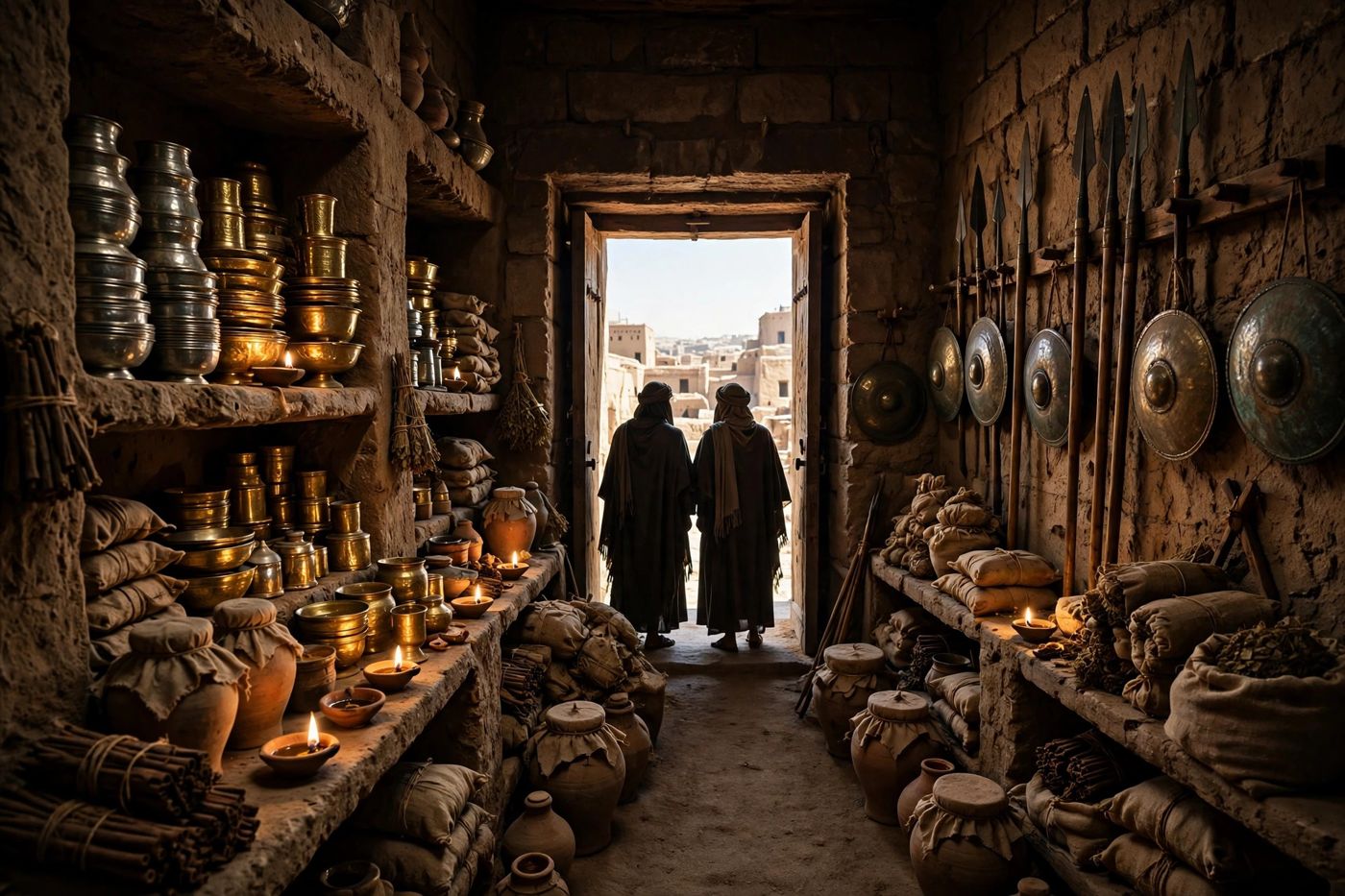
And hold the two rooms together, because the same man lived in both, and so do you. The king of the wall-prayer and the king of the showroom are one man in two seasons — which is a reason to keep praying the wall-prayer after the answer comes. Especially after the answer comes.
LORD, I am oppressed; undertake for me. Be surety for the parts of my life I cannot stand under. Teach me to pray out of a walk, not a technique — and when You answer, and the glad days come, keep my hand off the doors You never told me to open. You have cast my sins behind Your back; let me live softly, and sing, all the days You add. In Jesus' name, amen.
12. FOR DISCUSSION — OR FOR YOUR JOURNAL
With a group, work these aloud. Alone, they're yours — answer them in your journal or in prayer; they lose nothing in the quiet.
- Hezekiah's prayer rests on a walk: "how I have walked before thee in truth and with a perfect heart." What would your own version of that prayer honestly say today?
- The death sentence came with no charge of sin attached, and the prayer contains no bargain. How does that change the way you think about serious illness — and the prayers that belong beside it?
- The king faced Assyria's threats with commanded silence and Babylon's flattery with an open house. Where are you well-defended against pressure but undefended against praise? Name the doorway.
- Hezekiah's last word accepts God's oracle because peace will hold "in my days" (39:8). §16 argues the two readings of that reply. Which do you find in the text — and what does your answer mean for how you think about the generations after you?
13. THE WALK-OUT — T: Transfer to today
Meaning is settled. Now — and only now — application. Run the five Transfer Tests on this passage:
- Same covenant? Hezekiah prays as the Davidic king under the old covenant. We pray as believers in Christ under the new — the pattern of his prayer (a walked life laid before a remembering God) crosses; his office, dynasty, and national stakes do not.
- Same audience? The oracle of 39:6–7 was spoken to one king about one house and one coming exile — not a prediction about your nation or family. What reaches us is the God it reveals and the pattern it exposes, not its address.
- Same genre rules? Narrative shows before it commands (no one is ordered to demand a sign); the psalm models prayed emotion honestly; the oracle warns by example.
- Repeated or rooted? Praying in mortal illness, using God's means without shame, praising while we live, guarding the heart in prosperity — each is rooted in God's character and repeated across the canon (2 Samuel 12; James 5:14; Psalms 118:17). These cross.
- Ten verses either side? Every practice below is drawn from these thirty verses read whole — sickroom, song, and showroom together.
What crosses:
- God hears and sees. Before any practice: the indicative. This passage's God hears prayer, sees tears, adds what no one can add to themselves, signs His promises, and forgives sins by casting them behind His back. Application that starts anywhere else has skipped the passage.
- Prayer is a walk, spoken. Build the walk in ordinary years, and pray it honestly in the crisis — no technique, no bargaining, no performance for the room.
- Means are not unspiritual. Isaiah prescribes the poultice. Medical care is not a rival to trusting God; in this chapter it is the prophet's own prescription, held inside answered prayer.
- Prosperity is a test, not a graduation. God "left him, to try him" — in the good season, with visitors. The heart is audited at the showroom as at the sickbed.
- The living praise, and fathers tell. Hezekiah's vow defines the use of added days: praise now, and God's truth handed to children. Whatever years God adds — fifteen, or fifty, or five — this is what they are for.
The gate, at a glance:
| Crosses | Does not cross |
|---|---|
| Prayer as a walked life, spoken honestly | Any promised number of added years |
| God's means, used without shame | A sign demanded as the price of trust |
| Guarded gladness in prosperity | Isaiah 39:6–7 read onto modern nations |
| Praise, and telling the children, while we live | "In my days" as a way to live |
Practices — made concrete this week:
- Set one piece of your house in order. This week, do one concrete act from Isaiah's first sentence: the will reviewed or made, the apology owed, the account explained to whoever would have to untangle it.
- Pray the walk. Twenty minutes. Write out, in Hezekiah's form, an honest "remember" prayer: the walk as it actually is, gaps named without varnish.
- Take the figs. If you have been treating a means of help — treatment, counsel, rest — as a failure of faith, reconsider it in Isaiah's presence this week, and take the postponed step. Prayer and poultice, together.
- Audit your open doors. Name one place where gladness or flattery has been showing the wrong guests your treasures. Decide what gets shown more carefully now, and to whom.
- Memorize Isaiah 38:14's cry and 38:17's comfort. "O LORD, I am oppressed; undertake for me" — and "thou hast cast all my sins behind thy back."
What does not cross: claiming fifteen years — or any number — as a promised outcome of sufficiently intense prayer; demanding a sign as the price of trusting a promise; reading 39:6–7 as prophecy about any modern nation's politics; or treating "peace in my days" as permission to stop caring about the generation after yours — the passage exposes that sentence; it does not bless it (see §16).
Praise Him
Praise Him as the living praise Him — as I do this day. Praise the God who heard a prayer and saw tears nobody else was meant to see; who added years no one had earned and signed the addition in His own sun; who put a rescued soul's sins where He would never look at them again — behind His back. The grave cannot praise Him — but the living, the living, he shall praise thee. Praise Him with the days you have.
14. THE RECAP CARD — this study on one page
Print it. Keep it where you'll see it this week.
- The passage: Isaiah 38:1–39:8 — the death sentence, the king's psalm, the backward shadow, the envoys shown everything.
- Say It Plain: God reverses Hezekiah's death sentence in answer to a prayer grounded in a walked life, adds fifteen years and a sign — and the recovered king then opens every door to Babylon.
- The AIM: At Book One's hinge, God hears the death-sentenced king whose prayer is a life walked before Him — adding fifteen years by grace, signing it in the sun, healing him through a poultice — and then lets that same king, unguarded in gladness, open every door to Babylon, so the treasures he displayed become the inventory of the coming exile.
- Key terms: set thine house in order — put household and dynasty under orders for your absence · the dial of Ahaz — the steps of Ahaz, a stairway keeping time by shadow · undertake for me — 'arab, "be my surety": sign for a man who cannot stand.
- The Misread, in one line: prayer is a character, never a technique · chapters 38–39 are the hinge, not an appendix · the tour is display-become-captivity, not mere vanity.
- Memory verse: "The living, the living, he shall praise thee, as I do this day: the father to the children shall make known thy truth." — Isaiah 38:19
- This week's practice: set one piece of your house in order; audit one open door.
15. CHECK YOURSELF — five questions
Answer from the study, not from instinct. (Answers live in the Teacher Edition.)
- In your own words: what is the AIM of Isaiah 38–39?
- In time, which came first — the events of chapters 36–37 or of 38–39? What inside chapter 38 proves it, and why does the book order them as it does?
- Hezekiah's prayer in 38:3 rests on a walk, not on intensity. State the prayer's actual content — and explain why the answer (38:5) shows grace rather than a technique working.
- "Undertake for me" (38:14) — what legal picture does the word carry, and where does the New Testament spend the same idea?
- A friend shrugs: "Hezekiah just showed off a bit." Using the oracle's symmetry and the Chronicler's diagnosis, show why the tour is more than vanity.
16. GO DEEPER
Optional — the lesson is complete without it.
From the Sources — The envoys' king, in the records
Merodach-baladan is no biblical invention. As Marduk-apla-iddina II, a Chaldean chief of the Bit-Yakin tribe, he seizes Babylon's throne in the Assyrian records themselves, holds it against Sargon II (722–710 BC), loses it, and claws it back briefly (703 BC) before Sennacherib drives him out for good. [25, 30] FACT — the man and the double reign stand in the enemy's own annals, which is why the embassy's date matters: a king in revolt against Assyria, shopping for allies just before 701, has every reason to send "letters and a present" to a wealthy king of Judah with a famous recovery. [11, 16]
The Honest Argument — "Good is the word of the LORD… if peace and truth be in my days" (39:8)
No sentence in the hinge chapters has divided readers like the king's last one. The king replies to the exile oracle: "Good is the word of the LORD which thou hast spoken" — and adds, "For there shall be peace and truth in my days." Two readings have stood against each other for as long as the text has been read; this course will not pretend one of them away.
Reading one — submission. "Good is the word of the LORD" is the classic posture of a believer under a hard word: Eli's "It is the LORD: let him do what seemeth him good" (1 Samuel 3:18); Job's "the LORD gave, and the LORD hath taken away." On this reading the king bows: the word is good because it is God's, and the clause gives his reason for receiving it without despair — peace in his own days. Calvin, characteristically, finds real submission in it, mixed with the flesh's relief, and warns against both sneering at the king and canonising him. 36 Many modern commentators follow some form of this. [4, 2]
Reading two — relief, and a small heart. On this reading the weight falls on the clause: peace in my days. The king's comfort is that the blow lands on his grandchildren — and the text supports the darker note: Isaiah records no repentance, no intercession for the sons to come (contrast Abraham for Sodom, Moses for Israel), and the Chronicler's verdict is a lifted-up heart that "rendered not again according to the benefit done unto him" (2 Chronicles 32:25). 1
The grammar — why translators divide. The Hebrew of the last clause can be read as the king's stated reason ("for / since there shall be peace…"), as his hopeful inference, or — as some render — virtually as a question: "Is it not good, if peace and truth be in my days?" The KJV prints it as statement; the ambiguity lives in the connectors. [19, 11] DISPUTED — the tone is undecidable from grammar alone.
POSITION — this course's, held loosely: the text's silence is its intended verdict. Isaiah, who narrated the king's tears and printed his psalm entire, gives this sentence no comment — and a reader should leave the room as the book leaves it: a good king's ambiguous word echoing, submission and self-relief both audible in it, and the uneasy recognition that we have all prayed some version of "in my days." The one reading the evidence excludes is indifference-as-heroism: whatever else 39:8 is, the book does not present it as the reign's finest hour. It presents it last.
The Word Underneath — hashaq, the love that cleaves
§5's Translation Note introduced the verb; here is its field. Hashaq runs through the covenant's love-language: God "set his love" — hashaq — on Israel not for her numbers but of His own attachment (Deuteronomy 7:7), and "upon thy fathers" (Deuteronomy 10:15). [19, 21] FACT as to the word's range. What Hezekiah does with it in 38:17 is the move to notice: he takes the verb of God's electing attachment to a nation and prays it in the first person, of his own soul. INFERENCE — a disciplined one: the king reads his personal rescue through the nation's covenant. He is held not by his treasures or his record, but by a love that bound itself to him before he could perform for it. The tragedy of chapter 39, in this word's terms: the God who hashaq-ed Hezekiah's soul got a tour of the treasury in return.
Go Read
- Oswalt, The Book of Isaiah, Chapters 1–39 (NICOT) 2 — the hinge chapters, the chronology, and the psalm.
- Smith, Isaiah 1–39 (New American Commentary) 11 — the Assyrian and Babylonian records set beside the narrative.
- Calvin, Commentary on Isaiah 36 — the Reformation reading of 39:8, refusing both sneer and canonisation.
17. SOURCES & REFERENCES
Numbered citations in this lesson key to this list — the course standard: every sourced claim carries its number, and every number can be checked.
- The KJV text itself — Holy Bible, King James Version (eBible.org KJV, 1769 text). Scripture quotations are from the King James Version (KJV), which is in the public domain in the United States; the full passage is always assigned as reading. Cross-references within Scripture cite this number.
- Oswalt, The Book of Isaiah, Chapters 1–39 (NICOT) — John N. Oswalt (Eerdmans). The leading evangelical commentary on the first half; defends essential unity of authorship and reads the book as a finished theological whole. Detailed notes on the Assyrian-period history (Ahaz, Hezekiah, Sennacherib).
- Motyer, The Prophecy of Isaiah — J. Alec Motyer (IVP). A one-volume commentary by an evangelical scholar who argues the whole book breathes the mind of the eighth-century prophet; especially strong on the book's structure, its repeated refrains, and the Servant.
- Childs, Isaiah (Old Testament Library) — Brevard S. Childs (Westminster John Knox). The canonical-approach reading: the book in its final form as Scripture, whatever its compositional prehistory; a control on both conservative and critical overreach.
- Smith, Isaiah 1–39 and Isaiah 40–66 (New American Commentary) — Gary V. Smith (B&H). Evangelical commentary with strong historical notes (the Assyrian and Babylonian records) and an even-handed survey of the authorship debate.
- Seitz, Isaiah 1–39 (Interpretation) — Christopher R. Seitz (John Knox). A theological reading alert to the book's editorial shaping and to Isaiah's place in the canon; useful on Zion theology and on chapters 36–39 as the hinge.
- Brueggemann, Isaiah 1–39 and Isaiah 40–66 (Westminster Bible Companion) — Walter Brueggemann (Westminster John Knox). A rhetorical-theological reading for preachers and teachers; strong on the poetry's movement from judgment to hope.
- Walton, Matthews & Chavalas, The IVP Bible Background Commentary: Old Testament — John H. Walton, Victor H. Matthews, Mark W. Chavalas (IVP). Verse-by-verse ancient Near Eastern background: Assyrian siege practice, Babylonian religion, treaty and coronation customs, geography.
- VanGemeren (ed.), New International Dictionary of Old Testament Theology and Exegesis (NIDOTTE) — Willem A. VanGemeren (Zondervan). Theological word studies with semantic-range discipline for the Hebrew terms.
- Brown, Driver & Briggs, Hebrew and English Lexicon of the Old Testament (BDB) — The standard older Hebrew lexicon; word senses and usage ranges for the Terms sections.
- Koehler & Baumgartner, The Hebrew and Aramaic Lexicon of the Old Testament (HALOT) — The standard modern Hebrew lexicon; the control on BDB for contested senses (e.g., 'almah).
- Harris, Archer & Waltke (eds.), Theological Wordbook of the Old Testament (TWOT) — Word studies from a conservative-evangelical hand; pastoral-theological range of key terms.
- The Great Isaiah Scroll (1QIsaᵃ) and the Dead Sea Scrolls Bible — The complete Isaiah scroll from Qumran Cave 1 (c. 125 BC), in Abegg, Flint & Ulrich, The Dead Sea Scrolls Bible (HarperSanFrancisco). The oldest substantial witness to Isaiah's text — already a single scroll of all 66 chapters centuries before Christ.
- Pritchard (ed.), Ancient Near Eastern Texts Relating to the Old Testament (ANET) — James B. Pritchard (Princeton). Translations of the primary records: Sennacherib's annals, the Babylonian Chronicle, the Cyrus Cylinder, treaty and hymn texts.
- Grayson, Assyrian and Babylonian Chronicles — A. Kirk Grayson (J.J. Augustin). The Babylonian Chronicle series, including the fall of Babylon to Cyrus in 539 BC and the reign of Nebuchadnezzar.
- Calvin, Commentary on Isaiah — John Calvin (public domain). Reformation exegesis; a control on interpretation and a voice in the Long View.
- The International Standard Bible Encyclopedia (rev. ed.) — Articles on Isaiah, Assyria, Babylon, Lachish, the Servant of the Lord, and related entries — encyclopedic background and older scholarship in one place.
- Fee & Stuart, How to Read the Bible for All Its Worth — Gordon D. Fee and Douglas Stuart (Zondervan). The beginner's method book; its prophecy chapter ("a forthtelling first") undergirds the Genre sections.
- Ryken, Wilhoit & Longman (eds.), Dictionary of Biblical Imagery — Leland Ryken et al. (IVP). Isaiah's image-fields — vineyard, highway, banner, potter, watchman — traced across the canon.
- King & Stager, Life in Biblical Israel — Philip J. King and Lawrence E. Stager (Westminster John Knox). Daily life, agriculture, warfare, and worship in Isaiah's world.