
One study, one walk — the universal FIRM format. The passage first and whole; then its world; then the Walk (Context · Observe · Genre · Terms · Entire Canon); the meaning taught straight; the AIM sentence; the misread exposed and answered; and the walk-out, where application has to pass the Transfer Tests before it reaches your week. The same skeleton serves a book, a chapter, a single verse, or a whole subject. In the early studies the moves are labeled as they happen. The labels fade as the walk becomes yours.
THE WEEK WITH THIS STUDY — six bites
Day 1 — Read the passage · Say It Plain · The World (§§1–2) · Day 2 — Observe · Genre (§§3–4) · Day 3 — Terms · Entire Canon (§§5–6) · Day 4 — The Meaning · the AIM Sentence · Say It Back (§§7–9) · Day 5 — The Misread · From Word to Walk (§§10–11 — add For Discussion, §12, if you're with others) · Day 6 — The Walk-Out · the Recap Card (§§13–14). Go Deeper (§16) any evening you want the basement.
BEFORE YOU READ — Open My Eyes
Everlasting God, Creator of the ends of the earth — my way is not hidden from You, even when I have said it is. Open my eyes to the comfort You actually speak here: a closed ledger, a road through the desert, and strength given to people who have none. Teach me to wait on You, and not just to wish. In Jesus' name, amen.
§ means “section” — the numbered parts of your lesson. Each bite above names the sections for that day.
1. READ THE PASSAGE — Isaiah 40:1–31 (KJV)
Read it all, slowly, before any teaching. In this course the passage always prints once, in full, at the head of the lesson. Everything after this is commentary — this is the text.
1 Comfort ye, comfort ye my people, saith your God.
2 Speak ye comfortably to Jerusalem, and cry unto her, that her warfare is accomplished, that her iniquity is pardoned: for she hath received of the LORD's hand double for all her sins.
3 The voice of him that crieth in the wilderness, Prepare ye the way of the LORD, make straight in the desert a highway for our God.
4 Every valley shall be exalted, and every mountain and hill shall be made low: and the crooked shall be made straight, and the rough places plain:
5 And the glory of the LORD shall be revealed, and all flesh shall see it together: for the mouth of the LORD hath spoken it.
6 The voice said, Cry. And he said, What shall I cry? All flesh is grass, and all the goodliness thereof is as the flower of the field:
7 The grass withereth, the flower fadeth: because the spirit of the LORD bloweth upon it: surely the people is grass.
8 The grass withereth, the flower fadeth: but the word of our God shall stand for ever.
9 O Zion, that bringest good tidings, get thee up into the high mountain; O Jerusalem, that bringest good tidings, lift up thy voice with strength; lift it up, be not afraid; say unto the cities of Judah, Behold your God!
10 Behold, the Lord GOD will come with strong hand, and his arm shall rule for him: behold, his reward is with him, and his work before him.
11 He shall feed his flock like a shepherd: he shall gather the lambs with his arm, and carry them in his bosom, and shall gently lead those that are with young.
12 Who hath measured the waters in the hollow of his hand, and meted out heaven with the span, and comprehended the dust of the earth in a measure, and weighed the mountains in scales, and the hills in a balance?
13 Who hath directed the Spirit of the LORD, or being his counsellor hath taught him?
14 With whom took he counsel, and who instructed him, and taught him in the path of judgment, and taught him knowledge, and shewed to him the way of understanding?
15 Behold, the nations are as a drop of a bucket, and are counted as the small dust of the balance: behold, he taketh up the isles as a very little thing.
16 And Lebanon is not sufficient to burn, nor the beasts thereof sufficient for a burnt offering.
17 All nations before him are as nothing; and they are counted to him less than nothing, and vanity.
18 To whom then will ye liken God? or what likeness will ye compare unto him?
19 The workman melteth a graven image, and the goldsmith spreadeth it over with gold, and casteth silver chains.
20 He that is so impoverished that he hath no oblation chooseth a tree that will not rot; he seeketh unto him a cunning workman to prepare a graven image, that shall not be moved.
21 Have ye not known? have ye not heard? hath it not been told you from the beginning? have ye not understood from the foundations of the earth?
22 It is he that sitteth upon the circle of the earth, and the inhabitants thereof are as grasshoppers; that stretcheth out the heavens as a curtain, and spreadeth them out as a tent to dwell in:
23 That bringeth the princes to nothing; he maketh the judges of the earth as vanity.
24 Yea, they shall not be planted; yea, they shall not be sown: yea, their stock shall not take root in the earth: and he shall also blow upon them, and they shall wither, and the whirlwind shall take them away as stubble.
25 To whom then will ye liken me, or shall I be equal? saith the Holy One.
26 Lift up your eyes on high, and behold who hath created these things, that bringeth out their host by number: he calleth them all by names by the greatness of his might, for that he is strong in power; not one faileth.
27 Why sayest thou, O Jacob, and speakest, O Israel, My way is hid from the LORD, and my judgment is passed over from my God?
28 Hast thou not known? hast thou not heard, that the everlasting God, the LORD, the Creator of the ends of the earth, fainteth not, neither is weary? there is no searching of his understanding.
29 He giveth power to the faint; and to them that have no might he increaseth strength.
30 Even the youths shall faint and be weary, and the young men shall utterly fall:
31 But they that wait upon the LORD shall renew their strength; they shall mount up with wings as eagles; they shall run, and not be weary; and they shall walk, and not faint.
SAY IT PLAIN — the passage in everyday words: God turns to a beaten, exiled people and gives an order — not to them, but about them: comfort them. Twice. Jerusalem's long hard service is finished, her sin is pardoned, the account is settled in full. Then a voice in the wilderness orders a highway built through the desert, because God Himself is coming, and every valley and mountain in the way will be leveled until all flesh sees His glory. People are grass — they wither. God's word does not. So Zion herself becomes the herald: climb a mountain, shout it, do not be afraid — Behold your God. He comes as a ruler with a strong arm, and in the same breath as a shepherd carrying lambs against His chest. Then the chapter stares down every comparison: oceans fit in His palm, nations are a drop in a bucket, idols are gold leaf over wood or a poor man's rot-proof log, and the stars come out at night like soldiers answering roll call, each one called by name, not one missing. Last, God quotes His people's complaint back to them — You think I have lost your file — and answers it with who He is: the everlasting Creator who never gets tired, who gives His own strength to people who have none, so that those who wait on Him fly, run, and — hardest of all — walk without fainting. Everything after this teaches from it.
2. THE WORLD — C: Context & Audience
A text can never mean what it never meant — so before we ask what these verses mean, we stand where their first hearers stood.
Hear the silence before the first word. Chapter 39 ends with a warning: Babylonian envoys have toured Hezekiah's palace, and Isaiah tells the king that a day is coming when everything in it — and some of his own descendants — will be carried off to Babylon, the rising empire to the east, in what is now Iraq. Chapter 40 opens on the far side of that warning, with the captivity no longer threatened but spent. The book simply steps across more than a century — past Isaiah's eighth-century sermons, past kings unborn when he died — and lands among people he never met, speaking as if the exile is the room they are sitting in. That step is deliberate, and it is the first thing to see. [3, 4]
So who is being addressed? Not Ahaz in his palace, not Hezekiah on his wall. The audience is Jerusalem's exiles and their children in Babylon — Judeans torn from Judah (the southern kingdom, capital Jerusalem) after Babylon destroyed city and temple in 586 BC, and the generation born in exile who had never seen home. Some families had been there for decades: farming, trading, burying their dead under foreign gods, within sight of processions for Marduk, Babylon's chief god. 16 Their city was rubble, their temple gone, their king's line captive. And a question had had fifty years to harden, a question God Himself quotes at the chapter's end: has God lost track of us out here?
Hold that audience in your ear; almost every sentence is aimed at it. The idols of verses 18–20 are the gods whose temples dominated the skyline exiles walked past daily — the gods who, by Babylon's telling, had won. The stars of verse 26 are not scenery; Babylonian religion read the heavens as a fate-map, and its priests watched the skies like generals watch borders. 16 The road-building is no floating metaphor; exiles think about one road — the road home, and most of it runs through desert. Even verse 27's complaint is not a line for comfortable people to borrow. It is the actual sentence of a people who believed heaven had mislaid their file.
A change of address, and a change of tone. Readers of chapters 1–39 will feel the weather change in the first syllable. The first half's dominant sounds are the lawsuit, the woes, the axe, the hand stretched out still. Chapter 40 does not apologize for any of that, or call the judgment a mistake. It says the term is accomplished and the iniquity pardoned — the judgment really fell, and now, on its far side, God's first word is not an accusation but a doubled command to comfort. The book turns here: chapters 40–55 are often called the Book of Comfort, and this lesson is its overture, stating every theme the next fifteen chapters develop. [3, 4]
About the authorship question — briefly, on purpose. Modern scholarship commonly speaks of a second, exilic voice behind chapters 40–55. Lesson 00 (§16) argued that whole case in the open — evidence both ways, the Great Isaiah Scroll's single scroll, the New Testament's citations under Isaiah's one name, and this program's labeled POSITION: the book is Isaiah's, one prophet's witness read whole. We will not re-try it here. Chapter 40 deserves to be heard at its own address, at full strength: what the exiles heard. Read it there first; every later reading grows out of that first landing. [3, 11]
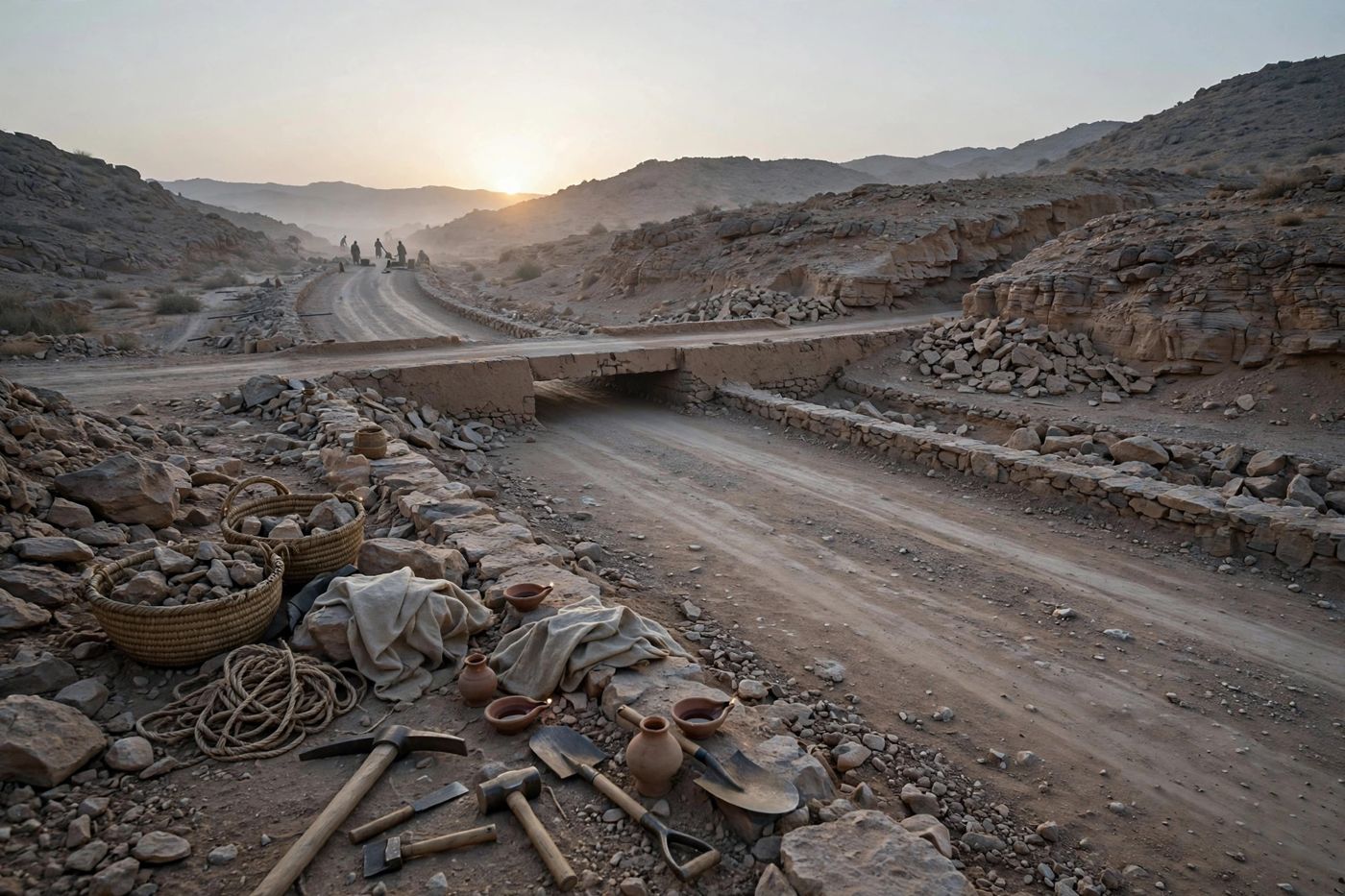
One more piece of the world: the king's highway. When a great king traveled in the ancient Near East, engineers went ahead: roads graded, valleys filled, passes cut down, so the procession could move unhindered. [16, 52] Verse 3 does not picture God struggling over obstacles; it pictures a coming so certain the landscape is regraded for it. In chapter 35 Isaiah had already sketched this highway — "the way of holiness" for the ransomed returning to Zion. That was a sketch. In chapter 40, the construction order is given. The voice does not say if. It says prepare.
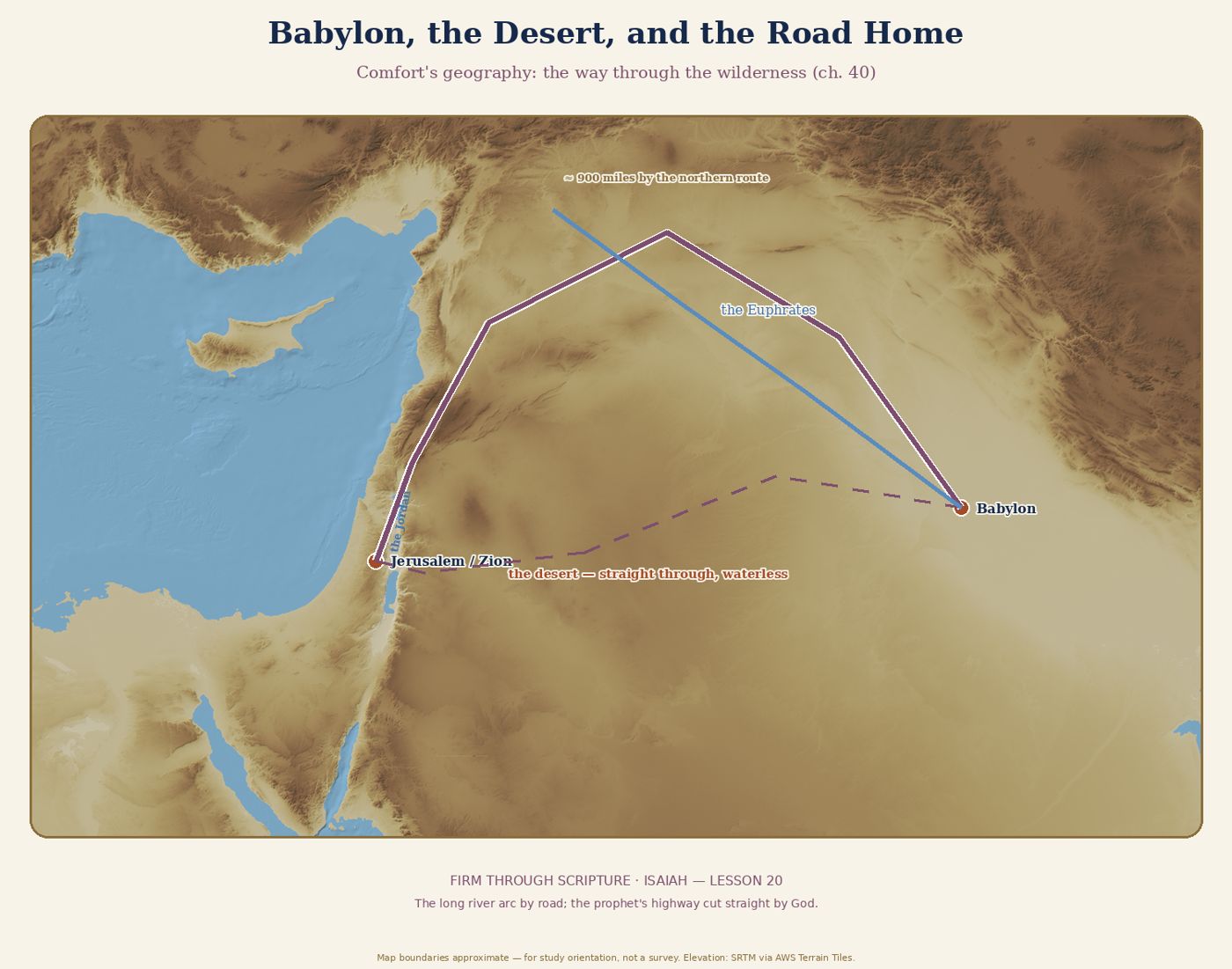
That is the world: a people at the far end of judgment, in the winners' city, under the winners' gods. Into that room, God says comfort twice.
3. OBSERVE — O: what the text actually does
Before meaning comes observation:
- Voices, voices everywhere. God commissions comforters (vv. 1–2). A voice cries in the wilderness (v. 3). Another voice orders a cry, and a questioner asks what to cry (v. 6). Zion becomes a herald (v. 9). Questions interrogate every comparison (vv. 12–26). Jacob-Israel's complaint is quoted (v. 27), then answered. The chapter is staged like a council chamber and a choir, not a lecture — its news is too big for one throat.
- The imperatives are aimed uphill. The commands are mostly not given to the exiles. Comfort ye — to the comforters. Prepare ye — to the road-builders. Lift up thy voice — to Zion. Lift up your eyes — to star-gazers. The broken people at the centre are given not a task but a posture: wait. Do not strip-mine this chapter into a to-do list for the exhausted. Hold that; it disciplines the Walk-Out.
- The questions do the arguing. Verses 12–26 carry more than a dozen questions. No idol or empire is refuted by counter-assertion; each is shrunk by a question the hearer must answer in his own head. Persuasion by interrogation — it works because the answers are obvious once the questions are asked in the right order.
- The grass bracket. Verses 6–8 come back disguised: inhabitants are "as grasshoppers" in verse 22, and princes wither when God blows on them in verse 24 — the same breath that faded the flower in verse 7. Empires are grass with armies. The chapter's botany is its politics.
- Small things and vast things keep changing places. Oceans fit in a palm (v. 12); nations are a drop, then dust, then less than nothing (vv. 15–17). Meanwhile lambs get carried against a chest (v. 11), and faint people with no might get an increase (v. 29). The scale is a sermon: everything men call huge shrinks; everyone God calls His gets carried.
- The ending lands lower than it starts — on purpose. Verse 31 climbs to eagles, then descends: run, then walk. The author spent his last clause on it. The great comfort chapter's final promise is not about soaring. It is about not fainting on an ordinary road.
4. GENRE — N: note the genre (prophetic poetry — the comfort oracle)
Isaiah 40 is prophetic poetry, and specifically the opening of a run of salvation oracles — speeches in which God announces deliverance before He performs it, in verse built to be heard, repeated, and carried. [15, 51] That genre label changes how you read almost everything here:
- Poetry argues by image and parallel, not by syllogism. Oceans in a palm and nations in a bucket are comparisons to be felt, in pairs — the second line sharpening the first. Where a line seems to restate its neighbour, it is usually adding the edge.
- A salvation oracle is a promise with an audience's despair in earshot. Every image answers a fear named in the room: we are forgotten (the muster of the stars), Babylon's gods won (the idol-satire), we have no strength left (verse 29). Prophecy is forthtelling first — God's word into a present crisis — even when it also reaches across centuries. 51
- Dialogue is a form, not a transcript. Voices question, answer, and proclaim, sometimes without name tags (vv. 1, 3, 6). Do not build doctrine on assigning every line a precise speaker where the text leaves the staging open; build it on what the whole exchange plainly says.
- Hyperbole in poetry is truth in its working clothes. "Less than nothing" (v. 17) is a poet's scale for what empires weigh against God — not a lab report, and not "just poetry" either. Isaiah's images make claims. They make them as images.
5. TERMS — T: the words in the writer's mouth
Three words carry this chapter. Learn them in the writer's mouth, and the famous verses stop floating free of the chapter that anchors them:
- Nachamu (na-kha-MOO), "comfort ye" (v. 1) — the doubled first word of the chapter, from the Hebrew root nacham: to comfort, to console, to relieve grief — the word used when comfort is brought to people who are actually mourning, not merely discouraged. [19, 3] It is a plural imperative: you-all, comfort. God does not say "be comforted" to the exiles; He commands others — His council, His messengers, His prophets — to go and comfort His people. The doubling is Hebrew emphasis at full volume: comfort, really comfort — and it is so defining that Jewish tradition named this whole second half of the book by it, and readers still call Isaiah 40–66 the Book of Comfort. After thirty-nine chapters in which the prophet's signature command was so often hear and woe, the new section renames itself with this word.
- "Double" (v. 2) — Hebrew kiflayim, a doubled portion, twice over. In Isaiah's wider usage the word-picture is of a full, corresponding measure — as when chapter 61 promises "double" honour in place of shame: not twice the suffering arbitrarily inflated, but a settlement that matches and closes the account. [19, 4] Hold the Terms discipline here: the word tells you the ledger is fully settled; the pastoral thunder of the verse is that there is no balance outstanding and no asterisk after "pardoned." Section 7 and Misread 1 do the careful work — for now, file the word where it belongs: in accounting, not in cruelty.
- "Wait" (v. 31) — Hebrew qavah: to wait with tension and expectation, like a cord pulled taut — the waiting of someone watching for a promised thing, not the waiting of someone killing time in a queue. [18, 19] It is the word of Psalm 27's closing charge and of Lamentations' "The LORD is good unto them that wait for him" 1. Isaiah's waiters are not passive; they are strung tight toward God. And note the promise's verb for what happens to their strength: they renew it — literally, they exchange it; they trade in spent strength and receive fresh strength in its place. The exchange is the doctrine. You bring the emptiness; God supplies the strength; the transaction is called waiting.
Method note — the word-study guardrail: a word means what its author uses it to mean, in its sentence, in its century. Every term above was settled by Isaiah's usage in Isaiah — a discipline that will matter twice here, for "double" and for "circle" (v. 22).
TRANSLATION NOTE — where does "in the wilderness" belong? (40:3)
Look at verse 3 in your KJV: "The voice of him that crieth in the wilderness, Prepare ye the way of the LORD…" In that punctuation, the voice is in the wilderness, and the preparing happens wherever God's road is needed. The ancient Greek translation, the Septuagint (LXX) — the Greek Old Testament made centuries before Christ — punctuated it the same way, and all four Gospels follow that reading when they apply the verse to John the Baptist, whose voice was literally in the wilderness. [24, 1] The Hebrew text's own traditional pointing and phrasing can be read the other way — "A voice cries: In the wilderness prepare ye the way of the LORD" — putting the wilderness with the preparing: the highway itself is to be built in the desert, which fits the exiles' road home exactly, and fits the parallel line, "make straight in the desert a highway for our God" 1. FACT: ancient Hebrew was written without punctuation marks, so this is a genuine, visible fork, not an error in anyone's Bible. This study's practice: teach both punctuations plainly, and notice that they are not rivals so much as two true camera angles on one promise — the road is built in the desert, and the herald who announces the greater coming cries from the wilderness. The canonical use — the Gospels' use — is honoured in full in the Entire Canon section below; the Hebrew road is honoured here. A beginner loses nothing by seeing the fork. He loses a great deal by being told forks do not exist.
6. ENTIRE CANON — E: where this passage sits in the whole story
No chapter in Isaiah stands more crowded with the rest of Scripture than this one. Trace the threads:
- Backward to chapter 35 — the highway already promised. Isaiah had seen this road before the hinge: a highway in the desert called the way of holiness, on which the ransomed return 1. Chapter 40 picks that sketch up and issues the construction order. The two chapters frame the Hezekiah history between them like covers: promise, crisis, promise resumed louder.
- Backward to chapter 6 — the council again. When Isaiah was called, he overheard a council — "who will go for us?" — and volunteered. The plural commands of 40:1–3 ("comfort ye," "prepare ye") have led many readers to hear another council scene, heaven's messengers commissioned as Isaiah once was. INFERENCE — widely held, honestly labeled: the text does not name the speakers, but the plural address and the staged voices fit the pattern of chapter 6, and the inference explains the chapter's choir-like opening better than any single-speaker staging. [3, 4]
- The Gospels open here — all four of them. When the New Testament needs a doorway for Jesus' story, it reaches for this chapter, every time. Matthew introduces John the Baptist with Isaiah 40:3. Mark opens his entire Gospel with it. Luke quotes the longest stretch, running through "all flesh shall see the salvation of God." John the Baptist, asked who he is, answers with nothing but this verse: he is the voice. 1 That is canon evidence of the heaviest kind: the apostolic writers did not treat verse 3 as a pretty line about a road. They treated it as the announcement script for the arrival of God in Christ — the highway of the exiles' return become, in its fullest landing, the road prepared for the Lord Jesus.
- Paul in the idol-courtroom. Arguing in Romans about the God who needs no advisers and can be put in no one's debt, Paul reaches for verses 13–14 of this chapter — "who hath been his counsellor?" — and sets it at the peak of his greatest doxology 1. The exiles' anti-idol argument becomes the apostle's argument against every human claim on God. Same God, same incomparability, larger room.
- Peter takes the grass. Preaching to scattered believers under pressure, Peter quotes verses 6–8 almost word for word — and then adds the interpretation in his own voice: this undying word "is the word which by the gospel is preached unto you" 1. The word that outlasted Babylon is identified, by an apostle, as the gospel message itself. What consoled exiles is what converts sinners; Peter says it is one and the same word.
Laid out flat, the New Testament's use of this one chapter looks like this:
| Isaiah 40 says… | The New Testament hears… | Which means… |
|---|---|---|
| The voice in the wilderness (v. 3) | John the Baptist, in all four Gospels 1 | The highway's fullest landing is Christ's coming |
| The word stands for ever (v. 8) | Peter: that word is the gospel preached (1 Pet. 1:25) 1 | The exiles' consolation and the church's gospel are one word |
| No counsellor taught Him (vv. 13–14) | Paul's doxology in Romans 11 1 | The incomparable God can be owed nothing by anyone |
| The Shepherd gathers lambs (v. 11) | Jesus: "I am the good shepherd" (John 10) 1 | The coming God of v. 9 steps into His own portrait |
7. THE MEANING — what the passage teaches
The Walk has established what the text says and where it sits. Now its payload, taught straight — in the chapter's own order, because the order is part of the teaching.
The commission: comfort is an order God gives (40:1–2)
Begin where God begins — not with the exiles' feelings, but with His command. Three things in two verses carry the weight.
First, whose people. Judgment has not revoked the possessive. After the lawsuit of chapter 1, the woes, the axe, and the exile itself, the new section's first word about Israel is my people — and the speaker is "your God." Covenant language, deliberately warmed. Comfort does not re-elect Israel; it announces God never un-elected her.
Second, the address of the tenderness: "Speak ye comfortably to Jerusalem" — literally, speak to the heart of Jerusalem, the Hebrew idiom for words aimed past the ears at the place where fear and resolve live [19, 3]. God is not issuing a press release. He is courting her — speaking tenderly, as Hosea said He would, to the heart of a city He judged. That is the register for the rest of the book.
Third, the ground of the comfort — entirely past tense. Her "warfare is accomplished": a term of hard service, a conscript's tour, completed — its time is up [19, 4]. Her "iniquity is pardoned." And the reason is the settlement: she has received "double for all her sins" — the account answered in full, the ledger closed. The pastoral point is not a quantity of suffering to audit (Misread 1 defends this at length). It is that comfort can now be preached without an asterisk. Every comfort in the chapter is preached downstream of a pardon already pronounced. Pardon first; then everything else grows out of it.
The voice: God is coming, so build the road (40:3–5)
We build roads hoping someone important will come. This road is built because the coming is certain: "for the mouth of the LORD hath spoken it" is the chapter's foundation stone, laid in verse 5.
Every valley exalted, every mountain made low, the crooked straight, the rough places plain — not pothole repair but the regrading of a landscape, meant at two levels the honest reader keeps together. First, the exiles' road: God will bring His people home across country that should make return impossible; no terrain vetoes His promise. Second, moral topography: pride is a mountain, despair is a valley, and the highway runs over both — the high things exalted against God's coming, and the low places that say He will never reach down here.
And the destination is a revelation: "the glory of the LORD shall be revealed, and all flesh shall see it together." Not Israel alone — all flesh. The exiles' rescue is staged from its first announcement as a public event the nations will witness; Luke, quoting this passage, hears in it "the salvation of God" for all flesh 1. God's comfort was never a secret to keep in Babylon. It was meant to be seen — which is why the preparation is so loud.
Grass and word: the ground that cannot wither (40:6–8)
A second voice interrupts. A voice says, Cry. A speaker asks the obvious pastoral question: "What shall I cry?" What do you preach to people whose world has ended? The answer is not, at first hearing, comforting: All flesh is grass.
Stand inside that image in its own climate. Spring grass and wildflowers blaze for a few weeks, then the hot desert wind shrivels them in days — everyone listening had watched it yearly. The flower, the showiest part, fades fastest: "all the goodliness thereof" — all human glory — is the flower part. And verse 7 removes every escape hatch: "surely the people is grass." Not only Babylon. The people, God's own hearers, are grass. The breath of the LORD blows on all flesh alike.
Why is that the first cry? Because comfort built on human permanence is a fraud. Any hope founded on "our nation will recover" or "you are young and resilient" will be scorched by the same wind. So the voice drives hearers down to the one thing the wind cannot touch: "but the word of our God shall stand for ever." The chapter's comforts rest on a spoken word — and the claim is that a word from this God is the sturdiest thing there is: spoken in Isaiah's century, standing in the exiles', and — Peter adds — the living content of the gospel in ours [1, 3]. Not "things will last," but "you will not last, and neither will Babylon — the promise will, because of who made it."
The herald and the shepherd: Behold your God (40:9–11)
The casting startles. The herald is not a prophet, angel, or king. "O Zion, that bringest good tidings… O Jerusalem, that bringest good tidings" — in the Hebrew the herald-word is feminine, and the evangelist is the city herself: Zion, yesterday's rubble and defendant, sent up the mountain as today's town-crier [3, 4]. Taught plainly: the comforted become the comforters. The first evangelist of the Book of Comfort is the forgiven city, shouting to her own scattered towns the message she has only just believed. Her instruction is every herald's: lift up thy voice with strength; lift it up, be not afraid. The news is not fragile, and it does not need to be whispered in Babylon's hearing.
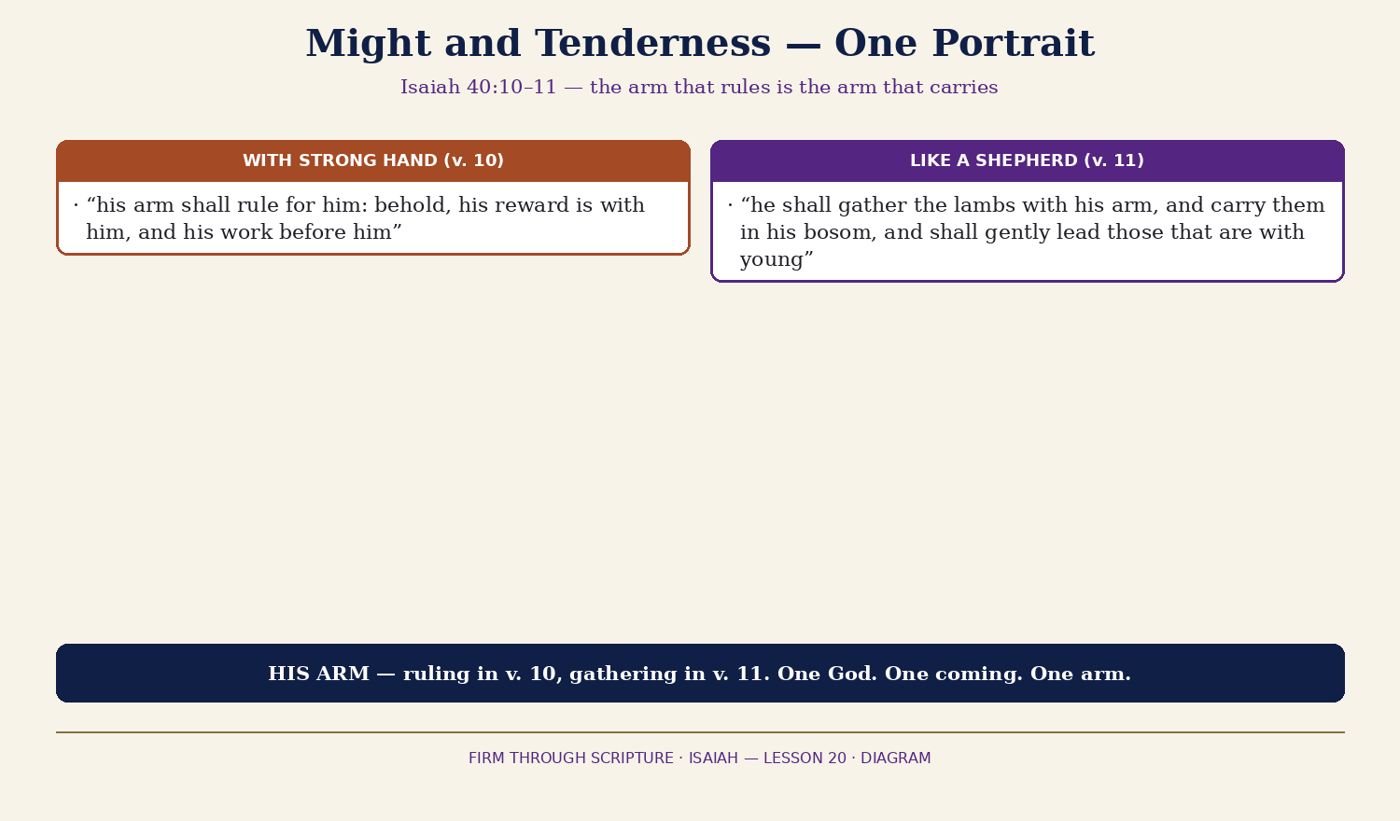
What she shouts is three words: "Behold your God!" Not improved circumstances, not a plan — a person arriving. Verses 10 and 11 paint that arrival in two panels, and teaching them as one portrait is this chapter's thesis.
Panel one (v. 10): He comes "with strong hand," His arm ruling, His reward with Him — a king returning from victory with the rescued in His train. Power that accomplishes: the exile will not end by Babylon's permission slip but by this God's arrival.
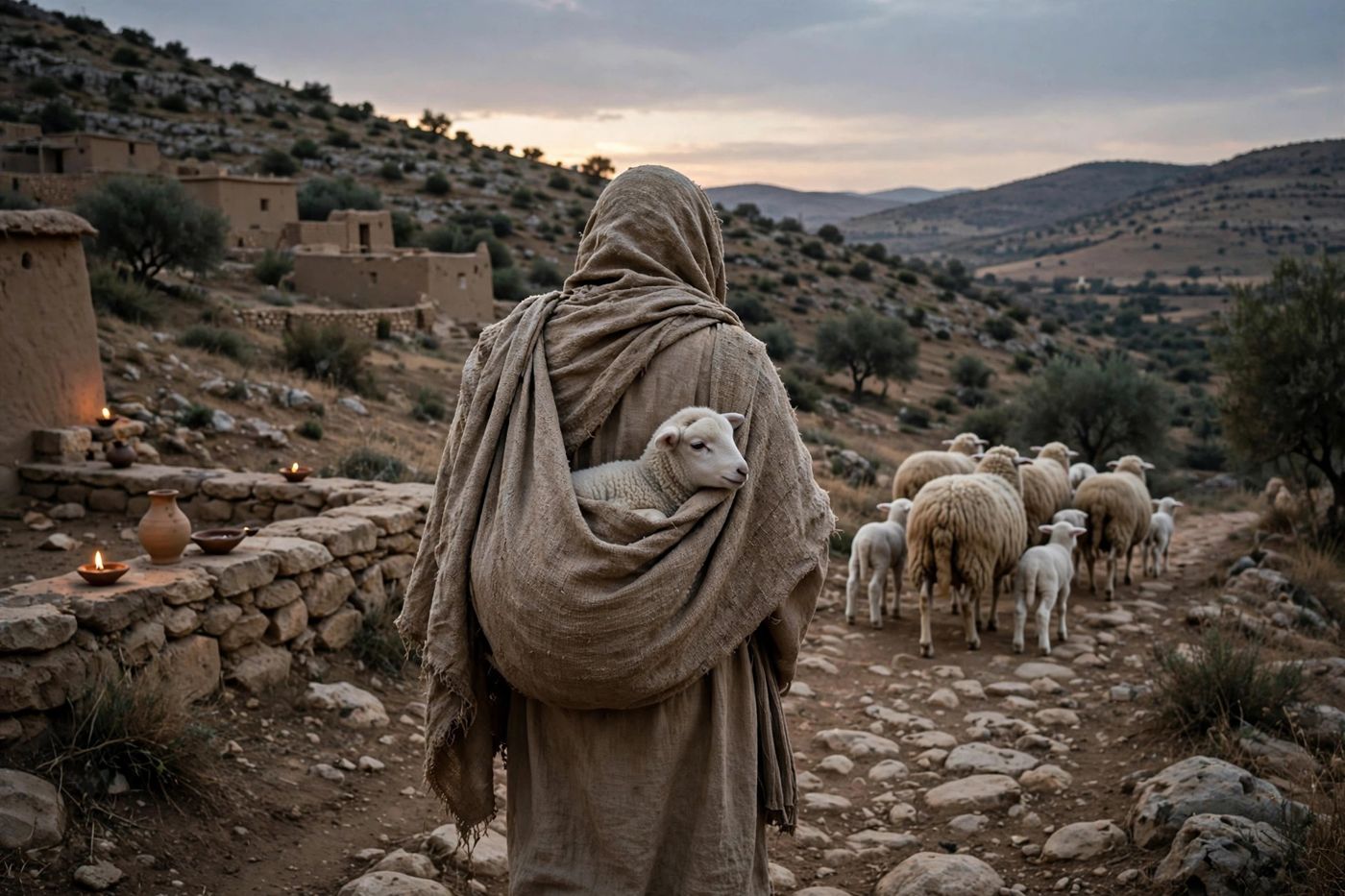
Panel two (v. 11), in the very next breath, with no transition because none is needed: "He shall feed his flock like a shepherd." And notice — it is the same arm: the arm that rules in verse 10 gathers lambs in verse 11. Lambs cannot keep up, so they are carried, "in his bosom" — against the chest, at the heartbeat. The ewes "with young," slow and burdened, are not driven at the flock's pace; He "shall gently lead" at theirs. Might and tenderness are not alternating moods. The strength is for the lambs, and the tenderness is what omnipotence looks like when it stoops. A God of verse 10 only would terrify the exiles; a God of verse 11 only could never get them home. Isaiah fuses them: behold that God.
The incomparable God: questions against the idols (40:12–26)
The chapter's longest stretch is an interrogation aimed at the 3 a.m. thought of every exile: maybe Babylon's gods really are bigger.
The measures (v. 12). Who has held the oceans in the hollow of a hand? Who has spanned the heavens, scooped the earth's dust into a measure, set mountains on scales? Tradesman's verbs, applied to a God for whom creation is hand-scale work. The point is not that God is large like Babylon. The categories of large and small were invented by Him and do not contain Him. [16, 3]
The counsellor (vv. 13–14). Who directed God's Spirit? Who was His tutor "in the path of judgment"? Silence answers: God has no advisers, no teachers, no debts to anyone's wisdom. Paul quotes exactly this silence at the climax of Romans and turns it into worship 1. He was never anyone's junior partner in history.
The nations on the scales (vv. 15–17). The empires shrink at every step: "a drop of a bucket," the bead that falls unnoticed; "the small dust of the balance," too light to move the needle; Lebanon's forests not firewood enough, its animals not offerings enough, for one worthy sacrifice. Then the verdict, in the poet's hyperbole (§4): all nations "less than nothing, and vanity." Babylon, the empire that ate nations, weighs in at dust on the pan. Accounting, done at God's scale, for people who needed the figures redone.
The idol-satire — its first laugh (vv. 18–20). "To whom then will ye liken God?" The camera cuts to a workshop. A workman casts an image; a goldsmith plates it with gold — the rich man's god. Then the poor man's: he chooses "a tree that will not rot" and hires the best craftsman he can afford to make a god "that shall not be moved." Sit with the absurdities: the god must be made, plated to look like more than it is, rot-proof lest it decay, engineered not to topple. The exile walking past Marduk's procession is taught to see the workshop behind the parade. [16, 4] This is only the satire's first pass — chapter 44 expands it into the full workshop comedy (Lesson 22) — signposted here, not exhausted.
The circle, the curtain, and the grasshoppers (vv. 21–24). "Have ye not known? have ye not heard?" The exiles are recalled to the oldest news. He "sitteth upon the circle of the earth," enthroned above the whole horizon, from whose height "the inhabitants thereof are as grasshoppers" — grass again, now as altitude. He stretches the heavens "as a curtain," spreads them "as a tent to dwell in." Princes He "bringeth… to nothing": barely planted when He blows on them — the breath that withers grass — "and the whirlwind shall take them away as stubble." Empires feel eternal from underneath. From above the circle, they are annuals.
An honest note on verse 22: the Hebrew is chug — a circle drawn with a compass, the ring of the horizon where sky meets earth as a watcher sees it [19, 20]. FACT: it describes the visible horizon-circle; it is not the word for a ball, and the verse is not a geometry lesson. Its claim faces upward, not outward. Misread 3 handles the proof-texting; the honest reading loses nothing.
The muster of the stars (vv. 25–26). God asks again, in v. 25, whom anyone will liken Him to — "saith the Holy One." Then the gentlest command: "Lift up your eyes on high." Above Babylon's astrologers and star-gods, the heavens are an army on parade: God "bringeth out their host by number" and "he calleth them all by names" — "not one faileth." Not one deserts, is lost, or is mislaid. Hear it as built: the people about to say our way is hid from the LORD are told their God runs a nightly roll-call of the stars and has never come up short. Those heavens are not Babylon's fate-map. They are His muster.
The complaint and the promise: the God who gives what He is (40:27–31)
The chapter ends by having its hardest conversation — and God quotes the complaint Himself, at full strength, in His people's own words.
In v. 27 God quotes them: "My way is hid from the LORD, and my judgment is passed over from my God." Two charges hide in that sentence. My way is hid — God cannot see me; my address in Babylon is off His map. My judgment is passed over — legal, and stronger: my case, the justice owed me, has been skipped in court. Together: God has lost our file, and even if He found it, He has decided not to act. It is the exact conclusion fifty years of exile were engineered to produce — and God does not rebuke them for thinking it. He answers with a portrait, then a gift.
The portrait (v. 28): "the everlasting God, the LORD, the Creator of the ends of the earth, fainteth not, neither is weary." Everlasting — a people's fifty years are not God's fifty years. Creator of the ends of the earth — including the end where Babylon sits; no address exists where His creatorship lapses. And He does not tire: the exile wore people down by duration, decades of Tuesdays, and a God who fainted might have started the rescue and flagged. "There is no searching of his understanding" — their case is not a file that can be mislaid; it is held in an understanding no one can plumb.
Then the gift (v. 29), the hinge of the chapter: "He giveth power to the faint; and to them that have no might he increaseth strength." God does not merely possess untiring strength; He gives it — and note the recipients. Not the strong, topped up. The faint. Not the capable, assisted. Those with "no might" — zero in the account — get an increase. Divine strength here is not a matching grant for the nearly-coping. It is a gift aimed precisely at depletion.
Verse 30 clears the last rival reservoir: "Even the youths shall faint and be weary, and the young men shall utterly fall." Peak human vigour also runs out — shall faint, shall utterly fall. Every door is closed except one, so no hearer leaves still trusting a reservoir — empire, idol, nation, or his own young legs — that the text has not already emptied.
Then the last verse, defended in the Misread from being floated off as a motto: "But they that wait upon the LORD shall renew their strength." The waiters — the qavah people of §5, strung taut toward God — make the great exchange: spent strength traded in, His strength taken on. And the results descend, deliberately: "they shall mount up with wings as eagles" — the rare, soaring moment, real and promised; "they shall run, and not be weary" — the demanding season sustained; "and they shall walk, and not faint" — the ordinary road, where almost all of a life is lived. The promise ends on walking because walking is where it is mostly needed. Exiles do not mainly need to fly over Babylon. They need to get up in Babylon, for years, and not faint — to farm, raise children, keep the faith, and hold on for a road home they cannot yet see. Isaiah's God meets His people at the altitude of a Tuesday. The eagles are real. But the last word is walk.
The Christ Thread
Isaiah 40 earns its Christ Thread the cleanest way a chapter can: the New Testament opens with it. All four Gospels introduce Jesus' ministry under this chapter's banner — the voice in the wilderness is John the Baptist, by his own testimony as well as the evangelists' 1. So verse 3's "our God" and verse 9's "Behold your God" reach their fullest landing, in the canon's own reading, at the coming of Jesus: the God whose highway the exiles awaited arrives in Christ, and the road home from Babylon becomes the road of repentance into His kingdom. Add the Shepherd: the arm that gathers lambs is confessed by Jesus Himself — "I am the good shepherd" — who gathers, carries, and lays down His life for the flock [1, 4]. Add Peter's identification of the undying word as the gospel preached 1. No type invented, no symbolism forced: the apostles built this thread themselves, out of this chapter, in public.
Where in the Covenant Story?
Chapter 40 is the covenant story at its great hinge. Behind it: creation (its God is defined first as Creator), the exodus (desert road, eagles' wings, a second deliverance modelled on the first), Sinai, the kings, the prophets' lawsuit — and the covenant curses, which the exile was, fallen in full. Ahead: pardon announced before return is performed, a remnant carried home, and a glory "all flesh shall see together." The chapter proves the covenant survives its own curse-stage: God's promises were not cancelled by God's judgments, because the same mouth spoke both, and that mouth's word "shall stand for ever." Every later mercy — down to the new covenant's promise that sins will be remembered no more — preaches in this pattern: judgment spent, pardon pronounced, then the road home built.
The Long View — what the church has believed
The church has always known this chapter was a doorway. The earliest Christians heard John's voice in it before the Gospels were written down, and the evangelists fixed that hearing in Scripture. The ancient church read the comfort chapters as the gospel in advance — Isaiah was sometimes called almost a fifth evangelist, a saying that tells you how saturated these chapters felt with Christ to their first Christian readers. [37, 45] Calvin, preaching this chapter to another displaced and frightened people, pressed its own point: comfort rests not on the church's strength but on the word of a God who cannot be measured, and therefore cannot be thwarted. 36 Where the centuries have honestly divided over chapter 40 is its composition — kept, by this program's rule, in Lesson 00 and §16, argued in the open. About what the chapter says, the church's reading has been remarkably of one mind: pardon is pronounced, God is coming, idols are nothing, and the faint who wait on Him receive strength that is not their own. The divisions cluster at the edges. The centre — the Comforter — has held.
8. THE AIM SENTENCE — X: eXplain the intent
Everything observed now compresses into one sentence — the author's intended meaning, stated before any application is allowed near it:
To a people in Babylon sure that God had lost their file, Isaiah 40 announces that their pardon is settled and their God is coming down a desert highway Himself — incomparable over every idol and empire, a ruler whose ruling arm gathers lambs — to give His own untiring strength to all who have none and wait on Him.
If a sermon, a post, or a devotional uses Isaiah 40 to say something that cannot be traced back to that sentence, it is not this chapter talking. That is the whole skill this course exists to build — and the next section is where you watch it work.
9. SAY IT BACK
Close the book and say the AIM sentence from section 8 in your own words — out loud, or written in your notes, without looking. Then say, in one more sentence, what it asks of you this week.
If your version quietly changes the meaning — settled pardon become vague hope, or the promise to the faint become a prize for the strong — walk it again. This exercise is the entire course in miniature: meaning first, then — and only then — your life.
10. THE MISREAD — the guardrail, with verdicts
Three live misuses of this chapter. Each gets a fair hearing, the evidence, and a verdict.
Misread 1: "'Double for all her sins' (v. 2) means God punished Jerusalem twice as much as she deserved — a God of overkill, whose comfort arrives only after excess cruelty." Why it sounds right: "double," in plain English, sounds like two helpings. If her sins earned one measure and she received two, the arithmetic looks unjust. The evidence: the arithmetic is English, not Hebrew. Isaiah's own usage controls the word (§5): when this book promises the restored people "double" in place of their shame (ch. 61), the doubled portion is the full, corresponding measure that answers and closes the shame — abundance as settlement, not surplus cruelty [19, 4]. In the ancient accounting idiom, to receive "double" at a debt's settlement is to have the account answered in full; the books are then closed — precisely verse 2's logic, where the "double" is the reason comfort can be preached: warfare accomplished, iniquity pardoned, account closed. FACT: the verse gives no ratio of suffering to desert; it gives a status — settled. And notice the speaker: God is not boasting of excess. He is sending comforters to a city that might forever ask whether some balance still hung over it. The sentence exists to end that question — answered from the idiom's evidence, not by embarrassment. Verdict: "double" is a ledger closed in full, not a punishment doubled in spite. The real scandal is the opposite one: that God declares the account settled and sends comfort at all.
Misread 2: "Isaiah 40:31 is my personal motto — a private promise that God will make me soar over my problems." Why it sounds right: the verse is magnificent, first-person application feels natural, and it really is for believers today — Peter carries this chapter's words to scattered, pressured Christians 1. The evidence: the verse has an address — plural, corporate, exilic. The "they" who wait are introduced in verse 27 as Jacob-Israel, a nation lodging a legal complaint that God has overlooked its case; the promise answers a people's despair under an empire, not an individual's hard week. Detached, the verse is quietly inverted: as a motto it promises escape from the ordinary (soaring over problems), while in its chapter it climaxes in endurance within the ordinary — walking and not fainting is its final clause and main theater. Its condition is a posture — waiting upon the LORD, §5's taut hope — and its promise is an exchange of strength, not a discovery of your own reserves. Application to you is real, but it travels by the Transfer Tests (§13), not by cutting the verse off its chapter. Verdict: a corporate rescue-promise before it is a personal encouragement — and stronger for it. You are not promised a private exemption from the road. You are promised the strength of the God who carried a nation down it.
Misread 3: "'The circle of the earth' (v. 22) proves the Bible taught the earth's shape — a scientific claim hidden in Isaiah." Why it sounds right: "circle" is really there, the verse is ancient, and a God who made the earth surely knows its shape — so the proof-text feels like honouring the text. The evidence: the Hebrew is chug, the circle drawn with a compass — the ring of the horizon as a watcher on the ground sees it [19, 20]. FACT: the verse's own emphasis falls not on shape but on scale and throne: He sitteth upon it, and from up there the inhabitants are grasshoppers. Pressing it into geometry does two harms: it stakes the Bible's truth on a claim the Hebrew does not make (a reader who checks the word feels bluffed), and it misses the larger claim the verse does make. FIRM teaches the word accurately and does not proof-text science from poetry. Verdict: the verse claims majesty, not geometry. Teach chug as the horizon-circle, let the grasshoppers preach, and never build a cosmology on a compass-drawn ring.
11. FROM WORD TO WALK
A reflection page — the lesson is not finished until the passage has had its say with you.
Sit with verse 27 before you rush to verse 31, because most of us quote the promise and skip the complaint — and God did not skip it. He wrote the complaint into His own book, in His people's own words, and then answered it. "My way is hid from the LORD" is not polite, tidy prayer. It is an accusation, brought by people with fifty years of evidence in a row. And heaven's response was not a rebuke for irreverence. It was a nightly roll-call of stars — not one faileth — a portrait of a God who cannot tire, and an offer of strength to people with none. If your prayers have gone flat because you have been editing out the complaint, this chapter gives it back to you. Bring the real sentence.
And sit with the order of the giving. God does not wait for the exiles to recover strength before He speaks. He speaks comfort into the depletion, and reserves His strength-transfer for those whose own account reads zero. The qualification for verse 29 is not improvement. It is admission. The faint qualify. The empty qualify. This chapter gently forecloses every private reserve — even the youths shall faint — and the good news is the foreclosure's other side: He giveth.
One more thing. The evangelist of verse 9 is Zion herself — the forgiven city, shouting. Comfort that is real does not terminate on the comforted. Somewhere in your life there is a city of Judah — a person or household living at a Babylonian address of their own — for whom you, precisely because you have been carried, are the appointed herald. You do not need a mountain, exactly. You need the refusal to whisper. Be not afraid. Behold your God.
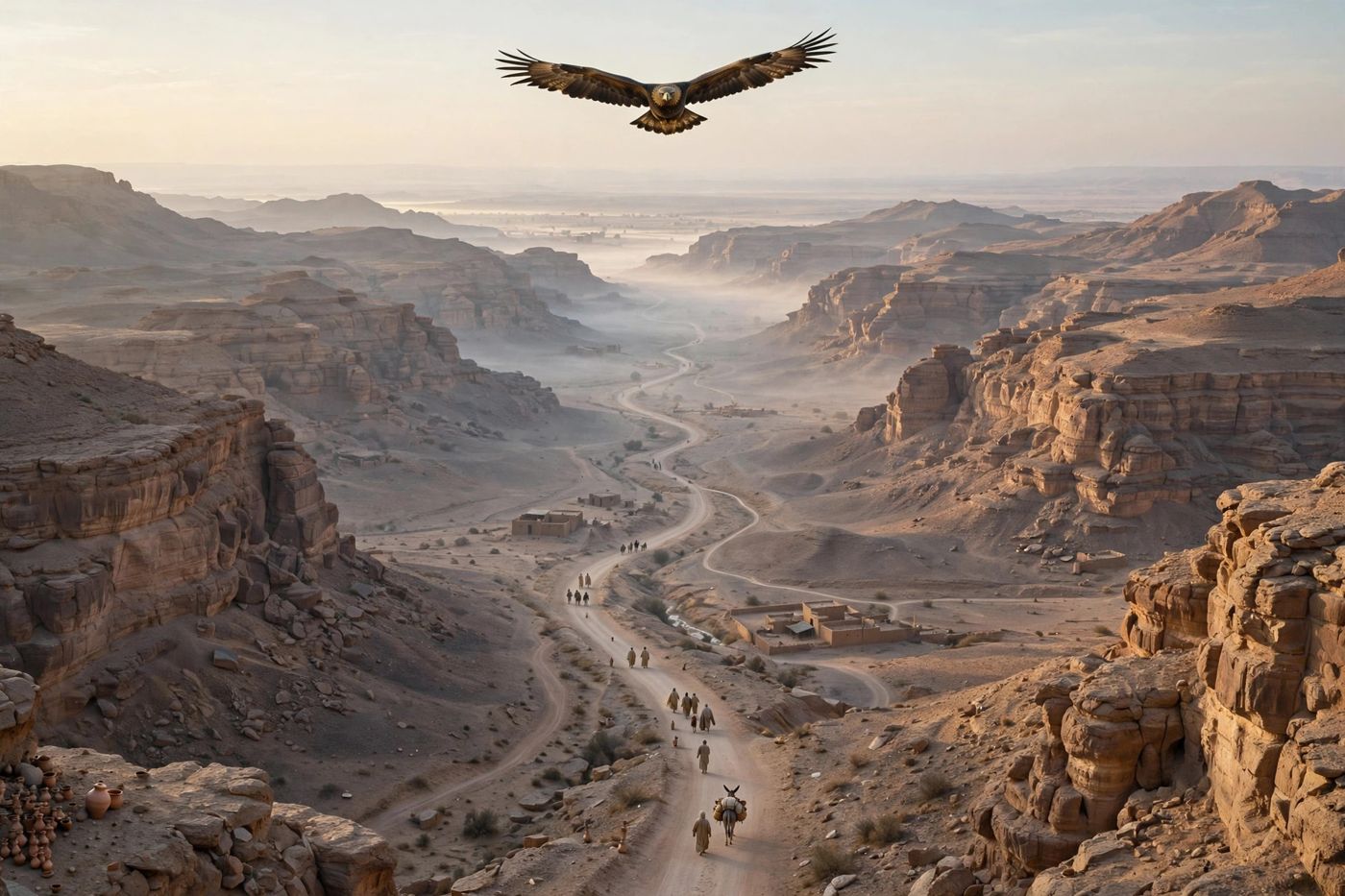
Everlasting God, Creator of the ends of the earth — I bring You my real complaint, the one I have been too polite, or too proud, to say: there are places where my way has felt hidden from You. Answer me the way You answered Jacob: not with my file, but with Yourself. I have no might to trade You; take my spent strength anyway, and give me Yours — enough to walk today and not faint. And make me, who have been comforted, a voice of comfort to someone still sitting by Babylon's canals. In Jesus' name, amen.
12. FOR DISCUSSION — OR FOR YOUR JOURNAL
With a group, work these aloud. Alone, they're yours — answer them in your journal or in prayer; they lose nothing in the quiet.
- God commands comfort for Jerusalem on the ground that her account is already settled (v. 2). Where in your own life are you still living as if a balance hangs over you that God has declared closed — and what would change if you believed the ledger line?
- Verses 10–11 hold the ruling arm and the lamb-carrying arm in one portrait. Which half do you instinctively trust, and which do you quietly doubt — and what has taught you to split them?
- The exiles' complaint — "My way is hid from the LORD" — is quoted by God without rebuke (v. 27). What is the honest complaint you have never actually prayed? What does it change that He answers complaints with a portrait of Himself and a gift, rather than an explanation?
- Verse 31 descends: fly, run, walk. Where is your "walking" right now — the ordinary stretch where fainting is the real temptation — and what would waiting on the LORD, as opposed to merely enduring, look like there this week?
13. THE WALK-OUT — T: Transfer to today
Meaning is settled. Now — and only now — application, and it must cross the bridge honestly. Run the five Transfer Tests on this passage:
- Same covenant? The pardon of verse 2 was announced to exiled Israel under the old covenant; we receive pardon in the new covenant, through Christ, in whom this chapter's undying word is preached as gospel (1 Pet. 1:25) 1. The pattern — God pronounces pardon, then builds the road — crosses intact. The exile's specific return is not re-promised to us as a timetable for our circumstances.
- Same audience? The first hearers are a nation sure it was forgotten. What reaches the individual believer reaches him as a member of God's people — not as a private owner ripping verse 31 off the wall. Pray it personally from inside the people of God.
- Same genre rules? Prophetic poetry and salvation oracle: it announces what God has done and will do before it instructs. So this chapter yields trust, posture, and proclamation first, and practices second — and no practice may contradict the announcement it grows from.
- Repeated or rooted? Waiting on the LORD with taut hope, God's strength given to the weak, God as shepherd carrying His flock, the word standing forever — each is repeated across the canon and rooted in God's character, from the eagles' wings of the exodus to the Good Shepherd to Peter's gospel [1, 52]. These cross with full weight.
- Ten verses either side? Every application below is drawn from the chapter read whole — pardon before practices (vv. 1–2), the herald comforted-then-shouting (v. 9), the God who gives to the empty (v. 29). Nothing hangs on verse 31 alone.
The crossing, at a glance:
| From the chapter… | …to your week |
|---|---|
| Pardon pronounced before the road is built (v. 2) | Live from a closed ledger, not toward one |
| Zion comforted, then heralding (v. 9) | Comfort received becomes comfort spoken |
| Strength given to the faint who wait (vv. 29–31) | Ask for the exchange; walk, and do not faint |
What crosses — and lands:
-
Led by what God has done (the indicative): before any practice, the chapter's gifts stand. God has declared the account of His people settled in Christ. He has come, in Jesus, down the very highway this chapter graded. He has never lost a star, a case, or a person He calls by name. And He gives strength — as a gift, to the faint, today. Application that starts anywhere else starts in the wrong place.
-
Comfort is commanded speech. God comforts His people through comforters; Zion comforted becomes Zion heralding. If you have received comfort in a hard season, you are not merely its beneficiary. You are, in this chapter's casting, its next voice.
- Waiting is the appointed posture of the strengthless. Not resignation, not spiritual numbness — qavah, the taut cord: expectant, watching, strung toward a God who has announced He is coming. The strength arrives in the waiting, by exchange. There is no verse in this chapter that promises strength to those who will not wait because they are busy trusting their own.
- Walking is a promised theatre of glory. The God of eagles' wings spends His last clause on ordinary walking. Faithfulness in the unglamorous stretch — the job, the illness, the long care of another person, the years-long prayer — is not the consolation prize for people who never soar. It is the promise's home address.
Practices — what the gate lets through, made concrete this week:
- Pray the complaint honestly. Once this week, in your own words, pray verse 27's sentence about your actual life — where your way feels hidden, where your case feels passed over. Say it to God, not about Him. Then read verses 28–29 aloud as His answer, slowly, twice.
- Close one ledger. Name one settled thing you keep re-litigating — a forgiven sin, a confessed failure God has pardoned in Christ. Write it down, write "pardoned — Isaiah 40:2" beside it, and when it reopens this week, answer it with the written line instead of a fresh trial.
- Comfort one exile. Identify one person living at a Babylonian address — displaced, forgotten-feeling, far from home in body or in heart. This week, speak to the heart: not advice first, but the actual news, in words — Behold your God; He has not lost you. A visit, a call, a letter; not a forwarded slogan.
- Practise the exchange daily. Each morning, before the day's demands, pray verse 29 in the first person: confess the specific faintness you woke with, by name, and ask for the transfer — His strength for the day's walking, not just its emergencies.
- Memorize Isaiah 40:31 whole, in order — fly, run, walk. The descending order is the point; learn it as written, and let the last clause preach to you on the most ordinary day of the week.
What does not cross: verse 31 as a guarantee of soaring outcomes, promotions, or healings on your schedule; verse 2 as a licence to audit how much suffering anyone "deserved"; verse 22 as a science text; and the exiles' return as a promise that God will restore your preferred circumstances on the exiles' pattern. The gate is not there to shrink the chapter's claims on you — it is there to make sure the claims that land are the ones God actually made, which are larger.
Praise Him
Everlasting God, Creator of the ends of the earth — we praise You because You faint not, neither are weary, and because the strength You never lose You love to give. Your word stands for ever when our glory is already grass. You call the stars out by name and not one faileth; You call lambs by armful and not one is left to keep up alone. Behold — You are our God: the arm that rules, the bosom that carries, the voice that says comfort ye over a people who deserved a closed door and found a highway. All flesh shall see Your glory together, for Your mouth has spoken it. Amen.
14. THE RECAP CARD — this study on one page
Print it. Keep it where you'll see it this week.
- The passage: Isaiah 40:1–31 — Book Two's overture: comfort commanded, the highway built, the incomparable God, and strength for the faint.
- Say It Plain: Jerusalem's hard service is over and her sin pardoned; God is coming down a desert highway; people are grass but His word stands forever; He rules with a strong arm and carries lambs with the same one; and He gives His untiring strength to people who have none and wait on Him.
- The AIM: To a people in Babylon sure that God had lost their file, Isaiah 40 announces that their pardon is settled and their God is coming down a desert highway Himself — incomparable over every idol and empire, a ruler whose ruling arm gathers lambs — to give His own untiring strength to all who have none and wait on Him.
- Key terms: nachamu — comfort ye, the doubled command that renames the book · "double" — the full, corresponding settlement; the ledger closed · "wait" (qavah) — taut, expectant hope; strength by exchange.
- The Misread, in one line: "double" is a closed ledger, not doubled cruelty · 40:31 is a nation's rescue-promise before a private motto · the "circle" is the horizon's ring — majesty, not geometry.
- Memory verse: "But they that wait upon the LORD shall renew their strength; they shall mount up with wings as eagles; they shall run, and not be weary; and they shall walk, and not faint." — Isaiah 40:31
- This week's practice: pray the complaint honestly (v. 27), receive the answer (vv. 28–29), and comfort one exile with your own voice.
15. CHECK YOURSELF — five questions
Answer from the study, not from instinct. (Answers live in the Teacher Edition.)
- In your own words: what is the AIM of Isaiah 40:1–31?
- Verse 2 grounds comfort in three past-tense facts. Name them — and explain what "double" means there, and what it does not mean.
- Verses 10 and 11 sound like two different Gods. Using the shared "arm," explain why they are one portrait — and why the chapter needs both halves.
- A friend has Isaiah 40:31 as a phone wallpaper and reads it as a private promise of soaring over problems. Using the chapter's audience and the verse's own order (fly, run, walk), show what the motto-reading misses.
- In verse 3, where can "in the wilderness" belong? Give both punctuations, say which one the Gospels follow, and name two other New Testament uses of this chapter given in §6.
16. GO DEEPER
Optional — for readers who want the machinery. The lesson is complete without it.
From the Sources — Babylon's stars, and a nightly roll-call
Babylon's priests were the ancient world's great sky-watchers, with a religion in which the great gods were written in the heavens and fate could be read off them. [16, 30] FACT. That sharpens verse 26 from scenery into polemic: Isaiah sends exiles under the very sky Babylon claimed as its scripture, and has their God call the host out "by number," name them all, and lose none. INFERENCE — the anti-astrological edge is the standard reading in context (the idol-satire stands six verses away), but the label stands: the text states the muster; the Babylonian target is inferred from the address. The exiles' sky was not a fate ruling them. It was a parade their God reviewed nightly.
The Honest Argument — who is speaking in chapter 40, and when?
The argument Lesson 00 (§16) keeps in the open belongs here in outline, because chapter 40 is where the critical case is strongest. The case for a distinct exilic voice behind chapters 40–55, classically crystallized by Duhm 40 and the critical tradition after him: the audience is exilic, Babylon is the present power, Jerusalem's fall is assumed as past, and a Persian king will shortly be named by name (44:28; 45:1) — all of it, on a naturalistic view of prophecy, most easily explained by an author standing in the exile himself. [43, 9] FACT — about what the text assumes and addresses; the lesson above taught that address at full strength and built nothing by hiding it. The case for the book's unity as Isaiah's witness: the chapter stands in one scroll with chapters 1–39 in the earliest complete witness, the Great Isaiah Scroll 22; its themes, images, and signature title for God — "the Holy One of Israel," on Isaiah's lips since chapter 1 — run unbroken through all three parts of the book [3, 4]; and the New Testament cites words from across the book, including these comfort chapters, under the one name Isaiah 1. POSITION — this program's labeled reading: the book is Isaiah's, one prophet's witness read whole; a God who names Cyrus ahead of time is not an embarrassment to that reading but, in 45:3–4, its stated point. What no honest party may do is argue in a circle: "it must be late, because prophecy cannot name the future" assumes what it claims to prove, and "the question may not be asked, because the book is Scripture" refuses evidence the book itself invites us to weigh. The charges are DISPUTED; the comfort, on either side of the argument, is the text's own, and it stands.
The Word Underneath — chug, the drawn circle
Verse 22's chug comes from a root meaning to draw a circle — a compass-word, used also in Proverbs 8 for the circle set on the face of the deep, and in Job for the boundary where light meets darkness. [19, 20] FACT: in every use, the picture is a boundary-ring perceived on a surface — the horizon as a watcher experiences it — never a three-dimensional solid surveyed from space. INFERENCE: Isaiah's hearers, under a sky that visibly domed to a circular horizon, would have heard exactly that — the whole ring of the visible world has a throne above it. The honest word study gives the preacher more than the proof-text did: not a geometry debate, but a worshipper's skyline, with God enthroned above all of it — and grasshoppers below who are, per verse 11, carried anyway.
| The case as stated… | Its strongest ground | Its honest label |
|---|---|---|
| A distinct exilic voice wrote 40–55 | The exilic address; Babylon present, fall assumed | DISPUTED |
| One Isaiah, read whole | One scroll in the earliest witness; the New Testament's one name | POSITION (this program) |
Go Read
- Oswalt, The Book of Isaiah, Chapters 40–66 (NICOT) 3 — the comfort chapters read as the deliberate answer to chapters 1–39, with verse 2's "double" and verse 31's exchange handled at full length.
- Motyer, The Prophecy of Isaiah 4 — the structure of chapter 40's voices and movements, and the shepherd-king portrait, taught with a preacher's economy.
- Westermann, Isaiah 40–66 (Old Testament Library) 15 — the classic critical treatment of the comfort chapters' forms: trial speeches, salvation oracles, and why the genres matter to the meaning.
17. SOURCES & REFERENCES
Numbered citations in this lesson key to this list — the course standard: every sourced claim carries its number, and every number can be checked.
- The KJV text itself — Holy Bible, King James Version (eBible.org KJV, 1769 text). Scripture quotations are from the King James Version (KJV), which is in the public domain in the United States; the full passage is always assigned as reading. Cross-references within Scripture cite this number.
- Oswalt, The Book of Isaiah, Chapters 40–66 (NICOT) — John N. Oswalt (Eerdmans). The second volume: the comfort section, the Servant Songs, Cyrus, and the new-creation chapters, read as the deliberate answer to chapters 1–39.
- Motyer, The Prophecy of Isaiah — J. Alec Motyer (IVP). A one-volume commentary by an evangelical scholar who argues the whole book breathes the mind of the eighth-century prophet; especially strong on the book's structure, its repeated refrains, and the Servant.
- Blenkinsopp, Isaiah 1–39, Isaiah 40–55, Isaiah 56–66 (Anchor Bible) — Joseph Blenkinsopp (Doubleday). Mainstream-critical commentary across all three traditional divisions; a fair statement of the multiple-authorship case and of post-exilic settings.
- Smith, Isaiah 1–39 and Isaiah 40–66 (New American Commentary) — Gary V. Smith (B&H). Evangelical commentary with strong historical notes (the Assyrian and Babylonian records) and an even-handed survey of the authorship debate.
- Westermann, Isaiah 40–66 (Old Testament Library) — Claus Westermann (Westminster). The classic critical commentary on the comfort chapters; foundational for the genre analysis of the trial speeches and salvation oracles.
- Walton, Matthews & Chavalas, The IVP Bible Background Commentary: Old Testament — John H. Walton, Victor H. Matthews, Mark W. Chavalas (IVP). Verse-by-verse ancient Near Eastern background: Assyrian siege practice, Babylonian religion, treaty and coronation customs, geography.
- VanGemeren (ed.), New International Dictionary of Old Testament Theology and Exegesis (NIDOTTE) — Willem A. VanGemeren (Zondervan). Theological word studies with semantic-range discipline for the Hebrew terms.
- Brown, Driver & Briggs, Hebrew and English Lexicon of the Old Testament (BDB) — The standard older Hebrew lexicon; word senses and usage ranges for the Terms sections.
- Koehler & Baumgartner, The Hebrew and Aramaic Lexicon of the Old Testament (HALOT) — The standard modern Hebrew lexicon; the control on BDB for contested senses (e.g., 'almah).
- The Great Isaiah Scroll (1QIsaᵃ) and the Dead Sea Scrolls Bible — The complete Isaiah scroll from Qumran Cave 1 (c. 125 BC), in Abegg, Flint & Ulrich, The Dead Sea Scrolls Bible (HarperSanFrancisco). The oldest substantial witness to Isaiah's text — already a single scroll of all 66 chapters centuries before Christ.
- The Septuagint (LXX) — Rahlfs–Hanhart edition. The ancient Greek Isaiah (2nd century BC): itself already one book of 66 chapters, and the Bible of the early church; its renderings (e.g., parthenos at 7:14) argued in the open where they matter.
- Grayson, Assyrian and Babylonian Chronicles — A. Kirk Grayson (J.J. Augustin). The Babylonian Chronicle series, including the fall of Babylon to Cyrus in 539 BC and the reign of Nebuchadnezzar.
- Calvin, Commentary on Isaiah — John Calvin (public domain). Reformation exegesis; a control on interpretation and a voice in the Long View.
- Jerome, Commentary on Isaiah — Jerome (c. AD 408–410). The early church's fullest Isaiah commentary; Jerome transmits the Hebrew learning of his day and treats Isaiah as one prophet's book.
- Duhm, Das Buch Jesaia (1892) — Bernhard Duhm. The commentary that named the "Servant Songs" as a distinct set and crystallized the "Deutero-Isaiah" division — the historical origin of the modern authorship debate, cited as fact about scholarship.
- Whybray, Isaiah 40–66 (NCB) and The Second Isaiah — R. N. Whybray. A critical voice arguing the comfort chapters' coherence under a single exilic author of genius — cited where the debate needs its strongest skeptical statement.
- Irenaeus, Against Heresies — 2nd century AD. Isaiah quoted as one prophet's witness to Christ throughout — evidence of how the earliest post-apostolic church held the book.
- Fee & Stuart, How to Read the Bible for All Its Worth — Gordon D. Fee and Douglas Stuart (Zondervan). The beginner's method book; its prophecy chapter ("a forthtelling first") undergirds the Genre sections.
- Ryken, Wilhoit & Longman (eds.), Dictionary of Biblical Imagery — Leland Ryken et al. (IVP). Isaiah's image-fields — vineyard, highway, banner, potter, watchman — traced across the canon.