
One study, one walk — the universal FIRM format. The passage first and whole; then its world; then the Walk (Context · Observe · Genre · Terms · Entire Canon); the meaning taught straight; the AIM sentence; the misread exposed and answered; and the walk-out, where application has to pass the Transfer Tests before it reaches your week. The same skeleton serves a book, a chapter, a single verse, or a whole subject. In the early studies the moves are labeled as they happen. The labels fade as the walk becomes yours.
THE WEEK WITH THIS STUDY — six bites
Day 1 — Read the passage · Say It Plain · The World (§§1–2) · Day 2 — Observe · Genre (§§3–4) · Day 3 — Terms · Entire Canon (§§5–6) · Day 4 — The Meaning · the AIM Sentence · Say It Back (§§7–9) · Day 5 — The Misread · From Word to Walk (§§10–11 — add For Discussion, §12, if you're with others) · Day 6 — The Walk-Out · the Recap Card (§§13–14). Go Deeper (§16) any evening you want the basement.
BEFORE YOU READ — Open My Eyes
LORD, first and last — silence me before You before I speak about You. Let me hear Your case fairly, see the Servant You uphold, and not flinch when the blind servant in this chapter turns out to look like me. Open my eyes. In Jesus' name, amen.
§ means “section” — the numbered parts of your lesson. Each bite above names the sections for that day.
1. READ THE PASSAGE — Isaiah 41:1–42:25 (KJV)
Read it all, slowly, before any teaching. In this course the passage always prints once, in full, at the head of the lesson. Everything after this is commentary — this is the text.
1 Keep silence before me, O islands; and let the people renew their strength: let them come near; then let them speak: let us come near together to judgment.
2 Who raised up the righteous man from the east, called him to his foot, gave the nations before him, and made him rule over kings? he gave them as the dust to his sword, and as driven stubble to his bow.
3 He pursued them, and passed safely; even by the way that he had not gone with his feet.
4 Who hath wrought and done it, calling the generations from the beginning? I the LORD, the first, and with the last; I am he.
5 The isles saw it, and feared; the ends of the earth were afraid, drew near, and came.
6 They helped every one his neighbour; and every one said to his brother, Be of good courage.
7 So the carpenter encouraged the goldsmith, and he that smootheth with the hammer him that smote the anvil, saying, It is ready for the sodering: and he fastened it with nails, that it should not be moved.
8 But thou, Israel, art my servant, Jacob whom I have chosen, the seed of Abraham my friend.
9 Thou whom I have taken from the ends of the earth, and called thee from the chief men thereof, and said unto thee, Thou art my servant; I have chosen thee, and not cast thee away.
10 Fear thou not; for I am with thee: be not dismayed; for I am thy God: I will strengthen thee; yea, I will help thee; yea, I will uphold thee with the right hand of my righteousness.
11 Behold, all they that were incensed against thee shall be ashamed and confounded: they shall be as nothing; and they that strive with thee shall perish.
12 Thou shalt seek them, and shalt not find them, even them that contended with thee: they that war against thee shall be as nothing, and as a thing of nought.
13 For I the LORD thy God will hold thy right hand, saying unto thee, Fear not; I will help thee.
14 Fear not, thou worm Jacob, and ye men of Israel; I will help thee, saith the LORD, and thy redeemer, the Holy One of Israel.
15 Behold, I will make thee a new sharp threshing instrument having teeth: thou shalt thresh the mountains, and beat them small, and shalt make the hills as chaff.
16 Thou shalt fan them, and the wind shall carry them away, and the whirlwind shall scatter them: and thou shalt rejoice in the LORD, and shalt glory in the Holy One of Israel.
17 When the poor and needy seek water, and there is none, and their tongue faileth for thirst, I the LORD will hear them, I the God of Israel will not forsake them.
18 I will open rivers in high places, and fountains in the midst of the valleys: I will make the wilderness a pool of water, and the dry land springs of water.
19 I will plant in the wilderness the cedar, the shittah tree, and the myrtle, and the oil tree; I will set in the desert the fir tree, and the pine, and the box tree together:
20 That they may see, and know, and consider, and understand together, that the hand of the LORD hath done this, and the Holy One of Israel hath created it.
21 Produce your cause, saith the LORD; bring forth your strong reasons, saith the King of Jacob.
22 Let them bring them forth, and shew us what shall happen: let them shew the former things, what they be, that we may consider them, and know the latter end of them; or declare us things for to come.
23 Shew the things that are to come hereafter, that we may know that ye are gods: yea, do good, or do evil, that we may be dismayed, and behold it together.
24 Behold, ye are of nothing, and your work of nought: an abomination is he that chooseth you.
25 I have raised up one from the north, and he shall come: from the rising of the sun shall he call upon my name: and he shall come upon princes as upon morter, and as the potter treadeth clay.
26 Who hath declared from the beginning, that we may know? and beforetime, that we may say, He is righteous? yea, there is none that sheweth, yea, there is none that declareth, yea, there is none that heareth your words.
27 The first shall say to Zion, Behold, behold them: and I will give to Jerusalem one that bringeth good tidings.
28 For I beheld, and there was no man; even among them, and there was no counsellor, that, when I asked of them, could answer a word.
29 Behold, they are all vanity; their works are nothing: their molten images are wind and confusion.
Chapter 42 continues the same passage — the verse numbers restart, as they do in your Bible.
1 Behold my servant, whom I uphold; mine elect, in whom my soul delighteth; I have put my spirit upon him: he shall bring forth judgment to the Gentiles.
2 He shall not cry, nor lift up, nor cause his voice to be heard in the street.
3 A bruised reed shall he not break, and the smoking flax shall he not quench: he shall bring forth judgment unto truth.
4 He shall not fail nor be discouraged, till he have set judgment in the earth: and the isles shall wait for his law.
5 Thus saith God the LORD, he that created the heavens, and stretched them out; he that spread forth the earth, and that which cometh out of it; he that giveth breath unto the people upon it, and spirit to them that walk therein:
6 I the LORD have called thee in righteousness, and will hold thine hand, and will keep thee, and give thee for a covenant of the people, for a light of the Gentiles;
7 To open the blind eyes, to bring out the prisoners from the prison, and them that sit in darkness out of the prison house.
8 I am the LORD: that is my name: and my glory will I not give to another, neither my praise to graven images.
9 Behold, the former things are come to pass, and new things do I declare: before they spring forth I tell you of them.
10 Sing unto the LORD a new song, and his praise from the end of the earth, ye that go down to the sea, and all that is therein; the isles, and the inhabitants thereof.
11 Let the wilderness and the cities thereof lift up their voice, the villages that Kedar doth inhabit: let the inhabitants of the rock sing, let them shout from the top of the mountains.
12 Let them give glory unto the LORD, and declare his praise in the islands.
13 The LORD shall go forth as a mighty man, he shall stir up jealousy like a man of war: he shall cry, yea, roar; he shall prevail against his enemies.
14 I have long time holden my peace; I have been still, and refrained myself: now will I cry like a travailing woman; I will destroy and devour at once.
15 I will make waste mountains and hills, and dry up all their herbs; and I will make the rivers islands, and I will dry up the pools.
16 And I will bring the blind by a way that they knew not; I will lead them in paths that they have not known: I will make darkness light before them, and crooked things straight. These things will I do unto them, and not forsake them.
17 They shall be turned back, they shall be greatly ashamed, that trust in graven images, that say to the molten images, Ye are our gods.
18 Hear, ye deaf; and look, ye blind, that ye may see.
19 Who is blind, but my servant? or deaf, as my messenger that I sent? who is blind as he that is perfect, and blind as the LORD's servant?
20 Seeing many things, but thou observest not; opening the ears, but he heareth not.
21 The LORD is well pleased for his righteousness' sake; he will magnify the law, and make it honourable.
22 But this is a people robbed and spoiled; they are all of them snared in holes, and they are hid in prison houses: they are for a prey, and none delivereth; for a spoil, and none saith, Restore.
23 Who among you will give ear to this? who will hearken and hear for the time to come?
24 Who gave Jacob for a spoil, and Israel to the robbers? did not the LORD, he against whom we have sinned? for they would not walk in his ways, neither were they obedient unto his law.
25 Therefore he hath poured upon him the fury of his anger, and the strength of battle: and it hath set him on fire round about, yet he knew not; and it burned him, yet he laid it not to heart.
SAY IT PLAIN — the passage in everyday words: God calls the whole world into court. A conqueror is marching from the east, flattening kings, and frightened peoples are answering by making more idols and cheering each other on. God turns to His own people, calls them by a title — My servant — and tells them not to fear: He will uphold them, make even a despised "worm" into an instrument that threshes mountains, and open rivers in the desert. Then He invites the idols to prove they are gods at all: tell the past, predict the future. They cannot. They are nothing. In their place God presents His real Servant — quiet, gentle with bruised people, unstoppable until He sets right order in the earth, a light to the nations and an opener of prison doors. God sings over what is coming, picturing Himself as a warrior, then as a woman in labour after a long silence. And then the sting: the servant who should have seen all this — Israel herself — is blind and deaf, robbed and imprisoned, burned by a fire she never understood. That is the whole passage. Everything after this teaches from it — nothing will change what you just read.
2. THE WORLD — C: Context & Audience
A text can never mean what it never meant — so before we ask what these verses mean, we stand where their first hearers stood.
Where we are in the book. Lesson 20 opened Part Two of Isaiah, the Book of Comfort (chapters 40–55). The setting the words imagine is no longer Isaiah's eighth century, with Assyria at the gate. Jerusalem has fallen to Babylon — God's people exiled, surrounded by Babylon's gods, asking whether their God had lost. Chapters 41–42 answer not with a pep talk but with a trial. [3, 4]
Names, quickly. The islands and isles (41:1, 5; 42:4, 10, 12) are the distant Mediterranean coastlands — Isaiah's shorthand for the far nations, the whole Gentile world. Jacob and Israel are two names for the same people — Jacob the patriarch, renamed Israel. Kedar (42:11) is a desert people east of Israel; Sela a rock-city in Edom, south of the Dead Sea. The courtroom is deliberately as wide as the world.
The courtroom was a familiar form. A lawsuit speech — charge, witnesses, a challenge to produce evidence — was a recognised prophetic form. Isaiah opened his book with one (Isaiah 1:2) 1. Here it returns enlarged: in chapter 1 the accused was Judah; in chapter 41 the defendants are the gods of the nations, and the courtroom holds the coastlands, the ends of the earth, and Israel at once — the trial speeches that run through the Book of Comfort. 3
Babylon's gods looked like winners. An exile did not meet Babylonian religion as an idea; he met it as a procession — polished images carried through broad streets, a king who credited his victories to Marduk, Babylon's chief god. The ancient world's assumption was brutal: the god of the winning army is the stronger god. Isaiah 41–42 refuses the scoreboard and changes the test: not whose army won last, but who can tell beforehand what will happen, and who was there at the beginning and will be there at the end. [11, 16]
Idols were made things — and everybody knew the supply chain. Verse 7 is not imagination. An image began with a carpenter shaping a wooden core, a goldsmith beating gold leaf over it, a smoother finishing it, a solderer joining the parts, nails driven in so the god would not topple. Isaiah's readers had watched it happen.
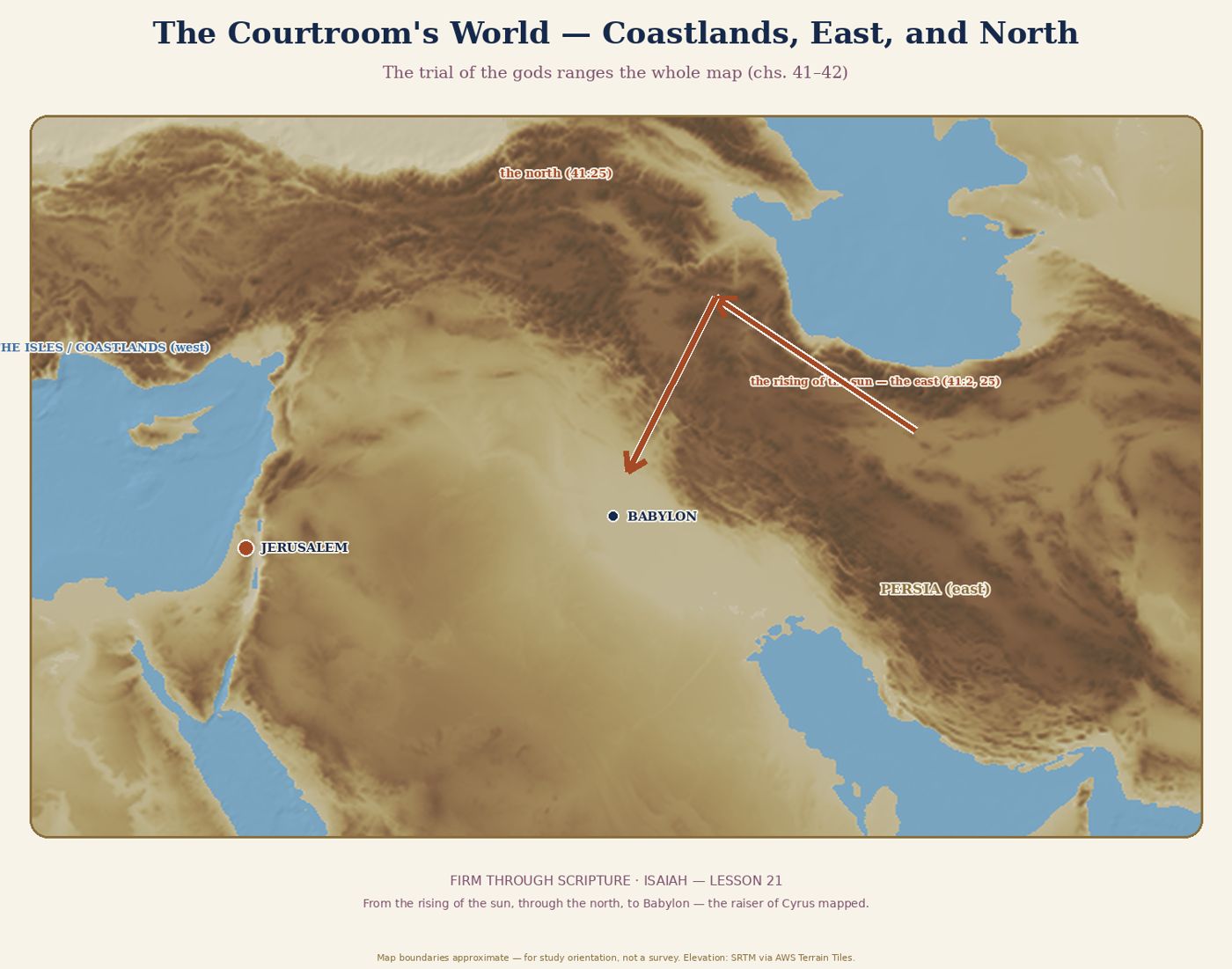
One conqueror moves through this passage unnamed. Verses 2–3 and verse 25 describe a man raised up from the east/north who flattens kings and calls on the LORD's name — without giving him a name. Hold the question open where the text holds it. In chapter 44 he will be called God's shepherd, and in chapter 45, by name: Cyrus, king of Persia, whose empire conquered Babylon in 539 BC and let exiles go home. [11, 29] For now: a figure approaching through the dust of other people's defeats, and verse 2's question — who raised him up?
That is the world. Now we open the text itself.
3. OBSERVE — O: what the text actually does
Before meaning comes observation. Most bad interpretation is not deep error; it is shallow reading — people answering a text they never actually looked at. So look:
- The passage is built as a hearing, with recesses of tenderness. Summons (41:1–4) → workshop panic (41:5–7) → a word to Israel the servant (41:8–20) → the trial proper (41:21–29) → the Servant presented (42:1–9) → a song (42:10–17) → a second hearing, with Israel in the dock (42:18–25). Track who is being spoken to and half the passage explains itself.
- "Fear not" is the passage's heartbeat. It sounds at 41:10, 41:13, and 41:14 — each time attached not to Israel's strength but to what God will do: I am with thee… I will help thee.
- Questions do the accusing. "Who raised up…?" (41:2). "Who hath wrought and done it?" (41:4). "Who hath declared from the beginning?" (41:26). "Who is blind, but my servant?" (42:19). "Who gave Jacob for a spoil…? did not the LORD?" (42:24). Cross-examination by question — each one leaves a silence where the other side's answer should be.
- The small made enormous, the enormous made nothing. A worm becomes a threshing instrument that levels mountains (41:14–15), while kings become dust and stubble (41:2), Israel's enemies "as nothing" (41:11–12), and the gods "of nothing… vanity… wind and confusion" (41:24, 29).
- Sight and blindness run from first to last. The isles saw and feared (41:5); the desert miracle happens "that they may see, and know, and consider, and understand together" (41:20); the Servant opens blind eyes (42:7); and then — "Who is blind, but my servant?… Seeing many things, but thou observest not" (42:19–20).
4. GENRE — N: note the genre (prophetic poetry — trial speech, salvation oracle, and song, in sequence)
Isaiah is prophetic poetry, and this passage shows how many kinds of speech that poetry can hold at once. Naming them keeps you from reading a courtroom challenge as a diary entry, or a song as if it were a statute:
- Trial speech (41:1–4, 21–29; 42:18–25). A lawsuit in verse: summons, challenge, demand for evidence, verdict. Its logic is forensic — produce your cause — and its silences are evidence: when the gods say nothing, that is the poem's point.
- Salvation oracle (41:8–20). The "fear not" speech, spoken by God directly to His people: address, reason for not fearing, promise in a chain of I wills.
- Servant Song (42:1–9). A presentation speech — "Behold my servant" — in which God introduces a figure, describes his character, and commissions him. Bernhard Duhm, in 1892, first isolated four such songs as a distinct set within chapters 40–55, and the label has stuck ever since. FACT about the history of scholarship. 42
- Hymn / new song (42:10–17). A summons to all creation to sing, followed by God speaking of His coming action in first-person images of war and childbirth.
Poetry's rules apply throughout: images are arguments (worm, sledge, reed, flax, travail), repetition is emphasis (the three "fear nots," the four verbs of 41:20), and parallel lines interpret each other. Read the pictures at full strength — section 10 shows what happens when we shrink them or apologise for them.
5. TERMS — T: the words in the writer's mouth
Three terms carry this passage. Learn what they meant in Isaiah's mouth, and the whole trial comes into focus:
- Servant — Hebrew 'ebed: a servant, one who belongs to and acts for a master — and often a title of honour for a person God commissions: 18 In this passage the word does something no reader should smooth away: it lands, in turn, on the nation ("thou, Israel, art my servant," 41:8), on an unnamed, upheld figure who brings right order to the nations (42:1), and on a blind, deaf messenger who is failing (42:19). Same title, three landings. Section 7 maps them rather than merging them, because the movement of the title is a large part of the passage's teaching.
- Judgment — Hebrew mishpat: not primarily punishment, but right order — things set right, justice done publicly, society arranged as God intends. 18 When the Servant "shall bring forth judgment to the Gentiles" (42:1) and will not rest "till he have set judgment in the earth" (42:4), the claim is that he will establish God's just order among the nations. Read the word as mere condemnation and the song's tone reverses: this judgment is what the isles are waiting for (v. 4).
- Produce your cause — the courtroom's terms of proof (41:21–23). "Cause" is a legal case; "strong reasons" a litigant's best arguments. And the passage specifies what evidence counts in a trial about who is God: declare the former things — explain the past as foretold — and declare things to come (41:22–23). That is the book's test of deity, stated by the text itself: a god who cannot speak beforehand is, by this court's standard, no god at all. Keep the test in view; chapters 43, 44, and 46 will run it again. 3
Method note — the word-study guardrail: a word means what its author uses it to mean, in its sentence, in its century — not what its oldest root once meant, and not everything it can mean anywhere. Every term above was settled by Isaiah's usage in Isaiah.
TRANSLATION NOTE — the bruised reed and the smoking flax (42:3)
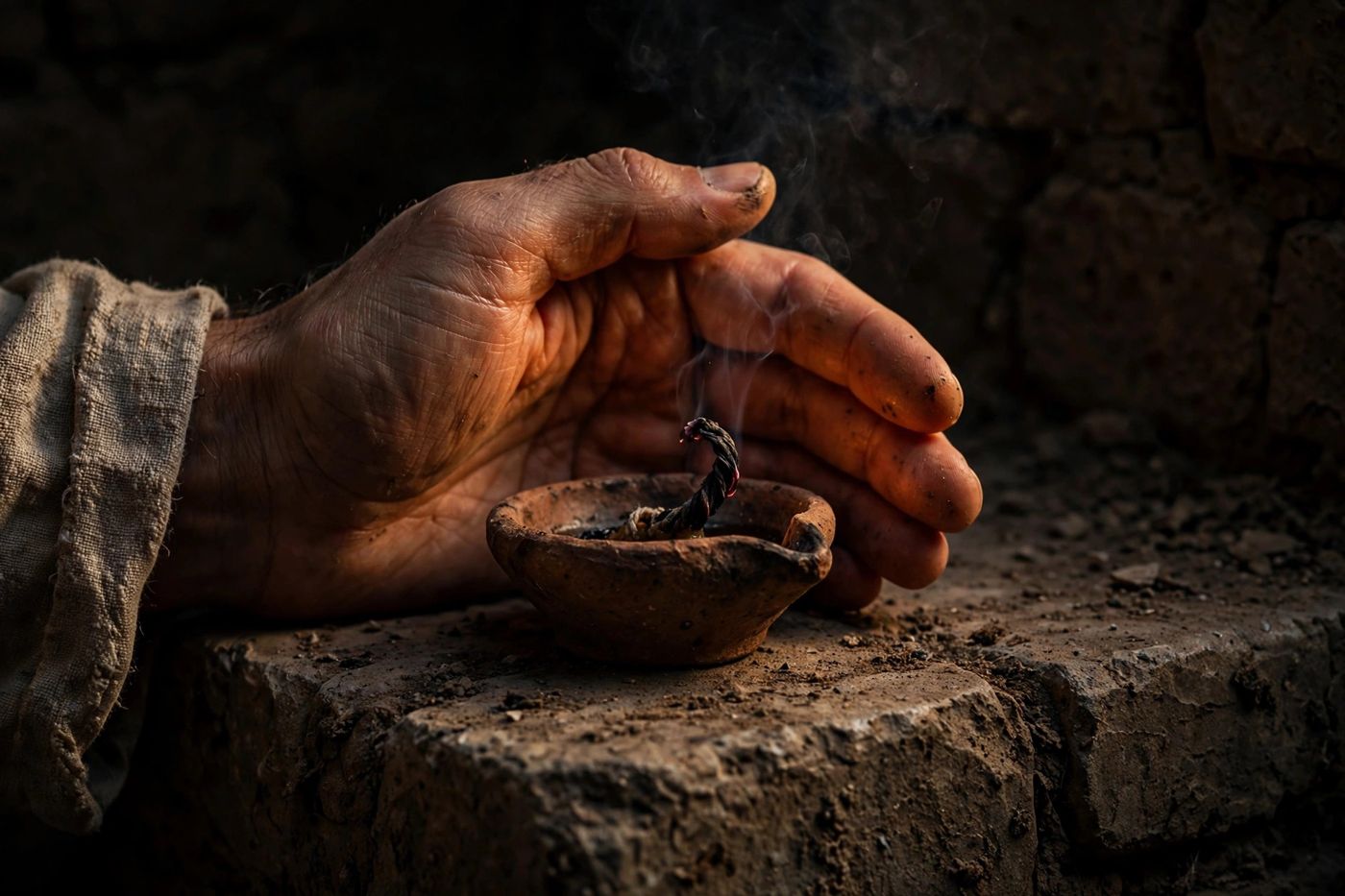
"A bruised reed shall he not break, and the smoking flax shall he not quench." A reed is a hollow waterside stem; bruised — cracked, bent — it is normally snapped and discarded. Flax here is a lamp wick: linen fibre in a clay oil lamp. "Smoking" means the flame has died to a smouldering thread — the wick is seconds from going out, and the ordinary move is to pinch it out. The Servant does neither. The idioms picture people at the point of being written off — damaged, nearly out — and the claim about the Servant's manner is precise: his power runs toward preservation, not disposal. Matthew quotes the verse whole, as Jesus' portrait (see §6); any translation that loses the smallness of the two objects loses the sermon. [4, 52]
6. ENTIRE CANON — E: where this passage sits in the whole story
No passage lives alone. Isaiah 41:1–42:25 is a knot where the whole Bible's threads cross:
- The lawsuit that opened the book, reopened at world scale. Isaiah 1 summoned heaven and earth against Judah 1; chapter 41 summons the islands — same court, wider jurisdiction. The trial keeps reconvening: "who among them can declare this?" (43:9); "ye are my witnesses" (43:10–12); the challenge repeated at 44:6–8 and 46:9–10. Book Two runs on this trial. [3, 4]
- The Abraham thread. Israel is "the seed of Abraham my friend" (41:8) — Abraham is called God's friend again only at 2 Chronicles 20:7 and James 2:23 1. The servant-nation's charter is not its talent but its descent: chosen in Abraham, "not cast thee away" (41:9). The promises to Abraham — blessing to all families of the earth (Genesis 12:1–3) — are the soil both the nation-as-servant and the Servant-as-light-to-the-Gentiles grow from.
- Matthew names the Servant — at length. When Jesus withdraws from a plot, heals everyone who follows, and charges them not to publicise him, Matthew stops his narrative to quote this lesson's song — the longest form of Isaiah 42:1–4 — as its explanation: "That it might be fulfilled which was spoken by Esaias the prophet, saying, Behold my servant, whom I have chosen…" (Matthew 12:17–21) 1. Matthew ends his quotation on the song's widest note: "and in his name shall the Gentiles trust."
- The song echoes across the New Testament. "A light of the Gentiles" (42:6) becomes Simeon's song over the infant Jesus (Luke 2:32) and Paul's charter at Acts 13:47 1.
7. THE MEANING — what the passage teaches
The Walk has established what the text says and where it sits. Now its payload, taught straight — the doctrines this passage actually carries, in the passage's own order.
The courtroom reopens — and the first witness is a conqueror
"Keep silence before me, O islands… let us come near together to judgment" (41:1). Silence first — the court's opening order is not speak but listen. Then God calls His first evidence, and it is not an argument. It is a man on the march: "Who raised up the righteous man from the east, called him to his foot, gave the nations before him, and made him rule over kings?" (41:2). Kings go down like dust before a sword, like stubble before a bow.
The question who raised him up? is evidence and cross-examination in one: history this large has an author. And the author introduces Himself on the back of the question — "I the LORD, the first, and with the last; I am he" (41:4). Notice the claim's shape: God spans the whole sequence — first, and with the last — the only witness present at the beginning and at the end. That is why He alone can pass the test this passage is about to set: declaring beforehand what He does.
The east-raiser's identification — with the labels on. The book walks it step by step. Here (41:2) and at verse 25 the conqueror is unnamed. At 44:28 God calls him "my shepherd" and names him: Cyrus. At 45:1 he is the LORD's "anointed." Cyrus of Persia is the historical figure whose conquest of Babylon in 539 BC and policy of restoring exiled peoples stand in records outside the Bible. [11, 29, 30] FACT: those are the book's own steps, and Cyrus's career is documented history. INFERENCE: the identification of chapter 41's unnamed raiser with that Cyrus — the reading the text's own arc compels, held across the spectrum, but in this chapter the name is withheld, and this study will not pretend the chapter says what only later chapters say. The withholding is a teaching device: the hearer asks who? for three chapters, so the name lands as an answer God gave in His own time.
The idol workshop — idolatry as mutual reassurance
The coastlands' response to the conqueror's march is one of the Bible's sharpest pieces of satire (41:5–7). They saw, feared, drew near — and what did frightened people do? "They helped every one his neighbour; and every one said to his brother, Be of good courage" (41:6). Then the camera moves into the workshop: carpenter encouraging goldsmith, the smoother of the hammer encouraging the striker of the anvil — "It is ready for the sodering" — and the finished god "fastened… with nails, that it should not be moved" (41:7).
Look at where the encouragement flows. In verse 10 God will strengthen Israel. Here the craftsmen strengthen each other — and then nail down the product of their encouragement and call it a god. That is the satire's social engine: idolatry here is not mainly a private intellectual mistake but a frightened community reassuring itself in a circle, until the finished object can be treated as a rescuer. The nails are the theology in one detail: the god who must be fastened so it will not move is about to be asked to move nations. Isaiah 44:9–20 will develop the same workshop at length; here seven lines already contain the whole argument. [3, 16]
Israel, My servant — the title's first landing, and its charter
Against the workshop noise, one quiet sentence changes everything: "But thou, Israel, art my servant, Jacob whom I have chosen, the seed of Abraham my friend" (41:8). The title servant lands here first in the Book of Comfort — on the nation: chosen, taken from the ends of the earth, called, and — the exile needed to hear exactly this — "not cast thee away" (41:9).
Then comes the charter, verse 10 — read it in its courtroom setting, spoken to a people who have just watched a conqueror flatten kings and a world respond by making gods. It opens "Fear thou not; for I am with thee" and "be not dismayed; for I am thy God," and piles promise on promise — strength, help, upholding — ending at "the right hand of my righteousness." Count the I's in it — five of them. The ground of not fearing is never Israel's grip on God; it is God's grip, God's presence, God's character — five times over, before any promise about circumstances. Her enemies will end "as nothing" (41:11–12) and verse 13 repeats the oracle's nerve in miniature: God holding her right hand this time, saying again, "Fear not; I will help thee."
"…I will uphold thee with the right hand of my righteousness." — the charter's last clause (41:10), and the grip the whole trial hangs on.
The worm and the threshing sledge — the small, made God's instrument
Then the passage does something with an image that should stop every reader. God addresses His people as "thou worm Jacob" — and in the same breath names Himself their "redeemer, the Holy One of Israel" — and then promises: "I will make thee a new sharp threshing instrument having teeth," an instrument that will thresh mountains, beat them small, and make the hills as chaff (41:14–15).
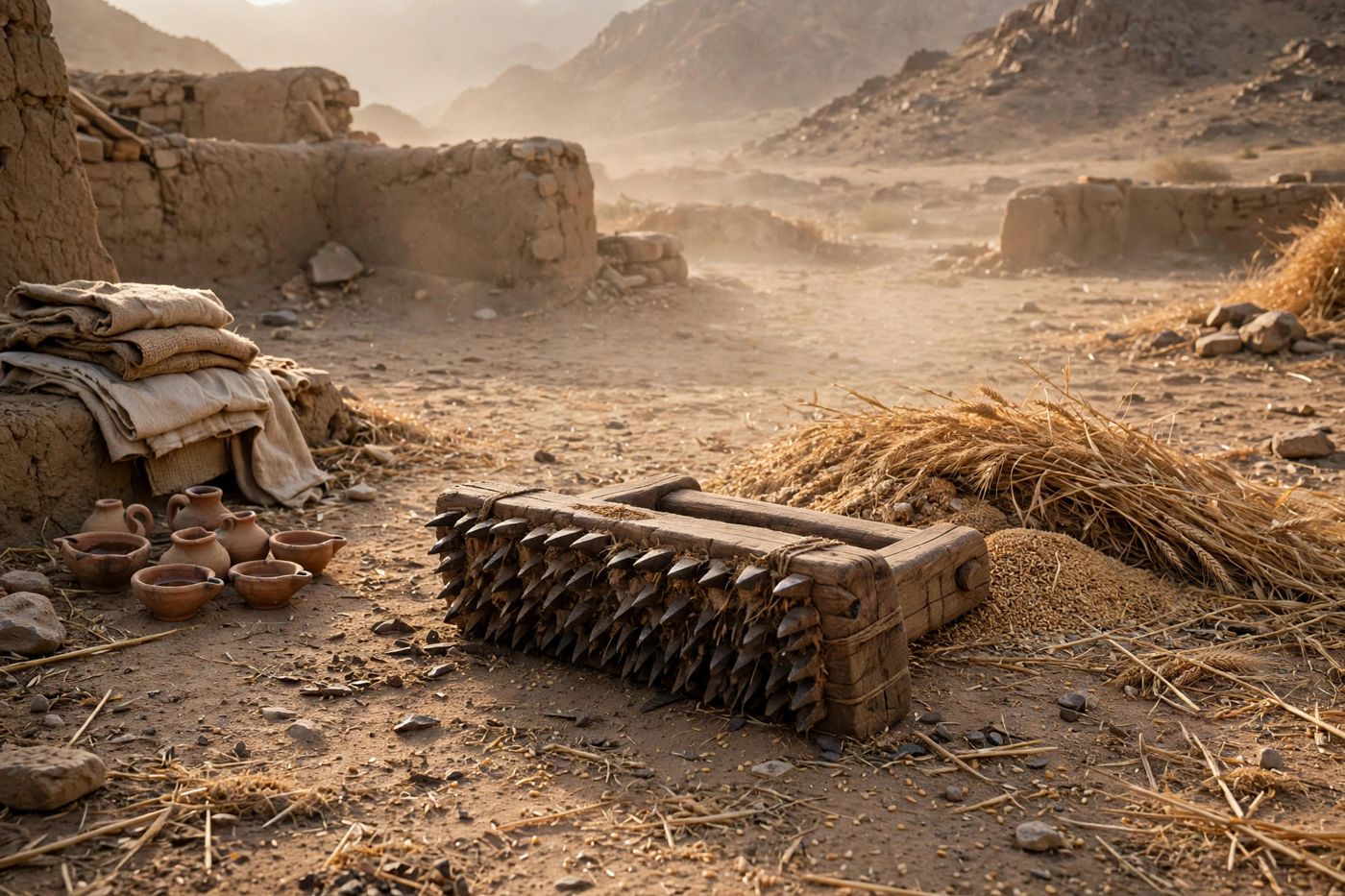
A worm is the ancient world's picture of the negligible — soft, small, trodden on. A threshing sledge is the opposite: a heavy board studded with sharp teeth, dragged over grain to tear stalk from kernel (see Visual 2). God does not tell the worm to become impressive. He says I will make thee — the transformation is His verb — and enlarges the harvest to absurdity: not sheaves but mountains, beaten small, hills made chaff and fanned away (41:16). Mountains in Isaiah are the proud, immovable powers of the world. The teaching is not "Israel was secretly strong." It is that God's chosen smallness, in God's hand, outranks the world's size — and the glory lands correctly: the instrument glories in the Hand that wielded it, not in its own teeth.
Water in the desert — and knowing, together
The oracle closes with the poor and needy seeking water, tongues failing for thirst (41:17) — exile as a desert water-crisis — and God's answer is landscape-scale: rivers on high places, fountains in valleys, the wilderness a pool, a planted forest of cedar, shittah (acacia), myrtle, and pine together (41:18–19).
But do not miss the purpose clause, because it hands the trial its pastoral twin: "that they may see, and know, and consider, and understand together, that the hand of the LORD hath done this" (41:20). Four verbs — see, know, consider, understand — and one crucial adverb: together. Knowledge of God here is not a private hunch; it is a community coming to a verdict on evidence. The God who demands evidence from the gods in verse 21 gladly gives evidence to the thirsty in verse 20. [4, 52]
The trial proper — the test of deity, and the verdict
Now the court turns to the defendants. "Produce your cause, saith the LORD; bring forth your strong reasons, saith the King of Jacob" (41:21). The terms of proof (§5) are enforced: shew the former things; "declare us things for to come"; "yea, do good, or do evil, that we may be dismayed, and behold it together" (41:22–23). The challenge descends to almost anything: predict the future — or merely do something, any act at all.
The verdict follows the silence: "Behold, ye are of nothing, and your work of nought" (41:24) — not merely weak: null. Then God's counter-evidence, in the exact form the test requires — a declaration beforehand: "I have raised up one from the north, and he shall come… he shall come upon princes as upon morter, and as the potter treadeth clay" (41:25). The audit of the other side is devastating: "there is none that sheweth, yea, there is none that declareth" (41:26); among the idols' counsellors, "there was no counsellor, that, when I asked of them, could answer a word" (41:28). Final sentence: "they are all vanity… their molten images are wind and confusion" (41:29). Confusion — the word-family Genesis uses for the earth "without form" (Genesis 1:2): un-creation, the opposite of the God who creates. 18 Meanwhile verse 27 locates the courtroom's only real tidings: God Himself will give Jerusalem "one that bringeth good tidings." The gospel in this book is news God publishes about what God is doing.
The First Servant Song — the Uphold One presented
The courtroom empties, and a voice presents somebody new: "Behold my servant, whom I uphold; mine elect, in whom my soul delighteth; I have put my spirit upon him: he shall bring forth judgment to the Gentiles" (42:1).
- Behold — a presentation formula: stop and look.
- My servant… whom I uphold — the title from 41:8, intensified: this servant is the upheld one.
- Mine elect, in whom my soul delighteth — chosen, and delighted in with God's whole soul; heaven will repeat it over Jesus (§6).
- I have put my spirit upon him — equipped by the Spirit, as the Branch was in chapter 11.
- He shall bring forth judgment to the Gentiles — mishpat, right order (§5), for the nations: the very coastlands summoned to silence in 41:1 are its intended recipients.
Then the manner, which is the song's beating heart (42:2–4). He shall not cry, nor lift up his voice in the street. The bruised reed he will not break; the smoking flax he will not quench; he will bring forth judgment "unto truth." And he will not fail nor be discouraged — will not himself be bruised or crushed — until the work is set in the earth and the far isles are waiting for his teaching (torah). Quiet, gentle, and yet utterly unstoppable: gentleness and inevitability in one person, Any portrait of this Servant that drops either half has dropped the song.
God then speaks to the Servant directly (42:5–9). The commission is grounded in creation itself — the God who made heavens and earth and gives breath to every person — and it is personal: called in righteousness, held by the hand, kept. And its content is embodiment: he is given for a covenant — not merely sent to announce one; his own person is the covenant for the people — and "for a light of the Gentiles," with blind eyes to open and prisoners to free (42:6–7): the two conditions this chapter will diagnose in Israel herself (42:18–22). Over it all, the guard-rail: "my glory will I not give to another" (42:8) — and the trial-test turned promise: "new things do I declare: before they spring forth I tell you of them" (42:9). God does not merely set the exam; He sits it, in public, in advance.
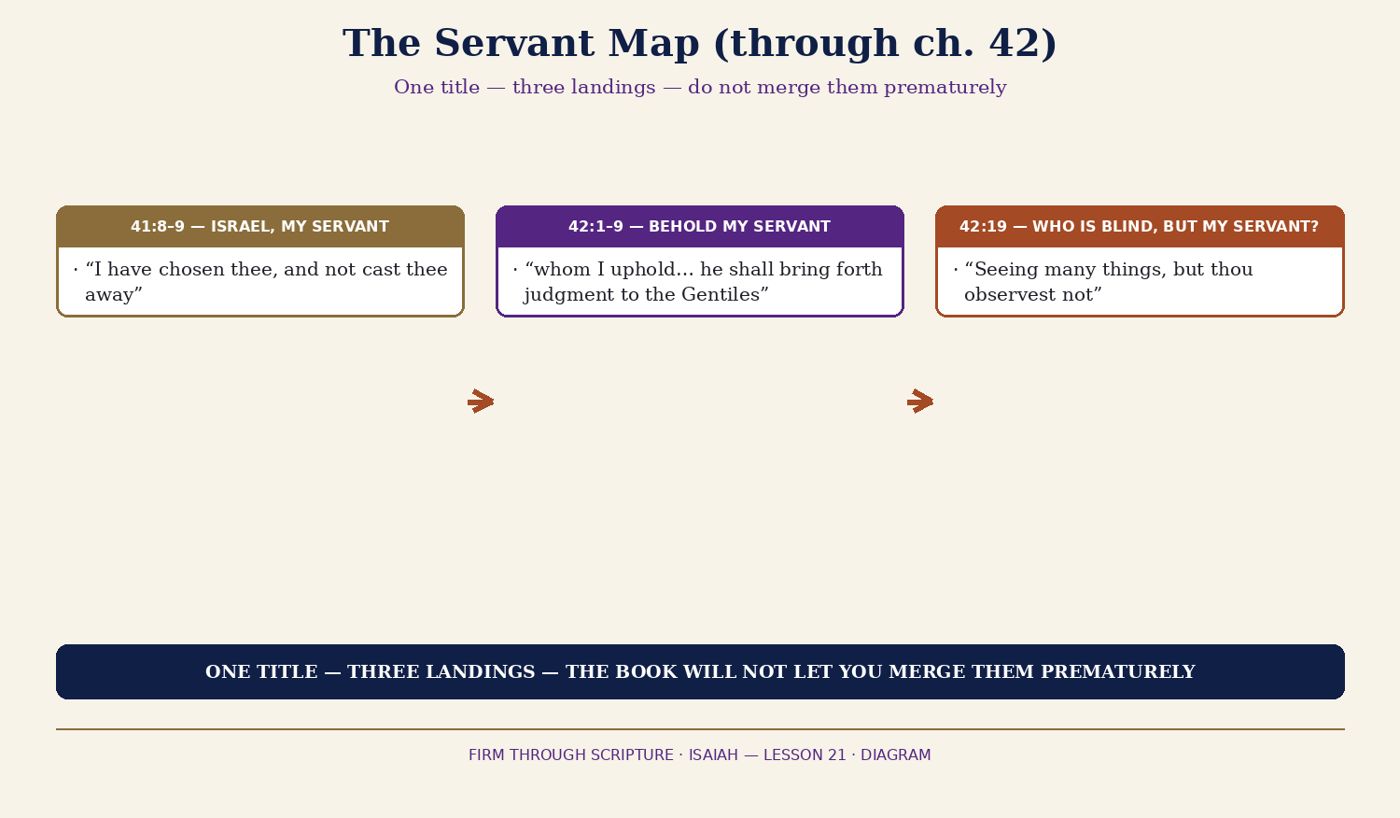
The Servant Map — the title's three landings in this passage
Teach this as a standing exhibit.
| Landing | Text | Who bears the title | Condition |
|---|---|---|---|
| 41:8–9 | "thou, Israel, art my servant… I have chosen thee, and not cast thee away" | The nation, Jacob/Israel, Abraham's seed | Chosen, upheld, told not to fear |
| 42:1–9 | "Behold my servant, whom I uphold… he shall bring forth judgment to the Gentiles" | The Uphold One — elect, Spirit-endowed, commissioned | Quiet, gentle, unfailing, a light to the nations |
| 42:19 | "Who is blind, but my servant?… the LORD's servant" | The nation again — as God's messenger | Blind, deaf, seeing without observing |
The pattern the map teaches has a name this course will use from here on: embodiment. The One does not replace Israel's calling; he concentrates it — Israel's vocation (chosen, witness, light to the nations) gathered into a single faithful person where the nation is failing at it. Argued fully in §16; stated here at its proper strength: POSITION — the church's historic reading, standing on the New Testament's citations. It is not a guess laid over the text; it is the reading the canon itself performs.
The Christ Thread
Here the thread does not need hunting. It needs only to be followed where the New Testament lays it.
Matthew 12 tells of Jesus withdrawing from a murder plot, healing all who followed, and ordering silence — and then explains the quietness with this song, quoted at length (Matthew 12:18–21, quoting Isaiah 42:1–4) 1. Look at Matthew's logic: it is the Servant's manner that identifies him. A Messiah who will not shout in the streets, who will not break the bruised or snuff the smouldering, who nevertheless will send forth judgment unto victory — Matthew's phrase — and in whose name the Gentiles will trust. Jesus is not merely being modest; he is being recognisable to anyone who knew the song. The church's reading stands on this: not preference, not ingenuity, but an apostle's citation identifying the Servant in the canon itself.
The fittings multiply. The delight of 42:1 is spoken over Jesus at his baptism and Transfiguration (Matthew 3:17; 17:5). The Spirit put upon the Servant descends on Jesus visibly (Luke 3:22). The light to the Gentiles (42:6) becomes Simeon's song (Luke 2:32) and Paul's charter (Acts 13:47). The prison-opening (42:7) shapes Jesus' own answer about whether he is the Coming One: "the blind receive their sight… the poor have the gospel preached to them" (Matthew 11:5). No typology is being invented here. The thread is the apostles' own — this study merely refuses to cut it.
The new song, the warrior, and the travailing God
The song answered by a song: "Sing unto the LORD a new song" (42:10) — new, because the thing God is doing is new (42:9) — and the choir is the whole map: seafarers and isles, wilderness and cities, Kedar's desert villages, Sela's rock-dwellers (42:10–11). Desert Arabs and island sailors in one anthem: the Gentile world of 42:1–4, already singing in anticipation.
Then God's own self-description, in consecutive verses that must not be separated (42:13–14). "The LORD shall go forth as a mighty man" — stirring up zeal "like a man of war," crying, roaring, prevailing against his enemies. And then: "I have long time holden my peace; I have been still, and refrained myself: now will I cry like a travailing woman." Warrior first — then, without apology or transition, a woman in labour. The silence of exile, which God's people had read as absence, is re-read by God Himself as restraint — a held breath, a pregnancy carried to term. Travail is not passive: it is pain with a delivery inside it. What is being born is the homecoming: God will waste the mountains that block the road and lead the blind "by a way that they knew not," making darkness light and crooked things straight — "and not forsake them" (42:15–16). Those who trusted graven images will be "turned back… greatly ashamed" (42:17) — the trial's verdict arriving as an event.
Hold the imagery rule steady, because section 10 returns to it: these are picture-words God chooses about Himself. A warrior and a labouring mother are not anatomy lessons; they are two true windows onto one act — irresistible strength, and long-carried pain breaking into delivery. Flatten either image and you lose half the verse-pair's force. 52
The blind servant — the paradox, undissolved
And then the lesson turns its face. "Hear, ye deaf; and look, ye blind, that ye may see" (42:18). "Who is blind, but my servant? or deaf, as my messenger that I sent?" And the diagnosis: "Seeing many things, but thou observest not; opening the ears, but he heareth not" (42:19–20). In the very chapter that crowned the Uphold One, the title servant is laid back on the nation — and the nation is blind. Not uninformed blind: seeing many things, but not observing. The evidence was in front of her — the trial itself, God's declared deeds — and it never got laid to heart (42:25).
God's own heart is stated plainly: "The LORD is well pleased for his righteousness' sake; he will magnify the law, and make it honourable" (42:21) — the failure is not in the teaching. Its fruit is verse 22, one of the saddest lines in the book: "a people robbed and spoiled," snared in holes, hid in prison houses — "for a prey, and none delivereth; for a spoil, and none saith, Restore." The people commissioned to open prison houses (42:7) are sitting in one, and no voice on earth is calling for their release. Then the courtroom question changes direction — aimed now at the readers of every age: "Who among you will give ear to this?" (42:23).
And the cause is named without flinching (42:24–25): "Who gave Jacob for a spoil, and Israel to the robbers? did not the LORD, he against whom we have sinned?" They would not walk in his ways; they were not obedient to his law. So he poured out the fury of his anger — a fire set round about him — "yet he knew not; and it burned him, yet he laid it not to heart." The exile, says Isaiah, was not Babylon's god outmuscling Israel's God. It was the LORD's own judgment on His servant's disobedience. And the tragedy's last word is not the fire but the incomprehension — which is precisely why the book needs another Servant, one who sees, hears, and does not fail. The paradox is the passage's design, not its embarrassment. Do not dissolve it. Lessons 26–29 will narrow the title further — to a Servant named Israel yet sent to Israel (49:3–6), who learns obedience morning by morning (50:4–5), and who finally bears what the blind servant could only suffer blindly (53).
Where in the Covenant Story?
This passage stands squarely inside the exile-shaped crisis of the covenant with Israel, facing outward. The Abrahamic promise supplies the servant-nation's charter ("seed of Abraham my friend," 41:8; blessing aimed at all nations, fulfilled as the Servant becomes "a light of the Gentiles," 42:6). The Mosaic covenant supplies the trial's grammar and the exile's explanation — disobedience bringing the spoiling the law warned of (42:24–25). And the new-covenant horizon opens in the Servant "given for a covenant" (42:6): a person as covenant, release for prisoners, sight for the blind — promises Jeremiah and Ezekiel phrase as a new covenant are here embodied in a figure before they are phrased as a document. 4
Father, Son, and Spirit
The passage earns this heading quietly but really. The Father — the LORD who speaks throughout — presents, upholds, delights in, and commissions the Servant, and gives His glory to no other (42:8). The Spirit is put upon the Servant (42:1), as at Jesus' baptism, where the same three appear in one scene: the Father's delighting voice, the Son in the water, the Spirit descending (Matthew 3:16–17) 1. The Son is not named in Isaiah 42 — honesty requires saying so — but the canon's own identification of this Servant (Matthew 12:18–21) means the church reads the song, on the apostles' warrant, as a portrait of the Son. One God acts; the persons are distinguishable in the action; Isaiah gives the pattern and the Gospel gives the names.
The Long View — what the church has believed
Stand back and notice how the centuries have read this passage, because you are not its first reader. The early church read the First Song christologically as a matter of course — Matthew's citation set the pattern, and writers from Justin onward treat Isaiah as the evangelist among the prophets. 44 The medieval Jewish reading, classically in Rashi's school, read the Servant corporately as Israel — a reading this lesson has shown its textual basis for (41:8; 49:3) rather than caricatured. 39 Where the church stands, and this course with it: the Servant is fulfilled in Jesus Christ, with Israel's vocation gathered into Him — POSITION, held on Matthew's evidence, with its rivals shown fairly (§16). Two errors about this history are refused: that the corporate reading is a modern evasion (it is medieval and textual), and that the christological reading is a late overlay (it is apostolic and first-century).
That is the payload. The next section compresses it into the one sentence you are meant to carry out of this study.
8. THE AIM SENTENCE — X: eXplain the intent
Everything observed now compresses into one sentence — the author's intended meaning, stated before any application is allowed near it:
In open court, the LORD — the first and the last — proves Himself God by declaring beforehand what He will do, exposes the nations' gods as nothing, upholds His servant Israel with a fear-not charter, and presents His Uphold One, the quiet Servant who will bring right order to the nations, open blind eyes, and free prisoners — while the servant nation itself sits blind in the prison he comes to empty.
If a sermon, a post, or a devotional uses Isaiah 41:1–42:25 to say something that cannot be traced back to that sentence, it is not this passage talking.
9. SAY IT BACK
Close the book and say the AIM sentence from section 8 in your own words — out loud, or written in your notes, without looking.
If your version quietly changes the meaning — if the trial becomes only comfort, or the Servant becomes only the nation with Matthew left out, or the blind servant disappears because he is uncomfortable — open the lesson and walk it again. It is the entire course in miniature: meaning first, in the author's words become your words, then — and only then — your life.
10. THE MISREAD — the guardrail, with verdicts
Three live misuses of this passage. Each gets a fair hearing, the evidence, and a verdict.
Misread 1: "The First Servant Song is only about the nation Israel — Matthew just borrowed its words for Jesus, the way a preacher borrows an illustration." Why it sounds right: the title really is Israel's in this very passage — "thou, Israel, art my servant" (41:8) — and the blind servant of 42:19 is the nation. A purely corporate reading has real verses under it, and the Rashi tradition has argued it for centuries. 39 The evidence: the text itself will not let the title stay only corporate. The Servant of 42:1–9 is distinguished from the Israel of 42:18–25 within one chapter: one is upheld, Spirit-endowed, unfailing, sent to open prisoners' blind eyes; the other is blind, deaf, and sitting in the prison house. A figure cannot, without distinction, be both the prisoner and the one sent to free prisoners — and the book sharpens the distinction until the Servant is sent to Israel (49:5–6). Then Matthew removes the matter from taste: Matthew 12:18–21 quotes the song not as illustration but as fulfilment — "that it might be fulfilled which was spoken by Esaias the prophet" — identifying its manner in Jesus' conduct. That is the canon interpreting itself. The opposite shortcut is refused with equal firmness: pretending 41:8 and 42:19 do not apply the title to Israel. The Map (§7) is the text's design — the tension is the teaching. Verdict: half a map, twice over. The title is Israel's and the One's; the canon resolves the tension by embodiment — Israel's calling concentrated in the faithful Servant, Jesus — not by deleting either landing. POSITION, standing on Matthew's citation as fact of canon.
Misread 2: "The trial scenes show God insecure, or putting on theatre — real gods wouldn't need to argue." Why it sounds right: a God who says "produce your cause" and taunts idols to "do good, or do evil" can sound, to modern ears, like a debater anxious about His ranking. The evidence: the trial is not God seeking information or reassurance; it is God publishing a test — epistemology, the question of how anyone can know who is God at all. Isaiah's court lays down a public, checkable criterion: the true God declares beforehand what He will do, and does it (41:22–23, 26; God applies the test to Himself at 42:9 and performs it at 41:25). The speeches address exiles tempted to defect — pastoral argument for people deciding whom to trust. The form recurs because the need recurs (43:9–13; 44:6–8; 46:9–10), and its verdicts are about the gods' nothingness, not God's feelings. Theatre, if the word must be used, that saves: a courtroom staged so the defendants' silence can be heard by the people most tempted to worship them. Verdict: the trial is a test of deity offered for Israel's sake — declaration-beforehand as the book's argued criterion of Godhood — not divine insecurity.
Misread 3: "The 'travailing woman' of 42:14 is an embarrassment to hurry past — feminine imagery shouldn't be pressed, and at most it's a stray metaphor." Why it sounds right: the verse startles, and it sits one verse away from God as "a man of war," which can feel safer to preach. The evidence: the pairing is deliberate — warrior (42:13) and travailing woman (42:14) in consecutive verses, both God's chosen self-descriptions of the same act. The image reinterprets the long silence of exile ("I have long time holden my peace… refrained myself") as gestation rather than indifference, and promises the waiting ends in a birth, not merely a battle. The Dictionary of Biblical Imagery traces this image-field across the canon — God in labour (here), Zion in labour (Isa. 66:7–9), creation groaning in travail (Romans 8:22) — a sustained metaphor, not a slip. 52 The imagery rules apply in full: God speaks of Himself in picture-words He chooses; receive them at their force; neither flatten them into claims about God's anatomy nor edit them out in embarrassment. A reading too embarrassed for the text's own pictures will soon be embarrassed by the text. Verdict: do not hurry past, do not apologise. Warrior and travailing mother stand side by side by God's own design: His strength is irresistible, and His silence was a carrying, not an absence.
11. FROM WORD TO WALK
A reflection page — the lesson is not finished until the passage has had its say with you.
Sit first in the workshop, because it is nearer to us than we like to admit. The craftsmen of verse 7 were not fools, and they were not insincere. They were afraid — a conqueror was coming — and fear made them industrious and kind: "every one said to his brother, Be of good courage." There is a kind of encouragement that is only people steadying each other around something that cannot save them. Our versions are rarely hammered out of gold: the plan everyone keeps saying will hold; the habit, the balance, the reputation — soldered, nailed down, that it should not be moved. Isaiah does not ask whether your idol is sincere. He asks whether it can speak beforehand or act at all — whether it is a rescuer or only a project. Hold that question over one named thing in your life this week, without rushing to answer it cheaply.
Then sit with the worm. God did not wait for Israel to feel like a threshing sledge before He promised; He addressed her at her smallest — worm Jacob — and put His own I will make thee between her smallness and the mountains. If you know your own negligibility too well to believe you could be God's instrument in any arena that matters, this text does not tell you to think bigger of yourself. It tells you to think truer of the Hand. It threshes by being dragged, steadily, by the One who made it sharp.
And then sit — honestly, because the passage insists — with the blind servant. "Seeing many things, but thou observest not." It is possible to be surrounded by God's declared deeds, to hold the trial transcript in your own hands, and still not lay it to heart: to be burned, in the chapter's terrible phrase, and not know it. Verse 23 aims that question at you: "Who among you will give ear to this?" The right response to discovering your own blindness in 42:19–20 is not despair or denial; it is to go to the One of 42:1–7 and ask to be led "by a way that they knew not" (42:16) — led, note, not left. He does not forsake the blind He leads. He never has.
| The workshop says (41:6–7) | The charter says (41:10) |
|---|---|
| "Be of good courage" — to each other | "Fear thou not; for I am with thee" |
| Hands that solder and nail | A right hand that upholds |
LORD, the first and with the last — I have helped solder things that cannot save, and called the workshop courage. Show me the one I am still nailing down. I am small, and some days I am the blind servant too, seeing and not observing. Uphold me with the right hand of Your righteousness; let Your Servant open my eyes, and lead me by the way I do not know. I will not fear — because You are with me. In Jesus' name, amen.
12. FOR DISCUSSION — OR FOR YOUR JOURNAL
With a group, work these aloud. Alone, they're yours — answer them in your journal or in prayer; they lose nothing in the quiet.
- The craftsmen "encouraged" each other while making a god that had to be nailed down. Where do you see that pattern — mutual reassurance around something that cannot save — around you, and in your own life?
- Verse 10 grounds "fear thou not" in five statements about God before saying anything about circumstances. Which of the five do you find hardest to rest on, and why?
- The Servant Map shows the title on the nation, on the Uphold One, and on the blind messenger. How does holding all three landings together change how you read Jesus' mission — and Israel's story?
- God pictures Himself as a warrior in one verse and as a woman in labour in the next. What does each image let you understand about the exile's silence?
13. THE WALK-OUT — T: Transfer to today
Meaning is settled. Now — and only now — application, and it must cross the bridge honestly. Run the five Transfer Tests on this passage:
- Same covenant? The fear-not charter was spoken to exiled Israel under the old covenant. Believers today receive it in Christ, the Servant in whom Israel's calling is gathered — through the One given "for a covenant of the people" (42:6).
- Same audience? The trial addresses the nations and their gods; the charter, God's servant people; the rebuke, the blind servant. Apply each speech to its own addressee first — comfort where God comforts, warning where God warns.
- Same genre rules? Prophetic poetry argues in images and courtroom speech, so applications run through the images' argued point — the nailed god, the upheld worm, the unquenched wick — not through literal imitation.
- Repeated or rooted? "Fear not, for I am with thee" is rooted in God's unchanging presence and repeated to His people across Scripture (Joshua 1:9; Isaiah 43:1–5; Matthew 28:20). The Servant's gentleness is embodied in Jesus and commended to His followers. These cross.
- Ten verses either side? Every application below comes from these two chapters read whole — the blind servant stands in the same passage as the charter, so no application may keep 41:10 and delete 42:25.
What crosses — and lands:
- God has acted, and will act — therefore, do not fear. The indicative leads, as it must: before any practice, the facts. The LORD is the first and with the last (41:4). He declared the conqueror beforehand and exposed the gods as nothing (41:24–29). He has presented a Servant who does not fail (42:4), who opens blind eyes and empties prisons (42:7) — and in Jesus that Servant has come: the Gentiles trust in his name (Matthew 12:21) 1. Fear-not is not a mood to manufacture; it is a verdict to live from.
- Assurance is God's grip, not ours. "I will uphold thee with the right hand of my righteousness" (41:10); "I… will hold thine hand" (42:6). The security of God's people rests on His hold, in every season.
- Gentleness with bruised people is the Servant's manner — and therefore his people's. He does not break the bruised reed or quench the smoking flax (42:3). His followers learn to handle nearly-extinguished people as he does — shielding the wick, splinting the reed — without surrendering the truth he brings judgment "unto truth" (42:3).
- Seeing must become observing. The blind servant saw many things and observed nothing (42:20). God's deeds are to be laid to heart (42:25) — considered, understood, together (41:20).
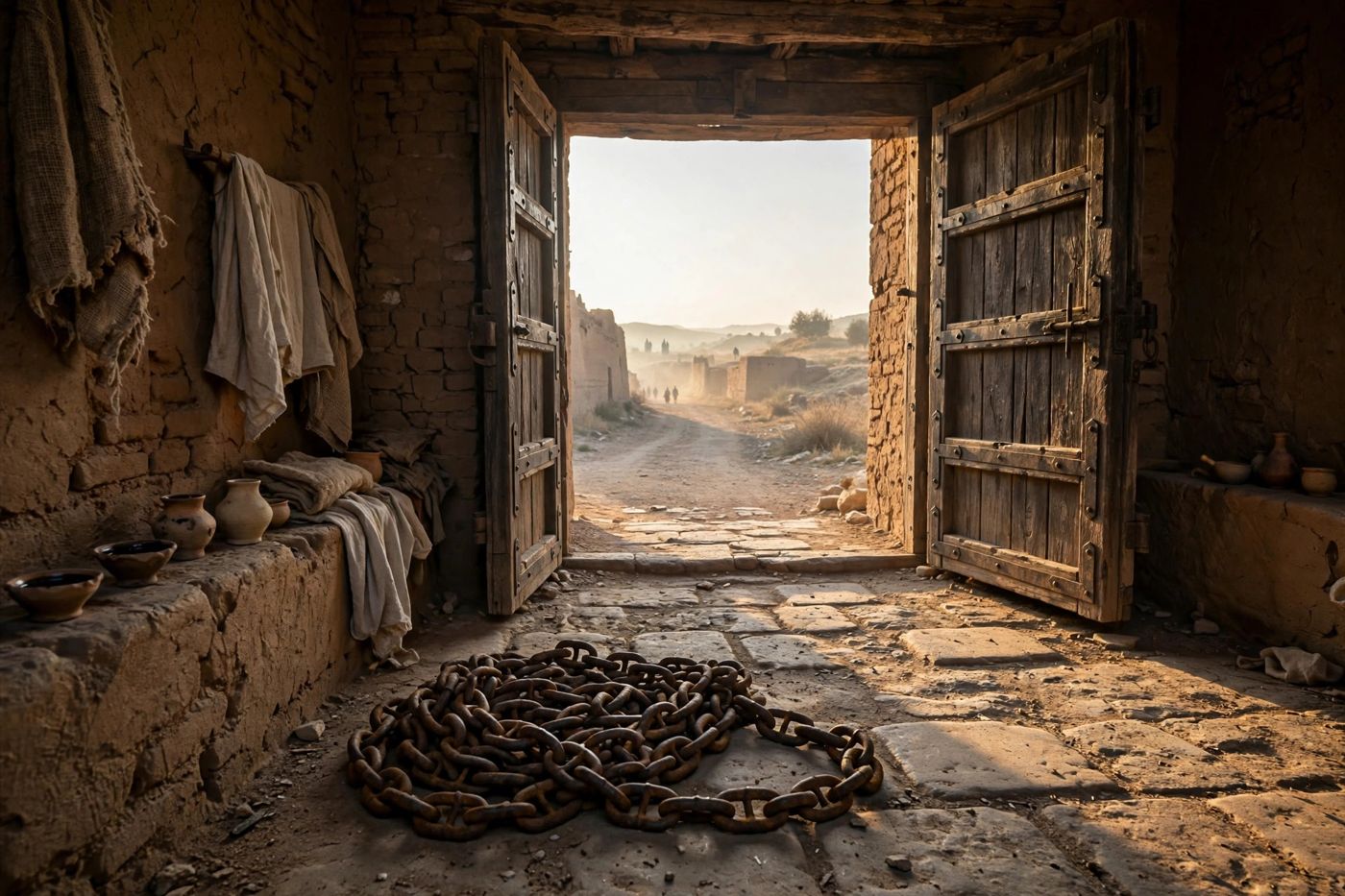
Practices — what the gate lets through, made concrete this week:
- The workshop audit. Name, in writing, one thing you are helping to "solder" — trusting, maintaining, encouraging others to trust — that has never spoken, acted, or saved. Pray verse 24's verdict over it, and take one concrete step of transferring that trust to the LORD this week.
- Five I's prayer. Take 41:10's five statements about God — I am with thee; I am thy God; I will strengthen thee; I will help thee; I will uphold thee — one per weekday morning, prayed back against that day's named fear.
- Shield one wick. Identify one bruised, nearly-out person in your life. This week, do the Servant's move: protect their remaining flame — a visit, a call, a defence spoken where they are being written off — and refuse the easy snuff of a dismissive word.
- Observe, together. With one other believer, walk 41:20's four verbs over one recent event: what did we see God do; what do we know; what should we consider; what do we now understand together? Write the verdict down.
- Memorize Isaiah 41:10, whole — carry it into the situation where fear is loudest this week.
What does not cross: claiming the threshing of mountains as a promise that God will crush your personal opponents on demand (the Servant of this passage does not cry out in the street); reading 42:14 as a doctrine of God's anatomy in either direction; treating the exile's judgments as a template for diagnosing other people's suffering; or quoting "fear thou not" as a guarantee no fire will come — the passage's own servant was burned (42:25), and the promise that crossed was presence and upholding, not exemption.
Praise Him
First and Last, King of Jacob, Holy One of Israel — You were there at the beginning and You will be there with the last, and no god the frightened world can solder together has answered You a single word. You uphold what You choose; You make worms into instruments and deserts into forests; Your Servant does not fail, does not break the bruised, does not snuff the smouldering. Glory is Yours and You give it to no other — and the isles, even now, wait for His law. We give it back to You in praise: the hand of the LORD hath done this, and the Holy One of Israel hath created it.
14. THE RECAP CARD — this study on one page
- The passage: Isaiah 41:1–42:25 — trial, charter, Song, and blind servant.
- Say It Plain: God calls the world to court, exposes the idols as nothing, upholds His servant Israel, presents His quiet, unfailing Servant for the nations — and shows the servant nation itself blind in prison.
- The AIM: In open court, the LORD — the first and the last — proves Himself God by declaring beforehand what He will do, exposes the nations' gods as nothing, upholds His servant Israel with a fear-not charter, and presents His Uphold One, the quiet Servant who will bring right order to the nations, open blind eyes, and free prisoners — while the servant nation itself sits blind in the prison he comes to empty.
- Key terms: servant ('ebed) — one title, three landings · judgment (mishpat) — God's right order set in the earth · produce your cause — the courtroom's terms of proof: declare the past, declare the future.
- The Misread, in one line: the Song is not nation-only — but Israel's title is real too · the trial is God's published test of deity, not His insecurity · the travailing woman is God's chosen picture of His silence as gestation, not an embarrassment.
- Memory verse: "Fear thou not; for I am with thee: be not dismayed; for I am thy God: I will strengthen thee; yea, I will help thee; yea, I will uphold thee with the right hand of my righteousness." — Isaiah 41:10
- This week's practice: the workshop audit, and shield one smoking wick the way the Servant does.
15. CHECK YOURSELF — five questions
Answer from the study, not from instinct. (Answers live in the Teacher Edition.)
- In your own words: what is the AIM of Isaiah 41:1–42:25?
- What is the passage's test of deity in the trial speeches — what evidence must a god produce, and what verdict did the gods receive?
- Draw the Servant Map: name the title's three landings in this passage, with their chapter-and-verse addresses and each bearer's condition.
- Someone says, "The First Song is only about Israel, so Matthew's use of it proves nothing." Give two answers from this study — one from within Isaiah 42 itself, one from Matthew.
- Verse 14 pictures God as a travailing woman one verse after picturing Him as a man of war. What does the second image teach about God's long silence that the first image alone could not — and what two errors about the image does this study refuse?
16. GO DEEPER
Optional — for readers who want the machinery. The lesson is complete without it.
"Who is blind, but my servant?" — the question the rest of the book answers.
From the Sources — Cyrus outside the Bible
The conqueror this passage leaves unnamed can be met in his own world's records. The Cyrus Cylinder, now in the British Museum, gives Cyrus's account of taking Babylon and restoring peoples and sanctuaries. 29 The Babylonian Chronicle tradition dates Babylon's fall to Cyrus in 539 BC. 11 FACT: Cyrus, his conquest, and his restoration policy are documented history, independent of the Bible. INFERENCE: that Isaiah 41's unnamed raiser is this Cyrus — the book makes the identification itself only at 44:28 and 45:1.
The Honest Argument — who is the Servant?
Here is the debate at full strength, because this passage is where it starts. The corporate reading: the Servant is Israel personified. Its evidence is textual and strong: "thou, Israel, art my servant" (41:8); "thou art my servant: I have formed thee" (44:21); "Thou art my servant, O Israel" (49:3). Rashi's medieval school built the sustained Jewish reading on these verses. 39 FACT that these identifications stand in the text. The individual reading: the songs describe a figure with a mission to Israel — called from the womb (49:1), sent "to bring Jacob again to him" (49:5) — and in chapter 42 itself, the upheld, unfailing Servant of verses 1–9 cannot simply be the blind, imprisoned servant of verses 19–25 without erasing the chapter's contrast. Targum Jonathan — naming chapter 53's Servant the Messiah — shows an ancient Jewish reader reaching for a messianic resolution. 38 The church's reading — POSITION of this course: the Servant is fulfilled in Jesus Christ, with Israel's vocation gathered into him by embodiment. Its warrant is canon evidence: Matthew quotes the First Song as fulfilled in Jesus (Matthew 12:18–21) 1; Luke, Acts, and 1 Peter extend the pattern. North's survey remains the fairest catalogue of every identification and its difficulties. 42 DISPUTED in the academy; settled for this course as a labelled POSITION standing on the New Testament's own interpretation — stated openly, so a reader knows exactly what is fact, what is inference, and what is the church's confession.
The Word Underneath — "the first, and with the last"
41:4's self-introduction — "I the LORD, the first, and with the last; I am he" — carries the trial in one clause. The Hebrew pairs primacy with presence-at-the-end: God will be with the last things, still Himself. The formula returns as a refrain (44:6; 48:12): only a God spanning the whole sequence can declare former things and things to come in one breath. [3, 18] FACT: the phrase and its refrains stand as described. INFERENCE: that Revelation's "I am the first and the last," on the lips of the risen Jesus (Revelation 1:17), deliberately takes up Isaiah's formula — an inference most readers find overwhelming, but labelled for what it is.
Go Read
- Oswalt, The Book of Isaiah, Chapters 40–66 (NICOT) 3 — the trial speeches and the Servant read as the deliberate answer to chapters 1–39.
- Motyer, The Prophecy of Isaiah 4 — especially strong on the Servant's identity and the book's structure; a map of exactly the tension this lesson charts.
- North, The Suffering Servant in Deutero-Isaiah 42 — every identification of the Servant, weighed in one place; the honest broker for §16's argument.
17. SOURCES & REFERENCES
Numbered citations in this lesson key to this list — the course standard: every sourced claim carries its number, and every number can be checked.
- The KJV text itself — Holy Bible, King James Version (eBible.org KJV, 1769 text). Scripture quotations are from the King James Version (KJV), which is in the public domain in the United States; the full passage is always assigned as reading. Cross-references within Scripture cite this number.
- Oswalt, The Book of Isaiah, Chapters 40–66 (NICOT) — John N. Oswalt (Eerdmans). The second volume: the comfort section, the Servant Songs, Cyrus, and the new-creation chapters, read as the deliberate answer to chapters 1–39.
- Motyer, The Prophecy of Isaiah — J. Alec Motyer (IVP). A one-volume commentary by an evangelical scholar who argues the whole book breathes the mind of the eighth-century prophet; especially strong on the book's structure, its repeated refrains, and the Servant.
- Smith, Isaiah 1–39 and Isaiah 40–66 (New American Commentary) — Gary V. Smith (B&H). Evangelical commentary with strong historical notes (the Assyrian and Babylonian records) and an even-handed survey of the authorship debate.
- Walton, Matthews & Chavalas, The IVP Bible Background Commentary: Old Testament — John H. Walton, Victor H. Matthews, Mark W. Chavalas (IVP). Verse-by-verse ancient Near Eastern background: Assyrian siege practice, Babylonian religion, treaty and coronation customs, geography.
- VanGemeren (ed.), New International Dictionary of Old Testament Theology and Exegesis (NIDOTTE) — Willem A. VanGemeren (Zondervan). Theological word studies with semantic-range discipline for the Hebrew terms.
- The Cyrus Cylinder (British Museum) — Cyrus of Persia's own proclamation of his restoration policy (539 BC onward) — the pagan parallel and backdrop to Isaiah 44:28–45:13 and Ezra 1.
- Grayson, Assyrian and Babylonian Chronicles — A. Kirk Grayson (J.J. Augustin). The Babylonian Chronicle series, including the fall of Babylon to Cyrus in 539 BC and the reign of Nebuchadnezzar.
- Targum Jonathan to Isaiah — The ancient Aramaic paraphrase read in synagogues. Its handling of chapter 53 — the Servant named as the Messiah, the sufferings reassigned — is primary evidence in the Honest Argument.
- Rashi and Ibn Ezra on Isaiah — The medieval Jewish commentators (11th–12th centuries). Rashi's school reads the Servant corporately as Israel; Ibn Ezra leaves doors open Rashi closes. Cited for the Jewish reading at full strength.
- North, The Suffering Servant in Deutero-Isaiah — C. R. North (Oxford). The classic survey of every identification of the Servant (Israel, a prophet, a king, the Messiah) weighed in one place.
- Justin Martyr, Dialogue with Trypho — 2nd century AD. The church's argument with Judaism over Isaiah 53 (and 7:14) conducted in the open, chapter by chapter — primary evidence for the Long View.
- Ryken, Wilhoit & Longman (eds.), Dictionary of Biblical Imagery — Leland Ryken et al. (IVP). Isaiah's image-fields — vineyard, highway, banner, potter, watchman — traced across the canon.