
One study, one walk — the universal FIRM format. The passage first and whole; then its world; then the Walk (Context · Observe · Genre · Terms · Entire Canon); the meaning taught straight; the AIM sentence; the misread exposed and answered; and the walk-out, where application has to pass the Transfer Tests before it reaches your week. The same skeleton serves a book, a chapter, a single verse, or a whole subject. In the early studies the moves are labeled as they happen. The labels fade as the walk becomes yours.
THE WEEK WITH THIS STUDY — six bites
Day 1 — Read the passage · Say It Plain · The World (§§1–2) · Day 2 — Observe · Genre (§§3–4) · Day 3 — Terms · Entire Canon (§§5–6) · Day 4 — The Meaning · the AIM Sentence · Say It Back (§§7–9) · Day 5 — The Misread · From Word to Walk (§§10–11 — add For Discussion, §12, if you're with others) · Day 6 — The Walk-Out · the Recap Card (§§13–14). Go Deeper (§16) any evening you want the basement.
BEFORE YOU READ — Open My Eyes
LORD, You called me by name before I called on You. Teach me to fear not because You are with me — not because the waters are shallow. Blot out what I cannot erase, and show me the lie in my right hand. Open my eyes. In Jesus' name, amen.
§ means “section” — the numbered parts of your lesson. Each bite above names the sections for that day.
1. READ THE PASSAGE — Isaiah 43:1–44:23 (KJV)
Read it all, slowly, before any teaching. In this course the passage always prints once, in full, at the head of the lesson. Everything after this is commentary — this is the text.
1 But now thus saith the LORD that created thee, O Jacob, and he that formed thee, O Israel, Fear not: for I have redeemed thee, I have called thee by thy name; thou art mine.
2 When thou passest through the waters, I will be with thee; and through the rivers, they shall not overflow thee: when thou walkest through the fire, thou shalt not be burned; neither shall the flame kindle upon thee.
3 For I am the LORD thy God, the Holy One of Israel, thy Saviour: I gave Egypt for thy ransom, Ethiopia and Seba for thee.
4 Since thou wast precious in my sight, thou hast been honourable, and I have loved thee: therefore will I give men for thee, and people for thy life.
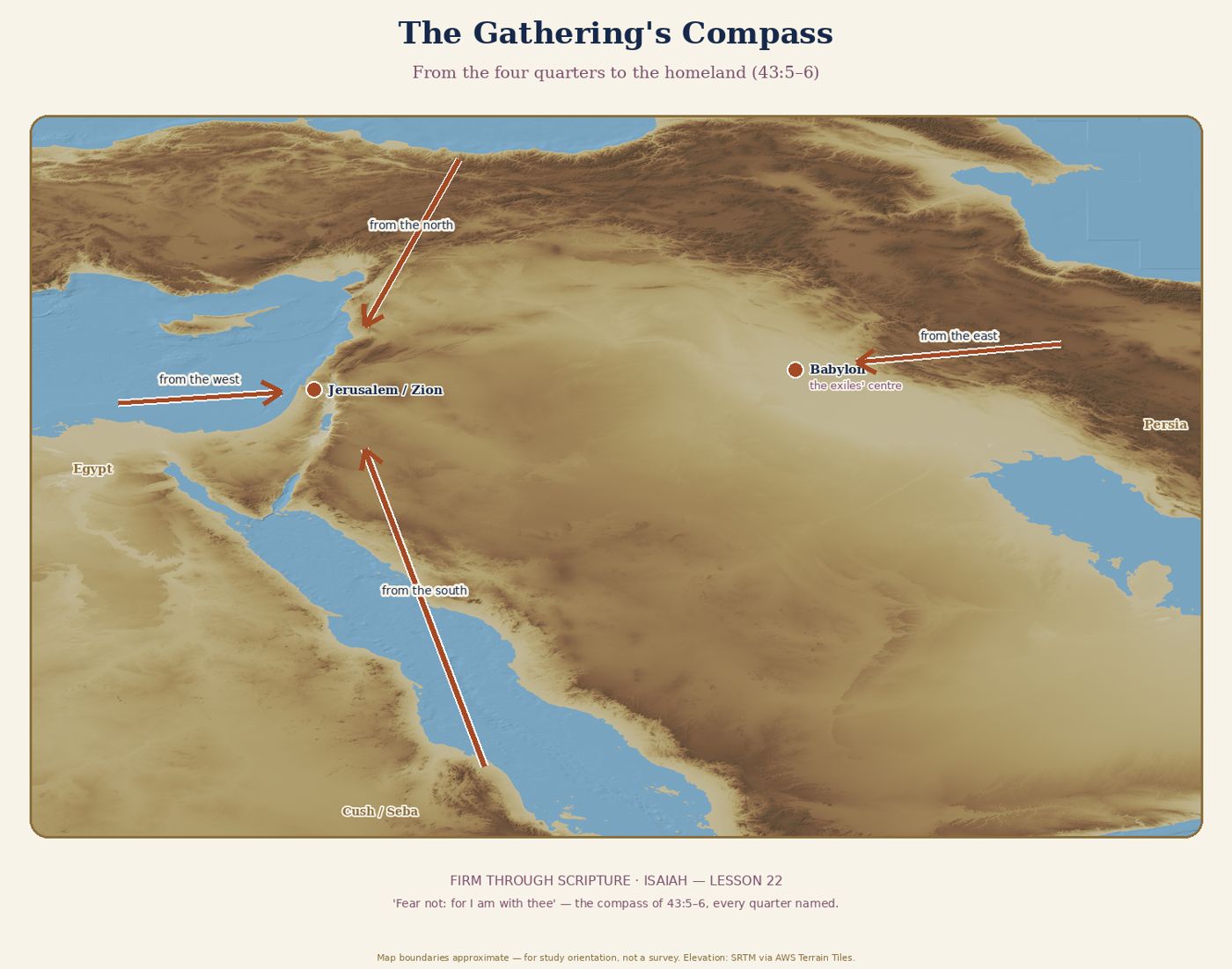
5 Fear not: for I am with thee: I will bring thy seed from the east, and gather thee from the west;
6 I will say to the north, Give up; and to the south, Keep not back: bring my sons from far, and my daughters from the ends of the earth;
7 Even every one that is called by my name: for I have created him for my glory, I have formed him; yea, I have made him.
8 Bring forth the blind people that have eyes, and the deaf that have ears.
9 Let all the nations be gathered together, and let the people be assembled: who among them can declare this, and shew us former things? let them bring forth their witnesses, that they may be justified: or let them hear, and say, It is truth.
10 Ye are my witnesses, saith the LORD, and my servant whom I have chosen: that ye may know and believe me, and understand that I am he: before me there was no God formed, neither shall there be after me.
11 I, even I, am the LORD; and beside me there is no saviour.
12 I have declared, and have saved, and I have shewed, when there was no strange god among you: therefore ye are my witnesses, saith the LORD, that I am God.
13 Yea, before the day was I am he; and there is none that can deliver out of my hand: I will work, and who shall let it?
14 Thus saith the LORD, your redeemer, the Holy One of Israel; For your sake I have sent to Babylon, and have brought down all their nobles, and the Chaldeans, whose cry is in the ships.
15 I am the LORD, your Holy One, the creator of Israel, your King.
16 Thus saith the LORD, which maketh a way in the sea, and a path in the mighty waters;
17 Which bringeth forth the chariot and horse, the army and the power; they shall lie down together, they shall not rise: they are extinct, they are quenched as tow.
18 Remember ye not the former things, neither consider the things of old.
19 Behold, I will do a new thing; now it shall spring forth; shall ye not know it? I will even make a way in the wilderness, and rivers in the desert.
20 The beast of the field shall honour me, the dragons and the owls: because I give waters in the wilderness, and rivers in the desert, to give drink to my people, my chosen.
21 This people have I formed for myself; they shall shew forth my praise.
22 But thou hast not called upon me, O Jacob; but thou hast been weary of me, O Israel.
23 Thou hast not brought me the small cattle of thy burnt offerings; neither hast thou honoured me with thy sacrifices. I have not caused thee to serve with an offering, nor wearied thee with incense.
24 Thou hast bought me no sweet cane with money, neither hast thou filled me with the fat of thy sacrifices: but thou hast made me to serve with thy sins, thou hast wearied me with thine iniquities.
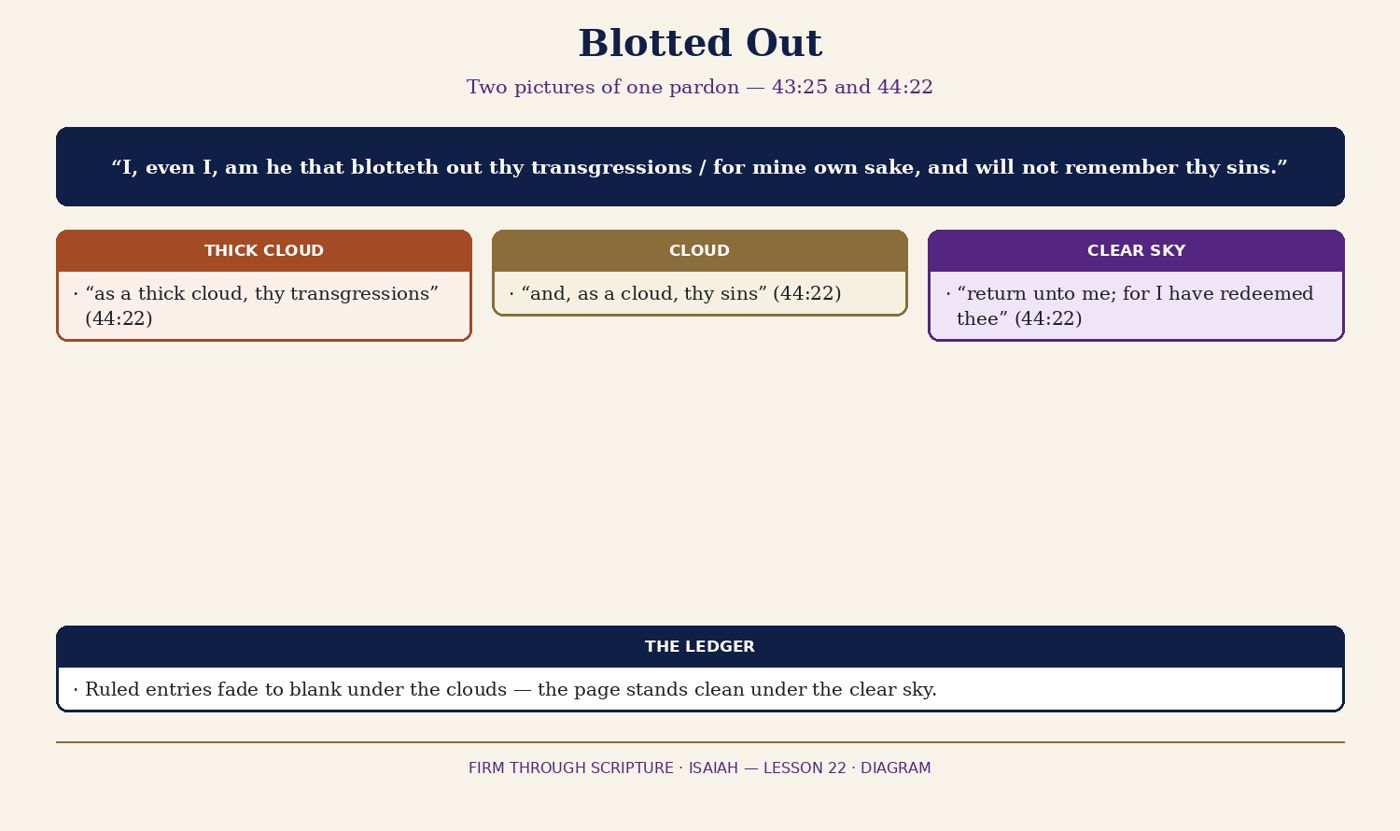
25 I, even I, am he that blotteth out thy transgressions for mine own sake, and will not remember thy sins.
26 Put me in remembrance: let us plead together: declare thou, that thou mayest be justified.
27 Thy first father hath sinned, and thy teachers have transgressed against me.
28 Therefore I have profaned the princes of the sanctuary, and have given Jacob to the curse, and Israel to reproaches.
Chapter 44 continues the same passage — the verse numbers restart, as they do in your Bible.
1 Yet now hear, O Jacob my servant; and Israel, whom I have chosen:
2 Thus saith the LORD that made thee, and formed thee from the womb, which will help thee; Fear not, O Jacob, my servant; and thou, Jesurun, whom I have chosen.
3 For I will pour water upon him that is thirsty, and floods upon the dry ground: I will pour my spirit upon thy seed, and my blessing upon thine offspring:
4 And they shall spring up as among the grass, as willows by the water courses.
5 One shall say, I am the LORD's; and another shall call himself by the name of Jacob; and another shall subscribe with his hand unto the LORD, and surname himself by the name of Israel.
6 Thus saith the LORD the King of Israel, and his redeemer the LORD of hosts; I am the first, and I am the last; and beside me there is no God.
7 And who, as I, shall call, and shall declare it, and set it in order for me, since I appointed the ancient people? and the things that are coming, and shall come, let them shew unto them.
8 Fear ye not, neither be afraid: have not I told thee from that time, and have declared it? ye are even my witnesses. Is there a God beside me? yea, there is no God; I know not any.
9 They that make a graven image are all of them vanity; and their delectable things shall not profit; and they are their own witnesses; they see not, nor know; that they may be ashamed.
10 Who hath formed a god, or molten a graven image that is profitable for nothing?
11 Behold, all his fellows shall be ashamed: and the workmen, they are of men: let them all be gathered together, let them stand up; yet they shall fear, and they shall be ashamed together.
12 The smith with the tongs both worketh in the coals, and fashioneth it with hammers, and worketh it with the strength of his arms: yea, he is hungry, and his strength faileth: he drinketh no water, and is faint.
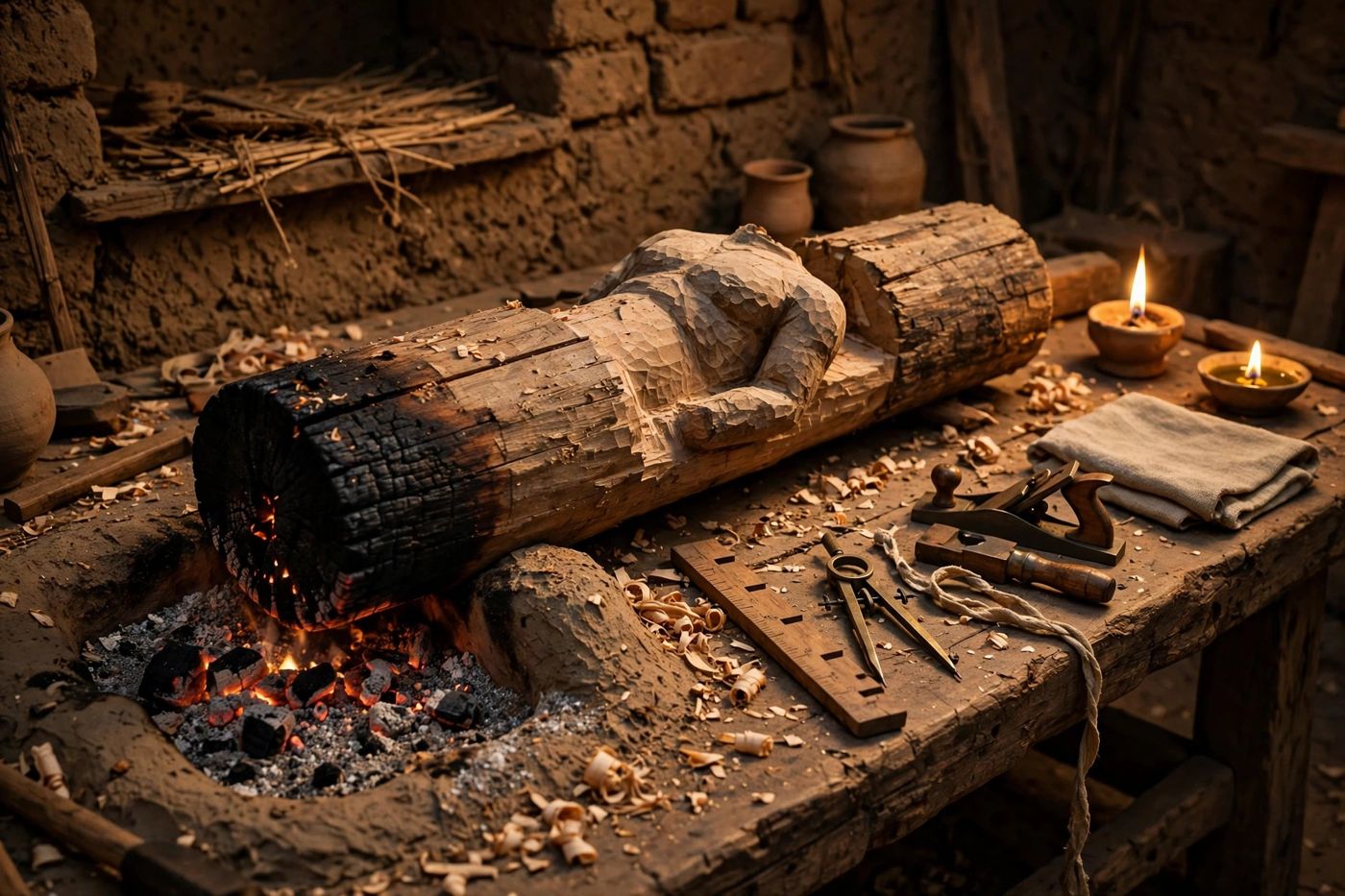
13 The carpenter stretcheth out his rule; he marketh it out with a line; he fitteth it with planes, and he marketh it out with the compass, and maketh it after the figure of a man, according to the beauty of a man; that it may remain in the house.
14 He heweth him down cedars, and taketh the cypress and the oak, which he strengtheneth for himself among the trees of the forest: he planteth an ash, and the rain doth nourish it.
15 Then shall it be for a man to burn: for he will take thereof, and warm himself; yea, he kindleth it, and baketh bread; yea, he maketh a god, and worshippeth it; he maketh it a graven image, and falleth down thereto.
16 He burneth part thereof in the fire; with part thereof he eateth flesh; he roasteth roast, and is satisfied: yea, he warmeth himself, and saith, Aha, I am warm, I have seen the fire:
17 And the residue thereof he maketh a god, even his graven image: he falleth down unto it, and worshippeth it, and prayeth unto it, and saith, Deliver me; for thou art my god.
18 They have not known nor understood: for he hath shut their eyes, that they cannot see; and their hearts, that they cannot understand.
19 And none considereth in his heart, neither is there knowledge nor understanding to say, I have burned part of it in the fire; yea, also I have baked bread upon the coals thereof; I have roasted flesh, and eaten it: and shall I make the residue thereof an abomination? shall I fall down to the stock of a tree?
20 He feedeth on ashes: a deceived heart hath turned him aside, that he cannot deliver his soul, nor say, Is there not a lie in my right hand?
21 Remember these, O Jacob and Israel; for thou art my servant: I have formed thee; thou art my servant: O Israel, thou shalt not be forgotten of me.
22 I have blotted out, as a thick cloud, thy transgressions, and, as a cloud, thy sins: return unto me; for I have redeemed thee.
23 Sing, O ye heavens; for the LORD hath done it: shout, ye lower parts of the earth: break forth into singing, ye mountains, O forest, and every tree therein: for the LORD hath redeemed Jacob, and glorified himself in Israel.
SAY IT PLAIN — the passage in everyday words: God speaks to His exiled people: I made you, I bought you back, I know your name — do not be afraid. I will be with you in the water and the fire, not instead of them. I paid empires to get you, and I will gather you from every point of the compass. You yourselves are My evidence in court: there is no God or Saviour beside Me. I am about to do a new exodus greater than the old — and though you stopped calling on Me and wore Me out with your sins, I Myself will erase your record, for My own sake, and pour My Spirit on your children like water on dry ground. Then God holds up a wooden idol — half firewood, half god — and lets the absurdity preach, before He calls His people home: your cloud of sin is blotted out; sing, heaven and earth — the LORD has redeemed Jacob. Nothing after this changes what you just read.
2. THE WORLD — C: Context & Audience
A text can never mean what it never meant — so before we ask what these verses mean, we stand where their first hearers stood.
Where we are in the book. You are deep in Part Two of Isaiah — the Book of Comfort, chapters 40–55. The scene has shifted a century and a half forward from Isaiah's own lifetime. The northern kingdom fell to Assyria long ago; the southern kingdom of Judah — the tribes around Jerusalem, ruled by David's descendants — has now fallen too, to Babylon, the empire centred on the great city of Babylon in what is now Iraq. Jerusalem was burned, the temple destroyed, thousands carried east into exile. That is the audience: not comfortable churchgoers, but deportees surrounded by Babylon's temples, processions, and gods — quietly wondering whether those gods had simply won. [3, 11]
The trial is still in session. Lessons 20 and 21 set up the courtroom that dominates chapters 40–48, and this lesson does not leave it. God has summoned the nations and their gods to a trial — a formal lawsuit, in the pattern scholars call a trial speech — with one test on the table: who can declare the former things and foretell what is coming? [15, 3] The idols failed the test in silence (ch. 41); God presented His Servant (ch. 42). Now He calls His star witness — not an angel, but the exiles themselves, blind and deaf as they are (43:8). Keep the courtroom in view: witnesses, pleading, and remembrance here are courtroom language, not decoration.
First, the passage keeps calling the people Jacob and Israel — because in the story they are one man and one people. Jacob was the patriarch, Abraham's grandson, whose name God changed to Israel (Genesis 32:28); his twelve sons became the twelve tribes. "Jacob" often carries the flavour of the people in their weakness, "Israel" of the people as God chose and named them — and the passage plays the names against each other deliberately (43:1; 43:22; 44:1–2, where a third appears: Jeshurun, an affectionate nickname for Israel, "the upright one" — used tenderly for a people who have been anything but upright). [4, 11]
Second, Babylon and the Chaldeans — the ruling people and their city, the same captor from two angles (43:14). FACT: Babylon did fall, to Cyrus of Persia in 539 BC, as the Babylonian Chronicle tradition and Cyrus's own inscriptions record. 30 Lesson 23 takes up Cyrus by name. [11, 16]
Third, in 43:3 God names Egypt, Ethiopia, and Seba as the price given for Israel. Egypt you know — Israel's first slave-master. Ethiopia here is Cush, up the Nile in what is now Sudan; Seba was a people of that same region: the great powers of the far south, the edge of the known map. [16, 3]
The world of the idol-maker. The second half of chapter 44 assumes a world where making a god was an ordinary, respected trade: the statue was washed, clothed, fed, and carried in procession as the god's presence, and nobody in Babylon thought the process was funny. [16, 52] Isaiah's workshop tour is reportage, not exaggeration — preached first to Israelites tempted to hedge their bets with this craft, not to smug outsiders.
3. OBSERVE — O: what the text actually does
Before meaning comes observation. Most bad interpretation is not deep error; it is shallow reading. So look:
-
"Fear not" bookends the comfort. The command sounds at 43:1, 43:5, 44:2, and in the plural at 44:8 — four times in fifty-one verses. In this book "fear not" is never a mood suggestion; each time it is bolted to a reason, and the reason is never "because things are not frightening." It is always "because of who I am and whose you are."
-
The verbs God keeps spending on Himself. Created, formed, made (43:1, 7; 44:2, 21) — and redeemed, called, gathered, poured. Chapter 43 alone is a drumbeat of divine first-person: I have redeemed thee, I have called thee, I will be with thee, I gave Egypt, I will bring thy seed… Observation before doctrine: this passage's centre of gravity is not Israel's performance. It is God's "I."
-
The witnesses who cannot see. God calls the nations to bring their witnesses (43:9), then names His own — "ye are my witnesses" (43:10, 12) — the same people introduced two verses earlier as "the blind people that have eyes, and the deaf that have ears" (43:8). The star witness is blind. Do not smooth that over. Israel's testimony is not their insight; it is their history — what God did for them in public, whether they understood it or not.
-
The pivot at 43:22. Everything before it is promise piled on promise. Then one word — "But" — and the temperature drops: "But thou hast not called upon me, O Jacob." The passage lets the indictment stand inside the comfort, not before it. God does not clear the record before He comforts; He comforts, then shows the record, then — 43:25 — erases it. The order is the theology.
-
A command to forget, from the God of remembrance. In 43:18 the God who elsewhere commands Israel to remember the exodus orders: remember not the former things. Watch who is told to remember what. God forgets sins and remembers His servant (43:25; 44:21); Israel is told to forget the old exodus as the ceiling of expectation and remember the blotting-out instead. Memory, in this passage, is assigned, not accidental.
-
The longest look in the passage is at a log. A full twelve verses (44:9–20) watch one craftsman eat lunch off half a tree and pray to the other half. Where a prophet lingers, a reader should slow down — §7 spends its longest stretch here.
4. GENRE — N: note the genre (prophetic salvation oracle inside a trial speech — with a satire inside the oracle)
Isaiah 43–44 is not one kind of writing but three, nested like boxes, and each box has its own reading rules.
The outer box: the trial speech. Across Isaiah 41–48 God conducts a lawsuit against the idols, and this passage still carries the courtroom's furniture — witnesses summoned (43:9–10), a plea invited ("let us plead together," 43:26). Scholars call these passages trial speeches, and the label matters because it tells you what the sentences are doing: evidence offered to persuade a jury — the nations, and wavering Israel itself. [15, 5] "Ye are my witnesses" is not poetry. It is testimony being called.
The middle box: the salvation oracle. Inside the trial, the dominant form is what scholars call an oracle of salvation — God's direct address to a frightened people with a fixed skeleton: "Fear not," followed by the reason, grounded in His past action ("for I have redeemed thee"), unfolding into promise. [15, 3] You met the skeleton at 41:10 and 41:14; here it reaches its fullest expansion. An oracle is received, not performed; its verbs belong to God. Strip-mining it for your to-do list inverts the genre — a point the Walk-Out will enforce.
The inner box: the idol satire. Isaiah 44:9–20 changes register entirely — from oracle to satire, the Bible's fullest piece of sustained comic exposure. Satire teaches by making you watch a thing until its absurdity becomes visible; it aims at recognition, not information. Nobody finishes 44:9–20 knowing a new fact about carpentry. They finish it unable to un-see the log. Read it slowly, let it be funny — then notice whose hands the recognition lands in.
One more note: the passage is poetry, Hebrew parallelism throughout — line answering line, image answering image (43:2; 44:22). Poetry argues by accumulation and picture, not by syllogism. Do not flatten its images into propositions, and do not multiply them into secret codes. 51
5. TERMS — T: the words in the writer's mouth
Method note — the word-study guardrail: a word means what its author uses it to mean, in its sentence, in its century — not what its oldest root once meant, and not everything it can mean anywhere. The terms below were settled by Isaiah's usage in Isaiah, checked against the standard lexica. [19, 18]
- "Witnesses" (43:10, 12; 44:8). The Hebrew is 'edim, the ordinary word for legal witnesses — people whose testimony establishes a fact in court (in Israel's law, a matter stood on two or three witnesses, Deuteronomy 19:15). Isaiah's stroke is to make an entire nation the witness. And what does a witness contribute? Not brilliance — testimony: this is what happened to us; this is what He said beforehand; this is what then came to pass. Israel qualifies not by seeing clearly (43:8 just called them blind) but by being the evidence — their survival and return are the exhibits. [18, 4]
- "Redeemed / Redeemer" — the ga'al cluster (43:1, 14; 44:6, 22, 23). This is the passage's master word, and English flattens it. The Hebrew verb ga'al belongs to the family before it belongs to the temple. In Israel's law the go'el — the kinsman-redeemer — was the near relative obligated to buy back what the family had lost: land sold under debt (Leviticus 25:25), a relative sold into slavery (Leviticus 25:47–49), or, in the famous story, the widowed Ruth's future, taken up by Boaz. [21, 19] To redeem is a kinsman paying a price to recover his own. Now hear Isaiah's move: again and again God calls Himself Israel's go'el — "thy redeemer, the Holy One of Israel" (43:14) — claiming the family's obligation as His own. Not a stranger purchasing strangers: the next of kin, doing what kin do, at cost to Himself. When 43:1 says "I have redeemed thee," the first hearers did not hear a banking term. They heard: your closest relative has already paid to get you back.
- "For mine own sake" (43:25). The Hebrew (lema'ani) locates an action's ground in the actor, not its object: "for my sake, because of who I am." Across the book God spares and defers anger on the same ground (37:35; 48:9–11). It never means "because you deserved it," nor "on a whim." The pardon is anchored in God's own name, character, and pledged reputation — the one anchor the people's record cannot drag. Misread 3 hangs on this term, and so does the passage's whole security. [18, 3]
- "Blot out" (43:25; 44:22). One verb (machah), two pictures. In 43:25 it is the ledger image — an entry wiped off a written record. In 44:22 the record becomes weather: transgressions blotted "as a thick cloud," sins "as a cloud" — overcast and mist, both dispersed by the same sun. What God erases, He erases in both registers: the account closed and the sky cleared. [19, 52]
TRANSLATION NOTE — "I gave Egypt for thy ransom" (43:3–4): what the price-language claims, and what it does not
Your KJV's words — "ransom" (kopher, a price paid to release or recover; Exodus 21:30; 30:12) and "for thee" — are deliberate, even startling, and this study will not soften them. [19, 21] What the language claims: Israel's rescue genuinely cost. God, acting as Israel's kinsman-redeemer, counts great nations — Egypt, Cush (Ethiopia), Seba — as the consideration given in exchange for His people's life, because Israel was "precious in my sight" (43:4). The text never narrates the transaction; it declares the value God sets on His people, in the currency of empires. [3, 11] What it does not claim: a payment made to anyone — not to Babylon, not to Satan, not to a cosmic creditor; the passage names no payee. Nor is it the New Testament's atonement stated early: there, Christ "gave himself a ransom for all" (1 Timothy 2:6) — payer and price converge on God Himself in a way 43:3 does not yet describe. 1 Read 43:3–4 at full strength, then — God's election economics, stated without apology — and refuse to load it with machinery it never mentions.
6. ENTIRE CANON — E: where this passage sits in the whole story
No passage lives alone. Isaiah 43:1–44:23 is a junction where at least five of the Bible's great lines cross:
- Back to Genesis — creation and naming. The passage opens with creation verbs — the LORD "that created thee… that formed thee" (43:1) — and repeats the triple at 43:7: created, formed, made. That is Genesis 1–2's vocabulary spent on Israel: the nation as a second creation, made for the same purpose as the first — its Maker's glory. And "I have called thee by thy name" reaches back to Genesis's namings and forward to a Shepherd who "calleth his own sheep by name" (John 10:3). [1, 4]
- Back to Exodus — and beyond it. The "way in the sea" (43:16) and the drowned "chariot and horse" (43:17) are the Red Sea, unmistakably (Exodus 14–15). But the passage treats the exodus as a first draft: "Behold, I will do a new thing" (43:19) — a greater deliverance, promising water in the wilderness where the first made a path through water. The canon keeps the pattern running: Jeremiah foresees the confession changing to the God who brought them up "out of the north country" (Jeremiah 16:14–15), and the New Testament reads the pattern onto Christ — Luke 9:31 names His departure, literally, an exodus — and onto baptism (1 Corinthians 10:1–2). [1, 52]
- Sideways in Isaiah — the hardening and the "until." Chapter 44:18's shut eyes are Isaiah 6 still echoing — a message that hardens as it is refused (6:9–10). Set beside it 32:15's hinge: desolation lasts "until the spirit be poured upon us from on high." Chapter 44:3 is that "until" arriving as promise (the line runs 32:15 → 44:3 → 59:21). [4, 3]
- Forward to the New Testament — witnesses, redemption, and the Spirit. The apostles reach for this passage constantly. "Ye are my witnesses" (43:10) becomes the risen Christ's commission in new form (Acts 1:8). "Beside me there is no saviour" (43:11) stands behind "neither is there salvation in any other" (Acts 4:12). The Spirit poured on offspring (44:3) is read at Pentecost in offspring-language (Acts 2:39), and Paul argues God's faithfulness to Israel in this passage's vocabulary: formed, called, not forgotten (Romans 11; cf. 44:21). Even the blotting crosses over (Psalm 51:1; Acts 3:19). 1 None of this is forced symbolism; it is the New Testament citing, echoing, and enacting this text — canon evidence, taught as such.
- The honesty note this passage requires. Chapters 40–55 are where the authorship question bites hardest: since Duhm, mainstream scholarship commonly assigns them to an unnamed exilic prophet, "Second Isaiah." [40, 9] DISPUTED. The evidence both ways is real — the shift of scene crossing from chapter 39 to 40 is undeniable, while the New Testament cites both halves under the one name "Isaiah" (John 12:38–41 weaves chapters 53 and 6 together) and the Great Isaiah Scroll already transmits all 66 chapters as one scroll. [22, 50] POSITION — this course's, stated openly: we read the book whole, as Isaiah's witness, at full prophetic strength — including that the prophet addresses exiles a century and a half ahead, which is precisely the book's own claim about prophecy (and, in this passage, the trial's very test). FACT: on either side of the dispute, the text makes the same demands and promises. The dispute concerns the messenger's biography, not the message.
7. THE MEANING — what the passage teaches
The Walk has established what the text says and where it sits. Now its payload, taught straight — the doctrines this passage actually carries, in the passage's own order and proportions.
Created, redeemed, named — and therefore unafraid (43:1–7)
The passage begins with two words English readers glide past: "But now" — in contrast to what came before. Chapter 42 ended with a blind, plundered servant. Into that wreckage, without waiting for the people to improve, comes the warmest sentence in the book: judgment stated honestly, then grace that does not wait to be deserved. That is the gospel's pattern everywhere.
Notice the grounds God stacks under "Fear not" — three, and not one is Israel's character. Creation: the LORD "that created thee… that formed thee" — you are Mine because I made you. Redemption: "for I have redeemed thee" — ga'al, §5's kinsman buy-back, and past tense: not "I will, if—" but the price already paid. Naming: "I have called thee by thy name; thou art mine" — to name was to claim and to know. Fearlessness here is not a temperament. It is a conclusion, drawn from Maker, Redeemer, and Name-Knower, in that order. [3, 4]
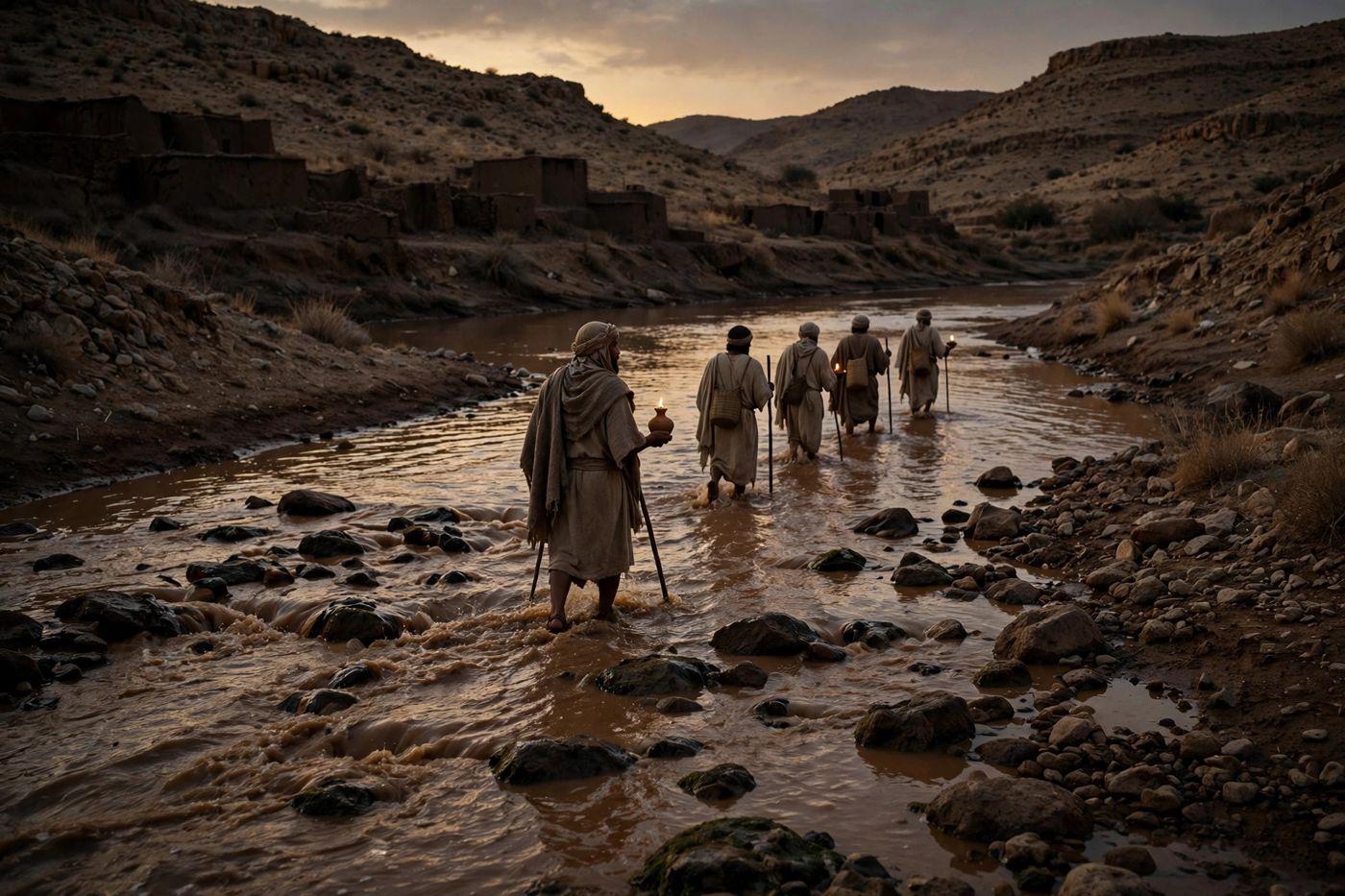
Then the verse this lesson will not let you misread. Look at v. 2's verbs. "When thou passest through the waters, I will be with thee." Not if — when. Not "I will divert the rivers" — "they shall not overflow thee." Not "you will never see fire" — "when thou walkest through the fire, thou shalt not be burned." The promise is presence within the element and survival through it, not exemption from it — and it is the exiles' own story told back to them: Babylon's waters were real, and the nation was not, in the end, overflowed or consumed. Daniel 3's literal furnace, in the same exile, enacts the pattern exactly: God does not keep the three Hebrews out of the fire; He is found in it, and they come out unburned. [1, 52] Teach it at that strength and no stronger — §10's first Misread draws the boundary; here, receive the promise as written: with thee, the two words the whole Bible keeps spending on frightened people.
Then God says the quiet part out loud, and §5's Translation Note has prepared you: "I gave Egypt for thy ransom, Ethiopia and Seba for thee… therefore will I give men for thee, and people for thy life" (43:3–4, read whole in §1). Do not rush to tidy this. At full strength the passage teaches election economics: this people is so precious in God's sight — "thou wast precious in my sight… and I have loved thee" — that God publicly reckons empires as the exchange for their life. Three disciplines keep the teaching honest. It declares worth, not a mechanism — no negotiation God had to win is described. It runs downhill through the book — the same God will, in chapter 53, lay the Servant's life down as the offering: God's pattern is finally not to spend others instead of His people but to spend Himself for them; the cross is where this arithmetic is completed and reversed (see the Christ Thread). And it is particular before it is general — spoken first to exiled Jacob, whose ransom really was bound up with the transfer of empires in their own generation. Application to us travels by the canon (§6), not by snatching the receipt. [3, 11]
The movement closes with the compass. "Fear not: for I am with thee" (43:5) — v. 2's presence scaled to geography — and God addresses the winds like a king addressing heralds: north, give up; south, keep not back. Sons from far, daughters from the ends of the earth (43:6–7) — and hear the purpose clause, where everything in Isaiah lands: "for I have created him for my glory." The gathering is not ultimately for Israel's comfort, though it brings comfort. It is for the display of the Gatherer — a people assembled from every direction is itself the sermon the nations are meant to read. 4
The blind witness takes the stand (43:8–13)
Now the trial resumes, and God calls His evidence. Verse 9 packs the court: all the nations gathered, and the standing challenge issued — let them bring forth their witnesses and be justified. Into that courtroom, at v. 8, God leads His own witness, and Isaiah makes you look twice: "the blind people that have eyes, and the deaf that have ears." The paradox is deliberate. God's exhibit A is a people who did not see and did not hear — because the testimony does not rest on the witness's acuity. It rests on the facts of the witness's history: a God who declared beforehand and saved in public, "when there was no strange god among you" (43:12). Israel can testify to what was done to them even where they cannot explain it. Every believer who has ever said "I don't understand it, but I know what He did for me" has stood in exactly this witness box. [15, 4]
The testimony itself is monotheism's charter — read it whole again in §1 (43:10–11) and weigh its three fused claims. Existence: before God there was no God formed — formed gods are manufactured gods, and the true God was never manufactured at all. Exclusivity: "beside me there is no saviour" — not "no greater saviour"; no saviour, full stop. Purpose: the witness exists "that ye may know and believe me" — the testimony converts the witness as it convinces the court. Verse 13 seals it: God before the first day, a hand no one can deliver out of, a work no one can reverse — "who shall let it?" [3, 15]
The new thing — greater than the exodus it echoes (43:14–21)
Chapter 43's second half opens with a title-stack — "your redeemer, the Holy One of Israel" — and a shock: "For your sake I have sent to Babylon, and have brought down all their nobles" (43:14). The captor's fall is announced as already decreed; the Chaldeans whose cry was in their ships will flee in those same ships. For your sake — vv. 3–4's ransom-economics, now with the empire named. Then God reintroduces Himself by His oldest résumé line (43:16–17): the sea-way-maker, the drowner of chariot and horse — "quenched as tow," snuffed like a wick. The exodus, recited perfectly.
And then — the passage's most startling command — He tells them to stop reciting it: "Remember ye not the former things… Behold, I will do a new thing" (43:18–19). Be precise about what is not said. The old exodus is not discarded or declared false — the passage has just used it as God's credentials. What is retired is the exodus as the ceiling: the fixed size of what God can do. God's answer to a people living off an old story is a bigger story, told in the old story's imagery and turned inside out — the first exodus made a way through water; the new one makes water spring up in the desert, watering even the wild beasts on the way home (43:20). "Shall ye not know it?" is the ache in v. 19: the new thing will spring forth, present tense, under the feet of people still staring backward. And the purpose lands where this passage always lands: "This people have I formed for myself; they shall shew forth my praise" (43:21) — the witness vocation of vv. 10–12 stated as the nation's very design. [3, 52]
The empty ledger — and the Eraser (43:22–28)
Now the pivot §3 warned you about — do not hurry it. Against all that grace, God sets the record, and it is not Babylon's. It is Israel's. "But thou hast not called upon me, O Jacob; but thou hast been weary of me, O Israel" (43:22). The offerings never arrived: no small cattle, no honour in sacrifices, no sweet cane, no fat (43:23–24). The charge is not logistics but direction: the only service God received from this people was carrying their sins. Read the exchange: "I have not… wearied thee with incense" (43:23) — I never made My worship a burden — "but thou hast… wearied me with thine iniquities" (43:24). The only heavy thing in this relationship's history was carried by God, and it was their sin. [11, 3]
And over that record — itemised, unexcused — falls the sentence the whole gospel leans on. Read v. 25 again in §1 until its structure is plain. The subject is doubled and emphatic: "I, even I, am he that blotteth out thy transgressions." The act is §5's ledger-verb: not ignoring, not overlooking — blotting out. The ground is stated, and Misread 3 will defend it: "for mine own sake." The manner completes it: "and will not remember thy sins" — the God who forgets nothing by accident chooses a covenant forgetting; the record will not be held, cited, or reopened. The court that heard the evidence now watches the Judge erase the file.
Even the lawsuit's last exchange refuses cheap comfort. "Put me in remembrance: let us plead together: declare thou, that thou mayest be justified" (43:26) — God invites Israel to make their case; He would rather argue with His people than abandon them. But the verdict is honest to the last line: the first father sinned, the teachers transgressed, the sanctuary's princes were profaned (43:27–28) — the exile itself was earned. Pardon with no alibi. God does not acquit Israel by discovering their innocence; He blots out the transgressions of a people He has just proved guilty — for His own sake. Grace that needs an alibi is not grace; it is bookkeeping. [3, 4] This is the other thing.
Water on dry ground — the Spirit promised to children (44:1–5)
Chapter 44 collects the verdict and pours it out. "Yet now hear, O Jacob my servant" — yet now, after 43:27–28's record, the address is still my servant, still whom I have chosen, and the command is still "Fear not" (44:1–2). Verse 2 stacks the names: made thee, formed thee from the womb, will help thee. Grace in this book does not begin at conversion. It begins at the womb.
Then the promise the rest of the Bible spends centuries unfolding (44:3, read whole in §1). Read the parallelism as the poet built it — water : Spirit :: dry ground : offspring. What rain does for cracked earth, God's Spirit will do for Israel's children. This is 32:15's "until" arriving (§6): the desolation was a season with an expiry date written into it. And the result is pictured organically, not mechanically — offspring springing up "as willows by the water courses" (44:4), the fastest, thirstiest trees of the riverbank. Plant the promise there and it cannot stay small. [52, 3]
Then, quietly, the passage's widest door opens (44:5, read whole in §1). Subscription — signing the hand over, as a servant is marked with a master's name — is the language of voluntary belonging. [16, 21] One, another, another: a queue forming of people claiming Israel's God and name as their own. The book returns to it directly (56:3–8; Lesson 31). The God who called His people by name (43:1) ends by welcoming people who take His name on themselves. The gathering of 43:5–6 was never only about geography.
The creed in one breath (44:6–8)
Before the satire, the passage plants its flag: "Thus saith the LORD the King of Israel, and his redeemer the LORD of hosts; I am the first, and I am the last; and beside me there is no God" (44:6). First and last — the total span, no rival at either end or anywhere between. Verse 7 reapplies the trial's test, and v. 8 turns it pastoral — fear not, you heard this from the beginning — and then the verdict, delivered with something very like a smile: "Is there a God beside me? yea, there is no God; I know not any." Dwell on that clause; it is the passage's wittiest line and perfectly serious. The omniscient God testifies that He has searched the category "God beside me" and found it empty — His ignorance of a rival is not a gap in His knowledge but the court's verdict: there is none to know. Every generation's panic about a rising rival meets the same answer. [4, 3]
The satire — a god, in two halves (44:9–20)
Now slow down. This is Book Two's comic masterpiece, the Bible's longest sustained exposure of idolatry, and it must be taught completely — its power is in its patience. Isaiah does not argue; he narrates, trade by trade, log by log, and lets the facts convict. Walk it in its own steps, reading each stretch whole in §1 as you go.
Step one — the verdict announced (44:9–11). Before the story starts, the conclusion is posted: makers of graven images "are all of them vanity"; their treasured things "shall not profit"; and the makers "are their own witnesses; they see not, nor know." That last phrase is the thesis in advance — the idol-makers will testify, by their own process, against their own product. The workmen, Isaiah notes drily, "are of men": gather the whole guild, stand them up together, and together they "shall fear, and they shall be ashamed together."
Step two — the smith (44:12). Watch the metalworker: tongs, coals, hammers, the strength of his arms. Isaiah lingers on the craftsman's body — "he is hungry, and his strength faileth: he drinketh no water, and is faint." The god-maker must be fed; the being who will shortly be prayed to for deliverance cannot be finished until its maker has had lunch. Isaiah does not underline it. He does not need to.
Step three — the carpenter and the tree (44:13–14). His tools are professional — rule, marking line, planes, compass — and his aim is stated with terrible plainness: to shape the wood "after the figure of a man, according to the beauty of a man; that it may remain in the house." A man makes a man-shaped thing, in his own image — the precise reversal of Genesis 1:27 — to sit in his house. Behind the workshop stands the forest: cedar, cypress, oak, the ash a man plants and the rain doth nourish it — the god's raw material grew because rain fell. Who sent the rain is a question the satire leaves lying in plain sight.
Step four — the budget of one log (44:15–17). Here is the centre of the piece. One piece of wood is divided, in one man's afternoon, into a budget: part to burn for warmth, part for the oven and the baking of bread, part for roasting meat — after which the man sits back, satisfied, and delivers the satire's most human line: "Aha, I am warm, I have seen the fire" (44:16). Warm, fed, content — and then: "And the residue thereof he maketh a god." The residue. The leftovers. What fire and dinner did not need becomes the object of prostration: he falls down and prays, "Deliver me; for thou art my god," to the leavings of the log that just cooked his lunch (44:17). Isaiah has not exaggerated a single motion: no villain, no fraud, just an ordinary craftsman and a budget that never gets questioned.
Step five — the diagnosis (44:18–20). The satire turns from the log to the mind, and the comedy curdles. "They have not known nor understood: for he hath shut their eyes, that they cannot see" (44:18) — Isaiah 6's hardening (§6) recurring as idolatry's own curse: the judgment of being handed over to the thing you chose. The man of v. 19 cannot perform the simplest sum — I burned part of it, baked on its coals, roasted and ate: shall I make the residue an abomination? The facts are all in his possession; the "consider[ing] in his heart" never happens. Then the summit sentence: "He feedeth on ashes: a deceived heart hath turned him aside, that he cannot deliver his soul, nor say, Is there not a lie in my right hand?" (44:20). Feedeth on ashes — idolatry's diet: grey, nourishing nothing. And the lie is not across the sea or inside a temple; it is in his right hand — held, carried, closest to him, unexamined because it is his. Keep the pity in frame, as the passage does: the man is deceived, not defiant — his worship's victim as well as its author. Exposure without pity is not Isaiah's method, and §10, Misread 2, draws the boundary. [52, 4]
The blot, and the song (44:21–23)
The passage lands where it must: back at the servant, back at the eraser. "Remember these, O Jacob and Israel; for thou art my servant… O Israel, thou shalt not be forgotten of me" (44:21). Remember these — §3's assigned memory. God's memory and Israel's are pointedly asymmetric: He will not remember their sins (43:25); He will not forget them (44:21). Both forgettings are grace, from opposite directions.
Then the weather clears. Read 44:22 whole in §1: the blotting of 43:25, now in §5's cloud-register — thick cloud and thin cloud, both dispersed — the kinsman's past-tense redeemed — and between them the only imperative addressed to Israel in the lesson's whole second half: return unto me. Not "earn," not "rebuild," not "explain." Return — because the obstacle (the record) has been removed and the relationship already stands. The order is unbreakable, and it is the order of the whole gospel: I have redeemed — therefore return.
The response, when pardon is real, cannot be contained in the pardoned. Verse 23 calls in the choir: heavens, earth's depths, mountains, forest and every tree therein — yes, the trees: the species that ended the satire as fuel and false god ends the lesson as a worshipper, in its right use at last. 52 And the song's ground closes the passage where 43:1 opened it: "for the LORD hath redeemed Jacob, and glorified himself in Israel." Created for glory (43:7) — glorified in the redeemed (44:23). The bookend holds.
The Christ Thread
Isaiah needs no forced symbolism, and this passage needs none. What it offers is a pattern the New Testament itself gathers up and names. The kinsman-redeemer who pays an empire-sized price for His people (43:3–4) reaches His completion when the Redeemer pays Himself: the Son of Man came "to give his life a ransom for many" (Mark 10:45), and in Him the church confesses redemption and "the forgiveness of sins" (Ephesians 1:7) — the blotting of 43:25 given a mechanism and a name. 1 The God who knows no saviour beside Himself (43:11) and the apostles who know no other name (Acts 4:12) preach one sermon; the Spirit promised to offspring (44:3) is poured at Pentecost and defended by Peter in offspring-language (Acts 2:39). POSITION — the church's historic reading, held by this course: fulfillments the apostles assert, not resemblances we invent. Underneath stands FACT: this passage's vocabulary — redeemed, ransom, blot out, witnesses, pour my Spirit — is the vocabulary the New Testament reaches for when it explains Jesus.
Where in the Covenant Story?
The passage stands in the exile — the Sinai covenant's darkest clause come true (Deuteronomy 28), as 43:27–28 owns without flinching. What chapters 43–44 announce is not the covenant's fine print but its future: a redemption that cannot be earned back under the old terms, a Spirit poured on offspring, people signing themselves with the LORD's name (44:5) — the contours of Jeremiah's new covenant, with its own "I will remember their sin no more" (Jeremiah 31:31–34), the twin of 43:25. The Mosaic covenant explains how Israel got to Babylon. It cannot explain how they get home. This passage can: for mine own sake.
Father, Son, and Spirit
Briefly, and without forcing a formula: the passage is the Father's voice; the Spirit is His to pour (44:3); the Redeemer's work is accomplished, as the canon unfolds it (§6), in the Son. What the passage itself contributes is monotheism with a pulse — one God, no formed rival, first and last, who redeems like a kinsman and gives His Spirit like rain. God's unity in Isaiah is never a bare number. It is a character.
The Long View — what the church has believed
You are not this passage's first reader, and its great sentences have been load-bearing for a long time. The early church heard in 43:25 the ground of its confidence that forgiveness rests in God's nature and promise rather than in the sinner's record — a reading Jerome's commentary on this chapter transmits from the church's first centuries. 37 Calvin, on the same verse, pressed exactly the clause Misread 3 defends: a pardon grounded in God's own sake is not the pardon's blemish but the believer's only unmoveable security, since a pardon grounded in us could be revoked by us. 36 Where the centuries have honestly differed is over the comfort's address and the book's authorship (§6): Jewish readers have read the redemption as Israel's national restoration, full stop; the church has heard the Redeemer's voice carry through to Christ — argued in the open since Justin's Dialogue in the second century. 44 On the satire, the centuries are nearly unanimous: 44:9–20 is Scripture's definitive anatomy of idolatry, and "a lie in my right hand" has passed into the moral vocabulary of both traditions, rabbinic and Christian alike.
8. THE AIM SENTENCE — X: eXplain the intent
Everything observed now compresses into one sentence — the author's intended meaning, stated before application is allowed near it:
Isaiah 43:1–44:23 comforts God's exiled people with God's own act: the Creator who redeemed them as a kinsman, named them, and promises His presence through — not around — water and fire, calls them as His witnesses that He alone is God and Saviour, announces a new exodus greater than the old, blots out the transgressions of a guilty people for His own sake, promises His Spirit to their children, and exposes every self-made god as a lie held in the hand — so that heaven and earth sing over a redeemed Jacob.
9. SAY IT BACK
Close the book and say the AIM sentence from §8 in your own words — out loud, or written in your notes, without looking. Then say, in one more sentence, what it asks of you this week.
If your version quietly changes the meaning — if "through the waters" becomes "away from all trouble," or "for mine own sake" becomes "because I finally deserved it," or the satire becomes a joke about other people — open the lesson and walk it again.
10. THE MISREAD — the guardrail, with verdicts
Three live misuses of this passage. Each gets a fair hearing, the evidence, and a verdict.
Why it sounds right: the verse really is a promise of protection, and comfort-preaching reaches for it at funerals and hospital beds, where it belongs. "Thou shalt not be burned" is in the text. The evidence: the verse's own grammar refuses the extraction reading at every joint. The time-word is "when," not "if" — passage through the waters is assumed. The preposition is "through," twice. The promises attached are presence ("I will be with thee") and non-consumption ("they shall not overflow thee… neither shall the flame kindle upon thee") — survival and accompaniment, not avoidance. The first hearers are the control group: the exiles who heard this were already in Babylon's waters, and the prophecy did not airlift them out the next morning; it promised they would not be overflowed — and they were not: this people survived an exile that dissolved other nations, and came home. Daniel's friends went into a literal furnace and out again unburned (Daniel 3) — the pattern enacted, exemption nowhere in sight. 1 A reading that promises exemption will eventually collide with a hospital corridor and shatter — and take someone's faith with it, because they will conclude the promise failed when in fact the reading failed.
The evidence: the satire's own diagnosis names a mechanism, not a technology: a man holding the evidence against his god in his own hand — he warmed himself by this wood an hour ago — and never "consider[ing] in his heart" (44:19). The target is self-deception with the counter-evidence in plain reach, and the mechanism transfers wherever a made, managed, fed thing — a portfolio performed for, a reputation curated, a substance or a screen — is finally prayed to: Deliver me (44:17). §13 runs that transfer formally. But it cuts the smug reader first: 44:18's shut eyes demand pity alongside exposure — the man is deceived, feeding on ashes, and does not know it. A reading that leaves you merely amused at ancient carpenters has performed the exact failure the text diagnoses.
Misread 3: "'For mine own sake' (43:25) makes God's forgiveness sound self-centred — pardon about His ego rather than our need." Why it sounds right: modern ears hear "for my own sake" as self-regard, and the clause is often quietly skipped in preaching, as if it embarrassed the verse. The evidence: argue it from the verses around it, as the passage insists. The preceding record (43:22–24) shows a people who brought God nothing and wearied Him with sins; the following verdict (43:27–28) proves the guilt from the first father down. Ground the pardon in anything about Israel and the next verse revokes it — the record is simply too bad. Ground it where the text grounds it — in God's own sake: His name, character, and pledged word — and it becomes the one pardon that record cannot undo, because its ground is not in the record at all. Calvin's verdict (§7's Long View) stands: the clause is not the pardon's problem. It is the pardon's foundation. 36 Verdict: "for mine own sake" is the exiles' security, not God's vanity. God anchors forgiveness in the only ground the guilty record cannot reach — Himself.
11. FROM WORD TO WALK
A reflection page — the lesson is not finished until the passage has had its say.
Sit with the two hands this passage puts in front of you.
In one hand — God's — there is a name. Yours. "I have called thee by thy name; thou art mine." Before the passage asks anything of you, it puts that there: known, claimed, bought back by a Kinsman who reckoned empires a fair exchange. The ledger here runs the other direction: shown to you in full, and then blotted, in front of you, by the only hand with the right to hold the eraser. If you keep a second ledger — your own record of sins you are sure God must still be holding somewhere — this passage asks you to watch what He does with His copy, and to stop trusting yours more than His.
In the other hand — the craftsman's hand, your hand — there may be a lie. "Is there not a lie in my right hand?" The satire's mercy is that it makes the question askable. Not am I an idolater? — our defences swat that away in a second — but: what am I holding, warming myself by, feeding from, that I also quietly ask to deliver me? Ashes feed nobody, but they can fill a life so gradually that the taste becomes normal. The passage does not ask you to smash the thing in a panic. It asks you to consider it in your heart — the one act the craftsman never performed — and then to do what 44:22 invites, in its exact order: the cloud is blotted out; return.
And if your honest location today is not the workshop but the water — if you are mid-stream, and the fire is not a metaphor this month — then the passage's first word is also its word for you, at its true strength: not you will be lifted out by morning, but I will be with thee, and the waters have a limit set by a hand that is not yours. The exiles heard this from inside Babylon, years before one stone of the return was laid. It held them. Let it hold you.

Redeemer — You called me by name before I called on You, and You have blotted out a record I could not have survived reading aloud. Thank You that my pardon rests on Your sake and not on mine. Show me the lie in my right hand, gently and plainly, and teach my feet the way back: return unto Me. Be with me in the waters I am actually in — I will trust Your presence where I cannot have Your explanations. In Jesus' name, amen.
12. FOR DISCUSSION — OR FOR YOUR JOURNAL
With a group, work these aloud. Alone, they're yours — answer them in your journal or in prayer; they lose nothing in the quiet.
- God stacks three grounds under "Fear not" in 43:1 — created, redeemed, named — none of them Israel's character. Which do you actually lean on when you are afraid, and which do you tend to replace with your own performance?
- Isaiah 43:2 promises presence through the waters, not removal from them. Where has that distinction mattered — or where does it need to matter — in a hard season of your own life?
- The witnesses of 43:10 are introduced as blind and deaf (43:8), yet God calls their testimony decisive. What does that teach about what makes a witness credible — and about what your own testimony consists of?
- The craftsman never asks, "Is there not a lie in my right hand?" (44:20). What helps a person actually ask that question — and what in your own week plays the role of the thing you warm yourself by and also ask to deliver you?
13. THE WALK-OUT — T: Transfer to today
Meaning is settled. Now — and only now — application, and it must cross the bridge honestly. Run the five Transfer Tests on this passage:
- Same covenant? The promises were spoken to exiled Israel under the old covenant. We receive them from the far side of the cross, in the new covenant Jesus sealed — where the blotting of sins (43:25) is accomplished in Christ's blood and the Spirit of 44:3 is poured out on all flesh. The promises cross through Christ, not around Him; their form changes, their Giver and His character do not.
- Same audience? The first audience is a nation — Jacob, corporately: created, ransomed, gathered, witnessed as a people. Applications that shrink the passage to private comfort alone break the address; applications that claim Israel's national promises as a modern state's charter or a church's property deed break it from the other side. What crosses to the believer crosses as a member of God's people, gathered into the story — not as a replacement of its first hearers.
- Same genre rules? This is oracle and satire, not a command-list. The imperatives are strikingly few — fear not, remember not the former things, remember these, return — and all four are responses to God's finished acts. Application must keep that shape: indicative first, imperative trailing behind, or we have rewritten the genre into law.
- Repeated or rooted? Presence through trial (not exemption), pardon grounded in God's character, the Spirit promised to the next generation, idolatry as self-deception — each reappears across the canon and is rooted in who God is (§6: Acts 1:8; 2:39; 4:12; Romans 11). These cross with confidence. The historical transactions — Egypt given, Babylon sent down — belong to that exile's moment and do not transfer as templates for reading today's headlines.
- Ten verses either side? Every application below survives its full context: 43:2 with the exile still standing; 43:25 with 43:22–28 on both sides; 44:20 with the whole workshop tour behind it. Nothing hangs on a torn-out line — §10 shows what happens to claims that cannot pass this test.
What crosses — and lands:
- Fear is answered with identity, not with forecasts. God never tells the exiles how the next year goes; He tells them whose they are — created, redeemed, named (43:1) — and that He will be with them in whatever comes (43:2, 5). When fear runs on uncertainty about outcomes, this passage's discipline is to answer it with settled facts: Maker, Redeemer, Name-Knower, present Companion. That is not a technique; it is the oracle's own logic, and it crosses intact.
- Pardon rests on God's sake, not on your improvement. The blotting of 43:25 and 44:22 is grounded in God ("for mine own sake") and answered by one act: "return unto me." The life this builds is not probation with better public relations; it is a settled record and an open door. Confession, in this light, is not re-earning the erasure — it is agreeing with it, and coming home through it.
- The Spirit is promised to the next generation, by name. "Upon thy seed… upon thine offspring" (44:3). Praying for children and grandchildren and expecting God's promise to reach them is not sentimentality imported into the text; it is the text.
- Every functional god fails the workshop test. Anything made, fed, and carried by us that we finally ask to deliver us (44:17) is the residue-log in modern dress. The passage's method crosses exactly: not panic, not superiority — consideration in the heart (44:19), and one honest question about the right hand (44:20).
Practices — what the gate lets through, made concrete this week:
- Answer fear with exhibits. Read 43:1 aloud once this week, standing where the church has always personalised this promise — in Christ, as a member of God's people. Write down its three grounds — Maker, Redeemer, Name-Knower — and beside each, one fact from your history that evidences it.
- Name your waters; claim presence, not exemption. Write down the one "water" or "fire" you are actually in. Under it, write the promise at its true strength — I will be with thee; it shall not overflow thee — and pray it as written, not edited into a promise of removal. Receive easing as mercy and endurance as the promise kept.
- Hold the audit of the right hand. Twenty unhurried minutes with 44:19–20 open. Walk the craftsman's budget over your own week: what did you spend on warmth and food — and what residue received the prayer "Deliver me"? Write its name. Consider it in your heart. Then pray 44:22 over it and take one concrete step of return — a deletion, a confession, a conversation, a reordered hour.
- Memorise Isaiah 43:25. Learn it whole (the Recap Card reprints it). When an old sin resurfaces, answer it with the verse's own ground: not "it wasn't so bad," but "blotted out — for His own sake."
- Bless the next generation out loud. Pick one child, grandchild, student, or younger believer. This week, pray 44:3 over them by name — water on thirst, Spirit on seed — and tell them one true thing you have seen God do, in witness-form (43:10).
What does not cross: a guarantee of exemption from suffering, loss, diagnosis, or grief (Misread 1); claiming 43:3–4 as a promise that God will harm your rivals for your comfort; treating Israel's national gathering promises as a deed to modern political claims in either direction — the passage's trajectory runs through Christ and the worldwide gathering of 44:5 (§§6–7); and using the satire against other people's gods while exempting your own hand (Misread 2). The gate exists to make sure the claims that land are the ones God actually made.
Praise Him
Sing, then — with the choir the passage itself assembled: heavens above and depths below, mountains, forest, and every tree therein. LORD, You have blotted out, as a thick cloud, our transgressions, and as a cloud, our sins — You have redeemed Jacob, and glorified Yourself in Israel. First and Last, beside whom there is no God: we feared, and You were with us; we forgot, and You remembered us; we held lies in our hands, and You put Your own name in our mouths. Yours is the glory for which we were created, formed, and made. Amen.
14. THE RECAP CARD — this study on one page
Print it. Keep it where you'll see it this week.
- The passage: Isaiah 43:1–44:23 — redeemed and renamed; witnesses in the trial; the new exodus; the blotted ledger; the poured-out Spirit; the god in two halves; the song.
- Say It Plain: God tells His exiles: I made you, I bought you back, I know your name — I will be with you through the water and fire. You are My witnesses that there is no God or Saviour beside Me. I am doing a new thing greater than the exodus — and though your record is guilty, I Myself blot it out, for My own sake, and pour My Spirit on your children. As for the wooden god — half of it cooked dinner. Return to Me: your cloud is blotted out, and creation sings.
- The AIM: Isaiah 43:1–44:23 comforts God's exiled people with God's own act: the Creator who redeemed them as a kinsman, named them, and promises His presence through — not around — water and fire, calls them as His witnesses that He alone is God and Saviour, announces a new exodus greater than the old, blots out the transgressions of a guilty people for His own sake, promises His Spirit to their children, and exposes every self-made god as a lie held in the hand — so that heaven and earth sing over a redeemed Jacob.
- Key terms: ga'al — the kinsman-redeemer's buy-back · 'edim — witnesses whose history is the evidence · lema'ani — "for mine own sake," pardon anchored in God · machah — to blot out, ledger wiped and cloud dispersed.
- The Misread, in one line: 43:2 promises presence through the fire, not extraction from it · the satire's mirror points at the reader's own right hand, not at ancient carpenters · "for mine own sake" is the pardon's foundation, not its problem.
- Memory verse: "I, even I, am he that blotteth out thy transgressions for mine own sake, and will not remember thy sins." — Isaiah 43:25
- This week's practice: the right-hand audit (44:19–20), and 44:3 prayed by name over one of the next generation.
15. CHECK YOURSELF — five questions
Answer from the study, not from instinct. (Answers live in the Teacher Edition.)
- In your own words: what is the AIM of Isaiah 43:1–44:23?
- Isaiah 43:2 makes three precise promises. Name them as the verse states them — and state the one promise the verse does not make.
- Why does God ground the blotting out "for mine own sake" (43:25) — and why would a pardon grounded in Israel's record have collapsed under 43:27–28?
- A friend laughs at 44:9–20: "Imagine praying to half a log." Using the satire's own diagnosis (44:18–20), explain what the passage actually targets — and why pity, not just exposure, is the right response.
- The passage calls blind, deaf Israel God's "witnesses" (43:8–10). What qualifies them to testify — what does a witness contribute, on this passage's own showing?
16. GO DEEPER
Optional — for readers who want the machinery. The lesson is complete without it.
From the Sources — The kinsman's paperwork
This passage's redemption language rests on real Israelite family law, and the paperwork survives in Leviticus 25: the go'el, the nearest kin, holds the right and duty to buy back family land lost to debt and family persons lost to slavery, at a calculated price. 21 FACT. Ruth turns a whole plot on it: Boaz redeems as near kinsman, and a nearer kinsman first declines on cost grounds (Ruth 4) — a genuine obligation with a genuine price, not a courtesy. 1 When Isaiah's God then takes the title Redeemer on Himself more densely in chapters 40–55 than anywhere else in the Old Testament, he claims a family duty toward people with no richer relative to appeal to. FACT as to the word-distribution; INFERENCE — a strong one — that the clustering is deliberate theology: exile had scattered the clan, so the Clan's Head acts in person. [18, 3]
The Honest Argument — Who is speaking in chapters 40–55, and does it change 43:2?
The authorship dispute of §6 returns in its sharpest local form: the text addresses exiles in Babylon as a present audience and announces Babylon's fall as imminent — all, on the critical reading, most naturally explained by an author living in the exile, a century and a half after Isaiah of Jerusalem. [9, 43] That is a real argument from real features of the text, and this course does not pretend otherwise. The counter-evidence is also real: the passage's own test for true deity is precisely the declaration of things to come before they spring forth (43:9, 19; 44:7–8) — the book stakes God's identity on advance declaration, so an eighth-century prophet addressing the exile ahead of time is not an embarrassment the text hides but the very credential it keeps presenting. [3, 50] DISPUTED — the dating divides competent, honest scholarship to the present. POSITION — this course reads the comfort chapters as Isaiah's prophetic address across the exile. And the point younger readers most need: the devotional use of 43:2 does not change by one syllable on either dating. On both, it is God's word to people in the water, promising presence in it.
The Word Underneath — machah, blotted
The verb of 43:25 and 44:22 (machah) ranges widely, and the range preaches: spoken at the flood of every living substance "blotted out" (Genesis 7:4, 23); staked by Moses in reverse — "blot me… out of thy book" (Exodus 32:32); begged by the psalmist against his own record (Psalm 51:1, 9); picked up in the New Testament — sins "blotted out" (Acts 3:19), the handwriting against us "blotted out" at the cross (Colossians 2:14). [1, 19] FACT — the occurrences and senses. INFERENCE — the sermon they tell together: the verb that once named judgment on the whole earth is turned, in Isaiah's hand, on the record of God's people instead of on the people. What gets blotted in the new thing is not the sinner. It is the sin.
Go Read
- Oswalt, The Book of Isaiah, Chapters 40–66 (NICOT) 3 — the trial speeches, 43:3–4's ransom language, and the satire.
- Westermann, Isaiah 40–66 (Old Testament Library) 15 — the salvation-oracle form, classically argued.
- Ryken, Wilhoit & Longman (eds.), Dictionary of Biblical Imagery 52 — this passage's image-fields across the canon.
17. SOURCES & REFERENCES
Numbered citations in this lesson key to this list — the course standard: every sourced claim carries its number, and every number can be checked.
- The KJV text itself — Holy Bible, King James Version (eBible.org KJV, 1769 text). Scripture quotations are from the King James Version (KJV), which is in the public domain in the United States; the full passage is always assigned as reading. Cross-references within Scripture cite this number.
- Oswalt, The Book of Isaiah, Chapters 40–66 (NICOT) — John N. Oswalt (Eerdmans). The second volume: the comfort section, the Servant Songs, Cyrus, and the new-creation chapters, read as the deliberate answer to chapters 1–39.
- Motyer, The Prophecy of Isaiah — J. Alec Motyer (IVP). A one-volume commentary by an evangelical scholar who argues the whole book breathes the mind of the eighth-century prophet; especially strong on the book's structure, its repeated refrains, and the Servant.
- Childs, Isaiah (Old Testament Library) — Brevard S. Childs (Westminster John Knox). The canonical-approach reading: the book in its final form as Scripture, whatever its compositional prehistory; a control on both conservative and critical overreach.
- Blenkinsopp, Isaiah 1–39, Isaiah 40–55, Isaiah 56–66 (Anchor Bible) — Joseph Blenkinsopp (Doubleday). Mainstream-critical commentary across all three traditional divisions; a fair statement of the multiple-authorship case and of post-exilic settings.
- Smith, Isaiah 1–39 and Isaiah 40–66 (New American Commentary) — Gary V. Smith (B&H). Evangelical commentary with strong historical notes (the Assyrian and Babylonian records) and an even-handed survey of the authorship debate.
- Westermann, Isaiah 40–66 (Old Testament Library) — Claus Westermann (Westminster). The classic critical commentary on the comfort chapters; foundational for the genre analysis of the trial speeches and salvation oracles.
- Walton, Matthews & Chavalas, The IVP Bible Background Commentary: Old Testament — John H. Walton, Victor H. Matthews, Mark W. Chavalas (IVP). Verse-by-verse ancient Near Eastern background: Assyrian siege practice, Babylonian religion, treaty and coronation customs, geography.
- VanGemeren (ed.), New International Dictionary of Old Testament Theology and Exegesis (NIDOTTE) — Willem A. VanGemeren (Zondervan). Theological word studies with semantic-range discipline for the Hebrew terms.
- Brown, Driver & Briggs, Hebrew and English Lexicon of the Old Testament (BDB) — The standard older Hebrew lexicon; word senses and usage ranges for the Terms sections.
- Harris, Archer & Waltke (eds.), Theological Wordbook of the Old Testament (TWOT) — Word studies from a conservative-evangelical hand; pastoral-theological range of key terms.
- The Great Isaiah Scroll (1QIsaᵃ) and the Dead Sea Scrolls Bible — The complete Isaiah scroll from Qumran Cave 1 (c. 125 BC), in Abegg, Flint & Ulrich, The Dead Sea Scrolls Bible (HarperSanFrancisco). The oldest substantial witness to Isaiah's text — already a single scroll of all 66 chapters centuries before Christ.
- Grayson, Assyrian and Babylonian Chronicles — A. Kirk Grayson (J.J. Augustin). The Babylonian Chronicle series, including the fall of Babylon to Cyrus in 539 BC and the reign of Nebuchadnezzar.
- Calvin, Commentary on Isaiah — John Calvin (public domain). Reformation exegesis; a control on interpretation and a voice in the Long View.
- Jerome, Commentary on Isaiah — Jerome (c. AD 408–410). The early church's fullest Isaiah commentary; Jerome transmits the Hebrew learning of his day and treats Isaiah as one prophet's book.
- Duhm, Das Buch Jesaia (1892) — Bernhard Duhm. The commentary that named the "Servant Songs" as a distinct set and crystallized the "Deutero-Isaiah" division — the historical origin of the modern authorship debate, cited as fact about scholarship.
- Whybray, Isaiah 40–66 (NCB) and The Second Isaiah — R. N. Whybray. A critical voice arguing the comfort chapters' coherence under a single exilic author of genius — cited where the debate needs its strongest skeptical statement.
- Justin Martyr, Dialogue with Trypho — 2nd century AD. The church's argument with Judaism over Isaiah 53 (and 7:14) conducted in the open, chapter by chapter — primary evidence for the Long View.
- Archer, A Survey of Old Testament Introduction — Gleason L. Archer (Moody). The standard conservative survey of the authorship question, including the Cyrus argument and the New Testament's citation pattern.
- Fee & Stuart, How to Read the Bible for All Its Worth — Gordon D. Fee and Douglas Stuart (Zondervan). The beginner's method book; its prophecy chapter ("a forthtelling first") undergirds the Genre sections.
- Ryken, Wilhoit & Longman (eds.), Dictionary of Biblical Imagery — Leland Ryken et al. (IVP). Isaiah's image-fields — vineyard, highway, banner, potter, watchman — traced across the canon.