
One study, one walk — the universal FIRM format. The passage first and whole; then its world; then the Walk (Context · Observe · Genre · Terms · Entire Canon); the meaning taught straight; the AIM sentence; the misread exposed and answered; and the walk-out, where application has to pass the Transfer Tests before it reaches your week. The same skeleton serves a book, a chapter, a single verse, or a whole subject. In the early studies the moves are labeled as they happen. The labels fade as the walk becomes yours.
THE WEEK WITH THIS STUDY — six bites
Day 1 — Read the passage · Say It Plain · The World (§§1–2) · Day 2 — Observe · Genre (§§3–4) · Day 3 — Terms · Entire Canon (§§5–6) · Day 4 — The Meaning · the AIM Sentence · Say It Back (§§7–9) · Day 5 — The Misread · From Word to Walk (§§10–11 — add For Discussion, §12, if you're with others) · Day 6 — The Walk-Out · the Recap Card (§§13–14). Go Deeper (§16) any evening you want the basement.
BEFORE YOU READ — Open My Eyes
LORD, You called a king by name who did not know You, and You hid Yourself in the way You saved. Open my eyes to the God who speaks beforehand and performs it — and teach me to look to You, and to no one else, to be saved. In Jesus' name, amen.
§ means “section” — the numbered parts of your lesson. Each bite above names the sections for that day.
1. READ THE PASSAGE — Isaiah 44:24–45:25 (KJV)
Read it all, slowly, before any teaching. In this course the passage always prints once, in full, at the head of the lesson. Everything after this is commentary.
One sentence of orientation before you start: this lesson picks up mid-speech — the address began at 44:1 (Lesson 22 covered 43:1–44:23) — opening with God still introducing Himself to His exiled people, and ending by introducing the man He has chosen to send them home.
24 Thus saith the LORD, thy redeemer, and he that formed thee from the womb, I am the LORD that maketh all things; that stretcheth forth the heavens alone; that spreadeth abroad the earth by myself;
25 That frustrateth the tokens of the liars, and maketh diviners mad; that turneth wise men backward, and maketh their knowledge foolish;
26 That confirmeth the word of his servant, and performeth the counsel of his messengers; that saith to Jerusalem, Thou shalt be inhabited; and to the cities of Judah, Ye shall be built, and I will raise up the decayed places thereof:
27 That saith to the deep, Be dry, and I will dry up thy rivers:
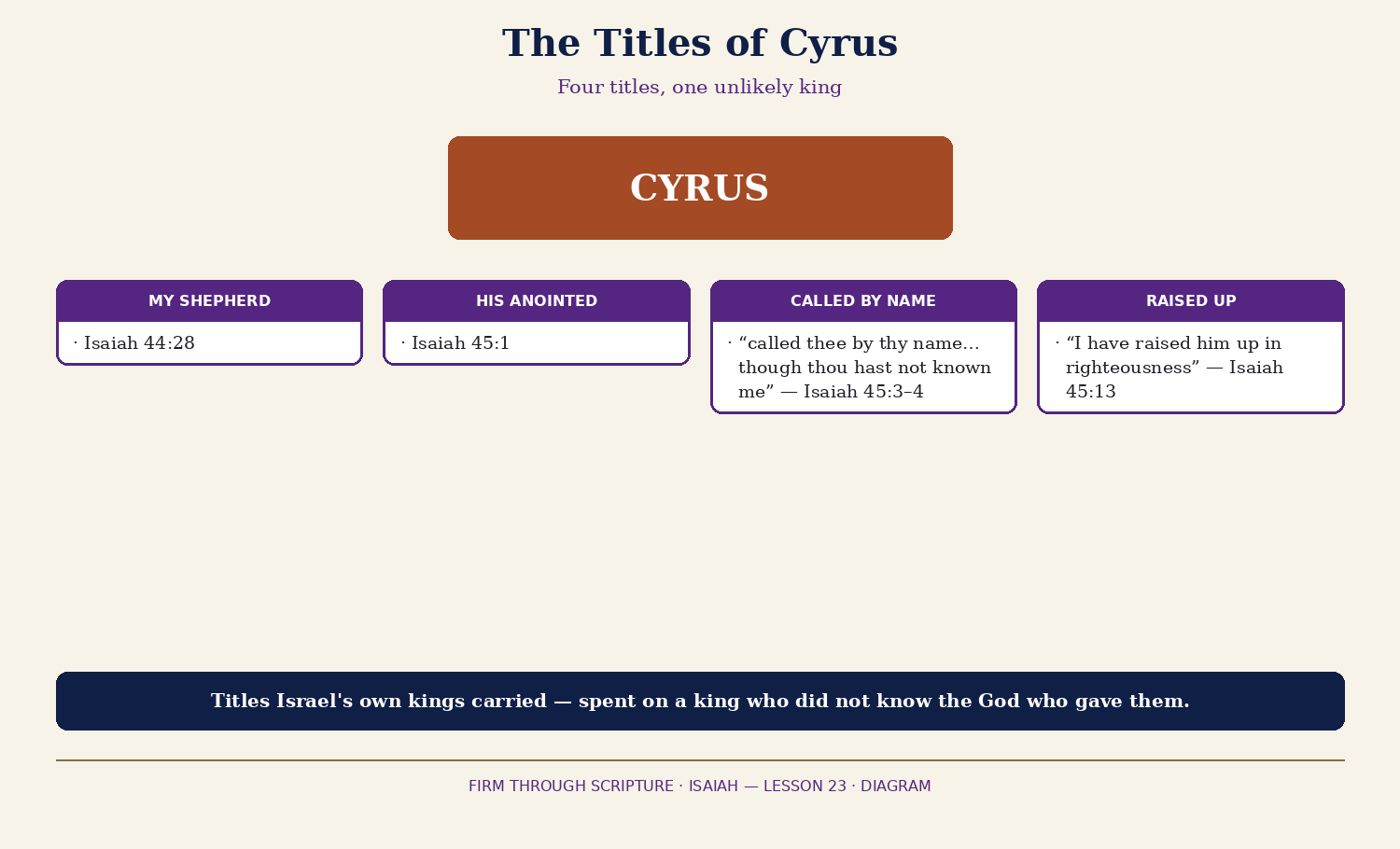
28 That saith of Cyrus, He is my shepherd, and shall perform all my pleasure: even saying to Jerusalem, Thou shalt be built; and to the temple, Thy foundation shall be laid.
1 Thus saith the LORD to his anointed, to Cyrus, whose right hand I have holden, to subdue nations before him; and I will loose the loins of kings, to open before him the two leaved gates; and the gates shall not be shut;
2 I will go before thee, and make the crooked places straight: I will break in pieces the gates of brass, and cut in sunder the bars of iron:
3 And I will give thee the treasures of darkness, and hidden riches of secret places, that thou mayest know that I, the LORD, which call thee by thy name, am the God of Israel.
4 For Jacob my servant's sake, and Israel mine elect, I have even called thee by thy name: I have surnamed thee, though thou hast not known me.
5 I am the LORD, and there is none else, there is no God beside me: I girded thee, though thou hast not known me:
6 That they may know from the rising of the sun, and from the west, that there is none beside me. I am the LORD, and there is none else.
7 I form the light, and create darkness: I make peace, and create evil: I the LORD do all these things.
8 Drop down, ye heavens, from above, and let the skies pour down righteousness: let the earth open, and let them bring forth salvation, and let righteousness spring up together; I the LORD have created it.
9 Woe unto him that striveth with his Maker! Let the potsherd strive with the potsherds of the earth. Shall the clay say to him that fashioneth it, What makest thou? or thy work, He hath no hands?
10 Woe unto him that saith unto his father, What begettest thou? or to the woman, What hast thou brought forth?
11 Thus saith the LORD, the Holy One of Israel, and his Maker, Ask me of things to come concerning my sons, and concerning the work of my hands command ye me.
12 I have made the earth, and created man upon it: I, even my hands, have stretched out the heavens, and all their host have I commanded.
13 I have raised him up in righteousness, and I will direct all his ways: he shall build my city, and he shall let go my captives, not for price nor reward, saith the LORD of hosts.
14 Thus saith the LORD, The labour of Egypt, and merchandise of Ethiopia and of the Sabeans, men of stature, shall come over unto thee, and they shall be thine: they shall come after thee; in chains they shall come over, and they shall fall down unto thee, they shall make supplication unto thee, saying, Surely God is in thee; and there is none else, there is no God.
15 Verily thou art a God that hidest thyself, O God of Israel, the Saviour.
16 They shall be ashamed, and also confounded, all of them: they shall go to confusion together that are makers of idols.
17 But Israel shall be saved in the LORD with an everlasting salvation: ye shall not be ashamed nor confounded world without end.
18 For thus saith the LORD that created the heavens; God himself that formed the earth and made it; he hath established it, he created it not in vain, he formed it to be inhabited: I am the LORD; and there is none else.
19 I have not spoken in secret, in a dark place of the earth: I said not unto the seed of Jacob, Seek ye me in vain: I the LORD speak righteousness, I declare things that are right.
20 Assemble yourselves and come; draw near together, ye that are escaped of the nations: they have no knowledge that set up the wood of their graven image, and pray unto a god that cannot save.
21 Tell ye, and bring them near; yea, let them take counsel together: who hath declared this from ancient time? who hath told it from that time? have not I the LORD? and there is no God else beside me; a just God and a Saviour; there is none beside me.
22 Look unto me, and be ye saved, all the ends of the earth: for I am God, and there is none else.
23 I have sworn by myself, the word is gone out of my mouth in righteousness, and shall not return, That unto me every knee shall bow, every tongue shall swear.
24 Surely, shall one say, in the LORD have I righteousness and strength: even to him shall men come; and all that are incensed against him shall be ashamed.
25 In the LORD shall all the seed of Israel be justified, and shall glory.
SAY IT PLAIN — the passage in everyday words: God introduces Himself as the Redeemer who made His people from the womb and made everything else besides. Babylon's fortune-tellers will be made fools of, while His own old word will stand — and then He does the unthinkable: He names the man who will rebuild Jerusalem and lay the temple's foundation. Cyrus, a pagan emperor of Persia. God calls him "my shepherd" and "his anointed," promises to march ahead of him breaking bronze gates, and says the quiet part out loud: I did all this for Jacob's sake — and Cyrus doesn't even know Me. When God's people protest that He has chosen the wrong instrument, He answers with a potter and a lump of clay. The passage ends with the widest invitation in the book — Look unto me, and be ye saved, all the ends of the earth — sworn by God's own oath, the oath the New Testament will lay at the feet of Jesus. That's the whole passage. Everything after this teaches from it — nothing will change what you just read.
2. THE WORLD — C: Context & Audience
A text can never mean what it never meant — so before we ask what these verses mean, we stand where their first hearers stood.
Where we are in the story. Isaiah, son of Amoz, prophesied in Jerusalem in the eighth century BC — in the days of kings Uzziah, Jotham, Ahaz, and Hezekiah, when Assyria was the superpower 1. But chapters 40–55 speak across the years to a later scene: Jerusalem destroyed by Babylon (586 BC), the temple burned, God's people carried off into exile in Babylon itself. The comfort chapters address those exiles where they sit: homesick, temple-less, asking whether Babylon's gods had simply beaten theirs.
Three empires, three names — keep them straight. Assyria was the brutal empire that swallowed the northern kingdom in 722 BC and threatened Jerusalem in Isaiah's own lifetime. Babylon — the Chaldeans, Nebuchadnezzar's empire — succeeded Assyria, destroyed Jerusalem, and holds God's people captive in this passage's world. Persia is the rising power to the east, in what is now Iran, and Cyrus is its founder-king: Cyrus II, called Cyrus the Great, who united Medes and Persians, conquered kingdom after kingdom, and in 539 BC took Babylon itself — a date the Babylonian Chronicle, Babylon's own record, confirms 30. Exiles would have heard his name the way occupied people hear an approaching general: first as rumour, then as hope, then as fact. In this text, they hear it earlier — on God's lips.
Babylon ran on omens. Babylonian religion prized the diviner — the specialist who read the future in sheep's livers, in oil on water, in the stars; a whole learned class lived by "tokens" and signs 16. When God says He "frustrateth the tokens of the liars, and maketh diviners mad" (44:25), He is naming the empire's intelligence service — and promising it will fail on the one question that matters: what is about to happen to Babylon? Against it stands Israel's prophet, whose counsel God promises to perform (44:26). Two rival systems for knowing the future. This passage is their courtroom.
A shepherd who is not a shepherd, an anointed who is not Israelite. "Shepherd" was a royal title, and God had promised David's line a shepherd-king. "Anointed" — mashiach, on which see section 5 — was even more loaded: the title of priests and kings set apart by oil, inside the covenant. Cyrus is neither Israelite nor, so far as the text ever says, a worshipper of Israel's God at all. That is the scandal humming under every verse of this lesson, and the protest of verses 9–10 is God's own people feeling it.
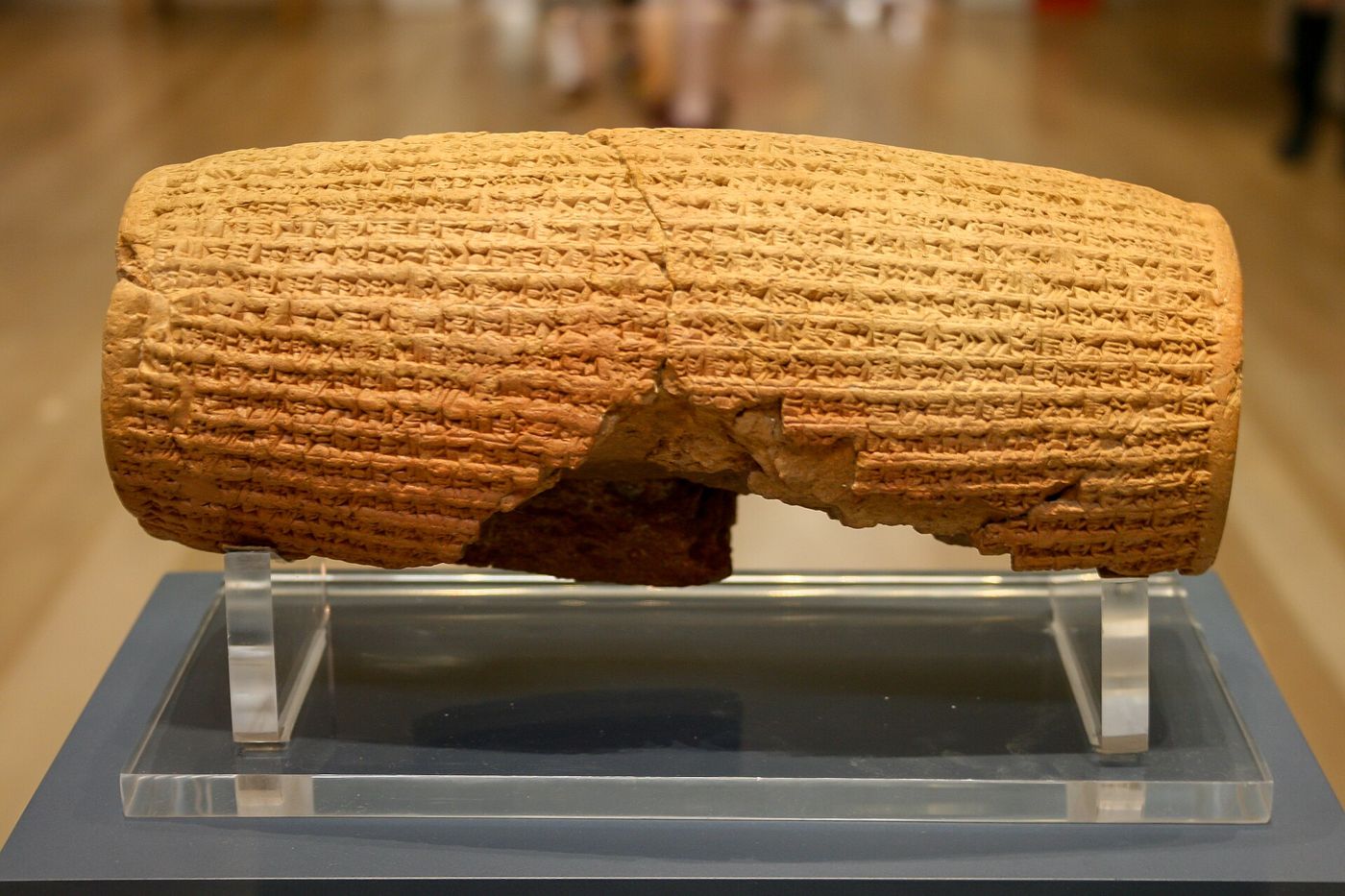
What the records outside the Bible show — taught with labels. Cyrus reversed imperial policy: where Assyria and Babylon deported peoples and hauled their gods off as trophies, Cyrus presented himself as a restorer — peoples returned, sanctuaries rebuilt, gods sent home. His proclamation of that policy survives on the Cyrus Cylinder, now in the British Museum 29, translated in the standard collection of ancient Near Eastern texts 25. FACT as a text: the Cylinder exists, it is Cyrus's inscription, and that is the policy it announces — though it names Marduk as his commissioner, not the LORD. INFERENCE: it is reasonable background corroboration that Ezra's decree fits Cyrus's documented way of ruling. What it does not do is mention Jerusalem, the Jews, or Isaiah.
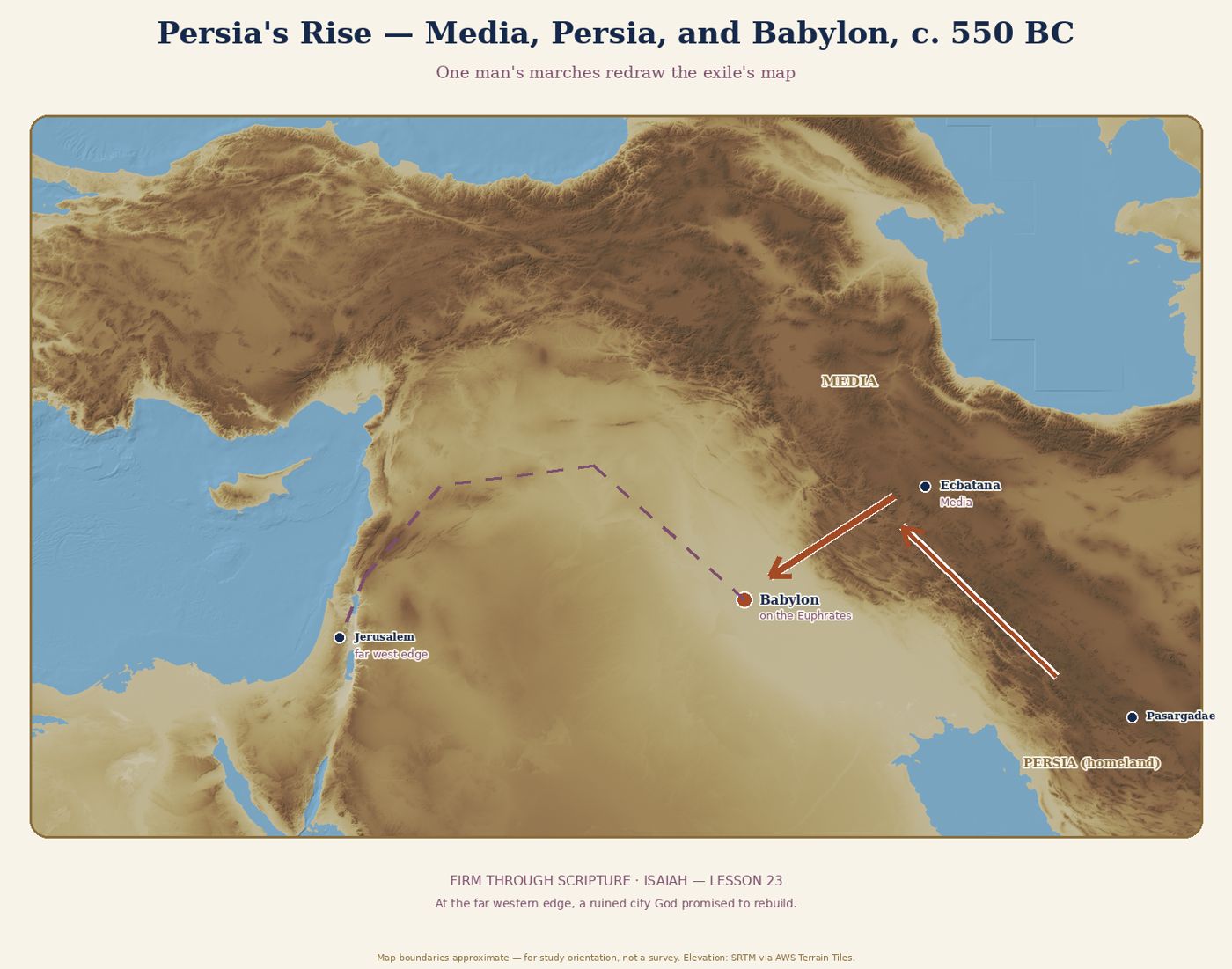
And what about the man who wrote the name down? Isaiah's ministry belongs to the eighth century BC; Cyrus's rise to the middle of the sixth — a century and a half later. Since the nineteenth century, mainstream scholarship has commonly concluded that chapters 40–55 come from an exilic author (often called Second Isaiah) writing in Cyrus's own days [40, 43]. The historic church, and the New Testament's citation habit, read one Isaiah — John 12 sets Isaiah 53 and Isaiah 6 side by side under the one name 1. POSITION — this program's settled reading: the book is Isaiah's, one prophet's witness read whole, and the naming is what the text claims it is — God declaring beforehand, the text's own stated test (sections 7 and 16). DISPUTED — the dating itself; section 16 argues it at full strength in both directions. The claim is enormous, and the text knows it — it builds its whole argument on it.
3. OBSERVE — O: what the text actually does
Before meaning comes observation. Most bad interpretation is shallow reading — people answering a text they never actually looked at. So look:
- The passage is a chain of "that" clauses. Read 44:24–28 slowly: that stretcheth forth the heavens, that frustrateth, that confirmeth, that saith to the deep, that saith of Cyrus. One great sentence stacking God's acts like cordwood — Cyrus enters as one more item in the list of things the LORD does.
- "Thus saith the LORD" keeps restarting the engine. Count the formula: 44:24, 45:1, 45:11, 45:14, 45:18. Five times God re-introduces Himself. This is God's self-presentation; Cyrus is evidence, not subject.
- The refrain underneath everything: "I am the LORD, and there is none else." At 45:5, 45:6, and 45:18, with cousins at 45:14, 45:21, and 45:22 — six strikes of the same bell: one God, no rivals, not even a Persian king, standing beside Him.
- The honest admission, repeated twice: "though thou hast not known me." At 45:4 and 45:5, God says of His own anointed that the man does not know Him. A legend-building author would have cut that line. This text insists on it.
- Watch the pronouns widen. The passage begins with "thee" — the redeemed people (44:24) — moves to Cyrus addressed directly (45:1–8), then to arguing clay (45:9–13), speaking nations (45:14), and Israel's answer (45:15), until by verse 22 the address has burst every border: "all the ends of the earth."
- Two invitations stand back to back. Verse 11: "Ask me of things to come." Verse 22: "Look unto me, and be ye saved." The God who will not be argued with by clay (v. 9) invites questions, and then invites the entire earth to be saved. Hold the tension.
4. GENRE — N: note the genre (prophetic oracle — a trial speech that turns into a commission)
Isaiah 44:24–45:25 is prophecy, read by its own rules. The method book undergirding this course puts the order plainly: a prophet is first a forthteller — speaking God's word into his hearers' own situation — before he is a foreteller, and the foretelling serves the forthtelling 51. This passage does both: the foretelling (a named king, a rebuilt city) is deployed as forthtelling to exiles — proof to captives that their God, not Babylon's, holds the future 15.
Within that, notice the passage's shifting forms, because form tells you how to listen:
- A self-presentation speech (44:24–28). God introduces Himself with a résumé of participles: the one who maketh, frustrateth, confirmeth, saith. Royal annals did this for kings; this résumé ends with Cyrus.
- A commissioning oracle (45:1–8). A named man is addressed in the second person, given a task, promises of God going before him, and the purpose of it all. It has the shape of Israel's call-narratives — except the man commissioned is a foreign emperor who does not know the God addressing him.
- A disputation (45:9–13). The "woe" of verse 9 is an argument form: God takes up His people's objection — why this instrument? — and answers it with the potter image. The text expects pushback; it invites yours, on God's terms.
- A trial speech widened into an invitation (45:18–25). The courtroom language of chapters 41–44 issues, not in a verdict against the nations, but in the summons of verse 22 — the trial of the gods ends with the defendants invited to be saved.
One genre warning, guarding section 16: prophecy's predictions are not newspaper reports filed early. They are God's word, in poetry, carrying the full claim of declared beforehand — to be read at the strength the text makes it, neither shrunk into metaphor nor inflated into a parlour trick.
5. TERMS — T: the words in the writer's mouth
Three words and one title carry this passage. Learn what they meant in their sentences, and watch how much confusion dies at the dictionary:
- Mashiach (mah-SHEE-akh), "anointed" (45:1) — from the verb mashach, to smear or pour oil on. In Israel, anointing set a person apart for an office God assigned: priests were anointed (Exodus 28–29), kings were anointed (Saul, then David), and the word became a title, the Anointed, gathering up the hope of a coming king from David's line 19. Mashiach is the Hebrew word behind "Messiah"; its Greek translation is Christos — Christ. Which is what makes 45:1 startling: the only place in the Old Testament where this title is given to a non-Israelite, it is given to a pagan emperor. Isaiah spends his most loaded title on Cyrus on purpose — Cyrus will do, once, the anointed one's defining job: deliver God's people and set them free to worship. The title's career then runs past him to the One who bears it as a name. The Christ Thread traces that road without cheating: the same word does not make Cyrus a type of Christ in every respect, and the text marks the difference — Cyrus acts "though thou hast not known me"; the true Anointed knows the Father perfectly.
- "My shepherd" (44:28) — the passage's other Cyrus title, spoken before "anointed" arrives. Shepherd was standard royal language across the ancient Near East, and Israel's kings carried it, David above all. God had also claimed it for Himself: "The LORD is my shepherd" (Psalm 23:1). To call Cyrus "my shepherd" is double language: God borrows the empire's royal boast and Israel's royal hope, and pins both on a foreigner doing God's errand — a hired hand who does not know the flock's Owner, and is God's shepherd anyway, for exactly as long as the task lasts.
- "A God that hidest thyself" (45:15) — Israel's own sentence, spoken not by scoffers but by the saved. The verb is reflexive: God hides Himself — the hiding is His act, not His absence. Hold the definition to its context: the verse stands between the nations' confession (v. 14) and the idol-makers' shame (v. 16) — the exiles' discovery that God was at work by a method they never saw coming: not a new exodus in public, but a pagan king rising in the east, in the dark, over decades. Hidden in method, never absent in fact.
Method note — the word-study guardrail: a word means what its author uses it to mean, in its sentence, in its century — not what its root once meant, and not everything it can mean anywhere. Every term above was settled by its usage here, with the lexica as controls [19, 20].
TRANSLATION NOTE — "I make peace, and create evil" (45:7)
Your KJV reads, at 45:7, "I form the light, and create darkness: I make peace, and create evil." That second pair needs its note. The Hebrew word is ra' — a wide word, ranging over badness in every register: moral evil, yes, but also harm, disaster, calamity — the "evil" that befalls a city in war as readily as the evil a man does in his heart [19, 20]. Context fixes a word's sense, and here the context is worked pairs: light against darkness, peace — shalom, wholeness — against its opposite. The natural opposite of shalom is not sin; it is calamity, the shattering of well-being. Read the pairs and the sense settles: God claims both poles of historical experience — a nation's peace and a nation's disaster. Modern translations printing "calamity" are not softening the verse; they are aiming the wide word at this sentence's target. What the verse will not bear is God as author of moral evil. That claim is not in the pairs, and not anywhere in Isaiah's God. Section 10 returns to the misread with a verdict.
6. ENTIRE CANON — E: where this passage sits in the whole story
No verse lives alone. This passage is a knot where the canon ties its own threads:
- The sequel the canon itself supplies: Ezra 1. The passage promises a foundation (44:28) and captives released unpaid (45:13). Ezra opens with it: "in the first year of Cyrus king of Persia... the LORD stirred up the spirit of Cyrus king of Persia, that he made a proclamation throughout all his kingdom" 1. The edict, in the king's own voice: "The LORD God of heaven hath given me all the kingdoms of the earth; and he hath charged me to build him an house at Jerusalem, which is in Judah" (Ezra 1:2). FACT as a text: Ezra 1:1–4 records this decree; 2 Chronicles 36:22–23 closes the Hebrew Bible's historical arc with it. Its correspondence to 44:28 is the canon's own cross-reference. Note the framing difference, honestly: Ezra and Chronicles credit the word spoken "by the mouth of Jeremiah" — the seventy years — while Isaiah's claim is the naming. Two spotlights on one event, not a contradiction.
- The ancient reception: Josephus and the scroll. Josephus, the first-century Jewish historian, tells how the decree came to be: Cyrus, he writes, was shown the book of Isaiah, read there his own name, and — moved by it — acted to fulfil it 31. FACT: Josephus tells this story, in Antiquities Book 11 — evidence of how the tradition was received in the first century. It is not a sixth-century report; he writes some six centuries later. File it as the prophecy's ancient reception — possibly true in substance, since it fits Cyrus's documented policy 29 — but labelled reception, not record.
- Paul takes up the potter (Romans 9). The clay's question (45:9) walks straight into the New Testament. Paul, answering the same objection, writes: "Shall the thing formed say to him that formed it, Why hast thou made me thus? Hath not the potter power over the clay...?" (Romans 9:20–21) 1. FACT: the echo is on the page, with Jeremiah's potter-house (Jeremiah 18) behind both. Paul treats the principle as settled: the Maker's freedom is not answerable to the made.
- Paul takes up the oath — and lays it at Jesus' feet (Philippians 2; Romans 14). The passage's largest New Testament thread gets its own treatment in the Christ Thread below. Here mark the bare facts: God swears in 45:23 that "unto me every knee shall bow," and Paul twice applies that oath to Jesus (Philippians 2:10–11; Romans 14:11) 1.
7. THE MEANING — what the passage teaches
The Walk has established what the text says and where it sits. Now its payload, taught straight.
The introductions: the God who confirms His old word (44:24–28)
The passage opens with God introducing Himself, and the introduction is an argument. He is "thy redeemer, and he that formed thee from the womb" — Redeemer, the kinsman who buys his family back (Lesson 22) — and the claim immediately scales up: this people's Redeemer is the Maker of all things, who stretched out the heavens alone and spread out the earth by myself (44:24). The creation claim is not decoration. It is jurisdiction: the God who made everything owns the right to direct anything — including an emperor.
Then comes the verse this whole stretch of Isaiah hangs its prophecy-claim on. God is the one "that frustrateth the tokens of the liars, and maketh diviners mad" and — the other half of the antithesis, in the same breath — "that confirmeth the word of his servant, and performeth the counsel of his messengers" (44:25–26). Babylon's seers get frustrated tokens — their signs jammed, their knowledge turned foolish. God's servant gets confirmation — and notice the claim: not a new word invented on the spot, but the old word, spoken earlier, standing up in events. This is the trial-test Isaiah has run since chapter 41: the true God is known by the fact that He "declare[s]... before they spring forth" (42:9) 1, and the idols fail precisely there.
The acts that follow cash the cheque. Jerusalem, a ruin as the exiles hear this, gets a future tense: "shall be inhabited," the cities of Judah "shall be built," their decayed places raised (44:26). And then a sentence out of the exodus: God is the one "that saith to the deep, Be dry" (44:27) — the God who once dried a sea for slaves now addresses Babylon's waters. Here a label is required. INFERENCE: Herodotus tells how Cyrus diverted the Euphrates and marched his army into Babylon along its lowered bed 32. He writes a century later and loves a story; his details are argued over. But the memory that the conquest involved her river being dried and crossed is ancient, and readers have long heard 44:27 as its echo. What is text, needing no label, is the theology: the exodus God is not retired.
Then — the name. Verse 28 is the introduction's climax and the book's boldest sentence: God, speaking of a man who from Isaiah's pulpit is a century and a half unborn, says, "That saith of Cyrus, He is my shepherd." Refuse to mute it in either direction: not embarrassed into metaphor by its dating, and not cheapened into a party trick. The shepherd will "perform all my pleasure" — named in the same verse: Jerusalem built, and "to the temple, Thy foundation shall be laid." Notice what Cyrus is for. Not conquest for its own sake: a city, and a house of worship. The empire's whole career is, in God's accounting, a building project for a ruined little city at the map's western edge.
The commission: anointed, held by the hand, and not knowing (45:1–8)
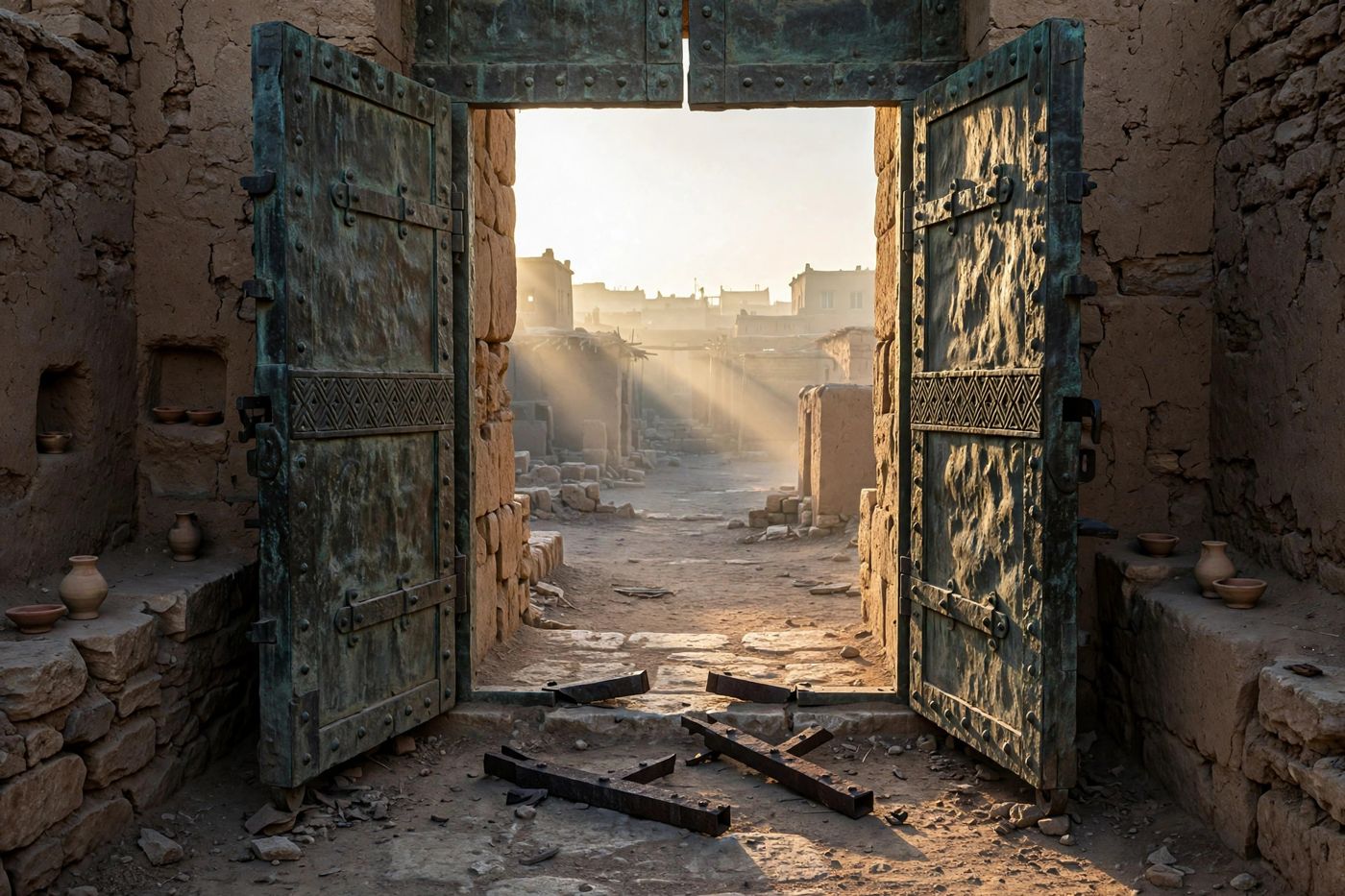
Chapter 45 turns and speaks to the man directly: "Thus saith the LORD to his anointed, to Cyrus, whose right hand I have holden." Royal language — the right hand held, as a king's sword-hand is steadied by a stronger ally — and the promises pile up like a campaign itinerary: nations subdued, kings' loins loosed (royalty unbelted, strength undone), "the two leaved gates" of gate-ringed Babylon 32 opened and never shut against him. And verse 2, where this lesson's fourth visual stands: God goes before him, breaking "the gates of brass" and cutting "the bars of iron" in sunder. Every fortification the ancient world trusted is scrap before the God who walks point for His instrument.
The treasure promise (45:3) — "the treasures of darkness, and hidden riches of secret places" — speaks of conquered capitals' hoarded wealth. But its stress falls on the purpose clause: that thou mayest know that the LORD, "which call thee by thy name," is "the God of Israel" — the one credential Cyrus cannot mistake: I knew your name and your work before you did them.
And then verse 4, the verse that governs everything else in this lesson: "For Jacob my servant's sake, and Israel mine elect, I have even called thee by thy name: I have surnamed thee, though thou hast not known me." Three things, in the text's own order. First, the reason: not Cyrus's merit — Jacob's sake, Israel the elect. The emperor is a means; the captives are the point. Second, the intimacy: called by name, surnamed — the named-ness elsewhere reserved for Israel herself ("I have called thee by thy name; thou art mine," 43:1). Third, the guardrail: though thou hast not known me — said twice (45:4, 5), as if Isaiah knows what later readers will do with this story. We want to convert the instrument. The text forbids it, in advance, twice.
Out of the commission, God preaches — to the pagan, by name — the sermon of the whole book: "I am the LORD, and there is none else, there is no God beside me" (45:5), preached while girding the man who doesn't know Him. Verse 6 gives the sermon its horizon: so "that they may know from the rising of the sun, and from the west, that there is none beside me." Cyrus's conquests are a publicity campaign for monotheism: every gate broken preaches that there is one God.
Verse 7 follows, handled here with both hands. The Translation Note has done the word work: ra' in this pair means calamity — the opposite of shalom. Now the theology. In a commission to a conqueror, the verse says: both sides of your career are Mine — the peace you will impose and the calamity you will inflict. No corner of history is outsourced. One more layer, at its honest weight: INFERENCE — many readers hear a deliberate answer to the religion of Cyrus's own Persia, where the world was commonly described as a battleground between a god of light and good and a power of darkness and evil 16. Against any two-gods system, verse 7 is a fence: darkness is not a second god; calamity is not a rival throne. The Persian target is labelled inference — the text names no Persian god — but the doctrine itself is what the verse says, in a book that has said "there is none else" six times in eighteen verses.
And the commission closes, astonishingly, in weather: "Drop down, ye heavens, from above, and let the skies pour down righteousness" (45:8). Salvation and righteousness are pictured as a crop: heaven rains, earth opens, and the two "spring up together." After gates and empires, deliverance is rain on fields.
The potter and the protest: why this instrument? (45:9–13)
Now the text turns on its own readers. The "woe" of verse 9 is aimed not at Babylon but at God's people — at the objection rising in every honest exile's throat since verse 28: Him? A pagan? An emperor who doesn't even know Your name — this is Your anointed, Your shepherd, Your plan? Isaiah answers with an image: "Shall the clay say to him that fashioneth it, What makest thou?" A potsherd — a broken shard of pottery, the most disposable object in the ancient world — does not cross-examine the potter. Verse 10 sharpens it to the family: a child does not audit his own begetting. The argument is not "stop thinking." It is about standing: the made thing lacks the maker's vantage. Readers across the spectrum — Oswalt 3 and Childs 5 alike — note that the objection answered is precisely the scandal of the instrument: not whether God can deliver, but whether He may deliver like this, through this man.
Then verse 11 keeps the potter image from becoming a gag: "Ask me of things to come concerning my sons, and concerning the work of my hands command ye me." The God who refuses the clay's audit invites the children's questions — and wraps the invitation in the language of command, as though prayer were a holy ordering God delights to be given. Hold verses 9 and 11 together: striving with the Maker is woe; asking the Father is welcome. The line between them is not volume. It is whether the speaker puts God in the dock or puts himself in God's hands.
Verse 12 re-founds everything on creation; verse 13 returns to Cyrus with the lesson's quietest thunderclap: "he shall build my city, and he shall let go my captives, not for price nor reward." Empires released prisoners for ransom or advantage; this release will be unpaid. Now hold that beside Lesson 22's text: in 43:3–4 God said "I gave Egypt for thy ransom." Two statements, both God's, apparently pulling opposite ways. This study lets both stand, because the text does. The resolution is directional: chapter 43 speaks from the side of God's giving — He spends nations for a people He values. Chapter 45 speaks from the side of Cyrus's receiving — the emperor gets nothing; he is not bought, and Israel is not purchased from him. Flatten either verse into the other and you lose one of them.
The confession and the hidden God (45:14–17)
The camera widens now to the nations — named, this time: Egypt, Ethiopia (Cush, the upper Nile), and the Sabeans, the tall trading people of the far south 16. Their "labour" and "merchandise" "shall come over unto thee," and they come "in chains," making supplication. But listen to what the chained nations say: "Surely God is in thee; and there is none else, there is no God." Hear the echo: in 43:10–11 Israel was told there was no saviour beside the LORD. Now the nations confess to Israel the very confession Israel was first taught. The mission runs both directions at once: God sends Israel's deliverer from the east, and brings the nations' confession to Israel's door [3, 4].
Then verse 15 — Israel's answer, and one of the most honest sentences in the Bible. The saved people, in the act of being saved, confess it: "thou art a God that hidest thyself" — and the same breath finishes, "O God of Israel, the Saviour." The Saviour hides Himself. Hidden how? The context answers: hidden in method, not absent in fact. Israel had been formed by the public God of the exodus: plagues announced, seas split, enemies drowned in daylight. This deliverance came disguised as geopolitics: a distant king's ambitions, a river lowered in the night, a repatriation policy that also freed a dozen other peoples. God's hand was in every joint of it and visible at almost none of them until afterward. The confession's placement is precise: between the nations' confession (v. 14) and the idol-makers' shame (v. 16) — the nations can see that God is with Israel; Israel herself can see only that God was hidden. Both are true at once. Verse 17 lands the counterweight: Israel "shall be saved in the LORD with an everlasting salvation," unashamed "world without end." The hiddenness is the method of a season. The salvation is the fact of forever.
The invitation and the oath (45:18–25)
The last movement begins with creation's charter: the God "that created the heavens" formed the earth — "he created it not in vain, he formed it to be inhabited" (45:18). Spoken over a ruined land, that is a promise about what ruins are for: not waste, but dwelling. It ends with the refrain, one last time: "I am the LORD; and there is none else."
Verse 19 draws the contrast the Cyrus argument rests on: "I have not spoken in secret, in a dark place of the earth: I said not unto the seed of Jacob, Seek ye me in vain." Babylon's gods mumbled through entrails and stars, to paid specialists. Israel's God spoke in the open, in advance, in a book, and put His name to predictions His people could check. Public speech, beforehand, verifiable: that is God's stated credential, and section 16 tests the Cyrus claim against exactly that standard.
Then the assembly is summoned a final time (45:20–21): the "escaped of the nations" are asked the trial question once more: "who hath declared this from ancient time?... have not I the LORD?" The idol-worshippers "pray unto a god that cannot save." Against that stands God's self-description, worth memorising: "a just God and a Saviour; there is none beside me" (45:21). Just and Saviour, in one breath — the book will need both words at full weight in chapter 53.
And then verse 22 — the charter verse of the book's mission: "Look unto me, and be ye saved, all the ends of the earth." Look. Not climb, not pay, not qualify — look, the smallest act of faith a human can perform, directed at the only God there is. The verse has gone on doing its own work ever since, and one reception note, carried with its label, belongs here: in January 1850, a fifteen-year-old Charles Haddon Spurgeon, driven by a snowstorm into a small Methodist chapel in Colchester, heard a lay preacher take this verse as his text and was converted on the spot, looking, as he told it for the rest of his life, to Jesus. FACT as reception history: Spurgeon's own oft-told account names this verse, that chapel, and that morning. The preacher could not have known whom he was addressing. Neither, usually, can we.
The passage closes under oath. Verse 23: "I have sworn by myself, the word is gone out of my mouth in righteousness, and shall not return." God swears by Himself — there is no higher court — and what He swears is universal submission rendered as confession: every knee bowed, every tongue swearing allegiance to Him. Verses 24–25 give the confession's content: righteousness and strength are found "in the LORD" and nowhere else; and — the passage's last word, given to the once-captive people — all the seed of Israel "justified, and shall glory," and both in the LORD. Justified — declared righteous. The exiles end this lesson not as a released workforce but as a justified seed, glorying. Keep that word warm; Paul will pick up both the oath and the justification.
The Christ Thread
Everything in this section is argued, not assumed. The thread from Isaiah 45 to Jesus runs along visible cords, each tied where the New Testament itself ties it.
First cord: the title. Mashiach — "anointed" — is spent once in the Old Testament on a foreigner (45:1), and its whole career in Israel bends toward a final bearer: the anointed king of David's line in whom the office comes home. When the New Testament names Jesus Christos — Christ, the Greek for mashiach — it is not inventing a surname; it is claiming the title. Cyrus shows the title can be lent for a task: a man who does the anointed one's delivering work for a season, without knowing God, without covenant, without permanence. Jesus bears the title as its owner: knowing the Father, inside the covenant, forever. Any reading that makes Cyrus a portrait of Christ in his person goes beyond what the text and the apostles draw. FACT: the word, its career, and its New Testament use. POSITION — the church's historic confession: in Jesus the anointed hope of Israel arrives in person.
Second cord: the oath. Isaiah 45:23 is God's oath about Himself: "unto me every knee shall bow, every tongue shall swear." Paul, the fiercest monotheist of the apostolic band, takes that oath and applies it, twice, to Jesus: at the name of Jesus every knee bows, every tongue confesses "that Jesus Christ is Lord" (Philippians 2:10–11; see also Romans 14:11). FACT: the citations are on the page; any reader can check them. What follows is the church's POSITION, stated plainly: Paul is not demoting God's oath or promoting a second god — Philippians 2 ends "to the glory of God the Father." He is including Jesus inside the identity of the one God to whom the oath was sworn. A Jewish monotheist does not casually hand God's own oath to a crucified man; Paul did it deliberately, twice, because — on the church's historic reading — he believed Jesus belongs within the "there is none else," not beside it. One more thread ties itself: verse 25's "justified... in the LORD" becomes the apostolic gospel's central verb — the same justification, opened to all who believe.
Where in the Covenant Story?
Place the passage in the long covenant arc. Abraham was promised a seed through whom all families of the earth would be blessed; Sinai made Israel a kingdom of priests — set apart for the nations, not merely from them; David was promised a son on an everlasting throne. Here the covenant logic runs in both directions at once. Centripetal: the nations' wealth and confession flow into Israel (45:14). Centrifugal: the invitation flows out — "all the ends of the earth" called to look and be saved (45:22). And the Davidic thread passes, for one astonishing season, through a foreign throne: David's own titles, carried by a Persian until the city and temple stand again. The covenant does not blink while its titles are on loan. God keeps every promise in this passage — some of them by hands that have never heard the promises: not God getting help because He is stuck, but God ruling so wide that even the empires are staff.
The Long View — what the church has believed
Stand back and notice how the centuries have read this passage. The early church read Isaiah as one prophet's witness to Christ, and the oath at 45:23 was among its treasures because Paul had laid it at Jesus' feet. Calvin lingers over the Cyrus commission as a lesson in providence: God governing nations who neither know nor seek Him, bending their ambitions to His church's deliverance 36. Preachers found verse 22 inexhaustible — Spurgeon's conversion under it made it the most famous sermon text of the nineteenth century's most famous preacher. Where the centuries have honestly divided is the dating of the Cyrus naming — argued in section 16 at full strength. The division sits around the text, not inside it: both camps read the same verses, the same titles, the same oath. The centre has held.
That is the payload. The next section compresses it into the one sentence you are meant to carry out of this study.
8. THE AIM SENTENCE — X: eXplain the intent
Everything observed now compresses into one sentence — the author's intended meaning, stated before any application:
Isaiah proclaims that the LORD alone is God, and proves it by naming His instrument beforehand: Cyrus — a pagan emperor who does not know Him — is God's shepherd and anointed for one task, to free the captives and rebuild the city unpaid; and the God who hides Himself in that strange method ends by swearing that every knee will bow to Him, and by inviting all the ends of the earth to look to Him and be saved.
If a sermon, a post, or a devotional uses Isaiah 44:24–45:25 to say something that cannot be traced back to that sentence, it is not this passage talking.
9. SAY IT BACK
Close the book and say the AIM sentence from section 8 in your own words — out loud, or written in your notes, without looking. Then say, in one more sentence, what it asks of you this week.
If your version quietly changes the meaning — if Cyrus becomes a convert, or "create evil" becomes God authoring sin, or the hidden God becomes an absent God — open the lesson and walk it again. This exercise feels small. It is the entire course in miniature: meaning first, then — and only then — your life.
10. THE MISREAD — the guardrail, with verdicts
Three live misuses of this passage, each with evidence and verdict.
Misread 1: "The name 'Cyrus' settles everything in one stroke — either it proves the whole Bible true at a glance, or it proves Isaiah was written late and the prophecy is a fraud." Why it sounds right: the name really is there, the dates really are a century and a half apart on the traditional reading, and both slogans feel like following the evidence. The evidence: a name, by itself, proves only what one's premises supply. "It must be late, because genuine prediction of a name that far ahead is impossible" builds its conclusion into its premise. "It must all be eighth-century, because the book says Isaiah wrote it" skips the evidence scholars weigh — style, setting, the scroll tradition 22, the New Testament's citation pattern. The text's own argument is neither slogan. It is the trial-test the passage runs: the God who "confirmeth the word of his servant" (44:26), who did not speak "in secret, in a dark place" (45:19), is to be checked against events — a claim staked in public, a far more serious thing than a parlour proof. Section 16 argues the whole case both ways. Verdict: the name is the text's boldest claim, not a shortcut for either side. Triumphalism and dismissal are the same failure in opposite jerseys.
Misread 2: "'I make peace, and create evil' — so God is the author of moral evil; sin and wickedness are His doing." Why it sounds right: the word "evil" is right there in the KJV, in a sentence ending "I the LORD do all these things." The evidence: the pairs fix the sense. Light's opposite here is darkness; shalom's opposite is its shattering: calamity, disaster, ruin. The Hebrew ra' ranges across both registers — harm that befalls as well as wickedness that is done [19, 20] — and this sentence, inside a commission to a conqueror, is about what befalls nations. Moral evil's authorship is a claim the verse never makes and the book everywhere refuses: God tempts no man (as James puts it), and His judgments are distinguished from the sins of the instruments who carry them out — Assyria is God's axe in Isaiah 10 and is punished for its arrogance in the same chapter 1. Verdict: 45:7 puts empires' peace and calamity in God's hand; it never puts sin's authorship there. The misread mistakes a wide word for a narrow doctrine — and the verse's own pairs settle the matter.
Misread 3: "Cyrus must have become a believer — God wouldn't call a pagan 'anointed'; somewhere along the way the emperor converted." Why it sounds right: the titles are so warm — shepherd, anointed, called by name — and Ezra's decree has him saying gracious things about "the LORD God of heaven." The evidence: the text installs its own guardrail, twice: "I have surnamed thee, though thou hast not known me" (45:4); "I girded thee, though thou hast not known me" (45:5). Whatever Cyrus came to acknowledge — Ezra's edict does credit the LORD with his kingdoms 1 — Isaiah's point depends on the not knowing: the deliverance is credited wholly to God's initiative, not to the instrument's faith. The Cyrus Cylinder, the king's own voice, credits Marduk 29. God's instruments need not know Him; the church's comfort here does not require inventing the emperor's faith. Invented conversions are a tax we charge stories God has already finished. Verdict: let the twice-repeated guardrail stand. Cyrus is God's anointed for the task, knowing or not knowing — and the doctrine is stronger for leaving his soul where Scripture leaves it: unreported.
11. FROM WORD TO WALK
A reflection page — the lesson is not finished until the passage has had its say.
Sit first with the sentence Israel spoke in the middle of her own rescue, at verse 15: the God who "hidest thyself" named, in the same breath, "the Saviour." Notice the pairing — hidden and Saviour together. Most of your life with God will be lived in exactly that pairing. The exiles' deliverance did not arrive with trumpets and a split sea. It arrived as politics in a distant capital, as a king they never met signing a paper they could not read, over years. Asked mid-process where God was, the honest ones would have said: hidden — describing the method, not the fact. He was never more present than in the years He was hardest to see.
So bring your own hidden season to this page honestly — the prayer unanswered by any means you can audit, the door that has not opened. Isaiah 45 does not scold that feeling; it canonises it. But it corrects its conclusion. Hidden is not absent. God hides Himself inside processes — a pagan king's ambition, of all things — and the hiding ends, every time, in the open: gates broken, captives walking home, a foundation laid in daylight. You may say "Thou art a God that hidest thyself." You may not stop the sentence before ", O God of Israel, the Saviour."
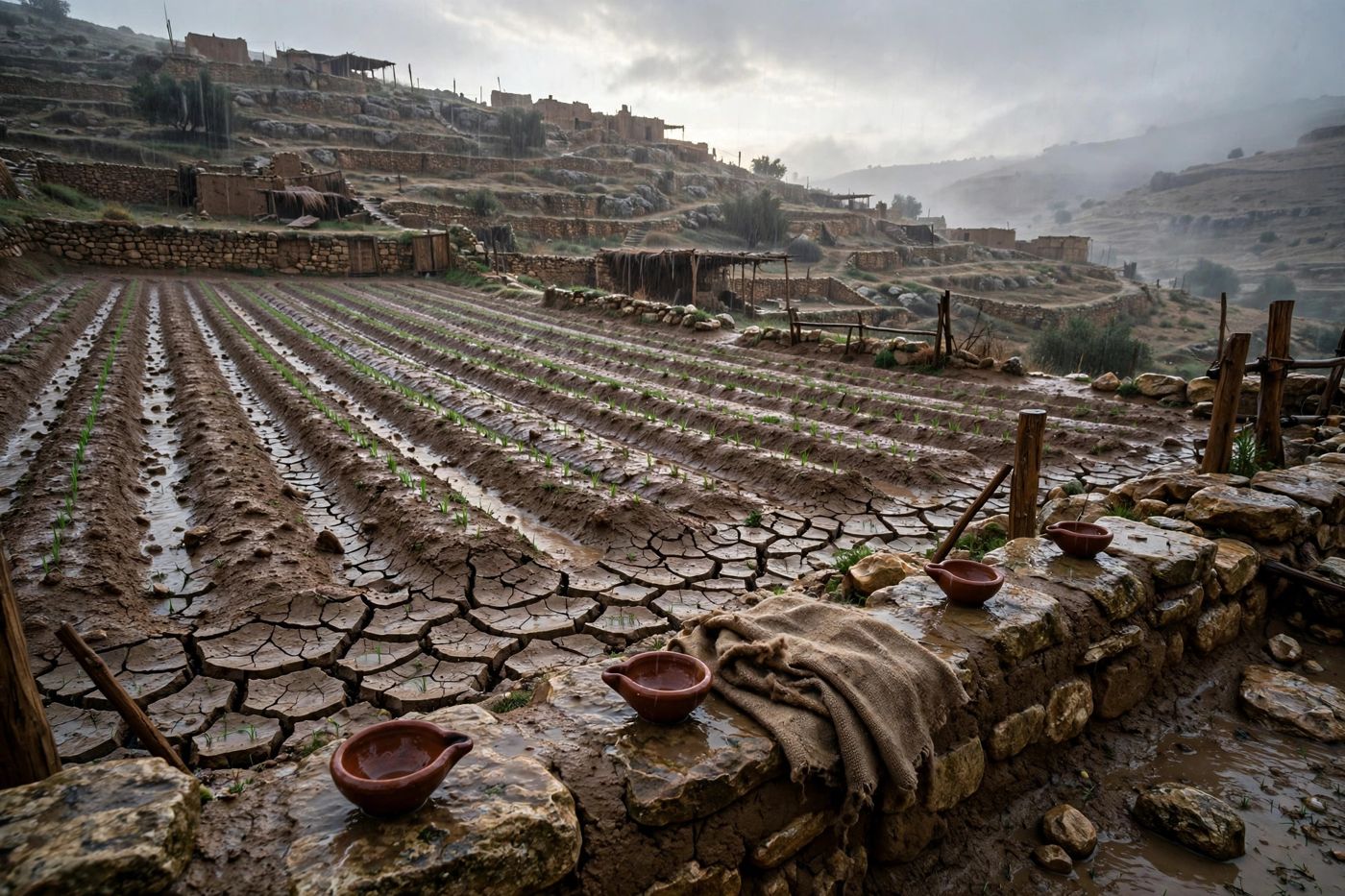
LORD, my Saviour who hides Himself — I confess how quickly I read Your hiddenness as absence. Teach me the exiles' sentence whole: hidden in method, never absent in fact. I will not argue with the Potter about Your instruments; I will ask You, as You invited me, about the things to come. And this week I look — only look — unto You to be saved, for You are God, and there is none else. In Jesus' name, amen.
12. FOR DISCUSSION — OR FOR YOUR JOURNAL
With a group, work these aloud. Alone, they're yours — answer them in your journal or in prayer; they lose nothing in the quiet.
- God says twice of Cyrus, "though thou hast not known me." Where have you seen God work through people or circumstances that did not know Him — and how did recognising it change your reading of the situation?
- Verse 15 calls God "a God that hidest thyself" in the same breath as "the Saviour." Describe a season when God seemed hidden. Where can you trace the method He was hiding in?
- The potter of verse 9 and the invitation of verse 11 stand two verses apart: clay may not audit the Maker, but children are invited to ask. Where is the line, in your prayer life, between striving with God and asking Him boldly?
- Verse 22's whole method of salvation is a look. What are the respectable-looking alternatives to looking — earning, climbing, paying, waiting to qualify — that you are personally tempted to substitute?
13. THE WALK-OUT — T: Transfer to today
Meaning is settled. Now application, and it must cross the bridge honestly. Run the five Transfer Tests:
- Same covenant? The promises were made to exilic Israel and fulfilled in their return under Cyrus 1. What crosses is the God of those promises — His character, methods, and oath — not a claim that He owes any modern nation the same decree.
- Same audience? The invitation of verse 22 is addressed, in the text itself, to "all the ends of the earth" — we are inside its address by its own terms. The commission of verses 1–8 is addressed to Cyrus alone; none of us is its recipient.
- Same genre rules? Prophetic oracle: it declares God's acts and character first. So this passage yields trust, prayer, and a posture toward unlikely instruments — not a technique for identifying "anointed" modern politicians, a use the genre flatly refuses (see below).
- Repeated or rooted? God's freedom to use unknowing instruments, His hiddenness in method, His sole Godhood, and justification "in the LORD" reappear across the canon — in Ezra, in Paul's potter and Paul's oath — and are rooted in God's character. These cross.
- Ten verses either side? Every application below is drawn from these thirty verses read whole. Nothing hangs on a torn-out line — least of all verse 7, which crosses only with its pairs attached, or verse 22, which crosses with its God attached: "for I am God, and there is none else."
The tests, at a glance:
| # | Test | Verdict here |
|---|---|---|
| 1 | Same covenant? | God's character crosses; the decree does not |
| 2 | Same audience? | Verse 22 includes us; verses 1–8 were Cyrus's alone |
| 3 | Same genre? | Oracle — trust and posture, not techniques |
| 4 | Repeated or rooted? | Yes — Ezra, Romans, Philippians |
| 5 | Ten verses either side? | Every application drawn from the whole passage |
What crosses — and lands:
- God is not limited to knowing, willing, or respectable instruments. He held Cyrus's right hand "though thou hast not known me." The indicative first: this tells you something about your world — workplace, government, surgeon, official, stranger — none of them outside the reach of a God who girds people who credit anyone but Him. Your deliverance may well arrive signed by a Cyrus. Receive it without needing to baptise the signature.
- Hidden is a method, not an absence. The saved people's confession (v. 15) becomes the believer's settled reading of God's quiet seasons. The absence you feel is not evidence; it is, at most, weather. The evidence is the record: a God who has never once failed to perform the counsel of His messengers in the end.
- Ask — because you were invited to. Verse 11 stands: "Ask me of things to come concerning my sons." Prayer about the future of God's people is not presumption here; it is obedience to an engraved invitation. The potter passage forbids the audit; it does not forbid the asking. Most of us have the two exactly backwards.
- Salvation is still a look. Verse 22 was built for export: "all the ends of the earth" is its own transfer certificate. Looking to the one God — in Christ, where the oath of verse 23 has been laid — is the whole human side of being saved. Anything added to the look is renovation of the gospel.
Practices — what the gate lets through, made concrete this week:
- Name your Cyrus. Write down one channel through which God has provided for you that did not know Him — an employer, a system, a stranger. Thank God for it, and let it recalibrate who you think God can use.
- Pray verse 11 back. Take one "thing to come" concerning God's people and ask God about it daily this week — not auditing His plan, but taking Him at His invitation. Write the ask down, dated. His answers may arrive disguised.
- Practise the confession of verse 15. In prayer, say it whole and out loud — the hidden God and the Saviour in one breath. Then name one place where you will act this week on Saviour rather than on hidden: one step of obedience postponed until you could see the whole method.
- Memorize Isaiah 45:22 (the Recap Card's memory verse) — an address with your name inside "all the ends of the earth."
- Tell one person to look. Verse 22's address includes someone you know by name. This week: one conversation, one message, one note — not an argument, an invitation: look.
What does not cross: naming a modern leader "the LORD's anointed" on this passage's authority to silence criticism of him — the title was God's to give, for one task, to one man who did not know God; treating verse 7 as God's authorship of anyone's sin; claiming Cyrus's campaign promises as guarantees for your plans; and praying verse 11 as a subpoena — "command ye me" is a Father's invitation, not a technique for bending heaven. The gate is there to make sure the claims that land are the ones God actually made.
Praise Him
God of Israel, who hid Yourself and saved — who formed the light and the darkness, who makes peace and sends calamity, and in all of it is just, and a Saviour — we praise You that there is none beside You. You called a king by name who did not know You, and You have sworn by Yourself that the knee-bowing is coming, to the glory of the One at whose name Paul taught us to bow. Until that day, teach us simply to look — unto You, and be saved. For You are God, and there is none else.
14. THE RECAP CARD — this study on one page
Print it. Keep it where you'll see it this week.
- The passage: Isaiah 44:24–45:25 — God names Cyrus His shepherd and anointed, answers the protest, is confessed as a hidden God and Saviour, and invites the ends of the earth to look and be saved.
- Say It Plain: The LORD alone made all things; He makes fools of Babylon's seers while confirming His servants' old word, and names Cyrus — an emperor who does not know Him — to free the captives and rebuild Jerusalem unpaid.
- The AIM: Isaiah proclaims that the LORD alone is God, and proves it by naming His instrument beforehand: Cyrus — a pagan emperor who does not know Him — is God's shepherd and anointed for one task, to free the captives and rebuild the city unpaid; and the God who hides Himself in that strange method ends by swearing that every knee will bow to Him, and by inviting all the ends of the earth to look to Him and be saved.
- Key terms: mashiach — anointed; the title lent to Cyrus for the task, owned by Christ · "my shepherd" — David's royal title on loan (44:28) · "a God that hidest thyself" — hidden in method, never absent in fact · ra' — calamity in 45:7's pairs, not moral evil.
- The Misread, in one line: the Cyrus name is no one-stroke proof for either side · "create evil" is calamity in God's hand, never sin's authorship · Cyrus is not to be converted by our imagination — "though thou hast not known me," twice.
- Memory verse: "Look unto me, and be ye saved, all the ends of the earth: for I am God, and there is none else." — Isaiah 45:22
- This week's practice: name your Cyrus, pray verse 11 back daily, and tell one person by name to look.
15. CHECK YOURSELF — five questions
Answer from the study, not from instinct. (Answers live in the Teacher Edition.)
- In your own words: what is the AIM of Isaiah 44:24–45:25?
- Which two titles does God give Cyrus in 44:28 and 45:1 — and why does the text insist, twice, that Cyrus did not know Him?
- What does ra' mean in 45:7, and how do the verse's own word-pairs prove it? What does the verse not claim?
- What is the difference between the striving verse 9 forbids and the asking verse 11 invites?
- What does Paul do with God's oath in 45:23 at Philippians 2:10–11 — and, stated as the church's position, what does his use of it claim about Jesus?
16. GO DEEPER
Optional — the lesson is complete without it.
From the Sources — The Cyrus Cylinder, read closely
The Cylinder is a barrel-shaped clay inscription, written after Cyrus's entry into Babylon in 539 BC, and housed today in the British Museum 29. In it, Cyrus presents himself as chosen by Marduk, Babylon's chief god, who delivered Babylon to him without battle; the king then boasts of returning displaced peoples and their gods to their sanctuaries. A standard translation stands in Pritchard's collection 25, and the Babylonian Chronicle confirms the fall of the city in 539 30. FACT — the artifact, its contents, its date. INFERENCE — its use beside Ezra 1: a king who publicly ran a restore-the-peoples policy is exactly the sort who would sign Ezra's decree. Strong as background; worthless as a stand-alone proof. And one honest asymmetry stays on the table: the Cylinder credits Marduk; Isaiah credits the LORD, who girded Cyrus "though thou hast not known me." The Cylinder does not confirm Isaiah's theology; it confirms the historical world in which that theology was spoken. That is enough, and it is not nothing.
The Honest Argument — the name of Cyrus, and the dating of this book
Lay the whole case out, both sides at full strength, because this course argues with the lights on.
The critical case. Since Duhm's commentary of 1892 crystallised the modern discussion 40, mainstream scholarship has commonly held that Isaiah 40–55 was composed in the sixth century BC — during the exile, as Cyrus's rise was unfolding — by a prophet whose name we do not know, whose work was joined to Isaiah's scroll. The arguments, as their ablest advocates state them 43: the chapters presuppose, rather than predict, Jerusalem's destruction and the exile; their audience is addressed in Babylon; their style and vocabulary differ measurably from chapters 1–39; and they name Cyrus the way a contemporary herald names good news arriving now. On this reading, "Cyrus" is not prediction but proclamation. The reading is coherent, and its advocates include scholars of the first rank. DISPUTED is the correct label for the question; anyone who calls it settled, either way, is selling something.
The traditional case. The church's historic reading — one Isaiah, son of Amoz — rests on evidence, not merely on habit. The book travels as one scroll from our earliest full witness: the Great Isaiah Scroll (c. 125 BC) already contains all 66 chapters as one work, and the Septuagint likewise 22. The New Testament cites Isaiah across all the supposed seams under the one name — most strikingly John 12:38–41, which sets chapter 53 beside chapter 6 and attributes both to the Isaiah who "saw his glory" 1. Conservative scholarship has argued the unity case from the Hebrew at length 50, and even critical scholars who hold the exilic dating — Childs above all — insist the book in its final form is to be read as one witness, whatever its prehistory 5. Add the text's own framing: these chapters stake their case on declared-beforehand speech (42:9; 44:26; 45:19, 21) — a strange architecture, the traditional reader notes, if declaring and events were simultaneous, though the critical reader replies, fairly, that it may celebrate Cyrus's arrival as the vindication of older oracles rather than as prediction itself.
Where the circular arguments live — named, on both sides. "Prophecy of a name a century and a half ahead is impossible, therefore the text is late" argues in a circle: the impossibility is the premise, a philosophical premise about what God can do, not a finding of history. "The book is entirely Isaiah's because the church has always said so" is the same circle in the other jersey. This course refuses both. POSITION — the program's settled reading, stated plainly: the book is Isaiah's, one prophet's witness read whole, and chapters 44–45 mean what they claim — God declaring Cyrus beforehand as His credential before the nations. That position is held with the evidence on the table, not by hiding it. Whichever century the pen moved in, the text claims a God who speaks beforehand and performs it, and it must be read at that strength or not read honestly at all.
The Word Underneath — ra', the wide word for bad
The Translation Note fixed 45:7 by its pairs; here is the word's wider field. The lexica range ra' across the whole territory of badness: of taste (spoiled food), of fortune (disaster, calamity), of character (wickedness) [19, 20]. When Amos asks, "shall there be evil in a city, and the LORD hath not done it?" (Amos 3:6), no reader imagines God authoring the city's sins; the evil is the calamity of judgment. FACT — the lexical range and the Amos parallel. INFERENCE — section 5's conclusion, that in 45:7 ra' means calamity: not a rescue manoeuvre, but the ordinary discipline of letting a sentence's parallel structure choose between a word's attested senses 51.
Go Read
- Oswalt, The Book of Isaiah, Chapters 40–66 (NICOT) 3 — the fullest evangelical treatment of the Cyrus chapters.
- Motyer, The Prophecy of Isaiah 4 — the one-volume reading that treats the book as a single mind's work.
- Westermann, Isaiah 40–66 (Old Testament Library) 15 — the classic critical reading of the trial speeches.
17. SOURCES & REFERENCES
Numbered citations in this lesson key to this list — the course standard: every sourced claim carries its number, and every number can be checked.
- The KJV text itself — Holy Bible, King James Version (eBible.org KJV, 1769 text). Scripture quotations are from the King James Version (KJV), which is in the public domain in the United States; the full passage is always assigned as reading. Cross-references within Scripture cite this number.
- Oswalt, The Book of Isaiah, Chapters 40–66 (NICOT) — John N. Oswalt (Eerdmans). The second volume: the comfort section, the Servant Songs, Cyrus, and the new-creation chapters, read as the deliberate answer to chapters 1–39.
- Motyer, The Prophecy of Isaiah — J. Alec Motyer (IVP). A one-volume commentary by an evangelical scholar who argues the whole book breathes the mind of the eighth-century prophet; especially strong on the book's structure, its repeated refrains, and the Servant.
- Childs, Isaiah (Old Testament Library) — Brevard S. Childs (Westminster John Knox). The canonical-approach reading: the book in its final form as Scripture, whatever its compositional prehistory; a control on both conservative and critical overreach.
- Westermann, Isaiah 40–66 (Old Testament Library) — Claus Westermann (Westminster). The classic critical commentary on the comfort chapters; foundational for the genre analysis of the trial speeches and salvation oracles.
- Walton, Matthews & Chavalas, The IVP Bible Background Commentary: Old Testament — John H. Walton, Victor H. Matthews, Mark W. Chavalas (IVP). Verse-by-verse ancient Near Eastern background: Assyrian siege practice, Babylonian religion, treaty and coronation customs, geography.
- Brown, Driver & Briggs, Hebrew and English Lexicon of the Old Testament (BDB) — The standard older Hebrew lexicon; word senses and usage ranges for the Terms sections.
- Koehler & Baumgartner, The Hebrew and Aramaic Lexicon of the Old Testament (HALOT) — The standard modern Hebrew lexicon; the control on BDB for contested senses (e.g., 'almah).
- The Great Isaiah Scroll (1QIsaᵃ) and the Dead Sea Scrolls Bible — The complete Isaiah scroll from Qumran Cave 1 (c. 125 BC), in Abegg, Flint & Ulrich, The Dead Sea Scrolls Bible (HarperSanFrancisco). The oldest substantial witness to Isaiah's text — already a single scroll of all 66 chapters centuries before Christ.
- Pritchard (ed.), Ancient Near Eastern Texts Relating to the Old Testament (ANET) — James B. Pritchard (Princeton). Translations of the primary records: Sennacherib's annals, the Babylonian Chronicle, the Cyrus Cylinder, treaty and hymn texts.
- The Cyrus Cylinder (British Museum) — Cyrus of Persia's own proclamation of his restoration policy (539 BC onward) — the pagan parallel and backdrop to Isaiah 44:28–45:13 and Ezra 1.
- Grayson, Assyrian and Babylonian Chronicles — A. Kirk Grayson (J.J. Augustin). The Babylonian Chronicle series, including the fall of Babylon to Cyrus in 539 BC and the reign of Nebuchadnezzar.
- Josephus, Antiquities of the Jews (Books 9–11; temple-court descriptions also from the Jewish War) — The first-century Jewish historian's retelling of the Hezekiah/Sennacherib crisis, Isaiah's reputation, and the Cyrus decree — an outside witness to how the traditions were held.
- Herodotus, Histories — The Greek historian on Babylon's city and fall, Cyrus, and the customs of the Persian world (used with his known limits as a storyteller).
- Calvin, Commentary on Isaiah — John Calvin (public domain). Reformation exegesis; a control on interpretation and a voice in the Long View.
- Duhm, Das Buch Jesaia (1892) — Bernhard Duhm. The commentary that named the "Servant Songs" as a distinct set and crystallized the "Deutero-Isaiah" division — the historical origin of the modern authorship debate, cited as fact about scholarship.
- Whybray, Isaiah 40–66 (NCB) and The Second Isaiah — R. N. Whybray. A critical voice arguing the comfort chapters' coherence under a single exilic author of genius — cited where the debate needs its strongest skeptical statement.
- Archer, A Survey of Old Testament Introduction — Gleason L. Archer (Moody). The standard conservative survey of the authorship question, including the Cyrus argument and the New Testament's citation pattern.
- Fee & Stuart, How to Read the Bible for All Its Worth — Gordon D. Fee and Douglas Stuart (Zondervan). The beginner's method book; its prophecy chapter ("a forthtelling first") undergirds the Genre sections.