
One study, one walk — the universal FIRM format. The passage first and whole; then its world; then the Walk (Context · Observe · Genre · Terms · Entire Canon); the meaning taught straight; the AIM sentence; the misread exposed and answered; and the walk-out, where application has to pass the Transfer Tests before it reaches your week. The same skeleton serves a book, a chapter, a single verse, or a whole subject. In the early studies the moves are labeled as they happen. The labels fade as the walk becomes yours.
THE WEEK WITH THIS STUDY — six bites
Day 1 — Read the passage · Say It Plain · The World (§§1–2) · Day 2 — Observe · Genre (§§3–4) · Day 3 — Terms · Entire Canon (§§5–6) · Day 4 — The Meaning · the AIM Sentence · Say It Back (§§7–9) · Day 5 — The Misread · From Word to Walk (§§10–11 — add For Discussion, §12, if you're with others) · Day 6 — The Walk-Out · the Recap Card (§§13–14). Go Deeper (§16) any evening you want the basement.
BEFORE YOU READ — Open My Eyes
LORD, I come to this chapter carrying Your name — teach me to carry it in truth, and not in name only. You who refined Your people in the furnace and did not cut them off, open my eyes to see what You foretold, and why, and give me a neck that bends. Lead me by the way that I should go, and let my peace be as a river. In Jesus' name, amen.
§ means “section” — the numbered parts of your lesson. Each bite above names the sections for that day.
1. READ THE PASSAGE — Isaiah 48:1–22 (KJV)
Read it all, slowly, before any teaching. In this course the passage always prints once, in full, at the head of the lesson. Everything after this is commentary — this is the text.
1 Hear ye this, O house of Jacob, which are called by the name of Israel, and are come forth out of the waters of Judah, which swear by the name of the LORD, and make mention of the God of Israel, but not in truth, nor in righteousness.
2 For they call themselves of the holy city, and stay themselves upon the God of Israel; The LORD of hosts is his name.
3 I have declared the former things from the beginning; and they went forth out of my mouth, and I shewed them; I did them suddenly, and they came to pass.
4 Because I knew that thou art obstinate, and thy neck is an iron sinew, and thy brow brass;
5 I have even from the beginning declared it to thee; before it came to pass I shewed it thee: lest thou shouldest say, Mine idol hath done them, and my graven image, and my molten image, hath commanded them.
6 Thou hast heard, see all this; and will not ye declare it? I have shewed thee new things from this time, even hidden things, and thou didst not know them.
7 They are created now, and not from the beginning; even before the day when thou heardest them not; lest thou shouldest say, Behold, I knew them.
8 Yea, thou heardest not; yea, thou knewest not; yea, from that time that thine ear was not opened: for I knew that thou wouldest deal very treacherously, and wast called a transgressor from the womb.
9 For my name's sake will I defer mine anger, and for my praise will I refrain for thee, that I cut thee not off.
10 Behold, I have refined thee, but not with silver; I have chosen thee in the furnace of affliction.
11 For mine own sake, even for mine own sake, will I do it: for how should my name be polluted? and I will not give my glory unto another.
12 Hearken unto me, O Jacob and Israel, my called; I am he; I am the first, I also am the last.
13 Mine hand also hath laid the foundation of the earth, and my right hand hath spanned the heavens: when I call unto them, they stand up together.
14 All ye, assemble yourselves, and hear; which among them hath declared these things? The LORD hath loved him: he will do his pleasure on Babylon, and his arm shall be on the Chaldeans.
15 I, even I, have spoken; yea, I have called him: I have brought him, and he shall make his way prosperous.
16 Come ye near unto me, hear ye this; I have not spoken in secret from the beginning; from the time that it was, there am I: and now the Lord GOD, and his Spirit, hath sent me.
17 Thus saith the LORD, thy Redeemer, the Holy One of Israel; I am the LORD thy God which teacheth thee to profit, which leadeth thee by the way that thou shouldest go.
18 O that thou hadst hearkened to my commandments! then had thy peace been as a river, and thy righteousness as the waves of the sea:
19 Thy seed also had been as the sand, and the offspring of thy bowels like the gravel thereof; his name should not have been cut off nor destroyed from before me.
20 Go ye forth of Babylon, flee ye from the Chaldeans, with a voice of singing declare ye, tell this, utter it even to the end of the earth; say ye, The LORD hath redeemed his servant Jacob.
21 And they thirsted not when he led them through the deserts: he caused the waters to flow out of the rock for them: he clave the rock also, and the waters gushed out.
22 There is no peace, saith the LORD, unto the wicked.
SAY IT PLAIN — the passage in everyday words: God speaks to people who wear His name but do not live it — they swear by Him and lean on Him as a talking point, "but not in truth, nor in righteousness." He reminds them why He announced things long before they happened: He knew they were stubborn, and He would not let them hand the credit to their idols. He has now shown them brand-new things they never heard, because He knows their record from the womb. For the sake of His own name He holds back His anger, refines them in the furnace of affliction instead of cutting them off, and refuses to share His glory. He is the first and the last, the Maker of earth and heaven; He has loved and called the man who will break Babylon, and He speaks openly — the Lord GOD and His Spirit sending His messenger. Then the Redeemer grieves aloud: if only they had listened, their peace would have flowed like a river. Instead, the word is an exit with a song: get out of Babylon, tell the whole earth the LORD has redeemed Jacob — the God who gave water from the rock will do it again. And the door shuts on one flat sentence: there is no peace for the wicked. That's the whole passage. Everything after this teaches from it — nothing will change what you just read.
2. THE WORLD — C: Context & Audience
A text can never mean what it never meant — so before we ask what these verses mean, we stand where their first hearers stood.
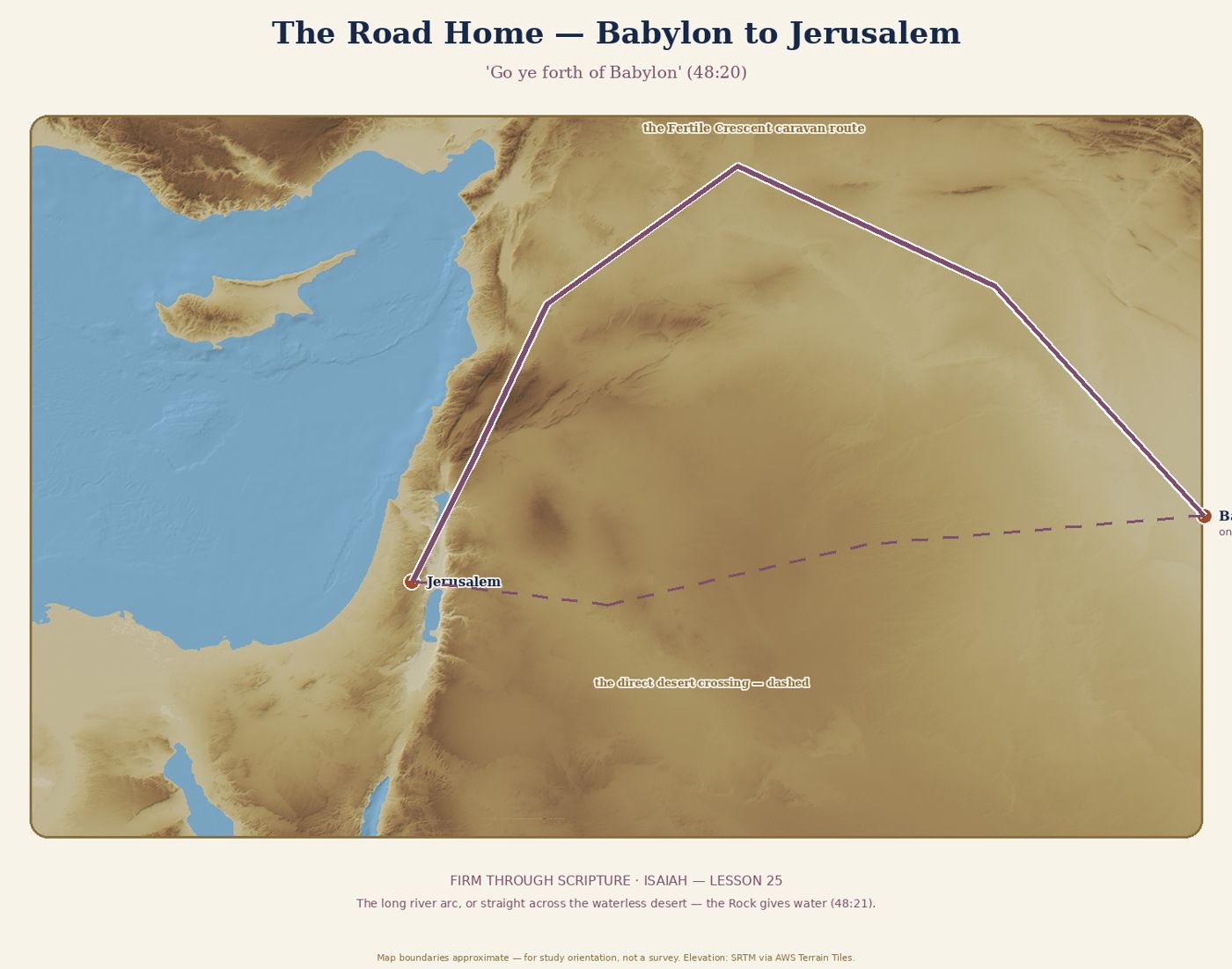
Where we are in the book. Isaiah 40–55 is the book's great comfort section — it opens with "Comfort ye, comfort ye my people" and speaks to Judah not in her eighth-century homeland but in (and on the edge of) Babylonian exile. Remember the book's shape: chapters 1–39 address Isaiah's own century, when Assyria — the empire centred on the Tigris in what is now northern Iraq — was the terror of the world; chapters 36–39 form the historical hinge, ending with Isaiah's warning that everything would one day be carried to Babylon. Chapters 40–55 answer that future. Chapter 48 addresses the exiled community — Judahites (people of Judah, the southern kingdom) living in Babylon, capital on the Euphrates in what is now Iraq, two generations after Nebuchadnezzar destroyed Jerusalem and its temple in 586 BC. [3, 11]
Babylon, by now, is home — and that is the problem. The first exiles arrived as captives; their grandchildren were born Babylonian subjects, speaking the language, doing business, raising families within sight of Babylon's ziggurat (a staged temple-tower) and its processional streets lined with images of Babylon's gods. Babylonian religion was not a hobby; it was the air — Marduk, Babylon's chief god, had his festival, his priests, his statues in the streets. The previous lesson watched those gods carried on beasts like luggage (chapter 46) and Babylon personified as a queen about to be dethroned (chapter 47). Now the question turns from Babylon's gods to Judah's heart: after seventy years of breathing that air, what has happened to the people who carry the LORD's name? Commentators across the spectrum agree on the setting — an exilic audience, a city about to fall, a deliverer already named. [3, 4, 11]
The deliverer is already on the stage. Lesson 23 lingered over him: Cyrus, king of Persia — the rising power east of Babylon, in what is now Iran — named in this book more than a century before his birth on the book's own reading: "that saith of Cyrus, He is my shepherd" (44:28), called the LORD's "anointed" (45:1). In 539 BC Cyrus took Babylon; the Babylonian Chronicle registers the fall in that year, and Cyrus's own Cyrus Cylinder (now in the British Museum) announces his policy of sending peoples home and restoring their sanctuaries. [29, 30] So when chapter 48 says a loved and called man "will do his pleasure on Babylon" (v. 14), the first hearers were not hearing far-off theory — and the summons "Go ye forth of Babylon" (v. 20) was a live travel order, not a metaphor in search of an application. [3, 16]
The older story underneath: the exodus. Every Israelite child knew how the nation began — slaves in Egypt, led out through the desert, kept alive when God split a rock and water gushed out (Exodus 17; Numbers 20). That memory is not decoration; it is conscripted. Verse 21 measures the journey home against Moses' desert journey: the same God, the same waterless stretches, the same provision promised. This section keeps calling the return a new exodus — greater than the first, because this time the captives come home singing (v. 20). 4
One name to have clear: the Chaldeans. Verses 14 and 20 use the name of Babylon's ruling people — the caste that supplied Babylon's kings, Nebuchadnezzar included; by this era "Chaldeans" and "Babylonians" are near-synonyms in prophetic speech. Same city, same captors, two names. [11, 16]
And one posture to have clear: the names the audience wears. The chapter opens by listing their titles like charges on an indictment — "called by the name of Israel," come "out of the waters of Judah" (lineage language: sprung from Judah's stock), people who "swear by the name of the LORD" and "call themselves of the holy city" (vv. 1–2). Israel was the covenant name God gave Jacob; the holy city is Jerusalem, Zion — the hill-city of God's presence and kingship throughout Isaiah. These are true titles; the people really are Israel. That is what makes the charge land: the names are genuine, and the life does not match them. Hold that sentence gently and firmly. This chapter begins as a mirror before it becomes a marching order, aimed first at people whose religion was real in vocabulary and absent in practice.
That is the world. Now we open the text itself.
3. OBSERVE — O: what the text actually does
Before meaning comes observation. Most bad interpretation is not deep error; it is shallow reading — people answering a text they never actually looked at. So look:
- The shape. Twenty-two verses in a clear arc: an indictment of name-only religion (vv. 1–2), God's own explanation of why He foretells (vv. 3–8), the furnace and the name (vv. 9–11), the first-and-last's new announcement (vv. 12–16), the Redeemer's lament (vv. 17–19), and the exit sung, shut by a warning (vv. 20–22). The chapter moves from a courtroom to a doorway.
- Who is speaking, and how often it matters. "Hear ye this" (v. 1), "Hearken unto me" (v. 12), "Come ye near unto me, hear ye this" (v. 16), "assemble yourselves, and hear" (v. 14). Four summonses to listen in one chapter — to people whose first-named disease is an ear that was never opened (v. 8). The form preaches the diagnosis.
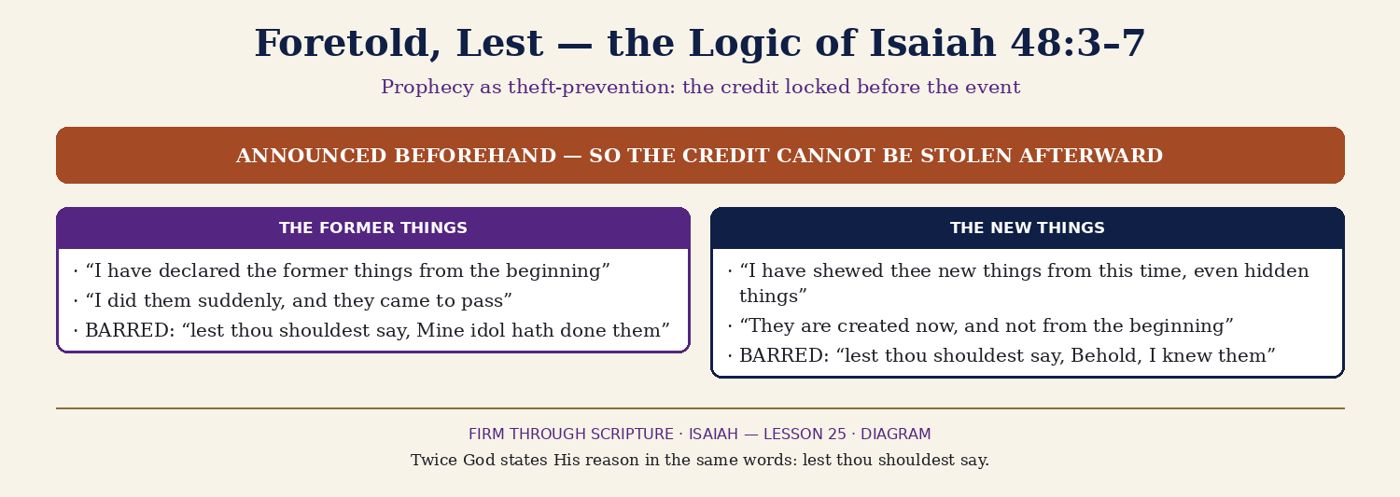
- The repeated reason: "lest thou shouldest say." Twice God states the purpose of His foretelling in those exact words — v. 5 and v. 7. When an author tells you his reason twice, in matching grammar, believe him. That repetition is the chapter's own table of contents for its prophecy-teaching.
- The doubled sake. "For my name's sake… for my praise" (v. 9); "For mine own sake, even for mine own sake" (v. 11). The doubling is Hebrew poetry's underlining: the ground of Israel's survival is stated, then restated — both times God's name, never Israel's merit.
- The titles stack at the centre. Verse 17 opens with a triple self-introduction — "the LORD, thy Redeemer, the Holy One of Israel" — and verse 12 with the book's signature claim, "I am the first, I also am the last" (compare 41:4; 44:6). Those phrases bind this section into a single argument. 4
- The one grief in the chapter. Between the announcements and the marching orders sits an "O that thou hadst hearkened" (v. 18) — a wish, a lament, in the mouth of the God who everywhere else in these chapters declares what "shall stand." Observation does not resolve that tension. It refuses to pretend it isn't there. Section 7 will sit with it properly.
- The silences. Cyrus is everywhere and never named — "him," the loved and called man of verses 14–15, identified only by the role chapters 44–45 filled in. And verse 16's speaker arrives with no name-tag at all. Sections 7 and 16 will walk slowly at both silences.

4. GENRE — N: note the genre (prophetic oracle — trial speech opening into a salvation oracle)
Isaiah 48 is prophecy — mostly poetry doing courtroom and pastoral work at once. The standard method holds here: prophecy is forthtelling first — God's word spoken into a real audience's real situation — before it is foretelling, and even its foretelling serves the forthtelling. 51 Two of the comfort section's characteristic forms share this chapter:
- The trial speech (or disputation). God summons, states evidence, cross-examines. Verses 1–8 have that courtroom grain: witnesses are called (v. 6), documents produced (the "former things" announced and fulfilled, v. 3), motives entered into the record (the two "lest thou shouldest say" clauses). The trial speeches of chapters 40–48 are the section's engine — God versus the idols, with Israel as the jury that keeps trying to leave the courtroom. 15
- The salvation oracle. From verse 9 the tone turns: anger deferred, choosing in the furnace, a new announcement, and finally the imperatives of departure — "Go ye forth," "flee ye," "declare ye" (v. 20). Judgment and salvation speech are not two moods God alternates; here they are cause and effect. The indictment establishes why the salvation must rest on God's name alone, and then the salvation arrives resting exactly there. [3, 15]
Genre rules for reading it well:
- Poetry argues in parallel lines. Hebrew poetry's basic move is parallelism — the second line restating, sharpening, or extending the first. "Thy neck is an iron sinew, and thy brow brass" (v. 4) is one diagnosis in two metals, not two separate conditions. Read the pairs as single strokes.
- Reported speech needs its speaker tracked. God speaks most of this chapter, but verse 16's voice is genuinely contested, and verse 14 contains a question put to the assembled gods and nations. Oracle punishes readers who stop asking who is talking. Section 16 takes verse 16 apart with the lights on.
- Commands at the end of an argument are its destination. The chapter's only imperatives — leave Babylon, sing, tell it — arrive after sixteen verses of grounding. Genre-honest reading does not lift verse 20 off its foundations as a free-standing slogan; the exit is sung by people who have first heard the indictment and the furnace through. 51
5. TERMS — T: the words in the writer's mouth
Four phrases carry this chapter. Learn what they meant in Isaiah's mouth, and watch how much misreading dies at the dictionary:
- Stay themselves (v. 2) — "they call themselves of the holy city, and stay themselves upon the God of Israel." Stay here is a leaning word: to prop oneself on something, to rest your weight against a support — the Hebrew verb is used elsewhere of leaning on a staff or resting against a wall. 19 The exiles do lean on God — as a posture: He is their stated support, the name in their oaths (v. 1). But a man can lean against a wall conversationally while his actual weight rests elsewhere — on Babylon's economy, gods, and approval. The charge is not you have the wrong religion on paper. It is your leaning is a pose. Isaiah has used posture-language for false trust before — Egypt was a staff that splinters into the hand that leans on it (36:6): the question is never whether you say you lean, but where the weight actually rests. 16
- Refined… chosen thee in the furnace of affliction (v. 10) — Refine is metalwork vocabulary: to smelt and test metal in fire so the dross (the worthless crust that clings to ore) separates and the true metal shows. The Hebrew word is the standard one for a goldsmith's testing, and Isaiah has spent it before — the LORD will "thoroughly purge away thy dross" from Jerusalem (1:25). [18, 19] A furnace was a clay chamber superheated with charcoal and bellows until metal ran liquid; nothing was refined that the refiner intended to discard — rubbish goes to the dump, not the furnace. That is why chosen sits inside the sentence: the place of Israel's worst suffering is named as the place of her election. Hold the two halves together; section 10's second misread comes from prising them apart.
- Created now (v. 7) — "They are created now, and not from the beginning." The verb created is the Bible's signature God-verb — the word of Genesis 1:1, used in these chapters of God's making of Israel (43:1) and of the new heavens and new earth still to come (65:17) — and here of announcements: the "new things" of verse 6. 19 Events not yet occurred are spoken of as brought into being — "created now" — at the moment of their declaration (v. 7). These revelations had no prior existence in Israel's hearing: freshly made, deliberately withheld ("hidden things," v. 6), released on a schedule the audience's stubbornness made necessary. Section 16 follows the verb further.
- Obstinate — neck of iron, brow of brass (v. 4) — the diagnosis in metallurgy. Obstinate is hard, stiff, unyielding; the pictures decode it. A neck whose sinew (the cord of muscle that turns the head) is iron cannot bow and cannot turn — Israel's fathers were charged with the same stiffness in the wilderness ("stiffnecked," Exodus 32:9). A brow — a forehead — of brass cannot blush and cannot be marked: shame does not register on metal, and neither does instruction. 19 Notice the kindness buried in the severity: God states the diagnosis as His reason for His method (vv. 4–5). The disease explains the prescription. That is pastoral logic, not contempt.
Method note — the word-study guardrail: a word means what its author uses it to mean, in its sentence, in its century — not what its oldest root once meant, and not everything it can mean anywhere. Every term above was settled by Isaiah's usage in Isaiah, checked against the standard lexica. 19 That is the discipline that keeps word studies honest.
TRANSLATION NOTE — "but not with silver" (v. 10)
"Behold, I have refined thee, but not with silver" — a small clause, and translations honestly divide over it. Three construals stand in the literature: (1) not as silver is refined — silver's refining runs until the metal is fully pure; Israel's was stopped short of that protocol, measured by mercy. (2) Not thoroughly — a process deliberately not carried to the end the dross would otherwise demand. (3) Occasionally, not for silver — not for payment or profit. The versions spread across these options; the standard critical text and lexica register the difficulty rather than hiding it. [19, 23] What does not divide is the shared sense, sealed by the previous verse: "that I cut thee not off" (v. 9) — a refining measured by mercy, its thermostat set by God's name. When a clause is genuinely hard, this study teaches what is certain in it and refuses to build on the disputed inch.
6. ENTIRE CANON — E: where this passage sits in the whole story
No verse lives alone. Isaiah 48:1–22 is a knot where several of the Bible's long threads pull tight:
- Backwards to the hinge (Isaiah 36–39) and to 37:35. When Sennacherib's army stood at Jerusalem's gate, God gave His reason for the city's rescue: "For I will defend this city to save it for mine own sake, and for my servant David's sake" (37:35). Chapter 48's "For my name's sake… For mine own sake, even for mine own sake" (vv. 9, 11) is that same ground, now carrying a whole people's survival in exile. In Isaiah, God's name is not the decoration on His mercy. It is the stated foundation under it. [3, 4]
- Sideways to 43:25 — the pattern accumulating. Earlier in the comfort section: "I, even I, am he that blotteth out thy transgressions for mine own sake, and will not remember thy sins." Set 37:35, 43:25, and 48:9–11 in a row: deliverance from Assyria, pardon of sins, survival in the furnace — three different rescues, one identical reason. This course trains you to notice when a book repeats its reason; Isaiah wants this one unmissable.
- Backwards to the exodus — and forwards through it. Verse 21's rock-water reaches straight back to Exodus 17:6 and Numbers 20:11, where water came from the struck rock for a murmuring camp. Isaiah's new-exodus frame (40:3's highway, 43:16–19's way in the wilderness, 48:21's rock) teaches the return from Babylon in the first exodus's vocabulary — deliberately: the God of the second rescue introduces Himself with the first rescue's credentials. 4
- Forwards to the refrain's return (57:21). "There is no peace, saith the LORD, unto the wicked" (v. 22) returns, expanded, at the close of the book's third movement (57:21). Two movements, two identical shut doors — a refrain marking comfort's boundary in both places. Watch for it again in Lesson 31.
- Forwards to the Servant's reopening voice (49:1). Chapter 48 ends Book Two's first great movement; chapter 49 opens with a new speaker entirely — "Listen, O isles, unto me" — the Servant himself, called from the womb (49:1–6, Lesson 26). The juxtaposition is deliberate: the people "called a transgressor from the womb" (48:8) are about to hear from the One called from the womb for their rescue. Failure's womb-word and the Servant's womb-word stand a page apart. 4
- Into the New Testament. Paul's "the gifts and calling of God are without repentance" (Romans 11:29) states as principle what 48:9 performs — a God who refrains "that I cut thee not off." 1 Jesus' grief over an unlistening city — "how often would I have gathered thy children together… and ye would not" (Matthew 23:37) — is 48:18's lament in the incarnate Redeemer's mouth: it did not expire with Isaiah's century. And Revelation's "Come out of her, my people" (Revelation 18:4) replays 48:20's exit-order against the final Babylon. FACT as canon-echo — how directly Revelation's Babylon maps onto the historical city is a question for Lesson 35's territory; here the echo itself is the observation. 1
Laid out flat, the chapter's own reason-chain looks like this:
| God says… | In… | Which means… |
|---|---|---|
| "For mine own sake" He defends Jerusalem | 37:35 | Rescue grounded in God's name, not the city's record |
| "For mine own sake" He blots out transgressions | 43:25 | Pardon grounded in God's name, not the sinner's record |
| "For my name's sake… for mine own sake, even for mine own sake" He refrains in the furnace | 48:9–11 | Survival grounded in God's name, not the nation's record |
7. THE MEANING — what the passage teaches
The Walk has established what the text says and where it sits. Now its payload, taught straight — the doctrines this passage actually carries, in the chapter's own order and the chapter's own proportions.
Names without the life (vv. 1–2)
Hear the indictment precisely, because its precision is its mercy. God does not call these people frauds who stole a name that was never theirs. They are "called by the name of Israel"; the holy city really is their city. The charge is narrower and therefore sharper: they "swear by the name of the LORD, and make mention of the God of Israel, but not in truth, nor in righteousness" (v. 1). Not in truth — their God-talk does not correspond to reality. Nor in righteousness — it does not correspond to a right life. The vocabulary is orthodox. The weight is missing.
Verse 2 completes the portrait: they "stay themselves upon the God of Israel" — lean on Him, introduce themselves by His name — and then the verse lands its quiet punch: "The LORD of hosts is his name." LORD of hosts means the LORD of armies — the title of absolute power. The people lean on that God as a posture while living unleaning: hedging with Babylon's gods, trusting Babylon's systems, reserving their real weight for other supports.
This is the one charge in the chapter that requires no Babylonian address to apply. Nominal religion — the name without the life, the lean without the weight — is the standing temptation of every generation that inherits a faith-language. God counts it as the first thing to say to a people He is about to rescue: grace in this book does not skip the audit. Oswalt makes the point structurally — chapters 40–55 answer chapters 1–39, and the disease diagnosed in chapter 1 (worship God calls weariness, hands full and hearts absent) is still on the chart in chapter 48. 3 The exile cured the address. It had not yet cured the lean.
Why God foretells — theft-prevention for stubborn people (vv. 3–5)
Now God does something He rarely does at this length: He explains His own method. "I have declared the former things from the beginning; and they went forth out of my mouth, and I shewed them; I did them suddenly, and they came to pass" (v. 3). The former things are the earlier announced-and-fulfilled words — prophecies already on the record, delivered and then done, "suddenly" when their moment came. The record is produced as evidence: announcement, then event, in that order, publicly.
Then the reason — and it is a reason about them, not about God's vanity: "Because I knew that thou art obstinate, and thy neck is an iron sinew, and thy brow brass; I have even from the beginning declared it to thee; before it came to pass I shewed it thee: lest thou shouldest say, Mine idol hath done them, and my graven image, and my molten image, hath commanded them" (vv. 4–5). Follow the logic slowly, because section 10's first misread dies here:
- God knows His audience. Left to themselves, watching an event unfold with no prior word about it, these stubborn people will credit the nearest statue. Idolatry, in Isaiah's analysis, is not primarily a worship problem; it is a credit problem — a reflex that assigns God's acts to anything but God.
- Therefore God announces beforehand. Advance declaration is a lock placed on the credit in advance: when the thing happens, the idol's claim is already foreclosed by a dated, public, prior word. The idol cannot have "commanded" what it never mentioned.
- Therefore prophecy here is pastoral protection — a fence built around a people whose reflex is theft, so that when deliverance comes they will know Whose it is.
Motyer traces this "lest" logic as one of the comfort section's signature arguments — God argues His case not to win a debate trophy but to leave His people without their favourite alibi. 4 In Babylon, every public event was officially credited to Babylon's gods by Babylon's priests; "Marduk's city fell, so Marduk must have willed it" was the local common sense. [11, 16] God's counter-move is not louder spectacle. It is earlier speech. In Isaiah 48, foretelling is shepherding before it is spectacle.
New things, kept hidden on purpose (vv. 6–8)
God then turns from the old record to a fresh one: "I have shewed thee new things from this time, even hidden things, and thou didst not know them. They are created now, and not from the beginning" (vv. 6–7). The new things — in context, the imminent fall of Babylon and the release under the loved man of verses 14–15, announced in their specifics only now — were not merely unnoticed. They were withheld: hidden by design until "this time," and verse 7 gives the same pastoral reason in its second form — "lest thou shouldest say, Behold, I knew them." The first "lest" guards against crediting idols; the second guards against a subtler theft, the hearer's own claim to have known all along. Between them, every exit from the evidence is closed.
And then — because this God never flatters the jury — the diagnosis is restated at full strength: "Yea, thou heardest not; yea, thou knewest not; yea, from that time that thine ear was not opened: for I knew that thou wouldest deal very treacherously, and wast called a transgressor from the womb" (v. 8). Three negatives stack like hammer-blows, and the record is traced to its origin: from the womb. This is not God discovering a disappointing trend; it is God reading a file He has held since before the patient was born. The honesty matters for everything that follows: the furnace speech of verses 9–11 will ground Israel's survival entirely in God's name precisely because the file reads like verse 8. A rescue grounded in the patient's promise would have died on this verse. That order — full diagnosis, then full mercy — is one of this book's habits: Calvin's Isaiah commentary lingers on exactly this sequencing, stripping away every ground of confidence in man so the promise stands on God alone. 36
The furnace — survival standing on God's name (vv. 9–11)
Here is the chapter's doctrinal centre — look back at vv. 9–11 and read them again before going on. "For my name's sake will I defer mine anger, and for my praise will I refrain for thee, that I cut thee not off." Begin with the outcome: not cut off. Given verse 8's file, cutting off was the available sentence — the covenant's own curses had described it for centuries. It will not be executed, and the reason given is neither Israel's repentance (not mentioned) nor Israel's potential (contradicted at v. 8). The reason is God's name and God's praise: He attached His name to this people at the exodus, and He will not let that name be read as the name of a God who abandoned His own to extinction. The exile itself is renamed: not a scrapyard, a furnace; not disposal, refining; not rejection, choosing-in-the-fire. "For mine own sake, even for mine own sake, will I do it: for how should my name be polluted? and I will not give my glory unto another."
Sit with how deliberately unflattering — and how ultimately secure — this ground is. A pardon standing on Israel's sake would be as stable as Israel; a pardon standing on God's sake is as stable as God. INFERENCE, drawn straight from the text's stated ground: the passage's deepest comfort is not "God has seen the good in you." It is "God has bound His name to His people, and He keeps His name" — 37:35's ground and 43:25's ground, now stated a third time at maximum volume. The witnesses across the spectrum converge on this theocentric ground in the comfort section, whatever else divides them. [3, 4, 15] And the restraint is not indifference dressed in theology: verse 9's anger is real anger, deferred, and the furnace is real fire. God has chosen the measure of the fire by the honour of His name, and the measure is "refined, not cut off." The mercy is measured; it is not mild.
The first and the last — and the loved man (vv. 12–15)
A fresh summons ("Hearken unto me, O Jacob and Israel, my called" — the people of verse 8's file are still my called in verse 12) and then the signature self-declaration: "I am he; I am the first, I also am the last" (v. 12) — temporal totality: this Speaker stands at both ends of everything and owns the span between. Verse 13 grounds it in the résumé: "Mine hand also hath laid the foundation of the earth, and my right hand hath spanned the heavens" — and when He calls to them, "they stand up together." This is the book's standing answer to Babylon's star-gods: the heavens the Chaldean priests consulted are here summoned like servants. 16
Then the assembly scene: "All ye, assemble yourselves, and hear; which among them hath declared these things?" (v. 14) — the courtroom question put once more to the gods and their spokesmen. Silence, as always. And the announcement: "The LORD hath loved him: he will do his pleasure on Babylon, and his arm shall be on the Chaldeans." The unnamed "him" is the man of Lesson 23 — Cyrus. But it is the predicate that should stop the reader. Not "the LORD hath used him," though that is true and said elsewhere. Loved. God declares choosing affection for a pagan emperor who, as 45:4–5 insists twice, does not know Him. Teach this plainly: the love is God's sovereign, electing favour settling on an instrument for His people's deliverance — the same undeserved favour Israel herself received (verse 8's file qualifies nobody). Do not sentimentalize it into a claim about Cyrus's inner life or final state, which the text does not give; do not shrink it into mere usefulness, which the word will not bear. The deliverance of God's people rides on a man loved by God and ignorant of Him, because the plan was never waiting on the instrument's worthiness. [3, 11] Verse 15 seals the errand: "I, even I, have spoken; yea, I have called him: I have brought him, and he shall make his way prosperous." Spoken, called, brought, prospered — Cyrus will march; every verb that matters belongs to the LORD.
Father, Son, and Spirit — the speaker of verse 16
Now the chapter's hardest and most honoured sentence — given a brief treatment here, and the full evidence table in section 16, as this lesson promised: "Come ye near unto me, hear ye this; I have not spoken in secret from the beginning; from the time that it was, there am I: and now the Lord GOD, and his Spirit, hath sent me" (v. 16).
FACT — the grammar, before any theology: the speaker is sent by "the Lord GOD, and his Spirit," which makes him grammatically distinct from both; and the same speaker claims, "from the time that it was, there am I." A merely human speaker fits the sending half and strains at the presence half; a divine speaker fits the presence half and raises the question of how God is sent by God. The verse holds both halves in one breath — which is why it has been a classic test case for fifteen centuries; Jerome's commentary already wrestles with it. 37
The readings, laid out fairly. (a) The prophet speaks — Isaiah describing his own commission: sent by the LORD and His Spirit, present and preaching openly throughout the events. This reading has serious scholarly defenders and honours the sending clause naturally. [7, 11] (b) The church's historic reading — a divine speaker, the Son, sent by the Father ("the Lord GOD") and the Spirit: a sent One who is God, sent by God, with the Spirit. POSITION — the reading the church has overwhelmingly confessed and this course holds, labeled because honest scholarship divides here. (c) Mediating proposals exist across the spectrum; section 16 tabulates them. DISPUTED — the speaker's identification is genuinely contested, and this lesson's posture is the course's standing one: the evidence table complete, the POSITION labeled, nothing forced. Students are not asked to fear this verse. They are asked to see it.
The Christ Thread
Isaiah 48 gives the thread three honest strands, none forced. First, the Redeemer who speaks: verse 17's self-title — "the LORD, thy Redeemer, the Holy One of Israel" — belongs to the God of Israel in the first instance, and the New Testament confesses that this redeeming God acted finally in Jesus Christ, "who gave himself for us, that he might redeem us" (Titus 2:14; Galatians 3:13). 1 The thread is not a symbol hunt; it is the New Testament reading Isaiah's Redeemer and naming where the redeeming arrived. Second, verse 16's sent speaker, on the church's historic reading held above as POSITION: a divine One sent — and John builds his whole portrait of Jesus on that grammar, the Son sent by the Father, speaking openly, not in secret (John 7:26; 18:20's shared wording is an INFERENCE from the echo, honestly labeled). 1 Third, verse 18's lament in Jesus' mouth over Jerusalem (Matthew 23:37): Isaiah's "O that thou hadst" becomes the incarnate Lord's "how often would I… and ye would not," weeping over the same city. The one Redeemer — prophesied, sent, and grieving — in person.
Where in the Covenant Story?
Chapter 48 stands late in the old covenant's story and knows it. Abraham's covenant promised seed "as the sand" — and verse 19 holds that promise against the exile's thin numbers in grief. Sinai gave the commandments whose hearkening verse 18 mourns; Deuteronomy's curses described the exile the audience is sitting in. Yet the chapter's own logic — survival grounded in God's name, not the covenant-keepers' record (vv. 9–11) — already strains past Sinai's terms toward the new-covenant promise Jeremiah, Isaiah's later contemporary, stated outright: a covenant God keeps from His side, sins remembered no more (Jeremiah 31:31–34). FACT as intertext: 43:25's "for mine own sake… I will not remember thy sins" and Jeremiah's "I will remember their sin no more" stand in the same prophetic air. Chapter 48 does not announce the new covenant by name — honesty requires saying so — but its ground of pardon is new-covenant-shaped, and the Servant chapters following will carry that shape to its centre. 5
The Redeemer's lament — peace like a river, forfeited (vv. 17–19)
After the furnace and the assembly, the chapter changes key. "Thus saith the LORD, thy Redeemer, the Holy One of Israel; I am the LORD thy God which teacheth thee to profit, which leadeth thee by the way that thou shouldest go" (v. 17). God's instruction is not ornamental; it profits, it lands a life in the way it should go. And then the sentence that has stopped readers for millennia: "O that thou hadst hearkened to my commandments! then had thy peace been as a river, and thy righteousness as the waves of the sea: thy seed also had been as the sand… his name should not have been cut off nor destroyed from before me" (vv. 18–19).
Three things to teach here, in order. First, the might-have-been is real speech. God states, as fact about an unrealized path, what Israel's life would have been: peace (the Hebrew shalom — wholeness, welfare, everything in its right place) flowing steadily as a river rather than arriving in puddles; righteousness as countless and surf-steady as sea-waves; a seed as innumerable as sand — Genesis's own promise-imagery, quoted back in the past conditional. Exile, the thin remnant, the threatened name — none of it was necessary. The commandments were a road to a river, and the nation took another road. Second, whose grief this is. The Redeemer is not reporting Israel's loss from a distance. "O that thou hadst" is first-person longing — the Teacher mourning the students who would not be taught. Section 6 traced the same lament into Jesus' mouth over Jerusalem. Third, the decree and the desire stand side by side — and this lesson will not dissolve either into the other. Two chapters earlier, God declared: "My counsel shall stand, and I will do all my pleasure" (46:10). Here, the same God says "O that thou hadst hearkened" over a history that did not happen. Lay them flat:
| The text says… | At… | And it means… |
|---|---|---|
| "My counsel shall stand, and I will do all my pleasure" | 46:10 | God's purpose is not defeated, negotiated, or surprised |
| "O that thou hadst hearkened to my commandments!" | 48:18 | God's stated desire for His people's good was genuinely refused, and the refusal genuinely grieves Him |
The book preaches decree and desire side by side, in adjacent chapters, without apology and without explanation — and the faithful lesson does the same. Systems that erase 46:10 make God a spectator; systems that erase 48:18 make Him a machine. Isaiah keeps both, and so will we. POSITION — the course's doctrinal posture, stated plainly: both texts are taught at full strength, and their reconciliation is confessed as God's own wisdom rather than constructed as ours.

The exit sung — and the door shut (vv. 20–22)
Everything the chapter has built now discharges in three verses. "Go ye forth of Babylon, flee ye from the Chaldeans, with a voice of singing declare ye, tell this, utter it even to the end of the earth; say ye, The LORD hath redeemed his servant Jacob" (v. 20). The departure is commanded to be a procession with a press release — singing, declaring, publishing to the ends of the earth — and the headline is past tense: the LORD hath redeemed "his servant Jacob," the obstinate people of verse 8, named at the exit with the servant-title the book will soon give its supreme bearer. As the first redemption was sung on a far shore (Exodus 15), this one is to be sung on the road.
"And they thirsted not when he led them through the deserts: he caused the waters to flow out of the rock for them" (v. 21). The verbs run in the prophetic past — the future journey spoken of as already accomplished, so certain is the Guide. The first exodus's signature miracle is promised as the second exodus's travel provision. Memory here is not nostalgia; exodus memory is conscripted as travel orders — the God who did that will do this; therefore walk.
And then, with the song still in the air, the door: "There is no peace, saith the LORD, unto the wicked" (v. 22). Do not soften it, and do not skip it. The line is comfort's boundary stone. Peace in this chapter is river-like, promised, led into — and it is not a universal weather system. To the wicked — in context, first, those who hear the redemption sung and will not leave Babylon — there is no peace, and the sentence returns at 57:21. A gospel with no boundary would not be this book's gospel: the invitation is real enough to be refused, and refusal has a stated end.
The Long View — what the church has believed
Stand back and notice how the centuries have read this chapter. The church has consistently heard in verses 9–11 one of Scripture's great statements of grace before the phrase sola gratia existed — salvation grounded in God's name and glory alone — and Calvin made the furnace verses a standing text for that doctrine: the prophet deliberately cuts away every human ground so the promise may rest on God only. 36 On verse 16 the centuries divide as section 16 maps: the early church's Trinitarian reading was its majority instinct — Jerome transmits it while registering the difficulty — and it remains the church's confession, labeled POSITION, where much modern scholarship prefers the prophet's own voice. 37 On verse 22's refrain the reading has been essentially undivided: comfort has a boundary, preached as mercy — a warning at the door of the Old Testament's greatest comfort-sequence precisely so hearers would enter, not admire the doorway. And Childs's canonical approach — the chapter in its final form, as the church's Scripture, whatever its compositional prehistory — represents this course's posture throughout Isaiah. 5 Where the centuries have divided over Isaiah 48, they have divided at its genuine difficulties — never over whether the God of the furnace saves for His own name's sake.
That is the payload. The next section compresses it into the one sentence you are meant to carry out of this study.
8. THE AIM SENTENCE — X: eXplain the intent
Everything observed now compresses into one sentence — the author's intended meaning, stated before any application is allowed near it:
Isaiah 48 exposes name-only religion, explains that God foretells so stubborn idol-creditors cannot steal His glory, grounds Israel's survival in the furnace wholly in His own name, announces the loved deliverer who will break Babylon, grieves the peace His people forfeited by not hearkening — and sends them out of Babylon singing, with no peace for the wicked.
If a sermon or devotional uses Isaiah 48 to say something that cannot be traced back to that sentence, it is not this chapter talking.
9. SAY IT BACK
Close the book and say the AIM sentence from section 8 in your own words — out loud, or in your notes, without looking. Then say, in one more sentence, what it asks of you this week.
If your version quietly changes the meaning — if the furnace becomes rejection, or verse 22 quietly falls off the end — open the lesson and walk it again. This exercise feels small. It is the entire course in miniature: meaning first, then — and only then — your life.
10. THE MISREAD — the guardrail, with verdicts
Three live misuses of this chapter. Each gets a fair hearing, the evidence, and a verdict.
Misread 1: "God foretells the future to show off — prophecy is heaven's magic trick, proof by spectacle." Why it sounds right: the chapter does argue from fulfilled prediction; a reader in a hurry can hear self-display in I told you, and it happened. The evidence: God states His reason Himself, twice, in matching words — and the reason is never applause. "I shewed it thee: lest thou shouldest say, Mine idol hath done them" (v. 5); the new things were hidden "lest thou shouldest say, Behold, I knew them" (v. 7). The foretelling is calibrated to the audience's known disease (v. 4's iron neck, v. 8's treachery): advance announcement exists so the credit cannot be handed to a statue or pocketed by the hearer's pride. The motive named is God's knowledge of them ("Because I knew that thou art obstinate"), not God's hunger for an audience. Verdict: divine showmanship is the one reading the chapter's own stated reasons exclude. Prophecy here is shepherding before it is spectacle — foretelling for the stubborn, to leave idols uncredited and stubbornness without its alibi.
Misread 2: "The furnace means God had rejected them — exile is abandonment, and suffering is the proof of it." Why it sounds right: the exile really was covenant judgment, the furnace really is affliction, and verse 8 really does read like a file no one survives. The evidence: the chapter's own grammar of the furnace forbids it. Refining is what a refiner does to metal he intends to keep — scrap is discarded without fire. The sentence pairs the fire with election: "I have refined thee… I have chosen thee in the furnace of affliction" (v. 10). The outcome is stated before the process: "that I cut thee not off" (v. 9). And the people inside the furnace are still addressed afterwards as "Jacob and Israel, my called" (v. 12). Add the Translation Note's settled point — a refining measured by mercy — and the picture is complete: measured fire, kept metal. Verdict: the furnace is rejection's opposite wearing severity's clothes. In this chapter, affliction is the place of choosing, and the fire's measure is mercy — the people in it are still "my called."
Misread 3: "Isaiah 48:16 settles the Trinity debate (or, from the other camp, is obviously just Isaiah talking) — anyone who hesitates is dodging." Why it sounds right: the verse really does contain a speaker sent by "the Lord GOD, and his Spirit," and it has been a banner text for the church's Trinitarian confession since the early centuries. Confidence feels like faithfulness — and the opposite camp's confidence feels like honesty. The evidence: the grammar, as section 7 laid out, cuts both ways at once: the speaker is distinct from the Lord GOD and His Spirit (he is sent by them), yet claims presence "from the time that it was." The prophet-reading honours the sending and strains at the presence; the Trinitarian reading honours the presence and must explain a God sent by God — grammar the incarnation itself supplies (the Son sent by the Father, throughout John's Gospel). Responsible commentators stand on both sides, and the difficulty is registered across the spectrum, not only by skeptics. [7, 11, 37] Verdict: 48:16 cannot be settled by a wave from either camp. The honest lesson shows the grammar, lays out both readings, names the stakes, and labels its conclusion POSITION — students learn more from the table than from a verdict shouted over it. Section 16 keeps that promise.
11. FROM WORD TO WALK
A reflection page — the lesson is not finished until the passage has had its say with you.
Begin where the chapter begins: with your name. You are called by a name — Christian, perhaps; church member; the one who has it together. Isaiah's audience would recognize the wardrobe. They swore by the LORD's name, and their sentences about God were all true sentences. The audit was never about their vocabulary. It was about the lean — where the weight actually rested when Babylon's week began: on the God they named, or on the systems, approvals, and quiet idols that actually carried them. You do not need Babylon to run this audit. You need ten quiet minutes: is my leaning a posture, or is it weight?
Then stand in the furnace a while, because some readers of this study are in one. Hear the chapter's order preached to yourself: the file read aloud (v. 8), the anger deferred (v. 9), the choosing spoken inside the fire (v. 10), the address unchanged afterwards — "my called" (v. 12). Isaiah 48 does not offer you the explanation of your furnace. It offers you its name (a refiner's tool, not a reject bin), its measure (mercy, not the full protocol your dross would earn), and its ground — a God who, for reasons located entirely in His own name, has decided you will not be cut off. That comfort cannot be taken from you, because it never rested on your record.
And hear the lament last: "O that thou hadst hearkened." There may be a road behind you that reads exactly like verse 18 — a way God taught, plainly, more than once, that you did not take, and a peace like a river that did not happen. Isaiah does not ask you to pretend that road away. But the lament is not the last word: after the grief comes the singing exit, and the God who mourns the forfeited river is, two verses later, splitting rocks in a new desert for the same people. The might-have-been is real; it is not the end of the story — unless, verse 22 warns, a person chooses the city over the road for good.

LORD, my Redeemer and my Refiner — I have leaned on Your name as a posture and called it faith; forgive me, and teach me to put my weight where my words already are. In the furnace, hold me to Your own sentence: refined, chosen, not cut off — for Your name's sake, since my sake would never have held. And where I did not hearken and the river did not flow, grieve with me a moment — then lead me out singing, by the way that I should go. In Jesus' name, amen.
12. FOR DISCUSSION — OR FOR YOUR JOURNAL
With a group, work these aloud. Alone, they're yours — answer them in your journal or in prayer; they lose nothing in the quiet.
- Verse 1's audit is "not in truth, nor in righteousness" — aimed at people with true titles and true vocabulary. Where in your own life is the gap between the name you carry and the weight you actually rest on God? Be specific, not general.
- God gives His reason for foretelling twice: "lest thou shouldest say." What changes in your picture of God — and of prophecy — if His advance announcements aim at protecting stubborn people from crediting idols, rather than at impressing spectators?
- The furnace's ground is "for mine own sake," not "for yours." Is that ground comforting to you, or does it unsettle you — and why? What would happen to your assurance if your survival with God rested on your record instead (v. 8)?
- Set 46:10 ("my counsel shall stand") beside 48:18 ("O that thou hadst hearkened"). Which of the two do you instinctively soften or skip — and what does this chapter gain by preaching both at full strength?
13. THE WALK-OUT — T: Transfer to today
Meaning is settled. Now — and only now — application, and it must cross the bridge honestly. Run the five Transfer Tests on this passage:
- Same covenant? The audience is exiled Judah under the old covenant; we live on the far side of the cross. The events — Cyrus, the 539 BC release, the road home — are theirs and finished. The God — His name-grounded mercy, foretelling care, and refining measure — is the same God, and His character crosses every covenant boundary.
- Same audience? The indictment of name-only religion was aimed at God's professing people, not at Babylon's pagans. That address transfers with unusual directness to professing believers in any century — the mirror was built for insiders. The exit-order was aimed at literal captives in a literal city; its transfer must be argued, not assumed (see What does not cross).
- Same genre rules? Prophetic oracle: it announces and indicts before it instructs, and its one direct command (v. 20) is historically located. So this passage yields primarily postures and audits — the lean examined, the credit assigned rightly, the furnace interpreted — before any programme.
- Repeated or rooted? God's glory guarded and unshared (v. 11) is rooted in His character and repeated across the canon; grace grounded in God's name is the New Testament's own gospel logic; the warning that there is no peace for the finally impenitent is repeated by the Lord Jesus and His apostles. These cross. A literal migration out of a modern "Babylon" does not, on this text's authority.
- Ten verses either side? Every application below is drawn from these twenty-two verses read whole — furnace with file, exit with lament, comfort with its shut door. Nothing hangs on a torn-out line; verse 22 crosses with verse 20 or not at all.
The tests, at a glance:
| Test | Verdict on Isaiah 48 |
|---|---|
| Same covenant? | Events finished; God's character crosses |
| Same audience? | The mirror was built for professing insiders |
| Same genre rules? | Oracle — postures and audits before programmes |
| Repeated or rooted? | Name-grounded grace and the peace-boundary cross |
| Ten verses either side? | Furnace with file, exit with lament, comfort with v. 22 |
What crosses — and lands:
- God has acted first — the indicative before everything. God has bound His name to His people's survival (vv. 9–11), announced His acts beforehand so His people would know Whose they are (vv. 3–7), and grieved over — not merely judged — their refusals (v. 18). Assurance, on this chapter, rests not on the quality of the believer but on the name God will not pollute and the glory He will not give away.
- The lean audit. "Stay themselves upon the God of Israel… but not in truth" (vv. 1–2) is a standing diagnostic for professing people. Where does your weight actually rest — income, approval, a system, a reputation — while your language rests on God? The test of a lean is not what you say in the sanctuary; it is what carries you in the week.
- Credit assigned in advance. God's foretelling trained Israel to credit God, not idols, when deliverance came (vv. 5, 7). The transferable discipline is the same reflex trained forward: settle beforehand that the good which comes is the LORD's doing — before the event arrives and a nearer, shinier explanation volunteers.
- The furnace read by its name. Affliction is to be interpreted first by Isaiah 48's grammar — refining that keeps, choosing inside the fire, a measure set by mercy (vv. 9–10) — never by the rejected-scrap reading section 10 buried. This explains no particular suffering; it forbids the one interpretation God has ruled out for His called people.
Practices — what the gate lets through, made concrete this week:
- The lean audit, in writing. Twenty minutes. List the three supports your life actually leans on, by evidence — where your time, money, and first phone call in a crisis go. Set the list beside verse 2. Where a support is not God, name one concrete weight-shift this week: one decision, one expense, one conversation moved onto Him.
- Credit where it's due — aloud, in advance. Choose one pending matter and pray it now in verse 5's direction: "LORD, when this resolves, it will not have been my idol — my hustle, my luck — that did it. It will have been You. I am saying so beforehand." When it resolves, say so again — to one other person.
- Memorize Isaiah 48:10 — the furnace sentence from §1: refined, but not with silver; chosen in the furnace of affliction. Learn it before you need it; the furnace is a poor classroom for first lessons.
- The lament, answered honestly. Write out verse 18 with your own forfeited river filled in — the road God taught that you did not take. Do not edit the grief down. Then write verse 20 beneath it, and name the one Babylon-habit that leaving begins with this week. One habit, one first step, dated.
- Sing the exit for someone else. This week, tell one person — a fellow believer in a furnace, if you know one — the furnace sentence and the exit sentence together: refined, not rejected; and there is a road out, and God splits rocks on it. By name, not in general.
What does not cross: treating verse 20 as a standing command to relocate from any place you dislike and call it Babylon; treating verse 22 as a licence to pronounce any living person finally "wicked" and peaceless (it is God's verdict on a posture finally kept, not our label for people mid-story — the same chapter sings an exit to people with verse 8's file); claiming the Cyrus pattern as a promise that God will prosper any modern political instrument a reader favours. The gate is not there to shrink the Bible's claims on you — it is there to make sure the claims that land are the ones God actually made.
Praise Him
Praise the God who, for His name's sake, deferred His anger and refined a treacherous people instead of cutting them off — who will not give His glory to another. Praise the First and the Last, whose hand laid earth's foundation and whose right hand spanned the heavens — and who calls Jacob, still, my called. Praise the Redeemer who teaches us to profit, who leads us by the way we should go, who grieves the rivers we forfeited and splits rocks in the desert we still must cross. The LORD hath redeemed His servant Jacob — sing it to the end of the earth.
14. THE RECAP CARD — this study on one page
Print it. Keep it where you'll see it this week.
- The passage: Isaiah 48:1–22 — names without the life, the foretold "lest," the furnace, the loved deliverer, the lament, and the exit sung out of Babylon.
- Say It Plain: God audits a people who wear His name without the life, foretells so idol-creditors cannot steal the credit, grounds their survival in His own name inside a measured furnace, announces the loved man who will break Babylon, grieves the forfeited river of peace — and sends them out singing, with no peace for the wicked.
- The AIM: Isaiah 48 exposes name-only religion, explains that God foretells so stubborn idol-creditors cannot steal His glory, grounds Israel's survival in the furnace wholly in His own name, announces the loved deliverer who will break Babylon, grieves the peace His people forfeited by not hearkening — and sends them out of Babylon singing, with no peace for the wicked.
- Key terms: stay themselves — leaning as a posture, weight to be audited · refined / furnace of affliction — fire that keeps the metal, measured by mercy · created now — new things brought into being at their announcement · obstinate — neck of iron, brow of brass.
- The Misread, in one line: foretelling is shepherding, not showmanship · the furnace is choosing, not rejection · 48:16 is genuinely hard — grammar and both readings on the table, the conclusion labeled POSITION.
- Memory verse: "Behold, I have refined thee, but not with silver; I have chosen thee in the furnace of affliction." — Isaiah 48:10
- This week's practice: the lean audit in writing — and one Babylon-habit named, with a first step dated.
15. CHECK YOURSELF — five questions
Answer from the study, not from instinct. (Answers live in the Teacher Edition.)
- In your own words: what is the AIM of Isaiah 48:1–22?
- God states His reason for foretelling twice, in the words "lest thou shouldest say." Give both "lest" clauses, and explain what each one guards against.
- What ground does God Himself give for not cutting Israel off in verses 9–11 — and why does the chapter insist the ground is not Israel's record (look at v. 8)?
- Who is the unnamed "him" of verses 14–15, what startling word does God use of him, and what should a careful reader not build on it?
- State verse 16's grammatical FACT about its speaker, name the two main readings, and say which this course holds and under what label.
16. GO DEEPER
Optional — for readers who want the machinery. The lesson is complete without it.
From the Sources — The fall of the city outside the prophet's window
Isaiah 48's exit-order assumes an event the ancient world recorded in its own hand. The Babylonian Chronicle — the terse, year-by-year court record kept in Babylon itself — registers Cyrus's takeover of Babylon in 539 BC. 30 Cyrus's own Cylinder announces the conqueror's policy in the aftermath: sanctuaries restored, displaced peoples returned — precisely the policy under which an exiled Judah could be told "Go ye forth of Babylon" and expect the road to be open. 29 FACT — the documents exist, are dated to the events, and say what these summaries say; both are non-biblical witnesses agreeing with the biblical frame where they touch it. INFERENCE — that this agreement strengthens the chapter's historical rootedness: it does, as far as it goes, and this course lets it go exactly that far. No claim in the lesson rests on these documents for the chapter's theology — only for the world the theology addressed. 16
The Honest Argument — the speaker of Isaiah 48:16
The verse, as a fragment, one more time: "…from the time that it was, there am I: and now the Lord GOD, and his Spirit, hath sent me." Everything turns on the "me." The argument, with the lights on:
The grammatical facts (FACT). (1) The speaker is sent, and the senders are named as two: "the Lord GOD, and his Spirit." (2) The speaker is therefore grammatically distinct from both senders. (3) The same speaker claims, "from the time that it was, there am I" — presence coextensive with the events from their beginning — and adds open, public speech across the whole span: "I have not spoken in secret from the beginning." (4) Verses 12–15 are spoken by the LORD Himself without a speaker-change marker before verse 16, while verse 17 resumes with a formal "Thus saith the LORD" introduction — which many readers take as a sign that verse 16's voice was not simply the LORD's unmarked continuation. FACT as a description of the textual signals; what they add up to is the dispute.
Reading (a): the prophet speaks. The prophetic voice steps forward to attest his own commission: present and preaching openly from the beginning of these events, now formally sent by the Lord GOD and His Spirit. Defenders note that prophets elsewhere describe their sending in just these terms, and that a divine speaker "sent" by God requires distinctions within God that the Old Testament nowhere else states this compactly. Serious commentators have held this reading. [7, 11] DISPUTED — it strains, its defenders often concede, at "from the time that it was, there am I": a prophet present at the beginning of what, exactly?
Reading (b): a divine speaker — the church's historic reading. The speaker is the LORD of verses 12–15, now distinguishing Himself as the One sent by "the Lord GOD, and his Spirit": the Son, sent by the Father, with the Spirit — the Trinity's grammar in one Old Testament sentence, and the seed of the New Testament's sending-language. The early church read it so with near-instinct; Jerome treats it in that frame while registering its difficulty. 37 POSITION — this course holds reading (b), with its label on: the evidence is grammatically real on both sides, and forcing it — from either direction — teaches students to fear hard verses instead of reading them.
The two readings at a glance:
| Reading (a): the prophet | Reading (b): a divine speaker | |
|---|---|---|
| Honours best | The sending — sent by the Lord GOD and His Spirit | The presence — "from the time that it was, there am I" |
| Strains at | The presence claim | A God sent by God (answered by the incarnation's own grammar) |
| Held by | Serious commentators, evangelical and critical | The historic church — this course's POSITION |
The decree and the desire, once more. FACT: 46:10's "my counsel shall stand" and 48:18's "O that thou hadst hearkened" are both Isaiah's, chapters apart, neither qualified by the other in the text. DISPUTED: how the church's theologians have systematized them — the library is large and the camps are real. POSITION: this course teaches both at full strength and declines to make either the footnote of the other — the posture of the chapter itself, which preaches the lament three verses after the loved man's guaranteed prosperous way (v. 15) without blinking.
The Word Underneath — bara', "created"
Verse 7's verb — "They are created now" — is bara', the verb of Genesis 1:1, and its distribution is a sermon. In the Hebrew Bible bara' takes God as its subject always — no human ever performs it — and Isaiah spends it with unusual density: of Israel's making (43:1, 15), of the sovereignty speech (45:7), and climactically of the new heavens and new earth (65:17–18). [18, 19] FACT — the lexical distribution is checkable and essentially uncontested. What Isaiah 48 does with the verb is apply creation-language to a revelation: the new things exist — are "created now" — in and by their announcement, before a single event has occurred. INFERENCE — drawn from that distribution and this usage: in this book, God's word does not merely describe the future the way Babylon's omen-readers described theirs; God's speaking is itself an act of making — which is why the chapter can call announcements "created," and why the idol-credit theft of verse 5 had to be fenced in advance.
Go Read
- Oswalt, The Book of Isaiah, Chapters 40–66 (NICOT) 3 — on 48:1's audit, the "lest" arguments, and the furnace's name-sake ground.
- Motyer, The Prophecy of Isaiah 4 — chapters 40–48 as one sustained argument; clear on the trial speeches and 48:14's loved man.
- Smith, Isaiah 40–66 (New American Commentary) 11 — even-handed on the disputed points, verse 16 included.
- Westermann, Isaiah 40–66 (Old Testament Library) 15 — the classic critical account of the trial-speech and salvation-oracle forms.
- Fee & Stuart, How to Read the Bible for All Its Worth 51 — the prophecy chapter behind this lesson's Genre section: forthtelling first.
17. SOURCES & REFERENCES
Numbered citations in this lesson key to this list — the course standard: every sourced claim carries its number, and every number can be checked.
-
The KJV text itself — Holy Bible, King James Version (eBible.org KJV, 1769 text). Scripture quotations are from the King James Version (KJV), which is in the public domain in the United States; the full passage is always assigned as reading. Cross-references within Scripture cite this number.
-
Oswalt, The Book of Isaiah, Chapters 40–66 (NICOT) — John N. Oswalt (Eerdmans). The second volume: the comfort section, the Servant Songs, Cyrus, and the new-creation chapters, read as the deliberate answer to chapters 1–39.
-
Motyer, The Prophecy of Isaiah — J. Alec Motyer (IVP). A one-volume commentary by an evangelical scholar who argues the whole book breathes the mind of the eighth-century prophet; especially strong on the book's structure, its repeated refrains, and the Servant.
-
Childs, Isaiah (Old Testament Library) — Brevard S. Childs (Westminster John Knox). The canonical-approach reading: the book in its final form as Scripture, whatever its compositional prehistory; a control on both conservative and critical overreach.
-
Young, The Book of Isaiah — Edward J. Young (Eerdmans, 3 vols.). The classic conservative commentary; meticulous on the Hebrew and on the unity question, and the standard evangelical treatment of Isaiah 53.
-
Smith, Isaiah 1–39 and Isaiah 40–66 (New American Commentary) — Gary V. Smith (B&H). Evangelical commentary with strong historical notes (the Assyrian and Babylonian records) and an even-handed survey of the authorship debate.
-
Westermann, Isaiah 40–66 (Old Testament Library) — Claus Westermann (Westminster). The classic critical commentary on the comfort chapters; foundational for the genre analysis of the trial speeches and salvation oracles.
-
Walton, Matthews & Chavalas, The IVP Bible Background Commentary: Old Testament — John H. Walton, Victor H. Matthews, Mark W. Chavalas (IVP). Verse-by-verse ancient Near Eastern background: Assyrian siege practice, Babylonian religion, treaty and coronation customs, geography.
-
VanGemeren (ed.), New International Dictionary of Old Testament Theology and Exegesis (NIDOTTE) — Willem A. VanGemeren (Zondervan). Theological word studies with semantic-range discipline for the Hebrew terms.
-
Brown, Driver & Briggs, Hebrew and English Lexicon of the Old Testament (BDB) — The standard older Hebrew lexicon; word senses and usage ranges for the Terms sections.
-
Biblia Hebraica Stuttgartensia (BHS) — The standard critical edition of the Hebrew text behind the modern translations, with its textual apparatus (the home of the Isaiah variants discussed in the Translation Notes).
-
The Cyrus Cylinder (British Museum) — Cyrus of Persia's own proclamation of his restoration policy (539 BC onward) — the pagan parallel and backdrop to Isaiah 44:28–45:13 and Ezra 1.
-
Grayson, Assyrian and Babylonian Chronicles — A. Kirk Grayson (J.J. Augustin). The Babylonian Chronicle series, including the fall of Babylon to Cyrus in 539 BC and the reign of Nebuchadnezzar.
-
Calvin, Commentary on Isaiah — John Calvin (public domain). Reformation exegesis; a control on interpretation and a voice in the Long View.
-
Jerome, Commentary on Isaiah — Jerome (c. AD 408–410). The early church's fullest Isaiah commentary; Jerome transmits the Hebrew learning of his day and treats Isaiah as one prophet's book.
-
Fee & Stuart, How to Read the Bible for All Its Worth — Gordon D. Fee and Douglas Stuart (Zondervan). The beginner's method book; its prophecy chapter ("a forthtelling first") undergirds the Genre sections.