
One study, one walk — the universal FIRM format. The passage first and whole; then its world; then the Walk (Context · Observe · Genre · Terms · Entire Canon); the meaning taught straight; the AIM sentence; the misread exposed and answered; and the walk-out, where application has to pass the Transfer Tests before it reaches your week. The same skeleton serves a book, a chapter, a single verse, or a whole subject. In the early studies the moves are labeled as they happen. The labels fade as the walk becomes yours.
THE WEEK WITH THIS STUDY — six bites
Day 1 — Read the passage · Say It Plain · The World (§§1–2) · Day 2 — Observe · Genre (§§3–4) · Day 3 — Terms · Entire Canon (§§5–6) · Day 4 — The Meaning · the AIM Sentence · Say It Back (§§7–9) · Day 5 — The Misread · From Word to Walk (§§10–11 — add For Discussion, §12, if you're with others) · Day 6 — The Walk-Out · the Recap Card (§§13–14). Go Deeper (§16) any evening you want the basement.
BEFORE YOU READ — Open My Eyes
LORD, You called Your Servant from the womb and hid him in the shadow of Your hand, like a shaft kept in the quiver for its hour. Teach me to trust Your hiding as much as Your sending, and to leave my work with You when the field looks barren. Open my eyes to what is actually here. In Jesus' name, amen.
§ means “section” — the numbered parts of your lesson. Each bite above names the sections for that day.
1. READ THE PASSAGE — Isaiah 49:1–13 (KJV)
Read it all, slowly, before any teaching. In this course the passage always prints once, in full, at the head of the lesson. Everything after this is commentary — this is the text.
1 Listen, O isles, unto me; and hearken, ye people, from far; The LORD hath called me from the womb; from the bowels of my mother hath he made mention of my name.
2 And he hath made my mouth like a sharp sword; in the shadow of his hand hath he hid me, and made me a polished shaft; in his quiver hath he hid me;
3 And said unto me, Thou art my servant, O Israel, in whom I will be glorified.
4 Then I said, I have laboured in vain, I have spent my strength for nought, and in vain: yet surely my judgment is with the LORD, and my work with my God.
5 And now, saith the LORD that formed me from the womb to be his servant, to bring Jacob again to him, Though Israel be not gathered, yet shall I be glorious in the eyes of the LORD, and my God shall be my strength.
6 And he said, It is a light thing that thou shouldest be my servant to raise up the tribes of Jacob, and to restore the preserved of Israel: I will also give thee for a light to the Gentiles, that thou mayest be my salvation unto the end of the earth.
7 Thus saith the LORD, the Redeemer of Israel, and his Holy One, to him whom man despiseth, to him whom the nation abhorreth, to a servant of rulers, Kings shall see and arise, princes also shall worship, because of the LORD that is faithful, and the Holy One of Israel, and he shall choose thee.
8 Thus saith the LORD, In an acceptable time have I heard thee, and in a day of salvation have I helped thee: and I will preserve thee, and give thee for a covenant of the people, to establish the earth, to cause to inherit the desolate heritages;
9 That thou mayest say to the prisoners, Go forth; to them that are in darkness, Shew yourselves. They shall feed in the ways, and their pastures shall be in all high places.
10 They shall not hunger nor thirst; neither shall the heat nor sun smite them: for he that hath mercy on them shall lead them, even by the springs of water shall he guide them.
11 And I will make all my mountains a way, and my highways shall be exalted.
12 Behold, these shall come from far: and, lo, these from the north and from the west; and these from the land of Sinim.
13 Sing, O heavens; and be joyful, O earth; and break forth into singing, O mountains: for the LORD hath comforted his people, and will have mercy upon his afflicted.
SAY IT PLAIN — the passage in everyday words: The Servant himself speaks. God called and named him before he was born, made his mouth his weapon, and then hid him away like a finished arrow in a quiver. God calls him "Israel" — and then gives him a job too big for that name to mean the nation alone: bring Israel home, and be God's salvation-light to the whole world. The Servant admits his work looks wasted, and hands the verdict to God. Then God widens everything: the despised one will be worshipped by kings, prisoners will walk out into daylight, and God's people will come home from the ends of the earth while creation itself is told to sing. That's the whole passage. Everything after this teaches from it — nothing will change what you just read.
2. THE WORLD — C: Context & Audience
A text can never mean what it never meant — so before we ask what these verses mean, we stand where their first hearers stood.
Where you are in the book. You are deep in the Book of Comfort, Isaiah 40–55 — the section that opens "Comfort ye, comfort ye my people" and speaks first to Israelites carried off to Babylon, the empire that destroyed Jerusalem and its temple in 586 BC and deported its people east. (Babylon, for a first-time reader: the great Mesopotamian empire of Nebuchadnezzar's day; Persia, which conquered Babylon in 539 BC under Cyrus, is the next power on the horizon.) The comfort chapters promise that exile is not the end: God will bring His people home, through figures these chapters keep introducing — Cyrus the conqueror (Lessons 23–24) and a quieter figure, the Servant of the LORD. Lesson 21 mapped that Servant's first song (Isaiah 42:1–9) and left a deliberate tension on the table: the title servant rests on the nation ("thou, Israel, art my servant," 41:8) and on an upheld One sent to that nation — and Lesson 21 refused to merge the two landings prematurely. Keep that map open. This lesson is where the tension sharpens into the book's hardest and most fruitful question.
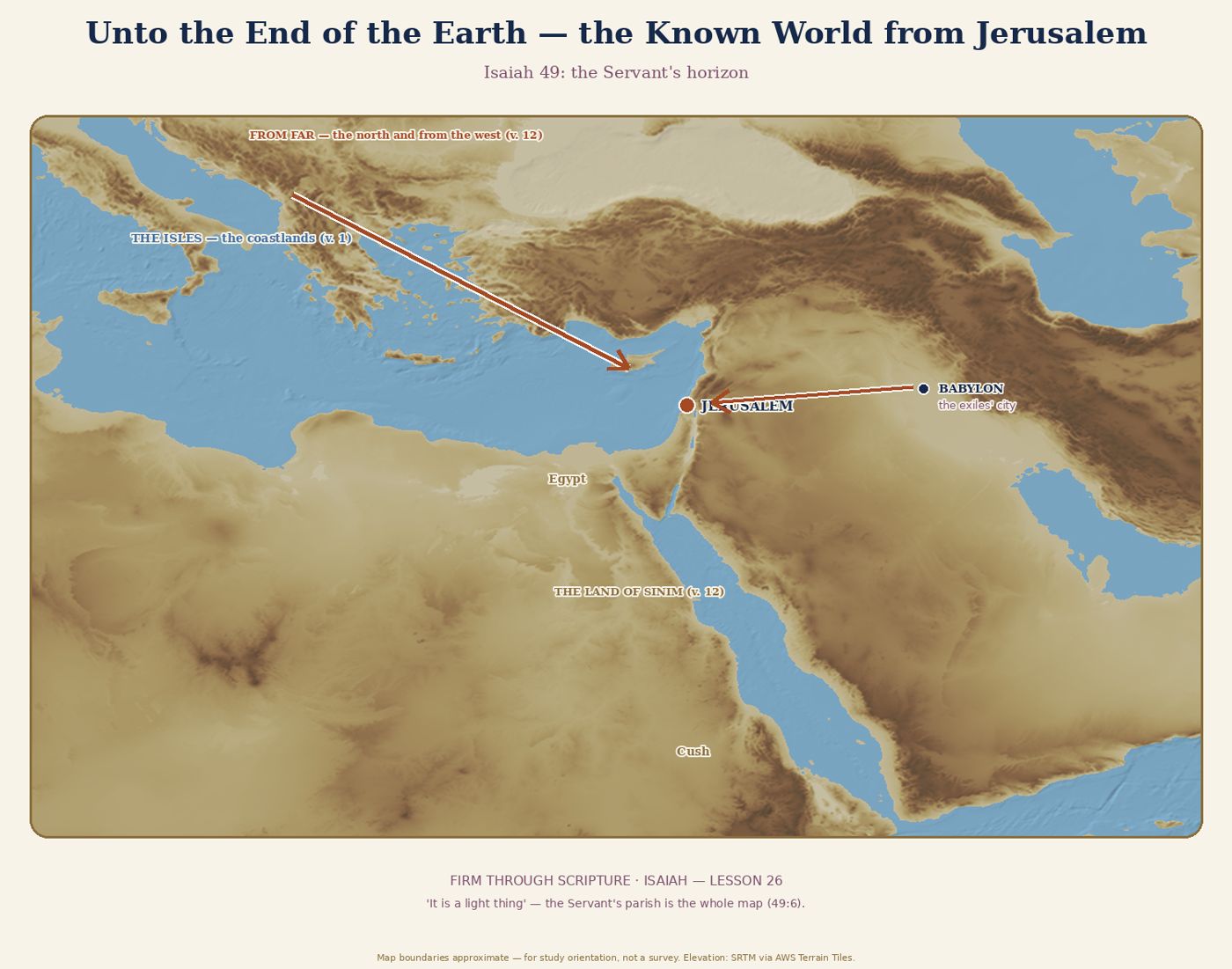
A beginner's note on names, because this passage moves fast. The isles (v. 1) are the distant coastlands of the Mediterranean world — Isaiah's shorthand for the far nations, the Gentiles: everyone who is not Israel. Jacob and Israel are two names for the same people: Jacob was the patriarch — the ancestor — renamed Israel, and the nation, his descendants, carries both names (v. 5 speaks of "the tribes of Jacob"). The preserved of Israel (v. 6) are the survivors God has kept through judgment — elsewhere Isaiah calls them the remnant, the part of the nation preserved through disaster to carry the future. Zion — Jerusalem under its covenant name — is not mentioned in these verses, but she is listening; she speaks next lesson (49:14). And the land of Sinim (v. 12) is so obscure a place-name that §5 gives it a Translation Note of its own.
The speaker changes — and that is the first fact of the world. Through most of chapters 40–48, God speaks and the prophet reports. Here the Servant steps forward and speaks in the first person: "Listen, O isles, unto me" (v. 1). His audience is not Jerusalem only — he summons the coastlands, "ye people, from far": the whole Gentile world is called to hear about a calling that began before birth. A commissioning report addressed to the nations, about a mission that will be enlarged to include those very nations: the form of the passage is already preaching its content.
Send-back: read verse 1 once more and notice who is talking, and who is being talked to. Neither is who a casual reader expects — the Servant does the talking, and the far nations do the listening.
The world of the hidden weapon. Two of the passage's pictures come from the armoury, and both were everyday sights. A shaft is an arrow — straightened, smoothed, and polished so it flies true; a quiver is the archer's case, where finished arrows wait in the dark until the moment of the shot. Isaiah reaches for sword and arrow in a single verse (v. 2) — then does something startling: the weapon is not drawn. It is hidden, twice over. In a world where kings displayed their weapons to advertise power, a God who conceals His chosen instrument is making a statement about how He works: preparation in obscurity, release at the appointed hour. Isaiah builds whole arguments out of such ordinary image-fields — weapons, highways, water in dry places — rather than dropping them as decoration. [16, 52]
Where scholars stand, stated plainly. Bernhard Duhm, in his 1892 commentary, first isolated four Servant Songs as a distinct set inside chapters 40–55, with the delimitation used ever since: 42:1–4 (with its wider frame in this course's Lesson 21), 49:1–6, 50:4–9, and 52:13–53:12. FACT about the history of scholarship. [40, 42] This lesson studies the second song — its core, verses 1–6 — and runs on to verse 13, because the song's comfort frame (the despised one honoured, the prisoners released, creation summoned to sing) belongs to the same movement of thought. The larger question of who wrote chapters 40–55 and when stands here as in Lesson 00: DISPUTED in the academy; this course's POSITION, labelled as such, is the historic church reading of one Isaiah, son of Amoz, whose book the earliest complete witness, the Great Isaiah Scroll, already carries as one scroll of all 66 chapters. [22, 40] Nothing here needs that debate settled first — because this lesson's central question is not who held the pen. It is who the Servant is, and the text itself forces that question.
3. OBSERVE — O: what the text actually does
Before meaning comes observation. Most bad interpretation is not deep error; it is shallow reading — people answering a text they never actually looked at. So look:
- The shape. Thirteen verses in three movements: the Servant speaks (vv. 1–6) — his calling, his confession, his enlarged commission; God answers and expands (vv. 7–12) — honour for the despised one, freedom for prisoners, a road home from the compass's far points; and creation is summoned to sing (v. 13). The passage begins with one hidden man addressing the nations and ends with heaven, earth, and mountains in full voice.
- Who speaks, verse by verse. The Servant speaks in verses 1–4 ("The LORD hath called me"). Verse 5 turns — "And now, saith the LORD" — and from verse 7 onward God's voice carries the passage. Watch the handover: the Servant's confession in verse 4 is not answered by an argument. It is answered by a bigger commission.
- "From the womb," twice. Verses 1 and 5 both reach back before birth — called from the womb, formed from the womb. In thirteen verses, repetition is emphasis: this mission was no improvisation, and neither was its enlargement. What verse 6 says was loaded into the calling from the start.
- The hiding, twice. "In the shadow of his hand hath he hid me" and "in his quiver hath he hid me" — one verse, two concealments (v. 2). Set beside it the passage's other direction: "Go forth… Shew yourselves" (v. 9), spoken to prisoners. God hides His Servant and un-hides His prisoners. The passage knows the difference between concealment as preparation and concealment as captivity.
- The one moment of despair — and its grammar. Verse 4 is the only verse where the Servant speaks of himself in the past tense of failure: "I have laboured in vain." And the same verse pivots on the passage's smallest hinge: "yet surely my judgment is with the LORD." The confession and the trust are one sentence, not two moods.
- The widening words. Track the scale: "isles" and "people, from far" (v. 1) → "the tribes of Jacob" and "the preserved of Israel" (v. 6) → "a light to the Gentiles" (v. 6) → "my salvation unto the end of the earth" (v. 6) → "from the north and from the west… from the land of Sinim" (v. 12). Every time the frame widens, it widens outward from Israel, never away from her. Hold that observation; §7 and Misread 3 both stand on it.
- The silences. The Servant is never given a personal name in the song — he is given Israel's name (v. 3), precisely the puzzle §7 must solve honestly. And no timetable is given for the hiding, either.

4. GENRE — N: note the genre (prophetic poetry — a Servant Song: first-person commissioning report opening into a salvation oracle)
Isaiah 49:1–13 is prophetic poetry, and inside that large family it belongs to a very specific room: it is the second of the four Servant Songs (see §2). Prophecy in this course is read by the rule Fee and Stuart state for beginners: prophecy is forthtelling first — the prophet speaks God's word into his own generation's situation — before it is ever foretelling, and its poetry must be read as poetry: compressed, pictured, built to be felt as well as parsed. 51 Three genre facts govern what follows:
Genre in one line: a Servant Song — the commissioned one testifies in the first person, and God answers him in an oracle of promise. Read it as testimony answered, not as a lecture delivered.
- A commissioning report, told by the commissioned. Prophets regularly report their own calling (Isaiah did, in chapter 6; Jeremiah did, in his first chapter). Here the Servant reports his — but he reports it to the nations (v. 1), not to Israel. That address is a genre signal: the report is itself the first act of the mission it describes. He is being a light to the Gentiles by the act of speaking to them.
- A song that becomes an oracle. Verses 1–6 are the song proper in Duhm's delimitation — the Servant's own testimony. [40, 42] Verses 7–13 shift form into a salvation oracle: God's direct speech of promise — honour pledged, prisoners addressed, a homecoming described — closing in a hymn-summons to creation (v. 13). Westermann's classic analysis taught readers to hear exactly this movement, from testimony to divine promise, as the comfort chapters' characteristic music. 15 Read the seam honestly: the frame is not a second song glued on; it is God's answer, in oracle form, to the song just sung.
- Poetry argues by picture and by placement. The sword-mouth, the polished shaft, the quiver, the springs in the desert are not illustrations pinned to an argument that exists without them. In Hebrew poetry the pictures are the argument's body. And placement argues too: a verse naming the Servant "Israel" (v. 3) set two verses before a verse sending him to Israel (vv. 5–6) is a deliberate collision — and collisions in poetry are where the teaching lives. Do not resolve it by deleting either verse. That rule runs the whole of §7.
5. TERMS — T: the words in the writer's mouth
Four expressions carry this passage. Learn what they meant in the writer's mouth, and watch how much false teaching dies at the dictionary:
- "A polished shaft… in his quiver hath he hid me" (49:2). The Hebrew word for the shaft is the ordinary word for an arrow, and "polished" describes a shaft made smooth and true — the lexica give the root's range as polished, smooth, and so selected, fit for use. [19, 20] A polished arrow was a finished weapon: straightened until it flew where it was aimed. The quiver (Hebrew 'ashpah) is the archer's carrying case. 19 Put the verse's halves together and the picture is exact: the Servant is a word-weapon — his mouth made "like a sharp sword" in the same breath — who has been finished, fitted, and then stored. The force of the term is not merely that he is sharp. It is that sharpness and storage come from the same hand.
- "It is a light thing" (49:6). "Light" here does not mean easy in the sense of effortless, and it certainly does not mean unimportant. The Hebrew verb underneath it means to be small, slight, of little weight — the word used when something is measured and found too small to be the whole assignment. [19, 20] God is doing arithmetic out loud: restoring Israel — the thing the exiles longed for most — registers on His scale as the smaller commission, next to what the Servant is actually being given.
- "In an acceptable time" (49:8). The Hebrew is 'et ratson — a time of favour, of pleased acceptance: the moment when the one petitioned is disposed to hear and to help. [18, 19] Ratson runs through the Old Testament's worship language for an offering accepted, received with pleasure. So verse 8 is not saying "at some convenient date." It is saying: there is a season in which God stands, so to speak, with His face turned toward the petitioner and His hand open — and the Servant's rescue falls inside it.
- "My salvation" (49:6, 8). The Hebrew word is yeshu'ah — salvation, deliverance, victory: God's own saving act, not a human improvement programme. [18, 21] Watch whose it is. The Servant will "be my salvation unto the end of the earth" (v. 6). He does not carry a salvation of his own manufacture. He is, in his person and mission, God's salvation arriving at the ends of the earth. That possessive — my — is doing doctrine.
Method note — the word-study guardrail: a word means what its author uses it to mean, in its sentence, in its century — not what its oldest root once meant, and not everything it can mean anywhere. Every term above was settled by Isaiah's usage in Isaiah 49.
TRANSLATION NOTE — "the land of Sinim" (49:12)
Your KJV reads "the land of Sinim." Underneath it, the Hebrew text (the Masoretic Text, the received Hebrew behind the KJV) reads Sinim — a place-name found nowhere else in the Bible, and its location is genuinely uncertain. FACT: the ancient witnesses vary here. The Great Isaiah Scroll from Qumran (1QIsaᵃ), our oldest substantial witness to this chapter, reads instead the people of Syene — Aswan, at Egypt's far southern border, the southern limit of the known world for an Israelite. [22, 23] Older commentators, reaching for the farthest place they knew, guessed China (the Sinae of the classical geographers). The Scroll's Syene sits far more naturally in the verse's own compass — far, north, west, and now the deep south. FACT: the witnesses vary, and the name is uncertain either way. What does not vary is the sense: from every farthest reach of the map, God's people come home. A translation question at the edge of the map does not move the doctrine at the verse's centre — and this course flags it rather than hiding it, because a text you are allowed to examine is a text you can trust further, not less.
6. ENTIRE CANON — E: where this passage sits in the whole story
No verse lives alone. Isaiah 49:1–13 is a knot where the whole Bible's threads cross — and at two points the New Testament reaches back and takes this passage up by name:
- The first song already promised this one. The First Servant Song gave the Servant "for a covenant of the people, for a light of the Gentiles" (Isaiah 42:6) — and verse 8 of our passage repeats the covenant gift almost word for word. The widening of verse 6 is therefore not new policy; it is the first song's commission, restated and enlarged. The New Testament's use of the first song belongs in this lesson's memory: Matthew quotes Isaiah 42:1–4 at length as fulfilled in Jesus (Matthew 12:18–21). [1, 4] Lesson 21 argued that identification in full; this lesson builds on it.
- Simeon takes up verse 6 over the infant Jesus — FACT as citation. The aged Simeon takes the child Jesus in his arms in the temple and blesses God for "a light to lighten the Gentiles, and the glory of thy people Israel" (Luke 2:32). 1 Simeon's words gather both songs at once — the light of 42:6 and of 49:6 — and notice his pairing: light to the Gentiles and glory to Israel, in one breath, exactly the two commissions verse 6 sets side by side.
- Paul and Barnabas take up the same verse as their charter — FACT as citation. At Pisidian Antioch, Paul announces the turn to the Gentiles with this passage's own words: "For so hath the Lord commanded us, saying, I have set thee to be a light of the Gentiles, that thou shouldest be for salvation unto the ends of the earth" (Acts 13:47). 1 Paul does not treat Isaiah 49:6 as a text about somebody else, long ago. He reads the Servant's commission as a command landing on the Servant's messengers — "commanded us" — and the mission to the nations proceeds under this verse as its warrant. Oswalt and Motyer both trace how the apostolic church read the Songs as one continuous commission running from the Servant into his people. [3, 4]
- Paul hears verse 8 as present tense. "In an acceptable time have I heard thee" becomes, in 2 Corinthians 6:2, "(For he saith, I have heard thee in a time accepted, and in the day of salvation have I succoured thee: behold, now is the accepted time; behold, now is the day of salvation.)" 1 Paul quotes the promise and then dates it: now. The apostle reads the Servant's accepted day as opened, through Christ, into his hearers' present moment. §13 teaches what that does and does not license.
-
The last book gathers verse 10 into the multitude's future. Revelation 7 pictures the great multitude before the throne and says of them, in this passage's own vocabulary, that they will hunger and thirst no more, that neither sun nor heat will light on them, and that the Lamb "shall lead them unto living fountains of waters" (Revelation 7:16–17). 1 FACT as citation: the gentled exodus of Isaiah 49:10 is gathered up, nearly phrase for phrase, into the church's final homecoming. Isaiah's road home from Babylon becomes, in the canon's last telling, the road home of a multitude no one can number.
Send-back: notice the pattern forming — the New Testament does not borrow only this passage's vocabulary. It borrows its commission (v. 6), its calendar (v. 8), and its road home (v. 10).
-
The called-from-the-womb pattern. The Servant is not the only figure described as called before birth: Jeremiah was ordained "before thou camest forth out of the womb," a prophet "unto the nations" (Jeremiah 1:5), and Paul describes himself as separated from his mother's womb and called by grace (Galatians 1:15). 1 But the direction of the pattern matters: Jeremiah's and Paul's callings echo the Servant's because theirs are patterned on his — the canon's servant-figures are drawn in the Servant's outline, not the other way round. INFERENCE — the direction is this study's judgment, stated for what it is.
- The covenant hinge. Verse 8 gives the Servant "for a covenant of the people" — his person is the covenant, as in 42:6 — and Israel's desolate inheritances are re-granted through him. The Abrahamic promise that in Abraham's seed all families of the earth will be blessed finds, in verse 6, its mechanism: the seed's Servant becomes the light by which the nations come in. 57
7. THE MEANING — what the passage teaches
The Walk has established what the text says and where it sits. Now its payload, taught straight — the doctrines this passage actually carries, in the text's own proportions.
The hidden weapon — called, named, armed, and concealed (49:1–2)
The Servant's testimony opens before his birth. "The LORD hath called me from the womb" — his mission is older than his memory of it. "From the bowels of my mother hath he made mention of my name" — God did not merely assign a task; He spoke his name, the way a father names a child, before the child could answer. Whatever the Servant is, he is not self-made, self-sent, or self-named.
Then the arming: "he hath made my mouth like a sharp sword." Notice the weapon. It is not his hand, his army, or his throne. It is his mouth — his speech. The Servant conquers by a word: testimony, proclamation, truth spoken. And in the same breath the arming turns to hiding: made a polished shaft, "in his quiver hath he hid me." The hidden years are not an interruption of the design, a delay God had to work around. They are in the design, named inside the commissioning verse itself. The shaft is not hidden because it failed inspection; it is hidden because the Archer keeps finished arrows in the quiver until the hour of the shot — and the hour belongs to the Archer, not the arrow. Concealment is not evidence against the calling. In this text, it is one of the calling's own features — and it becomes, in §11 and §13, this passage's word to every believer whose long preparation has not yet become visible usefulness. [3, 4]
Send-back: look at verse 2 again. Count the things God made — a mouth like a sword, a polished shaft — and then notice what He did with the finished weapon: He hid it. Twice. The making and the hiding are both God's verbs.
The name, and the confession (49:3–4)
God addresses the Servant by the nation's own name — "Thou art my servant, O Israel" — and stakes His own glory on the naming: this is the one "in whom I will be glorified." This is not a nickname: in Scripture a name spoken by God is a nature and a destiny (Abram becomes Abraham; Jacob becomes Israel). The Servant is told who he is before he is told, in verses 5–6, what he will do — the same order this course met at the Jordan: identity declared before a single act of ministry.
Then, immediately, the song does something no propaganda would do. The Servant confesses: "Then I said, I have laboured in vain, I have spent my strength for nought, and in vain." This is honest accounting from inside obedience. He does not say the calling was false. He says the results look like nothing. And the verse refuses to end there: "yet surely my judgment is with the LORD, and my work with my God." Judgment here is his case — the verdict on whether his labour counted. Work carries the sense of his wages: what his labour has earned is on deposit elsewhere. The Servant does not manufacture visible results to rescue his confidence. He transfers the ledger — the assessment of his work sits with the LORD, its payment with his God — and on that transfer, not on outcomes he can point to, he rests. Smith and Oswalt both linger here: the verse is the comfort chapters' pastoral centre for every faithful worker in a barren field, giving despair its full sentence and answering it not with results but with a relocation of the verdict. [3, 11] Misread 2 (§10) guards the verse; §11 will sit with it at length.
The crux — a Servant named Israel, sent to Israel (49:5–6)
Now the passage arrives at the verses everything else has been preparing. "And now, saith the LORD that formed me from the womb to be his servant, to bring Jacob again to him." The commission is stated in one infinitive: to bring Jacob back. And the parenthesis is devastating and essential: "Though Israel be not gathered, yet shall I be glorious in the eyes of the LORD." Israel's gathering, at the moment of speaking, is still outstanding — Israel is the mission's object, not yet its achievement. Then verse 6 doubles the commission in the same sentence that prices it: restoring Jacob's tribes and Israel's preserved is, to God, "a light thing" — too small to be the whole assignment — "I will also give thee for a light to the Gentiles, that thou mayest be my salvation unto the end of the earth."
Set the song's two certainties side by side and look at them without blinking:
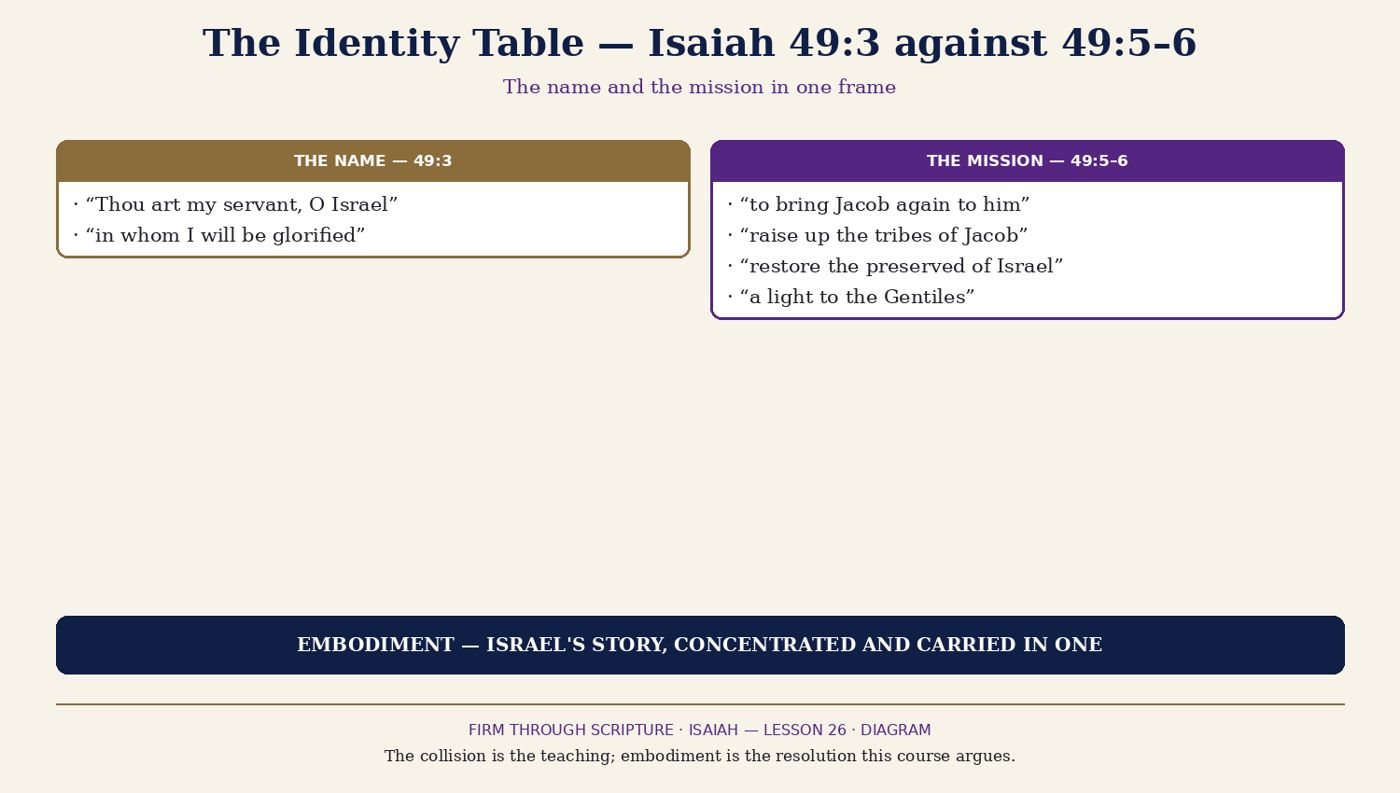
| The text says… | The verse | What it establishes |
|---|---|---|
| "Thou art my servant, O Israel" | 49:3 | The Servant bears Israel's name, given by God Himself |
| "to bring Jacob again to him" | 49:5 | The Servant has a mission to Israel — he is sent to someone |
| "Though Israel be not gathered, yet shall I be glorious" | 49:5 | Israel's gathering is still outstanding — distinct from the speaker's own standing |
| "to raise up the tribes of Jacob, and to restore the preserved of Israel" | 49:6 | Israel is the mission's object — raised and restored by another |
| "I will also give thee for a light to the Gentiles" | 49:6 | The same Servant is given beyond Israel, to the nations |
| "that thou mayest be my salvation unto the end of the earth" | 49:6 | His person carries God's salvation to the map's edge |
Read the table honestly, and both simple readings break on it. The corporate reading — the Servant is simply the nation personified — holds verse 3 easily and then strains at verses 5–6: a nation does not, without remainder, get sent to itself to raise its own tribes while its own gathering is still outstanding. The purely-individual reading holds verses 5–6 easily and then cannot explain verse 3: why would God give an unrelated individual the nation's name, and stake His glory on the giving? North's classic survey remains the fairest catalogue of exactly this difficulty — every proposed identification weighed against the verses it explains and the verses it strains. 42
This course's resolution, from Lesson 21 onward, is embodiment: the One bears Israel's name because He is Israel's story concentrated and carried — Israel's vocation (chosen servant, witness, light to the nations) gathered into a single faithful Person, who can therefore do for Israel what Israel could not do for herself, and then do for the nations what Israel was always meant to do for them. He does not bear the name by courtesy. He bears it the way a representative bears a people's hopes when he is their story, fulfilled and carried in one life. POSITION — this course's and the church's historic reading, argued from the text's own collision and confirmed, in the church's judgment, by the New Testament's uses of this very song (§6): Simeon does not hesitate over the infant, and Paul does not hesitate at Antioch. The evidence both ways, at full strength and fully labelled, is laid out in §16.
"It is a light thing" — God's arithmetic of the widening (49:6)
Do not let verse 6's most startling phrase slip past inside its famous one. Before God gives the Servant to the Gentiles, He re-prices the mission everyone thought was the whole mission. Raising the tribes of Jacob, restoring the preserved of Israel — the exiles' dearest hope, the thing they would have called impossibly large — God calls a light thing: too small, by itself, for this Servant. The widening is therefore not God enlarging the plan because the first version failed. It is God announcing the plan was always this size, and that what looked like the whole of it was the smaller part. The Gentiles are in the commission's grammar — "I will also give thee" — in the same sentence, the same speaking, the same womb-formed calling (v. 5) as the mission to Jacob. And the first song had already said it: "a light of the Gentiles" was in the Servant's charter at 42:6, before verse 4's confession ever made the work look barren. [3, 4] Misread 3 guards this in full. For now, let the arithmetic stand: if God calls Israel's restoration the small thing, no reader may call the nations the afterthought.
The despised one, honoured by kings (49:7)
God now speaks — "Thus saith the LORD, the Redeemer of Israel, and his Holy One" — and the addressee is described with three strokes of humiliation in a single breath: "to him whom man despiseth, to him whom the nation abhorreth, to a servant of rulers." Despised by man, abhorred by the nation — his own — and standing as a servant to rulers, a subordinate at foreign courts. And into the same sentence, without a break, God packs the reversal: "Kings shall see and arise, princes also shall worship." Rulers — the very class he serves — will stand when he enters and bow in worship, "because of the LORD that is faithful." Notice the ground of the honour. It is not better self-promotion, and it is not public opinion correcting itself. Kings will rise because of the LORD that is faithful — because the God who chose the despised one ("he shall choose thee") keeps faith with His own choice, publicly, until the world's seating order reverses itself around him. Humiliation and honour are not two chapters of the Servant's story, the bad replaced by the good. In verse 7 they are one sentence, spoken by one faithful God, about one chosen Servant — and the honour is as certain as the contempt, because both rest on the same faithfulness. POSITION in its full form at §16; the verse's humiliation-and-honour collision is FACT of the text.
The acceptable time — covenant, prisoners, and the gentled exodus (49:8–13)
Verse 8 opens God's answer to the Servant's own prayer — somewhere behind the song, the Servant has been heard: "In an acceptable time have I heard thee, and in a day of salvation have I helped thee." God heard him in the season of favour (§5), preserved him through the hidden years, and now gives him — as at 42:6 — "for a covenant of the people": his person is the covenant's substance, "to establish the earth, to cause to inherit the desolate heritages." The exile emptied inheritances all over the land; the Servant's work re-grants them.
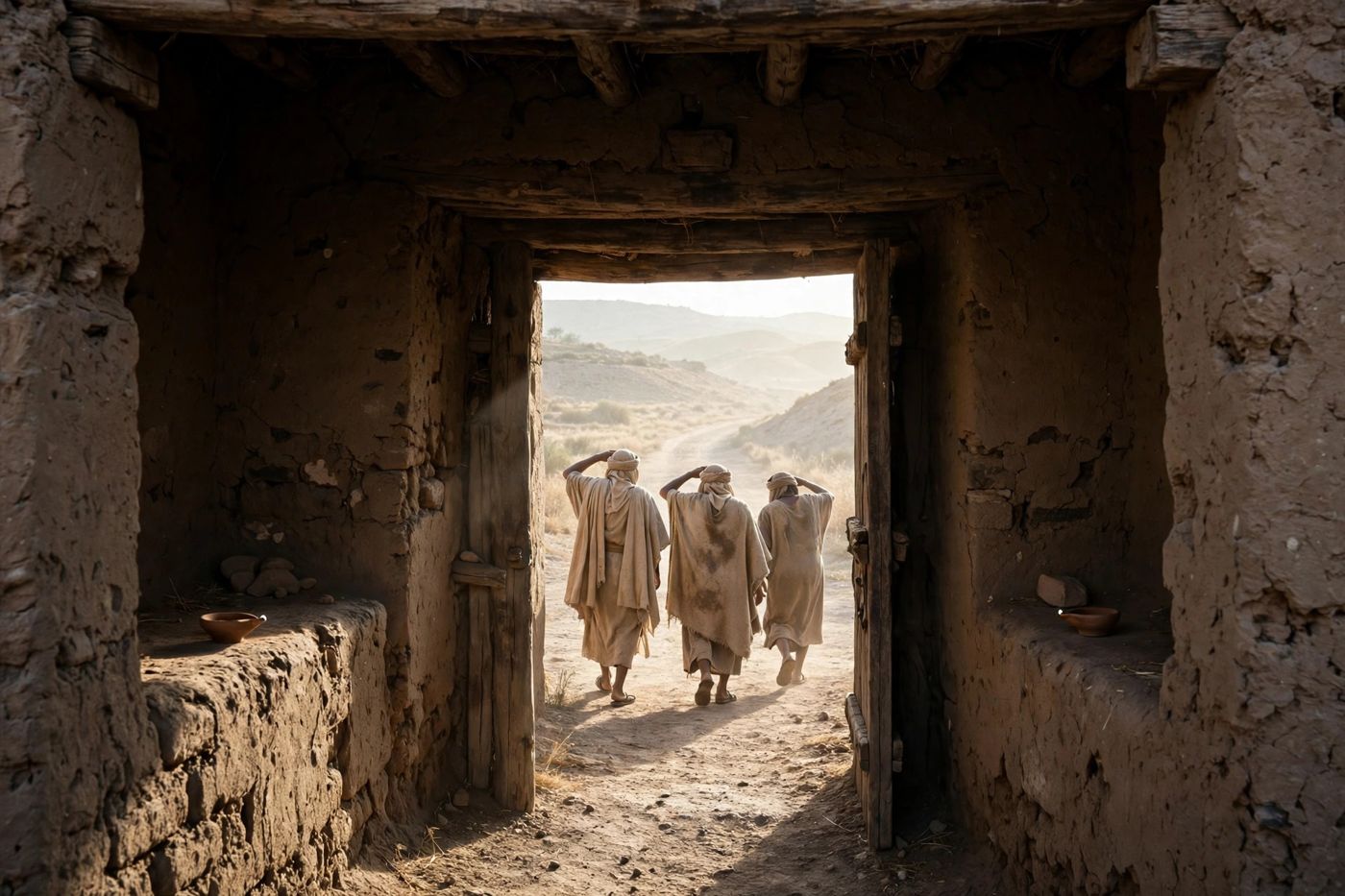
Then the commission becomes two spoken words to two groups of captives: to the prisoners, "Go forth"; to them that sit in darkness, "Shew yourselves" (v. 9). Release here is not escape — nobody tunnels out. It is an announcement that authorises the walking out; the captives' part is simply to come into the open. And the road home (vv. 9–12) is the exodus story retold in a gentler key — and the gentleness is the point. The first exodus ran through hunger, thirst, and smiting heat; this one is pastured on the way itself — "they shall feed in the ways," led by "he that hath mercy on them… by the springs of water" (v. 10), over a road God levels personally (v. 11), until the company arrives from the whole compass — far, north, west, and Sinim in the deep south (v. 12; see the Translation Note). Goldingay notes how deliberately this homecoming reverses the first exodus's hardships point by point — provision where there was hunger, guidance where there was wandering, mercy named as the Leader's motive. 6 And Revelation 7 takes verse 10's promises off the Babylon road and lays them on the final multitude (§6) — the gentled exodus was always a rehearsal for a larger homecoming.
The passage then hands the last word to creation. "Sing, O heavens; and be joyful, O earth; and break forth into singing, O mountains: for the LORD hath comforted his people, and will have mercy upon his afflicted" (v. 13). The song that began with one hidden Servant addressing the far nations ends with the whole created order commanded to sing — and the ground of the singing is God's own summary of the entire movement: comfort for His people, mercy for His afflicted. The hidden shaft, the transferred ledger, the doubled commission, the honoured despised one, the opened prison — all of it resolves into a universe told to sing because God has comforted His people.
The Christ Thread
This passage earns the heading on the New Testament's own testimony, not on this course's enthusiasm. Stand the citations in a row. Simeon, holding the infant Jesus, sings this song's commission over him: "a light to lighten the Gentiles, and the glory of thy people Israel" (Luke 2:32). 1 Paul and Barnabas quote verse 6 as the Lord's command to themselves (Acts 13:47). 1 Paul dates verse 8's acceptable time into his hearers' present (2 Corinthians 6:2). 1 Revelation lays verse 10 over the final multitude (Revelation 7:16–17). 1 Behind them stands Lesson 21's evidence (Matthew's fulfilment citation of the first song), and ahead stand songs three and four, narrowing to the obedient learner of chapter 50 and the suffering figure of chapter 53, whom Philip, beginning at the Ethiopian's own text, "preached unto him Jesus" (Acts 8:35). 1 The church's claim is precise in form, however vast in content: the New Testament reads Isaiah 49 of Christ, repeatedly and in its own words. Whether the Servant can be only that — the honest remainder — is argued at §16 with the labels on. The thread itself is FACT of canon.
Where in the Covenant Story?
The passage stands inside the exile-crisis of the covenant with Israel and opens it, deliberately, to the world. The Abrahamic promise is the charter underneath verse 6: the blessing sworn to Abraham was always aimed through his seed at all the families of the earth, and the Servant — Israel's story concentrated — is the seed's Servant through whom the aim is achieved: Israel restored and the nations lit, in that order, from one commission. The Mosaic covenant supplies the exile the comfort chapters answer — the deportation was the law's threatened judgment arrived (Lesson 21, from 42:24–25) — and the exodus pattern verse 10 so deliberately gentles. The Davidic hope sounds quietly in verse 7: the homage the psalms promised to God's king is here pledged to the despised Servant, and the world's rulers rise to him. And the new covenant horizon is the passage's own word for its centre: the Servant is given for a covenant (v. 8) — a person, not a document, is the covenant — through whom desolate heritages are inherited again and prisoners walk free. One covenant story, four threads, all pulled through a single hidden figure. [3, 57]
The Long View — what the church has believed
Stand back and notice how the centuries have read this song, because you are not its first reader. The ancient Aramaic paraphrase read in the synagogues, Targum Jonathan, names the Servant of these chapters the Messiah — evidence that a messianic, individual reading is not a Christian invention laid over Jewish texts. 38 The medieval Jewish school of Rashi read the Servant corporately, as Israel personified among the nations — a reading with real verses under it (49:3 stands first among them), argued at full strength in §16 rather than caricatured here. 39 The early church, following the apostles' citations, read the song of Christ as a matter of course — Simeon's and Paul's uses of verse 6 were its charter — and Calvin, among the tradition's great commentators, expounds the song's enlargement to the Gentiles as the church's own founding warrant. 36 In the modern academy the question Duhm formalised remains genuinely open: North's survey catalogued the candidates without pretending the case closed, and commentaries still divide over whether any single identification exhausts the text. [40, 42] Where the church stands, and this course with it: the Servant of Isaiah 49 is fulfilled in Jesus Christ, with Israel's vocation gathered into Him by embodiment — POSITION, held on the New Testament's evidence, with its rivals shown fairly. And one centre has held through all the division: no historic reading has ever made this song small.
That is the payload. The next section compresses it into the one sentence you are meant to carry out of this study.
8. THE AIM SENTENCE — X: eXplain the intent
Everything observed now compresses into one sentence — the author's intended meaning, stated before any application is allowed near it:
Isaiah 49:1–13 presents the Servant — named Israel by God, yet sent to restore an ungathered Israel — whom God called and named from the womb, armed with a word and hid like a polished shaft in His quiver; judging Israel's restoration a light thing, God gives him as His salvation-light to the Gentiles unto the end of the earth, honours the despised one before kings, and through him, in the acceptable time, frees the prisoners and brings His people home while creation sings.
If a sermon, a post, or a devotional uses Isaiah 49:1–13 to say something that cannot be traced back to that sentence, it is not this passage talking.
9. SAY IT BACK
Close the book and say the AIM sentence from section 8 in your own words — out loud, or written in your notes, without looking. Then say, in one more sentence, what it asks of you this week.
If your version quietly changes the meaning — if the Servant named Israel becomes only the nation and the mission to Israel evaporates, or the name of verse 3 disappears, or the light to the Gentiles shrinks into an afterthought — open the lesson and walk it again. This exercise feels small. It is the entire course in miniature: meaning first, in the author's words become your words, then — and only then — your life.
10. THE MISREAD — the guardrail, with verdicts
Three live misuses of this passage. Each gets a fair hearing, the evidence, and a verdict.
Misread 1: "'Thou art my servant, O Israel' (49:3) closes the case — the Servant is simply the nation, and every messianic reading is the church reading Jesus into a text that names its own subject." Why it sounds right: verse 3 really does say it, in God's own voice, and the corporate reading is neither modern nor careless — Rashi's school built the sustained Jewish reading on verses like this one, and the title is the nation's at 41:8 and 44:1. 39 The evidence: the same song will not let the case close there. The speaker of verse 3 is given, two verses later, a mission to Israel — "to bring Jacob again to him" — with Israel's gathering still outstanding (v. 5), and is commissioned to "raise up the tribes of Jacob, and to restore the preserved of Israel" (v. 6). A reading that identifies the speaker with the ungathered nation, without remainder, must explain how the nation is simultaneously the one sent and the one not yet gathered, the restorer and the thing restored — and the corporate reading, at its strongest, answers with personification stretched past what these verses will bear. The reverse sleight must be refused with equal firmness: readings that erase verse 3, treating the name as an embarrassment, are not solving the song either — the name is in the text, spoken by God, and §7's Identity Table exists precisely so neither verse is deleted. Then the canon speaks: Simeon and Paul take verse 6 up over Jesus and the Gentile mission (§6) — not as illustration-hunting but as identification. [1, 42] Verdict: verse 3 is a real exhibit, not a closed case. A reading that cannot hold verses 3 and 6 together has not read the song. This course's resolution is embodiment — the One bears Israel's name because He carries Israel's story — POSITION, standing on the text's own collision and the New Testament's citations, with the full argument at §16.
"Thou art my servant, O Israel" — and, two verses later, a mission to Israel. Hold both, or hold neither honestly.
Misread 2: "'I have laboured in vain' (49:4) is the Servant losing his faith — discouragement this honest must mean the calling had failed, or that he doubted it." Why it sounds right: the words are bleak, and they are his. "I have spent my strength for nought, and in vain" does not sound like a victory report — and readers who have felt the same about their own work recognise the sound instantly. The evidence: read the whole verse, in its place. The confession stands inside the commissioning report — the Servant tells the nations about his barren season as part of his credentials, not as a resignation. And the same sentence that owns the emptiness transfers the verdict: "yet surely my judgment is with the LORD, and my work with my God." He does not conclude the labour was worthless; he concludes that he is not the one keeping its books. What follows proves the reading: God answers the confession not with rebuke but with enlargement (vv. 5–6) — the commission doubles. A failed faith gets corrected in Scripture; this confession gets expanded. The verse is honest accounting inside obedience — a servant reporting truly what the field looks like, while refusing to let appearances pronounce the final word on the work. [3, 11] Verdict: not a failure of faith but faith's own bookkeeping under barrenness: the results are confessed honestly, and the judgment of the work is left where the Servant leaves it — with the LORD.
Misread 3: "The light to the Gentiles was God's plan B — Israel was the mission; only when Israel failed did God widen the offer to the nations." Why it sounds right: the historical sequence is real — the Gospel went to the Jew first, synagogue doors did close, and Paul's turn at Antioch (Acts 13) reads, in narrative, like a pivot. Read quickly, verse 6 can sound like an expansion announced after a disappointment. The evidence: the verse's own grammar forbids it. God calls Israel's restoration — the Servant's first-stated mission — "a light thing": too small to be the assignment's whole size. An afterthought is not introduced by declaring the original mission too small. The widening is spoken in the original commissioning, grounded in his forming "from the womb" (v. 5), in the same sentence as the mission to Jacob. And it is not even new in verse 6: the first song had already given him "for a light of the Gentiles" (Isaiah 42:6), and behind both stands the Abrahamic charter — blessing aimed at all families of the earth from the covenant's first page. Paul's Antioch sermon confirms the design rather than inventing it: he quotes this verse as a command already given, not a policy newly adopted. [1, 3] Verdict: the nations were in the charter from the start; the widening is the design, not the revision. The Gentile mission is not God's smaller mercy but His larger one, announced all along.
11. FROM WORD TO WALK
A reflection page — the lesson is not finished until the passage has had its say with you.
Sit first with the quiver. The Servant's story has a long, dark, quiet middle: called before birth, armed with a word — and hidden. If you are in a season where your preparation is real and your usefulness is not visible — training no one has called on, faithfulness in a place that feels like storage — this passage does not call your season a mistake. It has a name for it, and the name is not wasted. It is kept. The shaft in the quiver is not the failed arrow. It is the finished one, waiting on the only timing that was ever the point: the Archer's. The question the text puts to the hidden is whether you will let the hand that hid you be the hand you trust.
Then sit with verse 4, because most honest workers eventually live there. "I have laboured in vain" is a sentence God's own Servant was permitted to say — out loud, in Scripture, as part of his testimony. You are allowed to say what your field actually looks like. What the verse will not permit is stopping there: yet surely my judgment is with the LORD, and my work with my God. Somewhere this week there is a ledger you keep re-opening — the years, the effort, the people who did not respond. The Servant's move is available to you, and it is a move, not a mood: transfer the ledger. Not pretend the field is fruitful. Not call the barrenness good. Hand the judgment of the work to the One who commissioned it. That is not resignation. In this song, it is the exact doorway through which the commission doubled.
And hear, last, the two words spoken to the captives, because one of them may be yours: "Go forth." "Shew yourselves." Some darknesses persist not because the door is locked but because we have made our peace with the dark — hidden a struggle, a sin, a calling, a grief, until hiding feels like home. God's word to the hidden Servant was wait; His word to the hidden prisoner is come out. If yours is the second, this is the week to step into the light He is already standing in.
LORD, You hid Your Servant in Your quiver and called it preparation; teach me to trust the seasons You hide me in. You heard his honest "in vain" and answered with more, not less; take the ledger of my work out of my hands and keep it with Yourself. And where I am a prisoner calling the darkness home, speak Your "Go forth" over me until I walk out into Your morning. In Jesus' name, amen.

12. FOR DISCUSSION — OR FOR YOUR JOURNAL
With a group, work these aloud. Alone, they're yours — answer them in your journal or in prayer; they lose nothing in the quiet.
- The Servant is armed, finished — and hidden (v. 2). Where has God seemed to be keeping you in the quiver? What would change if you called that season kept rather than wasted?
- Verse 4 transfers the ledger: "my judgment is with the LORD, and my work with my God." Name one piece of work whose results you keep grading yourself on. What would handing that judgment to God look like, concretely, this week?
- God calls Israel's restoration "a light thing" beside the mission to the nations (v. 6). What does God's arithmetic do to the way you measure your own assignments — and to any instinct that God's concern stops at your own circle?
- The prisoners are told, "Go forth… Shew yourselves" (v. 9). Is there a darkness — a hidden struggle, sin, or calling — you have settled into? What is one step into the light that obedience would take this week?
13. THE WALK-OUT — T: Transfer to today
Meaning is settled. Now — and only now — application, and it must cross the bridge honestly. Run the five Transfer Tests on this passage:
- Same covenant? The Servant's commission is his own, spoken into Israel's exile and fulfilled first in Christ; we live on the far side of the cross as those the commission reached — Gentiles lit by the light, servants sent under the Servant's charter (Acts 13:47), not as replacements for the Servant himself.
- Same audience? Verses 1–6 are the Servant's testimony; verses 7–13 are God's promises to and through him. What reaches us directly is what the New Testament itself hands us: the acceptable time opened now (2 Corinthians 6:2), the light carried outward (Acts 13:47), the ledger-transfer of verse 4 as the Servant's pattern for his people's work.
- Same genre rules? Prophetic poetry teaches by picture and promise before it issues orders. So this passage yields postures and practices — trust in the hiding, honesty about barrenness, stepping out at God's word — not copied circumstances. Nobody is commanded to find a quiver.
- Repeated or rooted? God's faithfulness to His chosen, His keeping of hidden servants, His heart for the nations, and His hearing in the acceptable time are rooted in His character and repeated across the canon. These cross.
- Ten verses either side? Every application below is drawn from these thirteen verses read whole. Nothing hangs on verse 3 or verse 4 torn out alone — §10 has shown where torn-out verses lead.
| Test | What it guards here |
|---|---|
| Same covenant? | The Servant's commission is not transferred to us as our job description |
| Same audience? | What reaches us is what the New Testament itself hands us — the now of 2 Cor. 6:2, the charter of Acts 13:47 |
| Same genre rules? | Poetry yields postures and practices, not copied circumstances |
| Repeated or rooted? | God's keeping of hidden servants and His heart for the nations are rooted in His character |
| Ten verses either side? | Verse 3 and verse 4 are applied only with the whole thirteen verses attached |
What crosses — and lands:
- God hides what He has made, and the hiding is His. The indicative first: the Servant's concealed years were inside his commissioning, spoken by God in the same verse as his arming. A hidden season is therefore read by faith as keeping, not discarding — and that fact, believed, changes what a believer does in obscurity: prepares, stays sharp, stays put.
- The ledger of your work belongs to God. The Servant's answer to visible barrenness is neither despair nor denial but transfer — judgment and wages lodged with the LORD. That pattern crosses, and it frees a worker to be honest about results without being ruled by them.
- The nations were never an afterthought — so neither is your neighbour. The commission's widening is God's design from the womb; the Servant's people inherit his outward direction. Indifference to those outside your circle is not humility about your assignment. God's arithmetic calls your circle the light thing.
- Now is the acceptable time. Paul's dating of verse 8 stands: the season of God's turned face, opened through the Servant, is the present tense of everyone who hears. Delay in responding to God is never neutrality; the day of salvation has a now in it.
Practices — what the gate lets through, made concrete this week:
- Name the quiver. Write down one season where you were prepared and hidden rather than used and seen. Beside it, write verse 2's verdict in your own words: made, polished, hid — all God's verbs. Thank God for one specific thing the hidden season built in you.
- Transfer one ledger. Choose the work whose results you grade most harshly. Write its honest account — what was spent, what cannot be seen — then write verse 4's yet beneath it, and close the book on it for this week.
- One step out. If §11's second word was yours — "Go forth… Shew yourselves" — take one concrete step into the light this week: tell one trusted believer the hidden thing, confess the settled sin, or say yes aloud to the buried calling.
- Carry the light one street further. Name one person outside your usual circle, and do one deliberate good for them in Jesus' name this week: a meal, a visit, an invitation, a prayer offered in person.
- Memorize Isaiah 49:4's turn. "Yet surely my judgment is with the LORD, and my work with my God." Carry it into every barren-looking field you work.
What does not cross: claiming the Servant's unique commission as your personal job description (you serve under his charter; you are not the shaft of verse 2 or the covenant of verse 8); reading a hidden season as a guarantee of a spectacular unveiling on your timetable (the text promises the Archer's faithfulness, not a date); treating "now is the accepted time" as pressure-tactics material for manipulating others' decisions; or using verse 4 to baptise laziness — the Servant laboured; the transfer covers honest work's results, not work never done.
Praise Him
Sing, O heavens — the passage ends in a choir, and so does this study. Praise the LORD who calls His servants before they can answer and names them before they can earn: who makes a mouth like a sword and then, in wisdom the world calls delay, hides His finished weapon in the shadow of His hand. Praise Him who looked at the restoration of Israel and called it a light thing, because His heart was set on the ends of the earth; who heard His despised Servant in the acceptable time, kept him through the hidden years, and set him where kings rise and bow. Praise Him who says Go forth to prisoners, who leads the hungry home by springs of water and will have mercy upon His afflicted. The LORD hath comforted His people. Let heaven, earth, and mountains — and one reader, at the end of one study — break forth into singing.
14. THE RECAP CARD — this study on one page
Print it. Keep it where you'll see it this week.
- The passage: Isaiah 49:1–13 — the Second Servant Song and its comfort frame: the hidden shaft, the doubled commission, the freed prisoners, the singing creation.
- Say It Plain: God called and named His Servant before birth, hid him like a finished arrow, called him "Israel" — then sent him to restore Israel and be God's salvation-light to the ends of the earth. The Servant hands God the verdict on his barren-looking work; God answers with honour, freedom, and a road home.
- The AIM: The Servant — named Israel, yet sent to restore an ungathered Israel — is called from the womb, hid as a polished shaft, and given, Israel's restoration being a light thing, as God's salvation to the end of the earth; through him, in the acceptable time, prisoners go free and creation sings.
- Key terms: polished shaft in the quiver — a finished word-weapon, stored by the Maker for its hour · a light thing — God's estimate of the smaller commission · acceptable time — the season of God's favour, His face turned toward the petitioner · my salvation — the Servant himself is God's saving act.
- The Misread, in one line: 49:3 is an exhibit, not a closed case — the name and the mission must be held together · "I have laboured in vain" is honest bookkeeping inside obedience, not failed faith · the light to the Gentiles is the design, not plan B.
- Memory verse: "And he said, It is a light thing that thou shouldest be my servant to raise up the tribes of Jacob, and to restore the preserved of Israel: I will also give thee for a light to the Gentiles, that thou mayest be my salvation unto the end of the earth." — Isaiah 49:6
- This week's practice: transfer one ledger — write the honest account of one barren-looking work, write verse 4's yet beneath it, and leave its judgment with the LORD.
15. CHECK YOURSELF — five questions
Answer from the study, not from instinct. (Answers live in the Teacher Edition.)
- In your own words: what is the AIM of Isaiah 49:1–13?
- Verse 3 names the Servant "Israel," and verses 5–6 send him to Israel. State the difficulty each simple reading (purely corporate, purely individual) runs into — and name this course's resolution, with its label.
- What does verse 4 actually do with the Servant's apparently wasted labour? Answer with the verse's own mechanism, not with a general word about discouragement.
- God calls restoring Israel "a light thing" (v. 6). What is He measuring it against — and why does that single phrase destroy the claim that the Gentile mission was an afterthought?
- Name two New Testament voices that take up this passage, and say what each does with it: Simeon (v. 6), Paul at Antioch (v. 6), or Paul on verse 8 (2 Corinthians 6).
16. GO DEEPER
Optional — for readers who want the machinery. The lesson is complete without it.
From the Sources — the Scroll at the far south
Verse 12's "land of Sinim" is this lesson's window into how the text reaches us. FACT: the received Hebrew text reads Sinim, a name found nowhere else in Scripture, its location uncertain. FACT: the Great Isaiah Scroll (1QIsaᵃ, c. 125 BC) — the oldest substantial witness to this chapter — reads instead the people of Syene, the city at Egypt's southern border (modern Aswan), the deep-south limit of the biblical map. [22, 23] The classical commentaries record the older reach for China, the farthest east their geography knew. 34 The Scroll's reading requires no reach at all: north, west, and the far south complete the verse's compass, and the exiles' world supplies every point of it. This course prints the KJV's Sinim and teaches the variant with the lights on — the witnesses vary at a place-name, the sense (the farthest reaches) holds either way, and a text whose edges can be examined this closely is a text whose centre can be trusted the more. INFERENCE — the judgment about trust is the study's; the manuscript facts beneath it are not.
Labels are load-bearing here. FACT for the manuscripts and the citations. DISPUTED for the Servant's identity in the academy. POSITION for the church's embodiment reading. Never trade one label for another to make the argument end sooner.
The Honest Argument — who is the Servant?
Here is the dispute at full strength, because this song is where it comes to its sharpest point. The corporate reading: the Servant is Israel personified. Its evidence is textual: God names the speaker "my servant, O Israel" (v. 3), as He named the nation at 41:8 and 44:1, and Rashi's medieval school built the sustained Jewish reading on exactly these identifications. 39 FACT that these identifications stand in the text. The strain: the same speaker is sent to Israel — to bring Jacob again, to raise the tribes, to restore the preserved — while Israel's gathering remains outstanding (vv. 5–6); and he is given beyond Israel, as God's salvation to the earth's end. The corporate reading must read all of that as the nation addressing itself across its own division, a personification the verses resist at every clause. The individual reading: a distinct figure — called from the womb, despised by the nation he serves (v. 7), heard and preserved by God (v. 8). Targum Jonathan's instinct, naming the Servant of these chapters the Messiah, shows an ancient Jewish reader reaching for an individual resolution. 38 Its strain: it must explain why God gives this individual the nation's name — and "mere metaphor" is too thin an answer for a name God speaks. The church's reading — POSITION of this course: embodiment. The Servant is the One in whom Israel's story and calling are concentrated and carried: He bears the name truthfully because He is Israel's vocation fulfilled in a single faithful life, and He can therefore restore Israel and light the nations as Israel herself could not. Its warrant is the canon's own practice: Simeon takes verse 6 over the infant Jesus (Luke 2:32), Paul and Barnabas take the same verse as the Gentile mission's charter (Acts 13:47), and behind this song stands Matthew's fulfilment-citation of the first (Matthew 12:18–21). 1 DISPUTED in the academy — North's survey weighed every candidacy and the argument continues. 42 Settled for this course as a labelled POSITION: the labels are the honesty. A reader who disagrees can still see exactly which parts are the text's facts, which the academy's open questions, and which the church's confession standing on the apostles' citations.
The Word Underneath — "my judgment… my work" (49:4)
"Yet surely my judgment is with the LORD, and my work with my God" — verse 4's hinge (see §7) is worth sitting under once more, word by word.
The Servant's transfer in verse 4 rests on two loaded nouns. Judgment — Hebrew mishpat, this book's word for right order publicly established — here carries its courtroom sense: his case, the verdict on his labour, lodged "with the LORD." Work — Hebrew pe'ullah — is a labourer's word, used for a worker's deeds and the wages they earn: his recompense, held "with my God." [18, 19] FACT as a matter of Hebrew usage. Set the two together and the mechanism is exact: both the verdict on the work and the payment for it are deposited with God — neither is in the Servant's hands, and neither is in the field's. Nothing has been lost; it has been lodged. INFERENCE — but the kind the word-choice was plainly built to carry.
Go Read
- North, The Suffering Servant in Deutero-Isaiah 42 — the classic survey of every identification of the Servant; the fairest single map of §16's argument.
- Oswalt, The Book of Isaiah, Chapters 40–66 (NICOT) 3 — the fullest evangelical treatment of the second song: the hidden years, verse 4's confession, and verse 6's enlargement read as one movement.
- Motyer, The Prophecy of Isaiah 4 — especially strong on the Servant's identity across the four songs.
17. SOURCES & REFERENCES
Numbered citations in this lesson key to this list — the course standard: every sourced claim carries its number, and every number can be checked.
- The KJV text itself — Holy Bible, King James Version (eBible.org KJV, 1769 text). Scripture quotations are from the King James Version (KJV), which is in the public domain in the United States; the full passage is always assigned as reading. Cross-references within Scripture cite this number.
- Oswalt, The Book of Isaiah, Chapters 40–66 (NICOT) — John N. Oswalt (Eerdmans). The second volume: the comfort section, the Servant Songs, Cyrus, and the new-creation chapters, read as the deliberate answer to chapters 1–39.
- Motyer, The Prophecy of Isaiah — J. Alec Motyer (IVP). A one-volume commentary by an evangelical scholar who argues the whole book breathes the mind of the eighth-century prophet; especially strong on the book's structure, its repeated refrains, and the Servant.
- Goldingay, Isaiah (Understanding the Bible / NIBC) — John Goldingay (Hendrickson). A mainstream-critical one-volume commentary; the exilic-community reading of chapters 40–55 stated fairly, with close attention to the poetry.
- Smith, Isaiah 1–39 and Isaiah 40–66 (New American Commentary) — Gary V. Smith (B&H). Evangelical commentary with strong historical notes (the Assyrian and Babylonian records) and an even-handed survey of the authorship debate.
- Westermann, Isaiah 40–66 (Old Testament Library) — Claus Westermann (Westminster). The classic critical commentary on the comfort chapters; foundational for the genre analysis of the trial speeches and salvation oracles.
- Walton, Matthews & Chavalas, The IVP Bible Background Commentary: Old Testament — John H. Walton, Victor H. Matthews, Mark W. Chavalas (IVP). Verse-by-verse ancient Near Eastern background: Assyrian siege practice, Babylonian religion, treaty and coronation customs, geography.
- VanGemeren (ed.), New International Dictionary of Old Testament Theology and Exegesis (NIDOTTE) — Willem A. VanGemeren (Zondervan). Theological word studies with semantic-range discipline for the Hebrew terms.
- Brown, Driver & Briggs, Hebrew and English Lexicon of the Old Testament (BDB) — The standard older Hebrew lexicon; word senses and usage ranges for the Terms sections.
- Koehler & Baumgartner, The Hebrew and Aramaic Lexicon of the Old Testament (HALOT) — The standard modern Hebrew lexicon; the control on BDB for contested senses (e.g., 'almah).
- Harris, Archer & Waltke (eds.), Theological Wordbook of the Old Testament (TWOT) — Word studies from a conservative-evangelical hand; pastoral-theological range of key terms.
- The Great Isaiah Scroll (1QIsaᵃ) and the Dead Sea Scrolls Bible — The complete Isaiah scroll from Qumran Cave 1 (c. 125 BC), in Abegg, Flint & Ulrich, The Dead Sea Scrolls Bible (HarperSanFrancisco). The oldest substantial witness to Isaiah's text — already a single scroll of all 66 chapters centuries before Christ.
- Biblia Hebraica Stuttgartensia (BHS) — The standard critical edition of the Hebrew text behind the modern translations, with its textual apparatus (the home of the Isaiah variants discussed in the Translation Notes).
- Keil & Delitzsch, Commentary on the Prophecies of Isaiah — C. F. Keil and Franz Delitzsch (19th century; public domain). Delitzsch famously revised his view of Isaiah's composition across editions — the honest-argument file in one author.
- Calvin, Commentary on Isaiah — John Calvin (public domain). Reformation exegesis; a control on interpretation and a voice in the Long View.
- Targum Jonathan to Isaiah — The ancient Aramaic paraphrase read in synagogues. Its handling of chapter 53 — the Servant named as the Messiah, the sufferings reassigned — is primary evidence in the Honest Argument.
- Rashi and Ibn Ezra on Isaiah — The medieval Jewish commentators (11th–12th centuries). Rashi's school reads the Servant corporately as Israel; Ibn Ezra leaves doors open Rashi closes. Cited for the Jewish reading at full strength.
- Duhm, Das Buch Jesaia (1892) — Bernhard Duhm. The commentary that named the "Servant Songs" as a distinct set and crystallized the "Deutero-Isaiah" division — the historical origin of the modern authorship debate, cited as fact about scholarship.
- North, The Suffering Servant in Deutero-Isaiah — C. R. North (Oxford). The classic survey of every identification of the Servant (Israel, a prophet, a king, the Messiah) weighed in one place.
- Fee & Stuart, How to Read the Bible for All Its Worth — Gordon D. Fee and Douglas Stuart (Zondervan). The beginner's method book; its prophecy chapter ("a forthtelling first") undergirds the Genre sections.
- Ryken, Wilhoit & Longman (eds.), Dictionary of Biblical Imagery — Leland Ryken et al. (IVP). Isaiah's image-fields — vineyard, highway, banner, potter, watchman — traced across the canon.
- House, Old Testament Theology — Paul R. House (IVP). Isaiah's place in a whole-Bible theology; the book's three movements read as one argument.