
One study, one walk — the universal FIRM format. The passage first and whole; then its world; then the Walk (Context · Observe · Genre · Terms · Entire Canon); the meaning taught straight; the AIM sentence; the misread exposed and answered; and the walk-out, where application has to pass the Transfer Tests before it reaches your week. The same skeleton serves a book, a chapter, a single verse, or a whole subject. In the early studies the moves are labeled as they happen. The labels fade as the walk becomes yours.
THE WEEK WITH THIS STUDY — six bites
Day 1 — Read the passage · Say It Plain · The World (§§1–2) · Day 2 — Observe · Genre (§§3–4) · Day 3 — Terms · Entire Canon (§§5–6) · Day 4 — The Meaning · the AIM Sentence · Say It Back (§§7–9) · Day 5 — The Misread · From Word to Walk (§§10–11 — add For Discussion, §12, if you're with others) · Day 6 — The Walk-Out · the Recap Card (§§13–14). Go Deeper (§16) any evening you want the basement.
BEFORE YOU READ — Open My Eyes
LORD, You have graven Your people on the palms of Your hands — open my eyes when I am sure You have forgotten. Wake my ear morning by morning before You loosen my tongue, set my face toward obedience, and teach me to trust Your name in the dark without kindling a light of my own. In Jesus' name, amen.
§ means “section” — the numbered parts of your lesson. Each bite above names the sections for that day.
1. READ THE PASSAGE — Isaiah 49:14–50:11 (KJV)
Read it all, slowly, before any teaching. In this course the passage always prints once, in full, at the head of the lesson. Everything after this is commentary — this is the text.
Lesson 26 ended with the Servant, called from the womb, promising that the LORD would gather Israel and give him as a light to the nations (Isaiah 49:1–13); this lesson begins at verse 14, where Zion herself finally speaks — and what she says is a complaint.
14 But Zion said, The LORD hath forsaken me, and my Lord hath forgotten me.
15 Can a woman forget her sucking child, that she should not have compassion on the son of her womb? yea, they may forget, yet will I not forget thee.
16 Behold, I have graven thee upon the palms of my hands; thy walls are continually before me.
17 Thy children shall make haste; thy destroyers and they that made thee waste shall go forth of thee.
18 Lift up thine eyes round about, and behold: all these gather themselves together, and come to thee. As I live, saith the LORD, thou shalt surely clothe thee with them all, as with an ornament, and bind them on thee, as a bride doeth.
19 For thy waste and thy desolate places, and the land of thy destruction, shall even now be too narrow by reason of the inhabitants, and they that swallowed thee up shall be far away.
20 The children which thou shalt have, after thou hast lost the other, shall say again in thine ears, The place is too strait for me: give place to me that I may dwell.
21 Then shalt thou say in thine heart, Who hath begotten me these, seeing I have lost my children, and am desolate, a captive, and removing to and fro? and who hath brought up these? Behold, I was left alone; these, where had they been?
22 Thus saith the Lord GOD, Behold, I will lift up mine hand to the Gentiles, and set up my standard to the people: and they shall bring thy sons in their arms, and thy daughters shall be carried upon their shoulders.
23 And kings shall be thy nursing fathers, and their queens thy nursing mothers: they shall bow down to thee with their face toward the earth, and lick up the dust of thy feet; and thou shalt know that I am the LORD: for they shall not be ashamed that wait for me.
24 Shall the prey be taken from the mighty, or the lawful captive delivered?
25 But thus saith the LORD, Even the captives of the mighty shall be taken away, and the prey of the terrible shall be delivered: for I will contend with him that contendeth with thee, and I will save thy children.
26 And I will feed them that oppress thee with their own flesh; and they shall be drunken with their own blood, as with sweet wine: and all flesh shall know that I the LORD am thy Saviour and thy Redeemer, the mighty One of Jacob.
1 Thus saith the LORD, Where is the bill of your mother's divorcement, whom I have put away? or which of my creditors is it to whom I have sold you? Behold, for your iniquities have ye sold yourselves, and for your transgressions is your mother put away.
2 Wherefore, when I came, was there no man? when I called, was there none to answer? Is my hand shortened at all, that it cannot redeem? or have I no power to deliver? behold, at my rebuke I dry up the sea, I make the rivers a wilderness: their fish stinketh, because there is no water, and dieth for thirst.
3 I clothe the heavens with blackness, and I make sackcloth their covering.
4 The Lord GOD hath given me the tongue of the learned, that I should know how to speak a word in season to him that is weary: he wakeneth morning by morning, he wakeneth mine ear to hear as the learned.
5 The Lord GOD hath opened mine ear, and I was not rebellious, neither turned away back.
6 I gave my back to the smiters, and my cheeks to them that plucked off the hair: I hid not my face from shame and spitting.
7 For the Lord GOD will help me; therefore shall I not be confounded: therefore have I set my face like a flint, and I know that I shall not be ashamed.
8 He is near that justifieth me; who will contend with me? let us stand together: who is mine adversary? let him come near to me.
9 Behold, the Lord GOD will help me; who is he that shall condemn me? lo, they all shall wax old as a garment; the moth shall eat them up.
10 Who is among you that feareth the LORD, that obeyeth the voice of his servant, that walketh in darkness, and hath no light? let him trust in the name of the LORD, and stay upon his God.
11 Behold, all ye that kindle a fire, that compass yourselves about with sparks: walk in the light of your fire, and in the sparks that ye have kindled. This shall ye have of mine hand; ye shall lie down in sorrow.
SAY IT PLAIN — the passage in everyday words: Zion — Jerusalem as a bereaved mother — says what exile feels like: God has forsaken and forgotten her. God answers without scolding: a bond stronger than a nursing mother's, and His own palms — she is engraved there, her ruined walls always before Him. Then the picture reverses: children hurry home, destroyers leave, the land gets too crowded, and the nations carry her sons and daughters back while kings and queens serve as foster-parents. Even the prey of the mighty will be taken back, because God will contend for her children. Did God divorce their mother or sell them to a creditor? He demands the paperwork: there is none. They sold themselves by their sins — and His hand is not too short to redeem. Then the Servant speaks as a disciple: God wakes his ear every morning, gives him a taught tongue for the weary, and he does not rebel — he gives his back to the smiters, sets his face like flint, and stands confident that his Justifier is near. The passage ends by sorting its hearers: walk in darkness, and trust and lean on God; kindle your own fire, and lie down in sorrow. That's the whole passage. Everything after this teaches from it — nothing will change what you just read.
2. THE WORLD — C: Context & Audience
A text can never mean what it never meant — so before we ask what these verses mean, we stand where their first hearers stood.
Where we are in the book. This lesson sits in Part Two of Isaiah, the Book of Comfort (chapters 40–55). Chapters 1–39 spoke mainly to Isaiah's eighth-century world, when Assyria — the empire centred on the Tigris River in what is now northern Iraq — dominated the region. Chapters 36–39 form the hinge: Babylonian envoys visit Jerusalem, and Isaiah warns that Judah's descendants will be carried to Babylon, the great city on the Euphrates in what is now Iraq. Chapters 40–55 answer that future exile, addressing a people who know Jerusalem ruined and their families scattered: the city is a bereaved mother and her children are gone. Commentators across the spectrum read these chapters against that exilic crisis, even where they divide over the book's composition. [3, 4, 6, 11]
Zion, explained. Zion is originally the hill in Jerusalem where the temple stood; in the prophets the name grows until it means Jerusalem herself, and then God's people pictured as that city. Here Zion is personified — a woman, a wife, and above all a mother. That is not decoration: almost every image in 49:14–23 runs on the mother-picture (nursing child, children lost and born, children carried, foster-parents nursing). If you lose the mother, you lose the passage. Verse 14 is a mother in an empty house doing the arithmetic of loss — and God's answer stays inside her own picture until it out-argues her grief from within.
The Servant Songs so far. Four passages in chapters 42–53 stand out as a single figure — the Servant of the LORD — is described or speaks in the first person. Bernhard Duhm's 1892 commentary named these the "Servant Songs," and the name has stuck. 40 FACT about the scholarship. Song One (42:1–9): God presents the Servant, Spirit upon him, a light to the Gentiles. Song Two (49:1–6, previous lesson): the Servant speaks of his call — restoring Israel is too small; he will light the nations too. Our passage contains the third Song (50:4–9). The book is building one portrait panel by panel; Lesson 29 stands before the fourth and greatest panel (52:13–53:12).
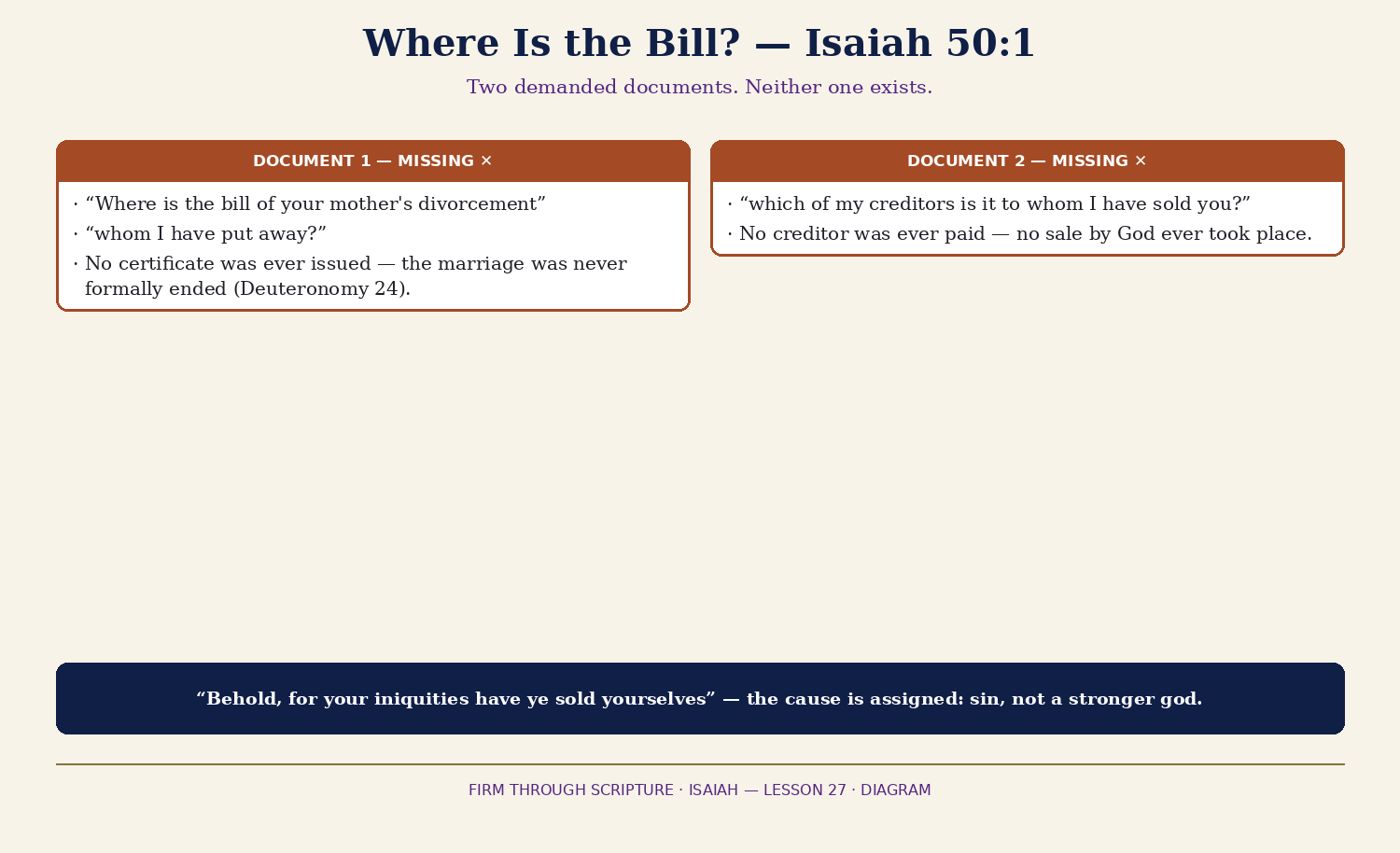
The legal world behind chapter 50. Two documents dominate 50:1, both from everyday ancient law. A bill of divorcement: under Moses' law, a man who sent away his wife gave her a written certificate in her hand (Deuteronomy 24:1–4), proving the marriage formally ended and leaving her free to belong to another. [1, 16] A sale to a creditor: without bankruptcy courts, debt could be settled in persons — the widow in 2 Kings 4:1 cries that the creditor has come to take her two sons as bondmen, and Israelites could sell themselves into servitude (Leviticus 25:39). [1, 16] So God's demand is no exotic metaphor. He asks for the two ordinary papers that would prove a separation was His doing and final. Every hearer knew: nobody could produce either one.
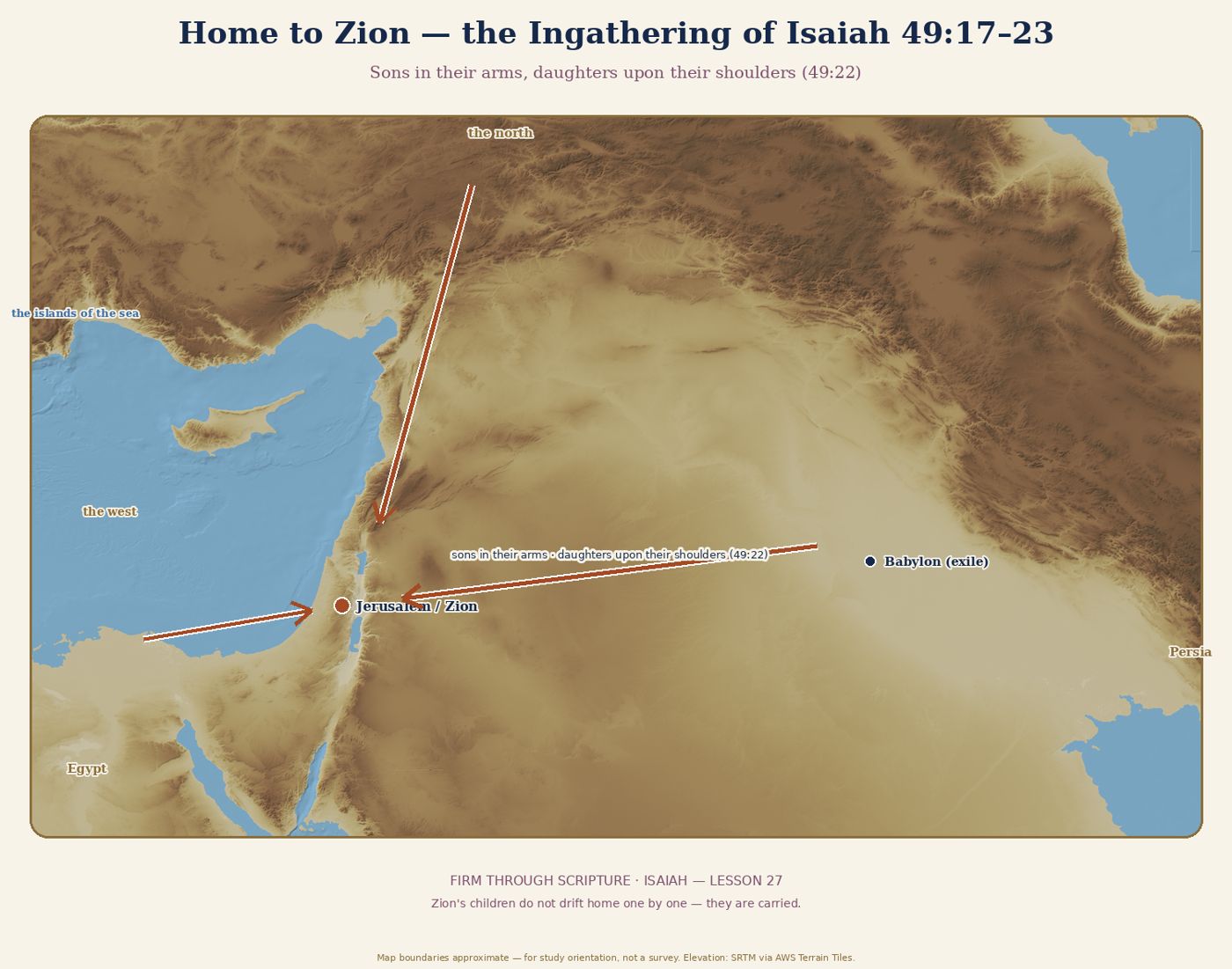
3. OBSERVE — O: what the text actually does
Before meaning comes observation. This passage changes speaker five times, argues in questions, and ends by addressing you directly:
- The speakers, in order. Zion speaks first — one verse, two charges (49:14). Then the LORD answers her (49:15–26), then legally examines the whole people (50:1–3). Then a new "me" speaks — the Servant as disciple (50:4–9). Finally the prophet sorts the audience into two companies (50:10–11). Flatten these voices and you will misread the passage: verse 14 is Zion talking, not God concluding; verses 4–9 are the Servant testifying, not a narrator describing him.
- The questions do the arguing. "Can a woman forget her sucking child . . . ?" (49:15). "Shall the prey be taken from the mighty . . . ?" (49:24). "Where is the bill . . . ? or which of my creditors . . . ?" (50:1). "Is my hand shortened at all, that it cannot redeem?" (50:2). "Who will contend with me?" (50:8). "Who is he that shall condemn me?" (50:9). Courtroom and kitchen-table argument at once — questions that contain their answers, asked so the hearer must say the answer himself.
- "Forget" against "not forget." God's answer picks up Zion's exact word and reverses it: a woman may forget; "yet will I not forget thee" (v. 15). The passage does not change the subject when it answers grief; it takes grief's vocabulary and outbids it.
- Hands everywhere. Zion graven on the palms (49:16); His hand lifted to the Gentiles (49:22); His hand "shortened"? (50:2); the spark-kindlers' end "of mine hand" (50:11). Beside God's hand, the Servant's body: ear, tongue, back, cheeks, face. A passage about what God carries in His hands and what His Servant offers with his body.
- The garments, and the one silence. Zion wears her returning children "as with an ornament" (49:18); the Servant's enemies "shall wax old as a garment" (50:9); between them God clothes the heavens in sackcloth (50:3). And after verse 14 Zion never complains again in this passage — by verse 21 she is asking astonished questions. Her grief is answered by events and oaths, not by her announcing she feels better. Hold that for §11.
| Voice | Verses | What the voice is doing |
|---|---|---|
| Zion | 49:14 | Complaining: forsaken, forgotten |
| The LORD to Zion | 49:15–26 | Answering: the mother, the palms, the returning children, the rescued prey |
| The LORD to the people | 50:1–3 | Examining: where is the bill? whose creditor? is My hand shortened? |
| The Servant | 50:4–9 | Testifying: ear wakened, back given, face set, Justifier near |
| The prophet to you | 50:10–11 | Sorting: trust in the dark, or kindle your own fire |
That is what the text does. Now for the kind of literature doing it.
4. GENRE — N: note the genre (prophetic poetry — salvation oracle, disputation, and Servant Song)
This passage is prophetic poetry — three established forms woven together. Naming them keeps you from reading any one with the wrong expectations. Form-critical study of the comfort chapters, associated above all with Claus Westermann, identified these forms and how Isaiah 40–55 builds its arguments from them. 15
- The salvation oracle (49:15–26, in the main). A salvation oracle answers a lament with promise. Zion's verse 14 is a lament compressed to one line — the Psalms' complaint form — and verses 15 onward answer it: oath ("As I live, saith the LORD," v. 18), promise, and a closing knowledge-formula ("thou shalt know that I am the LORD," v. 23). Reading rule: promise to be trusted by people whose circumstances argue the opposite — a pledge, not a timetable.
- The disputation, or trial speech (49:24–25; 50:1–3). God argues a case: He states His people's objection, cross-examines it with questions, presents evidence, delivers a verdict. The objection underneath this lesson: we are prey in a stronger power's grip; the separation is formal and final; God's hand has lost its reach. Each clause gets a hearing. Reading rule: follow the argument, not just the images — the questions are steps in a proof.
- The Servant Song (50:4–9). First-person testimony, not oracle about somebody else: his formation ("he wakeneth mine ear"), his suffering ("I gave my back"), his confidence ("He is near that justifieth me"). Reading rule: first-person testimony is still prophecy, not a private journal — verse 10 immediately applies it, calling hearers to obey "the voice of his servant."
5. TERMS — T: the words in the writer's mouth
Four expressions carry this passage:
- "Graven thee upon the palms of my hands" (49:16). The verb behind "graven" is the Hebrew chaqaq — to cut in, inscribe, engrave, the word also used for laws cut as decrees. 19 Engraving is not pencil: the mark cannot be washed or smudged off; the surface itself would have to be destroyed. And the surface is not a wall or monument but the palms — plural — of God's own hands. Note the direction, because sermons regularly reverse it: the mark is carried by God, where His eyes fall whenever His hands open, and the verse explains it from His side: "thy walls are continually before me." The ruined walls Zion assumes prove her forgotten are the very thing permanently in God's view. This is no memory aid for a God who might misplace her. It is her guarantee that being out of her own sight has never meant being out of His.
- "The tongue of the learned" (50:4). "The learned" renders a Hebrew word-family, limmud, for a taught one — a disciple. The same word describes taught tongues and taught ears because both belong to the disciple. So this is not a clever or naturally eloquent tongue; it is the speech of a man who has been taught — by an ear wakened "morning by morning" to "hear as the learned." The tongue is the ear's graduate: nobody gets a tongue for the weary who has not first surrendered an ear to be wakened. [19, 21]
- "Set my face like a flint" (50:7). Flint yields to nothing; struck, it does not dent — it throws sparks. To set the face is deliberate (the Servant does it himself, because God will help him — note the order), and in the prophets it is a messenger's posture: deliver the word, absorb the consequences, do not renegotiate. Ezekiel was promised a forehead hard against Israel's foreheads (Ezekiel 3:8–9); the Servant makes the hardness his own resolve. 1 Not stubbornness — obedience that has finished debating itself.
- "The lawful captive" / "the prey" (49:24). Prey is what a stronger army has seized and holds by right of conquest. "Lawful" adds the legal sting: war-captives were held by recognised custom, so the question is whether the captor holds any right God must respect. 16 Verse 25 does not negotiate the right; it overrides it — "I will contend with him that contendeth with thee." Contend is courtroom language: God will out-litigate and out-fight any claimant, because the captives are His children before they are anyone's prey.
Method note — the word-study guardrail: a word means what its author uses it to mean, in its sentence, in its century — not what its oldest root once meant, and not everything it can mean anywhere. Each term above was settled by Isaiah's usage here, checked against the standard lexica. 19
TRANSLATION NOTE — the bill of divorcement that is not there (50:1)
Your KJV asks, "Where is the bill of your mother's divorcement, whom I have put away?" The phrase is a legal term from Deuteronomy 24, where the certificate is literally a "scroll of cutting-off" — the document that cut the marriage and proved it cut. [1, 19] No translation dispute hides here; every version asks for the same document. What matters is the absence: God does not say the bill was lost or that He might issue one. He demands its production — a challenge no one can meet — and pairs it with a second missing document, the creditor's bill of sale. Two documents would settle the case against hope. Neither exists. The argument is not a rendering. It is an empty evidence table.
6. ENTIRE CANON — E: where this passage sits in the whole story
No passage lives alone. This one sits where the exodus behind it, the Servant sequence inside it, and two New Testament echoes ahead of it meet.
- Back to the exodus. Defending His power, God reaches for the founding memory: "at my rebuke I dry up the sea, I make the rivers a wilderness" (50:2) — Red Sea and Jordan in one line, the same move chapter 51 makes at length. The God who made a highway through water has not had His hand "shortened" by Babylon. [1, 3]
- The mother-city through Isaiah. Zion as mother is not invented in verse 14: the barren woman will sing in chapter 54 ("more are the children of the desolate than the children of the married wife"), and the book ends with God comforting "as one whom his mother comforteth" (66:13). 1 Our passage is the middle panel: the mother who believes herself forgotten is promised children beyond counting, and chapter 54 — Lesson 30 — expands this promise in song.
- The Servant sequence — the map so far. Song One (42:1–9): God presents the Servant; he does not speak. Song Two (49:1–6): he speaks of his calling. Song Three (50:4–9): he speaks of his formation and suffering — morning listening, an unrebellious ear, a back given, a courtroom stood in alone. Song Four (52:13–53:12): his death, and its meaning for others. The identity question — Israel named as servant (41:8; 44:1; 49:3), yet a Servant distinguished from Israel and sent to restore her (49:5–6) — is argued in §16. Here the point is simpler: the book narrows, lesson by lesson, from a nation, to a figure, to a sufferer, to a sacrifice. [3, 4, 42]
| Song | Passage | Who speaks | New in the portrait |
|---|---|---|---|
| First | 42:1–9 | God, about the Servant | Spirit upon him; gentle; a light to the Gentiles |
| Second | 49:1–6 | The Servant, about his call | Called from the womb; restores Israel and lights the nations |
| Third | 50:4–9 | The Servant, about his obedience | Taught ear and tongue; back given; face like flint; Justifier near |
| Fourth | 52:13–53:12 | The nations and the prophet, about his death | Wounded for transgressions not his own; silent; satisfied |
- Luke 9:51 and the flint face — a resonance, carefully labelled. Luke writes of Jesus: "he steadfastly set his face to go to Jerusalem." 1 A face deliberately set, direction Jerusalem, suffering at the end of the road — remarkably close to Isaiah 50:7. FACT: the resonance exists and has been noted for centuries; Luke quotes Isaiah deliberately and tells the journey that follows as a road walked with a set face. INFERENCE: that Luke intended a direct allusion — deliberate borrowing rather than a shared idiom for resolve — fits his habits, but the text carries no footnote saying so, and this study does not upgrade it. Either way the rhyme is real: Servant and Son set their faces toward the same city and the same shame.
- Romans 8 and the Servant's courtroom. In 50:8–9: a Justifier near, an adversary invited forward, a charge that cannot stick, accusers decaying like cloth. In Romans 8:33–34 Paul asks, in courtroom sequence: "Who shall lay any thing to the charge of God's elect? It is God that justifieth. Who is he that condemneth?" 1 The parallel is strong evidence, shown as such. That Paul is building on this Song, carrying its courtroom to every believer, is INFERENCE — widely argued, plausible in Paul's Isaiah-saturated letters, but labelled. If true, the Servant's solitary confidence becomes a confidence handed to the whole church. The singular courtroom opens its doors.
7. THE MEANING — what the passage teaches
Now the payload, taught straight — the doctrines this passage carries, in the text's own proportions.
The complaint is given a verse — so that it can be answered
Begin where the passage begins. "But Zion said, The LORD hath forsaken me, and my Lord hath forgotten me" (49:14). The book does not paraphrase that grief into something more respectable or rebuke it in the next breath. It gives the worst thought a believer can think — God has left; God has forgotten — a full verse, in direct speech. Then it answers it for thirty verses.
That sets the Bible's pastoral method in miniature. The Psalms do this constantly: complaint is a legitimate form of address to God, not a failure of faith to be hushed. What the text will not do is let the complaint have the last word, treat the feeling as evidence, or pretend it was never felt. Oswalt and Motyer both note the structural fact: the complaint is the oracle's occasion, not its embarrassment — the verse exists so verses 15–26 can exist. [3, 4] A sermon that ends at verse 14 has stopped mid-sentence; one that scolds verse 14 out of sufferers has misread its tone. Hear it fully — then answer it with evidence about God.
And notice what counts as evidence: not a warmer feeling, but a mother, God's palms, and a road filling with children. The comfort is relentlessly external — who God is and what He is doing, true on days Zion cannot feel either.
A mother, and then past a mother
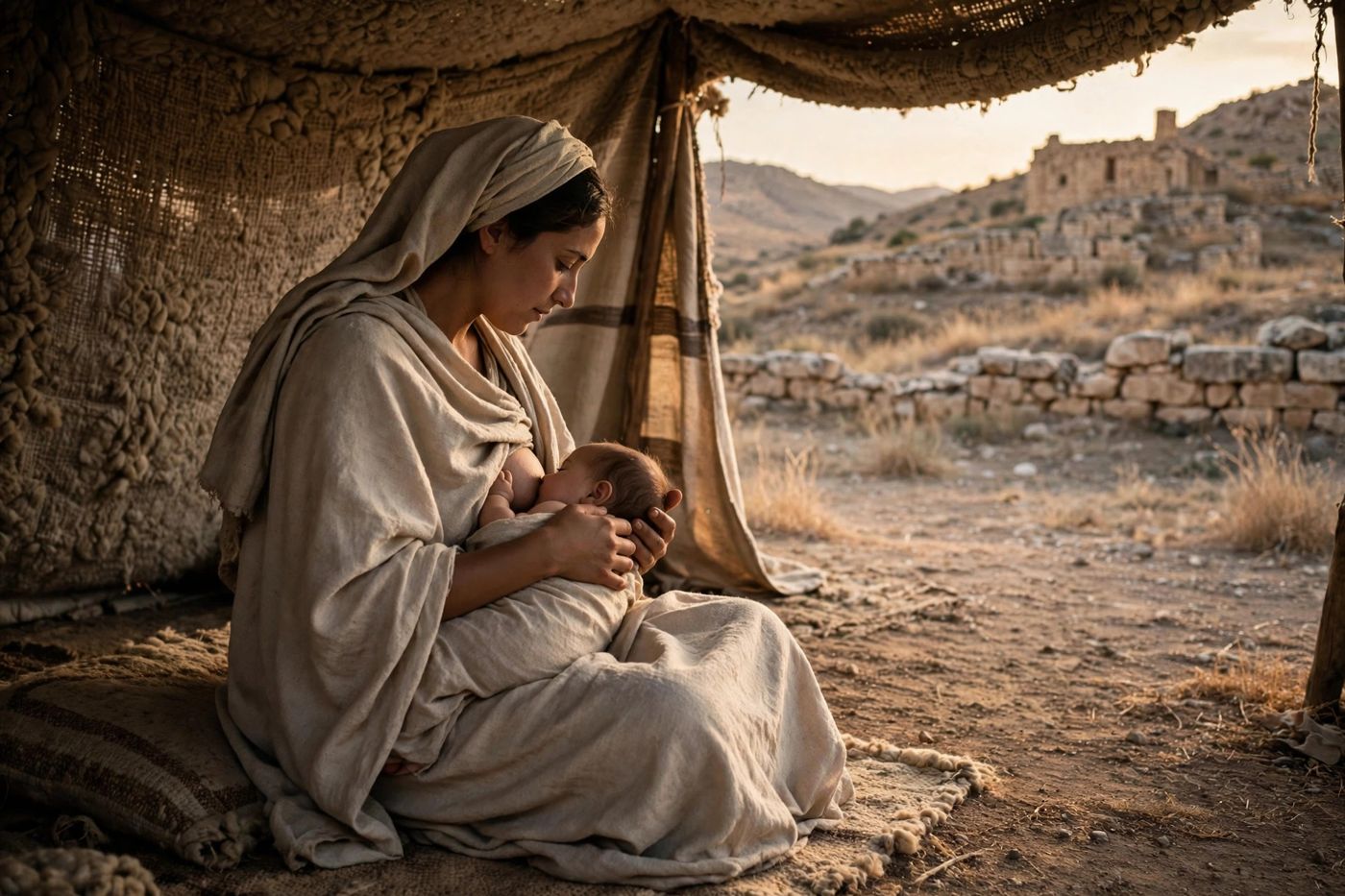
The answer's first move asks about the strongest bond the hearers knew: "Can a woman forget her sucking child, that she should not have compassion on the son of her womb?" (v. 15). A nursing infant is not remembered like an appointment; the child lives against the mother's body, fed from it. Forgetting such a child would be a kind of amputation.
Then God concedes the unthinkable, and the concession is the engine: "yea, they may forget." He does not claim mothers never fail — in famine and horror, the Bible knows mothers who forgot compassion (Lamentations 4:3). 1 If the argument were mothers never forget, and I am like a mother, the first failed mother would break it. So God outbids His own comparison: human compassion at its strongest may fail — "yet will I not forget thee." The "yet" carries the doctrine. God's remembering is a different order of faithfulness, for which the creaturely bond is only the nearest picture. Goldingay's reading makes the same grammatical point: the concession exists so the promise never rests on human reliability, even at its best. 6
Zion's case felt airtight: my circumstances prove I am forgotten. God does not dispute her circumstances — the children are gone, the walls are down. He disputes the inference. A ruined wall is evidence of judgment and exile; it is not evidence of forgetting, because forgetting is a claim about God's mind — and God's mind is what the next verse exhibits.
Graven on the palms — who carries the mark, and why
Look at v. 16 again — "graven thee upon the palms of my hands," and the walls "continually before me." We settled the direction in §5; now take the weight. Permanence: what is cut in is not held in memory subject to mood. Nearness of sight: the walls — ruined, breached, Zion's own exhibit for abandonment — are the object of His continual attention; not in scheduled audiences, but as the standing state of affairs. Whose mark it is: God's palms, both hands — the hands that lift a signal to the nations (v. 22) and whose power is defended in 50:2. Stated plainly: God's people are remembered not as information He retains but as names He bears. The answer is not an argument about memory. It is an exhibition: Behold — look.
The reversal: an empty house becomes a crowded one
Verses 17–23 paint the answer's future in a rush of scenes:
| Scene | Verse | What reverses |
|---|---|---|
| Children hasten; destroyers depart | 49:17 | The traffic through the gates changes direction |
| Children worn as a bride's ornaments | 49:18 | Mourning clothes become wedding clothes |
| The land too narrow for its people | 49:19–20 | Emptiness becomes overcrowding |
| Zion's astonished arithmetic | 49:21 | Bereavement cannot account for the births |
| Nations carry the children home | 49:22 | The conquerors' world becomes a carrier service |
| Kings and queens as nursing parents | 49:23 | Rulers bow, and serve as foster-parents |
The destroyers leave first (v. 17), vacating the place they ruined. Then Zion lifts her eyes under an oath — "As I live, saith the LORD" (v. 18), God staking His own life on the ingathering. What she sees is no trickle but a gathering — "all these gather themselves together, and come to thee" — and the image is bridal: she will clothe herself with them "as with an ornament," bind them on "as a bride doeth." Children as joy worn in public; the woman who sat desolate sits adorned.
Then comes the book's favourite impossibility: shortage of room. The waste places will be "too narrow by reason of the inhabitants" (v. 19), and children born after the loss will negotiate for space — "The place is too strait for me: give place to me that I may dwell" (v. 20). Hear how ordinary that complaint is: the squabble of a full house. Isaiah promises not mere survival but a family argument about elbow room.
Verse 21, the scene's emotional centre, is a question: "Who hath begotten me these, seeing I have lost my children, and am desolate, a captive, and removing to and fro? . . . Behold, I was left alone; these, where had they been?" Zion recites her biography — lost, desolate, captive, wandering, alone — and the children before her cannot be explained by it. Grace produces a population her history cannot account for; they are gift, not the fruit of her recovery plan. For the first hearers the scene was also realism: return from exile required imperial permission, roads, and carriers from nations with no natural reason to help. 11
And the carriers are the shock of verses 22–23. God lifts His hand — a signal-banner that summons — and the nations respond as staff: "they shall bring thy sons in their arms, and thy daughters shall be carried upon their shoulders." Then the rulers of verse 7 (previous lesson), promised they would rise and worship, are re-employed: "kings shall be thy nursing fathers, and their queens thy nursing mothers" (v. 23) — foster-parents now, carrying and sheltering at the cost of their dignity. The bowing and dust-licking is the ancient posture of submission, deliberately humbling imagery with a courtly background. [3, 11, 16] But the promise ends not in humiliation-talk but in knowledge and unashamed waiting: "thou shalt know that I am the LORD: for they shall not be ashamed that wait for me." The destination is not Zion's vanity. It is her knowledge of God.
The prey, the mighty, and the God who contends
A new objection surfaces at verse 24 — look at it again: shall the prey be taken from the mighty, or the lawful captive delivered? In the hearers' mouths it sounds like realism — Babylon is the mighty, the exiles prey already in the jaws, war-captives lawfully held (§5). Is rescue even a coherent hope?
God's answer concedes the strength and denies the conclusion: "Even the captives of the mighty shall be taken away, and the prey of the terrible shall be delivered: for I will contend with him that contendeth with thee, and I will save thy children" (v. 25). The ground is not Zion's strength or worthiness but a double promise about God: He will contend — plead and fight the case — and He will save her children. Rescue here is litigation backed by power; no captor's claim survives when the children's prior Owner enters the court.
Verse 26 speaks of the oppressors' end in the passage's harshest imagery: fed with their own flesh, drunken with their own blood "as with sweet wine." Label this honestly: judgment imagery in prophetic hyperbole — violence consuming itself, those who fed on others' lives feeding on their own. [3, 6] Its purpose is recognition: "all flesh shall know that I the LORD am thy Saviour and thy Redeemer, the mighty One of Jacob." Saviour — the Rescuer. Redeemer — the kinsman who buys back what was lost, with the right and duty to recover persons and property (the office Boaz fills in Ruth). "Mighty One of Jacob" reaches back to Jacob's blessing by "the mighty God of Jacob" (Genesis 49:24). 1 Zion's case is not heard by a stranger.
The missing paperwork, and the hand that is not shortened
Chapter 50's first verse is the tightest argument in the lesson. Two documents are demanded (§5, Visual 3), in three steps:
- No divorce was ever issued. "Where is the bill of your mother's divorcement, whom I have put away?" Israel is the LORD's wife in the prophets (Hosea preaches it; Jeremiah 3:8 shows God can speak of a bill of divorce, in judgment on the northern kingdom — making its absence here a chosen mercy). 1 For this mother — Zion — no certificate exists. The separation was never formalised as final.
- No sale by God ever took place. "Or which of my creditors is it to whom I have sold you?" Name the creditor; produce the buyer. God has no creditors — the absurdity is the argument: a sale needs a seller, a buyer, and a price, and none can be produced.
- The cause is therefore assigned. "Behold, for your iniquities have ye sold yourselves, and for your transgressions is your mother put away." You sold yourselves. Sin, not a stronger god, drove the separation. Motyer stresses that this is mercy-shaped: a separation caused by sin can be ended at the cause, by the God who deals with sin; one caused by God's rejection or debts would have no door back. 4
Verse 2 presses the second half: is God able to reverse it? "Is my hand shortened at all, that it cannot redeem?" — a sleeve cut too short, an arm that no longer reaches. The evidence is the exodus (§6): a sea dried at a rebuke, rivers made wilderness, heavens clothed with blackness (vv. 2–3). That God has not lost reach in Babylon. And do not lose verse 2's quieter accusation: "when I came, was there no man? when I called, was there none to answer?" A God came and called; a people were not home to answer. But only one side engraved the other on His palms.
The Third Servant Song: an ear before a tongue
The voice changes at 50:4; for six verses the Servant testifies. Read the Song as a formation story in its own order — the order is the doctrine.
First, the mornings. "The Lord GOD hath given me the tongue of the learned, that I should know how to speak a word in season to him that is weary: he wakeneth morning by morning, he wakeneth mine ear to hear as the learned" (50:4). Before the Servant opens his mouth, he describes being wakened — daily, by God, in the ear. Speech for the weary ("a word in season" — the right word at the right time) is downstream: God wakes, the disciple hears, then the taught tongue speaks what the taught ear received. [19, 21] Oswalt notes how this inverts the false-prophet pattern Isaiah condemns — men speaking from their own dreams: this speaker's authority is that he is, first and daily, a hearer. 3
Second, the unrebellious ear. "The Lord GOD hath opened mine ear, and I was not rebellious, neither turned away back" (50:5). An opened ear is an ear made to obey — the Exodus 21 servant who loves his master has his ear pierced against the doorpost as the sign of willing, permanent service. [1, 16] Isaiah's people are the book's picture of the shut ear: heavy ears (6:10), an ear "not opened" (48:8). The Servant is everything Israel was called to be at Israel's point of chronic failure. And a man who does not turn back presents, inevitably, his back to someone.

Third, the suffering accepted — not sought, not evaded. "I gave my back to the smiters, and my cheeks to them that plucked off the hair: I hid not my face from shame and spitting" (50:6). Back to blows, cheeks to beard-tearing — an assault on honour as much as skin — face unhidden to spitting. 16 Note the verb: "I gave my back." Not a man overtaken by events, but obedience that has priced the shame and walks toward it. The Song does not yet say why the suffering comes or what it accomplishes for others — that waits for Song Four. Here the emphasis is posture: non-retaliation, non-concealment, non-rebellion.
Fourth, the courtroom confidence. Verses 7–9 interpret the suffering legally, before it is finished. "For the Lord GOD will help me; therefore shall I not be confounded . . . therefore have I set my face like a flint, and I know that I shall not be ashamed" (v. 7). Then the challenge: "He is near that justifieth me; who will contend with me? . . . who is mine adversary? let him come near to me" (v. 8). The Servant does not claim the court is empty; he claims his Justifier is near, and invites the prosecution to discover it. Verse 9 pronounces the opposition's shelf life: "they all shall wax old as a garment; the moth shall eat them up." Accusers are cloth; time, which they count on, is what undoes them. His confidence is not that his enemies are weak today, but that his Helper is God and his enemies are perishable.
North's survey shows how these features have been read: the disciple-virtues fit a prophet's real life, while the suffering and the courtroom keep outrunning any merely biographical reading. 42 §10 and §16 take that up with labels. §7's centre is this: obedience, in Isaiah 50, is a man formed by listening, who accepts shame without returning it, and rests his whole case on a Justifier he cannot yet see acquitting him — and calls that rest knowledge: "I know that I shall not be ashamed."
The Christ Thread
This passage earns its Christ Thread from the inside out — no symbols forced, only the book's trajectory and the New Testament's readings. First, the trajectory. The figure of 50:4–9 — taught daily, obedient without rebellion, struck, shamed, spat upon, vindicated by God's justification — is the third panel of a sequence ending in 52:13–53:12, where the Servant is wounded for others' transgressions. The church's historic reading, and this course's POSITION, is that the sequence is fulfilled in Jesus: the Servant's vocation, which Israel bore corporately and failed, is gathered into one obedient Israelite. Inside the canon that is not speculation: Matthew applies Isaiah 53 to Jesus' healings, Luke has Him claim the written word "must yet be accomplished in me," the Ethiopian in Acts 8 is told Isaiah 53 is about Jesus, and 1 Peter 2's silent, non-retaliating Christ is woven from these Songs' cloth. [1, 42]
Second, the details the Gospels show without underlining. Jesus is the man of the wakened ear — withdrawing in the mornings to hear His Father before He speaks (Mark 1:35; Luke 5:16); the teacher whose word in season finds the weary ("Come unto me, all ye that labour and are heavy laden"); and in the passion, struck and spat upon (Matthew 26:67 records spit and blows to the face in so many words), His face set toward Jerusalem. 1 The Gospels do not footnote Isaiah 50; they narrate a life that walks in its footprint (§6 labelled the dependence questions).
Third, the courtroom transferred: if Romans 8 builds on this Song — INFERENCE (§6) — the Justifier who stood near one sufferer stands, in Christ, near everyone he represented.
Where in the Covenant Story?
Israel stands under the old covenant's sanctions: exile is the curse Moses warned of (Deuteronomy 28), and 50:1 insists on it ("for your iniquities have ye sold yourselves"). 1 But the passage announces what the old covenant could not produce: a return engineered by God alone, a population granted as gift (49:21), and a Servant embodying the obedience Israel never rendered — ear opened, not rebellious. The new covenant is not yet named as in Jeremiah 31, but its pillars are here: God restoring what sin forfeited, and a mediator whose obedience succeeds where the nation's failed.
The two ways in the dark
The passage ends not with the Servant but with you, sorted. Verses 10–11 are twins — two companies, two kinds of walking, two ends. Company one: "Who is among you that feareth the LORD, that obeyeth the voice of his servant, that walketh in darkness, and hath no light? let him trust in the name of the LORD, and stay upon his God" (50:10). A whole pastoral theology is packed in: this person fears the LORD, obeys, and has no light — no felt guidance, no improving circumstances — in one sentence, without apology. His instruction is exactly two verbs: trust in the name (bank on who God has revealed Himself to be) and stay upon his God (lean his whole weight, as on a staff). No third instruction: no command to manufacture light, feel better, or find the exit. Darkness here is a place where obedience is practised, not a diagnosis of obedience failed.
Company two: "Behold, all ye that kindle a fire, that compass yourselves about with sparks: walk in the light of your fire, and in the sparks that ye have kindled" (50:11). The self-illuminators, unwilling to walk dark, manufacture light — schemes, explanations, alliances (Judah's fires all book long: Egyptian alliances, idol-manufacture). God's word is terrible courtesy: walk in it, then. "This shall ye have of mine hand; ye shall lie down in sorrow." The twins are plain: same darkness, two responses. One leans; one kindles. One trusts a name; one trusts a spark.
The Long View — what the church has believed
You are not this passage's first reader. The palms of 49:16 became one of the church's most beloved assurances — across hymns, prayers, and deathbed comforts, the standing rebuttal to "God has forgotten me." On chapter 50's Servant, the church's historic reading was christological: Calvin reads the obedient, suffering speaker in line with the church's confession of Christ, while expounding the disciple-features as the prophet's own pattern. 36 Rashi's school read the Servant corporately; the ancient synagogue paraphrase names chapter 53's Servant the Messiah while reassigning his sufferings (§16). Where the centuries divided is the Servant's identity. Where they have not is 50:10 — a charter text, across traditions, for trusting God without light.
That is the payload. The next section compresses it into the one sentence you are meant to carry out of this study.
8. THE AIM SENTENCE — X: eXplain the intent
Everything observed compresses into one sentence — the author's intended meaning, before any application is allowed near it:
To a Zion sure she is forsaken and forgotten, God answers that she is graven on His palms and her children will be gathered by the nations themselves, that no divorce was ever issued and no sale ever made — her sins sold her, and His hand is not shortened to redeem — and He sets before her His Servant, the disciple whose wakened ear, given back, and flint-set face rest on a near Justifier, as the pattern for the dark: trust in the LORD's name and lean on God, rather than kindling your own fire.
If a sermon or devotional uses this passage to say something that cannot be traced back to that sentence, it is not this passage talking.
9. SAY IT BACK
Close the book and say the AIM from section 8 in your own words, without looking. Then say, in one more sentence, what it asks of you this week.
If your version quietly changes the meaning — palms become a vague "God loves you," the Servant a nice example, the darkness verse a promise that obedience buys light — walk it again. This exercise is the entire course in miniature: meaning first, then — and only then — your life.
10. THE MISREAD — the guardrail, with verdicts
Three live misuses. Each gets a fair hearing, the evidence, and a verdict.
Misread 1: "Isaiah 49:14 is the passage's verdict on exile: 'The LORD hath forsaken me, and my Lord hath forgotten me' — God had abandoned His people, full stop." Why it sounds right: the words are in the text, and they describe how exile genuinely felt; verse 14 is often quoted as a caption for suffering seasons. The evidence: verse 14 is Zion speaking, not the passage concluding — and the passage exists to answer her. The complaint is the question; verses 15–26 are the answer, and chapter 50 continues it. The text never scolds the feeling and never grants it the last word: it hears the complaint in full, then answers with evidence — a stronger bond (v. 15), engraved palms (v. 16), an oath ("As I live," v. 18), and a legal demonstration that no divorce and no sale occurred (50:1). Quoting verse 14 as the conclusion is stopping mid-sentence and calling the interruption a doctrine. Verdict: the complaint is real speech, really heard — and really answered. A reading that ends at verse 14 has Zion's grief without God's reply, which is the one thing this passage refuses to leave anyone with.
Misread 2: "Isaiah 50:4–9 is simply Isaiah's diary — the prophet describing his own hard ministry, and nothing more." Why it sounds right: the disciple-features are genuinely prophetic. A wakened ear, morning listening, a taught tongue for the weary — these fit a prophet's real formation, and Isaiah's ministry was opposed and painful. Honest reading keeps all of that. The evidence: the contents outrun biography as written — a back given to smiters, a face unhidden from spitting, a courtroom where the speaker invites any adversary to step forward because his Justifier is God — pitched beyond a ministry report, and sitting third in a sequence narrowing since 42:1 toward a fourth Song whose sufferer dies for others' sins. North's survey documents the range of identifications defended — Israel, a prophet, a king, the Messiah — precisely because the text sustains more than the diary reading. 42 Yet severing the Song from the prophet's real pattern is the opposite error: the ear and tongue are not costumes; a real disciple's obedience is the shape the greater Servant's will take. Verdict: neither flattened to autobiography nor severed from the prophet's life. The Song is prophecy in the first person, cumulative with its three companions, and its full measure is reached only where the sequence reaches — a verdict argued with labels in §16.
Misread 3: "If you are walking in darkness, something is wrong with your obedience — faithful people walk in light; darkness is the failure." Why it sounds right: Scripture does call believers to walk in the light, and darkness is often its picture for sin. That can make 50:10 sound like a problem to fix rather than a person to instruct. The evidence: read the verse's own description of the dark-walker: he "feareth the LORD," he "obeyeth the voice of his servant" — and he "walketh in darkness, and hath no light." The text blesses exactly the combination the misread condemns. The only party warned in the twin verses is not the dark-walker but the spark-kindler of verse 11: the one who, refusing the dark, manufactures his own light and lies down in sorrow. Darkness, in these verses, is weather. Self-made light is the danger. Verdict: obedience and darkness can share a sentence, because Isaiah puts them there. Application that promises believers they will never walk dark — or diagnoses every dark season as disobedience — misreads both verses: it rebukes the person verse 10 instructs, and it leaves the spark-kindler of verse 11, the passage's actual warning, completely unaddressed.
11. FROM WORD TO WALK
The lesson is not finished until the passage has had its say with you.
Start with the sentence you may have come carrying. Zion said it first, in Scripture, out loud: "The LORD hath forsaken me, and my Lord hath forgotten me." If some version of it has run underneath your week — the bills, the diagnosis, the prayer prayed so long it has gone quiet — this passage does not begin by arguing with you. It lets the sentence be said. God gave it a verse. He can bear to hear yours.
Then watch what He does with it. He does not say feel differently. He says look differently. A mother at the breast — could she forget? Look at My palms: your name is not on a list I might misplace; it is cut into Me. Your walls — the ruined places you rehearse as proof — are continually before Me; there has not been one day of the ruin when I was looking elsewhere. Comfort here is not a mood God waits for you to work up. It is evidence He sets before people who cannot feel it yet.
And the Servant reorders your mornings: ear before tongue. How much of your speaking is downstream of listening that never happened? Words for the weary come from a man who let God wake his ear before he asked God to use his mouth.
Now go slowly into verse 10, as promised. "Who is among you that feareth the LORD, that obeyeth the voice of his servant, that walketh in darkness, and hath no light?" If that is your address — obedient as far as you know how, and dark, without one lamp of circumstance or feeling — hear what the prophet does not say. He does not say the darkness proves a hidden sin or a failed faith. He gives two leaning-words: trust in the name of the LORD — the Saviour and Redeemer of verse 26, the God of the palms — and stay upon your God, weight down on Him as on a staff when the path disappears. That is the whole instruction, and it is not small: leaning is what the body does when it stops pretending it can stand unaided.
And hear verse 11 as protection, not threat. The temptation of the dark is rarely rebellion; it is illumination on your own terms — the scheme that forces an answer, the compromise that at least makes the waiting stop. Isaiah calls it kindling. A self-lit fire feels like faith for an evening; the road by spark-light ends: "ye shall lie down in sorrow." God has, for reasons the passage does not fully give, chosen trust over visibility in this stretch. The Servant walked exactly it — face set, Justifier unseen-but-near — and the Father did not leave him in it. Neither will He leave the people the Servant represents.

LORD, my Saviour and my Redeemer — when I am sure You have forgotten, show me Your palms. Wake my ear morning by morning before You trust my tongue with anyone weary. When I walk in darkness and have no light, keep me from kindling fires of my own; I will trust in Your name and stay upon You, because the God who contends for His children has never issued the bill that would end us. In Jesus' name, amen.
12. FOR DISCUSSION — OR FOR YOUR JOURNAL
With a group, work these aloud. Alone, they're yours — answer them in your journal or in prayer; they lose nothing in the quiet.
- God answers "You have forgotten me" with a mother, His palms, and a road full of children — evidence, not a scolding. When you have felt forgotten, what kind of answer have you actually wanted, and how does this passage's compare?
- The Servant's order is ear before tongue. What would change in your speech — at home, at church, online — if it had to pass through that order first?
- In 50:1 God assigns the separation's cause: "for your iniquities have ye sold yourselves." Why is that hard sentence also a hopeful one? What door does it leave open that "God divorced us" or "God sold us" would have closed?
- Verse 10's dark-walker and verse 11's spark-kindler stand side by side. Where are you most tempted to kindle your own fire — to force an answer, an outcome, or a feeling — instead of trusting and leaning? Name the spark honestly.
13. THE WALK-OUT — T: Transfer to today
Meaning is settled. Now application, and it must cross the bridge honestly. Run the five Transfer Tests:
- Same covenant? The ingathering promises were spoken to exiled Israel, and their national, land-shaped fulfilment belongs to her story. But the God who makes them is the same God, and believers are grafted into His people through the Servant (§7). What crosses first is His character as pledged to His people in Christ; Zion's specific promises cross only along lines the New Testament itself draws (Romans 8's courtroom is the passage's own example).
- Same audience? The national promises are not a private horoscope. But 50:10 turns toward any hearer — "Who is among you that feareth the LORD . . . ?" The dark-walking instruction addresses God's servants in any century; the national promises are received as the church's family history and the church's God, not as personal guarantees of circumstance.
- Same genre rules? Prophetic poetry: images are claims, hyperbole is marked, promises are pledges not timetables. Applications lean on the passage's arguments and commands, not on squeezing its pictures — nobody is assigned a nursing king, a moth, or a ridge walk.
- Repeated or rooted? Trusting God in darkness, hearing before speaking, non-retaliation under shame, and confidence in God's justification all reappear across the canon and are rooted in God's character (Psalm 73 and Habakkuk wrestle the same dark; Romans 8 hands the same courtroom to the church). These cross at full strength.
- Ten verses either side? Every application is drawn from the passage read whole — complaint and answer, Song and its sorting conclusion. Nothing hangs on verse 14, 16, or 10 alone.
What crosses — and lands:
- God has remembered, before you feel remembered. The indicative leads: Zion graven on His palms, no divorce issued, no sale made, a hand unshortened, a Servant justified by a near God. Application that starts with your grip on God has reversed the passage; it starts with His engraving of you.
- Complaint is speech to bring to God, not a verdict to live under. Say the worst thought to God, in its own words — then sit still while He answers it from outside the feeling: His bond, His palms, His acts.
- Darkness can be the setting of obedience, not its failure. What crosses is the twin instruction of 50:10: trust the name, lean the weight. What is refused is the spark — self-manufactured light, however religious its packaging.
- The disciple's order: ear, then tongue; back given, face set. Morning listening before weary-people words; non-retaliation under shame; resolve that is the result of God's help, not a substitute for it.
Practices — what the gate lets through, made concrete this week:
- Answer your own verse 14 with the passage's evidence. Write the complaint as you actually feel it — one or two honest sentences. Underneath, write God's three answers: the mother who may forget and the God who will not (v. 15); the palms and the walls before Him (v. 16); the missing bill and the unshortened hand (50:1–2). Pray through the page once, slowly, this week.
- Morning ear before any tongue. On five mornings this week, before messages or news, give ten unhurried minutes to hearing: read a short passage aloud, sit in silence for two minutes, and write in one line what you heard. The Servant's formation in miniature.
- One word in season, deliberately. Name one weary person — you know who came to mind at 50:4. After a morning of listening (Practice 2), speak or write them a word that fits their weariness: specific, brief, true. Not unasked advice. A word in season.
- Refuse one spark. Identify the fire you most want to kindle in your darkness — the forcing scheme or pressured decision whose real purpose is to end the waiting. Name it in your journal, decline it in one concrete act (the message not sent, the commitment not made to escape the dark), and replace it with the verse's own act: say 50:10 aloud and lean — ten minutes of trust prayed, not problems solved.
- Memorize Isaiah 49:16 — the palms verse, printed in full on the Recap Card (§14). The verse the passage itself exhibits against forgetting — yours to say back on the day the feelings file their report.
What does not cross: the national ingathering as a personal guarantee that your lost things return on your timetable; 49:14 as God's assessment of your life (it is Zion's feeling, answered); every dark season as automatically righteous (the dark-walker's marks are given — fearing the LORD, obeying His servant's voice); and the Servant's sufferings as a summons to seek mistreatment. The gate makes sure the claims that land are the ones God actually made.
Praise Him
We praise You, LORD, mighty One of Jacob — our Saviour and our Redeemer: stronger than a mother's heart, never forgetful where even hers could fail. Our names are graven on Your palms, our ruined walls continually before You; there is no bill against us in Your hand and no creditor who can produce a price. Your hand is not shortened; it dries the sea, saves Your children, and contends with everyone who contends with us. Blessed be the God whose Servant listened, gave His back, set His face like flint, and was not ashamed — and blessed be Your name, to be trusted in the dark until the children come home.
14. THE RECAP CARD — this study on one page
Print it. Keep it where you'll see it this week.
- The passage: Isaiah 49:14–50:11 — Zion's complaint answered by the palms; the missing divorce bill; the Third Servant Song; and two ways to walk in the dark.
- Say It Plain: God has not forgotten Zion — she is engraved on His palms, her children are coming home carried by the nations, no divorce was issued, no sale was made, and His hand still redeems. His Servant trusts a near Justifier — and everyone hearing must choose: lean on God in the dark, or kindle your own fire.
- The AIM: To a Zion sure she is forsaken, God answers: graven on His palms, children gathered by the nations, no divorce issued and no sale made — her sins sold her, and His hand is not shortened — and He sets His Servant before her, wakened ear, given back, and flint-set face resting on a near Justifier, as the pattern for the dark: trust and lean, do not kindle.
- Key terms: graven on the palms — cut in, permanently, on God's hands, always before Him · the tongue of the learned — a taught one's speech, earned by a wakened ear · set my face like a flint — resolve that does not dent, because God will help · the lawful captive — prey held by claimed right, rescued when God contends.
- The Misread, in one line: verse 14 is the complaint, not the conclusion · the Third Song is more than a diary — it is the sequence's third panel · darkness is the weather, not the failure; self-kindled light is the danger.
- Memory verse: "Behold, I have graven thee upon the palms of my hands; thy walls are continually before me." — Isaiah 49:16
- This week's practice: answer your own verse 14 with God's evidence in writing — and refuse one spark: name the self-made light, decline it, and lean on 50:10 instead.
15. CHECK YOURSELF — five questions
Answer from the study, not from instinct. (Answers live in the Teacher Edition.)
- In your own words: what is the AIM of Isaiah 49:14–50:11?
- God's answer to "You have forgotten me" reaches its strongest point not in the mother comparison but in its concession. Explain: what does "yea, they may forget, yet will I not forget thee" do that "mothers never forget" could not?
- In Isaiah 50:1, what are the two documents God demands, what would each one have proved, and why does their absence matter? What cause does God assign instead?
- Trace the Servant's formation in 50:4–7 in its own order: ear, tongue, back, face. What comes first, and why does the order matter?
- Two people walk in darkness in 50:10–11. Describe each one, the instruction or permission each receives, and where each road ends.
16. GO DEEPER
Optional. The lesson is complete without it.
From the Sources — the Servant, weighed in one place
North's The Suffering Servant in Deutero-Isaiah is the classic survey: every identification — Israel, an individual, a king, the Messiah — weighed in one volume. 42 FACT: after a century there is no scholarly consensus, which is why this course labels its reading. Oswalt and Motyer work toward a Servant who is Israel's vocation concentrated until one can carry it; Goldingay states the exilic-community reading at full strength. [3, 4, 6]
The Honest Argument — who is the Servant of the Songs?
For the corporate reading (the Servant is Israel): the text says so — "Thou art my servant, O Israel" (41:8), "my servant Jacob" (44:1), and inside a Song itself, "Thou art my servant, O Israel, in whom I will be glorified" (49:3). 1 Rashi's school held this line: the sufferer is Israel personified among the nations. 39 For an individual reading: the same Song distinguishes the Servant from Israel — his mission is "to raise up the tribes of Jacob, and to restore the preserved of Israel" (49:5–6), work done for Israel; the first-person features accumulate an individual's profile (womb, mouth, ear, back, face); and no nation confesses "I was not rebellious" — a claim corporate Israel, in this book, could never make. For the church's historic reading: the New Testament applies the Songs to Jesus in quotation and allusion across Matthew, Luke, Acts, and 1 Peter. 1 And Targum Jonathan names chapter 53's Servant "the Messiah" — while reassigning his sufferings to Israel's enemies, evidence a messianic identification was thinkable in ancient Judaism even where the suffering was not. 38 POSITION — the Servant is Israel's vocation gathered into one obedient figure and fulfilled in Christ: he is Israel (49:3) and more than the nation (49:5–6), and the New Testament's reading is the canon's verdict on the sequence. DISPUTED — the academy does not share that verdict; a reader who weights the evidence differently has left the course's position, not the text.
The authorship question belongs in the same file. The critical case rests on chapters 40–55's exilic setting and on Cyrus named ahead of his era (44:28; 45:1): on the premise that such prediction does not happen, a later date follows — name the premise and the argument is fair; hide it and it is circular. The unity case rests on the book's self-presentation, its one-scroll transmission from our earliest substantial witness, its shared themes across all three parts, and the New Testament's citation of all parts under Isaiah's name. [3, 11, 22] DISPUTED, both ways. POSITION — the program reads one Isaiah.
The Word Underneath — "forget," answered in its own verb
In 49:14 Zion's "forgotten" and in 49:15 God's "will I not forget thee" use the same Hebrew verb, shakach — to forget, to cease to bear in mind. 19 FACT — God answers Zion in her own verb and negates it. But He does not claim the human kind of remembering, only performed perfectly. Verse 16 inserts a different mechanism: inscription, not recollection. What is cut into the palms is not remembered and forgotten by turns at all. INFERENCE — from the juxtaposition of verses 15 and 16: the mother-verse concedes the limits of the strongest natural bond so the palms-verse can introduce a bond that does not run on natural faculties.
Go Read
- C. R. North, The Suffering Servant in Deutero-Isaiah 42 — every identification of the Servant, weighed in one place.
- John N. Oswalt, The Book of Isaiah, Chapters 40–66 (NICOT) 3 — the comfort chapters as the deliberate answer to chapters 1–39.
- Claus Westermann, Isaiah 40–66 (Old Testament Library) 15 — the form-critical account behind §4's Genre section.
- J. Alec Motyer, The Prophecy of Isaiah 4 — the book's structure and refrains, by a reader who hears one mind across 66 chapters.
17. SOURCES & REFERENCES
Numbered citations in this lesson key to this list — the course standard: every sourced claim carries its number, and every number can be checked.
- The KJV text itself — Holy Bible, King James Version (eBible.org KJV, 1769 text). Scripture quotations are from the King James Version (KJV), which is in the public domain in the United States; the full passage is always assigned as reading. Cross-references within Scripture cite this number.
- Oswalt, The Book of Isaiah, Chapters 40–66 (NICOT) — John N. Oswalt (Eerdmans). The second volume: the comfort section, the Servant Songs, Cyrus, and the new-creation chapters, read as the deliberate answer to chapters 1–39.
- Motyer, The Prophecy of Isaiah — J. Alec Motyer (IVP). A one-volume commentary by an evangelical scholar who argues the whole book breathes the mind of the eighth-century prophet; especially strong on the book's structure, its repeated refrains, and the Servant.
- Goldingay, Isaiah (Understanding the Bible / NIBC) — John Goldingay (Hendrickson). A mainstream-critical one-volume commentary; the exilic-community reading of chapters 40–55 stated fairly, with close attention to the poetry.
- Smith, Isaiah 1–39 and Isaiah 40–66 (New American Commentary) — Gary V. Smith (B&H). Evangelical commentary with strong historical notes (the Assyrian and Babylonian records) and an even-handed survey of the authorship debate.
- Westermann, Isaiah 40–66 (Old Testament Library) — Claus Westermann (Westminster). The classic critical commentary on the comfort chapters; foundational for the genre analysis of the trial speeches and salvation oracles.
- Walton, Matthews & Chavalas, The IVP Bible Background Commentary: Old Testament — John H. Walton, Victor H. Matthews, Mark W. Chavalas (IVP). Verse-by-verse ancient Near Eastern background: Assyrian siege practice, Babylonian religion, treaty and coronation customs, geography.
- Brown, Driver & Briggs, Hebrew and English Lexicon of the Old Testament (BDB) — The standard older Hebrew lexicon; word senses and usage ranges for the Terms sections.
- Harris, Archer & Waltke (eds.), Theological Wordbook of the Old Testament (TWOT) — Word studies from a conservative-evangelical hand; pastoral-theological range of key terms.
- The Great Isaiah Scroll (1QIsaᵃ) and the Dead Sea Scrolls Bible — The complete Isaiah scroll from Qumran Cave 1 (c. 125 BC), in Abegg, Flint & Ulrich, The Dead Sea Scrolls Bible (HarperSanFrancisco). The oldest substantial witness to Isaiah's text — already a single scroll of all 66 chapters centuries before Christ.
- Calvin, Commentary on Isaiah — John Calvin (public domain). Reformation exegesis; a control on interpretation and a voice in the Long View.
- Targum Jonathan to Isaiah — The ancient Aramaic paraphrase read in synagogues. Its handling of chapter 53 — the Servant named as the Messiah, the sufferings reassigned — is primary evidence in the Honest Argument.
- Rashi and Ibn Ezra on Isaiah — The medieval Jewish commentators (11th–12th centuries). Rashi's school reads the Servant corporately as Israel; Ibn Ezra leaves doors open Rashi closes. Cited for the Jewish reading at full strength.
- Duhm, Das Buch Jesaia (1892) — Bernhard Duhm. The commentary that named the "Servant Songs" as a distinct set and crystallized the "Deutero-Isaiah" division — the historical origin of the modern authorship debate, cited as fact about scholarship.
- North, The Suffering Servant in Deutero-Isaiah — C. R. North (Oxford). The classic survey of every identification of the Servant (Israel, a prophet, a king, the Messiah) weighed in one place.