
One study, one walk — the universal FIRM format. The passage first and whole; then its world; then the Walk (Context · Observe · Genre · Terms · Entire Canon); the meaning taught straight; the AIM sentence; the misread exposed and answered; and the walk-out, where application has to pass the Transfer Tests before it reaches your week. The same skeleton serves a book, a chapter, a single verse, or a whole subject. In the early studies the moves are labeled as they happen. The labels fade as the walk becomes yours.
THE WEEK WITH THIS STUDY — six bites
Day 1 — Read the passage · Say It Plain · The World (§§1–2) · Day 2 — Observe · Genre (§§3–4) · Day 3 — Terms · Entire Canon (§§5–6) · Day 4 — The Meaning · the AIM Sentence · Say It Back (§§7–9) · Day 5 — The Misread · From Word to Walk (§§10–11 — add For Discussion, §12, if you're with others) · Day 6 — The Walk-Out · the Recap Card (§§13–14). Go Deeper (§16) any evening you want the basement.
BEFORE YOU READ — Open My Eyes
LORD, Maker of the heavens and the earth — before I ask You to wake, teach me to listen for where You are waking me. Show me the rock I was hewn from, take the cup-talk and the fear-talk of this passage straight, and set my feet on the road home with singing. In Jesus' name, amen.
§ means “section” — the numbered parts of your lesson. Each bite above names the sections for that day.
1. READ THE PASSAGE — Isaiah 51:1–52:12 (KJV)
Read it all, slowly, before any teaching. In this course the passage always prints once, in full, at the head of the lesson. Everything after this is commentary — this is the text.
1 Hearken to me, ye that follow after righteousness, ye that seek the LORD: look unto the rock whence ye are hewn, and to the hole of the pit whence ye are digged.
2 Look unto Abraham your father, and unto Sarah that bare you: for I called him alone, and blessed him, and increased him.
3 For the LORD shall comfort Zion: he will comfort all her waste places; and he will make her wilderness like Eden, and her desert like the garden of the LORD; joy and gladness shall be found therein, thanksgiving, and the voice of melody.
4 Hearken unto me, my people; and give ear unto me, O my nation: for a law shall proceed from me, and I will make my judgment to rest for a light of the people.
5 My righteousness is near; my salvation is gone forth, and mine arms shall judge the people; the isles shall wait upon me, and on mine arm shall they trust.
6 Lift up your eyes to the heavens, and look upon the earth beneath: for the heavens shall vanish away like smoke, and the earth shall wax old like a garment, and they that dwell therein shall die in like manner: but my salvation shall be for ever, and my righteousness shall not be abolished.
7 Hearken unto me, ye that know righteousness, the people in whose heart is my law; fear ye not the reproach of men, neither be ye afraid of their revilings.
8 For the moth shall eat them up like a garment, and the worm shall eat them like wool: but my righteousness shall be for ever, and my salvation from generation to generation.
9 Awake, awake, put on strength, O arm of the LORD; awake, as in the ancient days, in the generations of old. Art thou not it that hath cut Rahab, and wounded the dragon?
10 Art thou not it which hath dried the sea, the waters of the great deep; that hath made the depths of the sea a way for the ransomed to pass over?
11 Therefore the redeemed of the LORD shall return, and come with singing unto Zion; and everlasting joy shall be upon their head: they shall obtain gladness and joy; and sorrow and mourning shall flee away.
12 I, even I, am he that comforteth you: who art thou, that thou shouldest be afraid of a man that shall die, and of the son of man which shall be made as grass;
13 And forgettest the LORD thy maker, that hath stretched forth the heavens, and laid the foundations of the earth; and hast feared continually every day because of the fury of the oppressor, as if he were ready to destroy? and where is the fury of the oppressor?
14 The captive exile hasteneth that he may be loosed, and that he should not die in the pit, nor that his bread should fail.
15 But I am the LORD thy God, that divided the sea, whose waves roared: The LORD of hosts is his name.
16 And I have put my words in thy mouth, and I have covered thee in the shadow of mine hand, that I may plant the heavens, and lay the foundations of the earth, and say unto Zion, Thou art my people.
17 Awake, awake, stand up, O Jerusalem, which hast drunk at the hand of the LORD the cup of his fury; thou hast drunken the dregs of the cup of trembling, and wrung them out.
18 There is none to guide her among all the sons whom she hath brought forth; neither is there any that taketh her by the hand of all the sons that she hath brought up.
19 These two things are come unto thee; who shall be sorry for thee? desolation, and destruction, and the famine, and the sword: by whom shall I comfort thee?
20 Thy sons have fainted, they lie at the head of all the streets, as a wild bull in a net: they are full of the fury of the LORD, the rebuke of thy God.
21 Therefore hear now this, thou afflicted, and drunken, but not with wine:
22 Thus saith thy Lord the LORD, and thy God that pleadeth the cause of his people, Behold, I have taken out of thine hand the cup of trembling, even the dregs of the cup of my fury; thou shalt no more drink it again:
23 But I will put it into the hand of them that afflict thee; which have said to thy soul, Bow down, that we may go over: and thou hast laid thy body as the ground, and as the street, to them that went over.
Chapter 52 continues the same movement — the verse numbers start again at 1:
1 Awake, awake; put on thy strength, O Zion; put on thy beautiful garments, O Jerusalem, the holy city: for henceforth there shall no more come into thee the uncircumcised and the unclean.
2 Shake thyself from the dust; arise, and sit down, O Jerusalem: loose thyself from the bands of thy neck, O captive daughter of Zion.
3 For thus saith the LORD, Ye have sold yourselves for nought; and ye shall be redeemed without money.
4 For thus saith the Lord GOD, My people went down aforetime into Egypt to sojourn there; and the Assyrian oppressed them without cause.
5 Now therefore, what have I here, saith the LORD, that my people is taken away for nought? they that rule over them make them to howl, saith the LORD; and my name continually every day is blasphemed.
6 Therefore my people shall know my name: therefore they shall know in that day that I am he that doth speak: behold, it is I.
7 How beautiful upon the mountains are the feet of him that bringeth good tidings, that publisheth peace; that bringeth good tidings of good, that publisheth salvation; that saith unto Zion, Thy God reigneth!
8 Thy watchmen shall lift up the voice; with the voice together shall they sing: for they shall see eye to eye, when the LORD shall bring again Zion.
9 Break forth into joy, sing together, ye waste places of Jerusalem: for the LORD hath comforted his people, he hath redeemed Jerusalem.
10 The LORD hath made bare his holy arm in the eyes of all the nations; and all the ends of the earth shall see the salvation of our God.
11 Depart ye, depart ye, go ye out from thence, touch no unclean thing; go ye out of the midst of her; be ye clean, that bear the vessels of the LORD.
12 For ye shall not go out with haste, nor go by flight: for the LORD will go before you; and the God of Israel will be your rereward.
SAY IT PLAIN — the passage in everyday words: God tells His frightened people to look back at where they came from — one old, childless couple, Abraham and Sarah, whom He called alone and multiplied. What He did with that small beginning, He will do with ruined Zion: waste places replanted like Eden, while heaven and earth themselves wear out like old clothes and His salvation does not. Then the people pray the boldest prayer in the book — "Awake, awake, O arm of the LORD" — reminding God of the day He cut down Egypt and dried the sea for the ransomed. God answers, but not by accepting the charge that He slept: I am your Comforter; who are you to fear men who die like grass, and forget the Maker of the heavens? He takes the cup of trembling out of Jerusalem's hand forever and gives it to her tormentors. And the prayer comes back reversed: "Awake, awake; put on thy strength, O Zion" — beautiful garments on, dust off, neck-bands loosed. A runner crosses the mountains with the news, "Thy God reigneth!", the LORD bares the arm the people prayed awake, and the redeemed walk out of Babylon in a clean, guarded procession — no haste, no flight, the LORD in front and behind. That's the whole passage. Everything after this teaches from it — nothing will change what you just read.
2. THE WORLD — C: Context & Audience
A text can never mean what it never meant — so stand first where its first hearers stood.
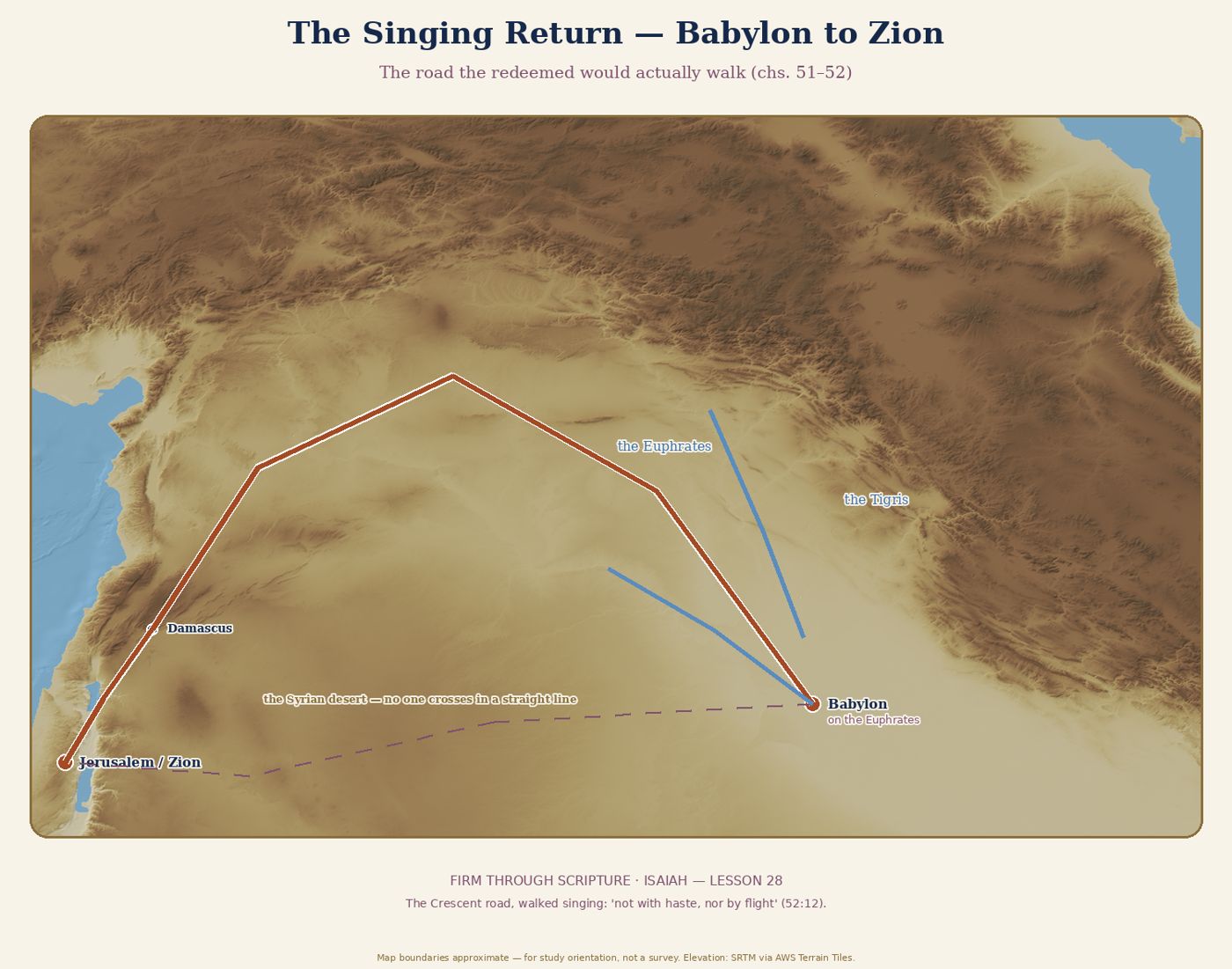
Where we are in the book. Isaiah 40 opened a new movement of this long book: "Comfort ye, comfort ye my people" — words spoken over Jerusalem after her judgment, to a people carried away to Babylon. Babylon was the superpower that destroyed Jerusalem and its temple (586 BC) and deported Judah's people hundreds of miles east, to live as exiles beside the rivers of a foreign empire. [11, 16] Chapters 40–55 — the section Lesson 20 called the Book of Comfort — are addressed to that exiled generation and to their children: people who had never seen Zion (Jerusalem, called by the name of the hill it stands on — you will meet "Zion" and "Jerusalem" as the same city, and also as the people who belong to her), who worshipped without a temple, and who were quietly concluding that their God had either lost or lost interest. The remnant — the surviving portion of God's people who still seek Him — is the audience named in this passage's first line: "ye that follow after righteousness, ye that seek the LORD" (51:1).
An honesty note about who is speaking, because this course does not hide it. The book presents these chapters as the word of Isaiah, son of Amoz, the eighth-century prophet — comfort spoken ahead, across the exile, before Babylon had even risen. Since the nineteenth century, much mainstream scholarship has instead assigned chapters 40–55 to an unnamed prophet of the exile itself — "Second Isaiah" — reasoning from the changed setting and style. [4, 11] That is DISPUTED terrain, argued in the open in Lesson 00. This program's POSITION, labeled as such: the book is Isaiah's, one prophet's witness read whole — the reading the New Testament assumes when it quotes these chapters under Isaiah's one name 1, and the reading the Great Isaiah Scroll already embodies as a single scroll of all 66 chapters. 22 Either way, what does not move is the audience inside the text: the exile generation, wondering if God was awake.
The empires in the rear-view mirror. Verse 4 of chapter 52 compresses Israel's captivity-history into two names, and a first reader needs both. Egypt: Israel's first house of slavery, from which God brought them out in the exodus under Moses, through the divided sea — the founding rescue this passage keeps citing. Assyria: the empire that swallowed the northern kingdom of Israel (722 BC) and besieged Jerusalem itself a generation later, in Isaiah's own lifetime. [11, 16] "Now," says 52:5, it is Babylon — a third captor in the same pattern, and the hearers knew the list by heart.
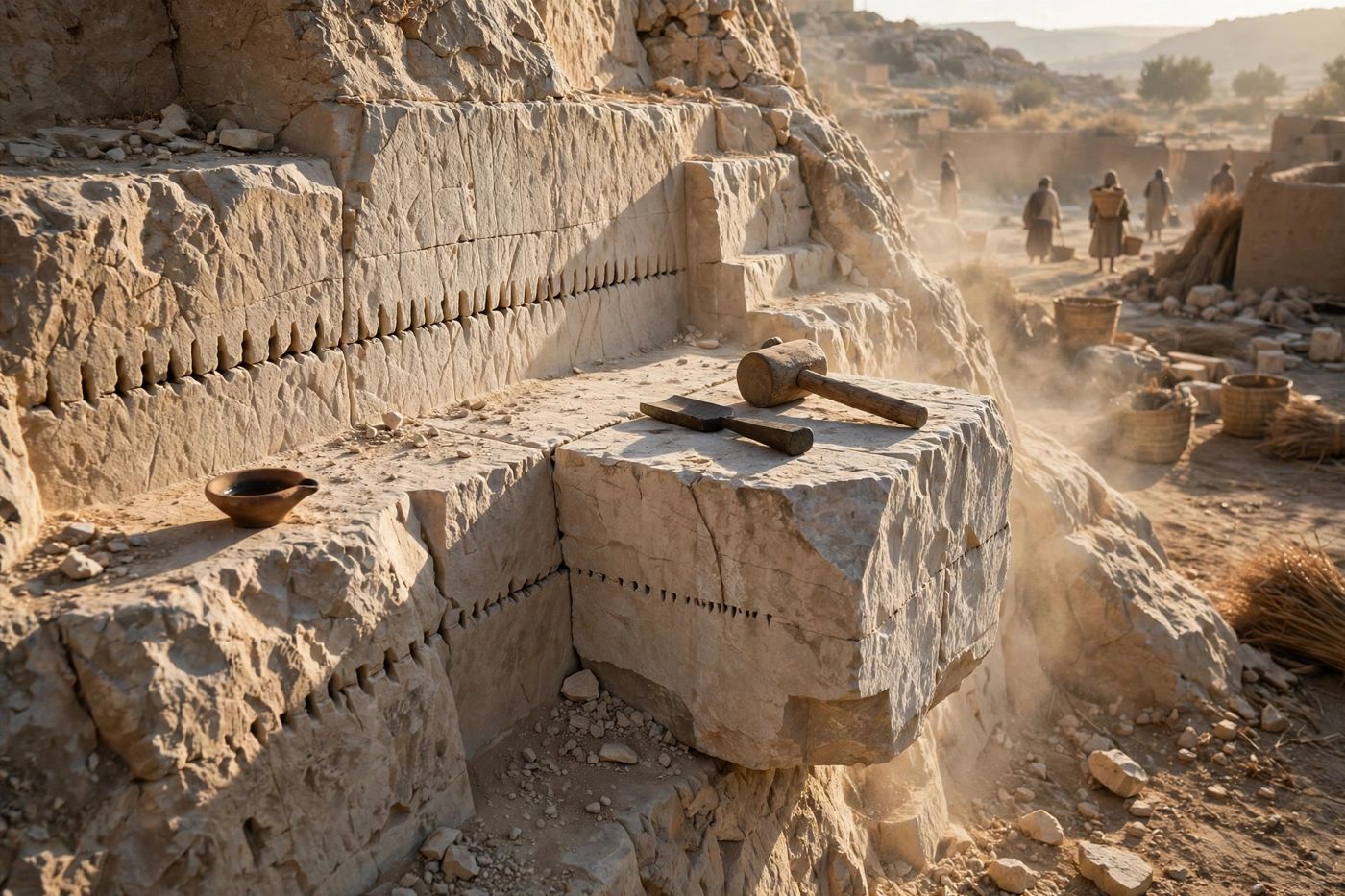
The quarry and the garment. Two everyday pictures carry this passage. Stone for Jerusalem's buildings was hewn out of bedrock quarries: a block was scored, wedged, and split free from the rock face, so a finished stone still showed you the pit it came from. [16, 53] And clothing was wealth: a garment was woven, worn, patched, and worn again until it wore out — thinned, holed, discarded. When this passage calls the whole earth a garment waxing old, its hearers were not reaching for a metaphor. They were looking down at their own sleeves.
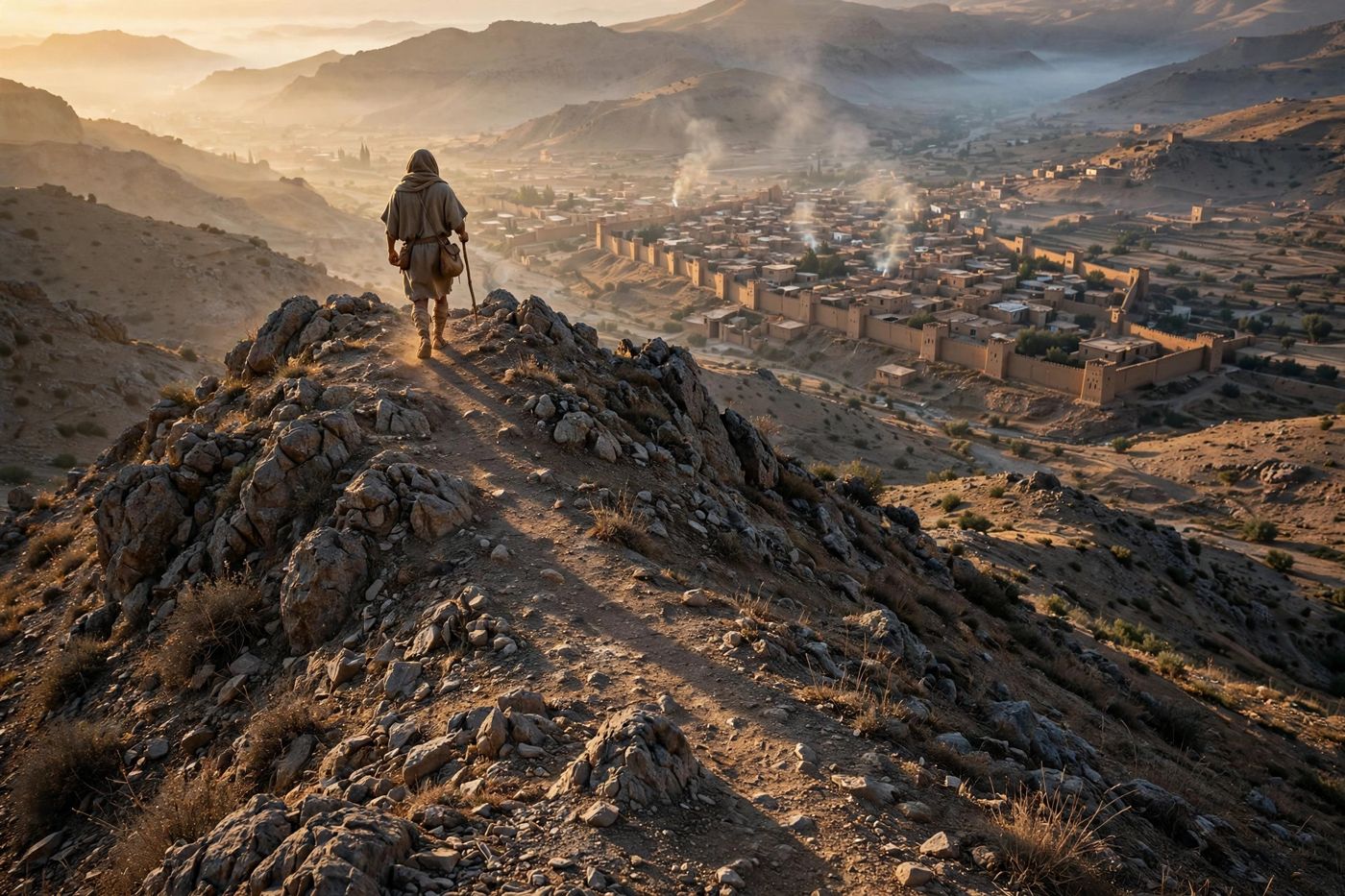
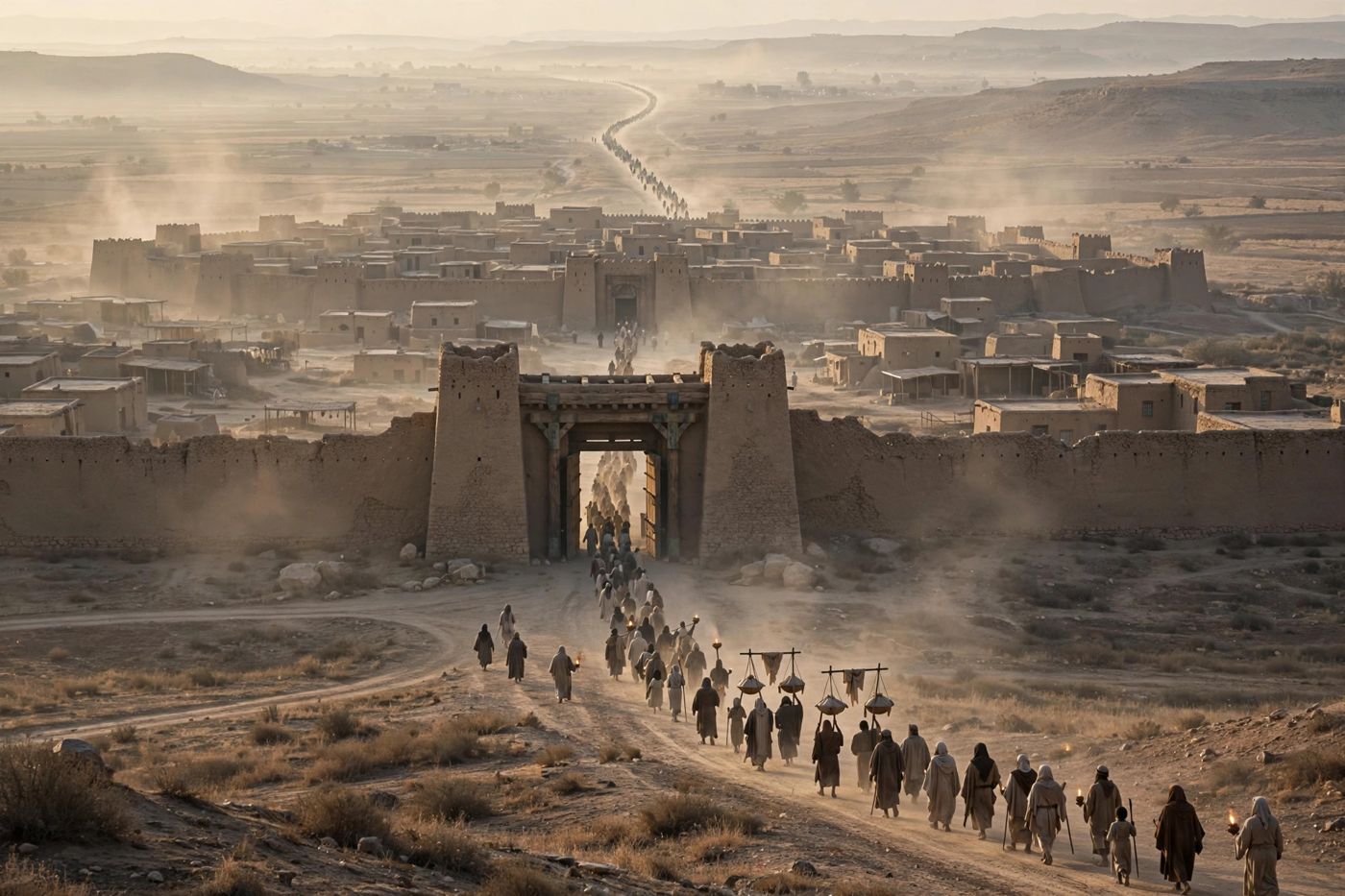
One more piece of the world: the herald. News in the ancient world travelled at the speed of a runner. A messenger crossing the mountains toward a waiting city — dust on his feet, staff in his hand — was the broadcast of the age, and a city posted watchmen on its walls to catch the first sight of him and read, from his pace, whether his news was good or bad before he arrived. [16, 52] Hold that picture. Chapter 52 will put a runner on those mountains.
That is the world. Now we open the text itself.
3. OBSERVE — O: what the text actually does
Before meaning comes observation. Most bad interpretation is shallow reading — people answering a text they never looked at. So look:
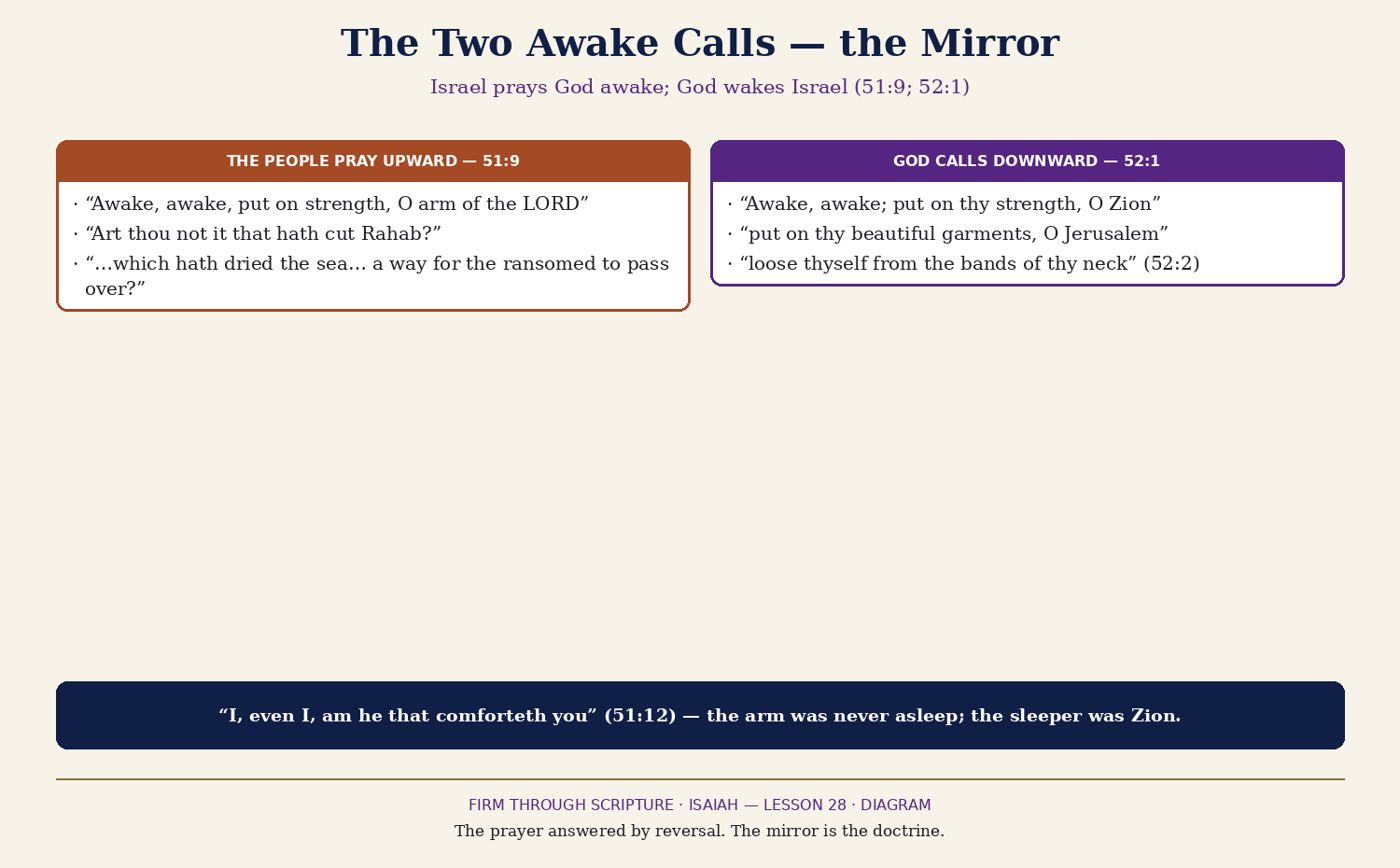
- The passage is built out of wake-up calls. Count the command "Awake, awake": at 51:9 it is prayed upward — "put on strength, O arm of the LORD." At 51:17 it is spoken to Jerusalem — "stand up, O Jerusalem." At 52:1 it comes doubled to Zion with a dress code: "put on thy strength, O Zion; put on thy beautiful garments." One imperative, three addresses, and the direction of travel is the sermon in embryo: the cry Israel aims at heaven comes back down aimed at Israel.
- "Hearken" opens the doors. Three times God begins with "Hearken to me" (51:1, 4, 7). Before anyone in this passage is told to do anything, they are told three times to hear something. The wake-up God prescribes first is ears.
- The speakers keep changing — track them. God speaks (51:1–8). Then the people speak, in the passage's only full prayer (51:9–11). Then God answers (51:12–16), turns to Jerusalem (51:17–23), and chapter 52 ends with His summons and procession orders. A choreography, not a lecture: call and counter-call.
- The arm threads everything. God's "arms shall judge the people" and the isles trust "on mine arm" (51:5); the people pray the "arm of the LORD" awake (51:9); and near the end, "the LORD hath made bare his holy arm" (52:10). Follow the arm and you follow the plot.
- The cup appears, is drained, and changes hands. Jerusalem has "drunken the dregs of the cup of trembling" (51:17); God takes that cup "out of thine hand" (51:22) and puts it "into the hand of them that afflict thee" (51:23). Observe the transfer now; the Terms section will open the cup up.
- The passage keeps quoting the book itself. "Everlasting joy shall be upon their head… sorrow and mourning shall flee away" (51:11) is Isaiah 35:10 — from Lesson 17 — returning almost word for word. Isaiah is not repeating himself because he ran out of material. He is building a refrain, and refrains are meant to be noticed.
4. GENRE — N: note the genre (prophetic poetry — salvation oracles, a prayer, and a summons)
This passage is prophetic poetry, several kinds woven: salvation oracles (God speaking comfort in the first person, 51:1–8, 12–16), a communal lament-prayer (the people answering with His own history, 51:9–11), a judgment-transfer oracle (the cup changing hands, 51:17–23), and a summons and departure liturgy (52:1–12). Prophecy, as this course keeps insisting, is forthtelling first — God's word into the hearers' present crisis — before it is foretelling. 51
Poetry reads by its own rules:
- Parallelism is the engine. Hebrew poetry thinks in paired lines — the second line restating, sharpening, or answering the first. "Look unto the rock whence ye are hewn, / and to the hole of the pit whence ye are digged" (51:1) is one command said twice, the second saying it deeper. Read pairs, not isolated lines.
- Images argue. Eden, the garment, the quarry, the cup, the runner's feet — these are not illustrations pasted onto an argument. They are the argument, in the form poetry makes. The Genre discipline is to let each image do its own work before translating it into a proposition.
- Imperatives in poetry are events. When this passage says "Awake," something is happening in the saying — a summons that creates the reality it names, the way "Comfort ye" did in chapter 40. Do not flatten the commands into advice.
- A prayer inside a prophecy is teaching. Verses 9–11 of chapter 51 are Israel praying — and the prophet includes the prayer, answers it, and corrects it. Scripture is showing you how God's people may pray at Him, and how He takes it.
5. TERMS — T: the words in the writer's mouth
Three terms carry this passage. Learn what they meant in Isaiah's mouth, and watch how much confusion dies at the dictionary:
- Rahab (51:9) — a name doing double duty, and Isaiah knows it. In the poetry of Israel, Rahab is a name for the chaos-monster of the deep — the dragon-power God subdued when He made and ordered the world: "he cut Rahab in pieces" is Job's language for God's mastery of the sea (Job 26:12). [19, 21] But the same name is also, plainly, a poetic nickname for Egypt: Psalm 87:4 lists "Rahab" — Egypt — among the nations, and Psalm 89:10 sets the "scattering" of Rahab beside God's rule of the raging sea. 1 Lesson 15 met this name at Isaiah 30:7, where Egypt is called "Rahab" that sits still. So hold the pattern with its label on: FACT — one Hebrew name carries two registers in the poetry, the mythic (chaos, the dragon, the deep) and the historical (Egypt at the sea). In 51:9–10 the two registers are deliberately laid on top of each other: the prayer moves in one breath from "wounded the dragon" to "dried the sea… a way for the ransomed to pass over" — creation's victory and the exodus named as one act of the same arm. Isaiah is not confusing mythology with history. He is saying the exodus was chaos-combat: the God who ordered the deep then ordered Pharaoh.
- The cup of trembling (51:17, 22) — the cup is Scripture's standing image for what God hands a person or nation to drink down — most often, His judgment, drunk like wine until it staggers the drinker. The Hebrew behind "trembling" pictures reeling — a drunk man's stagger. [19, 20] Jerusalem "hath drunken the dregs" — the last, thickest sediment at the cup's bottom; she has not sipped God's fury, she has drained it and "wrung them out" (51:17). The prophets use this picture repeatedly (Jeremiah 25; Ezekiel 23), and Psalm 75:8 puts the cup in God's own hand. 1 Learn the image whole: a cup can be given, drained, and — this passage's thunderclap — taken out of a hand and put into another.
- Rereward (52:12) — an old English word your KJV keeps, and worth rescuing. It means the rear guard: the detachment marching behind an army or caravan to gather stragglers and guard the back. The Hebrew underneath means to gather in — the rereward is the Gatherer, collecting anyone who might fall behind. [19, 21] The glory of the LORD carries the same title at Isaiah 58:8, in the same picture-language. 1 So 52:12 promises a procession guarded at both ends — vanguard and rear guard, and the same God in both posts.
Method note — the word-study guardrail: a word means what its author uses it to mean, in its sentence, in its century — not what its oldest root once meant, and not everything it can mean anywhere. Every term above was settled by Isaiah's usage. That discipline keeps word studies honest.
TRANSLATION NOTE — two hewings, one verb
Look at 51:1 and 51:9 side by side. Israel is "the rock whence ye are hewn" (51:1). God's arm is the one that "hath cut Rahab" (51:9) — and behind the KJV's two different English words stands the same Hebrew verb (chatzav, to hew, to quarry-cut). [19, 20] FACT. The verb that dug you out of the rock is the verb that cut the dragon down. Your translation smooths the echo flat; the Hebrew rings it like a bell — the Maker who quarried a people out of one barren couple is the Warrior who quarried victory out of the sea. When a rendering hides an echo the author planted, this study flags it, because the echo is part of the argument: same verb, same arm, same God.
6. ENTIRE CANON — E: where this passage sits in the whole story
No verse lives alone. Here are this passage's load-bearing seams with the whole Bible:
- The rock is Abraham — and the argument is Genesis. "Look unto Abraham your father" (51:2) sends the exiles back to Genesis 12–22: an old man called alone — a barren wife, no heir, no land — whom God "blessed… and increased" into a nation. 1 Genesis is not background decoration here; it is evidence entered in court, as the Meaning section will show. And the Eden of 51:3 is Genesis 2's garden, promised as the pattern of Zion's restoration — waste places made "like the garden of the LORD."
- The sea is the exodus. Verses 9–10 of chapter 51 retell Exodus 14–15 in two lines: the sea dried, the deep made "a way for the ransomed to pass over." Rahab the dragon falls and Pharaoh's Egypt falls in the same stroke — the pattern labeled in Terms. And 51:11 then does something remarkable: it quotes the book's own earlier song. Isaiah 35:10 sang of the ransomed returning to Zion with everlasting joy; 51:11 reprises it with "redeemed" for "ransomed" and the same joy, the same flight of sorrow and sighing. 4 FACT — the echo is verbal and near-total; the book is quoting itself, deliberately, as a refrain: the promise made on the Highway of Holiness in chapter 35 is now sung over Babylon's exiles as ready to happen.
- The watching world. "The isles shall wait upon me" (51:5) — the far coastlands — and "all the ends of the earth shall see the salvation of our God" (52:10). The horizon is never only Israel: the runner's news is announced to Zion, but the arm is bared before the world.
- Paul, twice, on the runner and the departure. Paul takes 52:7 as the charter text for gospel preaching: "How beautiful are the feet of them that preach the gospel of peace, and bring glad tidings of good things!" (Romans 10:15) — FACT, his application of the verse to the church's heralds. 1 He was not the first to re-sing it: Nahum 1:15 had already lifted the same beautiful feet and the same tidings a generation earlier, against Assyria. 1 And 52:11's "depart ye… touch no unclean thing" becomes his summons to the Corinthian church's separation (2 Corinthians 6:17), just as 52:5's grieving line — "my name continually every day is blasphemed" — is re-aimed at hypocritical teachers in Romans 2:24. 1 Three times in two letters, Paul reaches into this one passage — which licenses our Walk-Out later, on the tests, not on a whim.
- The cup, one verse of signpost. The cup Jerusalem drains here will be lifted again in Scripture — in the next lesson's suffering Servant passage the figure deepens, and in a garden called Gethsemane the Lord Jesus will pray about a cup in His Father's hand (Matthew 26:39). 1 One line only, and we move on: the pattern — a cup given, drained, and governed by the Father's hand — is labeled here so that when you meet it again, you will meet it awake.
Laid out flat, the passage's own self-quotation looks like this:
| The song first sung (Isa. 35:10) | The song reprised (Isa. 51:11) | What the echo does |
|---|---|---|
| The ransomed of the LORD return to Zion with singing | The redeemed of the LORD return to Zion with singing | The exiles in Babylon are written into the Highway promise |
| Everlasting joy upon their heads; gladness and joy obtained | Everlasting joy upon their head; gladness and joy obtained | Same joy, now announced as the prayer's own answer |
| Sorrow and sighing flee away | Sorrow and mourning flee away | The refrain lands inside the prayer of 51:9–11 — God answers with His own earlier words |
7. THE MEANING — what the passage teaches
The Walk has established what the text says and where it sits. Now its payload, taught straight, in the passage's own order.
Look back to go forward — the rock and the garden (51:1–3)
The passage opens with an argument disguised as a history lesson. God does not begin with a command to feel better. He begins with a direction to look: "look unto the rock whence ye are hewn, and to the hole of the pit whence ye are digged" (51:1). A hewn stone's origin explains its existence — it was not self-made; it was cut, by someone, out of something. And the rock Israel was cut from is a couple: "Look unto Abraham your father, and unto Sarah that bare you: for I called him alone, and blessed him, and increased him" (51:2).
Notice the numbers the argument depends on. Alone. One man. A wife who, Genesis says plainly, was barren — the "hole of the pit" language is quarry language, but it is also womb language: Israel's raw material was a dead-end. And out of that one-called-alone, God made a nation numerous as the stars Abraham was told to count. [3, 4] Now set the exiles beside it: the many who feel like nothing, their city a waste place. God's argument runs: if I made the many out of the one and the living out of the barren, the ruined-many are not a harder problem than the one I already solved. Origins here are not nostalgia. They are the first exhibit in a courtroom case for hope — Misread 2 in §10 defends exactly that.
Then the promise the exhibit supports: "the LORD shall comfort Zion: he will comfort all her waste places; and he will make her wilderness like Eden, and her desert like the garden of the LORD" (51:3). Eden is not chosen because it was pretty. Eden is the one place in Scripture where God's planting was perfect and unruined — and the promise is that the waste places, specifically, get replanted to that standard. The soundtrack is named twice over: "joy and gladness shall be found therein, thanksgiving, and the voice of melody." Comfort, in Isaiah, is not a sedative. It is a garden with singing in it. [4, 52]
The everlasting outlasts the garment (51:4–8)
The second "Hearken" widens the lens from Zion to the world: a law going forth, judgment made "a light of the people," the far coastlands waiting on God's arm (51:4–5). Then God gives the passage's great permanence argument as an instruction in where to look: "Lift up your eyes to the heavens, and look upon the earth beneath" (51:6). Look at the biggest, most permanent things you know — sky and earth — and hear their expiry date: the heavens vanish "like smoke," the earth waxes "old like a garment," and its inhabitants die "in like manner." Against that triple decay stands one unaging thing: "but my salvation shall be for ever, and my righteousness shall not be abolished."
This is a proportions argument, and the passage will use the same weapon again at verses 12–13. The cosmos is clothing; God's salvation is not. [3, 11] Chapter 50's moth completes the wardrobe in verse 8: the revilers will be eaten "like a garment," exactly as 50:9 warned (Lesson 27), "but my righteousness shall be for ever, and my salvation from generation to generation." So the third "Hearken" (51:7) lands its command with the argument already built: "fear ye not the reproach of men, neither be ye afraid of their revilings." Not because reviling is pleasant, but because everything the revilers stand on is wearing out and what you stand on is not. Fear, in this passage, is a calculation error — and God corrects the arithmetic before He comforts the feeling.
The prayer that drags God's past into the present (51:9–11)
Now the people answer, and their answer is the boldest prayer in the book: "Awake, awake, put on strength, O arm of the LORD; awake, as in the ancient days, in the generations of old" (51:9). Look at how the prayer is built, because its construction is its theology. It does not present God with new information. It presents Him with His own résumé: "Art thou not it that hath cut Rahab, and wounded the dragon? Art thou not it which hath dried the sea… that hath made the depths of the sea a way for the ransomed to pass over?" (51:9–10). Two rhetorical questions, both expecting the answer yes, that was You — and the exodus as the exhibit. This is memory used as leverage: the congregation drags God's past acts into the present tense and holds them up as the reason He should act now, consistently with Himself. [3, 15]
And then — the masterstroke of the poem — the prayer answers itself. Verse 11 does not wait for heaven's reply: "Therefore the redeemed of the LORD shall return, and come with singing unto Zion." Therefore. Because the arm that did it before is the arm being prayed to now, the return can be sung in the present tense inside the prayer itself, in the words of the book's own earlier song (35:10 — see §6). Biblical lament at its strongest argues from God's character and history until hope starts singing before the circumstances change. Hold the prayer in mind, though — God's actual reply (51:12–16) will agree with its hope while pointedly refusing its premise: the prayer is honored and answered, and never once does God say, you were right, I was asleep. Misread 1 guards that distinction.
The Comforter answers — fear is a forgetting (51:12–16)
God's reply opens with the book's comfort-title, doubled for emphasis: "I, even I, am he that comforteth you" (51:12). Then, immediately, a diagnosis — not the one the prayer requested. The prayer implied the problem was God's inactivity. God locates it in the pray-ers' fear, and the fear in their forgetting: "who art thou, that thou shouldest be afraid of a man that shall die, and of the son of man which shall be made as grass; and forgettest the LORD thy maker, that hath stretched forth the heavens, and laid the foundations of the earth" (51:12–13). There is the proportions argument again, aimed at a person instead of a cosmos: on one side a mortal — grass, with an expiry date; on the other, the Maker of heaven and earth. To fear the first while forgetting the second is a measurement problem. "And hast feared continually every day because of the fury of the oppressor… and where is the fury of the oppressor?" (51:13) — the fury that filled every day has a very short shelf life next to the Maker.
The reply then turns tender and specific. The captive exile "hasteneth that he may be loosed, and that he should not die in the pit, nor that his bread should fail" (51:14) — release is coming, and coming in time. And the speaker identifies Himself by the prayer's own exhibit: "I am the LORD thy God, that divided the sea, whose waves roared: The LORD of hosts is his name" (51:15). You cited the sea at me. Quite right. That was Me. It still is.
And then verse 16, the passage's most compressed and debated sentence: "I have put my words in thy mouth, and I have covered thee in the shadow of mine hand," God says — for nothing less than a new creation, "that I may plant the heavens, and lay the foundations of the earth, and say unto Zion, Thou art my people." Any reader of Lesson 26 hears the echoes: words put in a mouth, a figure covered in the shadow of God's hand — that is Servant-language, spoken of the Servant in Isaiah 49:2 almost word for word. [3, 42] Yet the sentence ends by naming its addressee: Zion. So teach the interplay plainly, with the labels on. FACT — the wording of 51:16 reuses the Servant's own idiom from 49:2 while addressing Zion. INFERENCE — the reading this course commends: the remnant is addressed in the Servant's own language because the Servant's vocation — bearing God's words, sheltered in His hand, for a renewed creation ("plant the heavens, and lay the foundations of the earth") — is being laid on the people he represents and restores. Who the "thee" is at the deepest level divides the commentators honestly; §16's Honest Argument lays it out. No reading may flatten the verse into one register and pretend the other isn't in the ink.
The cup passes (51:17–23)
The third wake-up call is the passage's darkest: "Awake, awake, stand up, O Jerusalem, which hast drunk at the hand of the LORD the cup of his fury" (51:17). Jerusalem is pictured as a drunk woman staggering — the cup of trembling drained to the dregs — with none of her sons able to guide her or take her by the hand (51:18). Her sons lie fainted "at the head of all the streets, as a wild bull in a net" (51:20) — a strong animal thrashing itself tighter into the trap, strength spent uselessly. 16 This is judgment remembered from inside it: desolation, destruction, famine, sword (51:19) — the full covenant curse, drunk to the bottom.
Then the turn, and it is total: "Behold, I have taken out of thine hand the cup of trembling, even the dregs of the cup of my fury; thou shalt no more drink it again: but I will put it into the hand of them that afflict thee" (51:22–23). Note what God does not do. He does not say the cup was imaginary, or that Jerusalem hadn't deserved it — her affliction is named as His fury, honestly (51:21). What He announces is a transfer with a terminus: the drinking is finished for her ("no more… again"), and the same cup now goes to the tormentors who made her body a street to walk over — "Bow down, that we may go over" (51:23). Judgment here is neither denied nor endless. It is measured, completed, and reversed onto the arrogance that exploited it. And God gives Himself a courtroom title for the occasion: "thy God that pleadeth the cause of his people" (51:22) — the drunk in the street has acquired an advocate, and the advocate is the Judge who handed her the cup. [3, 4]
Beautiful garments, beautiful feet (52:1–12)
Chapter 52 answers chapter 51's prayer with its mirror, now in full: "Awake, awake; put on thy strength, O Zion; put on thy beautiful garments, O Jerusalem, the holy city" (52:1). The strength Israel begged God's arm to put on, Zion is now told to put on herself — not because it is hers, but because God's strength has come to her address. The wardrobe tells the story: dust shaken off, the neck-bands of captivity loosed, and the captive daughter no longer sitting in the dust but invited to "arise, and sit down" — enthroned (52:2). The economics are stated flatly: "Ye have sold yourselves for nought; and ye shall be redeemed without money" (52:3). Sin's wages were always counterfeit; God redeems without payment changing hands, because the price side of this transaction is His own to settle. 3
Verses 4–6 compress the captivity-history (§2) and land on the wound underneath the wound: "my name continually every day is blasphemed" (52:5). The exile reads, to the watching nations, as God's defeat. So restoration has a purpose beyond Israel's comfort: "Therefore my people shall know my name… that I am he that doth speak: behold, it is I" (52:6). The God accused of sleep announces Himself in the first person — the same voice that answered at 51:12.
Then the runner. "How beautiful upon the mountains are the feet of him that bringeth good tidings, that publisheth peace" — and the tidings build to their one-line content: "that saith unto Zion, Thy God reigneth!" (52:7). Every word of the tidings has content, and Misread 3 will guard it: the good news is not a mood of optimism — it is a reign announced, "Thy God reigneth," and it is addressed first to Zion, to the ruined city that thought her God had abdicated. Beautiful feet — dusty, blistered, ordinary feet — because of the news they carry and the city they carry it to. [4, 52] The watchmen see him coming and cannot contain it: they "lift up the voice; with the voice together shall they sing: for they shall see eye to eye, when the LORD shall bring again Zion" (52:8) — watchmen who have stared at empty roads for years now seeing the same sight at the same moment, in perfect unison, as the LORD returns to Zion. And the waste places themselves break into song (52:9), because the LORD "hath comforted his people, he hath redeemed Jerusalem" — past tense, before a single stone is relaid.
And then the arc of the whole passage closes: "The LORD hath made bare his holy arm in the eyes of all the nations; and all the ends of the earth shall see the salvation of our God" (52:10). The arm Israel prayed awake at 51:9 — put on strength — is now bared, rolled up to the shoulder, in public, before every nation. God was never asleep. He was rolling up His sleeve.
What remains is the exit, and it is liturgy, not escape: "Depart ye, depart ye, go ye out from thence, touch no unclean thing… be ye clean, that bear the vessels of the LORD" (52:11). The vessels — the temple's holy ware, carried off to Babylon generations earlier — come home carried by clean hands, in procession. And the final verse sets the tempo: "For ye shall not go out with haste, nor go by flight: for the LORD will go before you; and the God of Israel will be your rereward" (52:12). The first exodus left Egypt in haste, eating with staffs in hand, fleeing an army. This one walks out — no pursuit behind worth running from, God in front, God gathering up the rear (the rereward of §5). The redeemed do not escape Babylon. They are escorted out of it, like a procession leaving a cathedral.
The Christ Thread
This passage earns its Christ Thread chiefly through the New Testament's own hands — the only way this course draws one. FACT: Paul preaches 52:7 as the pattern of gospel heralds (Romans 10:15), commands the church with 52:11's departure ("Come out from among them, and be ye separate," 2 Corinthians 6:17), and grieves with 52:5 (Romans 2:24) 1 — so the feet that ran to Zion become, by apostolic reading, the church's preachers' feet, and the clean procession becomes the church's holiness. And the cup taken out of Jerusalem's hand here is the cup Jesus will take up in prayer at Gethsemane and drain at the cross — the signpost planted in §6. Beyond the apostles' own usage this course does not speculate. 36
Where in the Covenant Story?
This passage stands at the covenant's lowest ebb and its turning. The curses have been drunk to the dregs — famine, sword, exile, the holy city a waste place (51:19–20): everything Deuteronomy warned has happened. God's next covenant word is not a renegotiation but a remembering: He pleads His people's cause (51:22), names them "my people" again in the Servant's own idiom (51:16), and announces a redemption "without money" (52:3) resting on His name and His arm alone. Mark this as the hinge where comfort becomes the covenant's future tense — the movement Lesson 20 opened at chapter 40, here at its fullest before the Servant's work, next lesson, explains its cost.
The Long View — what the church has believed
Stand back and notice how the centuries have read this passage, because you are not its first reader. The ancient church read Isaiah whole, as one prophet's witness, and heard its wake-up calls as resurrection-language: Paul echoes the very cadence — "Awake thou that sleepest, and arise from the dead, and Christ shall give thee light" (Ephesians 5:14). [1, 36] Calvin, preaching these chapters, pressed the proportions argument of 51:12–13 on frightened believers: fear of dying men, he argued from this text, is what happens when the Maker slips from view. 36 On the runner of 52:7, the church's reading has been strikingly settled: Paul's use in Romans 10 fixed the verse as the charter of gospel preaching — and the church kept the verse's Zion-first address while obeying Paul's extension of it. 4 Where honest readers have differed — the "thee" of 51:16, the composition question behind chapters 40–55 — the differences are real, and argued in §16 with the lights on. The centre has held: the God who comforts His people was never asleep, and His arm was never short.
That is the payload. The next section compresses it into the one sentence you are meant to carry out of this study.
8. THE AIM SENTENCE — X: eXplain the intent
Everything observed now compresses into one sentence — the author's intended meaning, stated before any application is allowed near it:
To exiles who pray as if God has fallen asleep, Isaiah answers with God's own wake-up call: the Comforter who hewed a nation out of one barren couple, whose salvation outlasts heaven and earth, takes the drained cup of judgment out of Jerusalem's hand forever, bares His arm before the nations, and wakes Zion herself — to dress, to hear "Thy God reigneth," and to walk home in His guarded procession.
If a sermon, a post, or a devotional uses Isaiah 51:1–52:12 to say something that cannot be traced back to that sentence, it is not this passage talking.
9. SAY IT BACK
Close the book and say the AIM sentence from section 8 in your own words — out loud, or written in your notes, without looking. Then say, in one more sentence, what it asks of you this week.
If your version quietly changes the meaning — if the God who was never asleep becomes a God you must rouse, or the tidings lose their content, "Thy God reigneth" — open the lesson and walk it again. This exercise feels small. It is the entire course in miniature: meaning first, then — and only then — your life.
10. THE MISREAD — the guardrail, with verdicts
Three live misuses of this passage — a fair hearing, the evidence, and a verdict for each.
Misread 1: "Israel prayed 'Awake, O arm of the LORD' because God had slept — God sometimes nods off, withdraws, or loses track of His people until prayer wakes Him." Why it sounds right: the prayer's words really do say "Awake, awake," twice, "as in the ancient days." Taken flat, as a doctrinal proposition about God's state, it sounds like a sleeping God and a congregation with a alarm clock. The evidence: the prayer is the book's liturgy of memory, not a report on God's consciousness. Its construction gives it away — verses 9–10 are entirely God's past ("Art thou not it that hath…?"), the pray-ers arguing from who God has been, in the Bible's established pattern of lament. And God's answer is the control: He never accepts the premise. He does not say "I was asleep" or "you woke me." He corrects the pray-ers' condition — "who art thou, that thou shouldest be afraid of a man that shall die… and forgettest the LORD thy maker" (51:12–13) — and turns the imperative around: "Awake, awake, stand up, O Jerusalem" (51:17); "Awake, awake; put on thy strength, O Zion" (52:1). The only party ever found sleeping is Zion. The mirror-structure is the doctrine. Verdict: prayer that argues from God's remembered acts is biblical and bold; the conclusion that God slept is refuted by the passage itself. Israel drags God's past into the present tense — and God answers by waking Israel.
Misread 2: "Look unto Abraham and Sarah — the cure for a discouraged church is nostalgia: remembering the great beginnings, the founders, the good old days." Why it sounds right: verses 1–2 really are a command to look backward, and backward-looking can be warm. Whole ministries run on founder-stories and anniversary sentiment. The evidence: watch what the look is for. Abraham is not presented as a mood but as an exhibit: "for I called him alone, and blessed him, and increased him" (51:2) — a premise in an argument whose conclusion is verse 3, "the LORD shall comfort Zion." The logic is forensic: the God whose handling of one barren couple produced a nation is thereby shown competent to handle a nation reduced to waste places. Nostalgia looks back to feel; this look goes back to prove — and its face is turned forward the whole time, toward Eden replanted. Where the look stops at fondness, it has stopped halfway through the verse. Verdict: origins are evidence for the present case, not a mood to live in. Abraham is Exhibit A, not a screensaver.
Misread 3: "How beautiful are the feet — 52:7 blesses any cheerful message, any good news anyone brings, anything that lifts the spirits." Why it sounds right: the verse really is about the beauty of good-news feet, and Paul really does extend it to the church's preachers in Romans 10:15. Universalizing it feels generous. The evidence: the tidings in 52:7 have a named content — "Thy God reigneth!" — and a first addressee: the feet run to Zion, a ruined city that believed her God dethroned, and the news is that He reigns and has redeemed Jerusalem (52:9–10). Strip the reign out and "good tidings" becomes a compliment we pay any optimistic messenger. Paul's extension stands precisely because it keeps the content: his heralds preach the gospel — the reigning God's finished rescue (Romans 10:14–17). 1 The extension stands on the verse, not instead of it. Verdict: 52:7 blesses feet that carry this news — God reigns, and has redeemed — first to Zion, and then, by Paul's own hand, to the nations through the church's heralds. Cheerfulness is not the tiding. The reign is.
11. FROM WORD TO WALK
A reflection page — the lesson is not finished until the passage has had its way with you.
Notice, first, the kindness hidden in the mirror. Israel's prayer was — honestly — a little bit accusatory. Awake. Where were You? You did it before; why not now? And heaven's answer contains no scolding for the tone. God answers the hope inside the accusation, corrects the arithmetic underneath it, and hands the imperative back as a gift: you awake. If your own recent prayers have been more accusation than adoration, this passage is not your rebuke. It is your precedent. Bring God His own résumé; He has never been offended by being reminded of the sea.
Sit, second, with the diagnosis that fear is a forgetting (51:13). The passage does not treat fear as a character flaw to be shamed; it treats it as a measurement to be corrected. You have been weighing a mortal — a boss, a diagnosis, a debt, a person whose opinion rules your week — on one side of the scale, and on the other side you have left an empty pan. God says: put the Maker back on the scale — the One who stretched forth the heavens and laid the foundations of the earth. "Feared continually every day" is what a scale reads when heaven's pan is empty. The cure is not "try not to feel it." It is remember who made the heavens — rehearsed out loud, in prayer, until the proportions come back.
And sit, finally, with the tempo of 52:12 — the most countercultural line in the passage for a people formed by hurry and panic. Not with haste. Nor by flight. God's redeemed do not sneak out, dash out, or burn out. They process out — clean hands, holy vessels, God in front, God gathering up the rear, nobody left behind. Whatever Babylon you are walking out of in this season — a bondage, a grief, a long captivity of habit — the passage does not ask you to run faster. It asks you to walk cleaner, and to trust the formation.
Comforter — I, even I, am He: You said it, and I am taking You at Your word. I have feared men who shall die and forgotten the Maker who stretched out the heavens; correct my measures. Take out of my hand what You have finished with, put Your words in my mouth and Your cover over me, and wake me — dress me in strength that is Yours, and walk me out at Your pace, with You before me and behind me. In Jesus' name, amen.
12. FOR DISCUSSION — OR FOR YOUR JOURNAL
With a group, work these aloud. Alone, they're yours — answer them in your journal or in prayer; they lose nothing in the quiet.
- Israel's prayer (51:9–11) argues with God out of His own past acts. Is that a pattern for your prayers — and what specific "Art thou not it that hath…?" could you honestly pray this week?
- God diagnoses fear as forgetting the Maker (51:12–13). Which mortal or circumstance has been overweighted on your scale lately — and what does putting the Maker back on the other pan actually change?
- The look at Abraham is an exhibit, not nostalgia (Misread 2). Where in your own history with God is there an "I called him alone" moment — a small, dead beginning He multiplied — that stands as evidence for a present waste place?
- The departure is a procession, "not with haste, nor by flight" (52:12). What would it mean, concretely, to walk out of your current Babylon at God's tempo instead of panicking out of it — or lingering in it?
13. THE WALK-OUT — T: Transfer to today
Meaning is settled. Now — and only now — application, and it must cross the bridge honestly. Run the five Transfer Tests on this passage:
- Same covenant? These words were spoken to exiled Israel about a literal return from Babylon; we read them on the far side of the cross, in the church Paul himself taught with this very passage (Romans 10:15; 2 Corinthians 6:17). The national-political promises land on Israel first; what reaches us travels the apostles' own roads — and the character of God they reveal travels free of charge.
- Same audience? The wake-up commands name Zion/Jerusalem. We do not steal the city's mail; we receive, as God's people grafted into her story, the pattern: God's first address to a sleeping people is a summons to awake, dress, and hear.
- Same genre rules? Prophetic poetry: its images argue and its imperatives are events. So we take the passage's transposed commands — hear, remember, fear rightly, awake, depart clean — and not its literal staging. Nobody is ordered to find a Babylonian gate.
- Repeated or rooted? God's comfort of the fearful, His diagnosis of fear as forgetting, salvation that outlasts the cosmos, tidings of His reign carried by heralds — each reappears across the canon and is rooted in God's character (51:6, 12; Romans 10). These cross at full strength.
- Ten verses either side? Every application below is drawn from these thirty-five verses read whole — the rock, the garment, the prayer, the cup, the feet, the procession. Nothing hangs on a torn-out line.
What crosses — and lands:
- God has acted — therefore remember on purpose. Before the passage asks anything of Israel, it recites what God did: called Abraham alone, cut Rahab, dried the sea. The indicative leads. Christian memory is not decoration; it is the evidence base of present hope, and rehearsing it is a discipline, not a mood.
- Fear is corrected by proportion, not by pep talk. "Who art thou, that thou shouldest be afraid of a man that shall die?" (51:12). The fear that rules a week is, on this passage's diagnosis, a forgotten Maker. The crossing application: when a mortal looms, the answer is to re-weigh — deliberately, in prayer, with the heavens-stretching God back on the scale.
- What God has finished, He has finished. The cup comes out of Jerusalem's hand with a "no more… again" (51:22). Where God has pronounced a judgment endured and done, living as if you are still drinking is not humility. It is disputing the transfer.
- The news still has feet. "Thy God reigneth" is still the content, and Paul has already carried the verse to the church's heralds (Romans 10:15). Somebody's mountains are crossed on ordinary, dusty feet — a conversation, a visit, an invitation. Beautiful is what heaven calls them.
Practices — what the gate lets through, made concrete this week:
- Pray the résumé. Take 51:9–10 as your template once this week: name three specific acts of God — one from Scripture's history, two from your own — back to Him in prayer, in the prayer's own form: "Art thou not it that…?" Then tell Him, in one sentence, the present case the résumé argues.
- Sit at the rock. Read Genesis 12 and 15 slowly, and write down your own "called him alone" beginning — the smallest, deadest start God has multiplied in your life. Keep the page; exhibits are for hard days.
- Re-weigh one fear. Name the mortal or circumstance you have "feared continually every day" (51:13). Write beside it, in full, who God is in 51:12–15 — Maker of heaven and earth, divider of the sea, LORD of hosts. Pray the proportions daily this week.
- Memorize Isaiah 52:10. The arm bared, the nations watching, the ends of the earth seeing — carry the passage's closing arc in your head where fear can be measured against it.
- Be somebody's feet. One person needs to hear "Thy God reigneth" as news, not a slogan — name them, and this week cross their mountain: one visit, one call, one honest conversation.
What does not cross: claiming Israel's national restoration promises as your personal political program; treating "awake" as a technique for rousing a reluctant God (Misread 1 — the sleeper in the passage is us); universalizing 52:7 into a blessing on any optimism (Misread 3). The gate is not there to shrink the Bible's claims on you — it is there to make sure the claims that land are the ones God actually made.
The departure itself, set beside the first exodus, is the Walk-Out in one table:
| The first exodus (Exodus 12–14) | This departure (52:11–12) | |
|---|---|---|
| Tempo | Haste — eaten with loins girded, staff in hand, out by night | "Not with haste, nor by flight" — a procession's pace |
| Hands | Unleavened bread, borrowed silver and gold | Clean hands, bearing the vessels of the LORD |
| Behind them | Pharaoh's army in pursuit | The God of Israel as rereward — the Gatherer at the rear |
| Before them | The pillar of cloud and fire | "The LORD will go before you" — the same God, both posts |
Praise Him
Arm of the LORD, bared before the nations — we praise You, because You were never asleep and never absent: You are the Comforter who says "I, even I," the Maker who stretched forth the heavens, the Judge who takes the cup away and pleads Your people's cause, the King whose reign is the news on the runner's lips, and our rereward who leaves no straggler behind. Salvation that shall be for ever, righteousness that shall not be abolished — be praised for it, from Zion to the ends of the earth.
14. THE RECAP CARD — this study on one page
Print it. Keep it where you'll see it this week.
- The passage: Isaiah 51:1–52:12 — the wake-up passage: God wakes Zion, Zion's prayer wakes no one in heaven, the cup changes hands, and the redeemed process home.
- Say It Plain: Look at the rock — one called alone, multiplied. Heaven and earth wear out; God's salvation does not. Israel prays "Awake, O arm of the LORD"; God answers, "I am your Comforter — fear no mortal," takes the cup from Jerusalem's hand forever, and calls Zion herself awake — to beautiful garments, to the news "Thy God reigneth," to a guarded walk home.
- The AIM: To exiles who pray as if God has fallen asleep, Isaiah answers with God's own wake-up call: the Comforter who hewed a nation out of one barren couple, whose salvation outlasts heaven and earth, takes the drained cup of judgment out of Jerusalem's hand forever, bares His arm before the nations, and wakes Zion herself — to dress, to hear "Thy God reigneth," and to walk home in His guarded procession.
- Key terms: Rahab — one name, two registers: the chaos-dragon and Egypt at the sea · the cup of trembling — judgment drunk to the dregs, then transferred · rereward — the rear guard; God Himself gathering up the stragglers.
- The Misread, in one line: God never slept — the sleeper was Zion · Abraham is an exhibit, not nostalgia · the tidings have a content: "Thy God reigneth."
- Memory verse: "The LORD hath made bare his holy arm in the eyes of all the nations; and all the ends of the earth shall see the salvation of our God." — Isaiah 52:10
- This week's practice: pray the résumé — three of God's acts named back to Him — and re-weigh one fear against the Maker of heaven and earth.
15. CHECK YOURSELF — five questions
Answer from the study, not from instinct. (Answers live in the Teacher Edition.)
- In your own words: what is the AIM of Isaiah 51:1–52:12?
- The passage contains three "Awake, awake" calls (51:9; 51:17; 52:1). Who is addressed in each — and what does the pattern teach about who was actually asleep?
- Why does God command Israel to "look unto Abraham" (51:2)? Explain the argument the look is making, and why it is not nostalgia.
- What happens to the cup of trembling in 51:22–23 — taken, emptied, or transferred? Say exactly what the text says, and why the distinction matters.
- A friend says 52:7 means God blesses anyone who brings cheerful news. Using the verse's own content and Paul's use of it, where does that reading fail?
16. GO DEEPER
Optional — the lesson is complete without it.
From the Sources — the book quoting itself
The echo between Isaiah 35:10 and 51:11 is not a preacher's guess; it is a verbal correspondence you can lay side by side (the table in §6 does). Commentators note the refrain-like returns in these chapters — the same words coming back at the book's turning points, the way a hymn's chorus returns — and Motyer builds much of his reading of Isaiah's structure on these planted refrains. [4, 52] FACT — the wording recurs, near-verbatim, at 35:10 and 51:11, and again, varied, at 62:10–12's highway home. INFERENCE — that the returns are deliberate architecture rather than accident: an inference from the precision and placement of the repetition. The pastoral cash value is §11's: when God answers the prayer of 51:9, He answers it in His own earlier words — promise quoting promise.
The Honest Argument — who is "thee" in 51:16?
"And I have put my words in thy mouth, and I have covered thee in the shadow of mine hand… and say unto Zion, Thou art my people." Two readings divide the commentators, and this course shows both. Reading one — the addressee is the Servant. The filled mouth and the hand's shadow are the Servant's exact portrait from 49:2; on this reading 51:16 commissions the Servant, whose work issues in Zion named God's people and in a new creation ("plant the heavens… lay the foundations of the earth"). Oswalt gives this reading its full weight. 3 Reading two — the addressee is Zion herself, corporately. The sentence ends "say unto Zion, Thou art my people," and the "thee" of verses 12–16 has been the fearful people throughout; on this reading the people are dignified with the Servant's own vocation-language. [6, 11] North's classic file surveys every Servant-identification across the centuries. 42 POSITION — this course's reading, labeled: the registers interpenetrate on purpose. The remnant is addressed in the Servant's idiom because their calling is gathered into his — the Servant represents Israel so truly that God can speak to Zion in the words that describe him. The wording is FACT; the interpenetration is reasoned POSITION, and honest scholars land on either side of the "thee."
The Word Underneath — 'asaph, the Gatherer at the rear
"Rereward" (§5) rests on the Hebrew me'asseph — "the one who gathers in," from 'asaph, to gather, collect, take in. [19, 21] FACT — it is the verb of harvest gathering and of gathering people from scattering; the same word-family names the rear detachment of Israel's wilderness march, Dan's camp that "brought up the rear" gathering the tribes' stragglers (Numbers 10:25). 1 Set that underneath 52:12 and the promise sharpens: the God at the rear is not merely guarding against attack. He is gathering — the slow and wounded who would fall out of the column are His personal assignment. INFERENCE — of the kind an author earns by choosing a gatherer's word where a soldier's would have done: nobody in this procession is lost for being last.
Go Read
- Oswalt, The Book of Isaiah, Chapters 40–66 (NICOT) 3 — the fullest slow treatment of the comfort chapters, including the 51:16 commissioning debate.
- Motyer, The Prophecy of Isaiah 4 — on the refrain-system of these chapters and the movement from chapter 51's prayer to chapter 52's answer.
- Fee & Stuart, How to Read the Bible for All Its Worth 51 — the prophecy chapter: forthtelling first, and how oracles like these address their first hearers before they address us.
- Smith, Isaiah 40–66 (New American Commentary) 11 — historical notes on the exile setting and the empires compressed in 52:4–5.
17. SOURCES & REFERENCES
Numbered citations in this lesson key to this list — the course standard: every sourced claim carries its number, and every number can be checked.
-
The KJV text itself — Holy Bible, King James Version (eBible.org KJV, 1769 text). Scripture quotations are from the King James Version (KJV), which is in the public domain in the United States; the full passage is always assigned as reading. Cross-references within Scripture cite this number.
-
Oswalt, The Book of Isaiah, Chapters 40–66 (NICOT) — John N. Oswalt (Eerdmans). The second volume: the comfort section, the Servant Songs, Cyrus, and the new-creation chapters, read as the deliberate answer to chapters 1–39.
-
Motyer, The Prophecy of Isaiah — J. Alec Motyer (IVP). A one-volume commentary by an evangelical scholar who argues the whole book breathes the mind of the eighth-century prophet; especially strong on the book's structure, its repeated refrains, and the Servant.
-
Goldingay, Isaiah (Understanding the Bible / NIBC) — John Goldingay (Hendrickson). A mainstream-critical one-volume commentary; the exilic-community reading of chapters 40–55 stated fairly, with close attention to the poetry.
-
Smith, Isaiah 1–39 and Isaiah 40–66 (New American Commentary) — Gary V. Smith (B&H). Evangelical commentary with strong historical notes (the Assyrian and Babylonian records) and an even-handed survey of the authorship debate.
-
Westermann, Isaiah 40–66 (Old Testament Library) — Claus Westermann (Westminster). The classic critical commentary on the comfort chapters; foundational for the genre analysis of the trial speeches and salvation oracles.
-
Walton, Matthews & Chavalas, The IVP Bible Background Commentary: Old Testament — John H. Walton, Victor H. Matthews, Mark W. Chavalas (IVP). Verse-by-verse ancient Near Eastern background: Assyrian siege practice, Babylonian religion, treaty and coronation customs, geography.
-
Brown, Driver & Briggs, Hebrew and English Lexicon of the Old Testament (BDB) — The standard older Hebrew lexicon; word senses and usage ranges for the Terms sections.
-
Koehler & Baumgartner, The Hebrew and Aramaic Lexicon of the Old Testament (HALOT) — The standard modern Hebrew lexicon; the control on BDB for contested senses (e.g., 'almah).
-
Harris, Archer & Waltke (eds.), Theological Wordbook of the Old Testament (TWOT) — Word studies from a conservative-evangelical hand; pastoral-theological range of key terms.
-
The Great Isaiah Scroll (1QIsaᵃ) and the Dead Sea Scrolls Bible — The complete Isaiah scroll from Qumran Cave 1 (c. 125 BC), in Abegg, Flint & Ulrich, The Dead Sea Scrolls Bible (HarperSanFrancisco). The oldest substantial witness to Isaiah's text — already a single scroll of all 66 chapters centuries before Christ.
-
Calvin, Commentary on Isaiah — John Calvin (public domain). Reformation exegesis; a control on interpretation and a voice in the Long View.
-
North, The Suffering Servant in Deutero-Isaiah — C. R. North (Oxford). The classic survey of every identification of the Servant (Israel, a prophet, a king, the Messiah) weighed in one place.
-
Fee & Stuart, How to Read the Bible for All Its Worth — Gordon D. Fee and Douglas Stuart (Zondervan). The beginner's method book; its prophecy chapter ("a forthtelling first") undergirds the Genre sections.
-
Ryken, Wilhoit & Longman (eds.), Dictionary of Biblical Imagery — Leland Ryken et al. (IVP). Isaiah's image-fields — vineyard, highway, banner, potter, watchman — traced across the canon.
-
King & Stager, Life in Biblical Israel — Philip J. King and Lawrence E. Stager (Westminster John Knox). Daily life, agriculture, warfare, and worship in Isaiah's world.