
One study, one walk — the universal FIRM format. The passage first and whole; then its world; then the Walk (Context · Observe · Genre · Terms · Entire Canon); the meaning taught straight; the AIM sentence; the misread exposed and answered; and the walk-out, where application has to pass the Transfer Tests before it reaches your week. The same skeleton serves a book, a chapter, a single verse, or a whole subject. In the early studies the moves are labeled as they happen. The labels fade as the walk becomes yours.
THE WEEK WITH THIS STUDY — six bites
Day 1 — Read the passage · Say It Plain · The World (§§1–2) · Day 2 — Observe · Genre (§§3–4) · Day 3 — Terms · Entire Canon (§§5–6) · Day 4 — The Meaning · the AIM Sentence · Say It Back (§§7–9) · Day 5 — The Misread · From Word to Walk (§§10–11 — add For Discussion, §12, if you're with others) · Day 6 — The Walk-Out · the Recap Card (§§13–14). Go Deeper (§16) any evening you want the basement.
BEFORE YOU READ — Open My Eyes
LORD, You announced the exaltation before You showed the marred face — open my eyes to hold both in one look, and not to flinch from either. Teach me to believe the report I would never have invented: that the arm of the LORD is revealed in the One who bore what was mine. In Jesus' name, amen.
§ means “section” — the numbered parts of your lesson. Each bite above names the sections for that day.
1. READ THE PASSAGE — Isaiah 52:13–53:12 (KJV)
Read it all, slowly, before any teaching. In this course the passage always prints once, in full, at the head of the lesson. Everything after this is commentary — this is the text.
One orientation before you read: the song begins mid-chapter. Isaiah 52:1–12 — the call to awake and depart Babylon — was Lesson 28. This lesson takes up the song that answers it, 52:13 to the end of chapter 53, as one continuous passage; verse numbers restart, as in your Bible, at chapter 53.
13 Behold, my servant shall deal prudently, he shall be exalted and extolled, and be very high.
14 As many were astonied at thee; his visage was so marred more than any man, and his form more than the sons of men:
15 So shall he sprinkle many nations; the kings shall shut their mouths at him: for that which had not been told them shall they see; and that which they had not heard shall they consider.
1 Who hath believed our report? and to whom is the arm of the LORD revealed?
2 For he shall grow up before him as a tender plant, and as a root out of a dry ground: he hath no form nor comeliness; and when we shall see him, there is no beauty that we should desire him.
3 He is despised and rejected of men; a man of sorrows, and acquainted with grief: and we hid as it were our faces from him; he was despised, and we esteemed him not.
4 Surely he hath borne our griefs, and carried our sorrows: yet we did esteem him stricken, smitten of God, and afflicted.
5 But he was wounded for our transgressions, he was bruised for our iniquities: the chastisement of our peace was upon him; and with his stripes we are healed.
6 All we like sheep have gone astray; we have turned every one to his own way; and the LORD hath laid on him the iniquity of us all.
7 He was oppressed, and he was afflicted, yet he opened not his mouth: he is brought as a lamb to the slaughter, and as a sheep before her shearers is dumb, so he openeth not his mouth.
8 He was taken from prison and from judgment: and who shall declare his generation? for he was cut off out of the land of the living: for the transgression of my people was he stricken.
9 And he made his grave with the wicked, and with the rich in his death; because he had done no violence, neither was any deceit in his mouth.
10 Yet it pleased the LORD to bruise him; he hath put him to grief: when thou shalt make his soul an offering for sin, he shall see his seed, he shall prolong his days, and the pleasure of the LORD shall prosper in his hand.
11 He shall see of the travail of his soul, and shall be satisfied: by his knowledge shall my righteous servant justify many; for he shall bear their iniquities.
12 Therefore will I divide him a portion with the great, and he shall divide the spoil with the strong; because he hath poured out his soul unto death: and he was numbered with the transgressors; and he bare the sin of many, and made intercession for the transgressors.
SAY IT PLAIN — the passage in everyday words: God speaks first: watch My Servant — lifted very high in the end, but on the way His face beaten past recognition, and kings who never heard of Him falling silent before Him. Then confessors take over: nobody believed this report. He grew up unnoticed and unimpressive, despised, a man who knew grief from the inside — and we looked away and wrote Him off as a man God had struck. We were wrong. He was carrying our griefs, wounded for our sins; the punishment that bought our peace fell on Him, and His wounds are our healing. We are the ones who wandered off, every one of us — and the LORD Himself laid all of it on Him. He never opened His mouth in self-defence; He was cut off and buried — a grave assigned with criminals, a rich man's tomb in the event — though He had done no violence and told no lies. And the song's hardest line: it pleased the LORD to bruise Him. Made a guilt offering, He will see offspring, live long past His death, justify many by bearing their sins, and take a conqueror's spoil — because He poured out His soul to death, was counted among transgressors, bore the sin of many, and still intercedes for them. That's the whole song. Everything after this teaches from it — nothing will change what you just read.
2. THE WORLD — C: Context & Audience
A text can never mean what it never meant — so before we ask what these verses mean, we stand where their first hearers stood.
Where you are in the book. Isaiah's second great movement (chapters 40–55) speaks comfort to a people facing — or living inside — exile in Babylon, the empire that destroyed Jerusalem. These chapters argue that Israel's God alone foretells, creates, and saves. Threaded through them are four poems the scholar Bernhard Duhm, in 1892, first set apart and named the Servant Songs: 42:1–9, 49:1–13, 50:4–11, and this one, 52:13–53:12, the fourth and longest. 40
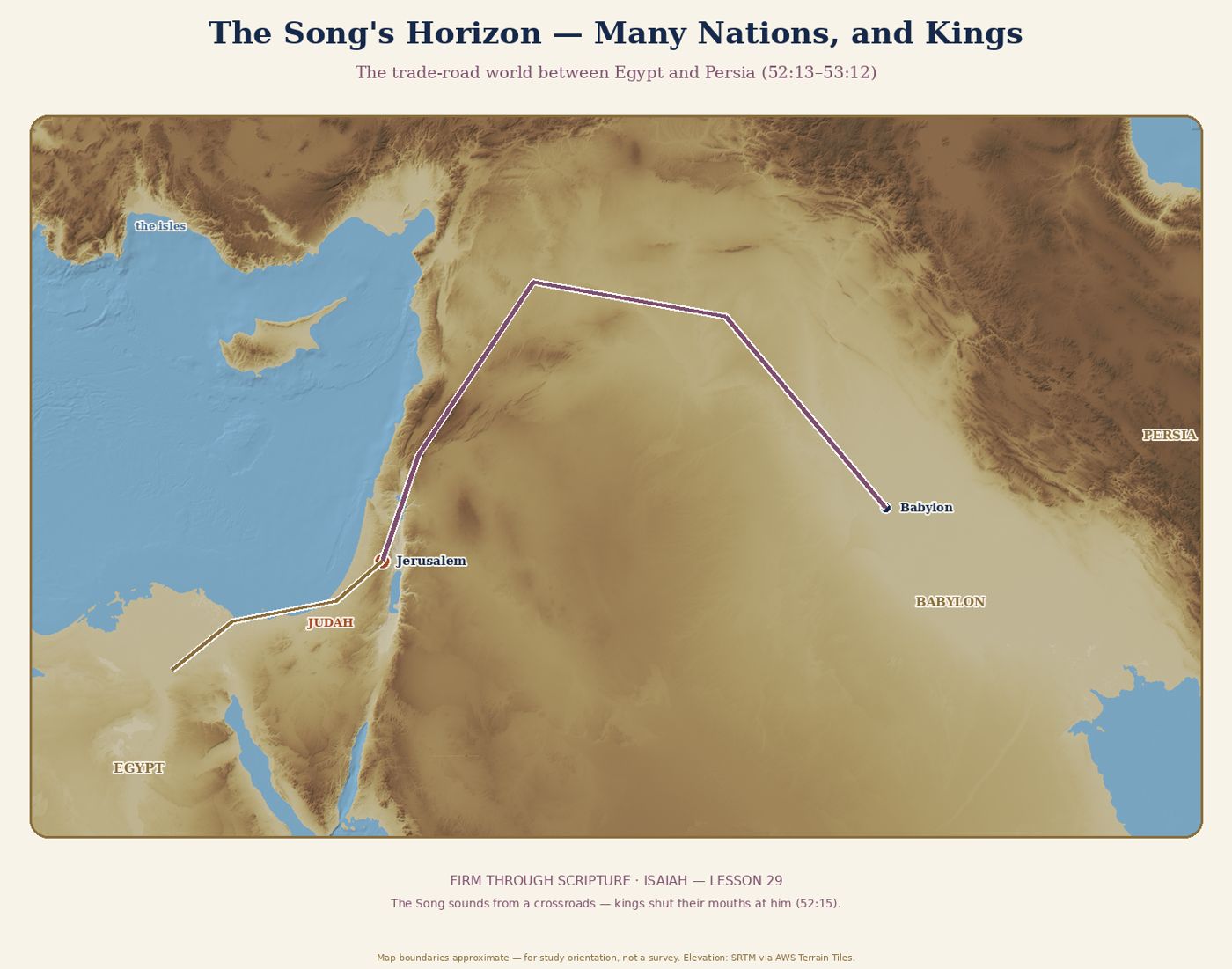
The Servant so far. The word "servant" has been doing double duty for chapters, and both uses are the honest background. The book calls the nation God's servant in so many words (41:8; 44:1–2). 1 And a figure has been emerging inside that calling — Spirit-anointed (42:1, Lesson 21), a light to the nations (49:6, Lesson 26), last seen with a back given to the smiters (50:6, Lesson 27). The fourth Song gathers everything those Songs promised and takes it somewhere none of them went: to wounds, to a grave — and past the grave. Who this Servant is gets the full argument in §16. For now: the Song stands at the climax of the comfort chapters, immediately before the invitation of chapters 54–55 — "Ho, every one that thirsteth, come ye to the waters" — and is the ground that invitation stands on. [3, 4]
The arm, the audience, and the kings. Twice just before this Song, Isaiah cries out about the LORD's arm — His power in action: "Awake, awake, put on strength, O arm of the LORD" (51:9); the LORD "hath made bare his holy arm in the eyes of all the nations" (52:10). 1 The Song's first question — "to whom is the arm of the LORD revealed?" (53:1) — asks where that bared arm shows up. The audience: "many nations" and their kings (52:15). And the speakers change: God speaks the frame (52:13–15; 53:11–12); the middle is a confession — a "we" who once misjudged the Servant. Who "we" is belongs to §16.
A word about the world inside the poem: sacrifice. The Song thinks in the categories of Israel's altar. Under Moses' law, worship ran on offerings: unblemished animals at the sanctuary, their blood handled by priests. Among them stood the guilt offering — in Hebrew, the asham — made when a wrong had created a debt requiring atonement and restitution (Leviticus 5–6). [16, 54] Not a symbol of feeling sorry: the God-appointed way a specific debt was dealt with. Priests also sprinkled blood — flicked from the finger onto altar and mercy seat — applying an offering's benefit (Leviticus 4; 16). 54 When the Song says the Servant will "sprinkle many nations" (52:15) and that God will make His soul an "offering for sin" (53:10 — the asham itself), it reaches into that altar-world, then carries its language to people, and to a Person, the altar never contained. §5 treats those words in full.
That is the world. Now we open the Song itself — and the first discipline is to read it as one Song.
3. OBSERVE — O: what the text actually does
Before meaning comes observation. Most bad reading of this Song is shallow reading — mining fifteen verses for the one line already loved. So watch what the whole poem does:
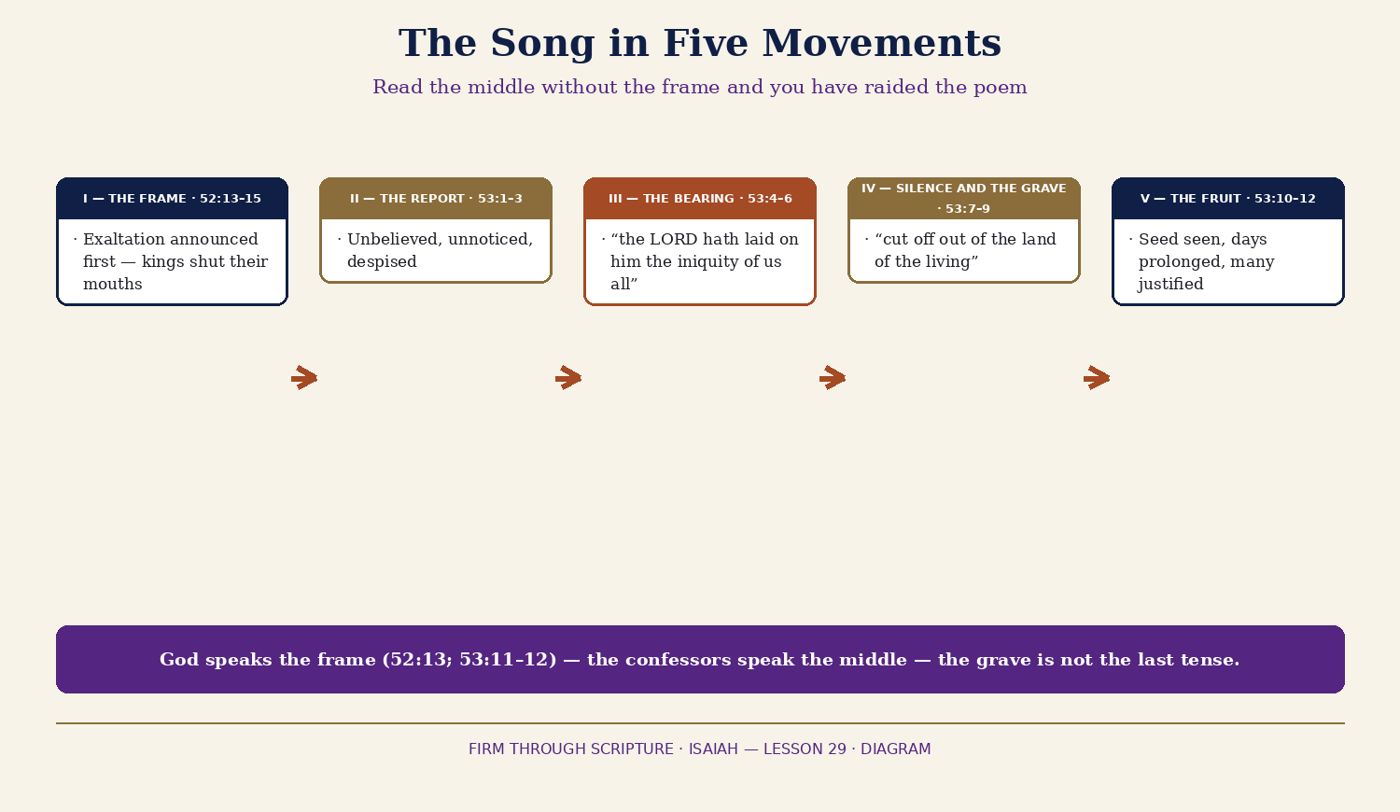
- The shape: five movements, framed by God. The Song falls into five stanzas of three verses each — 52:13–15, 53:1–3, 53:4–6, 53:7–9, 53:10–12 — a shape widely observed across commentators of very different schools. [3, 6, 7] First and last stanzas: God speaking ("my servant"); middle three: the confession. Exaltation announced → the unbelieved report → the bearing → the silence and the grave → the fruit — that arc is a FACT of the text's shape.
- The frame reverses the expected order. Exaltation is announced first (52:13); the Song's last word is not the death but the spoil and the intercession (53:12). A reader who starts at 53:5 has started mid-sentence.
- The pronouns do the theology. Track "he/him" against "we/our/us." Stanza two: we hid our faces, we esteemed him not. Stanza three interlocks them line by line — he bore, our griefs; he wounded, our transgressions — landing on the one clause where God is the subject: "the LORD hath laid on him the iniquity of us all." The substitution is not imported into the Song's pronouns. It is its pronouns.
- The misjudgment is confessed, not hidden. The speakers admit their first reading was backwards: "we did esteem him stricken, smitten of God" (53:4) — his suffering read as God's verdict against him, when it was God's act for them. Your first impression of this figure may be the wrong one; the text knows it.
- The last stanza's verbs turn. Suffering's verbs are passive and past — borne, wounded, bruised, cut off. The final stanza runs forward: "he shall see his seed," "shall prolong his days," "shall justify many" — and one verb is present and ongoing: he "made intercession for the transgressors." The grave is in the Song; it is not the Song's last tense.
- The silences. The Song never names the Servant — no town, no mother, no century. Nor does it describe any resurrection scene; it gives the results — seed seen, days prolonged, spoil divided. The canon will supply the name where the Song supplies the shape (§6).

4. GENRE — N: note the genre (prophetic poetry — the fourth Servant Song)
This is prophetic poetry, and specifically a Servant Song — the fourth of the four poems Duhm's work brought into focus. 40 Poetry in Isaiah is not decoration on prose; it is the book's native tongue, and it reads by its own rules, several of which this Song leans on hard: 51
- Parallelism carries meaning. Hebrew poetry thinks in paired lines — the second restating, sharpening, or completing the first. "He hath borne our griefs, and carried our sorrows" is one fact struck twice, like a bell — not a list to be separated and sold individually. That rule matters directly in §10.
- Prophecy forthtells before it foretells. Fee and Stuart's beginner rule — prophecy is first a word forth, God's covenant message into its own moment — holds here. 51 The Song's first work is theological: it tells exiled Israel who bears sin, against every instinct that says the sufferer must be the guilty one. Its reach beyond that moment is §6's canon question.
- A song is read whole or not at all. A poem with a frame, a confession, and an outcome is an argument in verse; quoting its middle without its ends is quoting a verdict without the trial. This lesson teaches the Song stanza by stanza and whole — and §10 names verse-raiding as the first misread for exactly that reason.
5. TERMS — T: the words in the writer's mouth
Four pieces of the Song's vocabulary carry its weight:
- Asham — "offering for sin" (53:10). Your KJV's phrase translates one Hebrew word, asham, the guilt offering of Leviticus 5–6 — the offering prescribed where a wrong had created a debt: something owed, to God or to a neighbour, to be dealt with by sacrifice and, where possible, restitution. [18, 19] The Song's climax reaches for precisely this word: God will make the Servant's soul — his whole life — an asham. Not a picture of one: the offering itself, at the level of a human life. Any reading that empties the word of that altar content has stopped reading the verse.
- Nazah — "sprinkle" (52:15). The priestly verb: the flicking or sprinkling of blood (or water, or oil) by which an offering's benefit was applied — the priest sprinkled the sin offering's blood on the altar and, on the Day of Atonement, on the mercy seat itself (Leviticus 4; 16). [19, 21] The Song turns that verb outward as no priest ever did: the Servant shall sprinkle many nations. Some propose "startle" instead. 20 That is a DISPUTED rendering, held by a minority; the priestly sense fits the Song's altar-world (§2) and is the KJV's. Either way, what this figure does reaches nations who never stood at Israel's altar.
- "Justify many" (53:11). Courtroom language: to justify is to declare righteous — the judge's verdict "in the right," not a teacher's improvement programme. [18, 21] And do not separate what the Song joins: its ground is stated in the same breath — "for he shall bear their iniquities." The verdict over the many and the bearing by the One are one sentence.
- "Cut off out of the land of the living" (53:8). This book's phrase for the world of the living against the realm of the dead (compare 38:11, Lesson 19); to be "cut off" from it is to die — not a metaphor for a bad year. 19 The next stanza buries him. The plain words are a FACT.
Method note — the word-study guardrail: a word means what its author uses it to mean, in its sentence, in its century — not what its oldest root once meant, and not everything it can mean anywhere. Every term above was settled by Isaiah's usage and the law's. That discipline keeps word studies honest.
TRANSLATION NOTE — "he shall see light" (53:11)?
Your KJV reads: "He shall see of the travail of his soul, and shall be satisfied." In the Hebrew behind the KJV (the Masoretic Text), the Servant simply "shall see" — what is not said; readers supply "the fruit" from "of the travail of his soul." Two ancient witnesses read one more word. The Great Isaiah Scroll (1QIsaᵃ, copied about 125 BC) and the Greek Septuagint both read "he shall see LIGHT." [22, 24] That is a FACT about the witnesses. Many modern translations adopt it, since a scribe is likelier to drop a word than two traditions are to invent the same one. Which reading is original is DISPUTED. Nothing hangs on the variant — fruit seen, or light seen, the outcome in this stanza is the same. But a variant this old and wide belongs on the table.
A smaller witness-note: at 53:8 the Scroll and the Septuagint carry small variants around "taken from prison and from judgment" (the Greek form is the one Acts 8 quotes). [22, 24] The variants are a FACT; the sense — justice itself removed — is stable across them.
6. ENTIRE CANON — E: where this passage sits in the whole story
No Old Testament passage is quoted and applied in the New Testament the way this one is — a list, and a list can be checked. Every item is a FACT of citation: [1, 3]
- The frame becomes a mission charter. Paul, explaining why he preached only where Christ had not been named, quotes 52:15 as his warrant: "To whom he was not spoken of, they shall see: and they that have not heard shall understand" (Romans 15:21). 1
- The unbelieved report frames the unbelief. John quotes 53:1 at the close of Jesus's public ministry (John 12:38) to explain the unbelief that met the signs, setting Isaiah 6:10 beside it under the one name "Esaias" (John 12:38–41). 1 Paul quotes the same line for the gospel's reception (Romans 10:16). 1
- The bearing runs across the ministry, not only at the cross. After an evening of healings, Matthew writes: "That it might be fulfilled which was spoken by Esaias the prophet, saying, Himself took our infirmities, and bare our sicknesses" (Matthew 8:17) — applying 53:4 to the healing ministry, years before the crucifixion. 1 The bearing is the pattern of the whole ministry: griefs carried in the healings by the same One who will carry sins at the cross.
- The apostle re-runs the centre. Peter walks through the Song's middle: 53:9's innocence ("Who did no sin, neither was guile found in his mouth," 1 Peter 2:22), 53:7's silence, then vv. 5–6 nearly verbatim: "Who his own self bare our sins in his own body on the tree… by whose stripes ye were healed. For ye were as sheep going astray" (1 Peter 2:24–25). 1
- The Sufferer quotes the Song of Himself. On the last night, Jesus takes 53:12 as His own text: "this that is written must yet be accomplished in me, And he was reckoned among the transgressors" (Luke 22:37). 1 Whatever else is debated (§16 debates it in the open), this is not: the New Testament's central figure read the Song's final verse as a sentence about Himself that must be accomplished.
- The canon shows its reading being made. On the road to Gaza, an Ethiopian treasurer, returning from worshipping at Jerusalem, sits reading Isaiah at this very passage, in its Greek form: "He was led as a sheep to the slaughter; and like a lamb dumb before his shearer, so opened he not his mouth" (Acts 8:32). 1 He asks the question this book has been building: "I pray thee, of whom speaketh the prophet this? of himself, or of some other man?" (Acts 8:34). 1 Luke's answer is the early church's hermeneutic in one breath: "Then Philip opened his mouth, and began at the same scripture, and preached unto him Jesus" (Acts 8:35). 1
Laid out flat, the New Testament's use of the Song looks like this:
| The Song says… | The New Testament takes it up… | At… |
|---|---|---|
| The nations who never heard shall see and understand (52:15) | Paul's charter for preaching where Christ is unnamed | Romans 15:21 |
| "Who hath believed our report?" (53:1) | The unbelief that met Jesus's signs; the gospel's mixed reception | John 12:38; Romans 10:16 |
| "He hath borne our griefs" (53:4) | Jesus's healings: "Himself took our infirmities, and bare our sicknesses" | Matthew 8:17 |
| No deceit in his mouth; the silence (53:9, 7) | The pattern for suffering wrongfully, in Jesus first | 1 Peter 2:22–23 |
| "By his stripes we are healed"; sheep gone astray (53:5–6) | "By whose stripes ye were healed… ye were as sheep going astray" | 1 Peter 2:24–25 |
| "Numbered with the transgressors" (53:12) | Jesus, of Himself, the night before the cross: "must yet be accomplished in me" | Luke 22:37 |
| The lamb dumb before his shearers (53:7–8) | Read aloud on the Gaza road; Philip "preached unto him Jesus" | Acts 8:32–35 |
7. THE MEANING — what the passage teaches
The Walk has established what the text says and where it sits. Now its payload, taught straight, stanza by stanza.
First movement — the frame: exaltation announced first, horror understood, kings silenced last (52:13–15)
God opens His own Song by announcing the end: His Servant "shall deal prudently" — act wisely and prosper — and "shall be exalted and extolled, and be very high." Three verbs stacked like a staircase, before one suffering is mentioned. [3, 4] Read every horror that follows inside a conclusion God has already published. A triumph announced in advance, whose middle you are about to be shown.
Then the middle shows through the frame itself: "his visage was so marred more than any man" — astonied (52:14) is the old KJV word for stunned, appalled, at a face damaged past ordinary recognition. 19 Hold the frame's halves together: the book's most exalted figure arrives by way of its most marred face. And the frame's last word belongs to the watchers: he shall "sprinkle many nations," and "the kings shall shut their mouths at him" — royalty, whose whole trade is speaking, silenced by "that which had not been told them."
Second movement — the unbelieved report: the arm revealed as this figure (53:1–3)
The confessors take over with a lament: "Who hath believed our report?" The report has been met, in the main, with unbelief; §6 showed John and Paul both quoting this line for exactly that experience, so the church's preachers stand inside this stanza, not above it. The second question gives the report its content: "and to whom is the arm of the LORD revealed?" Remember the arm the prophet begged to wake (51:9), the holy arm bared before all nations (52:10). 1 The Song answers its own book: the arm of the LORD is revealed as this figure. Not as a new exodus spectacle. As a man.
His growth was unpromising: up "as a tender plant" — a soft sucker-shoot, the kind a gardener cuts away — "and as a root out of a dry ground," life where the soil says life is impossible (Visual 2). Then the verdict, without flinching: "he hath no form nor comeliness" — no majesty in the bearing — "there is no beauty that we should desire him." Nothing about him attracted — no charisma to gather a crowd, no splendour to make desire do faith's work. So the stanza lands on the social fact: "He is despised and rejected of men; a man of sorrows, and acquainted with grief" — acquainted, knowing grief by long familiarity, from the inside. "And we hid as it were our faces from him" — people passing a suffering they do not want to see — "he was despised, and we esteemed him not." Priced at nothing. Whoever "we" is — §16 lays the options out, labelled DISPUTED (the kings and nations of 52:15 turned confessors; Israel confessing; the prophet for his people) — the confession's content is the text either way: we saw him, we priced him at nothing, and we were wrong. [3, 6, 42]
Third movement — the centre: the grammar of bearing (53:4–6)
Everything the Song exists to say stands in these three verses, in their grammar. Take it clause by clause.
"Surely he hath borne our griefs, and carried our sorrows." Surely is a correction word: what really happened was this. The verbs are load-verbs — what a porter does with a weight belonging to someone else (this book used "carried" for God carrying His people, and for idols that must themselves be carried, 46:1–4, Lesson 24). [3, 4] What he carries is ours. He did not merely sympathize with the load. He got under it.
"Yet we did esteem him stricken, smitten of God, and afflicted." The confession's pivot: the ancient world's reflex — and ours — reads great suffering as God's verdict on the sufferer. The speakers confess it as their error.
"But he was wounded for our transgressions, he was bruised for our iniquities." Now the for. The wounds are specified — pierced (wounded), crushed (bruised) — and their direction with them: for our transgressions… for our iniquities. The preposition is the doctrine. Exchange is not a theory laid on this verse; it is the verse's syntax.
"The chastisement of our peace was upon him." The punishment that our peace — peace with God, the shalom — required. It did not evaporate. It was located: upon him.
"And with his stripes we are healed." Stripes — the welts of a beating. The healing is real and by them: the instrument of his wounding is the instrument of our cure. (What "healed" covers: Matthew, below.)
"All we like sheep have gone astray; we have turned every one to his own way." Not a few bad sheep but all — and not victims of the flock but each one deliberately: "every one to his own way." Straying, here, is not getting lost. It is choosing your own road.
"And the LORD hath laid on him the iniquity of us all." The Song's most important sentence about agency. Who did this? Not the crowd, not the soldiers, not chance. The LORD hath laid on him — causing to fall upon: the iniquity of all of us, made to land on one. [18, 19] Teach it exactly as it stands: the substitution here is not men's violence afterwards reinterpreted as meaningful. In the Song's own telling it is God's own act — the LORD is the subject of the laying-on.
Matthew's reading, taught exactly (53:4 and Matthew 8:17). Matthew applies v. 4 to an evening of healings — "Himself took our infirmities, and bare our sicknesses" — before the cross is in view. 1 The evangelist reads the bearing as the pattern of the whole ministry: the healings are not illustrations borrowed for colour but the bearing itself at work, griefs carried by the same One who will carry sins. This forbids both flattenings: the healing-only reading that seizes v. 4 (or v. 5's "healed") as a mechanism guaranteeing any particular healing on demand — the verse is about him bearing, not a technique in our hands — and the cross-only reading that treats Matthew 8:17 as an embarrassment, as though the apostle misapplied his own Bible. The passage is read whole: sickness borne in the ministry, sin borne at the cross, one Servant, one bearing. (The divided atonement theories and healing claims are handled, labelled, in §16.)
Fourth movement — the silence and the grave (53:7–9)
"He was oppressed, and he was afflicted, yet he opened not his mouth." The stanza's centre is a refusal: no self-defence, no curse back, no summoning of rescue — "brought as a lamb to the slaughter" (Visual 4).
"He was taken from prison and from judgment" — swept out of custody and out of any just process (small variants here, §5). [22, 24] "And who shall declare his generation? for he was cut off out of the land of the living" — no posterity: he dies, in §5's plain sense, and dies childless — "for the transgression of my people was he stricken," God's own voice (my people) underwriting stanza three's grammar from heaven's side.
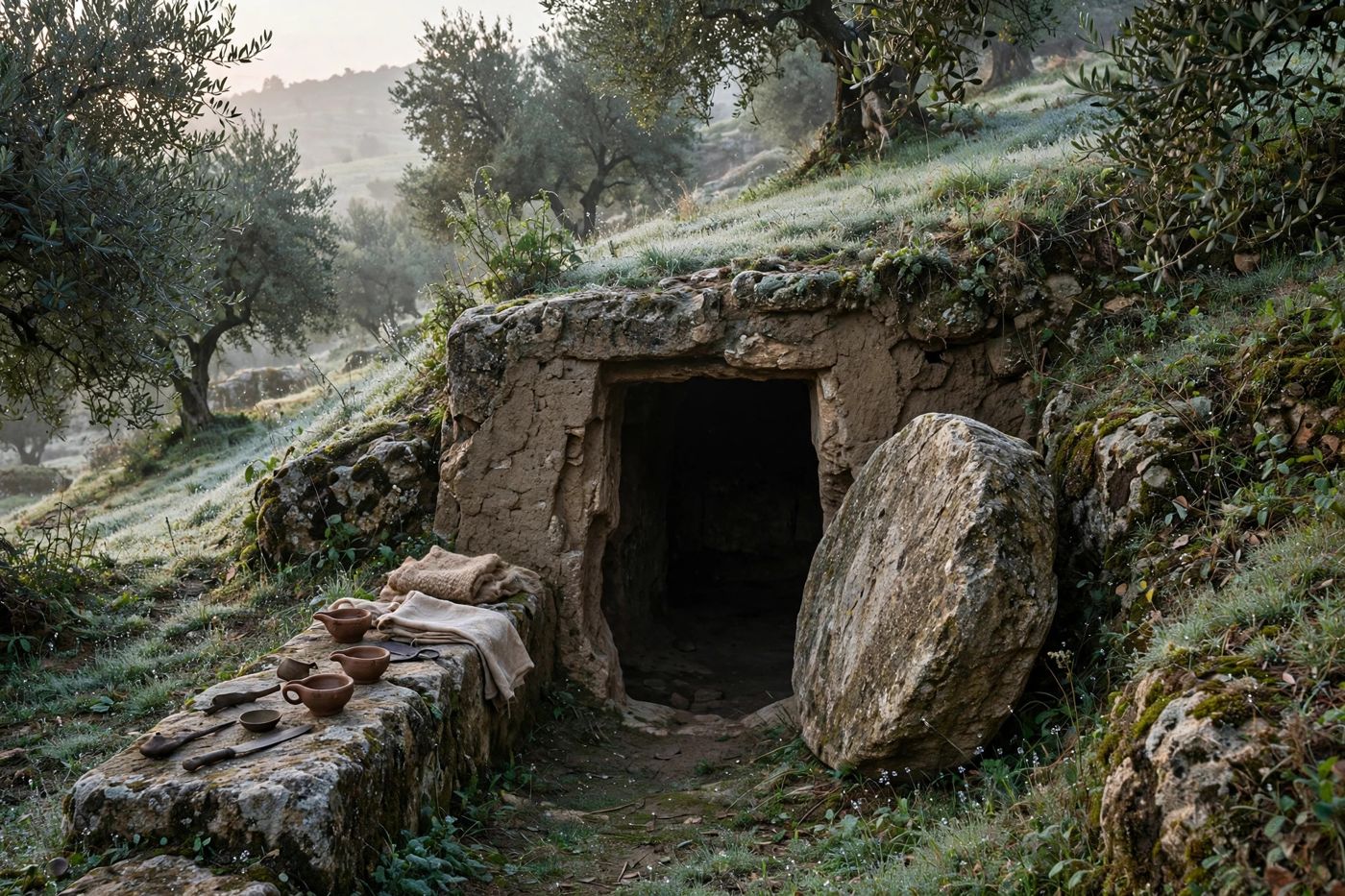
Then the grave, and the Song's quiet paradox, stated and not solved cheaply: "And he made his grave with the wicked, and with the rich in his death." A grave assigned with the wicked — the executed man's expected end — and yet, in his death, with the rich. (§6's table gives the New Testament's telling: a rich man of Arimathaea, a new tomb in a garden — Matthew 27:57–60; John 19:41.) 1 The ground follows at once, Peter quoting it as the Servant's certificate: "because he had done no violence, neither was any deceit in his mouth" (1 Peter 2:22). 1 Innocence is the substitution's load-bearing wall: only a bearer who owed nothing could bear what others owed.

Fifth movement — the outcome: "it pleased the LORD," and the fruit after death (53:10–12)
Now the stanza every reader trips on, taught unsoftened, with its own grammar in hand: "Yet it pleased the LORD to bruise him; he hath put him to grief." The Song does not say God enjoyed pain. It locates the bruising inside the LORD's pleasure — His purpose and good intent (the same word ends the verse). Stanza three prepared you: the LORD laid the iniquity on him; stanza five says the laying-on was not reluctant. The hardest clause in Isaiah is its most necessary: the bearing was God's purposed act — the only ground on which it can be for us rather than merely to him. [3, 7]
Then the grammar does something extraordinary: "when thou shalt make his soul an offering for sin, he shall see his seed, he shall prolong his days." What is promised to a man the Song has just buried? Seed — offspring — for the childless dead of v. 8. Prolonged days — lengthened life — for the man cut off from the land of the living. The stanza is not confused; it proclaims a life on the far side of this death, locating the pleasure of the LORD in the offering's fruit — seed seen, days prolonged. A buried, childless man who afterwards sees offspring and lives long is a man death did not finish with — said without one resurrection scene, the results given and the canon (and Easter) left to supply the event. INFERENCE — the stanza's strongest reading; alternatives are weighed in §16.
"He shall see of the travail of his soul, and shall be satisfied" (§5's "light" waits there). "By his knowledge shall my righteous servant justify many" — God's voice again, its ground attached: "for he shall bear their iniquities." The verdict over the many rests on the bearing by the One — courtroom and altar in one sentence (§5).
"Therefore will I divide him a portion with the great, and he shall divide the spoil with the strong" — the conqueror's distribution, awarded because: "because he hath poured out his soul unto death: and he was numbered with the transgressors; and he bare the sin of many, and made intercession for the transgressors." The spoil is his because the death was his; the counting among transgressors — criminals on either side in the Gospels' telling (Luke 23:32–33) 1 — was itself part of the bearing; and his present activity, the Song's last word about him, is intercession — the once-silenced mouth now open, permanently, for the very people he was numbered with.
The Christ Thread
This passage earns the thread at full strength the way this course requires: not by forced symbolism, but by the canon's own citations, laid out as FACT in §6. Gathered: the New Testament reads this Song of Jesus at every joint of its arc — His healings (Matthew 8:17), His innocence and silence (1 Peter 2:22–23), His bearing of sins on the tree (1 Peter 2:24), His burial by a rich man (Matthew 27:57–60), His counting with transgressors, in His own mouth the night before (Luke 22:37), and His identity preached from this text to its first recorded Gentile inquirer (Acts 8:35). 1 The course's POSITION, argued in full in §16 with the corporate evidence at full strength beside it: the Servant of the Song is the coming One in whom Israel is embodied and for whom Israel's story was the pattern — the nation's vocation gathered into a single righteous bearer, so that what Israel was called to be and could not, he is; and what Israel suffered as pattern, he suffers as reality, for Israel and for the many nations of the frame.
Where in the Covenant Story?
The Song stands inside the new-exodus movement of Isaiah 40–55: God is bringing His people out of Babylon as once out of Egypt, and the section's pressing question is how a holy God brings a guilty people home — a people the book calls transgressors from the womb (48:8). 1 The Song is the deepest answer: not merely a road through the desert (40:3) or a Cyrus to open the gates (45:1), but a bearing of the iniquity that made exile just. In covenant terms, v. 10's asham takes Sinai's guilt offering — local, animal, repeated — and speaks of a soul made that offering, once, with nations in its reach (52:15). The new covenant the wider canon announces (Jeremiah 31), forgiveness as its foundation stone, presupposes exactly this dealing with iniquity. 57
Father, Son, and Spirit
Ask the course's standing question — which Person is acting? — and the Song answers clearly about the Father: framing voice and acting subject — the Servant His ("my servant"), the iniquity laid on by Him, the bruising within His pleasure, the spoil divided by Him, the justification of many announced in His sentence ("my righteous servant"). The Son is not named here — the Song predates the naming — but the figure the New Testament identifies with the Son is the passage's entire middle: bearer, silent lamb, soul made an offering, intercessor. Their relation in the atonement is one purposed act, not two wills at war: the Father laying on, the Servant bearing without refusal. The Spirit is not named in these fifteen verses, and this lesson will not pretend otherwise; the earlier Songs' Servant is the Spirit-anointed one (42:1; 61:1), and the Songs are read together, as the book gives them.
The Long View — what the church has believed
Across two thousand years, this Song has been the church's central Old Testament text for the cross — its argument often conducted in the open. Justin Martyr's Dialogue with Trypho (2nd century) argues Isaiah 53 with a Jewish interlocutor chapter by chapter. 44 Jerome treats the Song, as the whole early church did, as one prophet's witness to Christ. 37 Calvin lingers on the grammar of for and on God as the laying-on's subject. 36 The church's historic reading is a POSITION in the academy's terms and a confession in the church's: stated here with its label on, argued in §16. What the centuries have not divided over is the centre: the suffering is vicarious — borne for others, at God's appointing — and exemplar-only readings were weighed early and found to require erasing the central stanza. Christians divide honestly only over the mechanics — how the bearing saves — and the reach of "healed" in v. 5.
8. THE AIM SENTENCE — X: eXplain the intent
Everything observed now compresses into one sentence — the author's intended meaning, stated before any application:
Isaiah's fourth Servant Song announces God's own act of salvation: His Servant — announced exalted before he is shown marred, despised and disbelieved, silent under affliction and cut off into a borrowed grave — bears the griefs, transgressions, and iniquity of others because the LORD Himself lays them on him and makes his soul a guilt offering, so that the many are healed, justified, and gathered in, and the buried Servant lives to see his seed, divide the spoil, and intercede for the transgressors he was counted among.
9. SAY IT BACK
Close the book and say the AIM sentence from section 8 in your own words, without looking. Then say, in one more sentence, what it asks of you this week.
If your version quietly changes the meaning — the guilt offering become only an example, the exaltation dropped — open the lesson and walk it again. This exercise is the entire course in miniature: meaning first, then — and only then — your life.
10. THE MISREAD — the guardrail, with verdicts
Three live misuses of this Song — each with a fair hearing, the evidence, and a verdict.
Misread 1: "Isaiah 53:5 is a standalone promise — quote the one line and claim its benefit: 'by his stripes I am healed,' full stop." Why it sounds right: the line is really there, and really does say "we are healed." The evidence: the verse is the middle line of a stanza, inside a Song with a frame, and the Song polices the raiding. Verse 5's healing is by stripes that are for our transgressions — the stanza's subject is sin borne, its healer God acting through the Servant's bearing, not a formula in the reader's hand. Matthew's use of the neighbourhood (8:17) applies v. 4 to Jesus bearing sicknesses in His ministry; Peter's use of v. 5 itself (1 Peter 2:24) sets "by whose stripes ye were healed" after "bare our sins in his own body on the tree," in a paragraph about suffering wrongfully — not about claiming outcomes. 1 Verdict: read the whole Song or you have not read the verse. The healing of Isaiah 53 is real, deep, and sin-deep first; it is received by trusting the Bearer, not by operating a line of poetry as a mechanism.
Misread 2: "The Servant is really just a moral example — his patience is the point, and the 'bearing' language is poetic colour." Why it sounds right: the example is there — Peter applies vv. 7–9's silence and innocence as the pattern for believers suffering unjustly (1 Peter 2:21–23), so an example-reading can quote an apostle. The evidence: Peter applies the example on the ground of the bearing — his next verse is "who his own self bare our sins in his own body on the tree" (1 Peter 2:24). 1 And the text's grammar is not colour: borne… carried… wounded for our transgressions… the LORD hath laid on him the iniquity of us all… his soul an offering for sin… he shall bear their iniquities. An exemplar reading must erase vv. 4–6 and 10–12 to stand — delete the centre and the climax, keep only the patience. What remains is not a leaner reading of the Song. It is a shorter poem nobody wrote. Verdict: example, yes — §13 will take it. Example only, no: that a bearing stands at the centre is the text, not a theory.
Misread 3: "The identity debate is a distraction — honest readers don't need it mentioned" (and its mirror: "the academy has settled it, so the church's reading is just stubbornness"). Why it sounds right: both versions sound like maturity — one protecting devotion from argument, the other scholarship from devotion. The evidence: the question is the one the text's own first recorded reader asked aloud — "of whom speaketh the prophet this? of himself, or of some other man?" (Acts 8:34) 1 — and the evidence runs in more than one direction: the book names Israel God's servant (41:8; 44:1; 49:3) and gives the Servant a mission to Israel (49:5–6); the Targum names him Messiah and moves his sufferings elsewhere 38; Rashi's school reads him as Israel personified 39; the New Testament applies the Song to Jesus at every joint (§6). Hiding any column of that table — the church reader who hides the corporate evidence, the critic who hides Acts 8 — is the same act by opposite teams. Verdict: the debate gets a full table in §16, labels on, POSITION stated. A faith that must hide evidence is not being protected; it is being managed.
11. FROM WORD TO WALK
A reflection page — the lesson is not finished until the passage has had its say with you.
Sit first with the confession, because the Song puts you inside it before it lets you admire it. The speakers' mistake was not cruelty; it was a reading — they saw a man under affliction and concluded, with the whole ancient world nodding behind them, stricken, smitten of God. Ask, before this week is out, where that reflex lives in you: whose suffering have you filed under "God must be teaching them something," and walked past with your face hidden — the gesture this Song confesses by name?
Then sit with the centre's other side, the side meant for you as one of the straying. The confession does not say "all we like sheep were driven astray." It says we turned, every one, to his own way — your road, chosen. If part of your life has been described as drifting when the honest word is choosing, this Song gives you the sentence to say it in — and then the better sentence that follows: the iniquity of it has somewhere to land that is not you. It was laid — by the LORD, on purpose — on the One who could bear it. Confession here is not grovelling. It is agreeing with the stanza.
And let the frame do its quiet work on your worst week. God announced the exaltation before He showed the marred face; He is not asking you to pretend the middle isn't marred — He wrote it Himself. Read your middle the way He taught you to read His Servant's: inside a conclusion He has already published. You are, if you are in Christ, among the "many" of v. 11 — justified not because your case was strong, but because his bearing was.
LORD — I confess the hidden face: the suffering I explained away, and the straying I called drifting. You laid on him the iniquity of us all — lay my self-defence down too. Teach me to read the marred middle of things, mine and others', inside the end You have already announced; and let the intercession that ends the Song be the sound my week is lived under. In Jesus' name, amen.
12. FOR DISCUSSION — OR FOR YOUR JOURNAL
With a group, work these aloud. Alone, they're yours — answer them in your journal or in prayer; they lose nothing in the quiet.
- The confessors' first reading — "stricken, smitten of God" — was their whole world's reflex. Where does it appear today, in the church and in you: whose suffering gets read as God's verdict, and what does this Song do to that reading?
- God announces the exaltation (52:13) before showing the marred face (52:14). How does knowing the end first change how a believer reads a marred middle — in this text, and in a hard season of your own?
- Matthew applies 53:4 to Jesus's healings; Peter applies 53:5–6 to the cross and to conduct under injustice. What does holding both apostles' uses together do to your reading of "by his stripes we are healed"?
- The Ethiopian's question — "of whom speaketh the prophet this?" — is asked in churches and classrooms still. Using §6 and §16, how would you answer a friend who asks it honestly — with the evidence complete, and without pretending the question is small?
13. THE WALK-OUT — T: Transfer to today
Meaning is settled. Now application — and it must cross the bridge honestly. Run the five Transfer Tests:
- Same covenant? The Song's guilt offering is announced before it is accomplished; we live after the accomplishment. The offering is not repeated or supplemented, and no practice re-enacts the bearing. What crosses is trust in the Bearer.
- Same audience? The confession's "we" is first the Song's own speakers (§16). We enter it by the Song's own grammar: "all we like sheep" leaves no reader outside the flock, and the "many" justified are a door the text itself opens.
- Same genre rules? Prophetic poetry, read whole: applications hang on the Song's arc and grammar, not on a severed line — §10's first verdict is a transfer rule.
- Repeated or rooted? Confession and trust in God's provided bearing; refusing to read suffering as automatic verdict; non-retaliatory silence under injustice (1 Peter 2:21–23); intercession for wrongdoers — each rooted in God's character and repeated across the canon. These cross.
- Ten verses either side? Every application below comes from these fifteen verses read whole — frame, centre, and fruit together.
The gate in one line: the offering is finished and unrepeatable; trust, confession, and intercession cross — mechanisms and severed lines do not.
What crosses — and lands:
- God has acted first. The indicative before every imperative here is the Song itself: the LORD hath laid — God's act, before any response of ours exists. The Christian life this passage builds is life lived in answer to what He says He has done.
- Confession with the Song's exact honesty. Name the straying as turning ("every one to his own way"), and the misjudgments too — faces hidden, sufferers written off.
- A corrected eye for suffering. This Song permanently forbids afflicted, therefore God-forsaken — first about its Servant, and by rooted extension (test 4) about the afflicted generally. The church that has read Isaiah 53 draws near to the marred.
- The pattern of the silence, in its place. Under unjust treatment, the Servant's non-retaliation is the apostles' pattern for us (1 Peter 2:21–23) — entrusting oneself to the Father who judges righteously. It is a pattern for suffering wrong, never a command to conceal crime or refuse all defence of others; it crosses only along Peter's road, at Peter's scope.
- Intercession as the Song's last tense. The figure who would not open his mouth to escape ends by opening it for transgressors. Prayer for wrongdoers — including the ones who wronged you — is this passage's final verb, not an advanced elective.
Practices — what the gate lets through, made concrete this week:
- Read the Song whole, aloud, once a day this week. Fifteen verses, frame to fruit. Let the arc do what fragments cannot.
- The confession in writing. Write your own "all we like sheep" sentence — one specific own-way turning, named — then write stanza three's last clause over it, in your own hand, as the answer.
- Unhide one face. Name one sufferer — a person, not a category — you have been explaining away or avoiding, and take one concrete step toward them this week: a visit, a call, a meal, money, time. The step counts; sentiment alone is the hidden face again.
- Practise the Peter-pattern once. In one situation of unfair treatment this week — small is fine — refuse the retaliatory sentence you were about to speak or send, and entrust the matter to God in prayer instead.
- Intercede by name. Pray, by name and more than once this week, for one person you would honestly class among the wrongdoers.
What does not cross: claiming verse 5 as a mechanism obliging God to any particular healing on your timetable (§10, Misread 1 — the healing is the Bearer's work, received by trust, in the Song's whole arc); treating the Servant's silence as a rule that suffering must never be reported, resisted, or fled; treating the guilt offering as a rite anyone repeats. The gate is not there to shrink the Bible's claims on you — it is there to make sure the claims that land are the ones God actually made.
Praise Him
Praise the LORD who speaks the end before the middle — exalted, extolled, and very high — and did not spare the marred middle to get there. Praise Him that the laying-on was His: no iniquity of ours met His eye that He had not already laid where it could be borne. Praise the righteous Servant who justifies many, who sees of the travail of his soul and is satisfied, and who lives — prolonging his days into our days — still making intercession for the transgressors. The kings shut their mouths. We open ours, to say back what His own Song said first: surely he hath borne our griefs. Amen.
14. THE RECAP CARD — this study on one page
Print it. Keep it where you'll see it this week.
- The passage: Isaiah 52:13–53:12 — the fourth Servant Song: frame, unbelieved report, bearing, silence and grave, fruit.
- Say It Plain: God announces His Servant exalted, then shows him marred and misjudged; he was bearing their griefs and sins — the LORD laid their iniquity on him and made his soul a guilt offering — and the buried Servant lives to justify many and intercede for transgressors.
- The AIM: Isaiah's fourth Servant Song announces God's own act of salvation: His Servant — announced exalted before he is shown marred, despised and disbelieved, silent under affliction and cut off into a borrowed grave — bears the griefs, transgressions, and iniquity of others because the LORD Himself lays them on him and makes his soul a guilt offering, so that the many are healed, justified, and gathered in, and the buried Servant lives to see his seed, divide the spoil, and intercede for the transgressors he was counted among.
- Key terms: asham — the guilt offering; his soul made the offering itself · nazah — to sprinkle, the priestly verb turned on many nations · "justify many" — the courtroom verdict, grounded in his bearing · "cut off out of the land of the living" — he truly dies.
- The Misread, in one line: never raid 53:5 out of its Song · example only must erase the bearing · the identity question gets a full table, not a hiding.
- Memory verse: "But he was wounded for our transgressions, he was bruised for our iniquities: the chastisement of our peace was upon him; and with his stripes we are healed." — Isaiah 53:5
- This week's practice: read the Song whole, aloud, daily — and unhide one face: one named sufferer, one concrete step toward them.
15. CHECK YOURSELF — five questions
Answer from the study, not from instinct. (Answers are in the Teacher Edition.)
- In your own words: what is the AIM of this Song?
- Walk the Song's five movements in order. In the centre movement (53:4–6), who is the subject of the last clause — and why does it matter?
- What is an asham, and what does 53:10 say God makes of the Servant's soul? What two impossible-sounding things are then promised to a man the Song has buried?
- A friend says: "Isaiah 53 is just about Israel in exile — Christians borrowed it later." Give two difficulties the corporate reading struggles to carry, and one piece of evidence that keeps it honestly on the table.
- Someone quotes "by his stripes I am healed" as a guarantee to claim a specific healing this week. Run the five Transfer Tests. Where does it fail — and what does Matthew 8:17 actually show the verse's neighbourhood doing?
16. GO DEEPER
Optional — the lesson is complete without it.
From the Sources — the oldest copy of this Song
The Great Isaiah Scroll (1QIsaᵃ, c. 125 BC, Qumran Cave 1) contains this Song complete — already one scroll of all 66 chapters, centuries before the New Testament. 22 Two things follow, and both are FACT. First, nobody can claim the church composed or inserted Isaiah 53 to suit its message: the Song sat in its scroll, in Jewish hands, generations before Jesus was born. Second, the Scroll is a working witness, not a museum copy — its small variants (the "light" at 53:11; the wording at 53:8) are the living evidence of the text being copied, read, and argued over long before either side of the later argument existed. [22, 24] The Septuagint, the Greek Isaiah translated in the same broad era, tells the same story: one book, this Song in place, and a Greek wording close enough that the Ethiopian treasurer on the Gaza road was reading recognizably this text (Acts 8:32–33). 24
The Honest Argument — of whom speaketh the prophet this?
The Ethiopian's question is the oldest recorded form of the scholarly question. Here is the whole table, every reading at full strength, labels on; the verdict comes last.
(a) The corporate reading: the Servant is Israel. Its evidence, at full strength, is real and textual. The book names the nation God's servant in so many words: "But thou, Israel, art my servant, Jacob whom I have chosen" (41:8); "O Jacob my servant; and Israel, whom I have chosen" (44:1); and, inside the second Song itself, "Thou art my servant, O Israel, in whom I will be glorified" (49:3). [1, 42] Israel suffered in exile, was despised among nations, and was "cut off" from her land — and Ezekiel's valley vision reads the nation's death as exile, her resurrection as return (Ezekiel 37:11–14): the corporate reading's best bridge. 1 A people can be figured as a person throughout this book (Zion a woman, Jacob a worm, 41:14), so this is no desperate invention: it is the reading of Rashi's school 39 and of much modern scholarship. [42, 43]
Its difficulties, stated as fairly. (i) Mission to Israel: the Song that names him Israel (49:3) then gives him a mission to Israel — "to bring Jacob again to him… to raise up the tribes of Jacob" (49:5–6) — a distinction the corporate reading must flatten, reading v. 3 as the ideal and vv. 5–6 as the actual: an interpretation laid on the text, not read off it. 42 (ii) Innocence: the bearer "had done no violence, neither was any deceit in his mouth" (53:9), while this book's verdict on the nation is "a people laden with iniquity" (1:4), "wounds, and bruises, and putrifying sores" with "no soundness in it" (1:6), a people given over "against whom we have sinned" (42:24), "called a transgressor from the womb" (48:8). 1 The bruised body of chapter 1 is the guilty nation; the bruised body of chapter 53 is the innocent bearer. (iii) The substitution grammar: if the bearer is the whole nation, who is the "we" whose griefs he bears and whose iniquity the LORD lays on him? Bearer and borne-for interlock as distinct parties for three stanzas; the pronouns resist making Israel both. (iv) The grave and the prolonging: the nation survived exile and returned — which cuts against the bridge in reverse. Ezekiel 37's metaphor covers a figurative cutting-off well, but the Song buries its figure, promises him seed though childless, and prolongs his days though dead — a sequence fitting a person past death more naturally than a nation whose seed and days never stopped. North weighs the attempted answers to each. 42 Together, they are why the corporate reading has never carried the whole Song without remainder. DISPUTED — the reading; FACT — the texts on both sides, as quoted.
(b) The remnant reading. The Servant is faithful Israel within Israel, suffering with and for the rest. It eases (iii) and honours the book's remnant theology (Lesson 1; 10:20–22). Its costs: the remnant is nowhere called innocent in 53:9's terms, nowhere made an asham for the nation, and (iv) stands undiminished. 42 DISPUTED.
(c) An individual contemporary. All have been tried. The prophet himself: he suffers in the book, but no deceitlessness, grave, or seed-after-death attaches to him, and God speaks of the Servant in the third person, as of another. Jeremiah: the strongest parallel — persecuted, "a lamb… brought to the slaughter" in his own words (Jeremiah 11:19) — but he died in Egypt an old man, and no text makes his suffering an offering for the nation's iniquity. 42 A king — Hezekiah (Lesson 19) or Josiah: Hezekiah's prolonged days tempt the parallel, but his sickness bore no one else's sins and his confessed pride stands against 53:9's innocence (39:8; 2 Chronicles 32:25–26). The consensus across schools: no contemporary carries the Song's details. 42 FACT about the state of the argument.
(d) The Targum's witness — the telling middle evidence. Targum Jonathan, the Aramaic paraphrase read aloud in synagogues, opens this Song naming the figure outright: "my servant the Messiah." 38 Then it keeps the Messiah and systematically reassigns the sufferings — the griefs fall on Israel's enemies, the humiliation transferred away. It testifies in both directions at once — the most telling document in this file: the ancient synagogue tradition could keep neither the Messiah out of the Song nor the suffering on him, and solved the tension by surgery. 38 FACT — the Targum's text and moves; this course gives them great weight.
The middle evidence in one line: the Targum could keep neither the Messiah out of the Song nor the suffering off him — and solved it by surgery.
(e) Rashi, in his setting. Rashi (11th century) and his school read the Servant consistently as Israel personified among the nations. 39 The setting matters, respectfully: the reading was sharpened in centuries when Isaiah 53 was wielded in forced disputations against Jewish communities — a weapon against the very people whose book it is. [39, 44] That a besieged community read its own suffering into its own Scriptures' suffering text is exegesis under fire, not evasion, and (a)'s evidence gave it real footing. Ibn Ezra left doors open Rashi closed. 39 FACT — the readings and the setting; the pressure explains the hardening without settling whether the reading is right.
(f) The modern poles: North and Whybray. North's The Suffering Servant in Deutero-Isaiah remains the classic survey — every identification weighed, the conclusion that the figure outruns every candidate its first centuries could supply. 42 Whybray argued the comfort chapters as one exilic genius's coherent work and read the Servant within that community's self-understanding — the strongest modern form of the skeptical case. 43 Between those poles the academy still works. DISPUTED.
(g) The New Testament's sustained application — and the course's POSITION. Against that table, set §6's list — simply the record: the frame as a mission charter (Romans 15:21); v. 1 quoted by John and Paul (John 12:38; Romans 10:16); v. 4 applied by Matthew to the healings; vv. 5–6 and 9 re-run by Peter; v. 12 claimed by Jesus for Himself on the last night (Luke 22:37); the Song read on the Gaza road and answered with the preaching of Jesus (Acts 8:35). 1 John even welds the book's two ends together — 53:1 and 6:10 under the one name "Esaias," in one paragraph about one ministry (John 12:38–41). 1 The earliest church argued this chapter in the open with Trypho 44, believing the identification was in the text. POSITION — this course's, and the historic church's: the Servant of the Song is the coming One in whom Israel is embodied and for whom Israel's story was the pattern. The corporate texts (41:8; 44:1; 49:3) are not explained away; they are gathered up — he bears Israel's name because he bears Israel's calling, and then does, innocently, substitutionally, and past death, what the called nation could not do for itself or the nations. Israel's sufferings are the pattern; his are the reality it pointed to — the New Testament's application is recognition, not borrowing, and (a)'s difficulties are not embarrassments to the church's reading but its very outline.
The table in one view:
| Reading | Strongest evidence | Heaviest difficulty |
|---|---|---|
| Israel (corporate) | Named "my servant" — 41:8; 44:1; 49:3 | Mission to Israel (49:5–6); innocence (53:9); the "we" |
| The remnant | The book's remnant theology | Nowhere made an asham; the grave-and-seed sequence |
| A contemporary individual | Jeremiah's parallels (Jer. 11:19) | No candidate carries death, grave, and fruit together |
| The Targum's Messiah | "My servant the Messiah" 38 | The sufferings reassigned, not borne |
| The coming One (POSITION) | The NT's sustained application (§6) | Must gather, not erase, the corporate texts |
A note on the theories, as promised in §7. How the bearing saves has been modelled several ways — penal substitution (the Servant bears the penalty justice required), satisfaction (his offering makes full amends to God's honour), Christus Victor (in bearing, he breaks the powers that held the straying), governmental and moral-influence models at the spectrum's other end. [3, 11] Each can quote its stanza. This course teaches the Song's own grammar as the core every faithful theory must carry — bearing, laying-on by God, for-ness, guilt offering, justification grounded in the bearing — and labels the mechanics beyond it DISPUTED among Christians. Likewise on healing: "healed" (53:5) read whole covers the borne-for's whole restoration — sin's guilt at the centre (Peter), sickness really borne in the ministry (Matthew), final wholeness at the resurrection horizon; the on-demand guarantee of any specific present healing is refused by §13's tests, and the claim that it has nothing to do with bodily healing is refused by Matthew 8:17 itself. [1, 3]
The Word Underneath — "laid on him": hifgiaʿ
Stanza three's greatest clause turns on one verb. "The LORD hath laid on him the iniquity of us all" renders pagaʿ in its causative stem: to cause to meet, to make fall upon a person. [18, 19] Its ordinary stem ranges over meeting and over intercession, meeting God on another's behalf — and the Song's last word about its Servant uses the same verb: "he… made intercession for the transgressors" (53:12). [1, 18] The iniquity was made to meet him; he now meets God for the transgressors. FACT — the range and the two occurrences; the sermon in their pairing is INFERENCE.
Go Read
- C. R. North, The Suffering Servant in Deutero-Isaiah 42 — the classic survey of every identification of the Servant; the honest map of §16's argument.
- Edward J. Young, The Book of Isaiah, vol. 3 7 — the standard evangelical treatment of Isaiah 53, meticulous on the Hebrew.
- J. Alec Motyer, The Prophecy of Isaiah 4 — on this Song's structure and the Servant within the one book.
- Targum Jonathan to Isaiah 52–53 38 — read it yourself: the Messiah named, the sufferings reassigned.
17. SOURCES & REFERENCES
Numbered citations in this lesson key to this list — the course standard: every sourced claim carries its number, and every number can be checked. 1. The KJV text itself — Holy Bible, King James Version (eBible.org KJV, 1769 text). Scripture quotations are from the King James Version (KJV), which is in the public domain in the United States; the full passage is always assigned as reading. Cross-references within Scripture cite this number.
-
Oswalt, The Book of Isaiah, Chapters 40–66 (NICOT) — John N. Oswalt (Eerdmans). The second volume: the comfort section, the Servant Songs, Cyrus, and the new-creation chapters, read as the deliberate answer to chapters 1–39.
-
Motyer, The Prophecy of Isaiah — J. Alec Motyer (IVP). A one-volume commentary by an evangelical scholar who argues the whole book breathes the mind of the eighth-century prophet; especially strong on the book's structure, its repeated refrains, and the Servant.
-
Goldingay, Isaiah (Understanding the Bible / NIBC) — John Goldingay (Hendrickson). A mainstream-critical one-volume commentary; the exilic-community reading of chapters 40–55 stated fairly, with close attention to the poetry.
-
Young, The Book of Isaiah — Edward J. Young (Eerdmans, 3 vols.). The classic conservative commentary; meticulous on the Hebrew and on the unity question, and the standard evangelical treatment of Isaiah 53.
-
Smith, Isaiah 1–39 and Isaiah 40–66 (New American Commentary) — Gary V. Smith (B&H). Evangelical commentary with strong historical notes (the Assyrian and Babylonian records) and an even-handed survey of the authorship debate.
-
Walton, Matthews & Chavalas, The IVP Bible Background Commentary: Old Testament — John H. Walton, Victor H. Matthews, Mark W. Chavalas (IVP). Verse-by-verse ancient Near Eastern background: Assyrian siege practice, Babylonian religion, treaty and coronation customs, geography.
-
VanGemeren (ed.), New International Dictionary of Old Testament Theology and Exegesis (NIDOTTE) — Willem A. VanGemeren (Zondervan). Theological word studies with semantic-range discipline for the Hebrew terms.
-
Brown, Driver & Briggs, Hebrew and English Lexicon of the Old Testament (BDB) — The standard older Hebrew lexicon; word senses and usage ranges for the Terms sections.
-
Koehler & Baumgartner, The Hebrew and Aramaic Lexicon of the Old Testament (HALOT) — The standard modern Hebrew lexicon; the control on BDB for contested senses (e.g., 'almah).
-
Harris, Archer & Waltke (eds.), Theological Wordbook of the Old Testament (TWOT) — Word studies from a conservative-evangelical hand; pastoral-theological range of key terms.
-
The Great Isaiah Scroll (1QIsaᵃ) and the Dead Sea Scrolls Bible — The complete Isaiah scroll from Qumran Cave 1 (c. 125 BC), in Abegg, Flint & Ulrich, The Dead Sea Scrolls Bible (HarperSanFrancisco). The oldest substantial witness to Isaiah's text — already a single scroll of all 66 chapters centuries before Christ.
-
The Septuagint (LXX) — Rahlfs–Hanhart edition. The ancient Greek Isaiah (2nd century BC): itself already one book of 66 chapters, and the Bible of the early church; its renderings (e.g., parthenos at 7:14) argued in the open where they matter.
-
Calvin, Commentary on Isaiah — John Calvin (public domain). Reformation exegesis; a control on interpretation and a voice in the Long View.
-
Jerome, Commentary on Isaiah — Jerome (c. AD 408–410). The early church's fullest Isaiah commentary; Jerome transmits the Hebrew learning of his day and treats Isaiah as one prophet's book.
-
Targum Jonathan to Isaiah — The ancient Aramaic paraphrase read in synagogues. Its handling of chapter 53 — the Servant named as the Messiah, the sufferings reassigned — is primary evidence in the Honest Argument.
-
Rashi and Ibn Ezra on Isaiah — The medieval Jewish commentators (11th–12th centuries). Rashi's school reads the Servant corporately as Israel; Ibn Ezra leaves doors open Rashi closes. Cited for the Jewish reading at full strength.
-
Duhm, Das Buch Jesaia (1892) — Bernhard Duhm. The commentary that named the "Servant Songs" as a distinct set and crystallized the "Deutero-Isaiah" division — the historical origin of the modern authorship debate, cited as fact about scholarship.
-
North, The Suffering Servant in Deutero-Isaiah — C. R. North (Oxford). The classic survey of every identification of the Servant (Israel, a prophet, a king, the Messiah) weighed in one place.
-
Whybray, Isaiah 40–66 (NCB) and The Second Isaiah — R. N. Whybray. A critical voice arguing the comfort chapters' coherence under a single exilic author of genius — cited where the debate needs its strongest skeptical statement.
-
Justin Martyr, Dialogue with Trypho — 2nd century AD. The church's argument with Judaism over Isaiah 53 (and 7:14) conducted in the open, chapter by chapter — primary evidence for the Long View.
-
Fee & Stuart, How to Read the Bible for All Its Worth — Gordon D. Fee and Douglas Stuart (Zondervan). The beginner's method book; its prophecy chapter ("a forthtelling first") undergirds the Genre sections.
-
de Vaux, Ancient Israel: Its Life and Institutions — Roland de Vaux (McGraw-Hill). The classic account of Israel's social, military, and religious institutions.
-
House, Old Testament Theology — Paul R. House (IVP). Isaiah's place in a whole-Bible theology; the book's three movements read as one argument.