
One study, one walk — the universal FIRM format. The passage first and whole; then its world; then the Walk (Context · Observe · Genre · Terms · Entire Canon); the meaning taught straight; the AIM sentence; the misread exposed and answered; and the walk-out, where application has to pass the Transfer Tests before it reaches your week. The same skeleton serves a book, a chapter, a single verse, or a whole subject. In the early studies the moves are labeled as they happen. The labels fade as the walk becomes yours.
THE WEEK WITH THIS STUDY — six bites
Day 1 — Read the passage · Say It Plain · The World (§§1–2) · Day 2 — Observe · Genre (§§3–4) · Day 3 — Terms · Entire Canon (§§5–6) · Day 4 — The Meaning · the AIM Sentence · Say It Back (§§7–9) · Day 5 — The Misread · From Word to Walk (§§10–11 — add For Discussion, §12, if you're with others) · Day 6 — The Walk-Out · the Recap Card (§§13–14). Go Deeper (§16) any evening you want the basement.
BEFORE YOU READ — Open My Eyes
LORD, You swore by Your own flood that Your kindness would not depart, and then You threw Your market open to people with no money. Open my eyes to the proportions of Your mercy — small moments against everlasting kindness — and teach my thirsty soul to come, and hear, and live. In Jesus' name, amen.
§ means “section” — the numbered parts of your lesson. Each bite above names the sections for that day.
1. READ THE PASSAGE — Isaiah 54:1–55:13 (KJV)
Read it all, slowly, before any teaching. In this course the passage always prints once, in full, at the head of the lesson. Everything after this is commentary — this is the text.
One orientation before you read: this lesson takes two chapters as one passage, because the book does. Chapter 54 answers the Servant's work of Lesson 29 (Isaiah 52:13–53:12); chapter 55 throws the doors open on everything that work purchased. The verse numbers restart, as they do in your Bible, at chapter 55.
Isaiah 54
1 Sing, O barren, thou that didst not bear; break forth into singing, and cry aloud, thou that didst not travail with child: for more are the children of the desolate than the children of the married wife, saith the LORD.
2 Enlarge the place of thy tent, and let them stretch forth the curtains of thine habitations: spare not, lengthen thy cords, and strengthen thy stakes;
3 For thou shalt break forth on the right hand and on the left; and thy seed shall inherit the Gentiles, and make the desolate cities to be inhabited.
4 Fear not; for thou shalt not be ashamed: neither be thou confounded; for thou shalt not be put to shame: for thou shalt forget the shame of thy youth, and shalt not remember the reproach of thy widowhood any more.
5 For thy Maker is thine husband; the LORD of hosts is his name; and thy Redeemer the Holy One of Israel; The God of the whole earth shall he be called.
6 For the LORD hath called thee as a woman forsaken and grieved in spirit, and a wife of youth, when thou wast refused, saith thy God.
7 For a small moment have I forsaken thee; but with great mercies will I gather thee.
8 In a little wrath I hid my face from thee for a moment; but with everlasting kindness will I have mercy on thee, saith the LORD thy Redeemer.
9 For this is as the waters of Noah unto me: for as I have sworn that the waters of Noah should no more go over the earth; so have I sworn that I would not be wroth with thee, nor rebuke thee.
10 For the mountains shall depart, and the hills be removed; but my kindness shall not depart from thee, neither shall the covenant of my peace be removed, saith the LORD that hath mercy on thee.
11 O thou afflicted, tossed with tempest, and not comforted, behold, I will lay thy stones with fair colours, and lay thy foundations with sapphires.
12 And I will make thy windows of agates, and thy gates of carbuncles, and all thy borders of pleasant stones.
13 And all thy children shall be taught of the LORD; and great shall be the peace of thy children.
14 In righteousness shalt thou be established: thou shalt be far from oppression; for thou shalt not fear: and from terror; for it shall not come near thee.
15 Behold, they shall surely gather together, but not by me: whosoever shall gather together against thee shall fall for thy sake.
16 Behold, I have created the smith that bloweth the coals in the fire, and that bringeth forth an instrument for his work; and I have created the waster to destroy.
17 No weapon that is formed against thee shall prosper; and every tongue that shall rise against thee in judgment thou shalt condemn. This is the heritage of the servants of the LORD, and their righteousness is of me, saith the LORD.
Isaiah 55
1 Ho, every one that thirsteth, come ye to the waters, and he that hath no money; come ye, buy, and eat; yea, come, buy wine and milk without money and without price.
2 Wherefore do ye spend money for that which is not bread? and your labour for that which satisfieth not? hearken diligently unto me, and eat ye that which is good, and let your soul delight itself in fatness.
3 Incline your ear, and come unto me: hear, and your soul shall live; and I will make an everlasting covenant with you, even the sure mercies of David.
4 Behold, I have given him for a witness to the people, a leader and commander to the people.
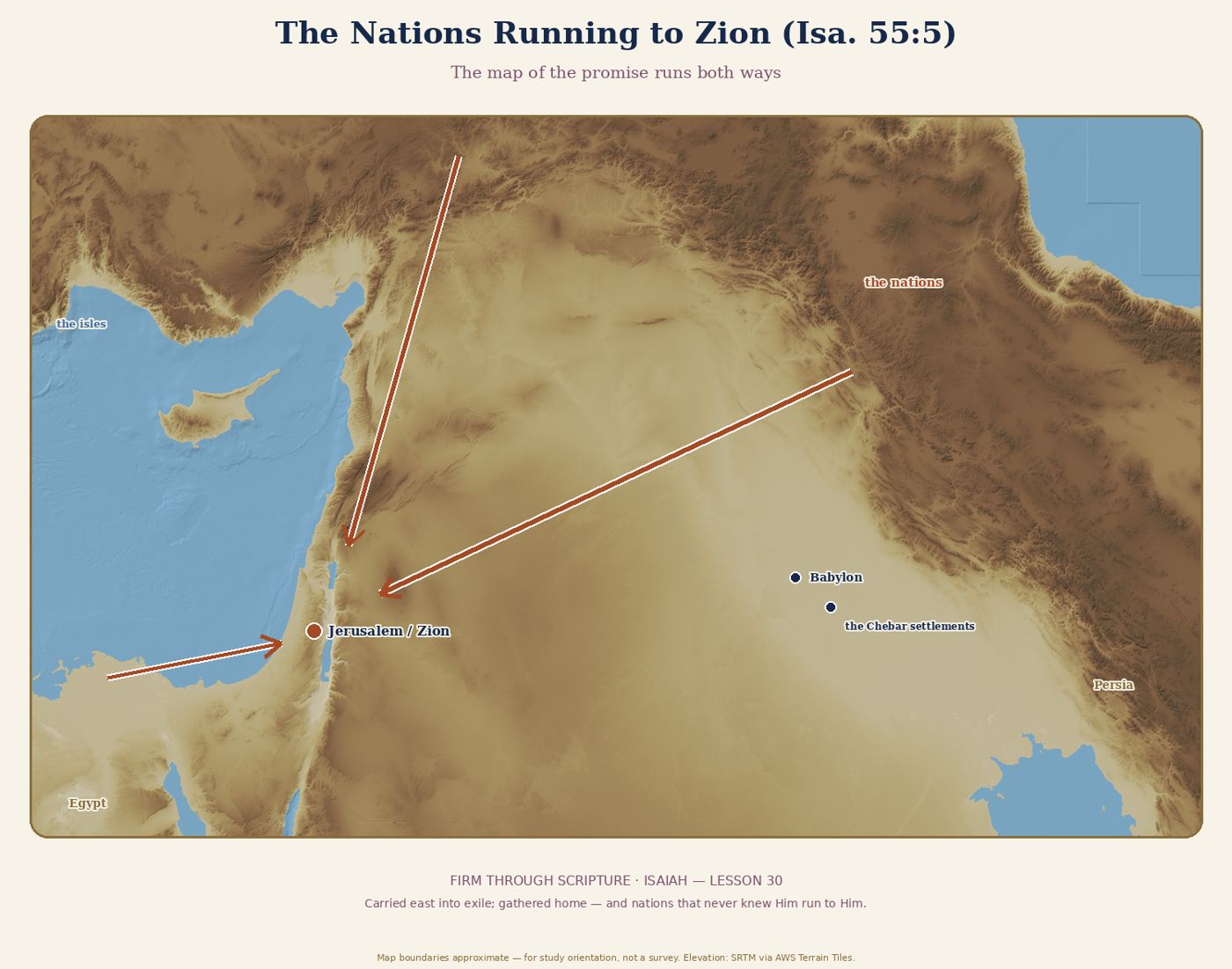
5 Behold, thou shalt call a nation that thou knowest not, and nations that knew not thee shall run unto thee because of the LORD thy God, and for the Holy One of Israel; for he hath glorified thee.
6 Seek ye the LORD while he may be found, call ye upon him while he is near:
7 Let the wicked forsake his way, and the unrighteous man his thoughts: and let him return unto the LORD, and he will have mercy upon him; and to our God, for he will abundantly pardon.
8 For my thoughts are not your thoughts, neither are your ways my ways, saith the LORD.
9 For as the heavens are higher than the earth, so are my ways higher than your ways, and my thoughts than your thoughts.
10 For as the rain cometh down, and the snow from heaven, and returneth not thither, but watereth the earth, and maketh it bring forth and bud, that it may give seed to the sower, and bread to the eater:
11 So shall my word be that goeth forth out of my mouth: it shall not return unto me void, but it shall accomplish that which I please, and it shall prosper in the thing whereto I sent it.
12 For ye shall go out with joy, and be led forth with peace: the mountains and the hills shall break forth before you into singing, and all the trees of the field shall clap their hands.
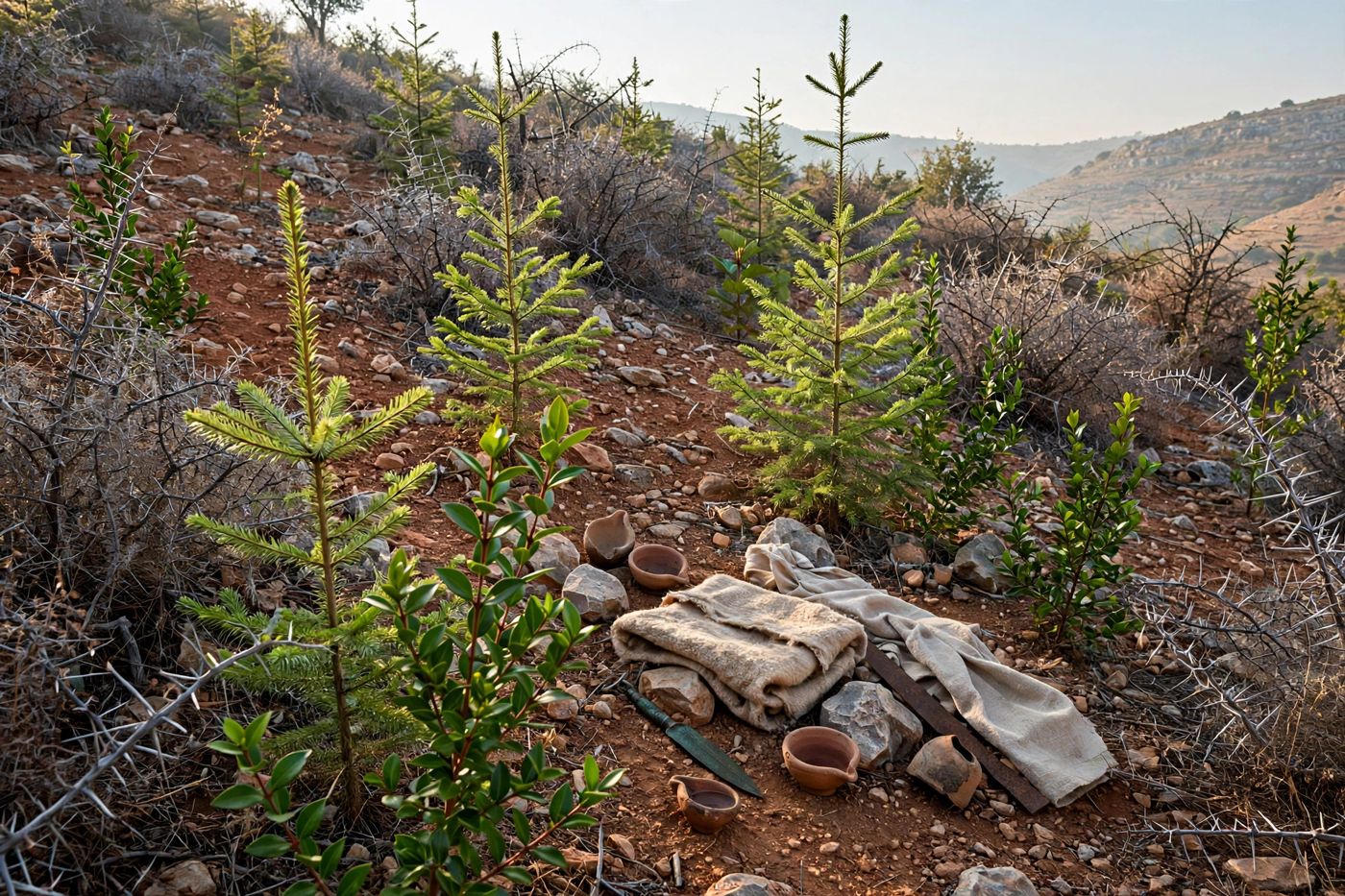
13 Instead of the thorn shall come up the fir tree, and instead of the brier shall come up the myrtle tree: and it shall be to the LORD for a name, for an everlasting sign that shall not be cut off.
SAY IT PLAIN — the passage in everyday words: God turns to His people pictured as a childless, widowed, shamed woman — Jerusalem herself — and orders her to sing before anything has visibly changed, and to stretch her tent bigger, because children and nations are coming. Her Maker is her husband; her Redeemer is the God of the whole earth. The forsaking was a small moment; the kindness gathering her is everlasting, and God swears it the way He swore after Noah's flood: mountains may move before this covenant of peace does. The ruined city is rebuilt in jewels, her children taught by the LORD Himself, and the servants of the LORD inherit a verdict no weapon and no accusing tongue can overturn — their righteousness comes from God. Then the prophet becomes a market crier: everyone thirsty, come — water, wine, and milk, free, no money needed — stop spending your wages on food that isn't food; listen, and your soul will live, under the everlasting covenant, the sure mercies promised to David. Seek the LORD while He can be found; let the wicked turn, because this God pardons abundantly — His thoughts about pardon are higher than ours as heaven is above earth. His word works like rain: it does not come back empty. And the people go out singing, while thorns give way to fir and myrtle — an everlasting sign. That's the whole passage. Everything after this teaches from it — nothing will change what you just read.
2. THE WORLD — C: Context & Audience
A text can never mean what it never meant — so before we ask what these verses mean, we stand where their first hearers stood.
Where you are in the book. These two chapters close Isaiah's second great movement (chapters 40–55) — the "Book of Comfort" this course has been walking since Lesson 20. Those chapters speak to exiles: Judah's people carried away to Babylon, the empire that destroyed Jerusalem in 586 BC, burned its temple, and emptied its streets — a generation wondering whether their God had finished with them. [3, 11] Chapter 53 (Lesson 29) was the movement's centre: the Servant bearing the sins of many. Chapters 54–55 are what that centre is for — first the result for the city (54), then the open invitation to everybody (55). Read without 53 behind them, the joy sounds cheap; with it, every line is purchased. [3, 4]
The woman is a city. Isaiah's first readers knew this picture-language well. Zion — the hill in Jerusalem where the temple stood, and by extension the city and its people — is pictured as a woman: a wife, a mother, a widow. In chapter 49 the picture was at its lowest: "Zion said, The LORD hath forsaken me, and my Lord hath forgotten me" (49:14). 1 She had reason, humanly speaking, to say it. A city whose children are dead or deported is a mother bereaved; a city whose temple lies ruined is a wife whose house is gone; a people whose king is blinded and chained in Babylon is a widow in the ancient world — a woman without a protector, living on charity and shame. Barrenness carried the same weight: a childless woman bore a reproach her neighbours could see. Every image in chapter 54 — barren, desolate, widowed, forsaken, ashamed — is drawn from that single, honour-and-shame world, and the chapter answers every one of them by name. 16 This is not a passage about one woman's feelings in the abstract. It is Jerusalem, the covenant city, addressed in the most personal language the culture had.
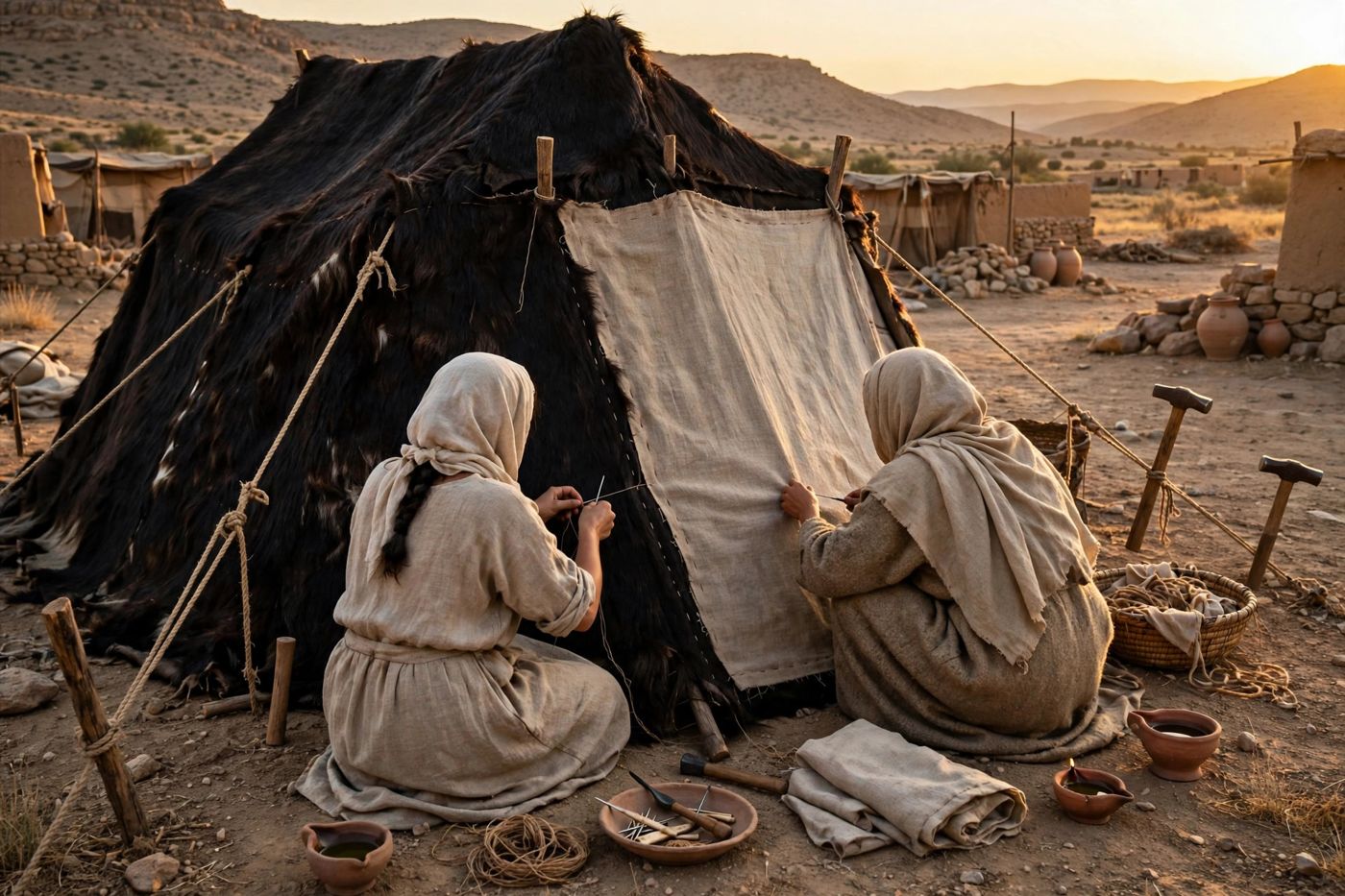
A tent, enlarged. The first command after "sing" is domestic: enlarge the tent, stretch the curtains, lengthen the cords, strengthen the stakes (54:2). Israel's ancestors had actually lived in tents (Hebrews 11:9), and a tent is enlarged just so: more fabric let out, ropes run longer, pegs driven deeper, because more people are coming. 16 God does not say, "Wait, and I will build you a palace." He tells a homeless woman to do housework in faith — prepare room for children she does not yet have.
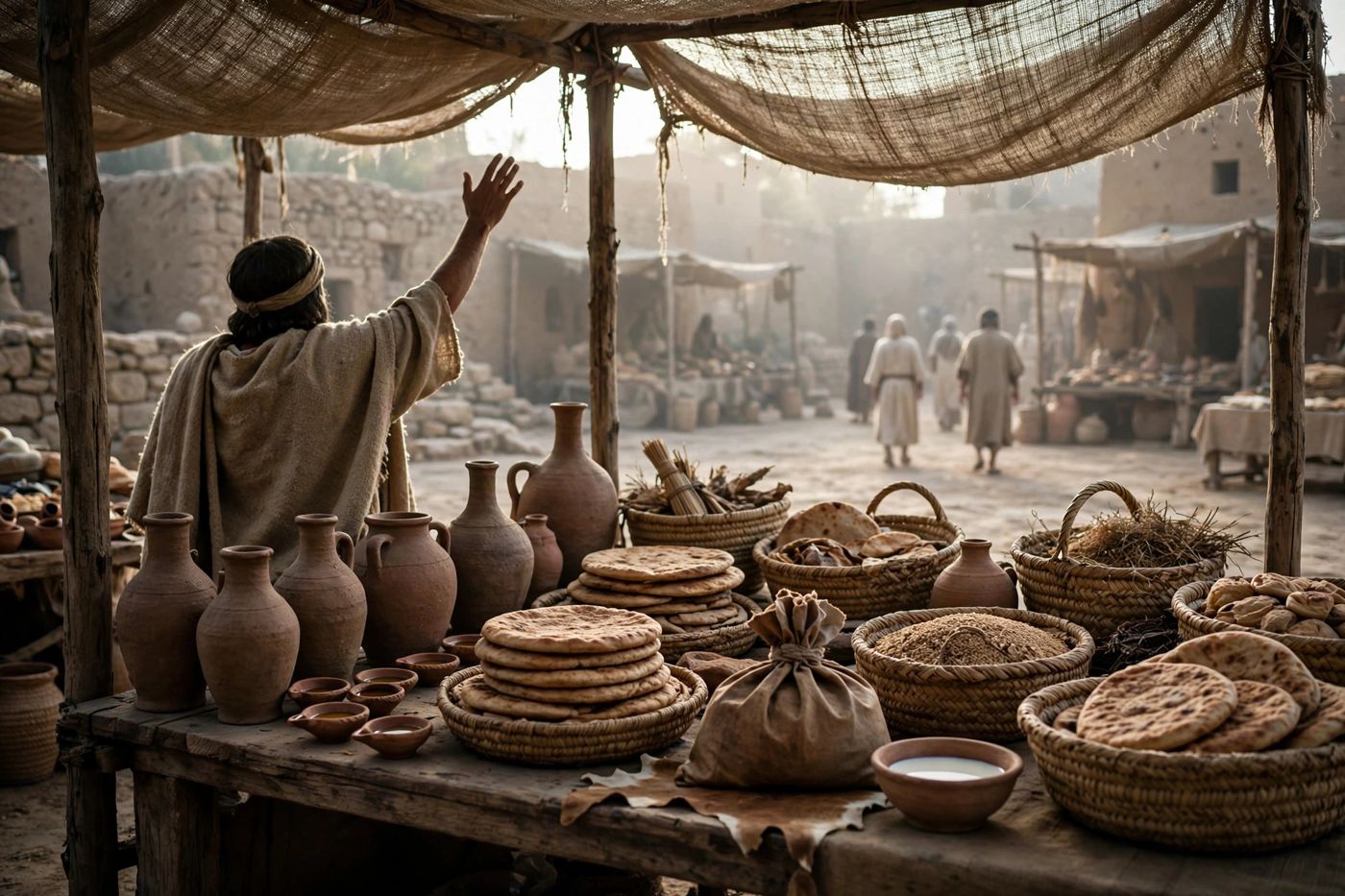
The market crier. Chapter 55 opens in a different register: a street market, where water-sellers, bakers, and wine merchants cried their wares aloud, competing for coins; the opening word "Ho" is a crier's shout, meant to stop foot traffic. 16 A market ran on one rule everybody understood: no money, no goods; the poor stood at its edge and watched. Into that square steps the prophet, crying the one offer that breaks the rule — water, wine, and milk, "without money and without price" (55:1). The first hearers were exiles whose wallets were as empty as their temple. The economics are the point: what is sold here cannot be bought — so it can be given to people who have nothing.
Noah, David, and the smith — the passage's furniture. Three pieces of Israel's furniture stand in these chapters, and a beginner needs each named. Noah is the survivor of the flood in Genesis: after the waters fell, God covenanted with Noah and all flesh that flood waters would never again destroy the earth, and set the rainbow as the sign (Genesis 9). When God wants a precedent for an oath He will never break, that is the oath He reaches for (54:9). David is Israel's great king (about 1000 BC), to whom God promised an enduring house and kingdom: "thine house and thy kingdom shall be established for ever before thee: thy throne shall be established for ever" (2 Samuel 7:16). 1 The "sure mercies of David" (55:3) are that promise, still standing centuries after David's throne had visibly fallen — §5 gives the phrase its full treatment. And the smith of 54:16 is the weapons-maker at his forge — in a world where the empire's armouries were a real and recent terror, the verse's calm claim that God created the smith is the claim that no weapon exists outside His government. 16 Keep the smith in mind; §7 returns to his forge.
3. OBSERVE — O: what the text actually does
Before meaning comes observation. These two chapters are often raided for single verses; watch what they do as a whole first:
- The shape. Two chapters, two movements, one hinge. Chapter 54 is promise addressed to the city-woman in the second person — "sing," "enlarge," "fear not" — a string of assurances each grounded in who God is. Chapter 55 is invitation addressed outward to everyone thirsty — "come," "hear," "seek," "return" — and it ends not with the people but with the landscape itself transformed. The book of comfort that began "Comfort ye my people" (40:1) ends with an open market and a singing countryside.
- Singing opens it and closes it. The first command is "Sing, O barren," and "break forth into singing" (54:1); the last scene has mountains and hills that "shall break forth before you into singing" and trees clapping their hands (55:12). The exact phrase — break forth into singing — brackets the whole passage. At the start, a promise believed before it is seen; at the end, a people actually going out.
- The commands pile up — and they are commands to receive. Count the imperatives: sing, break forth, enlarge, stretch forth, spare not, lengthen, strengthen, fear not (ch. 54); come (four times in 55:1 alone), buy, eat, hearken, incline your ear, hear, seek, call, forsake, return (ch. 55). Almost every command orders the hearer to take something God is giving. Hold that for §13: a passage whose commands are "come and receive" must not be re-engineered into commands to achieve.
- Verses sit in paragraphs. 55:8–9, the most-quoted lines here, stand inside a paragraph about pardon (55:6–7 before; the effective word, 55:10–11, after). A verse's paragraph is part of its meaning — §10 shows what happens when it is ignored.
- "Everlasting" does the heavy lifting. Track the word: "everlasting kindness" (54:8), a "covenant of my peace" not removed (54:10), an "everlasting covenant" (55:3), an "everlasting sign" (55:13) — set against "a small moment," "a moment" (54:7, 8). The passage's whole doctrine of time is in that contrast, and §7 teaches it as doctrine, not decoration.
- The titles widen as the chapters run. God is named Maker, husband, "the LORD of hosts," Redeemer, "the God of the whole earth" (54:5), "the LORD that hath mercy on thee" (54:10), "the Holy One of Israel" (55:5). And the people widen with Him: the barren woman (54:1) → her seed inheriting the Gentiles (54:3) → "the servants of the LORD" (54:17, plural) → "every one that thirsteth" (55:1) → nations running (55:5). One Servant in chapter 53; servants, nations, and everyone thirsty by chapter 55. That widening is the passage's plot.
4. GENRE — N: note the genre (prophetic poetry — promise oracle turning to public invitation)
This is prophetic poetry, in two of its classic registers back to back. Chapter 54 is a salvation oracle — God's direct promise of deliverance to His afflicted people, the form that runs through the comfort chapters ("Fear not" is its signature opening; Lessons 21–22 at 41:10 and 43:1). Chapter 55 is a prophetic invitation — the oracle leaves the sanctuary for the marketplace, taking the form of a street crier's call and a wisdom teacher's question ("wherefore do ye spend money…?"). Commentators across the spectrum trace the same two movements here — assurance, then summons. [3, 4] Poetry in Isaiah reads by its own rules, and this passage leans on all of them: 51
- Parallelism carries meaning. Hebrew poetry thinks in paired lines. "For a small moment have I forsaken thee; but with great mercies will I gather thee" (54:7) is not two facts but one weighed contrast — the second line sets the scale of the first. Read the pairs as single hammer-blows, never separated and sold individually.
- The metaphors are the argument, not its wrapping. Woman = the city and people; tent = their dwelling and future; market = the economy of grace; rain = the word's effectiveness. In prophetic poetry the image is the teaching — a husband is not a metaphor for a contract; he is more, and the more is the point.
- Prophecy forthtells before it foretells. Fee and Stuart's beginner rule — the prophets first speak God's covenant word forth into their own moment — governs here. 51 To exiles, chapter 54 forthtells: your shame-story is not your end; chapter 55: come now, while He may be found. The foretelling is real too, and §6 tracks how the canon cashes it.
- An oracle's promises belong to its addressee first. Chapter 54 is spoken to Zion. Chapter 55 is spoken to the thirsty. Who may claim which line, and by what road, is a transfer question — §13 runs it through the tests, and §10 shows what goes wrong when the road is skipped.
5. TERMS — T: the words in the writer's mouth
Four phrases carry these chapters. Learn what they meant in the writer's mouth:
- "The covenant of my peace" (54:10). A covenant is a binding, pledged relationship — not a mood and not a contract of equals, but a sworn commitment. Peace — Hebrew shalom — is far wider than the absence of war: wholeness, welfare, everything set right. [18, 19] So the phrase names a pledged relationship whose content is wholeness — and notice whose peace it is: "my peace." The covenant stands because it is His, sworn by Him, which is why mountains departing cannot remove it. The phrase echoes the "covenant of peace" given to Phinehas (Numbers 25:12) and Ezekiel's later "covenant of peace" (Ezekiel 34:25; 37:26) — a thread §6 picks up. [1, 3]
- "The sure mercies of David" (55:3). "Mercies" is the great covenant word hesed in the plural — steadfast, pledged lovingkindness. [18, 19] "Sure" translates a form of the verb 'aman — to be firm, reliable, believable: the root from which "amen" grows. The phrase therefore means: the reliable covenant-loves once pledged to David, now made the content of a fresh everlasting covenant with everyone who hears (55:3). Psalm 89 had already sung those mercies as sworn and unbreakable — "My mercy will I keep for him for evermore, and my covenant shall stand fast with him" — and in the same psalm had cried over how fallen David's throne looked (Psalms 89:28, 49). 1 Isaiah 55 holds both facts together: the throne looks fallen; the mercies are sure. What the New Testament does with that tension is one of §6's headline facts.
- "Abundantly pardon" (55:7). The Hebrew construction is a multiplication: literally, God "multiplies pardoning" — the verb for pardon itself (salach) is used in the Old Testament only of God, because no human being can do what it names. 19 Two things follow. First, pardon in this book is not rationed: its grammar is abundance. Second, it is exclusively divine work — which is why the verse commands the wicked to return to the LORD, not to repair themselves first. The size of the pardon is the argument for the return, not a reward after it.
- "The servants of the LORD" (54:17). Hold the plural. Through chapters 42–53 the title "my servant" has belonged to a single figure — the Servant who justifies many (53:11, Lesson 29). Here it stands plural, as the name of a people: "the heritage of the servants of the LORD." [3, 4] A heritage is an inheritance — what passes to heirs not because they built it but because of whose they are. And this people's "righteousness is of me" (54:17): what the one Servant is and did becomes, by gift, what the many servants have and hold. §7 teaches the widening in full.
Method note — the word-study guardrail: a word means what its author uses it to mean, in its sentence, in its century — not what its oldest root once meant, and not everything it can mean anywhere. Every term above was settled by Isaiah's usage in Isaiah. That is the discipline that keeps word studies honest.
TRANSLATION NOTE — "buy… without money" (55:1)?
Your KJV's market cry sounds like a contradiction: "come ye, buy, and eat; yea, come, buy wine and milk without money and without price." English readers sometimes soften this into "receive," but the Hebrew keeps the commercial verb deliberately — buy — and then cancels its price twice over, with two different words: without money (silver, the actual currency) and without price (the cost charged). 19 The paradox is the sermon, and every honest translation keeps it. Why keep "buy"? Because buying names a real transaction in which a real good is really yours. And why cancel the price? Because the buyer here is defined by having nothing: "he that hath no money" (v. 1). A purchase whose price has been paid elsewhere, received by empty hands — the grammar of 55:1 is the grammar of Isaiah 53 behind it. §10, Misread 3, deals with dropping either half.
6. ENTIRE CANON — E: where this passage sits in the whole story
No verse lives alone, and these two chapters are quoted by name at some of the New Testament's highest moments. Every item below that reports what a later writer did with these verses is a FACT of citation — checkable on the page: 1
- Paul makes 54:1 the charter of the free Jerusalem. Arguing in Galatians 4 that there are two Jerusalems — the present city in bondage, and "Jerusalem which is above," free, "the mother of us all" — Paul quotes our verse as his proof-text: "For it is written, Rejoice, thou barren that bearest not; break forth and cry, thou that travailest not: for the desolate hath many more children than she which hath an husband" (Galatians 4:26–27). 1 That Paul cites Isaiah 54:1 for the Jerusalem above is FACT. The allegorical force he draws from it is Paul's argument, and §7 teaches it as the apostle's own reading, not as a licence for us to allegorise at will.
- Jesus quotes 54:13 for the Father's drawing. "It is written in the prophets, And they shall be all taught of God. Every man therefore that hath heard, and hath learned of the Father, cometh unto me" (John 6:45). 1 The prophets-text He quotes is Isaiah 54:13 — "all thy children shall be taught of the LORD." The FACT is the quotation; notice what Jesus does with it: the promise that Zion's children will be God-taught becomes, in His mouth, the explanation of how anyone comes to the Son at all.
- Paul quotes 55:3 for the resurrection. At Pisidian Antioch, preaching that God raised Jesus from the dead, Paul reaches for our chapter: "And as concerning that he raised him up from the dead, now no more to return to corruption, he said on this wise, I will give you the sure mercies of David" (Acts 13:34). 1 His logic, stated in the verse itself: mercies that are sure cannot be given to a Davidic heir who rots in a tomb — so the sure mercies land on the risen One, and through Him on "you" (the hearers). §7 traces the thread; here register the FACT: the New Testament's own use of "the sure mercies of David" is a resurrection argument.
- The jeweled city reaches Revelation 21. John sees "the holy city, new Jerusalem, coming down from God out of heaven, prepared as a bride adorned for her husband" (Revelation 21:2), its wall's foundations "garnished with all manner of precious stones" — the second foundation, sapphire (21:19). 1 The correspondence with Isaiah 54:11–12 is a pattern the canon itself completes: the wife-city of Isaiah 54, adorned in jewels, is the bride-city of the Bible's last vision. That is a pattern recognised and labelled here as such — the pattern's heir — not a claim that Isaiah's first hearers saw John's vision.
- The invitation runs to the Bible's last page. Jesus stands at the feast and cries, "If any man thirst, let him come unto me, and drink" (John 7:37); the Bible closes with the same crier's voice: "And whosoever will, let him take the water of life freely" (Revelation 22:17). 1 Isaiah 55:1 is the headwaters of both. And the word-doctrine of 55:10–11 answers to this book's own bookends — "the word of our God shall stand for ever" (40:8) and "seek ye out of the book of the LORD, and read" (34:16). 1
Laid out flat, the chapter's reach looks like this:
| Isaiah says… | The canon takes it up… | As… |
|---|---|---|
| "more are the children of the desolate" (54:1) | Galatians 4:27 — quoted by Paul | the charter of Jerusalem above |
| "all thy children shall be taught of the LORD" (54:13) | John 6:45 — quoted by Jesus | the Father's drawing of people to the Son |
| "the sure mercies of David" (55:3) | Acts 13:34 — quoted by Paul | proof the Davidic heir was raised incorruptible |
| foundations of sapphires (54:11–12) | Revelation 21:19 — sapphire foundation | the bride-city's pattern completed |
| "come ye to the waters" (55:1) | Revelation 22:17 — "take the water of life freely" | the Bible's closing invitation |
7. THE MEANING — what the passage teaches
The Walk has established what the text says and where it sits. Now its payload, taught straight — the doctrines this passage actually carries, in the passage's own proportions.
Sing first — the barren woman's song (54:1–3)
The passage opens with the most unreasonable command in the book of comfort: a childless woman is ordered to sing — not when the children arrive, not when she can see them, but now, while she is still, by every visible measure, barren and desolate. Look at the order in verse 1: sing, break forth, cry aloud — and the ground follows in the same breath, "for more are the children of the desolate than the children of the married wife." The song is not the celebration after the promise is fulfilled. The song is the response to the promise believed. In this book, faith sings ahead of sight. The "married wife" is the woman whose fruitfulness runs the ordinary, visible course — husband, household, children in the natural order. The "desolate" has none of that machinery. And God says the desolate will end with more. His arithmetic of fruitfulness does not run on visible resources. It never has in this Bible: it is the arithmetic of Sarah, of Hannah, of Elizabeth — here scaled up from a woman to a city, and from a city to a people gathered out of the nations. [3, 4]
Then the tent (54:2), which §2 introduced: enlarge, stretch, lengthen, strengthen — and "spare not," do not hold back out of caution. Growth, in this picture, is not God's problem to solve while the woman watches. Room-making is hers. The verse-pair's two halves belong together: verse 3 promises what only God can do — "thy seed shall inherit the Gentiles, and make the desolate cities to be inhabited"; verse 2 commands what the people can do — prepare space for it. A church that will not lengthen its cords has not believed verse 3, however loudly it sings verse 1. And note the direction of the inheritance: the seed does not merely recover its own towns. It inherits the Gentiles — the nations, the very peoples under whose empires Israel had suffered. From chapter 49 the Servant's commission was to be "a light to the Gentiles"; here its fruit comes home as population. [3, 11]
Thy Maker is thine husband (54:4–8)
The centre of chapter 54 is a marriage. Verses 4–6 work through the woman's whole shamed biography and erase it line by line: the shame of her youth — Israel's early waywardness — she shall forget; the reproach of her widowhood — the exile, the years when she seemed husbandless and unprotected — she shall not remember any more. Shame, in this chapter, is not managed or re-framed. It is ended, by reunion.
And then verse 5, the verse the whole chapter hangs on: "For thy Maker is thine husband; the LORD of hosts is his name; and thy Redeemer the Holy One of Israel; The God of the whole earth shall he be called." Hold those two halves together. On one side, the intimacy could not be closer: not her landlord, not merely her king — her husband, and her Maker, the One who formed her, now joined to her. "Redeemer" is the family word — the kinsman-redeemer, the near relative obligated and willing to buy back what was lost (the book of Ruth turns on it). On the other side, the scope could not be wider: this husband is no local deity with a tribal marriage. He is the God of the whole earth. The marriage verse already contains the missionary horizon of 54:3 and 55:5: because the husband is the whole earth's God, the tent can stretch to the whole earth. Commentators across traditions linger on exactly this juxtaposition — the most particular claim in the Bible ("thine husband") fused to the most universal ("the whole earth") in a single sentence. [3, 4, 11]
Verse 6 then does something tender and exact: God names what she felt. "The LORD hath called thee as a woman forsaken and grieved in spirit, and a wife of youth, when thou wast refused." This is the cry of 49:14 — "The LORD hath forsaken me" — taken up into covenant language and answered, not rebuked. God does not say she was wrong to grieve. He says: that forsaken, grieving, refused woman — that is the one I am calling back, as a wife of youth. The feeling of forsakenness is met by a covenant act, not by a lecture on feelings.
The pastoral mathematics — moment against everlasting (54:7–8)
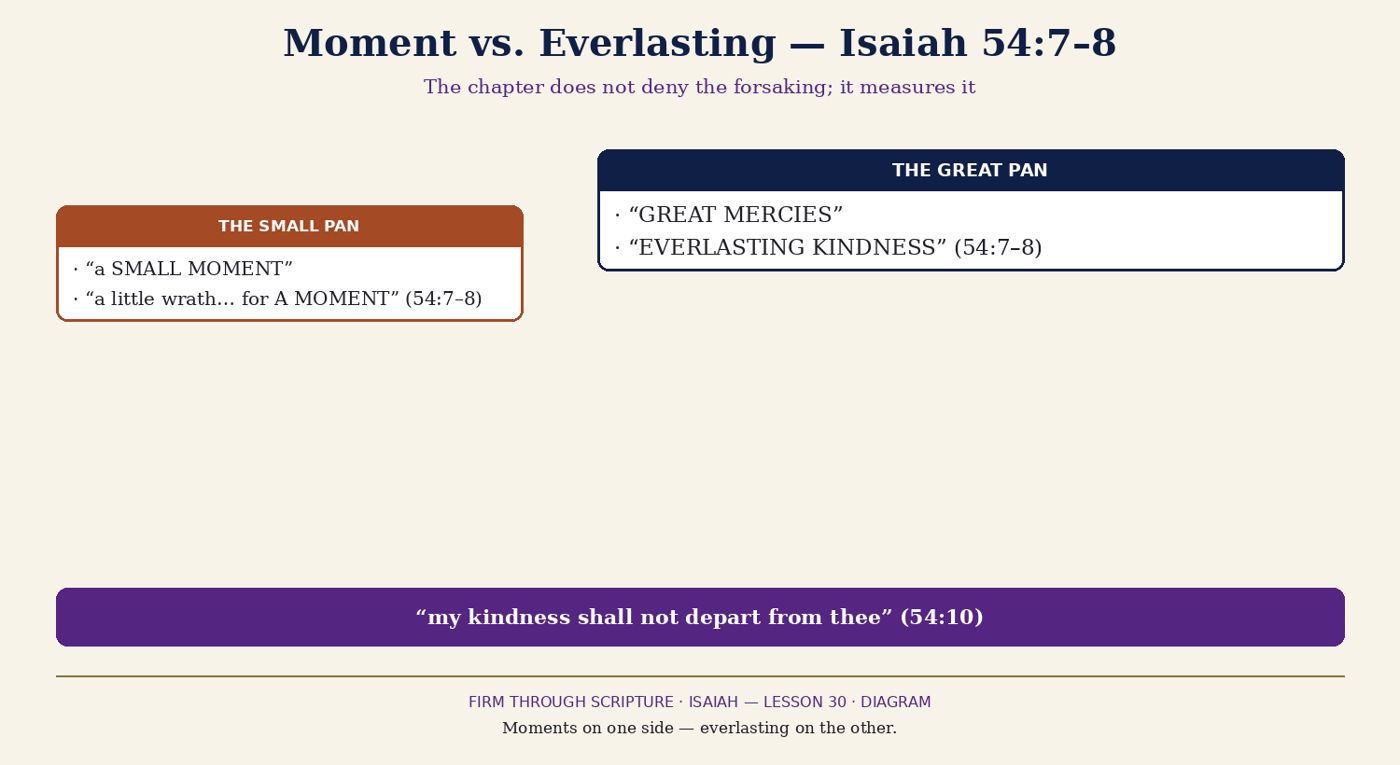
Now the proportions, and learn to state them as doctrine, because the text does. "For a small moment have I forsaken thee; but with great mercies will I gather thee. In a little wrath I hid my face from thee for a moment; but with everlasting kindness will I have mercy on thee, saith the LORD thy Redeemer."
Weigh the two columns. On the forsaking side: small, a moment, a little wrath, a face hidden — for a moment. On the mercy side: great mercies, everlasting kindness. The chapter does not deny the forsaking; the exile was real, the wrath was real, the hidden face was real — seventy years of it can feel like anything but a moment from inside. The chapter measures it. Against the scale of the kindness that gathers, the forsaking registers as momentary, and the kindness as everlasting — the same "everlasting" that marks the covenant at 55:3 and the sign at 55:13. This is the Bible's pastoral mathematics, taught as proportion, not denial: God Himself supplies the ratio by which His people are to reckon their worst season. A believer reading her life by this arithmetic does not say "it was nothing." She says what the text says: "it was a moment — small and real — inside an everlasting kindness that is still running." [3, 4] The diagram below sets the two columns side by side.
The Noah oath and the covenant of peace (54:9–10)
Verse 9 grounds the proportions in an oath — God's oath about His oath: "as I have sworn that the waters of Noah should no more go over the earth; so have I sworn that I would not be wroth with thee, nor rebuke thee." Understand the precedent. After the flood, God bound Himself, unilaterally, before any human performance existed to rest on, that a catastrophe of that kind would never recur — and centuries of weather since have kept the precedent standing in public. God now reaches for that public record and says: my restraint toward you stands in the same class, sworn by the same swearer. The anger of the exile is hereby declared closed — not suspended, not probationary. [3, 11]
Verse 10 then makes the famous comparison, and it is a comparison about what moves. "For the mountains shall depart, and the hills be removed; but my kindness shall not depart from thee, neither shall the covenant of my peace be removed." In the ancient imagination nothing is less movable than mountains — they are the very picture of the permanent. Isaiah concedes the strongest possible movement — grant the mountains departing, grant the hills removed — and sets the covenant beyond even that concession. And what does not move is given its name in §5's term: the covenant of my peace — held in place not by the people's grip on Him but by His oath to them. This is the verse the Recap Card gives you as the memory verse; learn it with its logic attached: mountains are the movable things in this verse. The kindness is not.
The jeweled city and the servants' heritage (54:11–17)
The camera moves from the woman to the city — the same subject, now architectural. God begins by naming her as she is: "O thou afflicted, tossed with tempest, and not comforted." The splendour promised to that comfortless city is not modest: stones laid "with fair colours," foundations of sapphires, windows of agates, gates of carbuncles (54:11–12). As §6 showed, the pattern's heir is Revelation 21's bride-city, sapphire foundation and all. In Isaiah's own horizon: the God who stripped Jerusalem in judgment will Himself be her builder in restoration — and He builds beyond utility, into beauty. [3, 16]
Then, amid the gemstones, verse 13 — in some ways the city's most valuable foundation: "all thy children shall be taught of the LORD; and great shall be the peace of thy children." A city can have sapphire foundations and ignorant children and be a ruin with good masonry. Zion's wealth is taught children, and the fruit of God's teaching is named at once: "great… peace." Jesus' use of this line (John 6:45, §6) confirms the canon's reading: being taught of God is the Father drawing people to the Son. Verse 14 establishes her in a single word — "In righteousness shalt thou be established" — the very thing Lesson 01 indicted her for lacking (1:21) becomes her foundation, and the exile's two terrors are dismissed: oppression far off, terror not coming near.
Verses 15–17 then close the chapter in a courtroom — watch the scene change, because §10 will need it. Enemies "gather together" — but "not by me," not at God's commission as His rod, as Assyria once was (Isaiah 10); unauthorised gatherings fall. And the reason is verse 16's calm sovereignty: "I have created the smith that bloweth the coals in the fire… and I have created the waster to destroy." The weapons-maker and the destroyer are both creatures — made, bounded, governed. No weapon in this universe is freelance. Then the heritage itself: "No weapon that is formed against thee shall prosper; and every tongue that shall rise against thee in judgment thou shalt condemn. This is the heritage of the servants of the LORD, and their righteousness is of me, saith the LORD."
Three observations carry the verse's weight. First, the imagery is forensic: tongues rising in judgment, verdicts condemned — this is a court, and the promise is about verdicts that will not stand. Second, the recipients are plural and derived: the servants — the many who now bear the one Servant's title (§5) — inherit this as an heirloom, not an achievement. Third, the source is stated outright: "their righteousness is of me." The servants do not defend themselves in that court by producing their own righteousness; theirs is God's gift — flowing from the Servant who "justify[s] many" (53:11) to the servants who bear his name. The map of the whole comfort book completes itself here: one righteous Servant; now a people of servants; their heritage, his vindication extended to them; their righteousness, his, given. [3, 4, 11]
The Christ Thread
This passage's road to Christ is not a type we invent; it is a trail the New Testament itself walks, three times, in §6's list. Galatians 4:27: the barren woman's song as charter-text of "Jerusalem which is above" — fruitfulness running on promise, not machinery. John 6:45: "taught of the LORD" as the Father's drawing — everyone who has learned from the Father comes to me — Isaiah 54's schoolroom emptying, by design, into Christ. Acts 13:34: "the sure mercies of David" as resurrection evidence — mercies sworn sure must vest in an heir who cannot corrupt. And behind all three: chapter 55's invitation is chapter 53's spending. Why can the thirsty buy without money? Because the price does not read "waived"; it reads paid — by the Servant on whom "the LORD hath laid… the iniquity of us all" (53:6). The servants of 54:17 are his justified many, now named as a people. Not a symbol hunt, but the canon reading its own documents in order. [1, 3]
The open market (55:1–5)
Chapter 55 changes the acoustics. The intimate marriage language gives way to a public shout — "Ho, every one that thirsteth" — and the first thing to notice is who is invited: everyone thirsty, and specifically "he that hath no money." The qualifying asset for this market is an admitted lack. Thirst is the entry requirement; emptiness is the currency. The goods ascend in richness: water (the necessity — in a dry land, life itself), then wine and milk (the feast — nourishment and celebration together). And the verbs tumble over each other: come, buy, eat, come, buy — a crier repeating the offer because the hearers cannot believe the terms. §5's Translation Note kept the paradox intact: buy, without money and without price — a real obtaining of real goods, at no cost to the obtainer. [3, 4]
Verse 2 then interrogates the alternative economy: "Wherefore do ye spend money for that which is not bread? and your labour for that which satisfieth not?" The charge is not that people spend; it is that the spending is on food that is not food. Against it, one command: "hearken diligently unto me, and eat ye that which is good" — hearing is this feast's eating; the ear is the mouth of the soul in chapter 55. And the promised result is not mere survival: "let your soul delight itself in fatness." There are two tables in the world, and their posted prices are exactly reversed from what shoppers assume. 16
Verse 3 makes the feast a covenant: "Incline your ear, and come unto me: hear, and your soul shall live" — and the promise attached to the hearing is an "everlasting covenant… even the sure mercies of David." Note the sequence — ear inclined, coming, hearing, living: the soul lives by hearing its way to God. And the Davidic promise is now addressed "with you" — plural hearers, everyone who came thirsty. Verse 4 sets David in his place — given "for a witness to the people, a leader and commander to the people": the king as testimony, the type's outline, pointing past himself to the coming Davidic heir, in whom alone — per Acts 13:34 — the mercies prove literally incorruptible (that is the type's outline, labelled as such). Then verse 5 springs the horizon wide: "nations that knew not thee shall run unto thee" — not crawl, not be dragged: run, uninvited and unknown, "for he hath glorified thee." This is 54:3's seed inheriting the Gentiles, seen from the road. [3, 11] The picture below is that road's destination, drawn as a market stall.
Seek, return — and the higher thoughts in their place (55:6–9)
The market's shout now sharpens into a summons with an expiry condition: "Seek ye the LORD while he may be found, call ye upon him while he is near." Nearness is a season, and a season is not forever. But look at exactly what seeking involves, because verse 7 defines it and the definition is moral, not mystical: "let the wicked forsake his way, and the unrighteous man his thoughts: and let him return unto the LORD." Seeking God, in Isaiah's dictionary, means leaving — a way walked and a way of thinking, both abandoned — and returning: the wicked man does not climb to God; he turns around, on the road he is already on, to a God who is near. And the engine of the verse is its motive clause: "he will abundantly pardon" — the multiplication of §5's term. The summons to repent is carried, in this text, entirely on the size of the pardon offered. Fear is not the fuel here. Munificence is.
Only then — inside this paragraph, as its explanation — come the famous lines: God's "thoughts are not your thoughts," His ways not our ways — and the measure of the difference is the heavens' height above the earth (55:8–9). Read in their place, the referent is not obscure. Which of God's thoughts has just been declared higher? The thought that has just scandalised the market: that the returning wicked should be — not probated, not billed, not shamed at the gate — abundantly pardoned; that the feast is free; that enemies and empties are gathered with great mercies. Our thoughts run on desert, rationing, and getting even. God's thought, announced in verses 6–7, is pardon multiplied past all proportion. That is the heaven-high thought. §10 will deal with the use of these verses as a conversation-ender; here, simply let them mean what their paragraph says: God's ways are higher than ours precisely at the point where His pardon outruns our arithmetic. [3, 4]
The word like weather (55:10–11)
The passage's last doctrine is about itself. Rain and snow come down from heaven and — the observation is agricultural and exact — they do not return to heaven as water; they go into the ground, make it "bring forth and bud," and come back, if at all, as wheat on a table: "seed to the sower, and bread to the eater." So shall my word be: it shall not return unto me void, but shall accomplish what God pleases, and prosper in the thing whereto He sent it (55:11).
This is the book of comfort's doctrine of its own word, stated as it closes: God's speech is not commentary on events; it is weather — an agent that enters the world and effects what it was sent to effect. Every promise in chapters 54–55 carries this verse as its own guarantee: the barren will sing, not because the prediction is optimistic, but because the Word that said it is already in the ground, working. Note the divine pleasure in it — "that which I please" — and the mission-language — "whereto I sent it": the word is an envoy with orders, and envoys of this King do not come home reporting failure. This is a career-long conviction of the book, not a closing flourish: "the word of our God shall stand for ever" (40:8), and the challenge of 34:16 to search the book and find that "no one of these shall fail." 1
The singing exit (55:12–13)
The passage ends — and with it the whole comfort section — not with a doctrine but with a departure: "For ye shall go out with joy, and be led forth with peace." Go out is exodus language (52:11–12, Lesson 28), and here the going-out is scored like a procession: creation itself turned into a choir, mountains breaking forth into singing, trees clapping their hands (55:12). The phrase that opened the passage, commanded to a barren woman, is now performed by the landscape, uncommanded.
And the final image is botanical and precise: "Instead of the thorn shall come up the fir tree, and instead of the brier shall come up the myrtle tree." Thorn and brier are the flora of the curse — "thorns also and thistles shall it bring forth to thee" (Genesis 3:18) — the signature vegetation of a world gone wrong. 1 Fir and myrtle are the opposite signature: timber and fragrant evergreen, trees of building and festival (Nehemiah 8:15). The thorn giving way to the fir means the curse's own landscape is being replanted — the pattern labelled here: Eden's ground-thorns replaced by the trees of the new creation of chapters 65–66 (Lesson 35). The purpose clause captions the vista: "it shall be to the LORD for a name, for an everlasting sign that shall not be cut off." Book Two's final picture is not a throne room but a hillside: thorns out, firs up, a people walking home through a singing country. 3
Where in the Covenant Story?
Spread the passage on the covenant map and it touches nearly every era. Its oath reaches back to Noah (54:9). Its husband-language gathers up the Sinai marriage — God wedded to Israel at the exodus (Jeremiah 2:2), shattered by her unfaithfulness, here restored as to "a wife of youth" (54:6). Its centre-promise is Davidic: the sure mercies of David (55:3), re-issued as an everlasting covenant to all who hear. And its horizon runs forward: Ezekiel's covenant of peace (Ezekiel 37:26), Jeremiah's taught-of-God people (Jeremiah 31:34), and — on the New Testament's own testimony — a Davidic heir raised incorruptible (Acts 13:34) and a bride-city descending jewelled from heaven (Revelation 21:2, 19). Preservation, marriage, kingship, and new creation, bound in two chapters and priced at nothing. [1, 3]
The Long View — what the church has believed
You are not the first reader of these chapters, and the centuries have read them with unusual unanimity about their centre. The early church heard chapter 55 Christologically from the start: Justin Martyr, arguing with Trypho in the second century, pressed Isaiah's invitations as the prophets' own summons to the nations to come to Christ, and treated the free feast as a standing embarrassment to any system that made men pay their way to God. 44 The church's historic reading of chapter 54 followed Paul without serious deviation: the barren woman's multiplied children as the promise-people gathered from the nations — a reading already fixed by Galatians 4 itself. On 54:17, the centuries read the verse where the text puts it — in the courtroom, in the wake of the Servant's vindication — as the servants' assurance that no accusation finally stands against those whose righteousness is God's gift. Where honest readers divide is at the edges: how literally to take the jewelled architecture, and how much of chapter 54 is exhausted by the return from Babylon. Those divisions are flagged rather than settled; the centre — oath, pardon, free feast, effective word — has been the church's common confession on every side of them.
That is the payload. The next section compresses it into the one sentence you are meant to carry out of this study.
8. THE AIM SENTENCE — X: eXplain the intent
Everything observed now compresses into one sentence — the author's intended meaning, stated before any application is allowed near it:
Because the Servant has borne His people's sin, God commands His shamed, exiled people — pictured as a barren wife and a ruined city — to sing and make room: their Maker-husband swears by His Noah oath that a moment's forsaking is answered by everlasting kindness and an unremovable covenant of peace, gives them the Servant's own heritage and a righteousness that is God's gift, and throws the feast open free to everyone thirsty, to returning sinners He abundantly pardons, and to nations who will run to Him — all guaranteed by a word that, like rain, never returns void.
If a sermon, a post, or a devotional uses Isaiah 54–55 to say something that cannot be traced back to that sentence, it is not this passage talking. That is the whole skill this course exists to build — and the next section is where you watch it work.
9. SAY IT BACK
Close the book and say the AIM sentence from section 8 in your own words — out loud, or written in your notes, without looking. Then say, in one more sentence, what it asks of you this week.
If your version quietly changes the meaning — if the free feast becomes a reward for the deserving, or the moment-versus-everlasting proportions flatten into "God was never angry," or the invitation shrinks to people like you — open the lesson and walk it again. This exercise feels small. It is the entire course in miniature: meaning first, then — and only then — your life.
10. THE MISREAD — the guardrail, with verdicts
Three live misuses of this passage. Each gets a fair hearing, the evidence, and a verdict.
Misread 1: "My thoughts are not your thoughts — God's ways are higher, so stop asking questions and stop expecting to understand." Why it sounds right: verses 8–9 really do set God's thoughts at heaven-height above ours, and there is a true humility in them. Quoted at the right moment, the lines can sound like reverence itself. The evidence: read the paragraph, not the poster. Verses 8–9 stand between verse 7 and verses 10–11, and they explain verse 7: the higher thought just named is that God will abundantly pardon the wicked man who forsakes his way and returns. The thought that towers over ours is not a hidden decree we may not examine; it is a generosity we would never have dared to propose — pardon multiplied, a feast without price. The same passage that says His thoughts are higher commands seeking, calling, inclining the ear, and hearkening diligently (55:2, 3, 6). Deployed as a thinking-stopper, the verse is made to say the opposite of what it says in place: it does not rebuke our questions; it rebukes our small mercy and our small expectations of pardon — our assumption that God rations forgiveness the way we ration ours. Verdict: in context, "higher" describes the altitude of God's pardoning generosity, not a fence around your mind. Bring the verse to someone who thinks God could never pardon them — that is the small thought it was written to correct.
Misread 2: "'No weapon formed against thee shall prosper' — a believer who claims this verse will not be harmed, defeated, or successfully opposed, full stop." Why it sounds right: the words are gloriously absolute, the verse is addressed to God's servants, and the whole comfort book has spent sixteen chapters saying God defends His people. Claimed as a personal, blanket guarantee of a harm-free life, it promises something every suffering believer wants to be true. The evidence: look first at the verse's own courtroom. Its parallel line is about tongues rising "in judgment" and being condemned — verdicts overturned, not events prevented. Look second at the verse before it: God has "created the smith" who forms the weapons, and "the waster to destroy" (54:16) — weapons in this chapter are formed, by smiths God made and governs; the promise was never that none would be. Look third at where the verse stands: it crowns the section whose centre is a Servant who was wounded, bruised, cut off, and buried — and triumphed through suffering, not around it; and its first recipients were exiles who had already lost city, temple, and land. What the verse promises, at full strength, is this: no weapon's case against God's servants finally stands — no accusation carries the verdict, no formed weapon achieves its ultimate purpose against a people whose righteousness is God's own gift (54:17). Verdict: a verdict-promise, not a force-field. The heritage is that the prosecution loses — in God's court, at God's time — not that weapons are never formed, fired, or felt.
Misread 3: "The feast is free — so grace costs nothing, asks nothing, and I can come exactly as I am and stay exactly as I am." Why it sounds right: the text's emphasis really is violent gratuity — "without money and without price," addressed to the man who has no money. Any suggestion of a price sounds, against verse 1, like smuggling a cash register into the market square.The evidence: the passage itself holds both halves. Half one: the feast is not costless — it is cost-transferred. Behind chapter 55 stands chapter 53, where the Servant bore griefs, carried sorrows, and had the iniquity of all laid on him; the food is free to the buyer because it was not free to the Buyer. Half two: the free feast still summons, with the densest cluster of commands in the book — come, buy, hear, incline your ear, seek, call, forsake your way and your thoughts, return (55:1–3, 6–7). Buying, in this market's idiom (§5), is receiving by coming; and the man who comes is defined as one who leaves his way behind. A grace that never asks a man to forsake anything is not Isaiah 55's grace; it is the other economy's product — that which satisfieth not — wearing the market's colours. Verdict: grace without price is not grace without repentance. Everything is free, and the free thing demands your whole road turn around — those are not two gospels; they are verses 1 and 7 of the same chapter.
11. FROM WORD TO WALK
A reflection page — the lesson is not finished until the passage has had its say with you.
Start with the woman who was told to sing. She had no children in her arms when the command came, no husband at her side that she could see, no city but a ruin — and heaven's first word to her was not "wait quietly" but "sing." There is a kind of obedience that only exists in that order: praise that runs on a promise, not on a result. Most of us sing after the scan comes back clear, after the prodigal texts, after the account recovers. She sang with empty arms, on the strength of a sentence. If God has given you a sentence — a promise you have read until the page is soft — and your circumstances still look like her tent before the cords were lengthened, her order is yours: the song is not the celebration of the thing. The song is how the thing is believed before it can be seen.
Then sit with the mathematics until it gets personal. A small moment. That is God's own measure of the season you may have been calling "my whole life," "the wasted years," "the part where God forgot me." He does not call it nothing. He calls it a moment — set, deliberately, next to the only word in the passage that outlasts mountains: everlasting. You are not asked to pretend the moment didn't hurt; God recorded the hurt in her own words ("grieved in spirit") and answered it with an oath. You are asked to do His arithmetic: moment on one side, everlasting on the other.
And end at the market, with empty pockets — because empty pockets are the qualification, not the disqualification. The crier is not scanning the crowd for the worthy; he is shouting at the thirsty. Whatever you have been spending on that which is not bread — the scrolling that leaves you hungrier, the approval that evaporates by morning, the sin that charges full price for a mouthful of air — verse 2's question is not an accusation; it is an invitation to stop paying for what is being given away across the square. Come with nothing. That is not the obstacle to the feast. It is the ticket.
LORD, my Maker and my Redeemer — You called the forsaken woman back as a wife of youth, and You swore by Your own flood that Your kindness would not depart. Teach me Your proportions: my worst season a small moment, Your kindness everlasting. I come to Your market with no money, and I believe the price is paid. Abundantly pardon what I am forsaking today, and make my life lengthen its cords for the people You are bringing home. In Jesus' name, amen.
12. FOR DISCUSSION — OR FOR YOUR JOURNAL
With a group, work these aloud. Alone, they're yours — answer them in your journal or in prayer; they lose nothing in the quiet.
- The barren woman is commanded to sing and to enlarge her tent before she has any children. Where in your life is God asking for room-making or singing that runs ahead of visible results — and what is the promise-sentence you would be running on?
- Chapter 54 weighs "a small moment" of forsaking against "everlasting kindness." How does that God-given proportion change the way you tell the story of your hardest season — without pretending it did not hurt?
- "Wherefore do ye spend money for that which is not bread?" Answer verse 2's question about your own actual spending — of money, yes, but also of hours, attention, and labour. What have you been buying that is not bread?
- A friend says, "God could never pardon someone like me — you don't know what I've done." Using 55:6–9 in its paragraph, how would you answer — and why is the "higher thoughts" verse exactly the right text for that conversation, and the wrong text for ending one?
13. THE WALK-OUT — T: Transfer to today
Meaning is settled. Now — and only now — application, and it must cross the bridge honestly. Run the five Transfer Tests on this passage:
- Same covenant? Chapter 54 is spoken to Zion — Israel, pictured as wife and city. Chapter 55's invitation is issued in the text itself to "every one that thirsteth," and the New Testament itself carries both chapters across: Paul applies 54:1 to the Jerusalem above (Galatians 4:26–27); Jesus applies 54:13 to all whom the Father draws (John 6:45); Paul applies 55:3 to the risen Christ and his hearers (Acts 13:34); Christ's cry and the Bible's last invitation reissue 55:1 to whosoever will (John 7:37; Revelation 22:17). 1 The road across is the apostles' road, and we cross where they crossed.
- Same audience? The promises were made to God's covenant people corporately first. They reach the individual believer through belonging to that people — now, the people gathered in Christ, the Servant's "servants" (54:17) — not by detaching a verse into a private charm. The belonging-route makes each promise stronger: it rests on God's centuries-kept oath, not on a mood.
- Same genre rules? Prophetic poetry: its images — wife, tent, jewels, market, rain — teach truly but are not engineering drawings. We receive the realities the images carry (restoration, room-making, beauty, free grace, the effective word), not literal assignments to rebuild with sapphires.
- Repeated or rooted? Seeking the LORD, forsaking a wicked way, returning for pardon — commanded across both Testaments (Joel 2:13; Acts 3:19; 1 John 1:9). God's word accomplishing its purpose — rooted in His character and confessed by the whole book (40:8; 55:11). The free feast — reissued by Christ Himself and at the Bible's close. These cross at full strength.
- Ten verses either side? Every application below is checked against its paragraph: 55:8–9 only inside 55:6–11; 54:17 only beside 54:16 and the Servant's suffering; 54:7–8 only with its oath in 54:9–10. Nothing hangs on a torn-out line.
The crossing, at a glance:
| Promise | Addressed first to… | Reaches us by… |
|---|---|---|
| Sing, enlarge the tent (54:1–3) | barren Zion in exile | the Jerusalem above, mother of the free (Gal. 4:26–27) |
| No weapon… in judgment (54:17) | the Servant's people, Zion | belonging to the servants whose righteousness is God's gift |
| Come to the waters (55:1) | every one that thirsteth | Christ's own reissue — "whosoever will" (Rev. 22:17) |
What crosses — and lands:
- Sing and make room before you see. The order of 54:1–2 is itself the application: praise and preparation, run on a promise, precede the visible fruit. The indicative underneath is an oath — God has sworn the gathering (54:9–10) — so the room-making is not optimism; it is bookkeeping on a sworn account.
- Reckon your season by God's proportions. Forsaking: a small moment. Kindness: everlasting. That ratio becomes a discipline of remembrance: when the moment feels like the whole story, 54:7–10 is the correction — spoken by the Husband, not by a bystander.
- Come empty; turn wholly. The market's terms cross unchanged: no money is the qualification (55:1), and forsaking way and thoughts is the coming (55:7). In Christ — Himself the water, the bread, and the sure mercies of David risen (John 6:35; Acts 13:34) — the invitation is still open, still free, and still a summons to turn.
- Expect God's word to work like weather. Not always visibly — rain works underground before it shows as wheat — but certainly: sent words accomplish sent purposes (55:10–11).
Practices — what the gate lets through, made concrete this week:
- Lengthen one cord. Name one place — a table seat, a budget line, an hour, a spare room, a ministry roster — where you will make physical room this week for people God may be bringing, before they arrive.
- Do the proportion exercise in writing. Two columns, on paper: what belongs under "a small moment" (the season, its real dates and real pain) and what belongs under "everlasting" (the kindness, the oath, the covenant of peace). Keep the paper with the memory verse (54:10).
- Answer the market question with a ledger. List this month's spending of money, hours, and attention on "that which is not bread." Cut one line; redirect its cost to the feast — time in the word, a meal with someone thirsty, generosity with no audience.
- Seek while He is near — today, specifically. One forsaking named from 55:7: a way, and under it a thought, to leave. Confess it, return, and receive the abundant pardon as promised — without negotiating the price back up.
- Carry the invitation to one thirsty person. One name; this week, one actual conversation, message, or meal in which the free feast is the subject — told as Isaiah tells it: everything free, because everything was paid for, and the door is open now.
What does not cross: 54:17 as a blanket no-harm guarantee detached from its courtroom and its suffering Servant (§10); 55:8–9 as a silencer for honest questions; the jewelled architecture as a building-fund text for literal sapphires; and the "sure mercies of David" as a political programme for any modern state — the canon itself lands those mercies on a risen King and His hearers, not on a flag.
Praise Him
Mountains may depart and hills be removed — but Your kindness has not departed, LORD, and Your covenant of peace stands where You swore it would. You are the Maker who is a husband, the Redeemer who is God of the whole earth, the Crier who feeds the penniless, the Pardoner whose thoughts of mercy are higher than the heavens. The thorn is giving way to the fir; the barren are singing; the nations are running. Let the trees of the field clap their hands — and let us go out with joy, and be led forth with peace.
14. THE RECAP CARD — this study on one page
Print it. Keep it where you'll see it this week.
- The passage: Isaiah 54:1–55:13 — Book Two's invitation finale: the barren wife sings, the city is rebuilt in jewels, the servants inherit the Servant's verdict, and the market of grace opens free to everyone thirsty.
- Say It Plain: A moment's forsaking, answered by everlasting kindness sworn on the Noah oath; a covenant of peace that outlasts mountains; a free feast for the moneyless; abundant pardon for the returning; a word like rain that never returns void — and fir and myrtle where the thorns were.
- The AIM: Because the Servant has borne His people's sin, God commands His shamed people to sing and make room — a moment's forsaking answered by everlasting kindness, sworn — and throws the feast open free to everyone thirsty, to sinners He abundantly pardons, and to running nations.
- Key terms: the covenant of my peace — God's sworn pledge of wholeness · the sure mercies of David — the guaranteed covenant-loves of David's house · abundantly pardon — God multiplies pardoning · the servants of the LORD — the one Servant's title, become a people's heritage.
- The Misread, in one line: "higher thoughts" rebukes small mercy, not questions · "no weapon" is a courtroom verdict, not a force-field · free grace cost the Servant everything, and still summons us to forsake and return.
- Memory verse: "For the mountains shall depart, and the hills be removed; but my kindness shall not depart from thee, neither shall the covenant of my peace be removed, saith the LORD that hath mercy on thee." — Isaiah 54:10
- This week's practice: lengthen one cord — make real room for people God may be bringing — and answer the market question with one line of "not bread" spending cut.
15. CHECK YOURSELF — five questions
Answer from the study, not from instinct. (Answers live in the Teacher Edition.)
- In your own words: what is the AIM of Isaiah 54:1–55:13?
- State 54:7–8's proportions exactly: what words measure the forsaking, and what words measure the mercy — and why does the chapter insist on measuring rather than denying the forsaking?
- "The servants of the LORD" (54:17) is plural. Who held that title before, in the singular, and what has happened to it by this verse? Whose is the servants' righteousness, on the verse's own statement?
- Someone says: "God's thoughts are higher — so don't ask why He hasn't answered; just stop questioning." Using 55:6–9 in its paragraph, explain what God's "higher thought" in this text actually is, and what this same passage commands the questioning person to do.
- A friend claims 54:17 for a completely trouble-free year. Give the two pieces of evidence from the immediate context — verse 16 and the courtroom language of verse 17 — that correct the claim without throwing the promise away.
16. GO DEEPER
Optional — for readers who want the machinery. The lesson is complete without it.
From the Sources — Justin at the market
In the mid-second century AD, Justin Martyr argued his way through Isaiah with Trypho, a Jewish teacher. 44 Reaching the prophets' invitations, Justin presses texts like our chapter 55 — the thirsty summoned, bread eaten that no money bought — as the prophets' open summons to the nations, fulfilled in Christ's call. FACT as to what Justin argued: the Dialogue is on the page for anyone to read. 44 What it shows: within about a century of the apostles, the church's public argument already treated Isaiah 54–55 as addressed beyond ethnic Israel to the nations — the widening traced in the text itself (54:3; 55:5). INFERENCE — a fair one — that this reading was no later invention.
The Honest Argument — one Isaiah, exilic comfort?
These chapters are the heartland of the authorship question this course states honestly wherever it touches it (Lesson 00 carries the full file). Mainstream critical scholarship since Duhm commonly assigns chapters 40–55 to an unnamed prophet of the Babylonian exile — "Deutero-Isaiah" — reasoning that the chapters address exiles as contemporaries, name Cyrus as a present actor (44:28; 45:1), and never name Isaiah son of Amoz. 40 Those observations about the text's surface are FACT; the conclusion drawn from them — a sixth-century author distinct from the eighth-century prophet — is an INFERENCE, and a DISPUTED one, since the alternative inference (an eighth-century prophet granted a sustained, exilic vantage — the very thing the book claims prophecy can do) reads the same surface differently, and the earliest complete witness, the Great Isaiah Scroll, already carries all 66 chapters as one scroll. 22 The New Testament's habit is relevant data: it cites material from across the book under the one name "Isaiah" (John 12:38–41). 1 POSITION — this course's, labelled: the book is Isaiah's, one prophet's witness read whole, and chapters 54–55 are read in this lesson at full strength on that basis. Neither side's premise about predictive prophecy may be smuggled in unnamed.
The Word Underneath — salach, He pardons — abundantly
The verb "pardon" in 55:7 is salach, and its usage across the Old Testament is a small, checkable marvel: it is predicated only of God. Men forgive one another offences in other words; but salach — pardon in the full, debt-cancelling sense — has God as its subject every time it appears, from the law's sin offerings (Leviticus 4) to the psalmist's "ready to pardon" (Psalms 86:5, the adjective built from the same root). 19 FACT, as a matter of the lexica's usage records. Isaiah 55:7 then compounds it with a verb of increase: God does not merely salach; He multiplies pardoning. INFERENCE, but a close one: that is why "abundantly pardon" is not devotional embroidery; it is the verse's grammar — and why verse 8's "higher thoughts" are already in view at the level of the Hebrew verbs before verse 8 speaks.
Go Read
- Oswalt, The Book of Isaiah, Chapters 40–66 (NICOT) 3 — the fullest evangelical treatment of these chapters as the comfort book's designed finale, especially on 54:7–8's proportions and the Servant-to-servants widening.
- Motyer, The Prophecy of Isaiah 4 — the whole book read as one mind's work; his handling of the tent, the market, and the weather-word is this lesson's closest companion.
- Justin Martyr, Dialogue with Trypho 44 — the second century arguing Isaiah in the open; watch how early the nations-reading of these chapters was the church's public case.
17. SOURCES & REFERENCES
Numbered citations in this lesson key to this list — the course standard: every sourced claim carries its number, and every number can be checked.
-
The KJV text itself — Holy Bible, King James Version (eBible.org KJV, 1769 text). Scripture quotations are from the King James Version (KJV), which is in the public domain in the United States; the full passage is always assigned as reading. Cross-references within Scripture cite this number.
-
Oswalt, The Book of Isaiah, Chapters 40–66 (NICOT) — John N. Oswalt (Eerdmans). The second volume: the comfort section, the Servant Songs, Cyrus, and the new-creation chapters, read as the deliberate answer to chapters 1–39.
-
Motyer, The Prophecy of Isaiah — J. Alec Motyer (IVP). A one-volume commentary by an evangelical scholar who argues the whole book breathes the mind of the eighth-century prophet; especially strong on the book's structure, its repeated refrains, and the Servant.
-
Smith, Isaiah 1–39 and Isaiah 40–66 (New American Commentary) — Gary V. Smith (B&H). Evangelical commentary with strong historical notes (the Assyrian and Babylonian records) and an even-handed survey of the authorship debate.
-
Walton, Matthews & Chavalas, The IVP Bible Background Commentary: Old Testament — John H. Walton, Victor H. Matthews, Mark W. Chavalas (IVP). Verse-by-verse ancient Near Eastern background: Assyrian siege practice, Babylonian religion, treaty and coronation customs, geography.
-
VanGemeren (ed.), New International Dictionary of Old Testament Theology and Exegesis (NIDOTTE) — Willem A. VanGemeren (Zondervan). Theological word studies with semantic-range discipline for the Hebrew terms.
-
Brown, Driver & Briggs, Hebrew and English Lexicon of the Old Testament (BDB) — The standard older Hebrew lexicon; word senses and usage ranges for the Terms sections.
-
The Great Isaiah Scroll (1QIsaᵃ) and the Dead Sea Scrolls Bible — The complete Isaiah scroll from Qumran Cave 1 (c. 125 BC), in Abegg, Flint & Ulrich, The Dead Sea Scrolls Bible (HarperSanFrancisco). The oldest substantial witness to Isaiah's text — already a single scroll of all 66 chapters centuries before Christ.
-
Duhm, Das Buch Jesaia (1892) — Bernhard Duhm. The commentary that named the "Servant Songs" as a distinct set and crystallized the "Deutero-Isaiah" division — the historical origin of the modern authorship debate, cited as fact about scholarship.
-
Justin Martyr, Dialogue with Trypho — 2nd century AD. The church's argument with Judaism over Isaiah 53 (and 7:14) conducted in the open, chapter by chapter — primary evidence for the Long View.
-
Fee & Stuart, How to Read the Bible for All Its Worth — Gordon D. Fee and Douglas Stuart (Zondervan). The beginner's method book; its prophecy chapter ("a forthtelling first") undergirds the Genre sections.