
One study, one walk — the universal FIRM format. The passage first and whole; then its world; then the Walk (Context · Observe · Genre · Terms · Entire Canon); the meaning taught straight; the AIM sentence; the misread exposed and answered; and the walk-out, where application has to pass the Transfer Tests before it reaches your week. The same skeleton serves a book, a chapter, a single verse, or a whole subject. In the early studies the moves are labeled as they happen. The labels fade as the walk becomes yours.
THE WEEK WITH THIS STUDY — six bites
Day 1 — Read the passage · Say It Plain · The World (§§1–2) · Day 2 — Observe · Genre (§§3–4) · Day 3 — Terms · Entire Canon (§§5–6) · Day 4 — The Meaning · the AIM Sentence · Say It Back (§§7–9) · Day 5 — The Misread · From Word to Walk (§§10–11 — add For Discussion, §12, if you're with others) · Day 6 — The Walk-Out · the Recap Card (§§13–14). Go Deeper (§16) any evening you want the basement.
BEFORE YOU READ — Open My Eyes
High and Lofty One, You dwell in eternity and You dwell with the contrite. Open my eyes at Your wide gate: teach me to keep judgment and do justice while I wait, to trust the name You give better than any name I could make, and to find my rest in You — for there is no peace apart from You. In Jesus' name, amen.
§ means “section” — the numbered parts of your lesson. Each bite above names the sections for that day.
1. READ THE PASSAGE — Isaiah 56:1–57:21 (KJV)
Read it all, slowly, before any teaching. In this course the passage always prints once, in full, at the head of the lesson. Everything after this is commentary — this is the text.
One orientation before you read: this lesson takes two chapters as one continuous passage, because the book does. Chapter 56 opens the last great act of Isaiah; chapter 57 follows it without a pause. The verse numbers restart, as they do in your Bible, at chapter 57.
Isaiah 56
1 Thus saith the LORD, Keep ye judgment, and do justice: for my salvation is near to come, and my righteousness to be revealed.
2 Blessed is the man that doeth this, and the son of man that layeth hold on it; that keepeth the sabbath from polluting it, and keepeth his hand from doing any evil.
3 Neither let the son of the stranger, that hath joined himself to the LORD, speak, saying, The LORD hath utterly separated me from his people: neither let the eunuch say, Behold, I am a dry tree.
4 For thus saith the LORD unto the eunuchs that keep my sabbaths, and choose the things that please me, and take hold of my covenant;
5 Even unto them will I give in mine house and within my walls a place and a name better than of sons and of daughters: I will give them an everlasting name, that shall not be cut off.
6 Also the sons of the stranger, that join themselves to the LORD, to serve him, and to love the name of the LORD, to be his servants, every one that keepeth the sabbath from polluting it, and taketh hold of my covenant;
7 Even them will I bring to my holy mountain, and make them joyful in my house of prayer: their burnt offerings and their sacrifices shall be accepted upon mine altar; for mine house shall be called an house of prayer for all people.
8 The Lord GOD which gathereth the outcasts of Israel saith, Yet will I gather others to him, beside those that are gathered unto him.
9 All ye beasts of the field, come to devour, yea, all ye beasts in the forest.
10 His watchmen are blind: they are all ignorant, they are all dumb dogs, they cannot bark; sleeping, lying down, loving to slumber.
11 Yea, they are greedy dogs which can never have enough, and they are shepherds that cannot understand: they all look to their own way, every one for his gain, from his quarter.
12 Come ye, say they, I will fetch wine, and we will fill ourselves with strong drink; and to morrow shall be as this day, and much more abundant.
Isaiah 57
1 The righteous perisheth, and no man layeth it to heart: and merciful men are taken away, none considering that the righteous is taken away from the evil to come.
2 He shall enter into peace: they shall rest in their beds, each one walking in his uprightness.
3 But draw near hither, ye sons of the sorceress, the seed of the adulterer and the whore.
4 Against whom do ye sport yourselves? against whom make ye a wide mouth, and draw out the tongue? are ye not children of transgression, a seed of falsehood,
5 Enflaming yourselves with idols under every green tree, slaying the children in the valleys under the clifts of the rocks?
6 Among the smooth stones of the stream is thy portion; they, they are thy lot: even to them hast thou poured a drink offering, thou hast offered a meat offering. Should I receive comfort in these?
7 Upon a lofty and high mountain hast thou set thy bed: even thither wentest thou up to offer sacrifice.
8 Behind the doors also and the posts hast thou set up thy remembrance: for thou hast discovered thyself to another than me, and art gone up; thou hast enlarged thy bed, and made thee a covenant with them; thou lovedst their bed where thou sawest it.
9 And thou wentest to the king with ointment, and didst increase thy perfumes, and didst send thy messengers far off, and didst debase thyself even unto hell.
10 Thou art wearied in the greatness of thy way; yet saidst thou not, There is no hope: thou hast found the life of thine hand; therefore thou wast not grieved.
11 And of whom hast thou been afraid or feared, that thou hast lied, and hast not remembered me, nor laid it to thy heart? have not I held my peace even of old, and thou fearest me not?
12 I will declare thy righteousness, and thy works; for they shall not profit thee.
13 When thou criest, let thy companies deliver thee; but the wind shall carry them all away; vanity shall take them: but he that putteth his trust in me shall possess the land, and shall inherit my holy mountain;
14 And shall say, Cast ye up, cast ye up, prepare the way, take up the stumblingblock out of the way of my people.
15 For thus saith the high and lofty One that inhabiteth eternity, whose name is Holy; I dwell in the high and holy place, with him also that is of a contrite and humble spirit, to revive the spirit of the humble, and to revive the heart of the contrite ones.
16 For I will not contend for ever, neither will I be always wroth: for the spirit should fail before me, and the souls which I have made.
17 For the iniquity of his covetousness was I wroth, and smote him: I hid me, and was wroth, and he went on frowardly in the way of his heart.
18 I have seen his ways, and will heal him: I will lead him also, and restore comforts unto him and to his mourners.
19 I create the fruit of the lips; Peace, peace to him that is far off, and to him that is near, saith the LORD; and I will heal him.
20 But the wicked are like the troubled sea, when it cannot rest, whose waters cast up mire and dirt.
21 There is no peace, saith my God, to the wicked.
SAY IT PLAIN — the passage in everyday words: A new act of the book opens with ethics, not ecstasy: because God's salvation is near, His people are to keep judgment, do justice, keep the sabbath, and keep their hands from evil. Then God turns to the two people most sure they have no future in His house — the foreigner who fears he will be separated out, and the eunuch, a man cut off from having children, who calls himself a dry tree — and forbids them to say it. To the covenant-keeping eunuch God promises, inside His own house and walls, a place and a name better than sons and daughters, an everlasting name that will never be cut off. The foreigners He will bring to His holy mountain, make joyful in His house of prayer, and accept at His altar — and the Gatherer of Israel's outcasts says He is not finished gathering. Then the camera swings to the gatehouse: the watchmen are blind, silent dogs asleep at midday, greedy shepherds planning tomorrow's drinking. In such days the righteous die unnoticed, taken away from the evil to come, entering into peace. The rest of the generation is summoned into court and its worship exposed: idols under the trees, children killed in the valleys, stones for a portion, memorials behind the door, envoys sent far off. God answers: let your gathered idols save you; the wind will carry them off, but the one who trusts in Me will inherit My holy mountain. Clear the road, He says. And then He names Himself: the high and lofty One who inhabits eternity, whose name is Holy, who dwells in the high and holy place — and, in the same breath, with the contrite and humble in spirit, to revive them. He has seen the backslider's ways and will heal him anyway; He creates peace for far and near alike. But the wicked are a sea that cannot rest — there is no peace, says my God, to the wicked. That's the whole passage. Everything after this teaches from it — nothing will change what you just read.
2. THE WORLD — C: Context & Audience
A text can never mean what it never meant — so before we ask what these verses mean, we stand where their first hearers stood.
Welcome to Book Three. Isaiah falls, in the form the church has always read it, into three great movements. Chapters 1–39 — the Book of the King — spoke to Isaiah's own eighth-century world of Assyrian crisis and proud kings. Chapters 40–55 — the Book of Comfort, our last eleven lessons — spoke over the exile: a Servant, Cyrus named, Babylon fallen, an invitation thrown open to everyone thirsty. Now, at chapter 56, the curtain rises on the last act: chapters 56–66, the Book of Glory. [3, 4]
Hear the change of question. Book Two asked: Can God bring His people back, and will He? Book Three asks what follows any great deliverance: Now who belongs in the restored people — and how do they live while they wait? That is why this lesson opens with a foreigner and a eunuch at the door, and a community told to keep justice because salvation is near (56:1). The ethics are not an afterthought to the comfort. They are what the comfort was for.
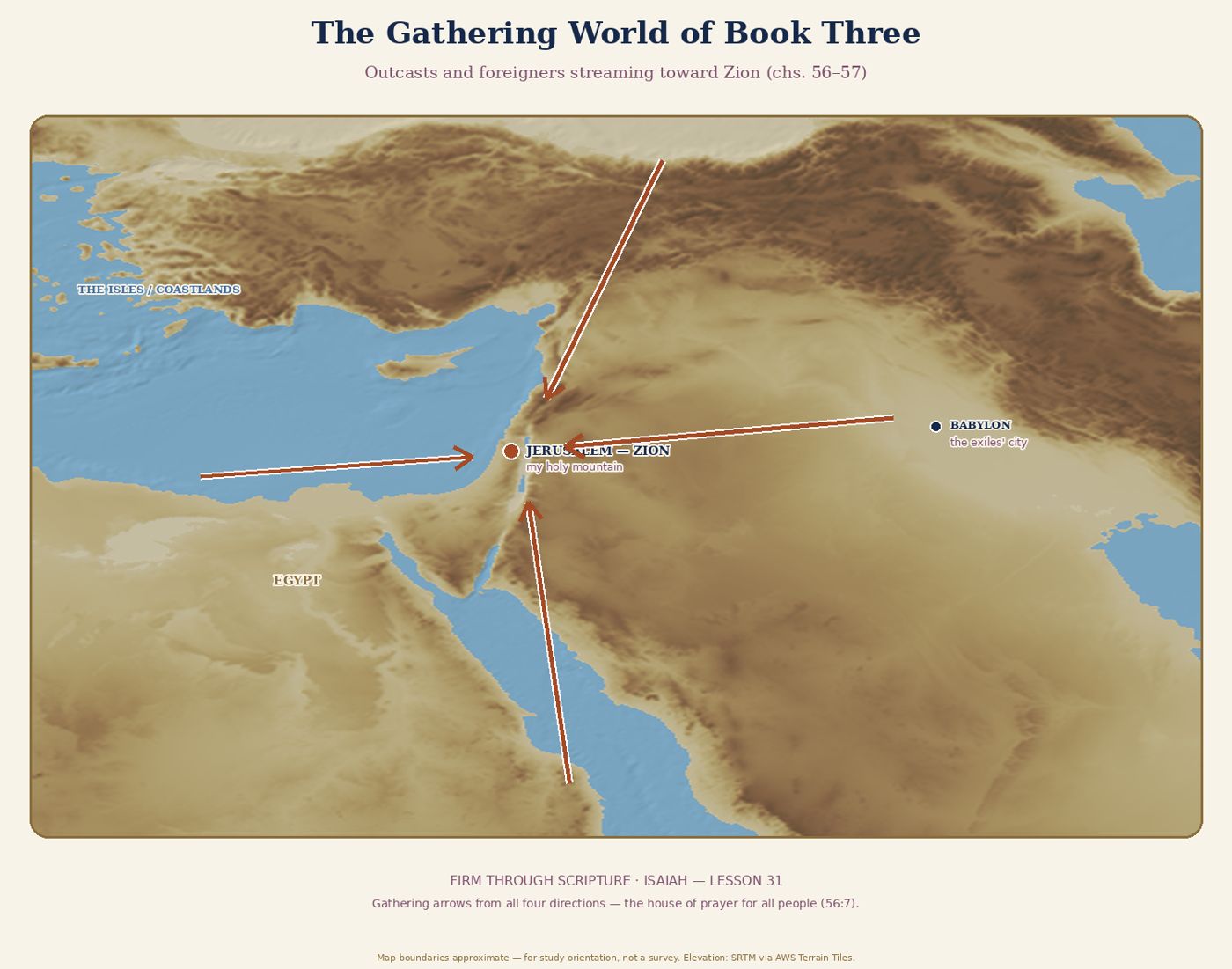
Where are we in the story? After the return promises of chapters 40–55, we face a restored — but still waiting, still compromised — community gathered around Zion, God's holy mountain and temple city (Jerusalem, set on its hill, with the temple at its heart). The temple matters enormously here: house, walls, altar, sabbaths, sacrifices, a house of prayer. Its community is ragged: watchmen sleep, shepherds grab, righteous people die unnoticed (57:1). Post-exile Jerusalem in Ezra and Nehemiah's day faced exactly these pressures, and many readers hear chapters 56–66 against that restored-but-struggling setting. [3, 9] Hold it lightly: it is the setting the text itself paints, whatever you conclude about dates.
The honesty note this book always carries. Since the nineteenth century, mainstream scholarship has commonly spoken of these chapters as "Third Isaiah" — a post-exilic circle speaking in the prophet's tradition rather than the eighth-century Isaiah himself — while the historic church read one Isaiah, son of Amoz, and the oldest complete witness, the Great Isaiah Scroll from Qumran (about 125 BC), already carries all sixty-six chapters as one scroll. [9, 22] That debate is DISPUTED terrain. Our POSITION, carried through the book, is the church's historic reading: Isaiah's, one prophet's witness read whole.
Two outsiders, defined — because beginners trip here. A foreigner — the KJV's "son of the stranger" — is a non-Israelite, from another nation, with no birthright in Israel's covenant. The ones in this chapter have "joined" themselves to the LORD (56:3, 6) — attached themselves to Israel's God, His service, and His covenant. A eunuch is a man who has been castrated, often for service in a royal court — a common practice in the ancient Near Eastern courts Israel knew, Babylon's included. 16 A eunuch could hold real power, but he could never father children — and in a world where your name survived in your children, and Israel's promises ran through offspring, that was, humanly speaking, the end of his line, his name, and his future. When he says "I am a dry tree" (56:3), he uses orchard language for a life that can bear no fruit and leave nothing behind it. Feel that sentence's weight before God answers it.
The old fence. And there really was a fence, written into Israel's law. Deuteronomy 23:1–8 excludes, among others, the man "wounded in the stones" — the eunuch — from entering "the congregation of the LORD," and it bars Ammonites and Moabites for generations, while explicitly admitting Edomites and Egyptians in the third generation. 1 That is FACT as a statement about what the two texts say: Deuteronomy draws a guarded boundary; Isaiah 56 re-opens it for the eunuch and the foreigner who take hold of God's covenant — God speaking past one boundary to announce a wider gathering, on covenant terms He Himself names. The first hearers would have heard it as startling: the two categories most permanently outside are the two God addresses by name — and forbids to despair.
3. OBSERVE — O: what the text actually does
Before meaning comes observation. Most bad interpretation is shallow reading — answering a text you never actually looked at. So look:
- The shape. Two chapters, five movements, one deliberate contrast. (1) The ethics vestibule and the welcome (56:1–8). (2) The sleeping gatehouse (56:9–12). (3) The righteous taken, unnoticed (57:1–2). (4) The arraignment of the idolatrous generation (57:3–13). (5) The way cleared, the two addresses of God, healing — and the shut door of the refrain (57:14–21). Each half interprets the other.
- The repeated verb: gather. The Lord "gathereth the outcasts of Israel" and will "gather others to him" (56:8). Set it against 57:13, where the idolater is told to let his "companies" — his gathered things, his collection of gods — deliver him. Two gatherings face each other: God gathering people in; people gathering idols the wind will carry out.
- The sabbath, three times. Sabbath-keeping appears at 56:2, 56:4, and 56:6 — for the blessed man, for the eunuch, and for the foreigner alike. It is the passage's recurring badge of covenant membership: one rest, one rhythm, for native and newcomer, whole and wounded. When a practice repeats across every category of person in a chapter, it is a load-bearing wall, not decoration.
- The silences. No king is named, no date given, no foreign army at the gate — the beasts of 56:9 are a picture of judgment on a leaderless flock, not a battlefield report. And nobody in 56:9–57:13 repents on the page: the healing of 57:18 is promised over a backslider still walking "frowardly in the way of his heart" (57:17).
4. GENRE — N: note the genre (prophetic poetry — salvation oracle, leadership indictment, and covenant lawsuit in sequence)
Isaiah 56–57 is prophetic poetry that changes its sub-genre the way a courtroom changes its business. Fee and Stuart's rule governs the whole lesson: a prophet is first a forthteller — speaking God's word into his own generation — before he is a foreteller, and most of this passage is forthtelling of the sharpest kind. 51
Watch the forms move. Chapter 56:1–8 is a salvation oracle with conditions of entrance: "Thus saith the LORD," a blessing (56:2), a despairing speech forbidden, and promises in God's first person — "will I give" (56:5), "will I bring" (56:7), "will I gather" (56:8). Verses 9–12 swing into indictment by metaphor — an animal picture doing the work of a charge sheet. Chapter 57:1–2 is a short lament with a consolation inside it; verses 3–13 are a covenant lawsuit — the accused summoned (57:3), the evidence toured, a question put (57:11), a split verdict delivered (57:13); verses 14–21 close with a salvation oracle again, sealed by the refrain.
Genre rules that keep you honest here:
- Poetry's images are arguments, not photographs. The "dry tree," the "dumb dogs," the "troubled sea" — each image carries a claim you must state in plain words before you apply it. Do not build doctrine on an image you have not translated.
- An oracle's audience controls its comfort. The welcome of 56:3–8 is addressed to the despairing outsider; the fury of 57:3–13 to the defiant insider. Swapping them is the classic way this passage gets mishandled.
- A lawsuit's verdict is the point. Everything in 57:3–12 builds toward the split sentence of verse 13.
5. TERMS — T: the words in the writer's mouth
Four terms carry this passage. Learn what they meant in Isaiah's mouth, and watch how much confusion dies at the dictionary:
- "A place and a name" (56:5) — in Hebrew, yad vashem: literally "a hand and a name," where yad in this idiom means a memorial, a monument — a marker set up by hand so that someone is not forgotten. [18, 19] (Absalom used the same word for the pillar he set up to carry his own name, 2 Samuel 18:18.) 1 In a culture where a man's continuation ran through sons, God promises the sonless man a memorial and a name inside God's own house — a place (the KJV's rendering of yad here) and a name, together, and explicitly "better than of sons and of daughters." Reception note (labeled): Jerusalem's Holocaust memorial takes its name, Yad Vashem, from this verse — a fact about the verse's afterlife, not part of its original meaning.
- "An house of prayer for all people" (56:7) — the temple named not by its sacrifices but by its prayer, and its prayer not by one nation but by all people — in Hebrew, kol-ha'ammim, all the peoples, plural nations. The house exists, in God's own description of it, for the nations' praying — the charter Jesus quotes in the temple court (§6) as the house's own definition of itself. [1, 3]
- "The high and lofty One that inhabiteth eternity" (57:15) — see the Translation Note below. In brief: ram v'nissa, "high and lifted up" — the same exalted language Isaiah used of the LORD on His throne in chapter 6 ("high and lifted up," 6:1) — joined to a dwelling-verb and the word 'ad, perpetuity, eternity. 19
- "Contrite and humble" (57:15) — dakka and shephal-ruach: the crushed, the crumbled-to-dust, and the low in spirit. Dakka is a strong word — what is ground down, broken into pieces (the same root describes the Servant as crushed in Isaiah 53:5, "bruised" in the KJV's rendering). [18, 19] God's stated address, at the summit of His transcendence, is with people who have been crushed, whose hearts He comes "to revive" — to make live again. "Contrite" in modern ears can sound merely apologetic. In Isaiah it means powder. God dwells with powder, and makes it live.
Method note — the word-study guardrail: a word means what its author uses it to mean, in its sentence, in its century. Every term above was settled by Isaiah's usage in Isaiah.
TRANSLATION NOTE — "inhabiteth eternity" (57:15)
Your KJV says the high and lofty One "inhabiteth eternity." Underneath it stands a dwelling-verb — shokhen, "dwells, takes up residence" (the root behind the tabernacle, God's dwelling-place) — joined to 'ad, perpetuity, unending duration. 19 God is not subject to eternity, the way a very old man is subject to his years. He resides in it, the way a landlord resides in his own house. Time is His address, not His cage — eternity's resident, not its prisoner. The KJV's stranger, stronger wording — where God lives, not only that He lasts — is the one to keep. And notice what the verse immediately does with this resident of eternity: His other address is "with him also that is of a contrite and humble spirit." That is not two verses. It is one sentence, and §7 teaches it as one.
6. ENTIRE CANON — E: where this passage sits in the whole story
No passage lives alone. Isaiah 56:1–57:21 stands at a crossroads of the whole Bible — backward to a law it re-opens, forward to two New Testament scenes that walk straight through its sentences:
- The fence re-opened — Deuteronomy 23:1–8. As §2 established, this is FACT at the level of the texts: Deuteronomy excludes the eunuch from the congregation and grades the nations' admission by generations; Isaiah 56 admits the covenant-keeping eunuch unconditionally and brings the foreigner to the altar. 1 The law's fence guarded Israel's holiness in her youth; Isaiah's oracle announces the hour the Gatherer Himself widens the gate — not by lowering the covenant, but by gathering more people into it (56:4, 6). The same LORD speaks in both.
- Jesus in the foreigners' court — Mark 11:17 and parallels. This is FACT: when Jesus overturned the tables in the temple, He taught, saying, "Is it not written, My house shall be called of all nations the house of prayer? but ye have made it a den of thieves" (Mark 11:17). 1 He is quoting 56:7 — fusing it with Jeremiah 7:11's "den of robbers" — in the Court of the Gentiles, the one court where foreigners could pray, which was precisely the space the money-changers had filled with commerce. Matthew 21:13 and Luke 19:46 carry the same saying. 1
- The pilgrim on the Gaza road — Acts 8. FACT: Luke's Ethiopian is a eunuch and a foreigner — a court official from Ethiopia who "had come to Jerusalem for to worship" and was returning home reading Isaiah, specifically the suffering-Servant passage (Acts 8:27–33). Philip joins the chariot, preaches Jesus from that Scripture, and baptizes him on the road (Acts 8:35–38). 1 INFERENCE / POSITION: that Luke stages, in one pilgrim, the two exact categories of Isaiah 56:3 — foreigner and eunuch in a single man, found reading this book — is a connection the canon invites and this course argues as the canon staging its own theme. Luke never states it (he never quotes 56:3–7), and we do not upgrade it. But what he does show is a man who faced both exclusions at once — and the gospel's answer on the road was not a waiting period. It was water, that day.
- Peace to far and near — Ephesians 2:17. FACT: Paul writes of Christ that He "came and preached peace to you which were afar off, and to them that were nigh" (Ephesians 2:17) — a direct carrying-forward of 57:19's "Peace, peace to him that is far off, and to him that is near." 1 Paul's extension is apostolic: the "far off" are the Gentiles, the "nigh" are Israel — Isaiah's gathering, now named as accomplished in Christ.
- Clearing the way — 40:3 and 57:14. Chapter 40's highway, built by God, becomes at 57:14 the community's own work: "take up the stumblingblock out of the way of my people" — the obstacles now sit inside the people's road. [3, 4]
Laid out flat, the canon traffic through this one lesson looks like this:
| This passage says… | The canon answers… | Where |
|---|---|---|
| The eunuch shall not say, "I am a dry tree" (56:3) | A eunuch from Ethiopia, reading Isaiah, is baptized without delay | Acts 8:27–38 |
| "My house shall be called an house of prayer for all people" (56:7) | Jesus quotes the sentence in the Gentiles' court, clearing it | Mark 11:17 |
| "Peace, peace to him that is far off, and to him that is near" (57:19) | Christ "preached peace to you which were afar off, and to them that were nigh" | Ephesians 2:17 |
| "Take up the stumblingblock out of the way of my people" (57:14) | "Prepare ye the way of the Lord" — God's highway becomes the people's work | Isaiah 40:3 |
7. THE MEANING — what the passage teaches
The Walk has established what the text says and where it sits. Now its payload, taught straight — the doctrines this passage actually carries, in the text's own proportions.
Book Three opens with ethics, not ecstasy (56:1–2)
Feel the first verse's surprise. Sixteen chapters of comfort have ended with the widest invitation in the Old Testament — come to the waters, everyone, without money (55:1). A lesser book might have made what follows pure celebration. Isaiah makes it a command: "Keep ye judgment, and do justice: for my salvation is near to come" (56:1). The for is the doctrine. Salvation's nearness is the reason for justice-keeping, not the replacement for it. A people who believe God is about to act do not sit down; they straighten up. [3, 4]
Verse 2 shows the ethics' shape in three strokes: the man who does this and lays hold on it; who "keepeth the sabbath from polluting it"; and who "keepeth his hand from doing any evil." Positive and negative, worship and conduct, held in one blessing. The sabbath — Israel's weekly rest, the covenant's sign — stands here as the ethics' beating heart, not its decoration. 16 And note who verse 2 blesses: not "the Israelite" but "the man… the son of man" — the widest words for a human being the language has. The blessing's grammar is already leaning toward verse 3.
Do not say it: the foreigner (56:3, 6–8)
God does something in verse 3 He does nowhere else quite this way: He quotes a despairing man's sentence in order to forbid him to say it. "Neither let the son of the stranger, that hath joined himself to the LORD, speak, saying, The LORD hath utterly separated me from his people." The foreigner in view is no tourist and no enemy. He has joined himself to the LORD — the verb is attachment, cleaving. He serves, loves God's name, keeps the sabbath, and takes hold of the covenant (56:6) — a profile of devotion, not of convenience. And still he expects to be separated out. Perhaps he has read Deuteronomy's graded admissions and done the arithmetic on his nation; perhaps he has watched the temple's barrier — in the later temple, a stone balustrade beyond which no foreigner could pass on pain of death. 16 Whatever his evidence, God calls his conclusion a sentence that must not be spoken.
The answer (56:6–7) is not reassurance; it is a programme, in God's first person, future tense: I will bring them to my holy mountain. I will make them joyful — not tolerated, not processed: joyful — in my house of prayer. Their sacrifices shall be accepted upon mine altar. Every barrier he feared is answered at the exact point he feared it: access (brought), affect (joy), acceptance (offerings received). And then the reason, the house's own charter: "for mine house shall be called an house of prayer for all people" (56:7). A temple that functions otherwise is not being more holy than God. It is being something else than His house.
Verse 8 breaks the frame wider still, as a formal divine saying: "The Lord GOD which gathereth the outcasts of Israel saith, Yet will I gather others to him, beside those that are gathered unto him." The Gatherer's work is unfinished by His own announcement — His title is His activity, "which gathereth," and His promise is an open "yet… others." Nobody who has read verse 8 honestly can build a theology in which God is reluctantly inclusive.
Better than sons and daughters: the eunuch (56:3–5)
If the foreigner's fear is separation, the eunuch's is erasure. "Behold, I am a dry tree" (56:3) — a tree that flowers for no one, fruits for no one, and when it falls, nothing grows from it. Under Israel's promise-structure, where God's covenant ran through descendants — Abraham's seed, David's house, a name continued in children — the eunuch stood where the future stopped. Deuteronomy's exclusion (§2, §6) only wrote his private sorrow into public law. God forbids his sentence too, and answers it with the most tender arithmetic in the book.
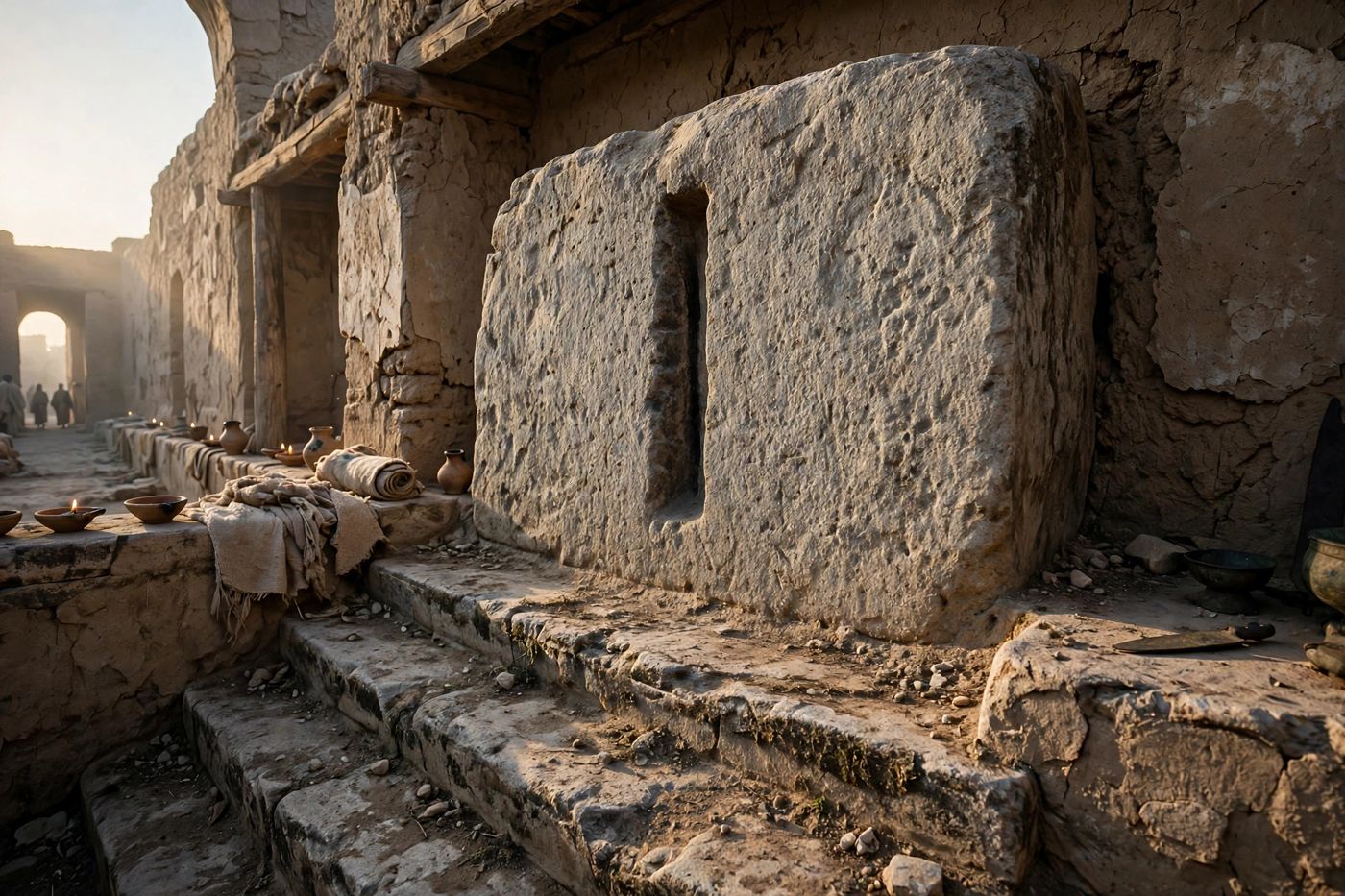
Read the promise's terms first, because they are the same terms offered to everyone in this chapter: "unto the eunuchs that keep my sabbaths, and choose the things that please me, and take hold of my covenant" (56:4). Sabbath, chosen obedience, covenant grip — no lowered standard as compensation; the full inheritance on the full terms. Then the gift (56:5): "in mine house and within my walls a place and a name" — a yad vashem, a memorial and a name (§5) — placed not in a suburb of the community but in God's house, inside His walls. And the comparison God Himself chooses: "better than of sons and of daughters." Not equal to, considering. Better. What children were for — continuation, remembrance, a name that outlasts death — God gives directly: "I will give them an everlasting name, that shall not be cut off." Savour the wordplay: the man who was cut — and whose name faced being cut off — receives a name that shall not be cut off. Oswalt presses the point: God's gift outruns the natural good he missed, because a name held in God's house outlasts a name held in any genealogy. 3
The wide gate and the sleeping gatehouse (56:9–12)
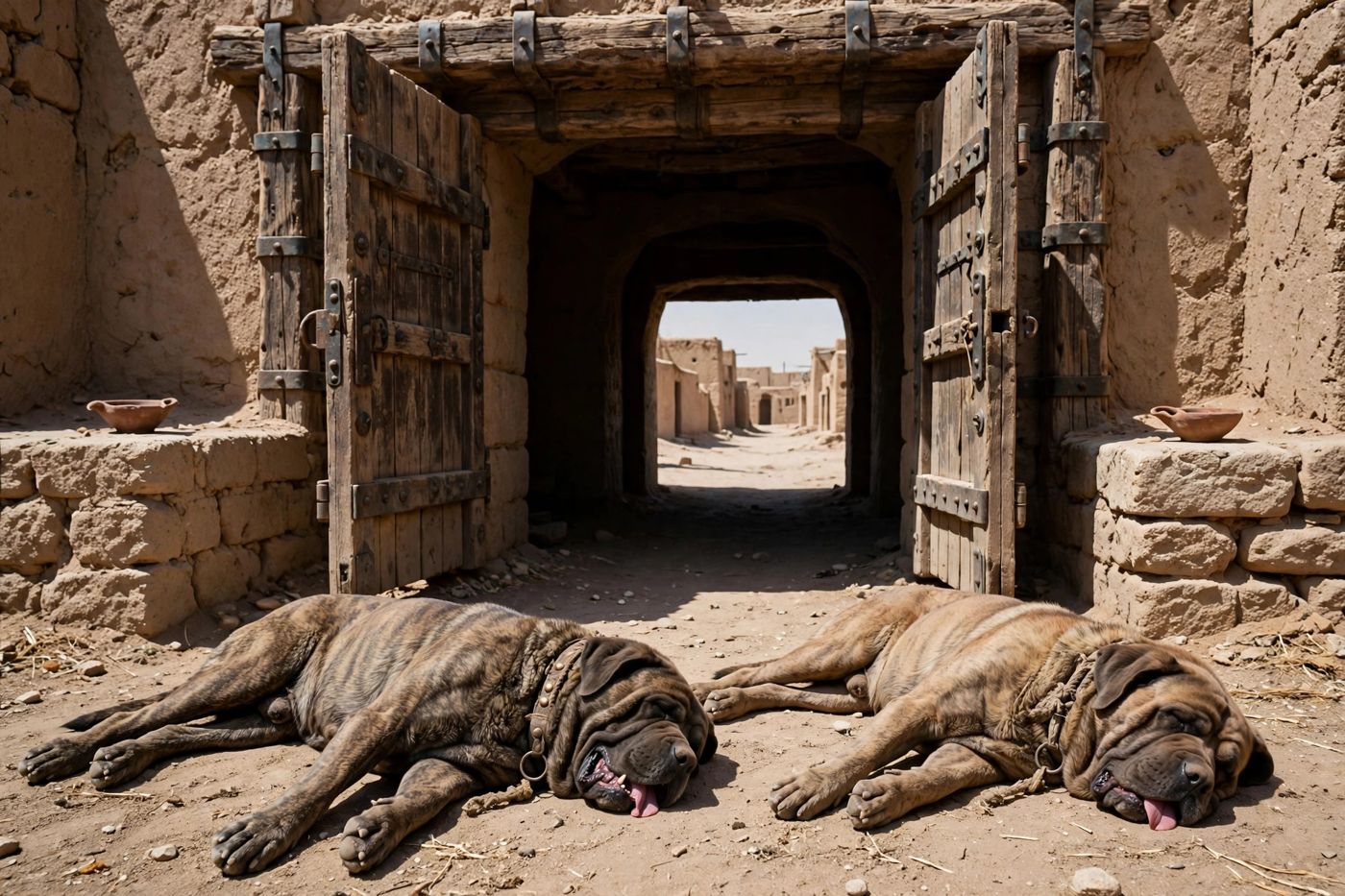
Then — whiplash, and it is meant as whiplash — verse 9 summons the wild animals to dinner: "All ye beasts of the field, come to devour." Why? Verse 10 answers: because the flock's guard is down. "His watchmen are blind: they are all ignorant, they are all dumb dogs, they cannot bark" — and then, the reason given in the same breath: "sleeping, lying down, loving to slumber." The watchmen — the men posted to see — are blind, the one disability that ends a watchman's usefulness, and ignorant besides. As dogs they are dumb — here the KJV's older sense matters: not stupid, but mute, unable to bark. A watchdog's bark is its whole job; it need not win the fight, only sound the alarm and wake the house. These cannot. And the reason is not incapacity but appetite: slumber is not their failure, it is their love.
Verse 11 makes it more precise: "greedy dogs which can never have enough… shepherds that cannot understand: they all look to their own way, every one for his gain, from his quarter." Every shepherd faces inward. And verse 12 lets them preach their own sermon: "Come ye… I will fetch wine, and we will fill ourselves with strong drink; and to morrow shall be as this day, and much more abundant." Hear it rightly: a liturgy of presumption. Tomorrow shall be as today, only better — they pronounce over their own future the certainty that belongs to God's promises, and they pronounce it drunk. God has just said "yet will I gather" (56:8) — a future held in His hand. The watchmen presume a future in theirs. One of these is a promise. The other is a toast.
Set the chapter's two halves side by side, as Isaiah built them: a diptych. The gate: wide, God-guarded, gathering. The gatehouse: blind, mute, asleep, self-feeding. The danger to the foreigner and the eunuch in this text is not God's narrowness — God has spent eight verses dismantling that idea. It is a leadership so asleep that outsiders at a wide gate find no one awake to welcome, guard, or guide them. When God widens a gate, the first sin to guard against is not the wrong people coming in. It is the appointed people going to sleep.
The righteous taken, and nobody notices (57:1–2)
The camera drops from the gatehouse to a funeral nobody attends. "The righteous perisheth, and no man layeth it to heart: and merciful men are taken away, none considering that the righteous is taken away from the evil to come. He shall enter into peace: they shall rest in their beds, each one walking in his uprightness" (57:1–2). The verses reverse how a rotten generation reads a good man's death. The generation reads it as loss, accident, or nothing. Heaven reads it as evacuation: in days when watchmen sleep and judgment gathers, God takes His righteous ones out of the road of the coming evil — the Gatherer, gathering early.
Note the words spent on the dead: righteous, merciful — covenant words for people who kept judgment and did justice (56:1) while their neighbours slept. Their end is rest-language: they "enter into peace," they "rest in their beds" — the grave renamed a bedchamber. Smith's treatment notes the pastoral weight the church has rightly found here: one of the Old Testament's clearest windows on death as God sees it for His own — not extinction, but removal into peace, ahead of a storm the righteous are spared from watching arrive. 11 §10's Misread 2 will fence this verse against its cruel misuse. Here take both its comfort and its rebuke at full strength: the scandal is not the death but the inattention — "no man layeth it to heart."
And hold, gently, one tradition attached to these verses — labeled for exactly what it is. Later tradition held that Isaiah himself died a martyr — sawn in two under King Manasseh — and read 57:1–2 as the prophet's own epitaph. §16 tells that story in the open: it rests on the Ascension of Isaiah and later tradition — TRADITION, not Scripture — and Hebrews 11:37's "sawn asunder" is a possible allusion, no more. The verses preach at full strength without it.
The arraignment: a tour of the other worship (57:3–13)
"But draw near hither" (57:3) — court is in session, and the defendants are summoned the way the despairing were summoned in 56:3, with an order to approach. The name God calls them is the charge itself: "ye sons of the sorceress, the seed of the adulterer and the whore." Not parentage — paternity of practice: a generation formed by fortune-telling and spiritual adultery (the Bible's settled metaphor for idolatry) is addressed as the offspring of what it practises. Verse 4 adds mockery to the charge — a wide mouth, a drawn-out tongue — against whom? The mocker's target is God Himself and His righteous. Children of transgression, a seed of falsehood — the genealogy is moral, and it is devastating.
Then the evidence, toured in verses 5–9 like exhibits carried past the jury, and this study will not soften the worst of it. "Enflaming yourselves with idols under every green tree" — the high-place worship of the Canaanite fertility cults, lust and liturgy fused. 16 And in the same breath: "slaying the children in the valleys under the clifts of the rocks" (57:5). Child sacrifice — the offering of sons and daughters, the horror Israel's law named and cursed, practised in the valley ravines (the Valley of Hinnom outside Jerusalem was its notorious address) to gods like Molech. 16 Isaiah names it without flinching, as worship — because that is his point: this is not the community at play, it is the community at prayer, and its prayers kill children. The smooth stones of the stream are chosen as "thy portion" (57:6) — river-worn stones given the offerings that belonged to God: "Should I receive comfort in these?" The bed on the high mountain (57:7) — idolatry in the marriage metaphor again. The memorial behind the door and the posts (57:8) — where the law commanded God's words to be (Deuteronomy 6:9), this worshipper sets up a different remembrance, hidden and private. [1, 16] And verse 9 sends the envoys far off, debased "even unto hell" — diplomacy as another face of the same adultery.
Verse 10 is the tour's saddest line: "Thou art wearied in the greatness of thy way; yet saidst thou not, There is no hope." Exhaustion without repentance — still the sunk cost preaches: we have come too far to call it hopeless. And verse 11 puts God's question, the one the lawsuit turns on: "And of whom hast thou been afraid or feared, that thou hast lied, and hast not remembered me, nor laid it to thy heart?" Every idolatry, Isaiah says, has a fear underneath it — someone whose displeasure felt more dangerous than God's. And God's silence was misread as God's absence: "have not I held my peace even of old, and thou fearest me not?" Patience mistaken for permission — §11 will sit with that, because every generation inherits the mistake.
The verdict is split, and both halves matter (57:12–13). "I will declare thy righteousness, and thy works; for they shall not profit thee" — God's "declaration" of their self-righteousness is its exposure: read aloud, it profits nothing. "When thou criest, let thy companies deliver thee" — your gathered gods, your collection: let them try. "But the wind shall carry them all away; vanity shall take them." A puff of wind against a lifetime of gathering. And then the door that has stood open since 56:3 swings once more: "but he that putteth his trust in me shall possess the land, and shall inherit my holy mountain." Not "he that was born in the right nation." He that putteth his trust in me. The mountain promised to the foreigner (56:7) is promised again, here, to the truster — on the far side of the arraignment.
Cast ye up: the way cleared (57:14)
One verse, and a hinge of the book. "And shall say, Cast ye up, cast ye up, prepare the way, take up the stumblingblock out of the way of my people" (57:14). The doubled command is road-builder's language — heap up the causeway. In chapter 40, God built this road Himself. Here the work is specified with uncomfortable localness: not mountains levelled in a desert, but the stumblingblock, the particular obstacle in my people's own path, lifted out. The implication stands: obstacles between God and His people are now, in part, ours to remove [3, 4] — not to become the stumblingblock, and not to leave one lying where a foreigner, a eunuch, or a returning backslider will trip on it in the dark.
The high and lofty One, and His two addresses (57:15)
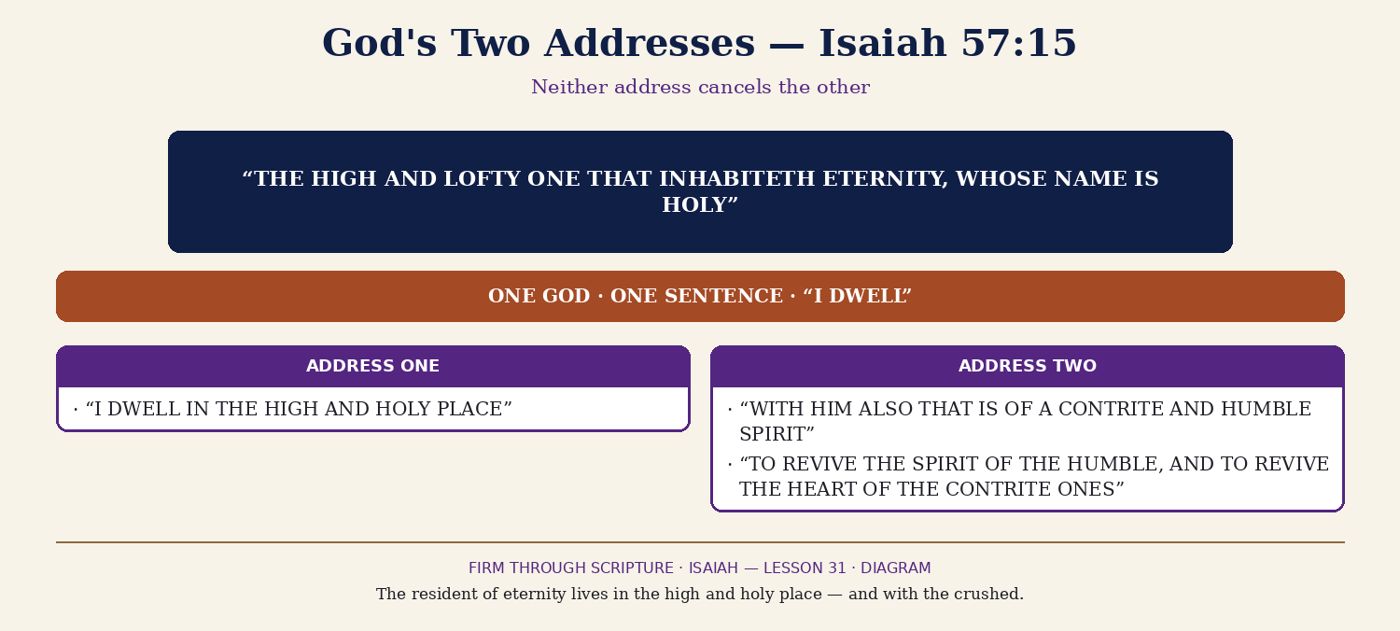
Now the summit — the verse many readers judge the doctrinal peak of the whole book, and the one this lesson is named for. Read it as slowly as it asks. It opens with a name: "the high and lofty One that inhabiteth eternity, whose name is Holy." It continues with an address — two of them: "I dwell in the high and holy place, with him also that is of a contrite and humble spirit" — and it ends with a purpose: "to revive the spirit of the humble, and to revive the heart of the contrite ones." Three things must be held together, because the verse holds them together.
First, the transcendence is total. "High and lofty" is Isaiah's throne-room language — the LORD of chapter 6, seated "upon a throne, high and lifted up," before whom seraphim cover their faces. 1 This One "inhabiteth eternity" (§5): time is His residence. His name — His revealed character — is Holy: separate, other, unapproachable in moral splendour. His dwelling is "the high and holy place." Nothing in the verse qualifies any of that down. God is not brought nearer by being made smaller.
Second, the condescension is simultaneous, not subsequent. "I dwell in the high and holy place, with him also that is of a contrite and humble spirit." Also. In the same self-predication, with the same dwelling-verb, God gives His second address. He does not commute. Both dwellings are present tense; both are where He lives. The crushed and lowly in spirit — the dakka, the powdered ones of §5 — are not visited by this God on holy days. They are His housemates.
Third, the purpose is resurrection in miniature: "to revive the spirit of the humble, and to revive the heart of the contrite ones." Revive — to make alive. God's presence with the contrite is not solidarity for its own sake; it is life-support from the resident of eternity. He moves in with the crushed in order to make the crushed live.
This verse is the passage's doctrine of God, and §10's Misread 3 guards its two commonest ruins: the high-and-lofty sermon that never descends, and the near-and-tender sermon that never ascends. Isaiah preaches one God, one sentence, two addresses. And notice whose benefit the summit serves: it stands immediately before the promise to heal the backslider (57:17–18). The contrite heart is not the price of God's nearness — as if heaven ran a door policy of sufficient brokenness. It is God's stated residence. The backslider of verse 17 becomes the healed man of verse 18 by becoming, at last, the contrite man of verse 15 — not paying for the visit, but finally being home where the Visit lives.
The anger has a term, and the healing has no deserving (57:16–19)
"For I will not contend for ever, neither will I be always wroth: for the spirit should fail before me, and the souls which I have made" (57:16). God's anger, in God's own account of it, is self-limited by His compassion for the creatures He made: if He contended forever, the human spirit would simply fail before Him. Then the case study (57:17): a man — the community in one figure — whose covetousness provoked wrath; God smote him, hid Himself, and the man's response to discipline was to go "on frowardly in the way of his heart." Froward: perverse, turned-away, backsliding as a direction of travel. If the story were written by desert, verse 17 is the last verse.
It is not. "I have seen his ways, and will heal him: I will lead him also, and restore comforts unto him and to his mourners" (57:18). Every verb is God's, and the order is mercy's order: seen (the ways are not excused — they are seen, all of them), heal (not merely forgive: heal, the physician's word), lead (the backslider does not navigate home; he is led), restore comforts (to him "and to his mourners," the people his wandering grieved). The initiative is entirely God's, announced after the full record of the man's frowardness has been read into evidence: healing spoken over a man whose only contribution to the paragraph is the disease.
And God creates the response too: "I create the fruit of the lips; Peace, peace to him that is far off, and to him that is near, saith the LORD; and I will heal him" (57:19). The "fruit of the lips" — praise, confession, the speech of the healed — is created, not farmed by the patient. Peace is pronounced to both distances: far off and near — the foreigner and the Israelite, the outcast and the insider — and Paul will preach it exactly so (Ephesians 2:17; §6). This is the last word of grace in the lesson. It is not the last word of the lesson, and the difference is the next heading.
No peace: the sea and the shut door (57:20–21)
"But the wicked are like the troubled sea, when it cannot rest" — a sea "whose waters cast up mire and dirt," under the verdict, "There is no peace… to the wicked" (57:20–21). The image is exact, not decorative. A sea cannot rest — rest is not in its nature when the wind works it — and its restlessness is not productive: what it casts up is "mire and dirt," the dredge of itself. So the wicked: not people who have peace and lose it, but people whose element excludes it. Shalom — peace, wholeness, rest, pronounced twice to far and near in verse 19 — is precisely what is not available on the far side of refusing the Gatherer, the Healer, and the indictment. The sea is Isaiah's standing picture of restless, God-resisting turmoil 52 — here the anti-type of everything verses 15–19 promised.
And the refrain is deliberate. Isaiah has spent this phrase before — 48:22, at the close of Book Two's central movement — and he spends it again here, expanded with "my God," at the close of Book Three's opening lesson. Refrains in this book are load-bearing (Motyer's structural reading makes them the book's skeleton, not its decoration). 4 The effect is bracing: the widest welcome in Isaiah ends with a door shut and labelled by God — no peace to the wicked. Not to the foreign, or the wounded: to those who, offered gathering, healing, and a cleared way, choose the sea. The comfort of this book and the warning of this book are the same size.
The Christ Thread
This passage earns its Christ Thread in the open, from the New Testament's own mouth — no forcing required.
Jesus quotes 56:7 as the temple's charter, in the temple, in the foreigners' court. Mark 11:17 is the scene (§6): the tables overturned are the tables that had colonized the one court where the nations could pray, and the sentence Jesus chooses as His warrant is Isaiah's — "My house shall be called of all nations the house of prayer." 1 Two things follow. First, Jesus treats 56:7 as the house's present definition, not a distant aspiration. Second, the Lord who clears the court is Himself the offering that court prefigured: the foreigners' offerings "accepted upon mine altar" (56:7) reach their ground in the one sacrifice offered once for all — the church's historic reading, earned because Jesus Himself does the quoting.
And the Gatherer of 56:8 gathers, in the Gospels, exactly as announced. "Yet will I gather others to him" stands behind the Good Shepherd's "other sheep I have, which are not of this fold: them also I must bring" (John 10:16) — the same open arithmetic, whether or not a direct quotation is claimed. 1 The pattern is the preaching: the God of Isaiah 56 keeps gathering past every fold's fence, in person, in Christ — and the Ethiopian of Acts 8 is baptized on a desert road as if the canon wanted one photograph of it (§6).
Where in the Covenant Story?
This lesson stands at the covenant's great widening. The old covenant's administration had always contained the seed of it — Abraham promised that in his seed all families of the earth would be blessed; Rahab and Ruth gathered in; the law itself commanding love of the stranger — but it also carried real fences (Deuteronomy 23) for a real season. 1 Isaiah 56 announces the season's turn: the fences are opened by the Covenant-Maker, on covenant terms. The new covenant completes what this chapter announces: in Christ, the middle wall of partition is broken down, and the far-off are made nigh by His blood (Ephesians 2:13–17) — preaching this chapter's own peace (57:19). 1 Not a contradiction of Moses, then, but Moses' God announcing the day the doorway built into the house from the beginning would stand fully open.
The Long View — what the church has believed
Stand back and watch the centuries read this passage. The ancient church read 56:7 through the lips of Jesus and treated the house-of-prayer saying as settled ground: the Gentiles' welcome was not, for the early fathers, an inference to be argued but a charter to be obeyed, and Jerome's great commentary reads Isaiah as one prophet's book whose widening promises run straight to the church of the nations. 37 The Reformers pressed the chapter's ethics: Calvin lingers on 56:1's logic — the nearness of salvation as the church's reason for justice, not its excuse from justice — a standing rebuke to any piety that uses grace as a sedative. 36 On 57:15, the church's devotional tradition has been of one voice: transcendence and condescension in one breath, Scripture's own summary of the doctrine of God. Where the centuries have honestly divided is the composition question (§2, §16) — a dispute the church's practice has refused to let mute the text: it has argued about Isaiah's pen for two hundred years and obeyed Isaiah's welcome for two thousand.
That is the payload. The next section compresses it into one sentence.
8. THE AIM SENTENCE — X: eXplain the intent
Everything observed now compresses into one sentence — the author's intended meaning, stated before any application is allowed near it:
Isaiah opens the book's last act by announcing that the God who inhabits eternity is still gathering — He forbids the covenant-keeping foreigner and eunuch to despair, promising them His mountain, His altar, and an everlasting name, He arraigns the sleeping watchmen and the idolatrous generation, and He declares that He dwells both in the high and holy place and with the contrite, healing even the backslider and giving peace to far and near — but there is no peace to the wicked.
If a sermon or devotional uses this passage to say something that cannot be traced back to that sentence, it is not this passage talking.
9. SAY IT BACK
Close the book and say the AIM sentence from section 8 in your own words — out loud, or written in your notes, without looking. Then say, in one more sentence, what it asks of you this week.
If your version quietly changes the meaning — if the wide gate loses its covenant, or the high and lofty One loses His second address, or the refrain politely disappears — walk it again. This exercise is the entire course in miniature: meaning first, then — and only then — your life.
10. THE MISREAD — the guardrail, with verdicts
Three live misuses of this passage. Each gets a fair hearing, the evidence, and a verdict.
Misread 1: "Isaiah 56 lowers the gate — God welcomes the outsiders just as they are, so belonging to God no longer involves keeping anything." Why it sounds right: the welcome really is wide, Deuteronomy 23's fence really is re-opened, and the promises really are spoken to people with every reason to expect exclusion. The evidence: read the terms the chapter repeats three times. The blessed man keeps the sabbath and keeps his hand from evil (56:2). The eunuchs promised the everlasting name are those "that keep my sabbaths, and choose the things that please me, and take hold of my covenant" (56:4). The foreigners brought to the mountain join themselves to the LORD "to serve him, and to love the name of the LORD… every one that keepeth the sabbath from polluting it, and taketh hold of my covenant" (56:6). The gate is widened; it is not removed. The outsiders are gathered into covenant-keeping, not excused from it. And the counter-error falls in the same breath: to treat Deuteronomy 23's fence as God's last word is to contradict God's own "Neither let… speak, saying" (56:3) and His "Yet will I gather others" (56:8). Verdict: the welcome is unconditional in its offer and covenantal in its shape. God widens the gate Himself, and what stands inside it is sabbath-keeping, covenant-gripping obedience, for native and newcomer alike.
Misread 2: "Isaiah 57:1–2 teaches that God takes the righteous young — the good die young, by God's design." Why it sounds right: the verse really does say "the righteous is taken away from the evil to come," and grieving people reach for it at real funerals. Its pastoral use is genuine — §7 affirms it — which is why its misuse does such quiet damage. The evidence: watch the verse's own frame. It is spoken over a specific scene: watchmen asleep (56:10–12), a generation arraigned (57:3–13), evil coming on a community in decay — and the righteous man's removal is mercy within that scene, God evacuating His own ahead of a national storm, while his contemporaries are rebuked not for surviving him but for not noticing ("no man layeth it to heart," 57:1). The verse offers no general law about the age at which good people die, and the wider canon forbids one: Abraham dies at a "good old age" (Genesis 25:8), Job is restored to long years, and Psalm 73's wicked often prosper. 1 Turned into a law, the verse becomes cruelty with a proof-text. Verdict: Isaiah 57:1–2 reads a rotten generation, not a timetable: removal as mercy in days of decay, and a rebuke to the living who did not notice. Use it pastorally inside that frame, and never as a general law of early death.
Misread 3: "Isaiah 57:15 gives us a God of two halves — take your pick: the high and lofty One, remote and majestic, or the near and tender One who dwells with the humble." Why it sounds right: the two addresses really are at opposite poles of experience — eternity's throne room and a crushed human heart. The evidence: the grammar refuses the split. "I dwell in the high and holy place, with him also…" — one subject, one dwelling-verb, one sentence, one self-predication (§5, §7). The transcendence is not the price of the condescension, and the condescension is not a softening of the transcendence: the same God, at the same moment, resides in eternity and with the contrite, and His name — Holy — governs both addresses. Nor is the contrite heart a fee paid to unlock the second address: God does not promise to visit the sufficiently broken; He says He dwells with them — the contrite heart is His stated residence, and He dwells there on His own initiative: "to revive." Verdict: one God, one sentence, two addresses. Preach the throne without the crushed heart and you have half a God; preach the nearness without the loftiness and you have the other half. Isaiah 57:15 permits neither half-sermon.
11. FROM WORD TO WALK
A reflection page — the lesson is not finished until the passage has had its say with you.
Two forbidden sentences open this lesson, and most of us have said at least one of them — in the car, in the night, in the doorway of a church where we stood feeling like the category that doesn't fit. The LORD hath utterly separated me from his people. Behold, I am a dry tree. A loss that seems to have ended the future — the children not had, the years not recoverable, the name that feels like it stops with you. Isaiah 56 does not argue with those sentences by first improving your circumstances. God forbids the sentence, and gives a better one instead: a place, a name, better than sons and daughters, everlasting, not cut off — spoken not by your optimism but by the Gatherer Himself. If that is your place in the passage, sit here a while. The first sermon of Book Three is God, interrupting despair, in the second person.
And if it isn't — if you came to this lesson as an insider, at home in the house — the passage has a different mirror for you: the gatehouse. Isaiah's watchmen were not wicked men by their own account; they were comfortable men, well-fed on their own quarter, planning tomorrow's abundance. Their sin was not cruelty. It was sleep, at a post, while the gate God had widened stood open. Is there anyone at God's wide gate in your world who has met your sleep instead of your welcome? And is there a righteous man or woman whose passing your community barely noticed? "No man layeth it to heart" is a sentence a whole congregation can earn without a single dramatic sin — just years of not laying things to heart.
Then let the summit do its work. The God of 57:15 is not waiting at the top of a staircase of sufficient brokenness. He dwells with the contrite — present tense, stated address — and He dwells there to revive. Whatever in you is crushed to powder this week — and dakka means powder — is not the obstacle to His presence in this verse. It is the address He gives for it. And to the backslider the word is not climb back. It is "I have seen his ways, and will heal him: I will lead him also." Seen — all of it. Healed anyway. Led, not left to navigate.
High and Lofty One, You inhabit eternity, and You live with the crushed. I bring You the sentence I keep saying about myself — that I am separated, that I am a dry tree — and I lay it down under Your "neither let him speak, saying." Give me the name You give, and teach me to trust its Keeper. Wake me where I have slept at a post You set me to, revive my heart, and grant me Your peace — the peace that is not in the sea. In Jesus' name, amen.
12. FOR DISCUSSION — OR FOR YOUR JOURNAL
With a group, work these aloud. Alone, they're yours — answer them in your journal or in prayer; they lose nothing in the quiet.
- The foreigner and the eunuch are each forbidden to say a sentence about themselves (56:3). What sentence about your own place with God does this passage forbid you to keep saying — and what sentence does God put in its place?
- The watchmen's failure was sleep and self-feeding at a wide gate (56:10–12), not heresy. Where do leaders and communities today most often fail the people God is gathering — by cruelty, or by sleep? Which is your own greater temptation?
- Isaiah 57:15 gives God two addresses in one sentence. Which address do you instinctively emphasize, and which do you neglect — and what has that imbalance done to your picture of God?
- God says of the backslider, "I have seen his ways, and will heal him" (57:18) — seeing first, healing anyway. How does that order change the way you would approach someone who has wandered — or the way you would come home yourself?
13. THE WALK-OUT — T: Transfer to today
Meaning is settled. Now — and only now — application, and it must cross the bridge honestly. Run the five Transfer Tests on this passage:
- Same covenant? We live on the far side of the cross, in the new covenant this chapter foresaw: the literal sabbath day, the temple courts, the altar, and Deuteronomy's fence belong to the old administration. What crosses is the covenant's substance — justice, welcomed outsiders, covenant obedience, rest in God — fulfilled and widened in Christ (Ephesians 2:13–17). 1
- Same audience? The welcome was addressed to despairing outsiders who had joined themselves to the LORD; the indictment to defiant insiders and sleeping leaders. Apply each word to its own audience: do not hand 57:3–13 to the despairing, nor 56:5's promise, unexamined, to the defiant.
- Same genre rules? Prophetic poetry and lawsuit: the images state claims translated in §7; the practices below are built on those claims, not on the pictures raw.
- Repeated or rooted? Welcoming the outsider who comes to God, guarding against self-feeding leadership, God's nearness to the contrite, and peace withheld from unrepentant wickedness — each is repeated across both covenants and rooted in God's character (Psalm 34:18; James 4:6; Romans 15:7). These cross. 1
- Ten verses either side? Every application below is drawn from these two chapters read whole — the welcome kept with its covenant terms, the summit kept with both its addresses, the refrain kept with the comfort. Nothing hangs on a torn-out line.
| The gate (God) | The gatehouse (men) |
|---|---|
| Still gathering others (56:8) | Asleep at the post (56:10) |
| An everlasting name given (56:5) | Tomorrow presumed (56:12) |
| Dwelling with the contrite (57:15) | No peace on the sea (57:21) |
What crosses — and lands:
- Justice is what salvation's nearness produces. Before any practice: the indicative. God's salvation is near (56:1) — in Christ it has come, and the Gatherer is still gathering (56:8). This passage's ethics are not a ladder toward that salvation; they are its fruit and its evidence.
- God's welcome outruns every documentary case for exclusion. The two people with the strongest textual reasons to expect to be shut out are the two God addresses first (56:3–8). The application is not a lowered standard — Misread 1 settled that — but a widened expectation: nobody who has joined himself to the LORD, keeps His ways, and takes hold of His covenant is to be told, by us or by himself, that he is separated out.
- Leadership is judged by wakefulness and by whose gain it serves. Watchmen and shepherds are condemned for blindness, silence, sleep, and self-feeding quarters (56:10–11). Shepherding means feeding a flock that is not yours.
- The high and lofty One dwells with the contrite. Both addresses cross, because both are God's character (57:15; Psalm 34:18). 1 Contrition is not a technique for attracting God; it is the address where He has announced He lives — and His business there is reviving.
Practices — what the gate lets through, made concrete this week:
- Retire one forbidden sentence. Write down, in your own words, the sentence you say about your place with God that 56:3 forbids — separated, dried up, finished, whatever its exact wording is for you. Then write God's replacement sentence beside it, from the passage: a place and a name, better, everlasting, not cut off. Read His sentence aloud each morning this week; let the older one go unspoken.
- Clear one stumblingblock (57:14). Name one obstacle between someone specific and God's people that is yours to lift — the unmade invitation, the unreturned call, the practical barrier (a ride, a seat, a cost). Lift that one this week. Road work, not sentiments.
- A watchman's round. Take twenty minutes and ask the passage's three questions in writing: What danger am I not seeing? What warning have I not sounded because it would cost me comfort? Whose gain am I serving in this post — mine, from my quarter, or the flock's?
- Keep a rest. The sabbath badge repeats three times in one chapter for every category of person. Keep one real day-segment of rest this week, as a covenant act, not a collapse.
- Memorize Isaiah 57:15's second address (in the Recap Card) — the half to carry into a hard room.
What does not cross: reimposing Deuteronomy 23's fence on anyone who comes to God in Christ; claiming 56:5 as a promise that God owes the childless earthly children or the excluded earthly status; reading 57:1–2 as a timetable for anyone's death (Misread 2); treating the literal altar, courts, and sabbath-day administration as the new covenant's standing furniture rather than its fulfilled pattern. The gate is not there to shrink the Bible's claims on you — it is there to make sure the claims that land are the ones God actually made.
Praise Him
High and Lofty One, who inhabiteth eternity, whose name is Holy — we praise You that Your greatness never priced You out of our reach: You dwell in the high and holy place, and You dwell with the crushed, and both addresses are Yours. Gatherer of the outcasts of Israel, we praise You that You are still gathering others; Giver of the everlasting name, we praise You that what You name cannot be cut off; Healer of the froward heart, we praise You that You saw our ways — and healed anyway. Peace, peace, to him that is far off and to him that is near. To You, the resident of eternity, who chose the contrite heart for a home — all honour, now and in the age where names do not fade. Amen.
14. THE RECAP CARD — this study on one page
Print it. Keep it where you'll see it this week.
- The passage: Isaiah 56:1–57:21 — Book Three opens: the wide gate, the sleeping gatehouse, the arraignment, and the God of two addresses.
- Say It Plain: Because salvation is near, God's people keep justice; God forbids the foreigner and the eunuch to despair, promising covenant-keepers His mountain, His altar, and an everlasting name; the watchmen sleep, the righteous die unnoticed into peace, the idolatrous generation is arraigned, the way is cleared, and the high and lofty One dwells also with the contrite, healing the backslider — but there is no peace to the wicked.
- The AIM: Isaiah opens the book's last act by announcing that the God who inhabits eternity is still gathering — He forbids the covenant-keeping foreigner and eunuch to despair, promising them His mountain, His altar, and an everlasting name, He arraigns the sleeping watchmen and the idolatrous generation, and He declares that He dwells both in the high and holy place and with the contrite, healing even the backslider and giving peace to far and near — but there is no peace to the wicked.
- Key terms: yad vashem — a memorial ("place") and a name · "an house of prayer for all people" — the temple's charter at its widest · "inhabiteth eternity" — God as time's resident, not its prisoner · dakka — contrite: crushed to powder.
- The Misread, in one line: The gate is widened, not lowered — outsiders are gathered into covenant-keeping · 57:1–2 is mercy in a rotten generation, not a law that the good die young · 57:15 is one God with two addresses, not two half-Gods.
- Memory verse: "I dwell in the high and holy place, with him also that is of a contrite and humble spirit, to revive the spirit of the humble, and to revive the heart of the contrite ones." — Isaiah 57:15 (second half)
- This week's practice: retire one forbidden sentence — and clear one stumblingblock off somebody else's road (57:14).
15. CHECK YOURSELF — five questions
Answer from the study, not from instinct. (Answers live in the Teacher Edition.)
- In your own words: what is the AIM of Isaiah 56:1–57:21?
- What does God promise the covenant-keeping eunuch in 56:5, and why is the comparison "better than of sons and of daughters" the exact answer to his "dry tree" sentence?
- The gate in this passage is wide, yet people are still in danger at it. Who endangers them (56:9–12), how — and what is the watchmen's own one-sentence sermon?
- Someone tells a grieving family, "Isaiah 57 says God takes the righteous young — that's why she died." Using the study's verdict, explain what 57:1–2 actually claims and why the general law does not follow.
- State both of God's addresses from 57:15, and explain in one or two sentences why neither may be preached without the other.
16. GO DEEPER
Optional — for readers who want the machinery. The lesson is complete without it.
From the Sources — the barrier in the court
In the temple of Jesus' day, the Court of the Gentiles — the only court where a foreigner could come to pray — was separated from the inner courts by a stone balustrade, the soreg, carrying inscriptions warning any foreigner who passed it that death would follow. Josephus describes the barrier and its warning, and two of the actual inscription stones have been recovered. [16, 31] FACT. That archaeology stands behind the tension every first-century reader would feel in 56:7: the house called a house of prayer for all people contained, in stone, a death notice for the peoples at its inner edge — and it was precisely the outer court, theirs, that commerce had occupied when Jesus arrived quoting this verse.
The Honest Argument — who first spoke chapters 56–66?
The division of Isaiah into three voices — an eighth-century prophet (chs. 1–39), an exilic author (40–55), and a post-exilic circle (56–66) — was crystallized by Bernhard Duhm's 1892 commentary and remains the mainstream critical arrangement. 40 The case, at full strength: chapters 56–66 name no king and no prophet, presuppose a standing temple and a restored-but-compromised community, and address sins that fit Ezra and Nehemiah's post-exilic world like a key. FACT — as a description of the critical argument and the features it cites. The counterweight, also at full strength: the book arrives as one scroll in its earliest complete witness (the Great Isaiah Scroll, c. 125 BC) 22; its refrains (48:22 / 57:21) and its road (40:3 / 57:14) stitch the sections together; and the New Testament cites across all three parts under the single name "Isaiah" (John 12:38–41). 1 INFERENCE runs in both directions from those facts. POSITION — this course's, stated in §2: the historic church's reading, one Isaiah read whole, with Blenkinsopp 9 kept on the desk as the fair statement of the other side. The argument is about the pen. The welcome is not in dispute.
The Word Underneath — Isaiah's epitaph, and the saw
An ancient work called the Ascension of Isaiah (roughly first–second century AD in its surviving form) tells how the prophet, hunted by the wicked King Manasseh, was sawn in two. Justin Martyr charges his opponents' ancestors with having "sawn Isaiah in half with a wooden saw" as a settled Jewish memory, and rabbinic tradition in the Babylonian Talmud (Yevamot 49b) preserves its own account of Isaiah's death under Manasseh. [44, 16] TRADITION — all of it: early, widespread, and unverifiable; no biblical text narrates Isaiah's death at all. Hebrews 11:37 lists among the faithful those who were "sawn asunder" — FACT that the phrase stands in the New Testament; INFERENCE, and a widely held one, that Isaiah is its chief referent. The church received 57:1–2 alongside this tradition and read the verses as the prophet's own gravestone. Receive it exactly at that strength: a tradition that shows how the earliest readers heard these verses' size, not a fact the lesson needs.
Go Read
- Oswalt, The Book of Isaiah, Chapters 40–66 (NICOT) 3 — the fullest evangelical treatment of the third book's opening: the eunuch's name, the watchmen, and 57:15 taught at the pace they deserve.
- Motyer, The Prophecy of Isaiah 4 — on the refrains as the book's skeleton, and on 56–66 as the deliberate answer to everything chapters 1–39 arraigned.
- Blenkinsopp, Isaiah 56–66 (Anchor Bible) 9 — the post-exilic reading at full strength, for readers who want the Honest Argument's other side from its own best advocate.
17. SOURCES & REFERENCES
Numbered citations in this lesson key to this list — the course standard: every sourced claim carries its number, and every number can be checked.
- The KJV text itself — Holy Bible, King James Version (eBible.org KJV, 1769 text). Scripture quotations are from the King James Version (KJV), which is in the public domain in the United States; the full passage is always assigned as reading. Cross-references within Scripture cite this number.
- Oswalt, The Book of Isaiah, Chapters 40–66 (NICOT) — John N. Oswalt (Eerdmans). The second volume: the comfort section, the Servant Songs, Cyrus, and the new-creation chapters, read as the deliberate answer to chapters 1–39.
- Motyer, The Prophecy of Isaiah — J. Alec Motyer (IVP). A one-volume commentary by an evangelical scholar who argues the whole book breathes the mind of the eighth-century prophet; especially strong on the book's structure, its repeated refrains, and the Servant.
- Blenkinsopp, Isaiah 1–39, Isaiah 40–55, Isaiah 56–66 (Anchor Bible) — Joseph Blenkinsopp (Doubleday). Mainstream-critical commentary across all three traditional divisions; a fair statement of the multiple-authorship case and of post-exilic settings.
- Smith, Isaiah 1–39 and Isaiah 40–66 (New American Commentary) — Gary V. Smith (B&H). Evangelical commentary with strong historical notes (the Assyrian and Babylonian records) and an even-handed survey of the authorship debate.
- Walton, Matthews & Chavalas, The IVP Bible Background Commentary: Old Testament — John H. Walton, Victor H. Matthews, Mark W. Chavalas (IVP). Verse-by-verse ancient Near Eastern background: Assyrian siege practice, Babylonian religion, treaty and coronation customs, geography.
- VanGemeren (ed.), New International Dictionary of Old Testament Theology and Exegesis (NIDOTTE) — Willem A. VanGemeren (Zondervan). Theological word studies with semantic-range discipline for the Hebrew terms.
- Brown, Driver & Briggs, Hebrew and English Lexicon of the Old Testament (BDB) — The standard older Hebrew lexicon; word senses and usage ranges for the Terms sections.
- The Great Isaiah Scroll (1QIsaᵃ) and the Dead Sea Scrolls Bible — The complete Isaiah scroll from Qumran Cave 1 (c. 125 BC), in Abegg, Flint & Ulrich, The Dead Sea Scrolls Bible (HarperSanFrancisco). The oldest substantial witness to Isaiah's text — already a single scroll of all 66 chapters centuries before Christ.
- Josephus, Antiquities of the Jews (Books 9–11; temple-court descriptions also from the Jewish War) — The first-century Jewish historian's retelling of the Hezekiah/Sennacherib crisis, Isaiah's reputation, and the Cyrus decree — an outside witness to how the traditions were held.
- Calvin, Commentary on Isaiah — John Calvin (public domain). Reformation exegesis; a control on interpretation and a voice in the Long View.
- Jerome, Commentary on Isaiah — Jerome (c. AD 408–410). The early church's fullest Isaiah commentary; Jerome transmits the Hebrew learning of his day and treats Isaiah as one prophet's book.
- Duhm, Das Buch Jesaia (1892) — Bernhard Duhm. The commentary that named the "Servant Songs" as a distinct set and crystallized the "Deutero-Isaiah" division — the historical origin of the modern authorship debate, cited as fact about scholarship.
- Justin Martyr, Dialogue with Trypho — 2nd century AD. The church's argument with Judaism over Isaiah 53 (and 7:14) conducted in the open, chapter by chapter — primary evidence for the Long View.
- Fee & Stuart, How to Read the Bible for All Its Worth — Gordon D. Fee and Douglas Stuart (Zondervan). The beginner's method book; its prophecy chapter ("a forthtelling first") undergirds the Genre sections.
- Ryken, Wilhoit & Longman (eds.), Dictionary of Biblical Imagery — Leland Ryken et al. (IVP). Isaiah's image-fields — vineyard, highway, banner, potter, watchman — traced across the canon.