
One study, one walk — the universal FIRM format. The passage first and whole; then its world; then the Walk (Context · Observe · Genre · Terms · Entire Canon); the meaning taught straight; the AIM sentence; the misread exposed and answered; and the walk-out, where application has to pass the Transfer Tests before it reaches your week. The same skeleton serves a book, a chapter, a single verse, or a whole subject. In the early studies the moves are labeled as they happen. The labels fade as the walk becomes yours.
THE WEEK WITH THIS STUDY — six bites
Day 1 — Read the passage · Say It Plain · The World (§§1–2) · Day 2 — Observe · Genre (§§3–4) · Day 3 — Terms · Entire Canon (§§5–6) · Day 4 — The Meaning · the AIM Sentence · Say It Back (§§7–9) · Day 5 — The Misread · From Word to Walk (§§10–11 — add For Discussion, §12, if you're with others) · Day 6 — The Walk-Out · the Recap Card (§§13–14). Go Deeper (§16) any evening you want the basement.
BEFORE YOU READ — Open My Eyes
LORD, lift the trumpet to my own life first. Show me where my worship has a bowed head and an unbowed heart, teach my hands the fast You have chosen, and let me hear You say, Here I am — not because I performed, but because You are the Redeemer who comes. In Jesus' name, amen.
§ means “section” — the numbered parts of your lesson. Each bite above names the sections for that day.
1. READ THE PASSAGE — Isaiah 58:1–59:21 (KJV)
Read it all, slowly, before any teaching. In this course the passage always prints once, in full, at the head of the lesson. Everything after this is commentary — this is the text.
One orientation before you read: this lesson takes two chapters as one continuous passage, because the book does. Chapter 58 exposes worship that fasts and oppresses on the same day; chapter 59 follows the same people into confession, then watches God act when no one else can. Verse numbers restart at chapter 59.
Isaiah 58
1 Cry aloud, spare not, lift up thy voice like a trumpet, and shew my people their transgression, and the house of Jacob their sins.
2 Yet they seek me daily, and delight to know my ways, as a nation that did righteousness, and forsook not the ordinance of their God: they ask of me the ordinances of justice; they take delight in approaching to God.
3 Wherefore have we fasted, say they, and thou seest not? wherefore have we afflicted our soul, and thou takest no knowledge? Behold, in the day of your fast ye find pleasure, and exact all your labours.
4 Behold, ye fast for strife and debate, and to smite with the fist of wickedness: ye shall not fast as ye do this day, to make your voice to be heard on high.
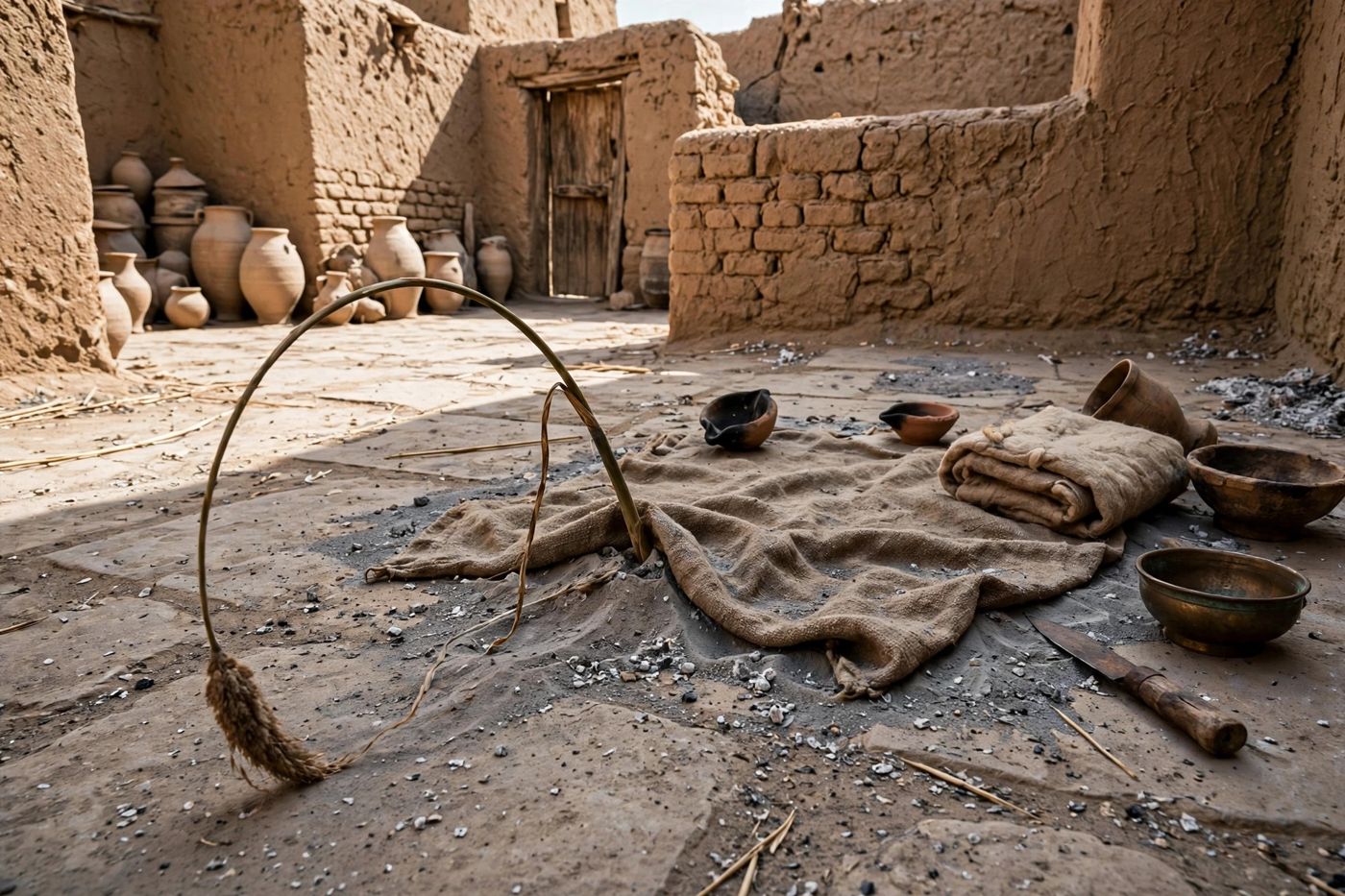
5 Is it such a fast that I have chosen? a day for a man to afflict his soul? is it to bow down his head as a bulrush, and to spread sackcloth and ashes under him? wilt thou call this a fast, and an acceptable day to the LORD?
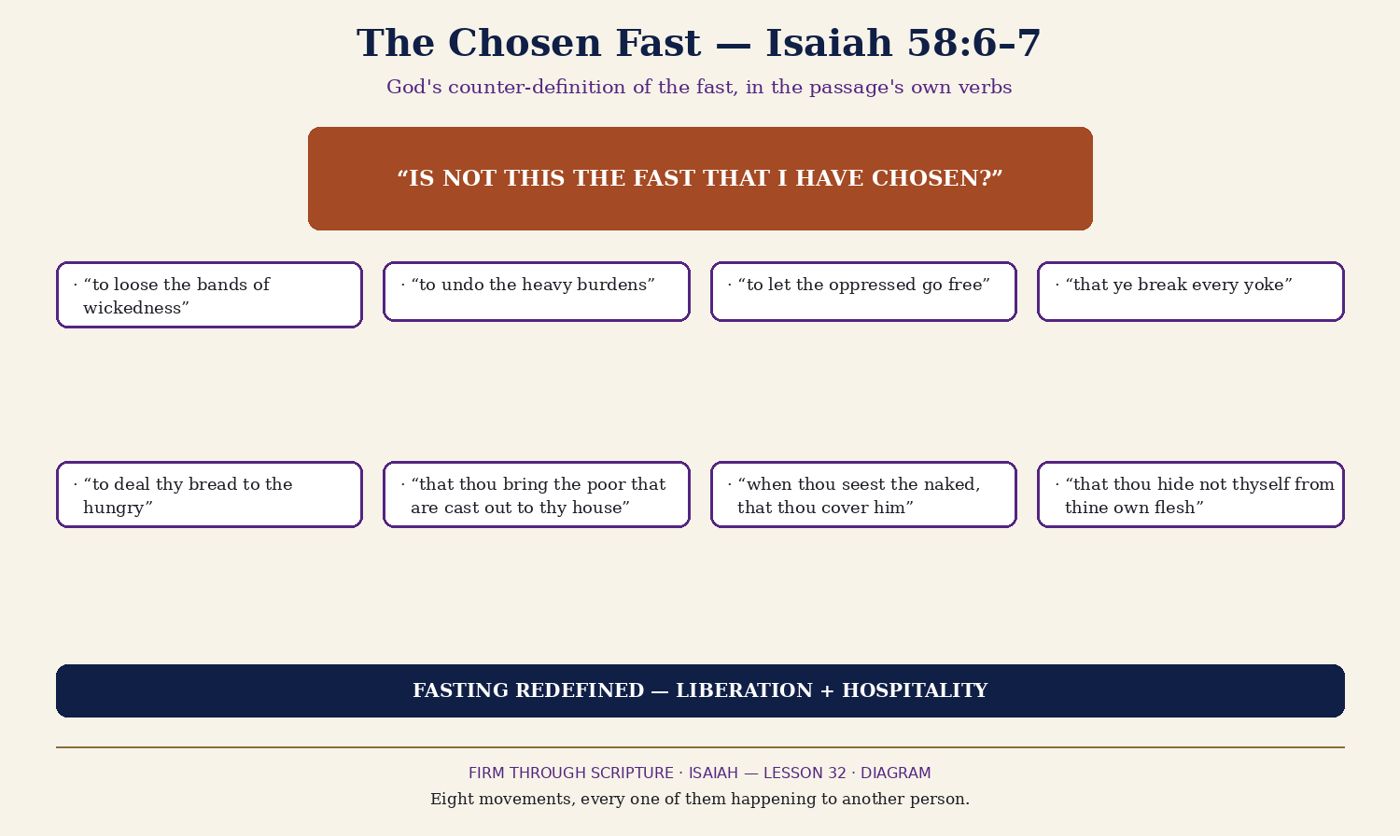
6 Is not this the fast that I have chosen? to loose the bands of wickedness, to undo the heavy burdens, and to let the oppressed go free, and that ye break every yoke?
7 Is it not to deal thy bread to the hungry, and that thou bring the poor that are cast out to thy house? when thou seest the naked, that thou cover him; and that thou hide not thyself from thine own flesh?
8 Then shall thy light break forth as the morning, and thine health shall spring forth speedily: and thy righteousness shall go before thee; the glory of the LORD shall be thy rereward.
9 Then shalt thou call, and the LORD shall answer; thou shalt cry, and he shall say, Here I am. If thou take away from the midst of thee the yoke, the putting forth of the finger, and speaking vanity;
10 And if thou draw out thy soul to the hungry, and satisfy the afflicted soul; then shall thy light rise in obscurity, and thy darkness be as the noonday:
11 And the LORD shall guide thee continually, and satisfy thy soul in drought, and make fat thy bones: and thou shalt be like a watered garden, and like a spring of water, whose waters fail not.
12 And they that shall be of thee shall build the old waste places: thou shalt raise up the foundations of many generations; and thou shalt be called, The repairer of the breach, The restorer of paths to dwell in.
13 If thou turn away thy foot from the sabbath, from doing thy pleasure on my holy day; and call the sabbath a delight, the holy of the LORD, honourable; and shalt honour him, not doing thine own ways, nor finding thine own pleasure, nor speaking thine own words:
14 Then shalt thou delight thyself in the LORD; and I will cause thee to ride upon the high places of the earth, and feed thee with the heritage of Jacob thy father: for the mouth of the LORD hath spoken it.
Isaiah 59
1 Behold, the LORD's hand is not shortened, that it cannot save; neither his ear heavy, that it cannot hear:
2 But your iniquities have separated between you and your God, and your sins have hid his face from you, that he will not hear.
3 For your hands are defiled with blood, and your fingers with iniquity; your lips have spoken lies, your tongue hath muttered perverseness.
4 None calleth for justice, nor any pleadeth for truth: they trust in vanity, and speak lies; they conceive mischief, and bring forth iniquity.
5 They hatch cockatrice' eggs, and weave the spider's web: he that eateth of their eggs dieth, and that which is crushed breaketh out into a viper.
6 Their webs shall not become garments, neither shall they cover themselves with their works: their works are works of iniquity, and the act of violence is in their hands.
7 Their feet run to evil, and they make haste to shed innocent blood: their thoughts are thoughts of iniquity; wasting and destruction are in their paths.
8 The way of peace they know not; and there is no judgment in their goings: they have made them crooked paths: whosoever goeth therein shall not know peace.
9 Therefore is judgment far from us, neither doth justice overtake us: we wait for light, but behold obscurity; for brightness, but we walk in darkness.
10 We grope for the wall like the blind, and we grope as if we had no eyes: we stumble at noonday as in the night; we are in desolate places as dead men.
11 We roar all like bears, and mourn sore like doves: we look for judgment, but there is none; for salvation, but it is far off from us.
12 For our transgressions are multiplied before thee, and our sins testify against us: for our transgressions are with us; and as for our iniquities, we know them;
13 In transgressing and lying against the LORD, and departing away from our God, speaking oppression and revolt, conceiving and uttering from the heart words of falsehood.
14 And judgment is turned away backward, and justice standeth afar off: for truth is fallen in the street, and equity cannot enter.
15 Yea, truth faileth; and he that departeth from evil maketh himself a prey: and the LORD saw it, and it displeased him that there was no judgment.
16 And he saw that there was no man, and wondered that there was no intercessor: therefore his arm brought salvation unto him; and his righteousness, it sustained him.
17 For he put on righteousness as a breastplate, and an helmet of salvation upon his head; and he put on the garments of vengeance for clothing, and was clad with zeal as a cloke.
18 According to their deeds, accordingly he will repay, fury to his adversaries, recompence to his enemies; to the islands he will repay recompence.
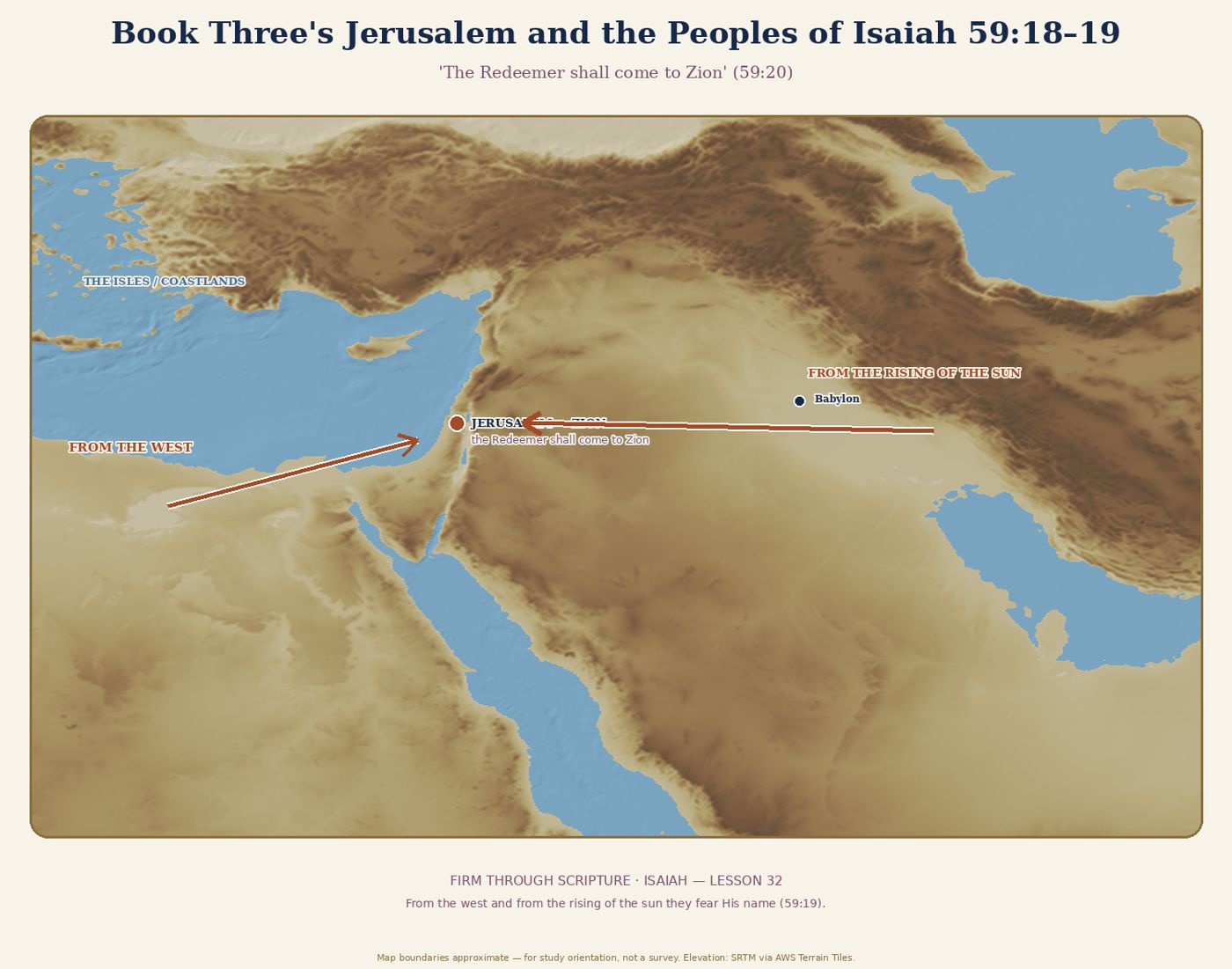
19 So shall they fear the name of the LORD from the west, and his glory from the rising of the sun. When the enemy shall come in like a flood, the Spirit of the LORD shall lift up a standard against him.
20 And the Redeemer shall come to Zion, and unto them that turn from transgression in Jacob, saith the LORD.
21 As for me, this is my covenant with them, saith the LORD; My spirit that is upon thee, and my words which I have put in thy mouth, shall not depart out of thy mouth, nor out of the mouth of thy seed, nor out of the mouth of thy seed's seed, saith the LORD, from henceforth and for ever.
SAY IT PLAIN — the passage in everyday words: God tells His prophet to shout like a trumpet, and the sin he must name is not in the godless — it is in the devout. These people seek God daily, delight to know His ways, and love approaching Him — and on the very day they fast, they chase their own pleasure, squeeze their workers, and settle arguments with their fists. When they complain that God has not noticed their fasting, He answers from the day itself: a bowed head and sackcloth and ashes is not the fast He chose. His chosen fast frees the oppressed, breaks every yoke, feeds the hungry, houses the cast-out, and clothes the naked. Do that, and light breaks like morning, God's glory guards the rear, and when you call, He answers, Here I am. The ruin-rebuilders earn a name: Repairer of the Breach. The sabbath gets the same lesson: turn from self-pleasure, call the day a delight, and God will lift you up. Chapter 59 answers the deeper complaint — that God seems unable to save. His hand is not shortened and His ear is not heavy; iniquity built the separation. Then the speakers stop saying they and start saying we: we grope like the blind, our transgressions testify against us, truth has fallen in the street, and the honest man makes himself a target. God saw there was no justice, no man, no intercessor — so His own arm brought salvation, sustained by His own righteousness. He dressed for battle to repay His adversaries and make the nations fear His name from west to east. And the Redeemer will come to Zion, to those in Jacob who turn from transgression; and God's covenant is that His Spirit and His words will not depart from the mouths of generation after generation, for ever. That's the whole passage. Everything after this teaches from it — nothing will change what you just read.
2. THE WORLD — C: Context & Audience
A text can never mean what it never meant — so before we ask what these verses mean, we stand where their first hearers stood.
Where we stand in the book. We are deep in Isaiah's third great movement — chapters 56–66, the Book of Glory. The exile is behind the book's horizon, chapters 40–55's return promises have been thundered, and the question has changed: not only Can God bring His people home? but What will the people God brings home look like? Lesson 31 opened this movement with a wide gate and watchmen asleep at it. This lesson stands in the same restored-but-compromised community: a people back around Zion (Jerusalem, God's holy mountain and temple city — the place the Redeemer comes to), keeping fasts and sabbaths, rebuilding ruins, discovering that being gathered is not the same as being changed. The commentaries across the spectrum read chapters 58–59 here: Book Three's ethics at full volume — worship, labour, courts, and streets in one frame. [3, 4, 11]
The honesty note, carried honestly. Mainstream scholarship commonly assigns chapters 56–66 to a post-exilic circle — “Third Isaiah” — while the historic church read one Isaiah, and the oldest complete witness already carries all sixty-six chapters as one scroll. That question is DISPUTED; this course's POSITION is the church's historic reading (Lesson 00). Nothing here needs it settled first: the audience is unmistakable — observant, fast-keeping people of Jacob, the patriarch whose name became Israel's other name, so “the house of Jacob” (58:1) is the whole covenant people. [4, 11]
What a fast was. A fast was a set-apart day of abstaining from food, joined with prayer and repentance. The law required one great fast: the Day of Atonement, when Israel was told to “afflict your souls” — the phrase chapter 58 argues with (Leviticus 16). 1 Other fasts were called in crisis, and by these chapters fasting was a regular, visible devotion with its outward kit: sackcloth (coarse cloth worn or spread in mourning), ashes, a bowed head — signs of humiliation known across the ancient world as well as in Israel. [16, 53] Chapter 58 never mocks the kit. It asks whether the kit has become a costume.
What a sabbath was. The sabbath was the seventh day, commanded at Sinai: no ordinary work, rest extended to servants and animals, a sign that God, not Israel's labour, sustained Israel (Exodus 20:8–11). [1, 16] Under economic pressure it was the easiest command to trim — a day's rest is a day's loss. That pressure stands behind 58:13's “thy pleasure” on God's holy day. Sabbath and fast ask one question in two calendars: will God's day be God's, or annexed to my business?
Yokes, labourers, and the economics in the room. Read 58:3 and 58:6 with a payroll in mind. To “exact all your labours” is to squeeze work out of people who work for you — the full day, and more, from labourers and debtors, even while you afflict your soul before God. A yoke was the beam across oxen's necks — and, in the prophets' picture-language, across people's: debt that never shrinks, labour that never rests. Isaiah used the yoke for Assyria's oppression (chapters 9–10); here God's own people hold the other end of it. In a subsistence economy, “deal thy bread” and “cover” the naked are not charities of surplus — bread, housing, and clothing were the basic securities so many lived without. [16, 53]
That is the world: devout people, real disciplines, real poverty at the door. Now look closely at what the text itself does.
3. OBSERVE — O: what the text actually does
Before meaning comes observation. Watch the passage's own moves, because this passage is built like an argument with receipts:
- The trumpet is aimed inward. The opening command is not aimed at Babylon or the nations. “Shew my people their transgression, and the house of Jacob their sins” (58:1). The loudest voice in Book Three sounds inside the congregation.
- One small word does the damage. Verse 2 loads the praise — seek daily, delight, ask, approach — then inserts the crack: “as a nation that did righteousness.” They perform the shape of a righteous nation. The whole indictment hangs on that “as.”
- A complaint, answered with a ledger. The people's question is a bill presented to God: we fasted, we afflicted our souls — and You did not see (58:3). God's answer does not discuss their sincerity in the abstract. He reads the same day back: pleasure found, labours exacted, strife, debate, the fist (58:3–4).
- Count the verbs of God's fast. In 58:6–7 the chosen fast is defined almost entirely in action-words — loose, undo, let go free, break, deal out, bring in, cover, do not hide. Set them beside verse 5's fasting verbs — bow, spread — and the contrast is the sermon: posture versus liberation.
THE INFINITIVES, COUNTED ALOUD — 58:6–7, in the KJV's own verbs: to loose the bands of wickedness · to undo the heavy burdens · to let the oppressed go free · to break every yoke · to deal thy bread to the hungry · to bring the poor that are cast out to thy house · to cover the naked · and not to hide thyself from thine own flesh. Eight movements, and not one of them is a posture. Every one of them happens to another person.
- “Then” does heavy lifting. The promises of 58:8–12 pour out in a cascade of then — light, health, an answered call — with conditions braided into its middle, not tacked onto its end: “If thou take away… the yoke, the putting forth of the finger, and speaking vanity” (58:9); “and if thou draw out thy soul to the hungry” (58:10). Promise and practice are one fabric.
- The voice changes in chapter 59. Verses 3–8 speak of “your” hands and “their” feet — indictment at arm's length. At verse 9 the pronouns turn: “we wait for light… our transgressions are multiplied” (59:9–12). The prophet stops standing beside God pointing at them, and kneels inside the people confessing as one of them. That turn is the chapter's hinge; section 7 treats it so.
- God wonders — and then God moves. Twice the camera rests on God's seeing: He saw truth fallen and was displeased (59:15); He saw no man, no intercessor, and wondered (59:16). “Wondered” is astonishment, not ignorance — the text is measuring how empty the field was.
4. GENRE — N: note the genre (prophetic indictment, confession, and salvation oracle woven together)
Isaiah 58–59 is prophecy — and remember this course's rule: a prophet is a forthteller first, God's spokesman to his own generation, before he is a foreteller. 51 Most of these chapters' sentences are not predictions. They are present-tense work: an indictment read aloud, a false practice dismantled, a true practice defined, a confession spoken in the first person plural, and only then a future act of God announced. Readers hunting only for forecasts will skim the very thing these chapters exist to do. 51
Three forms take turns holding the microphone:
- The covenant indictment (58:1–5; 59:1–8). The lawsuit form of chapter 1: the accused summoned, the evidence presented — here, a fast day's schedule, an empty courtroom, hands, lips, feet. Indictment is a covenant partner naming the breach so it can be answered — which is why this one gives way to confession instead of ending in a sentence.
- The communal confession (59:9–15a). A “we” prayer of the kind Israel prayed together in disaster — compare Daniel 9 or Nehemiah 9, where the speaker owns his people's sins as his own. 1
- The salvation oracle (58:6–14; 59:15b–21). God's first-person answer: the fast He chooses, the “then” cascade, and finally the announcement that He Himself will act — arm, armour, Redeemer, covenant. The oracle does not cancel the indictment; it answers what the indictment exposed and the confession admitted.
Read by these rules: do not ask an indictment to comfort before it has told the truth, or flatten the oracle into a reward schedule, when its grammar keeps God's chosen practice and God's free promise in one breath.
5. TERMS — T: the words in the writer's mouth
Three phrases carry this passage. Learn them in the writer's mouth, and whole sermons — true and false — sort themselves:
- “The fast that I have chosen” (58:6). The weight sits on two words. Chosen — the verb Isaiah uses for God's choosing of His Servant and His people: this fast is not man's invention offered upward for approval; it is God's own selection, prescribed downward. [3, 4] And fast — Hebrew tsom, an abstaining — does not change meaning in verse 6. God does not redefine the dictionary; He redefines the day: the abstaining He chooses runs outward into loosening, freeing, feeding, housing, and clothing. Note what the phrase does not say: not “the fast I have abolished.” Misread 1 guards that door.
- “The repairer of the breach” (58:12). A breach is a gap broken in a wall — the hole an enemy pours through. “Repairer” was a builder's title before a poet's: the one who closes the gap so people can dwell safely inside. 16 Isaiah spends the picture again in chapters 30 and 61, and Ezekiel uses its world for the man who “stands in the gap.” 1 Here the title is promised not to a king but to a fasting-right people: loose the yoke, feed the hungry — and you will be called wall-menders. Private devotion, public masonry.
- “No intercessor” (59:16). An intercessor steps between — standing in the space between an offended party and an offender to plead and intervene. Moses was Israel's great picture, standing between God and a golden-calf generation (Exodus 32). 1 The Hebrew word pictures one who meets and falls upon the situation — an intervener, not a well-wisher. [19, 20] God's “wonder” at finding none measures the emptiness: in a whole people, no one in the gap at all.
Method note — the word-study guardrail: a word means what its author uses it to mean, in its sentence, in its century — not what its oldest root once meant, and not everything it can mean anywhere. Every term above was settled by Isaiah's usage in Isaiah.
TRANSLATION NOTE — 59:19, who comes in like a flood?
The KJV: when the enemy comes in like a flood, the Spirit of the LORD lifts up a standard — a battle flag — against him. The flood is the enemy's, the standard God's. But the Hebrew is unusually compressed, and translators have long divided over how its pieces join. On another honest construal, the LORD Himself comes like a pent-up, rushing stream driven by His own wind — the flood is not the attack but the answer. Modern versions divide between the two attachments, and the lexica and commentaries lay out both. [3, 11, 20] Verdict, labelled: the grammar genuinely permits both — that is FACT about the Hebrew; which the prophet intended is DISPUTED. What does not move is the verse's comfort: God answers overwhelming force with greater force of His own — His flag raised against the flood, or His coming as the flood. Build no doctrine on the attachment; receive the promise both readings carry.
6. ENTIRE CANON — E: where this passage sits in the whole story
No passage lives alone, and these chapters are a junction where a dozen of Isaiah's own threads — and several of the New Testament's — cross in the open.
The arm arc of the whole book. Lay the sightings side by side and the arc preaches:
| Where | The arm does what? | What it teaches |
|---|---|---|
| Isaiah 40:10 | Comes “with strong hand,” His arm ruling for Him | God's rule is personal, not delegated away |
| Isaiah 51:5 | His arms judge the peoples; the isles wait for His arm | The nations, not only Israel, live under that arm |
| Isaiah 52:10 | The LORD makes bare His holy arm before all nations | God rolls up His sleeve in public |
| Isaiah 53:1 | “To whom is the arm of the LORD revealed?” — the suffering Servant | The arm's power is disclosed in the Servant's humiliation |
| Isaiah 59:16 | With no intercessor, “his arm brought salvation unto him” | When no human arm can intervene, God's own arm does |
| Isaiah 63:5 (ahead) | “Mine own arm brought salvation unto me” | Book Three returns to it — 59 is no isolated flare |
That table is the book's own cross-referencing, drawn from the text itself. [1, 3, 4]
The question answered from the other side. Lesson 27's forsaken-feeling people asked, “Is my hand shortened at all, that it cannot redeem?” (50:2). 1 Chapter 59:1 lifts that question facing the other direction: the hand is not shortened; the separation has another address — comfort for the crushed in chapter 50, diagnosis for the comfortable here.
The rereward returns. “The glory of the LORD shall be thy rereward” (58:8) — rereward is the rear-guard marching behind a caravan to protect its back. Isaiah 52:12 promised departing exiles the LORD before them and as their rereward. 1 Chapter 58 gives the same escort to a fast made just: righteousness in front, glory behind — the exodus picture become an ethics picture, promise intact.
THE SABBATH THREAD OF BOOK THREE — Lesson 31 heard the sabbath at the wide gate: the man blessed who keeps it (56:2), foreigners and eunuchs who keep God's sabbaths given an everlasting name (56:4–6). Chapter 58:13–14 completes that thread from the inside — foot turned, pleasure surrendered, the day called a delight — crowned with delight in the LORD Himself. Book Three centres on the sabbath because the sabbath is where a hurried, squeezing people either will or will not learn that God, not their labour, keeps them. [3, 4]
Paul braids chapter 59 into Romans — twice, and differently. In Romans 3, Paul weaves Isaiah 59:7–8 into his universal indictment: feet swift to shed blood, the way of peace not known (Romans 3:15–17). 1 That is FACT about what Paul quotes: Isaiah's diagnosis of Jacob becomes part of the diagnosis of everyone. Then Romans 11:26–27 reaches for the chapter's other end — the Deliverer coming out of Sion, taking away Jacob's sins (Isaiah 59:20–21) — read as still-future promise for Israel. 1 One chapter, two uses: universal guilt, and a covenanted Redeemer for Jacob. Hold both; Misread 3 guards the second.
The armour changes hands. Isaiah 59:17 dresses God: righteousness a breastplate, salvation a helmet. In Ephesians 6, Paul dresses the church in recognisably this kit. 1 That transfer is FACT in wording and image; what it means — the church fights in God's own righteousness, not its own manufacture — section 7 teaches.
7. THE MEANING — what the passage teaches
The Walk has established what the text says and where it sits. Now its payload, taught straight — the doctrines this passage actually carries, in the passage's own proportions.
The trumpet and the performance (58:1–2)
Start where God starts: with volume. “Cry aloud, spare not” — the prophet is forbidden the diplomatic register, because the people concerned have built excellent insulation against hearing this. And who are they? Not pagans, not the lapsed. Verse 2 is a pastor's dream congregation: they seek God daily, delight to know His ways, ask Him for ordinances of justice, and “take delight in approaching to God.”
Everything in that sentence is warm religion — and that is precisely the target: not cold irreligion, but warm religion running alongside injustice. The cold do not fast or ask for ordinances. These people do everything — and squeeze their labourers on the holy day itself. The crack is one word: “as a nation that did righteousness” (58:2). Not a nation that did righteousness — a nation performing the appearance of one. The forms are real, sincerely performed, and the life underneath runs the other way. [3, 4, 11] Learn the diagnostic: God does not measure devotion by its temperature, but by its company — what else is happening, on the same day, in the same hands. A fast sharing a calendar with exploitation is not a slightly flawed fast. The exploitation re-describes the fast.
The fast-day ledger (58:3–5)
God lets the congregation present its case — a complaint about His bookkeeping. “Wherefore have we fasted… and thou seest not?” We did the afflicting; You did none of the noticing. Underneath sits a transaction: devotion as a deposit, God's attention as the owed withdrawal. Much false religion is this ledger with better manners.
God's answer is devastating because it is not theological. He does not dispute their doctrine; He reads their day. “In the day of your fast ye find pleasure, and exact all your labours” — the day set apart for humbling themselves is a working day like any other for the people under them; worse, the boss, feeling righteous, squeezes harder. “Ye fast for strife and debate, and to smite with the fist of wickedness” — religion as fuel for quarrels, ending in fists. Such a fast cannot “make your voice to be heard on high” (58:4) — not because God is hard of hearing (chapter 59 will clear His ear), but because the voice and the fist belong to the same person, and heaven hears them together.
Verse 5 anatomises the refused fast: a head bowed “as a bulrush” — the reed that bends double, all curve and no root — and sackcloth and ashes underneath. Every element is posture: humility's shape, expertly assumed. “Wilt thou call this a fast, and an acceptable day to the LORD?” Acceptable is altar language, for a sacrifice God receives. This one He declines — not because the posture was wrong, but because posture was all there was. Bulrush-theatre: the reed bends beautifully, and nothing in the neighbourhood changes. [3, 11]
THE LEDGER TEST — God does not ask how the fast felt. He asks what the fast day did to the people under your hand.
The chosen fast (58:6–7)
God answers theatre not with a lecture on sincerity but with verbs — counted in section 3 — every one taking an object outside the faster. To loose the bands of wickedness — the cords tying unjust arrangements tight: the crooked contract, the bond that should never have bound. To undo the heavy burdens — pack-straps lifted off the carrier. To let the oppressed go free — not manage them more kindly, but release them. And that ye break every yoke — every: no favourite oppressions. Then liberation becomes hospitality: deal thy bread to the hungry — thy bread, your own loaf; bring the poor that are cast out to thy house — not relief sent out, but the cast-out brought in, across your threshold, where the cost lives; cover the naked; and hide not thyself from thine own flesh — forbidding the most respectable evasion, the averted face toward needy kin. [3, 4, 16]
Here is that counter-definition as one exhibit:
Two clarifications keep this honest. [3, 11] This is not fasting instead of prayer or abstinence — it is fasting given a body; the discipline is kept, and refused permission to terminate on the performer. And the list is not a points code — the next section pours promise over it like weather. The fast God chooses makes the faster resemble the God fasted to. That resemblance is the point; the verbs are its shape.
The cascade (58:8–12)
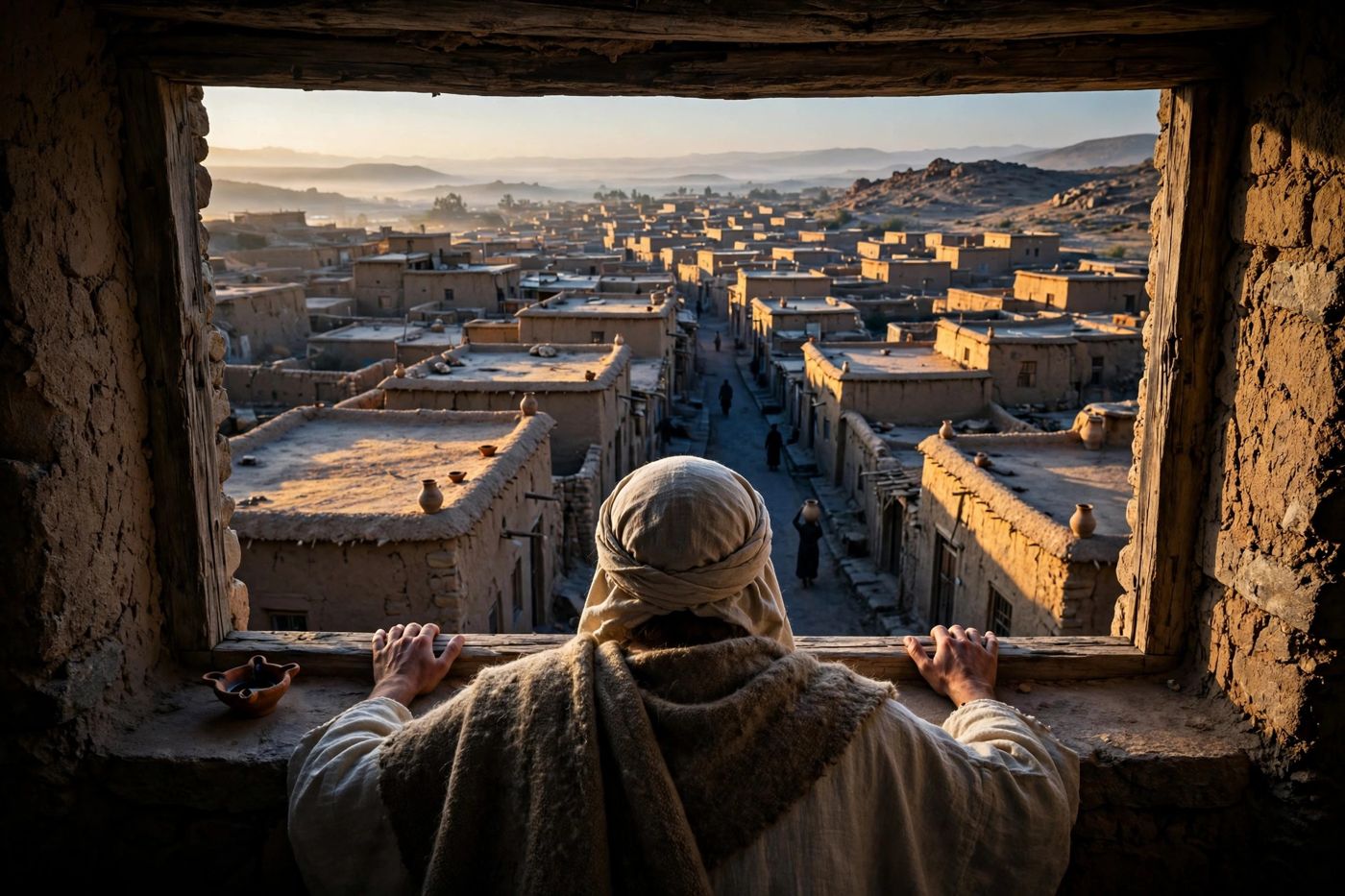
And then — then. “Then shall thy light break forth as the morning” — dawn after this book's long darkness; the community that frees others becomes luminous. “Thine health shall spring forth speedily” — healing, new flesh over a wound: those who covered the naked find their own wounds closing. “Thy righteousness shall go before thee” — the justice they practised marches ahead like a vanguard; “the glory of the LORD shall be thy rereward” — God's glory covers their back (section 6, on the rear-guard). Righteousness in front, glory behind: a people surrounded.
“Then shalt thou call, and the LORD shall answer; thou shalt cry, and he shall say, Here I am” (58:9). Stop on those three words. Verse 3's complaint was that God did not see or answer. The chosen fast's fruit is not a louder heaven but a nearer one: God's availability, a present person's answer, not a processed request.
But the cascade is honest about its conditions. Braided into the promise stand the ifs: if the yoke is taken away, if “the putting forth of the finger” — blame as public sport — and “speaking vanity” are gone; and if “thou draw out thy soul to the hungry… and satisfy the afflicted soul,” then light rises “in obscurity,” darkness as “the noonday” (58:9–10). Not a price tag on grace — chapter 59 will prove salvation is God's act — but a description of the channel: light does not rise in a community still clutching bread, because that clutching is the darkness. [3, 4]
The dawn the cascade promises, as one exhibit:
The cascade ends in a name. God will “guide thee continually, and satisfy thy soul in drought” — in drought, not only after it — until the fed become feeders, “like a watered garden… whose waters fail not” (58:11). The ruins get rebuilt — and the community is called “The repairer of the breach, The restorer of paths to dwell in” (58:12). Not the loudest faster: the people who loosed, freed, fed, housed, and clothed wake to find the neighbourhood calling them wall-menders. The name is given — reputation as God's gift to obedient hands.
The sabbath twin (58:13–14)
If the fast re-aims the appetite, the sabbath re-aims the calendar, with the same anatomy. The temptation comes three ways in one verse: doing “thy pleasure” on God's holy day, finding “thine own pleasure,” speaking “thine own words” — my business, my leisure, my talk, annexing His day. The remedy: “turn away thy foot” — the foot already walking toward the market, deliberately turned — and “call the sabbath a delight.” A stopped day can be a sullen, bulrush day; the sabbath is kept by delighting in the day and its LORD. The promise answers delight with delight: “Then shalt thou delight thyself in the LORD… feed thee with the heritage of Jacob.” Book Three's sabbath thread (56:2–7) is complete: the blessed day is received as gift, not spent as owners — and since sabbath was always rest for servants and animals too, its keeper becomes a restorer of other people's rest. [3, 16]
The separation diagnosed (59:1–2)
Chapter 59 clears God's name before it indicts anyone. Verse 1 answers the complaint of a quiet heaven in parallel denials: the hand is not shortened, the ear is not heavy — God's reach has not shrunk, His hearing is not dulled. This is 50:2's question answered from the other side (section 6): comfort for the crushed there, diagnosis for the comfortable here.
Verse 2's prepositions matter: iniquities “have separated between you and your God,” sins “have hid his face from you, that he will not hear.” The separation is real, but its construction is named: your iniquities built it. Cherished injustice and a listening God cannot occupy the same relationship unimpeded. Hold the guard — Misread 2 exists because these true lines, aimed at one documented complaint, have been torn out as a universal explanation for every silence of heaven. The chapter forbids that use by what it does next: it does not accuse sufferers. It moves the speakers onto their knees.
The indictment and the confession (59:3–15)
Verses 3–8 inventory a rotten order by body parts — a people sick from hands to feet:
| Body | The evidence (59:3–8) | The sermon in it |
|---|---|---|
| Hands & mouth | Hands defiled with blood, lips speaking lies; no one in court calls for justice or pleads for truth; mischief conceived and brought forth | Evil here is not an accident; it is bred |
| Eggs & webs | Cockatrice' eggs hatched — poison in the shell, a viper when crushed; spiders' webs woven that “shall not become garments” | Dangerous at the source, useless as a covering |
| Feet & paths | Feet that run to evil and haste to shed innocent blood; “the way of peace they know not” | Crooked paths produce travellers who cannot find peace |
The cockatrice was a legendary venomous serpent; the pictures preach one sermon — an output that kills and cannot clothe. 16 Paul takes the feet-and-paths lines universal in Romans 3 (section 6), because the anatomy generalises. [1, 3]
Then the hinge: at verse 9 the indictment becomes a confession. No new facts appear; the speakers' location changes. “Therefore is judgment far from us” — the “therefore” owns verses 1–2: given what we are, this darkness is not mysterious. “We wait for light, but behold obscurity… we grope for the wall like the blind… we stumble at noonday as in the night” (59:9–10) — noon stumbling: the light was available; the eyes were the problem. “We roar all like bears, and mourn sore like doves” (59:11) — honest noises, from a people that has stopped performing and started grieving.
The confession itemises rather than emotes: “our transgressions are multiplied before thee, and our sins testify against us… we know them” (59:12). The knowing is the breakthrough — 58:3's ledger-keepers have stopped presenting God with their account and started reading His. Verse 13 lists the contents: lying against the LORD, departing, oppression, revolt, falsehood “from the heart.” Then the bleakest line: truth is “fallen in the street… and he that departeth from evil maketh himself a prey” (59:14–15). In a rotten order, honesty does not merely go unrewarded — it paints a target; innocence has been made dangerous. [3, 11] A people there has only the truth just told to offer — and chapter 59 claims truth-telling is where the story turns: not because confession earns rescue, but because it clears the ground for the only rescuer there is.
The Arm intervenes (59:15b–21)
The turn is staged in God's seeing. “The LORD saw it, and it displeased him that there was no judgment” (59:15). Then, more searchingly: “he saw that there was no man, and wondered that there was no intercessor” (59:16). Teach the arm arc here as one exhibit (section 6's table), because this is its climax: the arm that rules (40:10), judges the peoples (51:5), is bared before the nations (52:10), and is revealed in the suffering Servant (53:1) now acts alone, for the stated reason that the human field is empty. “Therefore his arm brought salvation unto him; and his righteousness, it sustained him.” God is both rescuer and, in a sense, His own saving act's only support. No intercessor stood in the gap, so God did not wait for a volunteer. He became the intervention Himself. [3, 4, 11]
THE EMPTY GAP — 59:16 — No man. No intercessor. Therefore — his arm.
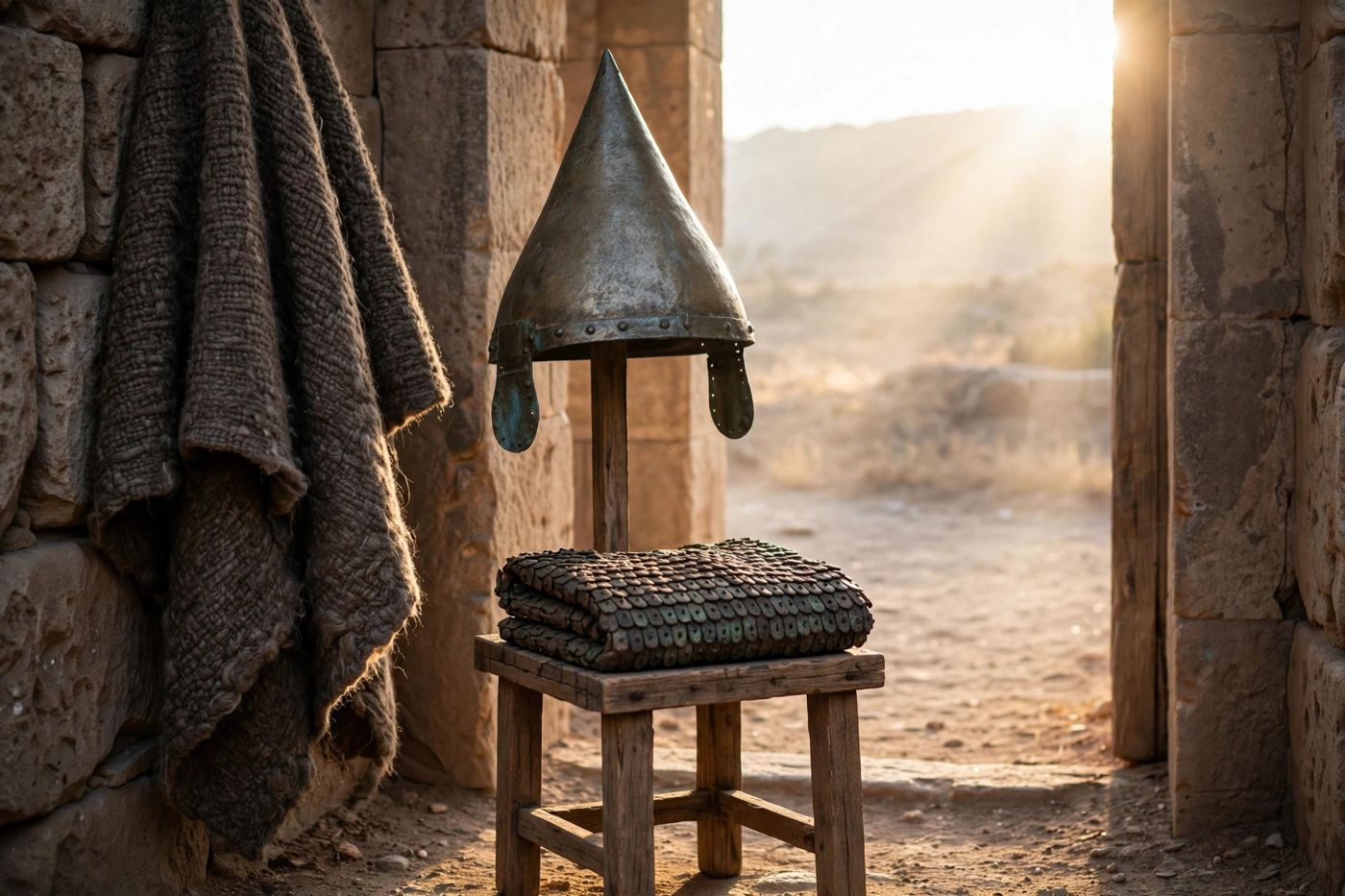
Then He dresses: righteousness a breastplate, salvation a helmet, garments of vengeance, zeal “as a cloke” (59:17) — a warrior-king settling accounts: recompense to adversaries, out “to the islands” (59:18). Comfort and terror are the same event from two sides. Verse 19 draws the horizon — the LORD's name feared from west to sunrise — and the flood verse follows, whose two renderings section 5 argued in the open; on either, the flood meets more than its match in God.
“And the Redeemer shall come to Zion” (59:20). A Redeemer was the kinsman who bought back what family had lost — land, or a relative in servitude — paying a price he did not owe (Boaz in Ruth is the beloved picture). [1, 16] Isaiah has called God by this title all through the comfort chapters; here the Redeemer comes — to Zion, a place; and “unto them that turn from transgression in Jacob,” a people defined by turning. Address and condition are part of the verse, not packaging — Misread 3 guards both, and Paul's still-future use for Israel in Romans 11 is the canon's own handling: the apostle does not evaporate Jacob; he leans on him.
The last verse is a covenant about a voice: God's Spirit and His words, put in the prophet's mouth, “shall not depart… nor out of the mouth of thy seed's seed… from henceforth and for ever” (59:21, in fragments). Track the mouth back: the Servant's mouth like a sharp sword (49:2), “the tongue of the learned” given morning by morning (50:4). 1 What God put in the prophet's and Servant's mouth He now promises to a people's generations — the trumpet passage ending with an unbroken line of speakers, Book Three's answer to truth fallen in the street.
The Christ Thread
Isaiah needs no forced symbolism; the New Testament walks through these chapters openly — 59:7–8 into Romans 3's indictment, 59:20–21 into Romans 11's hope for Israel, both FACT about the apostolic reading (section 6). 1 The church's historic reading gathers those threads in Christ, stated as POSITION where readers divide: the Redeemer who comes to Zion is, for the church, Jesus — God arriving in person to do what no intercessor could, the arm revealed (53:1) come as Zion's Redeemer; and 59:17's armour is in Ephesians 6 placed onto Christ's people, who fight clothed in what He is and has done. [1, 3] Let even the “Here I am” stay an echo of Christ's ministry, not a replacement for the text's own promise.
Where in the Covenant Story?
At the seam between exile's promises and new creation's life. Abraham's covenant promised blessing reaching the nations — chapter 59 ends with the nations fearing the Name, and a word kept in Jacob's mouths for ever. Sinai gave the fast day and the sabbath; chapters 58–59 teach what those gifts were always for. And the new covenant of Jeremiah and Ezekiel — God's Spirit in His people — is glimpsed in 59:21, running “henceforth and for ever,” while chapters 60–66's glory still lies ahead. A redeemed people is learning that redemption has a shape, and confessing where it has not yet taken it.
Father, Son, and Spirit
The passage does not preach a Trinity lesson, and this study will not force one — but it distinguishes the actors the whole canon will teach you to name. The LORD speaks, sees, wonders, dresses, and comes. The Redeemer is the LORD Himself arriving for Zion — no second god, no mere agent. And the Spirit acts: lifting the standard (on the KJV's rendering of 59:19) and resting on the covenant speaker, carrying God's words down the generations (59:21) — the same Spirit who fell on the Servant (42:1). Learn the habit: when a passage says “God,” ask who is acting, and how.
The Long View — what the church has believed
The church has always treated Isaiah 58 as the Bible's charter text on fasting: Jerome among the early voices read the chosen fast as God's own definition, and the church's fast seasons were perpetually recalled by this chapter from performance to almsgiving and justice. 37 Readers who divide over much in Isaiah do not divide over 58:6–7; Calvin presses it against his own day: God is not fed by ceremonies while neighbours starve. 36
On chapter 59 the long view shows an honest fork. The Redeemer of 59:20 has been read by the church, following Paul, as a promise with Israel's future still inside it, and Jewish readers — the medieval commentators among them — have held it as God's pledge to Zion itself. 39 The division is over timing, and over how the church's present possession of the Redeemer relates to Jacob's promised turning. POSITION — this course follows Paul's order in Romans 11: the Redeemer has come in Christ, and the promise to Jacob retains its future; readings deleting either half explain the text by amputating it. On the armour, readers from the earliest centuries preached Paul's Ephesians 6 handover as grace: the church stands in armour it did not forge.
That is the payload. The next section compresses it into the one sentence you are meant to carry out of this study.
8. THE AIM SENTENCE — X: eXplain the intent
Everything observed now compresses into one sentence — the author's intended meaning, before any application is allowed near it:
God trumpets against warm, observant religion that fasts and sabbaths while squeezing neighbour and stranger, defines the worship He chooses as liberation and hospitality, and promises light, healing, and His own “Here I am” to a people who confess the injustice that separated them from Him — and when no intercessor stands in that ruined order, His own arm brings salvation and the Redeemer comes to Zion for all in Jacob who turn.
If a sermon or devotional uses Isaiah 58–59 to say something untraceable to that sentence, it is not this passage talking. That is the skill this course exists to build.
9. SAY IT BACK
Close the book and say the AIM sentence from section 8 in your own words — out loud, or in your notes, without looking. Then say, in one more sentence, what it asks of you this week.
If your version quietly changes the meaning — the chosen fast become only charity, the Redeemer stripped of His Zion address — open the lesson and walk it again. This exercise feels small; it is the entire course in miniature: meaning first, then — and only then — your life.
10. THE MISREAD — the guardrail, with verdicts
Three live misuses of this passage. Each gets a fair hearing, the evidence, and a verdict.
Misread 1: “Isaiah 58 abolishes fasting and ritual — God wants only social action, not ceremonies.” Why it sounds right: God really does refuse this fast, in withering language, and His chosen fast really is a list of justice- and neighbour-acts with no ceremony in it. The evidence: the chapter's God prescribes both disciplines He is accused of abolishing. The chosen fast is still called a fast (58:6) — word kept, day kept, hands given. The next movement commands the sabbath be kept and delighted in (58:13–14); a text abolishing ritual does not end by re-consecrating a ritual day. The canon agrees: Zechariah's community keeps fasting and does justice (Zechariah 7–8); Jesus fasted, taught His disciples to fast without performing it, and aimed His rebuke — like Isaiah — at the theatre, not the discipline (Matthew 6:16–18). 1 The charge is precise: ritual as cover for exacting labourers and fists of debate. A “no-ritual” reading and an “only-ritual” reading are the same error in two directions — each amputates half the passage. Verdict: God does not trade ceremony for justice or justice for ceremony. He refuses ceremony used as an alibi, and gives the kept fast and kept sabbath their hands, their table, and their rest.
Misread 2: “Isaiah 59:1–2 explains every unanswered prayer: if God seems silent, sin in the sufferer's life is the reason.” Why it sounds right: the verses really do deny that God's hand or ear has failed, and blame iniquity for a separation. As a universal key, they seem to unlock every closed heaven. The evidence: the verses answer one complaint with one diagnosis, inside one chapter — from a community whose fast-day exploitation has just been documented line by line — and the diagnosis is immediately taken up by that community itself as confession: “our transgressions are multiplied before thee” (59:12). The chapter models the only authorised use of 59:2: a people applying it to itself, on its knees — never bystanders diagnosing sufferers. Scripture's standing warning stands in full view: Job's friends argued exactly this logic — pain proves hidden sin — and God pronounced His verdict: “ye have not spoken of me the thing that is right” (Job 42:7). 1 Verdict: true diagnosis, addressed to its own confessing community — and a cruelty when weaponised. The chapter's handling is the rule: say “we,” say it kneeling, or do not say it at all.
THE GUARDRAIL — 59:2 is a confession to kneel in, never a diagnosis to hand to a sufferer.
Misread 3: “The Redeemer of 59:20 has come, so the verse is now simply about the church — Jacob and Zion were just the envelope.” Why it sounds right: the church does confess the Redeemer has come in Christ, and Gentile believers really are gathered in — Lesson 31's wide gate is real, and Romans 11 celebrates the olive tree's widening. The evidence: the verse carries its address on its face: the Redeemer comes “to Zion, and unto them that turn from transgression in Jacob.” And the canon's own handling — Paul's, in Romans 11:26–27 — quotes it with Jacob kept in, future tense, as promise about Israel's turning and the taking away of their sins, inside an argument that God's calling of Israel is not revoked. 1 Readings evaporating Jacob fail the text at its plainest point. So do readings deleting the other condition — the Redeemer comes to turners, not to transgression cherished. Verdict: keep the address and keep the condition. The Redeemer comes to Zion, to turners in Jacob — and Paul's future-tense use for Israel is the pattern for holding the church's present joy in Him: without stealing the envelope's name.
11. FROM WORD TO WALK
Sit with the discomfort first. Nobody in Isaiah 58 is an atheist; nobody has stopped going, asking, delighting. Preached to people who never fasted, the trumpet would glance off. It lands on the regulars — on us. The question is not do I worship? It is what is my worship standing next to? What do my hands do on the same day my head bows? If everyone who meets my religion finds it cheap except me, the bulrush has been located.
So do the audit the chapter models, by name. Exacting: whose labour do I squeeze because I can — an employee, a spouse carrying a load I call normal, a tradesman whose invoice I slow-walk while my devotion runs on time? The finger: whose failure do I point at with a pleasure I would not admit to? The table: who is hungry within my actual reach — a face, not humanity in general — and what would dealing my bread look like this month? The threshold: who is cast out, and is my house a place relief is sent from, or a place people are brought to? The passage is not asking for a feeling about these questions. Feelings were the one thing its first hearers had in surplus.
Then let chapter 59 do its harder work. When you have told the truth — itemised like verses 12–13 — you have not reached the chapter's bottom. Underneath the confession stands an arm. Verse 16, read in full light, is the passage's most freeing sentence for a confessing sinner: God looked for an intercessor, found none — and acted anyway. Your rescue never waited on a better advocate inside yourself. There was no man; there was His arm. Bring the transgression the trumpet named in you to that God. The Redeemer comes to turners: turning is not the price of His coming; it is the direction of the people He comes to. Turn, and find He has come.
One more thing to carry out: the name. Somewhere in your neighbourhood there is a breach — a gap in a wall that used to protect somebody: a family one crisis from the street, a street where truth has fallen and nobody picks it up. The passage does not promise you will be called successful; it promises a fasting-right people a builder's name: Repairer of the Breach. You do not take that name. You wake up inside it, bread in your hands and dust on your shoes.
LORD, Your hand is not shortened and Your ear is not heavy — and I will stop blaming the silence on You. I confess the fasts I kept with a fist still clenched, the pleasure I exacted on Your holy days, the finger I pointed and the face I hid from my own flesh. Loose in me what You have chosen: break the yoke I hold, open the hand I close, bring the cast-out across my threshold. And since there was no intercessor in me fit to stand, I rest on Your arm — Redeemer, come to Zion, come also to this house — and teach my mouth to keep Your words to the third generation. In Jesus' name, amen.
12. FOR DISCUSSION — OR FOR YOUR JOURNAL
With a group, work these aloud. Alone, they're yours — answer them in your journal or in prayer; they lose nothing in the quiet.
- Verse 2's congregation delights in approaching God — and is indicted. Where is the gap, in your own life, between the warmth of your devotion and the company it keeps on the same day?
- Read the eight infinitives of 58:6–7 aloud. Which one is hardest for you personally, and who is the specific person on the other end of it?
- Chapter 59 moves from “their” sins to “our” transgressions. Why does confession in the first person plural change things that private regret does not — and what would it sound like for your family, church, or town?
- The Redeemer comes to “them that turn from transgression in Jacob.” How do you hold both halves of 59:20 — His free coming, and the turning of those He comes to — without shrinking either?
13. THE WALK-OUT — T: Transfer to today
Meaning is settled. Now — and only now — application, and it must cross the bridge honestly. Run the five Transfer Tests on this passage:
- Same covenant? We live on the far side of the cross — but these disciplines are not Sinai-only furniture. Fasting is taken up by Jesus as a continuing practice done without theatre (Matthew 6), and the moral core of both — no worship that oppresses, rest received as God's gift — is rooted in God's character. What crosses is the pattern, aimed by Christ's teaching. 1
- Same audience? The trumpet addresses God's observant people, not outsiders. Its first modern audience is the church — and the believer reading alone — not “society out there.” Applications aiming 58:1–5 mainly at non-believers fail at the first fence.
- Same genre rules? Indictment, confession, oracle: the passage commands practices (58:6–7, 13), forms a confession to imitate (59:9–15), and announces God's acts (59:16–21) for faith, not imitation — no believer is instructed to wear the vengeance garments. Sort by form before sorting your week.
- Repeated or rooted? Loosing burdens, feeding the hungry, housing the cast-out, clothing the naked, delighting in God's rest: each is repeated across both Testaments and rooted in who God is. These cross at full strength.
- Ten verses either side? Every application below keeps its context: the chosen fast inside the chapter that refuses the false one; 59:1–2 inside the confession that follows; 59:20 with its Zion-and-Jacob address intact. Nothing hangs on a torn-out line.
What crosses — and lands:
| The passage's act | Who does it? | How it reaches your week |
|---|---|---|
| The arm brings salvation (59:16) | God alone, no intercessor found | Received by faith — never imitated, never earned |
| The chosen fast (58:6–7) | God's people, commanded | Practised: loose, free, feed, bring in, cover |
| The vengeance garments (59:17–18) | God, repaying His adversaries | Not transferred — the church wears breastplate and helmet as gifts (Ephesians 6), not the vengeance |
Led by what God has done (the indicative, first, always): God's hand was never shortened. He saw a ruined order with no intercessor, and His own arm brought salvation; the Redeemer comes to Zion, to turners; He has covenanted to keep His Spirit and words in His people's mouths down the generations. You do not practise the chosen fast to persuade that God to arrive. He has arrived, in Christ, and answers with “Here I am.” The practices below are gratitude with hands, not wages for a reluctant heaven.
- Worship is audited by the week it stands in. A devotion coexisting comfortably with squeezed people and pointed fingers is, by this passage's definition, not yet the fast God chose — however warm it feels.
- The chosen fast is a standing pattern, not a seasonal novelty. Its infinitives describe the permanent grain of a redeemed people's life — measured in named people, not sentiments.
- Confession says “we.” The 59:9 turn crosses as a discipline for families and churches: own our transgressions, itemised, before reaching for anyone else's. And 59:1–2 crosses only in that posture — self-applied, kneeling, never as a diagnosis handed to a sufferer.
- The armour is received, not manufactured. In Christ, God's people stand in 59:17's breastplate and helmet as gifts (Ephesians 6) — worn, not achieved.
Practices — what the gate lets through, made concrete this week:
- The fast with hands. Keep one real fast this week — a day, or a set of meals, given to prayer — and attach to it, in advance, one chosen-fast verb with a name on it: a burden undone, bread dealt, a door opened.
- The exacting audit. Ask in prayer, then in writing: whose labour do I exact? List the names — household, work, church. Choose the clearest, and this week change one term of it: a load lightened, a payment made early.
- Bring one cast-out across a threshold. Not a donation at a distance — an invitation: a meal in your home, a seat at your table, a ride, a place in the plan, for one person outside the circle. Arrange it this week.
- A delight sabbath. Keep one day as 58:13–14 describes: foot turned from your pleasure-business, no buying or dealing as usual, the day called a delight out loud — worship, rest, and rest extended to everyone whose work usually serves you.
- Confess in the plural; pray for Jacob. Pray 59:9–15 once this week in the first person plural for your church or family — itemising, not emoting. Then pray 59:20 as Paul does in Romans 11, for Zion's turners. 1
- Memorise Isaiah 59:1 (see the Recap Card) — the verse that clears God's name, carried in your mouth.
What does not cross: diagnosing other people's unanswered prayers from 59:2; treating the “then” cascade as a transaction obliging God to prosper a performance; discarding fasting or sabbath as abolished; claiming 59:17–18's vengeance garments as the church's assignment; trimming 59:20 of Zion and Jacob. The gate makes sure the claims that land are the ones God actually made.
Praise Him
Praise Him whose hand was never shortened and whose ear was never heavy — who read His people's fast day back to them in mercy sharp enough to save, and taught their hands to loose and lift and feed. Praise the LORD who saw truth fallen in the street and no intercessor standing, and did not wait: whose own arm brought salvation, who came — Redeemer — to Zion. Praise Him who answers, Here I am, who makes darkness as noonday, and who will keep His Spirit and His words in the mouths of our seed's seed, from henceforth and for ever. The mouth of the LORD hath spoken it — praise Him.
14. THE RECAP CARD — this study on one page
Print it. Keep it where you'll see it this week.
- The passage: Isaiah 58:1–59:21 — the fast God chooses, the separation confessed, and the Redeemer who comes to Zion.
- Say It Plain: Observant religion that fasts while squeezing its neighbour is refused; God's chosen fast looses, frees, feeds, houses, and clothes — and when no intercessor is found, God's own arm brings salvation and the Redeemer comes to Zion.
- The AIM: God trumpets against observant religion that fasts while oppressing, defines His chosen worship as liberation and hospitality, promises His “Here I am” to a confessing people — and, finding no intercessor, brings salvation by His own arm, coming as Redeemer to Zion for turners in Jacob.
- Key terms: the fast that I have chosen — God's own prescribed fast: liberation and hospitality · the repairer of the breach — the name given to a fasting-right people: mender of the wall, restorer of liveable streets · no intercessor — the empty gap God Himself filled when no one stood in it.
- The Misread, in one line: Isaiah 58 keeps the fast and the sabbath and gives them hands — it abolishes neither · 59:1–2 is a diagnosis its own community confesses, not a weapon for sufferers · 59:20 keeps its address: Zion, and turners in Jacob.
- Memory verse: "Behold, the LORD's hand is not shortened, that it cannot save; neither his ear heavy, that it cannot hear:" — Isaiah 59:1
- This week's practice: one real fast with one chosen-fast verb attached to a name — and one delight sabbath, foot turned, day called a delight.
15. CHECK YOURSELF — five questions
Answer from the study, not from instinct. (Answers live in the Teacher Edition.)
- In your own words: what is the AIM of Isaiah 58:1–59:21?
- God's answer to the complaint of 58:3 is a ledger of the same day. What three things does He read back to the fasting people — and what does His chosen fast put in their place?
- Why does the pronoun change at 59:9 matter — and how does it govern the way 59:1–2 may and may not be used?
- Trace the arm of the LORD through Isaiah 40:10, 52:10, 53:1, and 59:16. What is new at 59:16?
- A friend says, “Since the Redeemer has come, Isaiah 59:20 is just about the church now.” Answer from the verse itself and from Romans 11:26–27.
16. GO DEEPER
Optional — the lesson is complete without it.
IN THE BASEMENT — The labels stay on down here: FACT · INFERENCE · DISPUTED · POSITION — especially where scholars argue.
From the Sources — Fasting in the restored community
Isaiah 58's fast day has a social address. The background tradition notes that fasting in the post-exilic community was a developed, calendared devotion — set fasts mourning the temple's fall are what Zechariah 7–8 argues about in the same era — and that 58:3's labour relations presume householders who now employ, lend to, and hold obligations over poorer neighbours of their own nation. [11, 16] FACT, at the level those sources document it: the first audience was not choosing between prayer and justice in the abstract; householders were fasting while administering the debts and labour of the people around them. INFERENCE: that is why the chosen fast's verbs are relentlessly economic — bands, burdens, yokes, bread, houses, clothing are a householder's inventory, not a poet's decoration. Every economy has its yokes.
The Honest Argument — who is speaking in chapters 56–66, and does it change chapter 58?
The critical case at full strength: since Duhm (1892), mainstream scholarship has commonly read chapters 56–66 as a post-exilic circle — “Third Isaiah” — speaking into the restored community's real conditions: sabbath and fasting disputes, greedy leadership, delayed glory. 40 The case is DISPUTED: the unity reader answers that the book's threads argue design across the divisions — the arm arc (section 6), the sabbath thread, 59:21's mouth-covenant gathering up 49:2 and 50:4 — and that the Great Isaiah Scroll already presents one book of sixty-six chapters. 22 POSITION — this course's since Lesson 00: the book is Isaiah's, one prophet's witness read whole. Practically: on either account, the passage addresses an observant covenant community about its fasts, sabbaths, labourers, and courts — and its diagnosis has outlived its first audience by two and a half millennia. Do not let a debate about the speaker's century deafen you to the trumpet. The trumpet is the FACT in the room.
The Word Underneath — rereward, the guard at your back
Rereward (58:8): rere, rear, plus ward, a guard. The Hebrew pictures God's glory gathering up the rear of the march — the same picture Isaiah 52:12 spends on the new exodus. [1, 19] The rear-guard was where the vulnerable travelled. FACT, as the word's sense and the text's usage. INFERENCE — earned by a rare picture spent twice: the escort that brought Israel out of slavery now walks behind a community learning to end slavery-shaped things in its own streets.
Go Read
- Oswalt, The Book of Isaiah, Chapters 40–66 (NICOT) 3 — the fullest slow treatment here of the chosen fast, the “Here I am,” and the arm that acts alone.
- Motyer, The Prophecy of Isaiah 4 — strong on the threads: sabbath across 56–58, the arm arc, 59:21's mouth-covenant.
- Smith, Isaiah 40–66 (New American Commentary) 11 — historical notes on the restored community's fasts, labour, and courts.
- Fee & Stuart, How to Read the Bible for All Its Worth 51 — the prophecy chapter behind §4: forthtelling first.
17. SOURCES & REFERENCES
Numbered citations in this lesson key to this list — the course standard: every sourced claim carries its number, and every number can be checked.
- The KJV text itself — Holy Bible, King James Version (eBible.org KJV, 1769 text). Scripture quotations are from the King James Version (KJV), which is in the public domain in the United States; the full passage is always assigned as reading. Cross-references within Scripture cite this number.
- Oswalt, The Book of Isaiah, Chapters 40–66 (NICOT) — John N. Oswalt (Eerdmans). The second volume: the comfort section, the Servant Songs, Cyrus, and the new-creation chapters, read as the deliberate answer to chapters 1–39.
- Motyer, The Prophecy of Isaiah — J. Alec Motyer (IVP). A one-volume commentary by an evangelical scholar who argues the whole book breathes the mind of the eighth-century prophet; especially strong on the book's structure, its repeated refrains, and the Servant.
- Smith, Isaiah 1–39 and Isaiah 40–66 (New American Commentary) — Gary V. Smith (B&H). Evangelical commentary with strong historical notes (the Assyrian and Babylonian records) and an even-handed survey of the authorship debate.
- Walton, Matthews & Chavalas, The IVP Bible Background Commentary: Old Testament — John H. Walton, Victor H. Matthews, Mark W. Chavalas (IVP). Verse-by-verse ancient Near Eastern background: Assyrian siege practice, Babylonian religion, treaty and coronation customs, geography.
- Brown, Driver & Briggs, Hebrew and English Lexicon of the Old Testament (BDB) — The standard older Hebrew lexicon; word senses and usage ranges for the Terms sections.
- Koehler & Baumgartner, The Hebrew and Aramaic Lexicon of the Old Testament (HALOT) — The standard modern Hebrew lexicon; the control on BDB for contested senses (e.g., 'almah).
- The Great Isaiah Scroll (1QIsaᵃ) and the Dead Sea Scrolls Bible — The complete Isaiah scroll from Qumran Cave 1 (c. 125 BC), in Abegg, Flint & Ulrich, The Dead Sea Scrolls Bible (HarperSanFrancisco). The oldest substantial witness to Isaiah's text — already a single scroll of all 66 chapters centuries before Christ.
- Calvin, Commentary on Isaiah — John Calvin (public domain). Reformation exegesis; a control on interpretation and a voice in the Long View.
- Jerome, Commentary on Isaiah — Jerome (c. AD 408–410). The early church's fullest Isaiah commentary; Jerome transmits the Hebrew learning of his day and treats Isaiah as one prophet's book.
- Rashi and Ibn Ezra on Isaiah — The medieval Jewish commentators (11th–12th centuries). Rashi's school reads the Servant corporately as Israel; Ibn Ezra leaves doors open Rashi closes. Cited for the Jewish reading at full strength.
- Duhm, Das Buch Jesaia (1892) — Bernhard Duhm. The commentary that named the "Servant Songs" as a distinct set and crystallized the "Deutero-Isaiah" division — the historical origin of the modern authorship debate, cited as fact about scholarship.
- Fee & Stuart, How to Read the Bible for All Its Worth — Gordon D. Fee and Douglas Stuart (Zondervan). The beginner's method book; its prophecy chapter ("a forthtelling first") undergirds the Genre sections.
- King & Stager, Life in Biblical Israel — Philip J. King and Lawrence E. Stager (Westminster John Knox). Daily life, agriculture, warfare, and worship in Isaiah's world.