
One study, one walk — the universal FIRM format. The passage first and whole; then its world; then the Walk (Context · Observe · Genre · Terms · Entire Canon); the meaning taught straight; the AIM sentence; the misread exposed and answered; and the walk-out, where application has to pass the Transfer Tests before it reaches your week. The same skeleton serves a book, a chapter, a single verse, or a whole subject. In the early studies the moves are labeled as they happen. The labels fade as the walk becomes yours.
THE WEEK WITH THIS STUDY — six bites
Day 1 — Read the passage · Say It Plain · The World (§§1–2) · Day 2 — Observe · Genre (§§3–4) · Day 3 — Terms · Entire Canon (§§5–6) · Day 4 — The Meaning · the AIM Sentence · Say It Back (§§7–9) · Day 5 — The Misread · From Word to Walk (§§10–11 — add For Discussion, §12, if you're with others) · Day 6 — The Walk-Out · the Recap Card (§§13–14). Go Deeper (§16) any evening you want the basement.
BEFORE YOU READ — Open My Eyes
LORD, my light is not my own making. Open my eyes to the glory that rises on Your people, teach me to stand up into what You have already given, and let Your Anointed's own words — beauty for ashes, liberty for captives — do their work in me this week. In Jesus' name, amen.
§ means “section” — the numbered parts of your lesson. Each bite above names the sections for that day.
1. READ THE PASSAGE — Isaiah 60:1–62:12 (KJV)
Read it all, slowly, before any teaching. In this course the passage always prints once, in full, at the head of the lesson. Everything after this is commentary — this is the text.
One orientation before you read: this lesson takes three chapters as one continuous passage, because the book does. Chapter 60 pictures Zion rising into light; chapter 61 gives the Anointed Preacher his charter; chapter 62 renames and watches the city until the promise lands. The verse numbers restart, as they do in your Bible, at chapters 61 and 62.
Isaiah 60
1 Arise, shine; for thy light is come, and the glory of the LORD is risen upon thee.
2 For, behold, the darkness shall cover the earth, and gross darkness the people: but the LORD shall arise upon thee, and his glory shall be seen upon thee.
3 And the Gentiles shall come to thy light, and kings to the brightness of thy rising.
4 Lift up thine eyes round about, and see: all they gather themselves together, they come to thee: thy sons shall come from far, and thy daughters shall be nursed at thy side.
5 Then thou shalt see, and flow together, and thine heart shall fear, and be enlarged; because the abundance of the sea shall be converted unto thee, the forces of the Gentiles shall come unto thee.
6 The multitude of camels shall cover thee, the dromedaries of Midian and Ephah; all they from Sheba shall come: they shall bring gold and incense; and they shall shew forth the praises of the LORD.
7 All the flocks of Kedar shall be gathered together unto thee, the rams of Nebaioth shall minister unto thee: they shall come up with acceptance on mine altar, and I will glorify the house of my glory.
8 Who are these that fly as a cloud, and as the doves to their windows?
9 Surely the isles shall wait for me, and the ships of Tarshish first, to bring thy sons from far, their silver and their gold with them, unto the name of the LORD thy God, and to the Holy One of Israel, because he hath glorified thee.
10 And the sons of strangers shall build up thy walls, and their kings shall minister unto thee: for in my wrath I smote thee, but in my favour have I had mercy on thee.
11 Therefore thy gates shall be open continually; they shall not be shut day nor night; that men may bring unto thee the forces of the Gentiles, and that their kings may be brought.
12 For the nation and kingdom that will not serve thee shall perish; yea, those nations shall be utterly wasted.
13 The glory of Lebanon shall come unto thee, the fir tree, the pine tree, and the box together, to beautify the place of my sanctuary; and I will make the place of my feet glorious.
14 The sons also of them that afflicted thee shall come bending unto thee; and all they that despised thee shall bow themselves down at the soles of thy feet; and they shall call thee, The city of the LORD, The Zion of the Holy One of Israel.
15 Whereas thou hast been forsaken and hated, so that no man went through thee, I will make thee an eternal excellency, a joy of many generations.
16 Thou shalt also suck the milk of the Gentiles, and shalt suck the breast of kings: and thou shalt know that I the LORD am thy Saviour and thy Redeemer, the mighty One of Jacob.
17 For brass I will bring gold, and for iron I will bring silver, and for wood brass, and for stones iron: I will also make thy officers peace, and thine exactors righteousness.
18 Violence shall no more be heard in thy land, wasting nor destruction within thy borders; but thou shalt call thy walls Salvation, and thy gates Praise.
19 The sun shall be no more thy light by day; neither for brightness shall the moon give light unto thee: but the LORD shall be unto thee an everlasting light, and thy God thy glory.
20 Thy sun shall no more go down; neither shall thy moon withdraw itself: for the LORD shall be thine everlasting light, and the days of thy mourning shall be ended.
21 Thy people also shall be all righteous: they shall inherit the land for ever, the branch of my planting, the work of my hands, that I may be glorified.
22 A little one shall become a thousand, and a small one a strong nation: I the LORD will hasten it in his time.
Isaiah 61
1 The Spirit of the Lord GOD is upon me; because the LORD hath anointed me to preach good tidings unto the meek; he hath sent me to bind up the brokenhearted, to proclaim liberty to the captives, and the opening of the prison to them that are bound;
2 To proclaim the acceptable year of the LORD, and the day of vengeance of our God; to comfort all that mourn;
3 To appoint unto them that mourn in Zion, to give unto them beauty for ashes, the oil of joy for mourning, the garment of praise for the spirit of heaviness; that they might be called trees of righteousness, the planting of the LORD, that he might be glorified.
4 And they shall build the old wastes, they shall raise up the former desolations, and they shall repair the waste cities, the desolations of many generations.
5 And strangers shall stand and feed your flocks, and the sons of the alien shall be your plowmen and your vinedressers.
6 But ye shall be named the Priests of the LORD: men shall call you the Ministers of our God: ye shall eat the riches of the Gentiles, and in their glory shall ye boast yourselves.
7 For your shame ye shall have double; and for confusion they shall rejoice in their portion: therefore in their land they shall possess the double: everlasting joy shall be unto them.
8 For I the LORD love judgment, I hate robbery for burnt offering; and I will direct their work in truth, and I will make an everlasting covenant with them.
9 And their seed shall be known among the Gentiles, and their offspring among the people: all that see them shall acknowledge them, that they are the seed which the LORD hath blessed.
10 I will greatly rejoice in the LORD, my soul shall be joyful in my God; for he hath clothed me with the garments of salvation, he hath covered me with the robe of righteousness, as a bridegroom decketh himself with ornaments, and as a bride adorneth herself with her jewels.
11 For as the earth bringeth forth her bud, and as the garden causeth the things that are sown in it to spring forth; so the Lord GOD will cause righteousness and praise to spring forth before all the nations.
Isaiah 62
1 For Zion's sake will I not hold my peace, and for Jerusalem's sake I will not rest, until the righteousness thereof go forth as brightness, and the salvation thereof as a lamp that burneth.
2 And the Gentiles shall see thy righteousness, and all kings thy glory: and thou shalt be called by a new name, which the mouth of the LORD shall name.
3 Thou shalt also be a crown of glory in the hand of the LORD, and a royal diadem in the hand of thy God.
4 Thou shalt no more be termed Forsaken; neither shall thy land any more be termed Desolate: but thou shalt be called Hephzi-bah, and thy land Beulah: for the LORD delighteth in thee, and thy land shall be married.
5 For as a young man marrieth a virgin, so shall thy sons marry thee: and as the bridegroom rejoiceth over the bride, so shall thy God rejoice over thee.
6 I have set watchmen upon thy walls, O Jerusalem, which shall never hold their peace day nor night: ye that make mention of the LORD, keep not silence,
7 And give him no rest, till he establish, and till he make Jerusalem a praise in the earth.
8 The LORD hath sworn by his right hand, and by the arm of his strength, Surely I will no more give thy corn to be meat for thine enemies; and the sons of the stranger shall not drink thy wine, for the which thou hast laboured:
9 But they that have gathered it shall eat it, and praise the LORD; and they that have brought it together shall drink it in the courts of my holiness.
10 Go through, go through the gates; prepare ye the way of the people; cast up, cast up the highway; gather out the stones; lift up a standard for the people.
11 Behold, the LORD hath proclaimed unto the end of the world, Say ye to the daughter of Zion, Behold, thy salvation cometh; behold, his reward is with him, and his work before him.
12 And they shall call them, The holy people, The redeemed of the LORD: and thou shalt be called, Sought out, A city not forsaken.
SAY IT PLAIN — the passage in everyday words: Zion — Jerusalem, God's city and people pictured as a forsaken woman left in the dark — is told to get up and shine, not because she lit her own lamp, but because her light has come and God's glory has risen on her. The world still sits in thick darkness, but nations and kings walk toward her light. Her scattered children come home, carried; caravans bring gold and incense; Arabia's flocks are accepted on God's altar; ships arrive first bringing sons, silver, and gold; foreigners rebuild her walls and her gates stay open day and night. Any nation that refuses to serve her will perish. Her oppressors' children bow and call her by an honoured name. In place of forsakenness she becomes an eternal joy: materials upgraded, peace and righteousness governing, violence ended, walls called Salvation and gates Praise, no need of sun or moon because the LORD Himself is her everlasting light and her mourning is over. Her people are all righteous, and God will hasten the whole thing in His own time. Then a new voice speaks: a preacher anointed by God's Spirit to bring good news to the meek, bind up the brokenhearted, proclaim liberty to captives and the opening of prison, announce God's year of favour — and His day of vengeance — and dress mourners with beauty for ashes, joy for mourning, praise for heaviness, so they stand like planted trees of righteousness. Those mourners rebuild ancient ruins; strangers serve while God's people are named His priests; shame is repaid double; God, who loves justice and hates robbery dressed as worship, makes an everlasting covenant. A singer robed like a bride rejoices that righteousness and praise will spring up before all nations like a garden. Finally, an advocate refuses silence for Zion's sake until her righteousness burns like a lamp: she receives new names — Hephzibah, My Delight Is in Her, and Beulah, Married — watchmen are posted to remind God of His promise day and night until He makes Jerusalem a praise in the earth, her harvest is secured to those who grew it, the highway is built one last time, and the closing word renames her altogether: the holy people, the redeemed of the LORD, Sought out, a city not forsaken. That's the whole passage. Everything after this teaches from it — nothing will change what you just read.
2. THE WORLD — C: Context & Audience
A text can never mean what it never meant — so before we ask what these verses mean, we stand where their first hearers stood.
Where we stand in the book. These three chapters are the blazing centre of Isaiah's last act — Book Three, the Book of Glory (chapters 56–66). [3, 4] Book One (1–39) was the Book of the King; Book Two (40–55) the Book of Comfort, spoken over a people in or facing exile in Babylon — the empire that destroyed Jerusalem in 586 BC — and showing a Servant, God's chosen agent, identified at times with Israel and at times distinguished from her. Book Three asks what the restored people look like when God's glory settles on them. Lessons 31–32 have shown the shadow side: a wide gate, corrupt watchmen, a false fast. Chapters 60–62 answer with the book's most sustained picture of light: the city lit (60), the Preacher anointed (61), the city renamed and watched until morning (62). [3, 4]
Zion, defined before she shines. Zion is first Jerusalem's hill, where the temple stood. In Isaiah the word stretches: the city, then the people of God gathered around His presence, pictured as a woman — wife, mother, widow, forsaken bride. [4, 13] That matters because chapters 60–62 keep changing her clothes and her name: forsaken becomes delighted-in, desolate becomes married, mourning becomes praise. Zion is geography and people and promise, all at once, on purpose.
The honesty note this book always carries. Since the nineteenth century, mainstream scholarship has commonly spoken of chapters 56–66 as "Third Isaiah" — a post-exilic circle in the prophet's tradition — while the historic church read one Isaiah, and the Great Isaiah Scroll (about 125 BC) already carries all sixty-six chapters as one scroll. [3, 9] That question is DISPUTED; our POSITION is the church's historic reading, read whole. Nothing here needs the debate settled first: whoever first heard these chapters — a returned community staring at ruined walls — heard exactly what the words say. Hope is addressed to a people whose city does not gleam. Yet. [11, 13]
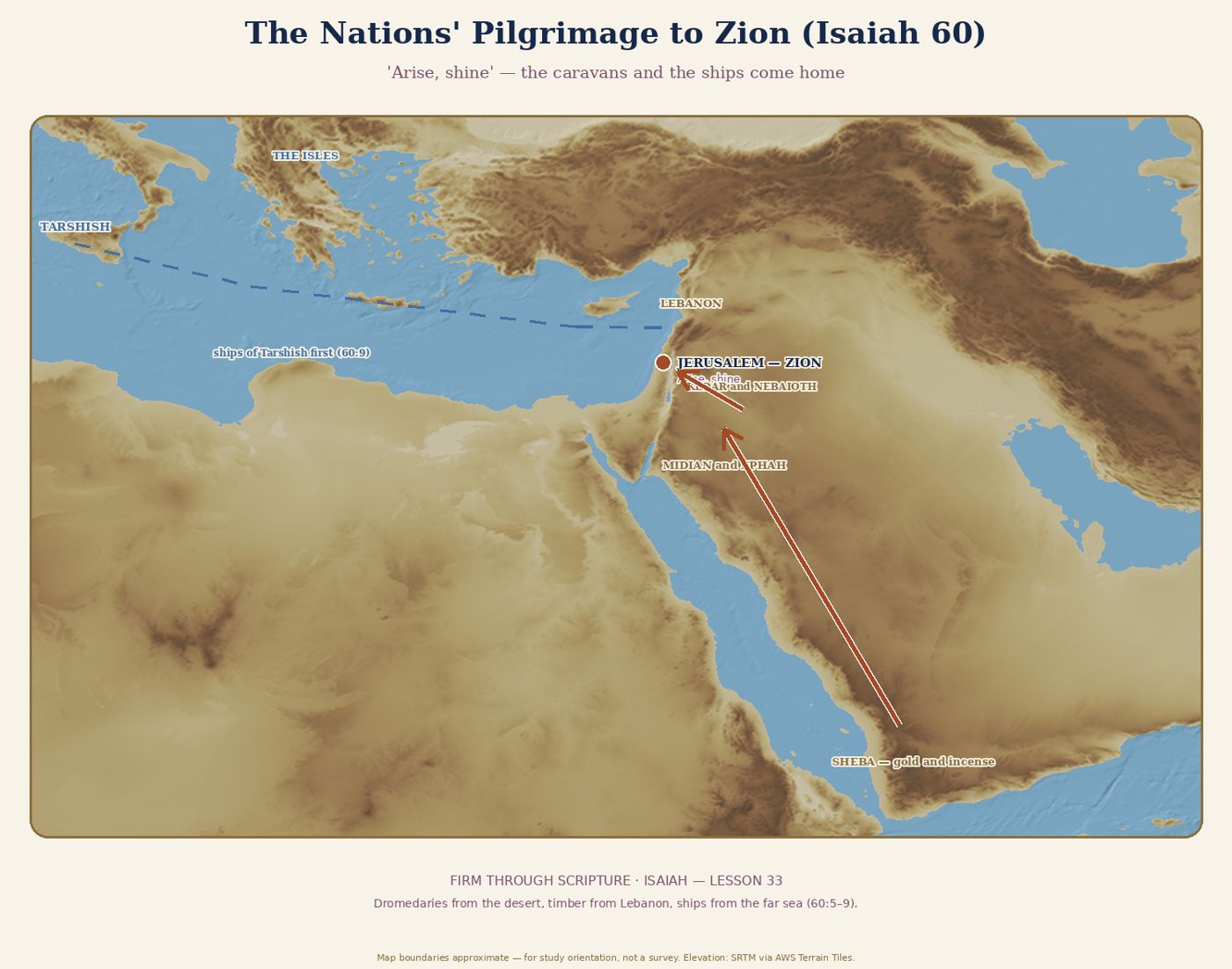
The caravan world. Chapter 60 names real peoples and real trade, and a first-time reader needs the map in words. 16 Midian and Ephah were desert peoples famous for camels — the freight trucks of the ancient world. Sheba, far south in Arabia, was the legendary source of gold and frankincense — incense, the fragrant resin burned in worship. Kedar and Nebaioth were Arab nomad peoples rich in flocks; Kedar is the people chapter 42 placed in the wilderness, now bringing rams to God's altar. Tarshish is the far west — a distant seafaring destination toward the western Mediterranean — whose ships mean even the most distant traders queue up first. 16 Lebanon, north of Israel, famous for tall timber — fir, pine, and the "box" tree — had supplied the first temple's wood. The isles — the Mediterranean coastlands — are Isaiah's phrase for the far-off nations (42:4; 49:1). Every name is a compass point: the whole trading world turned around, walking toward one hill. [4, 16]
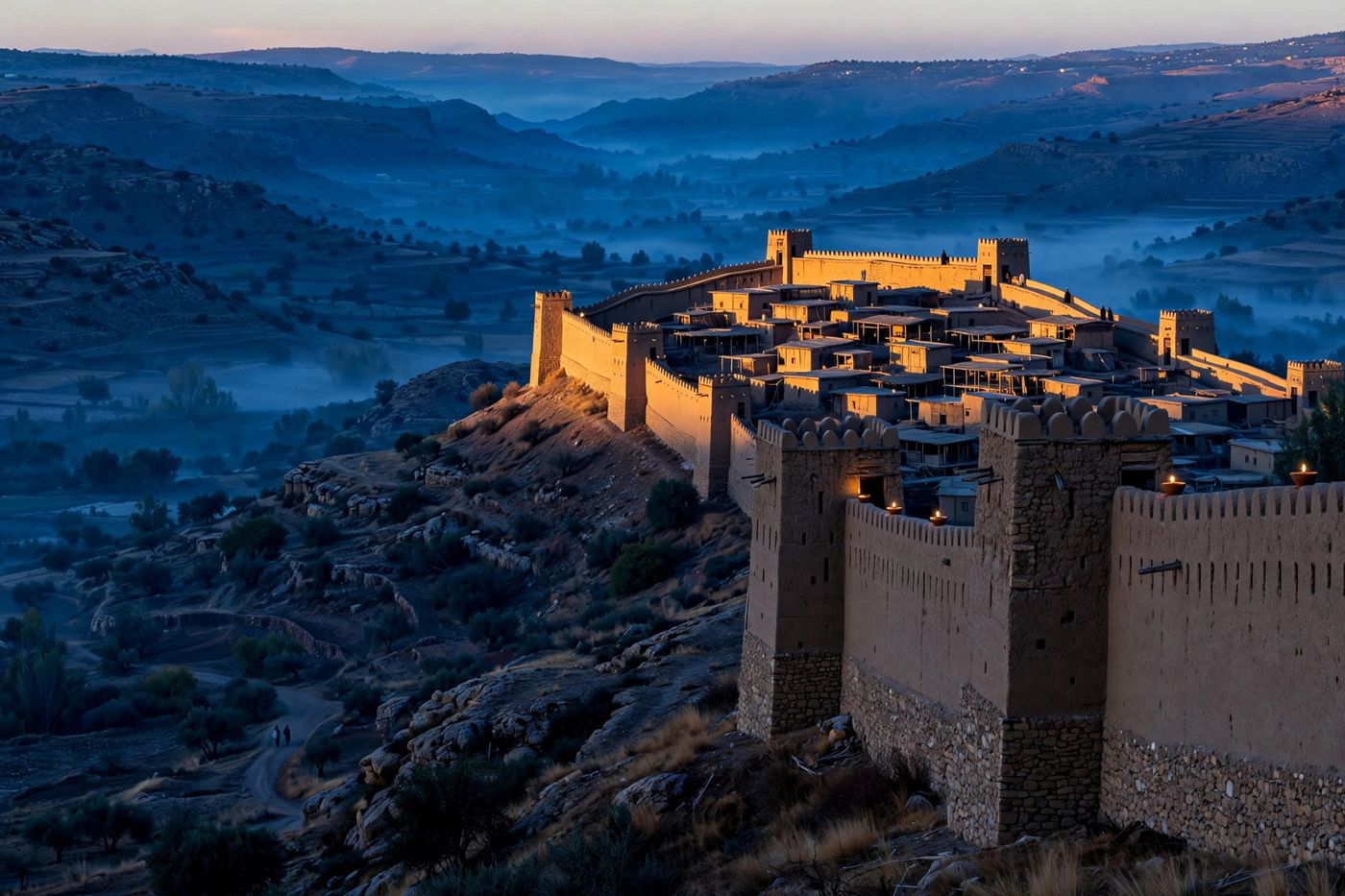
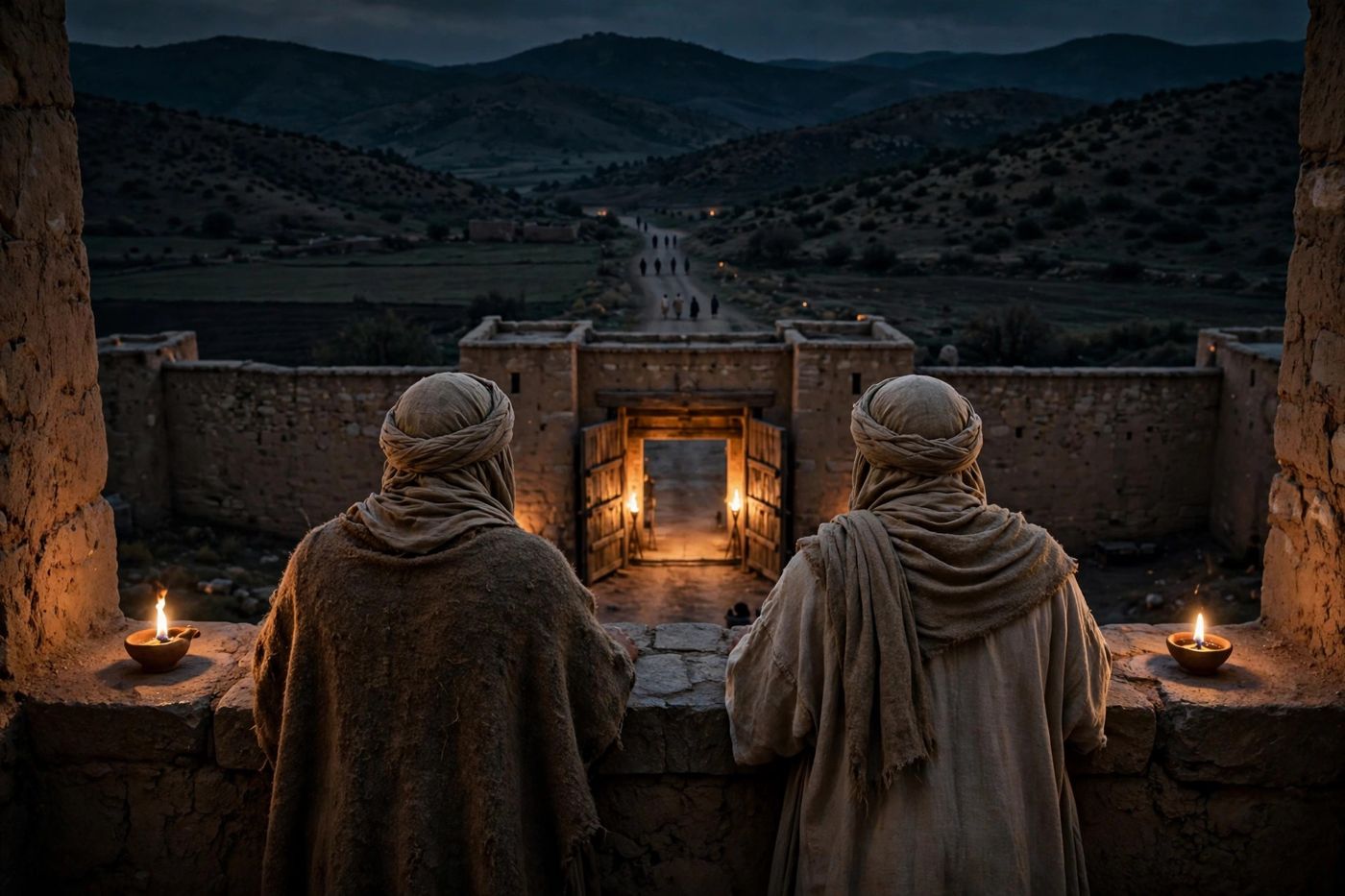
Light and darkness in a world without lamps to spare. Night in the ancient city was genuinely dark — clay oil lamps indoors, no street lighting, gates shut against robbers and armies precisely because the dark was dangerous. [16, 53] So weigh the contrast: darkness covering the earth, "gross darkness" covering the peoples, and one city with glory rising on it like dawn. And weigh gates standing "open continually" (60:11) — a thing no sane ancient city did. A city that never shuts its gates has nothing left to fear. The poetry makes claims about security, not just scenery.
Jubilee — the year underneath 61:2. Leviticus 25 set a fiftieth year — the Jubilee, announced by trumpet — in which liberty was proclaimed: slaves freed, debts released, sold family land returned. 1 It was the calendar preaching that no loss in Israel was permanent. When 61:1–2 proclaims "liberty to the captives" and "the acceptable year of the LORD," every Israelite ear heard the Jubilee trumpet. That is FACT about the idiom; §§5–6 do the careful work.
3. OBSERVE — O: what the text actually does
Before meaning comes observation. So look at what these forty-five verses actually do:
- The verbs of command, and who gets them. Chapter 60 opens with imperatives to Zion — arise, shine, lift up your eyes, see — but she is never told to produce anything: not light, not glory, not children, not wealth. She rises to what has come and looks at what is arriving. The producing verbs belong to God — "I will make," "I will glorify," "I the LORD will hasten it." Hold that distribution of labour; it governs the whole application (see Misread 2).
- Three chapters, three centres of gravity. Chapter 60 is the city — walls, gates, light, citizens. Chapter 61 narrows to a voice — "upon me" — the smallest focus in Book Three. Chapter 62 widens again to the city, through an advocate who will not be silent and watchmen who will not rest. The geometry is deliberate: glory lands on a place, through a Person, guarded by prayer until complete.
- The renaming machine. Count the names: "The city of the LORD" (60:14) · walls Salvation, gates Praise (60:18) · "Priests of the LORD" (61:6) · "trees of righteousness" (61:3) · Hephzibah and Beulah (62:4) · "Sought out, A city not forsaken" (62:12). Isaiah treats names as verdicts about what a thing is — and every new name here answers an old one: forsaken, desolate, hated, shamed.
- The condition buried in the procession. At its centre stands one hard sentence — look at v. 12 again and do not let the poetry hurry you past it: a nation that will not serve perishes. Observation refuses to trim the verses that complicate the party; §7 keeps that line in frame.
4. GENRE — N: note the genre (prophetic salvation oracle in Zion poetry, with a prophetic commissioning at its centre)
These chapters are prophecy in poetry — and, more precisely, the kind scholars call a salvation oracle: a speech in which God Himself announces coming deliverance, usually in the first person, to a named audience ("thus saith the LORD" stands behind every paragraph even where the formula is not repeated). 51 Three genre facts will keep you reading honestly:
- Prophecy is forthtelling first, foretelling inside it. 51 These chapters foretell — a glory, a Preacher, a renamed city still awaited in part when the New Testament opens — but their first work is address: comforting, summoning, renaming a real people. A reading that only mines them for a timetable has left the genre; a reading that denies they predict anything has left it from the other side.
- Poetry argues in pictures, and the pictures are the argument. Light, caravans, gates, garments, gardens, weddings — none is decoration. When 61:11 says righteousness and praise will spring "before all the nations," the garden picture is the claim: growth organic, unforced, visible, unstoppable in season. Flatten the image into a slogan and you have dropped the doctrine. 52
- Zion songs work by reversal — shamed → honoured, barren → mother of many, besieged → unshuttable. [4, 52] Chapters 60–62 are the book's fullest reversal-song, which is why plucking single luxury-verses out of the reversal (Misread 2) breaks the genre as well as the theology.
One more genre note: 61:1–3 is cast as a commissioning — a first-person report of an anointing and a sending, the shape of the Servant's self-introduction in chapter 49. When a text introduces its speaker by his commission rather than his name, the office is the point — and the hunt for the speaker (§7) must start there. [4, 15]
5. TERMS — T: the words in the writer's mouth
Four terms carry this passage. Learn them in the writer's mouth, not in ours:
- "The acceptable year of the LORD" (61:2) — the year of the LORD's favour, His delighted-in, approved time. The word for "acceptable" is altar language: what God accepts and delights in. Welded to "year" and proclaimed alongside "liberty to the captives" (61:1), it is Jubilee language — Leviticus 25's fiftieth year, when liberty was proclaimed, debts released, and land returned. [1, 18] The Anointed announces a calendar event in God's government: a season opened by proclamation in which captives go free because the year itself has changed. Notice the pairing in the same breath: the acceptable year and "the day of vengeance of our God" (61:2). Favour and judgment are one proclamation with two edges — the year that frees captives is a day of vengeance on captors. Keep both edges; §6 will show Jesus at Nazareth laying hold of one and stopping before the other.
- Hephzibah and Beulah (62:4) — two names, both verdicts. Hephzibah means "My delight is in her" — the LORD delighting in Zion, spoken as her new name. (The name already existed: Hephzibah was King Manasseh's mother — a quiet sting, since Manasseh's reign was Judah's darkest; the name of the worst era is reissued for the best.) 19 Beulah means "Married" — the land called Desolate through exile is now wedded: owned, cherished, fruitful. Together they reverse the divorce-language of 50:1 and answer, word for word, the cry of 49:14. Names in Isaiah are not labels; they are sentences God passes.
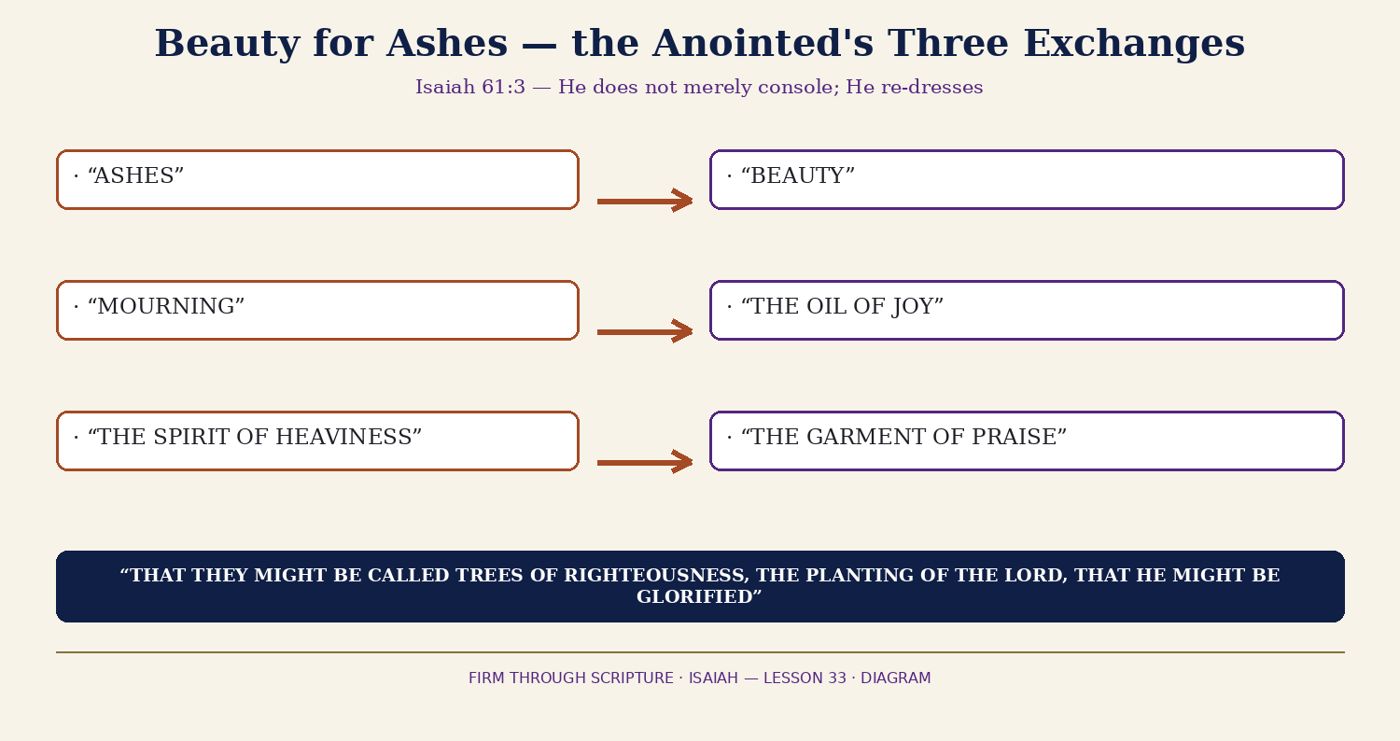
- "Beauty for ashes" (61:3) — see the Translation Note below; the exchange is the term. An ash-covered head was mourning's uniform: mourners sat in ashes and wore sackcloth, the coarse cloth of grief. 16 The Anointed removes mourning's uniform and replaces it with festival dress — a glorious head-dress where ash sat, festal oil where tears ran, a praise-garment where a fainting spirit hung like heavy cloth. God re-dresses His mourners for a feast.
- Watchmen / "ye that make mention of the LORD" (62:6–7) — the watchman you met at 56:10, now restored and given a second title: the LORD's remembrancers, court officers whose job was to keep matters before the king. Isaiah used the courtroom form at 43:26, where God invites His people to "put me in remembrance" — to plead His own promises back to Him. [19, 21] The watchmen are therefore not generic prayer-warriors. Their assignment is a named promise (Jerusalem made "a praise in the earth"), their method is reminding God of what He said, and their shift is day and night until He does it. Misread 3 guards the flattening of that office into a technique.
Method note — the word-study guardrail: a word means what its author uses it to mean, in its sentence, in its century. Every term above was settled by Isaiah's usage in Isaiah, checked against the lexica. [18, 19]
TRANSLATION NOTE — "beauty," and the wordplay your KJV keeps the sense of and loses the music of
At 61:3 the KJV gives mourners "beauty for ashes." Underneath, the Hebrew performs the exchange inside the spelling: the glorious head-dress given is pe'er — P-'-R — and the ashes removed are 'epher — '-P-R. The same letters, rearranged. [19, 20] Ashes reordered become glory; nothing is imported from outside — the very letters of grief are transposed into the letters of honour. No English rendering can carry that; "beauty" is a fair translation of the sense, and the music is in the Hebrew's anagram. The force is part of the meaning: grief itself, taken up and reordered, letter by letter, into praise.
6. ENTIRE CANON — E: where this passage sits in the whole story
No passage lives alone, and this one is a junction where the whole Bible's west–east line runs through. Trace the threads in the order the book itself lays them:
- Backward through Isaiah first. The light that dawned in 9:2 now rises on Zion herself. The carriers of 49:22–23 arrive in 60:4 and 60:14. The highway voices of 40:3, 49:11, and 57:14 build their last stretch at 62:10. The desolate woman of chapter 54 is renamed Married at 62:4. Nearly every image has roots you have already walked past in this book. [3, 4]
- The Magi — a pattern, labelled. Matthew's wise men arrive with gold and frankincense for a newborn king (Matthew 2), echoing 60:6's caravans bringing "gold and incense." It is a PATTERN — Matthew does not cite Isaiah 60 as fulfilled there, and this study will not upgrade an echo into a citation. The careful statement: Matthew's scene is shaped like Isaiah's procession, in miniature, at the King's first appearing. Hold the pattern at its true strength; it is strong enough labelled honestly. 4
- Revelation takes this city up whole — the citations as FACT. FACT: Revelation 21:23 says the glory of God lightens the New Jerusalem and "the Lamb is the light thereof" — Isaiah 60:19–20's retired sun and moon taken up and named. FACT: Revelation 22:5 repeats it — no night, no candle, no sun needed. FACT: Revelation 21:24–26 brings nations and kings walking by that light, through gates "not shut at all by day" — Isaiah 60:3, 11 in the new creation's own words. John is building his city out of Isaiah's. The pattern drawn — that Isaiah 60's Zion reaches its final form only in Revelation's descending city, so the promise outruns every interim fulfilment — is the canon's own geometry, argued in §16. [1, 3]
- The Nazareth event — the centre of this lesson's canon. FACT (Luke's record): Jesus, in Nazareth's synagogue, was handed "the book of the prophet Esaias," opened it at this passage — 61:1–2, with a line woven in from 58:6 — read the anointing, the liberty, the acceptable year, and stopped. The next words in Isaiah are "and the day of vengeance of our God." They are not in Luke's quotation. Jesus closed the book, sat down, and with every eye fastened on Him said, "This day is this scripture fulfilled in your ears." 1 No honest lesson on Isaiah 61 can route around that Sabbath morning. §7 teaches the speaker question and the famous pause in full.
- The entry into Jerusalem. FACT: Matthew 21:5 splices Isaiah 62:11's opening ("Say ye to the daughter of Zion, Behold, thy salvation cometh") with Zechariah 9:9's meek king to frame Palm Sunday. 1 And FACT: Revelation 22:12 re-voices 62:11's reward-line in the risen Christ's mouth — "my reward is with me." Zion's herald-cry is quoted at the King's entry and echoed at the canon's close.
7. THE MEANING — what the passage teaches
The Walk has established what the text says and where it sits. Now its payload, taught straight — in the proportions the passage itself sets: a city lit, a Preacher anointed, a people rebuilt, a name restored.
Rise to a light you did not make (60:1–3)
The opening command is the theology of Book Three in two words: "Arise, shine." Zion is not told to generate light. Her light "is come"; the glory "is risen upon thee." Her shining is a rising to something given — a city at dawn does not manufacture the sun. [3, 13] The sequence forbids two errors. Against despair: the darkness is real — "gross darkness the people" — yet it is not the active force; glory rises, darkness merely covers. Against self-congratulation: the light is local ("upon thee") and borrowed — God's glory seen on her (60:2), never her achievement. That is the mission geometry: God lights one place inside a dark world, and the lit place exists for the dark one — "the Gentiles shall come to thy light" (60:3). Light in Isaiah is always a gathering device. The first question for a lit person or church is not "how bright are we?" but "who is finding their way by us?"
The procession — the world bringing its best to God (60:4–14)
Lift up your eyes — and what Zion sees first is family: "thy sons shall come from far, and thy daughters shall be nursed at thy side" (60:4). The exiles come home not straggling but carried — 49:22's picture arriving as fact. Her heart will fear and be enlarged (60:5) — awe and expansion at once. Only then does the wealth register: "the abundance of the sea shall be converted unto thee" — converted, turned mid-flow.
Teach the procession's items as theology, not decoration. Camels and incense (60:6): the caravans' errand is named in the verse's last clause — they shew forth the praises of the LORD; the cargo is worship. Flocks on the altar (60:7): Kedar and Nebaioth, Arabia's nomads from 42:11, are now not merely singing but sacrificing, accepted on God's own altar — Book Three's wide gate has a wide altar. Ships first in line (60:9): Tarshish brings sons, silver, and gold "unto the name of the LORD thy God" — they come to God's name, drawn by what He has done for Zion; honoured Zion is the advertisement, God the destination. Builders and open gates (60:10–11): foreign sons build the walls their nations breached, kings who besieged now minister, and God interprets it Himself: in wrath He smote her, in favour He has had mercy — and mercy is the last word. Gates open continually are that mercy's architecture. - The hard line, in frame (60:12). "For the nation and kingdom that will not serve thee shall perish." Do not trim it, and do not weaponise it out of its register. In the blessing-and-taunt register of this whole book, the line states the procession's alternative: nations stream to the light, or refuse the city where God's King reigns — and refusal, throughout Isaiah, ends in waste. [3, 4] It is a sovereignty text, not a foreign-policy text: it names what God will do, and leaves the doing to Him. The church preaches it as Psalm 2's closing warning is preached — as a summons to come willingly now, by people who would rather see kings in the procession (60:3) than under the sentence. - Sanctuary timber and bending sons (60:13–14). Lebanon's timber comes "to beautify the place of my sanctuary" — and then the chapter's deepest reversal: "the sons also of them that afflicted thee shall come bending unto thee... and shall call thee, The city of the LORD, The Zion of the Holy One of Israel" (60:14). The oppressors' children come bending, and they come naming. Vindication in Isaiah is not Zion shouting her innocence louder; it is her accusers' sons pronouncing her real name.
| The procession brings | To | For |
|---|---|---|
| Gold and incense (60:6) | The LORD's praise | Worship |
| Flocks and rams (60:7) | God's altar | Accepted sacrifice |
| Timber (60:13) | The sanctuary | Beauty for God's house |
| Sons and wealth (60:9) | Zion, to God's name | The city rebuilt |
The transformed city — upgraded matter, governed peace, retired astronomy (60:15–22)
The last movement of chapter 60 moves from arrivals to constitution — what the city is once the procession settles:
Forsaken becomes excellent (60:15–16). "Whereas thou hast been forsaken and hated, so that no man went through thee, I will make thee an eternal excellency, a joy of many generations" — a city travellers routed around becomes a permanent destination of joy. She is nursed by nations and kings (60:16), and the curriculum is knowledge: "thou shalt know that I the LORD am thy Saviour and thy Redeemer, the mighty One of Jacob" — the book's grand titles, learned in a rescue, not a lecture.
The great upgrade — and its point (60:17). Brass becomes gold, iron silver, wood brass, stones iron: every material moves one rank up. Read in its own sentence, the upgrade is the setup — the punchline is governmental: "I will also make thy officers peace, and thine exactors righteousness." Exactors — tax-drivers, taskmasters — are the men 3:12 complained of. In the new city the administration is the miracle. Isaiah cares less about the city's gold than its governors, and any application that reverses that order has reversed the verse. [4, 13]
Walls named by what they do (60:18). "Thou shalt call thy walls Salvation, and thy gates Praise" — defences renamed after their cause. A community that calls its walls Salvation has stopped trusting masonry.
The sun retired (60:19–20). Sun and moon — Genesis 1's lights, the clock of every festival — are honourably discharged: "the LORD shall be unto thee an everlasting light, and thy God thy glory... and the days of thy mourning shall be ended." The claim is about dependence: in the consummated city, light comes unmediated — no cycle, no setting, no eclipse of grief. Revelation takes the picture up as the world to come's architecture (§6). Every lesser light is a deputy; the LORD is the light itself.
All righteous, planted, and hastened (60:21–22). The citizenry is defined: "Thy people also shall be all righteous... the branch of my planting, the work of my hands, that I may be glorified." Against every prosperity reduction, set the chapter's own definition of the blessed community: righteous people, God's planting, existing for God's glory. And the closing arithmetic frees: "A little one shall become a thousand... I the LORD will hasten it in his time." The growth is God's, the hastening is God's — and the timing is God's. "In his time" is not read into the verse; it is the verse. A people taught by 60:22 can work without franticness and wait without despair. 3
Now the camera tightens — from the city's light to a single voice, and the finest work of the arm of the LORD in this passage turns out to be a sermon.
The Anointed Preacher — Book Three's charter (61:1–3)
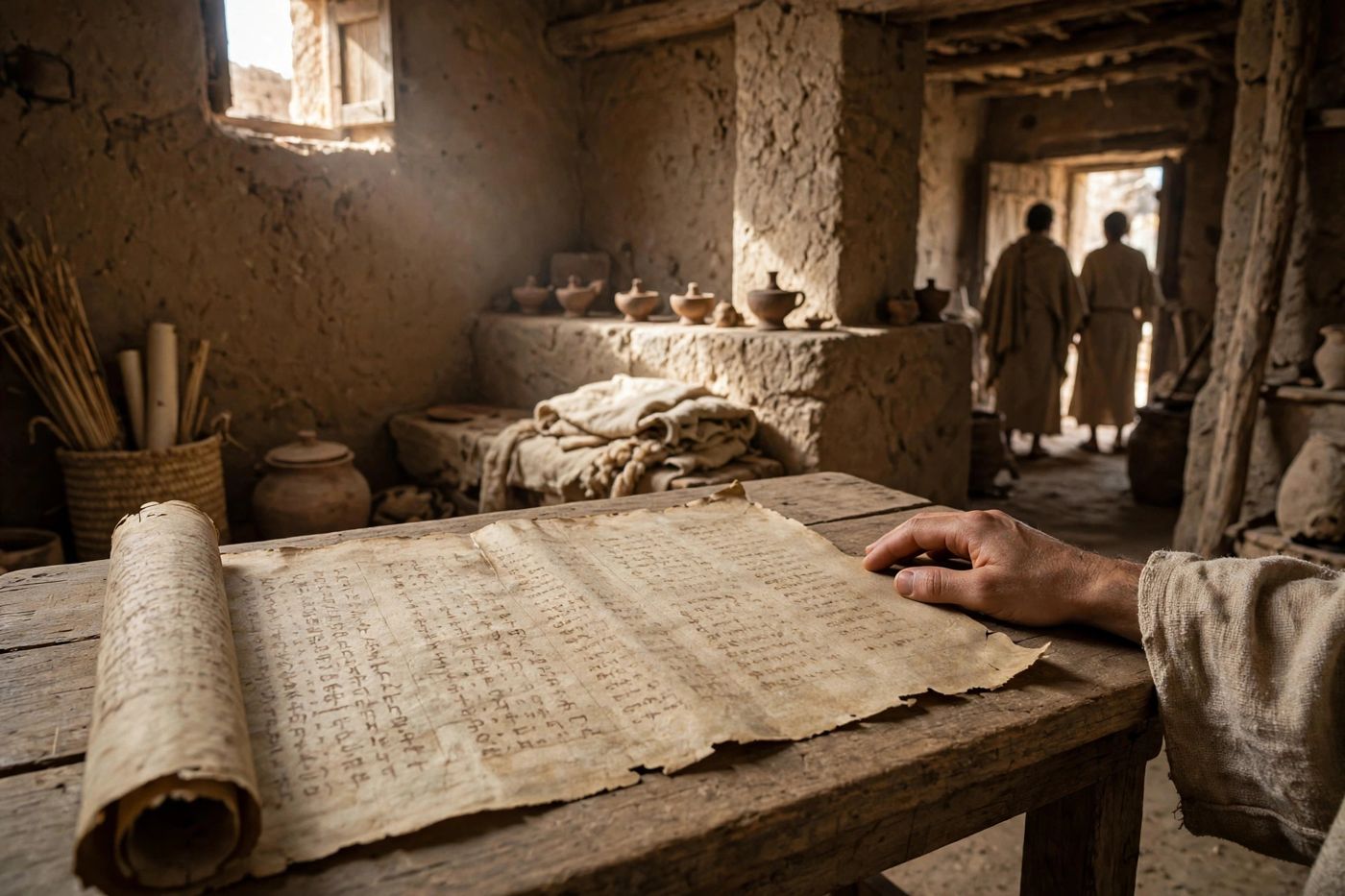
The camera that has been sweeping continents now tightens to a single voice: "The Spirit of the Lord GOD is upon me; because the LORD hath anointed me to preach..." The anointing — oil poured on priests, prophets, and kings to equip them for office — is here an anointing of the Spirit for a ministry of words: preach, bind up, proclaim, comfort, give. [4, 18] His congregation is named with care: the meek, the brokenhearted, captives, the bound. His syllabus runs in deliberate order: good tidings to the meek — news before instruction; binding up the brokenhearted — wounds wrapped, not lectured; liberty to captives — Jubilee proclaimed, not negotiated; the opening of the prison to the bound; and the acceptable year announced as open. Then the comfort of mourners and §5's three exchanges. And the goal: "that they might be called trees of righteousness, the planting of the LORD, that he might be glorified" — mourners re-dressed, re-planted, and renamed as oaks, slow-grown and storm-proof, for another's glory.
The speaker question, taught plainly. The text gives the speaker no name and a dense profile. [4, 42] Lay it out:
| The speaker's mark | Where Isaiah showed it | What it suggests |
|---|---|---|
| "The Spirit of the Lord GOD is upon me" | The Servant: "I have put my spirit upon him" (42:1) | The Servant's anointing, resumed |
| Anointed to preach, sent to proclaim | The obedient Servant's taught tongue (50:4) | A prophet-Servant, speaking |
| Liberty proclaimed; mourners comforted | The prophet's own commission (ch. 6; 40:1) | Isaiah's office, carried forward |
| Distinct from the LORD who sends him, yet sent to Zion | The Servant distinguished from Israel (49:5–6) | One who serves Israel without being absorbed into her |
The live readings, labelled: the Servant of chapters 42–53 in his post-triumph ministry — POSITION, widely held and the natural canonical reading; the prophet speaking in the Servant's pattern — POSITION, held by many careful readers; Israel personified — possible in the book's corporate grammar, but strained, since he is sent to Zion's mourners rather than mourning with them. What the options share matters more: in every reading the voice carries the Servant's profile and does the Servant's work. And the canon settles the centre of gravity in §6's event: Jesus stood up, read these words, and claimed them. The church does not stop debating the verse's first horizon; she knows where its spotlight lands, because the Anointed pointed it at Himself. [1, 4]
The pause at Nazareth, and the two comings. Jesus reads favour in full and stops mid-sentence — mid-verse — before "the day of vengeance of our God." The church's widely held reading is POSITION, stated at full strength because it deserves it: the acceptable year was what the first coming proclaimed, while the day of vengeance, equally written and equally His, was awaited, reserved to the return of the same Anointed. The pause, on this reading, is the space between the comings — the year of favour, still open, in which the church now preaches. Argue it carefully: Luke presents the stop as FACT; the two-visits theology built on it is the church's POSITION, not an annotation Luke supplies, and honest teachers label the seam. What no reading may do is dissolve either edge: strike the vengeance and you have edited Isaiah; strike the favour's priority and you have edited Luke.
The rebuilt people — mourners become builders, servants become priests (61:4–11)
The comforted become the workforce. "They shall build the old wastes... the desolations of many generations" (61:4) — 58:12's "repairer of the breach" at work, the ruins specified as generational. Comfort first, construction second — the sequence rebukes every programme that hands the brokenhearted a trowel before the garment of praise.
Then the social reversal (61:5–7): strangers serve — flocks, ploughing, vines — while Zion's own are set to higher labour: "ye shall be named the Priests of the LORD: men shall call you the Ministers of our God." Exodus 19:6's offer — a kingdom of priests — arrives as a name the nations themselves use. And shame's account closes with chapter 40's arithmetic come back as joy: for shame, double (61:7). Where grace at 40:2 overpaid the debt, it now overpays the portion.
And God interrupts His own celebration to state His terms (61:8): "For I the LORD love judgment [justice], I hate robbery for burnt offering." Book One's opening charges (1:11–17) are answered in Book Three: the God who rejected blood-soaked sacrifices from unjust hands has kept His standard into the glory itself. The everlasting covenant is made by a God whose ethics travel with Him. The seed is known among the nations as "the seed which the LORD hath blessed" (61:9) — and then the chapter breaks into song (61:10–11): garments of salvation, the robe of righteousness, bridegroom and bride in their ornaments. Whose voice? The text braids them — Zion as bride, or the Anointed singing over His robe — and the braiding is the point: Preacher and people share one wardrobe and one joy. This study labels that braiding observation, widely noted, not a problem to solve. [4, 13] The close is pure garden (61:11): righteousness and praise springing "before all the nations" — certain, seasonal, visible, and grown by the Gardener.
The renamed and watched city (62:1–12)
Chapter 62 opens with an advocate who will not shut up: "For Zion's sake will I not hold my peace... until the righteousness thereof go forth as brightness, and the salvation thereof as a lamp that burneth." Who speaks — the prophet interceding, or the LORD pledging Himself? Isaiah lets the voice carry both resonances (the LORD swears the chapter's other oath at 62:8), and teachers have read it both ways. [3, 4] Hold the function tightly: someone with standing has pledged not to stop until Zion's righteousness is as public as lamplight. The Gentiles will see it; and Zion will be glory itself as regalia — "a crown of glory in the hand of the LORD" (62:3): she does not wear the crown; she is the crown, held in God's hand.
Then the renaming that closes Book Two's open wound (62:4–5). Read 49:14 beside it: Zion said the LORD had forsaken and forgotten her. Chapter 62 answers not with an argument but with names: no more Forsaken, no more Desolate — Hephzibah, Beulah — "for the LORD delighteth in thee, and thy land shall be married... as the bridegroom rejoiceth over the bride, so shall thy God rejoice over thee." God's cure for the name Zion gave herself in the dark is to out-name her. Teach it without flinching: God's delight in His redeemed people is not a tolerated metaphor but a name He issues, and the marriage is His joy, not merely her rescue.
On the walls stand the remembrancers (62:6–7, §5), charged to "give him no rest, till he establish, and till he make Jerusalem a praise in the earth." The oath of 62:8–9 secures the promise's economics — harvest to its eaters, wine to its gatherers, "in the courts of my holiness"; exile's defining theft (strangers eating what you sowed) is revoked under God's sworn right hand. The highway is built one last time (62:10) — the road of 40:3, 49:11, and 57:14 completed, stones gathered out, standard lifted — and over it comes the herald's last cry (62:11–12) and the final names, stacked like seals: "The holy people, The redeemed of the LORD... Sought out, A city not forsaken." Sought out: not found by accident — hunted down, on purpose, by a God who would not rest.
Sought out, A city not forsaken — the last name in the passage is the one God went looking to give.
The Christ Thread
This lesson needs no forced thread; the New Testament reaches in with both hands. The centre is Luke 4: the Anointed of 61:1–2 claimed, in person and in public, by Jesus as His own commission — enacted across His ministry to the brokenhearted and bound, and carried to the cross where liberty for captives was purchased. Around that centre run the threads of §6: Matthew's splicing of 62:11 into the King's entry, the magi arriving in the shape of 60:6's procession, Revelation building the final city out of chapter 60, and the risen Christ closing the canon with 62:11's reward-line in His own mouth. The pattern, labelled: in the church's reading — POSITION at the junctions where scholars divide, FACT wherever the New Testament itself does the citing — Isaiah's Preacher, lit city, and coming salvation converge on Christ in His two comings: the acceptable year proclaimed at the first, the city's glory consummated at the second, and the church preaching between them in the pause He left in the sentence.
Where in the Covenant Story?
These chapters are the new-covenant horizon of the Mosaic story come due. Jubilee becomes the Anointed's proclaimed year; Exodus 19's kingdom of priests becomes 61:6's named reality; the land promises — inheritance "for ever" (60:21), harvest secured (62:8–9), land renamed Married (62:4) — are gathered up and glorified, not discarded. And Genesis 12's promise gets its geography: blessing flowing through Israel's city to all families, by light rather than conquest. [1, 4]
Father, Son, and Spirit
Chapter 61 opens with one of the canon's clearest sentences about how God works: "The Spirit of the Lord GOD is upon me; because the LORD hath anointed me." The Spirit rests on the Anointed; the Lord GOD — the Father, in the New Testament's naming of the same scene — anoints and sends; the Anointed speaks. At Nazareth the triad reappears: the Son reads, fresh from the Jordan where the Spirit descended and the Father named Him. The church shares the Preacher's office only as carried by the same Spirit who rested first on Him. 1
The Long View — what the church has believed
The centre has held steady. The early church read Isaiah 61 christologically without hesitation — Jesus' claim at Nazareth left her no other honest option — and Justin Martyr's second-century argument with Trypho shows the debate already running along this lesson's seam: not whether the chapters speak of God's Anointed, but who he is and when the vengeance falls. 44 Jerome treats the Preacher as Christ and renamed Zion as the church gathered from Jews and Gentiles, keeping Israel's place in the promises in view. 37 Calvin reads chapter 60's glory as the church's calling and 62's watchmen as a standing ordinance of prayer — Zion's officers may not be silent because God has not finished. 36 Where the centuries divide is chapter 60's timetable — the church's present glory, a future restoration of Israel still awaited, or the new creation of Revelation 21–22 as final referent with earlier fulfilments as dawnings. §16 argues it in the open; the spine does not require settling it, because at every horizon the same three things hold: the light is God's, the Preacher is Christ, and the city ends not forsaken.
8. THE AIM SENTENCE — X: eXplain the intent
Everything observed now compresses into one sentence — the author's intended meaning, stated before any application is allowed near it:
Isaiah proclaims that God's own glory rises on forsaken Zion — drawing the nations, their kings, and her scattered children into a righteous, unviolent, ever-lit city — through the Spirit-anointed Preacher whose Jubilee sermon dresses mourners in praise, renames the desolate land Delighted-In and Married, and posts watchmen to remind God of His promise until Jerusalem is a praise in the earth.
If a sermon or tract uses Isaiah 60–62 to say something that cannot be traced back to that sentence, it is not this passage talking.
9. SAY IT BACK
Close the book and say the AIM sentence from section 8 in your own words — out loud, or written in your notes, without looking. Then say, in one more sentence, what it asks of you this week.
If your version quietly changes the meaning — if Zion's borrowed light becomes your own glow, or the Preacher's sermon becomes a generic ministry motto — open the lesson and walk it again. This exercise is the entire course in miniature: meaning first, then — and only then — your life.
10. THE MISREAD — the guardrail, with verdicts
Three live misuses of this passage. Each gets a fair hearing, the evidence, and a verdict.
Misread 1: "Isaiah 61:1–2 is a general anointing text — a charter for any preacher or ministry that feels the Spirit's call." Why it sounds right: the passage really is about anointing and preaching, and preachers really do share, by extension, in preaching good tidings. It feels ungenerous to fence a beloved ordination text. The evidence: Luke 4 fixes the passage's centre as canon fact. Jesus read it, stopped at the seam, and said, "This day is this scripture fulfilled in your ears" — locating the fulfilment in His own person. The profile (§7's table) is the Servant's — Spirit-anointing (42:1), the taught tongue (50:4) — gathered into One who could claim it without remainder. Others share its work derivatively, as members and messengers of the Anointed, never as independent holders of His office. Verdict: a true extension built on a stolen centre. Preach Isaiah 61 at ordinations — but preach it as participation in Christ's anointing, claimed by Him first at Nazareth, or the text's own spine has been replaced by a ministry motto.
Misread 2: "Chapter 60 is God's prosperity catalogue — gold, silver, nations' wealth, and increase promised to believers who claim them." Why it sounds right: the chapter really is full of wealth — camels, gold, silver, upgraded materials, a little one becoming a thousand — and it really is addressed to God's people in a tone of unqualified generosity. The verses quote beautifully on their own. The evidence: follow the chapter's arrows. Every gift flows inward to the sanctuary — flocks "on mine altar," timber "to beautify the place of my sanctuary," wealth "unto the name of the LORD thy God" — and the nations are enriched by coming, not believers by extracting. The citizens are "all righteous" (60:21), the officers peace, the light God Himself (60:19), and the increase hastened by God "in his time" (60:22), not on the claimant's calendar. A reading that turns the procession around — wealth flowing into private accounts, on demand — has reversed every arrow the chapter draws. Verdict: the catalogue is real and the direction is wrong. Chapter 60 promises a glorified city whose wealth is worship and whose citizens are righteous; applications must pass the Transfer Tests of §13 or not be made at all.
Misread 3: "'Give him no rest' (62:7) teaches a prayer technique — press God hard enough, long enough, and He will deliver the outcome you want." Why it sounds right: the watchmen really are told to keep not silence, to give God no rest, day and night — and Jesus really does commend persistent, even wearisome, prayer (Luke 18). Importunity is biblical. The misread is near enough to the truth to pass casual inspection. The evidence: the watchmen's importunity has an office, a text, and a target — all named. The office: the LORD's remembrancers (§5), posted officials, not private consumers. The text: God's own promise, pleaded back in the courtroom pattern of 43:26. The target: one named outcome, "till he establish, and till he make Jerusalem a praise in the earth" (62:7), a promise God had already sworn (62:8). Prayer as banging on heaven for unaimed private outcomes is not what this text teaches; flattening the watchmen into a technique robs intercessors of the harder, better assignment — learning God's promises well enough to plead them, by name, until He performs them. Verdict: right volume, wrong address. The watchmen give God no rest with His own words about His own city — covenant-reminding intercession for named promises is the text's teaching; technique for private outcomes is not.
11. FROM WORD TO WALK
Sit first with the mourners, because the Anointed does. Isaiah 61's congregation is the meek, the brokenhearted, the bound, and "them that mourn in Zion" — people grieving over what God's city and people have become, over ruins they did not make and cannot repair. If you have ever grieved over something broken that was older and bigger than you — a family pattern, a church's decline, a name you were given in the dark — you are in this sermon's front row, and its first word to you is not "build." It is a wardrobe: beauty for ashes. God begins restoring ruined places by re-dressing ruined people, and He begins not with their effort but with His exchange. Before you are a builder (61:4), you are a mourner He has planted — a tree of righteousness, planted by a hand that was not yours.
| The mourner's old uniform | The Anointed's exchange (61:3) |
|---|---|
| Ashes on the head | Beauty — pe'er for 'epher |
| Mourning | The oil of joy |
| The spirit of heaviness | The garment of praise |
Then sit with the watchmen, because all of us have a wall. Somewhere there is a promise of God not yet come to pass in a place you love, and the passage leaves exactly two alternatives: the silence of 56:10's sleeping watchmen, or the holy stubbornness of 62:6's remembrancers. Isaiah will not let you call resignation "faith." The watchmen's faith is loud, scheduled, and specific — and it is not anxious. A man who believes the swearing God of 62:8 can keep a night shift without panic. Reminding God is not doubting God; it is treating His promises as court-worthy documents, fit to be pleaded until the court rises.
And end with the names. Zion called herself Forsaken in the dark (49:14) — not lying about how it felt, but wrong about what it was. God answers the feeling not with a scolding but with a wedding: Hephzibah, Beulah, Sought out. Somewhere there is a name you answer to that God never gave you. This passage does not ask you to rename yourself by optimism. It tells you the Renamer is at work, His names outlast yours — and that before you ever climbed the wall to watch for Him, He had already come looking for you.
LORD, You rose on a city that could not light itself, and You were patient with her ashes longer than she was. Take the ashes I still wear and give me the garment You promised — not my brightness, but Yours, seen on me. Post me on my wall this week: teach me one of Your promises well enough to plead it back to You, day and night, without panic and without silence, until You make the place I love a praise in the earth. In the Anointed's name, amen.
12. FOR DISCUSSION — OR FOR YOUR JOURNAL
With a group, work these aloud. Alone, they're yours — answer them in your journal or in prayer; they lose nothing in the quiet.
- Zion is told to arise and shine to a light she did not make (60:1–2). Where in your life — or your church's — have you been trying to generate what God only asks you to rise to? What would rising, concretely, look like this week?
- The procession brings the nations' best into the sanctuary, and the citizens are "all righteous" (60:21). How does that direction of flow expose the prosperity reading — and where do you feel its pull yourself?
- Jesus stopped reading Isaiah 61 before "the day of vengeance" and said the scripture was fulfilled that day (Luke 4). What does the church's two-comings reading of that pause mean for how we preach, pray, and wait — in the acceptable year, with the vengeance day still ahead?
- The watchmen of 62:6–7 give God no rest with one named promise. Name one promise of God for a place or person you love. What would it mean to take up the remembrancer's office for it — specifically, scheduled, and in God's own words?
13. THE WALK-OUT — T: Transfer to today
Meaning is settled. Now — and only now — application, and it must cross the bridge honestly. Run the five Transfer Tests on this passage:
- Same covenant? The promises are made to Zion under the old covenant's horizon and reach their centre in Christ — the acceptable year He proclaimed is the age we live in. What crosses, crosses through Him: the church inherits Zion's light, sermon, and watch as Christ's body, not as a replacement city claiming land promises by title deed.
- Same audience? The addressees are Zion, her mourners, and her watchmen. A believer today receives this as one gathered into that people by faith in the Anointed — the applications below are the gathered people's, not private claims detached from the city.
- Same genre rules? Salvation oracle in poetry: it announces God's acts and renames God's people. So it yields first indicatives to believe and identities to wear — lit, renamed, planted, posted — and only then practices. Promise-poetry must not be strip-mined for techniques (Misreads 2 and 3 fail here).
- Repeated or rooted? Borrowed light that gathers (Matthew 5:14–16), the Anointed's sermon continued by His church, covenant-reminding prayer (43:26; Luke 18), comfort passed on to mourners — each repeated across the canon and rooted in God's character. These cross.
- Ten verses either side? Every application below is drawn from these chapters read whole — the light with 60:12's hard line, the wealth with its altar at 60:7, the watchmen with their named promise at 62:7. Nothing hangs on a torn-out line.
What crosses — and lands:
- Rise to given light. In Christ, the light is come; shining is response, not production — which kills both despair and performance. The question is never whether you feel bright, but whether you will stand where the light has risen and let it be seen on you.
- Be a gathering place, not a terminus. Zion's light exists for nations walking out of darkness (60:2–3). Whatever God has lit in you is a landmark for someone else's road home.
- Receive the exchange before attempting the rebuild. Dressed (61:3), then building (61:4). God's comfort is not the reward for your reconstruction; it is its foundation and fuel.
- Take up the remembrancer's post. One named promise, in God's own words, pleaded on a schedule, without panic and without silence. That is 62:6–7 transferred whole, office and all.
Practices — what the gate lets through, made concrete this week:
- The wardrobe prayer. Each morning, pray 61:3's three exchanges over one specific grief, by name: name the ashes, the mourning, the heaviness — then receive, out loud, the beauty, the oil, the garment. Do not rush to building until the exchange has been received.
- One landmark act. Choose one person in a dark place and do one concrete thing that makes God's light findable — a visit, a meal, an invitation.
- Post yourself. Write down one promise of God (with its reference) for one place or person. Set two fixed times this week — morning and night, the watchmen's shifts — to plead it back to God in its own words. Keep the post for a month before judging it.
- Rename honestly. Write the false name you have been answering to (Forsaken, Desolate, or your own version) beside the name this passage gives God's sought-out people. This week, tell one other believer, specifically, that God delights in them — pray Hephzibah over them by name.
What does not cross: private prosperity claims on chapter 60's wealth (Misread 2); Isaiah 61 as a personal ministry title independent of Christ (Misread 1); "give him no rest" as a technique for unaimed outcomes (Misread 3); and 60:12 as a warrant for any human programme against any nation — the sentence is God's, preached as a summons to come, never wielded as our threat. The gate is not there to shrink the Bible's claims on you — it is there to make sure the claims that land are the ones God actually made.
Praise Him
Praise Him — not for a light we lit, but for a glory that rose on us; not for a name we earned, but for Hephzibah spoken over the forsaken; not for a year we declared, but for the acceptable year His Anointed proclaimed. The LORD is our everlasting light, and the city He sought out shall be called — in His own words — not forsaken. Hasten it, LORD, in Your time; until then, keep us shining, planted, and posted.
14. THE RECAP CARD — this study on one page
Print it. Keep it where you'll see it this week.
- The passage: Isaiah 60:1–62:12 — Zion's rising, the Anointed's sermon, the city's new names.
- Say It Plain: God's glory rises on forsaken Zion; nations and children stream to her light; the Anointed proclaims Jubilee and dresses mourners in praise; the land is renamed Delighted-In and Married; watchmen remind God until Jerusalem is a praise in the earth.
- The AIM: God's glory rises on forsaken Zion, drawing the nations into a righteous, ever-lit city, through the Anointed Preacher who dresses mourners in praise, renames the land Delighted-In and Married, and posts watchmen until Jerusalem is a praise in the earth.
- Key terms: the acceptable year — God's Jubilee season of favour · Hephzibah — "My delight is in her" · Beulah — "Married" · pe'er / 'epher — glory and ashes, the same letters rearranged.
- The Misread, in one line: Isaiah 61 is Christ's charter first, shared by extension — not a generic ministry motto · chapter 60's wealth flows to the altar, not to private claims · "give him no rest" is the remembrancer's office for named promises, not a technique.
- Memory verse: "Arise, shine; for thy light is come, and the glory of the LORD is risen upon thee." — Isaiah 60:1
- This week's practice: the wardrobe prayer (61:3's exchanges over one named grief) — and one posted promise, pleaded morning and night like a watchman.
15. CHECK YOURSELF — five questions
Answer from the study, not from instinct. (Answers live in the Teacher Edition.)
- In your own words: what is the AIM of Isaiah 60–62?
- Zion is commanded to shine, yet the passage says her light "is come." Explain the difference — and name one error it forbids on each side.
- At Nazareth, what did Jesus read, where did He stop, and what did He claim? Label which parts of the church's reading of that moment are FACT and which are POSITION.
- A friend calls chapter 60 "the Bible's prosperity chapter" and claims its gold and increase for his business. Using the chapter's own arrows — altar, citizens, timing — show where his reading reverses the text.
- Who are the watchmen of 62:6–7, what is their office and their one target, and why does that make "prayer technique" the wrong label for their work?
16. GO DEEPER
Optional — the lesson is complete without it.
From the Sources — The procession and the real trade roads
The goods of chapter 60 travel real roads: frankincense and gold north from South Arabia along the desert incense route; Kedar in Assyrian records as a North Arabian power rich in sheep and camels; "ships of Tarshish" as the Mediterranean's long-haul carriers. [16, 25] FACT about the roads and records. The poem's claim is theological: it reverses the roads' direction of benefit, running the trade network into Zion as worship. INFERENCE — drawn from the text's own verbs of conversion and acceptance (60:5, 7), not imposed on them.
The Honest Argument — Whose glory is chapter 60, and when?
Three readings have stood their ground for centuries. (a) The church-age reading: Zion glorified is the church gathered from Jews and Gentiles, the procession fulfilled as nations stream into the gospel — strong on Luke 4's "this day" and on Revelation's final city. (b) The future-Israel reading: the land, city, and national specifics outrun anything yet seen and await a restoration of Israel in her land — strong on the passage's concreteness and Romans 11. (c) The consummation reading: Revelation 21–22 names the promise's final address, every earlier fulfilment a real but partial dawning. DISPUTED — compare Oswalt 3 with Blenkinsopp 9 and Goldingay 6. This course's POSITION: (c) as the governing horizon — 60:19–20's scale is new-creation scale, and Revelation confirms the address — while receiving (a) as the acceptable year's present reality and refusing to empty (b)'s concreteness: the God who renamed this land Beulah does not traffic in disposable geography. No side may claim its timetable is the text's plain statement.
The Word Underneath — hasten, in his time
The verb at 60:22 — "I the LORD will hasten it" — is the root Isaiah used for the child-sign of 8:1–3 ("hasting to the spoil"). In Isaiah, hastening is what God does with His appointed things, never a method placed in human hands. [19, 21] Welded to "in his time," it is the book's doctrine of pace in five words: certain enough to be hastened, sovereign enough to be scheduled. FACT about the word's usage; the doctrine is argued from the weld itself.
Go Read
- Oswalt, The Book of Isaiah, Chapters 40–66 (NICOT) 3 — chapters 60–62 as the deliberate answer to chapters 1–39, including the Nazareth pause.
- Motyer, The Prophecy of Isaiah 4 — on the Servant-profile of 61:1–3 and the book's renaming pattern, with the structure kept always in view.
- Brueggemann, Isaiah 40–66 (Westminster Bible Companion) 13 — a rhetorical reading for preachers; especially alive to 62:6–7.
- Smith, Isaiah 40–66 (New American Commentary) 11 — historical notes on the procession peoples, with the authorship debate surveyed evenly.
17. SOURCES & REFERENCES
Numbered citations in this lesson key to this list — the course standard: every sourced claim carries its number, and every number can be checked.
-
The KJV text itself — Holy Bible, King James Version (eBible.org KJV, 1769 text). Scripture quotations are from the King James Version (KJV), which is in the public domain in the United States; the full passage is always assigned as reading. Cross-references within Scripture cite this number.
-
Oswalt, The Book of Isaiah, Chapters 40–66 (NICOT) — John N. Oswalt (Eerdmans). The second volume: the comfort section, the Servant Songs, Cyrus, and the new-creation chapters, read as the deliberate answer to chapters 1–39.
-
Motyer, The Prophecy of Isaiah — J. Alec Motyer (IVP). A one-volume commentary by an evangelical scholar who argues the whole book breathes the mind of the eighth-century prophet; especially strong on the book's structure, its repeated refrains, and the Servant.
-
Goldingay, Isaiah (Understanding the Bible / NIBC) — John Goldingay (Hendrickson). A mainstream-critical one-volume commentary; the exilic-community reading of chapters 40–55 stated fairly, with close attention to the poetry.
-
Blenkinsopp, Isaiah 1–39, Isaiah 40–55, Isaiah 56–66 (Anchor Bible) — Joseph Blenkinsopp (Doubleday). Mainstream-critical commentary across all three traditional divisions; a fair statement of the multiple-authorship case and of post-exilic settings.
-
Smith, Isaiah 1–39 and Isaiah 40–66 (New American Commentary) — Gary V. Smith (B&H). Evangelical commentary with strong historical notes (the Assyrian and Babylonian records) and an even-handed survey of the authorship debate.
-
Brueggemann, Isaiah 1–39 and Isaiah 40–66 (Westminster Bible Companion) — Walter Brueggemann (Westminster John Knox). A rhetorical-theological reading for preachers and teachers; strong on the poetry's movement from judgment to hope.
-
Westermann, Isaiah 40–66 (Old Testament Library) — Claus Westermann (Westminster). The classic critical commentary on the comfort chapters; foundational for the genre analysis of the trial speeches and salvation oracles.
-
Walton, Matthews & Chavalas, The IVP Bible Background Commentary: Old Testament — John H. Walton, Victor H. Matthews, Mark W. Chavalas (IVP). Verse-by-verse ancient Near Eastern background: Assyrian siege practice, Babylonian religion, treaty and coronation customs, geography.
-
VanGemeren (ed.), New International Dictionary of Old Testament Theology and Exegesis (NIDOTTE) — Willem A. VanGemeren (Zondervan). Theological word studies with semantic-range discipline for the Hebrew terms.
-
Brown, Driver & Briggs, Hebrew and English Lexicon of the Old Testament (BDB) — The standard older Hebrew lexicon; word senses and usage ranges for the Terms sections.
-
Koehler & Baumgartner, The Hebrew and Aramaic Lexicon of the Old Testament (HALOT) — The standard modern Hebrew lexicon; the control on BDB for contested senses (e.g., 'almah).
-
Harris, Archer & Waltke (eds.), Theological Wordbook of the Old Testament (TWOT) — Word studies from a conservative-evangelical hand; pastoral-theological range of key terms.
-
Pritchard (ed.), Ancient Near Eastern Texts Relating to the Old Testament (ANET) — James B. Pritchard (Princeton). Translations of the primary records: Sennacherib's annals, the Babylonian Chronicle, the Cyrus Cylinder, treaty and hymn texts.
-
Calvin, Commentary on Isaiah — John Calvin (public domain). Reformation exegesis; a control on interpretation and a voice in the Long View.
-
Jerome, Commentary on Isaiah — Jerome (c. AD 408–410). The early church's fullest Isaiah commentary; Jerome transmits the Hebrew learning of his day and treats Isaiah as one prophet's book.
-
North, The Suffering Servant in Deutero-Isaiah — C. R. North (Oxford). The classic survey of every identification of the Servant (Israel, a prophet, a king, the Messiah) weighed in one place.
-
Justin Martyr, Dialogue with Trypho — 2nd century AD. The church's argument with Judaism over Isaiah 53 (and 7:14) conducted in the open, chapter by chapter — primary evidence for the Long View.
-
Fee & Stuart, How to Read the Bible for All Its Worth — Gordon D. Fee and Douglas Stuart (Zondervan). The beginner's method book; its prophecy chapter ("a forthtelling first") undergirds the Genre sections.
-
Ryken, Wilhoit & Longman (eds.), Dictionary of Biblical Imagery — Leland Ryken et al. (IVP). Isaiah's image-fields — vineyard, highway, banner, potter, watchman — traced across the canon.
-
King & Stager, Life in Biblical Israel — Philip J. King and Lawrence E. Stager (Westminster John Knox). Daily life, agriculture, warfare, and worship in Isaiah's world.